A Vision For A National Patient-Centered Research Network
                                      Francis S. Collins, M.D., Ph.D.
                               Director, National Institutes of Health
         National Workshop to Advance the Use of Electronic Data in
                              Patient-Centered Outcomes Research
                                                          July 2, 2012
Why is it so hard to do effective and
efficient clinical research?
§    Few pre-existing cohorts of substantial size
§    Even fewer with broad disease relevance
§    Absence of longitudinal follow up
§    Paper medical records the norm until very recently
§    Lack of population diversity
§    Vexing consent issues
§    Multiple IRBs
§    Privacy and confidentiality challenges
§    Chronic difficulty achieving enrollment goals
§    Limited data access
§    Heavy costs of start-up and shut-down
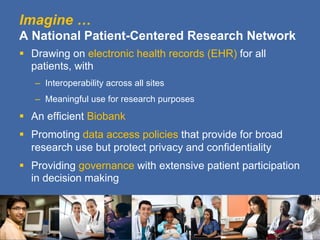
Imagine …
A National Patient-Centered Research Network
§  Bringing together 20–30 million covered lives, with
   –  Good representation of gender, geographic, ethnic, age,
      educational level, and socioeconomic diversity
   –  Broad opt-in consents from 80 - 90% of participants
   –  Longitudinal follow up over many years

§  Offering a stable research infrastructure
   –  Including trained personnel in each of the participating health
      services organizations
   –  Making it possible to run protocols with low marginal cost
Imagine …
A National Patient-Centered Research Network
§  Drawing on electronic health records (EHR) for all
    patients, with
   –  Interoperability across all sites
   –  Meaningful use for research purposes

§  An efficient Biobank
§  Promoting data access policies that provide for broad
    research use but protect privacy and confidentiality
§  Providing governance with extensive patient participation
    in decision making
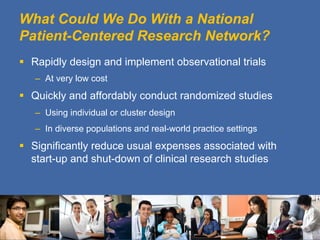
What Could We Do With a National
Patient-Centered Research Network?
§  Rapidly design and implement observational trials
   –  At very low cost

§  Quickly and affordably conduct randomized studies
   –  Using individual or cluster design
   –  In diverse populations and real-world practice settings

§  Significantly reduce usual expenses associated with
    start-up and shut-down of clinical research studies
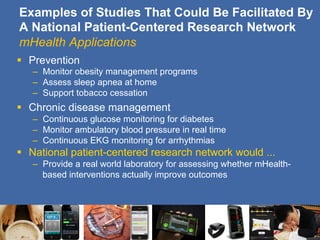
Examples of Studies That Could Be Facilitated By
A National Patient-Centered Research Network
mHealth Applications
§  Prevention
   –  Monitor obesity management programs
   –  Assess sleep apnea at home
   –  Support tobacco cessation
§  Chronic disease management
   –  Continuous glucose monitoring for diabetes
   –  Monitor ambulatory blood pressure in real time
   –  Continuous EKG monitoring for arrhythmias
§  National patient-centered research network would ...
   –  Provide a real world laboratory for assessing whether mHealth-
      based interventions actually improve outcomes
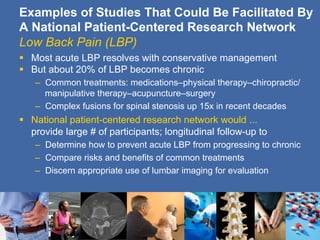
Examples of Studies That Could Be Facilitated By
A National Patient-Centered Research Network
Low Back Pain (LBP)
§  Most acute LBP resolves with conservative management
§  But about 20% of LBP becomes chronic
    –  Common treatments: medications–physical therapy–chiropractic/
       manipulative therapy–acupuncture–surgery
    –  Complex fusions for spinal stenosis up 15x in recent decades
§  National patient-centered research network would ...
    provide large # of participants; longitudinal follow-up to
    –  Determine how to prevent acute LBP from progressing to chronic
    –  Compare risks and benefits of common treatments
    –  Discern appropriate use of lumbar imaging for evaluation
Examples of Studies That Could Be Facilitated By
 A National Patient-Centered Research Network
 Large-Scale Pharmacogenomics
§  Example -- Clopidogrel (Plavix): powerful antiplatelet drug used in
    patients at risk for heart attack, stroke
   –  CYP2C19 genotype may identify decreased responsiveness
   –  FDA added black box warning – but other research has raised
      doubts about clinical importance of CYP2CI9 genotype
§  National patient-centered research network would …
    facilitate trials to examine conflicting data
   –  Large-scale, rapid-fire clinical trial of patients with acute coronary
      syndrome, recent stroke, recent placement of drug-eluting stent
       •  Randomized trial (individual or cluster)
       •  Only short-term (e.g. 6 to 12-month) follow-up needed
   –  Model could be applied to other pharmacogenomic questions

      By synchronizing with EHR data, one could
      do large definitive trials quickly at low cost
What Could Go Wrong?
§  EHRs won’t turn out to be that useful for research (hey,
    we’d better solve that one at this meeting!)
§  Business managers of health services organizations will
    perceive a conflict between health care delivery and
    research
§  Patients (especially underrepresented groups) will be
    unwilling to participate
§  The network will be too large to evolve when it needs to,
    and will become quickly ossified
§  An entitlement will be created – once a node in the
    network is supported, it can never be terminated
Why Now?
§  For the first time in the U.S., health services organizations
    with EHRs have reached the point of making this network
    feasible on a large scale
§  Scientific opportunities and the urgency of getting answers
    to clinical questions have never been greater
§  If we are ever to engage a larger proportion of the
    American public in medical research, we need to come to
    them – in partnership
§  General feasibility has been demonstrated through modest
    prior efforts (e.g. HMORN, eMERGE, etc.)
§  PCORI has arrived on the scene – and successful
    establishment of this Network, potentially with NIH and
    AHRQ as partners, could be PCORI’s most significant
    contribution and enduring legacy
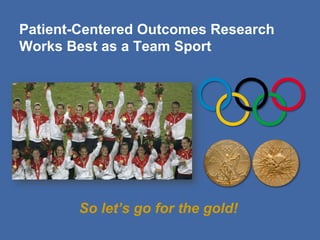
2012: An Olympic Year
Patient-Centered Outcomes Research
Works Best as a Team Sport


       So let’s go for the gold!

A Vision for a National Research Network

  • 1.
    A Vision ForA National Patient-Centered Research Network Francis S. Collins, M.D., Ph.D. Director, National Institutes of Health National Workshop to Advance the Use of Electronic Data in Patient-Centered Outcomes Research July 2, 2012
  • 2.
    Why is itso hard to do effective and efficient clinical research? §  Few pre-existing cohorts of substantial size §  Even fewer with broad disease relevance §  Absence of longitudinal follow up §  Paper medical records the norm until very recently §  Lack of population diversity §  Vexing consent issues §  Multiple IRBs §  Privacy and confidentiality challenges §  Chronic difficulty achieving enrollment goals §  Limited data access §  Heavy costs of start-up and shut-down
  • 3.
    Imagine … A NationalPatient-Centered Research Network §  Bringing together 20–30 million covered lives, with –  Good representation of gender, geographic, ethnic, age, educational level, and socioeconomic diversity –  Broad opt-in consents from 80 - 90% of participants –  Longitudinal follow up over many years §  Offering a stable research infrastructure –  Including trained personnel in each of the participating health services organizations –  Making it possible to run protocols with low marginal cost
  • 4.
    Imagine … A NationalPatient-Centered Research Network §  Drawing on electronic health records (EHR) for all patients, with –  Interoperability across all sites –  Meaningful use for research purposes §  An efficient Biobank §  Promoting data access policies that provide for broad research use but protect privacy and confidentiality §  Providing governance with extensive patient participation in decision making
  • 5.
    What Could WeDo With a National Patient-Centered Research Network? §  Rapidly design and implement observational trials –  At very low cost §  Quickly and affordably conduct randomized studies –  Using individual or cluster design –  In diverse populations and real-world practice settings §  Significantly reduce usual expenses associated with start-up and shut-down of clinical research studies
  • 6.
    Examples of StudiesThat Could Be Facilitated By A National Patient-Centered Research Network mHealth Applications §  Prevention –  Monitor obesity management programs –  Assess sleep apnea at home –  Support tobacco cessation §  Chronic disease management –  Continuous glucose monitoring for diabetes –  Monitor ambulatory blood pressure in real time –  Continuous EKG monitoring for arrhythmias §  National patient-centered research network would ... –  Provide a real world laboratory for assessing whether mHealth- based interventions actually improve outcomes
  • 7.
    Examples of StudiesThat Could Be Facilitated By A National Patient-Centered Research Network Low Back Pain (LBP) §  Most acute LBP resolves with conservative management §  But about 20% of LBP becomes chronic –  Common treatments: medications–physical therapy–chiropractic/ manipulative therapy–acupuncture–surgery –  Complex fusions for spinal stenosis up 15x in recent decades §  National patient-centered research network would ... provide large # of participants; longitudinal follow-up to –  Determine how to prevent acute LBP from progressing to chronic –  Compare risks and benefits of common treatments –  Discern appropriate use of lumbar imaging for evaluation
  • 8.
    Examples of StudiesThat Could Be Facilitated By A National Patient-Centered Research Network Large-Scale Pharmacogenomics §  Example -- Clopidogrel (Plavix): powerful antiplatelet drug used in patients at risk for heart attack, stroke –  CYP2C19 genotype may identify decreased responsiveness –  FDA added black box warning – but other research has raised doubts about clinical importance of CYP2CI9 genotype §  National patient-centered research network would … facilitate trials to examine conflicting data –  Large-scale, rapid-fire clinical trial of patients with acute coronary syndrome, recent stroke, recent placement of drug-eluting stent •  Randomized trial (individual or cluster) •  Only short-term (e.g. 6 to 12-month) follow-up needed –  Model could be applied to other pharmacogenomic questions By synchronizing with EHR data, one could do large definitive trials quickly at low cost
  • 9.
    What Could GoWrong? §  EHRs won’t turn out to be that useful for research (hey, we’d better solve that one at this meeting!) §  Business managers of health services organizations will perceive a conflict between health care delivery and research §  Patients (especially underrepresented groups) will be unwilling to participate §  The network will be too large to evolve when it needs to, and will become quickly ossified §  An entitlement will be created – once a node in the network is supported, it can never be terminated
  • 10.
    Why Now? §  Forthe first time in the U.S., health services organizations with EHRs have reached the point of making this network feasible on a large scale §  Scientific opportunities and the urgency of getting answers to clinical questions have never been greater §  If we are ever to engage a larger proportion of the American public in medical research, we need to come to them – in partnership §  General feasibility has been demonstrated through modest prior efforts (e.g. HMORN, eMERGE, etc.) §  PCORI has arrived on the scene – and successful establishment of this Network, potentially with NIH and AHRQ as partners, could be PCORI’s most significant contribution and enduring legacy
  • 11.
  • 12.
    Patient-Centered Outcomes Research WorksBest as a Team Sport So let’s go for the gold!