Macrosystems
The Dinh Thi
Jasmine Paul
Eva van Swaaij
What is a macrosystem?
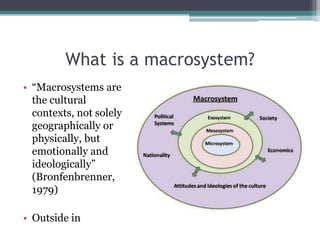
• “Macrosystems are
  the cultural
  contexts, not solely
  geographically or
  physically, but
  emotionally and
  ideologically”
  (Bronfenbrenner,
  1979)

• Outside in
The Macrosystem
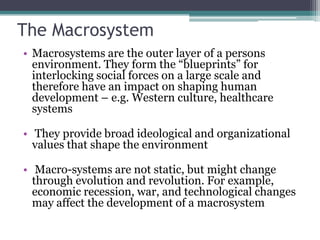
• Macrosystems are the outer layer of a persons
  environment. They form the “blueprints” for
  interlocking social forces on a large scale and
  therefore have an impact on shaping human
  development – e.g. Western culture, healthcare
  systems

• They provide broad ideological and organizational
  values that shape the environment

• Macro-systems are not static, but might change
  through evolution and revolution. For example,
  economic recession, war, and technological changes
  may affect the development of a macrosystem
Different types of macrosystems
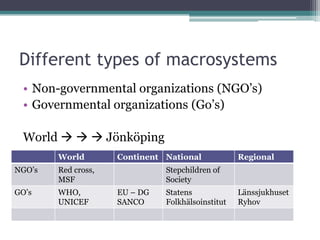
 • Non-governmental organizations (NGO’s)
 • Governmental organizations (Go’s)

 World    Jönköping
        World        Continent National            Regional
NGO’s   Red cross,             Stepchildren of
        MSF                    Society
GO’s    WHO,         EU – DG   Statens             Länssjukhuset
        UNICEF       SANCO     Folkhälsoinstitut   Ryhov
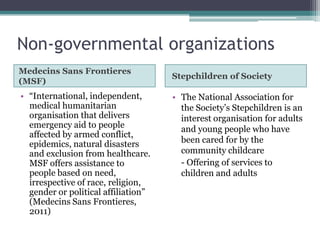
Non-governmental organizations
Medecins Sans Frontieres
                                     Stepchildren of Society
(MSF)
• “International, independent,       • The National Association for
  medical humanitarian                 the Society’s Stepchildren is an
  organisation that delivers           interest organisation for adults
  emergency aid to people              and young people who have
  affected by armed conflict,
  epidemics, natural disasters         been cared for by the
  and exclusion from healthcare.       community childcare
  MSF offers assistance to             - Offering of services to
  people based on need,                children and adults
  irrespective of race, religion,
  gender or political affiliation”
  (Medecins Sans Frontieres,
  2011)
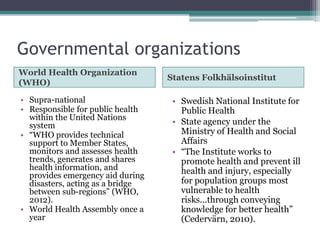
Governmental organizations
World Health Organization
                                  Statens Folkhälsoinstitut
(WHO)

• Supra-national                   • Swedish National Institute for
• Responsible for public health      Public Health
  within the United Nations
  system                           • State agency under the
• “WHO provides technical            Ministry of Health and Social
  support to Member States,          Affairs
  monitors and assesses health     • “The Institute works to
  trends, generates and shares       promote health and prevent ill
  health information, and            health and injury, especially
  provides emergency aid during
  disasters, acting as a bridge      for population groups most
  between sub-regions” (WHO,         vulnerable to health
  2012).                             risks...through conveying
• World Health Assembly once a       knowledge for better health”
  year                               (Cedervärn, 2010).
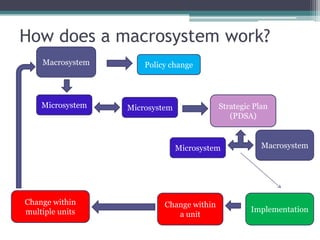
How does a macrosystem work?
    Macrosystem       Policy change


    Microsystem   Microsystem              Strategic Plan
                                              (PDSA)


                                Microsystem            Macrosystem


Change within              Change within
multiple units                                      Implementation
                              a unit
How can this be applied to a local
level?
• 1. Collaboration of macrosystems and
  microsystems –Policy guidelines, Emergency
  Department and Radiology Department

• 2. Common goal for change: Decrease x-ray
  turnaround times, decrease mortality, and
  increase patient satisfaction

• 3. Plan-do-study-act model is implemented
How can this be applied to a local
level continued
• 4. Monitor change through collection of data –
  e.g. number of deaths since implementation,
  surveys on patient satisfaction

• 5. If positive change occurs, macrosystems will
  see this as a benefit and may be inclined to
  change policies
Search Process
• Started with the topic “macrosystems” as a
  general search term and read abstracts of
  scholarly articles
• Went back and researched how microsystems
  make change to understand the importance of
  macrosystems
• Refined search to, “application of macrosystems
  as impacting the local level”
Search Process continued
• Looked for different types of organisations

• Looked on the website of the organisations to
  find information on their structure and goals

• Used Google translate for websites unavailable
  in English.
Collaboration Process
• We successfully collaborated by sharing ideas on
  the topics we wanted to cover within the
  discussion of macrosystems, and based on our
  personal interest chose the topics

• Democratically chose the presenter by creating a
  game that would ensure a fair and equal chance
  for all group members who wanted to present
References
• Bronfenbrenner, U. (1979). The ecology of human development:
      Experiments by nature and design. Oxford: Elsevier.

• Cedervärn, J. (2010). Statens Folkhälsoinstitut: About the national
      institute. Retrieved April 7, 2012, from http://www.fhi.se/

• Davies, T.R. (2010). Project on the evolution of international non-
      governmental organizations: Organizations. Retrieved April 7,
      2012, from
      http://www.staff.city.ac.uk/tom.davies/Organizations.html

• Kail, R.V., & Cavanaugh, J.C. (2010). Human development: A life-
       span view (5th ed.). Cengage: Belmont, CA:
       Wadsworth/Cengage Learning.

• Kosnik, L.K., & Espinosa, J.A. (2003). Microsystems in
      healthcare: Part 7. The microsystem as a platform for
      merging strategic planning and operations. Joint
      Commission Journal on Quality and Safety, 29(9), 452-459
References continued
•   Landstinget Jonkoping (2012). Health and social work. Retrieved April 7, 2012, from
          http://www.lj.se/

•   Medecins Sans Frontieres. (2011). About MSF. Retrieved on the 7th of April 2012 from,
          http://www.msf.org/msf/about-msf/about-msf_home.cfm

•   O’Keeffe, J. (2009). Urie Bronfenbrenner and the ecological systems theory. Retrieved April 8,
          2012, from http://lardydardyda.wordpress.com/

•   Samhällets Styvbarn. (2011). Stepchildren of society. Retrieved April 7, 2012, from:
         http://www.styvbarn.se/

•   Vogel, G.E., & Givey, J. (1985). Improving x-ray report turnaround. Pub Med, 14(1), 39-40

•   World Health Organization. (2012) Introducing the WHO regional office for Europe.
          Retrieved April 7, 2012, from
          http://www.euro.who.int/__data/assets/pdf_file/0017/122912/who_office_brochure-
          UK-www.pdf

•   Zeitlin, M.F., Megawangi, R., Kramer, E.M., Colletta, N.D., Babatunde, E.D., & Garman, D.
            (1995). Strengthening the family – Implications for international development: The
            family from a child development perspective. United Nations University Press: Tokyo, New
            York, Paris

Macrosystems

  • 1.
  • 2.
    What is amacrosystem? • “Macrosystems are the cultural contexts, not solely geographically or physically, but emotionally and ideologically” (Bronfenbrenner, 1979) • Outside in
  • 3.
    The Macrosystem • Macrosystemsare the outer layer of a persons environment. They form the “blueprints” for interlocking social forces on a large scale and therefore have an impact on shaping human development – e.g. Western culture, healthcare systems • They provide broad ideological and organizational values that shape the environment • Macro-systems are not static, but might change through evolution and revolution. For example, economic recession, war, and technological changes may affect the development of a macrosystem
  • 4.
    Different types ofmacrosystems • Non-governmental organizations (NGO’s) • Governmental organizations (Go’s) World    Jönköping World Continent National Regional NGO’s Red cross, Stepchildren of MSF Society GO’s WHO, EU – DG Statens Länssjukhuset UNICEF SANCO Folkhälsoinstitut Ryhov
  • 5.
    Non-governmental organizations Medecins SansFrontieres Stepchildren of Society (MSF) • “International, independent, • The National Association for medical humanitarian the Society’s Stepchildren is an organisation that delivers interest organisation for adults emergency aid to people and young people who have affected by armed conflict, epidemics, natural disasters been cared for by the and exclusion from healthcare. community childcare MSF offers assistance to - Offering of services to people based on need, children and adults irrespective of race, religion, gender or political affiliation” (Medecins Sans Frontieres, 2011)
  • 6.
    Governmental organizations World HealthOrganization Statens Folkhälsoinstitut (WHO) • Supra-national • Swedish National Institute for • Responsible for public health Public Health within the United Nations system • State agency under the • “WHO provides technical Ministry of Health and Social support to Member States, Affairs monitors and assesses health • “The Institute works to trends, generates and shares promote health and prevent ill health information, and health and injury, especially provides emergency aid during disasters, acting as a bridge for population groups most between sub-regions” (WHO, vulnerable to health 2012). risks...through conveying • World Health Assembly once a knowledge for better health” year (Cedervärn, 2010).
  • 7.
    How does amacrosystem work? Macrosystem Policy change Microsystem Microsystem Strategic Plan (PDSA) Microsystem Macrosystem Change within Change within multiple units Implementation a unit
  • 8.
    How can thisbe applied to a local level? • 1. Collaboration of macrosystems and microsystems –Policy guidelines, Emergency Department and Radiology Department • 2. Common goal for change: Decrease x-ray turnaround times, decrease mortality, and increase patient satisfaction • 3. Plan-do-study-act model is implemented
  • 9.
    How can thisbe applied to a local level continued • 4. Monitor change through collection of data – e.g. number of deaths since implementation, surveys on patient satisfaction • 5. If positive change occurs, macrosystems will see this as a benefit and may be inclined to change policies
  • 10.
    Search Process • Startedwith the topic “macrosystems” as a general search term and read abstracts of scholarly articles • Went back and researched how microsystems make change to understand the importance of macrosystems • Refined search to, “application of macrosystems as impacting the local level”
  • 11.
    Search Process continued •Looked for different types of organisations • Looked on the website of the organisations to find information on their structure and goals • Used Google translate for websites unavailable in English.
  • 12.
    Collaboration Process • Wesuccessfully collaborated by sharing ideas on the topics we wanted to cover within the discussion of macrosystems, and based on our personal interest chose the topics • Democratically chose the presenter by creating a game that would ensure a fair and equal chance for all group members who wanted to present
  • 13.
    References • Bronfenbrenner, U.(1979). The ecology of human development: Experiments by nature and design. Oxford: Elsevier. • Cedervärn, J. (2010). Statens Folkhälsoinstitut: About the national institute. Retrieved April 7, 2012, from http://www.fhi.se/ • Davies, T.R. (2010). Project on the evolution of international non- governmental organizations: Organizations. Retrieved April 7, 2012, from http://www.staff.city.ac.uk/tom.davies/Organizations.html • Kail, R.V., & Cavanaugh, J.C. (2010). Human development: A life- span view (5th ed.). Cengage: Belmont, CA: Wadsworth/Cengage Learning. • Kosnik, L.K., & Espinosa, J.A. (2003). Microsystems in healthcare: Part 7. The microsystem as a platform for merging strategic planning and operations. Joint Commission Journal on Quality and Safety, 29(9), 452-459
  • 14.
    References continued • Landstinget Jonkoping (2012). Health and social work. Retrieved April 7, 2012, from http://www.lj.se/ • Medecins Sans Frontieres. (2011). About MSF. Retrieved on the 7th of April 2012 from, http://www.msf.org/msf/about-msf/about-msf_home.cfm • O’Keeffe, J. (2009). Urie Bronfenbrenner and the ecological systems theory. Retrieved April 8, 2012, from http://lardydardyda.wordpress.com/ • Samhällets Styvbarn. (2011). Stepchildren of society. Retrieved April 7, 2012, from: http://www.styvbarn.se/ • Vogel, G.E., & Givey, J. (1985). Improving x-ray report turnaround. Pub Med, 14(1), 39-40 • World Health Organization. (2012) Introducing the WHO regional office for Europe. Retrieved April 7, 2012, from http://www.euro.who.int/__data/assets/pdf_file/0017/122912/who_office_brochure- UK-www.pdf • Zeitlin, M.F., Megawangi, R., Kramer, E.M., Colletta, N.D., Babatunde, E.D., & Garman, D. (1995). Strengthening the family – Implications for international development: The family from a child development perspective. United Nations University Press: Tokyo, New York, Paris

Editor's Notes

  • #3 O’Keeffe, J. (2009). Urie Bronfenbrenner and the ecological systems theory. Retrieved April 8, 2012, from http://lardydardyda.wordpress.com/
  • #4 Zeitlin, M.F., Megawangi, R., Kramer, E.M., Colletta, N.D., Babatunde, E.D., & Garman, D. (1995). Strengthening the family – Implications for international development: The family from a child development perspective. United Nations University Press: Tokyo, New York, Paris
  • #8  Macrosystems are based on the Social Ecological Perspective by Bonfenbrenner (1979), and are the outermost layer in a persons environment. They comprise of cultural views, values, and laws (Kail & Cavanaugh, 2010). For example, a macrosystem in healthcare can be a local health authority in Jönköping such as Länssjukhuset Ryhov, or a national organization such as the World Health Organization. In order for a macrosystem, or hospital organization to implement change, microsystems, or units must work together to see the potential for change (Kosnik & Espinosa, 2003). They must have a strategic plan that, “supports the mission, vision, and values of the macrosystem” (Kosnik & Espinosa, 2003, p. 452). At the same time, the microsystem must have a relationship with the macrosystem. Trust making, using common vocabulary, raising other microsystems awareness, and facilitation relationships is integral between microsystems and macrosystems (Kosnik & Espinosa, 2003). Once this is done, implementation of the PDSA model can be done. After implementing the change, it can be measured whether or not the change has been met, needs to be modified, or approached in a different way. Once successful changes have been made that can be measured, the cycle returns to the macrosystem, which can then change.Bronfenbrenner, U. (1979). The ecology of human development: Experiments by nature and design. Oxford: Elsevier. Kail, R.V., & Cavanaugh, J.C. (2010). Human development: A life-span view (5th ed.). Cengage: Belmont, CA: Wadsworth/Cengage Learning. Kosnik, L.K., & Espinosa, J.A. (2003). Microsystems in healthcare: Part 7. The microsystem as a platform for merging strategic planning and operations. Joint Commission Journal on Quality and Safety, 29(9), 452-459
  • #9 “Turnaround, or time measurement, surveys are the mechanism by which a radiology manager documents the department's efficiency in producing the typewritten x-ray report. Such surveys measure the time lapse between when a radiographic examination is performed and when the typewritten report is received by physician or nursing station. Turnaround studies reveal the reasons for poor reporting, whether originating from personnel inadequacies or organizational pitfalls. Equal in importance to the gathering of time flow statistics are the problem-solving methods which follow” (Vogel & Givey, 1984).Kosnik, L.K., & Espinosa, J.A. (2003). Microsystems in healthcare: Part 7. The microsystem as a platform for merging strategic planning and operations. Joint Commission Journal on Quality and Safety, 29(9), 452-459Vogel, G.E., & Givey, J. (1985). Improving x-ray report turnaround. Pub Med, 14(1), 39-40
  • #10 Kosnik, L.K., & Espinosa, J.A. (2003). Microsystems in healthcare: Part 7. The microsystem as a platform for merging strategic planning and operations. Joint Commission Journal on Quality and Safety, 29(9), 452-459