
Agenda
 Introduction
 The Team
 Approach
 Passive Intermodulation (PIM)
 What is PIM?
 What causes PIM?
 What PIM looks like
 Public Safety DAS and PIM
 New FCC Regulations on Part 90 Signal Boosters/Repeaters/BDA
 Current Public Safety DAS RF Environment
 New Public Safety DAS Standards Recommendations
 Conclusion
History
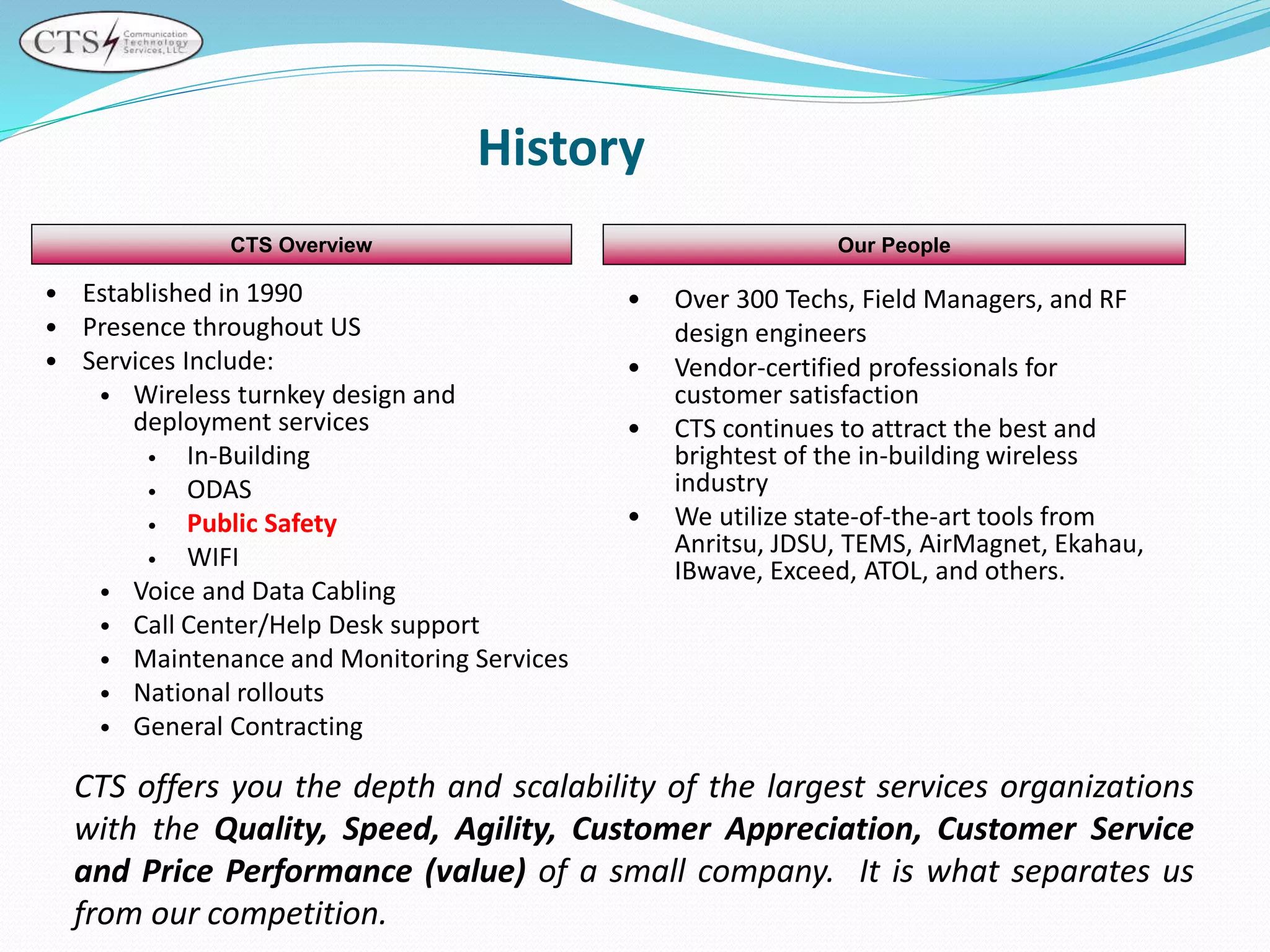
• Established in 1990
• Presence throughout US
• Services Include:
• Wireless turnkey design and
deployment services
• In-Building
• ODAS
• Public Safety
• WIFI
• Voice and Data Cabling
• Call Center/Help Desk support
• Maintenance and Monitoring Services
• National rollouts
• General Contracting
• Over 300 Techs, Field Managers, and RF
design engineers
• Vendor-certified professionals for
customer satisfaction
• CTS continues to attract the best and
brightest of the in-building wireless
industry
• We utilize state-of-the-art tools from
Anritsu, JDSU, TEMS, AirMagnet, Ekahau,
IBwave, Exceed, ATOL, and others.
CTS offers you the depth and scalability of the largest services organizations
with the Quality, Speed, Agility, Customer Appreciation, Customer Service
and Price Performance (value) of a small company. It is what separates us
from our competition.
CTS Overview Our People
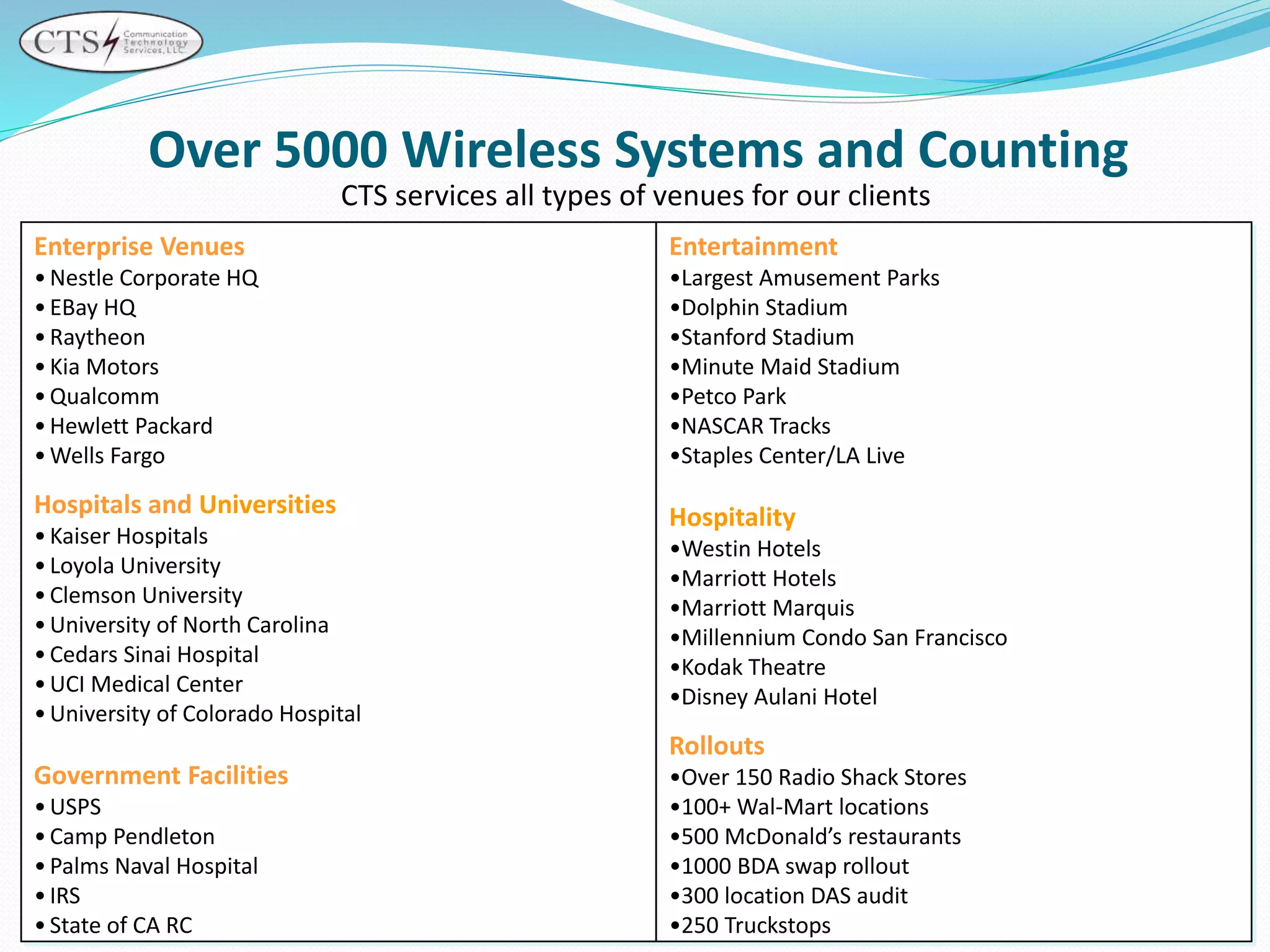
Over 5000 Wireless Systems and Counting
Enterprise Venues
•Nestle Corporate HQ
•EBay HQ
•Raytheon
•Kia Motors
•Qualcomm
•Hewlett Packard
•Wells Fargo
Hospitals and Universities
•Kaiser Hospitals
•Loyola University
•Clemson University
•University of North Carolina
•Cedars Sinai Hospital
•UCI Medical Center
•University of Colorado Hospital
Government Facilities
•USPS
•Camp Pendleton
•Palms Naval Hospital
•IRS
•State of CA RC
Entertainment
•Largest Amusement Parks
•Dolphin Stadium
•Stanford Stadium
•Minute Maid Stadium
•Petco Park
•NASCAR Tracks
•Staples Center/LA Live
Hospitality
•Westin Hotels
•Marriott Hotels
•Marriott Marquis
•Millennium Condo San Francisco
•Kodak Theatre
•Disney Aulani Hotel
Rollouts
•Over 150 Radio Shack Stores
•100+ Wal-Mart locations
•500 McDonald’s restaurants
•1000 BDA swap rollout
•300 location DAS audit
•250 Truckstops
CTS services all types of venues for our clients
Engineering Project MgmtConstruction
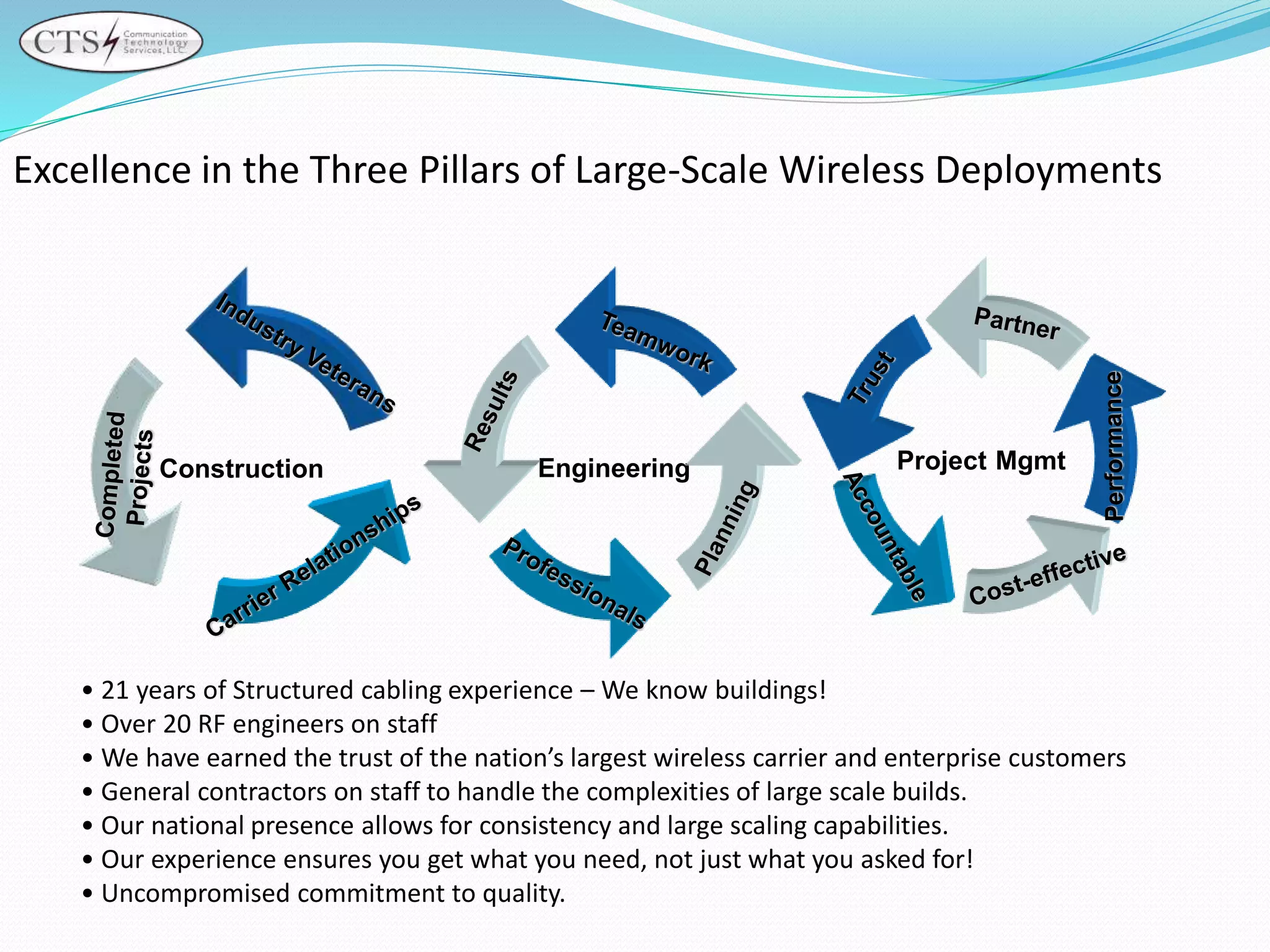
• 21 years of Structured cabling experience – We know buildings!
• Over 20 RF engineers on staff
• We have earned the trust of the nation’s largest wireless carrier and enterprise customers
• General contractors on staff to handle the complexities of large scale builds.
• Our national presence allows for consistency and large scaling capabilities.
• Our experience ensures you get what you need, not just what you asked for!
• Uncompromised commitment to quality.
Excellence in the Three Pillars of Large-Scale Wireless Deployments
Our Current Locations
 Marlborough MA (HQ)
 Fort Lee NJ (services NYC and NJ)
 Washington, DC
 Raleigh, NC
 Greenville, SC
 New Orleans , LA
 Dallas TX,
 Houston, TX
 Chicago, ILL
 Columbus, OH
 Las Vegas, NV
 Phoenix, AZ
 San Francisco, CA
 Los Angeles, CA
 Milwaukee, WI
 Portland, Oregon
 Denver, CO
 Miami, FL
 Atlanta, GA
 Orlando, FL
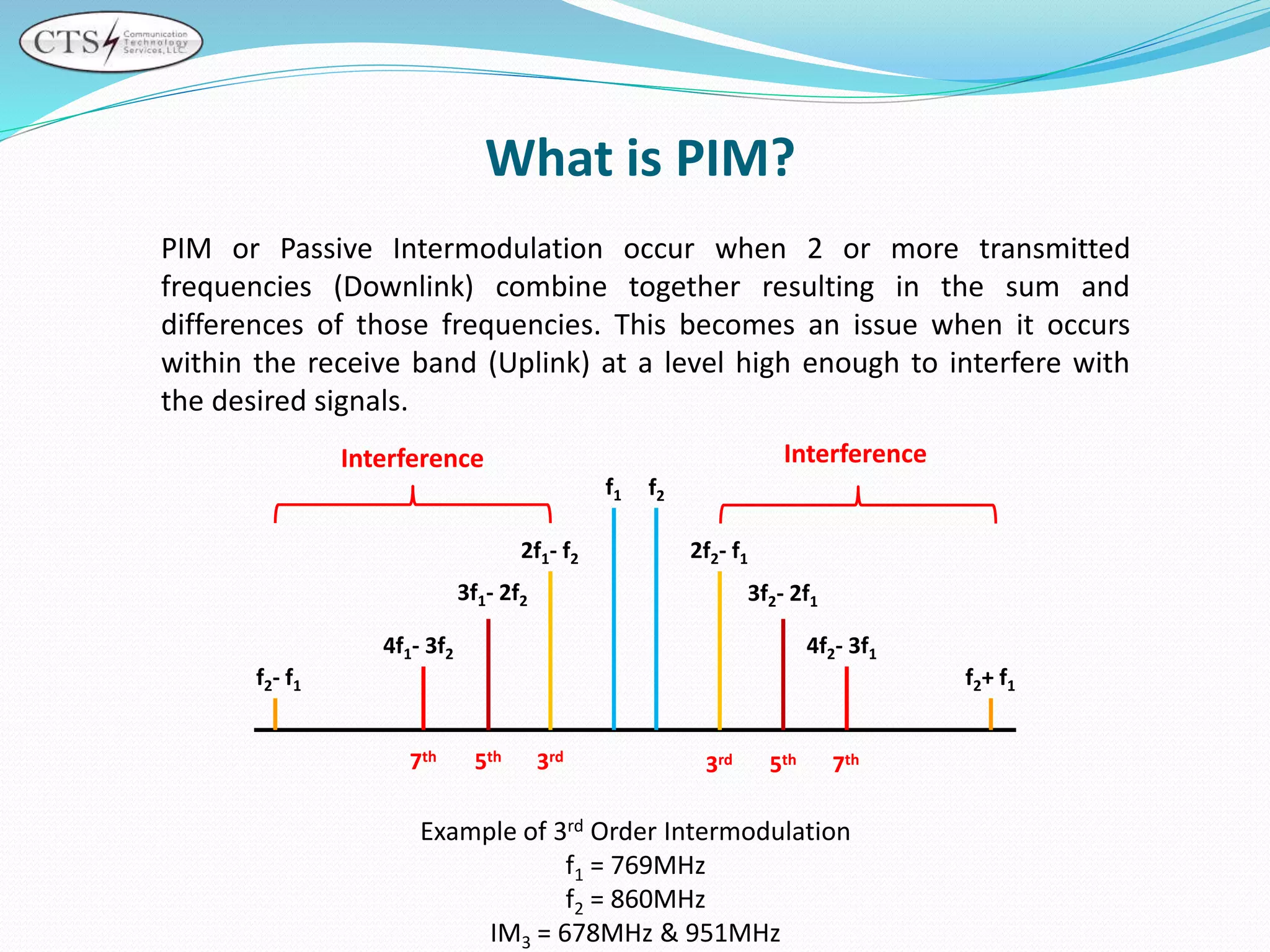
What is PIM?
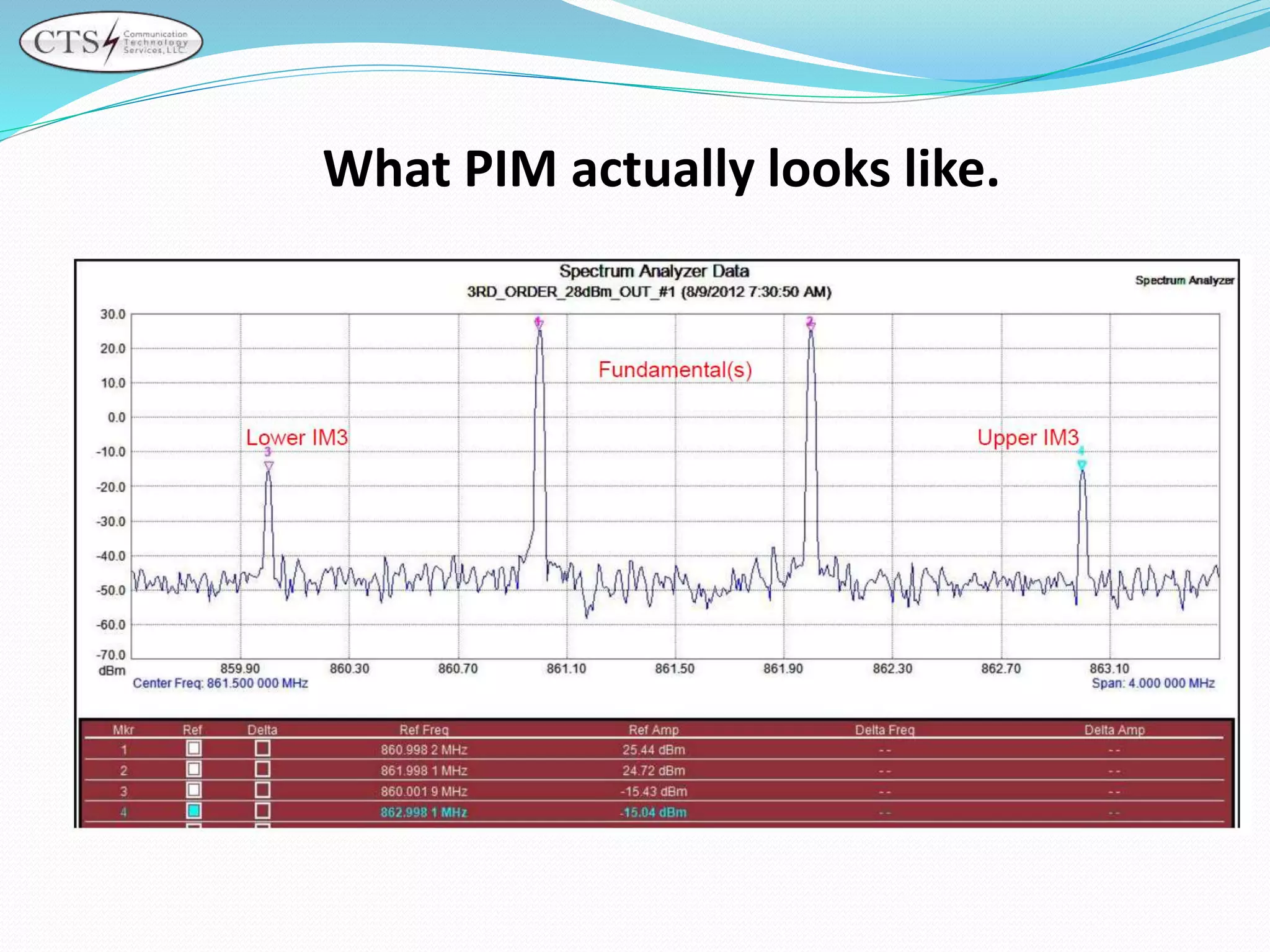
PIM or Passive Intermodulation occur when 2 or more transmitted
frequencies (Downlink) combine together resulting in the sum and
differences of those frequencies. This becomes an issue when it occurs
within the receive band (Uplink) at a level high enough to interfere with
the desired signals.
f1 f2
2f1- f2 2f2- f1
3f1- 2f2 3f2- 2f1
4f1- 3f2 4f2- 3f1
f2- f1 f2+ f1
Interference Interference
3rd
3rd5th
5th7th
7th
Example of 3rd Order Intermodulation
f1 = 769MHz
f2 = 860MHz
IM3 = 678MHz & 951MHz
• As signal amplitudes increase, the effect of nonlinearities
becomes more pronounced, causing more prominent
distortion.
• Third-order PIM — distortion closest to the intended signal —
produces the highest level of interference, followed by fifth-
and seventh-order.
• Third-order PIM will cause more severe system consequences
than fifth or seventh.
• When multiple users with widely spaced Transmit frequencies
share a common system, the probability of PIM in one or more
Receive bands increases.
• In other words, high-power (≥ 37dBm) multi-operator
Neutral Host DAS are particularly susceptible.
What is PIM?
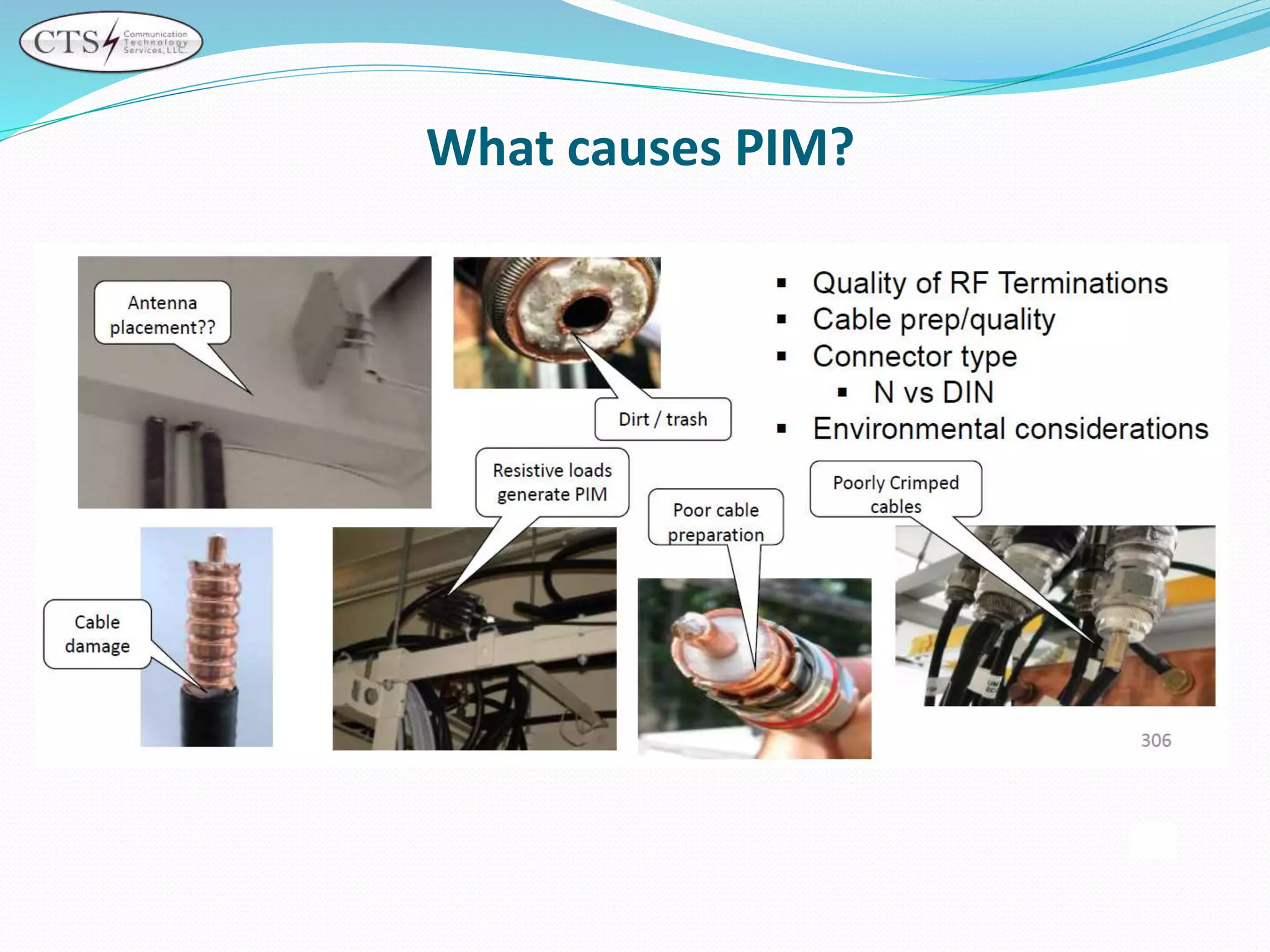
What causes PIM?
• PIM can be caused by any nonlinearity in the RF path.
• Possible sources include poor connections, damaged cable or
water infiltration.
• Weather-proof those donor antenna runs!
• In some cases, PIM can also be caused by objects outside the
path, such as machinery, metal conduit/cable trays, or site
equipment.
• RF producing machinery, elevator equipment and certain
medical devices are known PIM generators.
• In fact, there are so many possible sources, PIM is sometimes
known as “the rusty bolt effect.”
• Indoor antennas with grounded backplanes, connectors
touching cable trays etc.
What causes PIM?
What PIM actually looks like.
PIM and Public Safety DAS
• Majority of Public Safety DAS are passive.
• Public Safety DAS is cost driven, often designed and installed by
the lowest bidder.
• Only coverage requirements are tested for with minimal
load testing.
• Accepted objective is DAQ (Delivered Audio Quality) of 3.4
or better.
• DAQ 3.4 is defined as “understandable speech without
repetition. Some noise/distortion can be present.”
• The more passive components in a DAS – splitters, couplers,
combiners, jumper cables and connectors, the higher probability
of PIM.
• At every passive stage a large variety of detrimental PIM products
are generated falling in the uplink (UL) bands.
PIM and Public Safety DAS
• Due to the limited uplink (UL) transmit power of mobile
terminals, the Base Station uplink receive sensitivity is a critical
parameter to optimize in outdoor scenarios to allow a balanced
downlink/uplink maximum path-loss.
• PIM within a Public Safety DAS can cause Mobile Unit transmit
failures directly affecting first responder safety. Remember
Nextel?
• PIM from adjacent operator high-power DAS can be re-
transmitted over Public Safety DAS to serving Base Stations
affecting their uplink receive sensitivity.
New FCC Repeater Rules
• Report and Order FCC 13-21.
• http://wireless.fcc.gov/signal-boosters/part-90 boosters/index.html
• Part 90 specifically refers to Public Safety Bi-Directional
Amplifiers since March 1st, 2014.
• Requires owners/users to:
• Obtain wireless service provider/operator consent to
operate the device, and
• Register the device with their serving wireless service
provider prior to operation
• Within Part 90 are two classes:
• Class A, designed to transmit and receive one or more
specific channels and each passband CANNOT exceed
75kHz.
• Class B, designed to transmit and receive wideband
frequencies and each passband exceeds 75kHz. These BDAs
must be registered directly with the FCC before use.
• Legacy Public Safety DAS still operate BDAs not approved under
Part 90.
• Non-channelized, wideband repeaters will broadcast PIM in the
Receive or Uplink signal back to serving Base Stations affecting
their uplink receive sensitivity.
• Legacy Public Safety DAS will have significant PIM levels as
passive components age.
Current PS DAS Environment
• Increasing number of new construction is being LEED certified –
325 buildings in Denver alone between 2012-2014.
• http://www.usgbc.org/articles/usgbc-releases-top-10-states-leed-green-
building-capita-nation
• Low-E glass in LEED certified buildings is attenuating Public Safety
signals in stairwells and fire command centers requiring more
DAS be designed and installed.
• Imagine multiple Public Safety DAS installed in a major metro
area generating some level of PIM overwhelming a high power
donor site uplink receive sensitivity.
Current PS DAS Environment
New PS DAS Standards are needed
• Public Safety DAS Site Audits are necessary to ensure all Bi-
directional Amplifiers comply with Part 90 and are Class A.
• Mandatory Part 90 compliant Class A, channelized repeaters with
strong filtering to reduce 3rd Order PIM.
• Maximum composite output power of channelized repeaters to
be 30dBm.
• PIM increases along with channel power
• PIM rated components rated to at least -153 dBc specified
• Connectors, Splitters, Hybrid Combiners, Jumpers and
Antennas.
New PS DAS Standards are needed
• Mandatory PIM testing to be part of system design and
installation.
• Public Safety DAS design and testing parameters have to be
widened to include PIM.
• Reducing PIM will improve DAQ to 4.0 or better.
• Acceptance testing should include mobile to mobile testing.
• Adjacent high-power operator DAS PIM tested.
Conclusion
• Public Safety DAS is necessary and vital.
• Low cost installs can impact system performance due to lack of
attention to PIM.
• Adjacent high power operator DAS can also directly impact Public
Safety DAS performance.
• As more and more Public Safety DAS is needed, donor signal owners
(that’s you) must be more cognizant about poorly designed and
installed DAS.
Questions?
Contact Information:
Sujeeva Ranasinghe
Principal Engineer
Communication Technology Services
sranasinghe@cts1.com
303-483-3387
Please visit our website at www.cts1.com
Thank You

CTS Presentation to CCNC on PIM and PS DAS

  • 2.
    Agenda  Introduction  TheTeam  Approach  Passive Intermodulation (PIM)  What is PIM?  What causes PIM?  What PIM looks like  Public Safety DAS and PIM  New FCC Regulations on Part 90 Signal Boosters/Repeaters/BDA  Current Public Safety DAS RF Environment  New Public Safety DAS Standards Recommendations  Conclusion
  • 3.
    History • Established in1990 • Presence throughout US • Services Include: • Wireless turnkey design and deployment services • In-Building • ODAS • Public Safety • WIFI • Voice and Data Cabling • Call Center/Help Desk support • Maintenance and Monitoring Services • National rollouts • General Contracting • Over 300 Techs, Field Managers, and RF design engineers • Vendor-certified professionals for customer satisfaction • CTS continues to attract the best and brightest of the in-building wireless industry • We utilize state-of-the-art tools from Anritsu, JDSU, TEMS, AirMagnet, Ekahau, IBwave, Exceed, ATOL, and others. CTS offers you the depth and scalability of the largest services organizations with the Quality, Speed, Agility, Customer Appreciation, Customer Service and Price Performance (value) of a small company. It is what separates us from our competition. CTS Overview Our People
  • 4.
    Over 5000 WirelessSystems and Counting Enterprise Venues •Nestle Corporate HQ •EBay HQ •Raytheon •Kia Motors •Qualcomm •Hewlett Packard •Wells Fargo Hospitals and Universities •Kaiser Hospitals •Loyola University •Clemson University •University of North Carolina •Cedars Sinai Hospital •UCI Medical Center •University of Colorado Hospital Government Facilities •USPS •Camp Pendleton •Palms Naval Hospital •IRS •State of CA RC Entertainment •Largest Amusement Parks •Dolphin Stadium •Stanford Stadium •Minute Maid Stadium •Petco Park •NASCAR Tracks •Staples Center/LA Live Hospitality •Westin Hotels •Marriott Hotels •Marriott Marquis •Millennium Condo San Francisco •Kodak Theatre •Disney Aulani Hotel Rollouts •Over 150 Radio Shack Stores •100+ Wal-Mart locations •500 McDonald’s restaurants •1000 BDA swap rollout •300 location DAS audit •250 Truckstops CTS services all types of venues for our clients
  • 5.
    Engineering Project MgmtConstruction •21 years of Structured cabling experience – We know buildings! • Over 20 RF engineers on staff • We have earned the trust of the nation’s largest wireless carrier and enterprise customers • General contractors on staff to handle the complexities of large scale builds. • Our national presence allows for consistency and large scaling capabilities. • Our experience ensures you get what you need, not just what you asked for! • Uncompromised commitment to quality. Excellence in the Three Pillars of Large-Scale Wireless Deployments
  • 6.
    Our Current Locations Marlborough MA (HQ)  Fort Lee NJ (services NYC and NJ)  Washington, DC  Raleigh, NC  Greenville, SC  New Orleans , LA  Dallas TX,  Houston, TX  Chicago, ILL  Columbus, OH  Las Vegas, NV  Phoenix, AZ  San Francisco, CA  Los Angeles, CA  Milwaukee, WI  Portland, Oregon  Denver, CO  Miami, FL  Atlanta, GA  Orlando, FL
  • 7.
    What is PIM? PIMor Passive Intermodulation occur when 2 or more transmitted frequencies (Downlink) combine together resulting in the sum and differences of those frequencies. This becomes an issue when it occurs within the receive band (Uplink) at a level high enough to interfere with the desired signals. f1 f2 2f1- f2 2f2- f1 3f1- 2f2 3f2- 2f1 4f1- 3f2 4f2- 3f1 f2- f1 f2+ f1 Interference Interference 3rd 3rd5th 5th7th 7th Example of 3rd Order Intermodulation f1 = 769MHz f2 = 860MHz IM3 = 678MHz & 951MHz
  • 8.
    • As signalamplitudes increase, the effect of nonlinearities becomes more pronounced, causing more prominent distortion. • Third-order PIM — distortion closest to the intended signal — produces the highest level of interference, followed by fifth- and seventh-order. • Third-order PIM will cause more severe system consequences than fifth or seventh. • When multiple users with widely spaced Transmit frequencies share a common system, the probability of PIM in one or more Receive bands increases. • In other words, high-power (≥ 37dBm) multi-operator Neutral Host DAS are particularly susceptible. What is PIM?
  • 9.
    What causes PIM? •PIM can be caused by any nonlinearity in the RF path. • Possible sources include poor connections, damaged cable or water infiltration. • Weather-proof those donor antenna runs! • In some cases, PIM can also be caused by objects outside the path, such as machinery, metal conduit/cable trays, or site equipment. • RF producing machinery, elevator equipment and certain medical devices are known PIM generators. • In fact, there are so many possible sources, PIM is sometimes known as “the rusty bolt effect.” • Indoor antennas with grounded backplanes, connectors touching cable trays etc.
  • 10.
  • 11.
    What PIM actuallylooks like.
  • 12.
    PIM and PublicSafety DAS • Majority of Public Safety DAS are passive. • Public Safety DAS is cost driven, often designed and installed by the lowest bidder. • Only coverage requirements are tested for with minimal load testing. • Accepted objective is DAQ (Delivered Audio Quality) of 3.4 or better. • DAQ 3.4 is defined as “understandable speech without repetition. Some noise/distortion can be present.” • The more passive components in a DAS – splitters, couplers, combiners, jumper cables and connectors, the higher probability of PIM. • At every passive stage a large variety of detrimental PIM products are generated falling in the uplink (UL) bands.
  • 13.
    PIM and PublicSafety DAS • Due to the limited uplink (UL) transmit power of mobile terminals, the Base Station uplink receive sensitivity is a critical parameter to optimize in outdoor scenarios to allow a balanced downlink/uplink maximum path-loss. • PIM within a Public Safety DAS can cause Mobile Unit transmit failures directly affecting first responder safety. Remember Nextel? • PIM from adjacent operator high-power DAS can be re- transmitted over Public Safety DAS to serving Base Stations affecting their uplink receive sensitivity.
  • 14.
    New FCC RepeaterRules • Report and Order FCC 13-21. • http://wireless.fcc.gov/signal-boosters/part-90 boosters/index.html • Part 90 specifically refers to Public Safety Bi-Directional Amplifiers since March 1st, 2014. • Requires owners/users to: • Obtain wireless service provider/operator consent to operate the device, and • Register the device with their serving wireless service provider prior to operation • Within Part 90 are two classes: • Class A, designed to transmit and receive one or more specific channels and each passband CANNOT exceed 75kHz. • Class B, designed to transmit and receive wideband frequencies and each passband exceeds 75kHz. These BDAs must be registered directly with the FCC before use.
  • 15.
    • Legacy PublicSafety DAS still operate BDAs not approved under Part 90. • Non-channelized, wideband repeaters will broadcast PIM in the Receive or Uplink signal back to serving Base Stations affecting their uplink receive sensitivity. • Legacy Public Safety DAS will have significant PIM levels as passive components age. Current PS DAS Environment
  • 16.
    • Increasing numberof new construction is being LEED certified – 325 buildings in Denver alone between 2012-2014. • http://www.usgbc.org/articles/usgbc-releases-top-10-states-leed-green- building-capita-nation • Low-E glass in LEED certified buildings is attenuating Public Safety signals in stairwells and fire command centers requiring more DAS be designed and installed. • Imagine multiple Public Safety DAS installed in a major metro area generating some level of PIM overwhelming a high power donor site uplink receive sensitivity. Current PS DAS Environment
  • 17.
    New PS DASStandards are needed • Public Safety DAS Site Audits are necessary to ensure all Bi- directional Amplifiers comply with Part 90 and are Class A. • Mandatory Part 90 compliant Class A, channelized repeaters with strong filtering to reduce 3rd Order PIM. • Maximum composite output power of channelized repeaters to be 30dBm. • PIM increases along with channel power • PIM rated components rated to at least -153 dBc specified • Connectors, Splitters, Hybrid Combiners, Jumpers and Antennas.
  • 18.
    New PS DASStandards are needed • Mandatory PIM testing to be part of system design and installation. • Public Safety DAS design and testing parameters have to be widened to include PIM. • Reducing PIM will improve DAQ to 4.0 or better. • Acceptance testing should include mobile to mobile testing. • Adjacent high-power operator DAS PIM tested.
  • 19.
    Conclusion • Public SafetyDAS is necessary and vital. • Low cost installs can impact system performance due to lack of attention to PIM. • Adjacent high power operator DAS can also directly impact Public Safety DAS performance. • As more and more Public Safety DAS is needed, donor signal owners (that’s you) must be more cognizant about poorly designed and installed DAS.
  • 20.
  • 21.
    Contact Information: Sujeeva Ranasinghe PrincipalEngineer Communication Technology Services sranasinghe@cts1.com 303-483-3387 Please visit our website at www.cts1.com Thank You

Editor's Notes

  • #8 In just a few short years, passive intermodulation has gone from a vaguely understood but accepted nuisance to a major concern that wireless service providers seek to manage and minimize. Now, due to the frequency plans of today’s modern base stations, the use of higher transmitter power levels and more sensitive receivers, PIM has surfaced as a potential problem for not only wireless service providers but also Public Safety Entities.
  • #9 PIM is normally specified in terms of dBm or dBc. dBm is a measure of power relative to 1 milliwatt. Zero dBm is 1 milliwatt into a 50 ohm load. dBc is a measure of dB below a specified carrier level. For example, 20 watts, or 43 dBm is a typical input power level specified for testing passive devices. A normal test requirement for allowable PIM might be –110 dBm. This would make the specification –110-43, or -153 dBc. The typical range seen today is –100dBm to –120 dBm with two +43 dBm carriers.
  • #10 That’s a mouthful but what does that mean? In passive component – for example connectors and splitters, the output signal is not the same as the input signal.
  • #13 The lowest bidder is not necessarily a bad thing. In smaller buildings, an active DAS is not required, especially with conservative coverage thresholds of between -88 and -105dBm over 90-95% of the building
  • #17 Leadership in Energy and Environmental Design, helps building owners and operators be environmentally responsible and use resources efficiently Materials used for LEED standards can be RF attenuators