Edexcel CTLLS

                   Day 2
Preparing to be observed
Did you…….
 research   Minimum Core/ communication
  questions?
 have a go at accessing the VLE?

 complete the learning styles questionnaire?

 certificate copies for APL?

 send through photo for a student card?

 send details of your mentor to your tutor?
Minimum core task
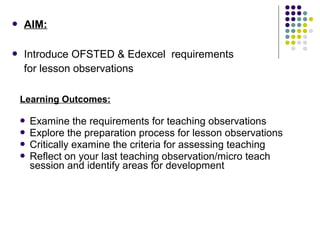
Aim:

   Introduce OFSTED & Edexcel requirements
    for lesson observations
    Learning Outcomes:

     Examine the requirements for teaching observations
     Explore the preparation process for lesson observations
     Critically examine the criteria for assessing teaching
     Reflect on your last teaching observation/micro teaching
      session and identify areas for development
Define it!
 In groups you will be given a set of
  adjectives.
 Take it in turns to define these words to
  your group.
 Who will guess the most?
Order the adjectives:
 Put the adjectives in order- you choose
  the order!
 What’s the connection between all of
  these adjectives?
How do you feel about being
observed?
 Choose  an adjective that matches your
  feelings.
 How can you empower yourself about
  the process of observation?
Empowerment

   Understand what the observer wants to
    see and give them this information
   Be prepared!
   Check your plan against the observation
    criteria at the planning stage.
   Use your tutor for support ( at the
    planning stage if necessary)
What is an observer
  looking for?
 In pairs, list all of the things you can
  think of that an observer wants to
  see.
 Now check against a set of criteria.
 Within each category, what tips can
  you give.
 Share your tips!
And for ICT….
 Engage  in online/elearning e.g. use a VLE
 Use software e.g. Excel, Word

 Communicate effectively using ICT as a
  medium e.g. email
 Use the language of ICT appropriately e.g.
  operating system. Hard drive
What might you need for an obs?
  Register
  Student profiles
  Lesson plans
  Scheme of work
  Course information/module brief
  Records of assessment plus examples
  ILPs & tutorial forms
  References to E&D / ELM
  Lesson Profile (example & next slide…)
Lesson rationale and class
profile

 Why  do we need these?
 What do they tell your observer?
 What kind of information will you include in
  class profile?

 Read  and check.
 What format could you use for individual
  learner profiles?
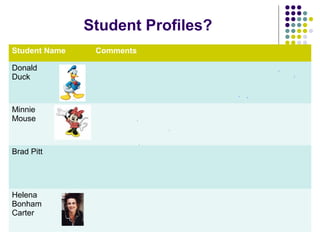
Student Profiles?
Student Name    Comments

Donald
Duck


Minnie
Mouse


Brad Pitt


Helena
Bonham
Carter
What is a scheme of work?


Briefly discuss the questions below with a
  partner.
 What is a scheme of work?

 What role do schemes of work play?


                                             14
What is a scheme of work?


According to Petty (2001:391)
“ It is a plan which organises course content,
   breaking it up into teaching weeks or lessons,
   and putting it into a logical teaching order.”


                                                15
What role do they play?


 A varietyof teaching and learning strategies
  can be identified
 They guide lesson planning by telling you
  what comes next
 They provide a guide as to whether or not
  you are running to schedule
 They are institutional requirements.


                                                 16
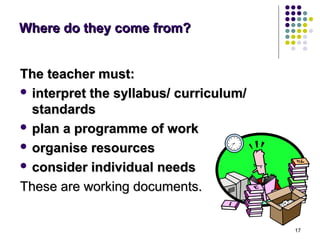
Where do they come from?


The teacher must:
 interpret the syllabus/ curriculum/
  standards
 plan a programme of work

 organise resources

 consider individual needs

These are working documents.


                                        17
Questions

 Who   am I planning my scheme of work
  for?
 What must I consider before I start
  preparing my scheme of work?
 What ought to be the content?
 What format do I use for my scheme of
  work?
 What are my objectives?


                                          18
Activity
 Look  at some example schemes of
  work. Do they help you answer any
  of your questions?
 Which of these schemes of work do
  you like best/ least? Why?
Observable verbs ??
Lesson plan
 Lookat an example lesson plan and answer
 the questions.
Criteria for assessment

 How  can you evidence units 2 and 3
  practical criteria?
 Look at pp. 8-10 in your teaching
  observation booklet and discuss in
  groups.
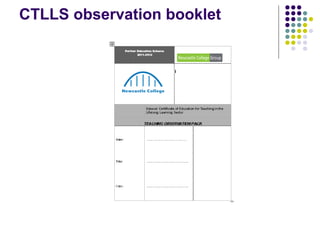
CTLLS observation booklet
What  were the aims
 and objectives for the
 session?
   AIM:

   Introduce OFSTED & Edexcel requirements
    for lesson observations

    Learning Outcomes:

     Examine the requirements for teaching observations
     Explore the preparation process for lesson observations
     Critically examine the criteria for assessing teaching
     Reflect on your last teaching observation/micro teach
      session and identify areas for development
Between session tasks:

 Revisitan old lesson plan and evaluate
  against what we have covered today.
     (e.g. interaction patterns, differentiation etc)

CTLLS day 2 lesson observation

  • 1.
    Edexcel CTLLS Day 2 Preparing to be observed
  • 2.
    Did you…….  research Minimum Core/ communication questions?  have a go at accessing the VLE?  complete the learning styles questionnaire?  certificate copies for APL?  send through photo for a student card?  send details of your mentor to your tutor?
  • 3.
  • 4.
    Aim:  Introduce OFSTED & Edexcel requirements for lesson observations Learning Outcomes:  Examine the requirements for teaching observations  Explore the preparation process for lesson observations  Critically examine the criteria for assessing teaching  Reflect on your last teaching observation/micro teaching session and identify areas for development
  • 5.
    Define it!  Ingroups you will be given a set of adjectives.  Take it in turns to define these words to your group.  Who will guess the most?
  • 6.
    Order the adjectives: Put the adjectives in order- you choose the order!  What’s the connection between all of these adjectives?
  • 7.
    How do youfeel about being observed?  Choose an adjective that matches your feelings.  How can you empower yourself about the process of observation?
  • 8.
    Empowerment  Understand what the observer wants to see and give them this information  Be prepared!  Check your plan against the observation criteria at the planning stage.  Use your tutor for support ( at the planning stage if necessary)
  • 9.
    What is anobserver looking for?  In pairs, list all of the things you can think of that an observer wants to see.  Now check against a set of criteria.  Within each category, what tips can you give.  Share your tips!
  • 10.
    And for ICT…. Engage in online/elearning e.g. use a VLE  Use software e.g. Excel, Word  Communicate effectively using ICT as a medium e.g. email  Use the language of ICT appropriately e.g. operating system. Hard drive
  • 11.
    What might youneed for an obs?  Register  Student profiles  Lesson plans  Scheme of work  Course information/module brief  Records of assessment plus examples  ILPs & tutorial forms  References to E&D / ELM  Lesson Profile (example & next slide…)
  • 12.
    Lesson rationale andclass profile  Why do we need these?  What do they tell your observer?  What kind of information will you include in class profile?  Read and check.  What format could you use for individual learner profiles?
  • 13.
    Student Profiles? Student Name Comments Donald Duck Minnie Mouse Brad Pitt Helena Bonham Carter
  • 14.
    What is ascheme of work? Briefly discuss the questions below with a partner.  What is a scheme of work?  What role do schemes of work play? 14
  • 15.
    What is ascheme of work? According to Petty (2001:391) “ It is a plan which organises course content, breaking it up into teaching weeks or lessons, and putting it into a logical teaching order.” 15
  • 16.
    What role dothey play?  A varietyof teaching and learning strategies can be identified  They guide lesson planning by telling you what comes next  They provide a guide as to whether or not you are running to schedule  They are institutional requirements. 16
  • 17.
    Where do theycome from? The teacher must:  interpret the syllabus/ curriculum/ standards  plan a programme of work  organise resources  consider individual needs These are working documents. 17
  • 18.
    Questions  Who am I planning my scheme of work for?  What must I consider before I start preparing my scheme of work?  What ought to be the content?  What format do I use for my scheme of work?  What are my objectives? 18
  • 19.
    Activity  Look at some example schemes of work. Do they help you answer any of your questions?  Which of these schemes of work do you like best/ least? Why?
  • 20.
  • 21.
    Lesson plan  Lookatan example lesson plan and answer the questions.
  • 22.
    Criteria for assessment How can you evidence units 2 and 3 practical criteria?  Look at pp. 8-10 in your teaching observation booklet and discuss in groups.
  • 23.
  • 24.
    What werethe aims and objectives for the session?
  • 25.
    AIM:  Introduce OFSTED & Edexcel requirements for lesson observations Learning Outcomes:  Examine the requirements for teaching observations  Explore the preparation process for lesson observations  Critically examine the criteria for assessing teaching  Reflect on your last teaching observation/micro teach session and identify areas for development
  • 26.
    Between session tasks: Revisitan old lesson plan and evaluate against what we have covered today.  (e.g. interaction patterns, differentiation etc)

Editor's Notes