EMS Provider
 Quick Reference
     Guide
                        for ER Staff
                           Members

          Provided by:
                                      Utah EMS
                                      for Children
                                      Program

© 2008 Utah Department of Health, Salt Lake City, UT
EMT-Basic (EMT-B)
Medications
Assists with self-
administration of patient
prescribed medications:
    Acetaminophen Elixir               NOTE: Medications and
                                        skills may vary by local
■   Activated Charcoal                           EMS agencies.

                                           All ambulances may
■   Aspirin                                       not carry this
                                                    medication.
■   Epinephrine by auto-injector
■   Metered dose inhalers
    Nerve Antidote Kits (Mark 1™ or DuoDote™)
■   Nitroglycerin
■   Oral glucose
Skills
Patient Assessment           ■   Stoma patient
■   Initial assessment           ventilation
■   Vital signs
                             Cardiovascular/
Airway / Ventilation /       Circulation
Oxygenation                  ■   CPR
■   Bag valve mask           ■   Control bleeding
    ventilation              ■   Semi-automatic
■   Flow restricted oxygen       defibrillation
    powered ventilation
    device                   Immobilization


                                                         EMT BASIC
■   Nasopharyngeal airway    ■   Spinal immobilization
    insertion                ■   Stabilize/immobilize
■   Oral suctioning              fractures
■   Oropharyngeal airway
    insertion                Miscellaneous
                             ■   Emergency childbirth
■   Oxygen administration,
                             ■   Measuring blood sugar
    nasal cannula, masks
                                 levels
■   Pocket mask artificial
    ventilation
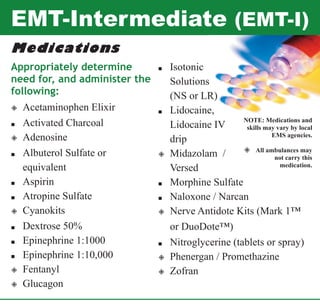
EMT-Intermediate (EMT-I)
Medications
Appropriately determine        ■   Isotonic
need for, and administer the       Solutions
following:                         (NS or LR)
    Acetaminophen Elixir       ■   Lidocaine,
                                                     NOTE: Medications and
■   Activated Charcoal             Lidocaine IV       skills may vary by local
    Adenosine                      drip                        EMS agencies.

                                                         All ambulances may
■   Albuterol Sulfate or           Midazolam /                  not carry this
    equivalent                     Versed                         medication.

■   Aspirin                    ■   Morphine Sulfate
■   Atropine Sulfate           ■   Naloxone / Narcan
    Cyanokits                      Nerve Antidote Kits (Mark 1™
■   Dextrose 50%                   or DuoDote™)
■   Epinephrine 1:1000         ■   Nitroglycerine (tablets or spray)
■   Epinephrine 1:10,000           Phenergan / Promethazine
    Fentanyl                       Zofran
    Glucagon
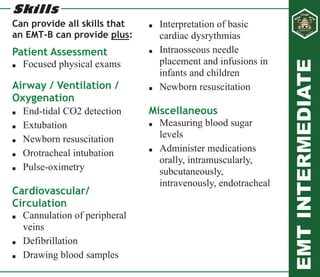
Skills
Can provide all skills that     ■   Interpretation of basic
an EMT-B can provide plus:          cardiac dysrythmias
Patient Assessment              ■   Intraosseous needle
    Focused physical exams          placement and infusions in


                                                                  EMT INTERMEDIATE
■
                                    infants and children
Airway / Ventilation /          ■   Newborn resuscitation
Oxygenation
■   End-tidal CO2 detection     Miscellaneous
■   Extubation                  ■   Measuring blood sugar
■   Newborn resuscitation           levels
■   Orotracheal intubation      ■   Administer medications
                                    orally, intramuscularly,
■   Pulse-oximetry                  subcutaneously,
                                    intravenously, endotracheal
Cardiovascular/
Circulation
■   Cannulation of peripheral
    veins
■   Defibrillation
■   Drawing blood samples
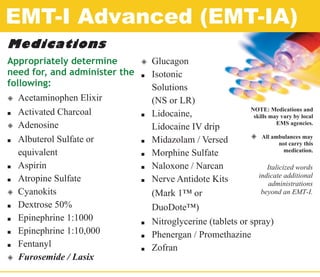
EMT-I Advanced (EMT-IA)
Medications
Appropriately determine            Glucagon
need for, and administer the   ■   Isotonic
following:                         Solutions
    Acetaminophen Elixir           (NS or LR)
                                                              NOTE: Medications and
■   Activated Charcoal         ■   Lidocaine,                  skills may vary by local
    Adenosine                      Lidocaine IV drip                     EMS agencies.

                                                                  All ambulances may
■   Albuterol Sulfate or       ■   Midazolam / Versed                     not carry this
    equivalent                 ■   Morphine Sulfate                         medication.

■   Aspirin                    ■   Naloxone / Narcan                 Italicized words
                                                                 indicate additional
■   Atropine Sulfate           ■   Nerve Antidote Kits                administrations
    Cyanokits                      (Mark 1™ or                    beyond an EMT-I.
■   Dextrose 50%                   DuoDote™)
■   Epinephrine 1:1000         ■   Nitroglycerine (tablets or spray)
■   Epinephrine 1:10,000       ■   Phenergan / Promethazine
■   Fentanyl                   ■   Zofran
    Furosemide / Lasix
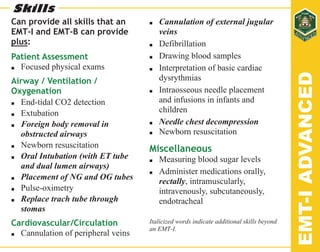
Skills
Can provide all skills that an      ■   Cannulation of external jugular
EMT-I and EMT-B can provide             veins
plus:                               ■   Defibrillation
Patient Assessment                  ■   Drawing blood samples
■ Focused physical exams            ■   Interpretation of basic cardiac


                                                                                         EMT-I ADVANCED
Airway / Ventilation /                  dysrythmias
Oxygenation                         ■   Intraosseous needle placement
■ End-tidal CO2 detection               and infusions in infants and
■ Extubation
                                        children
■ Foreign body removal in           ■   Needle chest decompression
  obstructed airways                ■   Newborn resuscitation
■ Newborn resuscitation
                                    Miscellaneous
■ Oral Intubation (with ET tube
                                    ■   Measuring blood sugar levels
  and dual lumen airways)
                                    ■   Administer medications orally,
■ Placement of NG and OG tubes
                                        rectally, intramuscularly,
■ Pulse-oximetry
                                        intravenously, subcutaneously,
■ Replace trach tube through            endotracheal
  stomas
Cardiovascular/Circulation          Italicized words indicate additional skills beyond
                                    an EMT-I.
■ Cannulation of peripheral veins
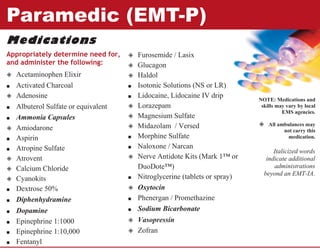
Paramedic (EMT-P)
Medications
Appropriately determine need for,         Furosemide / Lasix
and administer the following:             Glucagon
    Acetaminophen Elixir                  Haldol
■   Activated Charcoal                ■   Isotonic Solutions (NS or LR)
    Adenosine                         ■   Lidocaine, Lidocaine IV drip        NOTE: Medications and
■   Albuterol Sulfate or equivalent       Lorazepam                            skills may vary by local
                                                                                        EMS agencies.
■   Ammonia Capsules                      Magnesium Sulfate
                                          Midazolam / Versed                      All ambulances may
    Amiodarone                                                                          not carry this
■   Aspirin                           ■   Morphine Sulfate                               medication.

■   Atropine Sulfate                  ■   Naloxone / Narcan
                                                                                    Italicized words
    Atrovent                              Nerve Antidote Kits (Mark 1™ or        indicate additional
    Calcium Chloride                      DuoDote™)                                 administrations
                                                                                beyond an EMT-IA.
    Cyanokits                         ■   Nitroglycerine (tablets or spray)
■   Dextrose 50%                          Oxytocin
■   Diphenhydramine                   ■   Phenergan / Promethazine
■   Dopamine                          ■   Sodium Bicarbonate
■   Epinephrine 1:1000                    Vasopressin
■   Epinephrine 1:10,000                  Zofran
■   Fentanyl
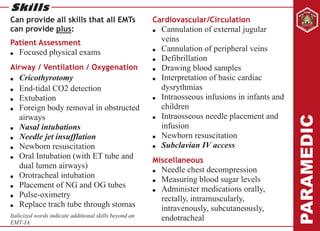
Skills
Can provide all skills that all EMTs                    Cardiovascular/Circulation
can provide plus:                                       ■   Cannulation of external jugular
Patient Assessment                                          veins
■   Focused physical exams                              ■   Cannulation of peripheral veins
                                                        ■   Defibrillation
Airway / Ventilation / Oxygenation                      ■   Drawing blood samples
■   Cricothyrotomy                                      ■   Interpretation of basic cardiac
■   End-tidal CO2 detection                                 dysrythmias
■   Extubation                                          ■   Intraosseous infusions in infants and
■   Foreign body removal in obstructed                      children
    airways                                             ■   Intraosseous needle placement and


                                                                                                    PARAMEDIC
■   Nasal intubations                                       infusion
■   Needle jet insufflation                             ■   Newborn resuscitation
■   Newborn resuscitation                               ■   Subclavian IV access
■   Oral Intubation (with ET tube and                   Miscellaneous
    dual lumen airways)                                 ■   Needle chest decompression
■   Orotracheal intubation                              ■   Measuring blood sugar levels
■   Placement of NG and OG tubes                        ■   Administer medications orally,
■   Pulse-oximetry                                          rectally, intramuscularly,
■   Replace trach tube through stomas                       intravenously, subcutaneously,
Italicized words indicate additional skills beyond an
EMT-IA.
                                                            endotracheal
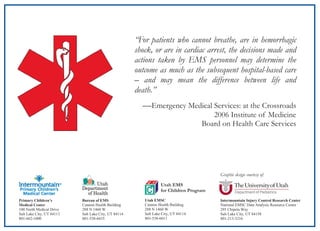
“For patients who cannot breathe, are in hemorrhagic
                                                      shock, or are in cardiac arrest, the decisions made and
                                                      actions taken by EMS personnel may determine the
                                                      outcome as much as the subsequent hospital-based care
                                                      – and may mean the difference between life and
                                                      death.”
                                                        —Emergency Medical Services: at the Crossroads
                                                                                       2006 Institute of Medicine
                                                                                    Board on Health Care Services


                                                                                         Graphic design courtesy of:

                                                                  Utah EMS
                                                                  for Children Program
Primary Children’s         Bureau of EMS                 Utah EMSC                       Intermountain Injury Control Research Center
Medical Center             Cannon Health Building        Cannon Health Building          National EMSC Data Analysis Resource Center
100 North Medical Drive    288 N 1460 W                  288 N 1460 W                    295 Chipeta Way
Salt Lake City, UT 84113   Salt Lake City, UT 84114      Salt Lake City, UT 84114        Salt Lake City, UT 84158
801-662-1000               801-538-6435                  801-538-6011                    801-213-3216

EMS Provider Quick Reference Guide

  • 1.
    EMS Provider QuickReference Guide for ER Staff Members Provided by: Utah EMS for Children Program © 2008 Utah Department of Health, Salt Lake City, UT
  • 2.
    EMT-Basic (EMT-B) Medications Assists withself- administration of patient prescribed medications: Acetaminophen Elixir NOTE: Medications and skills may vary by local ■ Activated Charcoal EMS agencies. All ambulances may ■ Aspirin not carry this medication. ■ Epinephrine by auto-injector ■ Metered dose inhalers Nerve Antidote Kits (Mark 1™ or DuoDote™) ■ Nitroglycerin ■ Oral glucose
  • 3.
    Skills Patient Assessment ■ Stoma patient ■ Initial assessment ventilation ■ Vital signs Cardiovascular/ Airway / Ventilation / Circulation Oxygenation ■ CPR ■ Bag valve mask ■ Control bleeding ventilation ■ Semi-automatic ■ Flow restricted oxygen defibrillation powered ventilation device Immobilization EMT BASIC ■ Nasopharyngeal airway ■ Spinal immobilization insertion ■ Stabilize/immobilize ■ Oral suctioning fractures ■ Oropharyngeal airway insertion Miscellaneous ■ Emergency childbirth ■ Oxygen administration, ■ Measuring blood sugar nasal cannula, masks levels ■ Pocket mask artificial ventilation
  • 4.
    EMT-Intermediate (EMT-I) Medications Appropriately determine ■ Isotonic need for, and administer the Solutions following: (NS or LR) Acetaminophen Elixir ■ Lidocaine, NOTE: Medications and ■ Activated Charcoal Lidocaine IV skills may vary by local Adenosine drip EMS agencies. All ambulances may ■ Albuterol Sulfate or Midazolam / not carry this equivalent Versed medication. ■ Aspirin ■ Morphine Sulfate ■ Atropine Sulfate ■ Naloxone / Narcan Cyanokits Nerve Antidote Kits (Mark 1™ ■ Dextrose 50% or DuoDote™) ■ Epinephrine 1:1000 ■ Nitroglycerine (tablets or spray) ■ Epinephrine 1:10,000 Phenergan / Promethazine Fentanyl Zofran Glucagon
  • 5.
    Skills Can provide allskills that ■ Interpretation of basic an EMT-B can provide plus: cardiac dysrythmias Patient Assessment ■ Intraosseous needle Focused physical exams placement and infusions in EMT INTERMEDIATE ■ infants and children Airway / Ventilation / ■ Newborn resuscitation Oxygenation ■ End-tidal CO2 detection Miscellaneous ■ Extubation ■ Measuring blood sugar ■ Newborn resuscitation levels ■ Orotracheal intubation ■ Administer medications orally, intramuscularly, ■ Pulse-oximetry subcutaneously, intravenously, endotracheal Cardiovascular/ Circulation ■ Cannulation of peripheral veins ■ Defibrillation ■ Drawing blood samples
  • 6.
    EMT-I Advanced (EMT-IA) Medications Appropriatelydetermine Glucagon need for, and administer the ■ Isotonic following: Solutions Acetaminophen Elixir (NS or LR) NOTE: Medications and ■ Activated Charcoal ■ Lidocaine, skills may vary by local Adenosine Lidocaine IV drip EMS agencies. All ambulances may ■ Albuterol Sulfate or ■ Midazolam / Versed not carry this equivalent ■ Morphine Sulfate medication. ■ Aspirin ■ Naloxone / Narcan Italicized words indicate additional ■ Atropine Sulfate ■ Nerve Antidote Kits administrations Cyanokits (Mark 1™ or beyond an EMT-I. ■ Dextrose 50% DuoDote™) ■ Epinephrine 1:1000 ■ Nitroglycerine (tablets or spray) ■ Epinephrine 1:10,000 ■ Phenergan / Promethazine ■ Fentanyl ■ Zofran Furosemide / Lasix
  • 7.
    Skills Can provide allskills that an ■ Cannulation of external jugular EMT-I and EMT-B can provide veins plus: ■ Defibrillation Patient Assessment ■ Drawing blood samples ■ Focused physical exams ■ Interpretation of basic cardiac EMT-I ADVANCED Airway / Ventilation / dysrythmias Oxygenation ■ Intraosseous needle placement ■ End-tidal CO2 detection and infusions in infants and ■ Extubation children ■ Foreign body removal in ■ Needle chest decompression obstructed airways ■ Newborn resuscitation ■ Newborn resuscitation Miscellaneous ■ Oral Intubation (with ET tube ■ Measuring blood sugar levels and dual lumen airways) ■ Administer medications orally, ■ Placement of NG and OG tubes rectally, intramuscularly, ■ Pulse-oximetry intravenously, subcutaneously, ■ Replace trach tube through endotracheal stomas Cardiovascular/Circulation Italicized words indicate additional skills beyond an EMT-I. ■ Cannulation of peripheral veins
  • 8.
    Paramedic (EMT-P) Medications Appropriately determineneed for, Furosemide / Lasix and administer the following: Glucagon Acetaminophen Elixir Haldol ■ Activated Charcoal ■ Isotonic Solutions (NS or LR) Adenosine ■ Lidocaine, Lidocaine IV drip NOTE: Medications and ■ Albuterol Sulfate or equivalent Lorazepam skills may vary by local EMS agencies. ■ Ammonia Capsules Magnesium Sulfate Midazolam / Versed All ambulances may Amiodarone not carry this ■ Aspirin ■ Morphine Sulfate medication. ■ Atropine Sulfate ■ Naloxone / Narcan Italicized words Atrovent Nerve Antidote Kits (Mark 1™ or indicate additional Calcium Chloride DuoDote™) administrations beyond an EMT-IA. Cyanokits ■ Nitroglycerine (tablets or spray) ■ Dextrose 50% Oxytocin ■ Diphenhydramine ■ Phenergan / Promethazine ■ Dopamine ■ Sodium Bicarbonate ■ Epinephrine 1:1000 Vasopressin ■ Epinephrine 1:10,000 Zofran ■ Fentanyl
  • 9.
    Skills Can provide allskills that all EMTs Cardiovascular/Circulation can provide plus: ■ Cannulation of external jugular Patient Assessment veins ■ Focused physical exams ■ Cannulation of peripheral veins ■ Defibrillation Airway / Ventilation / Oxygenation ■ Drawing blood samples ■ Cricothyrotomy ■ Interpretation of basic cardiac ■ End-tidal CO2 detection dysrythmias ■ Extubation ■ Intraosseous infusions in infants and ■ Foreign body removal in obstructed children airways ■ Intraosseous needle placement and PARAMEDIC ■ Nasal intubations infusion ■ Needle jet insufflation ■ Newborn resuscitation ■ Newborn resuscitation ■ Subclavian IV access ■ Oral Intubation (with ET tube and Miscellaneous dual lumen airways) ■ Needle chest decompression ■ Orotracheal intubation ■ Measuring blood sugar levels ■ Placement of NG and OG tubes ■ Administer medications orally, ■ Pulse-oximetry rectally, intramuscularly, ■ Replace trach tube through stomas intravenously, subcutaneously, Italicized words indicate additional skills beyond an EMT-IA. endotracheal
  • 10.
    “For patients whocannot breathe, are in hemorrhagic shock, or are in cardiac arrest, the decisions made and actions taken by EMS personnel may determine the outcome as much as the subsequent hospital-based care – and may mean the difference between life and death.” —Emergency Medical Services: at the Crossroads 2006 Institute of Medicine Board on Health Care Services Graphic design courtesy of: Utah EMS for Children Program Primary Children’s Bureau of EMS Utah EMSC Intermountain Injury Control Research Center Medical Center Cannon Health Building Cannon Health Building National EMSC Data Analysis Resource Center 100 North Medical Drive 288 N 1460 W 288 N 1460 W 295 Chipeta Way Salt Lake City, UT 84113 Salt Lake City, UT 84114 Salt Lake City, UT 84114 Salt Lake City, UT 84158 801-662-1000 801-538-6435 801-538-6011 801-213-3216