Town of Vernon
Emergency Medical Services
EMS PROTOCOLS
OBJECTIVES
 Review EMS Providers to CT Statewide OEMS
Protocols
 The proper use of medications under supervision of a
medical director or on standing order
 Understanding of each Medication
 Proper Dosage of each medication
 Indications / Contraindications
This presentation is based and follow the
CT STATEWIDE OEMS PROTOCOLS
Version 2019.5
ON-LINE ( Direct Medical Oversight)
 On-Line Medical Direction: is described as Direct
Medical Oversight (DMO) to render care for a patient.
 You the caregiver must contact Medical Control
(Direct Medical Oversight) and speak to a Doctor to
receive permission to administer / re-administer certain
medications prior to administration
OFF-LINE
 OFF-LINE: You are operating under a set of
guidelines or protocols that have been set by the
Statewide and / or local medical control.
 The medication / procedure is done under prior
authority of the sponsor hospitals Medical
Control Physician. (Standing Order)
Routine Patient Care 1.0
 Provides care and direction to follow for every
call
 Includes… Scene Size Up / Safety / Patient
Approach /ABC / Disability assessment /
Transport decision
EMR 1.1
 Reviews Scope of Practice for EMR’s
 Scope of Practice & Skills for ALL levels in
Appendix
Glucose (Hypoglycemia) 2.12 A/P
 Obtain FSBS (if able)
 If <70 Admin glucose
15Gms Oral Glucose
 Stop pump if Hypo and
cannot ingest Glucose
 May give more than one
glucose if remaining <70
Actions:
 increases blood glucose levels
Indications
 Altered mental status
 Hx of diabetes
 Known diabetic
 Blood Glucose level < 70mg/dl
 Signs & Symptoms of a diabetic Emergency
 Ability to swallow or gag reflex
Contraindications
 Unresponsive patient
 Patient unable to swallow (no gag reflex)
Side Effects
 May be aspirated
 No other reported side effects when given
properly
Dosage
 1 tube equals 15 grams of Glucose
Administration
 EMT’s
 Squeeze tube into mouth between cheek and
gum or under tongue and let absorb
 Reassess after 3-5 minutes
 Repeat Blood Glucose level
 If <70 mg/dl
 Repeat Glucose Administration
 Document administration, time and results
Administration
 ? Other possibilities (TIA / CVA)
 ? Opiate Overdose
 ? ETOH
Prescribed Inhalers
(Asthma) 2.5 A/P
CPAP 5.2
Inhaler Actions:
 relaxes bronchial smooth muscles, relieves
bronchospasm, reduces airway resistance, bronchial
dilation
Indications / Contraindications
INDICATIONS
Pt. exhibits signs & symptoms of Resp.
Distress
Non Adequate Breathing / Pulse Ox <94%
CONTRAINDICATIONS
Allergic
Pre-Caution with Rapid heart rates, HTN, C.P.
Side Effects
 Increased pulse rate
 Tremors
 Nervousness
 Nausea
Dosage
 Admin 4-6 Puffs
 Repeat every 5 minutes as needed
 MDI: Albuterol, Albuterol/Ipratropium
Bromide (DuoNeb)
Administration
 Confirm Shortness of Breath
 Confirm the patient has a prescribed inhaler
 Check expiration date
 Shake inhaler
 Have patient exhale
Administration
 Assist pt. if necessary
 Have PT. depress inhaler as they begin to inhale
deeply
 Have pt. hold breath for as long as comfortably
possible to have medication absorb
 Reassess
 Document time and dosage
CPAP
Continuous Positive Air Pressure
 Asthma patients who do not respond to MDI’s
 CHF Patients
 COPD Patients
 Pneumonia Patients
 MAX pressure of 10cm H2O
Acute Coronary Syndrome 3.0
Nitroglycerin / Aspirin
Nitroglycerin
 Confirm Pt’s own
 Expiration
 Admin 1 tablet or Spray
every 3-5 minutes until pain
subsides
 B.P. stays > 100 mmHg
 Total of 3 doses
Aspirin
 No Aspirin within 24 hours
 Able to swallow
 Admin (4) 81Mg baby aspirin
 Given once / not repeated
Nitro Actions
 Vascular smooth muscle relaxant
 Vasodilator which decreases myocardial
workload
 Decreases B/P
 Subsides C.P.
Nitro Indications
 Pt. is having C.P. cardiac in nature
 The Pt. has prescribed NTG to them
 Systolic B.P. >100
Nitro Contraindications
 Pt. has a SB.P. less than <100 mm/hg systolic
 Pt. has a head injury
 Use of a erectile dysfunction drug within the
past 48 hours (Viagra, Cialis,Levitra,
Staxyn,Revatio)
Nitro Dosage
 (1) tablet 0.4mg or (1) sublingual spray 1/150 gr.
 Repeated q5 minutes if continued C.P.
 B.P. checks between each dosage
 SB/P > 100mm Hg
 Repeat q5 minutes until symptom free or
maximum of 3 doses given
Nitro Administration
 Confirm C.P.
 Confirm prescribed nitro to Pt.
 Check expiration
 Determine if pt. has taken any doses and time
 Assess B.P.
 Determine usage of a Erectile medication within
48 hours
 All three NTG may now be given q5 if indicated
and necessary
Nitro Tablets
 Have pt. raise tongue up
 Administer to Pt. under tongue
 Advise Pt not swallow, allow tablet to absorb
under tongue
Nitro Spray
 Ask pt. to raise tongue
 Hand nitro spray to Pt. for self-administration
or spray the medication under Pt’s. tongue
 Advise Pt not to swallow for a few moments for
absorption
Aspirin Admin
 (4) 81mg tablets for total of 324mg (on
ambulances)
 Not expired
 Hand to patient they can self administer (if able)
Administration
 Evaluate for Hx of C.P. or new onset of C.P.
 Hx of C.A.D.
 Consider Nitro along with Aspirin
 Obtain vitals
 S.A.M.P.L.E. & EXAM
 Pour (4) tablets into gloved hand and hand to pt. to
chew tablets or administer to patient
 Reassess
 Document
Actions
 Inhibits platelet aggregation
 Decreases blood clotting time
 Slight Analgesic effects
Aspirin Contra
 Allergy's to ASA or NSAIDs
 Active GI Bleed
Side Effects
 Gastric irritation
 Nausea, vomiting
 Abd. Pain
 G.I. Bleeding
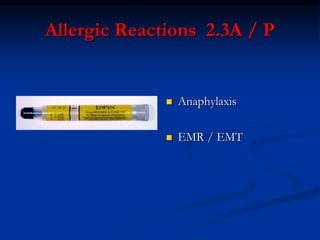
Allergic Reactions 2.3A / P
 Anaphylaxis
 EMR / EMT
Actions
 Dilates the bronchioles
 Constricts blood vessels
 Increases cardiac output and rate
Indications
Hypotension or respiratory compromise with known allergen exposure
OR:
Acute onset of symptoms and 2 or more of the following:
o Respiratory compromise (dyspnea, wheeze, stridor)
o Angioedema or facial/lip/tongue swelling
o Widespread hives, itching, swelling
o Persistent gastrointestinal involvement (vomiting, diarrhea, abdominal
pain)
o Altered mental status, syncope, cyanosis, delayed capillary refill, or
decreased level of consciousness associated with known/suspected
allergenic exposure
o Signs of shock
Contraindications
 Allergic
Side Effects
 An increase in H.R. and B.P.
 Pale skin
 Dizziness
 C.P.
 Headache
 Nausea, vomiting
 Excitability, anxiousness
Dosages
 Adult: 0.3mg (above 55 lbs.)
 Child: 0.15mg (below 55 lbs.)
Administration
 Confirm Allergic Reaction
 Use Direct Inject Epi From Ambulances
 Confirm it is not expired and liquid is clear
 Additional Dosing contact DMO
Oxygen Delivery
 Indicated in any condition with increased
Cardiac work load, respiratory distress or illness
or injury resulting in altered ventilation or
perfusion
 Supplemental oxygen is not needed without
evidence of the above or if SPO2 is <94%
(<90% for COPD Pt’s)
 If SPO2 is <94% oxygen maybe delivered
 Titrate to 94% or greater
Oxygen
 1-4 liters = Nasal Cannula
 6-15 liters = NRB
 15 liters or greater = BVM
Seizures 2.21 A/P
Diastat (Rectal Gel)
 Assist Family / Caregiver in
Administration
 Administered Rectally
Vagus Nerve Stimulation
 May assist family / Caregiver
 May administer VNS Magnet
 Pass Magnet closely over area
 Repeat q3-5 minutes if
unsuccessful
 Total of 3 times
Diastat Gel
 Diazepam (Valium)
 Seizure Control
 Administer as instructed (Family/ Caregiver)
Vagus Nerve Stimulator
 As stated stimulates Vagus Nerve
 Slows / Stops Seizures
 Activated by a magnet
 Implanted device similar to a pacemaker usually
upper left chest area
 Family or EMS may assist with magnet (Pt
should have magnet)
Naloxone (Narcan)
Poisoning / Overdose 2.20 A/P
Naloxone
 Suspected Opioid overdose with respiratory
depression
 Ineffective Respirations = <6 minute
Thinking Points
 “Addicts take opiates and other sedatives
specifically to induce a pleasant stupor. If they’re
lethargic and hard to arouse, but still breathing
EFFECTIVLY, it’s not an overdose.
“It’s a dose.”
 Naloxone is for depressed respirations, not
depressed mental status.
 Opiate use alone (without depressed
respirations) does not merit the use of naloxone.
Administration
 EMR / EMT
 Airway management Priority
 4mg IN
 Single nostril
 If inadequate response repeat 3-5 minutes
 Any additional doses contact DMO
Tourniquets 6.17 Pg. 152
Application
 Used to control a life threatening hemorrhage
on a injured extremity
 Used when bleeding cannot be controlled by
other means
Direct pressure
Pressure dressing
Tourniquet
Even if its not bleeding consider
a tourniquet in this scenario
Application
 2-3 inches above the wound
 Watch for other sites of bleeding
 above the wound
 Multiple bleeding sites
 proximal application
 May have to use two
Application
 Should be tight enough to stop bleeding
 The tourniquet should never be placed
 Joint (knee or elbow)
 Over an impaled object
 Extremity should be exposed
 Document application time
 Write on patient!
Application
 A prehospital tourniquet should not be
removed by EMS personnel without
authorization from their EMS Sponsor
Hospital/Medical Direction
 If application exceeds six hours, removal should
only be done by the physician providing
definitive care
Wound Packing
 EMR / EMT
 Used for severe hemorrhage in extremities or
central core where a Tourniquet cannot be
placed
 Find point of bleeding
 Apply direct pressure
 Use Gauze or Hemostatic treated Gauze to stop
bleeding
Wound Packing
 Hemostatic Gauze works within 3-5 minutes
 Fill all spaces
 Pack wound tightly
 Wrap with Pressure bandage
Questions
 Quiz
If you have any further questions or want more
information please refer to the Statewide
OEMS Protocols
Contact an EMS Supervisor
ctemscouncils.org

BLS Protocols

  • 1.
    Town of Vernon EmergencyMedical Services
  • 2.
  • 3.
    OBJECTIVES  Review EMSProviders to CT Statewide OEMS Protocols  The proper use of medications under supervision of a medical director or on standing order  Understanding of each Medication  Proper Dosage of each medication  Indications / Contraindications
  • 4.
    This presentation isbased and follow the CT STATEWIDE OEMS PROTOCOLS Version 2019.5
  • 5.
    ON-LINE ( DirectMedical Oversight)  On-Line Medical Direction: is described as Direct Medical Oversight (DMO) to render care for a patient.  You the caregiver must contact Medical Control (Direct Medical Oversight) and speak to a Doctor to receive permission to administer / re-administer certain medications prior to administration
  • 6.
    OFF-LINE  OFF-LINE: Youare operating under a set of guidelines or protocols that have been set by the Statewide and / or local medical control.  The medication / procedure is done under prior authority of the sponsor hospitals Medical Control Physician. (Standing Order)
  • 7.
    Routine Patient Care1.0  Provides care and direction to follow for every call  Includes… Scene Size Up / Safety / Patient Approach /ABC / Disability assessment / Transport decision
  • 8.
    EMR 1.1  ReviewsScope of Practice for EMR’s  Scope of Practice & Skills for ALL levels in Appendix
  • 9.
    Glucose (Hypoglycemia) 2.12A/P  Obtain FSBS (if able)  If <70 Admin glucose 15Gms Oral Glucose  Stop pump if Hypo and cannot ingest Glucose  May give more than one glucose if remaining <70
  • 10.
  • 11.
    Indications  Altered mentalstatus  Hx of diabetes  Known diabetic  Blood Glucose level < 70mg/dl  Signs & Symptoms of a diabetic Emergency  Ability to swallow or gag reflex
  • 12.
    Contraindications  Unresponsive patient Patient unable to swallow (no gag reflex)
  • 13.
    Side Effects  Maybe aspirated  No other reported side effects when given properly
  • 14.
    Dosage  1 tubeequals 15 grams of Glucose
  • 15.
    Administration  EMT’s  Squeezetube into mouth between cheek and gum or under tongue and let absorb  Reassess after 3-5 minutes  Repeat Blood Glucose level  If <70 mg/dl  Repeat Glucose Administration  Document administration, time and results
  • 16.
    Administration  ? Otherpossibilities (TIA / CVA)  ? Opiate Overdose  ? ETOH
  • 17.
  • 18.
    Inhaler Actions:  relaxesbronchial smooth muscles, relieves bronchospasm, reduces airway resistance, bronchial dilation
  • 19.
    Indications / Contraindications INDICATIONS Pt.exhibits signs & symptoms of Resp. Distress Non Adequate Breathing / Pulse Ox <94% CONTRAINDICATIONS Allergic Pre-Caution with Rapid heart rates, HTN, C.P.
  • 20.
    Side Effects  Increasedpulse rate  Tremors  Nervousness  Nausea
  • 21.
    Dosage  Admin 4-6Puffs  Repeat every 5 minutes as needed  MDI: Albuterol, Albuterol/Ipratropium Bromide (DuoNeb)
  • 22.
    Administration  Confirm Shortnessof Breath  Confirm the patient has a prescribed inhaler  Check expiration date  Shake inhaler  Have patient exhale
  • 23.
    Administration  Assist pt.if necessary  Have PT. depress inhaler as they begin to inhale deeply  Have pt. hold breath for as long as comfortably possible to have medication absorb  Reassess  Document time and dosage
  • 24.
  • 25.
    Continuous Positive AirPressure  Asthma patients who do not respond to MDI’s  CHF Patients  COPD Patients  Pneumonia Patients  MAX pressure of 10cm H2O
  • 26.
  • 27.
    Nitroglycerin / Aspirin Nitroglycerin Confirm Pt’s own  Expiration  Admin 1 tablet or Spray every 3-5 minutes until pain subsides  B.P. stays > 100 mmHg  Total of 3 doses Aspirin  No Aspirin within 24 hours  Able to swallow  Admin (4) 81Mg baby aspirin  Given once / not repeated
  • 28.
    Nitro Actions  Vascularsmooth muscle relaxant  Vasodilator which decreases myocardial workload  Decreases B/P  Subsides C.P.
  • 29.
    Nitro Indications  Pt.is having C.P. cardiac in nature  The Pt. has prescribed NTG to them  Systolic B.P. >100
  • 30.
    Nitro Contraindications  Pt.has a SB.P. less than <100 mm/hg systolic  Pt. has a head injury  Use of a erectile dysfunction drug within the past 48 hours (Viagra, Cialis,Levitra, Staxyn,Revatio)
  • 31.
    Nitro Dosage  (1)tablet 0.4mg or (1) sublingual spray 1/150 gr.  Repeated q5 minutes if continued C.P.  B.P. checks between each dosage  SB/P > 100mm Hg  Repeat q5 minutes until symptom free or maximum of 3 doses given
  • 32.
    Nitro Administration  ConfirmC.P.  Confirm prescribed nitro to Pt.  Check expiration  Determine if pt. has taken any doses and time  Assess B.P.  Determine usage of a Erectile medication within 48 hours  All three NTG may now be given q5 if indicated and necessary
  • 33.
    Nitro Tablets  Havept. raise tongue up  Administer to Pt. under tongue  Advise Pt not swallow, allow tablet to absorb under tongue
  • 34.
    Nitro Spray  Askpt. to raise tongue  Hand nitro spray to Pt. for self-administration or spray the medication under Pt’s. tongue  Advise Pt not to swallow for a few moments for absorption
  • 35.
    Aspirin Admin  (4)81mg tablets for total of 324mg (on ambulances)  Not expired  Hand to patient they can self administer (if able)
  • 36.
    Administration  Evaluate forHx of C.P. or new onset of C.P.  Hx of C.A.D.  Consider Nitro along with Aspirin  Obtain vitals  S.A.M.P.L.E. & EXAM  Pour (4) tablets into gloved hand and hand to pt. to chew tablets or administer to patient  Reassess  Document
  • 37.
    Actions  Inhibits plateletaggregation  Decreases blood clotting time  Slight Analgesic effects
  • 38.
    Aspirin Contra  Allergy'sto ASA or NSAIDs  Active GI Bleed
  • 39.
    Side Effects  Gastricirritation  Nausea, vomiting  Abd. Pain  G.I. Bleeding
  • 40.
    Allergic Reactions 2.3A/ P  Anaphylaxis  EMR / EMT
  • 41.
    Actions  Dilates thebronchioles  Constricts blood vessels  Increases cardiac output and rate
  • 42.
    Indications Hypotension or respiratorycompromise with known allergen exposure OR: Acute onset of symptoms and 2 or more of the following: o Respiratory compromise (dyspnea, wheeze, stridor) o Angioedema or facial/lip/tongue swelling o Widespread hives, itching, swelling o Persistent gastrointestinal involvement (vomiting, diarrhea, abdominal pain) o Altered mental status, syncope, cyanosis, delayed capillary refill, or decreased level of consciousness associated with known/suspected allergenic exposure o Signs of shock
  • 43.
  • 44.
    Side Effects  Anincrease in H.R. and B.P.  Pale skin  Dizziness  C.P.  Headache  Nausea, vomiting  Excitability, anxiousness
  • 45.
    Dosages  Adult: 0.3mg(above 55 lbs.)  Child: 0.15mg (below 55 lbs.)
  • 46.
    Administration  Confirm AllergicReaction  Use Direct Inject Epi From Ambulances  Confirm it is not expired and liquid is clear  Additional Dosing contact DMO
  • 47.
    Oxygen Delivery  Indicatedin any condition with increased Cardiac work load, respiratory distress or illness or injury resulting in altered ventilation or perfusion  Supplemental oxygen is not needed without evidence of the above or if SPO2 is <94% (<90% for COPD Pt’s)  If SPO2 is <94% oxygen maybe delivered  Titrate to 94% or greater
  • 48.
    Oxygen  1-4 liters= Nasal Cannula  6-15 liters = NRB  15 liters or greater = BVM
  • 49.
    Seizures 2.21 A/P Diastat(Rectal Gel)  Assist Family / Caregiver in Administration  Administered Rectally Vagus Nerve Stimulation  May assist family / Caregiver  May administer VNS Magnet  Pass Magnet closely over area  Repeat q3-5 minutes if unsuccessful  Total of 3 times
  • 50.
    Diastat Gel  Diazepam(Valium)  Seizure Control  Administer as instructed (Family/ Caregiver)
  • 51.
    Vagus Nerve Stimulator As stated stimulates Vagus Nerve  Slows / Stops Seizures  Activated by a magnet  Implanted device similar to a pacemaker usually upper left chest area  Family or EMS may assist with magnet (Pt should have magnet)
  • 52.
  • 53.
    Naloxone  Suspected Opioidoverdose with respiratory depression  Ineffective Respirations = <6 minute
  • 54.
    Thinking Points  “Addictstake opiates and other sedatives specifically to induce a pleasant stupor. If they’re lethargic and hard to arouse, but still breathing EFFECTIVLY, it’s not an overdose. “It’s a dose.”  Naloxone is for depressed respirations, not depressed mental status.  Opiate use alone (without depressed respirations) does not merit the use of naloxone.
  • 55.
    Administration  EMR /EMT  Airway management Priority  4mg IN  Single nostril  If inadequate response repeat 3-5 minutes  Any additional doses contact DMO
  • 56.
  • 57.
    Application  Used tocontrol a life threatening hemorrhage on a injured extremity  Used when bleeding cannot be controlled by other means Direct pressure Pressure dressing Tourniquet
  • 58.
    Even if itsnot bleeding consider a tourniquet in this scenario
  • 59.
    Application  2-3 inchesabove the wound  Watch for other sites of bleeding  above the wound  Multiple bleeding sites  proximal application  May have to use two
  • 60.
    Application  Should betight enough to stop bleeding  The tourniquet should never be placed  Joint (knee or elbow)  Over an impaled object  Extremity should be exposed  Document application time  Write on patient!
  • 61.
    Application  A prehospitaltourniquet should not be removed by EMS personnel without authorization from their EMS Sponsor Hospital/Medical Direction  If application exceeds six hours, removal should only be done by the physician providing definitive care
  • 62.
    Wound Packing  EMR/ EMT  Used for severe hemorrhage in extremities or central core where a Tourniquet cannot be placed  Find point of bleeding  Apply direct pressure  Use Gauze or Hemostatic treated Gauze to stop bleeding
  • 63.
    Wound Packing  HemostaticGauze works within 3-5 minutes  Fill all spaces  Pack wound tightly  Wrap with Pressure bandage
  • 64.
  • 65.
    If you haveany further questions or want more information please refer to the Statewide OEMS Protocols Contact an EMS Supervisor ctemscouncils.org