BRIAN G. MAGAN
ICT-CSS TEACHER
Computer System
Servicing
CHECKING OF ATTENDANCE
TERMINATING AND CONNECTING
ELECTRICAL WIRING AND
ELECTRONICS CIRCUIT
(TCEW)
BRIAN G. MAGAN
ICT-CSS TEACHER
Computer SystemServicing
LO1. Plan and prepare for termination and connection
of electrical wiring and electronic circuits.
LO2. Terminate and connect electrical wiring and
electronic circuits.
LO3. Test Termination and connection of electrical
wiring and /electronic circuit.
BRIAN G. MAGAN
ICT-CSS TEACHER
Computer SystemServicing
Objective: at the end of this lesson,
students must be able to:
 Select appropriate tools and equipment according
to task requirements
 Prepare electrical wiring/electronics circuits correctly
for connecting/terminating in accordance with
instruction and work site procedures.
 Observe safety procedures in using tools and use
appropriate personal protective equipment at all times
Electrical Theory
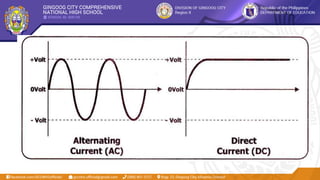
Direct Current or DC is the first type of current
because it was easy to produce. This type of current
always flows in one direction.
 Batteries are common sources of direct current.
Electrical Theory
Alternating Current or AC is the solution to the
problem of DC. AC allows the flow of current in two
directions.
 Common sources of AC are found in our AC
outlet (Typically, 220 volts, in the Philippines).
Electrical Theory
OHM’S LAW AND POWER LAW
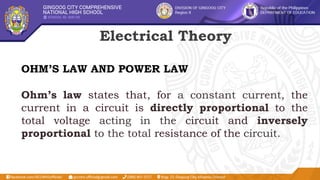
Ohm’s law states that, for a constant current, the
current in a circuit is directly proportional to the
total voltage acting in the circuit and inversely
proportional to the total resistance of the circuit.
Electrical Theory
OHM’S LAW AND POWER LAW
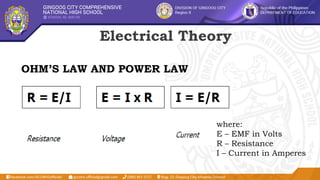
where:
E – EMF in Volts
R – Resistance
I – Current in Amperes
Electrical Theory
OHM’S LAW AND POWER LAW
E
X
A
M
P
L
E
Electrical Theory
OHM’S LAW AND POWER LAW
E
X
A
M
P
L
E
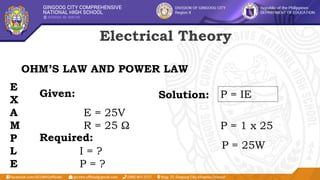
Given: P = IE
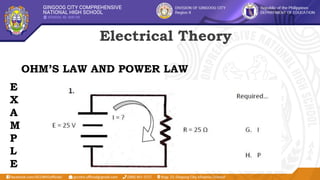
Required:
I = ?
P = ?
Solution:
P = 1 x 25
P = 25W
E = 25V
R = 25 Ω
Electrical Theory
OHM’S LAW AND POWER LAW
E
X
A
M
P
L
E
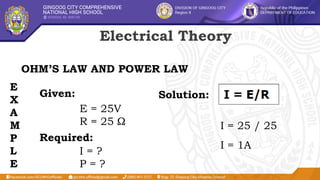
Given:
E = 25V
R = 25 Ω
Required:
I = ?
P = ?
Solution:
I = 25 / 25
I = 1A
Components of a Simple Circuit
 AC/DC source
 Equipment that will operate on either an AC or DC
power source
 Battery – A dc voltage source containing two or
more cells that convert chemical energy to electrical
energy.
 Cell‐ Single unit used to convert chemical energy
into a DC electrical voltage.
Components of a Simple Circuit
 FUSE
 is a safety device used to protect an electrical circuit
from the effect of excessive current.
 A fuse is usually rated in Amperes, which represent
the maximum continuous current it could handle
without blowing.
 The most popular type of fuse in Electronics is 3AG
type.
Components of a Simple Circuit
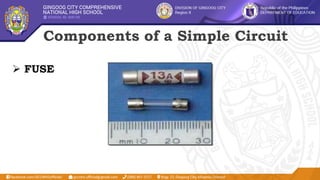
 FUSE
Components of a Simple Circuit
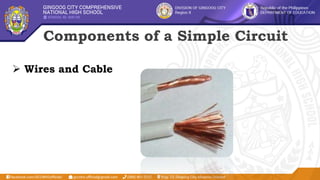
 Wires and Cable
 A wire is a single slender rod or filament of drawn
metal.
 A conductor is a wire suitable for carrying an
electric current.
 A stranded conductor is a conductor composed of a
group of wire or any combination of group of wires.
Components of a Simple Circuit
 Wires and Cable
Components of a Simple Circuit
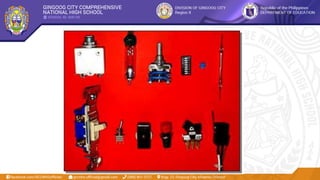
 Switch and its function
 Switch is a device used to break an electric current
or transfer it to another conductor.
 A switch is a mechanical device used to connect and
disconnect a circuit at will.
 Switch is a manually operated device capable of
making, breaking, or changing the connection in an
electronics or electrical circuit.
Components of a Simple Circuit
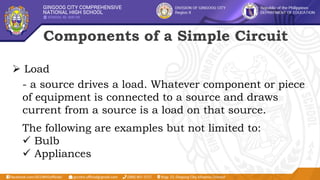
 Load
- a source drives a load. Whatever component or piece
of equipment is connected to a source and draws
current from a source is a load on that source.
The following are examples but not limited to:
 Bulb
 Appliances
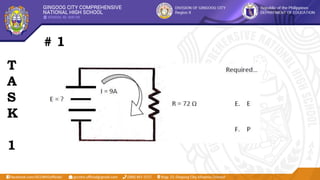
T
A
S
K
1
# 1
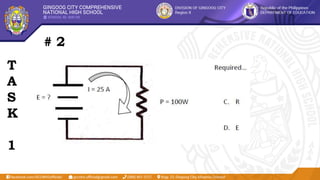
T
A
S
K
1
# 2
T
A
S
K
2
Fill in the blanks with what is referred to by each
of the following.
1. it is a type of current that allows the flow
of current in two directions
2. This type of current always flows in one
direction
3. A DC voltage source containing two or
more cells that convert chemical energy to
electrical energy.
T
A
S
K
2
Fill in the blanks with what is referred to by each
of the following.
4. Any device having two states, ON or OFF
5. A safety device used to protect an
electrical circuit from the effect of excessive
current.
6. A Components or pieces of equipment
connected to a source which draws current
from a source.
Websites:
Paul Goodman 2019 https://turbofuture.com/computers/Computer-Basics-10-Examples-of-Output-
Devices
© 2020 CBS Interactive. https://www.zdnet.com/article/best-cloud-storage-services/
©2008-2020 World Wide Web Foundation. This work is licensed under a Creative Commons
Attribution 4.0 International Licence https://webfoundation.org/about/vision/history-of-the-web/
https://www.cisco.com/c/en/us/products/security/advanced-malware-protection/what-is-
malware.html#:~:text=Malware%20is%20a%20contraction%20for,spyware%2C%20adware%2C%2
0and%20ransomware.
https://neosmart.net/wiki/disk-cleanup/
Agpaoa, Feliciano, Interior and Exterior Wiring Troubleshooting, National books Store, 1991
Enriquez, Michael, Simple Electronics (Basic) Fully Illustrated, Antonio M. Andes Sr.
Electronics Book Series
www.electronics‐lab.com
www.wikipedia.com
References
THANK YOU
AND
GOD BLESS

Css q3 week2

  • 1.
    BRIAN G. MAGAN ICT-CSSTEACHER Computer System Servicing
  • 2.
  • 3.
    TERMINATING AND CONNECTING ELECTRICALWIRING AND ELECTRONICS CIRCUIT (TCEW) BRIAN G. MAGAN ICT-CSS TEACHER Computer SystemServicing
  • 4.
    LO1. Plan andprepare for termination and connection of electrical wiring and electronic circuits. LO2. Terminate and connect electrical wiring and electronic circuits. LO3. Test Termination and connection of electrical wiring and /electronic circuit. BRIAN G. MAGAN ICT-CSS TEACHER Computer SystemServicing
  • 5.
    Objective: at theend of this lesson, students must be able to:  Select appropriate tools and equipment according to task requirements  Prepare electrical wiring/electronics circuits correctly for connecting/terminating in accordance with instruction and work site procedures.  Observe safety procedures in using tools and use appropriate personal protective equipment at all times
  • 6.
    Electrical Theory Direct Currentor DC is the first type of current because it was easy to produce. This type of current always flows in one direction.  Batteries are common sources of direct current.
  • 7.
    Electrical Theory Alternating Currentor AC is the solution to the problem of DC. AC allows the flow of current in two directions.  Common sources of AC are found in our AC outlet (Typically, 220 volts, in the Philippines).
  • 9.
    Electrical Theory OHM’S LAWAND POWER LAW Ohm’s law states that, for a constant current, the current in a circuit is directly proportional to the total voltage acting in the circuit and inversely proportional to the total resistance of the circuit.
  • 10.
    Electrical Theory OHM’S LAWAND POWER LAW where: E – EMF in Volts R – Resistance I – Current in Amperes
  • 11.
    Electrical Theory OHM’S LAWAND POWER LAW E X A M P L E
  • 12.
    Electrical Theory OHM’S LAWAND POWER LAW E X A M P L E Given: P = IE Required: I = ? P = ? Solution: P = 1 x 25 P = 25W E = 25V R = 25 Ω
  • 13.
    Electrical Theory OHM’S LAWAND POWER LAW E X A M P L E Given: E = 25V R = 25 Ω Required: I = ? P = ? Solution: I = 25 / 25 I = 1A
  • 14.
    Components of aSimple Circuit  AC/DC source  Equipment that will operate on either an AC or DC power source  Battery – A dc voltage source containing two or more cells that convert chemical energy to electrical energy.  Cell‐ Single unit used to convert chemical energy into a DC electrical voltage.
  • 15.
    Components of aSimple Circuit  FUSE  is a safety device used to protect an electrical circuit from the effect of excessive current.  A fuse is usually rated in Amperes, which represent the maximum continuous current it could handle without blowing.  The most popular type of fuse in Electronics is 3AG type.
  • 16.
    Components of aSimple Circuit  FUSE
  • 17.
    Components of aSimple Circuit  Wires and Cable  A wire is a single slender rod or filament of drawn metal.  A conductor is a wire suitable for carrying an electric current.  A stranded conductor is a conductor composed of a group of wire or any combination of group of wires.
  • 18.
    Components of aSimple Circuit  Wires and Cable
  • 19.
    Components of aSimple Circuit  Switch and its function  Switch is a device used to break an electric current or transfer it to another conductor.  A switch is a mechanical device used to connect and disconnect a circuit at will.  Switch is a manually operated device capable of making, breaking, or changing the connection in an electronics or electrical circuit.
  • 21.
    Components of aSimple Circuit  Load - a source drives a load. Whatever component or piece of equipment is connected to a source and draws current from a source is a load on that source. The following are examples but not limited to:  Bulb  Appliances
  • 22.
  • 23.
  • 24.
    T A S K 2 Fill in theblanks with what is referred to by each of the following. 1. it is a type of current that allows the flow of current in two directions 2. This type of current always flows in one direction 3. A DC voltage source containing two or more cells that convert chemical energy to electrical energy.
  • 25.
    T A S K 2 Fill in theblanks with what is referred to by each of the following. 4. Any device having two states, ON or OFF 5. A safety device used to protect an electrical circuit from the effect of excessive current. 6. A Components or pieces of equipment connected to a source which draws current from a source.
  • 26.
    Websites: Paul Goodman 2019https://turbofuture.com/computers/Computer-Basics-10-Examples-of-Output- Devices © 2020 CBS Interactive. https://www.zdnet.com/article/best-cloud-storage-services/ ©2008-2020 World Wide Web Foundation. This work is licensed under a Creative Commons Attribution 4.0 International Licence https://webfoundation.org/about/vision/history-of-the-web/ https://www.cisco.com/c/en/us/products/security/advanced-malware-protection/what-is- malware.html#:~:text=Malware%20is%20a%20contraction%20for,spyware%2C%20adware%2C%2 0and%20ransomware. https://neosmart.net/wiki/disk-cleanup/ Agpaoa, Feliciano, Interior and Exterior Wiring Troubleshooting, National books Store, 1991 Enriquez, Michael, Simple Electronics (Basic) Fully Illustrated, Antonio M. Andes Sr. Electronics Book Series www.electronics‐lab.com www.wikipedia.com References
  • 27.

Editor's Notes

  • #2 Good afternoon everyone! How are you? I know that you are kind of already exhausted, because of the fact that this is your last subject to attend to today., just hold on and bear with me as we discuss our todays topic. Alright, by the way, do not worry if you have not able to submit your output last week, it would be alright if you submit together with this week’s output. Ok? Just a reminder of your output submission, do not forget to always write your name and indicate always if what week output you are submitting. For examle
  • #3 Before we will continue, do not forget to write your name and section in a comment section below for your attendance, okay?
  • #4 Welcome to the Module “Terminating and Connecting Electrical Wiring and Electronic Circuits”. This module contains training materials and activities for you to complete. The unit of competency “Terminate and Connect Electrical Wiring and Electronic Circuits” contains knowledge, skills and attitudes required for a Computer Hardware Servicing NC II course.
  • #5 Welcome to the Module “Terminating and Connecting Electrical Wiring and Electronic Circuits”. This module contains training materials and activities for you to complete. The unit of competency “Terminate and Connect Electrical Wiring and Electronic Circuits” contains knowledge, skills and attitudes required for a Computer Hardware Servicing NC II course.
  • #7 Direct Current or DC is the first type of current because it was easy to produce. This type of current always flows in one direction. One of the disadvantages of using DC is the excessive voltage drop and power loss in the power lines in a long distance transmission. Batteries are common sources of direct current.
  • #8 Alternating Current or AC is the solution to the problem of DC. AC allows the flow of current in two directions. Today, it is possible to step‐up electricity, a power station, transmit it to any distant place and step it down to for consumption. A transformer is the device used for stepping‐up or stepping‐down AC voltage. Common sources of AC are found in our AC outlet (Typically, 220 volts, in the Philippines).
  • #9 AC and DC Wave Form
  • #11 The law may be expressed by the following equation if the current I is in amperes, EMF E is in volts, and the resistance R is in ohms. The relationship of the foregoing three variables was discovered by Georg Simon Ohm, who theorized that current is in direct proportion to resistance. The relationship is explained algebraically, using this formula: where: E – EMF in Volts R – Resistance I – Current in Amperes
  • #15 A Simple circuit contains the minimum things needed to have a functioning electric circuit. A simple circuit requires the following:
  • #16 Once you design a simple circuit on electronics, it is important to include a fuse in the primary or secondary of a transformer.  Fuse is a safety device used to protect an electrical circuit from the effect of excessive current. Its essential component is usually a strip of metal that will melt at a given temperature. A fuse is so designed that the strip of metal can easily be placed in the electric circuit. If the current in the circuit exceed a predetermined value, the fusible metal will melt and thus break, or open the circuit.  A fuse is usually rated in Amperes, which represent the maximum continuous current it could handle without blowing.  The most popular type of fuse in Electronics is 3AG type. This code describes the case size and material where “G” indicates a glass materials and “A” indicates that intended for automotive application. A 3AG fuse measures approximately 32mm x 6mm.
  • #17 Once you design a simple circuit on electronics, it is important to include a fuse in the primary or secondary of a transformer.  Fuse is a safety device used to protect an electrical circuit from the effect of excessive current. Its essential component is usually a strip of metal that will melt at a given temperature. A fuse is so designed that the strip of metal can easily be placed in the electric circuit. If the current in the circuit exceed a predetermined value, the fusible metal will melt and thus break, or open the circuit.  A fuse is usually rated in Amperes, which represent the maximum continuous current it could handle without blowing.  The most popular type of fuse in Electronics is 3AG type. This code describes the case size and material where “G” indicates a glass materials and “A” indicates that intended for automotive application. A 3AG fuse measures approximately 32mm x 6mm.
  • #18 Wires and Cable  A wire is a single slender rod or filament of drawn metal. This definition restricts the term to what would ordinarily be understood as solid wire. The word “slender” is used because the length of a wire is usually large when compared to its diameter. If a wire is covered with insulation, It is an insulated wire. Although the term “wire” properly refers to the metal, it also includes the insulation.  A conductor is a wire suitable for carrying an electric current.
  • #19 Wires and Cable  A wire is a single slender rod or filament of drawn metal. This definition restricts the term to what would ordinarily be understood as solid wire. The word “slender” is used because the length of a wire is usually large when compared to its diameter. If a wire is covered with insulation, It is an insulated wire. Although the term “wire” properly refers to the metal, it also includes the insulation.  A conductor is a wire suitable for carrying an electric current.
  • #20 Switch is a device used to break an electric current or transfer it to another conductor. Switches are commonly used to open or close a circuit. Closed is the ON position, while open is OFF position. Normally, switch is installed in series with the line carrying current from the power source to the load.  A switch is a mechanical device used to connect and disconnect a circuit at will. Switches cover a wide range of types, from subminiature up to industrial plant switching megawatts of power on high voltage distribution lines.  Switch is a manually operated device capable of making, breaking, or changing the connection in an electronics or electrical circuit. A switch connected in series with one of the connecting wires of simple circuit affords a means of controlling the current in the circuit.
  • #22 Power tools – grinder, electric drill