Maltsev digraphs

C. Carvalhoa , L. Egrib , M. Jacksonc and T. Nivenc

a University   of Hertfordshire, b McGill University, c LaTrobe University


                              CSR 2011
Digraphs


A directed graph or digraph is a relational structure G = (V , E)
with domain V , the vertices, and relation E ⊆ V × V , the
directed edges or arcs.

A polymorphism f of G is an n-ary operation in V that is a
homomorphism f : G × · · · × G −→ G.

A maltsev polymorphism of G is a 3-ary polymorphism, m, that
satisfies m(x, y , y ) = m(y , y , x) = x for all x, y ∈ V .
Constraint Satisfaction Problem
                    or Homomorphism Problem


Given two digraphs G = (V (G), E(G)), H = (V (H), E(H)) is
there a homomorphism h : G −→ H?

h satisfies (a, b) ∈ E(G) ⇒ (h(a), h(b)) ∈ E(H).

If a homomorphism exists we write G −→ H.

The CSP with a fixed H is denoted CSP(H), and can be viewed
as {G : G −→ H}.
CSP


Example
CSP(K2 ) is the graph 2-colourability problem.


More generally CSP(H), with H a digraph is the H-colouring
problem. This is a much studied problem in graph theory.

Problem: Classify CSP(H) with respect to computational (and
descriptive) complexity.
Polymorphisms and complexity

Good polymorphisms imply tractability.


Lack of polymorphisms NP-complete problems.


Certain polymorphism imply membership in a specific
complexity class.


Example (Dalmau, Krokhin)
If H is preserved by a majority operation then CSP(H) is in NL.

m(x, y , y ) = m(y , x, y ) = m(y , y , x) = y
Polymorphisms and complexity

Good polymorphisms imply tractability.


Lack of polymorphisms NP-complete problems.


Certain polymorphism imply membership in a specific
complexity class.


Example (Dalmau, Krokhin)
If H is preserved by a majority operation then CSP(H) is in NL.

m(x, y , y ) = m(y , x, y ) = m(y , y , x) = y
Example (Dalmau, Larose)
If H is preserved by a maltsev operation + extra condition then
CSP(H) is in L.


Polymorphisms are not easy to understand from a
combinatorial point of view.


Aim: combinatorial description of digraphs with certain
algebraic properties.
Characterization
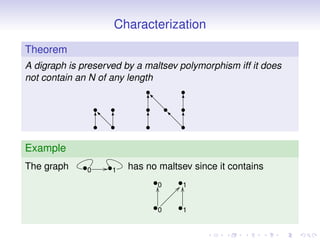
Theorem
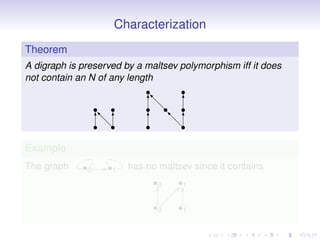
A digraph is preserved by a maltsev polymorphism iff it does
not contain an N of any length
                             s     s
                             Ts
                              d    T
                  s  s       s ds  s
                  T T
                  s
                  d          T d T
                                s
                  s ds       s    ds

Example
The graph    •0    /
                   •1    has no maltsev since it contains
                              •O0     •
                                      ? O1
                                   
                                 
                              •0 •1
Characterization
Theorem
A digraph is preserved by a maltsev polymorphism iff it does
not contain an N of any length
                             s     s
                             Ts
                              d    T
                  s  s       s ds  s
                  T T
                  s
                  d          T d T
                                s
                  s ds       s    ds

Example
The graph    •0    /
                   •1    has no maltsev since it contains
                              •O0     •
                                      ? O1
                                   
                                 
                              •0 •1
Recognition in polynomial time


The non existence of Ns of length 1 is equivalent in the
adjacency matrix to the following property: when 2 rows, or
columns, share a 1 then they are identical.


It folllows from that maltsev digraphs can be recognized in
polynomial time on the number of vertices, O(n4 ).
CSP


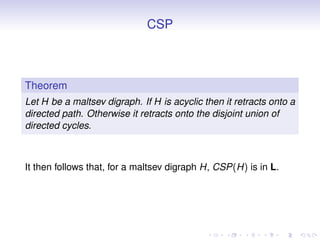
Theorem
Let H be a maltsev digraph. If H is acyclic then it retracts onto a
directed path. Otherwise it retracts onto the disjoint union of
directed cycles.


It then follows that, for a maltsev digraph H, CSP(H) is in L.
List Homomorphism problem


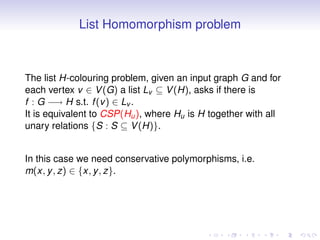
The list H-colouring problem, given an input graph G and for
each vertex v ∈ V (G) a list Lv ⊆ V (H), asks if there is
f : G −→ H s.t. f (v ) ∈ Lv .
It is equivalent to CSP(Hu ), where Hu is H together with all
unary relations {S : S ⊆ V (H)}.


In this case we need conservative polymorphisms, i.e.
m(x, y , z) ∈ {x, y , z}.
Characterization


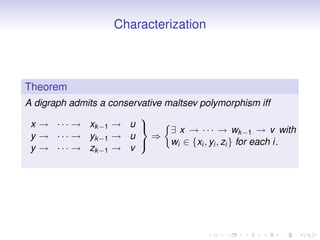
Theorem
A digraph admits a conservative maltsev polymorphism iff
                          
 x → · · · → xk −1 → u 
                                 ∃ x → · · · → wk −1 → v with
 y → · · · → yk −1 → u       ⇒
                                 wi ∈ {xi , yi , zi } for each i.
 y → · · · → zk −1 → v
                          
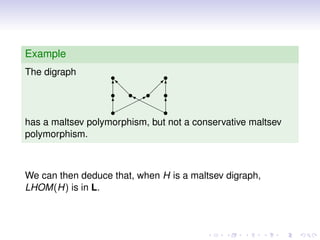
Example
The digraph        s          s
                   T
                   s
                   d        
                             T
                   s ds     s
                          s
                       ‰
                       rB
                        ¨
                   T¨¨rr T
                   s
                   ¨        rs
has a maltsev polymorphism, but not a conservative maltsev
polymorphism.


We can then deduce that, when H is a maltsev digraph,
LHOM(H) is in L.
Cycles and paths
Theorem
Let H be a (conservative) maltsev digraph. Then H is
preserved by (conservative) polymorphisms t1 , t2 , . . . , tk (not
necessarily distinct) satisfying a single equational sequence

    t1 (x1,1 , x1,2 , . . . , x1,n1 ) ≈ · · · ≈ tk (xk ,1 , xn,2 , . . . , xk ,nk ) ≈ x,

where {x1,1 , . . . , x1,n1 } = · · · = {xk ,1 , . . . , xk ,nk } and
x ∈ {x1,1 , . . . , x1,n1 }, iff the directed path/cycle is preserved by
these polymorphisms.


Maltsev iff Pixley iff Minority implies Majority

m(x, y , y ) = m(y , y , x) = m(x, y , x) = x
m(x, y , y ) = m(y , x, y ) = m(y , y , x) = x
2-semilattice polymorphisms


A binary polymorphism c is commutative if c(x, y ) = c(y , x).

A disjoint union of directed cycles admits a binary conservative
commutative polymorphism iff it contains no even cycles.


Theorem
A maltsev digraph with a conservative commutative
polymorphism is a conservative maltsev digraph.


These do not retract to cycles of even length.

Csr2011 june16 11_00_carvalho

  • 1.
    Maltsev digraphs C. Carvalhoa, L. Egrib , M. Jacksonc and T. Nivenc a University of Hertfordshire, b McGill University, c LaTrobe University CSR 2011
  • 2.
    Digraphs A directed graphor digraph is a relational structure G = (V , E) with domain V , the vertices, and relation E ⊆ V × V , the directed edges or arcs. A polymorphism f of G is an n-ary operation in V that is a homomorphism f : G × · · · × G −→ G. A maltsev polymorphism of G is a 3-ary polymorphism, m, that satisfies m(x, y , y ) = m(y , y , x) = x for all x, y ∈ V .
  • 3.
    Constraint Satisfaction Problem or Homomorphism Problem Given two digraphs G = (V (G), E(G)), H = (V (H), E(H)) is there a homomorphism h : G −→ H? h satisfies (a, b) ∈ E(G) ⇒ (h(a), h(b)) ∈ E(H). If a homomorphism exists we write G −→ H. The CSP with a fixed H is denoted CSP(H), and can be viewed as {G : G −→ H}.
  • 4.
    CSP Example CSP(K2 ) isthe graph 2-colourability problem. More generally CSP(H), with H a digraph is the H-colouring problem. This is a much studied problem in graph theory. Problem: Classify CSP(H) with respect to computational (and descriptive) complexity.
  • 5.
    Polymorphisms and complexity Goodpolymorphisms imply tractability. Lack of polymorphisms NP-complete problems. Certain polymorphism imply membership in a specific complexity class. Example (Dalmau, Krokhin) If H is preserved by a majority operation then CSP(H) is in NL. m(x, y , y ) = m(y , x, y ) = m(y , y , x) = y
  • 6.
    Polymorphisms and complexity Goodpolymorphisms imply tractability. Lack of polymorphisms NP-complete problems. Certain polymorphism imply membership in a specific complexity class. Example (Dalmau, Krokhin) If H is preserved by a majority operation then CSP(H) is in NL. m(x, y , y ) = m(y , x, y ) = m(y , y , x) = y
  • 7.
    Example (Dalmau, Larose) IfH is preserved by a maltsev operation + extra condition then CSP(H) is in L. Polymorphisms are not easy to understand from a combinatorial point of view. Aim: combinatorial description of digraphs with certain algebraic properties.
  • 8.
    Characterization Theorem A digraph ispreserved by a maltsev polymorphism iff it does not contain an N of any length s s Ts d T s s s ds s T T s d T d T s s ds s ds Example The graph •0 / •1 has no maltsev since it contains •O0 • ? O1   •0 •1
  • 9.
    Characterization Theorem A digraph ispreserved by a maltsev polymorphism iff it does not contain an N of any length s s Ts d T s s s ds s T T s d T d T s s ds s ds Example The graph •0 / •1 has no maltsev since it contains •O0 • ? O1   •0 •1
  • 10.
    Recognition in polynomialtime The non existence of Ns of length 1 is equivalent in the adjacency matrix to the following property: when 2 rows, or columns, share a 1 then they are identical. It folllows from that maltsev digraphs can be recognized in polynomial time on the number of vertices, O(n4 ).
  • 11.
    CSP Theorem Let H bea maltsev digraph. If H is acyclic then it retracts onto a directed path. Otherwise it retracts onto the disjoint union of directed cycles. It then follows that, for a maltsev digraph H, CSP(H) is in L.
  • 12.
    List Homomorphism problem Thelist H-colouring problem, given an input graph G and for each vertex v ∈ V (G) a list Lv ⊆ V (H), asks if there is f : G −→ H s.t. f (v ) ∈ Lv . It is equivalent to CSP(Hu ), where Hu is H together with all unary relations {S : S ⊆ V (H)}. In this case we need conservative polymorphisms, i.e. m(x, y , z) ∈ {x, y , z}.
  • 13.
    Characterization Theorem A digraph admitsa conservative maltsev polymorphism iff  x → · · · → xk −1 → u  ∃ x → · · · → wk −1 → v with y → · · · → yk −1 → u ⇒ wi ∈ {xi , yi , zi } for each i. y → · · · → zk −1 → v 
  • 14.
    Example The digraph s s T s d  T s ds   s s ‰ rB ¨ T¨¨rr T s ¨ rs has a maltsev polymorphism, but not a conservative maltsev polymorphism. We can then deduce that, when H is a maltsev digraph, LHOM(H) is in L.
  • 15.
    Cycles and paths Theorem LetH be a (conservative) maltsev digraph. Then H is preserved by (conservative) polymorphisms t1 , t2 , . . . , tk (not necessarily distinct) satisfying a single equational sequence t1 (x1,1 , x1,2 , . . . , x1,n1 ) ≈ · · · ≈ tk (xk ,1 , xn,2 , . . . , xk ,nk ) ≈ x, where {x1,1 , . . . , x1,n1 } = · · · = {xk ,1 , . . . , xk ,nk } and x ∈ {x1,1 , . . . , x1,n1 }, iff the directed path/cycle is preserved by these polymorphisms. Maltsev iff Pixley iff Minority implies Majority m(x, y , y ) = m(y , y , x) = m(x, y , x) = x m(x, y , y ) = m(y , x, y ) = m(y , y , x) = x
  • 16.
    2-semilattice polymorphisms A binarypolymorphism c is commutative if c(x, y ) = c(y , x). A disjoint union of directed cycles admits a binary conservative commutative polymorphism iff it contains no even cycles. Theorem A maltsev digraph with a conservative commutative polymorphism is a conservative maltsev digraph. These do not retract to cycles of even length.