Basic concepts of relations , digraph and POSETpdf
1.
Relations and Functions(Continued)
Zero – one Matrices
Let R be the relationfrom A to B so that R is a subset of AxB. Let mij = (ai,bj) and assign the values
1 or 0 according the following rule
The mxn matrix formed by mij’s is called the matrix of the relation R, or the relation matrix R,
and is denoted by MR or M(R). Since M(R) contains only 0 and 1 as its elements M(R) is also
called the Zero – one matrix for R.
Directed graph or Digraph of R
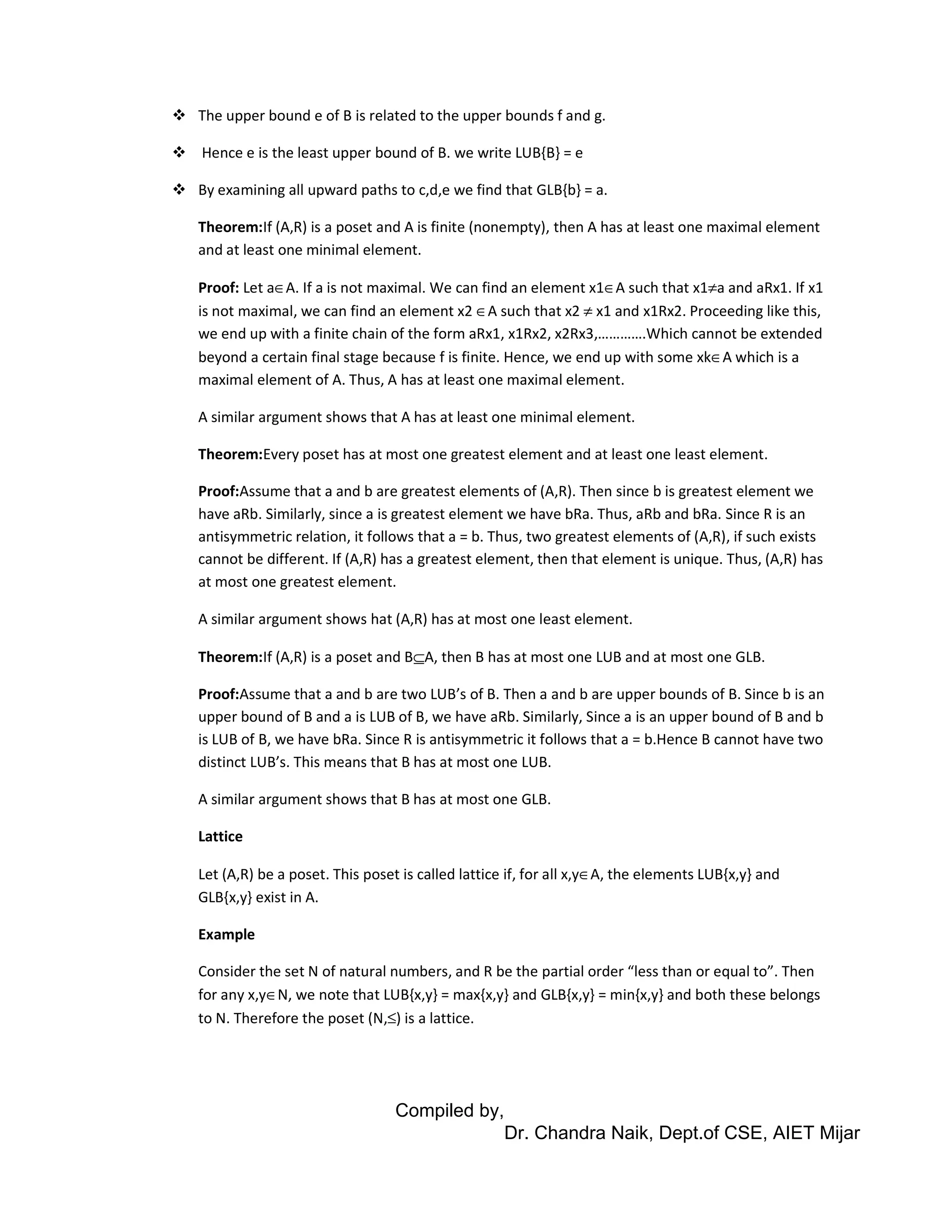
Let R be a relation on a finite set A. Then R can be represented pictorially with arrows and the
elements within the circle, is called Directed graph of R or Digraph of R
Problems
1. Let A = {1,2,3,4} and let R be the relation on A defined by xRy if and only if “x divides y”
a) Write down R as a set of ordered pairs.
b) Draw the diagraph of R.
c) Determine the in-degree and out-degree of the vertices in the diagraph.
d) Write the matrix
Solution:
AxA = {(1,1),(1,2),(1,3),(1,4), (2,1), (2,2),(2,3), (2,4), (3,1), (3,2), (3,3), (3,4),
(4,1), (4,2), (4,3), (4,4)}
R = {(1,1), ),(1,2),(1,3),(1,4), (2,2), (2,4), (3,3), (4,4)} . The diagraph of R is
( )
( )
∉
∈
=
R
a
a
if
R
a
a
if
m
j
i
j
i
ij
,
0
,
1
2.
Vertices 1 23 4
In-degree 1 2 2 3
Out-degree 4 2 1 1
The matrix representation is
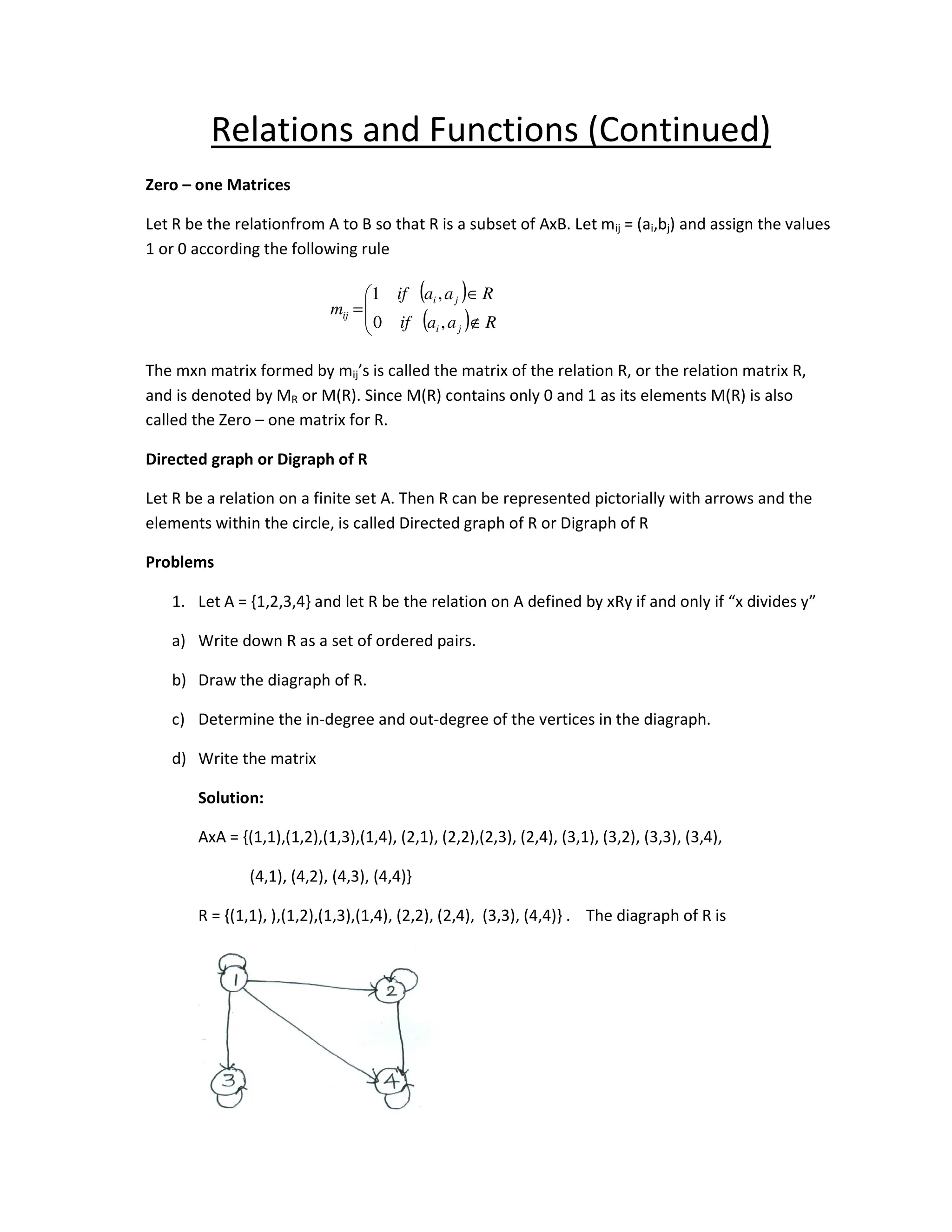
2. If R={(x,y)|x ≥ y} is relation defined on a set A = {1,2,3,4}.
a) Write down R as a set of ordered pairs.
b) Draw the diagraph of R.
c) Determine the in-degree and out-degree of the vertices in the diagraph.
d) Write the matrix
Solution:
AxA = {(1,1),(1,2),(1,3),(1,4), (2,1), (2,2), (2,3), (2,4), (3,1), (3,2), (3,3), (3,4), (4,1),
(4,2), (4,3), (4,4)}
R = {(1,1),(2,1), (2,2),(3,1), (3,2), (3,3), (4,1), (4,2), (4,3), (4,4)}
The digraph of R is
( )
=
1
0
0
0
0
1
0
0
1
0
1
0
1
1
1
1
R
M
3.
Vertices 1 23 4
In-degree 4 3 2 1
Out-degree 1 2 3 4
The matrix representation of R is
3. The matrix of the relation on the set A = {a,b,c,d,e} is
a) Write down R as a set of ordered pairs.
b) Draw the diagraph of R.
c) Determine the in-degree and out-degree of the vertices in the diagraph.
Solution:
R = {(a,a), (a,b), (b,c), (b,d), (c,d), (c,e), (d,b), (d,c), (e,a)}
[Answer for b and c as per previous examples]
4. The digraph of the relation on the set A = {a,b,c,d,e,f} is
a) Write down R as a set of ordered pairs.
b) Draw the matrix of R.
c) Determine the in-degree and out-degree of the vertices in the diagraph.
( )
=
1
1
1
1
0
1
1
1
0
0
1
1
0
0
0
1
R
M
0
0
0
0
1
0
0
1
1
0
1
1
0
0
0
0
1
1
0
0
0
0
0
1
1
4.
RESULTS
(a,b)∈R or(a,b)∈S then (a,b)∈R∪S
(a,b)∈R and (a,b)∈S then (a,b)∈R∩S
is the complement of the set R in the universal set AXB.
Rc
is the converse of R
[(a,b)∈Rc
if and only if (b,a)∈R]
If MR is the matrix of R then (MR)T
is the matrix of Rc
5. Let A=B = {1,2,3}, and R = {(1,1), (1,2),(2,3),(3,1)}, S = {(2,1),(3,1), (3,2),(3,3)}
a) Compute R∪S, R∩S, Rc
, Sc
b) Draw the diagraphs.
c) Determine the in-degree and out-degree of the vertices in the diagraphs.
d) Write the matrices.
Solution:
Given that R = {(1,1), (1,2),(2,3),(3,1)} and S = {(2,1),(3,1), (3,2),(3,3)}
R∪S = {(1,1), (1,2),(2,3),(2,1),(3,1), (3,2), (3,3)}
R∩S = {(3,1)}
AxB = {(1,1),(1,2),(1,3),(2,1), (2,2),
(2,3),(3,1), (3,2), (3,3)}
= {(1,3),(2,1), (2,2), (3,2), (3,3)}
= {(1,1),(1,2),(1,3), (2,2), (2,3)}
Rc
= {(1,1), (2,1), (3,2), (1,3)}
Sc
= {(1,2), (1,3), (2,3), (3,3)}
[Answer for c and d as per previous examples]
R
S
,
R
R
S
5.
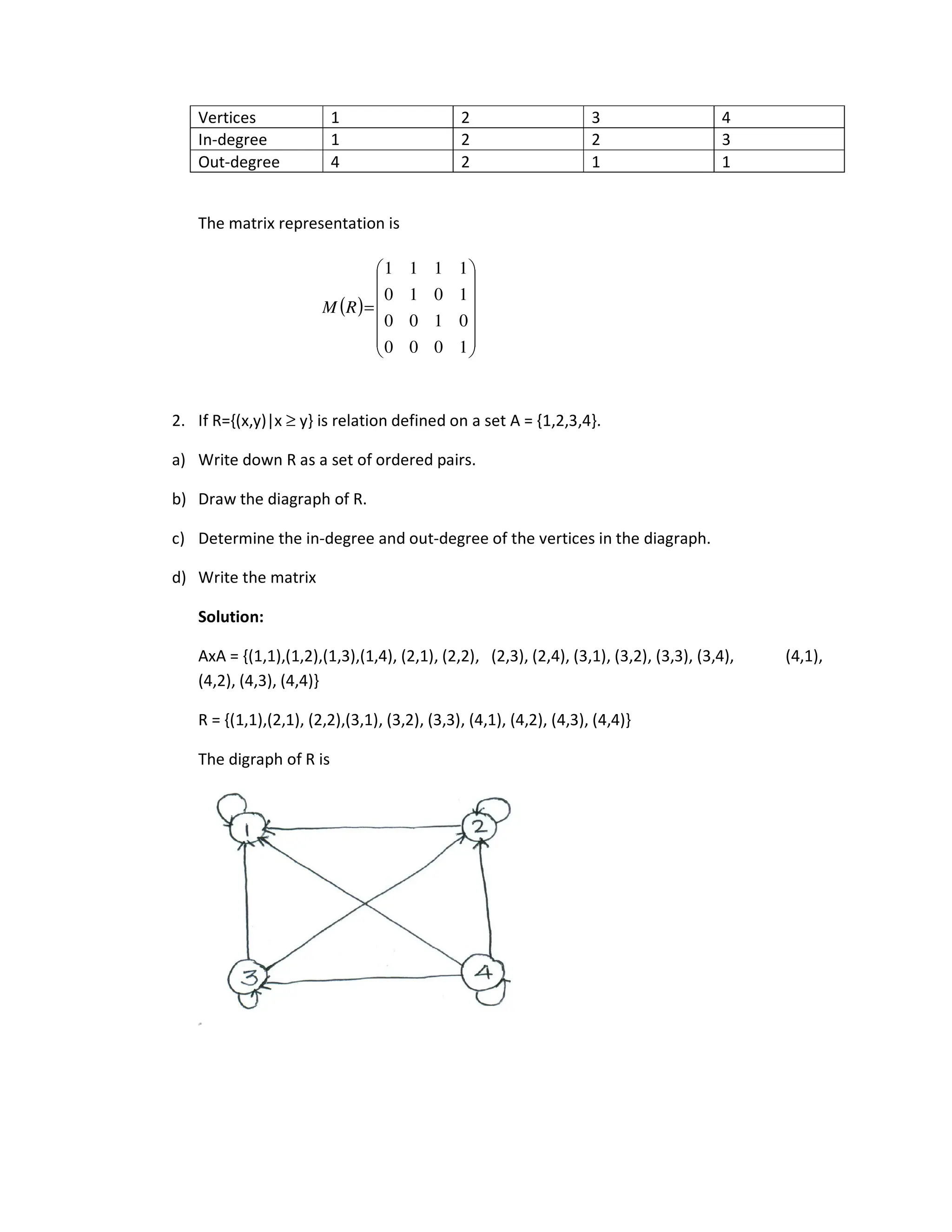
6. The digraphsof R and S are given as
a) Write R and S as ordered pairs
b) Compute R∪S, R∩S, Rc
, Sc
c) Determine the in-degree and out-degree of the vertices in the diagraphs.
d) Write the matrices.
COMPOSITION OF RELATION
R is a relation from A to B and S is a relation from B to C then RοS = {(a,c)|a∈A,c∈C, and
there exists b∈B with (a,b)∈A and (b,c)∈B}
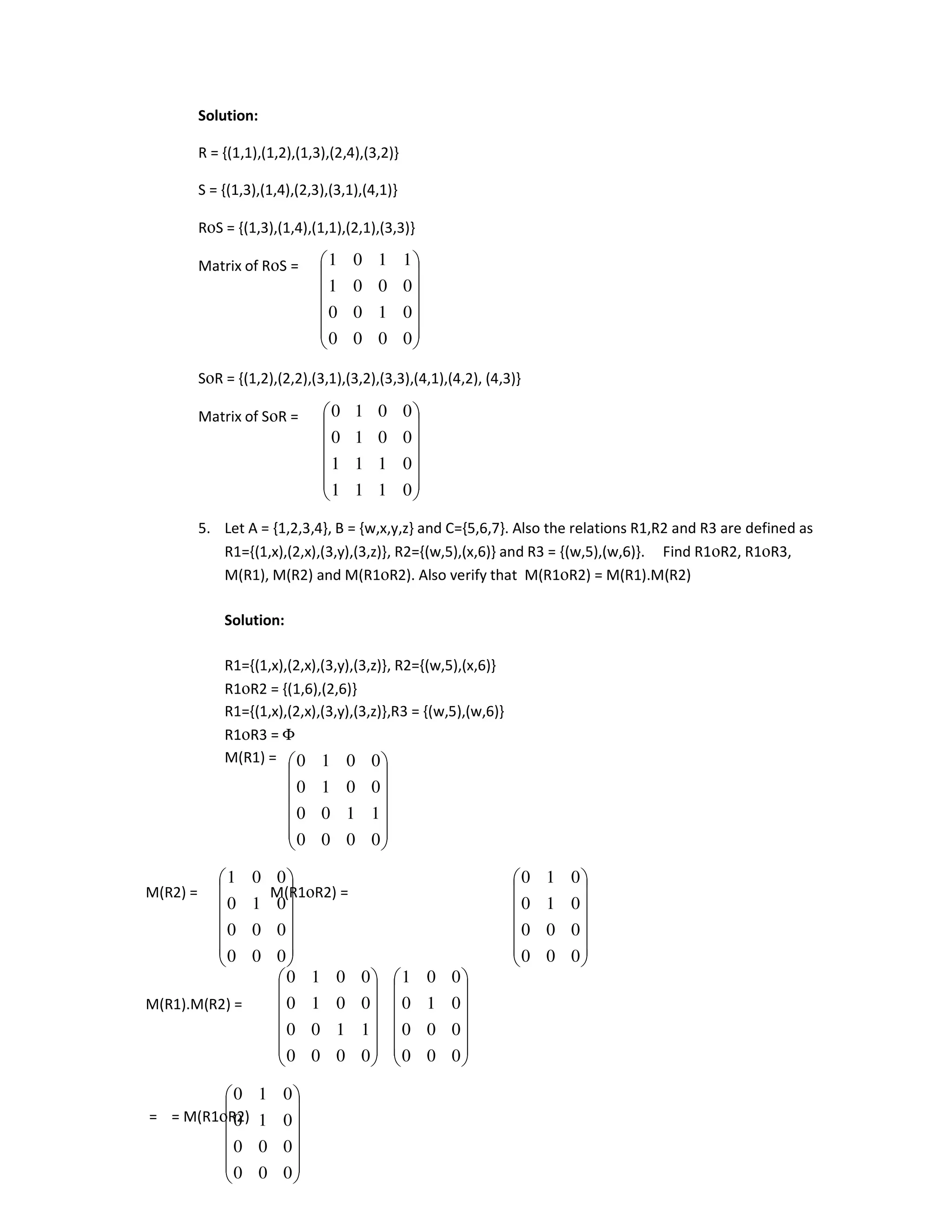
1. Let A = {1,2,3,4} and R = {(1,1),(1,3),(3,2), (3,4),(4,2)} and S = {(2,1),(3,3),(3,4),(4,1)} be
relations on A. Find RοS, SοR, R2
, R3
, S2
, S3
.
Solution: Given that R = {(1,1),(1,3),(3,2), (3,4),(4,2)} and S = {(2,1),(3,3),(3,4),(4,1)}
RοS = {(1,3), (1,4), (3,1), (4,1)}
SοR = {(2,1), (1,3), (3,2), (3,4), (4,1), (4,3)}
RοR = R2
= {(1,1),(1,3),(1,2),(1,4),(3,2)}
R2
οR = R3
= {(1,1),(1,3),(1,2),(1,4)}
SοS= S2
= {(3,3),(3,4),(3,1)}
S2
οS = S3
= {(3,3),(3,4),(3,1)}
2. Let A = {1,2,3,4} and R = {(1,1),(1,2),(2,3),(3,3),(3,4)} be relation on A. Find R2
, R3
, R4
and
draw their graphs.
S
,
R
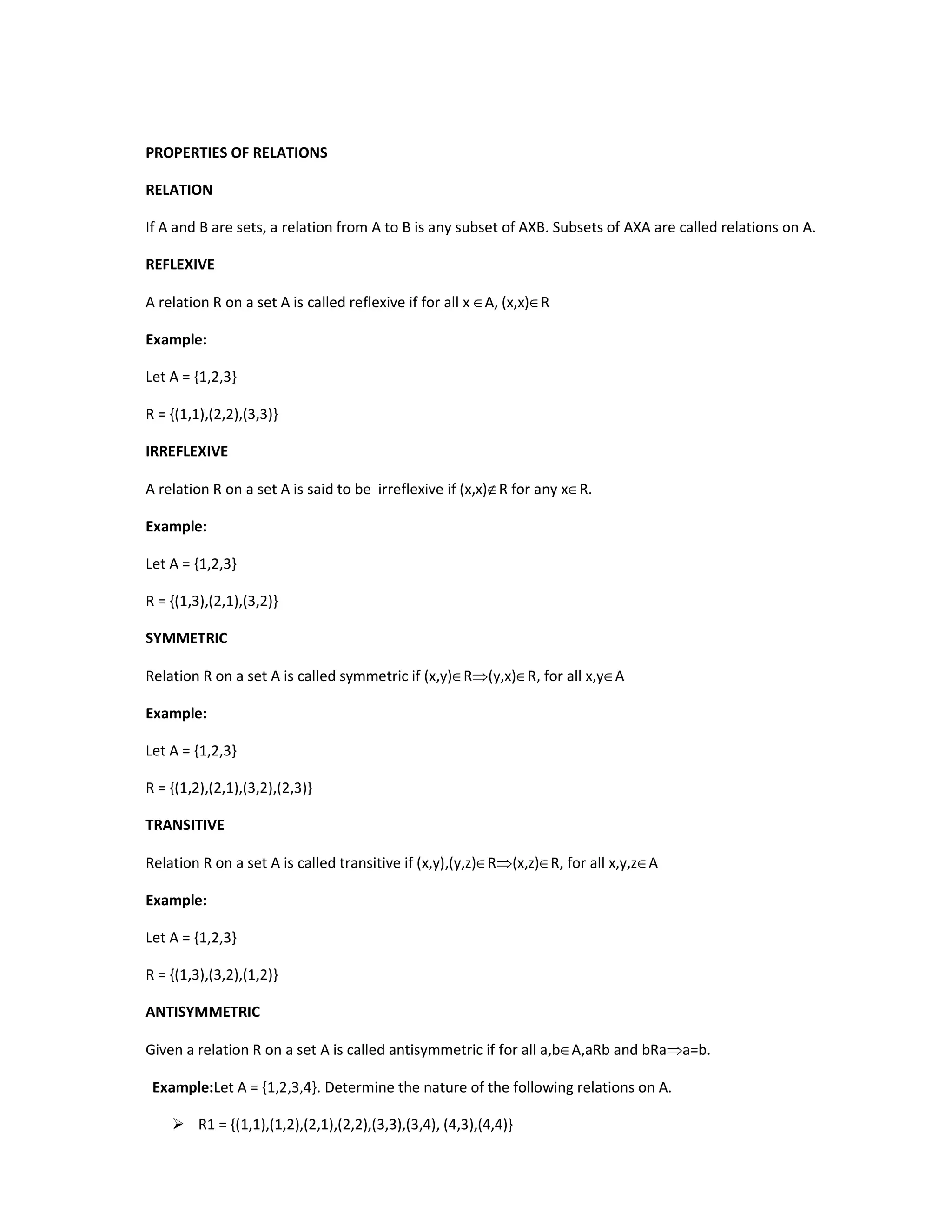
PROPERTIES OF RELATIONS
RELATION
IfA and B are sets, a relation from A to B is any subset of AXB. Subsets of AXA are called relations on A.
REFLEXIVE
A relation R on a set A is called reflexive if for all x ∈A, (x,x)∈R
Example:
Let A = {1,2,3}
R = {(1,1),(2,2),(3,3)}
IRREFLEXIVE
A relation R on a set A is said to be irreflexive if (x,x)∉R for any x∈R.
Example:
Let A = {1,2,3}
R = {(1,3),(2,1),(3,2)}
SYMMETRIC
Relation R on a set A is called symmetric if (x,y)∈R⇒(y,x)∈R, for all x,y∈A
Example:
Let A = {1,2,3}
R = {(1,2),(2,1),(3,2),(2,3)}
TRANSITIVE
Relation R on a set A is called transitive if (x,y),(y,z)∈R⇒(x,z)∈R, for all x,y,z∈A
Example:
Let A = {1,2,3}
R = {(1,3),(3,2),(1,2)}
ANTISYMMETRIC
Given a relation R on a set A is called antisymmetric if for all a,b∈A,aRb and bRa⇒a=b.
Example:Let A = {1,2,3,4}. Determine the nature of the following relations on A.
R1 = {(1,1),(1,2),(2,1),(2,2),(3,3),(3,4), (4,3),(4,4)}
9.
R2 = {(1,2),(1,3),(3,1),(1,1),(3,3),(3,2),(1,4), (4,2),(3,4)}
Solution:R1 is reflexive, symmetry and transitive.R2 is transitive
Equivalence Relation
A relation R on a set is said to be an equivalence relation on A if (i)R is reflexive (ii) R is symmetric (iii) R is
transitive , on A.
1. Let A = {1,2,3,4} and R = {(1,1),(1,2),(2,1), (2,2),(3,4),(4,3),(3,3),(4,4)} be a relation A. Verify that R
is equivalence relation.
Solution:
We note that (1,1),(2,2),(3,3),(4,4) belongs to R. That is (a,a)∈R for all a∈A
∴R is reflexive relation.
Next, we note that (1,2),(2,1) and (3,4),(4,3)∈R. That is whenever (a,b)∈R then (b,a)∈R for a,b∈A
∴R is symmetry relation.
Finally, (1,2),(2,1),(1,1)∈R,
(2,1),(1,2),(2,2)∈R,
(4,3),(3,4),(4,4)∈R,
That is whenever (a,b)∈R,(b,c)∈R then for (a,c)∈R a,b,c∈A
∴R is transitive relation.
Hence R is an equivalence relation
2. Let A = {1,2,3,4,5,6, 7,8,9, 10, 11, 12}. On this set define the relation R by (x,y)∈R iff x – y is
multiple of 5.verify R is an equivalence relation.
Equivalence Classes
Let R be an equivalence relation on a set A and a∈A. Then the set of all those elements x of A which are
related to a by R is called equivalence class of a with respect to R. This equivalence class is denoted by
R(a) or [a], or
=[a] = R(a) = {x∈A | (x,a)∈R}
Example
Let R = {(1,1), (1,3), (2,2), (3,1), (3,3)}
[1] = {1,3}[2] = {2}[3] = {1,3}
a
a
10.
Partition of aset
Let A be a nonempty set. Suppose there exists nonempty subsets A1,A2,……,Ak, o A such that the
following two conditions hold:
A is the union of A1,A2,……,Ak i.e. A = A1UA2U……UAk
Any two of the subsets A1,A2,……,Ak are disjoint; i.e. Ai∩Aj = Φ for i≠j
1. For the equivalence relation R = {(1,1), (1,2), (2,1),(2,2), (3,4),(4,3),(3,3),(4,4)} defined on the
set A = {1,2,3,4}, determined the partion induced.
Solution:
[1] = {1,2}, [2] = {1,2}, [3] = {3,4}, [4] = {3,4}
[1] and [3] are distinct.
Partion P = {[1],[3]} = {{1,2},{3,4}}
2. Let A = {a,b,c,d,e}. Consider the partion P = {{a,b},{c,d},{e}} of A. Find the equivalence relation
inducing the partion.
Solution:
P has {a,b} then (a,a),(a,b),(b,a),(b,b)∈R
P has {c,d} then (c,c),(c,d),(d,c),(d,d) ∈R
P has {e} then (e,e) ∈R
∴R = {(a,a),(a,b),(b,a),(b,b), (c,c),(c,d),(d,c), (d,d), (e,e)}
3. Let A = {1,2,3,4,5,6,7} and R be the equivalence relation on A that induces the partition A =
{1,2}∪{3}∪{4,5,7}∪{6}. Find R.
Solution:
R = {(1,1),(1,2),(2,1),(2,2),(3,3),(4,4),(4,5), (4,7),(5,5),(5,7),(5,4),(7,4),(7,5),(7,7),(6,6}}
4. Let A = {1,2,3,4,5}. Define a relation R on AxA by (x1,y1)R(x2,y2) iff x1+y1 = x2+y2
Verify that R is an equivalence relation on AxA.
Determine the equivalence classes [(1,3)], [(2,4)] and [(1,1)]
Determine the partition of AxA induced by R.
Solution:
For all (x,y)∈AxA, we have x+y = x+y i.e. (x,y)R(x,y). ∴R is reflexive.
11.
Let us consider(x1,y1),(x2,y2) ∈AxA. Also (x1,y1)R(x2,y2)i.e. x1+y1 = x2+y2.This gives x2+y2 =
x1+y1 which means (x2,y2)R(x1,y1). ∴R is symmetric.
Let us consider (x1,y1),(x2,y2) and (x3,y3) ∈AxA. Suppose that (x1,y1)R(x2,y2) and
(x2,y2)R(x3,y3).Then x1+y1 = x2+y2 and x2+y2= x3+y3.This gives x1+y1 = x3+y3 which means
(x1,y1)R(x3,y3). ∴R is transitive.
Thus, R is reflexive, symmetric and transitive. Hence R is an equivalence relation.
We note that
[(1,3)] = {(x,y)∈AxA|(x,y)R(1,3)}
= {(x,y)∈AxA|x+y = 1+3}
= {(1,3), (2,2), (3,1)}
Since A = {1,2,3,4,5}
Similarly [(2,4)] = {(1,5),(2,4),(3,3),(4,2), (5,1)}
[(1,1)] = {(1,1)}
To determine the partition induced by R, we have to find the equivalence classes of all elements
(x,y) of AxA with respect to R.
[(1,1)] = {(1,1)}
[(1,3)] = [(2,2)] = [(3,1)]
[(2,4)] = [(1,5)] = [(3,3)] = [(4,2)] = [(5,1)]
[(1,2)] = {(1,2),(2,1)} = [(2,1)]
[(1,4)] = {(1,4),(2,3),(3,2),(4,1)} = [(2,3)] = [(3,2)] = [(4,1)]
[(2,5)] = {(2,5), (5,2), (3,4), (4,3)} = [(3,4) = [(4,3)] = [(5,2)]
[(3,5)] = {(3,5), (5,3),(4,4)} = [(4,4)] = [(5,3)]
[(4,5)] = {(4,5),(5,4)} = [(5,4)]
[(5,5)] = {(5,5)}
Thus, [(1,1)], [(1,2)], [(1,3)], [(1,4)], [(1,5)], [(2,5)], [(3,5)], [(4,5)], and [(5,5)] are the only distinct
equivalence classes of AxA with respect to R. Hence the partition of AxA induced by R is
represented byAxA = [(1,1)] ∪ [(1,2)] ∪ [(1,3)] ∪ [(1,4)] ∪ [(1,5)] ∪ [(2,5)] ∪ [(3,5)] ∪ [(4,5)]∪
[(5,5)]
12.
Partial Orders
A relationR on a set A is said to be a partial ordering relation or a partial order on A if
i. R is reflexive
ii. R is antisymmetric and
iii. R is transitive, on A
Poset
A set A with a partial order R defined on it is called a partially ordered set or an ordered set or
poset and it denoted by the pair (A,R).
Example:
The relation ≤ on the set of integers Z is a poset (Z,≤)
The relation ≥ on the set of integers Z is a poset (Z,≥)
The relation on the set of integers Z is not a poset (Z,), because reflexive does not exist.
The relation on the set of integers Z is not a poset (Z,), because reflexive does not exist.
Total Order
Let R be a partial order on a set A. Then R is called a total order on A if for all x,y∈A, either xRy or
yRx. In this case, the poset (A,R) is called totally order set.
The totally ordered set is also called a linearly ordered set or chain.
Example:
The partial order relation ≤ is a totally order on the set R. Because, for any x,y∈R we have x ≤ y or
y ≤ x. Thus (R,≤) is a totally ordered set.
The partial order relation ≥ is a totally order on the set R. Because, for any x,y∈R we have x ≥ y
or y ≥ x. Thus (R,≥) is a totally ordered set.
Hasse Diagrams
It is the diagraph of partial orders
Represent the vertices by dots (bullets)
Draw the diagraph in such a way that all edges point upward.
Don’t put arrows for the edges.
This diagraph is called poset diagram or the Hasse diagram for the partial order.
In the hasse diagram don’t include reflexive elements
13.
In the hassediagram don’t include transitive elements
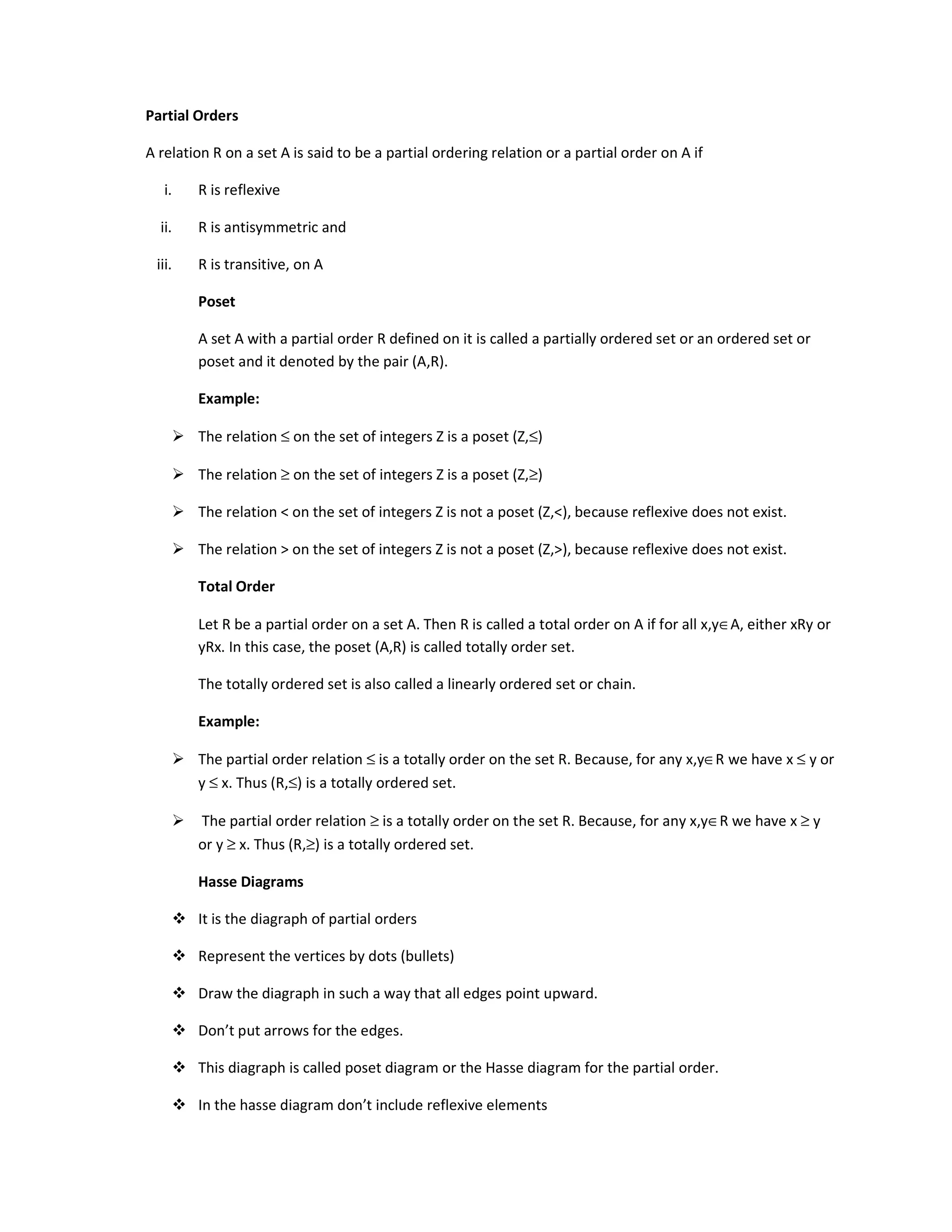
1. Let A = {1,2,3,4} and R = {(1,1), (1,2),(2,2),(2,4),(1,3),(3,3),(3,4), (1,4),(4,4)}. Verify that R is
partial order on A. Also, write down the Hasse diagram for R.
Solution:
Since (1,1),(2,2),(3,3),(4,4) are in R. R is reflexive.
Also, (1,2) is in R but (2,1) is not in R. It is true for other elements in R. Hence R is
antisymmetry.
We note that (1,1), (1,2),(1,2) is in R, (2,2),(2,4),(2,4) in R (1,3),(3,3) (1,3) in R, (3,4), (4,4),
(3,4) is in R. Hence R is transitive. Hence R is partial order on A.
R for Hasse diagram is {(1,2), (1,3), (2,4), (3,4)} and the Hasse diagram is
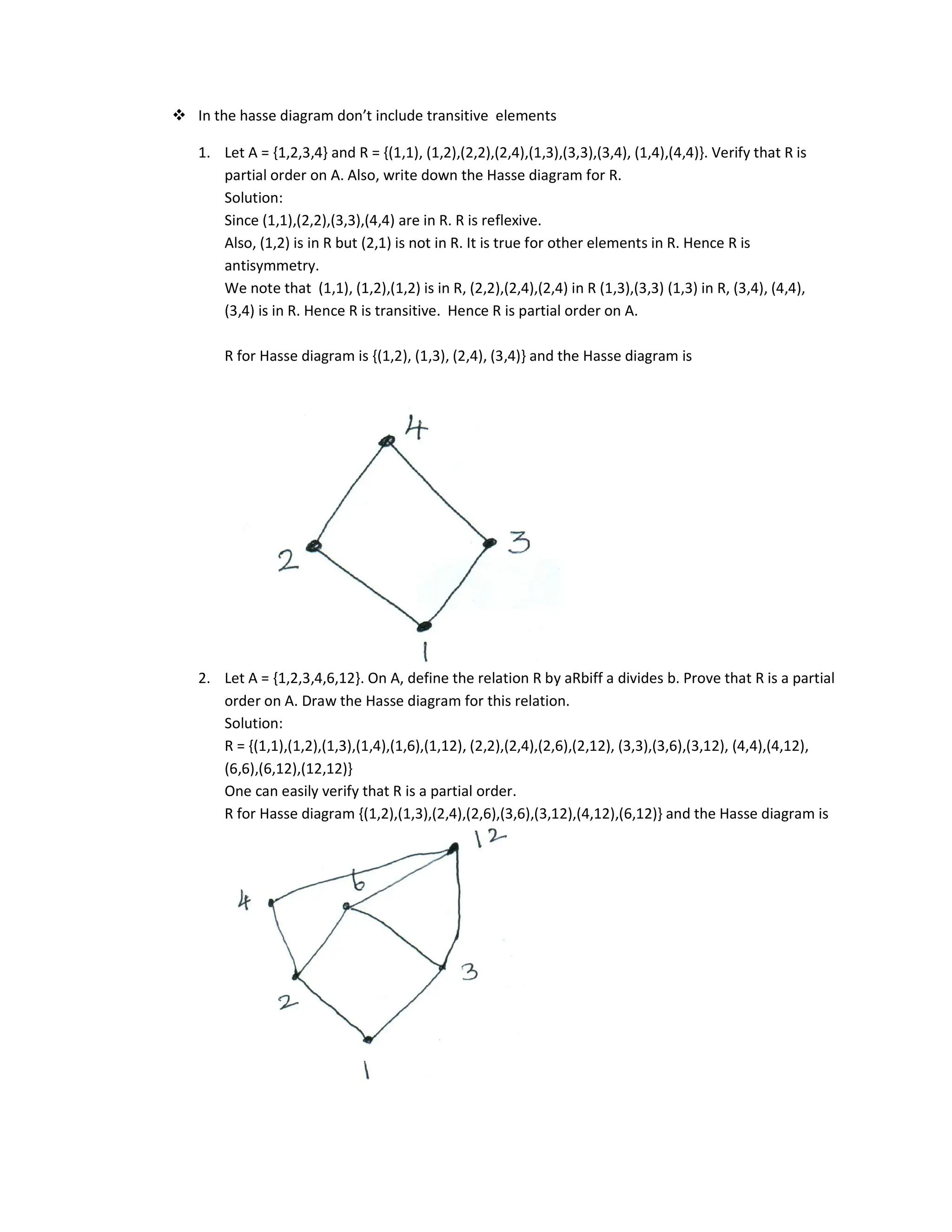
2. Let A = {1,2,3,4,6,12}. On A, define the relation R by aRbiff a divides b. Prove that R is a partial
order on A. Draw the Hasse diagram for this relation.
Solution:
R = {(1,1),(1,2),(1,3),(1,4),(1,6),(1,12), (2,2),(2,4),(2,6),(2,12), (3,3),(3,6),(3,12), (4,4),(4,12),
(6,6),(6,12),(12,12)}
One can easily verify that R is a partial order.
R for Hasse diagram {(1,2),(1,3),(2,4),(2,6),(3,6),(3,12),(4,12),(6,12)} and the Hasse diagram is
14.
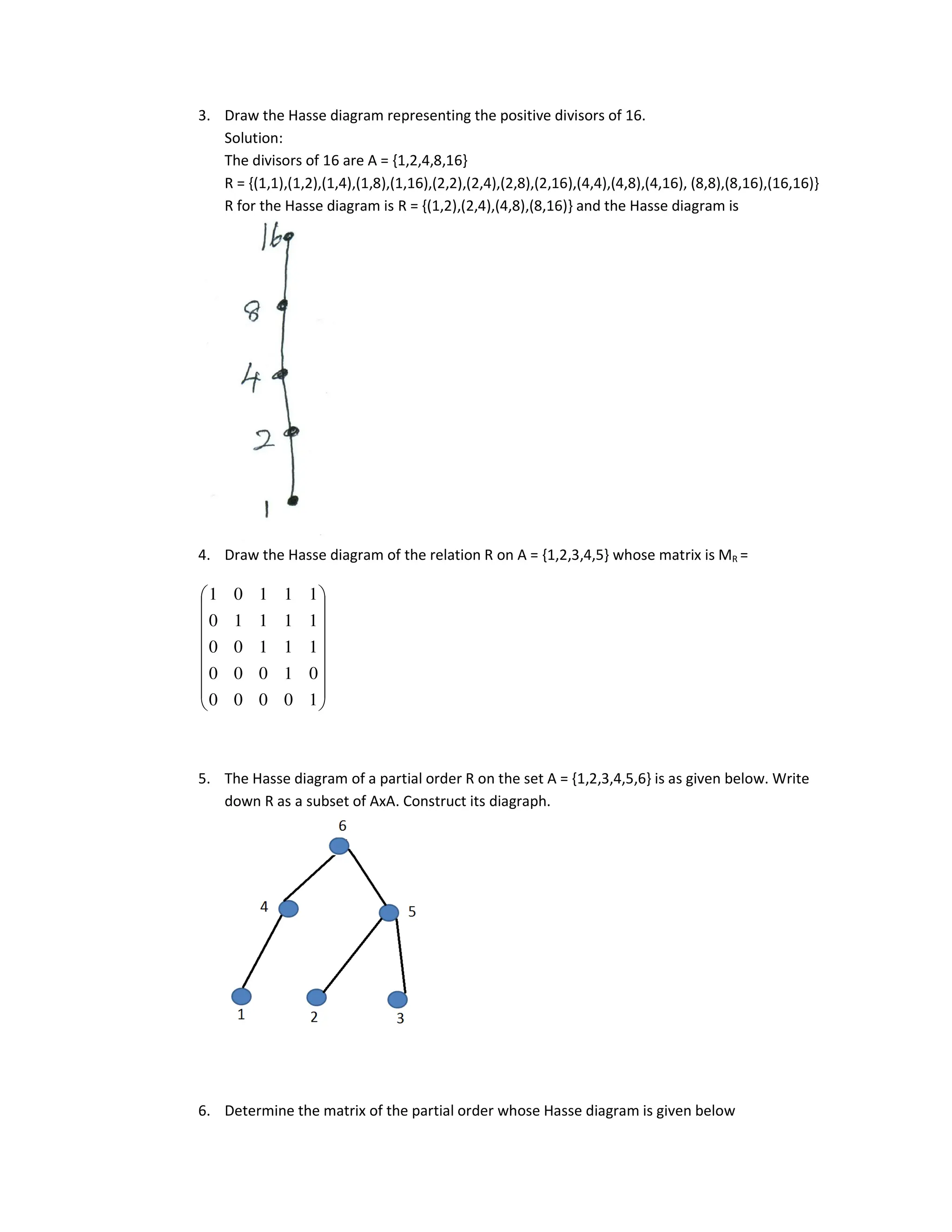
3. Draw theHasse diagram representing the positive divisors of 16.
Solution:
The divisors of 16 are A = {1,2,4,8,16}
R = {(1,1),(1,2),(1,4),(1,8),(1,16),(2,2),(2,4),(2,8),(2,16),(4,4),(4,8),(4,16), (8,8),(8,16),(16,16)}
R for the Hasse diagram is R = {(1,2),(2,4),(4,8),(8,16)} and the Hasse diagram is
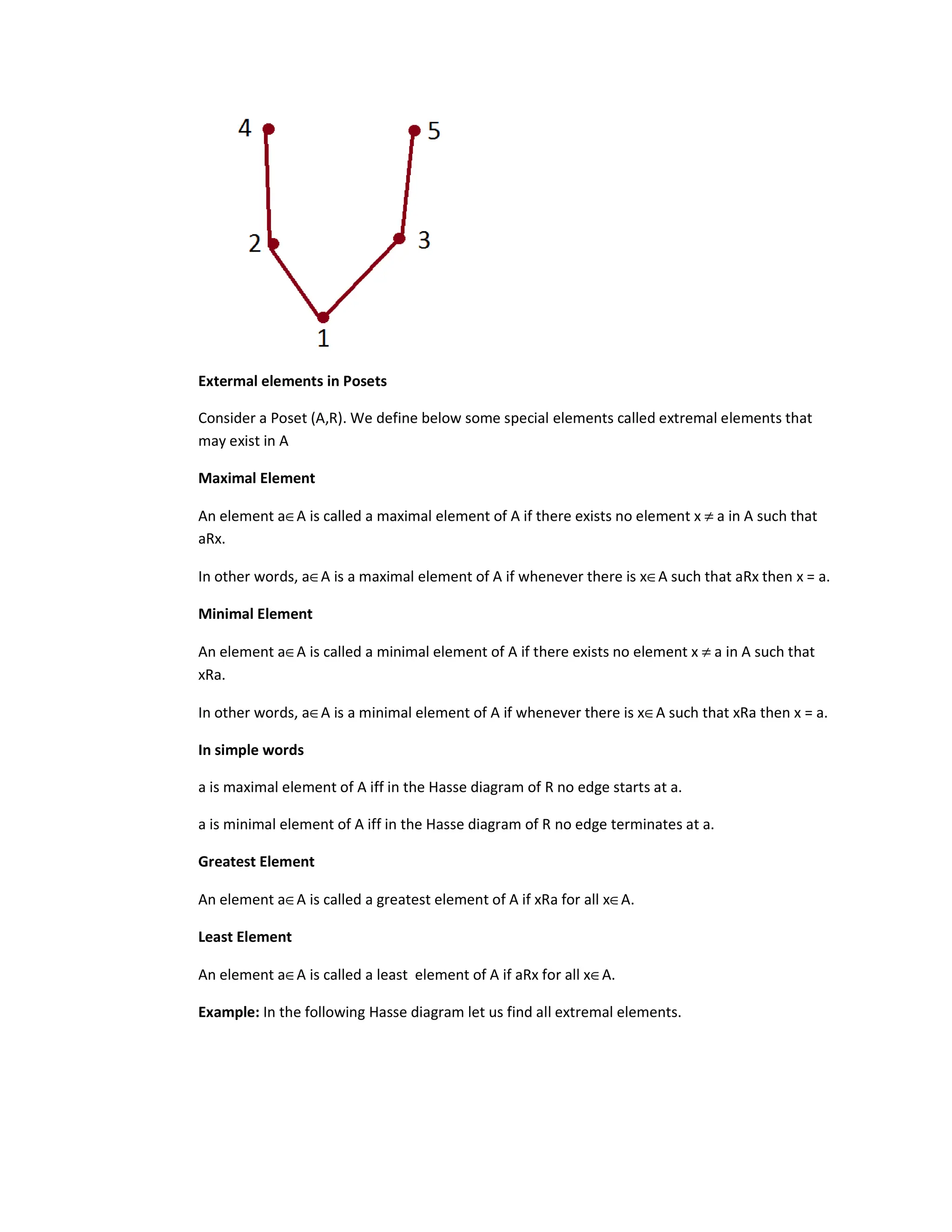
4. Draw the Hasse diagram of the relation R on A = {1,2,3,4,5} whose matrix is MR =
5. The Hasse diagram of a partial order R on the set A = {1,2,3,4,5,6} is as given below. Write
down R as a subset of AxA. Construct its diagraph.
6. Determine the matrix of the partial order whose Hasse diagram is given below
1
0
0
0
0
0
1
0
0
0
1
1
1
0
0
1
1
1
1
0
1
1
1
0
1
15.
Extermal elements inPosets
Consider a Poset (A,R). We define below some special elements called extremal elements that
may exist in A
Maximal Element
An element a∈A is called a maximal element of A if there exists no element x ≠ a in A such that
aRx.
In other words, a∈A is a maximal element of A if whenever there is x∈A such that aRx then x = a.
Minimal Element
An element a∈A is called a minimal element of A if there exists no element x ≠ a in A such that
xRa.
In other words, a∈A is a minimal element of A if whenever there is x∈A such that xRa then x = a.
In simple words
a is maximal element of A iff in the Hasse diagram of R no edge starts at a.
a is minimal element of A iff in the Hasse diagram of R no edge terminates at a.
Greatest Element
An element a∈A is called a greatest element of A if xRa for all x∈A.
Least Element
An element a∈A is called a least element of A if aRx for all x∈A.
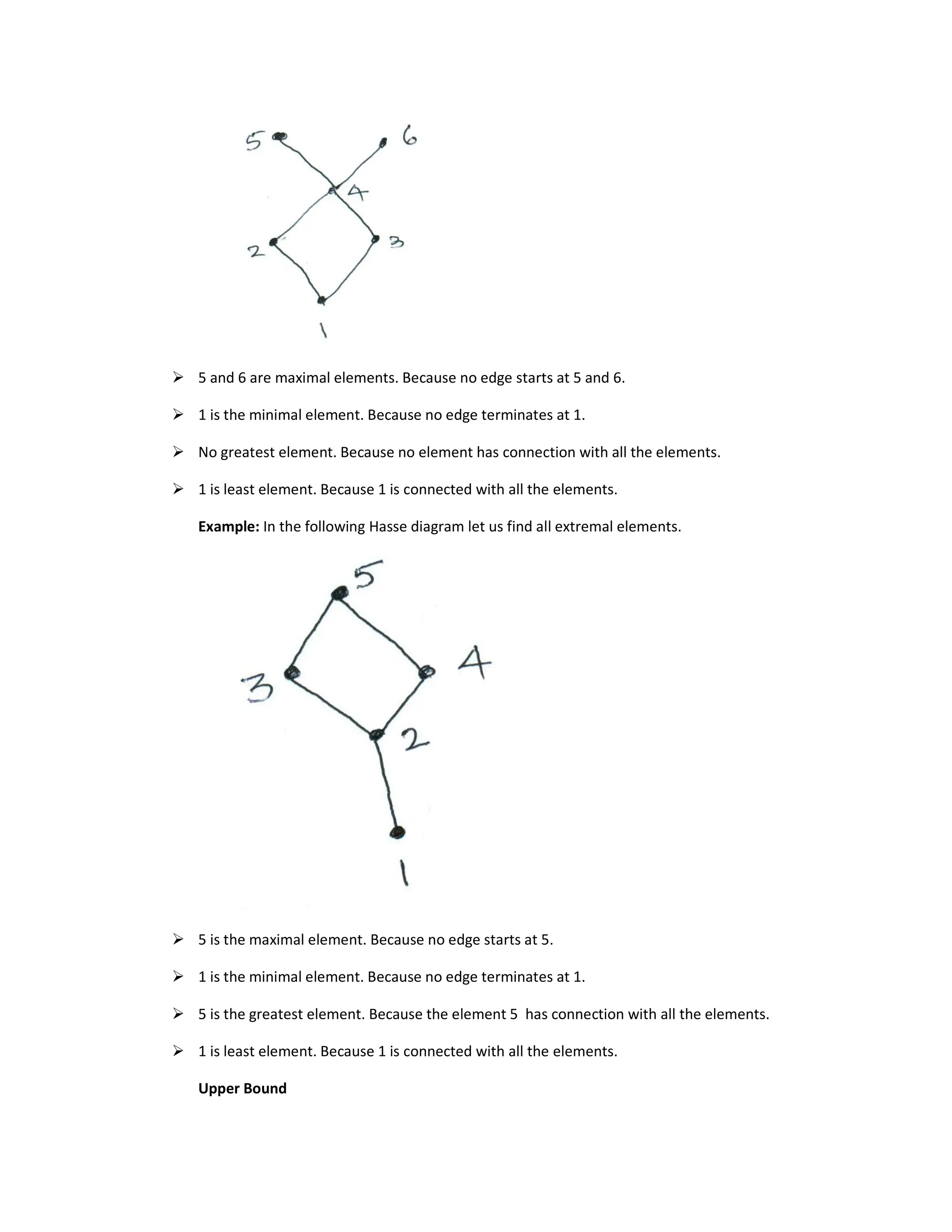
Example: In the following Hasse diagram let us find all extremal elements.
16.
5 and 6are maximal elements. Because no edge starts at 5 and 6.
1 is the minimal element. Because no edge terminates at 1.
No greatest element. Because no element has connection with all the elements.
1 is least element. Because 1 is connected with all the elements.
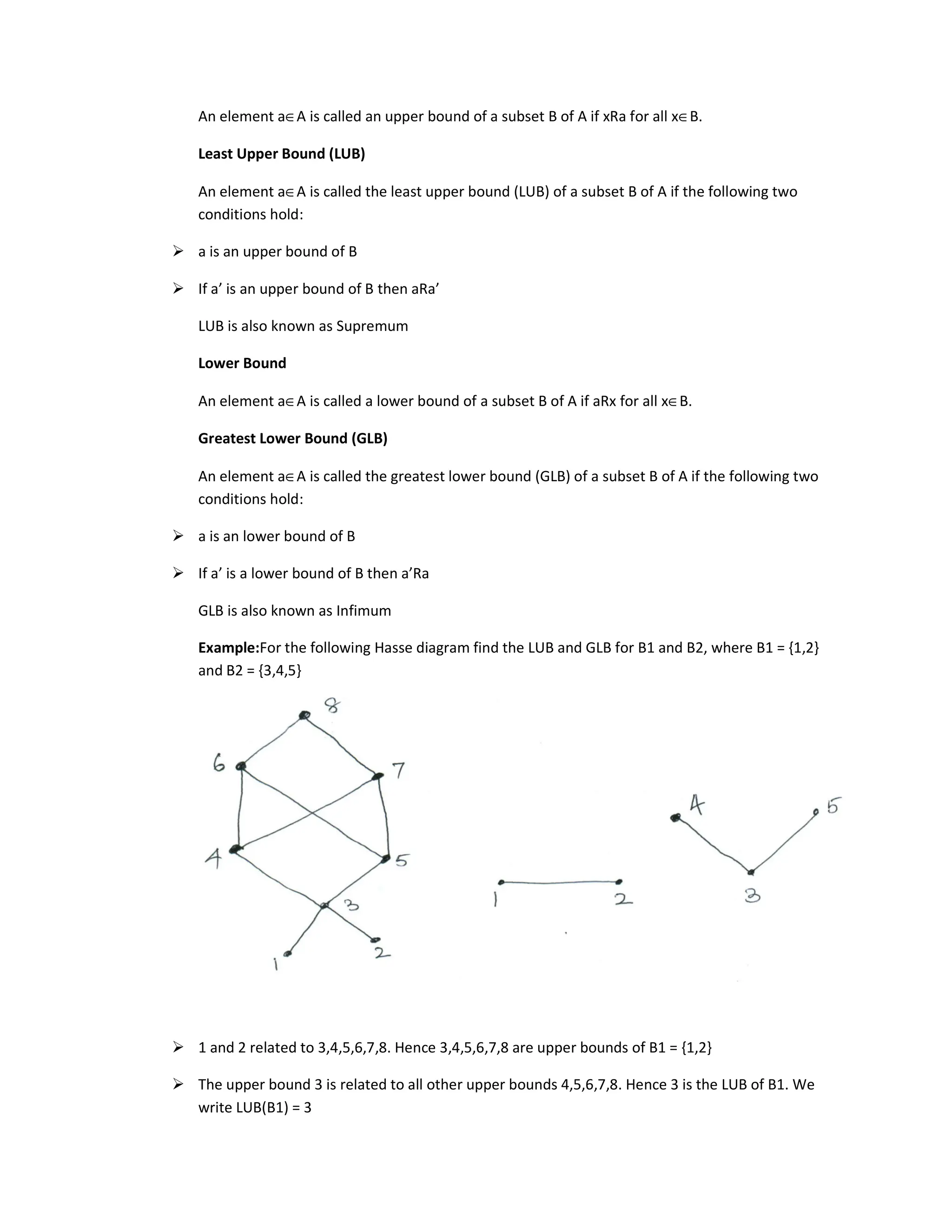
Example: In the following Hasse diagram let us find all extremal elements.
5 is the maximal element. Because no edge starts at 5.
1 is the minimal element. Because no edge terminates at 1.
5 is the greatest element. Because the element 5 has connection with all the elements.
1 is least element. Because 1 is connected with all the elements.
Upper Bound
17.
An element a∈Ais called an upper bound of a subset B of A if xRa for all x∈B.
Least Upper Bound (LUB)
An element a∈A is called the least upper bound (LUB) of a subset B of A if the following two
conditions hold:
a is an upper bound of B
If a’ is an upper bound of B then aRa’
LUB is also known as Supremum
Lower Bound
An element a∈A is called a lower bound of a subset B of A if aRx for all x∈B.
Greatest Lower Bound (GLB)
An element a∈A is called the greatest lower bound (GLB) of a subset B of A if the following two
conditions hold:
a is an lower bound of B
If a’ is a lower bound of B then a’Ra
GLB is also known as Infimum
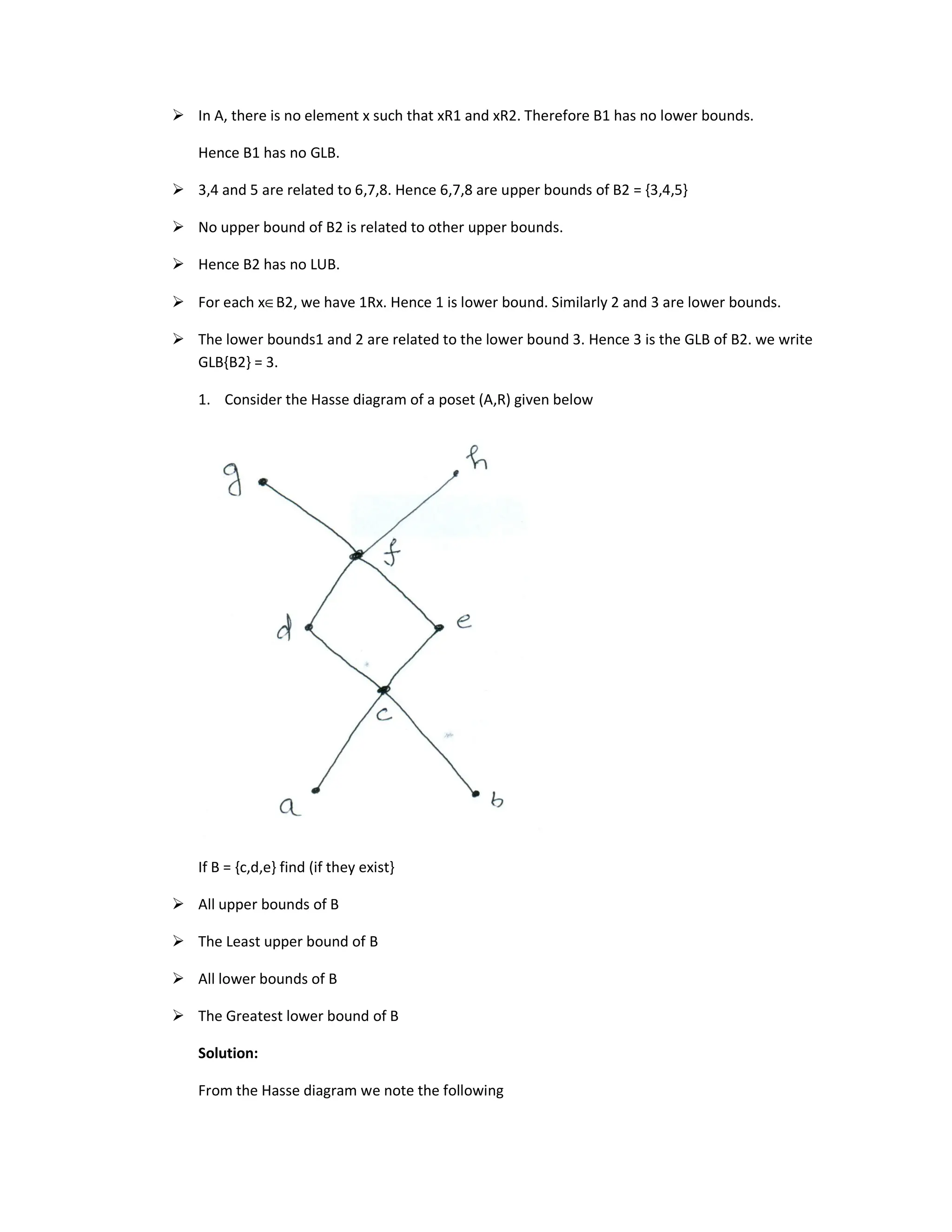
Example:For the following Hasse diagram find the LUB and GLB for B1 and B2, where B1 = {1,2}
and B2 = {3,4,5}
1 and 2 related to 3,4,5,6,7,8. Hence 3,4,5,6,7,8 are upper bounds of B1 = {1,2}
The upper bound 3 is related to all other upper bounds 4,5,6,7,8. Hence 3 is the LUB of B1. We
write LUB(B1) = 3
18.
In A, thereis no element x such that xR1 and xR2. Therefore B1 has no lower bounds.
Hence B1 has no GLB.
3,4 and 5 are related to 6,7,8. Hence 6,7,8 are upper bounds of B2 = {3,4,5}
No upper bound of B2 is related to other upper bounds.
Hence B2 has no LUB.
For each x∈B2, we have 1Rx. Hence 1 is lower bound. Similarly 2 and 3 are lower bounds.
The lower bounds1 and 2 are related to the lower bound 3. Hence 3 is the GLB of B2. we write
GLB{B2} = 3.
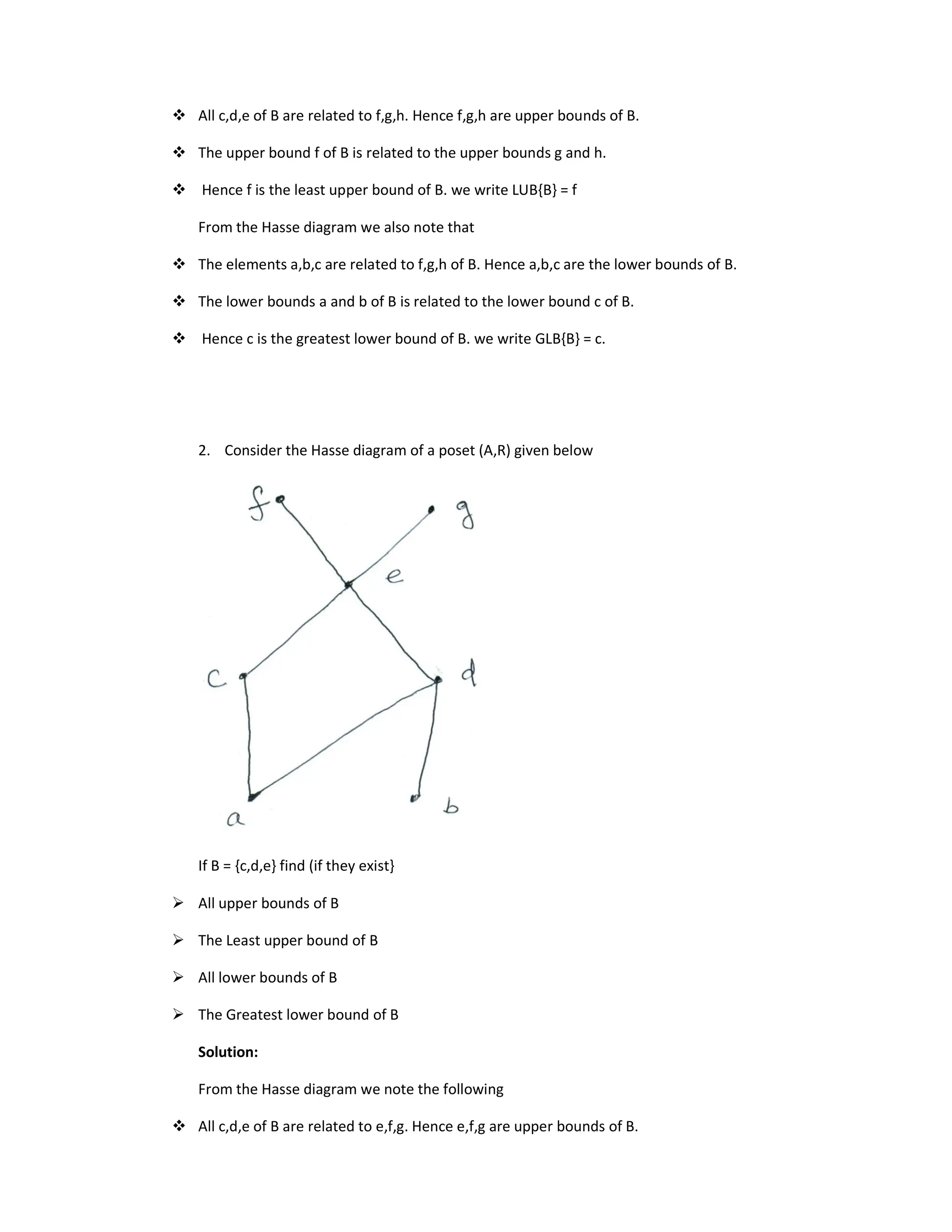
1. Consider the Hasse diagram of a poset (A,R) given below
If B = {c,d,e} find (if they exist}
All upper bounds of B
The Least upper bound of B
All lower bounds of B
The Greatest lower bound of B
Solution:
From the Hasse diagram we note the following
19.
All c,d,e ofB are related to f,g,h. Hence f,g,h are upper bounds of B.
The upper bound f of B is related to the upper bounds g and h.
Hence f is the least upper bound of B. we write LUB{B} = f
From the Hasse diagram we also note that
The elements a,b,c are related to f,g,h of B. Hence a,b,c are the lower bounds of B.
The lower bounds a and b of B is related to the lower bound c of B.
Hence c is the greatest lower bound of B. we write GLB{B} = c.
2. Consider the Hasse diagram of a poset (A,R) given below
If B = {c,d,e} find (if they exist}
All upper bounds of B
The Least upper bound of B
All lower bounds of B
The Greatest lower bound of B
Solution:
From the Hasse diagram we note the following
All c,d,e of B are related to e,f,g. Hence e,f,g are upper bounds of B.
20.
The upper bounde of B is related to the upper bounds f and g.
Hence e is the least upper bound of B. we write LUB{B} = e
By examining all upward paths to c,d,e we find that GLB{b} = a.
Theorem:If (A,R) is a poset and A is finite (nonempty), then A has at least one maximal element
and at least one minimal element.
Proof: Let a∈A. If a is not maximal. We can find an element x1∈A such that x1≠a and aRx1. If x1
is not maximal, we can find an element x2 ∈A such that x2 ≠ x1 and x1Rx2. Proceeding like this,
we end up with a finite chain of the form aRx1, x1Rx2, x2Rx3,………….Which cannot be extended
beyond a certain final stage because f is finite. Hence, we end up with some xk∈A which is a
maximal element of A. Thus, A has at least one maximal element.
A similar argument shows that A has at least one minimal element.
Theorem:Every poset has at most one greatest element and at least one least element.
Proof:Assume that a and b are greatest elements of (A,R). Then since b is greatest element we
have aRb. Similarly, since a is greatest element we have bRa. Thus, aRb and bRa. Since R is an
antisymmetric relation, it follows that a = b. Thus, two greatest elements of (A,R), if such exists
cannot be different. If (A,R) has a greatest element, then that element is unique. Thus, (A,R) has
at most one greatest element.
A similar argument shows hat (A,R) has at most one least element.
Theorem:If (A,R) is a poset and B⊆A, then B has at most one LUB and at most one GLB.
Proof:Assume that a and b are two LUB’s of B. Then a and b are upper bounds of B. Since b is an
upper bound of B and a is LUB of B, we have aRb. Similarly, Since a is an upper bound of B and b
is LUB of B, we have bRa. Since R is antisymmetric it follows that a = b.Hence B cannot have two
distinct LUB’s. This means that B has at most one LUB.
A similar argument shows that B has at most one GLB.
Lattice
Let (A,R) be a poset. This poset is called lattice if, for all x,y∈A, the elements LUB{x,y} and
GLB{x,y} exist in A.
Example
Consider the set N of natural numbers, and R be the partial order “less than or equal to”. Then
for any x,y∈N, we note that LUB{x,y} = max{x,y} and GLB{x,y} = min{x,y} and both these belongs
to N. Therefore the poset (N,≤) is a lattice.
Compiled by,
Dr. Chandra Naik, Dept.of CSE, AIET Mijar
![Vertices 1 2 3 4
In-degree 4 3 2 1
Out-degree 1 2 3 4
The matrix representation of R is
3. The matrix of the relation on the set A = {a,b,c,d,e} is
a) Write down R as a set of ordered pairs.
b) Draw the diagraph of R.
c) Determine the in-degree and out-degree of the vertices in the diagraph.
Solution:
R = {(a,a), (a,b), (b,c), (b,d), (c,d), (c,e), (d,b), (d,c), (e,a)}
[Answer for b and c as per previous examples]
4. The digraph of the relation on the set A = {a,b,c,d,e,f} is
a) Write down R as a set of ordered pairs.
b) Draw the matrix of R.
c) Determine the in-degree and out-degree of the vertices in the diagraph.
( )
=
1
1
1
1
0
1
1
1
0
0
1
1
0
0
0
1
R
M
0
0
0
0
1
0
0
1
1
0
1
1
0
0
0
0
1
1
0
0
0
0
0
1
1](https://image.slidesharecdn.com/relationsandfunctions-2-250415040751-3845f6b2/75/Basic-concepts-of-relations-digraph-and-POSETpdf-3-2048.jpg)
![RESULTS
(a,b)∈R or (a,b)∈S then (a,b)∈R∪S
(a,b)∈R and (a,b)∈S then (a,b)∈R∩S
is the complement of the set R in the universal set AXB.
Rc
is the converse of R
[(a,b)∈Rc
if and only if (b,a)∈R]
If MR is the matrix of R then (MR)T
is the matrix of Rc
5. Let A=B = {1,2,3}, and R = {(1,1), (1,2),(2,3),(3,1)}, S = {(2,1),(3,1), (3,2),(3,3)}
a) Compute R∪S, R∩S, Rc
, Sc
b) Draw the diagraphs.
c) Determine the in-degree and out-degree of the vertices in the diagraphs.
d) Write the matrices.
Solution:
Given that R = {(1,1), (1,2),(2,3),(3,1)} and S = {(2,1),(3,1), (3,2),(3,3)}
R∪S = {(1,1), (1,2),(2,3),(2,1),(3,1), (3,2), (3,3)}
R∩S = {(3,1)}
AxB = {(1,1),(1,2),(1,3),(2,1), (2,2),
(2,3),(3,1), (3,2), (3,3)}
= {(1,3),(2,1), (2,2), (3,2), (3,3)}
= {(1,1),(1,2),(1,3), (2,2), (2,3)}
Rc
= {(1,1), (2,1), (3,2), (1,3)}
Sc
= {(1,2), (1,3), (2,3), (3,3)}
[Answer for c and d as per previous examples]
R
S
,
R
R
S](https://image.slidesharecdn.com/relationsandfunctions-2-250415040751-3845f6b2/75/Basic-concepts-of-relations-digraph-and-POSETpdf-4-2048.jpg)
![3. Let A = {a,b,c,d,e} and R = {(a,a),(a,b), (b,c), (c,d),(c,e), (d,e)} be relation on A. Find R2
. Verify
that M(R2
) = [M(R)]2
Solution:
R = {(a,a),(a,b), (b,c), (c,d),(c,e), (d,e)}
R = {(a,a),(a,b), (b,c), (c,d),(c,e), (d,e)}
R2
= {(a,a),(a,b),(a,c),(b,d),(b,e),(c,e)}
[M(R)]2
= M(R) M(R)
=
=
--------------------------------------- (1)
R2
= {(a,a),(a,b),(a,c),(b,d),(b,e),(c,e)}
M(R2
) = ---------(2)
∴By (1) and (2)
Hence M(R2
) = [M(R)]2
4. Let A = {1,2,3,4} and
Find the matrices RοS and SοR
0
0
0
0
0
0
0
0
0
0
1
0
0
0
0
1
1
0
0
0
0
0
1
1
1
0
0
0
0
0
1
0
0
0
0
1
1
0
0
0
0
1
0
0
0
0
0
0
1
1
0
0
0
0
0
1
0
0
0
0
1
1
0
0
0
0
1
0
0
0
0
0
0
1
1
0
0
0
0
0
0
0
0
0
0
1
0
0
0
0
1
1
0
0
0
0
0
1
1
1
=
=
0
0
0
1
0
0
0
1
0
1
0
0
1
1
0
0
M
0
0
0
0
0
0
1
0
1
0
0
0
0
1
1
1
M S
R](https://image.slidesharecdn.com/relationsandfunctions-2-250415040751-3845f6b2/75/Basic-concepts-of-relations-digraph-and-POSETpdf-6-2048.jpg)
![R2 = {(1,2),(1,3),(3,1),(1,1),(3,3),(3,2), (1,4), (4,2),(3,4)}
Solution:R1 is reflexive, symmetry and transitive.R2 is transitive
Equivalence Relation
A relation R on a set is said to be an equivalence relation on A if (i)R is reflexive (ii) R is symmetric (iii) R is
transitive , on A.
1. Let A = {1,2,3,4} and R = {(1,1),(1,2),(2,1), (2,2),(3,4),(4,3),(3,3),(4,4)} be a relation A. Verify that R
is equivalence relation.
Solution:
We note that (1,1),(2,2),(3,3),(4,4) belongs to R. That is (a,a)∈R for all a∈A
∴R is reflexive relation.
Next, we note that (1,2),(2,1) and (3,4),(4,3)∈R. That is whenever (a,b)∈R then (b,a)∈R for a,b∈A
∴R is symmetry relation.
Finally, (1,2),(2,1),(1,1)∈R,
(2,1),(1,2),(2,2)∈R,
(4,3),(3,4),(4,4)∈R,
That is whenever (a,b)∈R,(b,c)∈R then for (a,c)∈R a,b,c∈A
∴R is transitive relation.
Hence R is an equivalence relation
2. Let A = {1,2,3,4,5,6, 7,8,9, 10, 11, 12}. On this set define the relation R by (x,y)∈R iff x – y is
multiple of 5.verify R is an equivalence relation.
Equivalence Classes
Let R be an equivalence relation on a set A and a∈A. Then the set of all those elements x of A which are
related to a by R is called equivalence class of a with respect to R. This equivalence class is denoted by
R(a) or [a], or
=[a] = R(a) = {x∈A | (x,a)∈R}
Example
Let R = {(1,1), (1,3), (2,2), (3,1), (3,3)}
[1] = {1,3}[2] = {2}[3] = {1,3}
a
a](https://image.slidesharecdn.com/relationsandfunctions-2-250415040751-3845f6b2/75/Basic-concepts-of-relations-digraph-and-POSETpdf-9-2048.jpg)
![Partition of a set
Let A be a nonempty set. Suppose there exists nonempty subsets A1,A2,……,Ak, o A such that the
following two conditions hold:
A is the union of A1,A2,……,Ak i.e. A = A1UA2U……UAk
Any two of the subsets A1,A2,……,Ak are disjoint; i.e. Ai∩Aj = Φ for i≠j
1. For the equivalence relation R = {(1,1), (1,2), (2,1),(2,2), (3,4),(4,3),(3,3),(4,4)} defined on the
set A = {1,2,3,4}, determined the partion induced.
Solution:
[1] = {1,2}, [2] = {1,2}, [3] = {3,4}, [4] = {3,4}
[1] and [3] are distinct.
Partion P = {[1],[3]} = {{1,2},{3,4}}
2. Let A = {a,b,c,d,e}. Consider the partion P = {{a,b},{c,d},{e}} of A. Find the equivalence relation
inducing the partion.
Solution:
P has {a,b} then (a,a),(a,b),(b,a),(b,b)∈R
P has {c,d} then (c,c),(c,d),(d,c),(d,d) ∈R
P has {e} then (e,e) ∈R
∴R = {(a,a),(a,b),(b,a),(b,b), (c,c),(c,d),(d,c), (d,d), (e,e)}
3. Let A = {1,2,3,4,5,6,7} and R be the equivalence relation on A that induces the partition A =
{1,2}∪{3}∪{4,5,7}∪{6}. Find R.
Solution:
R = {(1,1),(1,2),(2,1),(2,2),(3,3),(4,4),(4,5), (4,7),(5,5),(5,7),(5,4),(7,4),(7,5),(7,7),(6,6}}
4. Let A = {1,2,3,4,5}. Define a relation R on AxA by (x1,y1)R(x2,y2) iff x1+y1 = x2+y2
Verify that R is an equivalence relation on AxA.
Determine the equivalence classes [(1,3)], [(2,4)] and [(1,1)]
Determine the partition of AxA induced by R.
Solution:
For all (x,y)∈AxA, we have x+y = x+y i.e. (x,y)R(x,y). ∴R is reflexive.](https://image.slidesharecdn.com/relationsandfunctions-2-250415040751-3845f6b2/75/Basic-concepts-of-relations-digraph-and-POSETpdf-10-2048.jpg)
![Let us consider (x1,y1),(x2,y2) ∈AxA. Also (x1,y1)R(x2,y2)i.e. x1+y1 = x2+y2.This gives x2+y2 =
x1+y1 which means (x2,y2)R(x1,y1). ∴R is symmetric.
Let us consider (x1,y1),(x2,y2) and (x3,y3) ∈AxA. Suppose that (x1,y1)R(x2,y2) and
(x2,y2)R(x3,y3).Then x1+y1 = x2+y2 and x2+y2= x3+y3.This gives x1+y1 = x3+y3 which means
(x1,y1)R(x3,y3). ∴R is transitive.
Thus, R is reflexive, symmetric and transitive. Hence R is an equivalence relation.
We note that
[(1,3)] = {(x,y)∈AxA|(x,y)R(1,3)}
= {(x,y)∈AxA|x+y = 1+3}
= {(1,3), (2,2), (3,1)}
Since A = {1,2,3,4,5}
Similarly [(2,4)] = {(1,5),(2,4),(3,3),(4,2), (5,1)}
[(1,1)] = {(1,1)}
To determine the partition induced by R, we have to find the equivalence classes of all elements
(x,y) of AxA with respect to R.
[(1,1)] = {(1,1)}
[(1,3)] = [(2,2)] = [(3,1)]
[(2,4)] = [(1,5)] = [(3,3)] = [(4,2)] = [(5,1)]
[(1,2)] = {(1,2),(2,1)} = [(2,1)]
[(1,4)] = {(1,4),(2,3),(3,2),(4,1)} = [(2,3)] = [(3,2)] = [(4,1)]
[(2,5)] = {(2,5), (5,2), (3,4), (4,3)} = [(3,4) = [(4,3)] = [(5,2)]
[(3,5)] = {(3,5), (5,3),(4,4)} = [(4,4)] = [(5,3)]
[(4,5)] = {(4,5),(5,4)} = [(5,4)]
[(5,5)] = {(5,5)}
Thus, [(1,1)], [(1,2)], [(1,3)], [(1,4)], [(1,5)], [(2,5)], [(3,5)], [(4,5)], and [(5,5)] are the only distinct
equivalence classes of AxA with respect to R. Hence the partition of AxA induced by R is
represented byAxA = [(1,1)] ∪ [(1,2)] ∪ [(1,3)] ∪ [(1,4)] ∪ [(1,5)] ∪ [(2,5)] ∪ [(3,5)] ∪ [(4,5)]∪
[(5,5)]](https://image.slidesharecdn.com/relationsandfunctions-2-250415040751-3845f6b2/75/Basic-concepts-of-relations-digraph-and-POSETpdf-11-2048.jpg)