Introduction     Triangular tree-width                Permanents of bounded ttw matrices   Conclusions


         An extended tree-width notion for directed graphs
            related to the computation of permanents

                                             Klaus Meer

               Brandenburgische Technische Universit¨t, Cottbus, Germany
                                                    a


                        CSR St.Petersburg, June 16, 2011


                                         Klaus Meer      An extended tree-width notion
Introduction        Triangular tree-width                Permanents of bounded ttw matrices   Conclusions


Outline


       1   Introduction


       2   Basics; triangular tree-width


       3   Permanents of bounded ttw matrices


       4   Conclusion


                                            Klaus Meer      An extended tree-width notion
Introduction      Triangular tree-width                Permanents of bounded ttw matrices   Conclusions


                                           1. Introduction

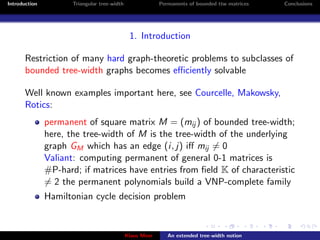
       Restriction of many hard graph-theoretic problems to subclasses of
       bounded tree-width graphs becomes efficiently solvable


                                          Klaus Meer      An extended tree-width notion
Introduction          Triangular tree-width                Permanents of bounded ttw matrices   Conclusions


                                               1. Introduction

       Restriction of many hard graph-theoretic problems to subclasses of
       bounded tree-width graphs becomes efficiently solvable

       Well known examples important here, see Courcelle, Makowsky,
       Rotics:
               permanent of square matrix M = (mij ) of bounded tree-width;
               here, the tree-width of M is the tree-width of the underlying
               graph GM which has an edge (i, j) iff mij = 0
               Valiant: computing permanent of general 0-1 matrices is
               #P-hard; if matrices have entries from field K of characteristic
               = 2 the permanent polynomials build a VNP-complete family
               Hamiltonian cycle decision problem


                                              Klaus Meer      An extended tree-width notion
Introduction       Triangular tree-width                Permanents of bounded ttw matrices   Conclusions


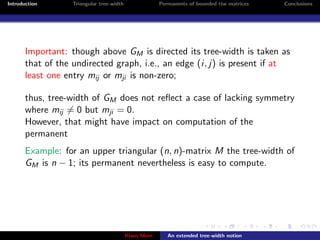
       Important: though above GM is directed its tree-width is taken as
       that of the undirected graph, i.e., an edge (i, j) is present if at
       least one entry mij or mji is non-zero;

       thus, tree-width of GM does not reflect a case of lacking symmetry
       where mij = 0 but mji = 0.
       However, that might have impact on computation of the
       permanent
       Example: for an upper triangular (n, n)-matrix M the tree-width of
       GM is n − 1; its permanent nevertheless is easy to compute.


                                           Klaus Meer      An extended tree-width notion
Introduction          Triangular tree-width                Permanents of bounded ttw matrices   Conclusions


       Goal: introduce new tree-width notion called triangular tree-width
       for directed graphs such that
               for square matrices M bounding the triangular tree-width of
               GM allows to compute perm(M) efficiently
               the (undirected) tree-width of GM is greater than or equal to
               its triangular tree-width; examples where the former is
               unbounded whereas the latter is not do exist.


                                              Klaus Meer      An extended tree-width notion
Introduction      Triangular tree-width                Permanents of bounded ttw matrices   Conclusions


                            2. Triangular tree-width
       Tree-width measures how close a graph is to a tree; on trees many
       otherwise hard problems are easy


                                          Klaus Meer      An extended tree-width notion
Introduction       Triangular tree-width                Permanents of bounded ttw matrices   Conclusions


                            2. Triangular tree-width
       Tree-width measures how close a graph is to a tree; on trees many
       otherwise hard problems are easy
       Definition (Tree-width)
       G = V , E graph, k-tree-decomposition of G is a tree
       T = VT , ET such that:
        (i) For each t ∈ VT a subset Xt ⊆ V of size at most k + 1.
        (ii) For each edge (u, v ) ∈ E there is a t ∈ VT s.t. {u, v } ⊆ Xt .
       (iii) For each vertex v ∈ V the set {t ∈ VT |v ∈ XT } forms a
             (connected) subtree of T .
       twd(G ) : smallest k such that there exists a k-tree-decomposition


                                           Klaus Meer      An extended tree-width notion
Introduction       Triangular tree-width                Permanents of bounded ttw matrices   Conclusions


                            2. Triangular tree-width
       Tree-width measures how close a graph is to a tree; on trees many
       otherwise hard problems are easy
       Definition (Tree-width)
       G = V , E graph, k-tree-decomposition of G is a tree
       T = VT , ET such that:
        (i) For each t ∈ VT a subset Xt ⊆ V of size at most k + 1.
        (ii) For each edge (u, v ) ∈ E there is a t ∈ VT s.t. {u, v } ⊆ Xt .
       (iii) For each vertex v ∈ V the set {t ∈ VT |v ∈ XT } forms a
             (connected) subtree of T .
       twd(G ) : smallest k such that there exists a k-tree-decomposition

       Trees have tree-width 1, cycles have twd 2


                                           Klaus Meer      An extended tree-width notion
Introduction      Triangular tree-width                Permanents of bounded ttw matrices   Conclusions


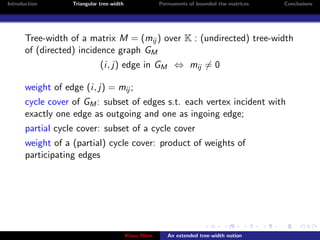
       Tree-width of a matrix M = (mij ) over K : (undirected) tree-width
       of (directed) incidence graph GM
                             (i, j) edge in GM ⇔ mij = 0


                                          Klaus Meer      An extended tree-width notion
Introduction       Triangular tree-width                Permanents of bounded ttw matrices   Conclusions


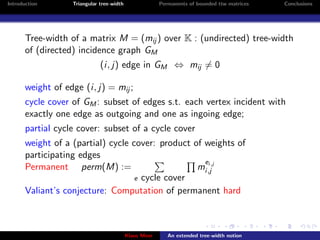
       Tree-width of a matrix M = (mij ) over K : (undirected) tree-width
       of (directed) incidence graph GM
                              (i, j) edge in GM ⇔ mij = 0

       weight of edge (i, j) = mij ;
       cycle cover of GM : subset of edges s.t. each vertex incident with
       exactly one edge as outgoing and one as ingoing edge;
       partial cycle cover: subset of a cycle cover
       weight of a (partial) cycle cover: product of weights of
       participating edges


                                           Klaus Meer      An extended tree-width notion
Introduction       Triangular tree-width                Permanents of bounded ttw matrices   Conclusions


       Tree-width of a matrix M = (mij ) over K : (undirected) tree-width
       of (directed) incidence graph GM
                              (i, j) edge in GM ⇔ mij = 0

       weight of edge (i, j) = mij ;
       cycle cover of GM : subset of edges s.t. each vertex incident with
       exactly one edge as outgoing and one as ingoing edge;
       partial cycle cover: subset of a cycle cover
       weight of a (partial) cycle cover: product of weights of
       participating edges
                                                     ei,j
       Permanent perm(M) :=                        mi,j
                                   e cycle cover
       Valiant’s conjecture: Computation of permanent hard


                                           Klaus Meer      An extended tree-width notion
Introduction       Triangular tree-width                Permanents of bounded ttw matrices   Conclusions


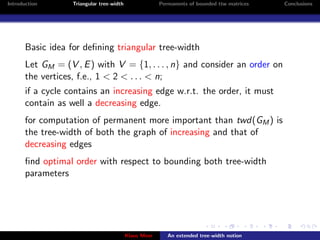
       Basic idea for defining triangular tree-width
       Let GM = (V , E ) with V = {1, . . . , n} and consider an order on
       the vertices, f.e., 1 < 2 < . . . < n;
       if a cycle contains an increasing edge w.r.t. the order, it must
       contain as well a decreasing edge.
       for computation of permanent more important than twd(GM ) is
       the tree-width of both the graph of increasing and that of
       decreasing edges
       find optimal order with respect to bounding both tree-width
       parameters


                                           Klaus Meer      An extended tree-width notion
Introduction       Triangular tree-width                Permanents of bounded ttw matrices   Conclusions


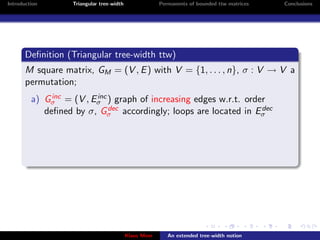
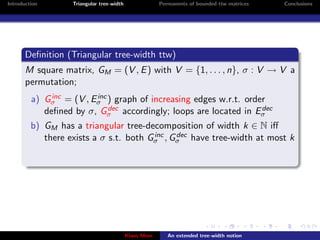
       Definition (Triangular tree-width ttw)
       M square matrix, GM = (V , E ) with V = {1, . . . , n}, σ : V → V a
       permutation;
              inc       inc
         a) Gσ = (V , Eσ ) graph of increasing edges w.r.t. order
                            dec
            defined by σ, Gσ accordingly; loops are located in Eσdec


                                           Klaus Meer      An extended tree-width notion
Introduction       Triangular tree-width                Permanents of bounded ttw matrices   Conclusions


       Definition (Triangular tree-width ttw)
       M square matrix, GM = (V , E ) with V = {1, . . . , n}, σ : V → V a
       permutation;
              inc       inc
         a) Gσ = (V , Eσ ) graph of increasing edges w.r.t. order
                            dec
            defined by σ, Gσ accordingly; loops are located in Eσdec

         b) GM has a triangular tree-decomposition of width k ∈ N iff
                                        inc  dec
            there exists a σ s.t. both Gσ , Gσ have tree-width at most k


                                           Klaus Meer      An extended tree-width notion
Introduction       Triangular tree-width                Permanents of bounded ttw matrices   Conclusions


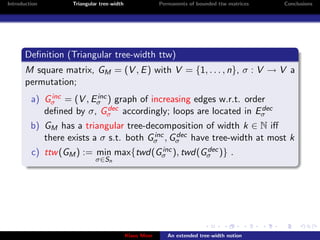
       Definition (Triangular tree-width ttw)
       M square matrix, GM = (V , E ) with V = {1, . . . , n}, σ : V → V a
       permutation;
              inc       inc
         a) Gσ = (V , Eσ ) graph of increasing edges w.r.t. order
                            dec
            defined by σ, Gσ accordingly; loops are located in Eσdec

         b) GM has a triangular tree-decomposition of width k ∈ N iff
                                        inc  dec
            there exists a σ s.t. both Gσ , Gσ have tree-width at most k
                                      inc       dec
         c) ttw (GM ) := min max{twd(Gσ ), twd(Gσ )} .
                            σ∈Sn


                                           Klaus Meer      An extended tree-width notion
Introduction          Triangular tree-width                Permanents of bounded ttw matrices   Conclusions


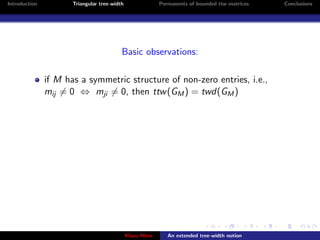
                                          Basic observations:

               if M has a symmetric structure of non-zero entries, i.e.,
               mij = 0 ⇔ mji = 0, then ttw (GM ) = twd(GM )


                                              Klaus Meer      An extended tree-width notion
Introduction          Triangular tree-width                Permanents of bounded ttw matrices   Conclusions


                                          Basic observations:

               if M has a symmetric structure of non-zero entries, i.e.,
               mij = 0 ⇔ mji = 0, then ttw (GM ) = twd(GM )
               computation of the triangular tree-width of a directed graph is
               NP-hard


                                              Klaus Meer      An extended tree-width notion
Introduction          Triangular tree-width                Permanents of bounded ttw matrices   Conclusions


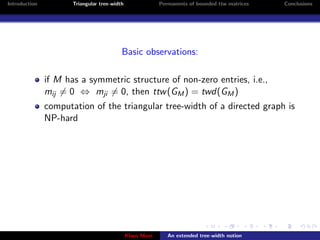
                                          Basic observations:

               if M has a symmetric structure of non-zero entries, i.e.,
               mij = 0 ⇔ mji = 0, then ttw (GM ) = twd(GM )
               computation of the triangular tree-width of a directed graph is
               NP-hard
               triangular tree-width extends the tree-width notion; in
               particular, there are families of graphs for which the former is
               bounded whereas the latter is not


                                              Klaus Meer      An extended tree-width notion
Introduction      Triangular tree-width                Permanents of bounded ttw matrices   Conclusions


                     v11 r v12 r v13 r v14 r v15 r v16 r

                     v21 r v22 r v23 r v24 r v25 r v26 r

                     v31 r v32 r v33 r v34 r v35 r v36 r

                     v41 r v42 r v43 r v44 r v45 r v46 r

                     v51 r v52 r v53 r v54 r v55 r v56 r

                     v61 r v62 r v63 r v64 r v65 r v66 r


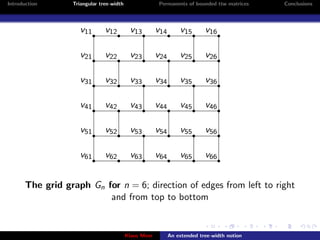
       The grid graph Gn for n = 6; direction of edges from left to right
                          and from top to bottom


                                          Klaus Meer      An extended tree-width notion
Introduction      Triangular tree-width                Permanents of bounded ttw matrices   Conclusions


                     v11 r v12 r v13 r v14 r v15 r v16 r

                     v21 r v22 r v23 r v24 r v25 r v26 r

                     v31 r v32 r v33 r v34 r v35 r v36 r

                     v41 r v42 r v43 r v44 r v45 r v46 r

                     v51 r v52 r v53 r v54 r v55 r v56 r

                     v61 r v62 r v63 r v64 r v65 r v66 r


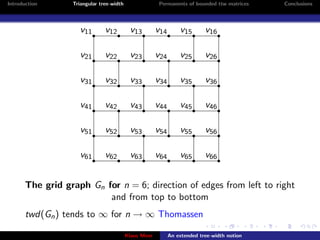
       The grid graph Gn for n = 6; direction of edges from left to right
                          and from top to bottom
       twd(Gn ) tends to ∞ for n → ∞ Thomassen

                                          Klaus Meer      An extended tree-width notion
Introduction       Triangular tree-width                Permanents of bounded ttw matrices   Conclusions


                      v11 r v12 r v13 r v14 r v15 r v16 r

                      v21 r v22 r v23 r v24 r v25 r v26 r

                      v31 r v32 r v33 r v34 r v35 r v36 r

                      v41 r v42 r v43 r v44 r v45 r v46 r

                      v51 r v52 r v53 r v54 r v55 r v56 r

                      v61 r v62 r v63 r v64 r v65 r v66 r


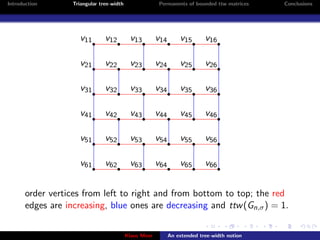
       order vertices from left to right and from bottom to top; the red
       edges are increasing, blue ones are decreasing and ttw (Gn,σ ) = 1.


                                           Klaus Meer      An extended tree-width notion
Introduction      Triangular tree-width                Permanents of bounded ttw matrices   Conclusions


                    3. Permanents of bounded ttw matrices

       Theorem (Main theorem)
       Let {Mi }i∈I be a family of matrices of bounded triangular
       tree-width at most k ∈ N. For every member M of the family,
       given corresponding tree-decompositions of the graphs of
       increasing and of decreasing edges, perm(M) can be computed in
       polynomial time in the size of M. The computation is fixed
       parameter tractable w.r.t. k.


                                          Klaus Meer      An extended tree-width notion
Introduction      Triangular tree-width                Permanents of bounded ttw matrices   Conclusions


       Typically, proving such theorems employs climbing a
       tree-decomposition bottom up, see, f.e., Flarup & Koiran &
       Lyaudet;
       once a vertex has been removed during this process from a bag of
       the tree-decomposition it has not to be considered any longer


                                          Klaus Meer      An extended tree-width notion
Introduction      Triangular tree-width                Permanents of bounded ttw matrices   Conclusions


       Typically, proving such theorems employs climbing a
       tree-decomposition bottom up, see, f.e., Flarup & Koiran &
       Lyaudet;
       once a vertex has been removed during this process from a bag of
       the tree-decomposition it has not to be considered any longer

       Main problem: we have to deal with two tree-decompositions. In
       general, a vertex that has been removed in one can occur further
       up in the other. Thus, it cannot be removed in the usual way and
       backtracking cannot be avoided.


                                          Klaus Meer      An extended tree-width notion
Introduction       Triangular tree-width                Permanents of bounded ttw matrices   Conclusions


       Solution of this problem: guarantee that one of the two
       decompositions bounds the number of occurences of each vertex in
       a bag to say 10 · k many.
       Definition (Perfect decompositions)
       G = (V , E ) directed has a perfect triangular tree-decomposition of
       width k if there is a permutation σ and two corresponding
                               inc  dec                  inc
       tree-decompositions Tσ , Tσ of width k for Gσ , Gσ ,   dec

       respectively, and none of the vertices of G occurs in more than 10k
       many bags of Tσ .dec


                                           Klaus Meer      An extended tree-width notion
Introduction     Triangular tree-width                Permanents of bounded ttw matrices   Conclusions


       STEP 1: Show main theorem for perfect decompositions
                               inc     inc
       Climb decomposition Tσ of Gσ bottom up and construct partial
       cycle covers together with their weights;


                                         Klaus Meer      An extended tree-width notion
Introduction      Triangular tree-width                Permanents of bounded ttw matrices   Conclusions


       STEP 1: Show main theorem for perfect decompositions
                               inc     inc
       Climb decomposition Tσ of Gσ bottom up and construct partial
       cycle covers together with their weights;
                          inc
       to each node of Tσ there correspond f (k) many types of partial
       cycle covers; here a type represents the information about how
       vertices occur in the cover; f only depends on k;


                                          Klaus Meer      An extended tree-width notion
Introduction       Triangular tree-width                Permanents of bounded ttw matrices   Conclusions


       STEP 1: Show main theorem for perfect decompositions
                               inc     inc
       Climb decomposition Tσ of Gσ bottom up and construct partial
       cycle covers together with their weights;
                          inc
       to each node of Tσ there correspond f (k) many types of partial
       cycle covers; here a type represents the information about how
       vertices occur in the cover; f only depends on k;
                                                                inc
       each time a vertex i disappears when climbing up in Tσ all
                                      dec
       information about i given in Tσ is incorporated; since i occurs in
       at most 10 · k bags of Tσ                                  ˜
                                dec again this results in at most f (k) many

       types;


                                           Klaus Meer      An extended tree-width notion
Introduction       Triangular tree-width                Permanents of bounded ttw matrices   Conclusions


       STEP 1: Show main theorem for perfect decompositions
                               inc     inc
       Climb decomposition Tσ of Gσ bottom up and construct partial
       cycle covers together with their weights;
                          inc
       to each node of Tσ there correspond f (k) many types of partial
       cycle covers; here a type represents the information about how
       vertices occur in the cover; f only depends on k;
                                                                inc
       each time a vertex i disappears when climbing up in Tσ all
                                      dec
       information about i given in Tσ is incorporated; since i occurs in
       at most 10 · k bags of Tσ                                  ˜
                                dec again this results in at most f (k) many

       types;
       thus, i can be removed in both decompositions


                                           Klaus Meer      An extended tree-width notion
Introduction      Triangular tree-width                Permanents of bounded ttw matrices   Conclusions


       STEP 2: Removing the perfectness assumption
       Theorem
       For M, GM and permutation σ with triangular tree-decomposition
         inc  dec                                ˜
       Tσ , Tσ one can construct a new matrix M, a corresponding
       graph GM and a permutation σ such that
               ˜                     ˜
             ˜ = perm(M), G ˜ is of bounded triangular tree-width
       perm(M)                 M
                           ˜ inc ˜ dec
       witnessed by σ and (Tσ , Tσ ) is a perfect triangular
                    ˜
       decomposition.


                                          Klaus Meer      An extended tree-width notion
Introduction      Triangular tree-width                Permanents of bounded ttw matrices   Conclusions


       STEP 2: Removing the perfectness assumption
       Theorem
       For M, GM and permutation σ with triangular tree-decomposition
         inc  dec                                ˜
       Tσ , Tσ one can construct a new matrix M, a corresponding
       graph GM and a permutation σ such that
               ˜                     ˜
             ˜ = perm(M), G ˜ is of bounded triangular tree-width
       perm(M)                 M
                           ˜ inc ˜ dec
       witnessed by σ and (Tσ , Tσ ) is a perfect triangular
                    ˜
       decomposition.

       Proof: New graph is obtained by adding at most linearly many
       vertices and edges in such a way that original vertices occurring
                              dec
       too often in bags of Tσ are partially replaced by new ones;
       replacement can be done in such a way that the cycle covers of the
       old and those of the new graph are in a 1-1 correspondence
       maintaining the weights

                                          Klaus Meer      An extended tree-width notion
Introduction      Triangular tree-width                Permanents of bounded ttw matrices   Conclusions


       Theorem
       The Hamiltonian cycle decision problem is efficiently solvable for
       families of matrices that are of bounded triangular tree-width k.
       Here, a corresponding tree-decomposition has to be given.


                                          Klaus Meer      An extended tree-width notion
Introduction      Triangular tree-width                Permanents of bounded ttw matrices   Conclusions


       Theorem
       The Hamiltonian cycle decision problem is efficiently solvable for
       families of matrices that are of bounded triangular tree-width k.
       Here, a corresponding tree-decomposition has to be given.

       Proof: Main difference is in removing the perfectness assumption;
       here, the transformation leads to a slight modification of the HC
       problem.


                                          Klaus Meer      An extended tree-width notion
Introduction      Triangular tree-width                Permanents of bounded ttw matrices   Conclusions


                                            4. Conclusions
       Triangular tree-width notion tailored to permanent problem;
       are there other graph related problems for which the result holds?
       More general: does it hold for all monadic-second order definable
       problems?
       We conjecture not


                                          Klaus Meer      An extended tree-width notion
Introduction      Triangular tree-width                Permanents of bounded ttw matrices   Conclusions


                                            4. Conclusions
       Triangular tree-width notion tailored to permanent problem;
       are there other graph related problems for which the result holds?
       More general: does it hold for all monadic-second order definable
       problems?
       We conjecture not
       Is triangular tree-width related to other parameters for directed
       graphs?
       Such parameters are for example directed tree-width (Johnson &
       Robertson & Seymour & Thomas) and entanglement (Berwanger
       & Gr¨del)
             a


                                          Klaus Meer      An extended tree-width notion

Csr2011 june16 15_45_meer

  • 1.
    Introduction Triangular tree-width Permanents of bounded ttw matrices Conclusions An extended tree-width notion for directed graphs related to the computation of permanents Klaus Meer Brandenburgische Technische Universit¨t, Cottbus, Germany a CSR St.Petersburg, June 16, 2011 Klaus Meer An extended tree-width notion
  • 2.
    Introduction Triangular tree-width Permanents of bounded ttw matrices Conclusions Outline 1 Introduction 2 Basics; triangular tree-width 3 Permanents of bounded ttw matrices 4 Conclusion Klaus Meer An extended tree-width notion
  • 3.
    Introduction Triangular tree-width Permanents of bounded ttw matrices Conclusions 1. Introduction Restriction of many hard graph-theoretic problems to subclasses of bounded tree-width graphs becomes efficiently solvable Klaus Meer An extended tree-width notion
  • 4.
    Introduction Triangular tree-width Permanents of bounded ttw matrices Conclusions 1. Introduction Restriction of many hard graph-theoretic problems to subclasses of bounded tree-width graphs becomes efficiently solvable Well known examples important here, see Courcelle, Makowsky, Rotics: permanent of square matrix M = (mij ) of bounded tree-width; here, the tree-width of M is the tree-width of the underlying graph GM which has an edge (i, j) iff mij = 0 Valiant: computing permanent of general 0-1 matrices is #P-hard; if matrices have entries from field K of characteristic = 2 the permanent polynomials build a VNP-complete family Hamiltonian cycle decision problem Klaus Meer An extended tree-width notion
  • 5.
    Introduction Triangular tree-width Permanents of bounded ttw matrices Conclusions Important: though above GM is directed its tree-width is taken as that of the undirected graph, i.e., an edge (i, j) is present if at least one entry mij or mji is non-zero; thus, tree-width of GM does not reflect a case of lacking symmetry where mij = 0 but mji = 0. However, that might have impact on computation of the permanent Example: for an upper triangular (n, n)-matrix M the tree-width of GM is n − 1; its permanent nevertheless is easy to compute. Klaus Meer An extended tree-width notion
  • 6.
    Introduction Triangular tree-width Permanents of bounded ttw matrices Conclusions Goal: introduce new tree-width notion called triangular tree-width for directed graphs such that for square matrices M bounding the triangular tree-width of GM allows to compute perm(M) efficiently the (undirected) tree-width of GM is greater than or equal to its triangular tree-width; examples where the former is unbounded whereas the latter is not do exist. Klaus Meer An extended tree-width notion
  • 7.
    Introduction Triangular tree-width Permanents of bounded ttw matrices Conclusions 2. Triangular tree-width Tree-width measures how close a graph is to a tree; on trees many otherwise hard problems are easy Klaus Meer An extended tree-width notion
  • 8.
    Introduction Triangular tree-width Permanents of bounded ttw matrices Conclusions 2. Triangular tree-width Tree-width measures how close a graph is to a tree; on trees many otherwise hard problems are easy Definition (Tree-width) G = V , E graph, k-tree-decomposition of G is a tree T = VT , ET such that: (i) For each t ∈ VT a subset Xt ⊆ V of size at most k + 1. (ii) For each edge (u, v ) ∈ E there is a t ∈ VT s.t. {u, v } ⊆ Xt . (iii) For each vertex v ∈ V the set {t ∈ VT |v ∈ XT } forms a (connected) subtree of T . twd(G ) : smallest k such that there exists a k-tree-decomposition Klaus Meer An extended tree-width notion
  • 9.
    Introduction Triangular tree-width Permanents of bounded ttw matrices Conclusions 2. Triangular tree-width Tree-width measures how close a graph is to a tree; on trees many otherwise hard problems are easy Definition (Tree-width) G = V , E graph, k-tree-decomposition of G is a tree T = VT , ET such that: (i) For each t ∈ VT a subset Xt ⊆ V of size at most k + 1. (ii) For each edge (u, v ) ∈ E there is a t ∈ VT s.t. {u, v } ⊆ Xt . (iii) For each vertex v ∈ V the set {t ∈ VT |v ∈ XT } forms a (connected) subtree of T . twd(G ) : smallest k such that there exists a k-tree-decomposition Trees have tree-width 1, cycles have twd 2 Klaus Meer An extended tree-width notion
  • 10.
    Introduction Triangular tree-width Permanents of bounded ttw matrices Conclusions Tree-width of a matrix M = (mij ) over K : (undirected) tree-width of (directed) incidence graph GM (i, j) edge in GM ⇔ mij = 0 Klaus Meer An extended tree-width notion
  • 11.
    Introduction Triangular tree-width Permanents of bounded ttw matrices Conclusions Tree-width of a matrix M = (mij ) over K : (undirected) tree-width of (directed) incidence graph GM (i, j) edge in GM ⇔ mij = 0 weight of edge (i, j) = mij ; cycle cover of GM : subset of edges s.t. each vertex incident with exactly one edge as outgoing and one as ingoing edge; partial cycle cover: subset of a cycle cover weight of a (partial) cycle cover: product of weights of participating edges Klaus Meer An extended tree-width notion
  • 12.
    Introduction Triangular tree-width Permanents of bounded ttw matrices Conclusions Tree-width of a matrix M = (mij ) over K : (undirected) tree-width of (directed) incidence graph GM (i, j) edge in GM ⇔ mij = 0 weight of edge (i, j) = mij ; cycle cover of GM : subset of edges s.t. each vertex incident with exactly one edge as outgoing and one as ingoing edge; partial cycle cover: subset of a cycle cover weight of a (partial) cycle cover: product of weights of participating edges ei,j Permanent perm(M) := mi,j e cycle cover Valiant’s conjecture: Computation of permanent hard Klaus Meer An extended tree-width notion
  • 13.
    Introduction Triangular tree-width Permanents of bounded ttw matrices Conclusions Basic idea for defining triangular tree-width Let GM = (V , E ) with V = {1, . . . , n} and consider an order on the vertices, f.e., 1 < 2 < . . . < n; if a cycle contains an increasing edge w.r.t. the order, it must contain as well a decreasing edge. for computation of permanent more important than twd(GM ) is the tree-width of both the graph of increasing and that of decreasing edges find optimal order with respect to bounding both tree-width parameters Klaus Meer An extended tree-width notion
  • 14.
    Introduction Triangular tree-width Permanents of bounded ttw matrices Conclusions Definition (Triangular tree-width ttw) M square matrix, GM = (V , E ) with V = {1, . . . , n}, σ : V → V a permutation; inc inc a) Gσ = (V , Eσ ) graph of increasing edges w.r.t. order dec defined by σ, Gσ accordingly; loops are located in Eσdec Klaus Meer An extended tree-width notion
  • 15.
    Introduction Triangular tree-width Permanents of bounded ttw matrices Conclusions Definition (Triangular tree-width ttw) M square matrix, GM = (V , E ) with V = {1, . . . , n}, σ : V → V a permutation; inc inc a) Gσ = (V , Eσ ) graph of increasing edges w.r.t. order dec defined by σ, Gσ accordingly; loops are located in Eσdec b) GM has a triangular tree-decomposition of width k ∈ N iff inc dec there exists a σ s.t. both Gσ , Gσ have tree-width at most k Klaus Meer An extended tree-width notion
  • 16.
    Introduction Triangular tree-width Permanents of bounded ttw matrices Conclusions Definition (Triangular tree-width ttw) M square matrix, GM = (V , E ) with V = {1, . . . , n}, σ : V → V a permutation; inc inc a) Gσ = (V , Eσ ) graph of increasing edges w.r.t. order dec defined by σ, Gσ accordingly; loops are located in Eσdec b) GM has a triangular tree-decomposition of width k ∈ N iff inc dec there exists a σ s.t. both Gσ , Gσ have tree-width at most k inc dec c) ttw (GM ) := min max{twd(Gσ ), twd(Gσ )} . σ∈Sn Klaus Meer An extended tree-width notion
  • 17.
    Introduction Triangular tree-width Permanents of bounded ttw matrices Conclusions Basic observations: if M has a symmetric structure of non-zero entries, i.e., mij = 0 ⇔ mji = 0, then ttw (GM ) = twd(GM ) Klaus Meer An extended tree-width notion
  • 18.
    Introduction Triangular tree-width Permanents of bounded ttw matrices Conclusions Basic observations: if M has a symmetric structure of non-zero entries, i.e., mij = 0 ⇔ mji = 0, then ttw (GM ) = twd(GM ) computation of the triangular tree-width of a directed graph is NP-hard Klaus Meer An extended tree-width notion
  • 19.
    Introduction Triangular tree-width Permanents of bounded ttw matrices Conclusions Basic observations: if M has a symmetric structure of non-zero entries, i.e., mij = 0 ⇔ mji = 0, then ttw (GM ) = twd(GM ) computation of the triangular tree-width of a directed graph is NP-hard triangular tree-width extends the tree-width notion; in particular, there are families of graphs for which the former is bounded whereas the latter is not Klaus Meer An extended tree-width notion
  • 20.
    Introduction Triangular tree-width Permanents of bounded ttw matrices Conclusions v11 r v12 r v13 r v14 r v15 r v16 r v21 r v22 r v23 r v24 r v25 r v26 r v31 r v32 r v33 r v34 r v35 r v36 r v41 r v42 r v43 r v44 r v45 r v46 r v51 r v52 r v53 r v54 r v55 r v56 r v61 r v62 r v63 r v64 r v65 r v66 r The grid graph Gn for n = 6; direction of edges from left to right and from top to bottom Klaus Meer An extended tree-width notion
  • 21.
    Introduction Triangular tree-width Permanents of bounded ttw matrices Conclusions v11 r v12 r v13 r v14 r v15 r v16 r v21 r v22 r v23 r v24 r v25 r v26 r v31 r v32 r v33 r v34 r v35 r v36 r v41 r v42 r v43 r v44 r v45 r v46 r v51 r v52 r v53 r v54 r v55 r v56 r v61 r v62 r v63 r v64 r v65 r v66 r The grid graph Gn for n = 6; direction of edges from left to right and from top to bottom twd(Gn ) tends to ∞ for n → ∞ Thomassen Klaus Meer An extended tree-width notion
  • 22.
    Introduction Triangular tree-width Permanents of bounded ttw matrices Conclusions v11 r v12 r v13 r v14 r v15 r v16 r v21 r v22 r v23 r v24 r v25 r v26 r v31 r v32 r v33 r v34 r v35 r v36 r v41 r v42 r v43 r v44 r v45 r v46 r v51 r v52 r v53 r v54 r v55 r v56 r v61 r v62 r v63 r v64 r v65 r v66 r order vertices from left to right and from bottom to top; the red edges are increasing, blue ones are decreasing and ttw (Gn,σ ) = 1. Klaus Meer An extended tree-width notion
  • 23.
    Introduction Triangular tree-width Permanents of bounded ttw matrices Conclusions 3. Permanents of bounded ttw matrices Theorem (Main theorem) Let {Mi }i∈I be a family of matrices of bounded triangular tree-width at most k ∈ N. For every member M of the family, given corresponding tree-decompositions of the graphs of increasing and of decreasing edges, perm(M) can be computed in polynomial time in the size of M. The computation is fixed parameter tractable w.r.t. k. Klaus Meer An extended tree-width notion
  • 24.
    Introduction Triangular tree-width Permanents of bounded ttw matrices Conclusions Typically, proving such theorems employs climbing a tree-decomposition bottom up, see, f.e., Flarup & Koiran & Lyaudet; once a vertex has been removed during this process from a bag of the tree-decomposition it has not to be considered any longer Klaus Meer An extended tree-width notion
  • 25.
    Introduction Triangular tree-width Permanents of bounded ttw matrices Conclusions Typically, proving such theorems employs climbing a tree-decomposition bottom up, see, f.e., Flarup & Koiran & Lyaudet; once a vertex has been removed during this process from a bag of the tree-decomposition it has not to be considered any longer Main problem: we have to deal with two tree-decompositions. In general, a vertex that has been removed in one can occur further up in the other. Thus, it cannot be removed in the usual way and backtracking cannot be avoided. Klaus Meer An extended tree-width notion
  • 26.
    Introduction Triangular tree-width Permanents of bounded ttw matrices Conclusions Solution of this problem: guarantee that one of the two decompositions bounds the number of occurences of each vertex in a bag to say 10 · k many. Definition (Perfect decompositions) G = (V , E ) directed has a perfect triangular tree-decomposition of width k if there is a permutation σ and two corresponding inc dec inc tree-decompositions Tσ , Tσ of width k for Gσ , Gσ , dec respectively, and none of the vertices of G occurs in more than 10k many bags of Tσ .dec Klaus Meer An extended tree-width notion
  • 27.
    Introduction Triangular tree-width Permanents of bounded ttw matrices Conclusions STEP 1: Show main theorem for perfect decompositions inc inc Climb decomposition Tσ of Gσ bottom up and construct partial cycle covers together with their weights; Klaus Meer An extended tree-width notion
  • 28.
    Introduction Triangular tree-width Permanents of bounded ttw matrices Conclusions STEP 1: Show main theorem for perfect decompositions inc inc Climb decomposition Tσ of Gσ bottom up and construct partial cycle covers together with their weights; inc to each node of Tσ there correspond f (k) many types of partial cycle covers; here a type represents the information about how vertices occur in the cover; f only depends on k; Klaus Meer An extended tree-width notion
  • 29.
    Introduction Triangular tree-width Permanents of bounded ttw matrices Conclusions STEP 1: Show main theorem for perfect decompositions inc inc Climb decomposition Tσ of Gσ bottom up and construct partial cycle covers together with their weights; inc to each node of Tσ there correspond f (k) many types of partial cycle covers; here a type represents the information about how vertices occur in the cover; f only depends on k; inc each time a vertex i disappears when climbing up in Tσ all dec information about i given in Tσ is incorporated; since i occurs in at most 10 · k bags of Tσ ˜ dec again this results in at most f (k) many types; Klaus Meer An extended tree-width notion
  • 30.
    Introduction Triangular tree-width Permanents of bounded ttw matrices Conclusions STEP 1: Show main theorem for perfect decompositions inc inc Climb decomposition Tσ of Gσ bottom up and construct partial cycle covers together with their weights; inc to each node of Tσ there correspond f (k) many types of partial cycle covers; here a type represents the information about how vertices occur in the cover; f only depends on k; inc each time a vertex i disappears when climbing up in Tσ all dec information about i given in Tσ is incorporated; since i occurs in at most 10 · k bags of Tσ ˜ dec again this results in at most f (k) many types; thus, i can be removed in both decompositions Klaus Meer An extended tree-width notion
  • 31.
    Introduction Triangular tree-width Permanents of bounded ttw matrices Conclusions STEP 2: Removing the perfectness assumption Theorem For M, GM and permutation σ with triangular tree-decomposition inc dec ˜ Tσ , Tσ one can construct a new matrix M, a corresponding graph GM and a permutation σ such that ˜ ˜ ˜ = perm(M), G ˜ is of bounded triangular tree-width perm(M) M ˜ inc ˜ dec witnessed by σ and (Tσ , Tσ ) is a perfect triangular ˜ decomposition. Klaus Meer An extended tree-width notion
  • 32.
    Introduction Triangular tree-width Permanents of bounded ttw matrices Conclusions STEP 2: Removing the perfectness assumption Theorem For M, GM and permutation σ with triangular tree-decomposition inc dec ˜ Tσ , Tσ one can construct a new matrix M, a corresponding graph GM and a permutation σ such that ˜ ˜ ˜ = perm(M), G ˜ is of bounded triangular tree-width perm(M) M ˜ inc ˜ dec witnessed by σ and (Tσ , Tσ ) is a perfect triangular ˜ decomposition. Proof: New graph is obtained by adding at most linearly many vertices and edges in such a way that original vertices occurring dec too often in bags of Tσ are partially replaced by new ones; replacement can be done in such a way that the cycle covers of the old and those of the new graph are in a 1-1 correspondence maintaining the weights Klaus Meer An extended tree-width notion
  • 33.
    Introduction Triangular tree-width Permanents of bounded ttw matrices Conclusions Theorem The Hamiltonian cycle decision problem is efficiently solvable for families of matrices that are of bounded triangular tree-width k. Here, a corresponding tree-decomposition has to be given. Klaus Meer An extended tree-width notion
  • 34.
    Introduction Triangular tree-width Permanents of bounded ttw matrices Conclusions Theorem The Hamiltonian cycle decision problem is efficiently solvable for families of matrices that are of bounded triangular tree-width k. Here, a corresponding tree-decomposition has to be given. Proof: Main difference is in removing the perfectness assumption; here, the transformation leads to a slight modification of the HC problem. Klaus Meer An extended tree-width notion
  • 35.
    Introduction Triangular tree-width Permanents of bounded ttw matrices Conclusions 4. Conclusions Triangular tree-width notion tailored to permanent problem; are there other graph related problems for which the result holds? More general: does it hold for all monadic-second order definable problems? We conjecture not Klaus Meer An extended tree-width notion
  • 36.
    Introduction Triangular tree-width Permanents of bounded ttw matrices Conclusions 4. Conclusions Triangular tree-width notion tailored to permanent problem; are there other graph related problems for which the result holds? More general: does it hold for all monadic-second order definable problems? We conjecture not Is triangular tree-width related to other parameters for directed graphs? Such parameters are for example directed tree-width (Johnson & Robertson & Seymour & Thomas) and entanglement (Berwanger & Gr¨del) a Klaus Meer An extended tree-width notion