Chapter 12
Vector-Valued Functions
12.1 Vector Functions
1. Since the square root function is only defined for nonnegative values, we must have t2
−9 ≥ 0.
So the domain is (−∞, −3) [3, ∞).
2. Since the natural logarithm is only defined for positive values, we must have 1 − t2
> 0. So
the domain is (−1, 1).
3. Since the inverse sine function is only defined for values between -1 and 1, the domain is
[−1, 1].
4. The vector function is defined for all real numbers.
5. r(t) = sin πti + cos πtj − cos2
πtk
6. r(t) = cos2
πti + 2 sin2
πtj + t2
k
7. r(t) = e−t
i + e2t
j + e3t
k
8. r(t) = −16t2
i + 50tj + 10k
9. x = t2
, y = sin t, z = cos t
10. r(t) = t sin t(i + k) = t sin ti + 0j + t sin tk so x = t sin t, y = 0, z = t sin t
11. x = ln t, y = 1 + t, z = t3
12. x = 5 sin t sin 3t, y = 5 cos 3t, z = 5 cos t sin 3t
48
12.1. VECTOR FUNCTIONS 49
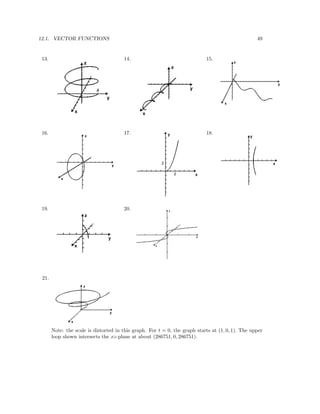
13.
z
y
x
4
14.
z
y
x
15.
z
y
x
16.
z
y
x
17. y
x2
2
18.
y
x
19.
z
y
x
20. z
y
x
21.
z
y
x
Note: the scale is distorted in this graph. For t = 0, the graph starts at (1, 0, 1). The upper
loop shown intersects the xz-plane at about (286751, 0, 286751).
50 CHAPTER 12. VECTOR-VALUED FUNCTIONS
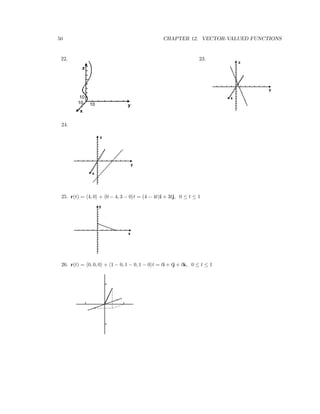
22.
z
y
x
10
10
10
23.
z
y
x
24.
z
y
x
25. r(t) = 4, 0 + 0 − 4, 3 − 0 t = (4 − 4t)i + 3tj, 0 ≤ t ≤ 1
x
y
26. r(t) = 0, 0, 0 + 1 − 0, 1 − 0, 1 − 0 t = ti + tj + tk, 0 ≤ t ≤ 1
12.1. VECTOR FUNCTIONS 51
27. x = t, y = t, z = t2
+ t2
= 2t2
; r(t) = ti + tj + 2t2
k
z
y
x
28. x = t, y = 2t, z = ±
√
t2 + 4t2 + 1 = ±
√
5t2 − 1; r(t) = ti + 2tj ±
√
5t2 − 1k
z
y
x
29. x = 3 cos t, z = 9 − 9 cos2
t = 0 sin2
t; y = 3 sin t; r(t) = 3 cos ti + 3 sin tj + 9 sin2
tk
z
y
x
30. x = sin t, z = 1, y = cos t; r(t) = sin ti + cos tj + k
52 CHAPTER 12. VECTOR-VALUED FUNCTIONS
z
y
x
31. x = t, y = t, z = 1 − 2t; r(t) = ti + tj + (1 − 2t)k
z
y
x
32. x = 11, y = t, z = 3 + 2t; r(t) = i + tj + (3 + 2t)k
z
y
x
33. (b); Notice that the y and z values consistently increase while the x values oscillate rapidly
between -1 and 1. The only vector fucntion that describes this behavior is (b).
34. (c); The trace of the graph on the xy−plane would look like a circle, while the z value oscillates
between 0 and 1. The only vector function that describes this behavior is (c).
35. (d); Notice that the z value is contant. The only vector function that satisfies this constraint
is (d).
36. (a); Notice that the x values consistently increase while the trace of the graph on the yz-plane
would look like a circle. The only vector function that describes this behavior is (a).
12.1. VECTOR FUNCTIONS 53
37. Letting x = at cos t, y = bt sin t, and z = ct, we have
z2
c2
=
c2
t2
c2
= t2
= t2
cos2
t + t2
sin2
t
=
a2
t2
cos2
t
a2
+
b2
t2
sin2
b2
=
x2
a2
+
y2
b2
38.
z
y
x
39. Letting x = aekt
cos t, y = bekt
sin t, and z = cekt
, we have
z2
c2
=
c2
ekt
c2
= e2kt
= e2kt
cos2
t + e2kt
sin2
t
=
a2
e2kt
cos2
t
a2
+
b2
e2kt
sin2
t
b2
x2
a2
+
y2
b2
40.
z
y
x
41. x2
+ y2
+ z2
= a2
sin2
kt cos2
t + a2
sin2
kt sin2
t + a2
cos2
kt
= a2
sin2
kt + a2
cos2
kt
= a2
54 CHAPTER 12. VECTOR-VALUED FUNCTIONS
42. k = 1 k = 2 k = 3
z
y
x
z
y
x
z
y
x
k = 4 k = 10 k = 20
z
y
x
z
y
x
z
y
x
43. (a)
z
y
x
(b) r1(t) = ti + tj + (4 − t2
)k
r2(t) = ti − tj + (4 − t2
)k
(c)
z
y
x
44. C lies on the surface of the sphere of radius a.
12.2. CALCULUS OF VECTOR FUNCTIONS 55
45.
46. k = 0.1 k = 0.2 k = 0.3
z
y
x
z
y
x
z
y
x
47. k = 2 k = 4
z
y
x
z
y
x
48. k = 1
10 k = 1
z
y
x
z
y
x
12.2 Calculus of Vector Functions
1. lim
t→2
[t3
i + t4
j + t5
k] = 23
i + 24
j + 25
k = 8i + 16j + 32k
56 CHAPTER 12. VECTOR-VALUED FUNCTIONS
2. r(t) =
sin 2t
t
i + (t − 2)5
k +
ln t
1/t
k. Using L’Hˆopital’s Rule,
lim
t→0+
r(t) =
2 cos 2t
1
i + (t − 2)5
j +
1/t
−1/t2
k = 2i − 32j
3. Using L’Hˆopital’s Rule, we have
lim
t→1
t2
− 1
t − 1
,
5t − 1
t + 1
,
2et−1
− 2
t − 1
= lim
t→1
=
2t
1
,
5t − 1
t + 1
,
2et−1
1
= 2, 2, 2
4. Since lim
t→∞
tan−1
t =
π
2
, we have
lim
t→∞
e2t
2e2t + t
,
e−1
2e−t + 5
, tan−1
t = lim
t→∞
1
2 + te−2t
,
1
2 + 5et
, tan−1
t
=
1
2
, 0,
π
2
The last equality follows from using L’Hˆopital’s Rule to get
lim
t→∞
te−2t
= lim
t→∞
t
e2t
= lim
t→∞
1
2e2t
= 0
5. lim
t→α
[−4r1(t) + 3r2(t)] = −4(i − 2j + k) + 3(2i + 5j + 7k) = 2i + 23j + 17k
6. lim
t→α
r1(t) · r2(t) = (i − 2j + k) = (i − 2j + k) · (2i + 5j + 7k) = −1
7. Notice that the k component ln(t−1) is not defined at t = 1. Therefore, r(t) is not continuous
at t = 1.
8. Notice that sin πt, tan πt, and cos πt are each continuous at t = 1 since the sine, cosine, and
tangent function are continuous on their domains. Therefore, since each of the component
functions are continuous at t = 1, we know that r(t) is continuous at t = 1.
9. r (t) = 3i + 8tj + (10t − 1)k
so r (1) = 3i + 8j + 9k = 3, 8, 9
while
r(1.1) − r(1)
0.1
=
3(1.1) − 1, 4(1.1)2
, 5(1.1)2
− (1.1) − 3(1) − 1, 4(1)2
, 5(1)2
− (1)
0.1
=
2.3, 4.84, 4.95 − 2, 4, 4
0.1
=
0.3, 0.84, 0.95
0.1
= 3, 8.4, 9.5
10. r (t) =
−5
(1 + 5t)2
i + (6t + 1)j − 3(1 − t)2
k
so r (0) =
−5
1
i + j + 3k = −5, 1, −3
12.2. CALCULUS OF VECTOR FUNCTIONS 57
while
r(0.05) − r(0)
0.05
=
1
1 + 5(0.05)
, 3(0.05)2
+ (0.05), (1 + 0.05)3
−
1
1 + 5(0)
, 3(0)2
+ (0), (1 − 0)3
0.05
=
0.8, 0.0575, 0.857375 − 1, 0, 1
0.05
=
−0.2, 0.0575, −0.142625
0.05
= −4, 1.15, −2.8525
11. r (t) =
1
t
i −
1
t2
j; r (t) = −
1
t2
i +
2
t3
j
12. r (t) = −t sin t, 1 − sin t ; r (t) = −t cos t − sin t, − cos t
13. r (t) = 2te2t
+ e2t
, 3t2
, 8t − 1 ; r (t) = 4te2t
+ 4e2t
, 6t, 8
14. r (t) = 2ti + 3t2
j +
1
1 + t2
k; r (t) = 2i + 6tj −
2t
(1 + t2)2
k
15. r (t) = −2 sin ti + 6 cos tj
r (π/6) = −i + 3
√
3j
x
y
16. r (t) = 3t2
i + 2tj
r (−1) = 3i − 2j
y
x
17. r (t) = j −
8t
(1 + t2)2
k
r (−1) = j − 2k
z
y
x
18. r (t) = −3 sin ti + 3 cos tj + 2k
r (π/4) =
−3
√
2
2
i +
3
√
2
2
j + 2k
z
x
y
58 CHAPTER 12. VECTOR-VALUED FUNCTIONS
19. r(t) = ti +
1
2
j +
1
3
t3
k; r(2) = 2i + 2j +
8
3
k; r (t) = i + tj + t2
k; r (2) = i + 2j + 4k
Using the point (2, 2, 8/3) and the direction vector r (2), we have x = 2 + t, y = 2 + 2t, z =
8/3 + 4t.
20. r(t) = (t3
−t)i+
6t
t + 1
j+(2t+1)2
k; r(1) = 3j+9k; r (t) = (3t2
−1)i+
6
(t + 1)2
j+(8t+4)k;
r (1) = 2i +
3
2
j + 12k. Using the point (0, 3, 9) and the direction vector r (1), we have x =
2t, y = 3 + 3
2 , z = 9 + 12t.
21. r (t) = et
+ tet
, 2t + 2, 3t2
− 1 so r (0) = 1, 2, −1 and |r (0)| = 12 + 22 + (−1)2 =
√
6
The unit tangent vector at t = 0 is given by
r (0)
|r (0)|
=
1, 2, −1
√
6
=
1
√
6
,
2
√
6
,
−1
√
6
To find the parametric equations of the tangent line at t = 0, we first compute r(0) =
0, 0, 0 . The tangent line is then given in vector form as p(t) = 0, 0, 0 +t
1
√
6
,
2
√
6
,
−1
√
6
=
1
√
6
t,
2
√
6
t,
−1
√
6
t or in parametric form as x =
1
√
6
t, y =
2
√
6
t, z =
−1
√
6
t.
22. r (t) = 3 cos 3t, 2 sec2
2t, 1 so r (π) = −3, 2, 1 and |r (π)| = (−3)2 + (2)2 + (1)2 =
√
14.
The unit tangent vector at t = π is given by
r (π)
|r (π)|
=
−3, 2, 1
√
14
=
−3
√
14
,
2
√
14
,
1
√
14
To find the parametric equations of the tangent line at t = π, we first compute r (π) = 1, 0, π .
The tangent line is then given in vector form as
p(t) = 1, 0, π + t
−3
√
14
,
2
√
14
,
1
√
14
= 1 −
−3
√
14
t,
2
√
14
t, π +
1
√
14
t
or in parametric form as x = 1 −
−3
√
14
t, y =
2
√
14
t, z = π +
1
√
14
t
23. r(π/3) =
1
2
,
√
3
2
,
π
3
r (t) = − sin t, cos t, 1
r (π/3) = −
√
3
2
,
1
2
, 1
so the tangent line is given by
p(t) =
1
2
,
√
3
2
,
π
3
+ t −
√
3
2
,
1
2
, 1
=
1
2
−
√
3
2
t,
√
3
2
+
1
2
t,
π
3
+ t
24. r(0) = 6, 1, 1
r (t) = −3e−t/2
, 2e2t
, 3e3t
12.2. CALCULUS OF VECTOR FUNCTIONS 59
r (0) = −3, 2, 3 So the tangent line is given by
r(t) = 6, 1, 1 + t −3, 2, 2
= 6 − 3t, 1 + 2t, 1 + 3t
25.
d
dt
[r(t) × r (t)] = r(t) × r (t) + r (t) × r (t) = r(t) × r (t)
26.
d
dt
[r(t) · (tr(t))] = r(t) ·
d
dt
(tr(t))+ = r(t) · (tr (t) + r(t)) + r (t) · (tr(t))
= r(t) · (tr (t)) + r(t) · r(t) + r (t) · (tr(t)) = 2t(r(t) · r (t)) + r(t) · r(t)
27.
d
dt
[r(t) · (r (t) × r (t))] = r(t) ·
d
dt
(r (t) × r (t)) + r (t) · (r (t) × r (t))
= r(t) · (r (t) × r (t) + r (t) × r (t)) + r (t) · (r (t) × r (t))
= r(t) · (r (t) × r (t))
28.
d
dt
[r1(t) × (r2(t) × r3(t))] = r1(t) ×
d
dt
(r2(t) × r3(t)) + r (t) × (r2(t) × r3(t))
= r1(t) × (r2(t) × r3(t) + r2(t) × r3(t) + r1(t) × (r2(t) × r3(t))
= r1(t) × (r2(t) × r3(t)) + r1(t) × (r2(t) × r3(t)) + r1(t) × (r2(t) × r3(t))
29.
d
dt
[r1(2t) + r2(1
t )] = 2r (2t) −
1
t2
r2(1
t )
30.
d
dt
[t3
r(t2
)] = t3
(2t)r (t2
) + 3t2
r(t2
) = 2t4
r (t2
) + 3t2
r(t2
)
31.
2
−1
r(t)dt =
2
−1
tdt i +
2
−1
3t2
dt j +
2
−1
4t3
dt k =
1
2
t2
2
−1
i + t3 2
−1
j + t4 2
−1
k =
3
2
i + 9j + 15k
32.
4
0
r(t)dt =
4
0
√
2t + 1dt i +
4
0
−
√
tdt j +
4
0
sin πtdt k
=
1
3
(2t + 1)3/2
4
0
i −
2
3
t3/2
4
0
j −
1
π
cos πt
4
0
k =
26
3
i −
16
3
j
33. r(t)dt = tet
dt i + −e−2t
dt j + tet2
dt k
= [tet
− et
+ c1]i +
1
2
e−2t
+ c2 j +
1
2
et2
+ d3 k = et
(t − 1)i +
1
2
e−2t
j +
1
2
et2
k + c,
where c = c1i + c2j + c3k.
34. r(t)dt =
1
1 + t2
dt i +
t
1 + t2
dt j +
t2
1 + t2
dt k
= [tan−1
t + c1]i +
1
2
ln(1 + t2
) + c2 j + 1 −
1
1 + t2
k
= [tan−1
t + c1]i +
1
2
ln(1 + t2
) + c2 j + [t − tan−1
t + c3]k
= tan−1
ti +
1
2
ln(1 + t2
)j + (t − tan−1
t)k + c,
60 CHAPTER 12. VECTOR-VALUED FUNCTIONS
where c = c1i + c2j + c3k.
35. r(t) = r (t)dt = 6dt i + 6tdt j + 3t2
dt k = [6t + c1]i + [3t2
+ c2]j + [t3
+ c3]k
Since r(0) = i + 2j + k = c1i + c2j + c3k, c1 − 1, c2 = −2, and c3 = 1. Thus,
r(t) = (6t + 1)i + (3t2
− 2)j + (t3
+ 1)k
36. r(t) = r (t)dt = t sin t2
dt i + − cos 2tdt j = − 1
2 cos t2
+ c1 i + −1
2 sin 2t + c2 j
Since r(0) = 3
2 = (−1
2 + c1)i + c2j, c1 = 2, and c2 = 0. Thus,
r(t) = −
1
2
cos t2
+ 2 i −
1
2
sin 2tj.
37. r (t) = r (t)dt = 12tdt i + −3t−1/2
dt j + 2dt k = [6t2
+ c1]i + [−6t1/2
+ c2]j +
[2t + c3]k
Since r (1) = j = (6 + c1)i + (−6 + c2)j + (2 + c3)k, c1 = −6, c2 = 7, and c3 = −2. Thus,
r (t) = (6t2
− 6)i + (−6t1/2
+ 7)j + (2t − 2)k.
r(t) = r (t)dt = (6t2
− 6)dt i + (−6t1/2
+ 7)dt j + (2t − 2)dt k
= [2t3
− 6t + c4]i + [−4t3/2
+ 7t + c5]j + [t2
− 2t + c6]k.
Since
r(1) = 2i − k = (−4 + c4)i + (3 + c5)j + (−1 + c6)k,
c4 = 6, c5 = −3, and c6 = 0. Thus,
r(t) = (2t3
− 6t + 6)i + (−4t3/2
+ 7t − 3)j + (t2
− 2t)k.
38. r (t) = r (t)dt = sec2
tdt i + cos tdt j + − sin tdt k
= [tan t + c1]i + [sin t + c2]j + [cos t + c3]k
Since r (0) = i + j + k = c1i + c2j + c3k, c1 = 1, c2 = 1, and c3 = 0. Thus,
r (t) = (tan t + 1)i + (sin t + 1)j + cos tk.
r(t) = r (t)dt = (tan t + 1)dt i + (sin t + 1)dt j + cos tdt k
= [ln | sec t| + c4]i + [− cos t + t + c5]j + [sin t + c6]k
.
Since r(0) = −j + 5k = (−1 + c5)j + (c6)k, c4 = 0, c5 = 0, and c6 = 5. Thus,
r(t) = (ln | sec t| + t)i + (− cos t + t)j + (sin t + 5)k.
39. r (t) = −a sin ti + a cos tj + ck; |r (t)| = (−a sin t)2 + (a cos t)2 + c2 =
√
a2 + c2
s =
2π
0
√
a2 + c2dt =
√
a2 + c2t
2π
0
= 2π
√
a2 + c2
12.2. CALCULUS OF VECTOR FUNCTIONS 61
40. r (t) = i + (cos t − t sin t)j + (sin t + t cos t)k
|r (t)| = 12 + (cos t − t sin t)2 + (sin t + t cos t)2 =
√
2 + t2
s =
π
0
√
2 + t2dt = t
2
√
2 + t2 + ln |t +
√
2 + t2|
π
0
= π
2
√
2 + π2 + ln(π +
√
2 + π2) − ln
√
2
41. r (t) = (−2et
sin 2t + et
cos 2t)i + (2et
cos 2t + et
sin 2t)j + et
k
|r (t)| = 5e2t cos2 2t + 5e2t sin2
2t + e2t =
√
6e2t =
√
6et
s =
3π
0
√
6et
dt =
√
6et
3π
0
=
√
6(e3π
− 1)
42. r (t) = 3i + 2
√
3tj + 2t2
k; |r (t)| = 32 + (2
√
3t)2 + (2t2)2 =
√
9 + 12t2 + 4t4 = 3 + 2t2
s =
1
0
(3 + 2t2
)dt = 3t + 2
3 t3
1
0
= 3 + 2
3 = 11
3
43. From r (t) = 9 cos t, −9 sin t , we find |r (t)| = 9. Therefore, s =
t
0
9du = 9t so that t =
s
9
. By
substituting for t in r(t), we obtain r(s) = 9 sin
s
9
, 9 cos
s
9
. Note that r (s) = sin
s
9
, cos
s
9
so that r (s) = sin2 s
9
+ cos
s
9
= 1.
44. From r(t) = −5 sin t, 12, 5 cos t , we find |r (t)| =
√
169 = 13. Therefore, s =
t
0
13du = 13t
so that t =
s
13
. By substituting for t in r(t), we obtain r(s) = 5 cos s
13 , 12
13 s, 5
13 cos s
13 .
Note that r (t) = − 5
13 sin s
13 , 12
13 , 5
13 cos s
13 so that
|r (s)| =
25
169
sin
25
13
+ 144
169 +
25
169
cos2 s
13 = 1
45. From r (t) = 2, −3, 4 , we find |r (t)| =
√
29. Therefore, s =
t
0
√
29du =
√
20t so that
t =
s
√
29
. By substituting for t in r(t), we obtain r(s) = 1 +
2
√
29
s, 5 −
3
√
29
s, 2 +
4
√
29
s .
Note that r (s) = 2√
29
, − 3√
29
, 4√
29
so that r (s) =
4
29
+
9
29
+
16
29
= 1.
46. From r (t) = et
cos t − et
sin t, et
sin t + et
cos t, 0 we find
|r (t)| = e2t cost −2e2t cos t sin t + e2t sin2
t + e2t sin2
t + 2e2t sin t cos t + e2t cos2 t =
√
2e2t = et
√
2.
Therefore, s =
t
0
eu
√
2du =
√
2(et
−1) so that t = ln s√
2
+ 1 . By substituting for t in r(t),
we obtain
r(s) = s√
2
+ 1 cos(ln s√
2
+ 1 , s√
2
+ 1 sin ln s√
2
+ 1 , 1 Note that
r (s) = 1√
2
cos ln s√
2
+ 1 − 1√
2
sin ln s√
2
+ 1 , 1√
2
sin ln s√
2
+ 1 + 1√
2
cos ln s√
2
+ 1 , 0
so that
|r (s)| =
1
2 cos2
ln s√
2
+ 1 − cos ln s√
2
+ 1 sin ln s√
2
+ 1 + 1
2 sin2
ln s√
2
+ 1
+1
2 sin2
ln s√
2
+ 1 + sin ln s√
2
+ 1 cos ln s√
2
+ 1 + 1
2 cos2
ln s√
2
+ 1
= cos2 ln
s
√
2
+ 1 + sin2
ln
s
√
2
+ 1 = 1
62 CHAPTER 12. VECTOR-VALUED FUNCTIONS
47. Since
d
dt
(r · r) =
d
dt
|r|2
=
d
dt
c2
= 0 and d
dt (r · r) = r · r + r · r = 2r · r , we have r · r = 0.
Thus, r is perpendicular to r.
48. Let v = ai + bj and r(t) = x(t)i + y(t)j. Then
b
a
v · r(t)dt =
b
a
[ax(t) + by(t)]dt = a
b
a
x(t)dt + b
b
a
y(t)dt = v ·
b
a
r(t)dt.
49. From r(t) = r0 + tv, we get r (t) = v so that |r (t)| = |v|. Therfore s =
t
0
|r (t)|du =
t
0
|v|du = |v|t which gives t =
s
|v|
. Substituting for t in r(t), we have r (s) = r0 +
s
|v|v = r0 + s
v
|v|
. Note that r (s) =
v
|v|
so that |r (s)| =
|v|
|v|
= 1.
50. (a) | 3, −4 | = 32 + (−4)2 = 5 so r(s) = 1, 2 +
s
5
3, −4 = 1, 2 + s
3
5
,
−4
5
(b) r(t) = 1, 1, 10 + t 1, 2, −1 and | 1, 2, −1 | =
√
1 + 4 + 1 =
√
6 so r(s) = 1, 1, 10 +
s
1
√
6
,
2
√
6
,
−1
√
6
12.3 Motion on a Curve
y
x
a
v
1. v(t) = 2ti + t3
j; v(1) = 2i + j; |v(1)| =
√
4 + 1 =
√
5;
a(t) = 2i + 3t2
j; a(1) = 2i + 3j
y
x
a
v
2. v(t) = 2ti −
2
t3
j; v(1) = 2i − 2j; |v(1)| =
√
4 + 4 = 2
√
2;
a(t) = 2i +
6
t4
j; a(1) = 2i + 6j
12.3. MOTION ON A CURVE 63
y
xa
v
3. v(t) = −2 sinh 2ti + 2 cosh 2tj; v(1) = 2j; |v(0)| = 2;
a(t) = −4 cosh 2ti + +4 sinh 2tj; a(0) = −4i
y
x
a
v
4. v(t) = −2 sin ti + cos tj; v(π/3) = −
√
3i +
1
2
j;
|v(π/3)| = 3 + 1/4 =
√
13/2; a(t) = −2 cos ti − sin tj;
a(π/3) = −i −
√
3
2
j
y
z
x
a
v
5. v(t) = (2t − 2)i + k; v(2) = 2j + k; |v(2)| =
√
4 + 1 =
√
5;
a(t) = 2j; a(2) = 2j
y
z
x
a
v
6. v(t) = i + j; v(2) = i + j + 12k; |v(2)| =
√
1 + 1 + 144 =
√
146;
a(t) = 6tk; a(2) = 12k
64 CHAPTER 12. VECTOR-VALUED FUNCTIONS
y
z
x
a
v
7. v(t) = i + 2tj + 3t2
k;
mathbfv(1) = i + 2j + 3k; |v(1)| =
√
1 + 1 + 9 =
√
14;
a(t) = 2j + 6tk; a(1) = 2j + 6k
y
z
x
a
v
8. v(t) = i + 3t2
j + k;
v(1) = i + 3j + k; |v(1)| =
√
1 + 9 + 1 =
√
11;
a(t) = 6tj; a(1) = 6j
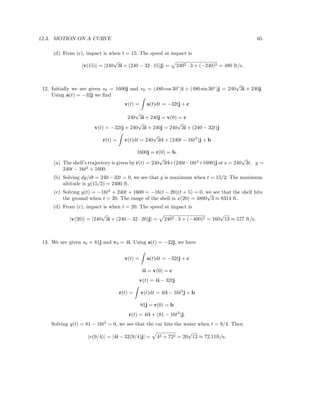
9. The particle passes through the xy-plane when z(t) = t2
−5t = 0 or t = 0, 5 which gives us the
points (0, 0, 0) and (25, 115, 0). v(t) = 2ti+(3t2
−2)j+(2t−5)k; v(0) = −2j−5k, v(5) =
10i + 73j + 5k; a(t) = 2i + 6tj + 2k; a(0) = 2i + 30j + 2k
10. If a(t) = 0, then v(t) = c1 and r(t) = c1t + c2. The graph of this equation is a straight line.
11. Initially we are given s0 = 0 and v0 = (480 cos 30◦
)i + (480 cos 30◦
)j = 240
√
3i + 240j. Using
a(t) = −32j we find
v(t) = a(t)dt = −32tj + c
240
√
3i + 240j = v(0) = c
v(t) = −32tj + 240
√
3i + 240j = 240
√
3i + (240 − 32t)j
r(t) = v(t)dt = 240
√
3ti + (240t − 16t2
)j + b
0 = r(0) = b.
(a) The shell’s trajectory is given by r(t) = 240
√
3ti + (240t − 16t2
)j or x = 240
√
3t, y =
240 − 16t2
.
(b) Solving dy/dt = 240−32t = 0, we see that y is maximum when t = 15/2. The maximum
altitude is y(15/2) = 900 ft.
(c) Solving y(t) = 240t − 16t2
= 16t(15 − t) = 0, we see that the shell is at ground level
when t = 0 and t = 15. The range of the shell is s(15) = 3600
√
3 ≈ 6235 ft.
12.3. MOTION ON A CURVE 65
(d) From (c), impact is when t = 15. The speed at impact is
|v(15)| = |240
√
3i + (240 − 32 · 15)j| = 2402 · 3 + (−240)2 = 480 ft/s.
12. Initially we are given s0 = 1600j and v0 = (480 cos 30◦
)i + (480 sin 30◦
)j = 240
√
3i + 240j.
Using a(t) = −32j we find
v(t) = a(t)dt = −32tj + c
240
√
3i + 240j = v(0) = c
v(t) = −32tj + 240
√
3i + 240j = 240
√
3i + (240 − 32t)j
r(t) = v(t)dt = 240
√
3ti + (240t − 16t2
)j + b
1600j = r(0) = b.
(a) The shell’s trajectory is given by r(t) = 240
√
3ti+(240t−16t2
+1600)j or s = 240
√
3t, y =
240t − 16t2
+ 1600.
(b) Solving dy/dt = 240−32t = 0, we see that y is maximum when t = 15/2. The maximum
altitude is y(15/2) = 2400 ft.
(c) Solving y(t) = −16t2
+ 240t + 1600 = −16(t − 20)(t + 5) = 0, we see that the shell hits
the ground when t = 20. The range of the shell is x(20) = 4800
√
3 ≈ 8314 ft.
(d) From (c), impact is when t = 20. The speed at impact is
|v(20)| = |240
√
3i + (240 − 32 · 20)j| = 2402 · 3 + (−400)2 = 160
√
13 ≈ 577 ft/s.
13. We are given s0 = 81j and v0 = 4i. Using a(t) = −32j, we have
v(t) = a(t)dt = −32tj + c
4i = v(0) = c
v(t) = 4i − 32tj
r(t) = v(t)dt = 4ti − 16t2
j + b
81j = r(0) = b
r(t) = 4ti + (81 − 16t2
)j.
Solving y(t) = 81 − 16t2
= 0, we see that the car hits the water when t = 9/4. Then
|v(9/4)| = |4i − 32(9/4)j| = 42 + 722 = 20
√
13 ≈ 72.11ft/s.
66 CHAPTER 12. VECTOR-VALUED FUNCTIONS
14. Let θ be the angle of elevation. Then v(0) = 98 cos θi + 98 sin θj. Using a(t) = −9.8j, we have
v(t) = a(t)dt = −9.8tj + c
98 cos θi + 98 sin θj = v(0) = c
v(t) = 98 cos θi + (98 sin θ − 9.8t)j
r(t) = 98t cos θi + (98t sin θ − 4.9t2
)j + b.
Since r(0) = 0, b = 0 and r(t) = 98t cos θi + (98t sin θ − 4.9t2
)j. Setting y(t) = 98t sin θ −
4.9t2
= t(98 sin θ − 4.9t) = 0, we see that the projectile hits the ground when t = 20 sin θ.
Thus, using x(t) = 98t cos θ, 490 = s(t) = 98(20 sin θ) cos θ or sin 2θ = 0.5. Then 2θ = 30◦
or
150◦
. The angles of elevation are 15◦
and 75◦
.
15. Let s be the initial speed. Then v(0) = s cos 45◦
i + s sin 45◦
j =
s
√
2
2
i +
s
√
2
2
j. Using a(t) =
−32j, we have
v(t) = a(t)dt = −32j + c
s
√
2
2
i +
s
√
2
2
j = v(0) = c
v(t) =
s
√
2
2
i +
s
√
2
2
− 32t j
r(t) =
s
√
2
2
ti +
s
√
2
2
t − 16t2
j + b.
Since r(0) = 0, b = 0 and
r(t) =
s
√
2
2
ti +
s
√
2
2
t − 16t2
j.
Setting y(t) = s
√
2t/2 − 16t2
= t(2
√
2/2 − 16t) = 0 we see that the ball hits the ground when
t =
√
2s/32. Thus, using x(t) = s
√
2t/2 and the fact that 100 yd = 300 ft, 300 = x(t) =
s
√
2
2
(
√
2s/32) =
s2
32
and s =
√
9600 ≈ 97.98 ft/s.
16. Let s be the initial speed and θ the initial angle. Then v() = s cos θi + s sin θj. Using a(t) =
−32j, we have
v(t) = a(t)dt = −32tj + c
s cos θi + s sin θj = v(0) = c
v(t) = s cos θi + (s sin θ − 32t)j
r(t) = st cos θi + (st sin θ − 16t2
)j + b.
12.3. MOTION ON A CURVE 67
Since r(0) = 0, b = 0 and r(t) = st cos θi + (st sin θ − 16t2
)j. Setting y(t) = st sin θ −
16t2
= t(s sin θ − 16t) =, we see that the ball hits the ground when t = (s sin θ)/16. Using
x(t) = st cos θi, we see that the range of the ball is
x
s sin θ
16
=
s2
sin θ cos θ
16
=
s2
sin 2θ
32
.
For θ = 30◦
, the range is s2
sin 60◦
/32 =
√
3s2
/64 and for θ = 60◦
the range is s2
sin 120◦
/32 =√
3s2
/64. In general, when the angle is 90◦
− θ then range is
[s2
sin 2(90◦
− θ)]/32 = s2
[sin(180◦
− 2θ)]/32 = s2
(sin 2θ)/32.
Thus, for angles θ and 90◦
− θ, the range is the same.
17. r (t) = v(t) = −r0ω sin ωti + r0ω cos ωtj; v = |v(t)| = r2
0ω2 sin2
ωt + r2
0ω2 cos2 ωt = r0ω
ω = v/r0; a(t) = r (t) = −r0ω2
cos ωti − r0ω2
sin ωtj
a = |a(t)| = r2
0ω4 cos2 ωt + r2
0ω4 sin2
ωt = r0ω2
= r0(v/r0)2
= v2
/r0.
18. (a) v(t) = −b sin ti + b cos tj + ck; |v(t)| = b2 sin2
t + b2 cos2 t + c2 =
√
b2 + c2
(b) s =
t
0
|v(t)|du =
t
0
√
b2 + c2du = t
√
b2 + c2;
ds
dt
=
√
b2 + c2
(c)
d2
s
dt2
= 0; a(t) = −b cos ti−b sin tj; |a(t)| = b2 cos2 t + b2 sin2
t = |b|. Thus, d2
s/dt2
=
|a(t)|.
y
xx0
θ
x0 tan θ
(x0,y0)
19. Let the initial speed of the projectile be s and let the target be
at (x0, y0). Then vp(0) = s cos θi + s sin θj and vt(0) = 0. Using
a(t) = −32j, we have
vp(t) = a dt = −32tj + c
s cos θi + s sin θj = vp(0) = c
vp(t) = s cos θi + (s sin θ − 32t)j
rp(t) = st cos θi + (st sin θ − 16t2
)j + b.
Since rp(0) = 0, b = 0 and rp(t) = st cos θi + (st sin θ − 16t2
)j. Also, vt(t) = −32tj + c and since
vt(0) = 0, c = 0 and vt(t) = −32tj. Then rt(t) = −16t2
tj + b. Since rt(0) = x0i + y0j, bx0i + y0j
and rt(t) = x0i+(y0 −16t2
)j. Now, the horizontal component of rp(t) will be x0 when t = x0/s cos θ
at which time the vertical component of rp(t) will be
(sx0/s cos θ) sin θ − 16(x0/s cos θ)2
= x0 tan θ − 16(x0/s cos θ)2
= y−) − 16(x0/s cos θ)2
.
Thus, rp(x0/s cos θ) = rt(x0/s cos θ) and the projectile will strike the target as it falls.
20. The initial angle is θ = 0, the initial height is 1024 ft, and the initial speed is s = 180(5280)/3600 =
264 ft/s. Then x(t) = 264t and y(t) = −16t2
+ 1024. Solving y(t) = 0 we see that the pack
hits the ground at t = 8 seconds. The horizontal distance tranvelled is x(8) = 2112 feet. From
the figure in the text, tan α = 1024/2112 = 16/33 and α ≈ 0.45 radian or 25.87◦
.
21. By Problem 17, a = v2
/v0 = 15302
/(4000 · 5280) ≈ 0.1108. We are given mg = 192, so
m = 192/32 and we = 1192 − (192/32)(0.1108) ≈ 191.33 lb.
68 CHAPTER 12. VECTOR-VALUED FUNCTIONS
φ
<mv2/r0, 32 m>
<mv2/r0, 0>
< 0, 32m>
22. By problem 17, the centripetal acceleration is v2
/r0. Then
the horizontal force is mv2
/r0. The vertical force is 32m.
The resultant force is U = (mv2
/r0)i + 32mj. From the
figure, we see that tan φ = (mv2
/r0)/32m = v2
/32r0. Using
r0 = 60 and v = 44 we obtain tan φ = 442
/32(60) ≈ 1.0083
and φ ≈ 45.24◦
.
23. Solving x(t) = (v0 cos θ)t for t and substituting into y(t) − 1
2 gt2
+ (v0 sin θ)t + s0 we obtain
y = −
1
2
g
x
v0 cos θ
2
+ (v0 sin θ)
x
v0 cos θ
+ s) = −
g
2v2
0 cos2 θ
x2
+ (tan θ)x + s0,
which is the equation of a parabola.
24. Since the projectile is launched from ground level, s0 = 0. To find the maximum height
we maximize y(t) = −1
2 gt2
+ (v0 sin θ)t. Solving y (t) = −gt + v0 sin θ = 0, we see that
t = (v0/g) sin θ is a critical point. Since y (t) = −g ≤ 0,
H = y
v0 sin θ
g
=
1
2
g
v2
0 sin2
θ
g2
+ v0 sin θ
v0 sin θ
g
=
v2
0 sin2
θ
2g
is the maximum height. To find the range we solve y(t) = −1
2 gt2
+ (v0 sin θ)t = t(v0 sin θ −
1
2 gt) = 0. The positive solution to this equation is t = (2v0 sin θ)/g. The range is thus
x(t) = (v0 cos θ)
2v0 sin θ
g
=
v2
0 sin 2θ
g
.
25. Letting r(t) = x(t)i + y(t)j + z(t)k, the equation dr/dt = v is equivalent to dx/dt =
6t2
x, dy/dt = −4ty2
, dz/dt = 2t(z + 1). Separating the variables and integrating, we
obtain x/x = 6t2
dt, dy/y2
= −4tdt, dz/(z + 1) = 2tdt, and ln x = 2t3
+ c1, −1/y =
2t2
+ c2, ln(z + 1) + t2
+ c3. Thus,
r(t) = k1e2t3
i +
1
2t2 + k2
j + (k3et2
− 1)k.
26. We require the fact that dr/dt = v. Then
dL
dt
=
d
dt
(r × p = r
dp
dt
+
dr
dt
× p = τ + v × p = τ + v × mv = τ + m(v × v) = τ + 0 = τ.
27. (a) Since F is directed along r we have F = cr for some constant c. Then
τ = r × F = r × (cr) = c(r × r) = 0.
(b) If τ = 0 then dL/dt = 0 and L is constant.
12.4. CURVATURE AND ACCELERATION 69
28. (a) Since the cannon is pointing directly to the left, tha parmetric equations describing the
path of the cannon ball are given by
x(t) = v0t, y(t) = −
1
2
gt2
+ s0
The cannon ball will touch the groun when y = 0, which occurs at t =
2s0
g
. At that
time, x is given by x =
2s0
g
= −v0
2s0
g
. Notice that this x value will be farther
to the left with increasing values of v0. Therefore, the cannon ball travels farther with
more gunpowder.
(b) As shown in part (a), the cannon ball will touch the groun when t =
2s0
g
. This value
of t is independent of v0. This occurs because v0 has no vertical component.
(c) If the cannon ball is dropped, we have v0 = 0. Therefore, the parametric equations
describing the cannon ball motion are given by
x(t) = 0, y(t) = −
1
2
gt2
+ s0.
As before, y = 0 when t =
2s0
g
. Therefore the cannon ball touches the ground at the
same time regardless of whether it is fired or dropped.
12.4 Curvature and Acceleration
1. r (t) = −t sin ti + t cos tj + 2tk; |r (t)| = t2 sin2
t + t2 cos2 t + 4t2 =
√
5t;
T = −
sin t
√
5
i +
cos t
√
5
j +
2
√
5
k
2. r (t) = et
(− sin t + cos t)i + et
(cos t + sin t)i +
√
2et
k,
|r (t)| = [et
(sin2
t−2 sin t cos t+cos2
t)+e2t
(cos2
t+2 sin t cos t+sin2
t)+2e2t
]1/2
=
√
4e2t = 2et
;
T(t) =
1
2
(− sin t + cos t)i +
1
2
(cos t + sin t)j +
√
2
2
k
3. We assume a > 0. r (t) = −a sin ti + a cos tj + ck; |r (t)| = a2 sin2
t + a2 cos2 t + c2 =√
a2 + c2;
T(t) −
a sin t
√
a2 + c2
i +
a cos t
√
a2 + c2
j +
c
√
a2 + c2
k;
dT
dt
= −
a cos t
√
a2 + c2
i −
a sin t
√
a2 + c2
j,
dT
dt
=
a2
cos2
t
a2 + c2
+
a2
sin2
t
a2 + c2
=
a
√
a2 + c2
; N = − cos ti − sin tj;
B = T × N =
i j k
−
a sin t
√
a2 + c2
a cos t
√
a2 + c2
c
√
a2 + c2
− cos t − sin t 0
=
c sin t
√
a2 + c2
i −
c cos t
√
a2 + c2
+
a
√
a2 + c2
k;
κ =
|dT/dt|
r (t)
=
a/
√
a2 + c2
√
a2 + c2
=
a
a2 + c2
70 CHAPTER 12. VECTOR-VALUED FUNCTIONS
4. r (t) = i + tj + t2
k; |r (t)| =
√
1 + t2 + t4, |r ; (1)| =
√
3;
T(t) = (1 + t2
+ t4
)−1/2
(i + tj + t2
k), T(1)
1
√
3
(i + j + k);
dT
dt
= −
1
2
(1 + t2
+ t4
)−3/2
(2t + 4t3
)i + [(1 + t2
+ t)−1/2
−
t
2
(1 + t2
+ t)−3/2
(2t + 4t3
)]j
[2t(1 + t2
+ t4
)−1/2 t2
2
(1 + t2
+ t4
)−3/2
(2t + 4t3
)]k;
d
dt
T(1) = −
1
√
3
i +
1
√
3
k,
d
dt
T(1) =
1
3
+
1
3
=
√
2
√
3
; N(1) = −
1
√
2
(i − k)k,
B(1) =
i j k
1/
√
3 1/
√
3 1/
√
3
−1/
√
2 0 1/
√
2
=
1
√
6
(i − 2j + k);
κ =
d
dt
T(1) = |r (1)| =
√
2/
√
3
√
3
=
√
2
3
5. From Example 1 in the text, a normal to the osculating plane is B(π/4) = 1
26 (3i−3j+2
√
2k).
The point on the curve when t = π/4 is (
√
2,
√
2, 3π/4). An equation of the plane is 3(x −√
2) − 3(y −
√
2) + 2
√
2(z − 3π/4(= 0, 3x − 3y + 2
√
2z = 3π/2, or 3
√
2x − 3
√
2y + 4z = 3π.
6. From Problem 4, a normal to the osculating plane is B(1) = 1√
6
(i − 2j + k). The point on the
curve when t = 1 is (1, 1/2, 1/3). An equaiton of the plane is (x−1)−2(y−1/2)+(z−1/3) = 0
or x − 2y + z = 1/3.
7. v(t) = j + 2tk, |v(t)| =
√
1 + 4t2; a(t) = 2k; v · a = 4t, v × a = 2i, |v × a| = 2;
aT =
4t
√
1 + 4t2
, aN =
2
√
1 + 4t2
8. v(t) = −3 sin ti + 2 cos tj + k,
|v(t)| = 9 sin2
t + 4 cos2 t = 1 = 5 sin2
t + 4 sin2
t + 4 cos2 t + 1 =
√
5 sin2
+1;
a(t) = −3 cos ti − 2 sin tj; v · a = 9 sin t cos t − 4 sin t cos t = 5 sin t cos t,
v × a = 2 sin ti − 3 cos tj + 6k, |v × a| = 4 sin2
+(cos2 t + 36 =
√
5
√
cos2 t + 8;
aT
√
5 sin t cos t
sin2
t + 1
, aN =
cos2
t + 8
sin2
t + 1
9. v(t) = 2ti+2tj+4tk, |v(t)| = 2
√
6t, t > 0; a(t) = 2i+2j+4k; v ·a = 24t, v ×a = 0;
aT =
24t
2
√
6t
= 2
√
6, aN = 0, t > 0
10. v(t) = 2ti − 3t2
j = 4t3
k, |v(t)| = t
√
4 + 9t2 + 16t4, t >); a(t) = 2i − 6tj + 12t2
k;
v · a = 4t + 18t3
+ 48t5
; v × a = −12t4
i − 16t3
j − 6t2
k, |v × a| = 2t2
√
36t4 + 64t2 + 9;
aT =
4 + 18t2
+ 48t4
√
4 + 9t2 + 16t4
, aN =
2t
√
36t4 + 64t2 + 9
√
4 + 9t2 + 16t4
t > 0
11. v(t) = 2i + 2tj, |v(t)| = 2
√
1 + t2; a(t) = 2j; v × a = 4k, |v × a| = 4;
aT =
2t
√
1 + t2
, aN =
2
√
1 + t2
12.4. CURVATURE AND ACCELERATION 71
12. v(t) =
1
1 + t2
i +
t
1 + t2
j, |v(t)| =
√
1 + t2
1 + t2
; a(t) = −
2t
(1 + t2)2
i +
1 − t2
(1 + t2)2
j;
v · a = −
2t
(1 + t2)3
+
t − t3
(1 + t2)3
; v × a =
1
(1 + t2)2
k, |v × a| =
1
(1 + t2)2
;
aT = −
t/(1 + t2
)3
√
1 + t2)/(1 + t2
= −
t
(1 + t2)3/2
, aN =
a/(1 + t2
)2
√
1 + t2/(1 + t2)
=
1
(1 + t2)3/2
13. v(t) = −5 sin ti + 5 cos tj, |v(t)| = 5; a(t) = −5 cos ti − 5 sin tj; v · a = 0,
v × a = 25k, |v × a| = 25; aT = 0, aN = 5
14. v(t) = sinh ti + cosh tj, |v(t)| = sinh t2 + cosh2
t a(t) = cosh ti + sinh tj
v · a = 2 sinh t cosh t; v × a = (sinh2
t − cosh2
t)k = −k, |v × a| = 1;
aT =
2 sinh t cosh t
sinh2
+ cosh2
, aN =
1
sinh2
+ cosh2
15. v(t) = et
(i + j + k), |v(t)| =
√
3e−t
; a(t) = e−t
(i + j + k); v · a = −3e−2t
; v × a = 0,
|v × a| = 0; aT = −
√
3e−t
, aN = 0
16. v(t) = i + 2j + 4k, |v(t)| =
√
21; a(t) = 0; v · a = 0, v × a = 0, |v × a| = 0; aT =
0, aN = 0
17. v(t) = −a sin ti + b cos tj + ck, |v(t)| = a2 sin2
t + b2 cos2 +c2; a(t) = −a cos ti − b sin tj;
v × a = bc sin ti − ac cos tj + abk, |v × a| = b2c2 sin2
t + a2c2 cos2 t + a2b2
κ =
|v × a|
|v|3
=
b2c2 sin2
t + a2c2 cos2 t + a2b2
(a2 sin2
t + b2 cos2 t + c2)3/2
18. (a) v(t) = −a sin ti + b cos tj, |v(t)| = a2 sin2
t + b2 cos2 t; a(t) = −a cos ti − b sin tj;
v × a = abk; |v × a| = ab; κ =
ab
(a2 sin2
t + b2 cos2 t)3/2
(b) When a = b, |v(t)| = a, |v × a| = a2
, and κ = a2
/a3
= 1/a.
19. The equation of a line is v(t) = b + tc, when b and c are constant vectors.
v(t) = c, |v(t)| = |c|; a(t) = 0; v × a = 0; κ = |v × a|/|v|3
= 0
20. v(t) = a(1 − cos t)i + a sin tj; v(π) = 2ai, |v(π)| = 2a; a(t) = a sin ti + a cos tj,
a(π) = −aj; |v × a| =
i j k
2a 0 0
0 −a 0
= −2a2
k; |v × a| = 2a2
; κ =
|v × a|
|v|3
=
2a2
8a3
=
1
4a
21. v(t) = f (t)i + g (t)j, |v(t)| = [f (t)]2 + [g (t)]2; a(t) = f (t)i + g (t)j;
v × a = [f (t)g (t) − g (t)f (t)]k, |v × a| = |f (t)g (t) − g (t)f (t)|;
κ =
|v × a|
|v|3
=
|f (t)g (t) − g (t)f (t)|
([f”(t)]2 + [g (t)]2)3/2
22. For y = F(x), r = xi + F(x)j. We identify f(x) = x and g(x) = F(x) in Problem 21. Then
f (x) = 1, f (x) = 0, g (x) = F (x), g (x) = F (x), and κ = |F (x)|/(1 + [F (x)]2
)3/2
.
72 CHAPTER 12. VECTOR-VALUED FUNCTIONS
23. F(x) = x2
, F(0) = 0, F(1) = 1; F (x) = 2x, F (0) = 0, F (1) = 2;
F (x) = 2, F (0) = 2, F (1) = 2; κ(0) =
2
(1 + 02)3/2
= 2; ρ(0) =
1
2
;
κ(1) =
2
(1 + 22)3/2
=
2
5
√
5
≈ 0.18;
ρ(1) =
5
√
5
2
≈ 5.59; Since 2 > 2/5
√
5, the curve is ”sharper” at (0, 0).
24. F(x) = x3
, F(−1) = −1, F(1/2) = 1/8; F (x) = 3x2
, F (−1) = 3,
F (1/2) = 3/4; F (x) = 6x, F (−1) = −6, F (1/2) = 3; κ(−1) = |−6|
(1+32)3/2 =
6
10
√
10
=
3
5
√
10
≈ 0.19;
ρ(−1) =
5
√
10
3
≈ 5.27;
κ(1
2 ) =
3
[1 + (3/4)2]3/2
=
3
125/64
≈ 1.54; ρ(1
2 ) =
125
192
≈ 0.65
Since 1.54 > 0.19, the curve is ”sharper” at (1/2, 1/8).
25. Letting F(x) = x2
, we can use Problem 22 to get κ(x) =
|F (x)|
|1 + (F (x))2|3/2
.
Now, F (x)2x, F (x) = 2, and (F (x))2
= 4x2
so that κ =
2
(1 + 4x2)3/2
.
As x → ±∞, the denominator grows without bound. Therefore, κ(x) → 0 as x → ±∞.
26. (a)
y
x
(b) κ (t) =
2t(t2
+ 2)
(t4 + t2 + 1)3/2
√
t4 + 4t2 + 1
−
3t(2t2
+ 1)
√
t4 + 4t2 + 1
(t4 + t2 + 1)5/2
;
critical numbers occur at t = −.271469, t = 0, and t = .271469.
(c) Maximum of 1.017182 occurs at t = −.271469 and t = .271469.
27. Since (c, F(c)) is an inflection point and F exists on an interval containg c, we must have
F (c) = 0. Therefore, using the formula from Problem 22, we see that the curvature is zero.
28. We use the fact that T · N = 0 and T · T = N · N = 1. Then
|a(t)|2
= a · a = (anN + atT) · (anN + atT) = a2
N N · N + 2anatN · T + a2
T T · T = a2
N + a2
T .
CHAPTER 12 IN REVIEW 73
Chapter 12 in Review
A. True/False
1. True; |v(t)| =
√
2
2. True; the curvature of a circle of radius a is κ = 1
a .
3. True
4. False; consider r(t) = t2
i. In this case, v(t) = 2ti and a(t) = 2i. Since v · a = 4t, the velocity
and acceleration vectors are not orthogonal for t = 0.
5. True
6. False; see Problem 20c in Section 14.2
7. True
8. True
9. False; consider r1(t) = r2(t) = i.
10. True,
d
dt
|r(t)|2
=
d
dt
(r · r) = r ·
dr
dt
+
dr
dt
· r = 2r ·
dr
dt
.
B. Fill in the Blanks
1. y = 4
2. 0
3. r (t) = 1, 2t, t2
so r (1) = 1, 2, 1
4. r (t) = 0, 2, 2t so r (1) = 0, 2, 2
5. r (1) × r (1) =
i j j
1 2 1
0 2 2
= 2, −2, 2 so r (1) × r (1) =
√
12.
Since r (1)| =
√
6, we have κ(1) =
r (1) × r (1)
|r (1)|3
=
√
12
6
√
6
=
√
2
6
.
6. T(1) =
r (1)
|r (1)|
=
1, 2, 1
√
6
=
1
√
6
,
2
√
6
,
1
√
6
7. T(t) =
r (t)
|r (t)|
=
1, 2t, t2
√
1 + 4t2 + t4
=
1
√
1 + 4t2 + t4
,
2t
√
1 + 4t2 + t4
,
t2
√
1 + 4t2 + t4
So T (t) =
−2(t2
+ 2)
(t4 + 4t2 + 1)3/2
,
−2(t4
− 1)
(t4 + 4t2 + 1)3/2
,
2t(2t2
+ 1)
(t4 + 4t2 + 1)3/2
.
This gives T (1) =
−6
63/2
, 0,
6
63/2
=
−1
√
6
, 0,
1
√
6
and |T (1)| = 1
6 + 1
6 =
1
√
3
.
Therefore N(1) =
T (1)
|T (1)|
=
−1√
6
, 0, 1√
6
( 1√
3)
=
−1
√
2
, 0,
1
√
2
.
74 CHAPTER 12. VECTOR-VALUED FUNCTIONS
8. B(1) = T(1) × N(1) =
i j k
1√
6
2√
6
1√
6
−1√
2
0 1√
2
=
1
√
3
,
−1
√
3
,
1
√
3
9. A normal to the normal plane is T(1) = 1√
6
, 2√
6
, 1√
6
so we can use n = 1, 2, 1 as a vector
normal to the plane. Since r(1) = 1, 1, 1
3 , the point (1, 1, 1
3 ) lies on the normal plane at t = 1.
Thus an equation of the normal plane is (x − 1) + 2(y − 1) + (z − 1
3 ) = 0 or x + 2y + z = 1)
3
or 3x + 6y + 3z = 10
10. A normal to the osculating plane is B(1) = 1√
3
, −1√
3
, 1√
3
. So we can use n = 1, −1, 1 as a
normal vector. Using the point (1, 1, 1
3 ), an equation of the osculating plane is (z − 1) − (y −
1) + (z − 1
3 ) = 0 or x − y + z = 1
3 or 3x − 3y + 3z = 1.
C. Exercises
1. r (t) = cos ti + sin tj + k; s =
π
0
cos2 t + sin2
+1dt =
π
0
√
2dt =
√
2π
2. r (t) = 5i+j+7k; s(t) =
t
0
√
25 + 1 + 49du = 5
√
3t; s(3) = 15
√
3. Solving 5
√
3t = 80
√
3,
we see that the distance traveled will be 80
√
3 when t = 16 or at the point (80, 17, 112).
3. r(3) = −27i + 8j + k; r (t) = −6ti =
2
√
t + 1
+ k; r (2) = −18i + j + k. The tangent line
is x = −27 − 18t, y = 8 + t, z = 1 + t.
4.
z
y
x
5.
z
yx
6.
d
dt
[r1(t) × r2(t)] = r1(t) ×
d
dt
r2(t) +
d
dt
r1(t) × r2(t)
= (t2
i + 2tj + t3
k) × (−i + 2tj + 2tk) + (2ti + 2j + 2t2
k) × [−ti + t2
j + (t2
+ 1)k]
= (4t2
− 2t4
)i − 3t3
j + (2t3
+ 2t)k + (2t2
+ 2 − 3t4
)i − (5t3
+ 2t)j + (2t3
+ 2t)k
= (2 + 6t2
− 5t4
)i − (8t3
+ 2t)j + (4t3
+ 4t)k
d
dt
[r1(t) × r2(t)] =
d
dt
[(2t3
+ 2t − t5
)i − (2t4
+ t2
)j + (t4
+ 2t2
)k]
= (2 + 6t2
− 5t4
)i − (8t3
+ 2t)j + (4t3
+ 4t)k
CHAPTER 12 IN REVIEW 75
7.
d
dt
[r1(t) · r2(t)] = r1(t) ·
d
dt
r2(t) +
d
dt
r1(t) · r2(t)
= (cos ti − sin tj + 4t3
k) · (2ti + sin tj + 2e2t
k)
(− sin ti − cos tj + 12t2
k) · (t2
i + sin tj + e2t
k)
= (2t cos t − sin t cos t + 8t3
e2t
− t2
sin t − sin t cos t + 12t2
e2t
= 2t cos t − t2
sin t − 2 sin t cos t + 8t3
e2t
+ 12t2
e2t
d
dt
[r1(t)·r2(t)] =
d
dt
[t2
cos t−sin2
t+4t3
e2t
] = −t2
sin t+2t cos t−2 sin t cos t+8t3
e2t
+12t2
e2t
8.
d
dt
[r1(t) · (r2(t) × r3(t))] = r1(t) ·
d
dt
[r2(t) × r3(t)] + r (t) · [r2(t) × r3(t)]
= r1(t) · [(r2(t) × r3(t)) + (r2(t) × r3(t))] + r1(t) · (r2(t) × r3(t))
= r1(t) · (r2(t) × r3(t)) + r1(t) · r2(t) × r3(t)) = r1(t) · (r2(t) × r3(t))
9. We are given F = ma = 2j; v(0) = i + j + k. and r(0) = i + j. Then
v(t) = a(t)dt =
2
m
jdt =
2
m
tj + c
i = j + k = v(0) = c
v(t) = i +
2
m
t + 1 j + k
r(t) = ti +
1
m
t2
+ t j + tk + b
i + j = r(0) = b
r(t) = (t + 1)i +
1
m
t2
+ t + 1 j + tk
The parametric equations are x = t, y =
1
m
t2
+ t + 1, z = t.
10.
y
x
a
v
v(t) = i − 3t2
j, v(1) = i − 3j; a(t) = −6tj, a(1) = −6j
|v(1)| = |i − 3j| =
√
1 + 9 =
√
10
76 CHAPTER 12. VECTOR-VALUED FUNCTIONS
11. v(t) = 6i + j + 2tk; a(t) = 2k. To find when the particle passes through the plane, we solve
−6t + t + t2
= −4 or t2
− 5t + 4 = 0. This gives t = 1 and t = 4. v(1) = 6i + j + 2k, a(1) = 2k;
v(4) = 6i + j + 8k, a(4) = 2k
12. We are given r(0) = i + 2j + 3k.
r(t) = v(t)dt = (−10ti + (3t2
− 4t)j + k)dt = −5t2
i + (t3
− 2t2
)j + tk + c
i + 2j + 3k = r(0) = c
r(t) = (1 − 5t2
)i + (t3
− 2t2
+ 2)j + (t + 3)k
r(t) = −19i + 2j + 5k
13. v(t) = a(t)dt = (
√
2 sin ti +
√
2 cos tj)dt = −
√
2 cos ti +
√
2 sin tj + c;
−i + j + k = v(π/4) = −i + j + c, c = k; v(t) = −
√
2 cos ti +
√
2 sin tj + k;
r(t) = −
√
2 sin ti−
√
2 cos tj+tk+b; i+2j+(π/4)k = r(π/4) = −i−j+(π/4)k+b, b = 2i+3j;
r(t) = (2 − 2
√
2 sin t)i + (3 −
√
2 cos t)j + tk; r(3π/4) = i + 4j + (3π/4)k
14. v(t) = ti + t2
j − tk; |v| = t
√
t2 + 2, t > 0; a(t) = i + 2tj − k; v · a = t + 2t3
+ t = 2t + 2t3
;
v × a = t2
bi + t2
k, |v × at2
√
2; aT =
2t + 2t3
t
√
t2 + 2
=
2 + 2t2
√
t2 + 2
, aN =
t2
√
2
t
√
t2 + 2
=
√
2t
√
t2 + 2
;
κ =
t2
√
2
t3(t2 + 2)3/2
=
√
2
t(t2 + 2)3/2
15. r (t) = sinh ti + cosh tj + k, r (1) = sinh 1i + cosh 1j + k;
|r (t)| = sinh2
t + cosh2
t + 1 =
√
2 cosh2
t =
√
2 cosh t; |r (1)| =
√
2 cosh 1;
T =
1
√
2
tanh ti +
1
√
2
j +
1
√
2
sech tk, T(1) =
1
√
2
(tanh 1i + j + sech 1k);
dT
dt
=
1
√
2
sech2
ti −
1
√
2
sech t tanh tk;
d
dt
T(1) =
1
√
2
sech2
1i −
1
√
2
sech 1 tanh 1k,
d
dt
T(1) ==
sech 1
√
2
sech2
1 + tanh2
+1 =
1
√
2
sech 1; N(1) = sech 1i − tanh 1k;
B(1) = T(1) × N(1) = −
1
√
2
tanh 1i +
1
√
2
(tanh2
1 + sech2
1)j −
1
√
2
sech 1k
=
1
√
2
(− tanh 1i + j − sech 1k)
κ =
d
dt
T(1) /|r (1)| =
(sech 1)/
√
2
√
2 cosh 1
=
1
2
sech2
1
16. The parametric equations describing the path of the ball are
x(t) = 66 cos(30◦
)t = 33
√
3ty(t) = −16t2
+ 66 sin(30◦
)t + 148 = −16t2
+ 33t + 148
The ball touches the ground when y(t) = 0 or −16t2
+ 33t + 148 = 0. This occurs when
t ≈ 4.243. The ball therefore strikes the ground at x(4.243) = 242.52 ft.
The velocity of the ball at time t is v(t) = 33
√
3, −32t + 33 . The impact velocity is given
by v(4.243) = 33
√
3, −32(4.243) + 33 ≈ 57.158, −102.776 . The impact speed is then
|v(4.243)| ≈ 117.6 ft/s.

Csm chapters12

  • 1.
    Chapter 12 Vector-Valued Functions 12.1Vector Functions 1. Since the square root function is only defined for nonnegative values, we must have t2 −9 ≥ 0. So the domain is (−∞, −3) [3, ∞). 2. Since the natural logarithm is only defined for positive values, we must have 1 − t2 > 0. So the domain is (−1, 1). 3. Since the inverse sine function is only defined for values between -1 and 1, the domain is [−1, 1]. 4. The vector function is defined for all real numbers. 5. r(t) = sin πti + cos πtj − cos2 πtk 6. r(t) = cos2 πti + 2 sin2 πtj + t2 k 7. r(t) = e−t i + e2t j + e3t k 8. r(t) = −16t2 i + 50tj + 10k 9. x = t2 , y = sin t, z = cos t 10. r(t) = t sin t(i + k) = t sin ti + 0j + t sin tk so x = t sin t, y = 0, z = t sin t 11. x = ln t, y = 1 + t, z = t3 12. x = 5 sin t sin 3t, y = 5 cos 3t, z = 5 cos t sin 3t 48
  • 2.
    12.1. VECTOR FUNCTIONS49 13. z y x 4 14. z y x 15. z y x 16. z y x 17. y x2 2 18. y x 19. z y x 20. z y x 21. z y x Note: the scale is distorted in this graph. For t = 0, the graph starts at (1, 0, 1). The upper loop shown intersects the xz-plane at about (286751, 0, 286751).
  • 3.
    50 CHAPTER 12.VECTOR-VALUED FUNCTIONS 22. z y x 10 10 10 23. z y x 24. z y x 25. r(t) = 4, 0 + 0 − 4, 3 − 0 t = (4 − 4t)i + 3tj, 0 ≤ t ≤ 1 x y 26. r(t) = 0, 0, 0 + 1 − 0, 1 − 0, 1 − 0 t = ti + tj + tk, 0 ≤ t ≤ 1
  • 4.
    12.1. VECTOR FUNCTIONS51 27. x = t, y = t, z = t2 + t2 = 2t2 ; r(t) = ti + tj + 2t2 k z y x 28. x = t, y = 2t, z = ± √ t2 + 4t2 + 1 = ± √ 5t2 − 1; r(t) = ti + 2tj ± √ 5t2 − 1k z y x 29. x = 3 cos t, z = 9 − 9 cos2 t = 0 sin2 t; y = 3 sin t; r(t) = 3 cos ti + 3 sin tj + 9 sin2 tk z y x 30. x = sin t, z = 1, y = cos t; r(t) = sin ti + cos tj + k
  • 5.
    52 CHAPTER 12.VECTOR-VALUED FUNCTIONS z y x 31. x = t, y = t, z = 1 − 2t; r(t) = ti + tj + (1 − 2t)k z y x 32. x = 11, y = t, z = 3 + 2t; r(t) = i + tj + (3 + 2t)k z y x 33. (b); Notice that the y and z values consistently increase while the x values oscillate rapidly between -1 and 1. The only vector fucntion that describes this behavior is (b). 34. (c); The trace of the graph on the xy−plane would look like a circle, while the z value oscillates between 0 and 1. The only vector function that describes this behavior is (c). 35. (d); Notice that the z value is contant. The only vector function that satisfies this constraint is (d). 36. (a); Notice that the x values consistently increase while the trace of the graph on the yz-plane would look like a circle. The only vector function that describes this behavior is (a).
  • 6.
    12.1. VECTOR FUNCTIONS53 37. Letting x = at cos t, y = bt sin t, and z = ct, we have z2 c2 = c2 t2 c2 = t2 = t2 cos2 t + t2 sin2 t = a2 t2 cos2 t a2 + b2 t2 sin2 b2 = x2 a2 + y2 b2 38. z y x 39. Letting x = aekt cos t, y = bekt sin t, and z = cekt , we have z2 c2 = c2 ekt c2 = e2kt = e2kt cos2 t + e2kt sin2 t = a2 e2kt cos2 t a2 + b2 e2kt sin2 t b2 x2 a2 + y2 b2 40. z y x 41. x2 + y2 + z2 = a2 sin2 kt cos2 t + a2 sin2 kt sin2 t + a2 cos2 kt = a2 sin2 kt + a2 cos2 kt = a2
  • 7.
    54 CHAPTER 12.VECTOR-VALUED FUNCTIONS 42. k = 1 k = 2 k = 3 z y x z y x z y x k = 4 k = 10 k = 20 z y x z y x z y x 43. (a) z y x (b) r1(t) = ti + tj + (4 − t2 )k r2(t) = ti − tj + (4 − t2 )k (c) z y x 44. C lies on the surface of the sphere of radius a.
  • 8.
    12.2. CALCULUS OFVECTOR FUNCTIONS 55 45. 46. k = 0.1 k = 0.2 k = 0.3 z y x z y x z y x 47. k = 2 k = 4 z y x z y x 48. k = 1 10 k = 1 z y x z y x 12.2 Calculus of Vector Functions 1. lim t→2 [t3 i + t4 j + t5 k] = 23 i + 24 j + 25 k = 8i + 16j + 32k
  • 9.
    56 CHAPTER 12.VECTOR-VALUED FUNCTIONS 2. r(t) = sin 2t t i + (t − 2)5 k + ln t 1/t k. Using L’Hˆopital’s Rule, lim t→0+ r(t) = 2 cos 2t 1 i + (t − 2)5 j + 1/t −1/t2 k = 2i − 32j 3. Using L’Hˆopital’s Rule, we have lim t→1 t2 − 1 t − 1 , 5t − 1 t + 1 , 2et−1 − 2 t − 1 = lim t→1 = 2t 1 , 5t − 1 t + 1 , 2et−1 1 = 2, 2, 2 4. Since lim t→∞ tan−1 t = π 2 , we have lim t→∞ e2t 2e2t + t , e−1 2e−t + 5 , tan−1 t = lim t→∞ 1 2 + te−2t , 1 2 + 5et , tan−1 t = 1 2 , 0, π 2 The last equality follows from using L’Hˆopital’s Rule to get lim t→∞ te−2t = lim t→∞ t e2t = lim t→∞ 1 2e2t = 0 5. lim t→α [−4r1(t) + 3r2(t)] = −4(i − 2j + k) + 3(2i + 5j + 7k) = 2i + 23j + 17k 6. lim t→α r1(t) · r2(t) = (i − 2j + k) = (i − 2j + k) · (2i + 5j + 7k) = −1 7. Notice that the k component ln(t−1) is not defined at t = 1. Therefore, r(t) is not continuous at t = 1. 8. Notice that sin πt, tan πt, and cos πt are each continuous at t = 1 since the sine, cosine, and tangent function are continuous on their domains. Therefore, since each of the component functions are continuous at t = 1, we know that r(t) is continuous at t = 1. 9. r (t) = 3i + 8tj + (10t − 1)k so r (1) = 3i + 8j + 9k = 3, 8, 9 while r(1.1) − r(1) 0.1 = 3(1.1) − 1, 4(1.1)2 , 5(1.1)2 − (1.1) − 3(1) − 1, 4(1)2 , 5(1)2 − (1) 0.1 = 2.3, 4.84, 4.95 − 2, 4, 4 0.1 = 0.3, 0.84, 0.95 0.1 = 3, 8.4, 9.5 10. r (t) = −5 (1 + 5t)2 i + (6t + 1)j − 3(1 − t)2 k so r (0) = −5 1 i + j + 3k = −5, 1, −3
  • 10.
    12.2. CALCULUS OFVECTOR FUNCTIONS 57 while r(0.05) − r(0) 0.05 = 1 1 + 5(0.05) , 3(0.05)2 + (0.05), (1 + 0.05)3 − 1 1 + 5(0) , 3(0)2 + (0), (1 − 0)3 0.05 = 0.8, 0.0575, 0.857375 − 1, 0, 1 0.05 = −0.2, 0.0575, −0.142625 0.05 = −4, 1.15, −2.8525 11. r (t) = 1 t i − 1 t2 j; r (t) = − 1 t2 i + 2 t3 j 12. r (t) = −t sin t, 1 − sin t ; r (t) = −t cos t − sin t, − cos t 13. r (t) = 2te2t + e2t , 3t2 , 8t − 1 ; r (t) = 4te2t + 4e2t , 6t, 8 14. r (t) = 2ti + 3t2 j + 1 1 + t2 k; r (t) = 2i + 6tj − 2t (1 + t2)2 k 15. r (t) = −2 sin ti + 6 cos tj r (π/6) = −i + 3 √ 3j x y 16. r (t) = 3t2 i + 2tj r (−1) = 3i − 2j y x 17. r (t) = j − 8t (1 + t2)2 k r (−1) = j − 2k z y x 18. r (t) = −3 sin ti + 3 cos tj + 2k r (π/4) = −3 √ 2 2 i + 3 √ 2 2 j + 2k z x y
  • 11.
    58 CHAPTER 12.VECTOR-VALUED FUNCTIONS 19. r(t) = ti + 1 2 j + 1 3 t3 k; r(2) = 2i + 2j + 8 3 k; r (t) = i + tj + t2 k; r (2) = i + 2j + 4k Using the point (2, 2, 8/3) and the direction vector r (2), we have x = 2 + t, y = 2 + 2t, z = 8/3 + 4t. 20. r(t) = (t3 −t)i+ 6t t + 1 j+(2t+1)2 k; r(1) = 3j+9k; r (t) = (3t2 −1)i+ 6 (t + 1)2 j+(8t+4)k; r (1) = 2i + 3 2 j + 12k. Using the point (0, 3, 9) and the direction vector r (1), we have x = 2t, y = 3 + 3 2 , z = 9 + 12t. 21. r (t) = et + tet , 2t + 2, 3t2 − 1 so r (0) = 1, 2, −1 and |r (0)| = 12 + 22 + (−1)2 = √ 6 The unit tangent vector at t = 0 is given by r (0) |r (0)| = 1, 2, −1 √ 6 = 1 √ 6 , 2 √ 6 , −1 √ 6 To find the parametric equations of the tangent line at t = 0, we first compute r(0) = 0, 0, 0 . The tangent line is then given in vector form as p(t) = 0, 0, 0 +t 1 √ 6 , 2 √ 6 , −1 √ 6 = 1 √ 6 t, 2 √ 6 t, −1 √ 6 t or in parametric form as x = 1 √ 6 t, y = 2 √ 6 t, z = −1 √ 6 t. 22. r (t) = 3 cos 3t, 2 sec2 2t, 1 so r (π) = −3, 2, 1 and |r (π)| = (−3)2 + (2)2 + (1)2 = √ 14. The unit tangent vector at t = π is given by r (π) |r (π)| = −3, 2, 1 √ 14 = −3 √ 14 , 2 √ 14 , 1 √ 14 To find the parametric equations of the tangent line at t = π, we first compute r (π) = 1, 0, π . The tangent line is then given in vector form as p(t) = 1, 0, π + t −3 √ 14 , 2 √ 14 , 1 √ 14 = 1 − −3 √ 14 t, 2 √ 14 t, π + 1 √ 14 t or in parametric form as x = 1 − −3 √ 14 t, y = 2 √ 14 t, z = π + 1 √ 14 t 23. r(π/3) = 1 2 , √ 3 2 , π 3 r (t) = − sin t, cos t, 1 r (π/3) = − √ 3 2 , 1 2 , 1 so the tangent line is given by p(t) = 1 2 , √ 3 2 , π 3 + t − √ 3 2 , 1 2 , 1 = 1 2 − √ 3 2 t, √ 3 2 + 1 2 t, π 3 + t 24. r(0) = 6, 1, 1 r (t) = −3e−t/2 , 2e2t , 3e3t
  • 12.
    12.2. CALCULUS OFVECTOR FUNCTIONS 59 r (0) = −3, 2, 3 So the tangent line is given by r(t) = 6, 1, 1 + t −3, 2, 2 = 6 − 3t, 1 + 2t, 1 + 3t 25. d dt [r(t) × r (t)] = r(t) × r (t) + r (t) × r (t) = r(t) × r (t) 26. d dt [r(t) · (tr(t))] = r(t) · d dt (tr(t))+ = r(t) · (tr (t) + r(t)) + r (t) · (tr(t)) = r(t) · (tr (t)) + r(t) · r(t) + r (t) · (tr(t)) = 2t(r(t) · r (t)) + r(t) · r(t) 27. d dt [r(t) · (r (t) × r (t))] = r(t) · d dt (r (t) × r (t)) + r (t) · (r (t) × r (t)) = r(t) · (r (t) × r (t) + r (t) × r (t)) + r (t) · (r (t) × r (t)) = r(t) · (r (t) × r (t)) 28. d dt [r1(t) × (r2(t) × r3(t))] = r1(t) × d dt (r2(t) × r3(t)) + r (t) × (r2(t) × r3(t)) = r1(t) × (r2(t) × r3(t) + r2(t) × r3(t) + r1(t) × (r2(t) × r3(t)) = r1(t) × (r2(t) × r3(t)) + r1(t) × (r2(t) × r3(t)) + r1(t) × (r2(t) × r3(t)) 29. d dt [r1(2t) + r2(1 t )] = 2r (2t) − 1 t2 r2(1 t ) 30. d dt [t3 r(t2 )] = t3 (2t)r (t2 ) + 3t2 r(t2 ) = 2t4 r (t2 ) + 3t2 r(t2 ) 31. 2 −1 r(t)dt = 2 −1 tdt i + 2 −1 3t2 dt j + 2 −1 4t3 dt k = 1 2 t2 2 −1 i + t3 2 −1 j + t4 2 −1 k = 3 2 i + 9j + 15k 32. 4 0 r(t)dt = 4 0 √ 2t + 1dt i + 4 0 − √ tdt j + 4 0 sin πtdt k = 1 3 (2t + 1)3/2 4 0 i − 2 3 t3/2 4 0 j − 1 π cos πt 4 0 k = 26 3 i − 16 3 j 33. r(t)dt = tet dt i + −e−2t dt j + tet2 dt k = [tet − et + c1]i + 1 2 e−2t + c2 j + 1 2 et2 + d3 k = et (t − 1)i + 1 2 e−2t j + 1 2 et2 k + c, where c = c1i + c2j + c3k. 34. r(t)dt = 1 1 + t2 dt i + t 1 + t2 dt j + t2 1 + t2 dt k = [tan−1 t + c1]i + 1 2 ln(1 + t2 ) + c2 j + 1 − 1 1 + t2 k = [tan−1 t + c1]i + 1 2 ln(1 + t2 ) + c2 j + [t − tan−1 t + c3]k = tan−1 ti + 1 2 ln(1 + t2 )j + (t − tan−1 t)k + c,
  • 13.
    60 CHAPTER 12.VECTOR-VALUED FUNCTIONS where c = c1i + c2j + c3k. 35. r(t) = r (t)dt = 6dt i + 6tdt j + 3t2 dt k = [6t + c1]i + [3t2 + c2]j + [t3 + c3]k Since r(0) = i + 2j + k = c1i + c2j + c3k, c1 − 1, c2 = −2, and c3 = 1. Thus, r(t) = (6t + 1)i + (3t2 − 2)j + (t3 + 1)k 36. r(t) = r (t)dt = t sin t2 dt i + − cos 2tdt j = − 1 2 cos t2 + c1 i + −1 2 sin 2t + c2 j Since r(0) = 3 2 = (−1 2 + c1)i + c2j, c1 = 2, and c2 = 0. Thus, r(t) = − 1 2 cos t2 + 2 i − 1 2 sin 2tj. 37. r (t) = r (t)dt = 12tdt i + −3t−1/2 dt j + 2dt k = [6t2 + c1]i + [−6t1/2 + c2]j + [2t + c3]k Since r (1) = j = (6 + c1)i + (−6 + c2)j + (2 + c3)k, c1 = −6, c2 = 7, and c3 = −2. Thus, r (t) = (6t2 − 6)i + (−6t1/2 + 7)j + (2t − 2)k. r(t) = r (t)dt = (6t2 − 6)dt i + (−6t1/2 + 7)dt j + (2t − 2)dt k = [2t3 − 6t + c4]i + [−4t3/2 + 7t + c5]j + [t2 − 2t + c6]k. Since r(1) = 2i − k = (−4 + c4)i + (3 + c5)j + (−1 + c6)k, c4 = 6, c5 = −3, and c6 = 0. Thus, r(t) = (2t3 − 6t + 6)i + (−4t3/2 + 7t − 3)j + (t2 − 2t)k. 38. r (t) = r (t)dt = sec2 tdt i + cos tdt j + − sin tdt k = [tan t + c1]i + [sin t + c2]j + [cos t + c3]k Since r (0) = i + j + k = c1i + c2j + c3k, c1 = 1, c2 = 1, and c3 = 0. Thus, r (t) = (tan t + 1)i + (sin t + 1)j + cos tk. r(t) = r (t)dt = (tan t + 1)dt i + (sin t + 1)dt j + cos tdt k = [ln | sec t| + c4]i + [− cos t + t + c5]j + [sin t + c6]k . Since r(0) = −j + 5k = (−1 + c5)j + (c6)k, c4 = 0, c5 = 0, and c6 = 5. Thus, r(t) = (ln | sec t| + t)i + (− cos t + t)j + (sin t + 5)k. 39. r (t) = −a sin ti + a cos tj + ck; |r (t)| = (−a sin t)2 + (a cos t)2 + c2 = √ a2 + c2 s = 2π 0 √ a2 + c2dt = √ a2 + c2t 2π 0 = 2π √ a2 + c2
  • 14.
    12.2. CALCULUS OFVECTOR FUNCTIONS 61 40. r (t) = i + (cos t − t sin t)j + (sin t + t cos t)k |r (t)| = 12 + (cos t − t sin t)2 + (sin t + t cos t)2 = √ 2 + t2 s = π 0 √ 2 + t2dt = t 2 √ 2 + t2 + ln |t + √ 2 + t2| π 0 = π 2 √ 2 + π2 + ln(π + √ 2 + π2) − ln √ 2 41. r (t) = (−2et sin 2t + et cos 2t)i + (2et cos 2t + et sin 2t)j + et k |r (t)| = 5e2t cos2 2t + 5e2t sin2 2t + e2t = √ 6e2t = √ 6et s = 3π 0 √ 6et dt = √ 6et 3π 0 = √ 6(e3π − 1) 42. r (t) = 3i + 2 √ 3tj + 2t2 k; |r (t)| = 32 + (2 √ 3t)2 + (2t2)2 = √ 9 + 12t2 + 4t4 = 3 + 2t2 s = 1 0 (3 + 2t2 )dt = 3t + 2 3 t3 1 0 = 3 + 2 3 = 11 3 43. From r (t) = 9 cos t, −9 sin t , we find |r (t)| = 9. Therefore, s = t 0 9du = 9t so that t = s 9 . By substituting for t in r(t), we obtain r(s) = 9 sin s 9 , 9 cos s 9 . Note that r (s) = sin s 9 , cos s 9 so that r (s) = sin2 s 9 + cos s 9 = 1. 44. From r(t) = −5 sin t, 12, 5 cos t , we find |r (t)| = √ 169 = 13. Therefore, s = t 0 13du = 13t so that t = s 13 . By substituting for t in r(t), we obtain r(s) = 5 cos s 13 , 12 13 s, 5 13 cos s 13 . Note that r (t) = − 5 13 sin s 13 , 12 13 , 5 13 cos s 13 so that |r (s)| = 25 169 sin 25 13 + 144 169 + 25 169 cos2 s 13 = 1 45. From r (t) = 2, −3, 4 , we find |r (t)| = √ 29. Therefore, s = t 0 √ 29du = √ 20t so that t = s √ 29 . By substituting for t in r(t), we obtain r(s) = 1 + 2 √ 29 s, 5 − 3 √ 29 s, 2 + 4 √ 29 s . Note that r (s) = 2√ 29 , − 3√ 29 , 4√ 29 so that r (s) = 4 29 + 9 29 + 16 29 = 1. 46. From r (t) = et cos t − et sin t, et sin t + et cos t, 0 we find |r (t)| = e2t cost −2e2t cos t sin t + e2t sin2 t + e2t sin2 t + 2e2t sin t cos t + e2t cos2 t = √ 2e2t = et √ 2. Therefore, s = t 0 eu √ 2du = √ 2(et −1) so that t = ln s√ 2 + 1 . By substituting for t in r(t), we obtain r(s) = s√ 2 + 1 cos(ln s√ 2 + 1 , s√ 2 + 1 sin ln s√ 2 + 1 , 1 Note that r (s) = 1√ 2 cos ln s√ 2 + 1 − 1√ 2 sin ln s√ 2 + 1 , 1√ 2 sin ln s√ 2 + 1 + 1√ 2 cos ln s√ 2 + 1 , 0 so that |r (s)| = 1 2 cos2 ln s√ 2 + 1 − cos ln s√ 2 + 1 sin ln s√ 2 + 1 + 1 2 sin2 ln s√ 2 + 1 +1 2 sin2 ln s√ 2 + 1 + sin ln s√ 2 + 1 cos ln s√ 2 + 1 + 1 2 cos2 ln s√ 2 + 1 = cos2 ln s √ 2 + 1 + sin2 ln s √ 2 + 1 = 1
  • 15.
    62 CHAPTER 12.VECTOR-VALUED FUNCTIONS 47. Since d dt (r · r) = d dt |r|2 = d dt c2 = 0 and d dt (r · r) = r · r + r · r = 2r · r , we have r · r = 0. Thus, r is perpendicular to r. 48. Let v = ai + bj and r(t) = x(t)i + y(t)j. Then b a v · r(t)dt = b a [ax(t) + by(t)]dt = a b a x(t)dt + b b a y(t)dt = v · b a r(t)dt. 49. From r(t) = r0 + tv, we get r (t) = v so that |r (t)| = |v|. Therfore s = t 0 |r (t)|du = t 0 |v|du = |v|t which gives t = s |v| . Substituting for t in r(t), we have r (s) = r0 + s |v|v = r0 + s v |v| . Note that r (s) = v |v| so that |r (s)| = |v| |v| = 1. 50. (a) | 3, −4 | = 32 + (−4)2 = 5 so r(s) = 1, 2 + s 5 3, −4 = 1, 2 + s 3 5 , −4 5 (b) r(t) = 1, 1, 10 + t 1, 2, −1 and | 1, 2, −1 | = √ 1 + 4 + 1 = √ 6 so r(s) = 1, 1, 10 + s 1 √ 6 , 2 √ 6 , −1 √ 6 12.3 Motion on a Curve y x a v 1. v(t) = 2ti + t3 j; v(1) = 2i + j; |v(1)| = √ 4 + 1 = √ 5; a(t) = 2i + 3t2 j; a(1) = 2i + 3j y x a v 2. v(t) = 2ti − 2 t3 j; v(1) = 2i − 2j; |v(1)| = √ 4 + 4 = 2 √ 2; a(t) = 2i + 6 t4 j; a(1) = 2i + 6j
  • 16.
    12.3. MOTION ONA CURVE 63 y xa v 3. v(t) = −2 sinh 2ti + 2 cosh 2tj; v(1) = 2j; |v(0)| = 2; a(t) = −4 cosh 2ti + +4 sinh 2tj; a(0) = −4i y x a v 4. v(t) = −2 sin ti + cos tj; v(π/3) = − √ 3i + 1 2 j; |v(π/3)| = 3 + 1/4 = √ 13/2; a(t) = −2 cos ti − sin tj; a(π/3) = −i − √ 3 2 j y z x a v 5. v(t) = (2t − 2)i + k; v(2) = 2j + k; |v(2)| = √ 4 + 1 = √ 5; a(t) = 2j; a(2) = 2j y z x a v 6. v(t) = i + j; v(2) = i + j + 12k; |v(2)| = √ 1 + 1 + 144 = √ 146; a(t) = 6tk; a(2) = 12k
  • 17.
    64 CHAPTER 12.VECTOR-VALUED FUNCTIONS y z x a v 7. v(t) = i + 2tj + 3t2 k; mathbfv(1) = i + 2j + 3k; |v(1)| = √ 1 + 1 + 9 = √ 14; a(t) = 2j + 6tk; a(1) = 2j + 6k y z x a v 8. v(t) = i + 3t2 j + k; v(1) = i + 3j + k; |v(1)| = √ 1 + 9 + 1 = √ 11; a(t) = 6tj; a(1) = 6j 9. The particle passes through the xy-plane when z(t) = t2 −5t = 0 or t = 0, 5 which gives us the points (0, 0, 0) and (25, 115, 0). v(t) = 2ti+(3t2 −2)j+(2t−5)k; v(0) = −2j−5k, v(5) = 10i + 73j + 5k; a(t) = 2i + 6tj + 2k; a(0) = 2i + 30j + 2k 10. If a(t) = 0, then v(t) = c1 and r(t) = c1t + c2. The graph of this equation is a straight line. 11. Initially we are given s0 = 0 and v0 = (480 cos 30◦ )i + (480 cos 30◦ )j = 240 √ 3i + 240j. Using a(t) = −32j we find v(t) = a(t)dt = −32tj + c 240 √ 3i + 240j = v(0) = c v(t) = −32tj + 240 √ 3i + 240j = 240 √ 3i + (240 − 32t)j r(t) = v(t)dt = 240 √ 3ti + (240t − 16t2 )j + b 0 = r(0) = b. (a) The shell’s trajectory is given by r(t) = 240 √ 3ti + (240t − 16t2 )j or x = 240 √ 3t, y = 240 − 16t2 . (b) Solving dy/dt = 240−32t = 0, we see that y is maximum when t = 15/2. The maximum altitude is y(15/2) = 900 ft. (c) Solving y(t) = 240t − 16t2 = 16t(15 − t) = 0, we see that the shell is at ground level when t = 0 and t = 15. The range of the shell is s(15) = 3600 √ 3 ≈ 6235 ft.
  • 18.
    12.3. MOTION ONA CURVE 65 (d) From (c), impact is when t = 15. The speed at impact is |v(15)| = |240 √ 3i + (240 − 32 · 15)j| = 2402 · 3 + (−240)2 = 480 ft/s. 12. Initially we are given s0 = 1600j and v0 = (480 cos 30◦ )i + (480 sin 30◦ )j = 240 √ 3i + 240j. Using a(t) = −32j we find v(t) = a(t)dt = −32tj + c 240 √ 3i + 240j = v(0) = c v(t) = −32tj + 240 √ 3i + 240j = 240 √ 3i + (240 − 32t)j r(t) = v(t)dt = 240 √ 3ti + (240t − 16t2 )j + b 1600j = r(0) = b. (a) The shell’s trajectory is given by r(t) = 240 √ 3ti+(240t−16t2 +1600)j or s = 240 √ 3t, y = 240t − 16t2 + 1600. (b) Solving dy/dt = 240−32t = 0, we see that y is maximum when t = 15/2. The maximum altitude is y(15/2) = 2400 ft. (c) Solving y(t) = −16t2 + 240t + 1600 = −16(t − 20)(t + 5) = 0, we see that the shell hits the ground when t = 20. The range of the shell is x(20) = 4800 √ 3 ≈ 8314 ft. (d) From (c), impact is when t = 20. The speed at impact is |v(20)| = |240 √ 3i + (240 − 32 · 20)j| = 2402 · 3 + (−400)2 = 160 √ 13 ≈ 577 ft/s. 13. We are given s0 = 81j and v0 = 4i. Using a(t) = −32j, we have v(t) = a(t)dt = −32tj + c 4i = v(0) = c v(t) = 4i − 32tj r(t) = v(t)dt = 4ti − 16t2 j + b 81j = r(0) = b r(t) = 4ti + (81 − 16t2 )j. Solving y(t) = 81 − 16t2 = 0, we see that the car hits the water when t = 9/4. Then |v(9/4)| = |4i − 32(9/4)j| = 42 + 722 = 20 √ 13 ≈ 72.11ft/s.
  • 19.
    66 CHAPTER 12.VECTOR-VALUED FUNCTIONS 14. Let θ be the angle of elevation. Then v(0) = 98 cos θi + 98 sin θj. Using a(t) = −9.8j, we have v(t) = a(t)dt = −9.8tj + c 98 cos θi + 98 sin θj = v(0) = c v(t) = 98 cos θi + (98 sin θ − 9.8t)j r(t) = 98t cos θi + (98t sin θ − 4.9t2 )j + b. Since r(0) = 0, b = 0 and r(t) = 98t cos θi + (98t sin θ − 4.9t2 )j. Setting y(t) = 98t sin θ − 4.9t2 = t(98 sin θ − 4.9t) = 0, we see that the projectile hits the ground when t = 20 sin θ. Thus, using x(t) = 98t cos θ, 490 = s(t) = 98(20 sin θ) cos θ or sin 2θ = 0.5. Then 2θ = 30◦ or 150◦ . The angles of elevation are 15◦ and 75◦ . 15. Let s be the initial speed. Then v(0) = s cos 45◦ i + s sin 45◦ j = s √ 2 2 i + s √ 2 2 j. Using a(t) = −32j, we have v(t) = a(t)dt = −32j + c s √ 2 2 i + s √ 2 2 j = v(0) = c v(t) = s √ 2 2 i + s √ 2 2 − 32t j r(t) = s √ 2 2 ti + s √ 2 2 t − 16t2 j + b. Since r(0) = 0, b = 0 and r(t) = s √ 2 2 ti + s √ 2 2 t − 16t2 j. Setting y(t) = s √ 2t/2 − 16t2 = t(2 √ 2/2 − 16t) = 0 we see that the ball hits the ground when t = √ 2s/32. Thus, using x(t) = s √ 2t/2 and the fact that 100 yd = 300 ft, 300 = x(t) = s √ 2 2 ( √ 2s/32) = s2 32 and s = √ 9600 ≈ 97.98 ft/s. 16. Let s be the initial speed and θ the initial angle. Then v() = s cos θi + s sin θj. Using a(t) = −32j, we have v(t) = a(t)dt = −32tj + c s cos θi + s sin θj = v(0) = c v(t) = s cos θi + (s sin θ − 32t)j r(t) = st cos θi + (st sin θ − 16t2 )j + b.
  • 20.
    12.3. MOTION ONA CURVE 67 Since r(0) = 0, b = 0 and r(t) = st cos θi + (st sin θ − 16t2 )j. Setting y(t) = st sin θ − 16t2 = t(s sin θ − 16t) =, we see that the ball hits the ground when t = (s sin θ)/16. Using x(t) = st cos θi, we see that the range of the ball is x s sin θ 16 = s2 sin θ cos θ 16 = s2 sin 2θ 32 . For θ = 30◦ , the range is s2 sin 60◦ /32 = √ 3s2 /64 and for θ = 60◦ the range is s2 sin 120◦ /32 =√ 3s2 /64. In general, when the angle is 90◦ − θ then range is [s2 sin 2(90◦ − θ)]/32 = s2 [sin(180◦ − 2θ)]/32 = s2 (sin 2θ)/32. Thus, for angles θ and 90◦ − θ, the range is the same. 17. r (t) = v(t) = −r0ω sin ωti + r0ω cos ωtj; v = |v(t)| = r2 0ω2 sin2 ωt + r2 0ω2 cos2 ωt = r0ω ω = v/r0; a(t) = r (t) = −r0ω2 cos ωti − r0ω2 sin ωtj a = |a(t)| = r2 0ω4 cos2 ωt + r2 0ω4 sin2 ωt = r0ω2 = r0(v/r0)2 = v2 /r0. 18. (a) v(t) = −b sin ti + b cos tj + ck; |v(t)| = b2 sin2 t + b2 cos2 t + c2 = √ b2 + c2 (b) s = t 0 |v(t)|du = t 0 √ b2 + c2du = t √ b2 + c2; ds dt = √ b2 + c2 (c) d2 s dt2 = 0; a(t) = −b cos ti−b sin tj; |a(t)| = b2 cos2 t + b2 sin2 t = |b|. Thus, d2 s/dt2 = |a(t)|. y xx0 θ x0 tan θ (x0,y0) 19. Let the initial speed of the projectile be s and let the target be at (x0, y0). Then vp(0) = s cos θi + s sin θj and vt(0) = 0. Using a(t) = −32j, we have vp(t) = a dt = −32tj + c s cos θi + s sin θj = vp(0) = c vp(t) = s cos θi + (s sin θ − 32t)j rp(t) = st cos θi + (st sin θ − 16t2 )j + b. Since rp(0) = 0, b = 0 and rp(t) = st cos θi + (st sin θ − 16t2 )j. Also, vt(t) = −32tj + c and since vt(0) = 0, c = 0 and vt(t) = −32tj. Then rt(t) = −16t2 tj + b. Since rt(0) = x0i + y0j, bx0i + y0j and rt(t) = x0i+(y0 −16t2 )j. Now, the horizontal component of rp(t) will be x0 when t = x0/s cos θ at which time the vertical component of rp(t) will be (sx0/s cos θ) sin θ − 16(x0/s cos θ)2 = x0 tan θ − 16(x0/s cos θ)2 = y−) − 16(x0/s cos θ)2 . Thus, rp(x0/s cos θ) = rt(x0/s cos θ) and the projectile will strike the target as it falls. 20. The initial angle is θ = 0, the initial height is 1024 ft, and the initial speed is s = 180(5280)/3600 = 264 ft/s. Then x(t) = 264t and y(t) = −16t2 + 1024. Solving y(t) = 0 we see that the pack hits the ground at t = 8 seconds. The horizontal distance tranvelled is x(8) = 2112 feet. From the figure in the text, tan α = 1024/2112 = 16/33 and α ≈ 0.45 radian or 25.87◦ . 21. By Problem 17, a = v2 /v0 = 15302 /(4000 · 5280) ≈ 0.1108. We are given mg = 192, so m = 192/32 and we = 1192 − (192/32)(0.1108) ≈ 191.33 lb.
  • 21.
    68 CHAPTER 12.VECTOR-VALUED FUNCTIONS φ <mv2/r0, 32 m> <mv2/r0, 0> < 0, 32m> 22. By problem 17, the centripetal acceleration is v2 /r0. Then the horizontal force is mv2 /r0. The vertical force is 32m. The resultant force is U = (mv2 /r0)i + 32mj. From the figure, we see that tan φ = (mv2 /r0)/32m = v2 /32r0. Using r0 = 60 and v = 44 we obtain tan φ = 442 /32(60) ≈ 1.0083 and φ ≈ 45.24◦ . 23. Solving x(t) = (v0 cos θ)t for t and substituting into y(t) − 1 2 gt2 + (v0 sin θ)t + s0 we obtain y = − 1 2 g x v0 cos θ 2 + (v0 sin θ) x v0 cos θ + s) = − g 2v2 0 cos2 θ x2 + (tan θ)x + s0, which is the equation of a parabola. 24. Since the projectile is launched from ground level, s0 = 0. To find the maximum height we maximize y(t) = −1 2 gt2 + (v0 sin θ)t. Solving y (t) = −gt + v0 sin θ = 0, we see that t = (v0/g) sin θ is a critical point. Since y (t) = −g ≤ 0, H = y v0 sin θ g = 1 2 g v2 0 sin2 θ g2 + v0 sin θ v0 sin θ g = v2 0 sin2 θ 2g is the maximum height. To find the range we solve y(t) = −1 2 gt2 + (v0 sin θ)t = t(v0 sin θ − 1 2 gt) = 0. The positive solution to this equation is t = (2v0 sin θ)/g. The range is thus x(t) = (v0 cos θ) 2v0 sin θ g = v2 0 sin 2θ g . 25. Letting r(t) = x(t)i + y(t)j + z(t)k, the equation dr/dt = v is equivalent to dx/dt = 6t2 x, dy/dt = −4ty2 , dz/dt = 2t(z + 1). Separating the variables and integrating, we obtain x/x = 6t2 dt, dy/y2 = −4tdt, dz/(z + 1) = 2tdt, and ln x = 2t3 + c1, −1/y = 2t2 + c2, ln(z + 1) + t2 + c3. Thus, r(t) = k1e2t3 i + 1 2t2 + k2 j + (k3et2 − 1)k. 26. We require the fact that dr/dt = v. Then dL dt = d dt (r × p = r dp dt + dr dt × p = τ + v × p = τ + v × mv = τ + m(v × v) = τ + 0 = τ. 27. (a) Since F is directed along r we have F = cr for some constant c. Then τ = r × F = r × (cr) = c(r × r) = 0. (b) If τ = 0 then dL/dt = 0 and L is constant.
  • 22.
    12.4. CURVATURE ANDACCELERATION 69 28. (a) Since the cannon is pointing directly to the left, tha parmetric equations describing the path of the cannon ball are given by x(t) = v0t, y(t) = − 1 2 gt2 + s0 The cannon ball will touch the groun when y = 0, which occurs at t = 2s0 g . At that time, x is given by x = 2s0 g = −v0 2s0 g . Notice that this x value will be farther to the left with increasing values of v0. Therefore, the cannon ball travels farther with more gunpowder. (b) As shown in part (a), the cannon ball will touch the groun when t = 2s0 g . This value of t is independent of v0. This occurs because v0 has no vertical component. (c) If the cannon ball is dropped, we have v0 = 0. Therefore, the parametric equations describing the cannon ball motion are given by x(t) = 0, y(t) = − 1 2 gt2 + s0. As before, y = 0 when t = 2s0 g . Therefore the cannon ball touches the ground at the same time regardless of whether it is fired or dropped. 12.4 Curvature and Acceleration 1. r (t) = −t sin ti + t cos tj + 2tk; |r (t)| = t2 sin2 t + t2 cos2 t + 4t2 = √ 5t; T = − sin t √ 5 i + cos t √ 5 j + 2 √ 5 k 2. r (t) = et (− sin t + cos t)i + et (cos t + sin t)i + √ 2et k, |r (t)| = [et (sin2 t−2 sin t cos t+cos2 t)+e2t (cos2 t+2 sin t cos t+sin2 t)+2e2t ]1/2 = √ 4e2t = 2et ; T(t) = 1 2 (− sin t + cos t)i + 1 2 (cos t + sin t)j + √ 2 2 k 3. We assume a > 0. r (t) = −a sin ti + a cos tj + ck; |r (t)| = a2 sin2 t + a2 cos2 t + c2 =√ a2 + c2; T(t) − a sin t √ a2 + c2 i + a cos t √ a2 + c2 j + c √ a2 + c2 k; dT dt = − a cos t √ a2 + c2 i − a sin t √ a2 + c2 j, dT dt = a2 cos2 t a2 + c2 + a2 sin2 t a2 + c2 = a √ a2 + c2 ; N = − cos ti − sin tj; B = T × N = i j k − a sin t √ a2 + c2 a cos t √ a2 + c2 c √ a2 + c2 − cos t − sin t 0 = c sin t √ a2 + c2 i − c cos t √ a2 + c2 + a √ a2 + c2 k; κ = |dT/dt| r (t) = a/ √ a2 + c2 √ a2 + c2 = a a2 + c2
  • 23.
    70 CHAPTER 12.VECTOR-VALUED FUNCTIONS 4. r (t) = i + tj + t2 k; |r (t)| = √ 1 + t2 + t4, |r ; (1)| = √ 3; T(t) = (1 + t2 + t4 )−1/2 (i + tj + t2 k), T(1) 1 √ 3 (i + j + k); dT dt = − 1 2 (1 + t2 + t4 )−3/2 (2t + 4t3 )i + [(1 + t2 + t)−1/2 − t 2 (1 + t2 + t)−3/2 (2t + 4t3 )]j [2t(1 + t2 + t4 )−1/2 t2 2 (1 + t2 + t4 )−3/2 (2t + 4t3 )]k; d dt T(1) = − 1 √ 3 i + 1 √ 3 k, d dt T(1) = 1 3 + 1 3 = √ 2 √ 3 ; N(1) = − 1 √ 2 (i − k)k, B(1) = i j k 1/ √ 3 1/ √ 3 1/ √ 3 −1/ √ 2 0 1/ √ 2 = 1 √ 6 (i − 2j + k); κ = d dt T(1) = |r (1)| = √ 2/ √ 3 √ 3 = √ 2 3 5. From Example 1 in the text, a normal to the osculating plane is B(π/4) = 1 26 (3i−3j+2 √ 2k). The point on the curve when t = π/4 is ( √ 2, √ 2, 3π/4). An equation of the plane is 3(x −√ 2) − 3(y − √ 2) + 2 √ 2(z − 3π/4(= 0, 3x − 3y + 2 √ 2z = 3π/2, or 3 √ 2x − 3 √ 2y + 4z = 3π. 6. From Problem 4, a normal to the osculating plane is B(1) = 1√ 6 (i − 2j + k). The point on the curve when t = 1 is (1, 1/2, 1/3). An equaiton of the plane is (x−1)−2(y−1/2)+(z−1/3) = 0 or x − 2y + z = 1/3. 7. v(t) = j + 2tk, |v(t)| = √ 1 + 4t2; a(t) = 2k; v · a = 4t, v × a = 2i, |v × a| = 2; aT = 4t √ 1 + 4t2 , aN = 2 √ 1 + 4t2 8. v(t) = −3 sin ti + 2 cos tj + k, |v(t)| = 9 sin2 t + 4 cos2 t = 1 = 5 sin2 t + 4 sin2 t + 4 cos2 t + 1 = √ 5 sin2 +1; a(t) = −3 cos ti − 2 sin tj; v · a = 9 sin t cos t − 4 sin t cos t = 5 sin t cos t, v × a = 2 sin ti − 3 cos tj + 6k, |v × a| = 4 sin2 +(cos2 t + 36 = √ 5 √ cos2 t + 8; aT √ 5 sin t cos t sin2 t + 1 , aN = cos2 t + 8 sin2 t + 1 9. v(t) = 2ti+2tj+4tk, |v(t)| = 2 √ 6t, t > 0; a(t) = 2i+2j+4k; v ·a = 24t, v ×a = 0; aT = 24t 2 √ 6t = 2 √ 6, aN = 0, t > 0 10. v(t) = 2ti − 3t2 j = 4t3 k, |v(t)| = t √ 4 + 9t2 + 16t4, t >); a(t) = 2i − 6tj + 12t2 k; v · a = 4t + 18t3 + 48t5 ; v × a = −12t4 i − 16t3 j − 6t2 k, |v × a| = 2t2 √ 36t4 + 64t2 + 9; aT = 4 + 18t2 + 48t4 √ 4 + 9t2 + 16t4 , aN = 2t √ 36t4 + 64t2 + 9 √ 4 + 9t2 + 16t4 t > 0 11. v(t) = 2i + 2tj, |v(t)| = 2 √ 1 + t2; a(t) = 2j; v × a = 4k, |v × a| = 4; aT = 2t √ 1 + t2 , aN = 2 √ 1 + t2
  • 24.
    12.4. CURVATURE ANDACCELERATION 71 12. v(t) = 1 1 + t2 i + t 1 + t2 j, |v(t)| = √ 1 + t2 1 + t2 ; a(t) = − 2t (1 + t2)2 i + 1 − t2 (1 + t2)2 j; v · a = − 2t (1 + t2)3 + t − t3 (1 + t2)3 ; v × a = 1 (1 + t2)2 k, |v × a| = 1 (1 + t2)2 ; aT = − t/(1 + t2 )3 √ 1 + t2)/(1 + t2 = − t (1 + t2)3/2 , aN = a/(1 + t2 )2 √ 1 + t2/(1 + t2) = 1 (1 + t2)3/2 13. v(t) = −5 sin ti + 5 cos tj, |v(t)| = 5; a(t) = −5 cos ti − 5 sin tj; v · a = 0, v × a = 25k, |v × a| = 25; aT = 0, aN = 5 14. v(t) = sinh ti + cosh tj, |v(t)| = sinh t2 + cosh2 t a(t) = cosh ti + sinh tj v · a = 2 sinh t cosh t; v × a = (sinh2 t − cosh2 t)k = −k, |v × a| = 1; aT = 2 sinh t cosh t sinh2 + cosh2 , aN = 1 sinh2 + cosh2 15. v(t) = et (i + j + k), |v(t)| = √ 3e−t ; a(t) = e−t (i + j + k); v · a = −3e−2t ; v × a = 0, |v × a| = 0; aT = − √ 3e−t , aN = 0 16. v(t) = i + 2j + 4k, |v(t)| = √ 21; a(t) = 0; v · a = 0, v × a = 0, |v × a| = 0; aT = 0, aN = 0 17. v(t) = −a sin ti + b cos tj + ck, |v(t)| = a2 sin2 t + b2 cos2 +c2; a(t) = −a cos ti − b sin tj; v × a = bc sin ti − ac cos tj + abk, |v × a| = b2c2 sin2 t + a2c2 cos2 t + a2b2 κ = |v × a| |v|3 = b2c2 sin2 t + a2c2 cos2 t + a2b2 (a2 sin2 t + b2 cos2 t + c2)3/2 18. (a) v(t) = −a sin ti + b cos tj, |v(t)| = a2 sin2 t + b2 cos2 t; a(t) = −a cos ti − b sin tj; v × a = abk; |v × a| = ab; κ = ab (a2 sin2 t + b2 cos2 t)3/2 (b) When a = b, |v(t)| = a, |v × a| = a2 , and κ = a2 /a3 = 1/a. 19. The equation of a line is v(t) = b + tc, when b and c are constant vectors. v(t) = c, |v(t)| = |c|; a(t) = 0; v × a = 0; κ = |v × a|/|v|3 = 0 20. v(t) = a(1 − cos t)i + a sin tj; v(π) = 2ai, |v(π)| = 2a; a(t) = a sin ti + a cos tj, a(π) = −aj; |v × a| = i j k 2a 0 0 0 −a 0 = −2a2 k; |v × a| = 2a2 ; κ = |v × a| |v|3 = 2a2 8a3 = 1 4a 21. v(t) = f (t)i + g (t)j, |v(t)| = [f (t)]2 + [g (t)]2; a(t) = f (t)i + g (t)j; v × a = [f (t)g (t) − g (t)f (t)]k, |v × a| = |f (t)g (t) − g (t)f (t)|; κ = |v × a| |v|3 = |f (t)g (t) − g (t)f (t)| ([f”(t)]2 + [g (t)]2)3/2 22. For y = F(x), r = xi + F(x)j. We identify f(x) = x and g(x) = F(x) in Problem 21. Then f (x) = 1, f (x) = 0, g (x) = F (x), g (x) = F (x), and κ = |F (x)|/(1 + [F (x)]2 )3/2 .
  • 25.
    72 CHAPTER 12.VECTOR-VALUED FUNCTIONS 23. F(x) = x2 , F(0) = 0, F(1) = 1; F (x) = 2x, F (0) = 0, F (1) = 2; F (x) = 2, F (0) = 2, F (1) = 2; κ(0) = 2 (1 + 02)3/2 = 2; ρ(0) = 1 2 ; κ(1) = 2 (1 + 22)3/2 = 2 5 √ 5 ≈ 0.18; ρ(1) = 5 √ 5 2 ≈ 5.59; Since 2 > 2/5 √ 5, the curve is ”sharper” at (0, 0). 24. F(x) = x3 , F(−1) = −1, F(1/2) = 1/8; F (x) = 3x2 , F (−1) = 3, F (1/2) = 3/4; F (x) = 6x, F (−1) = −6, F (1/2) = 3; κ(−1) = |−6| (1+32)3/2 = 6 10 √ 10 = 3 5 √ 10 ≈ 0.19; ρ(−1) = 5 √ 10 3 ≈ 5.27; κ(1 2 ) = 3 [1 + (3/4)2]3/2 = 3 125/64 ≈ 1.54; ρ(1 2 ) = 125 192 ≈ 0.65 Since 1.54 > 0.19, the curve is ”sharper” at (1/2, 1/8). 25. Letting F(x) = x2 , we can use Problem 22 to get κ(x) = |F (x)| |1 + (F (x))2|3/2 . Now, F (x)2x, F (x) = 2, and (F (x))2 = 4x2 so that κ = 2 (1 + 4x2)3/2 . As x → ±∞, the denominator grows without bound. Therefore, κ(x) → 0 as x → ±∞. 26. (a) y x (b) κ (t) = 2t(t2 + 2) (t4 + t2 + 1)3/2 √ t4 + 4t2 + 1 − 3t(2t2 + 1) √ t4 + 4t2 + 1 (t4 + t2 + 1)5/2 ; critical numbers occur at t = −.271469, t = 0, and t = .271469. (c) Maximum of 1.017182 occurs at t = −.271469 and t = .271469. 27. Since (c, F(c)) is an inflection point and F exists on an interval containg c, we must have F (c) = 0. Therefore, using the formula from Problem 22, we see that the curvature is zero. 28. We use the fact that T · N = 0 and T · T = N · N = 1. Then |a(t)|2 = a · a = (anN + atT) · (anN + atT) = a2 N N · N + 2anatN · T + a2 T T · T = a2 N + a2 T .
  • 26.
    CHAPTER 12 INREVIEW 73 Chapter 12 in Review A. True/False 1. True; |v(t)| = √ 2 2. True; the curvature of a circle of radius a is κ = 1 a . 3. True 4. False; consider r(t) = t2 i. In this case, v(t) = 2ti and a(t) = 2i. Since v · a = 4t, the velocity and acceleration vectors are not orthogonal for t = 0. 5. True 6. False; see Problem 20c in Section 14.2 7. True 8. True 9. False; consider r1(t) = r2(t) = i. 10. True, d dt |r(t)|2 = d dt (r · r) = r · dr dt + dr dt · r = 2r · dr dt . B. Fill in the Blanks 1. y = 4 2. 0 3. r (t) = 1, 2t, t2 so r (1) = 1, 2, 1 4. r (t) = 0, 2, 2t so r (1) = 0, 2, 2 5. r (1) × r (1) = i j j 1 2 1 0 2 2 = 2, −2, 2 so r (1) × r (1) = √ 12. Since r (1)| = √ 6, we have κ(1) = r (1) × r (1) |r (1)|3 = √ 12 6 √ 6 = √ 2 6 . 6. T(1) = r (1) |r (1)| = 1, 2, 1 √ 6 = 1 √ 6 , 2 √ 6 , 1 √ 6 7. T(t) = r (t) |r (t)| = 1, 2t, t2 √ 1 + 4t2 + t4 = 1 √ 1 + 4t2 + t4 , 2t √ 1 + 4t2 + t4 , t2 √ 1 + 4t2 + t4 So T (t) = −2(t2 + 2) (t4 + 4t2 + 1)3/2 , −2(t4 − 1) (t4 + 4t2 + 1)3/2 , 2t(2t2 + 1) (t4 + 4t2 + 1)3/2 . This gives T (1) = −6 63/2 , 0, 6 63/2 = −1 √ 6 , 0, 1 √ 6 and |T (1)| = 1 6 + 1 6 = 1 √ 3 . Therefore N(1) = T (1) |T (1)| = −1√ 6 , 0, 1√ 6 ( 1√ 3) = −1 √ 2 , 0, 1 √ 2 .
  • 27.
    74 CHAPTER 12.VECTOR-VALUED FUNCTIONS 8. B(1) = T(1) × N(1) = i j k 1√ 6 2√ 6 1√ 6 −1√ 2 0 1√ 2 = 1 √ 3 , −1 √ 3 , 1 √ 3 9. A normal to the normal plane is T(1) = 1√ 6 , 2√ 6 , 1√ 6 so we can use n = 1, 2, 1 as a vector normal to the plane. Since r(1) = 1, 1, 1 3 , the point (1, 1, 1 3 ) lies on the normal plane at t = 1. Thus an equation of the normal plane is (x − 1) + 2(y − 1) + (z − 1 3 ) = 0 or x + 2y + z = 1) 3 or 3x + 6y + 3z = 10 10. A normal to the osculating plane is B(1) = 1√ 3 , −1√ 3 , 1√ 3 . So we can use n = 1, −1, 1 as a normal vector. Using the point (1, 1, 1 3 ), an equation of the osculating plane is (z − 1) − (y − 1) + (z − 1 3 ) = 0 or x − y + z = 1 3 or 3x − 3y + 3z = 1. C. Exercises 1. r (t) = cos ti + sin tj + k; s = π 0 cos2 t + sin2 +1dt = π 0 √ 2dt = √ 2π 2. r (t) = 5i+j+7k; s(t) = t 0 √ 25 + 1 + 49du = 5 √ 3t; s(3) = 15 √ 3. Solving 5 √ 3t = 80 √ 3, we see that the distance traveled will be 80 √ 3 when t = 16 or at the point (80, 17, 112). 3. r(3) = −27i + 8j + k; r (t) = −6ti = 2 √ t + 1 + k; r (2) = −18i + j + k. The tangent line is x = −27 − 18t, y = 8 + t, z = 1 + t. 4. z y x 5. z yx 6. d dt [r1(t) × r2(t)] = r1(t) × d dt r2(t) + d dt r1(t) × r2(t) = (t2 i + 2tj + t3 k) × (−i + 2tj + 2tk) + (2ti + 2j + 2t2 k) × [−ti + t2 j + (t2 + 1)k] = (4t2 − 2t4 )i − 3t3 j + (2t3 + 2t)k + (2t2 + 2 − 3t4 )i − (5t3 + 2t)j + (2t3 + 2t)k = (2 + 6t2 − 5t4 )i − (8t3 + 2t)j + (4t3 + 4t)k d dt [r1(t) × r2(t)] = d dt [(2t3 + 2t − t5 )i − (2t4 + t2 )j + (t4 + 2t2 )k] = (2 + 6t2 − 5t4 )i − (8t3 + 2t)j + (4t3 + 4t)k
  • 28.
    CHAPTER 12 INREVIEW 75 7. d dt [r1(t) · r2(t)] = r1(t) · d dt r2(t) + d dt r1(t) · r2(t) = (cos ti − sin tj + 4t3 k) · (2ti + sin tj + 2e2t k) (− sin ti − cos tj + 12t2 k) · (t2 i + sin tj + e2t k) = (2t cos t − sin t cos t + 8t3 e2t − t2 sin t − sin t cos t + 12t2 e2t = 2t cos t − t2 sin t − 2 sin t cos t + 8t3 e2t + 12t2 e2t d dt [r1(t)·r2(t)] = d dt [t2 cos t−sin2 t+4t3 e2t ] = −t2 sin t+2t cos t−2 sin t cos t+8t3 e2t +12t2 e2t 8. d dt [r1(t) · (r2(t) × r3(t))] = r1(t) · d dt [r2(t) × r3(t)] + r (t) · [r2(t) × r3(t)] = r1(t) · [(r2(t) × r3(t)) + (r2(t) × r3(t))] + r1(t) · (r2(t) × r3(t)) = r1(t) · (r2(t) × r3(t)) + r1(t) · r2(t) × r3(t)) = r1(t) · (r2(t) × r3(t)) 9. We are given F = ma = 2j; v(0) = i + j + k. and r(0) = i + j. Then v(t) = a(t)dt = 2 m jdt = 2 m tj + c i = j + k = v(0) = c v(t) = i + 2 m t + 1 j + k r(t) = ti + 1 m t2 + t j + tk + b i + j = r(0) = b r(t) = (t + 1)i + 1 m t2 + t + 1 j + tk The parametric equations are x = t, y = 1 m t2 + t + 1, z = t. 10. y x a v v(t) = i − 3t2 j, v(1) = i − 3j; a(t) = −6tj, a(1) = −6j |v(1)| = |i − 3j| = √ 1 + 9 = √ 10
  • 29.
    76 CHAPTER 12.VECTOR-VALUED FUNCTIONS 11. v(t) = 6i + j + 2tk; a(t) = 2k. To find when the particle passes through the plane, we solve −6t + t + t2 = −4 or t2 − 5t + 4 = 0. This gives t = 1 and t = 4. v(1) = 6i + j + 2k, a(1) = 2k; v(4) = 6i + j + 8k, a(4) = 2k 12. We are given r(0) = i + 2j + 3k. r(t) = v(t)dt = (−10ti + (3t2 − 4t)j + k)dt = −5t2 i + (t3 − 2t2 )j + tk + c i + 2j + 3k = r(0) = c r(t) = (1 − 5t2 )i + (t3 − 2t2 + 2)j + (t + 3)k r(t) = −19i + 2j + 5k 13. v(t) = a(t)dt = ( √ 2 sin ti + √ 2 cos tj)dt = − √ 2 cos ti + √ 2 sin tj + c; −i + j + k = v(π/4) = −i + j + c, c = k; v(t) = − √ 2 cos ti + √ 2 sin tj + k; r(t) = − √ 2 sin ti− √ 2 cos tj+tk+b; i+2j+(π/4)k = r(π/4) = −i−j+(π/4)k+b, b = 2i+3j; r(t) = (2 − 2 √ 2 sin t)i + (3 − √ 2 cos t)j + tk; r(3π/4) = i + 4j + (3π/4)k 14. v(t) = ti + t2 j − tk; |v| = t √ t2 + 2, t > 0; a(t) = i + 2tj − k; v · a = t + 2t3 + t = 2t + 2t3 ; v × a = t2 bi + t2 k, |v × at2 √ 2; aT = 2t + 2t3 t √ t2 + 2 = 2 + 2t2 √ t2 + 2 , aN = t2 √ 2 t √ t2 + 2 = √ 2t √ t2 + 2 ; κ = t2 √ 2 t3(t2 + 2)3/2 = √ 2 t(t2 + 2)3/2 15. r (t) = sinh ti + cosh tj + k, r (1) = sinh 1i + cosh 1j + k; |r (t)| = sinh2 t + cosh2 t + 1 = √ 2 cosh2 t = √ 2 cosh t; |r (1)| = √ 2 cosh 1; T = 1 √ 2 tanh ti + 1 √ 2 j + 1 √ 2 sech tk, T(1) = 1 √ 2 (tanh 1i + j + sech 1k); dT dt = 1 √ 2 sech2 ti − 1 √ 2 sech t tanh tk; d dt T(1) = 1 √ 2 sech2 1i − 1 √ 2 sech 1 tanh 1k, d dt T(1) == sech 1 √ 2 sech2 1 + tanh2 +1 = 1 √ 2 sech 1; N(1) = sech 1i − tanh 1k; B(1) = T(1) × N(1) = − 1 √ 2 tanh 1i + 1 √ 2 (tanh2 1 + sech2 1)j − 1 √ 2 sech 1k = 1 √ 2 (− tanh 1i + j − sech 1k) κ = d dt T(1) /|r (1)| = (sech 1)/ √ 2 √ 2 cosh 1 = 1 2 sech2 1 16. The parametric equations describing the path of the ball are x(t) = 66 cos(30◦ )t = 33 √ 3ty(t) = −16t2 + 66 sin(30◦ )t + 148 = −16t2 + 33t + 148 The ball touches the ground when y(t) = 0 or −16t2 + 33t + 148 = 0. This occurs when t ≈ 4.243. The ball therefore strikes the ground at x(4.243) = 242.52 ft. The velocity of the ball at time t is v(t) = 33 √ 3, −32t + 33 . The impact velocity is given by v(4.243) = 33 √ 3, −32(4.243) + 33 ≈ 57.158, −102.776 . The impact speed is then |v(4.243)| ≈ 117.6 ft/s.