18/04/2016
1
Teachers’	Experiences	of	the	Integration	of	21st	
Century	Learning	in	the	Mathematics	Classroom
the	Bridge21	Model	in	Action	
Author:	Dr	Aibhín	Bray Presented	by:	Professor	Brendan	Tangney
Email:	brayai@tcd.ie slideshare.net/tangney/csedu16-maths
Date:	 April	2016
Trinity	 College	Dublin,	The	University	of	Dublin
Bibliography
• Anderson,	T.	and	J.	Shattuck,	Design-Based	Research:	A	Decade	of	Progress	in	Education	
Research? Educational	Researcher,	2012.	41(1):	p.	16-25.	
• Freudenthal,	H.	(1991).	Revisiting	mathematics	education:	China	lectures	(Vol.	9).	
Dordrecht/Boston/London:Springer.
• Puentedura,	R.,	The	SAMR	model:	Background	and	exemplars.	Retrieved	June,	2012.	24:	
p.	2013.
• Conneely,	C.,	Girvan,	C.,		Lawlor,	J.,	Tangney,	B.,		An	Exploratory	Case	Study	into	the	
Adaption	of	the	Bridge21	Model	for	21st	Century	Learning	in	Irish	Classrooms, in	
editor(s)		Butler,	D.,	Marshall,	K.,	Leahy,	M.,		Shaping	our	Future:	How	the	lessons	of	the	
past	can	shape	educational	transformation,	Dublin,	Liffey Press.		2015,	pp	348-381.
• Lawlor	J.,	Marshall	K.,	Tangney	B.,	Bridge21	– Exploring	the	potential	to	foster	intrinsic	
student	motivation	through	a	team-based,	technology	mediated	learning	model,	
Technology,	Pedagogy	and	Education,	2015,	1-20	
http://dx.doi.org/10.1080/1475939X.2015.1023828
18/04/2016
2
Trinity	 College	Dublin,	The	University	of	Dublin
Publications
• Bray	A.,	Tangney	B.,	"Enhancing	Student	Engagement	through	the	Affordances	of	Mobile	
Technology:	A	21st	Century	Learning	Perspective	on	Realistic	Mathematics	Education",	
Mathematics	Education	Research	Journal.		2015.	1	-25	DOI 10.1007/s13394-015-0158-7
• Bray,	A,.		Oldham,	E.	&	Tangney,	B.	 Technology-Mediated	Realistic	Mathematics	Education	And	The	
Bridge21	Model:	A	Teaching	Experiment. Proceedings	of	the	Ninth	Conference	of	the	European	
Society	for	Research	in	Mathematics	Education	(CERME9).	February	(2015).	pp.	2487	– 2494,	
Prague,	Czech	Republic.
• Tangney	 B.,	Bray	A.,	Oldham	E.,	Realistic	Mathematics	Education,	Mobile	Technology	&	The	
Bridge21	Model	For	21st	Century	Learning	– A	Perfect	Storm,	in Mobile	Learning	and	Mathematics:	
Foundations,	Design,	and	Case	Studies,	Crompton	H.,		&	Traxler J.,	(Eds)	Routledge,	2015,	pp	96-
105.
• Bray,	A.,	&	Tangney,	B.	(2014).	Barbie	Bungee	Jumping,	Technology	and	Contextual	Learning	of	
Mathematics.	6th	International	Conference	on	Computer	Supported	Education	(CSEDU),		206	-
213.
• Bray,	A.	Oldham,	E.	&	Tangney,	B.,	The	Human	Catapult	and	Other	Stories	– 11th		International	
Conference	on	Technology	in	Maths	Teaching,		Italy,	July		2013,	pp77-83.		
• Bray,	A.,		&	Tangney,	B.,	Mathematics,	Technology	Interventions	and	Pedagogy	- Seeing	the	Wood	
From	the	Trees,	5th	International	Conference	on	Computer	Supported	Education,	Aachen,	
Germany,	May,	2013,	pp57-63.
Trinity	 College	Dublin,	The	University	of	Dublin
4
Irish	Secondary	School	Education	
Year	1
•Age	~13	–Junior	Cylce
Year	2
•Age	~14	–Junior	Cycle
Year	3
•Age	~	 15	–Junior	Cycle
•State	Examination	 – Junior	Certificate
Year	4	
•Age	~16	–Transition	Year	– flexibilty	in	curriculum
Year	5
•Age	~17		–Senior	Cycle
Year	6
•Age	~	 18	–Senior	Cylce
•HIGH	 STAKES	 STATE	 EXAMINATION
•Grades	are	sole	requirement	for	entry	to	3rd level
18/04/2016
3
Trinity	 College	Dublin,	The	University	of	Dublin
Beliefs	- ICT	in	the	Classroom
Trinity	 College	Dublin,	The	University	of	Dublin
21	C	Teaching	&	Learning	Requires	a	Move	to	
TRANSFORMARTION	Layers	in	the	SAMR	Model	of	
Technology	Adoption
(Puentedura 2012)
18/04/2016
4
Trinity	 College	Dublin,	The	University	of	Dublin
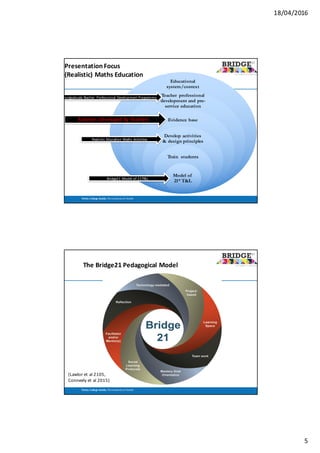
Educational
system/context
Teacher professional
development and pre-
service education
Evidence base
Develop activities
& design principles
Train students
Model of
21st
T&L
What	is	needed
to	bring	about
Transformation
Trinity	 College	Dublin,	The	University	of	Dublin
Educational
system/context
Teacher professional
development and pre-
service education
Evidence base
Develop activities
& design principles
Train students
Model of
21st
T&L
Bridge21
Longitudinal
Design	Based	Research
Initiative	in	Trinity
College	Dublin
(Anderson	2012)
18/04/2016
5
Trinity	 College	Dublin,	The	University	of	Dublin
Educational
system/context
Teacher professional
development and pre-
service education
Evidence base
Develop activities
& design principles
Train students
Model of
21st
T&L
Presentation	Focus
(Realistic)	Maths	Education
Bridge21	Model	of	21sT&L
Realistic	Education	Maths	Activities
Postgraduate	Teacher	 Professional	Development	Programme
Activities	Developed	by	Teachers
Trinity	 College	Dublin,	The	University	of	Dublin
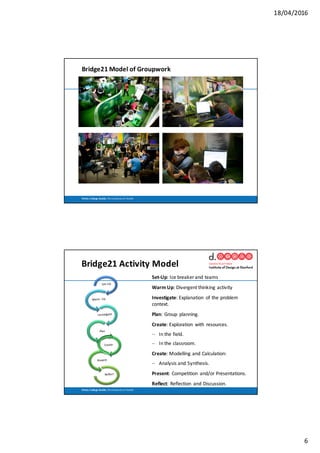
The	Bridge21	Pedagogical	Model
(Lawlor et	al	2105,	
Conneely et	al	2015)
18/04/2016
6
Trinity	 College	Dublin,	The	University	of	Dublin
Bridge21	Model	of	Groupwork
Trinity	 College	Dublin,	The	University	of	Dublin
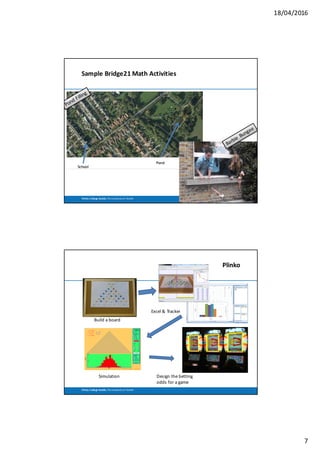
Bridge21	Activity	Model
Set-Up:	Ice	breaker	and	teams
Warm	Up:	Divergent	thinking	activity
Investigate:	Explanation	 of	the	problem	
context.
Plan:	Group	 planning.
Create:	Exploration	 with	 resources.
– In	the	field.
– In	the	classroom.
Create:	Modelling	and	Calculation:	
– Analysis	and	Synthesis.
Present:	Competition	 and/or	Presentations.
Reflect:	Reflection	 and	Discussion.
18/04/2016
7
Trinity	 College	Dublin,	The	University	of	Dublin
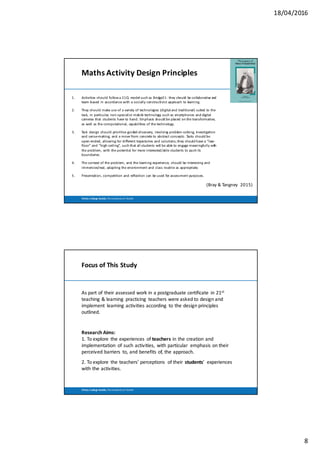
Sample	Bridge21	Math	Activities
Trinity	 College	Dublin,	The	University	of	Dublin
Plinko
Build	a	board
Excel	&	Tracker
Simulation Design	the	betting	
odds	for	a	game
18/04/2016
8
Trinity	 College	Dublin,	The	University	of	Dublin
Maths	Activity	Design	Principles
1. Activities	should	follow	a	21CL	model	such	as	Bridge21:	they	should	be	collaborative	and	
team-based	in	accordance	with	a	socially	constructivist	approach	to	learning.
2. They	should	make	use	of	a	variety	of	technologies	(digital	and	traditional)	suited	to	the	
task,	in	particular,	non-specialist	mobile	technology	such	as	smartphones	and	digital	
cameras	that	 students	have	to	hand.	Emphasis	should	be	placed	on	the	transformative,	
as	well	as	the	computational,	capabilities	of	the	technology.
3. Task	 design	should	prioritise	guided-discovery,	involving	problem-solving,	investigation	
and	sense-making,	and	a	move	from	concrete	to	abstract	concepts.	Tasks	should	be	
open-ended,	allowing	for	different	trajectories	and	solutions;	they	should	have	a	“low-
floor”	and	“high-ceiling”,	such	that	all	students	will	be	able	to	engage	meaningfully	with	
the	problem,	with	the	potential	for	more	interested/able	students	to	push	its	
boundaries.	
4. The	context	of	the	problem,	and	the	learning	experience,	should	be	interesting	and	
immersive/real,	adapting	the	environment	and	class	routine	as	appropriate;
5. Presentation,	competition	and	reflection	can	be	used	for	assessment	purposes.
(Bray	&	Tangney		2015)
Trinity	 College	Dublin,	The	University	of	Dublin
Focus	of	This	Study
As	part	of	their	assessed	work	in	a	postgraduate	certificate	 in	21st
teaching	&	learning	 practicing	 teachers	were	asked	to	design	and	
implement	 learning	activities	according	 to	the	design	principles	
outlined.
Research	Aims:
1.	To	explore	 the	experiences	 of	teachers in	the	creation	and	
implementation	 of	such	activities,	 with	particular	 emphasis	on	their	
perceived	barriers	 to,	and	benefits	of,	the	approach.	
2.	To	explore	 the	teachers’	perceptions	 of	their	 students’	 experiences	
with	the	activities.
18/04/2016
9
Trinity	 College	Dublin,	The	University	of	Dublin
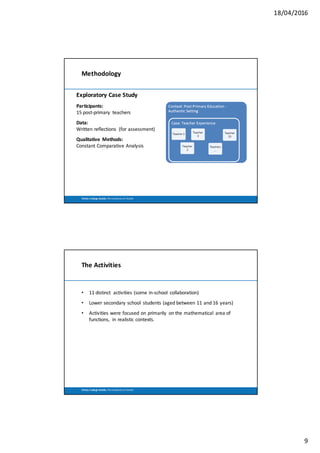
Methodology
Exploratory	Case	Study
Participants:
15	post-primary	 teachers
Data:
Written	reflections	 (for	assessment)
Qualitative	 Methods:
Constant	Comparative	Analysis	
Trinity	 College	Dublin,	The	University	of	Dublin
The	Activities
• 11	distinct	 activities	(some	in-school	 collaboration)
• Lower	secondary	school	 students	(aged	between	11	and	16	years)
• Activities	were	focused	on	primarily	 on	the	mathematical	 area	of	
functions,	 in	realistic	contexts.
18/04/2016
10
Trinity	 College	Dublin,	The	University	of	Dublin
Sample	Activity	
Multimedia	presentation	 by	a	participating	 teacher,	 for	assessment.
Trinity	 College	Dublin,	The	University	of	Dublin
Other	Activities	Developed	By	Teachers
• A	helium	balloon	and	technology	was	used	to	find	the	measure	of	certain	
heights	around	our	school.		
• Students	will	be	asking	themselves	“how	fast	am	I	running?”.	
• Working	in	groups	of	five	members,	students	are	tasked	with	comparing	the	
speed	of	the	shortest	and	tallest	members	of	their	group	over	a	specified	
distance.	
• The	students	will	be	asked	to	plot	the	quadratic	function	for	the	flight	of	their	
shot	in	a	football	crossbar	challenge.	
• Given	an	advertisement	for	a	party	hire	company,	the	students	are	
encouraged	to	use	GeoGebra to	explore	different	combinations	of	tables	etc.	
to	get	the	best	value	for	money.
• The	students	will	undertake	a	study	to	determine	if	the	speed	of	the	ball	
affects	the	chances	of	scoring	goal.
18/04/2016
11
Trinity	 College	Dublin,	The	University	of	Dublin
Findings	- Benefits	to	teachers
• Changes	in	Beliefs
• Change	in	role	from	transmitter	of	information	 to	facilitator	 of	
learning
“After trying this, my eyes have been
opened to the possibilities of covering
the curriculum, but by changing the
setting of the learning, you can teach
a lot more effectively to an audience
who are stimulated and engaged.”
“I decided to tell the students of how this was as much of a
learning curve to me as it was to them. This was because I really
did feel that they would lose confidence in me if they felt that I
was trying to teach them rather than facilitate them. This seemed
to empower them as they felt that even though I wasn’t part of
their team, I was learning and teaching with them.”
Trinity	 College	Dublin,	The	University	of	Dublin
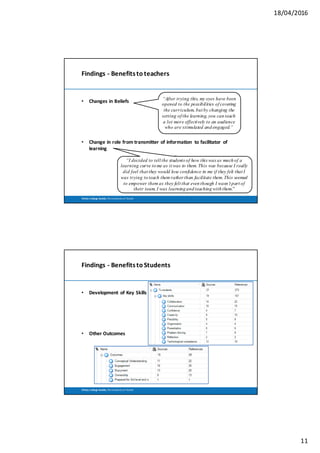
Findings	- Benefits	to	Students
• Development	 of	Key	Skills
• Other	Outcomes
18/04/2016
12
Trinity	 College	Dublin,	The	University	of	Dublin
Findings	– Barriers	to	the	Approach
1. Time	Constraints	
Most	significant	 barrier
2. Technical	 Issues:
1. Access	at	school	level
2. Small	“hitches”	
3. Small	number	of	issues	around	teamwork
Having a longer block of time would
have been more productive, having to
stop after 40 minutes and then pick up
again a day or two later was inconsistent
Trinity	 College	Dublin,	The	University	of	Dublin
Findings	– In	Conclusion
Consistency	 in	the	 use	of	this	 approach	has	the	potential	 to	lead	to	
very	positive	outcomes.
I have worked with this particular class group on two other 21st
Century Teaching and Learning Assignments. Their development
throughout the course of the year has been astounding. The flair
with which they now competently and confidently use technology
to gather and analyse information, and present their findings is
very impressive. This project was a thoroughly enriching
experience for both the students and teachers assisting them.

csedu16-maths

  • 1.
    18/04/2016 1 Teachers’ Experiences of the Integration of 21st Century Learning in the Mathematics Classroom the Bridge21 Model in Action Author: Dr Aibhín Bray Presented by: Professor Brendan Tangney Email: brayai@tcd.ie slideshare.net/tangney/csedu16-maths Date: April 2016 Trinity College Dublin, The University of Dublin Bibliography • Anderson, T. and J. Shattuck, Design-Based Research: A Decade of Progress in Education Research? Educational Researcher, 2012. 41(1): p. 16-25. • Freudenthal, H. (1991). Revisiting mathematics education: China lectures (Vol. 9). Dordrecht/Boston/London:Springer. • Puentedura, R., The SAMR model: Background and exemplars. Retrieved June, 2012. 24: p. 2013. • Conneely, C., Girvan, C., Lawlor, J., Tangney, B., An Exploratory Case Study into the Adaption of the Bridge21 Model for 21st Century Learning in Irish Classrooms, in editor(s) Butler, D., Marshall, K., Leahy, M., Shaping our Future: How the lessons of the past can shape educational transformation, Dublin, Liffey Press. 2015, pp 348-381. • Lawlor J., Marshall K., Tangney B., Bridge21 – Exploring the potential to foster intrinsic student motivation through a team-based, technology mediated learning model, Technology, Pedagogy and Education, 2015, 1-20 http://dx.doi.org/10.1080/1475939X.2015.1023828
  • 2.
    18/04/2016 2 Trinity College Dublin, The University of Dublin Publications • Bray A., Tangney B., "Enhancing Student Engagement through the Affordances of Mobile Technology: A 21st Century Learning Perspective on Realistic Mathematics Education", Mathematics Education Research Journal. 2015. 1 -25 DOI10.1007/s13394-015-0158-7 • Bray, A,. Oldham, E. & Tangney, B. Technology-Mediated Realistic Mathematics Education And The Bridge21 Model: A Teaching Experiment. Proceedings of the Ninth Conference of the European Society for Research in Mathematics Education (CERME9). February (2015). pp. 2487 – 2494, Prague, Czech Republic. • Tangney B., Bray A., Oldham E., Realistic Mathematics Education, Mobile Technology & The Bridge21 Model For 21st Century Learning – A Perfect Storm, in Mobile Learning and Mathematics: Foundations, Design, and Case Studies, Crompton H., & Traxler J., (Eds) Routledge, 2015, pp 96- 105. • Bray, A., & Tangney, B. (2014). Barbie Bungee Jumping, Technology and Contextual Learning of Mathematics. 6th International Conference on Computer Supported Education (CSEDU), 206 - 213. • Bray, A. Oldham, E. & Tangney, B., The Human Catapult and Other Stories – 11th International Conference on Technology in Maths Teaching, Italy, July 2013, pp77-83. • Bray, A., & Tangney, B., Mathematics, Technology Interventions and Pedagogy - Seeing the Wood From the Trees, 5th International Conference on Computer Supported Education, Aachen, Germany, May, 2013, pp57-63. Trinity College Dublin, The University of Dublin 4 Irish Secondary School Education Year 1 •Age ~13 –Junior Cylce Year 2 •Age ~14 –Junior Cycle Year 3 •Age ~ 15 –Junior Cycle •State Examination – Junior Certificate Year 4 •Age ~16 –Transition Year – flexibilty in curriculum Year 5 •Age ~17 –Senior Cycle Year 6 •Age ~ 18 –Senior Cylce •HIGH STAKES STATE EXAMINATION •Grades are sole requirement for entry to 3rd level
  • 3.
    18/04/2016 3 Trinity College Dublin, The University of Dublin Beliefs - ICT in the Classroom Trinity College Dublin, The University of Dublin 21 C Teaching & Learning Requires a Move to TRANSFORMARTION Layers in the SAMR Model of Technology Adoption (Puentedura 2012)
  • 4.
    18/04/2016 4 Trinity College Dublin, The University of Dublin Educational system/context Teacher professional developmentand pre- service education Evidence base Develop activities & design principles Train students Model of 21st T&L What is needed to bring about Transformation Trinity College Dublin, The University of Dublin Educational system/context Teacher professional development and pre- service education Evidence base Develop activities & design principles Train students Model of 21st T&L Bridge21 Longitudinal Design Based Research Initiative in Trinity College Dublin (Anderson 2012)
  • 5.
    18/04/2016 5 Trinity College Dublin, The University of Dublin Educational system/context Teacher professional developmentand pre- service education Evidence base Develop activities & design principles Train students Model of 21st T&L Presentation Focus (Realistic) Maths Education Bridge21 Model of 21sT&L Realistic Education Maths Activities Postgraduate Teacher Professional Development Programme Activities Developed by Teachers Trinity College Dublin, The University of Dublin The Bridge21 Pedagogical Model (Lawlor et al 2105, Conneely et al 2015)
  • 6.
    18/04/2016 6 Trinity College Dublin, The University of Dublin Bridge21 Model of Groupwork Trinity College Dublin, The University of Dublin Bridge21 Activity Model Set-Up: Ice breaker and teams Warm Up: Divergent thinking activity Investigate: Explanation of the problem context. Plan: Group planning. Create: Exploration with resources. – In the field. – In the classroom. Create: Modelling and Calculation: – Analysis and Synthesis. Present: Competition and/or Presentations. Reflect: Reflection and Discussion.
  • 7.
  • 8.
    18/04/2016 8 Trinity College Dublin, The University of Dublin Maths Activity Design Principles 1. Activities should follow a 21CL model such as Bridge21: they should be collaborative and team-based in accordance with a socially constructivist approach to learning. 2.They should make use of a variety of technologies (digital and traditional) suited to the task, in particular, non-specialist mobile technology such as smartphones and digital cameras that students have to hand. Emphasis should be placed on the transformative, as well as the computational, capabilities of the technology. 3. Task design should prioritise guided-discovery, involving problem-solving, investigation and sense-making, and a move from concrete to abstract concepts. Tasks should be open-ended, allowing for different trajectories and solutions; they should have a “low- floor” and “high-ceiling”, such that all students will be able to engage meaningfully with the problem, with the potential for more interested/able students to push its boundaries. 4. The context of the problem, and the learning experience, should be interesting and immersive/real, adapting the environment and class routine as appropriate; 5. Presentation, competition and reflection can be used for assessment purposes. (Bray & Tangney 2015) Trinity College Dublin, The University of Dublin Focus of This Study As part of their assessed work in a postgraduate certificate in 21st teaching & learning practicing teachers were asked to design and implement learning activities according to the design principles outlined. Research Aims: 1. To explore the experiences of teachers in the creation and implementation of such activities, with particular emphasis on their perceived barriers to, and benefits of, the approach. 2. To explore the teachers’ perceptions of their students’ experiences with the activities.
  • 9.
    18/04/2016 9 Trinity College Dublin, The University of Dublin Methodology Exploratory Case Study Participants: 15 post-primary teachers Data: Written reflections (for assessment) Qualitative Methods: Constant Comparative Analysis Trinity College Dublin, The University of Dublin The Activities • 11 distinct activities (some in-school collaboration) • Lower secondary school students (aged between 11 and 16 years) • Activities were focused on primarily on the mathematical area of functions, in realistic contexts.
  • 10.
    18/04/2016 10 Trinity College Dublin, The University of Dublin Sample Activity Multimedia presentation by a participating teacher, for assessment. Trinity College Dublin, The University of Dublin Other Activities Developed By Teachers • A helium balloon and technology was used to find the measure of certain heights around our school. • Students will be asking themselves “how fast am I running?”. • Working in groups of five members, students are tasked with comparing the speed of the shortest and tallest members of their group over a specified distance. • The students will be asked to plot the quadratic function for the flight of their shot in a football crossbar challenge. • Given an advertisement for a party hire company, the students are encouraged to use GeoGebra to explore different combinations of tables etc. to get the best value for money. • The students will undertake a study to determine if the speed of the ball affects the chances of scoring goal.
  • 11.
    18/04/2016 11 Trinity College Dublin, The University of Dublin Findings - Benefits to teachers •Changes in Beliefs • Change in role from transmitter of information to facilitator of learning “After trying this, my eyes have been opened to the possibilities of covering the curriculum, but by changing the setting of the learning, you can teach a lot more effectively to an audience who are stimulated and engaged.” “I decided to tell the students of how this was as much of a learning curve to me as it was to them. This was because I really did feel that they would lose confidence in me if they felt that I was trying to teach them rather than facilitate them. This seemed to empower them as they felt that even though I wasn’t part of their team, I was learning and teaching with them.” Trinity College Dublin, The University of Dublin Findings - Benefits to Students • Development of Key Skills • Other Outcomes
  • 12.
    18/04/2016 12 Trinity College Dublin, The University of Dublin Findings – Barriers to the Approach 1.Time Constraints Most significant barrier 2. Technical Issues: 1. Access at school level 2. Small “hitches” 3. Small number of issues around teamwork Having a longer block of time would have been more productive, having to stop after 40 minutes and then pick up again a day or two later was inconsistent Trinity College Dublin, The University of Dublin Findings – In Conclusion Consistency in the use of this approach has the potential to lead to very positive outcomes. I have worked with this particular class group on two other 21st Century Teaching and Learning Assignments. Their development throughout the course of the year has been astounding. The flair with which they now competently and confidently use technology to gather and analyse information, and present their findings is very impressive. This project was a thoroughly enriching experience for both the students and teachers assisting them.