Design and Analysis of Algorithms
Lecture 1
• Overview of the course
• Closest Pair problem
1
https://moodle.cse.iitk.ac.in
CS345A
Algorithms-II
Aim of the course
To empower each student with the skills to design algorithms
• With provable guarantee on correctness.
• With provable guarantee on their efficiency.
2
Algorithm Paradigm
Motivation:
• Many problems whose algorithms are based on a common approach.
➔ A need of a systematic study of the characteristics of such approaches.
Algorithm Paradigms:
• Divide and Conquer
• Greedy Strategy
• Dynamic Programming
3
(advanced)
(advanced)
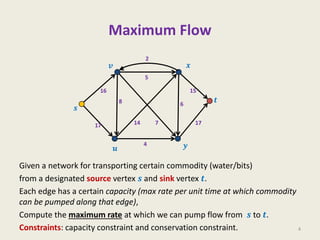
Maximum Flow
Given a network for transporting certain commodity (water/bits)
from a designated source vertex 𝒔 and sink vertex 𝒕.
Each edge has a certain capacity (max rate per unit time at which commodity
can be pumped along that edge),
Compute the maximum rate at which we can pump flow from 𝒔 to 𝒕.
Constraints: capacity constraint and conservation constraint. 4
𝒔
𝒗
𝒖
𝒙
𝒚
𝒕
2
17
5
6
8
17
4
15
16
7
14
Miscellaneous
• Matching in Graphs
Maximum matching, Stable matching
• Amortized Analysis
A powerful technique to analyse time complexity of algorithms
• String Matching
• Linear Programming
5
Last topic on Algorithms
• NP Complete problems
• Approximation/randomized Algorithms
6
Data Structures
7
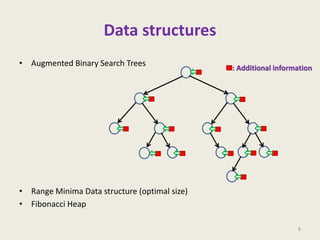
Data structures
• Augmented Binary Search Trees
• Range Minima Data structure (optimal size)
• Fibonacci Heap
8
: Additional information
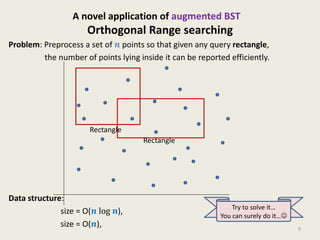
Orthogonal Range searching
Problem: Preprocess a set of 𝒏 points so that given any query rectangle,
the number of points lying inside it can be reported efficiently.
Data structure:
size = O(𝒏 log 𝒏), Query = O( log2 𝒏),
size = O(𝒏), Query = O( 𝑛), 9
Rectangle
A novel application of augmented BST
Try to solve it…
You can surely do it…☺
Rectangle
Divide and Conquer
10
A paradigm for Algorithm Design
An Overview
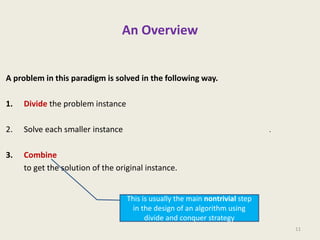
A problem in this paradigm is solved in the following way.
1. Divide the problem instance into two or more instances of the same problem.
2. Solve each smaller instance recursively (base case suitably defined).
3. Combine the solutions of the smaller instances
to get the solution of the original instance.
11
This is usually the main nontrivial step
in the design of an algorithm using
divide and conquer strategy
Example Problems
1. Merge Sort
2. Multiplication of two 𝒏-bit integers.
3. Counting the number of inversions in an array.
4. Median finding in linear time.
12
PROBLEM 1
Closest Pair of Points
13
The Closest Pair Problem
14
𝜹
Closest Pair of Points
Problem Definition:
Given a set 𝑷 of 𝒏 > 𝟏 points in plane,
compute the pair of points with minimum Euclidean distance.
Deterministic algorithms:
• O(𝒏𝟐) : Trivial algorithm
• O(𝒏 𝐥𝐨𝐠 𝒏) : Divide and Conquer based algorithm
15
Hint/Tool No. 1
Exercise:
What is the maximum number of points that can be placed in a unit square
such that the minimum distance is at least 1 ?
Answer: 4.
16
1
1
2
A discrete math exercise
If there are more than
4 points, at least one
of the four small
squares will have
more than 1 points.
Hint/Tool No. 2
Question:
For which algorithmic problems do we need a suitable data structure ?
Answer:
If the problem involves “many” operations of same type on a given data.
For example, it is worth sorting an array only if there are going to be many
search queries on it.
Let us see if you can use this principle in today’s class itself ☺
17
When do we use a data structure ?
The divide step
18
𝒏
𝟐
points
𝒏
𝟐
points
The conquer step
19
𝜹𝑳
𝜹𝑹
Compute closest pair of the
left half set
Compute closest pair of the
right half set
Notice 𝜹𝑳 < 𝜹𝑹 for this given instance
The combine step
20
𝜹𝑳
𝜹𝑹
𝜹𝑳
𝜹𝑳
Which points do
we need to focus
on for the closest
pairs ?
The combine step
21
𝜹𝑳
𝜹𝑹
𝜹𝑳
𝜹𝑳
But there may still be Θ(𝑛2
)
pairs of points here So what
to do ?
The combine step
22
𝜹𝑳
𝜹𝑹
𝜹𝑳
𝜹𝑳
Focus on a point 𝒑 in
left strip.
Where do we have to search for the
points in the right strip that can form a
pair with 𝒑 at distance < 𝜹𝑳 ?
𝒑
The combine step
23
𝜹𝑳
𝜹𝑹
𝜹𝑳
𝜹𝑳
𝜹𝑳
𝜹𝑳
𝒑
The combine step
24
𝜹𝑳
𝜹𝑹
𝜹𝑳
𝜹𝑳
𝜹𝑳
𝜹𝑳
Only the points lying in these
2 red squares are relevant as
far as 𝒑 is concerned.
𝒑
How many points can
there be in these 2 red
squares each of length𝜹𝑳?
Surely not more than 8
(using Hint 1)
How to find the points in
these red square for point 𝒑 ?
It will take O(𝒏) time for a given 𝒑.
It is time to use Hint/Tool no. 2.
Think for a while before going to
the next slide.
The combine step
25
𝜹𝑳
𝜹𝑹
𝜹𝑳
𝜹𝑳
𝜹𝑳
𝜹𝑳
We need to find points in the
2 red square for every point
in the left strip.
So build a suitable data structure
for points in the right strip so that
we can answer such query efficiently
for each point in the left strip.
What will be
the data structure ?
An array storing the points of
the right strip in increasing
order of y-coordinates.
𝜹𝑳
𝜹𝑳
𝜹𝑳
𝜹𝑳
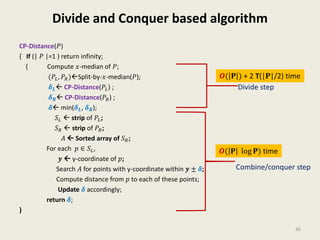
Divide and Conquer based algorithm
CP-Distance(𝑃)
{ If (| 𝑃 |=1 ) return infinity;
{ Compute 𝑥-median of 𝑃;
(𝑃𝐿, 𝑃𝑅)Split-by-𝑥-median(𝑃);
𝜹𝑳 CP-Distance(𝑃𝐿) ;
𝜹𝑹 CP-Distance(𝑃𝑅) ;
𝜹 min(𝜹𝑳, 𝜹𝑹);
𝑆𝐿  strip of 𝑃𝐿;
𝑆𝑅  strip of 𝑃𝑅;
𝐴  Sorted array of 𝑆𝑅;
For each 𝑝 ∈ 𝑆𝐿,
𝒚  y-coordinate of 𝑝;
Search 𝐴 for points with y-coordinate within 𝒚 ± 𝜹;
Compute distance from 𝑝 to each of these points;
Update 𝜹 accordingly;
return 𝜹;
}
26
Divide step
Combine/conquer step
𝑶( 𝐏 log 𝐏) time
𝑶( 𝐏 ) + 2 T(|𝐏|/2) time
Running time of the algorithm
What is the recurrence for running time?
T(𝑛) = c 𝑛 log 𝑛 + 2 T(𝑛/2)
➔
T(𝑛) = O( 𝑛 log2𝑛)
Theorem:
There exists an O( 𝑛 log2𝑛) time algorithm to compute closest pair of 𝑛 points
in plane.
27
Conclusion
Homework:
1. Try to improve the running time to O( 𝑛 log 𝑛).
Hint: “the code will look similar to that of MergeSort”.
2. Ponder over the data structure for orthogonal range searching.
28
How does one design an algorithm ?
If you wish to find the answer on your own,
try to solve the first assignment problem on your own.
29
Without any help from the web
Without any help from the your friends
Assignment 1
Smallest Enclosing circle
Problem definition: Given 𝒏 points in a plane,
compute the smallest radius circle that encloses all 𝒏 point.
30

CS345-Algorithms-II-Lecture-1-CS345-2016.pdf

  • 1.
    Design and Analysisof Algorithms Lecture 1 • Overview of the course • Closest Pair problem 1 https://moodle.cse.iitk.ac.in CS345A Algorithms-II
  • 2.
    Aim of thecourse To empower each student with the skills to design algorithms • With provable guarantee on correctness. • With provable guarantee on their efficiency. 2
  • 3.
    Algorithm Paradigm Motivation: • Manyproblems whose algorithms are based on a common approach. ➔ A need of a systematic study of the characteristics of such approaches. Algorithm Paradigms: • Divide and Conquer • Greedy Strategy • Dynamic Programming 3 (advanced) (advanced)
  • 4.
    Maximum Flow Given anetwork for transporting certain commodity (water/bits) from a designated source vertex 𝒔 and sink vertex 𝒕. Each edge has a certain capacity (max rate per unit time at which commodity can be pumped along that edge), Compute the maximum rate at which we can pump flow from 𝒔 to 𝒕. Constraints: capacity constraint and conservation constraint. 4 𝒔 𝒗 𝒖 𝒙 𝒚 𝒕 2 17 5 6 8 17 4 15 16 7 14
  • 5.
    Miscellaneous • Matching inGraphs Maximum matching, Stable matching • Amortized Analysis A powerful technique to analyse time complexity of algorithms • String Matching • Linear Programming 5
  • 6.
    Last topic onAlgorithms • NP Complete problems • Approximation/randomized Algorithms 6
  • 7.
  • 8.
    Data structures • AugmentedBinary Search Trees • Range Minima Data structure (optimal size) • Fibonacci Heap 8 : Additional information
  • 9.
    Orthogonal Range searching Problem:Preprocess a set of 𝒏 points so that given any query rectangle, the number of points lying inside it can be reported efficiently. Data structure: size = O(𝒏 log 𝒏), Query = O( log2 𝒏), size = O(𝒏), Query = O( 𝑛), 9 Rectangle A novel application of augmented BST Try to solve it… You can surely do it…☺ Rectangle
  • 10.
    Divide and Conquer 10 Aparadigm for Algorithm Design
  • 11.
    An Overview A problemin this paradigm is solved in the following way. 1. Divide the problem instance into two or more instances of the same problem. 2. Solve each smaller instance recursively (base case suitably defined). 3. Combine the solutions of the smaller instances to get the solution of the original instance. 11 This is usually the main nontrivial step in the design of an algorithm using divide and conquer strategy
  • 12.
    Example Problems 1. MergeSort 2. Multiplication of two 𝒏-bit integers. 3. Counting the number of inversions in an array. 4. Median finding in linear time. 12
  • 13.
  • 14.
    The Closest PairProblem 14 𝜹
  • 15.
    Closest Pair ofPoints Problem Definition: Given a set 𝑷 of 𝒏 > 𝟏 points in plane, compute the pair of points with minimum Euclidean distance. Deterministic algorithms: • O(𝒏𝟐) : Trivial algorithm • O(𝒏 𝐥𝐨𝐠 𝒏) : Divide and Conquer based algorithm 15
  • 16.
    Hint/Tool No. 1 Exercise: Whatis the maximum number of points that can be placed in a unit square such that the minimum distance is at least 1 ? Answer: 4. 16 1 1 2 A discrete math exercise If there are more than 4 points, at least one of the four small squares will have more than 1 points.
  • 17.
    Hint/Tool No. 2 Question: Forwhich algorithmic problems do we need a suitable data structure ? Answer: If the problem involves “many” operations of same type on a given data. For example, it is worth sorting an array only if there are going to be many search queries on it. Let us see if you can use this principle in today’s class itself ☺ 17 When do we use a data structure ?
  • 18.
  • 19.
    The conquer step 19 𝜹𝑳 𝜹𝑹 Computeclosest pair of the left half set Compute closest pair of the right half set Notice 𝜹𝑳 < 𝜹𝑹 for this given instance
  • 20.
    The combine step 20 𝜹𝑳 𝜹𝑹 𝜹𝑳 𝜹𝑳 Whichpoints do we need to focus on for the closest pairs ?
  • 21.
    The combine step 21 𝜹𝑳 𝜹𝑹 𝜹𝑳 𝜹𝑳 Butthere may still be Θ(𝑛2 ) pairs of points here So what to do ?
  • 22.
    The combine step 22 𝜹𝑳 𝜹𝑹 𝜹𝑳 𝜹𝑳 Focuson a point 𝒑 in left strip. Where do we have to search for the points in the right strip that can form a pair with 𝒑 at distance < 𝜹𝑳 ? 𝒑
  • 23.
  • 24.
    The combine step 24 𝜹𝑳 𝜹𝑹 𝜹𝑳 𝜹𝑳 𝜹𝑳 𝜹𝑳 Onlythe points lying in these 2 red squares are relevant as far as 𝒑 is concerned. 𝒑 How many points can there be in these 2 red squares each of length𝜹𝑳? Surely not more than 8 (using Hint 1) How to find the points in these red square for point 𝒑 ? It will take O(𝒏) time for a given 𝒑. It is time to use Hint/Tool no. 2. Think for a while before going to the next slide.
  • 25.
    The combine step 25 𝜹𝑳 𝜹𝑹 𝜹𝑳 𝜹𝑳 𝜹𝑳 𝜹𝑳 Weneed to find points in the 2 red square for every point in the left strip. So build a suitable data structure for points in the right strip so that we can answer such query efficiently for each point in the left strip. What will be the data structure ? An array storing the points of the right strip in increasing order of y-coordinates. 𝜹𝑳 𝜹𝑳 𝜹𝑳 𝜹𝑳
  • 26.
    Divide and Conquerbased algorithm CP-Distance(𝑃) { If (| 𝑃 |=1 ) return infinity; { Compute 𝑥-median of 𝑃; (𝑃𝐿, 𝑃𝑅)Split-by-𝑥-median(𝑃); 𝜹𝑳 CP-Distance(𝑃𝐿) ; 𝜹𝑹 CP-Distance(𝑃𝑅) ; 𝜹 min(𝜹𝑳, 𝜹𝑹); 𝑆𝐿  strip of 𝑃𝐿; 𝑆𝑅  strip of 𝑃𝑅; 𝐴  Sorted array of 𝑆𝑅; For each 𝑝 ∈ 𝑆𝐿, 𝒚  y-coordinate of 𝑝; Search 𝐴 for points with y-coordinate within 𝒚 ± 𝜹; Compute distance from 𝑝 to each of these points; Update 𝜹 accordingly; return 𝜹; } 26 Divide step Combine/conquer step 𝑶( 𝐏 log 𝐏) time 𝑶( 𝐏 ) + 2 T(|𝐏|/2) time
  • 27.
    Running time ofthe algorithm What is the recurrence for running time? T(𝑛) = c 𝑛 log 𝑛 + 2 T(𝑛/2) ➔ T(𝑛) = O( 𝑛 log2𝑛) Theorem: There exists an O( 𝑛 log2𝑛) time algorithm to compute closest pair of 𝑛 points in plane. 27
  • 28.
    Conclusion Homework: 1. Try toimprove the running time to O( 𝑛 log 𝑛). Hint: “the code will look similar to that of MergeSort”. 2. Ponder over the data structure for orthogonal range searching. 28

  • 29.
    How does onedesign an algorithm ? If you wish to find the answer on your own, try to solve the first assignment problem on your own. 29 Without any help from the web Without any help from the your friends
  • 30.
    Assignment 1 Smallest Enclosingcircle Problem definition: Given 𝒏 points in a plane, compute the smallest radius circle that encloses all 𝒏 point. 30