CS344 : Introduction to Artificial
Intelligence
Pushpak Bhattacharyya
CSE Dept.,
IIT Bombay
Lecture 15- Robotic Knowledge
Representation and Inferencing; Prolog
A planning agent



An agent interacts with the world via perception and actions
Perception involves sensing the world and assessing the
situation









creating some internal representation of the world

Actions are what the agent does in the domain. Planning
involves reasoning about actions that the agent intends to carry
out
Planning is the reasoning side of acting
This reasoning involves the representation of the world that the
agent has, as also the representation of its actions.
Hard constraints where the objectives have to be achieved
completely for success
The objectives could also be soft constraints, or preferences, to
be achieved as much as possible
Interaction with static domain








The agent has complete information of the domain
(perception is perfect), actions are instantaneous and
their effects are deterministic.
The agent knows the world completely, and it can
take all facts into account while planning.
The fact that actions are instantaneous implies that
there is no notion of time, but only of sequencing of
actions.
The effects of actions are deterministic, and therefore
the agent knows what the world will be like after each
action.
Two kinds of planning


Projection into the future




The planner searches through the possible
combination of actions to find the plan that
will work

Memory based planning



looking into the past
The agent can retrieve a plan from its
memory
Planning
•Definition : Planning is arranging a sequence of
actions to achieve a goal.
•Uses core areas of AI like searching and reasoning &
•Is the core for areas like NLP, Computer Vision.
•Robotics

Kinematics (ME)
Planning (CSE)

•Examples : Navigation , Manoeuvring, Language
Processing (Generation)
Language & Planning
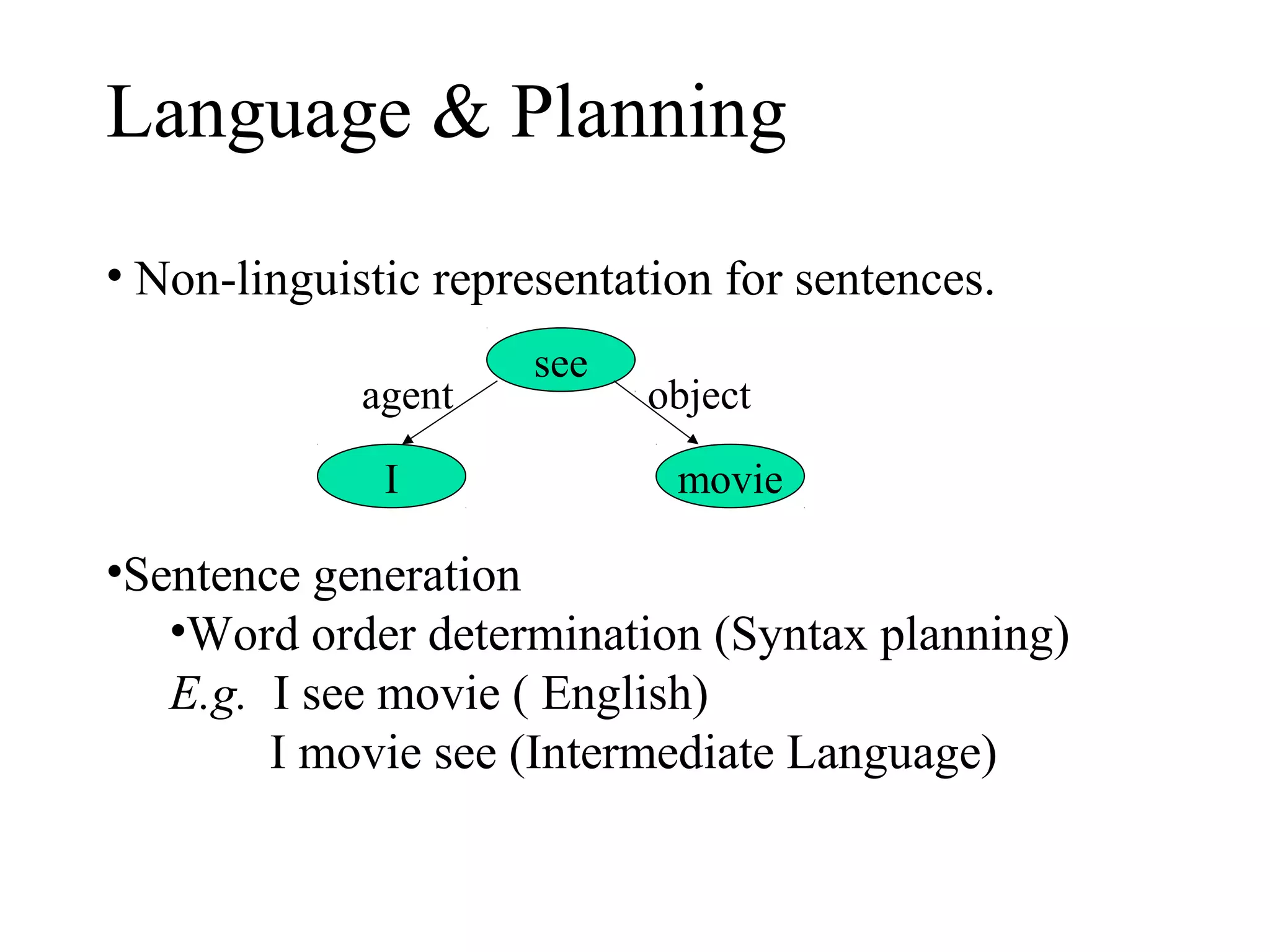
• Non-linguistic representation for sentences.
agent
I

see

object
movie

•Sentence generation
•Word order determination (Syntax planning)
E.g. I see movie ( English)
I movie see (Intermediate Language)
STRIPS
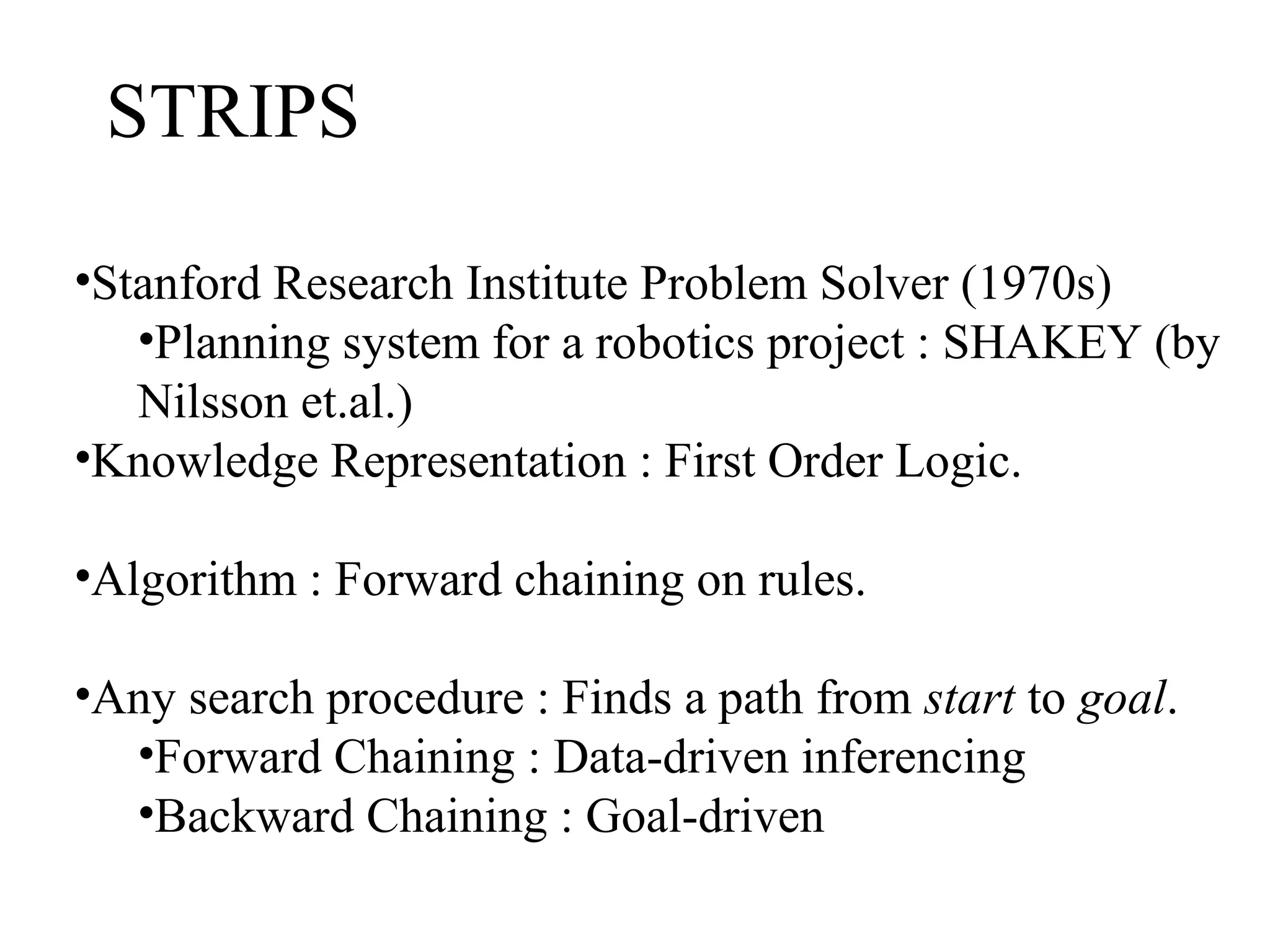
•Stanford Research Institute Problem Solver (1970s)
•Planning system for a robotics project : SHAKEY (by
Nilsson et.al.)
•Knowledge Representation : First Order Logic.
•Algorithm : Forward chaining on rules.
•Any search procedure : Finds a path from start to goal.
•Forward Chaining : Data-driven inferencing
•Backward Chaining : Goal-driven
Forward & Backward Chaining
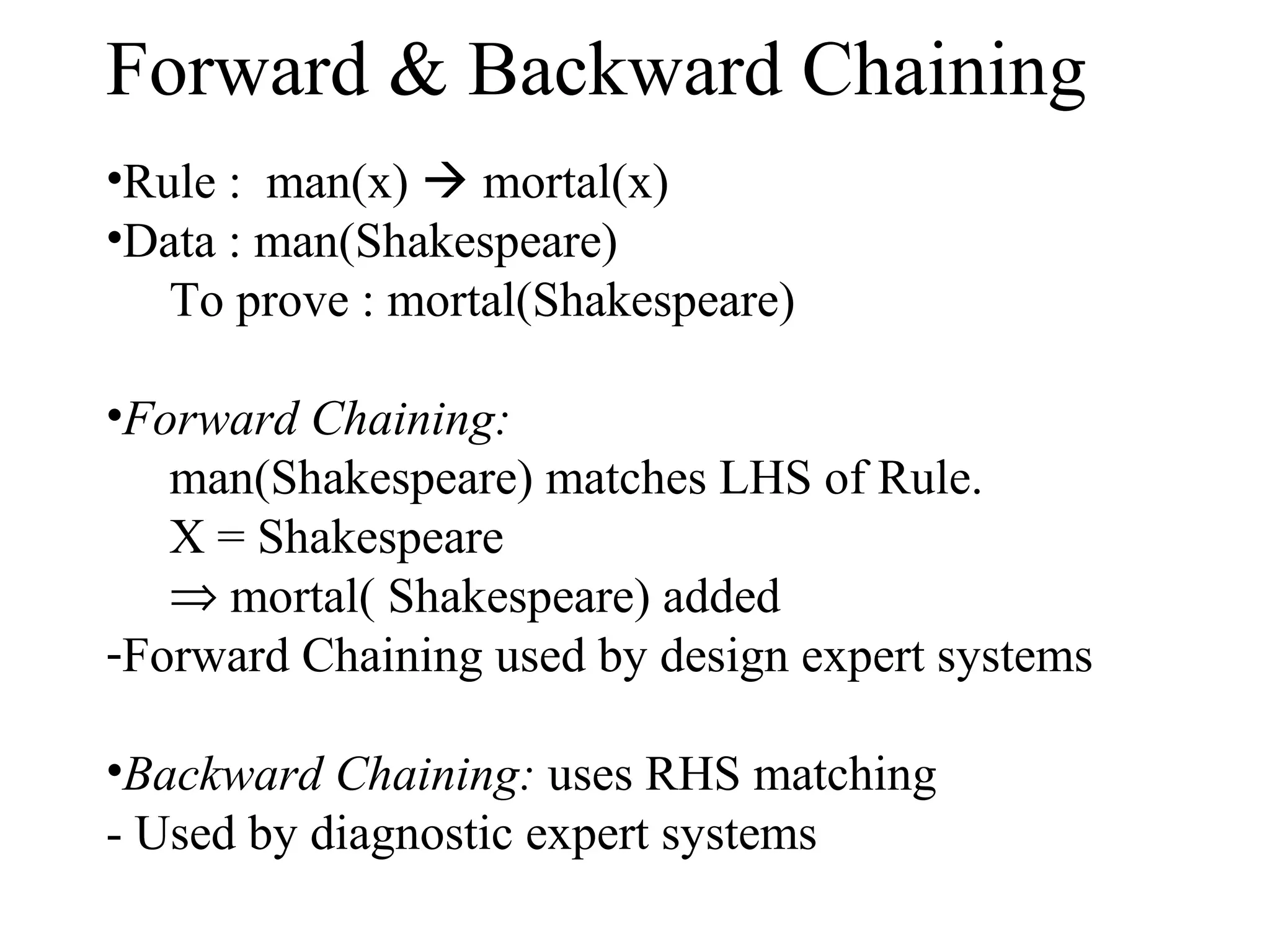
•Rule : man(x)  mortal(x)
•Data : man(Shakespeare)
To prove : mortal(Shakespeare)
•Forward Chaining:
man(Shakespeare) matches LHS of Rule.
X = Shakespeare
⇒ mortal( Shakespeare) added
-Forward Chaining used by design expert systems
•Backward Chaining: uses RHS matching
- Used by diagnostic expert systems
Example : Blocks World
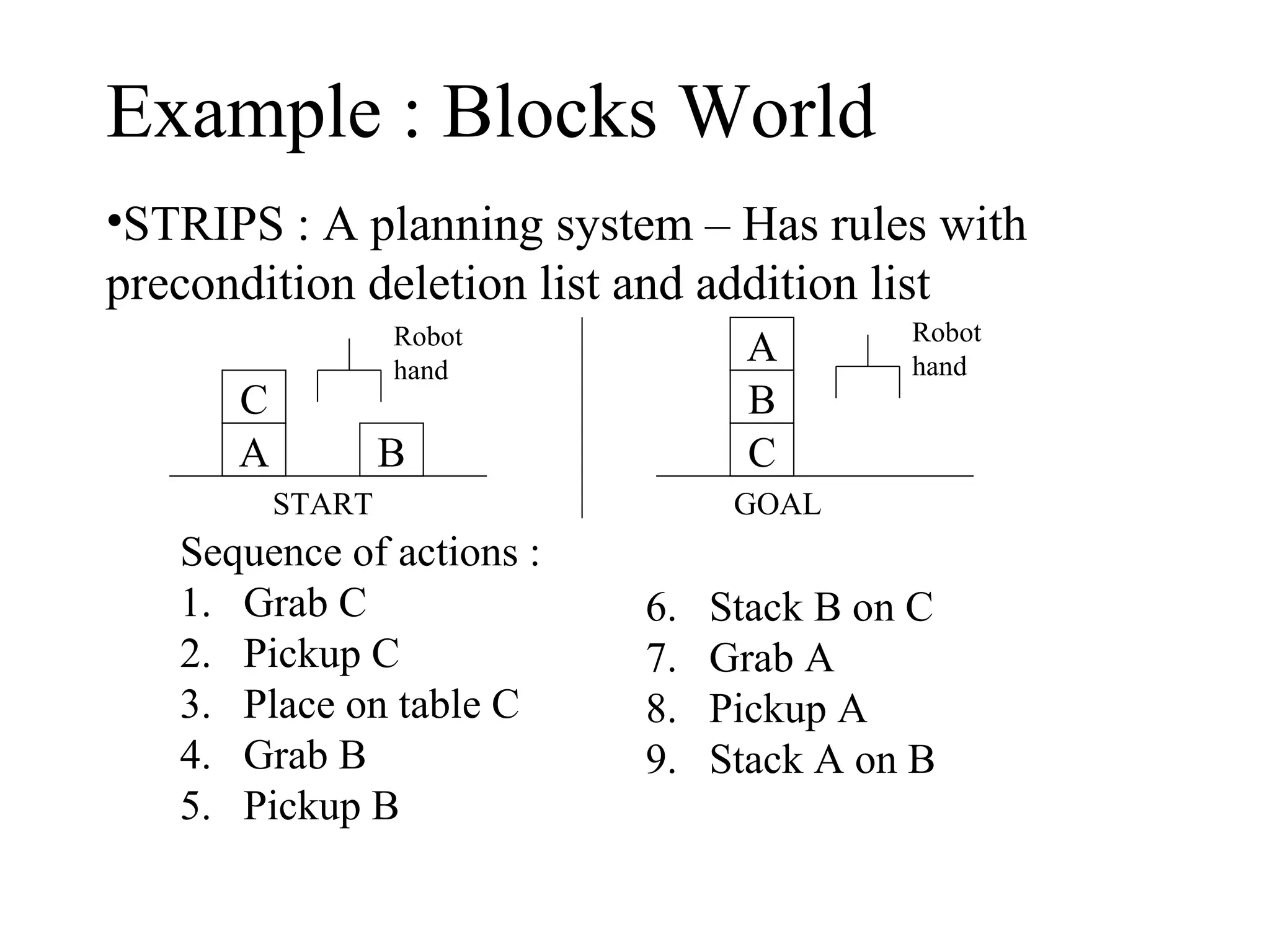
•STRIPS : A planning system – Has rules with
precondition deletion list and addition list
Robot
hand

C
A

A
B
C

B
START

Sequence of actions :
1. Grab C
2. Pickup C
3. Place on table C
4. Grab B
5. Pickup B

Robot
hand

GOAL

6.
7.
8.
9.

Stack B on C
Grab A
Pickup A
Stack A on B
Example : Blocks World
•Fundamental Problem :
The frame problem in AI is concerned with the question
of what piece of knowledge is relevant to the situation.
•Fundamental Assumption : Closed world assumption
If something is not asserted in the knowledge base, it is
assumed to be false.
(Also called “Negation by failure”)
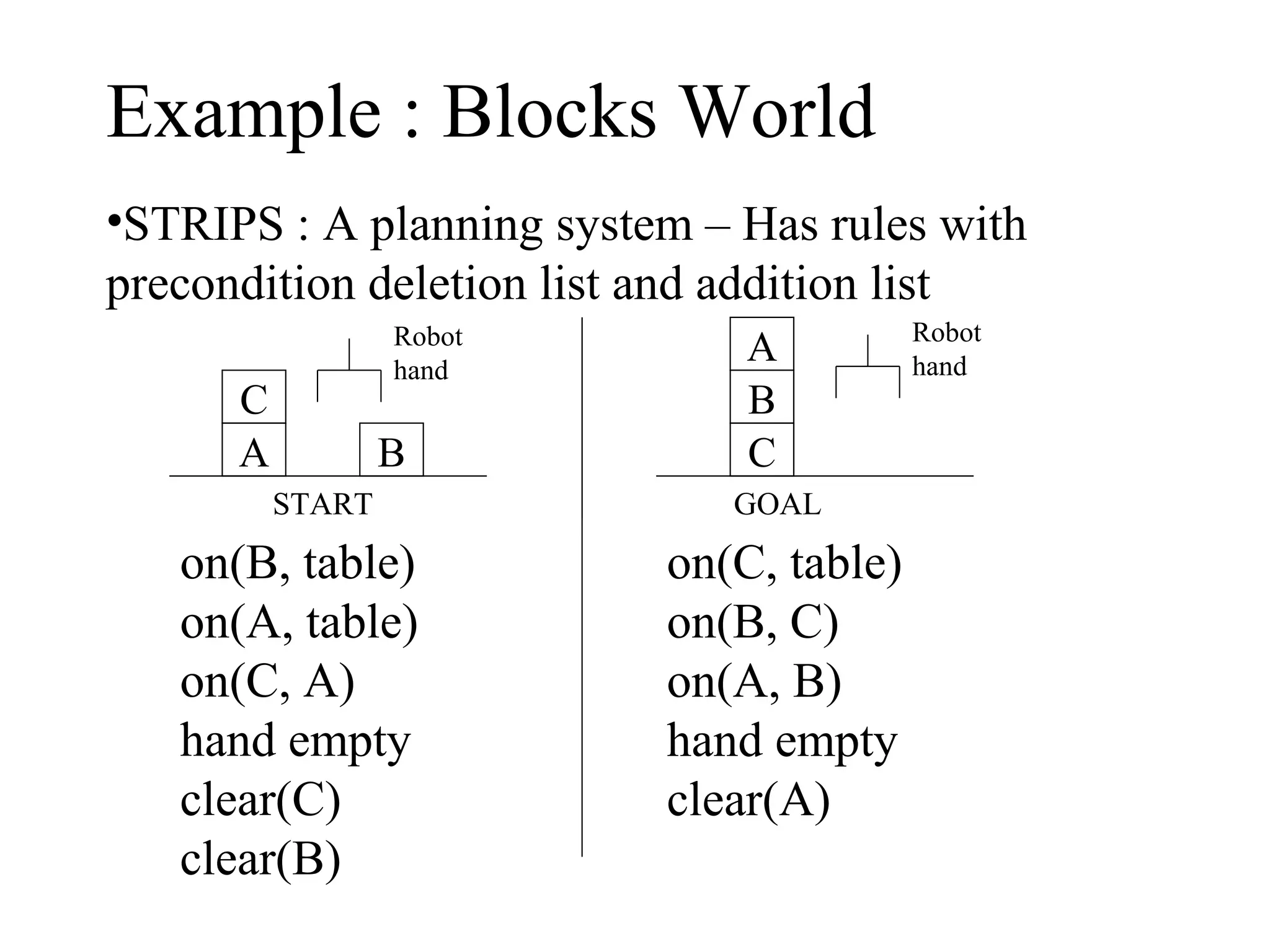
Example : Blocks World
•STRIPS : A planning system – Has rules with
precondition deletion list and addition list
Robot
hand

C
A

B
START

on(B, table)
on(A, table)
on(C, A)
hand empty
clear(C)
clear(B)

A
B
C
GOAL

on(C, table)
on(B, C)
on(A, B)
hand empty
clear(A)

Robot
hand
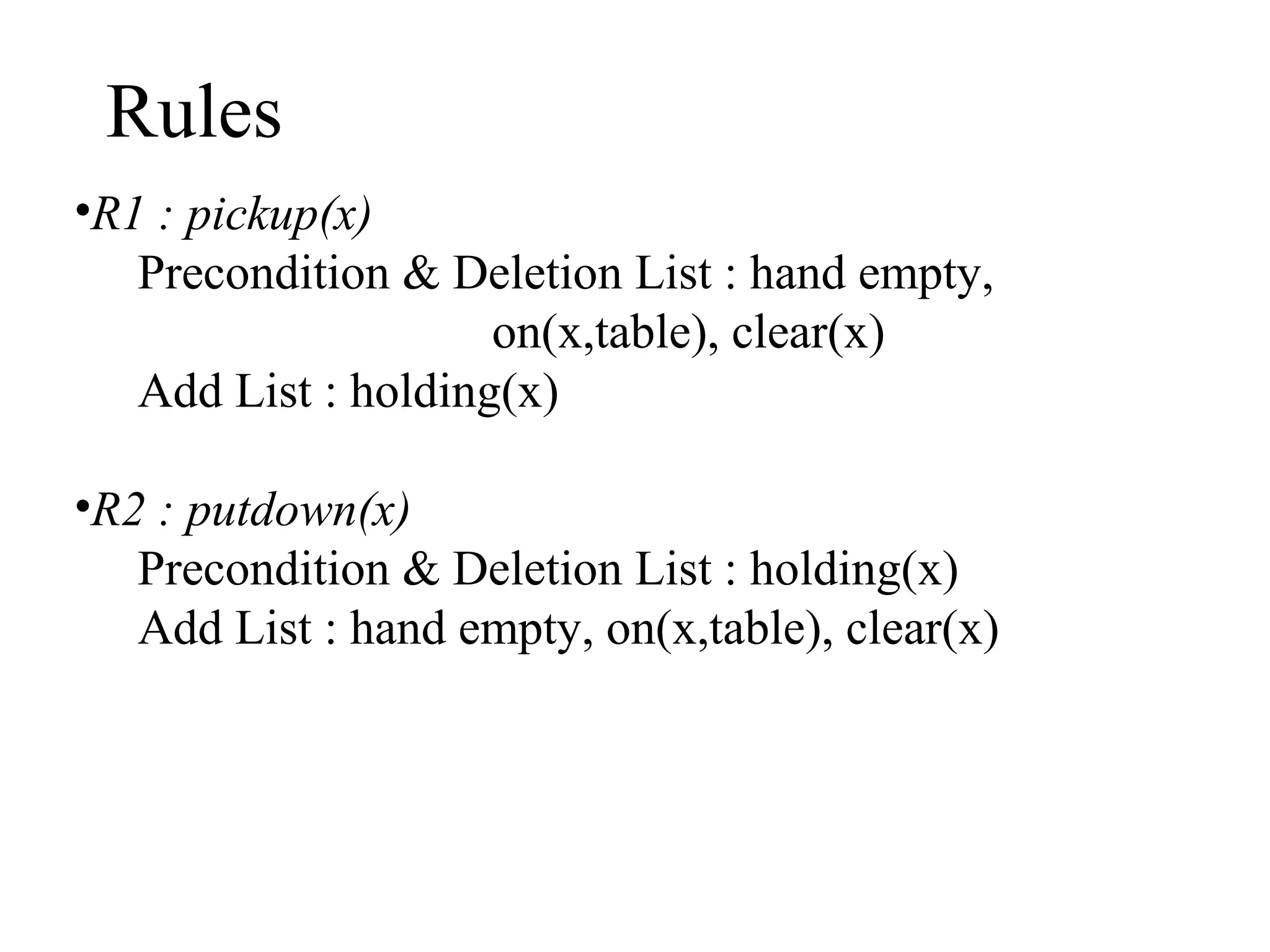
Rules
•R1 : pickup(x)
Precondition & Deletion List : hand empty,
on(x,table), clear(x)
Add List : holding(x)
•R2 : putdown(x)
Precondition & Deletion List : holding(x)
Add List : hand empty, on(x,table), clear(x)
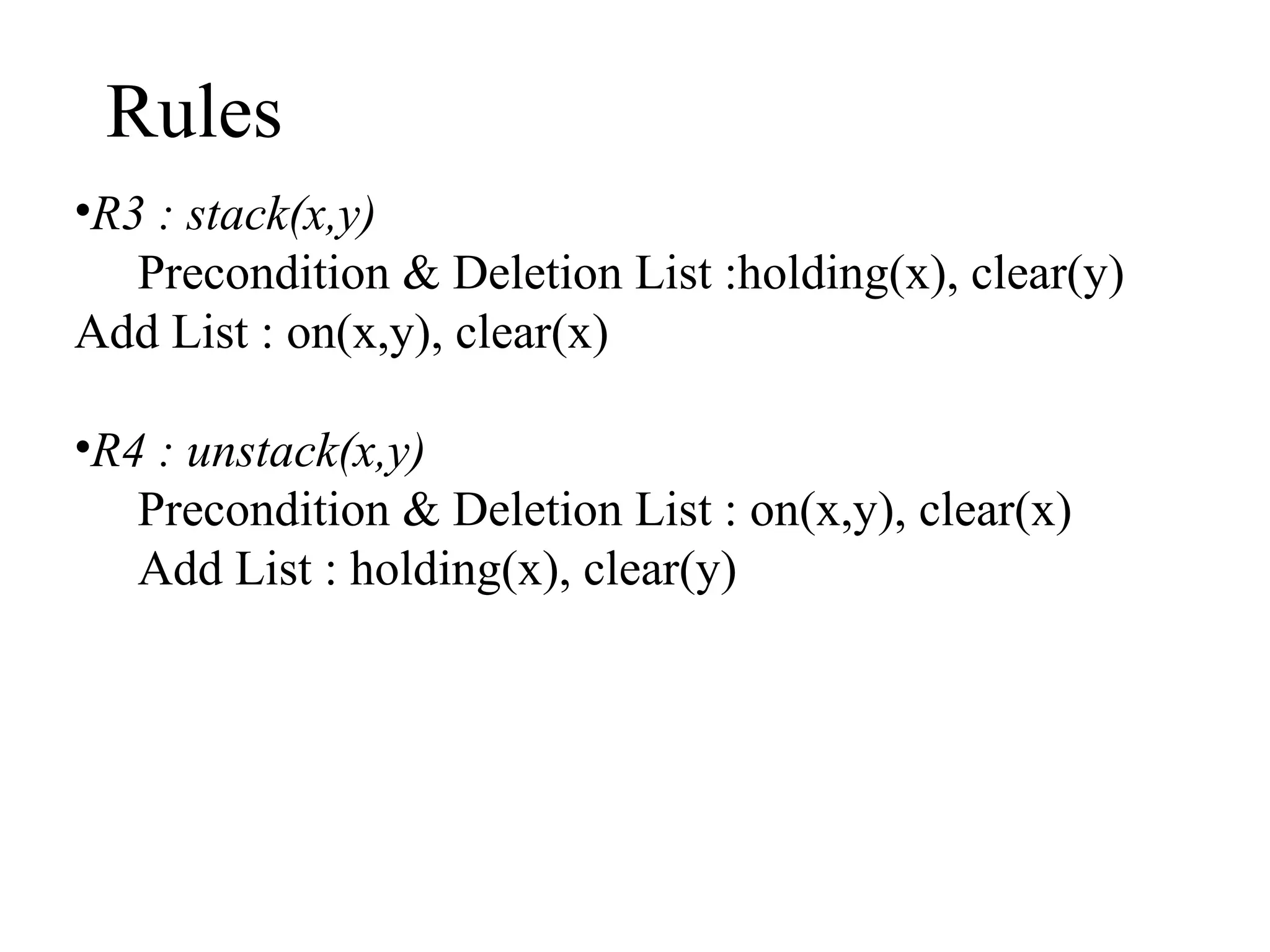
Rules
•R3 : stack(x,y)
Precondition & Deletion List :holding(x), clear(y)
Add List : on(x,y), clear(x)
•R4 : unstack(x,y)
Precondition & Deletion List : on(x,y), clear(x)
Add List : holding(x), clear(y)
Plan for the block world problem
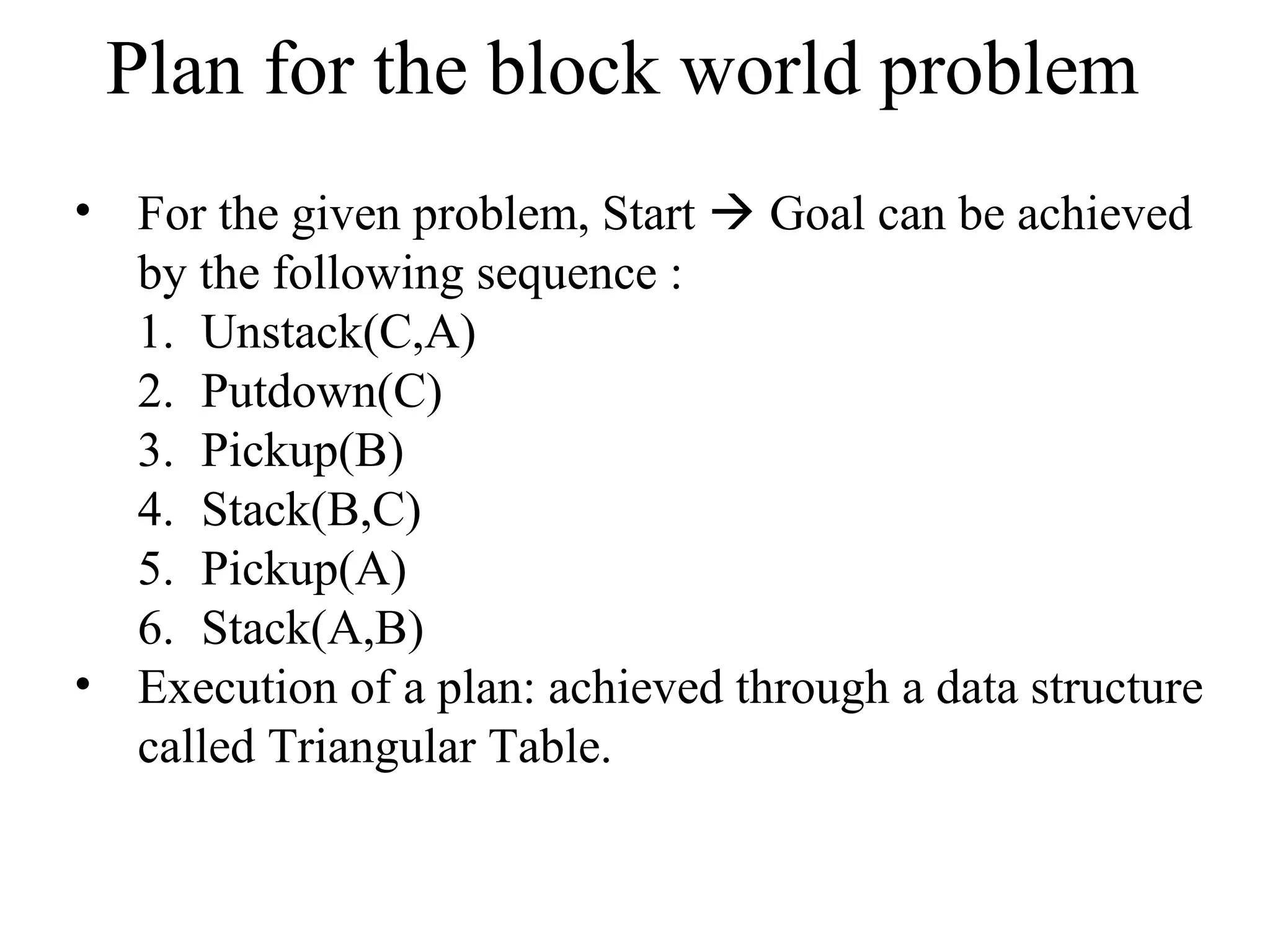
• For the given problem, Start  Goal can be achieved
by the following sequence :
1. Unstack(C,A)
2. Putdown(C)
3. Pickup(B)
4. Stack(B,C)
5. Pickup(A)
6. Stack(A,B)
• Execution of a plan: achieved through a data structure
called Triangular Table.
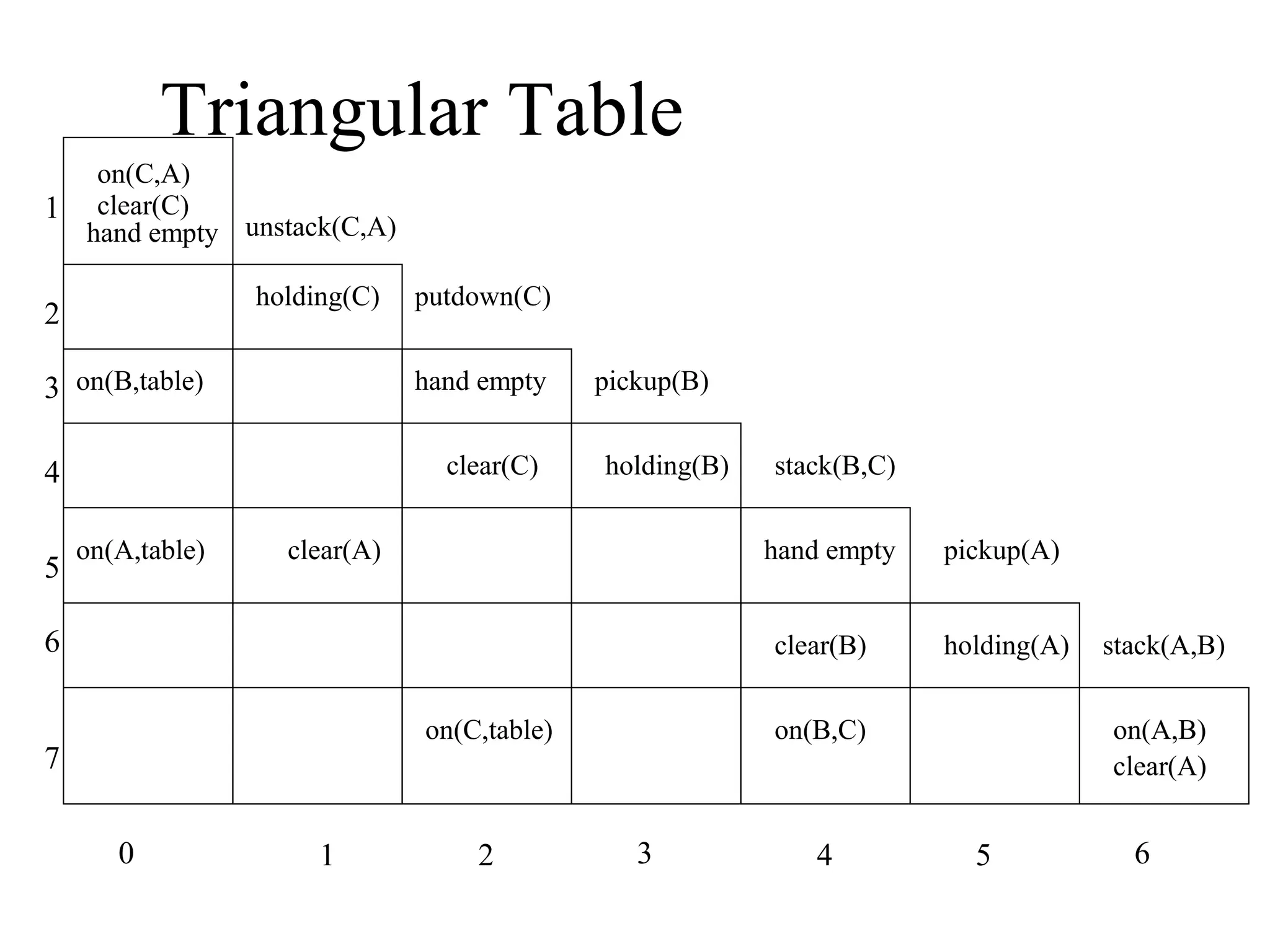
Triangular Table
on(C,A)
1 clear(C)
hand empty unstack(C,A)
holding(C)

2
3 on(B,table)

hand empty
clear(C)

4
5

putdown(C)

on(A,table)

pickup(B)
holding(B)

clear(A)

stack(B,C)
hand empty

6

clear(B)
on(C,table)

7
0

1

2

pickup(A)
holding(A)

on(B,C)

3

4

stack(A,B)
on(A,B)
clear(A)

5

6
Triangular Table
•
•
•
•
•
•

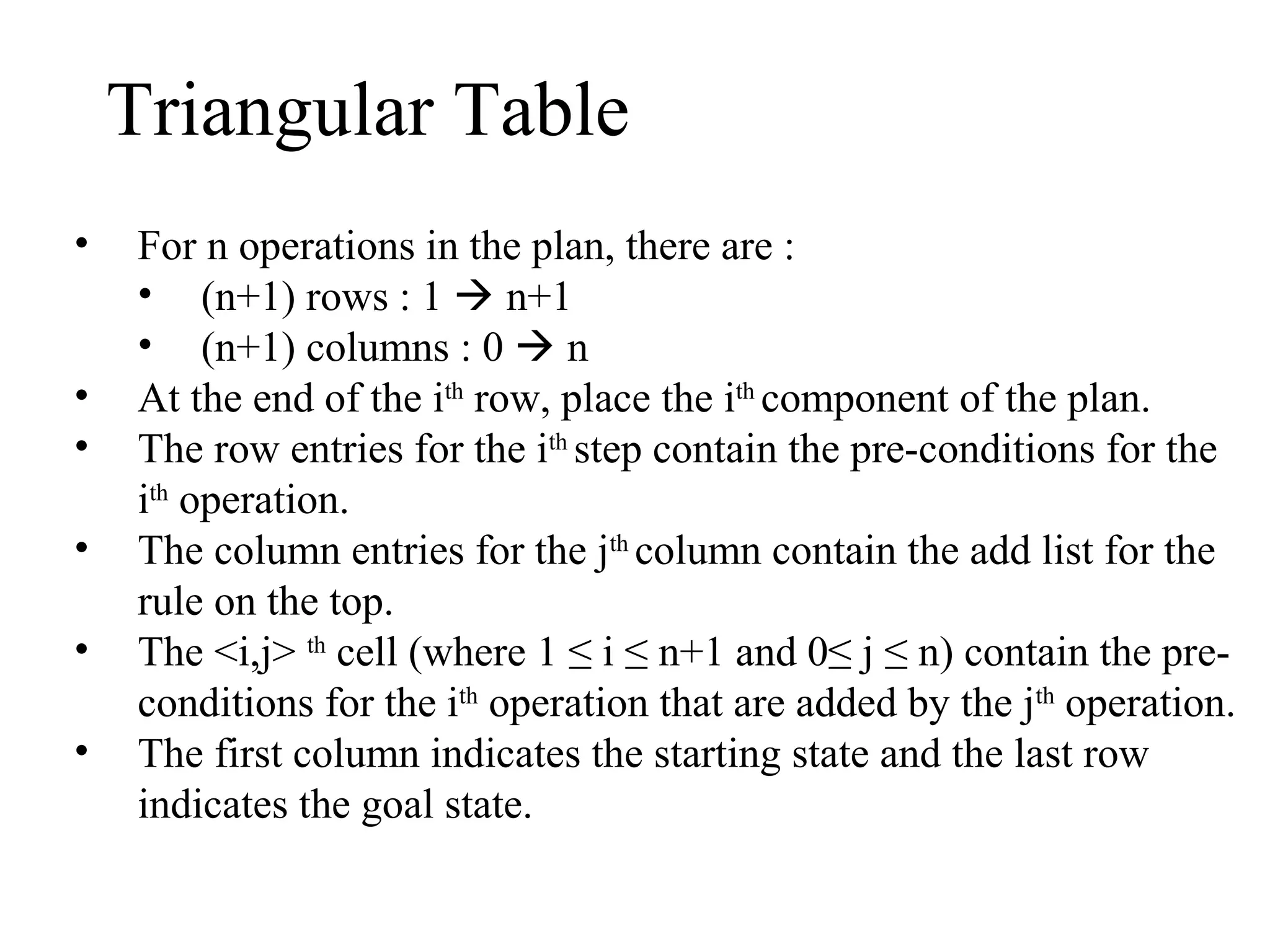
For n operations in the plan, there are :
• (n+1) rows : 1  n+1
• (n+1) columns : 0  n
At the end of the ith row, place the ith component of the plan.
The row entries for the ith step contain the pre-conditions for the
ith operation.
The column entries for the jth column contain the add list for the
rule on the top.
The <i,j> th cell (where 1 ≤ i ≤ n+1 and 0≤ j ≤ n) contain the preconditions for the ith operation that are added by the jth operation.
The first column indicates the starting state and the last row
indicates the goal state.
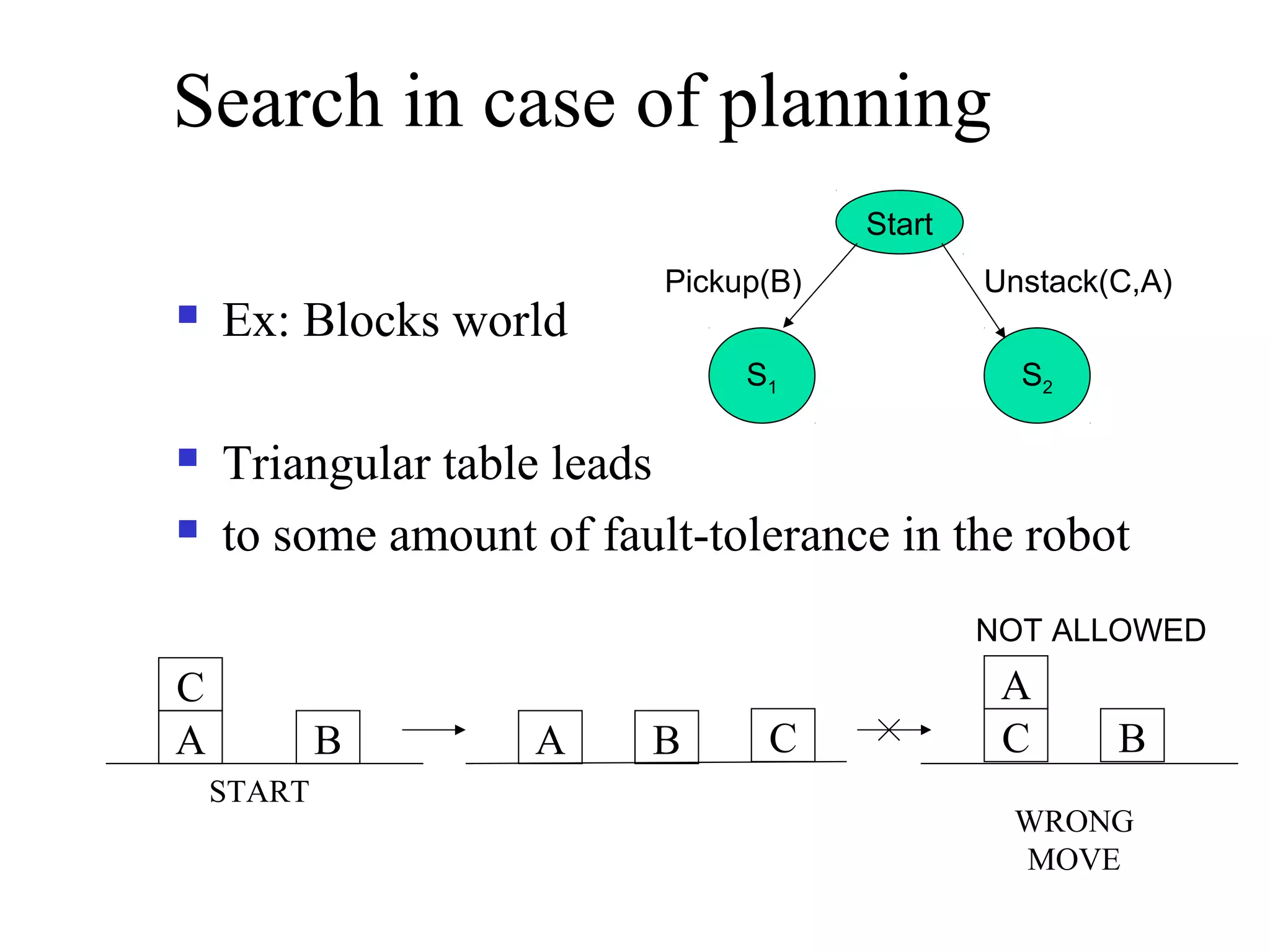
Search in case of planning
Start


Ex: Blocks world

Pickup(B)
S1




Unstack(C,A)
S2

Triangular table leads
to some amount of fault-tolerance in the robot
NOT ALLOWED

C
A

B
START

A

B

C

A
C

B

WRONG
MOVE
Resilience in Planning






After a wrong operation, can the robot come back
to the right path ?
i.e. after performing a wrong operation, if the
system again goes towards the goal, then it has
resilience w.r.t. that operation
Advanced planning strategies
 Hierarchical planning
 Probabilistic planning
 Constraint satisfaction
Prolog Programming
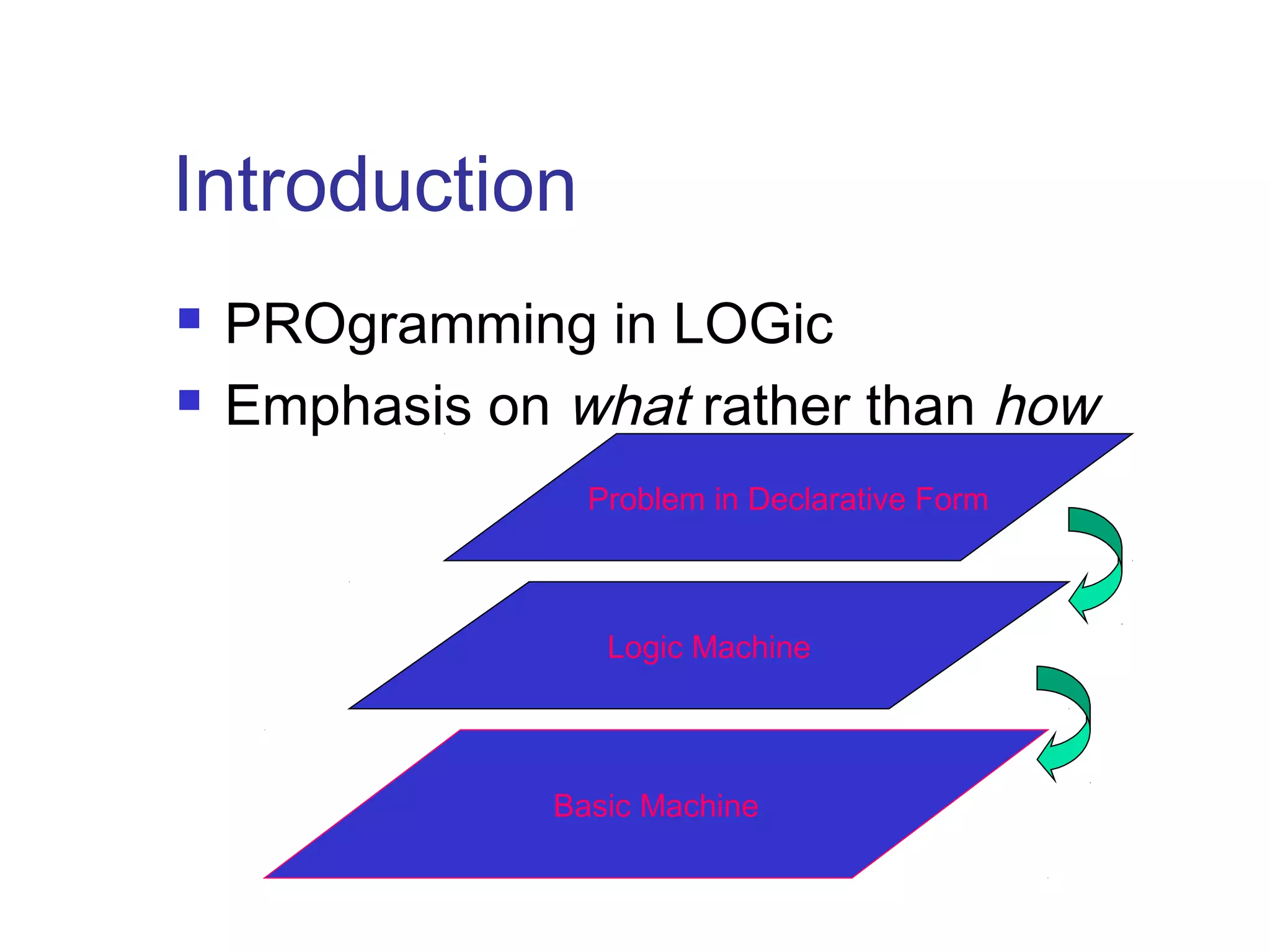
Introduction



PROgramming in LOGic
Emphasis on what rather than how
Problem in Declarative Form

Logic Machine

Basic Machine
Prolog’s strong and weak
points





Assists thinking in terms of objects and
entities
Not good for number crunching
Useful applications of Prolog in





Expert Systems (Knowledge
Representation and Inferencing)
Natural Language Processing
Relational Databases
A Typical Prolog program
Compute_length ([],0).
Compute_length ([Head|Tail], Length):Compute_length (Tail,Tail_length),
Length is Tail_length+1.
High level explanation:
The length of a list is 1 plus the length of the
tail of the list, obtained by removing the first
element of the list.
This is a declarative description of the
computation.
Fundamentals
(absolute basics for writing Prolog
Programs)
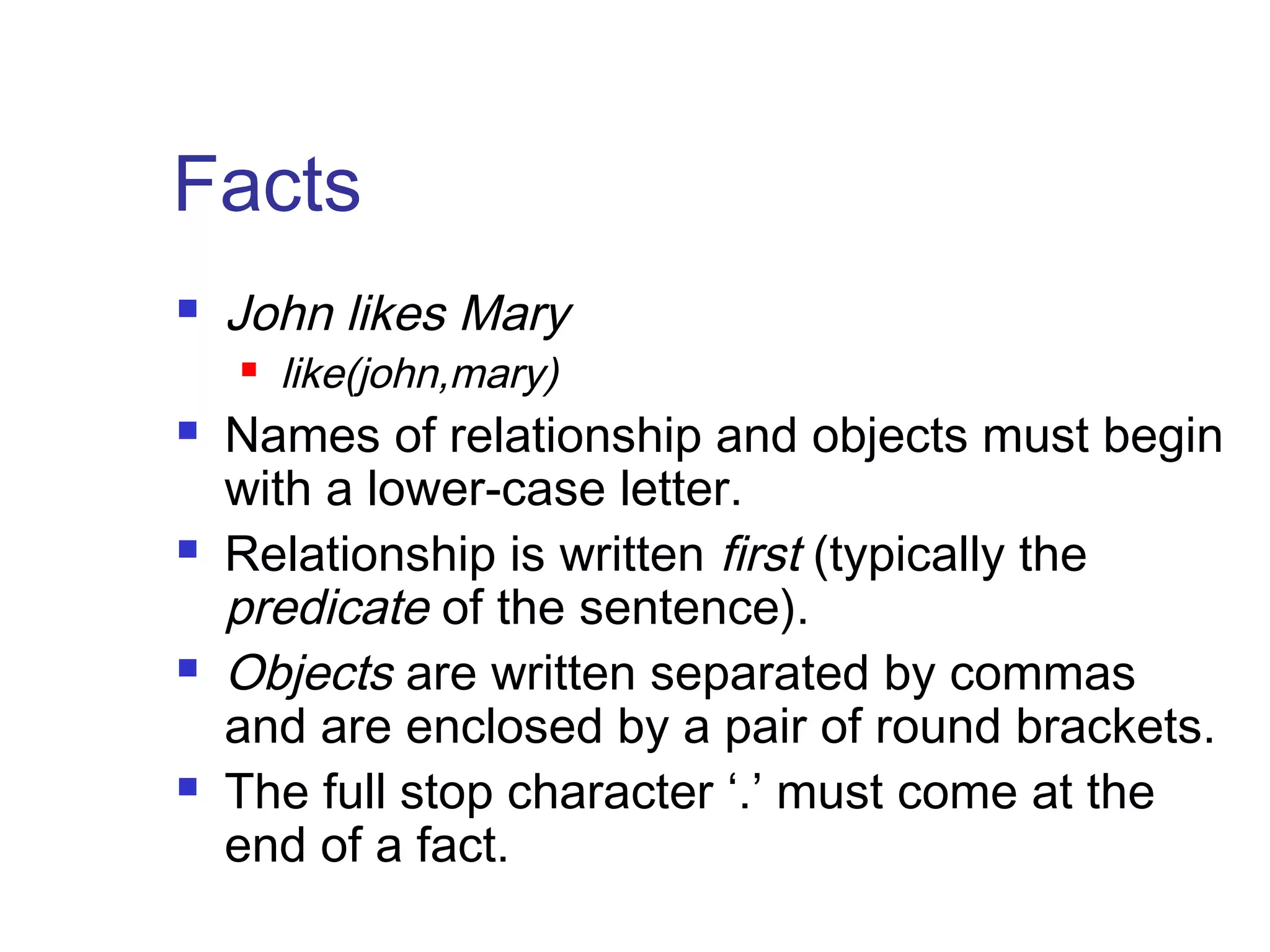
Facts


John likes Mary










like(john,mary)

Names of relationship and objects must begin
with a lower-case letter.
Relationship is written first (typically the
predicate of the sentence).
Objects are written separated by commas
and are enclosed by a pair of round brackets.
The full stop character ‘.’ must come at the
end of a fact.
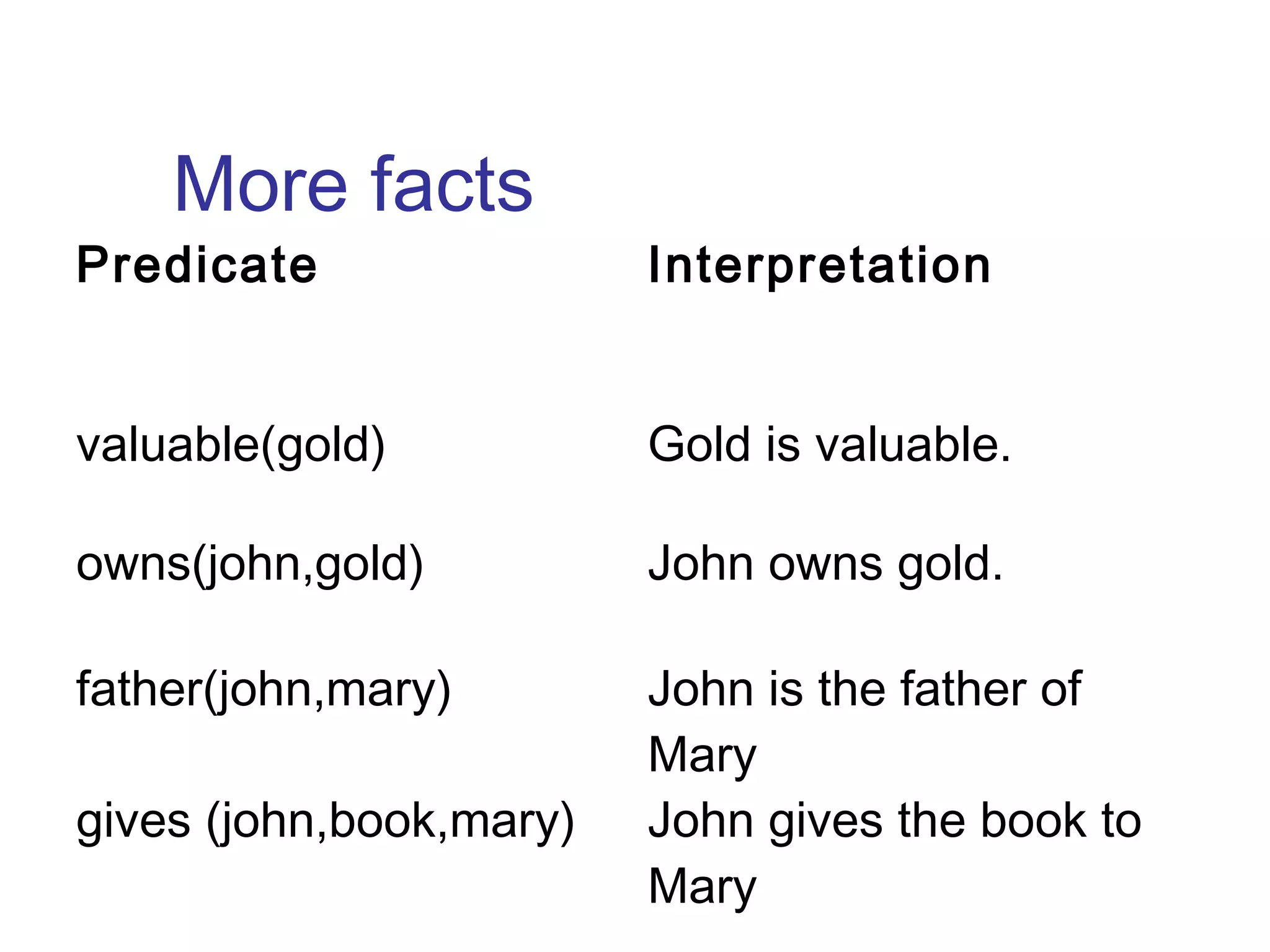
More facts

Predicate

Interpretation

valuable(gold)

Gold is valuable.

owns(john,gold)

John owns gold.

father(john,mary)

John is the father of
Mary
John gives the book to
Mary

gives (john,book,mary)
Questions


Questions based on facts



Answered by matching

Two facts match if their predicates are same
(spelt the same way) and the arguments each
are same.


If matched, prolog answers yes, else no.



No does not mean falsity.
Prolog does theorem proving





When a question is asked, prolog tries
to match transitively.
When no match is found, answer is no.
This means not provable from the given
facts.
Variables


Always begin with a capital letter





?- likes (john,X).
?- likes (john, Something).

But not


?- likes (john,something)
Example of usage of variable
Facts:

likes(john,flowers).
likes(john,mary).
likes(paul,mary).

Question:
?- likes(john,X)
Answer:

X=flowers and wait
;
mary
;
no
Conjunctions



Use ‘,’ and pronounce it as and.
Example


Facts:







likes(mary,food).
likes(mary,tea).
likes(john,tea).
likes(john,mary)

?


likes(mary,X),likes(john,X).
Meaning is anything liked by Mary also liked by John?
Backtracking (an inherent property of
prolog programming)
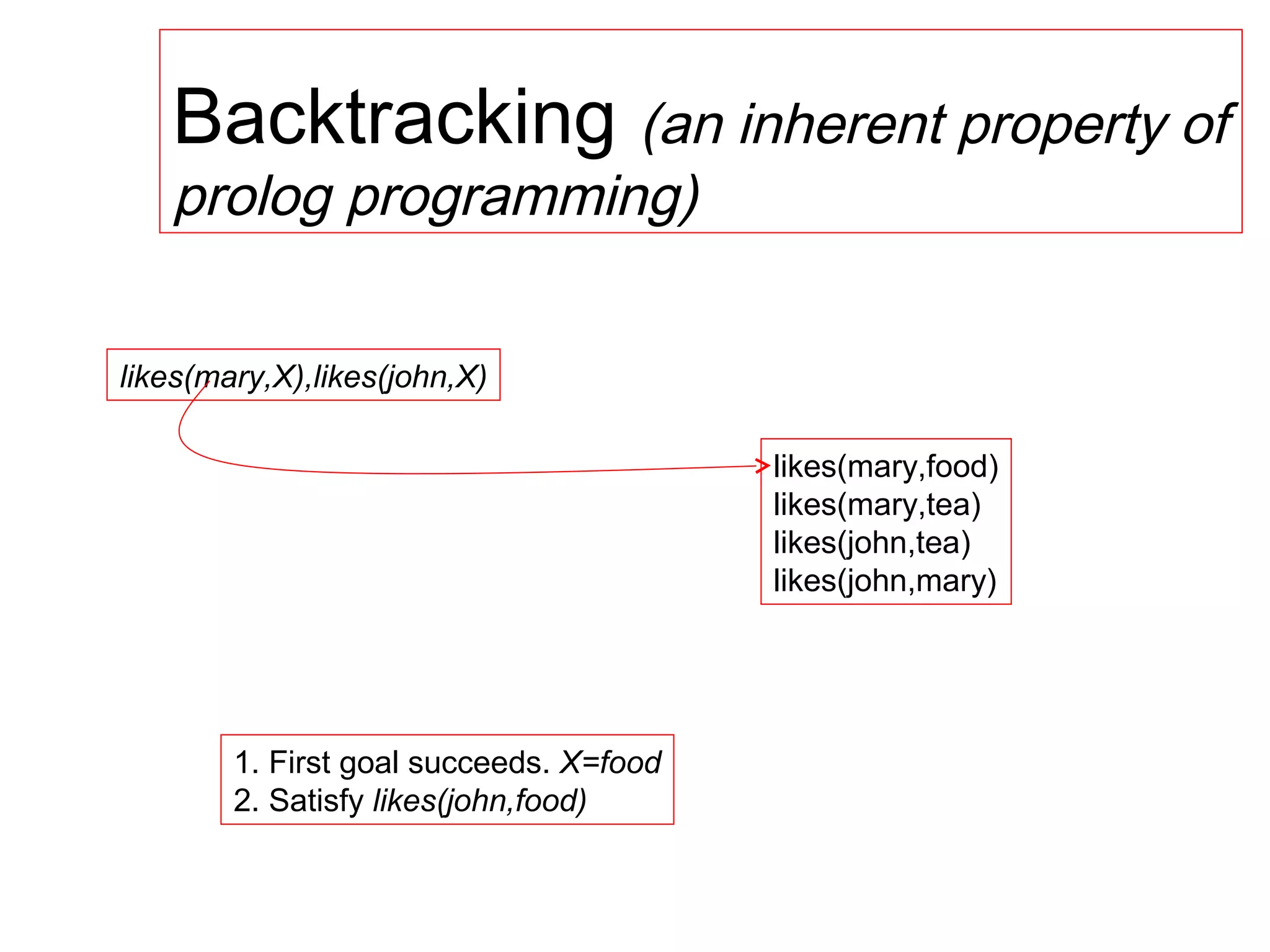
likes(mary,X),likes(john,X)
likes(mary,food)
likes(mary,tea)
likes(john,tea)
likes(john,mary)

1. First goal succeeds. X=food
2. Satisfy likes(john,food)
Backtracking (continued)
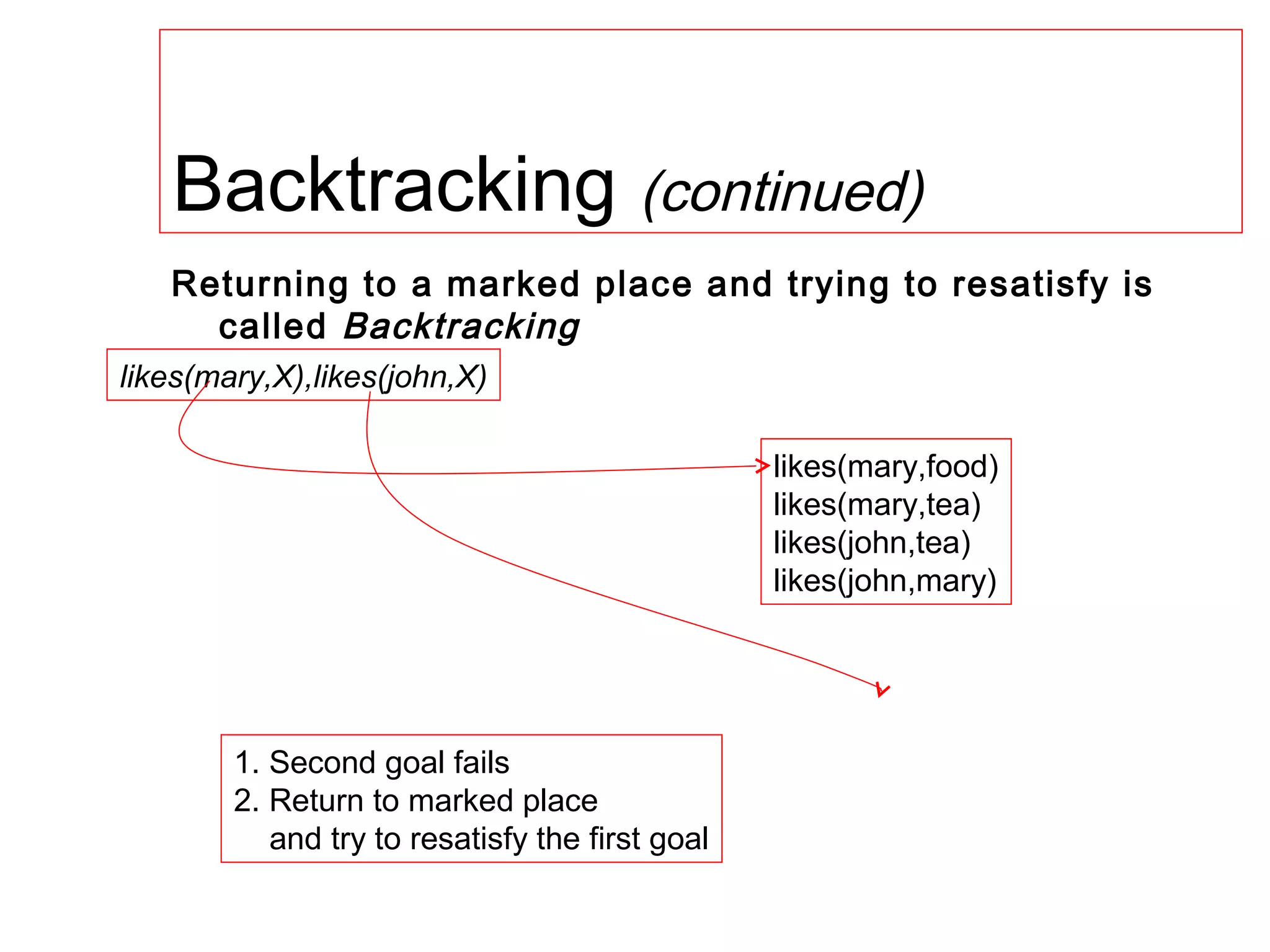
Returning to a marked place and trying to resatisfy is
called Backtracking
likes(mary,X),likes(john,X)
likes(mary,food)
likes(mary,tea)
likes(john,tea)
likes(john,mary)

1. Second goal fails
2. Return to marked place
and try to resatisfy the first goal
Backtracking (continued)
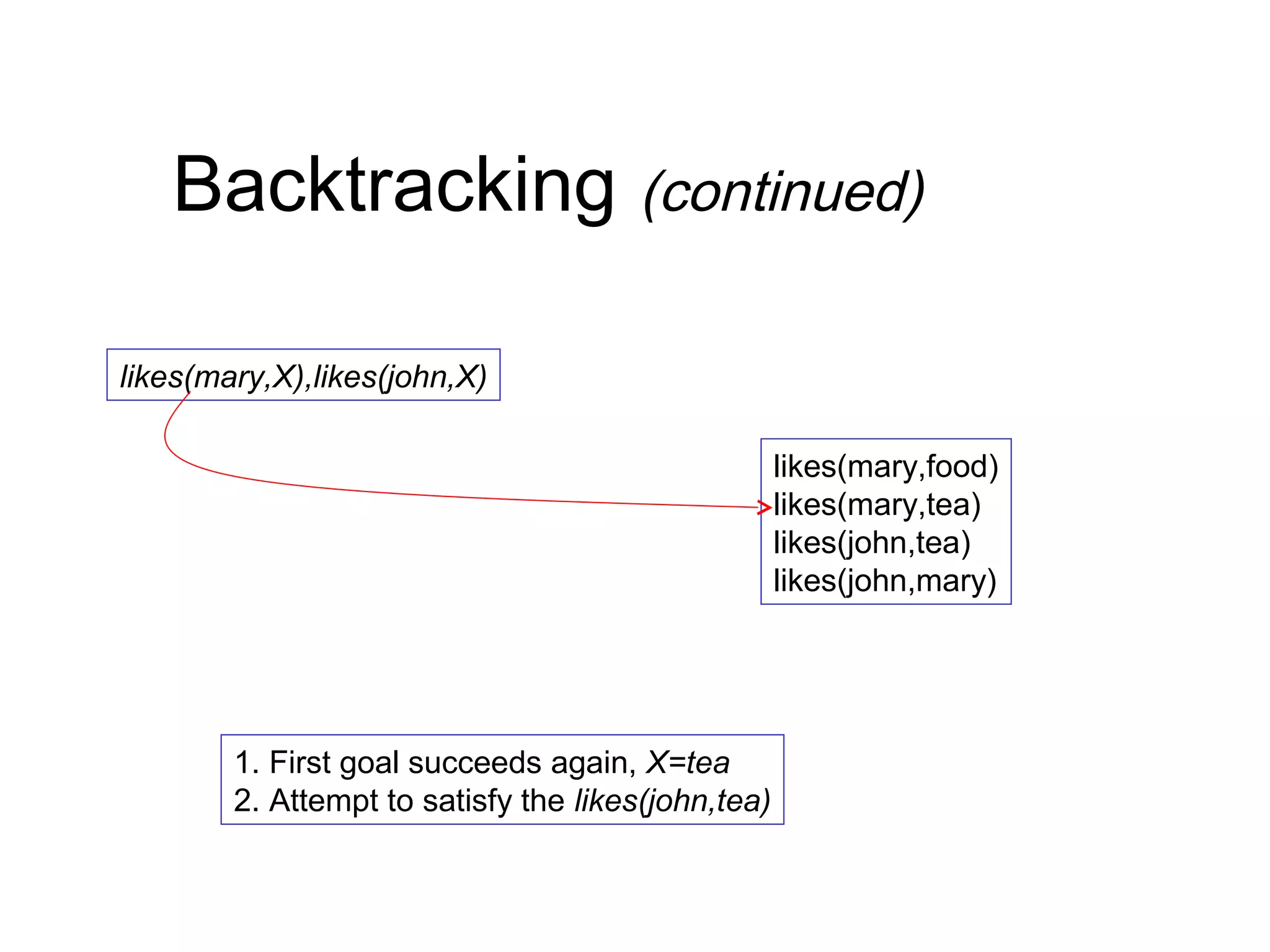
likes(mary,X),likes(john,X)
likes(mary,food)
likes(mary,tea)
likes(john,tea)
likes(john,mary)

1. First goal succeeds again, X=tea
2. Attempt to satisfy the likes(john,tea)
Backtracking (continued)
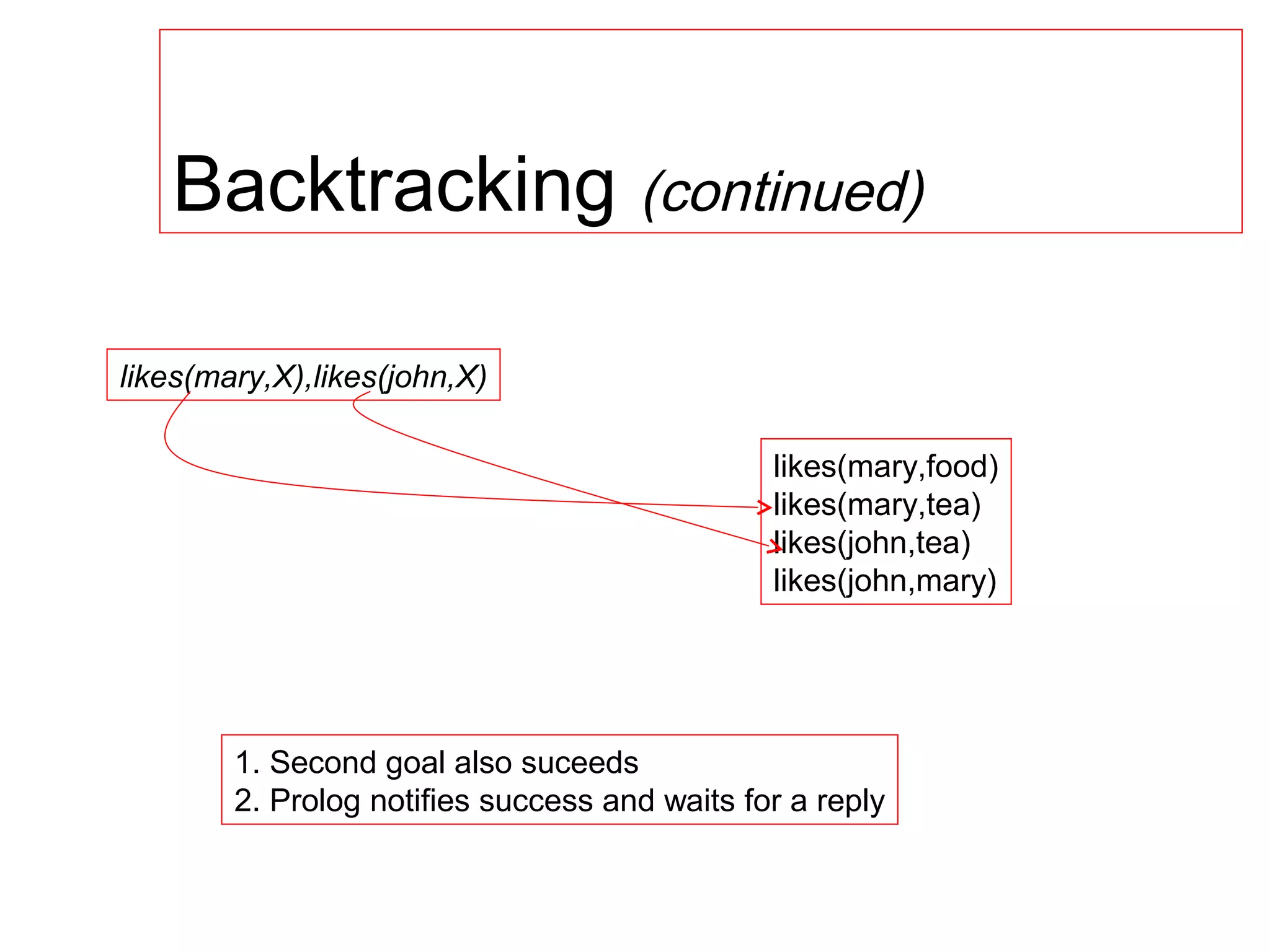
likes(mary,X),likes(john,X)
likes(mary,food)
likes(mary,tea)
likes(john,tea)
likes(john,mary)

1. Second goal also suceeds
2. Prolog notifies success and waits for a reply
Rules




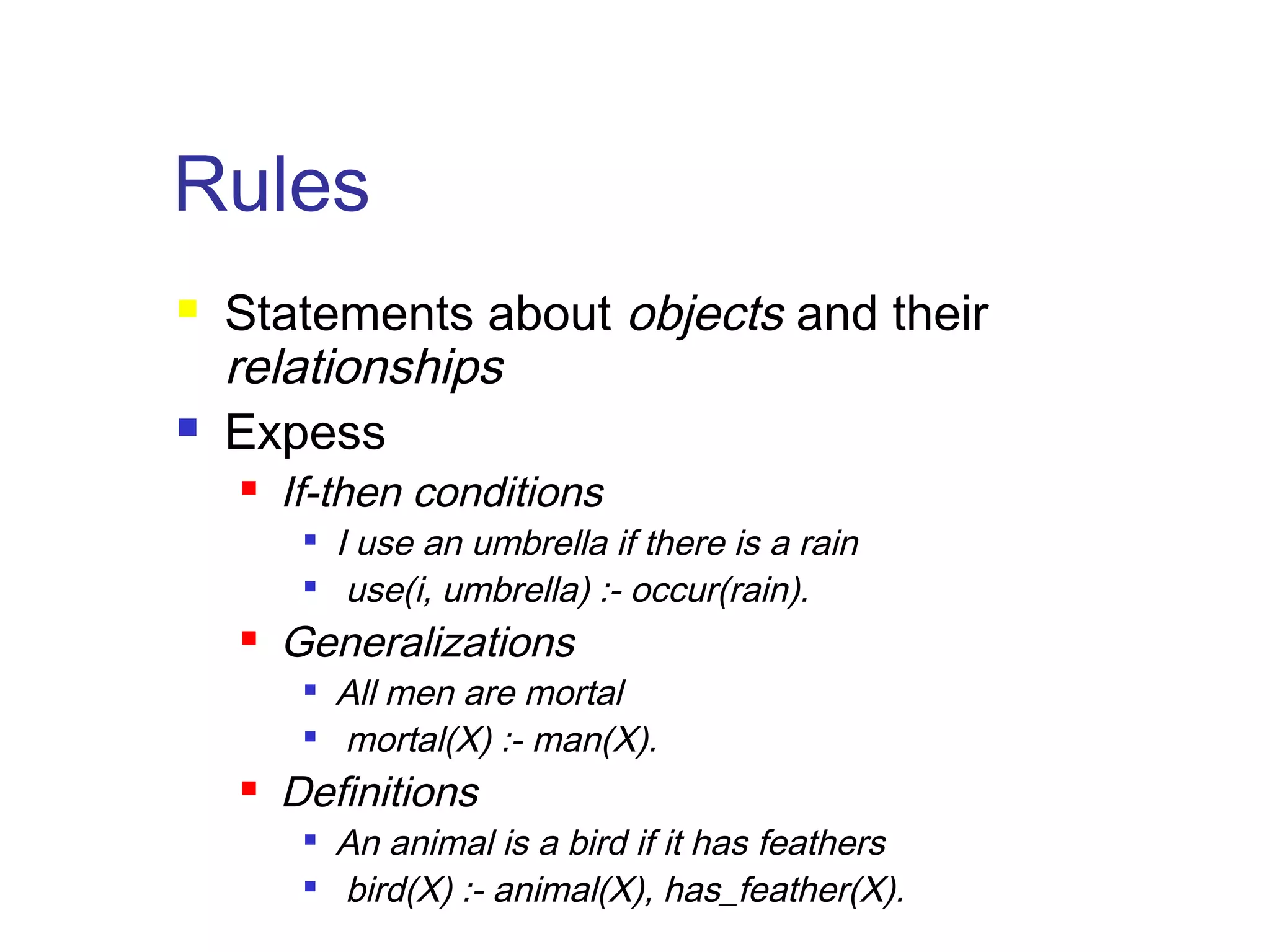
Statements about objects and their
relationships
Expess


If-then conditions





Generalizations





I use an umbrella if there is a rain
use(i, umbrella) :- occur(rain).
All men are mortal
mortal(X) :- man(X).

Definitions



An animal is a bird if it has feathers
bird(X) :- animal(X), has_feather(X).
Syntax




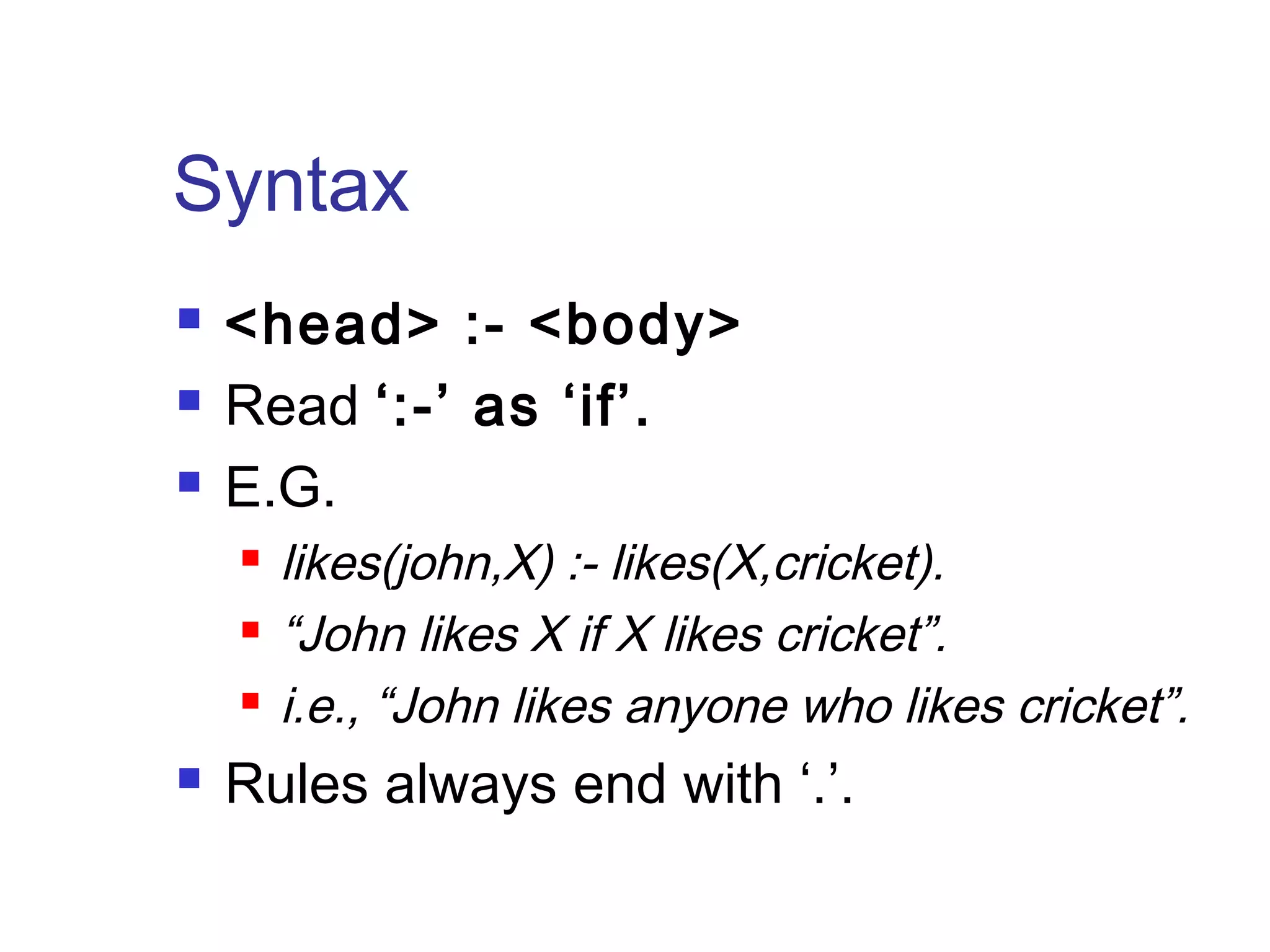
<head> :- <body>
Read ‘:-’ as ‘if’.
E.G.






likes(john,X) :- likes(X,cricket).
“John likes X if X likes cricket”.
i.e., “John likes anyone who likes cricket”.

Rules always end with ‘.’.
Another Example
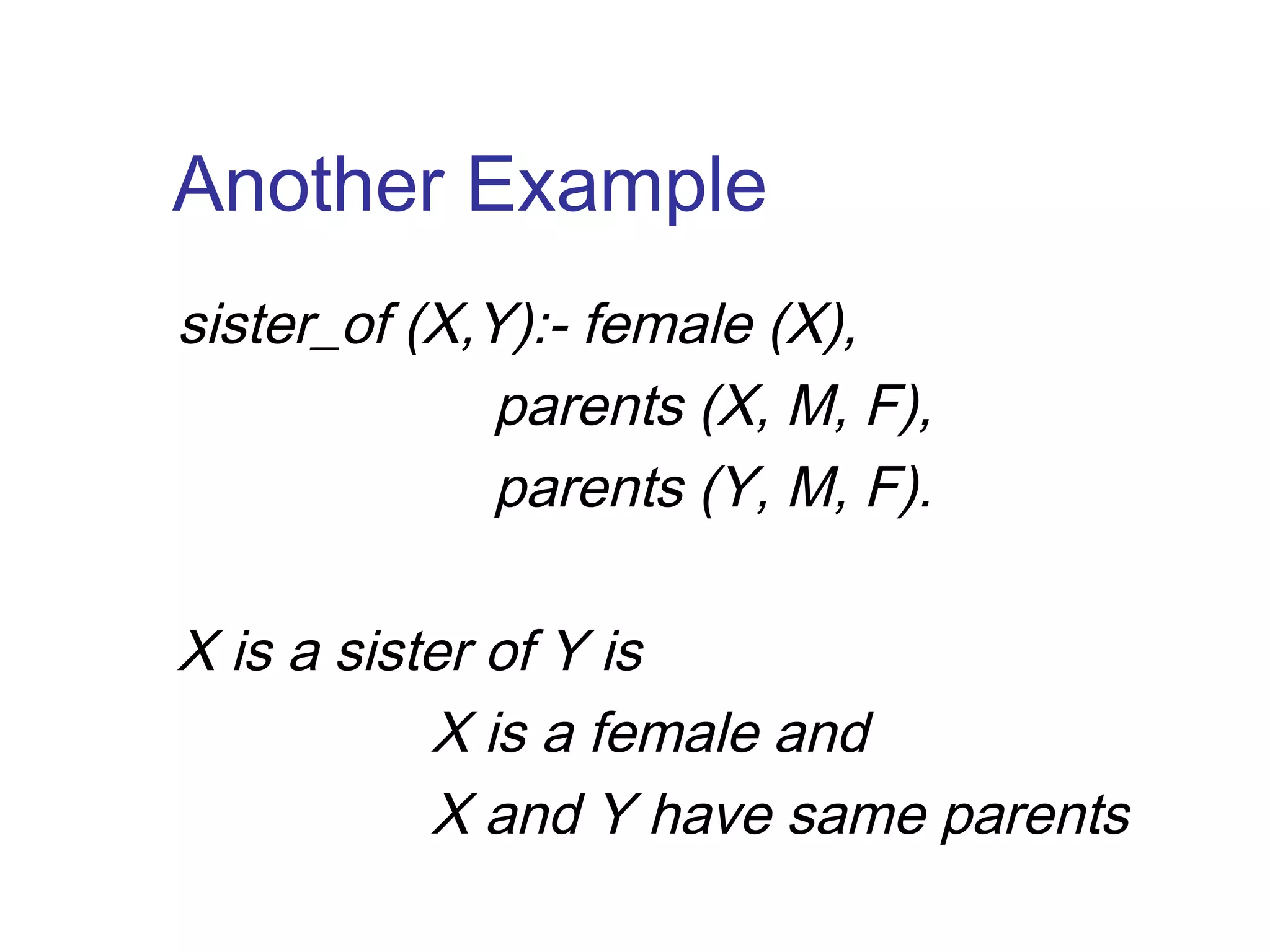
sister_of (X,Y):- female (X),
parents (X, M, F),
parents (Y, M, F).
X is a sister of Y is
X is a female and
X and Y have same parents
Question Answering in presence
of rules


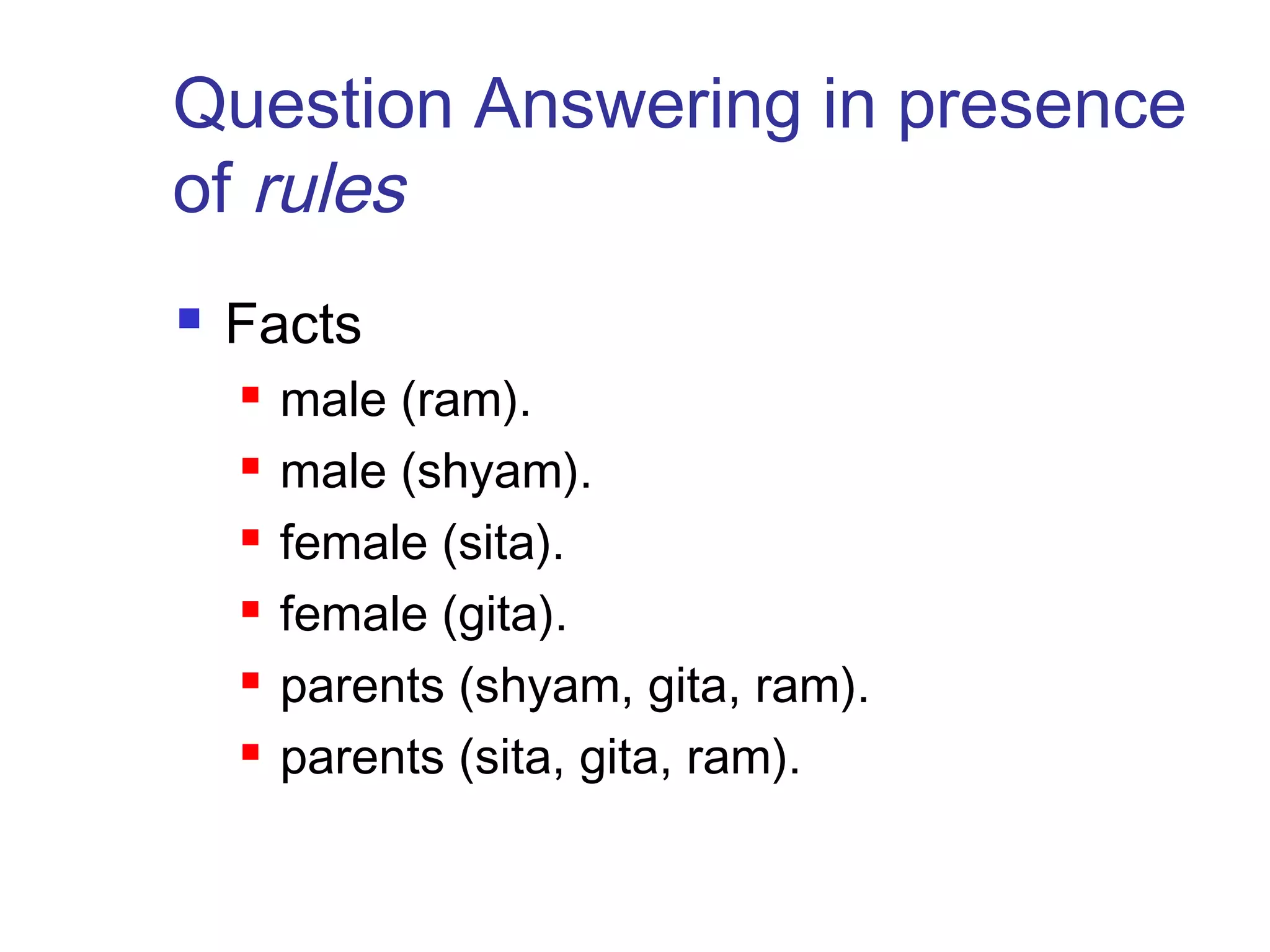
Facts







male (ram).
male (shyam).
female (sita).
female (gita).
parents (shyam, gita, ram).
parents (sita, gita, ram).
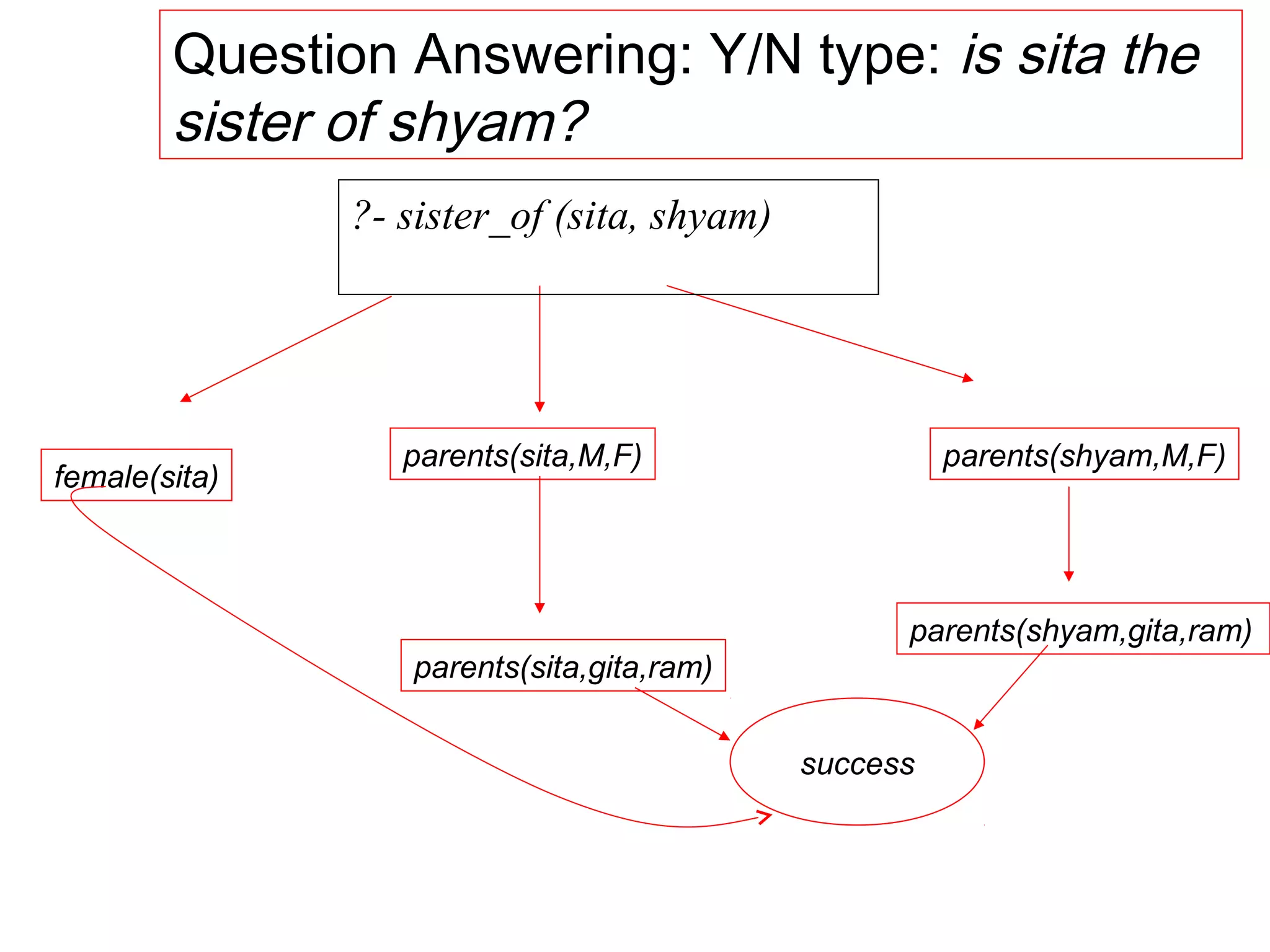
Question Answering: Y/N type: is sita the
sister of shyam?
?- sister_of (sita, shyam)

female(sita)

parents(sita,M,F)

parents(shyam,M,F)

parents(shyam,gita,ram)
parents(sita,gita,ram)
success
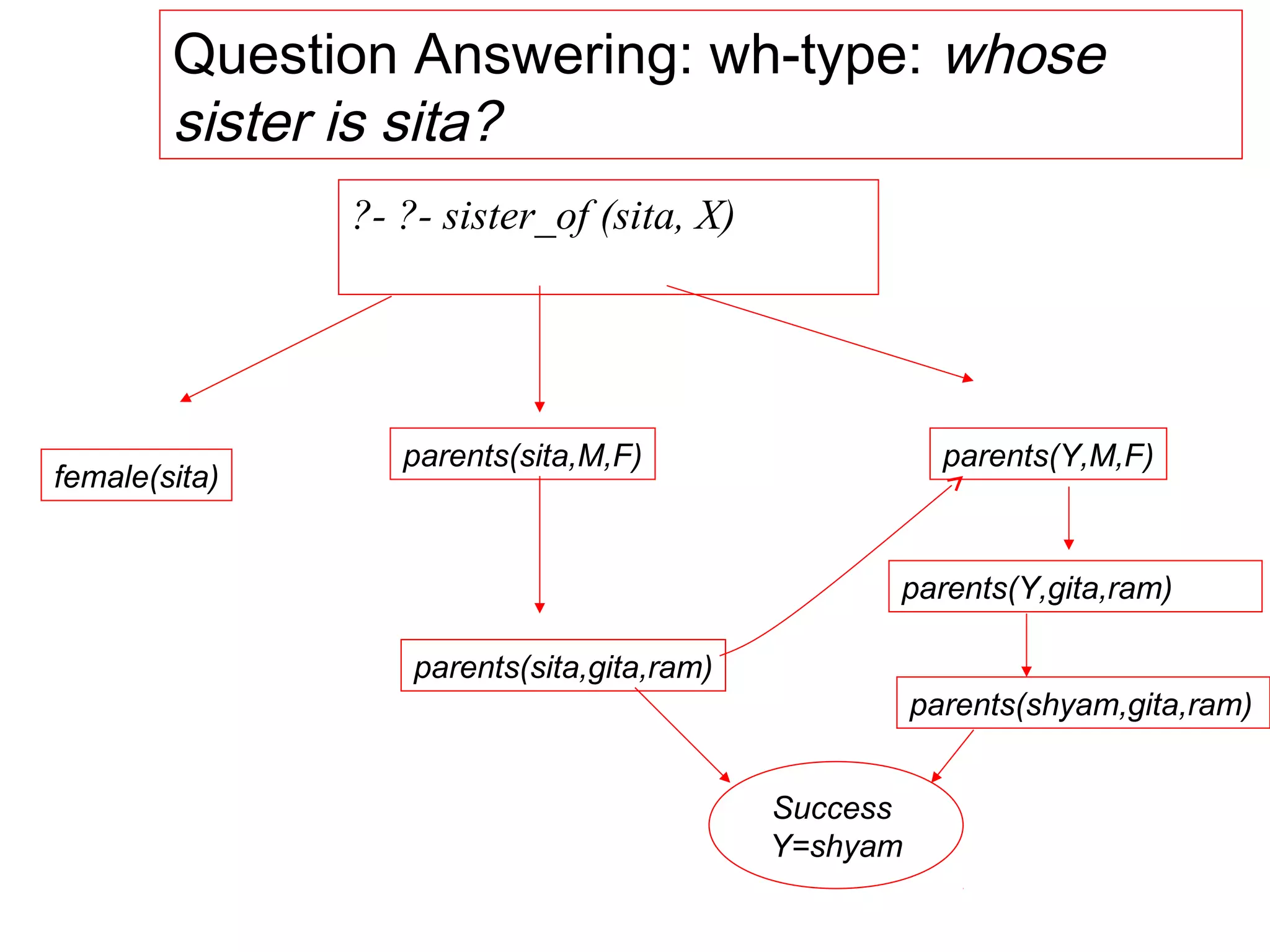
Question Answering: wh-type: whose
sister is sita?
?- ?- sister_of (sita, X)

female(sita)

parents(sita,M,F)

parents(Y,M,F)

parents(Y,gita,ram)
parents(sita,gita,ram)
parents(shyam,gita,ram)
Success
Y=shyam
Exercise
1. From the above it is possible for
somebody to be her own sister. How
can this be prevented?

Cs344 lect15-robotic-knowledge-inferencing-prolog-11feb08

  • 1.
    CS344 : Introductionto Artificial Intelligence Pushpak Bhattacharyya CSE Dept., IIT Bombay Lecture 15- Robotic Knowledge Representation and Inferencing; Prolog
  • 2.
    A planning agent   Anagent interacts with the world via perception and actions Perception involves sensing the world and assessing the situation       creating some internal representation of the world Actions are what the agent does in the domain. Planning involves reasoning about actions that the agent intends to carry out Planning is the reasoning side of acting This reasoning involves the representation of the world that the agent has, as also the representation of its actions. Hard constraints where the objectives have to be achieved completely for success The objectives could also be soft constraints, or preferences, to be achieved as much as possible
  • 3.
    Interaction with staticdomain     The agent has complete information of the domain (perception is perfect), actions are instantaneous and their effects are deterministic. The agent knows the world completely, and it can take all facts into account while planning. The fact that actions are instantaneous implies that there is no notion of time, but only of sequencing of actions. The effects of actions are deterministic, and therefore the agent knows what the world will be like after each action.
  • 4.
    Two kinds ofplanning  Projection into the future   The planner searches through the possible combination of actions to find the plan that will work Memory based planning   looking into the past The agent can retrieve a plan from its memory
  • 5.
    Planning •Definition : Planningis arranging a sequence of actions to achieve a goal. •Uses core areas of AI like searching and reasoning & •Is the core for areas like NLP, Computer Vision. •Robotics Kinematics (ME) Planning (CSE) •Examples : Navigation , Manoeuvring, Language Processing (Generation)
  • 6.
    Language & Planning •Non-linguistic representation for sentences. agent I see object movie •Sentence generation •Word order determination (Syntax planning) E.g. I see movie ( English) I movie see (Intermediate Language)
  • 7.
    STRIPS •Stanford Research InstituteProblem Solver (1970s) •Planning system for a robotics project : SHAKEY (by Nilsson et.al.) •Knowledge Representation : First Order Logic. •Algorithm : Forward chaining on rules. •Any search procedure : Finds a path from start to goal. •Forward Chaining : Data-driven inferencing •Backward Chaining : Goal-driven
  • 8.
    Forward & BackwardChaining •Rule : man(x)  mortal(x) •Data : man(Shakespeare) To prove : mortal(Shakespeare) •Forward Chaining: man(Shakespeare) matches LHS of Rule. X = Shakespeare ⇒ mortal( Shakespeare) added -Forward Chaining used by design expert systems •Backward Chaining: uses RHS matching - Used by diagnostic expert systems
  • 9.
    Example : BlocksWorld •STRIPS : A planning system – Has rules with precondition deletion list and addition list Robot hand C A A B C B START Sequence of actions : 1. Grab C 2. Pickup C 3. Place on table C 4. Grab B 5. Pickup B Robot hand GOAL 6. 7. 8. 9. Stack B on C Grab A Pickup A Stack A on B
  • 10.
    Example : BlocksWorld •Fundamental Problem : The frame problem in AI is concerned with the question of what piece of knowledge is relevant to the situation. •Fundamental Assumption : Closed world assumption If something is not asserted in the knowledge base, it is assumed to be false. (Also called “Negation by failure”)
  • 11.
    Example : BlocksWorld •STRIPS : A planning system – Has rules with precondition deletion list and addition list Robot hand C A B START on(B, table) on(A, table) on(C, A) hand empty clear(C) clear(B) A B C GOAL on(C, table) on(B, C) on(A, B) hand empty clear(A) Robot hand
  • 12.
    Rules •R1 : pickup(x) Precondition& Deletion List : hand empty, on(x,table), clear(x) Add List : holding(x) •R2 : putdown(x) Precondition & Deletion List : holding(x) Add List : hand empty, on(x,table), clear(x)
  • 13.
    Rules •R3 : stack(x,y) Precondition& Deletion List :holding(x), clear(y) Add List : on(x,y), clear(x) •R4 : unstack(x,y) Precondition & Deletion List : on(x,y), clear(x) Add List : holding(x), clear(y)
  • 14.
    Plan for theblock world problem • For the given problem, Start  Goal can be achieved by the following sequence : 1. Unstack(C,A) 2. Putdown(C) 3. Pickup(B) 4. Stack(B,C) 5. Pickup(A) 6. Stack(A,B) • Execution of a plan: achieved through a data structure called Triangular Table.
  • 15.
    Triangular Table on(C,A) 1 clear(C) handempty unstack(C,A) holding(C) 2 3 on(B,table) hand empty clear(C) 4 5 putdown(C) on(A,table) pickup(B) holding(B) clear(A) stack(B,C) hand empty 6 clear(B) on(C,table) 7 0 1 2 pickup(A) holding(A) on(B,C) 3 4 stack(A,B) on(A,B) clear(A) 5 6
  • 16.
    Triangular Table • • • • • • For noperations in the plan, there are : • (n+1) rows : 1  n+1 • (n+1) columns : 0  n At the end of the ith row, place the ith component of the plan. The row entries for the ith step contain the pre-conditions for the ith operation. The column entries for the jth column contain the add list for the rule on the top. The <i,j> th cell (where 1 ≤ i ≤ n+1 and 0≤ j ≤ n) contain the preconditions for the ith operation that are added by the jth operation. The first column indicates the starting state and the last row indicates the goal state.
  • 17.
    Search in caseof planning Start  Ex: Blocks world Pickup(B) S1   Unstack(C,A) S2 Triangular table leads to some amount of fault-tolerance in the robot NOT ALLOWED C A B START A B C A C B WRONG MOVE
  • 18.
    Resilience in Planning    Aftera wrong operation, can the robot come back to the right path ? i.e. after performing a wrong operation, if the system again goes towards the goal, then it has resilience w.r.t. that operation Advanced planning strategies  Hierarchical planning  Probabilistic planning  Constraint satisfaction
  • 19.
  • 20.
    Introduction   PROgramming in LOGic Emphasison what rather than how Problem in Declarative Form Logic Machine Basic Machine
  • 21.
    Prolog’s strong andweak points    Assists thinking in terms of objects and entities Not good for number crunching Useful applications of Prolog in    Expert Systems (Knowledge Representation and Inferencing) Natural Language Processing Relational Databases
  • 22.
    A Typical Prologprogram Compute_length ([],0). Compute_length ([Head|Tail], Length):Compute_length (Tail,Tail_length), Length is Tail_length+1. High level explanation: The length of a list is 1 plus the length of the tail of the list, obtained by removing the first element of the list. This is a declarative description of the computation.
  • 23.
    Fundamentals (absolute basics forwriting Prolog Programs)
  • 24.
    Facts  John likes Mary      like(john,mary) Namesof relationship and objects must begin with a lower-case letter. Relationship is written first (typically the predicate of the sentence). Objects are written separated by commas and are enclosed by a pair of round brackets. The full stop character ‘.’ must come at the end of a fact.
  • 25.
    More facts Predicate Interpretation valuable(gold) Gold isvaluable. owns(john,gold) John owns gold. father(john,mary) John is the father of Mary John gives the book to Mary gives (john,book,mary)
  • 26.
    Questions  Questions based onfacts  Answered by matching Two facts match if their predicates are same (spelt the same way) and the arguments each are same.  If matched, prolog answers yes, else no.  No does not mean falsity.
  • 27.
    Prolog does theoremproving    When a question is asked, prolog tries to match transitively. When no match is found, answer is no. This means not provable from the given facts.
  • 28.
    Variables  Always begin witha capital letter    ?- likes (john,X). ?- likes (john, Something). But not  ?- likes (john,something)
  • 29.
    Example of usageof variable Facts: likes(john,flowers). likes(john,mary). likes(paul,mary). Question: ?- likes(john,X) Answer: X=flowers and wait ; mary ; no
  • 30.
    Conjunctions   Use ‘,’ andpronounce it as and. Example  Facts:      likes(mary,food). likes(mary,tea). likes(john,tea). likes(john,mary) ?  likes(mary,X),likes(john,X). Meaning is anything liked by Mary also liked by John?
  • 31.
    Backtracking (an inherentproperty of prolog programming) likes(mary,X),likes(john,X) likes(mary,food) likes(mary,tea) likes(john,tea) likes(john,mary) 1. First goal succeeds. X=food 2. Satisfy likes(john,food)
  • 32.
    Backtracking (continued) Returning toa marked place and trying to resatisfy is called Backtracking likes(mary,X),likes(john,X) likes(mary,food) likes(mary,tea) likes(john,tea) likes(john,mary) 1. Second goal fails 2. Return to marked place and try to resatisfy the first goal
  • 33.
  • 34.
  • 35.
    Rules   Statements about objectsand their relationships Expess  If-then conditions    Generalizations    I use an umbrella if there is a rain use(i, umbrella) :- occur(rain). All men are mortal mortal(X) :- man(X). Definitions   An animal is a bird if it has feathers bird(X) :- animal(X), has_feather(X).
  • 36.
    Syntax    <head> :- <body> Read‘:-’ as ‘if’. E.G.     likes(john,X) :- likes(X,cricket). “John likes X if X likes cricket”. i.e., “John likes anyone who likes cricket”. Rules always end with ‘.’.
  • 37.
    Another Example sister_of (X,Y):-female (X), parents (X, M, F), parents (Y, M, F). X is a sister of Y is X is a female and X and Y have same parents
  • 38.
    Question Answering inpresence of rules  Facts       male (ram). male (shyam). female (sita). female (gita). parents (shyam, gita, ram). parents (sita, gita, ram).
  • 39.
    Question Answering: Y/Ntype: is sita the sister of shyam? ?- sister_of (sita, shyam) female(sita) parents(sita,M,F) parents(shyam,M,F) parents(shyam,gita,ram) parents(sita,gita,ram) success
  • 40.
    Question Answering: wh-type:whose sister is sita? ?- ?- sister_of (sita, X) female(sita) parents(sita,M,F) parents(Y,M,F) parents(Y,gita,ram) parents(sita,gita,ram) parents(shyam,gita,ram) Success Y=shyam
  • 41.
    Exercise 1. From theabove it is possible for somebody to be her own sister. How can this be prevented?