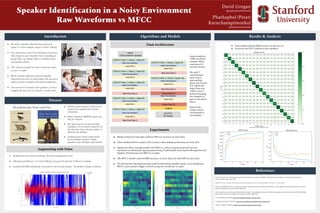
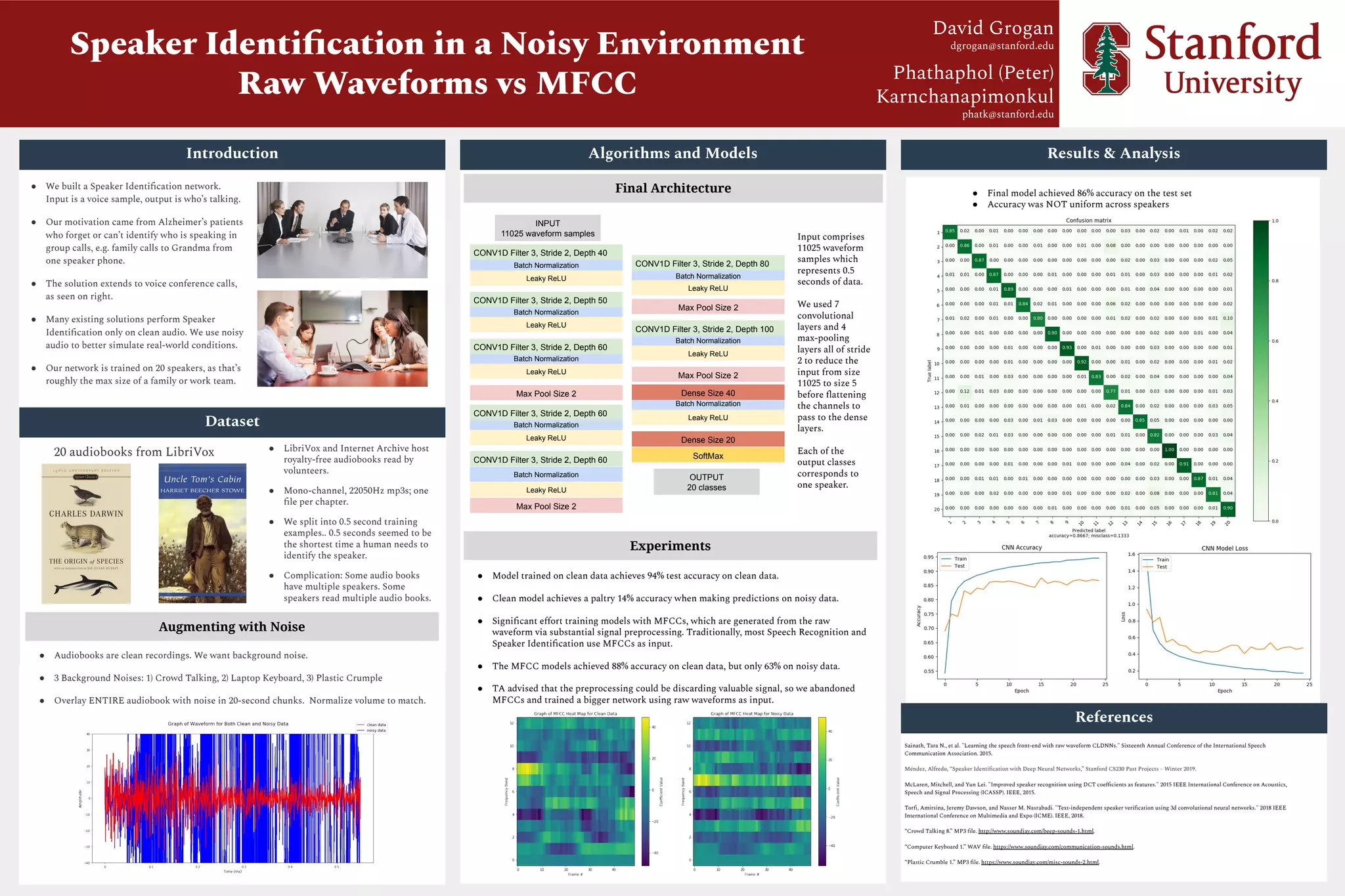
The document describes a speaker identification neural network that can identify speakers in noisy audio samples. The network was motivated by helping Alzheimer's patients identify speakers in group calls. It uses raw audio waveforms as input rather than preprocessed features, which allows it to achieve higher accuracy on noisy audio samples compared to models using preprocessed features. The network was trained on 0.5 second audio clips from 20 speakers and achieves 86% accuracy on a test set, though accuracy varies across speakers.