DISCOVER . LEARN . EMPOWER
Polymer Technology
Anju Singh (E5273)
INSTITUTE-UNIVERSITY INSTITUTE OF
SCIENCES
DIVISION - CHEMISTRY
Masters in Science (M.Sc. Chemistry)
Subject Name – Polymer Technology
Subject Code – SHT-755
2
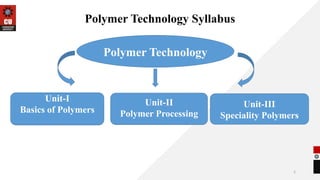
Polymer Technology Syllabus
Polymer Technology
Unit-I
Basics of Polymers
Unit-II
Polymer Processing
Unit-III
Speciality Polymers
3
Polymer Technology
CO
Number
Title
CO1
Apply appropriate background of Basic
polymer chemistry and based on this concept
analyze and evaluate basics.
CO2 Apply processing of polymers and evaluate
various techniques.
CO3 Analyze various specialty polymers and its
application in day to day life.
Course Outcome
https://www.shutterstock.com/image-photo/polymer-word-cloud-
concept-290359235
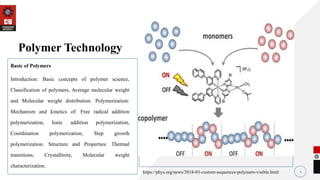
Basic of Polymers
Introduction: Basic concepts of polymer science,
Classification of polymers, Average molecular weight
and Molecular weight distribution. Polymerization:
Mechanism and kinetics of: Free radical addition
polymerization, Ionic addition polymerization,
Coordination polymerization, Step growth
polymerization. Structure and Properties: Thermal
transitions, Crystallinity, Molecular weight
characterization.
4
Polymer Technology
https://phys.org/news/2018-03-custom-sequences-polymers-visible.html
Crystallinity defines the degree of long-range order in a material, and strongly affects its
properties.
The more crystalline a polymer, the more regularly aligned its chains. Increasing the degree
of crystallinity increases hardness and density. This is illustrated in poly(ethene).
HDPE (high density poly(ethene)) is composed of linear chains with little branching.
Molecules pack closely together, leading to a high degree of order. This makes it stiff and dense,
and it is used for milk bottles and drainpipes.
Crystallinity in Polymers
The numerous short branches in LDPE (low density poly(ethene)) interfere with the close
packing of molecules, so they cannot form an ordered structure. The lower density and stiffness
make it suitable for use in films such as plastic carrier bags and food wrapping.
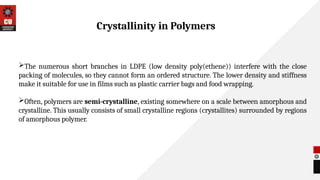
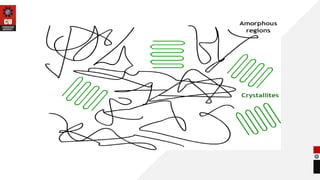
Often, polymers are semi-crystalline, existing somewhere on a scale between amorphous and
crystalline. This usually consists of small crystalline regions (crystallites) surrounded by regions
of amorphous polymer.
Crystallinity in Polymers
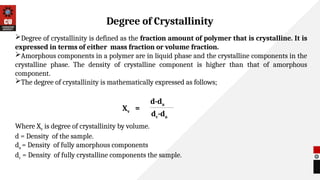
Degree of crystallinity is defined as the fraction amount of polymer that is crystalline. It is
expressed in terms of either mass fraction or volume fraction.
Amorphous components in a polymer are in liquid phase and the crystalline components in the
crystalline phase. The density of crystalline component is higher than that of amorphous
component.
The degree of crystallinity is mathematically expressed as follows;
Where Xv is degree of crystallinity by volume.
d = Density of the sample.
da = Density of fully amorphous components
dc = Density of fully crystalline components the sample.
Degree of Crystallinity
d-da
dc-da
Xv =
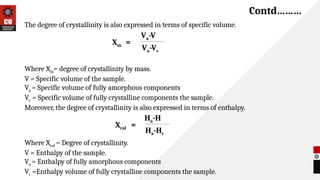
The degree of crystallinity is also expressed in terms of specific volume.
Where Xm= degree of crystallinity by mass.
V = Specific volume of the sample.
Va = Specific volume of fully amorphous components
Vc = Specific volume of fully crystalline components the sample.
Moreover, the degree of crystallinity is also expressed in terms of enthalpy.
Where Xcal = Degree of crystallinity.
V = Enthalpy of the sample.
Va = Enthalpy of fully amorphous components
Vc =Enthalpy volume of fully crystalline components the sample.
Contd………
Va-V
Va-Vc
Xm =
Ha-H
Ha-Hc
Xcal =
In general, factors causing polymers to be more ordered and regular tend to lead to a higher degree
of crystallinity.
Fewer short branches – Allowing molecules to pack closely together.
Higher degree of stereo-regularity- Syndiotactic and Isotactic polymers are more ordered than
Atactic polymers.
More regular copolymer configuration – having the same effect as stereo-regularity.
Factors favoring crystallinity
11
References
1. Polymer Science - Gowariker V. R., New age International Publishers
2. Textbook of Polymer Science - Billmeyer F. W, Wiley India Publishers
3. Advanced Polymer Chemistry – Manas Chanda Marcel Dekker INC.
4. http://faculty.uscupstate.edu/llever/polymer%20resources/glasstrans.htm
THANK YOU

SHT-755 Crystallinity (Lecture-19) (1).pptx

  • 1.
    DISCOVER . LEARN. EMPOWER Polymer Technology Anju Singh (E5273) INSTITUTE-UNIVERSITY INSTITUTE OF SCIENCES DIVISION - CHEMISTRY Masters in Science (M.Sc. Chemistry) Subject Name – Polymer Technology Subject Code – SHT-755
  • 2.
    2 Polymer Technology Syllabus PolymerTechnology Unit-I Basics of Polymers Unit-II Polymer Processing Unit-III Speciality Polymers
  • 3.
    3 Polymer Technology CO Number Title CO1 Apply appropriatebackground of Basic polymer chemistry and based on this concept analyze and evaluate basics. CO2 Apply processing of polymers and evaluate various techniques. CO3 Analyze various specialty polymers and its application in day to day life. Course Outcome https://www.shutterstock.com/image-photo/polymer-word-cloud- concept-290359235
  • 4.
    Basic of Polymers Introduction:Basic concepts of polymer science, Classification of polymers, Average molecular weight and Molecular weight distribution. Polymerization: Mechanism and kinetics of: Free radical addition polymerization, Ionic addition polymerization, Coordination polymerization, Step growth polymerization. Structure and Properties: Thermal transitions, Crystallinity, Molecular weight characterization. 4 Polymer Technology https://phys.org/news/2018-03-custom-sequences-polymers-visible.html
  • 5.
    Crystallinity defines thedegree of long-range order in a material, and strongly affects its properties. The more crystalline a polymer, the more regularly aligned its chains. Increasing the degree of crystallinity increases hardness and density. This is illustrated in poly(ethene). HDPE (high density poly(ethene)) is composed of linear chains with little branching. Molecules pack closely together, leading to a high degree of order. This makes it stiff and dense, and it is used for milk bottles and drainpipes. Crystallinity in Polymers
  • 6.
    The numerous shortbranches in LDPE (low density poly(ethene)) interfere with the close packing of molecules, so they cannot form an ordered structure. The lower density and stiffness make it suitable for use in films such as plastic carrier bags and food wrapping. Often, polymers are semi-crystalline, existing somewhere on a scale between amorphous and crystalline. This usually consists of small crystalline regions (crystallites) surrounded by regions of amorphous polymer. Crystallinity in Polymers
  • 8.
    Degree of crystallinityis defined as the fraction amount of polymer that is crystalline. It is expressed in terms of either mass fraction or volume fraction. Amorphous components in a polymer are in liquid phase and the crystalline components in the crystalline phase. The density of crystalline component is higher than that of amorphous component. The degree of crystallinity is mathematically expressed as follows; Where Xv is degree of crystallinity by volume. d = Density of the sample. da = Density of fully amorphous components dc = Density of fully crystalline components the sample. Degree of Crystallinity d-da dc-da Xv =
  • 9.
    The degree ofcrystallinity is also expressed in terms of specific volume. Where Xm= degree of crystallinity by mass. V = Specific volume of the sample. Va = Specific volume of fully amorphous components Vc = Specific volume of fully crystalline components the sample. Moreover, the degree of crystallinity is also expressed in terms of enthalpy. Where Xcal = Degree of crystallinity. V = Enthalpy of the sample. Va = Enthalpy of fully amorphous components Vc =Enthalpy volume of fully crystalline components the sample. Contd……… Va-V Va-Vc Xm = Ha-H Ha-Hc Xcal =
  • 10.
    In general, factorscausing polymers to be more ordered and regular tend to lead to a higher degree of crystallinity. Fewer short branches – Allowing molecules to pack closely together. Higher degree of stereo-regularity- Syndiotactic and Isotactic polymers are more ordered than Atactic polymers. More regular copolymer configuration – having the same effect as stereo-regularity. Factors favoring crystallinity
  • 11.
    11 References 1. Polymer Science- Gowariker V. R., New age International Publishers 2. Textbook of Polymer Science - Billmeyer F. W, Wiley India Publishers 3. Advanced Polymer Chemistry – Manas Chanda Marcel Dekker INC. 4. http://faculty.uscupstate.edu/llever/polymer%20resources/glasstrans.htm
  • 12.

Editor's Notes

  • #5 https://www.doitpoms.ac.uk/tlplib/polymerbasics/crystallinity.php
  • #6 https://www.doitpoms.ac.uk/tlplib/polymerbasics/crystallinity.php
  • #7 https://www.doitpoms.ac.uk/tlplib/polymerbasics/crystallinity.php
  • #8 Source: Polymer Science by V R Gowariker
  • #9 Source: Polymer Science by V R Gowariker
  • #10 https://www.doitpoms.ac.uk/tlplib/polymerbasics/crystallinity.php