
POLYMER SCIENCE
TOPIC : CRYSTALLINE IN POLYMER
MD. FEROZ AL MAMUM
CRYSTALLIZATION OF POLYMERS
Crystallization affects optical, mechanical, thermal and chemical
properties of the polymer. The degree of crystallinity is estimated by
different analytical methods and it typically ranges between 10 and
80%, thus crystallized polymers are often called "semi-crystalline".
CRYSTALLINITY AND POLYMER STRUCTURE
A polymer's structure affects crystallinity a good deal. If it's regular and
orderly, it will pack into crystals easily. If it's not, it won't. It helps to
look at polystyrene to understand how this works.
CRYSTALLINITY AND INTERMOLECULAR FORCES
Intermolecular forces can be a big help for a polymer if it wants to
form crystals. A good example is nylon. You can see from the picture
that the polar amide groups in the backbone chain of nylon 6,6 are
strongly attracted to each other. They form strong hydrogen bonds.
This strong binding holds crystals together. This raises the melting
point compared to polymers without strong intermolecular
interactions, like polyethylene
CONFINED CRYSTALLIZATION
When polymers crystallize from an isotropic, bulk of melt or
concentrated solution, the crystalline lamellae (10 to 20 nm in
thickness) are typically organized into a spherulitic morphology as
illustrated above.
DILATOMETRY
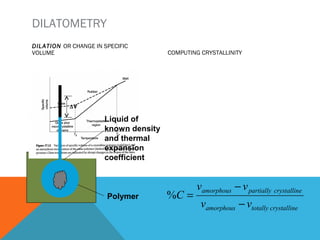
DILATION OR CHANGE IN SPECIFIC
VOLUME COMPUTING CRYSTALLINITY
Liquid of
known density
and thermal
expansion
coefficient
Polymer
∆V
ecrystallintotallyamorphous
ecrystallinpartiallyamorphous
vv
vv
C
−
−
=%
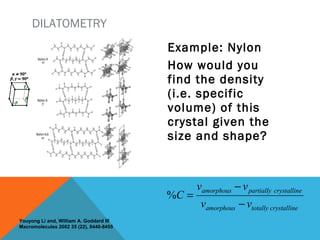
Example: Nylon
How would you
find the density
(i.e. specific
volume) of this
crystal given the
size and shape?
DILATOMETRY
ecrystallintotallyamorphous
ecrystallinpartiallyamorphous
vv
vv
C
−
−
=%
Youyong Li and, William A. Goddard III
Macromolecules 2002 35 (22), 8440-8455
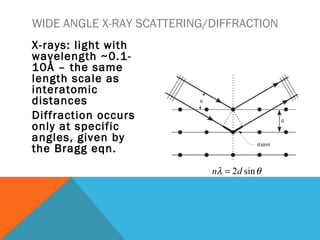
X-rays: light with
wavelength ~0.1-
10Å – the same
length scale as
interatomic
distances
Diffraction occurs
only at specific
angles, given by
the Bragg eqn.
WIDE ANGLE X-RAY SCATTERING/DIFFRACTION
θλ sin2dn =
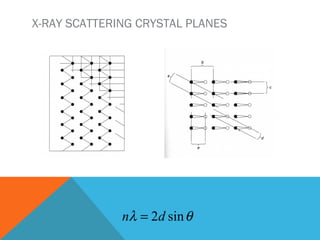
X-RAY SCATTERING CRYSTAL PLANES
θλ sin2dn =
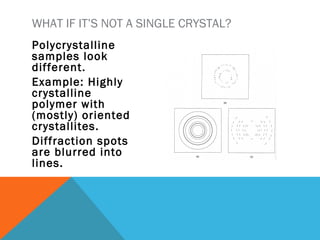
Polycrystalline
samples look
different.
Example: Highly
crystalline
polymer with
(mostly) oriented
crystallites.
Diffraction spots
are blurred into
lines.
WHAT IF IT’S NOT A SINGLE CRYSTAL?
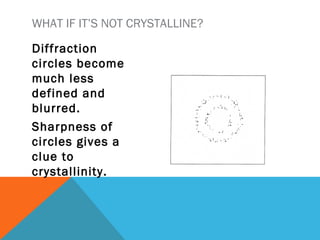
Diffraction
circles become
much less
defined and
blurred.
Sharpness of
circles gives a
clue to
crystallinity.
WHAT IF IT’S NOT CRYSTALLINE?
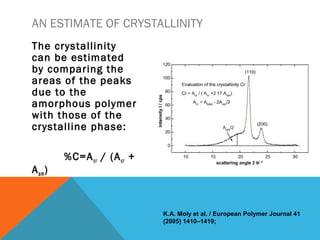
The crystallinity
can be estimated
by comparing the
areas of the peaks
due to the
amorphous polymer
with those of the
crystalline phase:
%C=Acr / (Acr +
Aam)
AN ESTIMATE OF CRYSTALLINITY
K.A. Moly et al. / European Polymer Journal 41
(2005) 1410–1419;
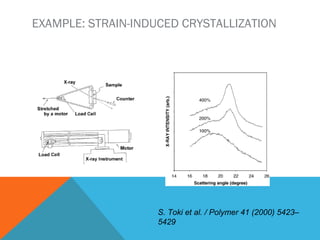
EXAMPLE: STRAIN-INDUCED CRYSTALLIZATION
S. Toki et al. / Polymer 41 (2000) 5423–
5429
CONCLUSION
Offshoot: A combination of methods may be the best solution (e.g. x-ray
scattering, DSC)
Polymer crystallinity contributes to the strength of many polymeric
materials.
Questions?
REFERANCE
 https://en.wikipedia.org/wiki/Crystallization_of_polymers
 http://pslc.ws/macrog/crystal.htm
 https://en.wikipedia.org/wiki/Crystallization_of_polymers#Crystalliza
tion_mechanisms
 http://encyclopedia2.thefreedictionary.com/crystalline+polymer
 Polymer Engineering and Science , September, 1969 , Vol. 9 No. 5

Crystallinity in polymers

  • 1.
    POLYMER SCIENCE TOPIC :CRYSTALLINE IN POLYMER MD. FEROZ AL MAMUM
  • 2.
    CRYSTALLIZATION OF POLYMERS Crystallization affectsoptical, mechanical, thermal and chemical properties of the polymer. The degree of crystallinity is estimated by different analytical methods and it typically ranges between 10 and 80%, thus crystallized polymers are often called "semi-crystalline".
  • 3.
    CRYSTALLINITY AND POLYMERSTRUCTURE A polymer's structure affects crystallinity a good deal. If it's regular and orderly, it will pack into crystals easily. If it's not, it won't. It helps to look at polystyrene to understand how this works.
  • 4.
    CRYSTALLINITY AND INTERMOLECULARFORCES Intermolecular forces can be a big help for a polymer if it wants to form crystals. A good example is nylon. You can see from the picture that the polar amide groups in the backbone chain of nylon 6,6 are strongly attracted to each other. They form strong hydrogen bonds. This strong binding holds crystals together. This raises the melting point compared to polymers without strong intermolecular interactions, like polyethylene
  • 5.
    CONFINED CRYSTALLIZATION When polymerscrystallize from an isotropic, bulk of melt or concentrated solution, the crystalline lamellae (10 to 20 nm in thickness) are typically organized into a spherulitic morphology as illustrated above.
  • 6.
    DILATOMETRY DILATION OR CHANGEIN SPECIFIC VOLUME COMPUTING CRYSTALLINITY Liquid of known density and thermal expansion coefficient Polymer ∆V ecrystallintotallyamorphous ecrystallinpartiallyamorphous vv vv C − − =%
  • 7.
    Example: Nylon How wouldyou find the density (i.e. specific volume) of this crystal given the size and shape? DILATOMETRY ecrystallintotallyamorphous ecrystallinpartiallyamorphous vv vv C − − =% Youyong Li and, William A. Goddard III Macromolecules 2002 35 (22), 8440-8455
  • 8.
    X-rays: light with wavelength~0.1- 10Å – the same length scale as interatomic distances Diffraction occurs only at specific angles, given by the Bragg eqn. WIDE ANGLE X-RAY SCATTERING/DIFFRACTION θλ sin2dn =
  • 9.
    X-RAY SCATTERING CRYSTALPLANES θλ sin2dn =
  • 10.
    Polycrystalline samples look different. Example: Highly crystalline polymerwith (mostly) oriented crystallites. Diffraction spots are blurred into lines. WHAT IF IT’S NOT A SINGLE CRYSTAL?
  • 11.
    Diffraction circles become much less definedand blurred. Sharpness of circles gives a clue to crystallinity. WHAT IF IT’S NOT CRYSTALLINE?
  • 12.
    The crystallinity can beestimated by comparing the areas of the peaks due to the amorphous polymer with those of the crystalline phase: %C=Acr / (Acr + Aam) AN ESTIMATE OF CRYSTALLINITY K.A. Moly et al. / European Polymer Journal 41 (2005) 1410–1419;
  • 13.
    EXAMPLE: STRAIN-INDUCED CRYSTALLIZATION S.Toki et al. / Polymer 41 (2000) 5423– 5429
  • 14.
    CONCLUSION Offshoot: A combinationof methods may be the best solution (e.g. x-ray scattering, DSC) Polymer crystallinity contributes to the strength of many polymeric materials. Questions?
  • 15.
    REFERANCE  https://en.wikipedia.org/wiki/Crystallization_of_polymers  http://pslc.ws/macrog/crystal.htm https://en.wikipedia.org/wiki/Crystallization_of_polymers#Crystalliza tion_mechanisms  http://encyclopedia2.thefreedictionary.com/crystalline+polymer  Polymer Engineering and Science , September, 1969 , Vol. 9 No. 5