Network Security Essentials
Lecture 1
Computer Security
• The protection afforded to an automated information system in
order to attain the applicable objectives of preserving the
integrity, availability and confidentiality of information system
resources (includes hardware, software, firmware,
information/data, and telecommunications)
[NIST 1995]
Key Security Concepts
Three Key Objectives
• Confidentiality
• Data confidentiality
• Privacy
• Integrity
• Data integrity
• System integrity
• Availability
• Additional concepts
• Authenticity
• Accountability
Levels of Impact
• 3 levels of impact from a security breach
• Low
• Moderate
• High
Examples of Security Requirements
• confidentiality – student grades
• integrity – patient information
• availability – authentication service
Computer Security Challenges
1. Not simple
2. Must consider potential attacks
3. Procedures used counter-intuitive
4. Involve algorithms and secret info
5. Must decide where to deploy mechanisms
6. Battle of wits between attacker / admin
7. not perceived on benefit until fails
8. Requires regular monitoring
9. Too often an after-thought
10. Considered as hindrance to using system
OSI Security Architecture
• ITU-T X.800 “Security Architecture for OSI”
• defines a systematic way of defining and providing security
requirements
• for us it provides a useful, if abstract, overview of concepts we
will study
Aspects of Security
• 3 aspects of information security:
• security attack
• security mechanism: detect, prevent, recover
• security service
• terms
• threat – a potential for violation of security
• attack – an assault on system security, a deliberate attempt
to avoid security services
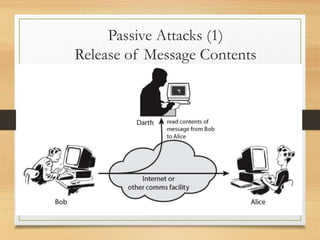
Passive Attacks (1)
Release of Message Contents
Passive Attacks (2)
Traffic Analysis
• Passive attacks do not affect system resources
• Eavesdropping, monitoring
• Two types of passive attacks
• Release of message contents
• Traffic analysis
• Passive attacks are very difficult to detect
• Message transmission apparently normal
• No alteration of the data
• Emphasis on prevention rather than detection
• By means of encryption
Active Attacks (1)
Masquerade
Active Attacks (2)
Replay
Active Attacks (3)
Modification of Messages
Active Attacks (4)
Denial of Service
• Active attacks try to alter system resources or affect their
operation
• Modification of data, or creation of false data
• Four categories
• Masquerade
• Replay
• Modification of messages
• Denial of service: preventing normal use
• A specific target or entire network
• Difficult to prevent
• The goal is to detect and recover
Security Service
• enhance security of data processing systems and information transfers of
an organization
• planned to counter security attacks
• using one or more security mechanisms
• often replicates functions normally associated with physical documents
• which, for example, have signatures, dates; need protection from disclosure,
tampering, or destruction; be notarized or witnessed; be recorded or licensed
Security Services
• X.800:
“a service provided by a protocol layer of communicating open systems,
which ensures adequate security of the systems or of data transfers”
• RFC 2828:
“a processing or communication service provided by a system to give a
specific kind of protection to system resources”
Security Services (X.800)
• Authentication - assurance that communicating entity is the one claimed
• have both peer-entity & data origin authentication
• Access Control - prevention of the unauthorized use of a resource
• Data Confidentiality –protection of data from unauthorized disclosure
• Data Integrity - assurance that data received is as sent by an authorized
entity
• Availability – resource accessible/usable
Security Mechanism
• feature designed to detect, prevent, or recover from a
security attack
• no single mechanism that will support all services
required
• however one particular element underlies many of
the security mechanisms in use:
• cryptographic techniques
• hence our focus on this topic
Security Mechanisms (X.800)
• specific security mechanisms:
• encipherment, digital signatures, access controls, data integrity,
authentication exchange, traffic padding, routing control, notarization
• pervasive security mechanisms:
• trusted functionality, security labels, event detection, security audit trails,
security recovery
Model for Network Security
• using this model requires us to:
1. design a suitable algorithm for the security
transformation
2. generate the secret information (keys) used by the
algorithm
3. develop methods to distribute and share the secret
information
4. specify a protocol enabling the principals to use the
transformation and secret information for a security
service
Model for Network Access Security
• using this model requires us to:
1. select appropriate gatekeeper functions to identify users
2. implement security controls to ensure only authorised
users access designated information or resources
Standards
• NIST: National Institute of Standards and
Technology
• FIPS: Federal Information Processing Standards
• SP: Special Publications
• ISOC: Internet Society
• Home for IETF (Internet Engineering Task Force) and
IAB (Internet Architecture Board)
• RFCs: Requests for Comments
Summary
• topic roadmap & standards organizations
• security concepts:
• confidentiality, integrity, availability
• X.800 security architecture
• security attacks, services, mechanisms
• models for network (access) security
Network Security Essentials
Lecture 2
Symmetric Encryption
• conventional encryption / private-key / single-key
• sender and recipient share a common key
• all classical encryption algorithms are private-key
• was only type prior to invention of public-key in
1970’s
• and by far most widely used
Some Basic Terminology
• plaintext - original message
• ciphertext - coded message
• cipher - algorithm for transforming plaintext to ciphertext
• key - info used in cipher known only to sender/receiver
• encipher (encrypt) - converting plaintext to ciphertext
• decipher (decrypt) - recovering ciphertext from plaintext
• cryptography - study of encryption principles/methods
• cryptanalysis (codebreaking) - study of principles/ methods
of deciphering ciphertext without knowing key
• cryptology - field of both cryptography and cryptanalysis
Symmetric Cipher Model
Requirements
•
Shift Cipher
• Each letter we identify with a number
• A = 0
• B = 1
• C = 2
• ...
• Z = 25
• The key k is a number in the range 0 − 25
• Encryption is add k onto each letter modulo 26.
• Use the key k = 3.
• HELLO becomes
• KHOOR
ROT-13 cipher (2)
•
Caesar cipher
• Earliest known substitution cipher and first attested use in
military affairs
• The Roman emperor Julius Caesar used to substitute each
letter in his diplomatic communications with the letter that
was three letters further along in the alphabet.
• Replaces each letter by 3rd letter on
• p : ABCDEFGHIJKLMNOPQRSTUVWXYZ
• F(p) : DEFGHIJKLMNOPQRSTUVWXYZABC
Caesar cipher (2)
• Example:
• Plaintext : ET TU BRUTUS
• Ciphertext : HW WX EUXWXV
Caesar cipher (3)
• Can define transformation as:
a b c d e f g h i j k l m n o p q r s t u v w x y z
D E F G H I J K L M N O P Q R S T U V W X Y Z A B C
• Mathematically give each letter a number
a b c d e f g h i j k l m n o p q r s t u v w x y z
0 1 2 3 4 5 6 7 8 9 10 11 12 13 14 15 16 17 18 19 20 21 22 23 24 25
• Then have Caesar cipher as:
c = E(p) = (p + k) mod (26)
p = D(c) = (c – k) mod (26)
Caesar cipher (4)
•

NETWORK SECURITY

  • 1.
  • 2.
    Computer Security • Theprotection afforded to an automated information system in order to attain the applicable objectives of preserving the integrity, availability and confidentiality of information system resources (includes hardware, software, firmware, information/data, and telecommunications) [NIST 1995]
  • 3.
  • 4.
    Three Key Objectives •Confidentiality • Data confidentiality • Privacy • Integrity • Data integrity • System integrity • Availability • Additional concepts • Authenticity • Accountability
  • 5.
    Levels of Impact •3 levels of impact from a security breach • Low • Moderate • High
  • 6.
    Examples of SecurityRequirements • confidentiality – student grades • integrity – patient information • availability – authentication service
  • 7.
    Computer Security Challenges 1.Not simple 2. Must consider potential attacks 3. Procedures used counter-intuitive 4. Involve algorithms and secret info 5. Must decide where to deploy mechanisms 6. Battle of wits between attacker / admin 7. not perceived on benefit until fails 8. Requires regular monitoring 9. Too often an after-thought 10. Considered as hindrance to using system
  • 8.
    OSI Security Architecture •ITU-T X.800 “Security Architecture for OSI” • defines a systematic way of defining and providing security requirements • for us it provides a useful, if abstract, overview of concepts we will study
  • 9.
    Aspects of Security •3 aspects of information security: • security attack • security mechanism: detect, prevent, recover • security service • terms • threat – a potential for violation of security • attack – an assault on system security, a deliberate attempt to avoid security services
  • 10.
    Passive Attacks (1) Releaseof Message Contents
  • 11.
  • 12.
    • Passive attacksdo not affect system resources • Eavesdropping, monitoring • Two types of passive attacks • Release of message contents • Traffic analysis • Passive attacks are very difficult to detect • Message transmission apparently normal • No alteration of the data • Emphasis on prevention rather than detection • By means of encryption
  • 13.
  • 14.
  • 15.
  • 16.
  • 17.
    • Active attackstry to alter system resources or affect their operation • Modification of data, or creation of false data • Four categories • Masquerade • Replay • Modification of messages • Denial of service: preventing normal use • A specific target or entire network • Difficult to prevent • The goal is to detect and recover
  • 18.
    Security Service • enhancesecurity of data processing systems and information transfers of an organization • planned to counter security attacks • using one or more security mechanisms • often replicates functions normally associated with physical documents • which, for example, have signatures, dates; need protection from disclosure, tampering, or destruction; be notarized or witnessed; be recorded or licensed
  • 19.
    Security Services • X.800: “aservice provided by a protocol layer of communicating open systems, which ensures adequate security of the systems or of data transfers” • RFC 2828: “a processing or communication service provided by a system to give a specific kind of protection to system resources”
  • 20.
    Security Services (X.800) •Authentication - assurance that communicating entity is the one claimed • have both peer-entity & data origin authentication • Access Control - prevention of the unauthorized use of a resource • Data Confidentiality –protection of data from unauthorized disclosure • Data Integrity - assurance that data received is as sent by an authorized entity • Availability – resource accessible/usable
  • 21.
    Security Mechanism • featuredesigned to detect, prevent, or recover from a security attack • no single mechanism that will support all services required • however one particular element underlies many of the security mechanisms in use: • cryptographic techniques • hence our focus on this topic
  • 22.
    Security Mechanisms (X.800) •specific security mechanisms: • encipherment, digital signatures, access controls, data integrity, authentication exchange, traffic padding, routing control, notarization • pervasive security mechanisms: • trusted functionality, security labels, event detection, security audit trails, security recovery
  • 23.
  • 24.
    Model for NetworkSecurity • using this model requires us to: 1. design a suitable algorithm for the security transformation 2. generate the secret information (keys) used by the algorithm 3. develop methods to distribute and share the secret information 4. specify a protocol enabling the principals to use the transformation and secret information for a security service
  • 25.
    Model for NetworkAccess Security
  • 26.
    Model for NetworkAccess Security • using this model requires us to: 1. select appropriate gatekeeper functions to identify users 2. implement security controls to ensure only authorised users access designated information or resources
  • 27.
    Standards • NIST: NationalInstitute of Standards and Technology • FIPS: Federal Information Processing Standards • SP: Special Publications • ISOC: Internet Society • Home for IETF (Internet Engineering Task Force) and IAB (Internet Architecture Board) • RFCs: Requests for Comments
  • 28.
    Summary • topic roadmap& standards organizations • security concepts: • confidentiality, integrity, availability • X.800 security architecture • security attacks, services, mechanisms • models for network (access) security
  • 29.
  • 30.
    Symmetric Encryption • conventionalencryption / private-key / single-key • sender and recipient share a common key • all classical encryption algorithms are private-key • was only type prior to invention of public-key in 1970’s • and by far most widely used
  • 31.
    Some Basic Terminology •plaintext - original message • ciphertext - coded message • cipher - algorithm for transforming plaintext to ciphertext • key - info used in cipher known only to sender/receiver • encipher (encrypt) - converting plaintext to ciphertext • decipher (decrypt) - recovering ciphertext from plaintext • cryptography - study of encryption principles/methods • cryptanalysis (codebreaking) - study of principles/ methods of deciphering ciphertext without knowing key • cryptology - field of both cryptography and cryptanalysis
  • 32.
  • 33.
  • 34.
    Shift Cipher • Eachletter we identify with a number • A = 0 • B = 1 • C = 2 • ... • Z = 25 • The key k is a number in the range 0 − 25 • Encryption is add k onto each letter modulo 26. • Use the key k = 3. • HELLO becomes • KHOOR
  • 35.
  • 36.
    Caesar cipher • Earliestknown substitution cipher and first attested use in military affairs • The Roman emperor Julius Caesar used to substitute each letter in his diplomatic communications with the letter that was three letters further along in the alphabet. • Replaces each letter by 3rd letter on • p : ABCDEFGHIJKLMNOPQRSTUVWXYZ • F(p) : DEFGHIJKLMNOPQRSTUVWXYZABC
  • 37.
    Caesar cipher (2) •Example: • Plaintext : ET TU BRUTUS • Ciphertext : HW WX EUXWXV
  • 38.
    Caesar cipher (3) •Can define transformation as: a b c d e f g h i j k l m n o p q r s t u v w x y z D E F G H I J K L M N O P Q R S T U V W X Y Z A B C • Mathematically give each letter a number a b c d e f g h i j k l m n o p q r s t u v w x y z 0 1 2 3 4 5 6 7 8 9 10 11 12 13 14 15 16 17 18 19 20 21 22 23 24 25 • Then have Caesar cipher as: c = E(p) = (p + k) mod (26) p = D(c) = (c – k) mod (26)
  • 39.