C-Reactive Protein and
Erythrocyte Sedimentation Rate
Introduction
• CRP  was discovered by Tillett and Francis in 1930
• The name CRP arose because it was first identified as a substance in the
serum of patients with acute inflammation that reacted with the "c“
carbohydrate antibody of the capsule of pneumococcus
• CRP belongs to the pentraxin family of calcium dependent ligand-binding
plasma proteins
• CRP  the 1st acute-phase protein to be described and is an exquisitely
sensitive systemic marker of inflammation and tissue damage
• The acute-phase response comprises the nonspecific physiological
and biochemical responses of endothermic animals to most forms of
tissue damage, infection, inflammation, and malignant neoplasia
Circulating CRP concentration
• In healthy young adult volunteer blood donors, the median concentration
of CRP is 0.8 mg/l
• There are many factors that can alter baseline CRP levels including age,
gender, smoking status, weight, lipid levels, and blood pressure
• An acute-phase stimulus, values may ↑ from less than 50 mg/l to
more than 500 mg/l
• CRP is synthesized primarily in liver hepatocytes but also by smooth
muscle cells, macrophages, endothelial cells, lymphocytes, and
adipocytes
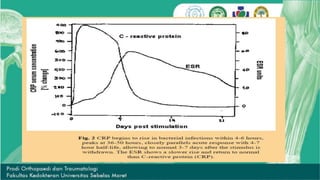
• Hepatic synthesis starts very rapidly after stimulus, serum
concentrations rising above 5 mg/l by about 6 hours and peaking
around 48 hours.
Crp and Inflammation
• CRP is mainly classed as an acute marker of inflammation
• The main role of CRP in inflammation tends to focus around the
activation of the C1q molecule in the complement pathway
leading to the opsonization of pathogens
• CRP also initiate cell-mediated pathways by activating complement as
well as to binding to Fc receptors of IgG
• CRP binds to Fc receptors with the resulting interaction leading to the
release of pro-inflammatory cytokines
Crp and Inflammation
• Evidence suggests that CRP is not only just a marker of
inflammation but also plays an active role in the inflammatory
process
• CRP is deposited at sites of inflammation and tissue damage in both
naturally occurring and experimental conditions
• The literature suggests that CRP binds to damaged cell membranes
and contributes to the inflammatory response
CRP and Infection
Kingsley and Jones (2008)  CRP increases during infection in response to
monocytic mediators such as IL-1 and IL-6 and that it has a stable decay rate
Most of the interaction between CRP and the immune response to pathogens
involves the binding of CRP to PCh and the activation of the classical
complement pathway
Mold et al. (1981)  CRP provides mice with protection against infection
by the gram-positive pathogen Streptococcus pneumoniae by binding to a
PCh determinant of the pathogen cell wall and activating the complement
pathway
CRP and Infection
Szalai et al. (2000)  CRP can confer protective benefit against Salmonella enterica
serovar Typhimurium, a gram-negative pathogen that provides a model of typhoid
fever in mice
Kingsley and Jones (2008)  All cases of infection showed an increase in CRP levels
compared to non-infected controls, but CRP levels could not distinguish between the
infection types
Povoa et al. (2005)  CRP can mediate host responses to Staphylococcus
aureus including some protective function against infection and an increase in
phagocytosis of this pathogen (normal CRP for healty population 0.08mg/dL, in
chronic S. aureus infection it become 8.7mg/dL)
The erythrocyte sedimentation rate
(ESR)
• ESR)is a nonspecificscreeningtest indicative of inflammation
• It is easytoperform, widely available and inexpensive
• used for many years to help detect inflammation associated with
conditionssuch asinfections, cancers, and autoimmune diseases.
The erythrocyte sedimentation
rate (ESR)
• Anticoagulated blood isdrawn up into atube of standardized dimensions
andleft in avertical position for exactly onehour
• After that period the point at which the red cells have separated and
settled from the plasma is recorded by reading from the scale on
the side of thetube
• It is used asan initial screening tool and also asafollow-uptest to
monitor therapy and progression or remissionof disease
• The ESRis directly proportional to red cell massand inversely
proportional to the plasmaviscosity
Principle
TheESR governed by the balance between pro- sedimentation
factors, mainly fibrinogen, and those factors resisting
sedimentation (negative chargeof Rbcs- that repel each other)
When an inflammatory process is present, the high proportion of
fibrinogen in the blood causes red blood cells to stick to eachother
ReferanceRange
• Adult females 0-20mm/h
• Adult males 0-15mm/hr
• Children(<10) 0-10 mm/hr
ConditionsAssociatedWithIncreasedEsr
• Kidneydisease
• Pregnancy
• Rheumatic fever
• Rheumatoidarthritis
• Anemia
• Systemiclupus erythematosus
• Thyroid disease
• Etc
Someconditions with very
high
ES R>100 mm/hr
• Multiple myeloma
• Connective tissue
• Autoimmune diseases
• Tuberculosis
• Malignancies
• Severeanemia
DecreasedESR
1. Congestiveheart failure
2. Hyperviscosity
3. Decreasedfibrinogenlevels
4. Polycythemia
5. Sicklecell anemia
<0.5 mm/hr
The significance of ESR in inflammation
• Inflammation can cause abnormal proteins to appear in your blood. These
proteins cause your red blood cells to clump together. This makes the red
blood cells fall more quickly
• A group of RBCs that are clumped together will form a stack (similar to a stack of
coins) called a rouleau (pleural is rouleaux)
• An increase in plasma proteins (present in inflammatory conditions) will
propagate an increase in rouleaux formations, which settle more readily than
single red blood cells
• The fluctuating nature of the acute phase proteins in inflammation leads to the
increased "stickiness" of RBC's, the formation of RBC "stacks" (rouleaux
formation), and an increase in ESR
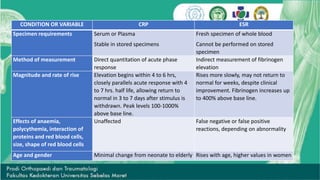
CONDITION OR VARIABLE CRP ESR
Specimen requirements Serum or Plasma
Stable in stored specimens
Fresh specimen of whole blood
Cannot be performed on stored
specimen
Method of measurement Direct quantitation of acute phase
response
Indirect measurement of fibrinogen
elevation
Magnitude and rate of rise Elevation begins within 4 to 6 hrs,
closely parallels acute response with 4
to 7 hrs. half life, allowing return to
normal in 3 to 7 days after stimulus is
withdrawn. Peak levels 100-1000%
above base line.
Rises more slowly, may not return to
normal for weeks, despite clinical
improvement. Fibrinogen increases up
to 400% above base line.
Effects of anaemia,
polycythemia, interaction of
proteins and red blood cells,
size, shape of red blood cells
Unaffected False negative or false positive
reactions, depending on abnormality
Age and gender Minimal change from neonate to elderly Rises with age, higher values in women
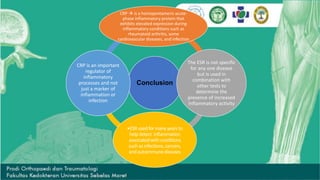
Conclusion
CRP  is a homopentameric acute-
phase inflammatory protein that
exhibits elevated expression during
inflammatory conditions such as
rheumatoid arthritis, some
cardiovascular diseases, and infection
The ESR is not specific
for any one disease
but is used in
combination with
other tests to
determine the
presence of increased
inflammatory activity
•ESRusedformanyyearsto
helpdetect inflammation
associatedwithconditions
suchasinfections,cancers,
andautoimmunediseases
CRP is an important
regulator of
inflammatory
processes and not
just a marker of
inflammation or
infection

CRP vs ESR.pptx

  • 1.
  • 2.
    Introduction • CRP was discovered by Tillett and Francis in 1930 • The name CRP arose because it was first identified as a substance in the serum of patients with acute inflammation that reacted with the "c“ carbohydrate antibody of the capsule of pneumococcus • CRP belongs to the pentraxin family of calcium dependent ligand-binding plasma proteins • CRP  the 1st acute-phase protein to be described and is an exquisitely sensitive systemic marker of inflammation and tissue damage • The acute-phase response comprises the nonspecific physiological and biochemical responses of endothermic animals to most forms of tissue damage, infection, inflammation, and malignant neoplasia
  • 3.
    Circulating CRP concentration •In healthy young adult volunteer blood donors, the median concentration of CRP is 0.8 mg/l • There are many factors that can alter baseline CRP levels including age, gender, smoking status, weight, lipid levels, and blood pressure • An acute-phase stimulus, values may ↑ from less than 50 mg/l to more than 500 mg/l • CRP is synthesized primarily in liver hepatocytes but also by smooth muscle cells, macrophages, endothelial cells, lymphocytes, and adipocytes • Hepatic synthesis starts very rapidly after stimulus, serum concentrations rising above 5 mg/l by about 6 hours and peaking around 48 hours.
  • 5.
    Crp and Inflammation •CRP is mainly classed as an acute marker of inflammation • The main role of CRP in inflammation tends to focus around the activation of the C1q molecule in the complement pathway leading to the opsonization of pathogens • CRP also initiate cell-mediated pathways by activating complement as well as to binding to Fc receptors of IgG • CRP binds to Fc receptors with the resulting interaction leading to the release of pro-inflammatory cytokines
  • 6.
    Crp and Inflammation •Evidence suggests that CRP is not only just a marker of inflammation but also plays an active role in the inflammatory process • CRP is deposited at sites of inflammation and tissue damage in both naturally occurring and experimental conditions • The literature suggests that CRP binds to damaged cell membranes and contributes to the inflammatory response
  • 7.
    CRP and Infection Kingsleyand Jones (2008)  CRP increases during infection in response to monocytic mediators such as IL-1 and IL-6 and that it has a stable decay rate Most of the interaction between CRP and the immune response to pathogens involves the binding of CRP to PCh and the activation of the classical complement pathway Mold et al. (1981)  CRP provides mice with protection against infection by the gram-positive pathogen Streptococcus pneumoniae by binding to a PCh determinant of the pathogen cell wall and activating the complement pathway
  • 8.
    CRP and Infection Szalaiet al. (2000)  CRP can confer protective benefit against Salmonella enterica serovar Typhimurium, a gram-negative pathogen that provides a model of typhoid fever in mice Kingsley and Jones (2008)  All cases of infection showed an increase in CRP levels compared to non-infected controls, but CRP levels could not distinguish between the infection types Povoa et al. (2005)  CRP can mediate host responses to Staphylococcus aureus including some protective function against infection and an increase in phagocytosis of this pathogen (normal CRP for healty population 0.08mg/dL, in chronic S. aureus infection it become 8.7mg/dL)
  • 9.
    The erythrocyte sedimentationrate (ESR) • ESR)is a nonspecificscreeningtest indicative of inflammation • It is easytoperform, widely available and inexpensive • used for many years to help detect inflammation associated with conditionssuch asinfections, cancers, and autoimmune diseases.
  • 10.
    The erythrocyte sedimentation rate(ESR) • Anticoagulated blood isdrawn up into atube of standardized dimensions andleft in avertical position for exactly onehour • After that period the point at which the red cells have separated and settled from the plasma is recorded by reading from the scale on the side of thetube • It is used asan initial screening tool and also asafollow-uptest to monitor therapy and progression or remissionof disease • The ESRis directly proportional to red cell massand inversely proportional to the plasmaviscosity
  • 11.
    Principle TheESR governed bythe balance between pro- sedimentation factors, mainly fibrinogen, and those factors resisting sedimentation (negative chargeof Rbcs- that repel each other) When an inflammatory process is present, the high proportion of fibrinogen in the blood causes red blood cells to stick to eachother
  • 12.
    ReferanceRange • Adult females0-20mm/h • Adult males 0-15mm/hr • Children(<10) 0-10 mm/hr
  • 13.
    ConditionsAssociatedWithIncreasedEsr • Kidneydisease • Pregnancy •Rheumatic fever • Rheumatoidarthritis • Anemia • Systemiclupus erythematosus • Thyroid disease • Etc
  • 14.
    Someconditions with very high ESR>100 mm/hr • Multiple myeloma • Connective tissue • Autoimmune diseases • Tuberculosis • Malignancies • Severeanemia
  • 15.
    DecreasedESR 1. Congestiveheart failure 2.Hyperviscosity 3. Decreasedfibrinogenlevels 4. Polycythemia 5. Sicklecell anemia <0.5 mm/hr
  • 16.
    The significance ofESR in inflammation • Inflammation can cause abnormal proteins to appear in your blood. These proteins cause your red blood cells to clump together. This makes the red blood cells fall more quickly • A group of RBCs that are clumped together will form a stack (similar to a stack of coins) called a rouleau (pleural is rouleaux) • An increase in plasma proteins (present in inflammatory conditions) will propagate an increase in rouleaux formations, which settle more readily than single red blood cells • The fluctuating nature of the acute phase proteins in inflammation leads to the increased "stickiness" of RBC's, the formation of RBC "stacks" (rouleaux formation), and an increase in ESR
  • 18.
    CONDITION OR VARIABLECRP ESR Specimen requirements Serum or Plasma Stable in stored specimens Fresh specimen of whole blood Cannot be performed on stored specimen Method of measurement Direct quantitation of acute phase response Indirect measurement of fibrinogen elevation Magnitude and rate of rise Elevation begins within 4 to 6 hrs, closely parallels acute response with 4 to 7 hrs. half life, allowing return to normal in 3 to 7 days after stimulus is withdrawn. Peak levels 100-1000% above base line. Rises more slowly, may not return to normal for weeks, despite clinical improvement. Fibrinogen increases up to 400% above base line. Effects of anaemia, polycythemia, interaction of proteins and red blood cells, size, shape of red blood cells Unaffected False negative or false positive reactions, depending on abnormality Age and gender Minimal change from neonate to elderly Rises with age, higher values in women
  • 19.
    Conclusion CRP  isa homopentameric acute- phase inflammatory protein that exhibits elevated expression during inflammatory conditions such as rheumatoid arthritis, some cardiovascular diseases, and infection The ESR is not specific for any one disease but is used in combination with other tests to determine the presence of increased inflammatory activity •ESRusedformanyyearsto helpdetect inflammation associatedwithconditions suchasinfections,cancers, andautoimmunediseases CRP is an important regulator of inflammatory processes and not just a marker of inflammation or infection