PLASMA PROTEINS
Objectives:
• To know the classification and functions of
plasma proteins
• An overview of their clinical significance in
health and diseases
• To discuss the therapeutic uses of plasma and
its components
• Water (89%)
• Electrolytes
• Metabolites
• Hormones
• Proteins (6%)
Simple proteins
Glycoproteins
Lipoproteins
Immunoglobulins
Plasma vs serum ?
Electrophoretic
separation
-
+
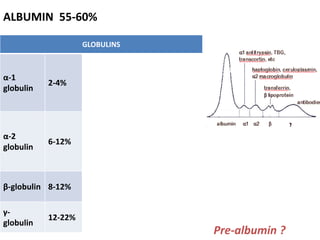
GLOBULINS
α-1
globulin
2-4%
α-1 antitrypsin, α-1 acid
glycoprotein, Thyroid Binding
Globulin (TBG), Transcortin,
HDL
α-2
globulin
6-12%
Haptoglobin, Ceruloplasmin,
α2 -macroglobulin
β-globulin 8-12%
β1Transferrin, LDL
β2  β2 microglobulin
γ-
globulin
12-22% Immunoglobulins
ALBUMIN 55-60%
Pre-albumin ?
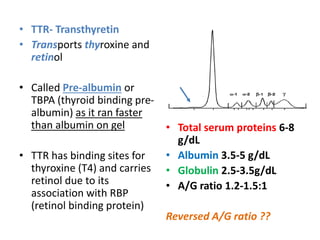
• TTR- Transthyretin
• Transports thyroxine and
retinol
• Called Pre-albumin or
TBPA (thyroid binding pre-
albumin) as it ran faster
than albumin on gel
• TTR has binding sites for
thyroxine (T4) and carries
retinol due to its
association with RBP
(retinol binding protein)
• Total serum proteins 6-8
g/dL
• Albumin 3.5-5 g/dL
• Globulin 2.5-3.5g/dL
• A/G ratio 1.2-1.5:1
Reversed A/G ratio ??
• Most plasma proteins are synthesised in liver
Exception: Immunoglobulins (plasma cells), factor III
(endothelium), vWF & VIII (platelets & endothelium)
• Most plasma proteins are glycoproteins except albumin
• Each plasma protein has a characteristic half life in
circulation
IgA
CRP
ALBUMIN
• Major plasma protein (60%)
• 69kDa
• 3.5-5 g/dL
• Synthesized by liver
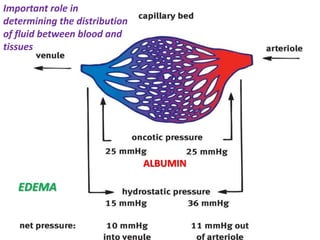
• Chief component responsible for the osmotic
pressure of human plasma
ALBUMIN
EDEMA
Important role in
determining the distribution
of fluid between blood and
tissues
Serves as low specificity transport
protein
It can bind and transport many diverse molecules.
Various ligands which bind albumin :
– Metal ion: such as calcium
– Free fatty acid: Albumin binds to free fatty acid released by
adipose tissue and facilitates their transfer to other tissue.
– Unconjugated bilirubin
– Hormones: steroid hormones
– Certain drugs: Sulphonamides, Penicillin G, Dicoumarol, Aspirin
• Nutritional function
• Therapeutic uses
↓ Albumin levels
(hypoalbuminemia)
• Liver diseases
• Malnutrition
• Nephrotic syndrome
• Protein losing
enteropathies
ACUTE PHASE PROTEINS
• There are certain proteins in plasma which play role in body’s
response to inflammation
• Their levels in blood changes in various Inflammatory states or
secondary to certain type of tissue damage or in some cancers.
POSITIVE ACUTE PHASE PROTEINS: levels are increased
C-Reactive Protein (CRP) can stimulate classic complement
pathway
Fibrinogen promotes endothelial repair, pro-coagulation state
Alpha-1 Antitrypsin (AAT) neutralises certain proteases
released during acute inflammatory states
Alpha-2 Macroglobulin (AMG)  Pan protease inhibitor
Ceruloplasmin, hepcidin, ferritin
Procalcitonin
One of the widely used clinical measures of
acute inflammation are CRP & ESR
Procalcitonin has been proposed as a sensitive marker
for sepsis & pneumonia and can be used to guide
antibiotic treatment
Rationale:
• Normally procalcitonin is produced by 
Parafollicular (C) cells of thyroid
glandconverted into calcitonin & released
• During inflammations medaitors activate
procalcitonin gene in other tissues like liver,
kidney, adipocytes, pancreas, colon etc
directly released in circulation
• PCT levels >0.25μg/L  correlate with
bacterial infections
• After 2-3 days of treatment PCT levels can
facilitate the decision to discontinue antibiotic
treatment
• PCT levels could be used as a guide for
antibiotic treatment
NEGATIVE ACUTE PHASE PROTEIN:
Levels decrease in inflammatory states
e.g. Albumin, Transferrin, Antithrombin
C-Reactive Protein
• Synthesised in Liver
• Has a role in stimulating complement activity
and macrophage phagocytosis
• So named because it reacts with C-
polysaccharide of capsule of pneumococci.
• When inflammation subsides, the levels of CRP
quickly fall
• Has a positive correlation in predicting the risk
of coronary artery diseases.
α1–Antitrypsin/ AAT/
α- anti-proteinase
• Inhibits serine proteases like trypsin, elastase
(enzymes having a serine at their active sites)
SERPINS (serine protease inhibitors )
• Synthesised from liver
• Major component of α1 fraction of human
plasma
• Deficiency of AAT
Emphysema
Infections/pneumonia
↑neutrophils
Infections/pneumonia
↑neutrophils
AAT deficiency
• Different mutations are known to cause the AAT
deficiency
• Most common being: GAGAAG (single purine base
mutation)
Substitution of lysineGlutamic acid at position 342
Polymerisation of the mutated protein in ER of the
hepatocytes ↓ secretion of AAT from liver
(cirrhosis of liver may also occur)
Emphysema
AAT deficiency and smokers
• A particular Methionine residue (at position
358) of α1 antitrypsin is involved in its
binding to proteases
• Smoking oxidizes this methionine and thus
inactivates it
• Unable to neutralize proteases
• Emphysema becomes inevitable in smokers
Ceruloplasmin
• α2- globulin synthesized in liver
• Carries 90% of the copper present in plasma; Rest
10% of binds to Albumin
• Copper dependent oxidase activity
(oxidation of Fe2+ to Fe3+ in transferrin)
Acts as important anti-oxidant
• ↓Ceruloplasmin : liver disases especially
WILSON’S DISEASE
• ↑ceruloplasmin : inflammatory conditions.
TRANSPORT PROTEINS
PLASMA PROTEIN COMPOUNDS TRANSPORTED
Albumin
Fatty acids, Calcium, Drugs,
Unconjugated Bilirubin
Pre-Albumin
(Transthyretin)
Thyroxine, Retinol, Steroid
hormones
Retinol binding protein (RBP) Retinol
Thyroxine binding globulin (TBG) Thyroxine
Transcortin; cortisol binding
globulin (CBG)
Cortisol
Haptoglobin Hemoglobin
Transferrin Iron
Hemopexin Free heme
HAPTOGLOBIN
• Glycoprotein
• Binds extra-corpuscular Hb  Hp-Hb complex
• Prevents free Hb to pass through glomerulus
(conserves Iron)
↓Hp seen in haemolyitc anemias
Half life of Hp=5days, but half-life of Hb-Hp
complex is 90 min
(Hb-Hp complex rapidly cleared from plasma by
hepatocytes)
• Fresh Frozen Plasma (FFP):
(shock due to massive haemorrhage, burns, liver
diseases – coagulants found in plasma aid in
decreasing bleeding time & stabilise the patient)
Plasma Protein derivative (PPD):
1. Factor VIII concentrate- in specific clotting
factor deficiency
2. Albumin infusion- peritonitis, nephrotic
syndrome
3. Immunoglobulins (IvIG)- In primary or
secondary immune deficiency states.
4. Hyperimmune plasma- Hyper-immune plasma is
collected from donors:
who have been actively immunized with specific
antigens such as rabies, tetanus, hepatitis B
Or
Can also be obtained from donors with naturally
occurring antibodies such as cytomegalovirus
(CMV), varicella (VZV), hepatitis A.
For the prevention in the persons who are not
vaccinated, if vaccination is not possible, or in
whom the vaccination has not resulted in a
sufficient protective antibody plasma level.
5. Platelet Rich Plasma (PRP):
Autologous blood with platelet concentrate
being used in sports injuries and derma/hair
procedures
Plasmapherseis
Thank you

plasma proteins, classification and functions.pptx

  • 1.
  • 2.
    Objectives: • To knowthe classification and functions of plasma proteins • An overview of their clinical significance in health and diseases • To discuss the therapeutic uses of plasma and its components
  • 3.
    • Water (89%) •Electrolytes • Metabolites • Hormones • Proteins (6%) Simple proteins Glycoproteins Lipoproteins Immunoglobulins Plasma vs serum ?
  • 4.
  • 5.
    GLOBULINS α-1 globulin 2-4% α-1 antitrypsin, α-1acid glycoprotein, Thyroid Binding Globulin (TBG), Transcortin, HDL α-2 globulin 6-12% Haptoglobin, Ceruloplasmin, α2 -macroglobulin β-globulin 8-12% β1Transferrin, LDL β2  β2 microglobulin γ- globulin 12-22% Immunoglobulins ALBUMIN 55-60% Pre-albumin ?
  • 6.
    • TTR- Transthyretin •Transports thyroxine and retinol • Called Pre-albumin or TBPA (thyroid binding pre- albumin) as it ran faster than albumin on gel • TTR has binding sites for thyroxine (T4) and carries retinol due to its association with RBP (retinol binding protein) • Total serum proteins 6-8 g/dL • Albumin 3.5-5 g/dL • Globulin 2.5-3.5g/dL • A/G ratio 1.2-1.5:1 Reversed A/G ratio ??
  • 7.
    • Most plasmaproteins are synthesised in liver Exception: Immunoglobulins (plasma cells), factor III (endothelium), vWF & VIII (platelets & endothelium) • Most plasma proteins are glycoproteins except albumin • Each plasma protein has a characteristic half life in circulation IgA CRP
  • 8.
    ALBUMIN • Major plasmaprotein (60%) • 69kDa • 3.5-5 g/dL • Synthesized by liver • Chief component responsible for the osmotic pressure of human plasma
  • 9.
    ALBUMIN EDEMA Important role in determiningthe distribution of fluid between blood and tissues
  • 10.
    Serves as lowspecificity transport protein It can bind and transport many diverse molecules. Various ligands which bind albumin : – Metal ion: such as calcium – Free fatty acid: Albumin binds to free fatty acid released by adipose tissue and facilitates their transfer to other tissue. – Unconjugated bilirubin – Hormones: steroid hormones – Certain drugs: Sulphonamides, Penicillin G, Dicoumarol, Aspirin
  • 11.
    • Nutritional function •Therapeutic uses ↓ Albumin levels (hypoalbuminemia) • Liver diseases • Malnutrition • Nephrotic syndrome • Protein losing enteropathies
  • 12.
    ACUTE PHASE PROTEINS •There are certain proteins in plasma which play role in body’s response to inflammation • Their levels in blood changes in various Inflammatory states or secondary to certain type of tissue damage or in some cancers. POSITIVE ACUTE PHASE PROTEINS: levels are increased C-Reactive Protein (CRP) can stimulate classic complement pathway Fibrinogen promotes endothelial repair, pro-coagulation state Alpha-1 Antitrypsin (AAT) neutralises certain proteases released during acute inflammatory states Alpha-2 Macroglobulin (AMG)  Pan protease inhibitor Ceruloplasmin, hepcidin, ferritin Procalcitonin
  • 13.
    One of thewidely used clinical measures of acute inflammation are CRP & ESR
  • 15.
    Procalcitonin has beenproposed as a sensitive marker for sepsis & pneumonia and can be used to guide antibiotic treatment Rationale: • Normally procalcitonin is produced by  Parafollicular (C) cells of thyroid glandconverted into calcitonin & released • During inflammations medaitors activate procalcitonin gene in other tissues like liver, kidney, adipocytes, pancreas, colon etc directly released in circulation
  • 16.
    • PCT levels>0.25μg/L  correlate with bacterial infections • After 2-3 days of treatment PCT levels can facilitate the decision to discontinue antibiotic treatment • PCT levels could be used as a guide for antibiotic treatment
  • 17.
    NEGATIVE ACUTE PHASEPROTEIN: Levels decrease in inflammatory states e.g. Albumin, Transferrin, Antithrombin
  • 18.
    C-Reactive Protein • Synthesisedin Liver • Has a role in stimulating complement activity and macrophage phagocytosis • So named because it reacts with C- polysaccharide of capsule of pneumococci. • When inflammation subsides, the levels of CRP quickly fall
  • 19.
    • Has apositive correlation in predicting the risk of coronary artery diseases.
  • 20.
    α1–Antitrypsin/ AAT/ α- anti-proteinase •Inhibits serine proteases like trypsin, elastase (enzymes having a serine at their active sites) SERPINS (serine protease inhibitors ) • Synthesised from liver • Major component of α1 fraction of human plasma • Deficiency of AAT Emphysema
  • 21.
  • 22.
    AAT deficiency • Differentmutations are known to cause the AAT deficiency • Most common being: GAGAAG (single purine base mutation) Substitution of lysineGlutamic acid at position 342 Polymerisation of the mutated protein in ER of the hepatocytes ↓ secretion of AAT from liver (cirrhosis of liver may also occur) Emphysema
  • 23.
    AAT deficiency andsmokers • A particular Methionine residue (at position 358) of α1 antitrypsin is involved in its binding to proteases • Smoking oxidizes this methionine and thus inactivates it • Unable to neutralize proteases • Emphysema becomes inevitable in smokers
  • 24.
    Ceruloplasmin • α2- globulinsynthesized in liver • Carries 90% of the copper present in plasma; Rest 10% of binds to Albumin • Copper dependent oxidase activity (oxidation of Fe2+ to Fe3+ in transferrin) Acts as important anti-oxidant • ↓Ceruloplasmin : liver disases especially WILSON’S DISEASE • ↑ceruloplasmin : inflammatory conditions.
  • 25.
    TRANSPORT PROTEINS PLASMA PROTEINCOMPOUNDS TRANSPORTED Albumin Fatty acids, Calcium, Drugs, Unconjugated Bilirubin Pre-Albumin (Transthyretin) Thyroxine, Retinol, Steroid hormones Retinol binding protein (RBP) Retinol Thyroxine binding globulin (TBG) Thyroxine Transcortin; cortisol binding globulin (CBG) Cortisol Haptoglobin Hemoglobin Transferrin Iron Hemopexin Free heme
  • 26.
    HAPTOGLOBIN • Glycoprotein • Bindsextra-corpuscular Hb  Hp-Hb complex • Prevents free Hb to pass through glomerulus (conserves Iron) ↓Hp seen in haemolyitc anemias Half life of Hp=5days, but half-life of Hb-Hp complex is 90 min (Hb-Hp complex rapidly cleared from plasma by hepatocytes)
  • 28.
    • Fresh FrozenPlasma (FFP): (shock due to massive haemorrhage, burns, liver diseases – coagulants found in plasma aid in decreasing bleeding time & stabilise the patient) Plasma Protein derivative (PPD): 1. Factor VIII concentrate- in specific clotting factor deficiency 2. Albumin infusion- peritonitis, nephrotic syndrome 3. Immunoglobulins (IvIG)- In primary or secondary immune deficiency states.
  • 29.
    4. Hyperimmune plasma-Hyper-immune plasma is collected from donors: who have been actively immunized with specific antigens such as rabies, tetanus, hepatitis B Or Can also be obtained from donors with naturally occurring antibodies such as cytomegalovirus (CMV), varicella (VZV), hepatitis A. For the prevention in the persons who are not vaccinated, if vaccination is not possible, or in whom the vaccination has not resulted in a sufficient protective antibody plasma level.
  • 30.
    5. Platelet RichPlasma (PRP): Autologous blood with platelet concentrate being used in sports injuries and derma/hair procedures
  • 31.
  • 33.

Editor's Notes

  • #4 There are about 2000-3000 plasma proteins whose conc. Range from ng/ml to mg/ml.
  • #5 Densitometry gives quantitation of electrophoresed proteins
  • #6 AAT is neutrophil elastase inhibitor, AAG is also called orosomucoid and transports progesterone and many drugs
  • #8 Different ½ lives and different synthesis rates. E.g. t1/2 for albumin is 21 days; TTR is 2 days; RBP is 12 hr : SO THEY reflect changes in nutritional status more quickly than others.
  • #14 ESR measures the distance that RBCs in the anti-coagulated blood fall in a vertical tube after 1hr. FIBRINOGEN decreases the charge on RBCs surfaces and therefore they aggregate fast
  • #18 Albumin is negative APP because its production is decreased to conserve aa for building increased positive APP Transferrin is negative APP because macrophages internalise TfR to sequester Fe
  • #19 Has opsonisation role; rises in 4-6 hrs and peaks in 36-50 hrs
  • #30 Hemopexin binds heme ; free Hb ia an oxidising agent and may cause free radical damage; bacterias can utilise iron from heme