Crossing the Tracks: 
The Academic Library as Social 
Justice Advocate 
A partnership of the Freeman Round House 
Museum of African American History, the Barton 
College History Department, and Hackney Library
“The mission of librarians is to 
improve society through 
facilitating knowledge creation 
in their communities.” 
R. David Lankes, The Atlas of New Librarianship. 
Cambridge: MIT Press, 2011.
Freeman Round House Museum of 
African American History 
Mission: To highlight, 
preserve, promote and 
present African 
American contributions 
to the development of 
East Wilson, Wilson, 
Wilson County and the 
surrounding area over 
the past 150 years.
“Preservation of Wilson... 
...provides leadership in the revitalization 
of Wilson County’s unique architectural 
heritage. As stewards of Wilson County’s 
historic buildings, we actively promote 
historic, architectural, and culturally 
significant properties….” 
from PoW Mission Statement (http://www.preservationofwilson.com/)
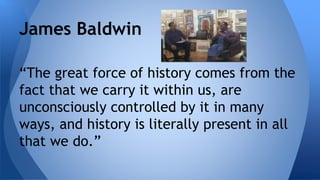
James Baldwin 
“The great force of history comes from the 
fact that we carry it within us, are 
unconsciously controlled by it in many 
ways, and history is literally present in all 
that we do.”
“Preservation of Wilson... 
...provides leadership in the revitalization 
of Wilson County’s unique architectural 
heritage. As stewards of Wilson County’s 
historic buildings, we actively promote 
historic, architectural, and culturally 
significant properties….” 
from PoW Mission Statement (http://www.preservationofwilson.com/)
Service Learning, Community Based 
Research, Participatory Action Research 
Service Learning requires a collaboration between the college and one or more communities. 
Projects meet community-defined needs. It may be integrated into the academic curriculum (course-based, 
credit bearing) or may be implemented as a co-curricular activity. 
Community Based Research (CBR) is a methodology that can be used in service learning. CBR is 
designed to identify and solve community-defined problems through a partnership between community 
members and college researchers. Unlike traditional research, which is completed at the conclusion of 
the project, CBR makes a lasting contribution to the community. 
Participatory Action Research (PAR) is a form of CBR that seeks to empower and emancipate 
community groups which are struggling to improve their social, political, and economic situations.
Barton College First Year Seminar 
“Exploring and confronting the roots and 
legacy of white supremacy.” 
Community Forums at St. John AME Zion 
Church organized by Mr. Louis Thomas 
Ms. Deloris Thomas
Crossing the Tracks: Round House Museum, 
Hackney Library, BC History Department 
• work 5 hours per week at the Oliver Nestus Freeman Round House Museum 
of African American History in Wilson 
• spend 2-3 hours per week on background reading, research, writing one-page 
reports, and discussing this intellectual work with the library director 
(this work will be done in the library, as part of the student’s regular duties). 
The topics will be oral history techniques, AV archiving techniques, and some 
general research on the socioeconomic history of East Wilson. These reports 
will be posted on the project’s libguide (library-linked website)
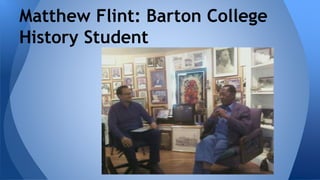
Matthew Flint: Barton College 
History Student
What we asked...the schools 
● Which neighborhood(s) did you grow up in? 
● How has the neighborhood changed over the years? 
● How have the changes affected the community? 
● Where did you go to school? 
● What was the school like? 
● Did you get a good education there? 
● Did you get support from the teachers and 
administrators? 
● Were the parents involved with the school? 
● Who was your favorite teacher? Why? 
● Who was the principal? What do you remember about 
him?
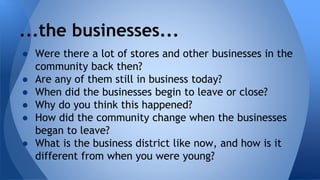
...the businesses... 
● Were there a lot of stores and other businesses in the 
community back then? 
● Are any of them still in business today? 
● When did the businesses begin to leave or close? 
● Why do you think this happened? 
● How did the community change when the businesses 
began to leave? 
● What is the business district like now, and how is it 
different from when you were young?
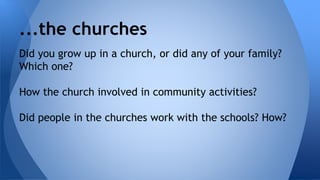
...the churches 
Did you grow up in a church, or did any of your family? 
Which one? 
How the church involved in community activities? 
Did people in the churches work with the schools? How?
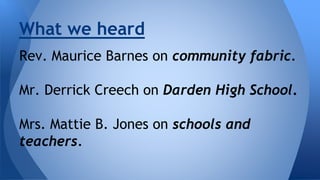
What we heard 
Rev. Maurice Barnes on community fabric. 
Mr. Derrick Creech on Darden High School. 
Mrs. Mattie B. Jones on schools and 
teachers.
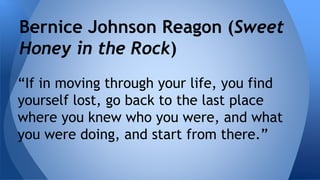
Bernice Johnson Reagon (Sweet 
Honey in the Rock) 
“If in moving through your life, you find 
yourself lost, go back to the last place 
where you knew who you were, and what 
you were doing, and start from there.”
“It takes a whole community and there needs to be a cooperative spirit,” [Bill] Myers said. “I don’t think 
you’ve done anything when you leave one section of the community out of history and not tell their 
contributions. We do better when we work together.” The Wilson Times, 2/18/14, 1A.
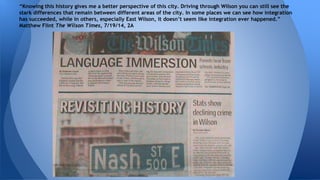
“Knowing this history gives me a better perspective of this city. Driving through Wilson you can still see the 
stark differences that remain between different areas of the city. In some places we can see how integration 
has succeeded, while in others, especially East Wilson, it doesn’t seem like integration ever happened.” 
Matthew Flint The Wilson Times, 7/19/14, 2A
Crossing the Tracks: The Academic Library as 
Social Justice Advocate 
http://barton.libguides.com/crossingthetracks 
George W. Loveland 
Associate Professor of Library Science 
Director of Hackney Library 
gwloveland@barton.edu 
252-399-6501

Crossing the Tracks: the Academic Library as Social Justice Advocate

  • 1.
    Crossing the Tracks: The Academic Library as Social Justice Advocate A partnership of the Freeman Round House Museum of African American History, the Barton College History Department, and Hackney Library
  • 2.
    “The mission oflibrarians is to improve society through facilitating knowledge creation in their communities.” R. David Lankes, The Atlas of New Librarianship. Cambridge: MIT Press, 2011.
  • 3.
    Freeman Round HouseMuseum of African American History Mission: To highlight, preserve, promote and present African American contributions to the development of East Wilson, Wilson, Wilson County and the surrounding area over the past 150 years.
  • 4.
    “Preservation of Wilson... ...provides leadership in the revitalization of Wilson County’s unique architectural heritage. As stewards of Wilson County’s historic buildings, we actively promote historic, architectural, and culturally significant properties….” from PoW Mission Statement (http://www.preservationofwilson.com/)
  • 5.
    James Baldwin “Thegreat force of history comes from the fact that we carry it within us, are unconsciously controlled by it in many ways, and history is literally present in all that we do.”
  • 6.
    “Preservation of Wilson... ...provides leadership in the revitalization of Wilson County’s unique architectural heritage. As stewards of Wilson County’s historic buildings, we actively promote historic, architectural, and culturally significant properties….” from PoW Mission Statement (http://www.preservationofwilson.com/)
  • 7.
    Service Learning, CommunityBased Research, Participatory Action Research Service Learning requires a collaboration between the college and one or more communities. Projects meet community-defined needs. It may be integrated into the academic curriculum (course-based, credit bearing) or may be implemented as a co-curricular activity. Community Based Research (CBR) is a methodology that can be used in service learning. CBR is designed to identify and solve community-defined problems through a partnership between community members and college researchers. Unlike traditional research, which is completed at the conclusion of the project, CBR makes a lasting contribution to the community. Participatory Action Research (PAR) is a form of CBR that seeks to empower and emancipate community groups which are struggling to improve their social, political, and economic situations.
  • 8.
    Barton College FirstYear Seminar “Exploring and confronting the roots and legacy of white supremacy.” Community Forums at St. John AME Zion Church organized by Mr. Louis Thomas Ms. Deloris Thomas
  • 9.
    Crossing the Tracks:Round House Museum, Hackney Library, BC History Department • work 5 hours per week at the Oliver Nestus Freeman Round House Museum of African American History in Wilson • spend 2-3 hours per week on background reading, research, writing one-page reports, and discussing this intellectual work with the library director (this work will be done in the library, as part of the student’s regular duties). The topics will be oral history techniques, AV archiving techniques, and some general research on the socioeconomic history of East Wilson. These reports will be posted on the project’s libguide (library-linked website)
  • 10.
    Matthew Flint: BartonCollege History Student
  • 11.
    What we asked...theschools ● Which neighborhood(s) did you grow up in? ● How has the neighborhood changed over the years? ● How have the changes affected the community? ● Where did you go to school? ● What was the school like? ● Did you get a good education there? ● Did you get support from the teachers and administrators? ● Were the parents involved with the school? ● Who was your favorite teacher? Why? ● Who was the principal? What do you remember about him?
  • 12.
    ...the businesses... ●Were there a lot of stores and other businesses in the community back then? ● Are any of them still in business today? ● When did the businesses begin to leave or close? ● Why do you think this happened? ● How did the community change when the businesses began to leave? ● What is the business district like now, and how is it different from when you were young?
  • 13.
    ...the churches Didyou grow up in a church, or did any of your family? Which one? How the church involved in community activities? Did people in the churches work with the schools? How?
  • 14.
    What we heard Rev. Maurice Barnes on community fabric. Mr. Derrick Creech on Darden High School. Mrs. Mattie B. Jones on schools and teachers.
  • 15.
    Bernice Johnson Reagon(Sweet Honey in the Rock) “If in moving through your life, you find yourself lost, go back to the last place where you knew who you were, and what you were doing, and start from there.”
  • 16.
    “It takes awhole community and there needs to be a cooperative spirit,” [Bill] Myers said. “I don’t think you’ve done anything when you leave one section of the community out of history and not tell their contributions. We do better when we work together.” The Wilson Times, 2/18/14, 1A.
  • 17.
    “Knowing this historygives me a better perspective of this city. Driving through Wilson you can still see the stark differences that remain between different areas of the city. In some places we can see how integration has succeeded, while in others, especially East Wilson, it doesn’t seem like integration ever happened.” Matthew Flint The Wilson Times, 7/19/14, 2A
  • 18.
    Crossing the Tracks:The Academic Library as Social Justice Advocate http://barton.libguides.com/crossingthetracks George W. Loveland Associate Professor of Library Science Director of Hackney Library gwloveland@barton.edu 252-399-6501