Project Plan
Revision History
Date Version Authors Explanation of Change
1/30/13 1 Derrick Jicha & Bethany Bowles Plan Created
2/5/13 2 Derrick Jicha & Bethany Bowles Revised based on new
information and
feedback
Contact Information
Prepared By: Bethany Bowles Derrick Jicha
Organization: University of Central Florida University of Central Florida
Location: Orlando, FL Melbourne, FL
Email Address: bethanybowles@gmail.com Derrick.Jicha@att.net
Phone Number: 321-213-2752 407-913-6189
Approved By:
Dr. Rosalind Beiler Date
Director of Public History
Information Development Plan - 1 -
Project Overview
This Information Development Plan is intended to outline the below-unfolding project the team has
agreed to work on for the client, Rosalind J. Beiler, the Director of Public History at UCF. The project
itself contains a multitude of documentation: a summary report, a brochure, and a style guide for
the Public History Center.
The Department of History at UCF is seeking to expand its Public History program by incorporating
new media, new management of cultural heritage, and new venues to reach students and the public
populace. Public History, as a field of academia, seeks to introduce and connect the general public
with the past, via stimulating questions and experiences that encourage further forays into the field.
In and of itself, Public History, as stated on the History Department’s webpage, “reframes questions,
theories, and methods in the hope of presenting an "active" story that is enjoyable, refreshing and
palatable to the larger audience. In reality, the study of public history is revolutionary because it
explores and creates new avenues to non-historians.”
With this mission statement and desire in mind, beginning in July 2012, UCF began renovations on
the Student Museum to transform it into its newest Public History event, the Public History Center
(PHC). The Romanesque revival style brick building, built in 1902, was once a public school for the
City of Sanford, and served as a focal point for public history in Sanford. As stated on the PHC
website, after its renovations, “UCF will enhance the current programming offered with the
addition of new media such as virtual exhibits, artifact databases, and podcasts. UCF students will
preserve and interpret the past at this site, using emerging audio, video, and digital technologies to
create engaging, interactive exhibits and programming. The UCF Public History Center will foster a
closer connection between the community and the university’s innovative research projects,
encouraging greater public engagement with this region’s history.”
Since the project’s beginnings back in 2012, there has been much ado about it proving itself to be a
worthwhile investment for both UCF and Seminole County. Among the university alone, several UCF
classes, interns, and students within a variety of fields, both graduate and undergraduate, have
been working on projects that focus on the PHC. This project, entrusted to the team by Dr. Beiler, is
a summary report that details all the accomplishments that have been undertaken by the PHC, and
a two-fold documentation, consisting of an informational brochure and a style guide.
The summary report will be written to Provost Waldrop and Dean Fernandez of UCF faculty, and
members of the Seminole County Academic Board, encouraging them to continue funding and
renovating the Public History Center. This report will include several categories of such
accomplishments: Educational Programming (including K-12 level and University level
programming), Community Programming & Events, Collections & Exhibits, Finance &
Administrations (including grants applied for and present budgets) and Research. The two-fold
documentation, including a brochure and a style guide, will be created and adapted to generate
knowledge of and interest in the Public History Center, encouraging further development of the
building project.
Information Development Plan - 2 -
Project Vision and Goals
The vision of this project is to help formulate the progress of the PHC, thus furthering the PHC
vision itself. The PHC seeks to foster 1) exploration within the field of public history by conducting
ground-breaking research that connects local people and events to global, 2) innovation within the
field of public history by providing cutting-edge hands-on educational programs for students, and
3) collaboration within the field of public history by engaging the community in contributing to the
growth of and learning from history. By showing the audience the progress and achievements
undertaken by the Public History Center, further funding and interest can be generated to assist
with the development of the project.
The goal of each piece of documentation in this project is different. The summary report will be
written to Provost Waldrop and Dean Fernandez of UCF faculty, and members of the Seminole
County Academic board, outlining the accomplishments seen at the Public History Center. This
report will include several categories of such accomplishments: Educational Programming
(including K-12 level and University level programming), Community Programming & Events,
Collections & Exhibits, Finance & Administrations (including grants applied for and present
budgets) and Research. The primary goal will be to show the effectiveness of the PHC as both an
academic learning center and a community research center and encourage the granting of
additional aid in finances, workers, and time from college, county, community, and even state.
Both the informational brochure and the style guide encompass the goal of creating more
awareness of the Public History Center, and thus more involvement and knowledge by the
academic community and the local community. With more awareness from and participation by
these communities within the PHC comes more revenue and accomplishments for the project. This
goal seeks to begin the expansion of the future and scope of the Public History Center.
Project Scope
The scope of the project is fairly limited. The project itself consists of three documents, capable of
being produced in physical and digital mediums: a summary report, an informational brochure, and
a style guide.
The summary report’s length is subject to change, given the data that will be contained within, but
will contain a categorized, persuasive summary of all information given to the team. It will be
presented to the client by March 1, 2013. The summary report has a potentially fairly short active
shelf life. Once the summary report is read and considered, thus serving its purpose, it will likely be
relegated to a file for future reference. It is highly probably that the summary report will be revised
within a year as a new summary report.
The brochure will be a tri-fold, colored, front-and-back format and will contain summarized,
important information regarding the Public History Center. There will be slight leeway permissible
for the client to change information and style during the creation process. This document will be
presented to the client by the middle of April. The brochure also has a potentially fairly short active
shelf life. While it will be widely used to spread information and awareness of the Public History
Center throughout the academic and local community, such documentations frequently run the
chance of being revised and redesigned as circumstances change.
Information Development Plan - 3 -
The style guide will be approximately 90 pages. There will be slight leeway permissible for the
client to change information and style during the creation process. The document will be presented
to the client by the middle of April. The style guide will have a reasonably long shelf life. It will be
widely used by students and visitors of both the academic and local community. There is a
possibility that a new, revised style guide will be created within approximately two years. Older
style guides can be kept for future research.
Project Budget
As the project will be done on home computers, with all foreseeable communications, drafts, and
publications between client and team taking place in cyberspace, it is safe to assume that a budget
for this project will not factor in. Once the project’s final phase is delivered to the client, the cost of
any physical publication will fall on the client at the client’s discretion.
Project Resource Requirements
For the summary report, the team will require access to documentations that provide information
regarding the accomplishments made by the Public History Center. These documents include
community events hosted at the PHC, class fieldtrips taken to the PHC, academic uses of the PHC
and its resources by students, finances spent and gained via the PHC, budget statistics, and other
necessary information that will give the team the ability to summarize the accomplishments of the
PHC and categorize them into the categories listed above. These documents, as agreed upon, will
come from Dr. Beiler, whereupon the team will categorize and sort the information within.
Both information brochure and style guide will require the originals of both documentation and any
additional, necessary information to help the team revise and restock the information found within.
This information includes history of the Public History Center, related academic and community
events, and more. There is a possibility that the team may also require access to some data about
UCF’s current circumstances involving time and money used and set aside for the project. Any
information in this venue will come from Dr. Beiler if able. Most importantly, the team will need to
be able to contact Dr. Beiler with understandable frequency in order to gauge progress in the
project.
Project Audience Analysis
The audience of the summary report is currently composed of Rosalind J. Beiler, the Director of
Public History at UCF, Tony Waldrop, provost and executive vice president of UCF, José Fernandez,
Dean of the College of Arts and Humanities, and a collection of members from the Seminole County
Academic Board. There is a high probability of the audience increasing the further the document
reaches up the chain of command. The audience will primarily be concerned with reviewing the
summary report as a means of learning about the accomplishments of the Public History Center and
thus deciding whether or not to continue supporting the PHC project. Because of the purpose of the
project, the audience expects to be swayed to make a decision.
The summary report will be required to make a point and will be written with a persuasive lighting
in order to encourage the audience to view the Public History Center as a worthwhile and
Information Development Plan - 4 -
important endeavor to continue funding, building, and progressing. Thus, the documentation needs
to be clear and concise, to both deliver the point with no ambiguity and be efficient in fitting in with
the audience’s time schedules. Formality must be present within the documentation in order to
make it appealing to the audience, which has a great deal of sway in the future of the PHC project.
The audience is expected to be able to quickly and thoroughly digest the information and utilize it
in order to reach a decision. Further audience relations and changes can be made during the
creation of the summary report.
The audience of the informational brochure and the style guide will consist of mostly local academic
students and members of the local community, as these two documentations will be open to the
public. The audience will expect to be both drawn to the Public History Center and informed of its
importance and uses to them. For most audience members, the brochure will inform them of the
PHC and draw their interest to further exploration. The style guide will inform them of the various
procedures utilized within the Public History Center.
Because of this draw-and-inform purpose, these two documentations will require a user-friendly
style and layout. The writing will be clear, concise, and engaging, quickly and efficiently giving the
audience relevant information without confusion and creating interest in the offerings of the PHC.
The design layout will cater to the attention of the audience, using soft, complimenting colors to
entice the eye and a structured hierarchy and categorizing of the information in order to convey the
data efficiently. There is no expected change within the audience of the informational brochure and
style guide at any present time.
Project Usability Requirements
The usability requirement of the summary report is fairly simple. Given that the audience of the
summary report will be educated members of the scholastic board, basic reading and thinking
skills, as well as understanding of persuasive data, are required to absorb the documentation. The
information presented within the documentation will be used to help the audience determine if the
Public History Center is a project worthy of being continually supported. Thus the requirements of
the audience in order to use this document also include the ability to check past data with newly
presented data and enter discussion using the presented data as evidence in order to support a
decision.
The usability requirement of the informational brochure and style guide is similar, despite the
audience of these two documentations being far more varied. Basic reading skills and logical
understanding are required to access the information within the documents. The two documents
themselves requires at least a cursory browse to ascertain if the information within is valuable to
the audience member currently engaging it.
Depending on the medium the documentation is conveyed through, be it physical hardcopy or
digital electronic, the requirements for viewing the documentation will change as such. So long as
the three documentations are kept clear and concise and offer valuable, necessary information,
both of which can be guided and tested by Dr. Beiler, it is assumed there will be no problem with
usability issues for the final product.
Information Development Plan - 5 -
Project Quality
Since all three of these documents will be crucial for demonstrating the success and viability of the
Public History Center, all of the documentation must be Level 3 Quality. Level 3 documentation
should meet the highest standards. The survey report, informational brochure, and style guide will
be thoroughly reviewed and revised for accuracy, completeness, and effectiveness before being
delivered to the client.
Project Roles and Responsibilities
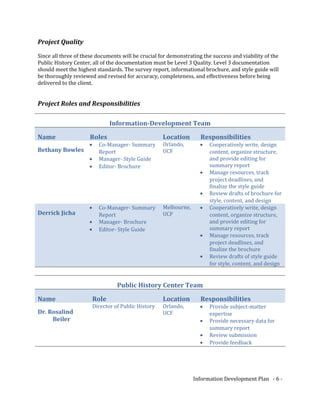
Information-Development Team
Name Roles Location Responsibilities
Bethany Bowles
• Co-Manager- Summary
Report
• Manager- Style Guide
• Editor- Brochure
Orlando,
UCF
• Cooperatively write, design
content, organize structure,
and provide editing for
summary report
• Manage resources, track
project deadlines, and
finalize the style guide
• Review drafts of brochure for
style, content, and design
Derrick Jicha
• Co-Manager- Summary
Report
• Manager- Brochure
• Editor- Style Guide
Melbourne,
UCF
• Cooperatively write, design
content, organize structure,
and provide editing for
summary report
• Manage resources, track
project deadlines, and
finalize the brochure
• Review drafts of style guide
for style, content, and design
Public History Center Team
Name Role Location Responsibilities
Dr. Rosalind
Beiler
Director of Public History Orlando,
UCF
• Provide subject-matter
expertise
• Provide necessary data for
summary report
• Review submission
• Provide feedback
Information Development Plan - 6 -
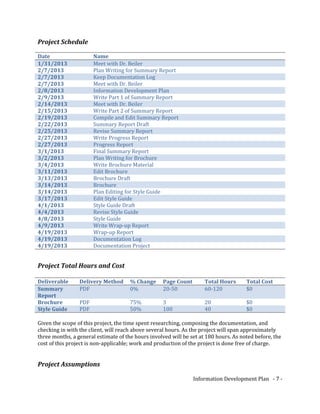
Project Schedule
Date Name
1/31/2013 Meet with Dr. Beiler
2/7/2013 Plan Writing for Summary Report
2/7/2013 Keep Documentation Log
2/7/2013 Meet with Dr. Beiler
2/8/2013 Information Development Plan
2/9/2013 Write Part 1 of Summary Report
2/14/2013 Meet with Dr. Beiler
2/15/2013 Write Part 2 of Summary Report
2/19/2013 Compile and Edit Summary Report
2/22/2013 Summary Report Draft
2/25/2013 Revise Summary Report
2/27/2013 Write Progress Report
2/27/2013 Progress Report
3/1/2013 Final Summary Report
3/2/2013 Plan Writing for Brochure
3/4/2013 Write Brochure Material
3/11/2013 Edit Brochure
3/13/2013 Brochure Draft
3/14/2013 Brochure
3/14/2013 Plan Editing for Style Guide
3/17/2013 Edit Style Guide
4/1/2013 Style Guide Draft
4/4/2013 Revise Style Guide
4/8/2013 Style Guide
4/9/2013 Write Wrap-up Report
4/19/2013 Wrap-up Report
4/19/2013 Documentation Log
4/19/2013 Documentation Project
Project Total Hours and Cost
Deliverable Delivery Method % Change Page Count Total Hours Total Cost
Summary
Report
PDF 0% 20-50 60-120 $0
Brochure PDF 75% 3 20 $0
Style Guide PDF 50% 100 40 $0
Given the scope of this project, the time spent researching, composing the documentation, and
checking in with the client, will reach above several hours. As the project will span approximately
three months, a general estimate of the hours involved will be set at 180 hours. As noted before, the
cost of this project is non-applicable; work and production of the project is done free of charge.
Project Assumptions
Information Development Plan - 7 -
For the purpose of this project plan, the team has made several assumptions:
1. Both team members will work together without conflict and will be able to complete their
respective duties without major interference from outside variables.
2. PHC documentation and information resources will be available for research, data-
gathering, and summarizing purposes.
3. With respect to time and travel, the project client, Dr. Beiler, or an appointed representative
will be able to meet regularly with the team to discuss project progress, including questions,
documentation review, schedule adjustments, etc…
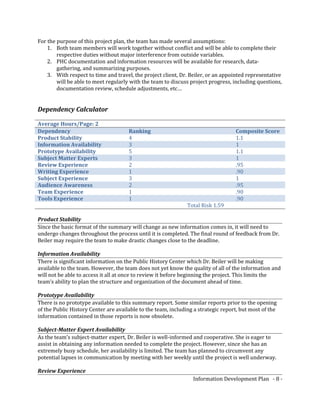
Dependency Calculator
Average Hours/Page: 2
Dependency Ranking Composite Score
Product Stability 4 1.1
Information Availability 3 1
Prototype Availability 5 1.1
Subject Matter Experts 3 1
Review Experience 2 .95
Writing Experience 1 .90
Subject Experience 3 1
Audience Awareness 2 .95
Team Experience 1 .90
Tools Experience 1 .90
Total Risk 1.59
Product Stability
Since the basic format of the summary will change as new information comes in, it will need to
undergo changes throughout the process until it is completed. The final round of feedback from Dr.
Beiler may require the team to make drastic changes close to the deadline.
Information Availability
There is significant information on the Public History Center which Dr. Beiler will be making
available to the team. However, the team does not yet know the quality of all of the information and
will not be able to access it all at once to review it before beginning the project. This limits the
team’s ability to plan the structure and organization of the document ahead of time.
Prototype Availability
There is no prototype available to this summary report. Some similar reports prior to the opening
of the Public History Center are available to the team, including a strategic report, but most of the
information contained in those reports is now obsolete.
Subject-Matter Expert Availability
As the team’s subject-matter expert, Dr. Beiler is well-informed and cooperative. She is eager to
assist in obtaining any information needed to complete the project. However, since she has an
extremely busy schedule, her availability is limited. The team has planned to circumvent any
potential lapses in communication by meeting with her weekly until the project is well underway.
Review Experience
Information Development Plan - 8 -
The team will be working together on this project and will have no difficulty completing the
scheduled reviews. There has been enough time built into the schedule to give Dr. Beiler an
opportunity to thoroughly review the documentation before submittal.
Subject Experience
While the team was unfamiliar with the Public History Center prior to working on this project,
significant time has been spent reviewing the background information Dr. Beiler has provided to
gain understanding and familiarity with the project.
Writing and Design Experience
As graduate students in technical communication, the team has significant experience with design
and writing. While this specific report is different from previous assignments and projects the team
has completed, the skills need to complete it are already within practiced possession.
Audience Understanding
Prior to the meeting with Dr. Beiler, the team was not certain of the audience for the report.
However, she has now provided a list of stakeholders and audience members to prepare the report
for.
Team Experience
Both members of this team have collaborated with fellow students on other group projects. While
each group dynamic is different, the commitment to the project and team’s mutual goals has formed
a bond between the team as teammates already.
Tools Experience
In order to accomplish the summary report, the team will only need to use Microsoft Word. While
the use of other publishing systems for the brochure may be required, the team is confident in its
possession of all the knowledge required to learn, adapt, and use any additional needed tools
effectively.
Project Risk Analysis
While there is no real physical risk within this project for either client or team, there is a heavy risk
to the Public History Center itself involved in the success of the summary report. As stated before,
the purpose of the summary report is to convince the audience, the Dean and Provost of UCF and
the Seminole County Academic Board, to continue supporting the Public History Center with
finances, manpower, time, and acknowledgement. The PHC’s efforts to become a self-sustaining
entity, recognized, supported, and utilized by both academic community and local community, have
ranged from great successes to potential disappointments. The team and client both desire to see
the continued support for the PHC by all factions associated with it (UCF, Seminole County,
academia, and local community). This summary report is a pivotal point in the life of the PHC, and
its success or failure will greatly affect the future of the Public History Center.
The PHC project runs the risk of being severely set back or even canceled should this summary
report fail to earn the support of the audience. However, the goal of the client and the team is to
prevent that risk from happening and to deliver to the audience a summary report that will earn
the Public History Center a new lease on life, continued support from all factions, and ensure a
strong future for the project.
Information Development Plan - 9 -
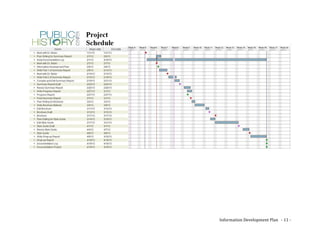
Since our project’s dependency calculation exceeds that average score of 1 by .59, we have included
a work plan that builds in extra time to recover from any setbacks. The Gantt chart below shows
our committed deadlines, our internal deadlines, and our assignments for the course in different
colors.
Information Development Plan - 10 -
Information Development Plan - 11 -

Information Development Plan Rough Draft 4

  • 1.
    Project Plan Revision History DateVersion Authors Explanation of Change 1/30/13 1 Derrick Jicha & Bethany Bowles Plan Created 2/5/13 2 Derrick Jicha & Bethany Bowles Revised based on new information and feedback Contact Information Prepared By: Bethany Bowles Derrick Jicha Organization: University of Central Florida University of Central Florida Location: Orlando, FL Melbourne, FL Email Address: bethanybowles@gmail.com Derrick.Jicha@att.net Phone Number: 321-213-2752 407-913-6189 Approved By: Dr. Rosalind Beiler Date Director of Public History Information Development Plan - 1 -
  • 2.
    Project Overview This InformationDevelopment Plan is intended to outline the below-unfolding project the team has agreed to work on for the client, Rosalind J. Beiler, the Director of Public History at UCF. The project itself contains a multitude of documentation: a summary report, a brochure, and a style guide for the Public History Center. The Department of History at UCF is seeking to expand its Public History program by incorporating new media, new management of cultural heritage, and new venues to reach students and the public populace. Public History, as a field of academia, seeks to introduce and connect the general public with the past, via stimulating questions and experiences that encourage further forays into the field. In and of itself, Public History, as stated on the History Department’s webpage, “reframes questions, theories, and methods in the hope of presenting an "active" story that is enjoyable, refreshing and palatable to the larger audience. In reality, the study of public history is revolutionary because it explores and creates new avenues to non-historians.” With this mission statement and desire in mind, beginning in July 2012, UCF began renovations on the Student Museum to transform it into its newest Public History event, the Public History Center (PHC). The Romanesque revival style brick building, built in 1902, was once a public school for the City of Sanford, and served as a focal point for public history in Sanford. As stated on the PHC website, after its renovations, “UCF will enhance the current programming offered with the addition of new media such as virtual exhibits, artifact databases, and podcasts. UCF students will preserve and interpret the past at this site, using emerging audio, video, and digital technologies to create engaging, interactive exhibits and programming. The UCF Public History Center will foster a closer connection between the community and the university’s innovative research projects, encouraging greater public engagement with this region’s history.” Since the project’s beginnings back in 2012, there has been much ado about it proving itself to be a worthwhile investment for both UCF and Seminole County. Among the university alone, several UCF classes, interns, and students within a variety of fields, both graduate and undergraduate, have been working on projects that focus on the PHC. This project, entrusted to the team by Dr. Beiler, is a summary report that details all the accomplishments that have been undertaken by the PHC, and a two-fold documentation, consisting of an informational brochure and a style guide. The summary report will be written to Provost Waldrop and Dean Fernandez of UCF faculty, and members of the Seminole County Academic Board, encouraging them to continue funding and renovating the Public History Center. This report will include several categories of such accomplishments: Educational Programming (including K-12 level and University level programming), Community Programming & Events, Collections & Exhibits, Finance & Administrations (including grants applied for and present budgets) and Research. The two-fold documentation, including a brochure and a style guide, will be created and adapted to generate knowledge of and interest in the Public History Center, encouraging further development of the building project. Information Development Plan - 2 -
  • 3.
    Project Vision andGoals The vision of this project is to help formulate the progress of the PHC, thus furthering the PHC vision itself. The PHC seeks to foster 1) exploration within the field of public history by conducting ground-breaking research that connects local people and events to global, 2) innovation within the field of public history by providing cutting-edge hands-on educational programs for students, and 3) collaboration within the field of public history by engaging the community in contributing to the growth of and learning from history. By showing the audience the progress and achievements undertaken by the Public History Center, further funding and interest can be generated to assist with the development of the project. The goal of each piece of documentation in this project is different. The summary report will be written to Provost Waldrop and Dean Fernandez of UCF faculty, and members of the Seminole County Academic board, outlining the accomplishments seen at the Public History Center. This report will include several categories of such accomplishments: Educational Programming (including K-12 level and University level programming), Community Programming & Events, Collections & Exhibits, Finance & Administrations (including grants applied for and present budgets) and Research. The primary goal will be to show the effectiveness of the PHC as both an academic learning center and a community research center and encourage the granting of additional aid in finances, workers, and time from college, county, community, and even state. Both the informational brochure and the style guide encompass the goal of creating more awareness of the Public History Center, and thus more involvement and knowledge by the academic community and the local community. With more awareness from and participation by these communities within the PHC comes more revenue and accomplishments for the project. This goal seeks to begin the expansion of the future and scope of the Public History Center. Project Scope The scope of the project is fairly limited. The project itself consists of three documents, capable of being produced in physical and digital mediums: a summary report, an informational brochure, and a style guide. The summary report’s length is subject to change, given the data that will be contained within, but will contain a categorized, persuasive summary of all information given to the team. It will be presented to the client by March 1, 2013. The summary report has a potentially fairly short active shelf life. Once the summary report is read and considered, thus serving its purpose, it will likely be relegated to a file for future reference. It is highly probably that the summary report will be revised within a year as a new summary report. The brochure will be a tri-fold, colored, front-and-back format and will contain summarized, important information regarding the Public History Center. There will be slight leeway permissible for the client to change information and style during the creation process. This document will be presented to the client by the middle of April. The brochure also has a potentially fairly short active shelf life. While it will be widely used to spread information and awareness of the Public History Center throughout the academic and local community, such documentations frequently run the chance of being revised and redesigned as circumstances change. Information Development Plan - 3 -
  • 4.
    The style guidewill be approximately 90 pages. There will be slight leeway permissible for the client to change information and style during the creation process. The document will be presented to the client by the middle of April. The style guide will have a reasonably long shelf life. It will be widely used by students and visitors of both the academic and local community. There is a possibility that a new, revised style guide will be created within approximately two years. Older style guides can be kept for future research. Project Budget As the project will be done on home computers, with all foreseeable communications, drafts, and publications between client and team taking place in cyberspace, it is safe to assume that a budget for this project will not factor in. Once the project’s final phase is delivered to the client, the cost of any physical publication will fall on the client at the client’s discretion. Project Resource Requirements For the summary report, the team will require access to documentations that provide information regarding the accomplishments made by the Public History Center. These documents include community events hosted at the PHC, class fieldtrips taken to the PHC, academic uses of the PHC and its resources by students, finances spent and gained via the PHC, budget statistics, and other necessary information that will give the team the ability to summarize the accomplishments of the PHC and categorize them into the categories listed above. These documents, as agreed upon, will come from Dr. Beiler, whereupon the team will categorize and sort the information within. Both information brochure and style guide will require the originals of both documentation and any additional, necessary information to help the team revise and restock the information found within. This information includes history of the Public History Center, related academic and community events, and more. There is a possibility that the team may also require access to some data about UCF’s current circumstances involving time and money used and set aside for the project. Any information in this venue will come from Dr. Beiler if able. Most importantly, the team will need to be able to contact Dr. Beiler with understandable frequency in order to gauge progress in the project. Project Audience Analysis The audience of the summary report is currently composed of Rosalind J. Beiler, the Director of Public History at UCF, Tony Waldrop, provost and executive vice president of UCF, José Fernandez, Dean of the College of Arts and Humanities, and a collection of members from the Seminole County Academic Board. There is a high probability of the audience increasing the further the document reaches up the chain of command. The audience will primarily be concerned with reviewing the summary report as a means of learning about the accomplishments of the Public History Center and thus deciding whether or not to continue supporting the PHC project. Because of the purpose of the project, the audience expects to be swayed to make a decision. The summary report will be required to make a point and will be written with a persuasive lighting in order to encourage the audience to view the Public History Center as a worthwhile and Information Development Plan - 4 -
  • 5.
    important endeavor tocontinue funding, building, and progressing. Thus, the documentation needs to be clear and concise, to both deliver the point with no ambiguity and be efficient in fitting in with the audience’s time schedules. Formality must be present within the documentation in order to make it appealing to the audience, which has a great deal of sway in the future of the PHC project. The audience is expected to be able to quickly and thoroughly digest the information and utilize it in order to reach a decision. Further audience relations and changes can be made during the creation of the summary report. The audience of the informational brochure and the style guide will consist of mostly local academic students and members of the local community, as these two documentations will be open to the public. The audience will expect to be both drawn to the Public History Center and informed of its importance and uses to them. For most audience members, the brochure will inform them of the PHC and draw their interest to further exploration. The style guide will inform them of the various procedures utilized within the Public History Center. Because of this draw-and-inform purpose, these two documentations will require a user-friendly style and layout. The writing will be clear, concise, and engaging, quickly and efficiently giving the audience relevant information without confusion and creating interest in the offerings of the PHC. The design layout will cater to the attention of the audience, using soft, complimenting colors to entice the eye and a structured hierarchy and categorizing of the information in order to convey the data efficiently. There is no expected change within the audience of the informational brochure and style guide at any present time. Project Usability Requirements The usability requirement of the summary report is fairly simple. Given that the audience of the summary report will be educated members of the scholastic board, basic reading and thinking skills, as well as understanding of persuasive data, are required to absorb the documentation. The information presented within the documentation will be used to help the audience determine if the Public History Center is a project worthy of being continually supported. Thus the requirements of the audience in order to use this document also include the ability to check past data with newly presented data and enter discussion using the presented data as evidence in order to support a decision. The usability requirement of the informational brochure and style guide is similar, despite the audience of these two documentations being far more varied. Basic reading skills and logical understanding are required to access the information within the documents. The two documents themselves requires at least a cursory browse to ascertain if the information within is valuable to the audience member currently engaging it. Depending on the medium the documentation is conveyed through, be it physical hardcopy or digital electronic, the requirements for viewing the documentation will change as such. So long as the three documentations are kept clear and concise and offer valuable, necessary information, both of which can be guided and tested by Dr. Beiler, it is assumed there will be no problem with usability issues for the final product. Information Development Plan - 5 -
  • 6.
    Project Quality Since allthree of these documents will be crucial for demonstrating the success and viability of the Public History Center, all of the documentation must be Level 3 Quality. Level 3 documentation should meet the highest standards. The survey report, informational brochure, and style guide will be thoroughly reviewed and revised for accuracy, completeness, and effectiveness before being delivered to the client. Project Roles and Responsibilities Information-Development Team Name Roles Location Responsibilities Bethany Bowles • Co-Manager- Summary Report • Manager- Style Guide • Editor- Brochure Orlando, UCF • Cooperatively write, design content, organize structure, and provide editing for summary report • Manage resources, track project deadlines, and finalize the style guide • Review drafts of brochure for style, content, and design Derrick Jicha • Co-Manager- Summary Report • Manager- Brochure • Editor- Style Guide Melbourne, UCF • Cooperatively write, design content, organize structure, and provide editing for summary report • Manage resources, track project deadlines, and finalize the brochure • Review drafts of style guide for style, content, and design Public History Center Team Name Role Location Responsibilities Dr. Rosalind Beiler Director of Public History Orlando, UCF • Provide subject-matter expertise • Provide necessary data for summary report • Review submission • Provide feedback Information Development Plan - 6 -
  • 7.
    Project Schedule Date Name 1/31/2013Meet with Dr. Beiler 2/7/2013 Plan Writing for Summary Report 2/7/2013 Keep Documentation Log 2/7/2013 Meet with Dr. Beiler 2/8/2013 Information Development Plan 2/9/2013 Write Part 1 of Summary Report 2/14/2013 Meet with Dr. Beiler 2/15/2013 Write Part 2 of Summary Report 2/19/2013 Compile and Edit Summary Report 2/22/2013 Summary Report Draft 2/25/2013 Revise Summary Report 2/27/2013 Write Progress Report 2/27/2013 Progress Report 3/1/2013 Final Summary Report 3/2/2013 Plan Writing for Brochure 3/4/2013 Write Brochure Material 3/11/2013 Edit Brochure 3/13/2013 Brochure Draft 3/14/2013 Brochure 3/14/2013 Plan Editing for Style Guide 3/17/2013 Edit Style Guide 4/1/2013 Style Guide Draft 4/4/2013 Revise Style Guide 4/8/2013 Style Guide 4/9/2013 Write Wrap-up Report 4/19/2013 Wrap-up Report 4/19/2013 Documentation Log 4/19/2013 Documentation Project Project Total Hours and Cost Deliverable Delivery Method % Change Page Count Total Hours Total Cost Summary Report PDF 0% 20-50 60-120 $0 Brochure PDF 75% 3 20 $0 Style Guide PDF 50% 100 40 $0 Given the scope of this project, the time spent researching, composing the documentation, and checking in with the client, will reach above several hours. As the project will span approximately three months, a general estimate of the hours involved will be set at 180 hours. As noted before, the cost of this project is non-applicable; work and production of the project is done free of charge. Project Assumptions Information Development Plan - 7 -
  • 8.
    For the purposeof this project plan, the team has made several assumptions: 1. Both team members will work together without conflict and will be able to complete their respective duties without major interference from outside variables. 2. PHC documentation and information resources will be available for research, data- gathering, and summarizing purposes. 3. With respect to time and travel, the project client, Dr. Beiler, or an appointed representative will be able to meet regularly with the team to discuss project progress, including questions, documentation review, schedule adjustments, etc… Dependency Calculator Average Hours/Page: 2 Dependency Ranking Composite Score Product Stability 4 1.1 Information Availability 3 1 Prototype Availability 5 1.1 Subject Matter Experts 3 1 Review Experience 2 .95 Writing Experience 1 .90 Subject Experience 3 1 Audience Awareness 2 .95 Team Experience 1 .90 Tools Experience 1 .90 Total Risk 1.59 Product Stability Since the basic format of the summary will change as new information comes in, it will need to undergo changes throughout the process until it is completed. The final round of feedback from Dr. Beiler may require the team to make drastic changes close to the deadline. Information Availability There is significant information on the Public History Center which Dr. Beiler will be making available to the team. However, the team does not yet know the quality of all of the information and will not be able to access it all at once to review it before beginning the project. This limits the team’s ability to plan the structure and organization of the document ahead of time. Prototype Availability There is no prototype available to this summary report. Some similar reports prior to the opening of the Public History Center are available to the team, including a strategic report, but most of the information contained in those reports is now obsolete. Subject-Matter Expert Availability As the team’s subject-matter expert, Dr. Beiler is well-informed and cooperative. She is eager to assist in obtaining any information needed to complete the project. However, since she has an extremely busy schedule, her availability is limited. The team has planned to circumvent any potential lapses in communication by meeting with her weekly until the project is well underway. Review Experience Information Development Plan - 8 -
  • 9.
    The team willbe working together on this project and will have no difficulty completing the scheduled reviews. There has been enough time built into the schedule to give Dr. Beiler an opportunity to thoroughly review the documentation before submittal. Subject Experience While the team was unfamiliar with the Public History Center prior to working on this project, significant time has been spent reviewing the background information Dr. Beiler has provided to gain understanding and familiarity with the project. Writing and Design Experience As graduate students in technical communication, the team has significant experience with design and writing. While this specific report is different from previous assignments and projects the team has completed, the skills need to complete it are already within practiced possession. Audience Understanding Prior to the meeting with Dr. Beiler, the team was not certain of the audience for the report. However, she has now provided a list of stakeholders and audience members to prepare the report for. Team Experience Both members of this team have collaborated with fellow students on other group projects. While each group dynamic is different, the commitment to the project and team’s mutual goals has formed a bond between the team as teammates already. Tools Experience In order to accomplish the summary report, the team will only need to use Microsoft Word. While the use of other publishing systems for the brochure may be required, the team is confident in its possession of all the knowledge required to learn, adapt, and use any additional needed tools effectively. Project Risk Analysis While there is no real physical risk within this project for either client or team, there is a heavy risk to the Public History Center itself involved in the success of the summary report. As stated before, the purpose of the summary report is to convince the audience, the Dean and Provost of UCF and the Seminole County Academic Board, to continue supporting the Public History Center with finances, manpower, time, and acknowledgement. The PHC’s efforts to become a self-sustaining entity, recognized, supported, and utilized by both academic community and local community, have ranged from great successes to potential disappointments. The team and client both desire to see the continued support for the PHC by all factions associated with it (UCF, Seminole County, academia, and local community). This summary report is a pivotal point in the life of the PHC, and its success or failure will greatly affect the future of the Public History Center. The PHC project runs the risk of being severely set back or even canceled should this summary report fail to earn the support of the audience. However, the goal of the client and the team is to prevent that risk from happening and to deliver to the audience a summary report that will earn the Public History Center a new lease on life, continued support from all factions, and ensure a strong future for the project. Information Development Plan - 9 -
  • 10.
    Since our project’sdependency calculation exceeds that average score of 1 by .59, we have included a work plan that builds in extra time to recover from any setbacks. The Gantt chart below shows our committed deadlines, our internal deadlines, and our assignments for the course in different colors. Information Development Plan - 10 -
  • 11.