Abstract
This paper presents a systematic approach for evaluating
CRM tools considering multiple business critical param-
eters via three different metrics based on CRM functional-
ity, quality & reliability, and price. This paper suggests that
CRM tools should be evaluated on multiple parameters,
rather than evaluating only on the basis of the price. Met-
rics presented in this paper are applicable for both cloud
and on premise CRM solutions. This paper recommend that
the tool which meets maximum business requirements,
has a high score in quality & reliability based evaluation
with lower total cost of ownership (TCO) should be selected
for implementation.
CRM Tools– Evaluation Approach
Problem
When a company decides to implement a CRM solution, the biggest question comes in the mind of
a decision maker is, “Which CRM tool should I select for implementation”? There are hundreds of
CRM tools available in the market. Some leading CRM tools are based on cloud computing and
some tools are on premise based. Both types of CRM tools are successful in specific business sce-
narios, however each type of tool has its own pros & cons. It is really difficult for a company to
decide whether they should go for a cloud based or on premise based solution. Even if the com-
pany is able to decide between cloud and on premise based solution, there are many tools avail-
able in each category. Other major challenge the company faces is to identify the parameters based
Contact and
Account
Management
Sales
Automation
CRM
Marketig
Automation
Integration
Customer
Service
Solution: This paper presents a systematic approach of evaluating CRM tools on multiple param-
eters, not only on the basis of the price. It suggest to evaluate CRM tools on following criteria’s.
1. Functionality based evaluation
2. Quality and reliability based evaluation
3. Price based Evaluation
In this paper a metrics has been presented for each evaluation criteria and it also explain how to
assign score to each parameter given in the metrics. This paper presents a method for calculating
a composite score for each CRM tool in evaluation scope, based on the weightage assigned to each
evaluation criteria and points worked out from the score. It recommend to go with the CRM tools
which has highest composite score.
www.fujitsu.com/inPage 1 of 6
White paper CRM Tools–Evaluation Approach
1.2. Assign requirement weightage & customization level score to each functionality
Once the business has identified its current and future requirements, table created in step 1.1 can
be extended to evaluate CRM tools against these requirements. A CRM tool being considered for
evaluation should meet current requirements and should also have the capability to meet future
requirements of the company. As given in below table, we can assign weightage to requirements
based on its priority ranking.
Approach for shortlisting CRM tools
1. Evaluate CRM based on its Functionality
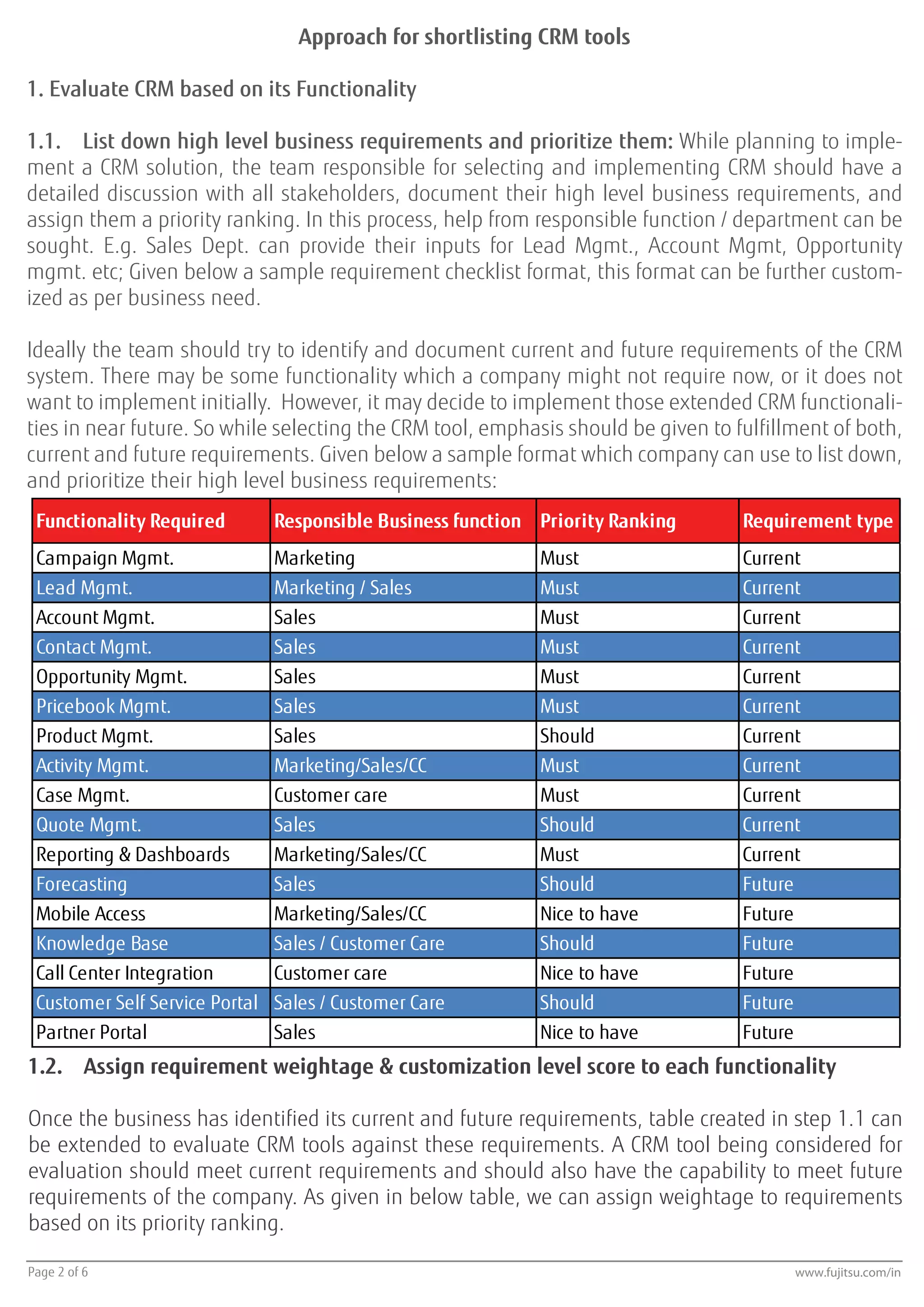
1.1. List down high level business requirements and prioritize them: While planning to imple-
ment a CRM solution, the team responsible for selecting and implementing CRM should have a
detailed discussion with all stakeholders, document their high level business requirements, and
assign them a priority ranking. In this process, help from responsible function / department can be
sought. E.g. Sales Dept. can provide their inputs for Lead Mgmt., Account Mgmt, Opportunity
mgmt. etc; Given below a sample requirement checklist format, this format can be further custom-
ized as per business need.
Ideally the team should try to identify and document current and future requirements of the CRM
system. There may be some functionality which a company might not require now, or it does not
want to implement initially. However, it may decide to implement those extended CRM functionali-
ties in near future. So while selecting the CRM tool, emphasis should be given to fulfillment of both,
current and future requirements. Given below a sample format which company can use to list down,
and prioritize their high level business requirements:
www.fujitsu.com/inPage 2 of 6
Functionality Required Responsible Business function Priority Ranking Requirement type
Campaign Mgmt. Marketing Must Current
Lead Mgmt. Marketing / Sales Must Current
Account Mgmt. Sales Must Current
Contact Mgmt. Sales Must Current
Opportunity Mgmt. Sales Must Current
Pricebook Mgmt. Sales Must Current
Product Mgmt. Sales Should Current
Activity Mgmt. Marketing/Sales/CC Must Current
Case Mgmt. Customer care Must Current
Quote Mgmt. Sales Should Current
Reporting & Dashboards Marketing/Sales/CC Must Current
Forecasting Sales Should Future
Mobile Access Marketing/Sales/CC Nice to have Future
Knowledge Base Sales / Customer Care Should Future
Call Center Integration Customer care Nice to have Future
Customer Self Service Portal Sales / Customer Care Should Future
Partner Portal Sales Nice to have Future
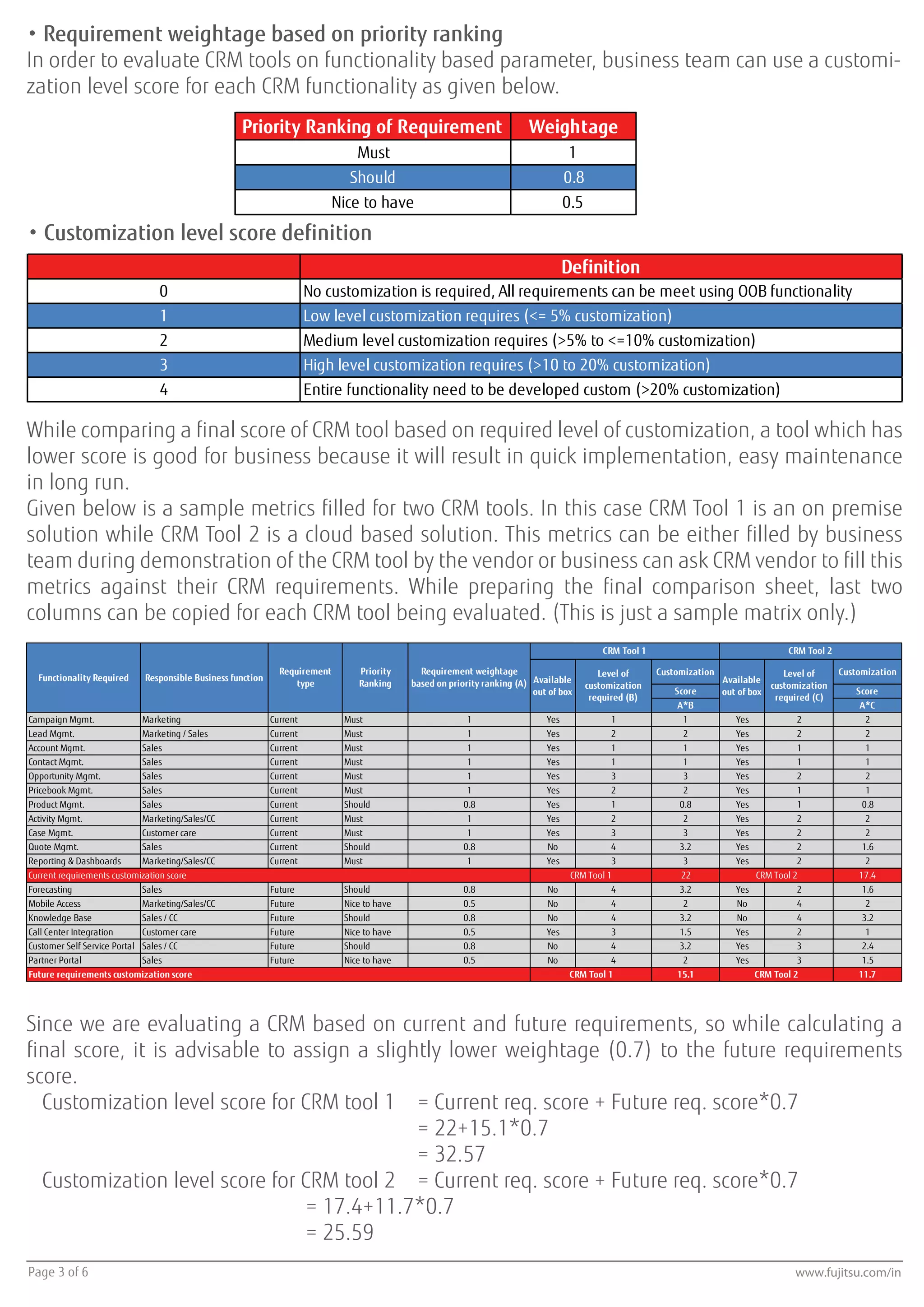
• Requirement weightage based on priority ranking
In order to evaluate CRM tools on functionality based parameter, business team can use a customi-
zation level score for each CRM functionality as given below.
Priority Ranking of Requirement Weightage
Must 1
Should 0.8
Nice to have 0.5
• Customization level score definition
Definition
0 No customization is required, All requirements can be meet using OOB functionality
1 Low level customization requires (<= 5% customization)
2 Medium level customization requires (>5% to <=10% customization)
3 High level customization requires (>10 to 20% customization)
4 Entire functionality need to be developed custom (>20% customization)
While comparing a final score of CRM tool based on required level of customization, a tool which has
lower score is good for business because it will result in quick implementation, easy maintenance
in long run.
Given below is a sample metrics filled for two CRM tools. In this case CRM Tool 1 is an on premise
solution while CRM Tool 2 is a cloud based solution. This metrics can be either filled by business
team during demonstration of the CRM tool by the vendor or business can ask CRM vendor to fill this
metrics against their CRM requirements. While preparing the final comparison sheet, last two
columns can be copied for each CRM tool being evaluated. (This is just a sample matrix only.)
Customization Customization
Score Score
A*B A*C
Campaign Mgmt. Marketing Current Must 1 Yes 1 1 Yes 2 2
Lead Mgmt. Marketing / Sales Current Must 1 Yes 2 2 Yes 2 2
Account Mgmt. Sales Current Must 1 Yes 1 1 Yes 1 1
Contact Mgmt. Sales Current Must 1 Yes 1 1 Yes 1 1
Opportunity Mgmt. Sales Current Must 1 Yes 3 3 Yes 2 2
Pricebook Mgmt. Sales Current Must 1 Yes 2 2 Yes 1 1
Product Mgmt. Sales Current Should 0.8 Yes 1 0.8 Yes 1 0.8
Activity Mgmt. Marketing/Sales/CC Current Must 1 Yes 2 2 Yes 2 2
Case Mgmt. Customer care Current Must 1 Yes 3 3 Yes 2 2
Quote Mgmt. Sales Current Should 0.8 No 4 3.2 Yes 2 1.6
Reporting & Dashboards Marketing/Sales/CC Current Must 1 Yes 3 3 Yes 2 2
22 17.4
Forecasting Sales Future Should 0.8 No 4 3.2 Yes 2 1.6
Mobile Access Marketing/Sales/CC Future Nice to have 0.5 No 4 2 No 4 2
Knowledge Base Sales / CC Future Should 0.8 No 4 3.2 No 4 3.2
Call Center Integration Customer care Future Nice to have 0.5 Yes 3 1.5 Yes 2 1
Customer Self Service Portal Sales / CC Future Should 0.8 No 4 3.2 Yes 3 2.4
Partner Portal Sales Future Nice to have 0.5 No 4 2 Yes 3 1.5
15.1 11.7
Requirement weightage
based on priority ranking (A)
Current requirements customization score CRM Tool 1 CRM Tool 2
Future requirements customization score CRM Tool 1 CRM Tool 2
Functionality Required Responsible Business function
Requirement
type
Priority
Ranking
CRM Tool 1 CRM Tool 2
Available
out of box
Level of
customization
required (B)
Available
out of box
Level of
customization
required (C)
Since we are evaluating a CRM based on current and future requirements, so while calculating a
final score, it is advisable to assign a slightly lower weightage (0.7) to the future requirements
score.
Customization level score for CRM tool 1 = Current req. score + Future req. score*0.7
= 22+15.1*0.7
= 32.57
Customization level score for CRM tool 2 = Current req. score + Future req. score*0.7
= 17.4+11.7*0.7
= 25.59
www.fujitsu.com/inPage 3 of 6
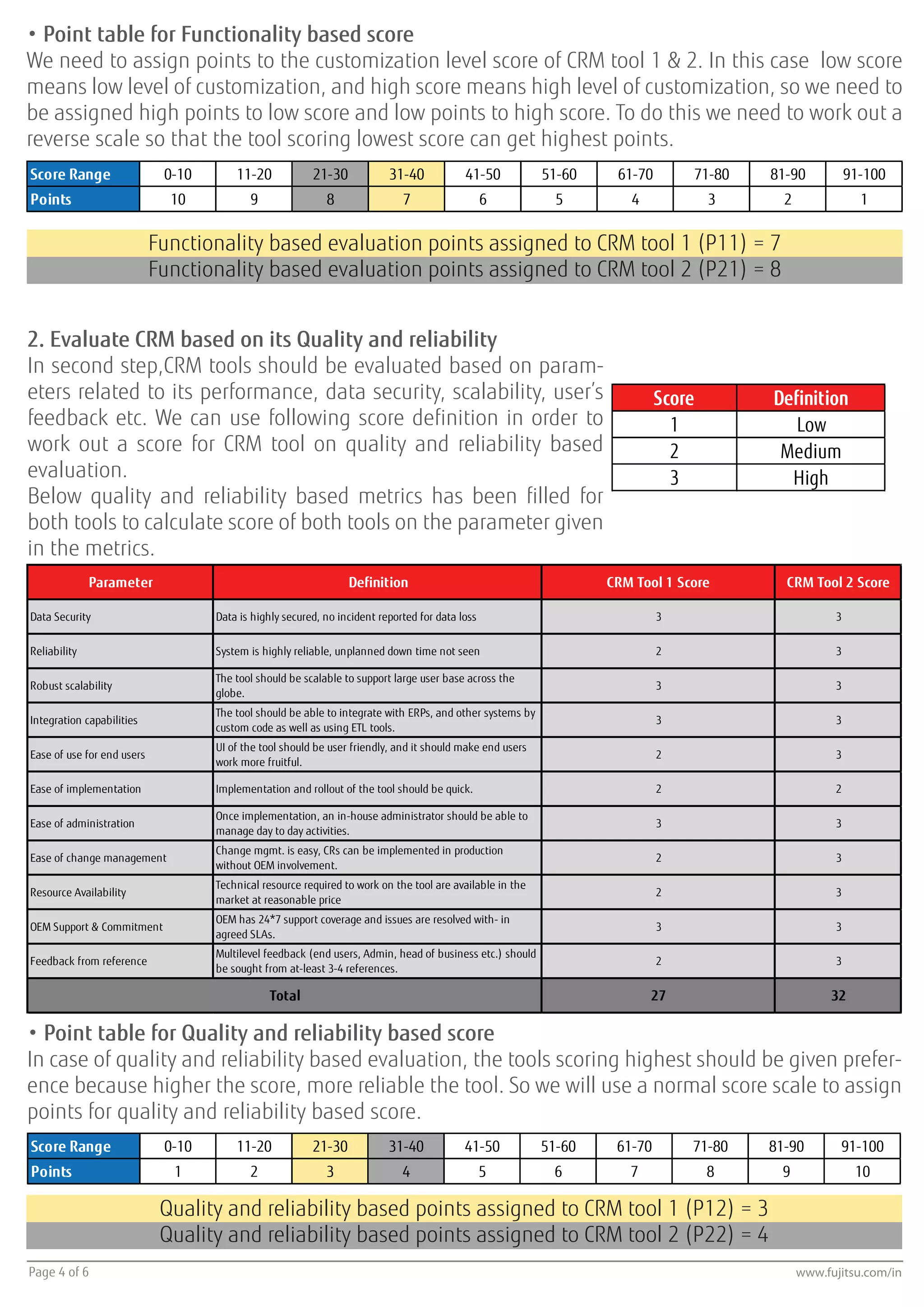
• Point table for Functionality based score
We need to assign points to the customization level score of CRM tool 1 & 2. In this case low score
means low level of customization, and high score means high level of customization, so we need to
be assigned high points to low score and low points to high score. To do this we need to work out a
reverse scale so that the tool scoring lowest score can get highest points.
Functionality based evaluation points assigned to CRM tool 1 (P11) = 7
Functionality based evaluation points assigned to CRM tool 2 (P21) = 8
2. Evaluate CRM based on its Quality and reliability
In second step,CRM tools should be evaluated based on param-
eters related to its performance, data security, scalability, user’s
feedback etc. We can use following score definition in order to
work out a score for CRM tool on quality and reliability based
evaluation.
Below quality and reliability based metrics has been filled for
both tools to calculate score of both tools on the parameter given
in the metrics.
Score Definition
1 Low
2 Medium
3 High
Parameter Definition CRM Tool 1 Score CRM Tool 2 Score
Data Security Data is highly secured, no incident reported for data loss 3 3
Reliability System is highly reliable, unplanned down time not seen 2 3
Robust scalability
The tool should be scalable to support large user base across the
globe.
3 3
Integration capabilities
The tool should be able to integrate with ERPs, and other systems by
custom code as well as using ETL tools.
3 3
Ease of use for end users
UI of the tool should be user friendly, and it should make end users
work more fruitful.
2 3
Ease of implementation Implementation and rollout of the tool should be quick. 2 2
Ease of administration
Once implementation, an in-house administrator should be able to
manage day to day activities.
3 3
Ease of change management
Change mgmt. is easy, CRs can be implemented in production
without OEM involvement.
2 3
Resource Availability
Technical resource required to work on the tool are available in the
market at reasonable price
2 3
OEM Support & Commitment
OEM has 24*7 support coverage and issues are resolved with- in
agreed SLAs.
3 3
Feedback from reference
Multilevel feedback (end users, Admin, head of business etc.) should
be sought from at-least 3-4 references.
2 3
27 32Total
• Point table for Quality and reliability based score
In case of quality and reliability based evaluation, the tools scoring highest should be given prefer-
ence because higher the score, more reliable the tool. So we will use a normal score scale to assign
points for quality and reliability based score.
Quality and reliability based points assigned to CRM tool 1 (P12) = 3
Quality and reliability based points assigned to CRM tool 2 (P22) = 4
www.fujitsu.com/inPage 4 of 6
Score Range 0-10 11-20 21-30 31-40 41-50 51-60 61-70 71-80 81-90 91-100
Points 10 9 8 7 6 5 4 3 2 1
Score Range 0-10 11-20 21-30 31-40 41-50 51-60 61-70 71-80 81-90 91-100
Points 1 2 3 4 5 6 7 8 9 10
3. Evaluate CRM based on its Price
While doing the price based evaluation of CRM tools, we should consider implementation cost and
recurring cost, annual resource cost etc. There are many tools which have initial lower cost but
annual maintenance and resources cost is high and in other case, initial cost is bit high, but the
annual recurring cost is low. The tool with lower TCO (total cost of ownership) should be given pref-
erence in final selection.
Points table for price based score
In case of price based evaluation, since lower TCO should be given preference and need to be
assigned highest points, we need to work out a reverse scale as we did in case of functionality
based points table score.
Price based evaluation points assigned to CRM tool 1 (P13) = 6
Price based evaluation points assigned to CRM tool 2 (P23) = 7
4. Assign weightage to each evaluation criteria and calculate composite score for each tool
Once above three comparative metrics are filled and final score is calculated and points are
assigned to each evaluation criteria, the organization needs to assign a weightage to each evalua-
tion criteria based on its criticality for the business. In general, the following weightages are
assigned to these three evaluation areas. Evaluation Criteria Weightage
CRM functionality based evaluation (W1) 50% or .5
Quality and reliability based evaluation (W2) 30% or .3
Price based Evaluation (W3) 20% or .2
Total (W1+W2+W3) 100% or 1
Now we have weightages assigned for each
evaluation criteria and points assigned to each
evaluation criteria score.
Evaluation Criteria Points Evaluation Criteria Points
CRM Tool 2
Functionality based evaluation points (P11) 7 Functionality based evaluation points (P21) 8
Quality and reliability based points (P12) 3 Quality and reliability based points (P22) 4
Price based evaluation points (P13) 6 Price based evaluation points (P23) 7
CRM Tool 1
This will help us in calculating a composite score for each CRM tool based on the above scores and
weightages.
www.fujitsu.com/inPage 5 of 6
One time (A) Annual (B) One time (A) Annual (B)
Avg. Implementation cost for similar business $30,000.00 $25,000.00
Annual subscription fees (50 users) $4,000.00 $3,000.00
Annual Maintenance and upgrade $1,000.00 $0.00
Avg. Annual Senior Consultant Cost $10,000.00 $6,000.00
Avg. Annual System Administration Cost $5,000.00 $4,000.00
Any other cost
Total cost of ownership (A+B)
Price based evaluation
CRM Tool 1 CRM Tool 2
$50,000.00 $38,000.00
Amount in 000 $ 0-10 11-20 21-30 31-40 41-50 51-60 61-70 71-80 81-90 91-100
Points 10 9 8 7 6 5 4 3 2 1
Formula for calculating composite score of a CRM tool =
Weightage of functionality based evaluation (W1) x points scored on the basis of functionality (P1)
+ Weightage of quality and reliability based evaluation (W2) x points scored on the basis of quality
and reliability (P2) + Weightage of price based evaluation (W3) x points scored on the basis of price
(P3)
Composite score for a tool = W1*P1+W2*P2+W3*P3
Composite score for CRM tool 1 = W1*P11+W2*P12+W3*P13
=.5*7+.3*3+.2*6
= 5.6
Composite Score for CRM Tool 2 = W1*P21+W2*P22+W3*P23
= .5*8+.3*4+.2*7
= 6.6
In this sample CRM evaluation case, after thoroughly evaluating both CRMs on all three evaluation
criteria suggested in this paper, composite score of CRM 2 is higher than CRM 1. So we recommend
to select CRM tool 2 for implementation.
Conclusion: Gartner Group research concludes that anywhere from 50% to 80% of CRM implementa-
tions fail in terms of not meeting expectations. (Ref: Thomas Net News Tech Trends Journal – Why
B2B CRM Systems Fail – 8/2013)
One of the major reasons for CRM system’s failure was due to business’ failure in selecting right CRM
tool for implementation. So if the client follows a systematic approach for CRM tool selection, one
can select right CRM tool for the business and can avoid risk of CRM failure because of wrong tool.
It is apparent from the discussion that while selecting a CRM tool, it should not be selected/rejected
only on the basis of the price. There should be a 3600 evaluation of the CRM tools based on three
metrics presented in this paper. If required, more parameters can be added to these metrics. The
composite score of each tool should be compared before finalizing any tool.
The selected CRM tool should have the ability to meet organization’s CRM vision with lower TCO. It
should add value in company’s front office processes as well as should help in increasing productiv-
ity of the end users of the CRM.
www.fujitsu.com/inPage 6 of 6
About the author
Rajneesh Jadon is Subject Matter Expert with Fujitsu Consulting India having close to 14 years of
industry experience. In FCI Rajneesh is part of CRM team and has worked across Salesforce & Lotus
Notes technologies. Rajneesh holds a PGDM from IIM Lucknow and MCA from MDU Rohtak.
Fujitsu Consulting India is Indian subsidiary of Fujitsu which is a leading Japanese information and
communication technology (ICT) company, offering a full range of technology products, solutions
and services. Approximately 159,000 Fujitsu people support customers in more than 100 countries.
FCI is first in India and second in the world to be awarded CMMI Services Level 5. Its integrated
services and software portfolio includes Business Application Services (including ERP, CRM, AMS, BI,
Mobility, Knowledge Management, Applications Packaging and Business Analytics- Rollouts,
Upgrades and Implementation), Managed Infrastructure Services (Remote Infrastructure Manage-
ment, System integration Services and End-user Services) and Business Support Services.
WP_16.0517

Crm tools – evaluation approach

  • 1.
    Abstract This paper presentsa systematic approach for evaluating CRM tools considering multiple business critical param- eters via three different metrics based on CRM functional- ity, quality & reliability, and price. This paper suggests that CRM tools should be evaluated on multiple parameters, rather than evaluating only on the basis of the price. Met- rics presented in this paper are applicable for both cloud and on premise CRM solutions. This paper recommend that the tool which meets maximum business requirements, has a high score in quality & reliability based evaluation with lower total cost of ownership (TCO) should be selected for implementation. CRM Tools– Evaluation Approach Problem When a company decides to implement a CRM solution, the biggest question comes in the mind of a decision maker is, “Which CRM tool should I select for implementation”? There are hundreds of CRM tools available in the market. Some leading CRM tools are based on cloud computing and some tools are on premise based. Both types of CRM tools are successful in specific business sce- narios, however each type of tool has its own pros & cons. It is really difficult for a company to decide whether they should go for a cloud based or on premise based solution. Even if the com- pany is able to decide between cloud and on premise based solution, there are many tools avail- able in each category. Other major challenge the company faces is to identify the parameters based Contact and Account Management Sales Automation CRM Marketig Automation Integration Customer Service Solution: This paper presents a systematic approach of evaluating CRM tools on multiple param- eters, not only on the basis of the price. It suggest to evaluate CRM tools on following criteria’s. 1. Functionality based evaluation 2. Quality and reliability based evaluation 3. Price based Evaluation In this paper a metrics has been presented for each evaluation criteria and it also explain how to assign score to each parameter given in the metrics. This paper presents a method for calculating a composite score for each CRM tool in evaluation scope, based on the weightage assigned to each evaluation criteria and points worked out from the score. It recommend to go with the CRM tools which has highest composite score. www.fujitsu.com/inPage 1 of 6 White paper CRM Tools–Evaluation Approach
  • 2.
    1.2. Assign requirementweightage & customization level score to each functionality Once the business has identified its current and future requirements, table created in step 1.1 can be extended to evaluate CRM tools against these requirements. A CRM tool being considered for evaluation should meet current requirements and should also have the capability to meet future requirements of the company. As given in below table, we can assign weightage to requirements based on its priority ranking. Approach for shortlisting CRM tools 1. Evaluate CRM based on its Functionality 1.1. List down high level business requirements and prioritize them: While planning to imple- ment a CRM solution, the team responsible for selecting and implementing CRM should have a detailed discussion with all stakeholders, document their high level business requirements, and assign them a priority ranking. In this process, help from responsible function / department can be sought. E.g. Sales Dept. can provide their inputs for Lead Mgmt., Account Mgmt, Opportunity mgmt. etc; Given below a sample requirement checklist format, this format can be further custom- ized as per business need. Ideally the team should try to identify and document current and future requirements of the CRM system. There may be some functionality which a company might not require now, or it does not want to implement initially. However, it may decide to implement those extended CRM functionali- ties in near future. So while selecting the CRM tool, emphasis should be given to fulfillment of both, current and future requirements. Given below a sample format which company can use to list down, and prioritize their high level business requirements: www.fujitsu.com/inPage 2 of 6 Functionality Required Responsible Business function Priority Ranking Requirement type Campaign Mgmt. Marketing Must Current Lead Mgmt. Marketing / Sales Must Current Account Mgmt. Sales Must Current Contact Mgmt. Sales Must Current Opportunity Mgmt. Sales Must Current Pricebook Mgmt. Sales Must Current Product Mgmt. Sales Should Current Activity Mgmt. Marketing/Sales/CC Must Current Case Mgmt. Customer care Must Current Quote Mgmt. Sales Should Current Reporting & Dashboards Marketing/Sales/CC Must Current Forecasting Sales Should Future Mobile Access Marketing/Sales/CC Nice to have Future Knowledge Base Sales / Customer Care Should Future Call Center Integration Customer care Nice to have Future Customer Self Service Portal Sales / Customer Care Should Future Partner Portal Sales Nice to have Future
  • 3.
    • Requirement weightagebased on priority ranking In order to evaluate CRM tools on functionality based parameter, business team can use a customi- zation level score for each CRM functionality as given below. Priority Ranking of Requirement Weightage Must 1 Should 0.8 Nice to have 0.5 • Customization level score definition Definition 0 No customization is required, All requirements can be meet using OOB functionality 1 Low level customization requires (<= 5% customization) 2 Medium level customization requires (>5% to <=10% customization) 3 High level customization requires (>10 to 20% customization) 4 Entire functionality need to be developed custom (>20% customization) While comparing a final score of CRM tool based on required level of customization, a tool which has lower score is good for business because it will result in quick implementation, easy maintenance in long run. Given below is a sample metrics filled for two CRM tools. In this case CRM Tool 1 is an on premise solution while CRM Tool 2 is a cloud based solution. This metrics can be either filled by business team during demonstration of the CRM tool by the vendor or business can ask CRM vendor to fill this metrics against their CRM requirements. While preparing the final comparison sheet, last two columns can be copied for each CRM tool being evaluated. (This is just a sample matrix only.) Customization Customization Score Score A*B A*C Campaign Mgmt. Marketing Current Must 1 Yes 1 1 Yes 2 2 Lead Mgmt. Marketing / Sales Current Must 1 Yes 2 2 Yes 2 2 Account Mgmt. Sales Current Must 1 Yes 1 1 Yes 1 1 Contact Mgmt. Sales Current Must 1 Yes 1 1 Yes 1 1 Opportunity Mgmt. Sales Current Must 1 Yes 3 3 Yes 2 2 Pricebook Mgmt. Sales Current Must 1 Yes 2 2 Yes 1 1 Product Mgmt. Sales Current Should 0.8 Yes 1 0.8 Yes 1 0.8 Activity Mgmt. Marketing/Sales/CC Current Must 1 Yes 2 2 Yes 2 2 Case Mgmt. Customer care Current Must 1 Yes 3 3 Yes 2 2 Quote Mgmt. Sales Current Should 0.8 No 4 3.2 Yes 2 1.6 Reporting & Dashboards Marketing/Sales/CC Current Must 1 Yes 3 3 Yes 2 2 22 17.4 Forecasting Sales Future Should 0.8 No 4 3.2 Yes 2 1.6 Mobile Access Marketing/Sales/CC Future Nice to have 0.5 No 4 2 No 4 2 Knowledge Base Sales / CC Future Should 0.8 No 4 3.2 No 4 3.2 Call Center Integration Customer care Future Nice to have 0.5 Yes 3 1.5 Yes 2 1 Customer Self Service Portal Sales / CC Future Should 0.8 No 4 3.2 Yes 3 2.4 Partner Portal Sales Future Nice to have 0.5 No 4 2 Yes 3 1.5 15.1 11.7 Requirement weightage based on priority ranking (A) Current requirements customization score CRM Tool 1 CRM Tool 2 Future requirements customization score CRM Tool 1 CRM Tool 2 Functionality Required Responsible Business function Requirement type Priority Ranking CRM Tool 1 CRM Tool 2 Available out of box Level of customization required (B) Available out of box Level of customization required (C) Since we are evaluating a CRM based on current and future requirements, so while calculating a final score, it is advisable to assign a slightly lower weightage (0.7) to the future requirements score. Customization level score for CRM tool 1 = Current req. score + Future req. score*0.7 = 22+15.1*0.7 = 32.57 Customization level score for CRM tool 2 = Current req. score + Future req. score*0.7 = 17.4+11.7*0.7 = 25.59 www.fujitsu.com/inPage 3 of 6
  • 4.
    • Point tablefor Functionality based score We need to assign points to the customization level score of CRM tool 1 & 2. In this case low score means low level of customization, and high score means high level of customization, so we need to be assigned high points to low score and low points to high score. To do this we need to work out a reverse scale so that the tool scoring lowest score can get highest points. Functionality based evaluation points assigned to CRM tool 1 (P11) = 7 Functionality based evaluation points assigned to CRM tool 2 (P21) = 8 2. Evaluate CRM based on its Quality and reliability In second step,CRM tools should be evaluated based on param- eters related to its performance, data security, scalability, user’s feedback etc. We can use following score definition in order to work out a score for CRM tool on quality and reliability based evaluation. Below quality and reliability based metrics has been filled for both tools to calculate score of both tools on the parameter given in the metrics. Score Definition 1 Low 2 Medium 3 High Parameter Definition CRM Tool 1 Score CRM Tool 2 Score Data Security Data is highly secured, no incident reported for data loss 3 3 Reliability System is highly reliable, unplanned down time not seen 2 3 Robust scalability The tool should be scalable to support large user base across the globe. 3 3 Integration capabilities The tool should be able to integrate with ERPs, and other systems by custom code as well as using ETL tools. 3 3 Ease of use for end users UI of the tool should be user friendly, and it should make end users work more fruitful. 2 3 Ease of implementation Implementation and rollout of the tool should be quick. 2 2 Ease of administration Once implementation, an in-house administrator should be able to manage day to day activities. 3 3 Ease of change management Change mgmt. is easy, CRs can be implemented in production without OEM involvement. 2 3 Resource Availability Technical resource required to work on the tool are available in the market at reasonable price 2 3 OEM Support & Commitment OEM has 24*7 support coverage and issues are resolved with- in agreed SLAs. 3 3 Feedback from reference Multilevel feedback (end users, Admin, head of business etc.) should be sought from at-least 3-4 references. 2 3 27 32Total • Point table for Quality and reliability based score In case of quality and reliability based evaluation, the tools scoring highest should be given prefer- ence because higher the score, more reliable the tool. So we will use a normal score scale to assign points for quality and reliability based score. Quality and reliability based points assigned to CRM tool 1 (P12) = 3 Quality and reliability based points assigned to CRM tool 2 (P22) = 4 www.fujitsu.com/inPage 4 of 6 Score Range 0-10 11-20 21-30 31-40 41-50 51-60 61-70 71-80 81-90 91-100 Points 10 9 8 7 6 5 4 3 2 1 Score Range 0-10 11-20 21-30 31-40 41-50 51-60 61-70 71-80 81-90 91-100 Points 1 2 3 4 5 6 7 8 9 10
  • 5.
    3. Evaluate CRMbased on its Price While doing the price based evaluation of CRM tools, we should consider implementation cost and recurring cost, annual resource cost etc. There are many tools which have initial lower cost but annual maintenance and resources cost is high and in other case, initial cost is bit high, but the annual recurring cost is low. The tool with lower TCO (total cost of ownership) should be given pref- erence in final selection. Points table for price based score In case of price based evaluation, since lower TCO should be given preference and need to be assigned highest points, we need to work out a reverse scale as we did in case of functionality based points table score. Price based evaluation points assigned to CRM tool 1 (P13) = 6 Price based evaluation points assigned to CRM tool 2 (P23) = 7 4. Assign weightage to each evaluation criteria and calculate composite score for each tool Once above three comparative metrics are filled and final score is calculated and points are assigned to each evaluation criteria, the organization needs to assign a weightage to each evalua- tion criteria based on its criticality for the business. In general, the following weightages are assigned to these three evaluation areas. Evaluation Criteria Weightage CRM functionality based evaluation (W1) 50% or .5 Quality and reliability based evaluation (W2) 30% or .3 Price based Evaluation (W3) 20% or .2 Total (W1+W2+W3) 100% or 1 Now we have weightages assigned for each evaluation criteria and points assigned to each evaluation criteria score. Evaluation Criteria Points Evaluation Criteria Points CRM Tool 2 Functionality based evaluation points (P11) 7 Functionality based evaluation points (P21) 8 Quality and reliability based points (P12) 3 Quality and reliability based points (P22) 4 Price based evaluation points (P13) 6 Price based evaluation points (P23) 7 CRM Tool 1 This will help us in calculating a composite score for each CRM tool based on the above scores and weightages. www.fujitsu.com/inPage 5 of 6 One time (A) Annual (B) One time (A) Annual (B) Avg. Implementation cost for similar business $30,000.00 $25,000.00 Annual subscription fees (50 users) $4,000.00 $3,000.00 Annual Maintenance and upgrade $1,000.00 $0.00 Avg. Annual Senior Consultant Cost $10,000.00 $6,000.00 Avg. Annual System Administration Cost $5,000.00 $4,000.00 Any other cost Total cost of ownership (A+B) Price based evaluation CRM Tool 1 CRM Tool 2 $50,000.00 $38,000.00 Amount in 000 $ 0-10 11-20 21-30 31-40 41-50 51-60 61-70 71-80 81-90 91-100 Points 10 9 8 7 6 5 4 3 2 1
  • 6.
    Formula for calculatingcomposite score of a CRM tool = Weightage of functionality based evaluation (W1) x points scored on the basis of functionality (P1) + Weightage of quality and reliability based evaluation (W2) x points scored on the basis of quality and reliability (P2) + Weightage of price based evaluation (W3) x points scored on the basis of price (P3) Composite score for a tool = W1*P1+W2*P2+W3*P3 Composite score for CRM tool 1 = W1*P11+W2*P12+W3*P13 =.5*7+.3*3+.2*6 = 5.6 Composite Score for CRM Tool 2 = W1*P21+W2*P22+W3*P23 = .5*8+.3*4+.2*7 = 6.6 In this sample CRM evaluation case, after thoroughly evaluating both CRMs on all three evaluation criteria suggested in this paper, composite score of CRM 2 is higher than CRM 1. So we recommend to select CRM tool 2 for implementation. Conclusion: Gartner Group research concludes that anywhere from 50% to 80% of CRM implementa- tions fail in terms of not meeting expectations. (Ref: Thomas Net News Tech Trends Journal – Why B2B CRM Systems Fail – 8/2013) One of the major reasons for CRM system’s failure was due to business’ failure in selecting right CRM tool for implementation. So if the client follows a systematic approach for CRM tool selection, one can select right CRM tool for the business and can avoid risk of CRM failure because of wrong tool. It is apparent from the discussion that while selecting a CRM tool, it should not be selected/rejected only on the basis of the price. There should be a 3600 evaluation of the CRM tools based on three metrics presented in this paper. If required, more parameters can be added to these metrics. The composite score of each tool should be compared before finalizing any tool. The selected CRM tool should have the ability to meet organization’s CRM vision with lower TCO. It should add value in company’s front office processes as well as should help in increasing productiv- ity of the end users of the CRM. www.fujitsu.com/inPage 6 of 6 About the author Rajneesh Jadon is Subject Matter Expert with Fujitsu Consulting India having close to 14 years of industry experience. In FCI Rajneesh is part of CRM team and has worked across Salesforce & Lotus Notes technologies. Rajneesh holds a PGDM from IIM Lucknow and MCA from MDU Rohtak. Fujitsu Consulting India is Indian subsidiary of Fujitsu which is a leading Japanese information and communication technology (ICT) company, offering a full range of technology products, solutions and services. Approximately 159,000 Fujitsu people support customers in more than 100 countries. FCI is first in India and second in the world to be awarded CMMI Services Level 5. Its integrated services and software portfolio includes Business Application Services (including ERP, CRM, AMS, BI, Mobility, Knowledge Management, Applications Packaging and Business Analytics- Rollouts, Upgrades and Implementation), Managed Infrastructure Services (Remote Infrastructure Manage- ment, System integration Services and End-user Services) and Business Support Services. WP_16.0517