CRM FOR CUSTOMER SERVICE: ELEVATING CUSTOMER SERVICE FOR
STRATEGIC ADVANTAGE
Introduction
In today’s marketplace, customer service has evolved beyond simple problem-solving; it
stands as a fundamental promise a brand makes to its customers. This commitment spans the
entire customer journey, from initial product interest through purchase and post-purchase
support, addressing any issues, complaints, or queries that may arise. Delivering exceptional
customer service is no longer just good practice; it is a secret weapon for fostering great
brand experiences and significantly boosting sales. Satisfied customers are more likely to
return, leading to repeat purchases and sustained brand loyalty.
Modern customer service interactions occur across a multitude of channels, including
traditional phone support, email, website support forms, text messages, social media, and
innovative emerging channels like self-service bots. The goal remains clear: to ensure
customer satisfaction by addressing all expectations and fulfilling every interaction with the
brand.
Achieving this necessitates that customer service agents are accessible at the right time and
place, a critical logistical challenge where Customer Relationship Management (CRM)
technology plays an indispensable role.
Transforming Service Delivery: Key Performance Indicators
Enhanced by CRM
A robust CRM system empowers
organizations to meticulously track and
improve critical customer service
metrics, providing data-driven insights
for operational excellence:
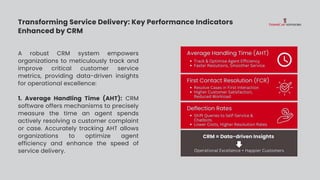
1. Average Handling Time (AHT): CRM
software offers mechanisms to precisely
measure the time an agent spends
actively resolving a customer complaint
or case. Accurately tracking AHT allows
organizations to optimize agent
efficiency and enhance the speed of
service delivery.
Transforming Service Delivery: Key Performance Indicators
Enhanced by CRM
2. First Contact Resolution (FCR): This metric is pivotal for the success of any customer service
team. A CRM system can track when a customer complaint or case was initiated and how
many of these were successfully resolved during the very first interaction between the
customer service agent and the customer. A cross-platform CRM is particularly effective,
offering a holistic view of the case across various contact channels and generating meaningful
FCR data. An increase in FCR numbers signifies a superior customer experience and
concurrently reduces the workload on the customer service team.
3. Deflection Rates: In the modern service landscape, CRM enables the automation and
tracking of deflection rates, a key metric for managing customer inquiries. Many customer
service requests can now be handled without direct human intervention through self-service
portals, chatbots, or comprehensive FAQ sections on a website. By effectively deflecting
customer queries to these self-service channels, companies can significantly improve
resolution rates, reduce the operational costs associated with deploying human agents, and
alleviate pressure on contact centers, ultimately enhancing customer satisfaction.
How CRM Applications Deliver Solid Customer Service
CRM technology provides a foundational platform that streamlines and elevates every aspect
of customer service:
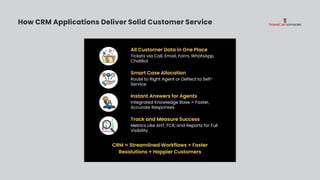
• Centralized Customer Information and Multi-Channel Engagement: A CRM application
serves as a central repository for all customer information, including every ticket and complaint
raised. Customers have the flexibility to log tickets through various channels—calling a contact
center, sending an email, filling out a website support form, or interacting with a chatbot on
platforms like WhatsApp.
• Intelligent Complaint Routing and Self-Service Deflection: Once a complaint is received, the
CRM system can automatically allocate it. For instance, a complaint about a specific product
can be routed directly to an agent specializing in that area. Additionally, queries can be
intelligently deflected to self-service channels, such as FAQ pages or chatbots, empowering
customers to find resolutions independently.
How CRM Applications Deliver Solid Customer Service
• Empowering Agents with Knowledge Bases: Customer service agents gain access to an
integrated knowledge base within the CRM system, providing immediate and relevant answers
to a wide array of queries. This minimizes the need for agents to be extensively trained on every
specific aspect of a product or service, as the correct information is readily available, allowing
for quick and accurate responses to customers. All interactions with the customer are logged
on the platform for future reference.
• Performance Tracking and Resolution Management: Post-resolution, all customer
complaints are meticulously tracked and closed within the CRM system. This enables the
measurement of crucial metrics like Average Handling Time and First Call Resolution rates,
offering valuable insights into team performance. The software also generates necessary
reports, providing a "bird's-eye view" of how the customer service team is performing
concerning customer issues and requests.
Beyond Resolution: Unlocking Upsell and Cross-sell
Opportunities
As a CRM consulting firm, we strongly believe that a properly implemented CRM software
transcends beyond query resolution; it actively contributes to revenue generation. During
regular feedback calls or after a query is resolved, CRM enables customer service executives to
identify potential cross-sell or up-sell opportunities. If a satisfied customer expresses interest
in a new product or an upgrade, the executive can create a sales opportunity within the CRM
system.
This opportunity can then be tagged to a salesperson who can follow up, assisting the
customer with their purchase. This demonstrates that CRM can not only resolve issues
efficiently but also directly generate revenue by identifying suitable sales opportunities.
Understanding the Landscape: Key Players in CRM for Customer
Service (Gartner's Perspective)
The technology landscape for customer engagement centers—as Gartner now refers to customer
service applications—is robust and dynamic. According to the Gartner Magic Quadrant for
Customer Engagement Center 2024, several key players stand out:
• Leaders:
◦Salesforce
◦Microsoft (Dynamics 365 Customer Service)
◦Oracle (Fusion Service)
◦Pega Systems
◦ServiceNow (Customer Service Management)
• Challengers:
◦Zendesk
◦e-gain
• Niche Players:
◦ SAP, Freshworks, Zoho, and HubSpot are some players also recognized for their specialized
offerings.
Conclusion
The strategic deployment of a CRM system is no longer optional but a critical differentiator for
organizations aiming to excel in customer service and drive sustained growth. By centralizing
customer data, streamlining operations, empowering agents, and leveraging intelligent
automation, CRM transforms the customer service function from a cost center into a powerful
engine for satisfaction and revenue generation.
Navigating the complexities of choosing, implementing, and optimizing the right CRM solution
requires a deep understanding of both technological capabilities and strategic business objectives
and that is where a CRM consulting services firm like ThinkCap Advisors can help. Ultimately, a well-
executed CRM strategy is a transformative journey that unlocks superior customer experiences and
tangible business value.
ARE YOU LOOKING TO IMPROVE/AUTOMATE YOUR CUSTOMER SERVICE
OPERATIONS? REACH US AT:
+91 8506860903
contact@thinkcapadvisors.com
www.thinkcapadvisors.com

CRM For Customer Service: Elevating Customer Service for Strategic Advantage

  • 1.
    CRM FOR CUSTOMERSERVICE: ELEVATING CUSTOMER SERVICE FOR STRATEGIC ADVANTAGE
  • 2.
    Introduction In today’s marketplace,customer service has evolved beyond simple problem-solving; it stands as a fundamental promise a brand makes to its customers. This commitment spans the entire customer journey, from initial product interest through purchase and post-purchase support, addressing any issues, complaints, or queries that may arise. Delivering exceptional customer service is no longer just good practice; it is a secret weapon for fostering great brand experiences and significantly boosting sales. Satisfied customers are more likely to return, leading to repeat purchases and sustained brand loyalty. Modern customer service interactions occur across a multitude of channels, including traditional phone support, email, website support forms, text messages, social media, and innovative emerging channels like self-service bots. The goal remains clear: to ensure customer satisfaction by addressing all expectations and fulfilling every interaction with the brand. Achieving this necessitates that customer service agents are accessible at the right time and place, a critical logistical challenge where Customer Relationship Management (CRM) technology plays an indispensable role.
  • 3.
    Transforming Service Delivery:Key Performance Indicators Enhanced by CRM A robust CRM system empowers organizations to meticulously track and improve critical customer service metrics, providing data-driven insights for operational excellence: 1. Average Handling Time (AHT): CRM software offers mechanisms to precisely measure the time an agent spends actively resolving a customer complaint or case. Accurately tracking AHT allows organizations to optimize agent efficiency and enhance the speed of service delivery.
  • 4.
    Transforming Service Delivery:Key Performance Indicators Enhanced by CRM 2. First Contact Resolution (FCR): This metric is pivotal for the success of any customer service team. A CRM system can track when a customer complaint or case was initiated and how many of these were successfully resolved during the very first interaction between the customer service agent and the customer. A cross-platform CRM is particularly effective, offering a holistic view of the case across various contact channels and generating meaningful FCR data. An increase in FCR numbers signifies a superior customer experience and concurrently reduces the workload on the customer service team. 3. Deflection Rates: In the modern service landscape, CRM enables the automation and tracking of deflection rates, a key metric for managing customer inquiries. Many customer service requests can now be handled without direct human intervention through self-service portals, chatbots, or comprehensive FAQ sections on a website. By effectively deflecting customer queries to these self-service channels, companies can significantly improve resolution rates, reduce the operational costs associated with deploying human agents, and alleviate pressure on contact centers, ultimately enhancing customer satisfaction.
  • 5.
    How CRM ApplicationsDeliver Solid Customer Service CRM technology provides a foundational platform that streamlines and elevates every aspect of customer service: • Centralized Customer Information and Multi-Channel Engagement: A CRM application serves as a central repository for all customer information, including every ticket and complaint raised. Customers have the flexibility to log tickets through various channels—calling a contact center, sending an email, filling out a website support form, or interacting with a chatbot on platforms like WhatsApp. • Intelligent Complaint Routing and Self-Service Deflection: Once a complaint is received, the CRM system can automatically allocate it. For instance, a complaint about a specific product can be routed directly to an agent specializing in that area. Additionally, queries can be intelligently deflected to self-service channels, such as FAQ pages or chatbots, empowering customers to find resolutions independently.
  • 6.
    How CRM ApplicationsDeliver Solid Customer Service
  • 7.
    How CRM ApplicationsDeliver Solid Customer Service • Empowering Agents with Knowledge Bases: Customer service agents gain access to an integrated knowledge base within the CRM system, providing immediate and relevant answers to a wide array of queries. This minimizes the need for agents to be extensively trained on every specific aspect of a product or service, as the correct information is readily available, allowing for quick and accurate responses to customers. All interactions with the customer are logged on the platform for future reference. • Performance Tracking and Resolution Management: Post-resolution, all customer complaints are meticulously tracked and closed within the CRM system. This enables the measurement of crucial metrics like Average Handling Time and First Call Resolution rates, offering valuable insights into team performance. The software also generates necessary reports, providing a "bird's-eye view" of how the customer service team is performing concerning customer issues and requests.
  • 8.
    Beyond Resolution: UnlockingUpsell and Cross-sell Opportunities As a CRM consulting firm, we strongly believe that a properly implemented CRM software transcends beyond query resolution; it actively contributes to revenue generation. During regular feedback calls or after a query is resolved, CRM enables customer service executives to identify potential cross-sell or up-sell opportunities. If a satisfied customer expresses interest in a new product or an upgrade, the executive can create a sales opportunity within the CRM system. This opportunity can then be tagged to a salesperson who can follow up, assisting the customer with their purchase. This demonstrates that CRM can not only resolve issues efficiently but also directly generate revenue by identifying suitable sales opportunities.
  • 9.
    Understanding the Landscape:Key Players in CRM for Customer Service (Gartner's Perspective) The technology landscape for customer engagement centers—as Gartner now refers to customer service applications—is robust and dynamic. According to the Gartner Magic Quadrant for Customer Engagement Center 2024, several key players stand out: • Leaders: ◦Salesforce ◦Microsoft (Dynamics 365 Customer Service) ◦Oracle (Fusion Service) ◦Pega Systems ◦ServiceNow (Customer Service Management) • Challengers: ◦Zendesk ◦e-gain • Niche Players: ◦ SAP, Freshworks, Zoho, and HubSpot are some players also recognized for their specialized offerings.
  • 10.
    Conclusion The strategic deploymentof a CRM system is no longer optional but a critical differentiator for organizations aiming to excel in customer service and drive sustained growth. By centralizing customer data, streamlining operations, empowering agents, and leveraging intelligent automation, CRM transforms the customer service function from a cost center into a powerful engine for satisfaction and revenue generation. Navigating the complexities of choosing, implementing, and optimizing the right CRM solution requires a deep understanding of both technological capabilities and strategic business objectives and that is where a CRM consulting services firm like ThinkCap Advisors can help. Ultimately, a well- executed CRM strategy is a transformative journey that unlocks superior customer experiences and tangible business value.
  • 11.
    ARE YOU LOOKINGTO IMPROVE/AUTOMATE YOUR CUSTOMER SERVICE OPERATIONS? REACH US AT: +91 8506860903 contact@thinkcapadvisors.com www.thinkcapadvisors.com