Brookfield & Kolb
Presented By: Vishant Singh Chettri
11th December 2018
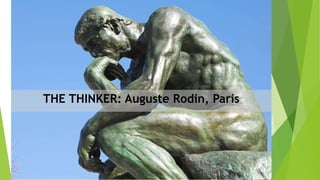
THE THINKER: Auguste Rodin, Paris
Index
S No. Topic Slide No.
1 Stephen Brookfield’s four Lenses 3
2 Kolb’s Learning Process 4
3 Similarities & Differences 5
4 Overview: My Field 6
5 Relevance at workplace 7
6 Criticism 8-9
7 Application to work related situations 10-11
8 References 12
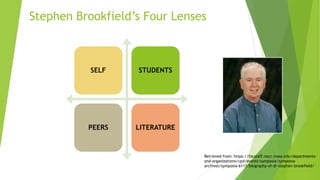
Stephen Brookfield’s Four Lenses
SELF STUDENTS
PEERS LITERATURE
Retrieved from: https://facstaff.necc.mass.edu/departments-
and-organizations/cpd/events/symposia/symposia-
archives/symposia-6111/biography-of-dr-stephen-brookfield/
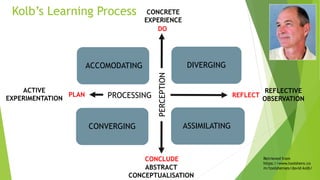
Kolb’s Learning Process
ACCOMODATING DIVERGING
CONVERGING ASSIMILATING
PERCEPTION
PROCESSING
FEELING
THINKING
WATCHINGDOING
CONCRETE
EXPERIENCE
ABSTRACT
CONCEPTUALISATION
REFLECTIVE
OBSERVATION
ACTIVE
EXPERIMENTATION
DO
REFLECT
CONCLUDE
PLAN
Retrieved from
https://www.toolshero.co
m/toolsheroes/david-kolb/
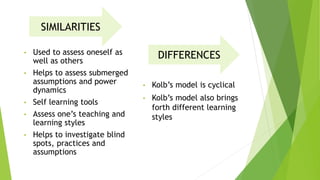
SIMILARITIES
• Used to assess oneself as
well as others
• Helps to assess submerged
assumptions and power
dynamics
• Self learning tools
• Assess one’s teaching and
learning styles
• Helps to investigate blind
spots, practices and
assumptions
DIFFERENCES
• Kolb’s model is cyclical
• Kolb’s model also brings
forth different learning
styles
Overview: My Field
Learning & Development
Design & Delivery
Team Management
Business Development
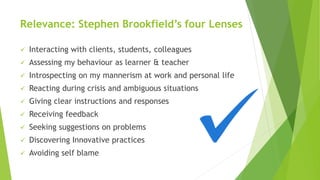
Relevance: Stephen Brookfield’s four Lenses
 Interacting with clients, students, colleagues
 Assessing my behaviour as learner & teacher
 Introspecting on my mannerism at work and personal life
 Reacting during crisis and ambiguous situations
 Giving clear instructions and responses
 Receiving feedback
 Seeking suggestions on problems
 Discovering Innovative practices
 Avoiding self blame
Criticism: Stephen Brookfield’s four Lenses
 Firstly being publicized as an imposter due in part to the fact that,
among teachers, “there is a general lack of confidence, a pervasive
feeling of vulnerability, a fear of being ‘found out’” (Lieberman &
Miller). Secondly, a risk of being placed on the periphery and seen as
a “troublemaker”. Thirdly, having to undergo the downfall of any
sense of conviction and lastly, a feeling of “being left in limbo”
(Brookfield, 1995).
Criticism: Stephen Brookfield’s four Lenses
 Slightly Simplistic and misleading
 Protecting practitioners from their own negativity and depression
 Does not look into the future (self, students)
 Ability to view through students lenses is questionable
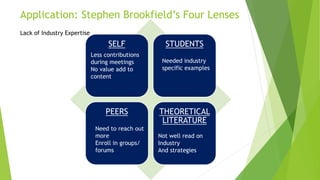
Application: Stephen Brookfield’s Four Lenses
SELF STUDENTS
PEERS THEORETICAL
LITERATURE
Lack of Industry Expertise
Less contributions
during meetings
No value add to
content
Needed industry
specific examples
Not well read on
Industry
And strategies
Need to reach out
more
Enroll in groups/
forums
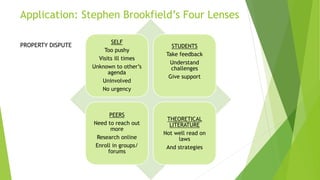
Application: Stephen Brookfield’s Four Lenses
SELF
Too pushy
Visits ill times
Unknown to other’s
agenda
Uninvolved
No urgency
STUDENTS
Take feedback
Understand
challenges
Give support
PEERS
Need to reach out
more
Research online
Enroll in groups/
forums
THEORETICAL
LITERATURE
Not well read on
laws
And strategies
PROPERTY DISPUTE
References
Brookfield, S. (1998). Critically reflective practice. Journal of Continuing Education in the Health Professions, 18(4), 197-205
Brookfield, S. (2008). Radical questioning on the long walk to freedom: Nelson Mandela and the practice of critical reflection. Adult Education Quarterly,
58(2), 95-109
Brookfield, S. (2015). Teaching students to think critically The skillful teacher: on technique, trust, and responsiveness in the classroom (3 ed., pp. 155-
167). San Francisco, CA: Jossey-Bass
Brookfield, S. (1995). Becoming a critically reflective teacher. San Francisco, CA: John Wiley & Sons.
Collabor8blog collabor8 training & consultancy: Critique of Brookfield’s four lens model of critical reflection. (2014). Retrieved from
https://collabor8blog.wordpress.com/2014/12/22/critique-of-brookfields-four-lens-model-of-critical-reflection
McLeod, S. (2013) Kolb Learning Styles. Retrieved form cei.ust.hk/files/public/simplypsychology_kolb_learning_styles.pdf
McLeod, S. A. (2017). Kolb - learning styles. Retrieved from https://www.simplypsychology.org/learning-kolb.html
Handbook of teaching and learning in medicine. Retrieved from http://www.bhmed-
emanual.org/chapter_2_learning_styles_%E2%80%93_examples_for_use/strengths_and_weaknesses_of_the_kolb_model
Wentworth Institute of Technology. Kolb experiential learning cycle. Retrieved from https://www.youtube.com/watch?v=DqoHn7xAlLQ
Thank You
“The ability to think critically about one’s assumptions,
beliefs and actions is a survival necessity.”
(Brookfield, 1995)

#CriticalReflectiveThinking #Brookfield&kolb

  • 1.
    Brookfield & Kolb PresentedBy: Vishant Singh Chettri 11th December 2018
  • 2.
  • 3.
    Index S No. TopicSlide No. 1 Stephen Brookfield’s four Lenses 3 2 Kolb’s Learning Process 4 3 Similarities & Differences 5 4 Overview: My Field 6 5 Relevance at workplace 7 6 Criticism 8-9 7 Application to work related situations 10-11 8 References 12
  • 4.
    Stephen Brookfield’s FourLenses SELF STUDENTS PEERS LITERATURE Retrieved from: https://facstaff.necc.mass.edu/departments- and-organizations/cpd/events/symposia/symposia- archives/symposia-6111/biography-of-dr-stephen-brookfield/
  • 5.
    Kolb’s Learning Process ACCOMODATINGDIVERGING CONVERGING ASSIMILATING PERCEPTION PROCESSING FEELING THINKING WATCHINGDOING CONCRETE EXPERIENCE ABSTRACT CONCEPTUALISATION REFLECTIVE OBSERVATION ACTIVE EXPERIMENTATION DO REFLECT CONCLUDE PLAN Retrieved from https://www.toolshero.co m/toolsheroes/david-kolb/
  • 6.
    SIMILARITIES • Used toassess oneself as well as others • Helps to assess submerged assumptions and power dynamics • Self learning tools • Assess one’s teaching and learning styles • Helps to investigate blind spots, practices and assumptions DIFFERENCES • Kolb’s model is cyclical • Kolb’s model also brings forth different learning styles
  • 7.
    Overview: My Field Learning& Development Design & Delivery Team Management Business Development
  • 8.
    Relevance: Stephen Brookfield’sfour Lenses  Interacting with clients, students, colleagues  Assessing my behaviour as learner & teacher  Introspecting on my mannerism at work and personal life  Reacting during crisis and ambiguous situations  Giving clear instructions and responses  Receiving feedback  Seeking suggestions on problems  Discovering Innovative practices  Avoiding self blame
  • 9.
    Criticism: Stephen Brookfield’sfour Lenses  Firstly being publicized as an imposter due in part to the fact that, among teachers, “there is a general lack of confidence, a pervasive feeling of vulnerability, a fear of being ‘found out’” (Lieberman & Miller). Secondly, a risk of being placed on the periphery and seen as a “troublemaker”. Thirdly, having to undergo the downfall of any sense of conviction and lastly, a feeling of “being left in limbo” (Brookfield, 1995).
  • 10.
    Criticism: Stephen Brookfield’sfour Lenses  Slightly Simplistic and misleading  Protecting practitioners from their own negativity and depression  Does not look into the future (self, students)  Ability to view through students lenses is questionable
  • 11.
    Application: Stephen Brookfield’sFour Lenses SELF STUDENTS PEERS THEORETICAL LITERATURE Lack of Industry Expertise Less contributions during meetings No value add to content Needed industry specific examples Not well read on Industry And strategies Need to reach out more Enroll in groups/ forums
  • 12.
    Application: Stephen Brookfield’sFour Lenses SELF Too pushy Visits ill times Unknown to other’s agenda Uninvolved No urgency STUDENTS Take feedback Understand challenges Give support PEERS Need to reach out more Research online Enroll in groups/ forums THEORETICAL LITERATURE Not well read on laws And strategies PROPERTY DISPUTE
  • 13.
    References Brookfield, S. (1998).Critically reflective practice. Journal of Continuing Education in the Health Professions, 18(4), 197-205 Brookfield, S. (2008). Radical questioning on the long walk to freedom: Nelson Mandela and the practice of critical reflection. Adult Education Quarterly, 58(2), 95-109 Brookfield, S. (2015). Teaching students to think critically The skillful teacher: on technique, trust, and responsiveness in the classroom (3 ed., pp. 155- 167). San Francisco, CA: Jossey-Bass Brookfield, S. (1995). Becoming a critically reflective teacher. San Francisco, CA: John Wiley & Sons. Collabor8blog collabor8 training & consultancy: Critique of Brookfield’s four lens model of critical reflection. (2014). Retrieved from https://collabor8blog.wordpress.com/2014/12/22/critique-of-brookfields-four-lens-model-of-critical-reflection McLeod, S. (2013) Kolb Learning Styles. Retrieved form cei.ust.hk/files/public/simplypsychology_kolb_learning_styles.pdf McLeod, S. A. (2017). Kolb - learning styles. Retrieved from https://www.simplypsychology.org/learning-kolb.html Handbook of teaching and learning in medicine. Retrieved from http://www.bhmed- emanual.org/chapter_2_learning_styles_%E2%80%93_examples_for_use/strengths_and_weaknesses_of_the_kolb_model Wentworth Institute of Technology. Kolb experiential learning cycle. Retrieved from https://www.youtube.com/watch?v=DqoHn7xAlLQ
  • 14.
    Thank You “The abilityto think critically about one’s assumptions, beliefs and actions is a survival necessity.” (Brookfield, 1995)

Editor's Notes

  • #2 I have heard people saying too much thinking is bad. Don’t think so much! What are your views on this?
  • #5 Brookfield, S. (1998). Critically reflective practice. Journal of Continuing Education in the Health Professions, 18(4), 197-205 Brookfield, S. (2008). Radical questioning on the long walk to freedom: Nelson Mandela and the practice of critical reflection. Adult Education Quarterly, 58(2), 95-109 Brookfield, S. (2015). Teaching students to think critically The skillful teacher: on technique, trust, and responsiveness in the classroom (3 ed., pp. 155-167). San Francisco, CA: Jossey-Bass Authors:Brookfield, Stephen1 Source:Adult Education Quarterly. Feb2008, Vol. 58 Issue 2, p95-109. 15p. Document Type:Article Nelson Mandela reflected on, and sometimes modified, four core assumptions at the heart of his struggle to overturn the White domionance Critical reflection's focus is on understanding the dynamics of power (and how to manipulate these) and on uncovering (and combating) ruling class hegemony Although not clearly stated by him but elements of the model can be clearly seen Mandela's reasoning on tactics and strategy, his awareness of the need to reappraise assumptions that previously were viewed as gospel, and his use of multiple lenses through which to view his actions as a freedom fighter exemplify the practice of critical reflection. Brookfield, S. (1998). Critically reflective practice. Journal of Continuing Education in the Health Professions, 18(4), 197-205. Using the lenses Makes us aware of Those submerged & unacknowledged power dynamics Assumptions Lens 1: This is important as no one experiences the death of a dear one in the same manner. The details may defer but the tensions are essentially the same. During peer groups discussions we learn to manage crisis These reflections are more productive than what we learn from book or seniors. We may realize that we are applying great models learnt from text books only to realize later upon reflection that they were baseless. In crisis and ambiguous situations we tend to fall back on instinctively on our experiences as learners and respond accordingly. (Delnico & pope). Eg is the teacher was underestimated, he tends to not do so which may make him lenient. Silence could be misunderstood as being attentive as it used to be in their days Lens 2: Our learners They misinterpret our instructions differently: So I need to be clear with instructions and clarifications (White wall) We need to be careful of our insignificant comments as they might haunt us later Learner are reluctant to be honest Cardinal rule Anonymity while conduction CIQs Only after they gain trust they speak honestly CIQ Lens 3: Helps get views of peers through critical conversations, They act as critical mirrors, We are able to check, reframe and broaden our own theories of practice. Makes us realize that we are not alone when it comes to the challenges we face. Lens 4: Helps us gain multiple perspectives. Helps us understand that only we are not to blame all the time for failure – Britzman. We realize that the leaners anger is not because of/ directed towards us. It may because they are on the verge of changing and scrutinizing ones untouched areas. Minority groups may feel victimized. Brookfield, S. (2015). Teaching students to think critically The skillfull teacher: on technique, trust, and responsiveness in the classroom (3 ed., pp. 155-167). San Francisco, CA: Jossey-Bass. Teaching CT to students: Don’t say what am about to teach you will blow their old ideas out of the window rather say it is a process to validate the accuracy of your assumptions It helps if you show how you as a teacher use CT Let them work in groups- will learn faster Use case studies, examples, simulations Disorienting dilemma – Penny drop moment They learn by modelling Give personal examples Don’t give your opinions let the discover theirs Situation Analysis Test- Workshop for black/ White students: This is a great article that shows a lot of examples of assumptions and how they can be overcome.
  • #6 References: McLeod, S. (2013) Kolb Learning Styles. Retrieved form cei.ust.hk/files/public/simplypsychology_kolb_learning_styles.pdf McLeod, S. A. (2017). Kolb - learning styles. Retrieved from https://www.simplypsychology.org/learning-kolb.html Handbook of teaching and learning in medicine. Retrieved from http://www.bhmed-emanual.org/chapter_2_learning_styles_%E2%80%93_examples_for_use/strengths_and_weaknesses_of_the_kolb_model Wentworth Institute of Technology. Kolb experiential learning cycle. Retrieved from https://www.youtube.com/watch?v=DqoHn7xAlLQ David A. Kolb is an American educational theorist whose interests and publications focus on experiential learning, the individual and social change, career development, and executive and professional education Born: 1939, Moline, Illinois, United States Education: Harvard University, Knox College Influenced by: John Dewey, Jean Piaget, Kurt Lewin Kolb model is based on two continuums perception & Processing. We perceive things based on feeling and thinking. We process things based on watching and doing. The beauty of this cycles is that we can start from any stage and proceed forward till we come back to where we had started from. http://www.bhmed-emanual.org/chapter_2_learning_styles_%E2%80%93_examples_for_use/strengths_and_weaknesses_of_the_kolb_model David Kolb is putting forward a particular learning style model. The problem here is that the experiential learning model does not apply to all situations. Another problem is that Kolb’s theory provides only limited number of factors that influence learning. It doesn’t explain psychodynamic, social, and institutional aspects of learning. It is important to have in mind that people differ in their learning type over time and over situations. Different approaches may be needed even to same person in different situations. Test/ Adapt Diverging: Different perspectives Sensitive Prefer to watch rather than do Gather and use imagination to solve problems Idea generation, brainstorming Assimilating Concise logical approach Ideas more important thatn people Like large info and organize them Converging Can solve problems Use learning to find practical solutions Prefer tech tasks, less with peole Accomodating Relies on intuition rather than logic Use other people analysis Use experiential a[proach New challenges and experience attracts them
  • #9 Brookfield, S. (1998). Critically reflective practice. Journal of Continuing Education in the Health Professions, 18(4), 197-205 Brookfield, S. (2008). Radical questioning on the long walk to freedom: Nelson Mandela and the practice of critical reflection. Adult Education Quarterly, 58(2), 95-109 Brookfield, S. (2015). Teaching students to think critically The skillful teacher: on technique, trust, and responsiveness in the classroom (3 ed., pp. 155-167). San Francisco, CA: Jossey-Bass
  • #10 Brookfield, S. (1995). Becoming a critically reflective teacher. San Francisco, CA: John Wiley & Sons. Collabor8blog collabor8 training & consultancy: Critique of Brookfield’s four lens model of critical reflection. (2014). Retrieved from https://collabor8blog.wordpress.com/2014/12/22/critique-of-brookfields-four-lens-model-of-critical-reflection In addition, it could be argued Brookfield’s model is as much a tool for protecting practitioners from their own negativity and depression – which Brookfield all but suggests teaching brings about – as it is for improving teaching practices. Just as Schön’s model is critiqued for not looking to the future, perhaps Brookfield’s four lens model is equally at risk of this
  • #11 Brookfield, S. (1995). Becoming a critically reflective teacher. San Francisco, CA: John Wiley & Sons. Collabor8blog collabor8 training & consultancy: Critique of Brookfield’s four lens model of critical reflection. (2014). Retrieved from https://collabor8blog.wordpress.com/2014/12/22/critique-of-brookfields-four-lens-model-of-critical-reflection In addition, it could be argued Brookfield’s model is as much a tool for protecting practitioners from their own negativity and depression – which Brookfield all but suggests teaching brings about – as it is for improving teaching practices. Just as Schön’s model is critiqued for not looking to the future, perhaps Brookfield’s four lens model is equally at risk of this