
TEXTBOOKS AND PUPPETS
TEXTBOOKSThe most obvious and most common form of material support for language instruction comes through textbooks. Sometimes new teachers, in their zeal for creating wonderful, marvelous written material for their students, neglect the standard textbook prescribed y the school curriculum and fail to see that this resource may actually be quite useful.
If there is no teacher’s edition, then your task becomes one of finding ways to present the content and exercises of the book to your class.
TEXTBOOK EVALUATION CHECKLISTGoals of the course (Will this text help to accomplish your course goals?)Background of the students (Does the textbook fit your student’s background)AgeNative languageEducational backgroundMotivation or purpose for learning English.
Approach (Does the theoretical approach reflected in the book reflect a philosophy that you and your institution and your students can easily identify with?Theory of learningTheory of language
Language skills (Does the book integrate the “four skills”  Does the textbook emphasizes skills which the curriculum also emphasizes?ListeningSpeakingreadingwriting
General content. (Does the textbook reflect what is now known about language and language learning?Validity—does the textbook accomplish what it is purposed to?Authenticity of languageApproppriateness and currency of topics, situations, and contextsProficiency level—is it pitched for the right level?
Quality of practice materialExercises—is there a variety from controlled to free?Clarity of directions—are they clear to both students and teacher?Active participation of students—is this encouraged effectively?Grammatical and other linguistic explanation—inductive or deductiveReview material—is there sufficient spiraling and review exercises?
Sequencing (how is the book sequenced?)By grammatical structuresBy skillsBy situationsBy some combination of the above
Vocabulary (Does the book pay sufficient attention to words and word study?)RelevanceFrequencyStrategies for word analysis
General sociolinguistic factorsA variety of English—American, British, etc.Cultural content—is there a cultural bias?
Format (Is the book attractive, usable, and durable?)Clarity of typesettingUse of special notation (phonetic symbols, stress/intonation marking, etc.) quality and clarity of illustrationsGeneral layout—is it comfortable and not too “busy”?Size of the book and bindingQuality of editingIndex, table of contents, chapter headings.
Accompanying materials (Are there useful supplementary materials?)WorkbookTapes—audio and/or videoPosters, flash cards, etcA set of tests
Teachers guide (Is it useful?)Helpful methodological guidanceAlternative and supplementary exercisesSuitable for non-native speaking teacherAnswer keys
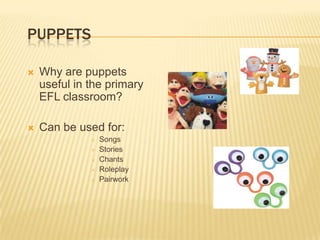
PUPPETSWhy are puppets useful in the primary EFL classroom?Can be used for:  SongsStoriesChantsRoleplayPairwork
Pedagogical and Linguistical aims behind using puppetsFor motivation:  it is funFor meaning:  listen with a purposeFor fluency:  to communicate, learn new wordsFor cross-curricular activities:  they can be used in most topic areas of the curriculum.To teach vocabulary: parts of the face, etc.O teach grammar: verbs, nouns, etc.
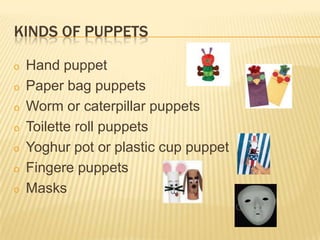
KINDS OF PUPPETSHand puppet

Textbooks and puppets

  • 1.
  • 2.
    TEXTBOOKSThe most obviousand most common form of material support for language instruction comes through textbooks. Sometimes new teachers, in their zeal for creating wonderful, marvelous written material for their students, neglect the standard textbook prescribed y the school curriculum and fail to see that this resource may actually be quite useful.
  • 3.
    If there isno teacher’s edition, then your task becomes one of finding ways to present the content and exercises of the book to your class.
  • 4.
    TEXTBOOK EVALUATION CHECKLISTGoalsof the course (Will this text help to accomplish your course goals?)Background of the students (Does the textbook fit your student’s background)AgeNative languageEducational backgroundMotivation or purpose for learning English.
  • 5.
    Approach (Does thetheoretical approach reflected in the book reflect a philosophy that you and your institution and your students can easily identify with?Theory of learningTheory of language
  • 6.
    Language skills (Doesthe book integrate the “four skills” Does the textbook emphasizes skills which the curriculum also emphasizes?ListeningSpeakingreadingwriting
  • 7.
    General content. (Doesthe textbook reflect what is now known about language and language learning?Validity—does the textbook accomplish what it is purposed to?Authenticity of languageApproppriateness and currency of topics, situations, and contextsProficiency level—is it pitched for the right level?
  • 8.
    Quality of practicematerialExercises—is there a variety from controlled to free?Clarity of directions—are they clear to both students and teacher?Active participation of students—is this encouraged effectively?Grammatical and other linguistic explanation—inductive or deductiveReview material—is there sufficient spiraling and review exercises?
  • 9.
    Sequencing (how isthe book sequenced?)By grammatical structuresBy skillsBy situationsBy some combination of the above
  • 10.
    Vocabulary (Does thebook pay sufficient attention to words and word study?)RelevanceFrequencyStrategies for word analysis
  • 11.
    General sociolinguistic factorsAvariety of English—American, British, etc.Cultural content—is there a cultural bias?
  • 12.
    Format (Is thebook attractive, usable, and durable?)Clarity of typesettingUse of special notation (phonetic symbols, stress/intonation marking, etc.) quality and clarity of illustrationsGeneral layout—is it comfortable and not too “busy”?Size of the book and bindingQuality of editingIndex, table of contents, chapter headings.
  • 13.
    Accompanying materials (Arethere useful supplementary materials?)WorkbookTapes—audio and/or videoPosters, flash cards, etcA set of tests
  • 14.
    Teachers guide (Isit useful?)Helpful methodological guidanceAlternative and supplementary exercisesSuitable for non-native speaking teacherAnswer keys
  • 15.
    PUPPETSWhy are puppetsuseful in the primary EFL classroom?Can be used for: SongsStoriesChantsRoleplayPairwork
  • 16.
    Pedagogical and Linguisticalaims behind using puppetsFor motivation: it is funFor meaning: listen with a purposeFor fluency: to communicate, learn new wordsFor cross-curricular activities: they can be used in most topic areas of the curriculum.To teach vocabulary: parts of the face, etc.O teach grammar: verbs, nouns, etc.
  • 17.