Fall In
LOVE
A Step Backward
What is Critical Thinking?
.... ability to analyze facts, generate and
organize ideas, defend opinions, make
comparison, draw inferences evaluate
arguments and solve problems (Chance,
1986, p.6)
.... Interpret and evaluate information and
experiences (Mertes, 1991, p.24)
.... active and systematic process of
understanding and evaluating arguments
(Meyer and Goodchild, 1990, p.4)
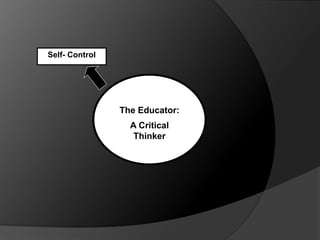
The Educator:
A Critical
Thinker
Self- Control
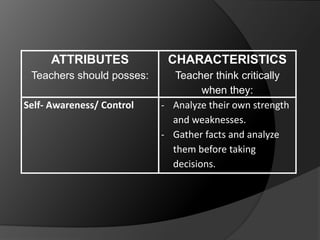
ATTRIBUTES
Teachers should posses:
CHARACTERISTICS
Teacher think critically
when they:
Self- Awareness/ Control - Analyze their own strength
and weaknesses.
- Gather facts and analyze
them before taking
decisions.
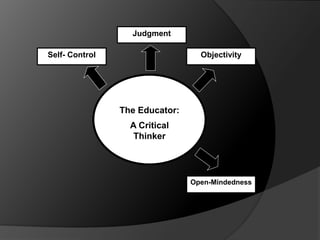
The Educator:
A Critical
Thinker
Self- Control
Judgment
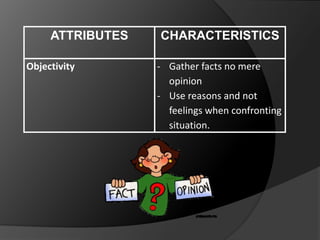
ATTRIBUTES CHARACTERISTICS
Judgment - See the extent and
veracity of evidence.
The Educator:
A Critical
Thinker
Self- Control
Judgment
Objectivity
ATTRIBUTES CHARACTERISTICS
Objectivity - Gather facts no mere
opinion
- Use reasons and not
feelings when confronting
situation.
The Educator:
A Critical
Thinker
Self- Control
Judgment
Objectivity
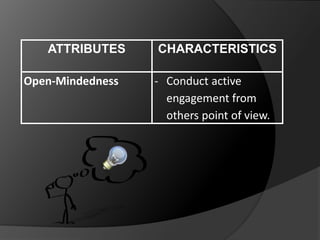
Open-Mindedness
ATTRIBUTES CHARACTERISTICS
Open-Mindedness - Conduct active
engagement from
others point of view.
The Educator:
A Critical
Thinker
Self- Control
Judgment
Objectivity
Open-Mindedness
Credibility
ATTRIBUTES CHARACTERISTICS
Credibility - Report issues with
authenticity and
conviction.
The Educator:
A Critical
Thinker
Self- Control
Judgment
Objectivity
Open-Mindedness
Credibility
Concern for Others
ATTRIBUTES CHARACTERISTICS
Concern for Others - Express feelings, ideas
and opinions carefully.
Elements of Critical Thinking3
•Attitude – an attitude of being disposed to
consider in a thoughtful way the problem as
subjects that that come within the range of one’s
experience.
•Knowledge- knowledge of the methods of
logical inquiry and reasoning.
•Skills- some skills in applying those
methods developing critical thinking in
children and adult learners, individually or in
a group problem solving and decision
making context, continue to address these
same three elements.
Hindi malunok ni Gardo
ang babaing ipinalit ng
kanyang ama sa kanyang
ina.
Strategies and Tactics in Developing Critical Thinking
Track down and evaluate their meaningful learning experience.
Help each other in making decision.
Include factual data and series of observations before reaching at a conclusion.
Never react to any situation without careful analysis.
Know and examine their strength and weaknesses
Read appropriate and relevant printed materials.
Examine their varied roles and responsibilities.
Answer question substantively.
Share some processes on how they arrived at an answer or solutions to problems
Open up with their feelings and ideas on certain situation.
Negotiate diverse opinions and come up with commonly understanding.
The Teacher needs to:
Allow students to think for few seconds before answering
thought provoking questions.
Guide the students to visualize and stay focus on a certain
situation.
Provide opportunities to student for experiential sharing.
Encouraged socialized recitation.
Start the day with a 5 to 10 minute sharing of news report or
significant stories/events to class.
Motivate the class to give reaction to the topic discussed.
Present a challenging proposition suitable for a mini-debate.
Critical thinking

Critical thinking

  • 2.
  • 3.
  • 5.
    What is CriticalThinking? .... ability to analyze facts, generate and organize ideas, defend opinions, make comparison, draw inferences evaluate arguments and solve problems (Chance, 1986, p.6) .... Interpret and evaluate information and experiences (Mertes, 1991, p.24) .... active and systematic process of understanding and evaluating arguments (Meyer and Goodchild, 1990, p.4)
  • 6.
  • 7.
    ATTRIBUTES Teachers should posses: CHARACTERISTICS Teacherthink critically when they: Self- Awareness/ Control - Analyze their own strength and weaknesses. - Gather facts and analyze them before taking decisions.
  • 8.
  • 9.
    ATTRIBUTES CHARACTERISTICS Judgment -See the extent and veracity of evidence.
  • 10.
    The Educator: A Critical Thinker Self-Control Judgment Objectivity
  • 11.
    ATTRIBUTES CHARACTERISTICS Objectivity -Gather facts no mere opinion - Use reasons and not feelings when confronting situation.
  • 12.
    The Educator: A Critical Thinker Self-Control Judgment Objectivity Open-Mindedness
  • 13.
    ATTRIBUTES CHARACTERISTICS Open-Mindedness -Conduct active engagement from others point of view.
  • 14.
    The Educator: A Critical Thinker Self-Control Judgment Objectivity Open-Mindedness Credibility
  • 15.
    ATTRIBUTES CHARACTERISTICS Credibility -Report issues with authenticity and conviction.
  • 16.
    The Educator: A Critical Thinker Self-Control Judgment Objectivity Open-Mindedness Credibility Concern for Others
  • 17.
    ATTRIBUTES CHARACTERISTICS Concern forOthers - Express feelings, ideas and opinions carefully.
  • 18.
    Elements of CriticalThinking3 •Attitude – an attitude of being disposed to consider in a thoughtful way the problem as subjects that that come within the range of one’s experience. •Knowledge- knowledge of the methods of logical inquiry and reasoning. •Skills- some skills in applying those methods developing critical thinking in children and adult learners, individually or in a group problem solving and decision making context, continue to address these same three elements. Hindi malunok ni Gardo ang babaing ipinalit ng kanyang ama sa kanyang ina.
  • 19.
    Strategies and Tacticsin Developing Critical Thinking Track down and evaluate their meaningful learning experience. Help each other in making decision. Include factual data and series of observations before reaching at a conclusion. Never react to any situation without careful analysis. Know and examine their strength and weaknesses Read appropriate and relevant printed materials. Examine their varied roles and responsibilities. Answer question substantively. Share some processes on how they arrived at an answer or solutions to problems Open up with their feelings and ideas on certain situation. Negotiate diverse opinions and come up with commonly understanding.
  • 20.
    The Teacher needsto: Allow students to think for few seconds before answering thought provoking questions. Guide the students to visualize and stay focus on a certain situation. Provide opportunities to student for experiential sharing. Encouraged socialized recitation. Start the day with a 5 to 10 minute sharing of news report or significant stories/events to class. Motivate the class to give reaction to the topic discussed. Present a challenging proposition suitable for a mini-debate.