







active reading skills for college success


                                               Gail Malone, Ph.D.
                                    Director, Teaching & Learning Center
                                                     South Plains College
                                                         (806) 716-2240
                                      gmalone@southplainscollege.edu

                                                     Troy Anderson
                                         Market Development Manager
                                                     Cengage Learning
                                                       (248) 207-6649
                                          troy.anderson@cengage.com
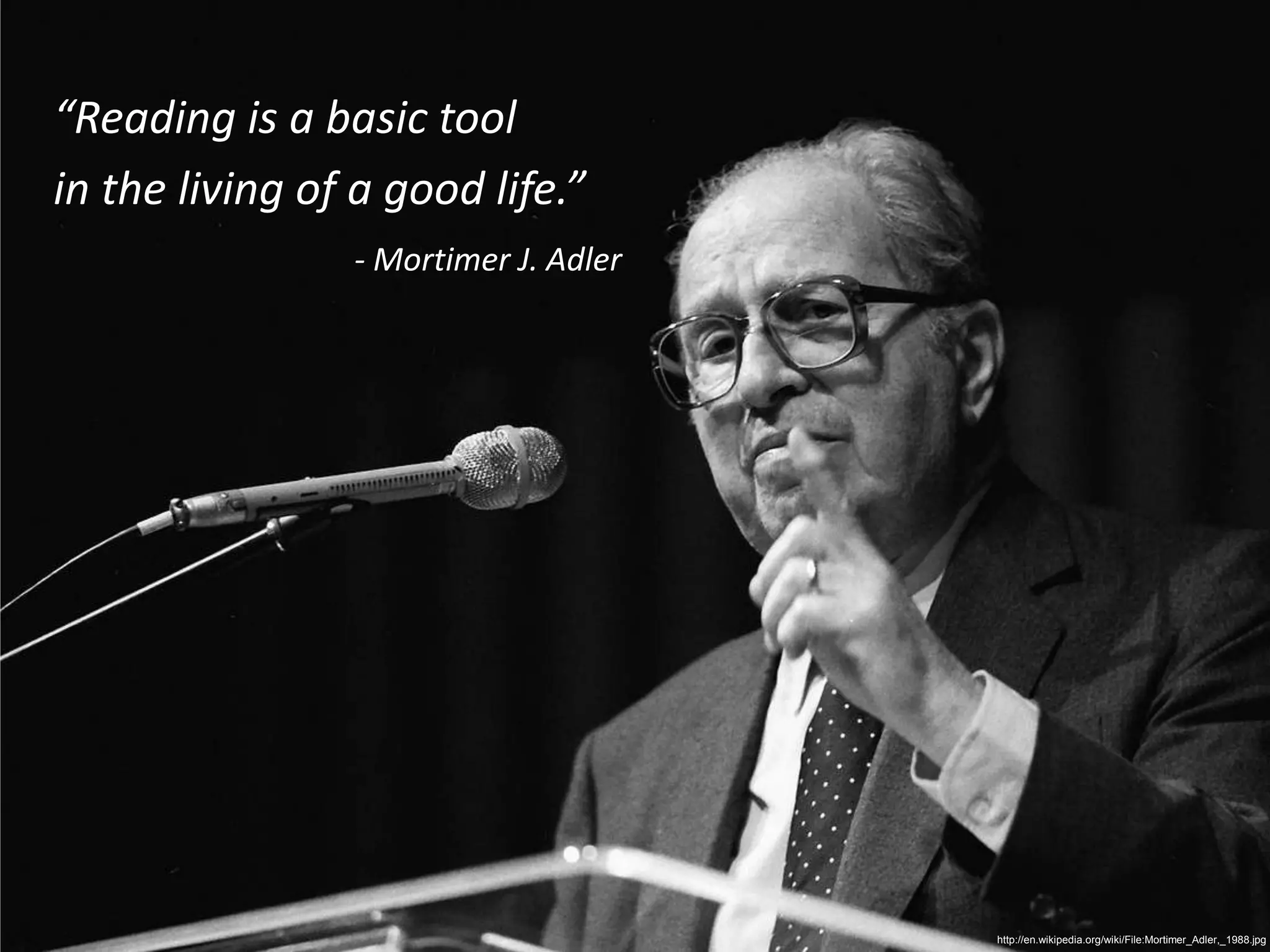
“Reading is a basic tool
in the living of a good life.”
                - Mortimer J. Adler


                                      http://en.wikipedia.org/wiki/File:Mortimer_Adler,_1988.jpg
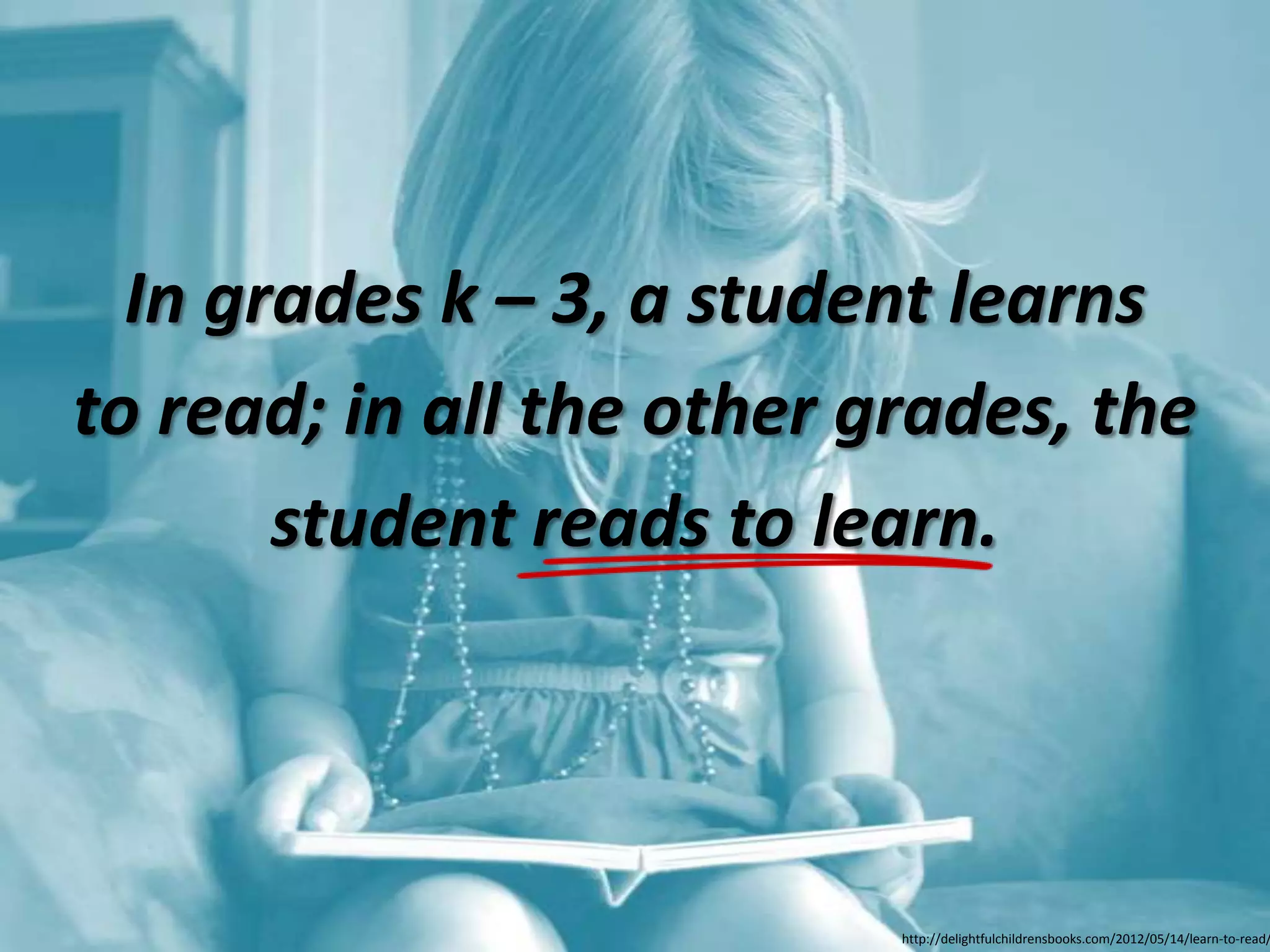
In grades k – 3, a student learns
to read; in all the other grades, the
       student reads to learn.


                           http://delightfulchildrensbooks.com/2012/05/14/learn-to-read/
http://blogs.orlandosentinel.com/entertainment_tv_tvblog/2010/10/george-clooney-to-nbcs-ann-curry-about-sudan.html
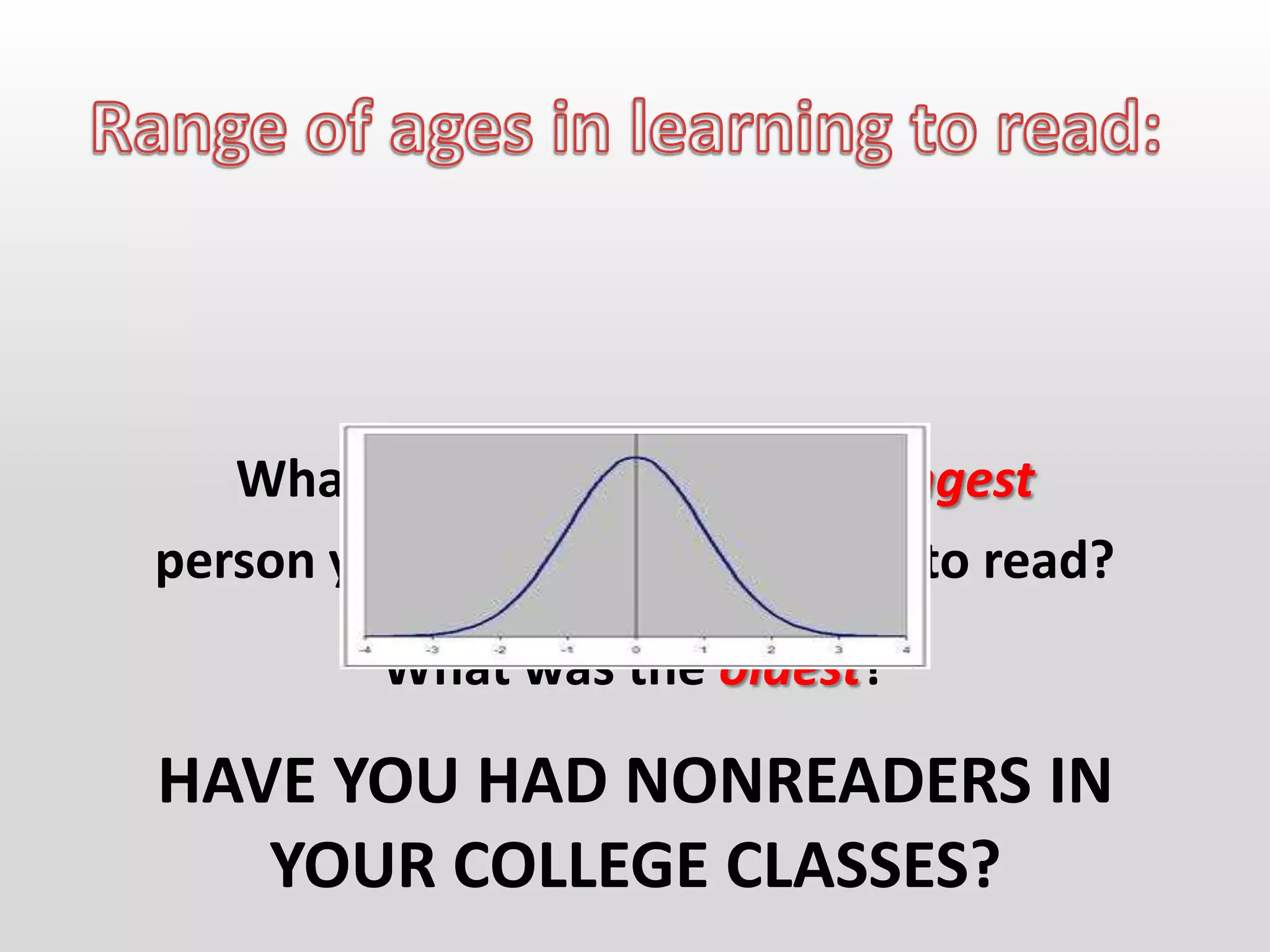
What was the age of the youngest
person you have known to learn to read?
         What was the oldest?

HAVE YOU HAD NONREADERS IN
   YOUR COLLEGE CLASSES?
A student must be able to
     read correctly approximately
        95% of the words in text
in order to comprehend what is read.
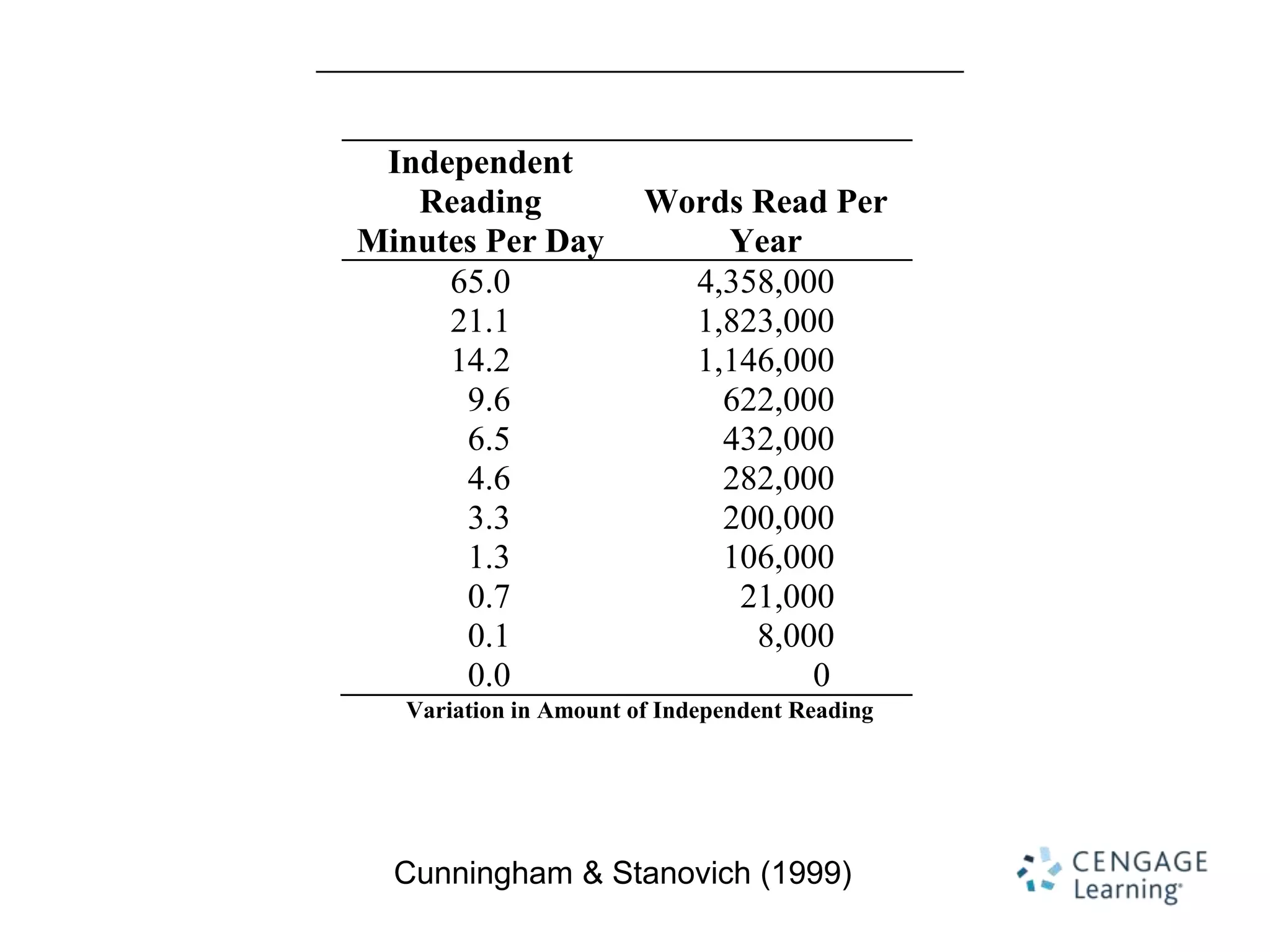
Table 3
 Independent
   Reading             Words Read Per
Minutes Per Day            Year
     65.0                4,358,000
     21.1                1,823,000
     14.2                1,146,000
      9.6                  622,000
      6.5                  432,000
      4.6                  282,000
      3.3                  200,000
      1.3                  106,000
      0.7                   21,000
      0.1                    8,000
      0.0                        0
  Variation in Amount of Independent Reading


  Cunningham & Stanovich (1999)
The average child from a low-income
family hears about 3 million words a
year compared to 11 million from a
middle-class professional family (Hart &
Risley, 1995).
HTTP://WWW.VIRTUALSALT.COM/VOCABLST.HTM

        College students need about 11000 to
        14000 root words (meter in thermometer
        or centimeter).
the POWER of the spoken word . . .
Kindle Study @ South Plains College
Academic reading is an
exercise that requires the
reader to be able to interact
with text in ways that will
aid retention and
understanding of the
material.
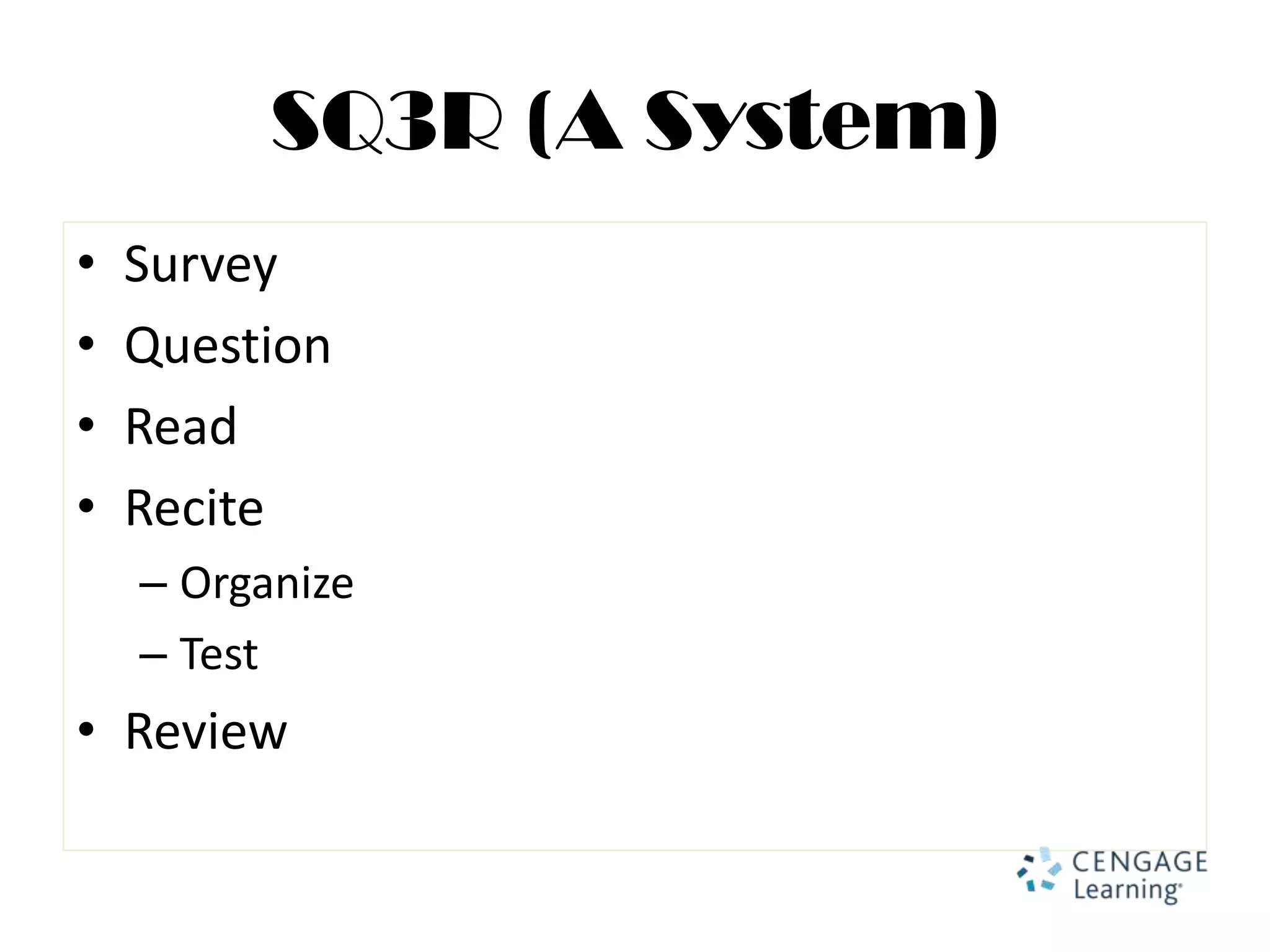
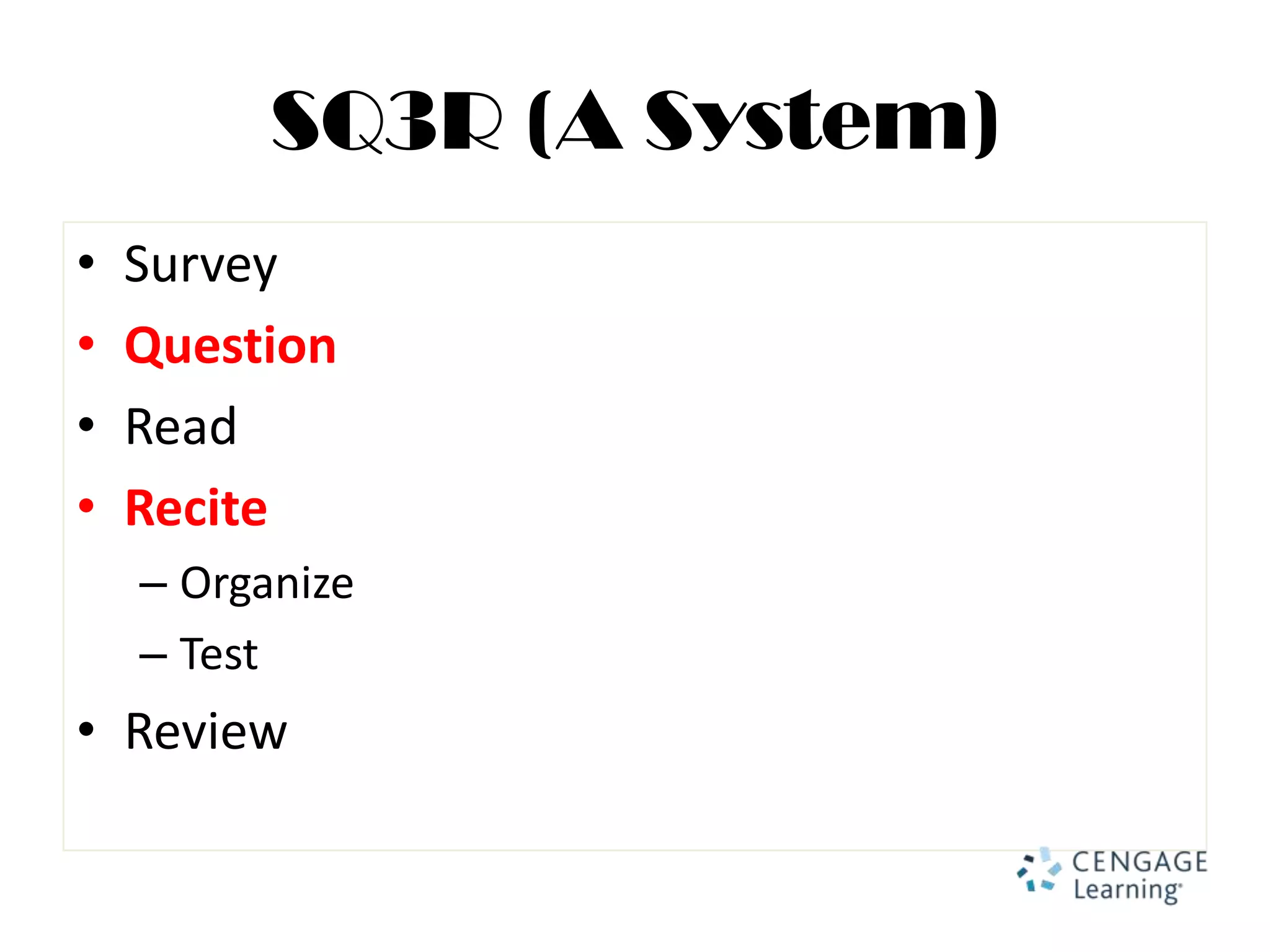
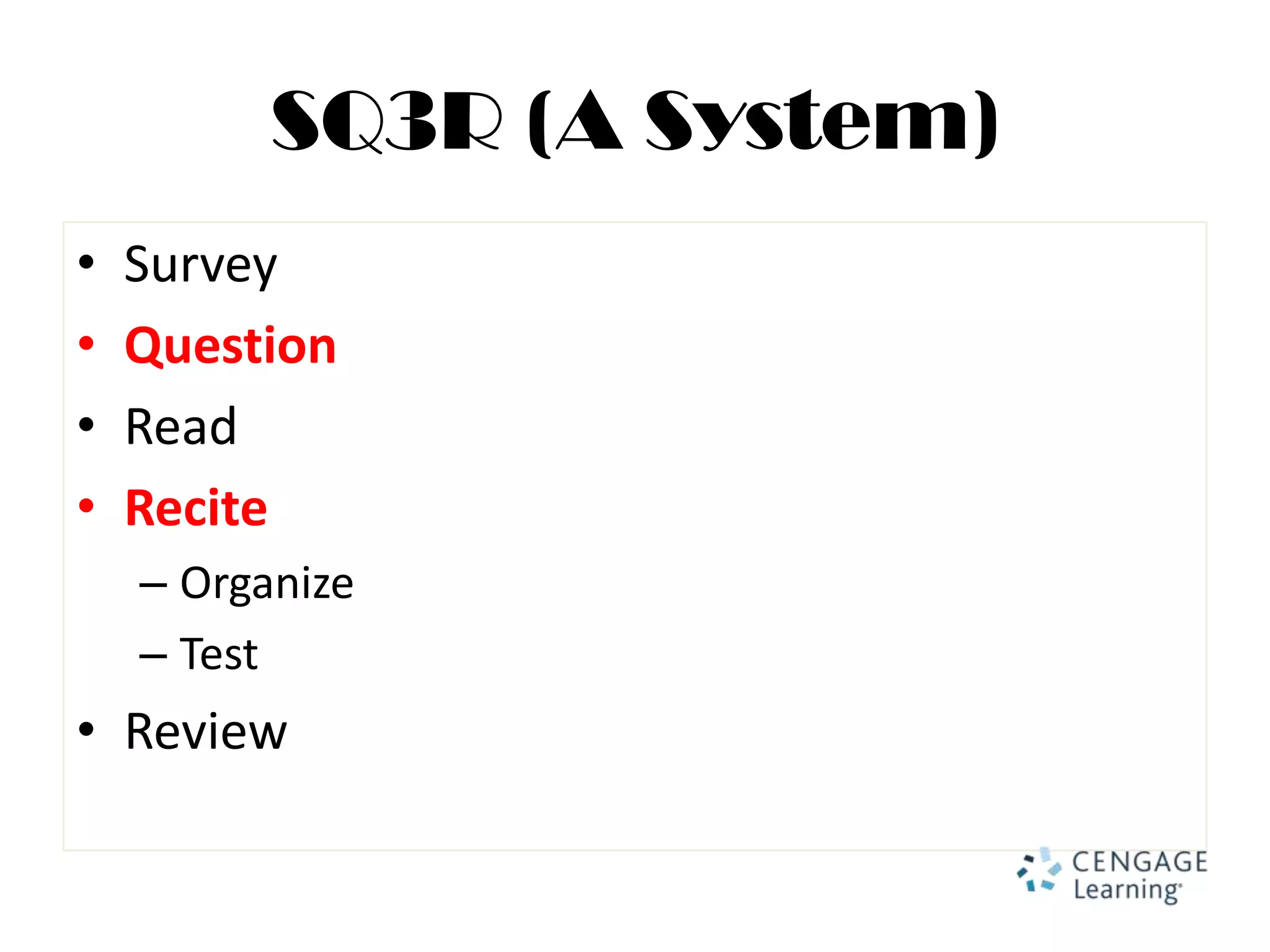
SQ3R (A System)
•   Survey
•   Question
•   Read
•   Recite
    – Organize
    – Test
• Review
SQ3R (A System)
•   Survey
•   Question
•   Read
•   Recite
    – Organize
    – Test
• Review
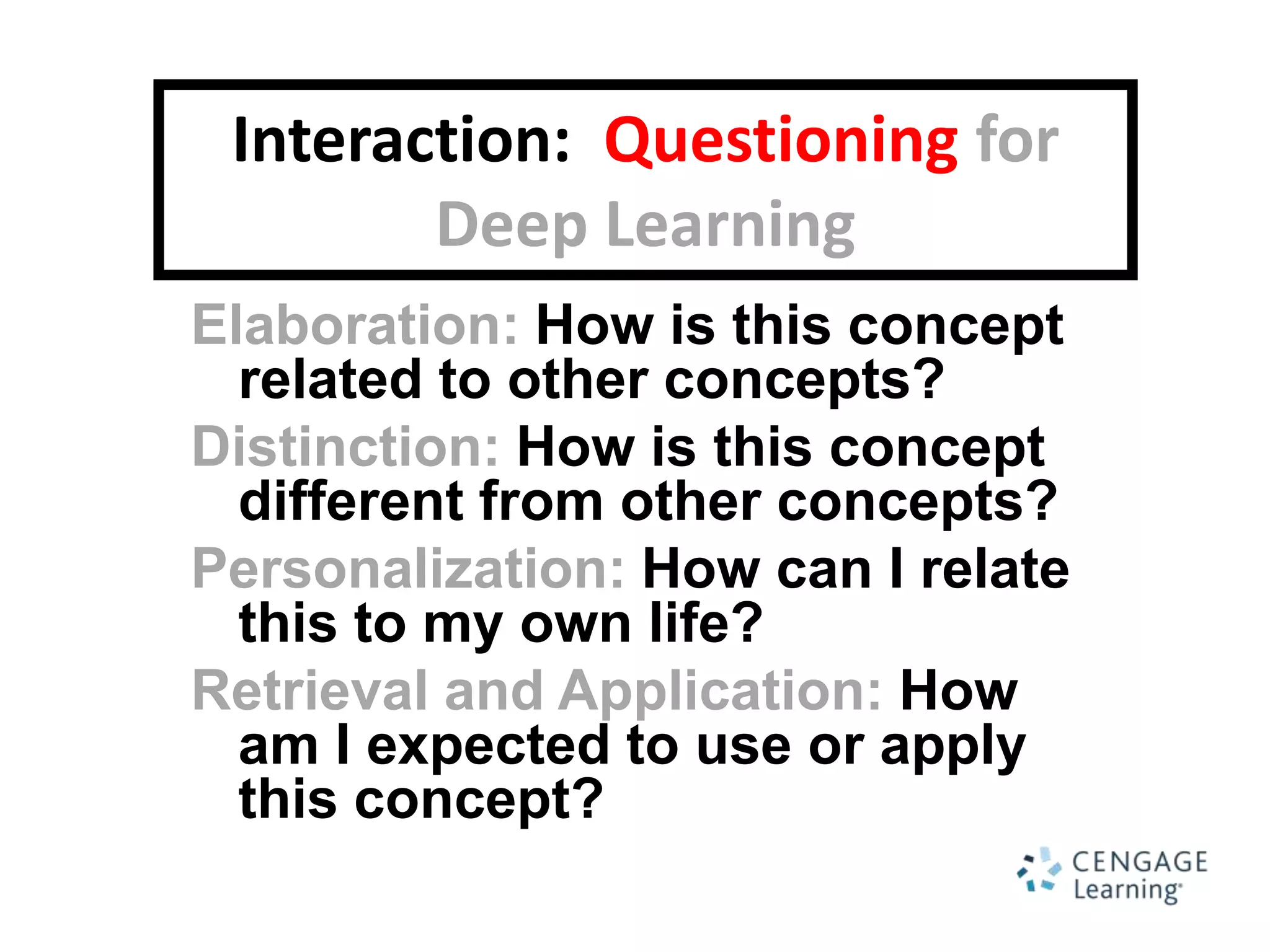
Interaction: Questioning for
        Deep Learning
Elaboration: How is this concept
  related to other concepts?
Distinction: How is this concept
  different from other concepts?
Personalization: How can I relate
  this to my own life?
Retrieval and Application: How
  am I expected to use or apply
  this concept?
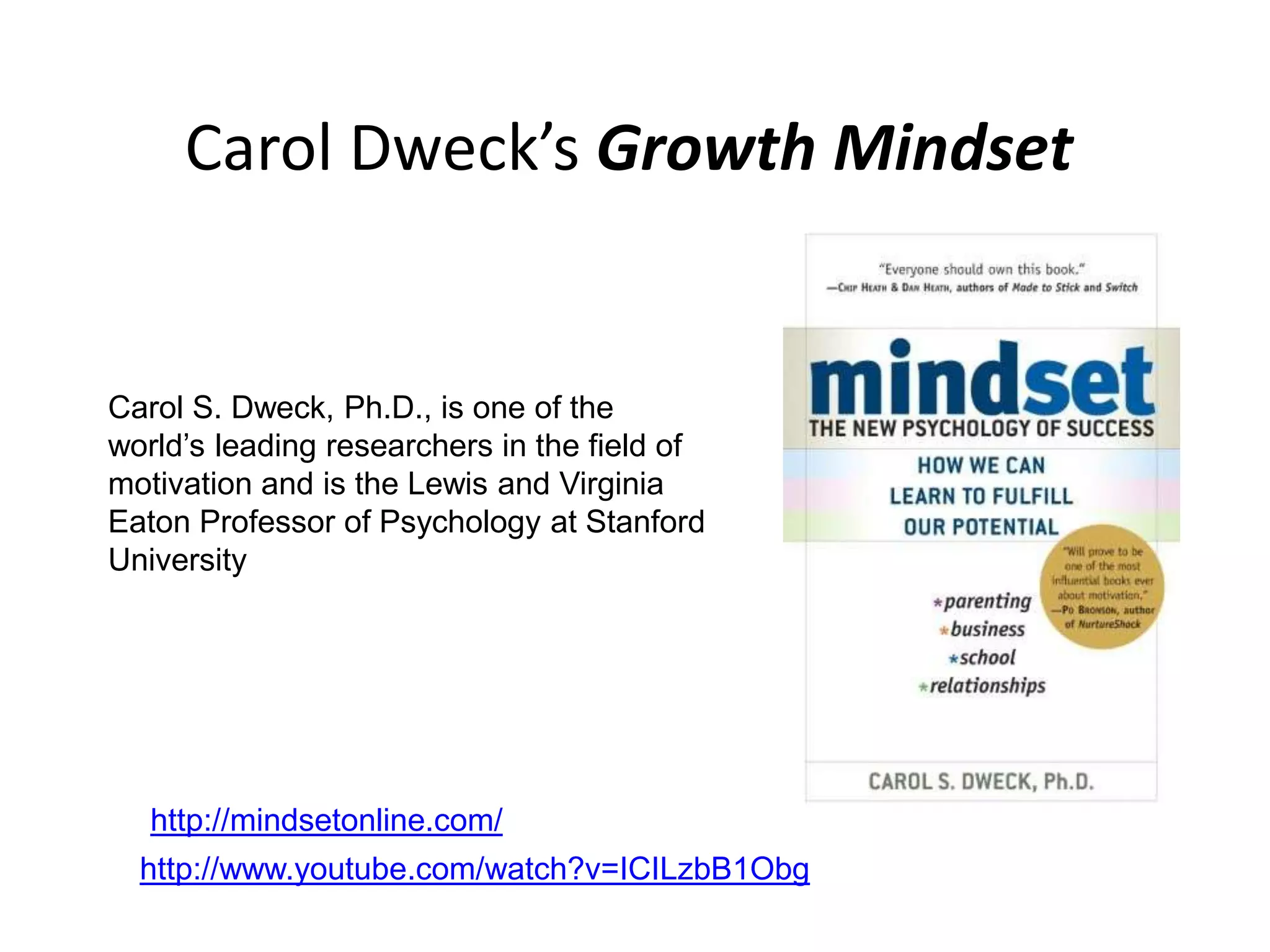
Carol Dweck’s Growth Mindset


Carol S. Dweck, Ph.D., is one of the
world’s leading researchers in the field of
motivation and is the Lewis and Virginia
Eaton Professor of Psychology at Stanford
University


   http://mindsetonline.com/
  http://www.youtube.com/watch?v=ICILzbB1Obg
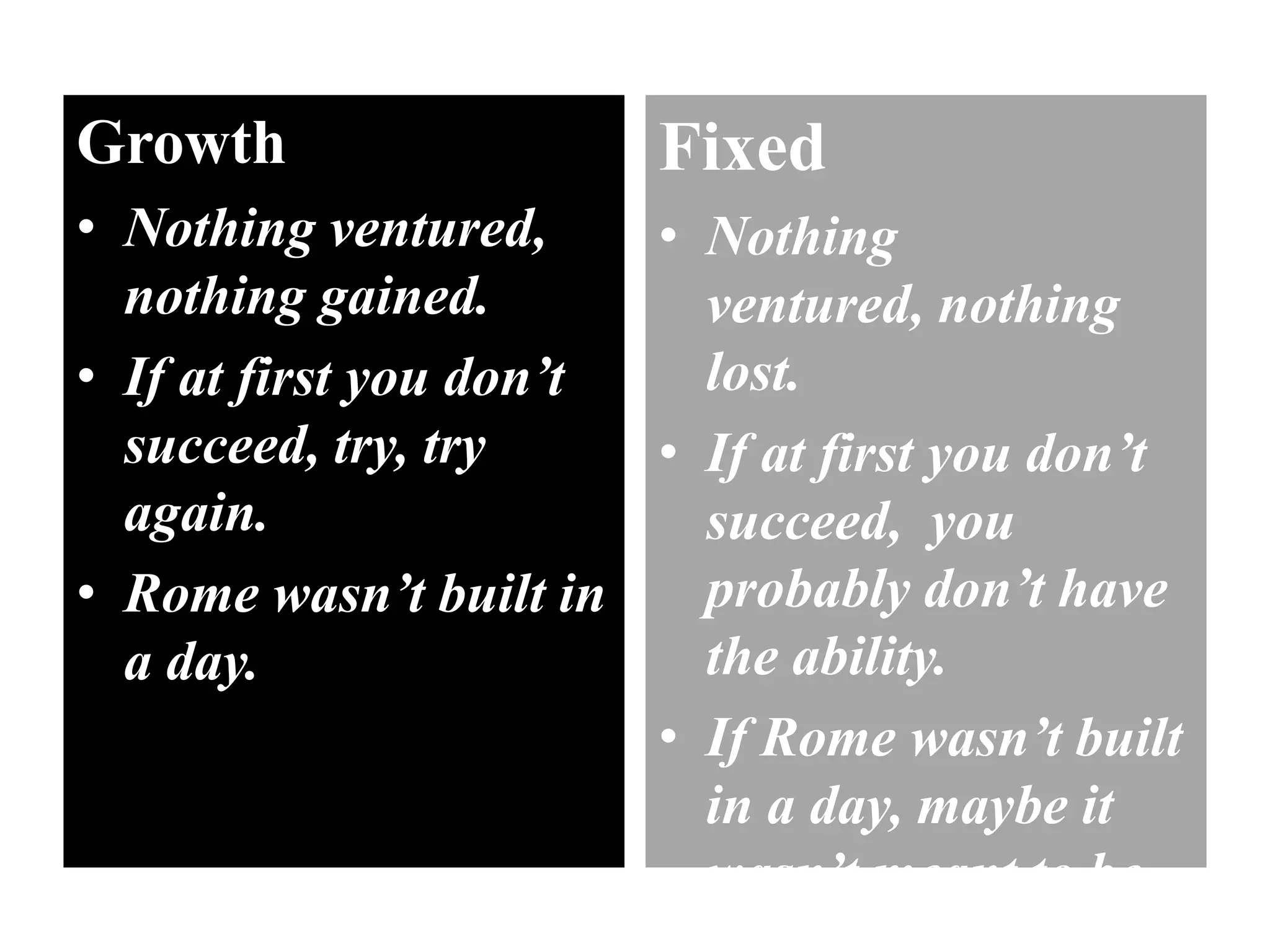
Growth                  Fixed
• Nothing ventured,     • Nothing
  nothing gained.         ventured, nothing
• If at first you don’t   lost.
  succeed, try, try     • If at first you don’t
  again.                  succeed, you
• Rome wasn’t built in    probably don’t have
  a day.                  the ability.
                        • If Rome wasn’t built
                          in a day, maybe it
                          wasn’t meant to be.
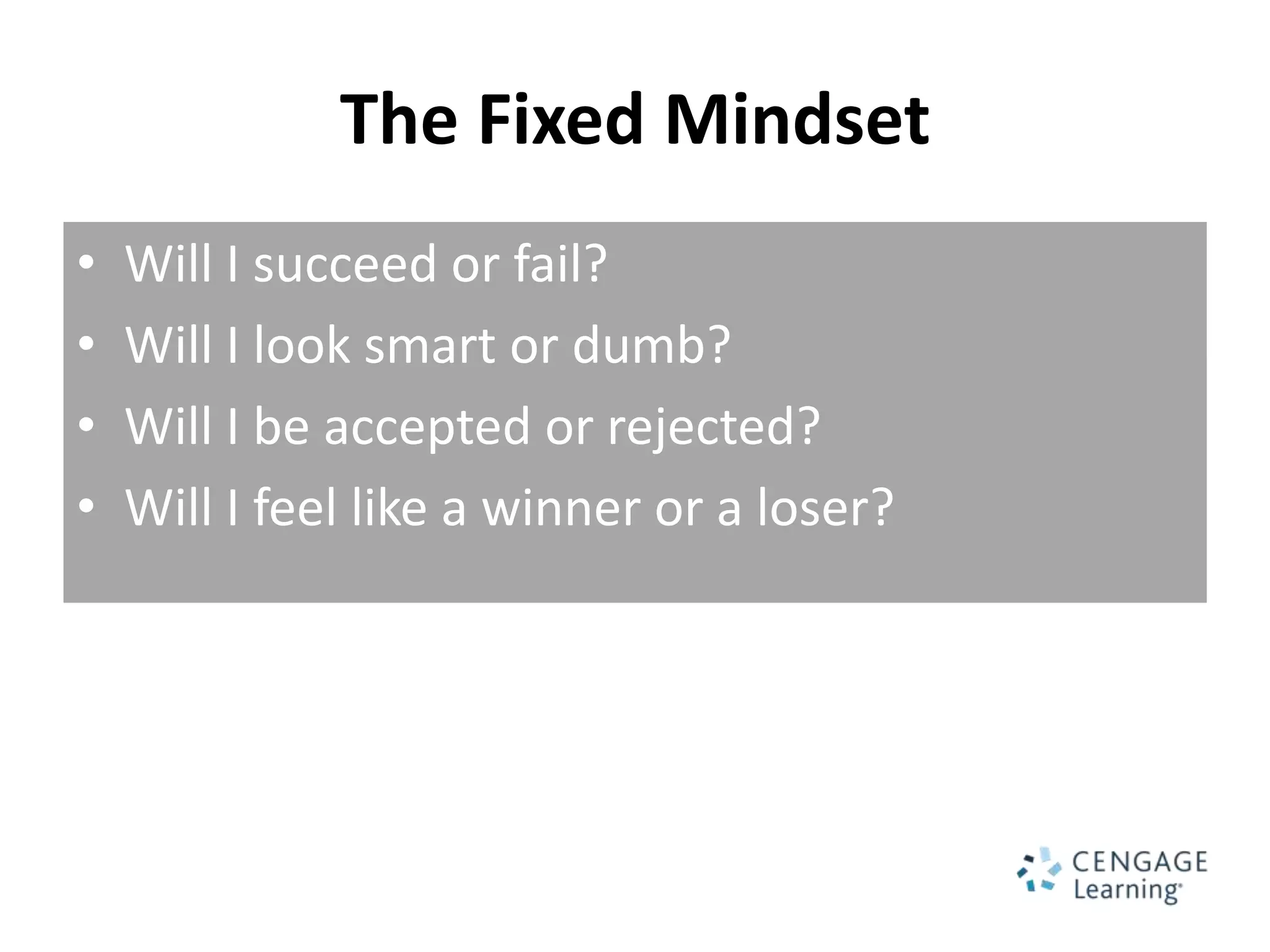
The Fixed Mindset
•   Will I succeed or fail?
•   Will I look smart or dumb?
•   Will I be accepted or rejected?
•   Will I feel like a winner or a loser?
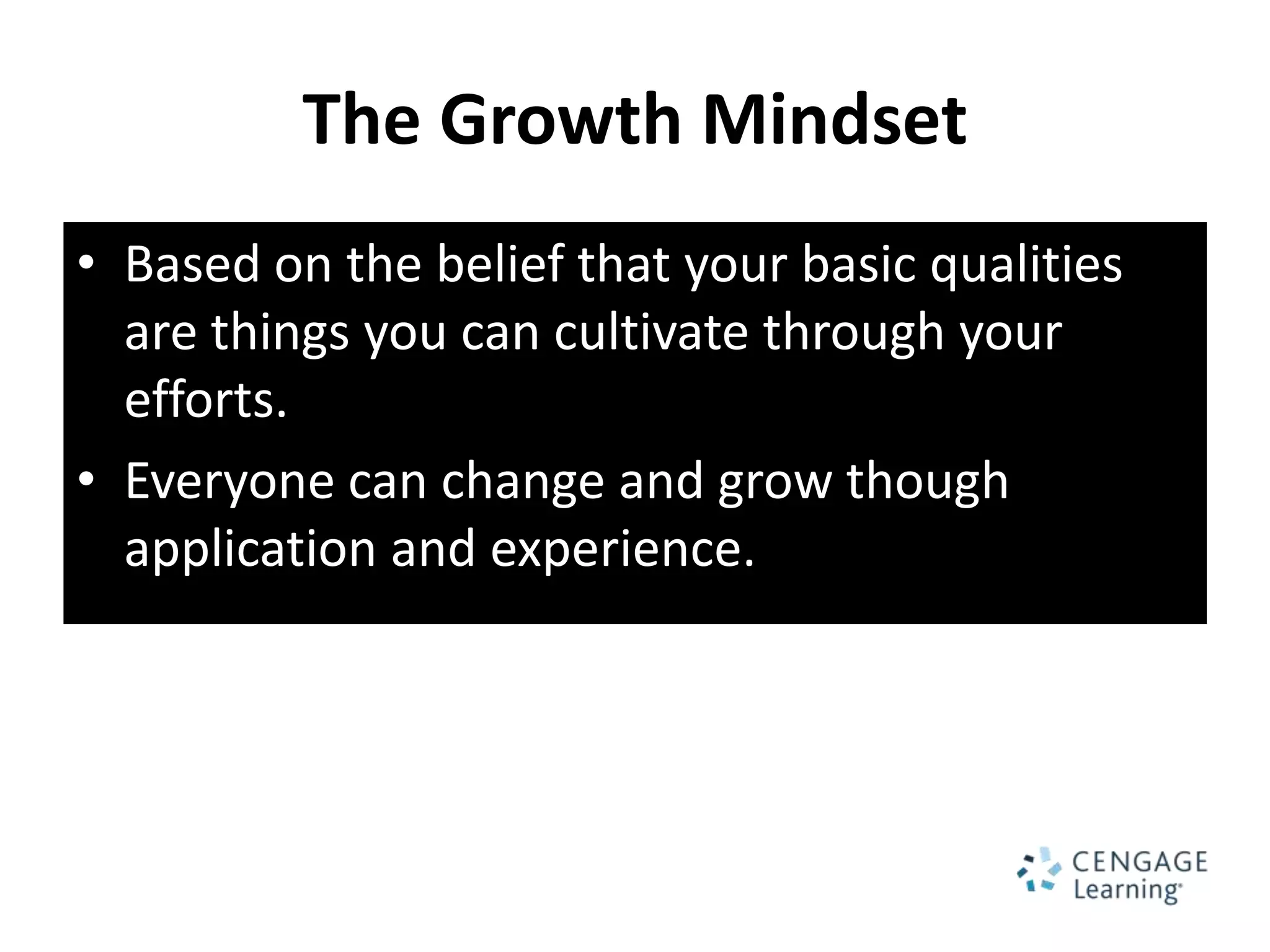
The Growth Mindset
• Based on the belief that your basic qualities
  are things you can cultivate through your
  efforts.
• Everyone can change and grow though
  application and experience.
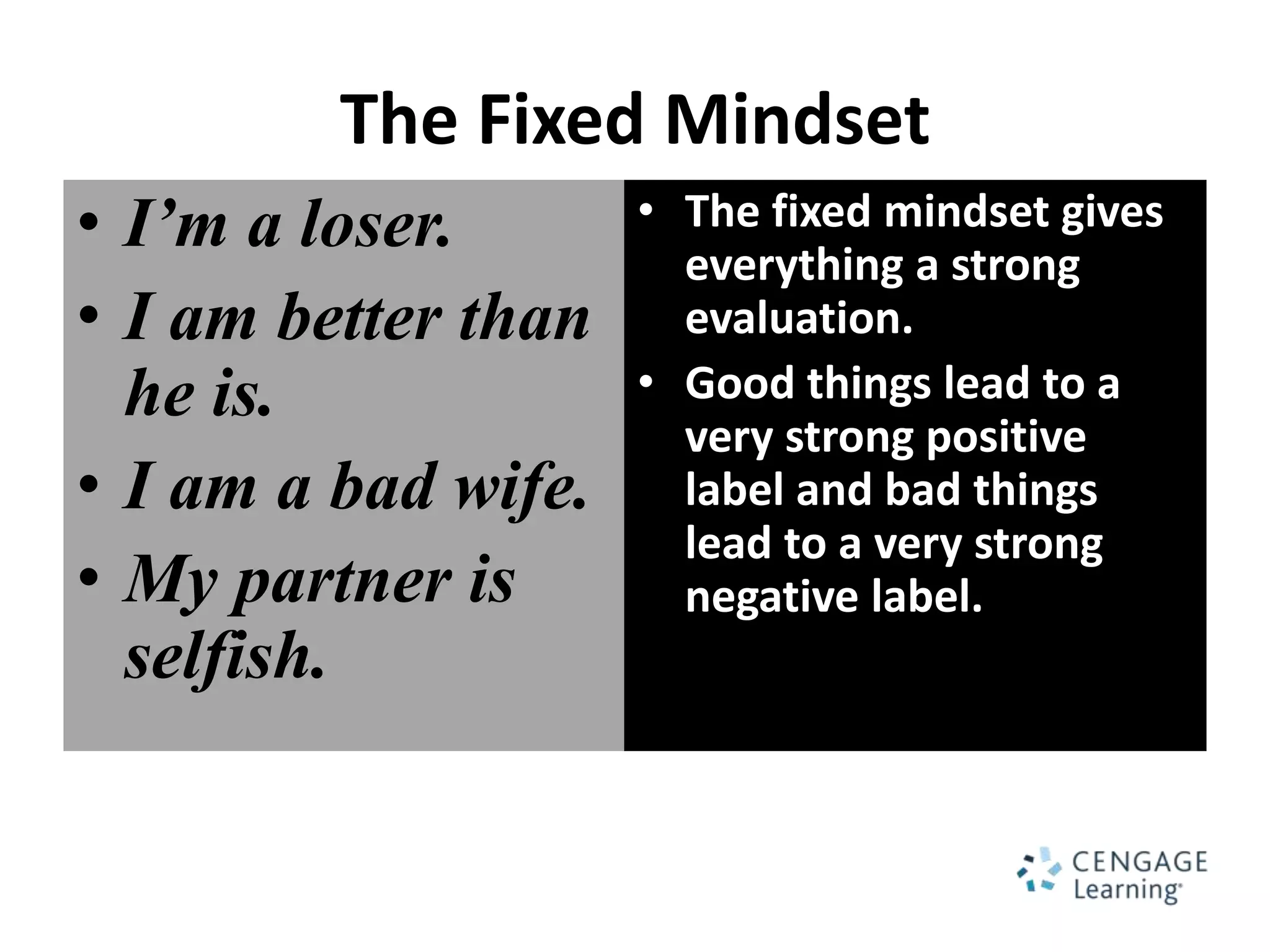
The Fixed Mindset
• I’m a loser.       • The fixed mindset gives
                       everything a strong
• I am better than     evaluation.
  he is.             • Good things lead to a
                       very strong positive
• I am a bad wife.     label and bad things
                       lead to a very strong
• My partner is        negative label.
  selfish.
The Growth Mindset
• What can I learn     • The growth mindset
  from this?             does not evaluate or
                         judge.
• How can I improve?   • People with the growth
• How can I do           mindset are attuned to
  better?                implications for
• How can I help         learning and
                         constructive action.
  someone else do
  better?
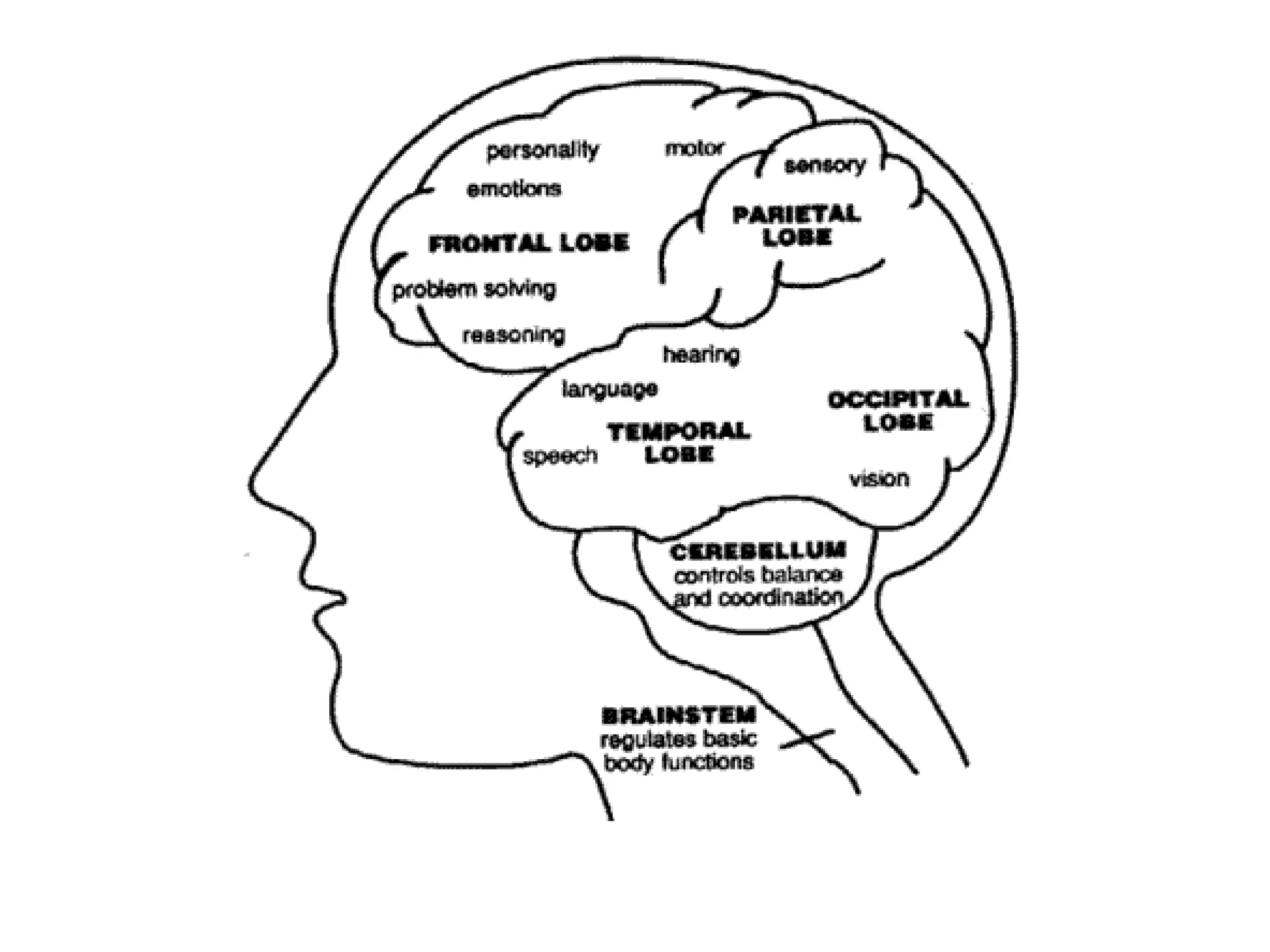
The entire brain is an organ of emotion, and
emotion, reason and memory are all linked
together (Zull, p. 65).
Feelings affect reasoning and memory.
Feelings can help us remember and forget.
They are essential for reasoning and they can
hinder reasoning.
Learning depends on the feelings of
learners.
Beliefs are the key to
happiness (or misery).
       Basis of cognitive therapy
ACTIVE LEARNING REQUIRES
     METACOGNITION
        (Bransford, et al, National Academies, 2000)


  Active Learning means helping students
     take control of their own learning
                        (p. 12)
SQ3R (A System)
•   Survey
•   Question
•   Read
•   Recite
    – Organize
    – Test
• Review
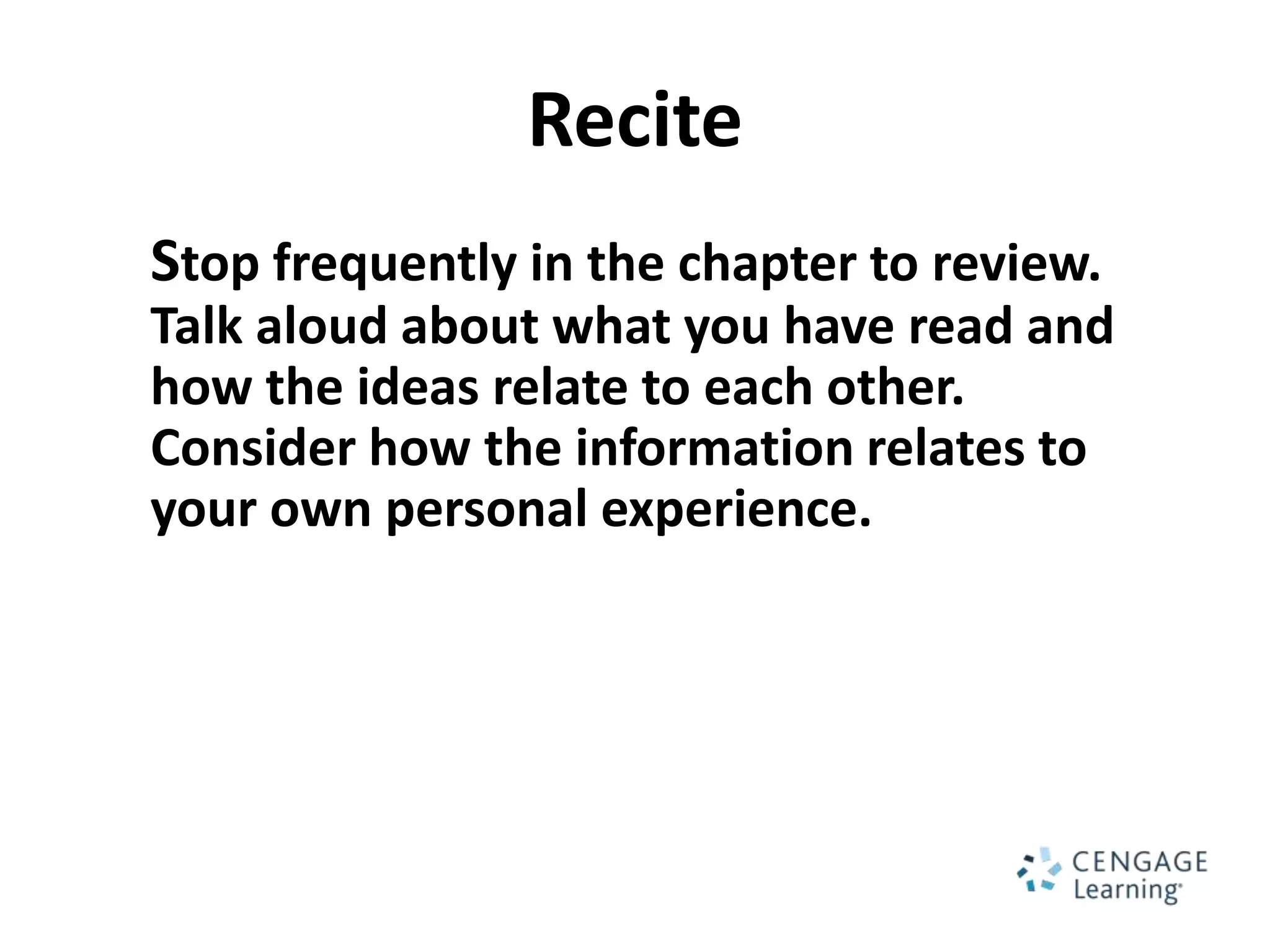
Recite
Stop frequently in the chapter to review.
Talk aloud about what you have read and
how the ideas relate to each other.
Consider how the information relates to
your own personal experience.
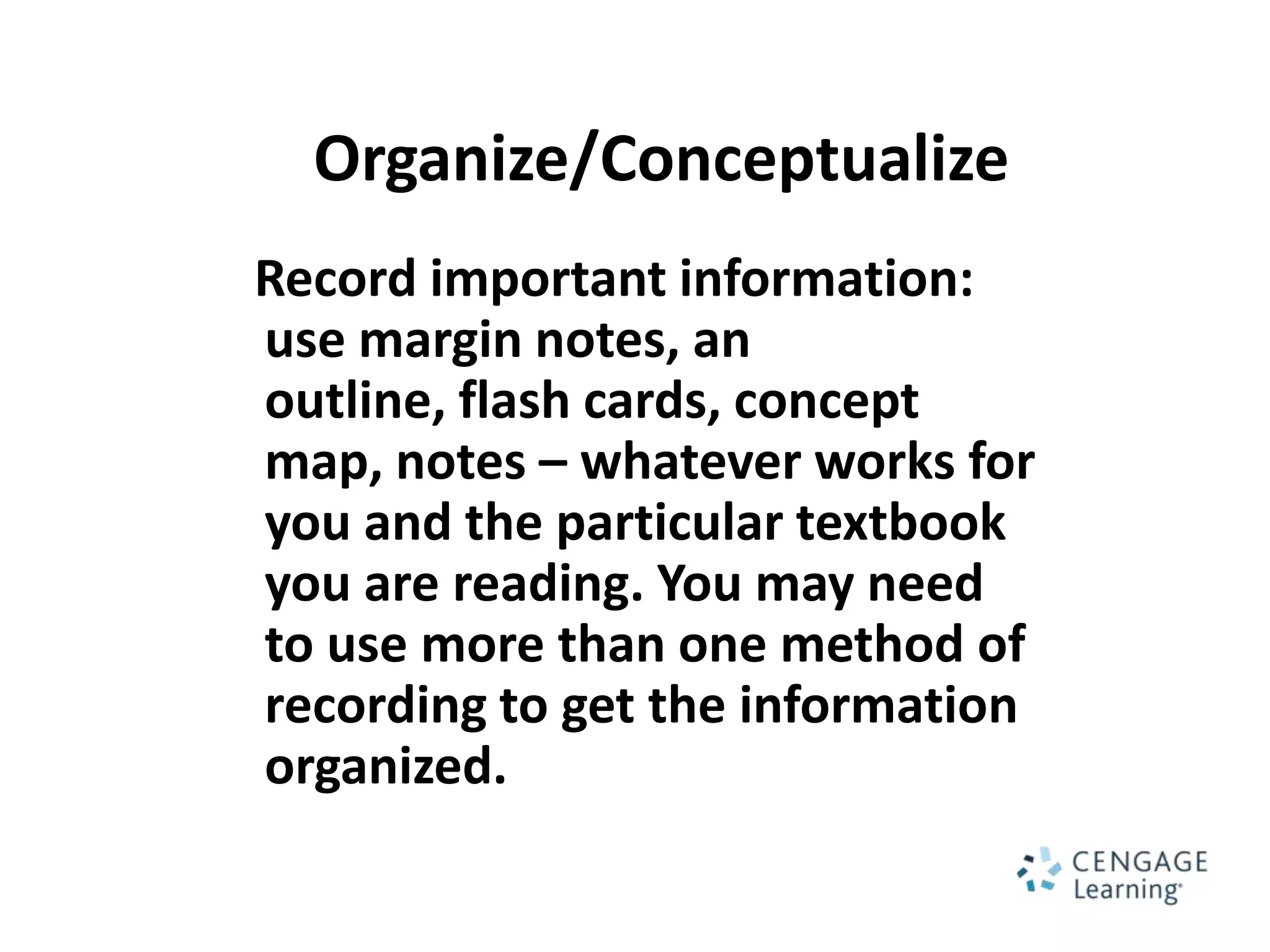
Organize/Conceptualize
Record important information:
use margin notes, an
outline, flash cards, concept
map, notes – whatever works for
you and the particular textbook
you are reading. You may need
to use more than one method of
recording to get the information
organized.
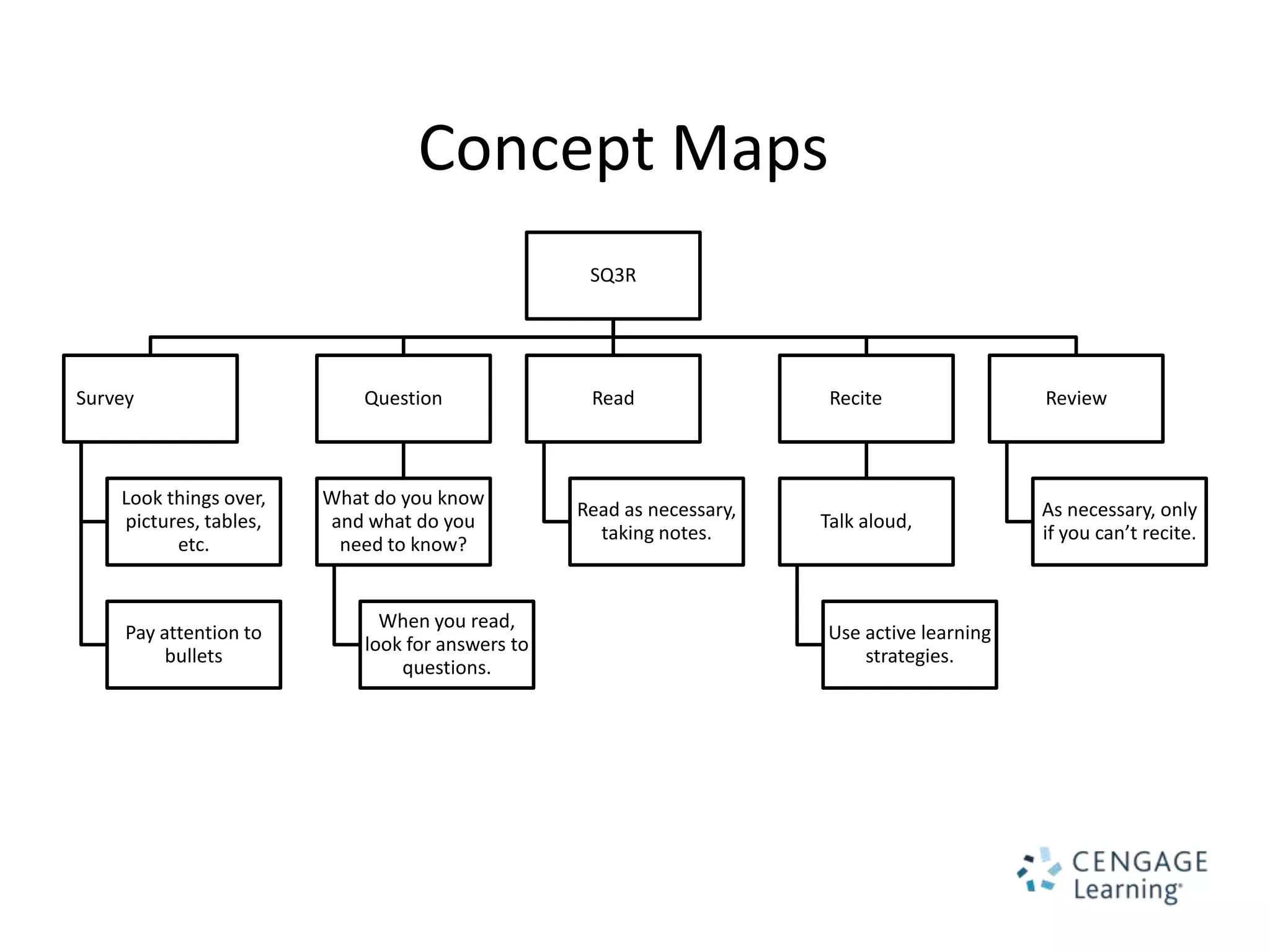
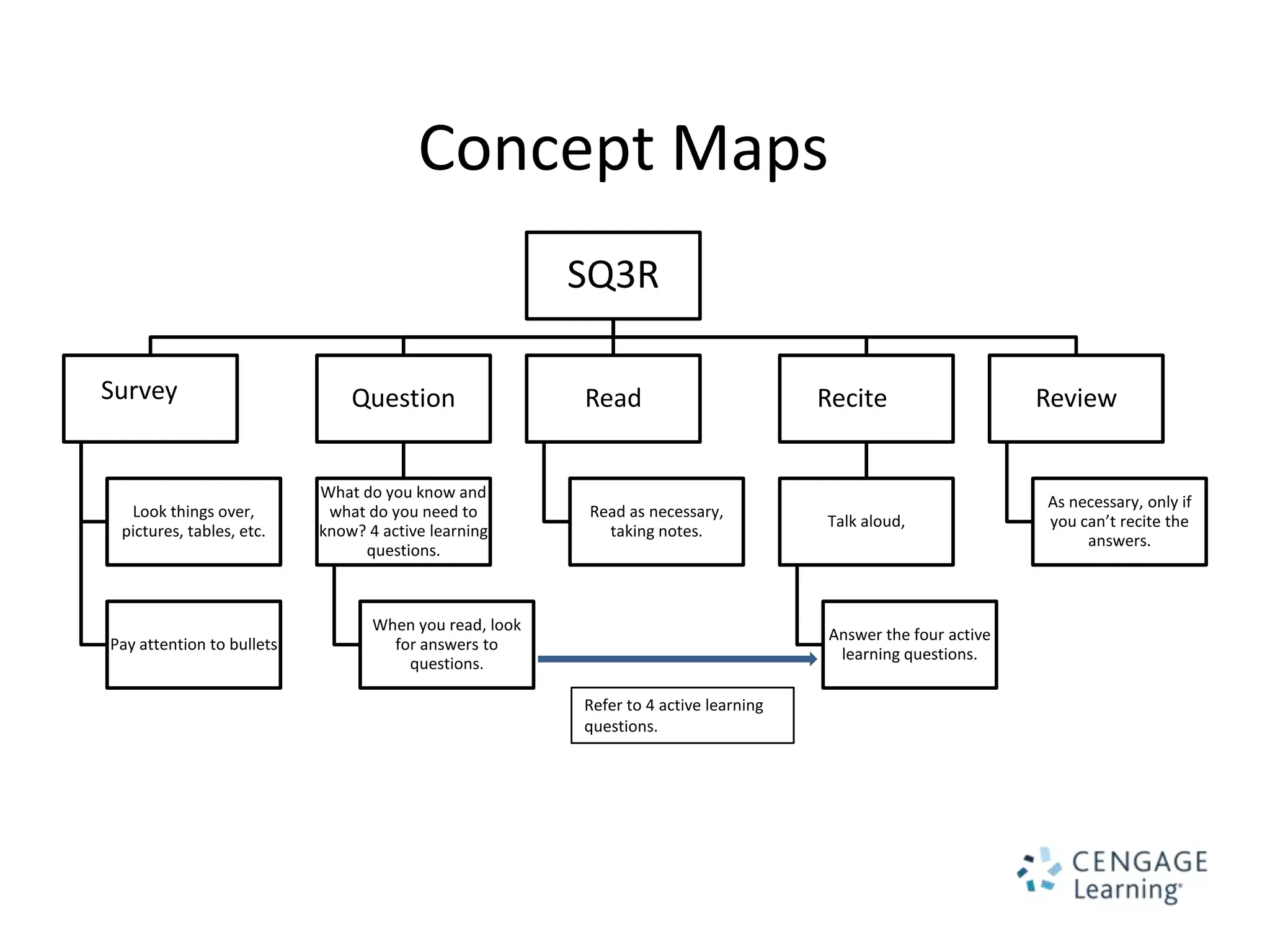
Concept Maps
                                                   SQ3R


Survey                      Question               Read                 Recite               Review


    Look things over,   What do you know
                                                  Read as necessary,                         As necessary, only
    pictures, tables,   and what do you                                Talk aloud,
                                                    taking notes.                            if you can’t recite.
          etc.           need to know?


                              When you read,
     Pay attention to                                                  Use active learning
                            look for answers to
          bullets                                                          strategies.
                                questions.
Concept Maps
                                                        SQ3R

Survey                         Question                 Read                         Recite                   Review


                           What do you know and
                                                                                                              As necessary, only if
  Look things over,         what do you need to         Read as necessary,
                                                                                     Talk aloud,              you can’t recite the
 pictures, tables, etc.    know? 4 active learning        taking notes.
                                                                                                                   answers.
                                questions.


                                  When you read, look
                                                                                     Answer the four active
Pay attention to bullets            for answers to
                                                                                      learning questions.
                                      questions.

                                                        Refer to 4 active learning
                                                        questions.
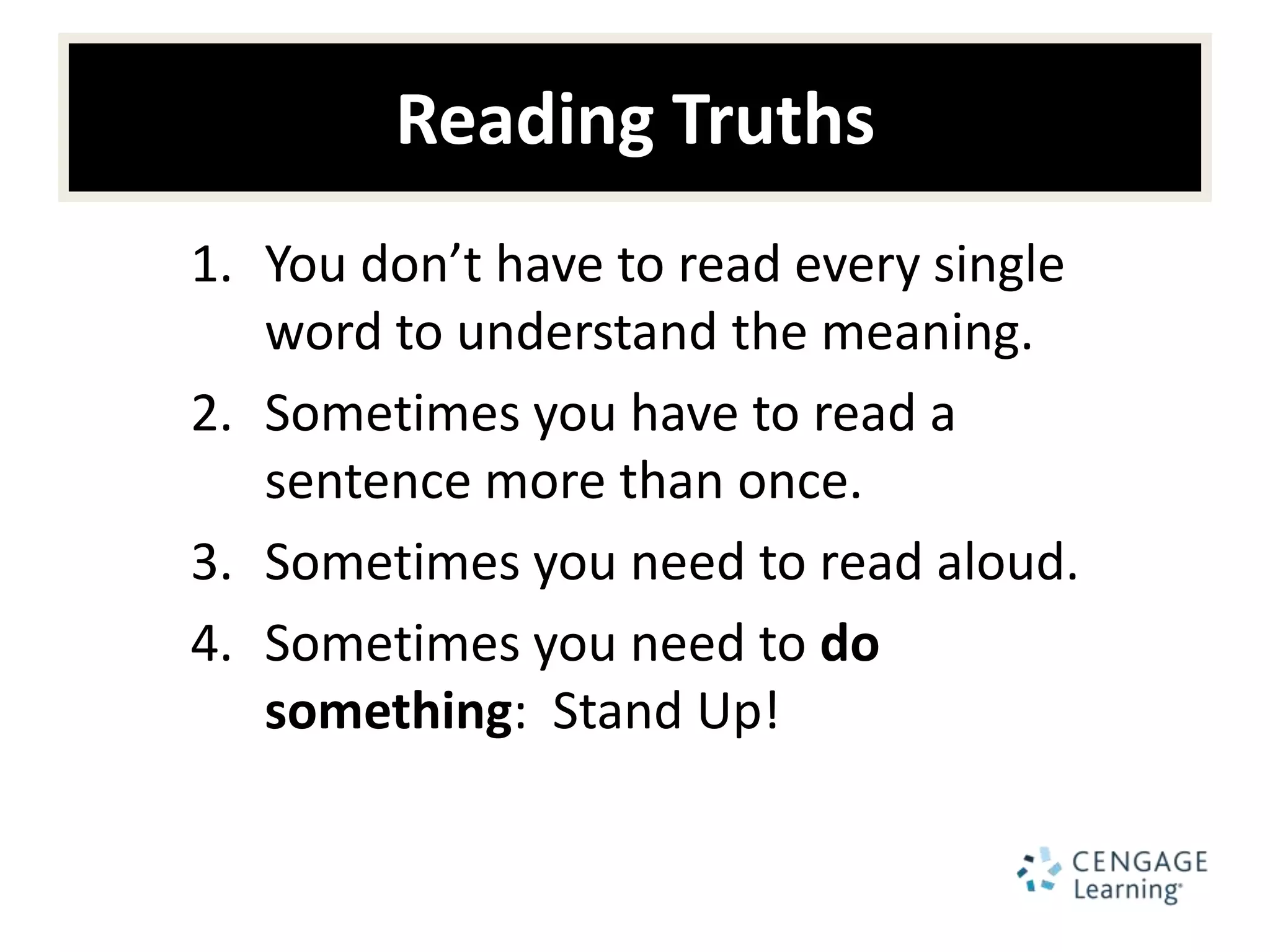
Reading Truths
1. You don’t have to read every single
   word to understand the meaning.
2. Sometimes you have to read a
   sentence more than once.
3. Sometimes you need to read aloud.
4. Sometimes you need to do
   something: Stand Up!
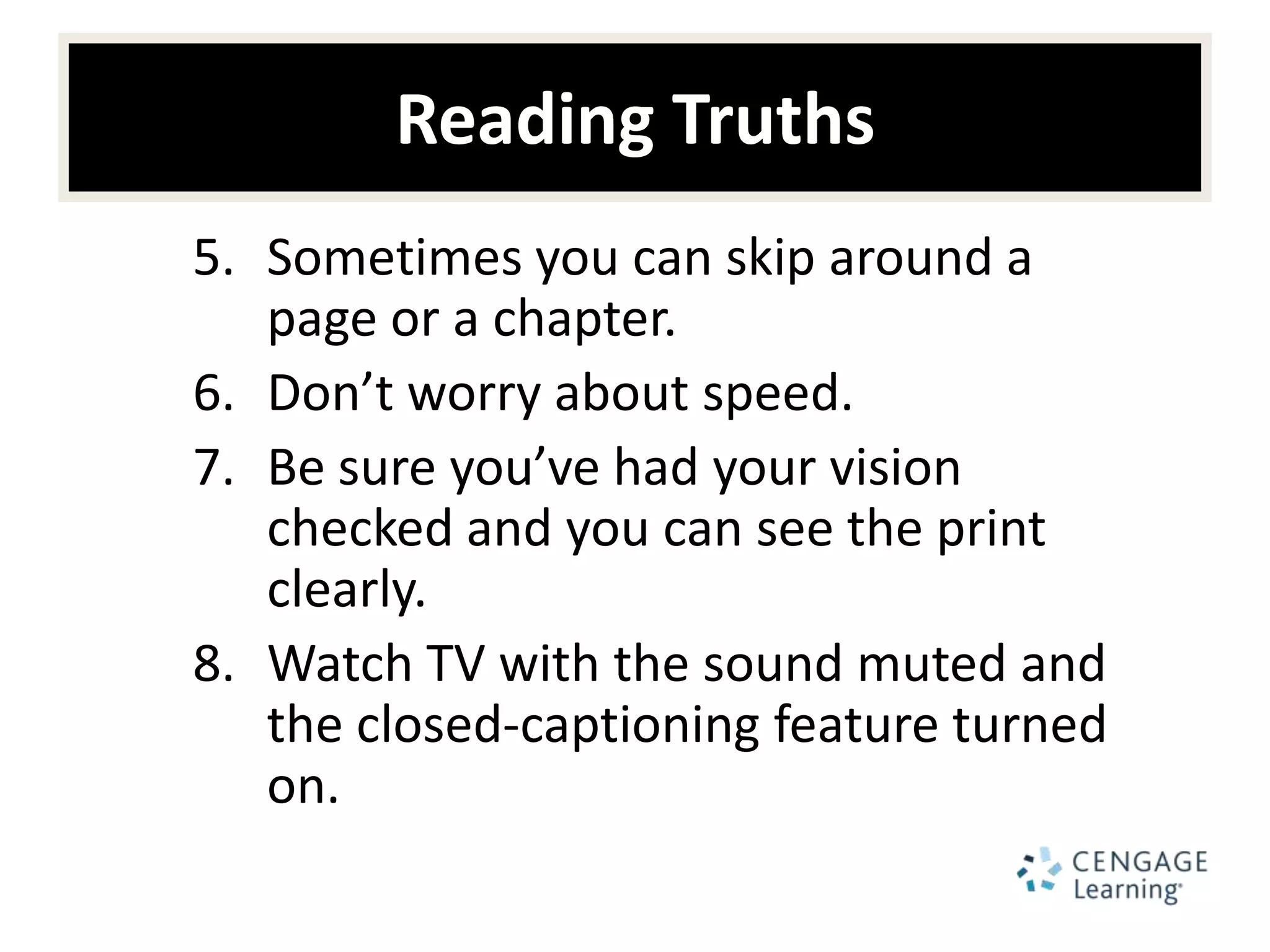
Reading Truths
5. Sometimes you can skip around a
   page or a chapter.
6. Don’t worry about speed.
7. Be sure you’ve had your vision
   checked and you can see the print
   clearly.
8. Watch TV with the sound muted and
   the closed-captioning feature turned
   on.
DEAR BOARD OF EDUCATION,
       SO ARE WE.
   SINCERELY, STUDENTS
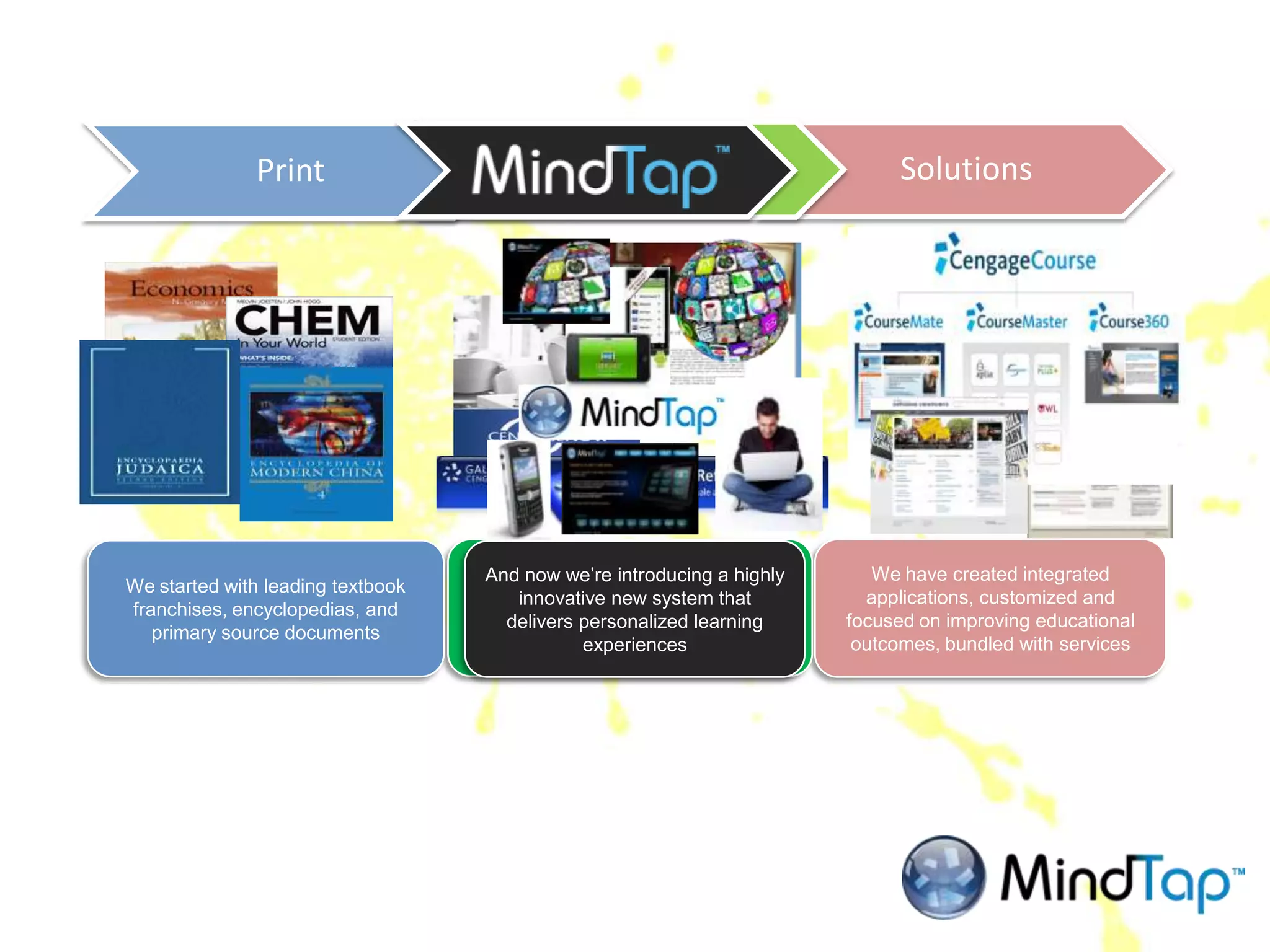
Print                            eBooks                            Solutions


                                     Overnow we’remigrated to eBooks
                                     And time, we introducing a highly         We have created integrated
We started with leading textbook
                                   and other digital products, making our
                                        innovative new system that            applications, customized and
franchises, encyclopedias, and
                                       assets available online and in
                                       delivers personalized learning       focused on improving educational
   primary source documents
                                               portable forms
                                                experiences                  outcomes, bundled with services
For more information:


Contact Gail Malone, Ph.D.
South Plains College,
Library 310
Levelland, TX 79336
(806) 716-2240
gmalone@southplainscollege.edu
© 2012
mindtap@cengage.com
References
Academic Skills Center. (2001. Dartmouth College available at
     http://www.dartmouth.edu/~acskills/docs/using_your_textbook.doc
Chew, Stephen. (2012). How to get the most out of studying [Available at
     http://www.youtube.com/playlist?list=PL85708E6EA236E3DB].
Davis, Stephen. (2007). Brain-based pedagogy. (available at
     http://www.hocking.edu/~aaffairs/FacDev_files/brain_based_pedagogy.htm
     )
Dweck, C. (2011). Mindsets [available at http://mindsetonline.com/].
National Research Council (2000). How people learn: Brain, mind, experience
     and school. Washington, DC: NRC. [Often referred to as Bransford, et al.]
Pelley, J. (2012). Success types [available at
     http://www.ttuhsc.edu/som/success/].
Smilkstein, Rita. (2007). Promising practices in education, Starlink telecast,
     March 27, 2007
     (for more information, see http://www.starlinktraining.org).
Willis, J. (2006). Research based strategies to ignite student learning.
     Alexandria, VA: ASCD.
Zull, J. (2002). The art of changing the brain: Enriching the practice of teaching
     by exploring the biology of learning. Sterling, VA: Stylus Publishing.

Cengage Webinar: Every time I start to read, I fall asleep

  • 1.
    active reading skillsfor college success Gail Malone, Ph.D. Director, Teaching & Learning Center South Plains College (806) 716-2240 gmalone@southplainscollege.edu Troy Anderson Market Development Manager Cengage Learning (248) 207-6649 troy.anderson@cengage.com
  • 2.
    “Reading is abasic tool in the living of a good life.” - Mortimer J. Adler http://en.wikipedia.org/wiki/File:Mortimer_Adler,_1988.jpg
  • 4.
    In grades k– 3, a student learns to read; in all the other grades, the student reads to learn. http://delightfulchildrensbooks.com/2012/05/14/learn-to-read/
  • 5.
  • 6.
    What was theage of the youngest person you have known to learn to read? What was the oldest? HAVE YOU HAD NONREADERS IN YOUR COLLEGE CLASSES?
  • 8.
    A student mustbe able to read correctly approximately 95% of the words in text in order to comprehend what is read.
  • 9.
    Table 3 Independent Reading Words Read Per Minutes Per Day Year 65.0 4,358,000 21.1 1,823,000 14.2 1,146,000 9.6 622,000 6.5 432,000 4.6 282,000 3.3 200,000 1.3 106,000 0.7 21,000 0.1 8,000 0.0 0 Variation in Amount of Independent Reading Cunningham & Stanovich (1999)
  • 10.
    The average childfrom a low-income family hears about 3 million words a year compared to 11 million from a middle-class professional family (Hart & Risley, 1995). HTTP://WWW.VIRTUALSALT.COM/VOCABLST.HTM College students need about 11000 to 14000 root words (meter in thermometer or centimeter).
  • 11.
    the POWER ofthe spoken word . . . Kindle Study @ South Plains College
  • 12.
    Academic reading isan exercise that requires the reader to be able to interact with text in ways that will aid retention and understanding of the material.
  • 13.
    SQ3R (A System) • Survey • Question • Read • Recite – Organize – Test • Review
  • 14.
    SQ3R (A System) • Survey • Question • Read • Recite – Organize – Test • Review
  • 15.
    Interaction: Questioning for Deep Learning Elaboration: How is this concept related to other concepts? Distinction: How is this concept different from other concepts? Personalization: How can I relate this to my own life? Retrieval and Application: How am I expected to use or apply this concept?
  • 17.
    Carol Dweck’s GrowthMindset Carol S. Dweck, Ph.D., is one of the world’s leading researchers in the field of motivation and is the Lewis and Virginia Eaton Professor of Psychology at Stanford University http://mindsetonline.com/ http://www.youtube.com/watch?v=ICILzbB1Obg
  • 18.
    Growth Fixed • Nothing ventured, • Nothing nothing gained. ventured, nothing • If at first you don’t lost. succeed, try, try • If at first you don’t again. succeed, you • Rome wasn’t built in probably don’t have a day. the ability. • If Rome wasn’t built in a day, maybe it wasn’t meant to be.
  • 19.
    The Fixed Mindset • Will I succeed or fail? • Will I look smart or dumb? • Will I be accepted or rejected? • Will I feel like a winner or a loser?
  • 20.
    The Growth Mindset •Based on the belief that your basic qualities are things you can cultivate through your efforts. • Everyone can change and grow though application and experience.
  • 21.
    The Fixed Mindset •I’m a loser. • The fixed mindset gives everything a strong • I am better than evaluation. he is. • Good things lead to a very strong positive • I am a bad wife. label and bad things lead to a very strong • My partner is negative label. selfish.
  • 22.
    The Growth Mindset •What can I learn • The growth mindset from this? does not evaluate or judge. • How can I improve? • People with the growth • How can I do mindset are attuned to better? implications for • How can I help learning and constructive action. someone else do better?
  • 23.
    The entire brainis an organ of emotion, and emotion, reason and memory are all linked together (Zull, p. 65). Feelings affect reasoning and memory. Feelings can help us remember and forget. They are essential for reasoning and they can hinder reasoning. Learning depends on the feelings of learners.
  • 24.
    Beliefs are thekey to happiness (or misery). Basis of cognitive therapy
  • 25.
    ACTIVE LEARNING REQUIRES METACOGNITION (Bransford, et al, National Academies, 2000) Active Learning means helping students take control of their own learning (p. 12)
  • 26.
    SQ3R (A System) • Survey • Question • Read • Recite – Organize – Test • Review
  • 27.
    Recite Stop frequently inthe chapter to review. Talk aloud about what you have read and how the ideas relate to each other. Consider how the information relates to your own personal experience.
  • 28.
    Organize/Conceptualize Record important information: usemargin notes, an outline, flash cards, concept map, notes – whatever works for you and the particular textbook you are reading. You may need to use more than one method of recording to get the information organized.
  • 29.
    Concept Maps SQ3R Survey Question Read Recite Review Look things over, What do you know Read as necessary, As necessary, only pictures, tables, and what do you Talk aloud, taking notes. if you can’t recite. etc. need to know? When you read, Pay attention to Use active learning look for answers to bullets strategies. questions.
  • 30.
    Concept Maps SQ3R Survey Question Read Recite Review What do you know and As necessary, only if Look things over, what do you need to Read as necessary, Talk aloud, you can’t recite the pictures, tables, etc. know? 4 active learning taking notes. answers. questions. When you read, look Answer the four active Pay attention to bullets for answers to learning questions. questions. Refer to 4 active learning questions.
  • 31.
    Reading Truths 1. Youdon’t have to read every single word to understand the meaning. 2. Sometimes you have to read a sentence more than once. 3. Sometimes you need to read aloud. 4. Sometimes you need to do something: Stand Up!
  • 32.
    Reading Truths 5. Sometimesyou can skip around a page or a chapter. 6. Don’t worry about speed. 7. Be sure you’ve had your vision checked and you can see the print clearly. 8. Watch TV with the sound muted and the closed-captioning feature turned on.
  • 34.
    DEAR BOARD OFEDUCATION, SO ARE WE. SINCERELY, STUDENTS
  • 35.
    Print eBooks Solutions Overnow we’remigrated to eBooks And time, we introducing a highly We have created integrated We started with leading textbook and other digital products, making our innovative new system that applications, customized and franchises, encyclopedias, and assets available online and in delivers personalized learning focused on improving educational primary source documents portable forms experiences outcomes, bundled with services
  • 37.
    For more information: ContactGail Malone, Ph.D. South Plains College, Library 310 Levelland, TX 79336 (806) 716-2240 gmalone@southplainscollege.edu © 2012
  • 38.
  • 39.
    References Academic Skills Center.(2001. Dartmouth College available at http://www.dartmouth.edu/~acskills/docs/using_your_textbook.doc Chew, Stephen. (2012). How to get the most out of studying [Available at http://www.youtube.com/playlist?list=PL85708E6EA236E3DB]. Davis, Stephen. (2007). Brain-based pedagogy. (available at http://www.hocking.edu/~aaffairs/FacDev_files/brain_based_pedagogy.htm ) Dweck, C. (2011). Mindsets [available at http://mindsetonline.com/]. National Research Council (2000). How people learn: Brain, mind, experience and school. Washington, DC: NRC. [Often referred to as Bransford, et al.] Pelley, J. (2012). Success types [available at http://www.ttuhsc.edu/som/success/]. Smilkstein, Rita. (2007). Promising practices in education, Starlink telecast, March 27, 2007 (for more information, see http://www.starlinktraining.org). Willis, J. (2006). Research based strategies to ignite student learning. Alexandria, VA: ASCD. Zull, J. (2002). The art of changing the brain: Enriching the practice of teaching by exploring the biology of learning. Sterling, VA: Stylus Publishing.