Erica Mitchell
                                                                             11/17/10

    Notes: This in-service is being provided to aid teachers in recognizing when students have obtained
    understanding of the curriculum. This course will dissect the difference between ―knowing‖ information
1   and ―understanding‖ the information. It will offer signs to look for when assessing for understanding.
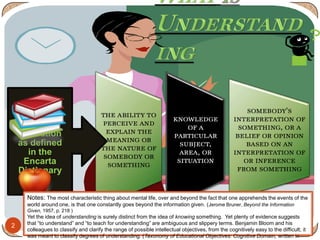
somebody's
                                        the ability to
                                                                         knowledge                  interpretation of
                                        perceive and
                                                                             of a                     something, or a
    Education                             explain the
                                                                         particular                  belief or opinion
                                          meaning or
    as defined                                                             subject,                     based on an
                                        the nature of
      in the                                                               area, or                 interpretation of
                                         somebody or
     Encarta                                                              situation                    or inference
                                          something
    Dictionary                                                                                       from something


      Notes: The most characteristic thing about mental life, over and beyond the fact that one apprehends the events of the
      world around one, is that one constantly goes beyond the information given. ( Jerome Bruner, Beyond the Information
      Given, 1957, p. 218 )
      Yet the idea of understanding is surely distinct from the idea of knowing something. Yet plenty of evidence suggests
      that ―to understand‖ and ―to teach for understanding‖ are ambiguous and slippery terms. Benjamin Bloom and his
2
      colleagues to classify and clarify the range of possible intellectual objectives, from the cognitively easy to the difficult; it
      was meant to classify degrees of understanding. (Taxonomy of Educational Objectives: Cognitive Domain, written in
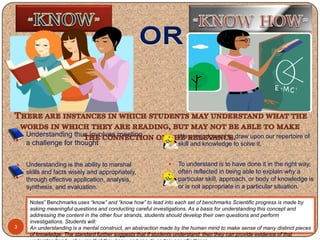
   Understanding thus involves meeting                         We use judgment to draw upon our repertoire of
    a challenge for thought                                      skill and knowledge to solve it.


   Understanding is the ability to marshal                     To understand is to have done it in the right way,
    skills and facts wisely and appropriately,                   often reflected in being able to explain why a
    through effective application, analysis,                     particular skill, approach, or body of knowledge is
    synthesis, and evaluation.                                   or is not appropriate in a particular situation.

     Notes‖ Benchmarks uses “know” and “know how” to lead into each set of benchmarks Scientific progress is made by
     asking meaningful questions and conducting careful investigations. As a basis for understanding this concept and
     addressing the content in the other four strands, students should develop their own questions and perform
     investigations. Students will:
3    An understanding is a mental construct, an abstraction made by the human mind to make sense of many distinct pieces
     of knowledge. The standard further suggests that if students understand, then they can provide evidence of that
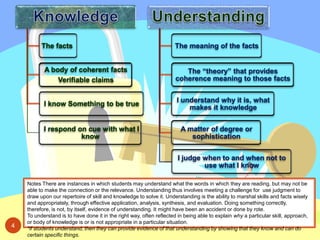
The facts                                                  The meaning of the facts


           A body of coherent facts                                      The “theory” that provides
               Verifiable claims                                      coherence meaning to those facts


                                                                      I understand why it is, what
           I know Something to be true
                                                                          makes it knowledge


           I respond on cue with what I                                 A matter of degree or
                      know                                                 sophistication


                                                                       I judge when to and when not to
                                                                               use what I know

    Notes There are instances in which students may understand what the words in which they are reading, but may not be
    able to make the connection or the relevance. Understanding thus involves meeting a challenge for use judgment to
    draw upon our repertoire of skill and knowledge to solve it. Understanding is the ability to marshal skills and facts wisely
    and appropriately, through effective application, analysis, synthesis, and evaluation. Doing something correctly,
    therefore, is not, by itself, evidence of understanding. It might have been an accident or done by rote.
    To understand is to have done it in the right way, often reflected in being able to explain why a particular skill, approach,
    or body of knowledge is or is not appropriate in a particular situation.
4   *if students understand, then they can provide evidence of that understanding by showing that they know and can do
    certain specific things.
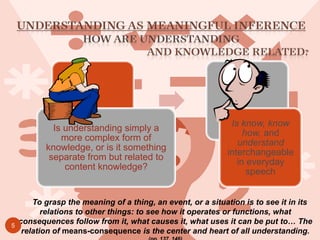
Is know, know
             Is understanding simply a
                                                                  how, and
               more complex form of
                                                                understand
           knowledge, or is it something
                                                             interchangeable
            separate from but related to
                                                                in everyday
                content knowledge?
                                                                   speech


        To grasp the meaning of a thing, an event, or a situation is to see it in its
           relations to other things: to see how it operates or functions, what
5
    consequences follow from it, what causes it, what uses it can be put to… The
     relation of means-consequence is the center and heart of all understanding.
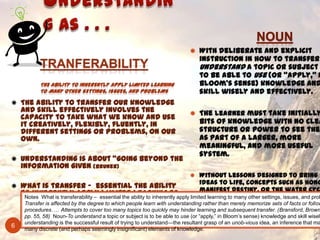
 With deliberate and explicit
                                                                                instruction in how to transfer
                                                                                understand a topic or subject
                                                                                to be able to use (or “apply,” i
                                                                                Bloom’s sense) knowledge and
                                                                                skill wisely and effectively.
 The ability to transfer our knowledge
    and skill effectively involves the                                       The learner must take initially
    capacity to take what we know and use
    it creatively, flexibly, fluently, in                                       bits of knowledge with no clea
    different settings or problems, on our                                      structure or power to see them
    own.                                                                        as part of a larger, more
                                                                                meaningful, and more useful
                                                                                system.
 Understanding is about “going beyond the
    information given (Bruner)
                                                                             Without lessons designed to bring
                                                                               ideas to life, concepts such as hono
 What is transfer – essential the ability
    to inherently applyessential the ability to inherently apply limited learningempty other or theissues, andcyc
     Notes What is transferability –
                                      limited learning to                      manifest destiny,
                                                                               remain to many phrases to be
                                                                                                        settings,
                                                                                                                   water
                                                                                                                                prob
    many other settings, issues, and problems                                  memorized, depriving learners of
     Transfer is affected by the degree to which people learn with understanding rather than merely memorize sets of facts or follow
     procedures. … Attempts to cover too many topics too quickly may hinder learning and subsequent transfer. (Bransford, Brown
                                                                               realization that ideas have power.
     pp. 55, 58) Noun-To understand a topic or subject is to be able to use (or ―apply,‖ in Bloom‘s sense) knowledge and skill wisely
     understanding is the successful result of trying to understand—the resultant grasp of an unob-vious idea, an inference that ma
6
     many discrete (and perhaps seemingly insignificant) elements of knowledge.
The Expert Blind Spot
Confusing what we (or textbook authors) talk about with the active meaning-making required by the learner to grasp
and use meaning.


                                 Blind Spot stated by Jerome Bruner
                               ‗Teaching specific topics or skills without
                               making clear their context in the broader
                               fundamental structure of a field of knowledge is
                               uneconomical.‖ The Process of Education, 1960, p. 31
                               • Blind spot 1- Such teaching makes it
                                 exceedingly difficult for the student to
                                 generalize from what he has learned to what he
                                 will encounter later

                               • Blind spot 2 -In the second place, [such]
                                 learning … has little reward in terms of
                                 intellectual excitement

                              • Blind spot 3 - Third, knowledge one has
                                acquired without sufficient structure to tie it
    Notes The Expert Blind Spot -confusing whatknowledge that is likely to be
                                together is we (or textbook authors) talk about with the active meaning-making required
                                forgotten.
    by the learner to grasp and use meaning.
   To understand a topic or subject is to be able to use (or ―apply,‖ in Bloom‘s sense) knowledge and skill wisely and effectively.
   An understanding is the successful result of trying to understand—the resultant grasp of an unobvious idea, an inference
 7 that makes meaning of many discrete (and perhaps seemingly insignificant) elements of knowledge.
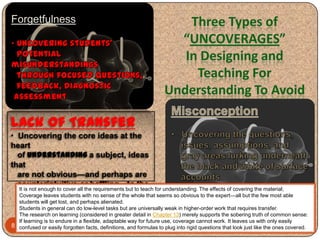
Forgetfulness


  It is not enough to cover all the requirements but to teach for understanding. The effects of covering the material;
  Coverage leaves students with no sense of the whole that seems so obvious to the expert—all but the few most able
  students will get lost, and perhaps alienated.
  Students in general can do low-level tasks but are universally weak in higher-order work that requires transfer.
  The research on learning (considered in greater detail in Chapter 13) merely supports the sobering truth of common sense:
  If learning is to endure in a flexible, adaptable way for future use, coverage cannot work. It leaves us with only easily
8 confused or easily forgotten facts, definitions, and formulas to plug into rigid questions that look just like the ones covered.
.
9
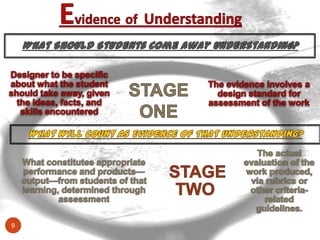
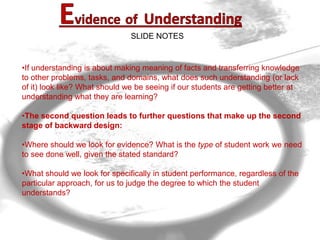
SLIDE NOTES


     •If understanding is about making meaning of facts and transferring knowledge
     to other problems, tasks, and domains, what does such understanding (or lack
     of it) look like? What should we be seeing if our students are getting better at
     understanding what they are learning?

     •The second question leads to further questions that make up the second
     stage of backward design:

     •Where should we look for evidence? What is the type of student work we need
     to see done well, given the stated standard?

     •What should we look for specifically in student performance, regardless of the
     particular approach, for us to judge the degree to which the student
     understands?


10
11
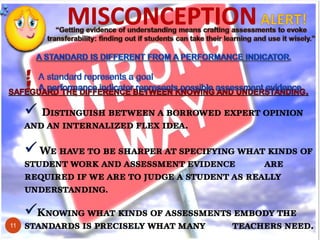
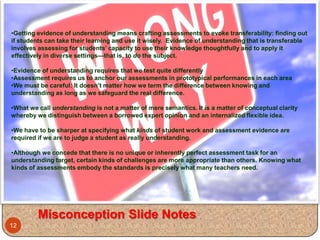
•Getting evidence of understanding means crafting assessments to evoke transferability: finding out
if students can take their learning and use it wisely. Evidence of understanding that is transferable
involves assessing for students’ capacity to use their knowledge thoughtfully and to apply it
effectively in diverse settings—that is, to do the subject.

•Evidence of understanding requires that we test quite differently
•Assessment requires us to anchor our assessments in prototypical performances in each area
•We must be careful: It doesn’t matter how we term the difference between knowing and
understanding as long as we safeguard the real difference.

•What we call understanding is not a matter of mere semantics. It is a matter of conceptual clarity
whereby we distinguish between a borrowed expert opinion and an internalized flexible idea.

•We have to be sharper at specifying what kinds of student work and assessment evidence are
required if we are to judge a student as really understanding.

•Although we concede that there is no unique or inherently perfect assessment task for an
understanding target, certain kinds of challenges are more appropriate than others. Knowing what
kinds of assessments embody the standards is precisely what many teachers need.


         Misconception Slide Notes
12
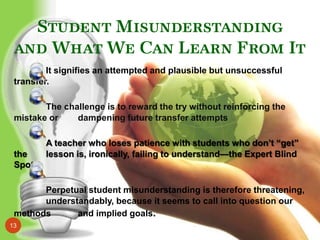
Student Misunderstanding
 and What We Can Learn From It
         It signifies an attempted and plausible but unsuccessful
 transfer.

        The challenge is to reward the try without reinforcing the
 mistake or    dampening future transfer attempts

        A teacher who loses patience with students who don’t “get”
 the    lesson is, ironically, failing to understand—the Expert Blind
 Spot

       Perpetual student misunderstanding is therefore threatening,
       understandably, because it seems to call into question our
 methods      and implied goals.
13
Student Misunderstanding and
        What We Can Learn From It
                      SLIDE NOTES
     •Misunderstanding is not ignorance, but it is the
     mapping of a working idea in a plausible but incorrect
     way in a new situation.

     •We must begin to design assessments in recognition of
     the need for conceptual benchmarks, not just
     performance abilities. We need to design assessments
     mindful of not only the big ideas but also the likelihood
     that those ideas will be misconceived—and will resist
     being overcome.


14
15
SLIDE NOTES


• Misunderstanding is not ignorance, but It is the mapping of a working
idea in a plausible but incorrect way in a new situation.

• It signifies an attempted and plausible but unsuccessful transfer.

• The challenge is to reward the try without reinforcing the mistake or
dampening future transfer attempts

• A teacher who loses patience with students who don‘t ―get‖ the lesson is,
ironically, failing to understand—the Expert Blind Spot
perpetual student misunderstanding is therefore threatening,
understandably, because it seems to call into question our methods and
implied goals.


16
Institutional Approaches to Curriculum Designs. JISC. (2010). Retrieved 11/7/10 from
http://www.jisc.ac.uk/what/we do/programmes/elearning/curriculumdesign.aspx


Wiggins, G. & McTighe, J. (2006). Understanding by Design (2 nd ed.). Upper Saddle River,
NJ: Pearson.

 17

Understanding understanding with notes

  • 1.
    Erica Mitchell 11/17/10 Notes: This in-service is being provided to aid teachers in recognizing when students have obtained understanding of the curriculum. This course will dissect the difference between ―knowing‖ information 1 and ―understanding‖ the information. It will offer signs to look for when assessing for understanding.
  • 2.
    somebody's the ability to knowledge interpretation of perceive and of a something, or a Education explain the particular belief or opinion meaning or as defined subject, based on an the nature of in the area, or interpretation of somebody or Encarta situation or inference something Dictionary from something Notes: The most characteristic thing about mental life, over and beyond the fact that one apprehends the events of the world around one, is that one constantly goes beyond the information given. ( Jerome Bruner, Beyond the Information Given, 1957, p. 218 ) Yet the idea of understanding is surely distinct from the idea of knowing something. Yet plenty of evidence suggests that ―to understand‖ and ―to teach for understanding‖ are ambiguous and slippery terms. Benjamin Bloom and his 2 colleagues to classify and clarify the range of possible intellectual objectives, from the cognitively easy to the difficult; it was meant to classify degrees of understanding. (Taxonomy of Educational Objectives: Cognitive Domain, written in
  • 3.
    Understanding thus involves meeting  We use judgment to draw upon our repertoire of a challenge for thought skill and knowledge to solve it.  Understanding is the ability to marshal  To understand is to have done it in the right way, skills and facts wisely and appropriately, often reflected in being able to explain why a through effective application, analysis, particular skill, approach, or body of knowledge is synthesis, and evaluation. or is not appropriate in a particular situation. Notes‖ Benchmarks uses “know” and “know how” to lead into each set of benchmarks Scientific progress is made by asking meaningful questions and conducting careful investigations. As a basis for understanding this concept and addressing the content in the other four strands, students should develop their own questions and perform investigations. Students will: 3 An understanding is a mental construct, an abstraction made by the human mind to make sense of many distinct pieces of knowledge. The standard further suggests that if students understand, then they can provide evidence of that
  • 4.
    The facts The meaning of the facts A body of coherent facts The “theory” that provides Verifiable claims coherence meaning to those facts I understand why it is, what I know Something to be true makes it knowledge I respond on cue with what I A matter of degree or know sophistication I judge when to and when not to use what I know Notes There are instances in which students may understand what the words in which they are reading, but may not be able to make the connection or the relevance. Understanding thus involves meeting a challenge for use judgment to draw upon our repertoire of skill and knowledge to solve it. Understanding is the ability to marshal skills and facts wisely and appropriately, through effective application, analysis, synthesis, and evaluation. Doing something correctly, therefore, is not, by itself, evidence of understanding. It might have been an accident or done by rote. To understand is to have done it in the right way, often reflected in being able to explain why a particular skill, approach, or body of knowledge is or is not appropriate in a particular situation. 4 *if students understand, then they can provide evidence of that understanding by showing that they know and can do certain specific things.
  • 5.
    Is know, know Is understanding simply a how, and more complex form of understand knowledge, or is it something interchangeable separate from but related to in everyday content knowledge? speech To grasp the meaning of a thing, an event, or a situation is to see it in its relations to other things: to see how it operates or functions, what 5 consequences follow from it, what causes it, what uses it can be put to… The relation of means-consequence is the center and heart of all understanding.
  • 6.
     With deliberateand explicit instruction in how to transfer understand a topic or subject to be able to use (or “apply,” i Bloom’s sense) knowledge and skill wisely and effectively.  The ability to transfer our knowledge and skill effectively involves the  The learner must take initially capacity to take what we know and use it creatively, flexibly, fluently, in bits of knowledge with no clea different settings or problems, on our structure or power to see them own. as part of a larger, more meaningful, and more useful system.  Understanding is about “going beyond the information given (Bruner)  Without lessons designed to bring ideas to life, concepts such as hono  What is transfer – essential the ability to inherently applyessential the ability to inherently apply limited learningempty other or theissues, andcyc Notes What is transferability – limited learning to manifest destiny, remain to many phrases to be settings, water prob many other settings, issues, and problems memorized, depriving learners of Transfer is affected by the degree to which people learn with understanding rather than merely memorize sets of facts or follow procedures. … Attempts to cover too many topics too quickly may hinder learning and subsequent transfer. (Bransford, Brown realization that ideas have power. pp. 55, 58) Noun-To understand a topic or subject is to be able to use (or ―apply,‖ in Bloom‘s sense) knowledge and skill wisely understanding is the successful result of trying to understand—the resultant grasp of an unob-vious idea, an inference that ma 6 many discrete (and perhaps seemingly insignificant) elements of knowledge.
  • 7.
    The Expert BlindSpot Confusing what we (or textbook authors) talk about with the active meaning-making required by the learner to grasp and use meaning. Blind Spot stated by Jerome Bruner ‗Teaching specific topics or skills without making clear their context in the broader fundamental structure of a field of knowledge is uneconomical.‖ The Process of Education, 1960, p. 31 • Blind spot 1- Such teaching makes it exceedingly difficult for the student to generalize from what he has learned to what he will encounter later • Blind spot 2 -In the second place, [such] learning … has little reward in terms of intellectual excitement • Blind spot 3 - Third, knowledge one has acquired without sufficient structure to tie it Notes The Expert Blind Spot -confusing whatknowledge that is likely to be together is we (or textbook authors) talk about with the active meaning-making required forgotten. by the learner to grasp and use meaning. To understand a topic or subject is to be able to use (or ―apply,‖ in Bloom‘s sense) knowledge and skill wisely and effectively. An understanding is the successful result of trying to understand—the resultant grasp of an unobvious idea, an inference 7 that makes meaning of many discrete (and perhaps seemingly insignificant) elements of knowledge.
  • 8.
    Forgetfulness Itis not enough to cover all the requirements but to teach for understanding. The effects of covering the material; Coverage leaves students with no sense of the whole that seems so obvious to the expert—all but the few most able students will get lost, and perhaps alienated. Students in general can do low-level tasks but are universally weak in higher-order work that requires transfer. The research on learning (considered in greater detail in Chapter 13) merely supports the sobering truth of common sense: If learning is to endure in a flexible, adaptable way for future use, coverage cannot work. It leaves us with only easily 8 confused or easily forgotten facts, definitions, and formulas to plug into rigid questions that look just like the ones covered.
  • 9.
  • 10.
    SLIDE NOTES •If understanding is about making meaning of facts and transferring knowledge to other problems, tasks, and domains, what does such understanding (or lack of it) look like? What should we be seeing if our students are getting better at understanding what they are learning? •The second question leads to further questions that make up the second stage of backward design: •Where should we look for evidence? What is the type of student work we need to see done well, given the stated standard? •What should we look for specifically in student performance, regardless of the particular approach, for us to judge the degree to which the student understands? 10
  • 11.
  • 12.
    •Getting evidence ofunderstanding means crafting assessments to evoke transferability: finding out if students can take their learning and use it wisely. Evidence of understanding that is transferable involves assessing for students’ capacity to use their knowledge thoughtfully and to apply it effectively in diverse settings—that is, to do the subject. •Evidence of understanding requires that we test quite differently •Assessment requires us to anchor our assessments in prototypical performances in each area •We must be careful: It doesn’t matter how we term the difference between knowing and understanding as long as we safeguard the real difference. •What we call understanding is not a matter of mere semantics. It is a matter of conceptual clarity whereby we distinguish between a borrowed expert opinion and an internalized flexible idea. •We have to be sharper at specifying what kinds of student work and assessment evidence are required if we are to judge a student as really understanding. •Although we concede that there is no unique or inherently perfect assessment task for an understanding target, certain kinds of challenges are more appropriate than others. Knowing what kinds of assessments embody the standards is precisely what many teachers need. Misconception Slide Notes 12
  • 13.
    Student Misunderstanding andWhat We Can Learn From It It signifies an attempted and plausible but unsuccessful transfer. The challenge is to reward the try without reinforcing the mistake or dampening future transfer attempts A teacher who loses patience with students who don’t “get” the lesson is, ironically, failing to understand—the Expert Blind Spot Perpetual student misunderstanding is therefore threatening, understandably, because it seems to call into question our methods and implied goals. 13
  • 14.
    Student Misunderstanding and What We Can Learn From It SLIDE NOTES •Misunderstanding is not ignorance, but it is the mapping of a working idea in a plausible but incorrect way in a new situation. •We must begin to design assessments in recognition of the need for conceptual benchmarks, not just performance abilities. We need to design assessments mindful of not only the big ideas but also the likelihood that those ideas will be misconceived—and will resist being overcome. 14
  • 15.
  • 16.
    SLIDE NOTES • Misunderstandingis not ignorance, but It is the mapping of a working idea in a plausible but incorrect way in a new situation. • It signifies an attempted and plausible but unsuccessful transfer. • The challenge is to reward the try without reinforcing the mistake or dampening future transfer attempts • A teacher who loses patience with students who don‘t ―get‖ the lesson is, ironically, failing to understand—the Expert Blind Spot perpetual student misunderstanding is therefore threatening, understandably, because it seems to call into question our methods and implied goals. 16
  • 17.
    Institutional Approaches toCurriculum Designs. JISC. (2010). Retrieved 11/7/10 from http://www.jisc.ac.uk/what/we do/programmes/elearning/curriculumdesign.aspx Wiggins, G. & McTighe, J. (2006). Understanding by Design (2 nd ed.). Upper Saddle River, NJ: Pearson. 17

Editor's Notes

  • #2 This in-service is being provided to aid teachers in recognizing when students have obtained understanding of the curriculum. This course will dissect the difference between “knowing” information and “understanding” the information. It will offer signs to look for when assessing for understanding.
  • #3 2 The most characteristic thing about mental life, over and beyond the fact that one apprehends the events of the world around one, is that one constantly goes beyond the information given. (Jerome Bruner, Beyond the Information Given, 1957, p. 218 )Yet the idea of understanding is surely distinct from the idea of knowing something. Yet plenty of evidence suggests that “to understand” and “to teach for understanding” are ambiguous and slippery terms.by Benjamin Bloom and his colleagues to classify and clarify the range of possible intellectual objectives, from the cognitively easy to the difficult; it was meant to classify degrees of understanding, in effect. (Taxonomy of Educational Objectives: Cognitive Domain, written in 1956 )
  • #4 Benchmarks uses “know” and “know how” to lead into each set of benchmarksScientific progress is made by asking meaningful questions and conducting careful investigations. As a basis for understanding this concept and addressing the content in the other four strands, students should develop their own questions and perform investigations. Students will:An understanding is a mental construct, an abstraction made by the human mind to make sense of many distinct pieces of knowledge. The standard further suggests that if students understand, then they can provide evidence of that understanding by showing that they know and can do certain specific things.
  • #5 There are instances in which students may understand what the words in which they are reading, but may not be able to make the connection or the relevance.Understanding thus involves meeting a challenge for thoughtWe use judgment to draw upon our repertoire of skill and knowledge to solve it.Understanding is the ability to marshal skills and facts wisely and appropriately, through effective application, analysis, synthesis, and evaluation. Doing something correctly, therefore, is not, by itself, evidence of understanding. It might have been an accident or done by rote.To understand is to have done it in the right way, often reflected in being able to explain why a particular skill, approach, or body of knowledge is or is not appropriate in a particular situation.
  • #6 To grasp the meaning of a thing, an event, or a situation is to see it in its relations to other things: to see how it operates or functions, what consequences follow from it, what causes it, what uses it can be put to. In contrast, what we have called the brute thing, the thing without meaning to us, is something whose relations are not grasped. … The relation of means-consequence is the center and heart of all understanding. (pp. 137, 146)
  • #7 TransferabilityWhat is transfer – essential the ability to inherently apply limited learning to many other settings, issues, and problemsTransfer is affected by the degree to which people learn with understanding rather than merely memorize sets of facts or follow a fixed set of procedures. … Attempts to cover too many topics too quickly may hinder learning and subsequent transfer. (Bransford, Brown, & Cocking, 2000, pp. 55, 58)NounTo understand a topic or subject is to be able to use (or “apply,” in Bloom’s sense) knowledge and skill wisely and effectively. An understanding is the successful result of trying to understand—the resultant grasp of an unob-vious idea, an inference that makes meaning of many discrete (and perhaps seemingly insignificant) elements of knowledge.
  • #8 The Expert Blind Spot -confusing what we (or textbook authors) talk about with the active meaning-making required by the learner to grasp and use meaning.To understand a topic or subject is to be able to use (or “apply,” in Bloom’s sense) knowledge and skill wisely and effectively. An understanding is the successful result of trying to understand—the resultant grasp of an unob-vious idea, an inference that makes meaning of many discrete (and perhaps seemingly insignificant) elements of knowledge.
  • #9 It is not enough to cover all the requirements but to teach for understanding. The effects of covering the material;Coverage leaves students with no sense of the whole that seems so obvious to the expert—all but the few most able students will get lost, and perhaps alienated.Students in general can do low-level tasks but are universally weak in higher-order work that requires transfer.The research on learning (considered in greater detail in Chapter 13) merely supports the sobering truth of common sense: If learning is to endure in a flexible, adaptable way for future use, coverage cannot work. It leaves us with only easily confused or easily forgotten facts, definitions, and formulas to plug into rigid questions that look just like the ones covered.
  • #10 If understanding is about making meaning of facts and transferring knowledge to other problems, tasks, and domains, what does such understanding (or lack of it) look like? What should we be seeing if our students are getting better at understanding what they are learning?The second question leads to further questions that make up the second stage of backward design:Where should we look for evidence? What is the type of student work we need to see done well, given the stated standard? What should we look for specifically in student performance, regardless of the particular approach, for us to judge the degree to which the student understands?
  • #12 Getting evidence of understanding means crafting assessments to evoke transferability: finding out if students can take their learning and use it wisely. Evidence of understanding that is transferable involves assessing for students’ capacity to use their knowledge thoughtfully and to apply it effectively in diverse settings—that is, to do the subject.Evidence of understanding requires that we test quite differentlyAssessment requires us to anchor our assessments in prototypical performances in each areaWe must be careful: It doesn’t matter how we term the difference between knowing and understanding as long as we safeguard the real difference. What we call understanding is not a matter of mere semantics. It is a matter of conceptual clarity whereby we distinguish between a borrowed expert opinion and an internalized flexible idea.We have to be sharper at specifying what kinds of student work and assessment evidence are required if we are to judge a student as really understanding.Although we concede that there is no unique or inherently perfect assessment task for an understanding target, certain kinds of challenges are more appropriate than others. Knowing what kinds of assessments embody the standards is precisely what many teachers need.
  • #14 Misunderstanding is not ignorance, but it is the mapping of a working idea in a plausible but incorrect way in a new situation.We must begin to design assessments in recognition of the need for conceptual benchmarks, not just performance abilities. We need to design assessments mindful of not only the big ideas but also the likelihood that those ideas will be misconceived—and will resist being overcome.
  • #16  Student misunderstanding and what we can learn from itMisunderstanding is not ignorance, but It is the mapping of a working idea in a plausible but incorrect way in a new situation.It signifies an attempted and plausible but unsuccessful transfer.The challenge is to reward the try without reinforcing the mistake or dampening future transfer attemptsA teacher who loses patience with students who don’t “get” the lesson is, ironically, failing to understand—the Expert Blind Spotperpetual student misunderstanding is therefore threatening, understandably, because it seems to call into question our methods and implied goals.