
Literacy and social change: From the classroom to the community and back Enid M. Rosario-Ramos Northwestern University March 14, 2009 This research is funded by the National Academy of Education Adolescent Literacy Fellowship
“… critical literacy means making one’s self present as part of a moral and political project that links the production of meaning to the possibility for human agency, democratic community, and transformative action.” (Giroux, In Freire & Macedo, 1987)
“… critical literacy means making one’s self present as part of a moral and political project that  links the production of meaning to  the possibility for human agency, democratic community, and  transformative action. ” (Giroux, In Freire & Macedo, 1987)
Research goals … explore the relationships between adolescents’ participation in community building efforts and the development of critical literacy skills.  … examine how schools and other community organizations provide opportunities for the development of critical literacy skills of adolescents from non-dominant groups.
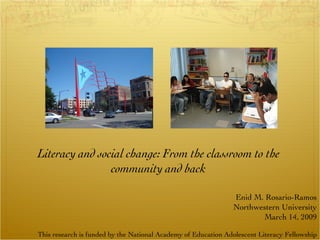
Research site Julia de Burgos High School (JBHS) Puerto Rican alternative high school  located in the heart of the Puerto Rican community in a Midwestern city
Research site JBHS is closely tied to the Luisa Capetillo Cultural Center (LCCC) community organization that organizes some of the community building efforts in the neighborhood  LCCC's programs encourage community members to critically analyze their reality and promote the development of self-reliance based on social responsibility  projects address different issues affecting the community, including AIDS, education, gang violence, teen pregnancy, police brutality, racism, housing, and human rights violations.
So, what is the school’s mission? The High School’s “mission is to provide a quality educational experience needed to empower students to engage in critical thinking and social transformation, from the classroom to the Puerto Rican community, based on the philosophical foundation of self-determination, a methodology of self-actualization and an ethics of self-reliance.”
So, what is the school’s mission? The High School’s “mission is to provide a quality educational experience needed to  empower students to engage in critical thinking and social transformation , from the classroom to the Puerto Rican community, based on the philosophical foundation of self-determination, a methodology of self-actualization and an ethics of self-reliance.”
Data Collection Case Study Data Collection Classroom observations (20hrs approx.) 1 Language Arts Class 4 Social Studies/History Classes 1 Civics class Unity for social analysis
Results Preliminary analysis suggests… Critical literacy is part of the school discourse.
Results: Critical Literacy “ they need to be given the texts that provide counter-histories and counter-narratives in general; and they need to read texts that are culturally affirming, culturally relevant, and culturally responsive.” (Morrell, 2008, p.212)
Results: Critical Literacy “ they need to be given the texts that provide  counter-histories and counter-narratives in general ; and they need to read texts that are culturally affirming, culturally relevant, and culturally responsive.” (Morrell, 2008, p.212)
Results: Critical Literacy Creating counter-narratives of disciplinary knowledge
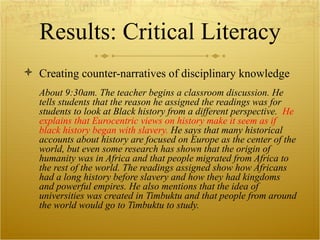
Results: Critical Literacy Creating counter-narratives of disciplinary knowledge About 9:30am. The teacher begins a classroom discussion. He tells students that the reason he assigned the readings was for students to look at Black history from a different perspective.  He explains that Eurocentric views on history make it seem as if black history began with slavery. He says that many historical accounts about history are focused on Europe as the center of the world, but even some research has shown that the origin of humanity was in Africa and that people migrated from Africa to the rest of the world. The readings assigned show how Africans had a long history before slavery and how they had kingdoms and powerful empires. He also mentions that the idea of universities was created in Timbuktu and that people from around the world would go to Timbuktu to study.
Results: Critical Literacy Creating counter-narratives of disciplinary knowledge About 9:30am. The teacher begins a classroom discussion. He tells students that the reason he assigned the readings was for students to look at Black history from a different perspective.  He explains that Eurocentric views on history make it seem as if black history began with slavery.  He says that many historical accounts about history are focused on Europe as the center of the world, but even some research has shown that the origin of humanity was in Africa and that people migrated from Africa to the rest of the world. The readings assigned show how Africans had a long history before slavery and how they had kingdoms and powerful empires. He also mentions that the idea of universities was created in Timbuktu and that people from around the world would go to Timbuktu to study.
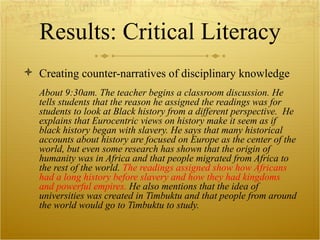
Results: Critical Literacy Creating counter-narratives of disciplinary knowledge About 9:30am. The teacher begins a classroom discussion. He tells students that the reason he assigned the readings was for students to look at Black  history from a different perspective.  He explains that Eurocentric views on history make it seem as if black history began with slavery. He says that many historical accounts about history are focused on Europe  as the center of the world, but even some research has shown that the origin of humanity was in Africa and that people migrated from Africa to the rest of the world.  The readings assigned show how Africans had a long history before slavery and how they had kingdoms and powerful empires.  He also mentions that the idea of universities was created in Timbuktu and that people from around the world would go to Timbuktu to study.
Results: Critical Literacy Creating counter-narratives of disciplinary knowledge Next part of the class is dedicated to the analysis of a poem written by another student from the school: A.T. The poem is titled My father. The group reads the first few verses collectively and discuss what kinds of feelings or images the poem evokes. They mention that the poem is sad. They talk about how the poem represents the author’s father absence from his life. They also mention that the author conveys a feeling of his father owing him something for being absent.
Results: Critical Literacy Creating counter-narratives of disciplinary knowledge Next part of the class is dedicated to the analysis of a poem written by another student from the school: A.T. The poem is titled My father . The group reads the first few verses collectively and discuss what kinds of feelings or images the poem evokes. They mention that the poem is sad. They talk about how the poem represents the author’s father absence from his life. They also mention that the author conveys a feeling of his father owing him something for being absent.
Results: Critical Literacy “ they need to be given the texts that provide counter-histories and counter-narratives in general; and they need to read texts that are culturally affirming, culturally relevant, and culturally responsive.” (Morrell, 2008, p.212) “ students need opportunities to produce multiple authentic texts in multiple authentic genres for multiple authentic purposes.” (Morrell, 2008, p.220)
Results: Critical Literacy “ they need to be given the texts that provide counter-histories and counter-narratives in general; and they need to read texts that are culturally affirming, culturally relevant, and culturally responsive.” (Morrell, 2008, p.212) “ students need opportunities  to produce multiple authentic texts in multiple authentic genres for multiple authentic purposes. ” (Morrell, 2008, p.220)
Results: Critical Literacy “ students need opportunities  to produce multiple authentic texts in multiple authentic genres for multiple authentic purposes. ” (Morrell, 2008, p.220) Teacher asks the question “Not enough stories about us? Who?” She tries to get students to provide an answer. A student responds: “minorities” Teacher explains that students will be writing short stories and poetry and that they will be publishing a book with their work.  Their pieces should be written using their peers’ stories or their own experiences
Results: Critical Literacy “ students need opportunities to produce multiple authentic texts in multiple authentic genres for multiple authentic purposes.”  (Morrell, 2008, p.220) Teacher asks the question “Not enough stories about us? Who?” She tries to get students to provide an answer. A student responds: “minorities” Teacher explains that  students will be writing short stories and poetry and that they will be publishing a book with their work .  Their pieces should be written using their peers’ stories or their own experiences
 
Discussion Through curriculum and informal discussions, critical literacy becomes part of the school discourse. Further analysis is needed to understand the relationship between critical literacy and community building.
THANK YOU!!

palante

  • 1.
    Literacy and socialchange: From the classroom to the community and back Enid M. Rosario-Ramos Northwestern University March 14, 2009 This research is funded by the National Academy of Education Adolescent Literacy Fellowship
  • 2.
    “… critical literacymeans making one’s self present as part of a moral and political project that links the production of meaning to the possibility for human agency, democratic community, and transformative action.” (Giroux, In Freire & Macedo, 1987)
  • 3.
    “… critical literacymeans making one’s self present as part of a moral and political project that links the production of meaning to the possibility for human agency, democratic community, and transformative action. ” (Giroux, In Freire & Macedo, 1987)
  • 4.
    Research goals …explore the relationships between adolescents’ participation in community building efforts and the development of critical literacy skills. … examine how schools and other community organizations provide opportunities for the development of critical literacy skills of adolescents from non-dominant groups.
  • 5.
    Research site Juliade Burgos High School (JBHS) Puerto Rican alternative high school located in the heart of the Puerto Rican community in a Midwestern city
  • 6.
    Research site JBHSis closely tied to the Luisa Capetillo Cultural Center (LCCC) community organization that organizes some of the community building efforts in the neighborhood LCCC's programs encourage community members to critically analyze their reality and promote the development of self-reliance based on social responsibility projects address different issues affecting the community, including AIDS, education, gang violence, teen pregnancy, police brutality, racism, housing, and human rights violations.
  • 7.
    So, what isthe school’s mission? The High School’s “mission is to provide a quality educational experience needed to empower students to engage in critical thinking and social transformation, from the classroom to the Puerto Rican community, based on the philosophical foundation of self-determination, a methodology of self-actualization and an ethics of self-reliance.”
  • 8.
    So, what isthe school’s mission? The High School’s “mission is to provide a quality educational experience needed to empower students to engage in critical thinking and social transformation , from the classroom to the Puerto Rican community, based on the philosophical foundation of self-determination, a methodology of self-actualization and an ethics of self-reliance.”
  • 9.
    Data Collection CaseStudy Data Collection Classroom observations (20hrs approx.) 1 Language Arts Class 4 Social Studies/History Classes 1 Civics class Unity for social analysis
  • 10.
    Results Preliminary analysissuggests… Critical literacy is part of the school discourse.
  • 11.
    Results: Critical Literacy“ they need to be given the texts that provide counter-histories and counter-narratives in general; and they need to read texts that are culturally affirming, culturally relevant, and culturally responsive.” (Morrell, 2008, p.212)
  • 12.
    Results: Critical Literacy“ they need to be given the texts that provide counter-histories and counter-narratives in general ; and they need to read texts that are culturally affirming, culturally relevant, and culturally responsive.” (Morrell, 2008, p.212)
  • 13.
    Results: Critical LiteracyCreating counter-narratives of disciplinary knowledge
  • 14.
    Results: Critical LiteracyCreating counter-narratives of disciplinary knowledge About 9:30am. The teacher begins a classroom discussion. He tells students that the reason he assigned the readings was for students to look at Black history from a different perspective. He explains that Eurocentric views on history make it seem as if black history began with slavery. He says that many historical accounts about history are focused on Europe as the center of the world, but even some research has shown that the origin of humanity was in Africa and that people migrated from Africa to the rest of the world. The readings assigned show how Africans had a long history before slavery and how they had kingdoms and powerful empires. He also mentions that the idea of universities was created in Timbuktu and that people from around the world would go to Timbuktu to study.
  • 15.
    Results: Critical LiteracyCreating counter-narratives of disciplinary knowledge About 9:30am. The teacher begins a classroom discussion. He tells students that the reason he assigned the readings was for students to look at Black history from a different perspective. He explains that Eurocentric views on history make it seem as if black history began with slavery. He says that many historical accounts about history are focused on Europe as the center of the world, but even some research has shown that the origin of humanity was in Africa and that people migrated from Africa to the rest of the world. The readings assigned show how Africans had a long history before slavery and how they had kingdoms and powerful empires. He also mentions that the idea of universities was created in Timbuktu and that people from around the world would go to Timbuktu to study.
  • 16.
    Results: Critical LiteracyCreating counter-narratives of disciplinary knowledge About 9:30am. The teacher begins a classroom discussion. He tells students that the reason he assigned the readings was for students to look at Black history from a different perspective. He explains that Eurocentric views on history make it seem as if black history began with slavery. He says that many historical accounts about history are focused on Europe as the center of the world, but even some research has shown that the origin of humanity was in Africa and that people migrated from Africa to the rest of the world. The readings assigned show how Africans had a long history before slavery and how they had kingdoms and powerful empires. He also mentions that the idea of universities was created in Timbuktu and that people from around the world would go to Timbuktu to study.
  • 17.
    Results: Critical LiteracyCreating counter-narratives of disciplinary knowledge Next part of the class is dedicated to the analysis of a poem written by another student from the school: A.T. The poem is titled My father. The group reads the first few verses collectively and discuss what kinds of feelings or images the poem evokes. They mention that the poem is sad. They talk about how the poem represents the author’s father absence from his life. They also mention that the author conveys a feeling of his father owing him something for being absent.
  • 18.
    Results: Critical LiteracyCreating counter-narratives of disciplinary knowledge Next part of the class is dedicated to the analysis of a poem written by another student from the school: A.T. The poem is titled My father . The group reads the first few verses collectively and discuss what kinds of feelings or images the poem evokes. They mention that the poem is sad. They talk about how the poem represents the author’s father absence from his life. They also mention that the author conveys a feeling of his father owing him something for being absent.
  • 19.
    Results: Critical Literacy“ they need to be given the texts that provide counter-histories and counter-narratives in general; and they need to read texts that are culturally affirming, culturally relevant, and culturally responsive.” (Morrell, 2008, p.212) “ students need opportunities to produce multiple authentic texts in multiple authentic genres for multiple authentic purposes.” (Morrell, 2008, p.220)
  • 20.
    Results: Critical Literacy“ they need to be given the texts that provide counter-histories and counter-narratives in general; and they need to read texts that are culturally affirming, culturally relevant, and culturally responsive.” (Morrell, 2008, p.212) “ students need opportunities to produce multiple authentic texts in multiple authentic genres for multiple authentic purposes. ” (Morrell, 2008, p.220)
  • 21.
    Results: Critical Literacy“ students need opportunities to produce multiple authentic texts in multiple authentic genres for multiple authentic purposes. ” (Morrell, 2008, p.220) Teacher asks the question “Not enough stories about us? Who?” She tries to get students to provide an answer. A student responds: “minorities” Teacher explains that students will be writing short stories and poetry and that they will be publishing a book with their work. Their pieces should be written using their peers’ stories or their own experiences
  • 22.
    Results: Critical Literacy“ students need opportunities to produce multiple authentic texts in multiple authentic genres for multiple authentic purposes.” (Morrell, 2008, p.220) Teacher asks the question “Not enough stories about us? Who?” She tries to get students to provide an answer. A student responds: “minorities” Teacher explains that students will be writing short stories and poetry and that they will be publishing a book with their work . Their pieces should be written using their peers’ stories or their own experiences
  • 23.
  • 24.
    Discussion Through curriculumand informal discussions, critical literacy becomes part of the school discourse. Further analysis is needed to understand the relationship between critical literacy and community building.
  • 25.