June 26, 2015 Labour Market Reform Commission: Technology, Innovation and Productivity Committee
Critical Issues Matrix
Page 1 of 5
Human Capital – ‘H’ SME – ‘S’ Government – ‘G’ National – ‘N’
General – ‘G’  Role of leadership in realising
transformational outcomes
 Role and practice of collective
action including roles of unions,
networks, associations in advancing
the collective
 Cooperation and positive group-
level behaviour
 Role of large enterprises in the
development of sustainable value
chains and supply chains for SME’s
Technology – ‘T’  Fostering and promoting training
and education opportunities in
technology
development/use/application (e.g.
internship)
 Adequacy of human capital to
support technological
development within Jamaica.
 Capacity to create, transmit and
absorption of knowledge, whether
sourced domestically or through
technology transfers from
overseas.
 Technology, adaptation of right tools
 Enablers & Inhibitors of adoption of
technology
 Technology as a simulant to MSME
growth & development
 Adoption & Diffusion of
technology in providing
government services
 Government’s role in
promoting technology
development
 National Campaign in
advancement in technology
 National culture of technology;
application of technology
towards efficiency at the
national level
June 26, 2015 Labour Market Reform Commission: Technology, Innovation and Productivity Committee
Critical Issues Matrix
Page 2 of 5
Innovation – ‘I’  Fostering creativity/Driver of
innovation
 Impact of Human Capital on
Innovative processes
 Partnership with academic institutions
 Promoting & Fostering R&D in SMEs
 Formation of incubators
 MSME and Innovation for socio-
economic development
 Government ‘s role in
promoting an innovative centric
society
 Effectiveness of strategies to
promote the STEM agenda
 National supporting systems in
the promotion of innovative-
centric environment.
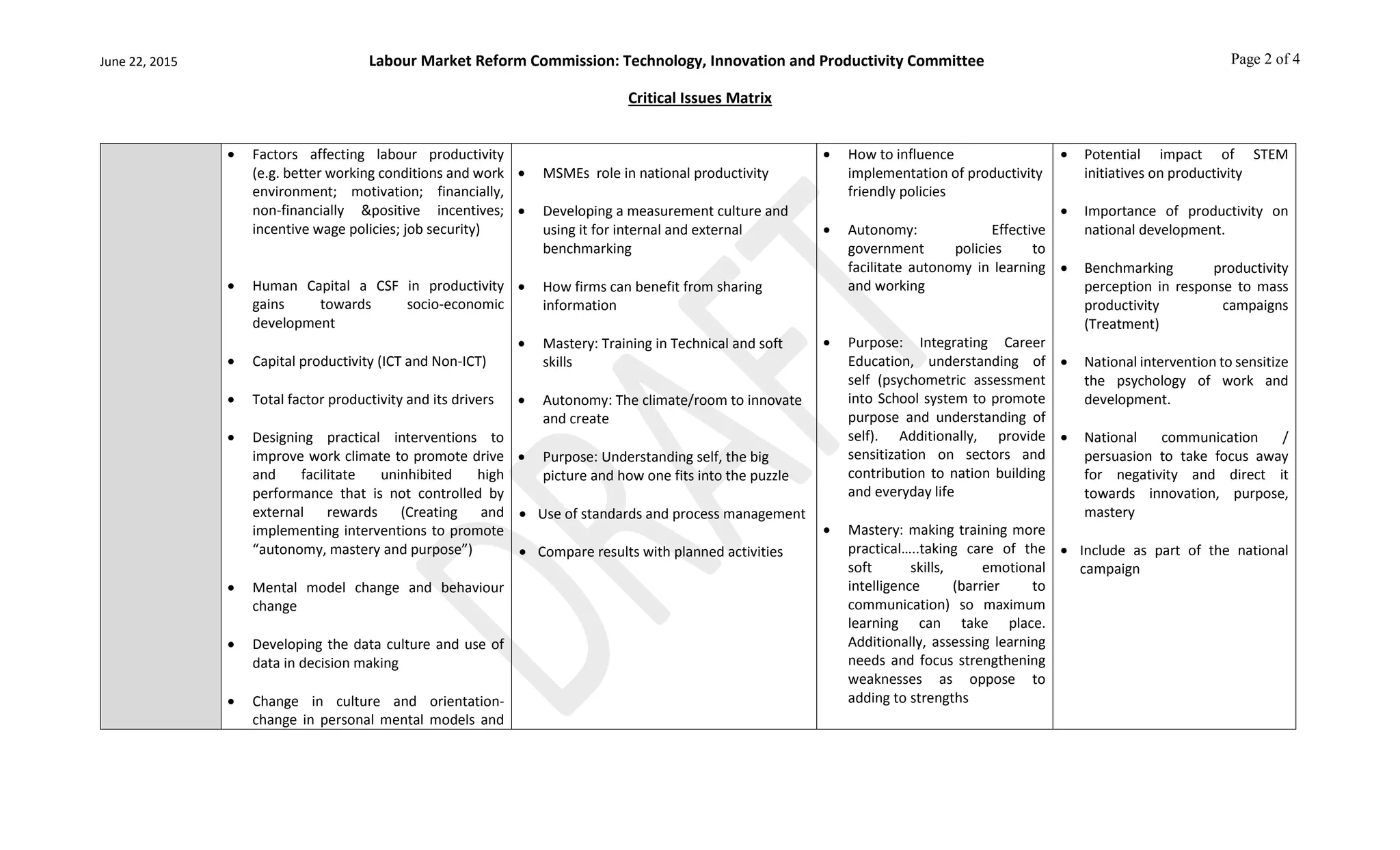
Productivity – ‘P’  Role & Effect of Training
 How to maximize worker output
 Factors affecting labour productivity
(e.g. better working conditions and
work environment; motivation;
financially, non-financially &positive
incentives; incentive wage policies;
job security)
 Human Capital a CSF in productivity
gains towards socio-economic
development
 Capital productivity (ICT and Non-
ICT)
 Total factor productivity and its
drivers
 SME Cluster and Network
Development/ Development of
Clusters and Networks of SMEs
 MSMEs role in national productivity
 Developing a measurement culture and
using it for internal and external
benchmarking
 How firms can benefit from sharing
information
 Mastery: Training in Technical and soft
skills
 Autonomy: The climate/room to
innovate and create
 Purpose: Understanding self, the big
picture and how one fits into the puzzle
 Effect of government policies
on productivity
 How to influence
implementation of productivity
friendly policies
 Autonomy: Effective
government policies to
facilitate autonomy in learning
and working
 Purpose: Integrating Career
Education, understanding of
self (psychometric assessment
into School system to promote
purpose and understanding of
self). Additionally, provide
sensitization on sectors and
contribution to nation building
and everyday life
 Evaluation of the impact of
culture on productivity
 Potential impact of STEM
initiatives on productivity
 Importance of productivity on
national development.
 Benchmarking productivity
perception in response to mass
productivity campaigns
(Treatment)
 National intervention to sensitize
the psychology of work and
development.
 National communication /
persuasion to take focus away
for negativity and direct it
towards innovation, purpose,
mastery
June 26, 2015 Labour Market Reform Commission: Technology, Innovation and Productivity Committee
Critical Issues Matrix
Page 3 of 5
 Designing practical interventions to
improve work climate to promote
drive and facilitate uninhibited high
performance that is not controlled by
external rewards (Creating and
implementing interventions to
promote “autonomy, mastery and
purpose”)
 Mental model change and behaviour
change
 Developing the data culture and use
of data in decision making
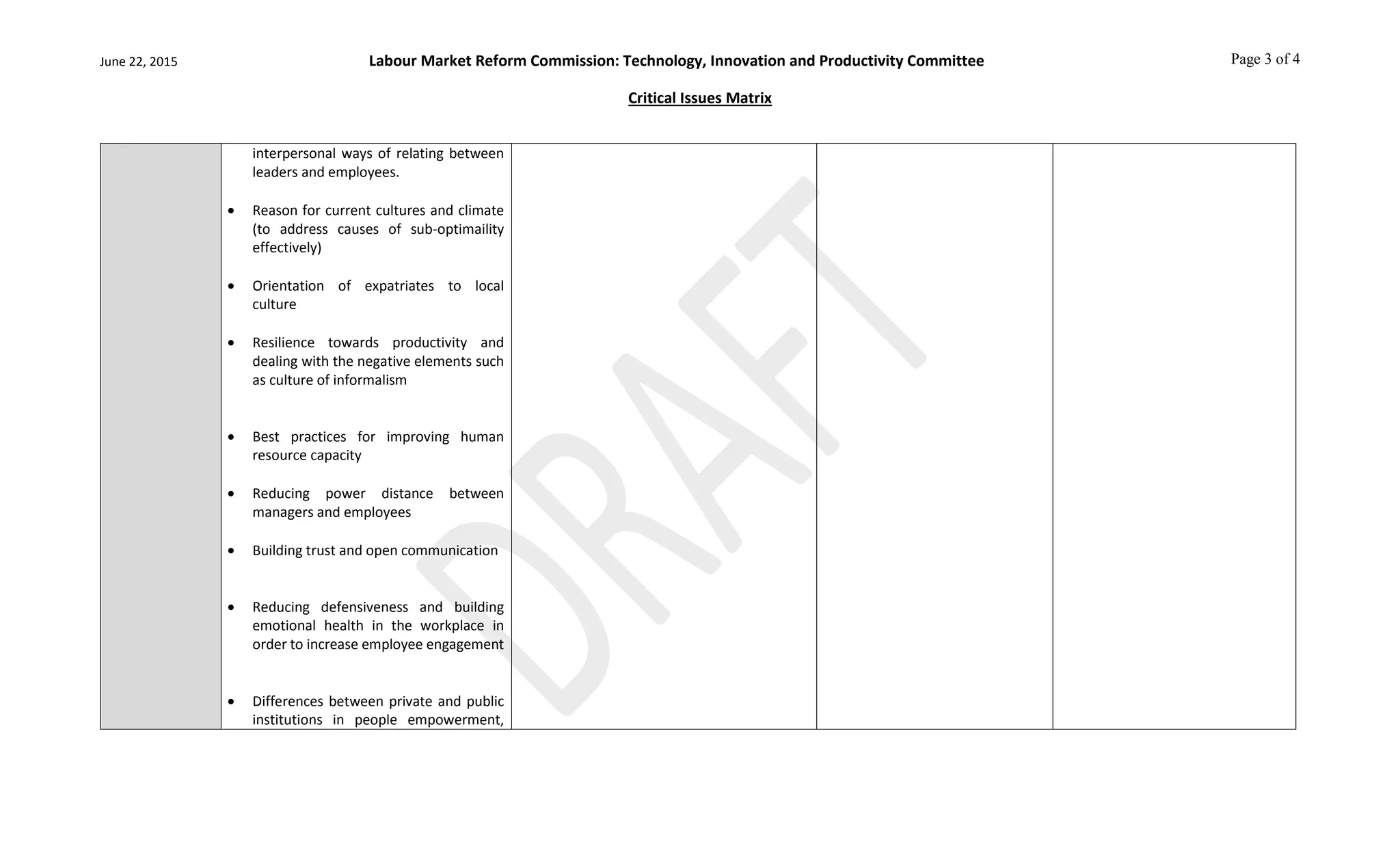
 Change in culture and orientation-
change in personal mental models
and interpersonal ways of relating
between leaders and employees.
 Reason for current cultures and
climate (to address causes of sub-
optimaility effectively)
 Orientation of expatriates to local
culture
 Resilience towards productivity and
dealing with the negative elements
such as culture of informalism
 Use of standards and process
management
 Compare results with planned activities
 Mastery: making training more
practical…..taking care of the
soft skills, emotional
intelligence (barrier to
communication) so maximum
learning can take place.
Additionally, assessing learning
needs and focus strengthening
weaknesses as oppose to
adding to strengths
 Include as part of the national
campaign
June 26, 2015 Labour Market Reform Commission: Technology, Innovation and Productivity Committee
Critical Issues Matrix
Page 4 of 5
 Best practices for improving human
resource capacity
 Reducing power distance between
managers and employees
 Building trust and open
communication
 Reducing defensiveness and building
emotional health in the workplace in
order to increase employee
engagement
 Differences between private and
public institutions in people
empowerment, knowledge
management and technological
application
 Cross-institutional collaboration to
conduct action research and to
influence the design of degree
programmes
Competitiveness – ‘C’  Creativity as a tool for
competitiveness
 Human Capital as critical component
to global competitiveness.
 Effect of product quality factors on
competitiveness
 Factors that affect product quality
 Creating an environment that
fosters competitiveness
 Government role in promoting a
global competitiveness agenda
 National competitiveness as a
critical success factor (CSF) for
economic growth.
June 26, 2015 Labour Market Reform Commission: Technology, Innovation and Productivity Committee
Critical Issues Matrix
Page 5 of 5
 Health, education and training
 Inequality in the distribution of
assets and income;
 SMEs and national competitiveness
 Business sophistication
 Innovation
 Effectiveness and efficiency of
Institutions
 Labour market efficiency
 Infrastructure
 Capital market efficiency
 Public education to change
perceptions as well as
communicating changed to
change perceptions.
 The efficacy of the national
financial system and its
effectiveness in the allocation of
resources;
 The existence and quality of
national institutions that impact
business productivity and
competitiveness;

Critical Issues Matrix - TIP Committee LMRC 22jun15

  • 1.
    June 26, 2015Labour Market Reform Commission: Technology, Innovation and Productivity Committee Critical Issues Matrix Page 1 of 5 Human Capital – ‘H’ SME – ‘S’ Government – ‘G’ National – ‘N’ General – ‘G’  Role of leadership in realising transformational outcomes  Role and practice of collective action including roles of unions, networks, associations in advancing the collective  Cooperation and positive group- level behaviour  Role of large enterprises in the development of sustainable value chains and supply chains for SME’s Technology – ‘T’  Fostering and promoting training and education opportunities in technology development/use/application (e.g. internship)  Adequacy of human capital to support technological development within Jamaica.  Capacity to create, transmit and absorption of knowledge, whether sourced domestically or through technology transfers from overseas.  Technology, adaptation of right tools  Enablers & Inhibitors of adoption of technology  Technology as a simulant to MSME growth & development  Adoption & Diffusion of technology in providing government services  Government’s role in promoting technology development  National Campaign in advancement in technology  National culture of technology; application of technology towards efficiency at the national level
  • 2.
    June 26, 2015Labour Market Reform Commission: Technology, Innovation and Productivity Committee Critical Issues Matrix Page 2 of 5 Innovation – ‘I’  Fostering creativity/Driver of innovation  Impact of Human Capital on Innovative processes  Partnership with academic institutions  Promoting & Fostering R&D in SMEs  Formation of incubators  MSME and Innovation for socio- economic development  Government ‘s role in promoting an innovative centric society  Effectiveness of strategies to promote the STEM agenda  National supporting systems in the promotion of innovative- centric environment. Productivity – ‘P’  Role & Effect of Training  How to maximize worker output  Factors affecting labour productivity (e.g. better working conditions and work environment; motivation; financially, non-financially &positive incentives; incentive wage policies; job security)  Human Capital a CSF in productivity gains towards socio-economic development  Capital productivity (ICT and Non- ICT)  Total factor productivity and its drivers  SME Cluster and Network Development/ Development of Clusters and Networks of SMEs  MSMEs role in national productivity  Developing a measurement culture and using it for internal and external benchmarking  How firms can benefit from sharing information  Mastery: Training in Technical and soft skills  Autonomy: The climate/room to innovate and create  Purpose: Understanding self, the big picture and how one fits into the puzzle  Effect of government policies on productivity  How to influence implementation of productivity friendly policies  Autonomy: Effective government policies to facilitate autonomy in learning and working  Purpose: Integrating Career Education, understanding of self (psychometric assessment into School system to promote purpose and understanding of self). Additionally, provide sensitization on sectors and contribution to nation building and everyday life  Evaluation of the impact of culture on productivity  Potential impact of STEM initiatives on productivity  Importance of productivity on national development.  Benchmarking productivity perception in response to mass productivity campaigns (Treatment)  National intervention to sensitize the psychology of work and development.  National communication / persuasion to take focus away for negativity and direct it towards innovation, purpose, mastery
  • 3.
    June 26, 2015Labour Market Reform Commission: Technology, Innovation and Productivity Committee Critical Issues Matrix Page 3 of 5  Designing practical interventions to improve work climate to promote drive and facilitate uninhibited high performance that is not controlled by external rewards (Creating and implementing interventions to promote “autonomy, mastery and purpose”)  Mental model change and behaviour change  Developing the data culture and use of data in decision making  Change in culture and orientation- change in personal mental models and interpersonal ways of relating between leaders and employees.  Reason for current cultures and climate (to address causes of sub- optimaility effectively)  Orientation of expatriates to local culture  Resilience towards productivity and dealing with the negative elements such as culture of informalism  Use of standards and process management  Compare results with planned activities  Mastery: making training more practical…..taking care of the soft skills, emotional intelligence (barrier to communication) so maximum learning can take place. Additionally, assessing learning needs and focus strengthening weaknesses as oppose to adding to strengths  Include as part of the national campaign
  • 4.
    June 26, 2015Labour Market Reform Commission: Technology, Innovation and Productivity Committee Critical Issues Matrix Page 4 of 5  Best practices for improving human resource capacity  Reducing power distance between managers and employees  Building trust and open communication  Reducing defensiveness and building emotional health in the workplace in order to increase employee engagement  Differences between private and public institutions in people empowerment, knowledge management and technological application  Cross-institutional collaboration to conduct action research and to influence the design of degree programmes Competitiveness – ‘C’  Creativity as a tool for competitiveness  Human Capital as critical component to global competitiveness.  Effect of product quality factors on competitiveness  Factors that affect product quality  Creating an environment that fosters competitiveness  Government role in promoting a global competitiveness agenda  National competitiveness as a critical success factor (CSF) for economic growth.
  • 5.
    June 26, 2015Labour Market Reform Commission: Technology, Innovation and Productivity Committee Critical Issues Matrix Page 5 of 5  Health, education and training  Inequality in the distribution of assets and income;  SMEs and national competitiveness  Business sophistication  Innovation  Effectiveness and efficiency of Institutions  Labour market efficiency  Infrastructure  Capital market efficiency  Public education to change perceptions as well as communicating changed to change perceptions.  The efficacy of the national financial system and its effectiveness in the allocation of resources;  The existence and quality of national institutions that impact business productivity and competitiveness;