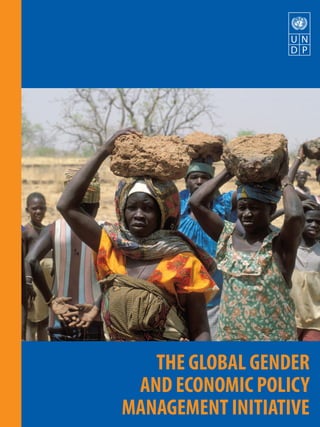
THE GLOBAL GENDER
AND ECONOMIC POLICY
MANAGEMENT INITIATIVE
1
FOREWORD
The Global Gender and Economic Policy Management Initiative (GEPMI) is a comprehensive capacity
development and policy advisory services programme that aims to accelerate achievement of the
Millennium Development Goals (MDGs) by making economic policies and poverty reduction strategies
deliver results equitably to women and men, girls and boys.
This programme was designed by the United Nations Development Programme (UNDP), through
regional partnerships, in order to respond to the urgent need to incorporate gender perspectives into
national development frameworks.
In close collaboration with leading international and regional scholars, feminist economists and policy
makers, this global programme was designed with three major interconnected components:
(1) A three-week Short Course on Gender-Responsive Economic Policy Management:This short course
aimstoprovidehands-onskillstomiddle-levelgovernmentplanningofficials,parliamentarystaff,civil
society organizations (CSOs) and UNDP policy advisers. This Course consists of twelve modules
addressingthemostcriticalgenderissuesinallaspectsofeconomicdevelopment(economicanalysis,
policyanalysis,povertyreduction,statistics,employment,unpaidcarework,macroeconomics,trade,
taxation, medium term expenditure framework and budget).
(2) GEPMI-TailoredCountryleveladvisoryservicesandcapacitydevelopmentworkshops.GEPMI’sshort-
course modules can also be used individually and tailored for immediate and specific capacity
development and policy advisory support to meet a country’s particular needs. A team of highly-
qualifiedregionalexperts,whosequalityisassuredbyUNDP,throughregulartrainingandcontinuous
knowledge sharing, is available to provide these services on request. To access this support, please
contact the UNDP GenderTeam (gepmi@groups.undp.org).
(3) A Master’s of Arts in Gender-Aware Economics: A first in the world of its kind, aims to generate
a new cadre of economists who are able to integrate gender equality as a parameter in economic
analysis, policies and budgets.
Currently implemented in Africa (GEPMI-Africa) and Asia and the Pacific (GEPMI-Asia-Pacific), GEPMI will
be expanding to other regions in the near future.
This booklet presents an overview of the three interconnected components of GEPMI-Africa and their
implementing partners:
1) thethree-weekShortCourseonGenderResponsiveEconomicPolicyManagement,deliveredbythe
AfricanInstituteforEconomicDevelopmentandPlanning(UNIDEP)inDakar,Senegal,inpartnership
with UNDP.
2
2) GEPMI-TailoredCountryleveladvisoryservicesandcapacitydevelopmentworkshops,implemented
by UNDP.
3) the Pan-African Master’s of Arts in Gender-Aware Economics, led by the Faculty of Economics and
Management (FEMA) and the Department of Women and Gender Studies (DWGS) at Makerere
University, Kampala, Uganda, in partnership with UNDP.
With less than five years left until the 2015 deadline, the Global Gender and Economic Policy
Management Initiative brings a critical contribution to scaling up the efforts toward the achievement
of all the MDGs. We are confident that this will bring great value to your work in this area.
Olav Kjørven Winnie Byanyima
Assistant Administrator and Director Director, UNDP Gender Team
Bureau for Development Policy Bureau for Development Policy
United Nations Development Programme
3
TABLE OF CONTENTS
Short Course on Gemder-Resposive Economic Policy Management 4
Module 1: Gender and Economics 6
Module 2: Gender-Responsive Policy Analysis 8
Module 3: Unpaid Care Work 10
Module 4: Gender, Data and Indices 12
Module 5: Employment and Labour Markets 14
Module 6: Gender and Poverty 16
Module 7: Gender and Macroeconomics 18
Module 8: Gender and Macroeconomic Strategies in Africa, Part I 20
Module 9: Gender and Macroeconomic Strategies in Africa, Part II 22
Module 10: Gender and Trade 24
Module 11: Gender and Access to Finance 26
Module 12: Public Finance and Gender-Responsive Budgeting 28
GEPMI’s Capacity Development and Policy Advisory Services Map 30
Master of Arts in Gender Aware Economics 31
4
WHY GENDER & ECONOMIC POLICY MANAGEMENT
SHORT COURSE ON
GENDER-RESPONSIVE ECONOMIC
POLICY MANAGEMENT
Evidence shows that investing in gender equality —such as increasing women’s access to
health care, employment and credit—can accelerate economic growth and reduce poverty
and that persistent gender inequalities reduce prospects for economic growth. Yet attention
to gender equality is still lacking in economic policy formulation and implementation.
The Gender and Economic Policy Management Initiative was created in response to this gap in
economicpolicyformulationandimplementationinAfrica.Theprogrammeintendstoaccelerate
achievement of the Millennium Development Goals (MDGs), in particular MDG 3 on gender
equality and women’s empowerment, by increasing the effectiveness of economic policies and
poverty reduction strategies in Africa to make them deliver to poor women and men, girls and
boys, more equitably.
MODE OF DELIVERY
Athree-weekshortcourse:Thetwelvecoursemodules,whichhavebeenvalidatedbyAfricanscholars,
policymakers, as well as UNDP advisors, were designed to run over a three-week period, to be offered
annuallyinbothEnglishandFrenchattheAfricanInstituteforEconomicDevelopmentandPlanning(UN
IDEP) in Dakar, Senegal. Candidates will be nominated by their governments, regional economic
communities, institutions, organizations. Each applicant will be required to submit an essay, answering
keyquestionsrelatedtomotivationtoparticipateinthecourseandpriorexperienceworkingongender
responsive economic policy management. A selection committee will carefully review the applications
and select 15 to 20 participants per intake. For more information, please see: www.unidep.org
GEPMI-Tailored Country level advisory services and capacity development workshops. GEPMI’s
short-course modules can also be used individually and tailored for immediate and specific capacity
development and policy advisory support to meet a country’s particular needs. We have developed
a learning map (please see on Page 30) which covers the most critical areas of policy making
processes and economic development issues. Governments interested in a specific capacity
development or policy advisory service can contact the UNDP GenderTeam (gepmi@groups.undp.org)
for immediate support.
IDEP
5
TARGET PARTICIPANTS
The course targets economic policy makers, development planners, researchers and particularly
middle- and senior-level economic policy makers responsible for policy formulation and decision-
making in their respective areas.The course will also admit competitive applications from officials of
parliaments, regional economic communities (RECs), management level staff members of national,
regional and international civil society organizations and other officials who want to increase their
capacity to analyze and main-stream gender perspectives in economic policy formulation and
management.
COURSE CONTENT
The three-week course on gender-responsive economic policy management aims at providing policy
makers and development practitioners with the skills and knowledge needed to identify and address
gender biases in the economic sectors; and effectively plan, implement, monitor and evaluate
development policies, strategies, programmes and projects that are responsive to gender equality.
The course will be delivered in English and French by the African Institute for Economic Development
and Planning (IDEP).
The course consists of one writing exercise that involves the drafting of individual or team papers and
12 standard modules:
I Gender and economics
I Gender-responsive policy analysis
I Unpaid care work
I Gender, data and indices
I Employment and labour markets
I Gender and poverty
I Gender and macroeconomics
I Gender and macroeconomic strategies in Africa, part I
I Gender and macroeconomic strategies in Africa, part II
I Gender and trade
I Gender and access to finance
I Public finance and gender-responsive budgeting
MODULE 1:
GENDER AND ECONOMICS
To establish a common analytical foundation across the diversity of participant backgrounds, this first
module aims to ensure that participants share similar understandings of basic economic and gender-
equality concepts, how they interact with each other and how basic economic ideas can be
approached through a gender lens. Among the participants in the course will be economic policy
makers, planners and practitioners, with varying degrees of exposure to working on gender issues
in economics. The course will also include gender specialists with varying degrees of exposure to
working on economic issues from a gender perspective.
The module does not aim to ensure that everyone operates at the same level of sophistication,
though a subsidiary aim is to encourage those with more sophisticated understandings of either
economics or gender equality issues to express themselves to others simply and in jargon-free terms,
especially when communicating with others less immersed in their knowledge areas. A further
subsidiary aim is to encourage all participants to speak and engage with each other.
LEARNING OBJECTIVES
At the conclusion of the module, participants will share a common understanding of:
1. Basic economic concepts.
2. Why basic economic concepts need to incorporate a gender dimension.
3. Basic gender concepts.
OUTLINE
I. Basic economic concepts.
II. Why gender matters for economics.
III. Agreeing on basic gender concepts.
DURATION
One-and-a-half days.
7
11
MODULE 2:
GENDER-RESPONSIVE POLICY ANALYSIS
Module 2 has three broad objectives.The first is to synthesize the separate insights that are acquired
during the course, in relation to economics, gender relations, economic development strategies,
sectoral issues and the development and implementation of public policies.The second is to review
and systematize the insights of gender-aware policy analysis developed during the various
components of the course.The third is to test participants’abilities to use their insights into gender-
aware policy analysis to structure the development of gender-aware policy proposals. Starting from
intensive group discussions at the beginning ofWeek 1, a gender-aware sectoral policy intervention
for a particular country is framed and designed and an implementation strategy developed, drafted
and documented, in the form of a group paper, during Week 2. The group paper is then refined into
a policy brief during Week 3.
LEARNING OBJECTIVES
At the conclusion of the module, participants will have:
1. Grasped a basic understanding of economic policy analysis.
2. Achieved a common competence in understanding why economic policy analysis must be
gender-aware.
3. Undertaken a gender-aware policy analysis.
OUTLINE
I. Economic policy analysis.
II. Making economic policy analysis gender-aware.
III. Sectoral gender-aware policy analysis.
DURATION
Initially, half a day; thereafter, for the duration of the course.
9
22
MODULE 3:
UNPAID CAREWORK
This module exposes participants to the concept of unpaid care work first introduced in Module 1.
It explores how unpaid care work can be measured and valued, and how it might be considered—
or ignored—in policy making. A subsidiary aim of this module is to highlight common weaknesses
and errors in how economic and social statistics are gathered and presented. Finally, the module
suggests general guidelines for policy making regarding unpaid care work.
LEARNING OBJECTIVES
At the conclusion of this module, participants will:
1. Recognize the importance of unpaid care work.
2. Understand the role that assumptions about care have for economic policy.
3. Be able to voice the general principles that should guide economic policy toward
unpaid care work.
OUTLINE
I. Understanding unpaid care work.
A. Challenging economic assumptions.
B. Recognizing the existence of unpaid care work.
C. Why is unpaid care work important?
D. Measuring unpaid care work.
E. Assigning a monetary value to unpaid care work.
II. Considering unpaid care work in policy.
A. Community subsidization of government.
B. International examples of care-sensitive policies.
C. Policy guidelines toward unpaid care work.
DURATION
One day.
11
33
MODULE 4:
GENDER, DATA AND INDICES
This module introduces participants to the use of data, statistics, indicators and indices in gender-
aware economics and economic policy-making, highlighting that standard indices and indicators
often fail to reflect gender issues because of the still widely used concept of the household head as
a unit of economic analysis. The module also introduces participants to the most well-known
international and African gender-related indices, as well as the Human Development Index on which
one of them is based.
LEARNING OBJECTIVE
At the conclusion of this module, participants will be able to:
1. Understand the meaning and sources of data, statistics, indictors and indices.
2. Critically consider the strengths and weaknesses of gender indices.
OUTLINE
I. Data, statistics, indicators and indices.
A. What are data?
B. Where do data come from?
C. Issues in data collection.
II. Indices and indicators developed by the United Nations.
A. Human Development Index (HDI).
B. Gender-related Development Index (GDI).
C. Gender Empowerment Measure (GEM).
D. African Gender and Development Index.
E. Millennium Development Goal indicators.
F. UN Development Assistance Framework indicators.
DURATION
Three-quarters of a day.
13
44
MODULE 5:
EMPLOYMENT AND LABOUR MARKETS
Having introduced unpaid care work as a significant component of time and resource allocation in
economic activity, this module introduces a gender analysis of employment and labour markets in
an African context, including labour supply issues and the segmented structure of employment, to
create a fuller picture of time and resource allocation. Definitions of informal employment are
stressed, given its importance in most African countries. The module includes an employment
mapping exercise and discusses employment policies from a gender perspective.
LEARNING OBJECTIVES
1. To consolidate participants’understanding of the relation between unpaid care work, labour
and employment.
2. To enable participants to recognize the gender aspects of labour-force participation
decisions.
3. To facilitate participants’abilities to evaluate the diversity of Africa’s employment structure.
4. To impart to participants a fuller understanding of specific policy issues facing women’s
employment in Africa.
OUTLINE
I. What is employment? What is labour?
A. The SNA dividing line revisited.
B. Non-employment labour.
C. Two crucial institutions: labour markets and households.
II. Labour supply.
A. Labour force participation decisions.
B. Education, skills and experience.
III. The structure of employment in African countries.
A. Agricultural employment.
B. Formal and informal employment.
C. Employment status.
IV. Women and employment in Africa.
A. Labour force segmentation.
B. Discrimination and earnings inequalities.
DURATION
One day.
15
55
MODULE 6:
GENDER AND POVERTY
This module introduces definitions and measurements of poverty and explores how gender
dynamics influence poverty as policy makers typically define it, stressing the importance of the
household as a social institution. Participants will examine the gender dimensions of poverty and
concepts such as the feminization of poverty. The module concludes with a brief discussion of the
links between employment policy, gender relations and poverty.
LEARNING OBJECTIVES
1. To enable participants to understand the definition and measurement of income and
consumption poverty.
2. To ensure that participants recognize the relation between poverty processes and household
structure.
3. To facilitate participants’abilities to unravel the gender dimensions of poverty dynamics.
4. To help participants address the policy implications of poverty processes within the context
of gender dynamics.
OUTLINE
I. Defining and measuring poverty.
A. Poverty: a complex idea.
B. Income and consumption poverty.
C. Relative poverty.
II. Poverty and the structure of households.
III. Gender and poverty.
A. The feminization of poverty.
B. Intra-household dynamics.
IV. Poverty reduction and gender: issues and dynamics.
A. Economic growth and poverty reduction.
B. Employment and poverty.
C. Gender, employment and poverty.
D. Poverty reduction policy strategies and gender.
DURATION
One day.
17
66
MODULE 7:
GENDER AND MACROECONOMICS
This module enables participants to establish a foundation in gender-aware macroeconomics.
Macroeconomics is typically seen to be gender blind: It examines the economic environment in
general, but it is rarely, if ever, gender neutral. A gender analysis of macroeconomics underscores
both how gender relations permeate macroeconomic concepts and how macroeconomic indicators
only measure a portion of total economic activity, with important consequences for unpaid care
work, household well-being, and the accurate evaluation of macroeconomic policies. To help
participants undertake a gender-aware investigation of macroeconomics, the module introduces
and elaborates on some key aspects of macroeconomics, including social accounting frameworks,
the circular flow of income and product, domestic absorption, the multiplier, the accelerator and
two-gap analysis. At the end of the module, participants should be able to evaluate a series of
macroeconomic concepts by their gender content.
LEARNING OBJECTIVES
At the conclusion of this module, participants will:
1. Have gained an understanding of elementary macroeconomics.
2. Be able to voice a gender critique of contemporary macroeconomics.
3. Have the capacity to explain the key concepts and implications of gender-aware
macroeconomics.
OUTLINE
I. Basic macroeconomics.
A. Social accounting frameworks and the circular flow model.
B. Domestic absorption.
C. The multiplier and the accelerator.
D. A two-gap model.
II. Gender-aware macroeconomics.
A. The role of unpaid care work in macroeconomic flows.
B. The role of gender in macroeconomic variables.
C. A gender-aware circular flow.
D. Gender-aware macrodynamics: thinking about policy.
DURATION
Three-quarters of a day.
19
77
MODULE 8:
GENDER AND MACROECONOMIC
STRATEGIES IN AFRICA, PART I
This module briefly reviews the evolution of development strategies in post-independence Africa
using macroeconomic theory and builds an analysis of development strategies from a gender
perspective. The module should help participants develop some of the skills needed to evaluate to
what extent development strategies incorporate gender perspectives into their policy assessments
and proposals. A subsidiary aim is to analyse the history of development strategies and policy
through a gender lens.
LEARNING OBJECTIVES
At the conclusion of this module, participants will be able to:
1. Locate state-led development and structural adjustment within the context of
macroeconomic theory.
2. Understand the development of the analysis of gender within development theory.
3. Offer an analysis of state-led development and structural adjustment within the framework of
gender-aware macroeconomics.
OUTLINE
I. Overview of development strategies in post-independence Africa.
A. Reflections on development experiences in Africa.
B. The state-led approach to development.
C. The period of structural adjustment.
D. Gender and problems with structural adjustment.
II. An overview of approaches to gender equality in development strategies.
A. The first generation: women in development.
B. A broader conceptualization: gender and development.
III. Gender-aware macroeconomics and African national development strategies.
DURATION
One-quarter of a day.
21
88
MODULE 9:
GENDER AND MACROECONOMIC
STRATEGIES IN AFRICA: PART II
This module reviews contemporary macroeconomic development strategies in the context of
globalization and the economic realities in Africa by critically evaluating poverty reduction strategy
papers (PRSPs) from the gender-aware macroeconomics perspective developed in Module 7 on
gender and macroeconomics. It uses this same framework to survey some of the key macroeconomic
policies that have been established under contemporary African policy regimes.The module does not
assess specific sectoral and subsectoral policy areas in detail, but rather introduces a gender approach
to contemporary macroeconomic development policy in Africa more broadly.
LEARNING OBJECTIVES
At the conclusion of this module, participants will be able to:
1. Understand contemporary macroeconomic development strategies in Africa.
2. Evaluate contemporary macroeconomic development strategies from a gender perspective.
OUTLINE
I. Globalization.
II. PRSPs.
III. Gender and PRSPs.
IV. Fiscal policy.
A. Gender relations and fiscal policy.
B. General fiscal policy issues: government spending and crowding out.
C. General fiscal policy issues: taxation.
D. Debt sustainability: external and domestic.
V. Monetary policy in Africa: a gender equality approach.
A. The conduct of monetary policy in African countries.
B. What are the main tools of monetary policy in African countries?
C. Monetary policy in African countries.
D. Inflation dynamics and inflation targets: implications from a gender perspective.
VI. Exchange rate policies: a few issues.
A. Types of exchange rate regimes in Africa.
B. Exchange rate issues in Africa.
C. The effect of exchange rates from a gender perspective.
DURATION
One day.
23
99
MODULE 10:
GENDER ANDTRADE
This module analyses gender and trade, focusing on linkages with development policies and welfare at
themicro,meso,macroandinternationallevels.Itfirstexaminessomekeyconceptsintradetheoryfrom
a gender perspective, demonstrating that trade, like macroeconomic policy, is gender blind, not gender
neutral. Second, the module discusses the implications of introducing a gender perspective for
understanding processes of trade and economic growth, examining gender value-chain analysis to
understand the interaction of gender and trade. Third, the module critiques trade liberalization from a
gender perspective, including case studies. This leads into a discussion of the gender dimensions and
policyimplicationsofmajortrade-relatedpoliciesandagreementsinAfrica,includingthoseoftheWorld
Trade Organization, economic partnership agreements, and bilateral and regional trade agreements.
LEARNING OBJECTIVES
At the conclusion of this module, participants will be able to understand:
1. The linkages between gender, trade and other macroeconomic policies.
2. The two-way interactive relation between trade and gender relations.
3. How the two-way relation between trade and gender influences gender equality, trade and
development outcomes.
OUTLINE
I. The economics of gender equality and trade.
A. Comparative advantage.
B. Why gender equality matters for trade.
II. Gender, trade and growth.
III. Gender and value chains.
IV. International trade, development and trade liberalization.
V. Gender equality effects of trade liberalization.
A. Macroeconomic impacts.
B. Mesoeconomic impacts.
C. Microeconomic impacts.
D. Gender equality and international trade in development policies.
VI. The multilateral trading system (MTS).
A. Trade liberalization and the institutions of the MTS.
B. Gender equality and the MTS.
C. Gender effects and implications of regional and bilateral trade agreements.
DURATION
One-and-a-half days.
25
1100
MODULE 11:
GENDER AND ACCESSTO FINANCE
This module provides a brief overview of the role of finance in development from a gender
perspective, laying the conceptual foundations that then permit an examination of microfinance as
one of the main strategic tools used in Africa to promote poverty reduction and gender equality.The
module introduces the theoretical, institutional and policy frameworks for the financial sector in
Africa, and then the idea and practice of microfinance in particular, highlighting the consensus and
contestations around its potential to reduce poverty and empower women.
LEARNING OBJECTIVES
At the conclusion of this module, participants will have:
1. Been enabled to understand the key aspects of the operation of the financial sector in Africa.
2. Developed a critical understanding of the relation between gender and finance.
3. Recognized the strengths and limitations of microfinance as a tool to improve women’s access
to financial services in Africa.
OUTLINE
I. The financial economy.
A. Finance and economics.
B. Financial sector institutions and monetary policy.
C. Women’s access to financial markets and services in Africa.
II. Microfinance in the African context.
A. Conceptual framework.
B. Institutional and policy frameworks.
C. Approaches to microfinance.
III. Gender, microfinance and economic empowerment.
A. Gender issues in microfinance.
B. The debate on microfinance and women’s economic empowerment.
C. Potential impacts of the financial crisis on microfinance from a gender perspective.
DURATION
One day.
27
1111
MODULE 12:
PUBLIC FINANCE AND
GENDER-RESPONSIVE BUDGETING
This module is intended to explain the broad scope of what gender-responsive budgeting (GRB)
can entail. This will include an attempt to highlight ‘incorrect’ or inadvisable interpretations of
gender-responsive budgeting. The module will explore how GRB interacts with public finance
reforms and, in particular, the introduction of performance-oriented, programme-based budgeting.
The module will include practical work developing basic gender budget statements in an effort to
illustrate that this type of work is relatively simple. It will also explore the experiences in gender-
responsive budgeting of a number of African countries. In doing so, it will attempt to give a sense
of the wide scope of work that can be done under the GRB‘umbrella’. Considerable time will be given
to group work and discussion of what might be done in participants own countries.
LEARNING OBJECTIVES:
At the conclusion of this module, participants will:
1. Have been enabled to comprehensively understand the principles and processes of gender-
responsive budgeting.
2. Have been enabled to critically evaluate the principles and processes of gender budget
statements.
OUTLINE
I. What is gender-responsive budgeting?
A. Concepts, principles, purposes and frameworks.
B. GRB and performance-based budgeting.
C. Country examples.
D. Non-governmental issue-focused GRB work.
II. Gender budget statements.
A. Call circulars and gender budget statements.
B. Developing gender budget statements.
DURATION
One-and-a-half days.
29 1122
30
Tailored Country Courses Course Modules Duration
Stage 1: Policy Analysis
National Statistics and Accounts
Human Development and Pro-Poor Policy Analysis, for example:
– Participatory Poverty Assessment (PPA)
– National Human Development Report (NHDR)
Foundation: 2 1/2 days
Intermediate: 4 days
Advanced: 5 days
Stage 2: Policy Formulation & Implementation
MDG based Poverty Reduction Strategy (PRS) / MDG
Aligned Development Plan
Intermediate: 4 days
Advanced: 5 days
Macro-Economic Policy Framework Intermediate:
Labour and Employment Policies Foundation: 2 1/2 days
Intermediate: 4 days
Advanced: 5 days
National Trade Policies, National Export Promotion Policies Intermediate: 4 days
Advanced: 5 days
Medium Term Expenditure Framework (MTEF) Intermediate: 4 days
Public Expenditure Review (PER) Intermediate: 4 days
Public Finance Policy, Aid Coordination Intermediate: 4 days
Stage 3: Monitoring and Evaluation of Public Policy
National MDG Report Intermediate: 4 days
MDG based PRSP Report Intermediate: 4 days
Advanced: 5 days
Short Course Modules
Gender and economics Gender and macroeconomics
Gender-responsive policy analysis Gender and macroeconomic development strategies in
Africa part I
Unpaid care work Gender and macroeconomic development strategies in
Africa part II
Gender, data and indices Gender and trade
Employment and labour markets Gender and access to finance
Gender and poverty Public finance and gender-responsive budgeting
Additional country courses can be tailored upon request. Please contact UNDP Gender Team at
(gepmi@groups.undp.org) for more information.
GEPMI’S CAPACITY DEVELOPMENT AND
POLICY ADVISORY SERVICES MAP
31
WHY GENDER-AWARE ECONOMICS?
MASTER OF ARTS IN
GENDER-AWARE ECONOMICS
Evidence shows that investing in gender equality—such as increasing women’s access to health
care, employment and credit—can accelerate economic growth and reduce poverty and that
persistent gender inequalities reduce prospects for economic growth. Yet, attention to gender
equality is still lacking in economic policy formulation and implementation.
TheGenderandEconomicPolicyManagementInitiativeAfricawascreatedinresponsetothisgap
inAfrica.TheprogrammeintendstoaccelerateachievementoftheMillenniumDevelopmentGoals
(MDGs), in particular MDG 3 on gender equality and women’s empowerment, by increasing the
effectivenessofeconomicpoliciesandpovertyreductionstrategiesinAfricatomakethemdeliver
to poor women and men, girls and boys, more equitably.
The Master of Arts in Gender-Aware Economics is open to students from all over Africa.
OBJECTIVES AND EXPECTED SKILLS UPON COMPLETION
The Master of Arts in Gender-Aware Economics, the first of its kind in Africa, is an intensive one year
programme starting in August 2010.
The programme will provide the future generation of African policy-makers and planners with the
knowledge and tools they need to apply gender equality as a key parameter in economic policy
making, analysis, planning, budgeting and implementation.
It is expected that the students will acquire conceptual understanding of gender issues in economic
analysis and policy making and knowledge and expertise to mainstream gender perspectives in
development policy formulation and planning at national and inter-national level.
ADMINISTRATION OF THE PROGRAMME
The programme will be managed and admi-nistered by the Faculty of Economics and Management
(FEMA)and runin collaboration withthe DepartmentofWomen and Gender Studies(DWGS),Makerere
University.
The programme will also benefit from visiting lecturers and professors as well as practitioners from the
public and the private sectors to serve as guest speakers and resource persons for selected modules.
The 12-month course of study will be held in three sessions, the first two focusing on core courses and
the last concentrating on electives. At the programme end, students will be required to submit a re-
search paper on economic policy issue from a gender perspective.
Makerere University
UNDP/PNUD Logos
Reversed Versions
32
ADMISSION REQUIREMENTS
Admission to the Master of Arts in Gender-Aware Economics programme is based on academic per-
formance and professional experience.
I A first degree in Economics, Commerce, Statistics or equivalent from a recognized university, with a
minimum of lower second class honours.
I Preference will be given to applicants who are in a relevant position in a government, para-statal or
non-governmentalorganizationandwhoarecommittedtoacareeringender-responsiveeconomic
policy management.
I Applicants are required to provide a one-page statement of interest/motivation into the pro-
gramme.
The Master of Arts in Gender-Aware Economics programme includes:
REQUIRED COURSES
I Applied Econometrics
I Foundations for Gender-Aware Economics
I Gender-Aware Macroeconomics
I Gender-Aware Microeconomics
I Gender-Aware Research Methodology
I Macroeconomics for Policy Management
I Microeconomics for Policy Management
I Policy Analysis and Management
ELECTIVE COURSES
I Gender Analysis of Development Finance
I Gender Analysis of InternationalTrade and Investment
I Gender-Aware Macroeconomic Modeling
I Gender-Aware Agricultural Economics
I Health Economics
I Public Sector Economics
I Resource and Environmental Economics
Copyright © 2010 United Nations Development Programme. All rights reserved. Articles may be freely reproduced as long as
credit is given to UNDP. Requests for all other uses, e.g. the sale of the materials or their inclusion in products to be sold, should
be addressed to communications.toolkit@undp.org.
ArticlesinthispublicationdonotnecessarilyreflecttheofficialviewsorpoliciesoftheUnitedNationsDevelopmentProgramme,
nor do the boundaries and names shown on maps imply official endorsement by the United Nations.
UNDP
304 East 45th Street
New York, NY
www.undp.org/women
E-Mail: gepmi@groups.undp.org

GEPMI global brochure

  • 1.
    THE GLOBAL GENDER ANDECONOMIC POLICY MANAGEMENT INITIATIVE
  • 2.
    1 FOREWORD The Global Genderand Economic Policy Management Initiative (GEPMI) is a comprehensive capacity development and policy advisory services programme that aims to accelerate achievement of the Millennium Development Goals (MDGs) by making economic policies and poverty reduction strategies deliver results equitably to women and men, girls and boys. This programme was designed by the United Nations Development Programme (UNDP), through regional partnerships, in order to respond to the urgent need to incorporate gender perspectives into national development frameworks. In close collaboration with leading international and regional scholars, feminist economists and policy makers, this global programme was designed with three major interconnected components: (1) A three-week Short Course on Gender-Responsive Economic Policy Management:This short course aimstoprovidehands-onskillstomiddle-levelgovernmentplanningofficials,parliamentarystaff,civil society organizations (CSOs) and UNDP policy advisers. This Course consists of twelve modules addressingthemostcriticalgenderissuesinallaspectsofeconomicdevelopment(economicanalysis, policyanalysis,povertyreduction,statistics,employment,unpaidcarework,macroeconomics,trade, taxation, medium term expenditure framework and budget). (2) GEPMI-TailoredCountryleveladvisoryservicesandcapacitydevelopmentworkshops.GEPMI’sshort- course modules can also be used individually and tailored for immediate and specific capacity development and policy advisory support to meet a country’s particular needs. A team of highly- qualifiedregionalexperts,whosequalityisassuredbyUNDP,throughregulartrainingandcontinuous knowledge sharing, is available to provide these services on request. To access this support, please contact the UNDP GenderTeam (gepmi@groups.undp.org). (3) A Master’s of Arts in Gender-Aware Economics: A first in the world of its kind, aims to generate a new cadre of economists who are able to integrate gender equality as a parameter in economic analysis, policies and budgets. Currently implemented in Africa (GEPMI-Africa) and Asia and the Pacific (GEPMI-Asia-Pacific), GEPMI will be expanding to other regions in the near future. This booklet presents an overview of the three interconnected components of GEPMI-Africa and their implementing partners: 1) thethree-weekShortCourseonGenderResponsiveEconomicPolicyManagement,deliveredbythe AfricanInstituteforEconomicDevelopmentandPlanning(UNIDEP)inDakar,Senegal,inpartnership with UNDP.
  • 3.
    2 2) GEPMI-TailoredCountryleveladvisoryservicesandcapacitydevelopmentworkshops,implemented by UNDP. 3)the Pan-African Master’s of Arts in Gender-Aware Economics, led by the Faculty of Economics and Management (FEMA) and the Department of Women and Gender Studies (DWGS) at Makerere University, Kampala, Uganda, in partnership with UNDP. With less than five years left until the 2015 deadline, the Global Gender and Economic Policy Management Initiative brings a critical contribution to scaling up the efforts toward the achievement of all the MDGs. We are confident that this will bring great value to your work in this area. Olav Kjørven Winnie Byanyima Assistant Administrator and Director Director, UNDP Gender Team Bureau for Development Policy Bureau for Development Policy United Nations Development Programme
  • 4.
    3 TABLE OF CONTENTS ShortCourse on Gemder-Resposive Economic Policy Management 4 Module 1: Gender and Economics 6 Module 2: Gender-Responsive Policy Analysis 8 Module 3: Unpaid Care Work 10 Module 4: Gender, Data and Indices 12 Module 5: Employment and Labour Markets 14 Module 6: Gender and Poverty 16 Module 7: Gender and Macroeconomics 18 Module 8: Gender and Macroeconomic Strategies in Africa, Part I 20 Module 9: Gender and Macroeconomic Strategies in Africa, Part II 22 Module 10: Gender and Trade 24 Module 11: Gender and Access to Finance 26 Module 12: Public Finance and Gender-Responsive Budgeting 28 GEPMI’s Capacity Development and Policy Advisory Services Map 30 Master of Arts in Gender Aware Economics 31
  • 5.
    4 WHY GENDER &ECONOMIC POLICY MANAGEMENT SHORT COURSE ON GENDER-RESPONSIVE ECONOMIC POLICY MANAGEMENT Evidence shows that investing in gender equality —such as increasing women’s access to health care, employment and credit—can accelerate economic growth and reduce poverty and that persistent gender inequalities reduce prospects for economic growth. Yet attention to gender equality is still lacking in economic policy formulation and implementation. The Gender and Economic Policy Management Initiative was created in response to this gap in economicpolicyformulationandimplementationinAfrica.Theprogrammeintendstoaccelerate achievement of the Millennium Development Goals (MDGs), in particular MDG 3 on gender equality and women’s empowerment, by increasing the effectiveness of economic policies and poverty reduction strategies in Africa to make them deliver to poor women and men, girls and boys, more equitably. MODE OF DELIVERY Athree-weekshortcourse:Thetwelvecoursemodules,whichhavebeenvalidatedbyAfricanscholars, policymakers, as well as UNDP advisors, were designed to run over a three-week period, to be offered annuallyinbothEnglishandFrenchattheAfricanInstituteforEconomicDevelopmentandPlanning(UN IDEP) in Dakar, Senegal. Candidates will be nominated by their governments, regional economic communities, institutions, organizations. Each applicant will be required to submit an essay, answering keyquestionsrelatedtomotivationtoparticipateinthecourseandpriorexperienceworkingongender responsive economic policy management. A selection committee will carefully review the applications and select 15 to 20 participants per intake. For more information, please see: www.unidep.org GEPMI-Tailored Country level advisory services and capacity development workshops. GEPMI’s short-course modules can also be used individually and tailored for immediate and specific capacity development and policy advisory support to meet a country’s particular needs. We have developed a learning map (please see on Page 30) which covers the most critical areas of policy making processes and economic development issues. Governments interested in a specific capacity development or policy advisory service can contact the UNDP GenderTeam (gepmi@groups.undp.org) for immediate support. IDEP
  • 6.
    5 TARGET PARTICIPANTS The coursetargets economic policy makers, development planners, researchers and particularly middle- and senior-level economic policy makers responsible for policy formulation and decision- making in their respective areas.The course will also admit competitive applications from officials of parliaments, regional economic communities (RECs), management level staff members of national, regional and international civil society organizations and other officials who want to increase their capacity to analyze and main-stream gender perspectives in economic policy formulation and management. COURSE CONTENT The three-week course on gender-responsive economic policy management aims at providing policy makers and development practitioners with the skills and knowledge needed to identify and address gender biases in the economic sectors; and effectively plan, implement, monitor and evaluate development policies, strategies, programmes and projects that are responsive to gender equality. The course will be delivered in English and French by the African Institute for Economic Development and Planning (IDEP). The course consists of one writing exercise that involves the drafting of individual or team papers and 12 standard modules: I Gender and economics I Gender-responsive policy analysis I Unpaid care work I Gender, data and indices I Employment and labour markets I Gender and poverty I Gender and macroeconomics I Gender and macroeconomic strategies in Africa, part I I Gender and macroeconomic strategies in Africa, part II I Gender and trade I Gender and access to finance I Public finance and gender-responsive budgeting
  • 7.
  • 8.
    To establish acommon analytical foundation across the diversity of participant backgrounds, this first module aims to ensure that participants share similar understandings of basic economic and gender- equality concepts, how they interact with each other and how basic economic ideas can be approached through a gender lens. Among the participants in the course will be economic policy makers, planners and practitioners, with varying degrees of exposure to working on gender issues in economics. The course will also include gender specialists with varying degrees of exposure to working on economic issues from a gender perspective. The module does not aim to ensure that everyone operates at the same level of sophistication, though a subsidiary aim is to encourage those with more sophisticated understandings of either economics or gender equality issues to express themselves to others simply and in jargon-free terms, especially when communicating with others less immersed in their knowledge areas. A further subsidiary aim is to encourage all participants to speak and engage with each other. LEARNING OBJECTIVES At the conclusion of the module, participants will share a common understanding of: 1. Basic economic concepts. 2. Why basic economic concepts need to incorporate a gender dimension. 3. Basic gender concepts. OUTLINE I. Basic economic concepts. II. Why gender matters for economics. III. Agreeing on basic gender concepts. DURATION One-and-a-half days. 7 11
  • 9.
  • 10.
    Module 2 hasthree broad objectives.The first is to synthesize the separate insights that are acquired during the course, in relation to economics, gender relations, economic development strategies, sectoral issues and the development and implementation of public policies.The second is to review and systematize the insights of gender-aware policy analysis developed during the various components of the course.The third is to test participants’abilities to use their insights into gender- aware policy analysis to structure the development of gender-aware policy proposals. Starting from intensive group discussions at the beginning ofWeek 1, a gender-aware sectoral policy intervention for a particular country is framed and designed and an implementation strategy developed, drafted and documented, in the form of a group paper, during Week 2. The group paper is then refined into a policy brief during Week 3. LEARNING OBJECTIVES At the conclusion of the module, participants will have: 1. Grasped a basic understanding of economic policy analysis. 2. Achieved a common competence in understanding why economic policy analysis must be gender-aware. 3. Undertaken a gender-aware policy analysis. OUTLINE I. Economic policy analysis. II. Making economic policy analysis gender-aware. III. Sectoral gender-aware policy analysis. DURATION Initially, half a day; thereafter, for the duration of the course. 9 22
  • 11.
  • 12.
    This module exposesparticipants to the concept of unpaid care work first introduced in Module 1. It explores how unpaid care work can be measured and valued, and how it might be considered— or ignored—in policy making. A subsidiary aim of this module is to highlight common weaknesses and errors in how economic and social statistics are gathered and presented. Finally, the module suggests general guidelines for policy making regarding unpaid care work. LEARNING OBJECTIVES At the conclusion of this module, participants will: 1. Recognize the importance of unpaid care work. 2. Understand the role that assumptions about care have for economic policy. 3. Be able to voice the general principles that should guide economic policy toward unpaid care work. OUTLINE I. Understanding unpaid care work. A. Challenging economic assumptions. B. Recognizing the existence of unpaid care work. C. Why is unpaid care work important? D. Measuring unpaid care work. E. Assigning a monetary value to unpaid care work. II. Considering unpaid care work in policy. A. Community subsidization of government. B. International examples of care-sensitive policies. C. Policy guidelines toward unpaid care work. DURATION One day. 11 33
  • 13.
  • 14.
    This module introducesparticipants to the use of data, statistics, indicators and indices in gender- aware economics and economic policy-making, highlighting that standard indices and indicators often fail to reflect gender issues because of the still widely used concept of the household head as a unit of economic analysis. The module also introduces participants to the most well-known international and African gender-related indices, as well as the Human Development Index on which one of them is based. LEARNING OBJECTIVE At the conclusion of this module, participants will be able to: 1. Understand the meaning and sources of data, statistics, indictors and indices. 2. Critically consider the strengths and weaknesses of gender indices. OUTLINE I. Data, statistics, indicators and indices. A. What are data? B. Where do data come from? C. Issues in data collection. II. Indices and indicators developed by the United Nations. A. Human Development Index (HDI). B. Gender-related Development Index (GDI). C. Gender Empowerment Measure (GEM). D. African Gender and Development Index. E. Millennium Development Goal indicators. F. UN Development Assistance Framework indicators. DURATION Three-quarters of a day. 13 44
  • 15.
  • 16.
    Having introduced unpaidcare work as a significant component of time and resource allocation in economic activity, this module introduces a gender analysis of employment and labour markets in an African context, including labour supply issues and the segmented structure of employment, to create a fuller picture of time and resource allocation. Definitions of informal employment are stressed, given its importance in most African countries. The module includes an employment mapping exercise and discusses employment policies from a gender perspective. LEARNING OBJECTIVES 1. To consolidate participants’understanding of the relation between unpaid care work, labour and employment. 2. To enable participants to recognize the gender aspects of labour-force participation decisions. 3. To facilitate participants’abilities to evaluate the diversity of Africa’s employment structure. 4. To impart to participants a fuller understanding of specific policy issues facing women’s employment in Africa. OUTLINE I. What is employment? What is labour? A. The SNA dividing line revisited. B. Non-employment labour. C. Two crucial institutions: labour markets and households. II. Labour supply. A. Labour force participation decisions. B. Education, skills and experience. III. The structure of employment in African countries. A. Agricultural employment. B. Formal and informal employment. C. Employment status. IV. Women and employment in Africa. A. Labour force segmentation. B. Discrimination and earnings inequalities. DURATION One day. 15 55
  • 17.
  • 18.
    This module introducesdefinitions and measurements of poverty and explores how gender dynamics influence poverty as policy makers typically define it, stressing the importance of the household as a social institution. Participants will examine the gender dimensions of poverty and concepts such as the feminization of poverty. The module concludes with a brief discussion of the links between employment policy, gender relations and poverty. LEARNING OBJECTIVES 1. To enable participants to understand the definition and measurement of income and consumption poverty. 2. To ensure that participants recognize the relation between poverty processes and household structure. 3. To facilitate participants’abilities to unravel the gender dimensions of poverty dynamics. 4. To help participants address the policy implications of poverty processes within the context of gender dynamics. OUTLINE I. Defining and measuring poverty. A. Poverty: a complex idea. B. Income and consumption poverty. C. Relative poverty. II. Poverty and the structure of households. III. Gender and poverty. A. The feminization of poverty. B. Intra-household dynamics. IV. Poverty reduction and gender: issues and dynamics. A. Economic growth and poverty reduction. B. Employment and poverty. C. Gender, employment and poverty. D. Poverty reduction policy strategies and gender. DURATION One day. 17 66
  • 19.
    MODULE 7: GENDER ANDMACROECONOMICS
  • 20.
    This module enablesparticipants to establish a foundation in gender-aware macroeconomics. Macroeconomics is typically seen to be gender blind: It examines the economic environment in general, but it is rarely, if ever, gender neutral. A gender analysis of macroeconomics underscores both how gender relations permeate macroeconomic concepts and how macroeconomic indicators only measure a portion of total economic activity, with important consequences for unpaid care work, household well-being, and the accurate evaluation of macroeconomic policies. To help participants undertake a gender-aware investigation of macroeconomics, the module introduces and elaborates on some key aspects of macroeconomics, including social accounting frameworks, the circular flow of income and product, domestic absorption, the multiplier, the accelerator and two-gap analysis. At the end of the module, participants should be able to evaluate a series of macroeconomic concepts by their gender content. LEARNING OBJECTIVES At the conclusion of this module, participants will: 1. Have gained an understanding of elementary macroeconomics. 2. Be able to voice a gender critique of contemporary macroeconomics. 3. Have the capacity to explain the key concepts and implications of gender-aware macroeconomics. OUTLINE I. Basic macroeconomics. A. Social accounting frameworks and the circular flow model. B. Domestic absorption. C. The multiplier and the accelerator. D. A two-gap model. II. Gender-aware macroeconomics. A. The role of unpaid care work in macroeconomic flows. B. The role of gender in macroeconomic variables. C. A gender-aware circular flow. D. Gender-aware macrodynamics: thinking about policy. DURATION Three-quarters of a day. 19 77
  • 21.
    MODULE 8: GENDER ANDMACROECONOMIC STRATEGIES IN AFRICA, PART I
  • 22.
    This module brieflyreviews the evolution of development strategies in post-independence Africa using macroeconomic theory and builds an analysis of development strategies from a gender perspective. The module should help participants develop some of the skills needed to evaluate to what extent development strategies incorporate gender perspectives into their policy assessments and proposals. A subsidiary aim is to analyse the history of development strategies and policy through a gender lens. LEARNING OBJECTIVES At the conclusion of this module, participants will be able to: 1. Locate state-led development and structural adjustment within the context of macroeconomic theory. 2. Understand the development of the analysis of gender within development theory. 3. Offer an analysis of state-led development and structural adjustment within the framework of gender-aware macroeconomics. OUTLINE I. Overview of development strategies in post-independence Africa. A. Reflections on development experiences in Africa. B. The state-led approach to development. C. The period of structural adjustment. D. Gender and problems with structural adjustment. II. An overview of approaches to gender equality in development strategies. A. The first generation: women in development. B. A broader conceptualization: gender and development. III. Gender-aware macroeconomics and African national development strategies. DURATION One-quarter of a day. 21 88
  • 23.
    MODULE 9: GENDER ANDMACROECONOMIC STRATEGIES IN AFRICA: PART II
  • 24.
    This module reviewscontemporary macroeconomic development strategies in the context of globalization and the economic realities in Africa by critically evaluating poverty reduction strategy papers (PRSPs) from the gender-aware macroeconomics perspective developed in Module 7 on gender and macroeconomics. It uses this same framework to survey some of the key macroeconomic policies that have been established under contemporary African policy regimes.The module does not assess specific sectoral and subsectoral policy areas in detail, but rather introduces a gender approach to contemporary macroeconomic development policy in Africa more broadly. LEARNING OBJECTIVES At the conclusion of this module, participants will be able to: 1. Understand contemporary macroeconomic development strategies in Africa. 2. Evaluate contemporary macroeconomic development strategies from a gender perspective. OUTLINE I. Globalization. II. PRSPs. III. Gender and PRSPs. IV. Fiscal policy. A. Gender relations and fiscal policy. B. General fiscal policy issues: government spending and crowding out. C. General fiscal policy issues: taxation. D. Debt sustainability: external and domestic. V. Monetary policy in Africa: a gender equality approach. A. The conduct of monetary policy in African countries. B. What are the main tools of monetary policy in African countries? C. Monetary policy in African countries. D. Inflation dynamics and inflation targets: implications from a gender perspective. VI. Exchange rate policies: a few issues. A. Types of exchange rate regimes in Africa. B. Exchange rate issues in Africa. C. The effect of exchange rates from a gender perspective. DURATION One day. 23 99
  • 25.
  • 26.
    This module analysesgender and trade, focusing on linkages with development policies and welfare at themicro,meso,macroandinternationallevels.Itfirstexaminessomekeyconceptsintradetheoryfrom a gender perspective, demonstrating that trade, like macroeconomic policy, is gender blind, not gender neutral. Second, the module discusses the implications of introducing a gender perspective for understanding processes of trade and economic growth, examining gender value-chain analysis to understand the interaction of gender and trade. Third, the module critiques trade liberalization from a gender perspective, including case studies. This leads into a discussion of the gender dimensions and policyimplicationsofmajortrade-relatedpoliciesandagreementsinAfrica,includingthoseoftheWorld Trade Organization, economic partnership agreements, and bilateral and regional trade agreements. LEARNING OBJECTIVES At the conclusion of this module, participants will be able to understand: 1. The linkages between gender, trade and other macroeconomic policies. 2. The two-way interactive relation between trade and gender relations. 3. How the two-way relation between trade and gender influences gender equality, trade and development outcomes. OUTLINE I. The economics of gender equality and trade. A. Comparative advantage. B. Why gender equality matters for trade. II. Gender, trade and growth. III. Gender and value chains. IV. International trade, development and trade liberalization. V. Gender equality effects of trade liberalization. A. Macroeconomic impacts. B. Mesoeconomic impacts. C. Microeconomic impacts. D. Gender equality and international trade in development policies. VI. The multilateral trading system (MTS). A. Trade liberalization and the institutions of the MTS. B. Gender equality and the MTS. C. Gender effects and implications of regional and bilateral trade agreements. DURATION One-and-a-half days. 25 1100
  • 27.
    MODULE 11: GENDER ANDACCESSTO FINANCE
  • 28.
    This module providesa brief overview of the role of finance in development from a gender perspective, laying the conceptual foundations that then permit an examination of microfinance as one of the main strategic tools used in Africa to promote poverty reduction and gender equality.The module introduces the theoretical, institutional and policy frameworks for the financial sector in Africa, and then the idea and practice of microfinance in particular, highlighting the consensus and contestations around its potential to reduce poverty and empower women. LEARNING OBJECTIVES At the conclusion of this module, participants will have: 1. Been enabled to understand the key aspects of the operation of the financial sector in Africa. 2. Developed a critical understanding of the relation between gender and finance. 3. Recognized the strengths and limitations of microfinance as a tool to improve women’s access to financial services in Africa. OUTLINE I. The financial economy. A. Finance and economics. B. Financial sector institutions and monetary policy. C. Women’s access to financial markets and services in Africa. II. Microfinance in the African context. A. Conceptual framework. B. Institutional and policy frameworks. C. Approaches to microfinance. III. Gender, microfinance and economic empowerment. A. Gender issues in microfinance. B. The debate on microfinance and women’s economic empowerment. C. Potential impacts of the financial crisis on microfinance from a gender perspective. DURATION One day. 27 1111
  • 29.
    MODULE 12: PUBLIC FINANCEAND GENDER-RESPONSIVE BUDGETING
  • 30.
    This module isintended to explain the broad scope of what gender-responsive budgeting (GRB) can entail. This will include an attempt to highlight ‘incorrect’ or inadvisable interpretations of gender-responsive budgeting. The module will explore how GRB interacts with public finance reforms and, in particular, the introduction of performance-oriented, programme-based budgeting. The module will include practical work developing basic gender budget statements in an effort to illustrate that this type of work is relatively simple. It will also explore the experiences in gender- responsive budgeting of a number of African countries. In doing so, it will attempt to give a sense of the wide scope of work that can be done under the GRB‘umbrella’. Considerable time will be given to group work and discussion of what might be done in participants own countries. LEARNING OBJECTIVES: At the conclusion of this module, participants will: 1. Have been enabled to comprehensively understand the principles and processes of gender- responsive budgeting. 2. Have been enabled to critically evaluate the principles and processes of gender budget statements. OUTLINE I. What is gender-responsive budgeting? A. Concepts, principles, purposes and frameworks. B. GRB and performance-based budgeting. C. Country examples. D. Non-governmental issue-focused GRB work. II. Gender budget statements. A. Call circulars and gender budget statements. B. Developing gender budget statements. DURATION One-and-a-half days. 29 1122
  • 31.
    30 Tailored Country CoursesCourse Modules Duration Stage 1: Policy Analysis National Statistics and Accounts Human Development and Pro-Poor Policy Analysis, for example: – Participatory Poverty Assessment (PPA) – National Human Development Report (NHDR) Foundation: 2 1/2 days Intermediate: 4 days Advanced: 5 days Stage 2: Policy Formulation & Implementation MDG based Poverty Reduction Strategy (PRS) / MDG Aligned Development Plan Intermediate: 4 days Advanced: 5 days Macro-Economic Policy Framework Intermediate: Labour and Employment Policies Foundation: 2 1/2 days Intermediate: 4 days Advanced: 5 days National Trade Policies, National Export Promotion Policies Intermediate: 4 days Advanced: 5 days Medium Term Expenditure Framework (MTEF) Intermediate: 4 days Public Expenditure Review (PER) Intermediate: 4 days Public Finance Policy, Aid Coordination Intermediate: 4 days Stage 3: Monitoring and Evaluation of Public Policy National MDG Report Intermediate: 4 days MDG based PRSP Report Intermediate: 4 days Advanced: 5 days Short Course Modules Gender and economics Gender and macroeconomics Gender-responsive policy analysis Gender and macroeconomic development strategies in Africa part I Unpaid care work Gender and macroeconomic development strategies in Africa part II Gender, data and indices Gender and trade Employment and labour markets Gender and access to finance Gender and poverty Public finance and gender-responsive budgeting Additional country courses can be tailored upon request. Please contact UNDP Gender Team at (gepmi@groups.undp.org) for more information. GEPMI’S CAPACITY DEVELOPMENT AND POLICY ADVISORY SERVICES MAP
  • 32.
    31 WHY GENDER-AWARE ECONOMICS? MASTEROF ARTS IN GENDER-AWARE ECONOMICS Evidence shows that investing in gender equality—such as increasing women’s access to health care, employment and credit—can accelerate economic growth and reduce poverty and that persistent gender inequalities reduce prospects for economic growth. Yet, attention to gender equality is still lacking in economic policy formulation and implementation. TheGenderandEconomicPolicyManagementInitiativeAfricawascreatedinresponsetothisgap inAfrica.TheprogrammeintendstoaccelerateachievementoftheMillenniumDevelopmentGoals (MDGs), in particular MDG 3 on gender equality and women’s empowerment, by increasing the effectivenessofeconomicpoliciesandpovertyreductionstrategiesinAfricatomakethemdeliver to poor women and men, girls and boys, more equitably. The Master of Arts in Gender-Aware Economics is open to students from all over Africa. OBJECTIVES AND EXPECTED SKILLS UPON COMPLETION The Master of Arts in Gender-Aware Economics, the first of its kind in Africa, is an intensive one year programme starting in August 2010. The programme will provide the future generation of African policy-makers and planners with the knowledge and tools they need to apply gender equality as a key parameter in economic policy making, analysis, planning, budgeting and implementation. It is expected that the students will acquire conceptual understanding of gender issues in economic analysis and policy making and knowledge and expertise to mainstream gender perspectives in development policy formulation and planning at national and inter-national level. ADMINISTRATION OF THE PROGRAMME The programme will be managed and admi-nistered by the Faculty of Economics and Management (FEMA)and runin collaboration withthe DepartmentofWomen and Gender Studies(DWGS),Makerere University. The programme will also benefit from visiting lecturers and professors as well as practitioners from the public and the private sectors to serve as guest speakers and resource persons for selected modules. The 12-month course of study will be held in three sessions, the first two focusing on core courses and the last concentrating on electives. At the programme end, students will be required to submit a re- search paper on economic policy issue from a gender perspective. Makerere University UNDP/PNUD Logos Reversed Versions
  • 33.
    32 ADMISSION REQUIREMENTS Admission tothe Master of Arts in Gender-Aware Economics programme is based on academic per- formance and professional experience. I A first degree in Economics, Commerce, Statistics or equivalent from a recognized university, with a minimum of lower second class honours. I Preference will be given to applicants who are in a relevant position in a government, para-statal or non-governmentalorganizationandwhoarecommittedtoacareeringender-responsiveeconomic policy management. I Applicants are required to provide a one-page statement of interest/motivation into the pro- gramme. The Master of Arts in Gender-Aware Economics programme includes: REQUIRED COURSES I Applied Econometrics I Foundations for Gender-Aware Economics I Gender-Aware Macroeconomics I Gender-Aware Microeconomics I Gender-Aware Research Methodology I Macroeconomics for Policy Management I Microeconomics for Policy Management I Policy Analysis and Management ELECTIVE COURSES I Gender Analysis of Development Finance I Gender Analysis of InternationalTrade and Investment I Gender-Aware Macroeconomic Modeling I Gender-Aware Agricultural Economics I Health Economics I Public Sector Economics I Resource and Environmental Economics
  • 34.
    Copyright © 2010United Nations Development Programme. All rights reserved. Articles may be freely reproduced as long as credit is given to UNDP. Requests for all other uses, e.g. the sale of the materials or their inclusion in products to be sold, should be addressed to communications.toolkit@undp.org. ArticlesinthispublicationdonotnecessarilyreflecttheofficialviewsorpoliciesoftheUnitedNationsDevelopmentProgramme, nor do the boundaries and names shown on maps imply official endorsement by the United Nations.
  • 35.
    UNDP 304 East 45thStreet New York, NY www.undp.org/women E-Mail: gepmi@groups.undp.org