CRITICAL  THINKING
As Teachers,  we are asked to be critical and creative because these are vital parts of learning.   However, critical and  creative thinking was  rarely taught  to us  while in training
Do you know that… Albert Einstein  was 4 years old before he could speak and 7 before he could read? Beethoven’s  music teacher once told him, “As a composer, you are hopeless?” Winston Churchill  failed in the 6 th  grade? Isaac Newton  did poorly in grade school? Thomas Edison’s  teacher told him that he was too stupid to learn anything?
Do you recognize these people? Do you consider them famous for their critical and creative thinking skills? They seemed to have problems when they were in school. Perhaps their being critical  and creative thinkers  got them into trouble. It is possible that their  teachers imposed so many  unnecessary restrictions  on their natural behavior  that hampered critical thinking.
What is THINKING SKILL? Thinking is  beyond the level of repeating or memorizing  information. Thinking is processing experiences by editing or rearranging them  (Matthew Lipman) Thinking is  bringing intellectual faculties into play . It requires one to ponder, reflect or weigh a matter mentally  (Webster’s Dictionary) Thinking is a  complex act  comprising knowledge, attitudes and skills that allow the individual to shape his/her environment more effectively than intuition alone  (Orlich)
There are really many views on thinking. For you, who are looking for ways to motivate students to think… Thinking is the act of withholding  judgment in order to use… new information, concepts or conclusions. experience knowledge
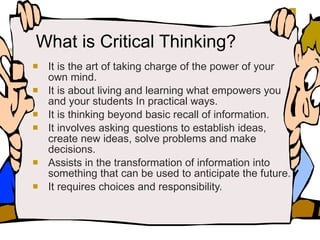
What is Critical Thinking? It is the art of taking charge of the power of your own mind. It is about living and learning what empowers you and your students In practical ways. It is thinking beyond basic recall of information. It involves asking questions to establish ideas, create new ideas, solve problems and make decisions. Assists in the transformation of information into something that can be used to anticipate the future. It requires choices and responsibility.
Asking question is the heart of critical thinking. Questioning to develop critical thinking requires students to; Raise issues; Discover ideas and things; Pursue problematic areas; Seek clarity and relevance of ideas; and Find evidence and make conclusions.
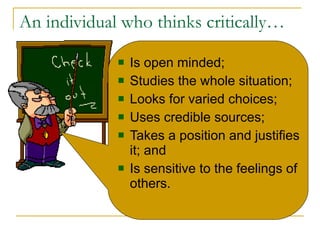
An individual who thinks critically… Is open minded; Studies the whole situation; Looks for varied choices; Uses credible sources; Takes a position and justifies it; and Is sensitive to the feelings of others.
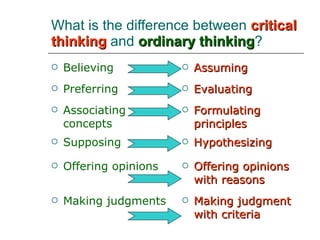
What is the difference between  critical thinking  and  ordinary thinking ? Believing Assuming Preferring Evaluating Associating   concepts Formulating principles Hypothesizing Offering opinions Offering opinions with reasons Making judgments Making judgment with criteria Supposing

Critica Thinking

  • 1.
  • 2.
  • 3.
    As Teachers, we are asked to be critical and creative because these are vital parts of learning. However, critical and creative thinking was rarely taught to us while in training
  • 4.
    Do you knowthat… Albert Einstein was 4 years old before he could speak and 7 before he could read? Beethoven’s music teacher once told him, “As a composer, you are hopeless?” Winston Churchill failed in the 6 th grade? Isaac Newton did poorly in grade school? Thomas Edison’s teacher told him that he was too stupid to learn anything?
  • 5.
    Do you recognizethese people? Do you consider them famous for their critical and creative thinking skills? They seemed to have problems when they were in school. Perhaps their being critical and creative thinkers got them into trouble. It is possible that their teachers imposed so many unnecessary restrictions on their natural behavior that hampered critical thinking.
  • 6.
    What is THINKINGSKILL? Thinking is beyond the level of repeating or memorizing information. Thinking is processing experiences by editing or rearranging them (Matthew Lipman) Thinking is bringing intellectual faculties into play . It requires one to ponder, reflect or weigh a matter mentally (Webster’s Dictionary) Thinking is a complex act comprising knowledge, attitudes and skills that allow the individual to shape his/her environment more effectively than intuition alone (Orlich)
  • 7.
    There are reallymany views on thinking. For you, who are looking for ways to motivate students to think… Thinking is the act of withholding judgment in order to use… new information, concepts or conclusions. experience knowledge
  • 8.
    What is CriticalThinking? It is the art of taking charge of the power of your own mind. It is about living and learning what empowers you and your students In practical ways. It is thinking beyond basic recall of information. It involves asking questions to establish ideas, create new ideas, solve problems and make decisions. Assists in the transformation of information into something that can be used to anticipate the future. It requires choices and responsibility.
  • 9.
    Asking question isthe heart of critical thinking. Questioning to develop critical thinking requires students to; Raise issues; Discover ideas and things; Pursue problematic areas; Seek clarity and relevance of ideas; and Find evidence and make conclusions.
  • 10.
    An individual whothinks critically… Is open minded; Studies the whole situation; Looks for varied choices; Uses credible sources; Takes a position and justifies it; and Is sensitive to the feelings of others.
  • 11.
    What is thedifference between critical thinking and ordinary thinking ? Believing Assuming Preferring Evaluating Associating concepts Formulating principles Hypothesizing Offering opinions Offering opinions with reasons Making judgments Making judgment with criteria Supposing