


Criteria for proper selection of
Study area, Population and
Sample
Presenter:
Jagat Prasad Upadhyay
MPH 2nd Semester
School of Health and Allied Sciences
(SHAS)
3/23/2023 Criteria for proper selection of Study area, Population and Sample 1
Presentation Outline
• Study Area
• Study Population
• Sample
3/23/2023 Criteria for proper selection of Study area, Population and Sample 2
Study Area
• Study area means the land surface area which was mapped and
quantitatively sample for conducting study.
• Research can be conducted in a wide variety of locales– health care
facilities, in people’s homes, classrooms.
• Researchers make decisions about where to conduct a study based on
the nature of the research question and the type of information needed
to address it.
3/23/2023 3
Criteria for proper selection of Study area, Population and Sample
Study Area
• The site is the overall location for the research– It could be an entire community
(e.g., a Tharu community) or an institution within a community (e.g., hospital).
• Researchers sometimes engage in multisite studies because the use of
multiple sites usually offers a larger or more diverse sample of study
participants.
3/23/2023 Criteria for proper selection of Study area, Population and Sample 4
Criteria for selecting study area
• Problem specific in the areas
• Administrative feasibility
• Nature of research question
• Culturally acceptable
• Study population availability
3/23/2023 Criteria for proper selection of Study area, Population and Sample 5
Research Area
• A research area is what a research topic is placed into, but is much
broader than the scope of the topic
• A research topic is a subject or issue that a researcher is interested in
when conducting research.
• Selecting a research area is the very first step in writing research report.
• It is important to choose a research area that is interesting professionally,
as well as, personally.
3/23/2023 6
Criteria for proper selection of Study area, Population and Sample
Research Areas
Research
Areas
Epidemiology
Global
Health
Biostatistics
Planning and
Evaluation
School
Health
Nutrition
and Diet
Occupational
Health
Disease
Prevention
Public
Health
Policy
Health
Promotion
3/23/2023 7
Criteria for proper selection of Study area, Population and Sample
Criteria For Selecting Research Area
3/23/2023 8
Criteria for proper selection of Study area, Population and Sample
Study Population
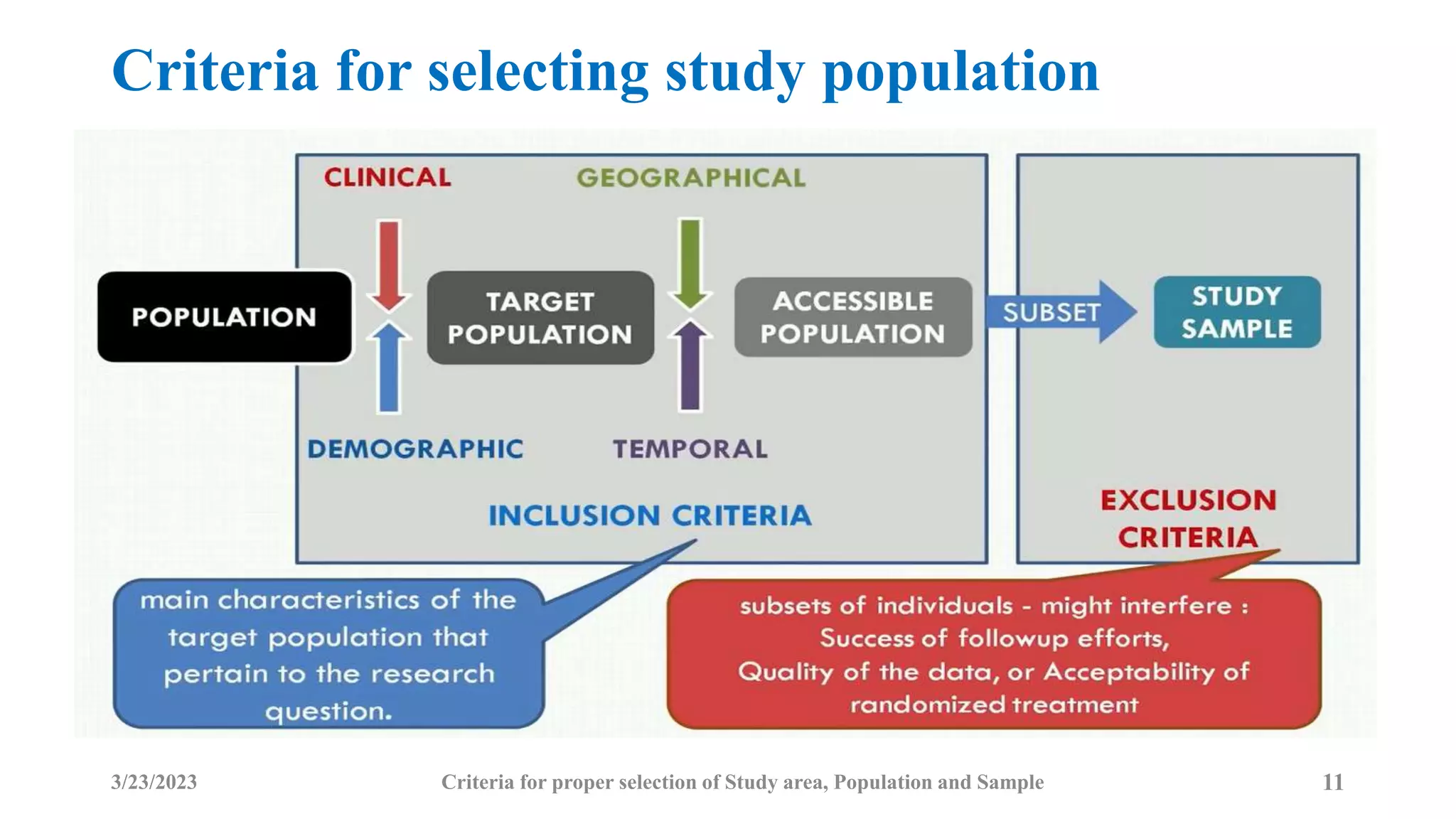
• The target population is the total group of subjects about whom a
researcher is interested and to whom results could reasonably be
generalized.
• Study population is a subset of the target population from which the
sample is actually selected. It is also known as accessible population.
• The study population is the population from which a sample is drawn.
3/23/2023 9
Criteria for proper selection of Study area, Population and Sample
Study Subject and Population connecting the Link
Representative
Adequate
Size
Acceptable
Cost
3/23/2023 Criteria for proper selection of Study area, Population and Sample 10
Criteria for selecting study population
3/23/2023 11
Criteria for proper selection of Study area, Population and Sample
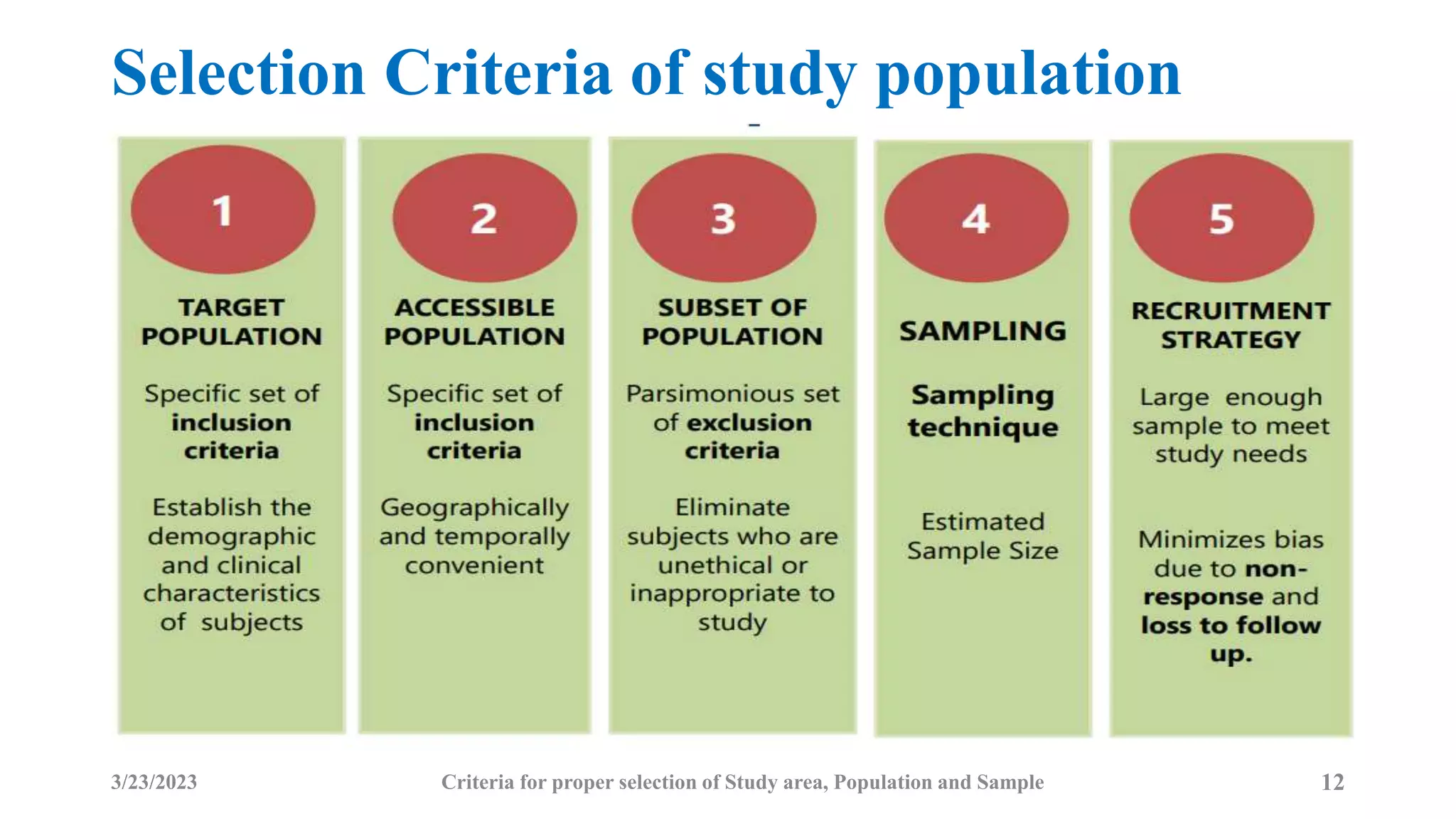
Selection Criteria of study population
3/23/2023 Criteria for proper selection of Study area, Population and Sample 12
Example
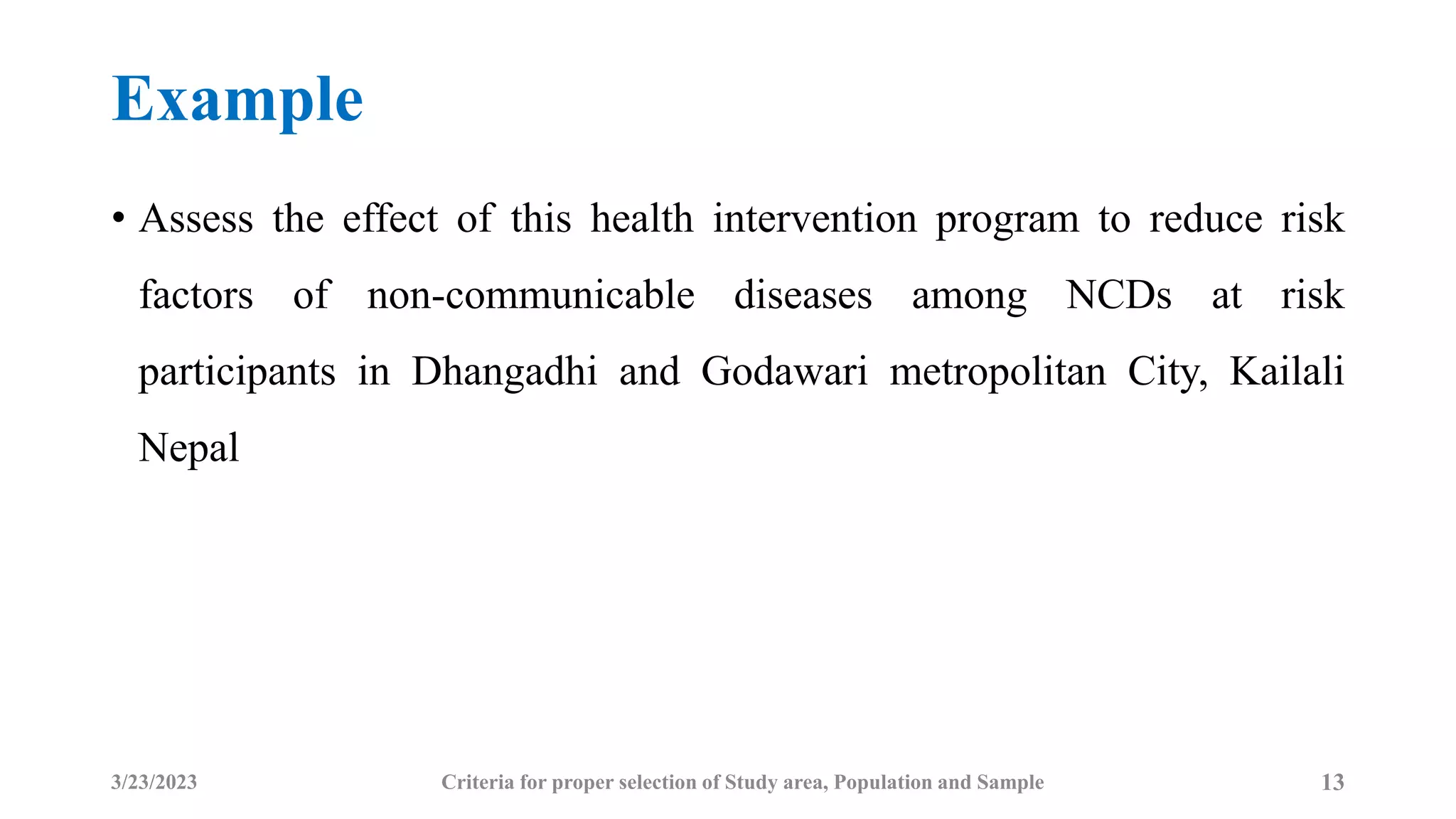
• Assess the effect of this health intervention program to reduce risk
factors of non-communicable diseases among NCDs at risk
participants in Dhangadhi and Godawari metropolitan City, Kailali
Nepal
3/23/2023 Criteria for proper selection of Study area, Population and Sample 13
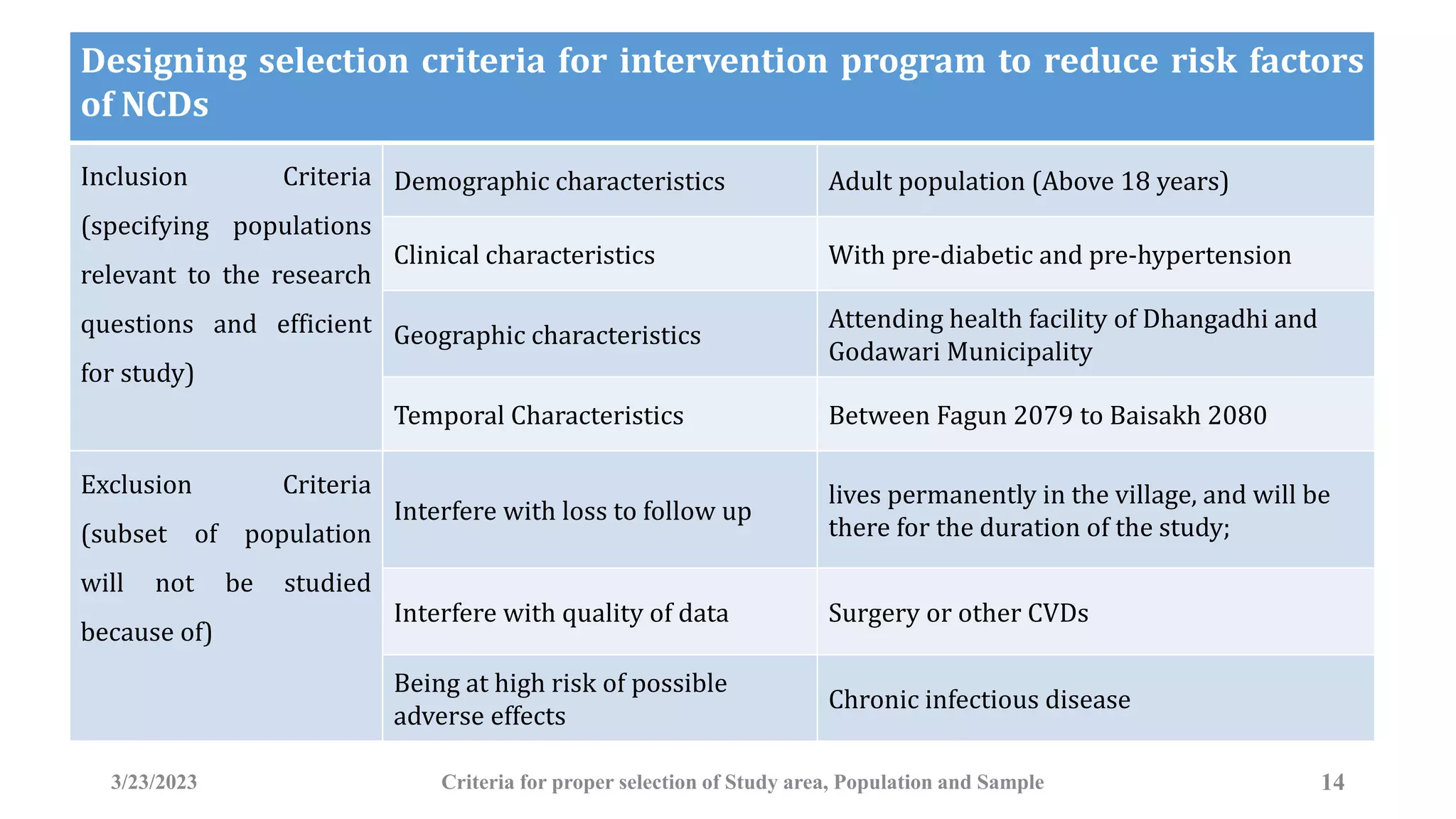
Designing selection criteria for intervention program to reduce risk factors
of NCDs
Inclusion Criteria
(specifying populations
relevant to the research
questions and efficient
for study)
Demographic characteristics Adult population (Above 18 years)
Clinical characteristics With pre-diabetic and pre-hypertension
Geographic characteristics
Attending health facility of Dhangadhi and
Godawari Municipality
Temporal Characteristics Between Fagun 2079 to Baisakh 2080
Exclusion Criteria
(subset of population
will not be studied
because of)
Interfere with loss to follow up
lives permanently in the village, and will be
there for the duration of the study;
Interfere with quality of data Surgery or other CVDs
Being at high risk of possible
adverse effects
Chronic infectious disease
3/23/2023 Criteria for proper selection of Study area, Population and Sample 14
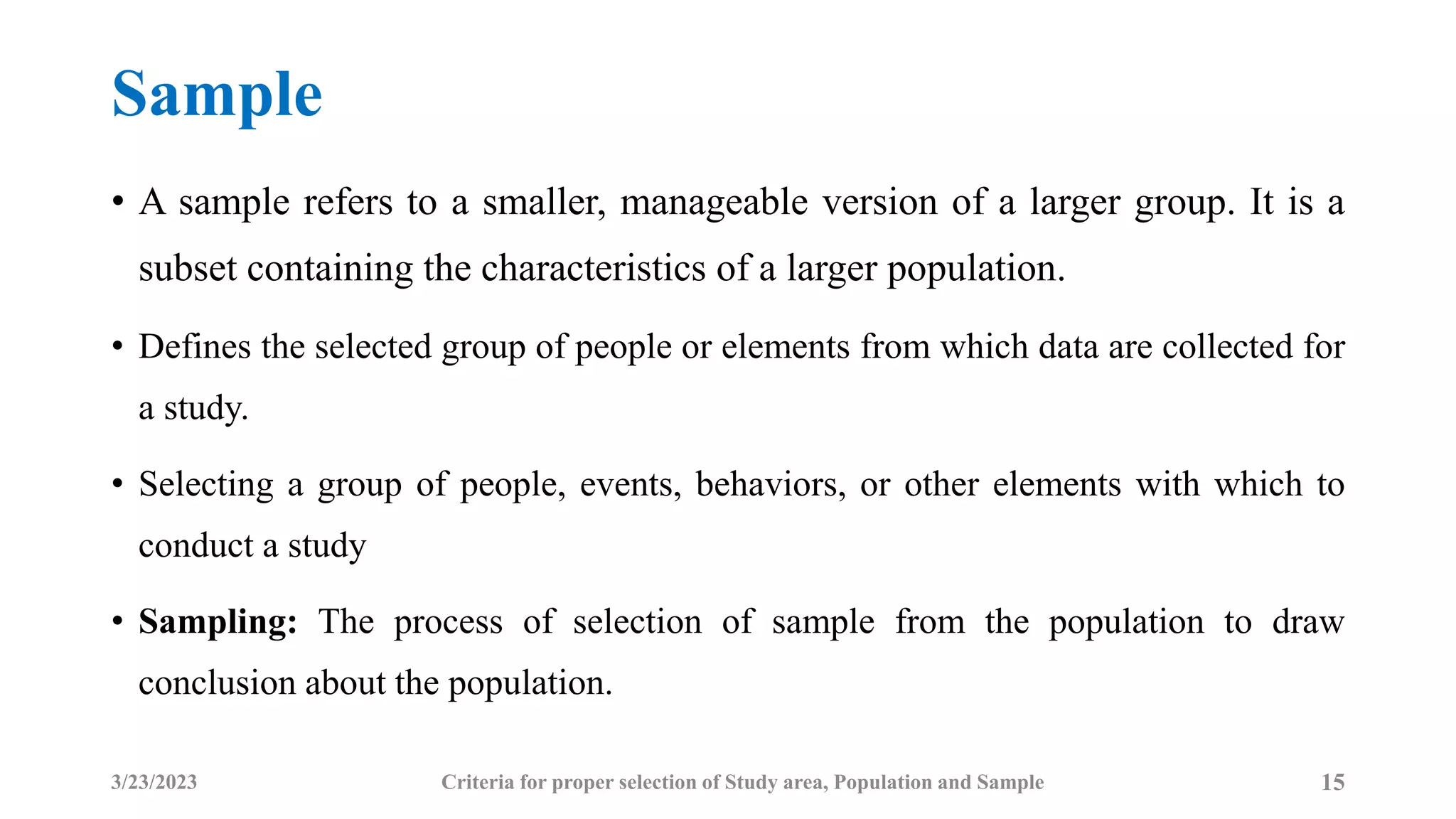
Sample
• A sample refers to a smaller, manageable version of a larger group. It is a
subset containing the characteristics of a larger population.
• Defines the selected group of people or elements from which data are collected for
a study.
• Selecting a group of people, events, behaviors, or other elements with which to
conduct a study
• Sampling: The process of selection of sample from the population to draw
conclusion about the population.
3/23/2023 15
Criteria for proper selection of Study area, Population and Sample
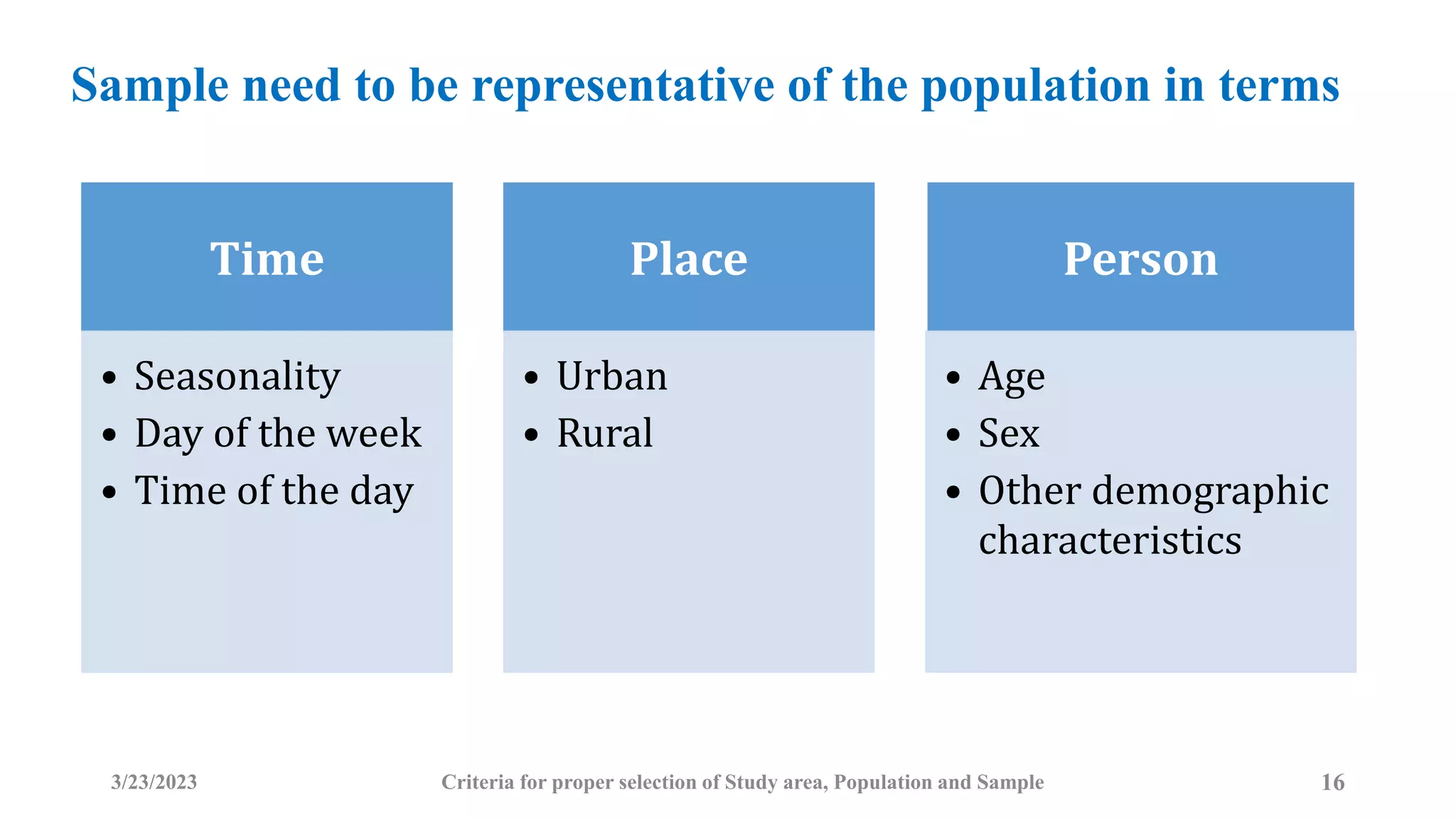
Sample need to be representative of the population in terms
Time
• Seasonality
• Day of the week
• Time of the day
Place
• Urban
• Rural
Person
• Age
• Sex
• Other demographic
characteristics
3/23/2023 16
Criteria for proper selection of Study area, Population and Sample
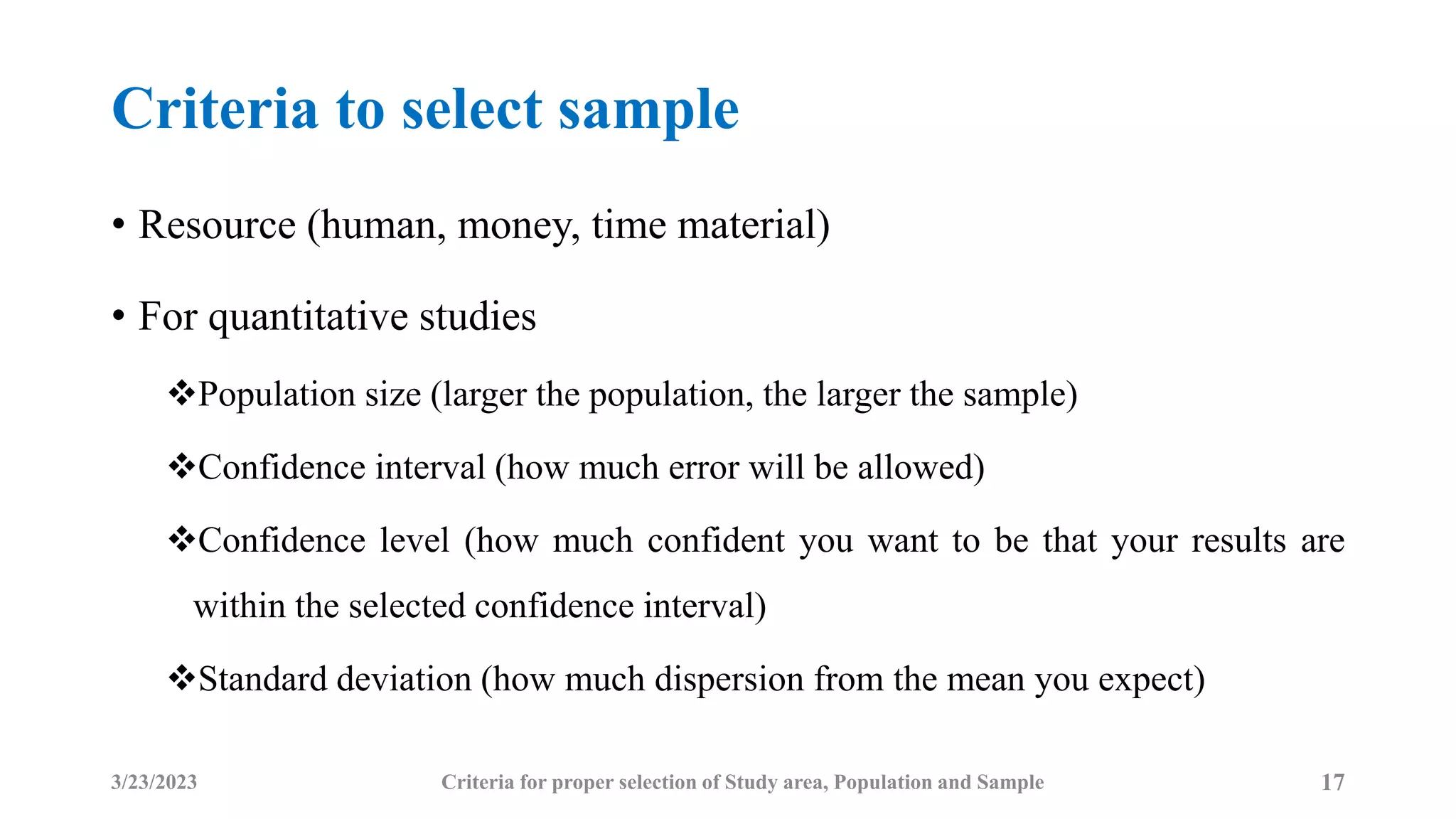
Criteria to select sample
• Resource (human, money, time material)
• For quantitative studies
Population size (larger the population, the larger the sample)
Confidence interval (how much error will be allowed)
Confidence level (how much confident you want to be that your results are
within the selected confidence interval)
Standard deviation (how much dispersion from the mean you expect)
3/23/2023 17
Criteria for proper selection of Study area, Population and Sample
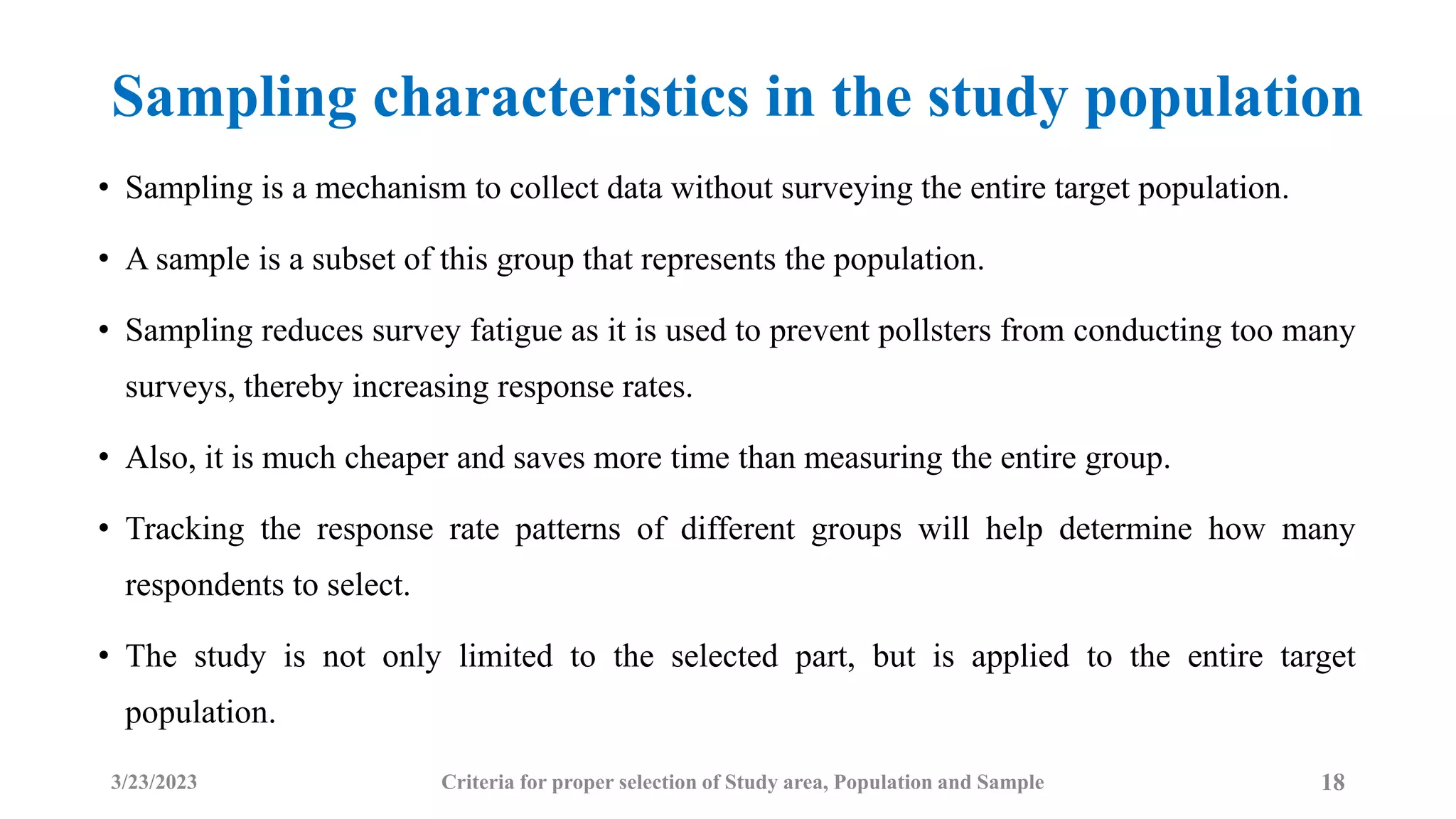
Sampling characteristics in the study population
• Sampling is a mechanism to collect data without surveying the entire target population.
• A sample is a subset of this group that represents the population.
• Sampling reduces survey fatigue as it is used to prevent pollsters from conducting too many
surveys, thereby increasing response rates.
• Also, it is much cheaper and saves more time than measuring the entire group.
• Tracking the response rate patterns of different groups will help determine how many
respondents to select.
• The study is not only limited to the selected part, but is applied to the entire target
population.
3/23/2023 18
Criteria for proper selection of Study area, Population and Sample
3/23/2023 Criteria for proper selection of Study area, Population and Sample 19

Criteria for proper selection of Study area, Population and Sample.pptx

  • 1.
    Criteria for properselection of Study area, Population and Sample Presenter: Jagat Prasad Upadhyay MPH 2nd Semester School of Health and Allied Sciences (SHAS) 3/23/2023 Criteria for proper selection of Study area, Population and Sample 1
  • 2.
    Presentation Outline • StudyArea • Study Population • Sample 3/23/2023 Criteria for proper selection of Study area, Population and Sample 2
  • 3.
    Study Area • Studyarea means the land surface area which was mapped and quantitatively sample for conducting study. • Research can be conducted in a wide variety of locales– health care facilities, in people’s homes, classrooms. • Researchers make decisions about where to conduct a study based on the nature of the research question and the type of information needed to address it. 3/23/2023 3 Criteria for proper selection of Study area, Population and Sample
  • 4.
    Study Area • Thesite is the overall location for the research– It could be an entire community (e.g., a Tharu community) or an institution within a community (e.g., hospital). • Researchers sometimes engage in multisite studies because the use of multiple sites usually offers a larger or more diverse sample of study participants. 3/23/2023 Criteria for proper selection of Study area, Population and Sample 4
  • 5.
    Criteria for selectingstudy area • Problem specific in the areas • Administrative feasibility • Nature of research question • Culturally acceptable • Study population availability 3/23/2023 Criteria for proper selection of Study area, Population and Sample 5
  • 6.
    Research Area • Aresearch area is what a research topic is placed into, but is much broader than the scope of the topic • A research topic is a subject or issue that a researcher is interested in when conducting research. • Selecting a research area is the very first step in writing research report. • It is important to choose a research area that is interesting professionally, as well as, personally. 3/23/2023 6 Criteria for proper selection of Study area, Population and Sample
  • 7.
    Research Areas Research Areas Epidemiology Global Health Biostatistics Planning and Evaluation School Health Nutrition andDiet Occupational Health Disease Prevention Public Health Policy Health Promotion 3/23/2023 7 Criteria for proper selection of Study area, Population and Sample
  • 8.
    Criteria For SelectingResearch Area 3/23/2023 8 Criteria for proper selection of Study area, Population and Sample
  • 9.
    Study Population • Thetarget population is the total group of subjects about whom a researcher is interested and to whom results could reasonably be generalized. • Study population is a subset of the target population from which the sample is actually selected. It is also known as accessible population. • The study population is the population from which a sample is drawn. 3/23/2023 9 Criteria for proper selection of Study area, Population and Sample
  • 10.
    Study Subject andPopulation connecting the Link Representative Adequate Size Acceptable Cost 3/23/2023 Criteria for proper selection of Study area, Population and Sample 10
  • 11.
    Criteria for selectingstudy population 3/23/2023 11 Criteria for proper selection of Study area, Population and Sample
  • 12.
    Selection Criteria ofstudy population 3/23/2023 Criteria for proper selection of Study area, Population and Sample 12
  • 13.
    Example • Assess theeffect of this health intervention program to reduce risk factors of non-communicable diseases among NCDs at risk participants in Dhangadhi and Godawari metropolitan City, Kailali Nepal 3/23/2023 Criteria for proper selection of Study area, Population and Sample 13
  • 14.
    Designing selection criteriafor intervention program to reduce risk factors of NCDs Inclusion Criteria (specifying populations relevant to the research questions and efficient for study) Demographic characteristics Adult population (Above 18 years) Clinical characteristics With pre-diabetic and pre-hypertension Geographic characteristics Attending health facility of Dhangadhi and Godawari Municipality Temporal Characteristics Between Fagun 2079 to Baisakh 2080 Exclusion Criteria (subset of population will not be studied because of) Interfere with loss to follow up lives permanently in the village, and will be there for the duration of the study; Interfere with quality of data Surgery or other CVDs Being at high risk of possible adverse effects Chronic infectious disease 3/23/2023 Criteria for proper selection of Study area, Population and Sample 14
  • 15.
    Sample • A samplerefers to a smaller, manageable version of a larger group. It is a subset containing the characteristics of a larger population. • Defines the selected group of people or elements from which data are collected for a study. • Selecting a group of people, events, behaviors, or other elements with which to conduct a study • Sampling: The process of selection of sample from the population to draw conclusion about the population. 3/23/2023 15 Criteria for proper selection of Study area, Population and Sample
  • 16.
    Sample need tobe representative of the population in terms Time • Seasonality • Day of the week • Time of the day Place • Urban • Rural Person • Age • Sex • Other demographic characteristics 3/23/2023 16 Criteria for proper selection of Study area, Population and Sample
  • 17.
    Criteria to selectsample • Resource (human, money, time material) • For quantitative studies Population size (larger the population, the larger the sample) Confidence interval (how much error will be allowed) Confidence level (how much confident you want to be that your results are within the selected confidence interval) Standard deviation (how much dispersion from the mean you expect) 3/23/2023 17 Criteria for proper selection of Study area, Population and Sample
  • 18.
    Sampling characteristics inthe study population • Sampling is a mechanism to collect data without surveying the entire target population. • A sample is a subset of this group that represents the population. • Sampling reduces survey fatigue as it is used to prevent pollsters from conducting too many surveys, thereby increasing response rates. • Also, it is much cheaper and saves more time than measuring the entire group. • Tracking the response rate patterns of different groups will help determine how many respondents to select. • The study is not only limited to the selected part, but is applied to the entire target population. 3/23/2023 18 Criteria for proper selection of Study area, Population and Sample
  • 19.
    3/23/2023 Criteria forproper selection of Study area, Population and Sample 19

Editor's Notes

  • #4 Study Setting
  • #7 Criteria For Selecting Research Area Passion Importance Impact Originality Feasibility A well-defined research topic is the starting point of every successful research project.
  • #11 Acceptable Cost in terms of Time and Money Adequate Size of the population, so that it control sampling error Representative so that study population generalize the population of interest
  • #16 Sample need to be representative of the population in terms Time, Place and Person
  • #19 Pollsters= Researcher