ROLE OF HUMAN
INTERACTION
By
T.Deepika
IIMSC(CS)
NADAR SARAWATHI ARTS AND SCIENCE COLLEGE
INTRODUCTION:
• Study of INTERACTION between HUMAN and
COMPUTER to Design Human-Centred Skills,So that there
are PRINCIPLES and METHODS to create EXCELLENT
INTERFACE with any technology.
• Its is a popular topic among IT PROFESSIONALS of
TODAY.
• HCI would play a leading role in the creation of
TOMMOROW's exciting software(i.e)New Technology
HCI IMPORTANCE:
• Have to deep understanding of the visual and memory
capabilities of the users when they are designing commercial
system.
• Knowledge of implementing research techniques and it have
to be understand by the user clearly.
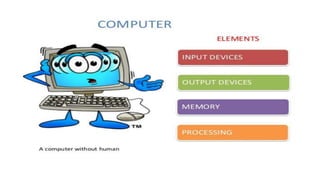
ELEMENTS OF COMPUTER:
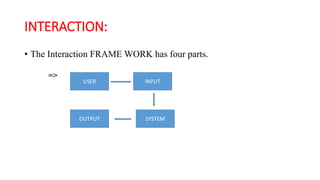
INTERACTION:
• The Interaction FRAME WORK has four parts.
=>
USER INPUT
SYSTEMOUTPUT
HCI IMPORTANCE:
• Human-Computer Interaction, often called HCI, is a
sociotechnological discipline whose goal is to bring the
power of computers and communications systems to people
in ways and forms that are both accessible and useful in our
working, learning, communicating, and recreational lives.
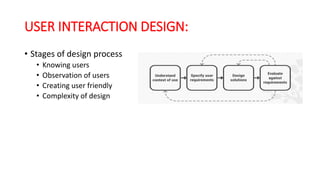
USER INTERACTION DESIGN:
• Stages of design process
• Knowing users
• Observation of users
• Creating user friendly
• Complexity of design
DEVELOPMENT:
• In order to develop a user-centered design we should follow
this steps.
• Data Collection
• Data Analytics
• User Modelling
• Design
ADVANTAGE OF HCI:
• The main advantages of HCI are simplicity, ease of
deployment & operations and cost savings – for smaller set-
ups.
• By using HCI you have fewer systems to manage. The hyper-
converged clouds reduce the time required to deploy many
applications.
• They also reduce solution design time and integration
complexity.
CONCLUSION:
• Every branch of science making entry in HCI. It is good thing
that HCI started dealing with human values, design for all,
involve users to design things, focus on user feedback, focus
on interaction and positive experience, they all are providing
us a way to entering into new modern era.

Role of human interaction

  • 1.
  • 2.
    INTRODUCTION: • Study ofINTERACTION between HUMAN and COMPUTER to Design Human-Centred Skills,So that there are PRINCIPLES and METHODS to create EXCELLENT INTERFACE with any technology. • Its is a popular topic among IT PROFESSIONALS of TODAY. • HCI would play a leading role in the creation of TOMMOROW's exciting software(i.e)New Technology
  • 3.
    HCI IMPORTANCE: • Haveto deep understanding of the visual and memory capabilities of the users when they are designing commercial system. • Knowledge of implementing research techniques and it have to be understand by the user clearly.
  • 5.
  • 6.
    INTERACTION: • The InteractionFRAME WORK has four parts. => USER INPUT SYSTEMOUTPUT
  • 8.
    HCI IMPORTANCE: • Human-ComputerInteraction, often called HCI, is a sociotechnological discipline whose goal is to bring the power of computers and communications systems to people in ways and forms that are both accessible and useful in our working, learning, communicating, and recreational lives.
  • 9.
    USER INTERACTION DESIGN: •Stages of design process • Knowing users • Observation of users • Creating user friendly • Complexity of design
  • 10.
    DEVELOPMENT: • In orderto develop a user-centered design we should follow this steps. • Data Collection • Data Analytics • User Modelling • Design
  • 11.
    ADVANTAGE OF HCI: •The main advantages of HCI are simplicity, ease of deployment & operations and cost savings – for smaller set- ups. • By using HCI you have fewer systems to manage. The hyper- converged clouds reduce the time required to deploy many applications. • They also reduce solution design time and integration complexity.
  • 12.
    CONCLUSION: • Every branchof science making entry in HCI. It is good thing that HCI started dealing with human values, design for all, involve users to design things, focus on user feedback, focus on interaction and positive experience, they all are providing us a way to entering into new modern era.