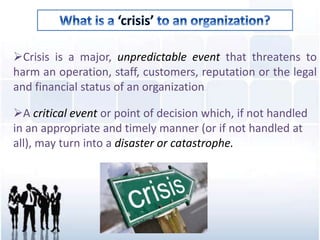
Crisis is a major, unpredictable event that threatens to
harm an operation, staff, customers, reputation or the legal
and financial status of an organization.
A critical event or point of decision which, if not handled
in an appropriate and timely manner (or if not handled at
all), may turn into a disaster or catastrophe.
The art of proactively dealing
with sudden and unexpected
events which disturbs the
employees, organization as well
as external clients refers to
Proactive Crisis Management.
Employees can understand and analyze the causes
of crisis and cope with it in the best possible way.
Crisis Management helps the managers to devise
strategies to come out of uncertain conditions and
also decide on the future course of action.
Crisis Management helps the managers to feel the
early signs of crisis, warn the employees against the
aftermaths and take necessary precautions for the
same.
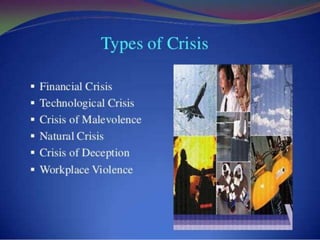
 Financial Crisis is any crisis that affects the
companys financial position, its market value and its
networth.
Any losses ,bankruptcy ,unavailability
of funds, increase in costs will lead to
a financial crisis for the company.
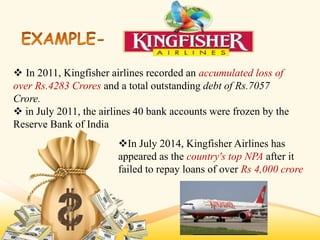
 In 2011, Kingfisher airlines recorded an accumulated loss of
over Rs.4283 Crores and a total outstanding debt of Rs.7057
Crore.
 in July 2011, the airlines 40 bank accounts were frozen by the
Reserve Bank of India
In July 2014, Kingfisher Airlines has
appeared as the country's top NPA after it
failed to repay loans of over Rs 4,000 crore
BETTER INVESTMENT DECISIONS
KFA bought Air Deccan for Rs.550 Crores , an an
airline which already bore debt of Rs.550 Crore .
 BETTER COST CONTROL
•KFA spent on luxury services like televison screens
fordomestic flights when it was running on a loss.
• Very high advertising expenses were made on the IPL team
and on Formula 1 team.
 Technological crisis arises as a result of failure in
technology. Problems in the overall systems lead to
technological crisis.
 Breakdown of machine, corrupted software and so
on give rise to technological crisis.
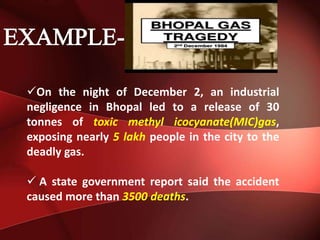
On the night of December 2, an industrial
negligence in Bhopal led to a release of 30
tonnes of toxic methyl icocyanate(MIC)gas,
exposing nearly 5 lakh people in the city to the
deadly gas.
 A state government report said the accident
caused more than 3500 deaths.
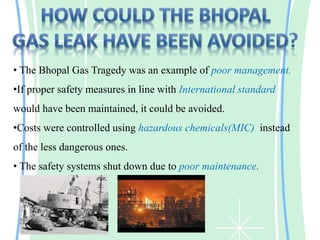
• The Bhopal Gas Tragedy was an example of poor management.
•If proper safety measures in line with International standard
would have been maintained, it could be avoided.
•Costs were controlled using hazardous chemicals(MIC) instead
of the less dangerous ones.
• The safety systems shut down due to poor maintenance.
•Organizations face crisis of malevolence when
some notorious employees take the help of
criminal activities and extreme steps to fulfill
their demands.
•Acts like kidnapping company’s officials, false
rumours all lead to crisis of malevolence.
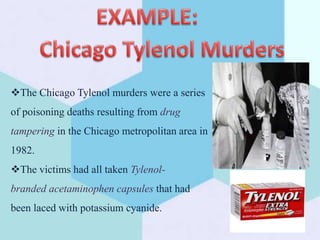
The Chicago Tylenol murders were a series
of poisoning deaths resulting from drug
tampering in the Chicago metropolitan area in
1982.
The victims had all taken Tylenol-
branded acetaminophen capsules that had
been laced with potassium cyanide.
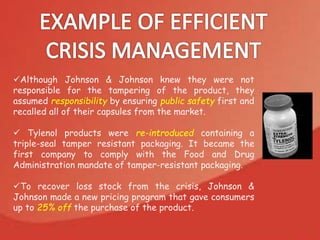
Although Johnson & Johnson knew they were not
responsible for the tampering of the product, they
assumed responsibility by ensuring public safety first and
recalled all of their capsules from the market.
 Tylenol products were re-introduced containing a
triple-seal tamper resistant packaging. It became the
first company to comply with the Food and Drug
Administration mandate of tamper-resistant packaging.
To recover loss stock from the crisis, Johnson &
Johnson made a new pricing program that gave consumers
up to 25% off the purchase of the product.
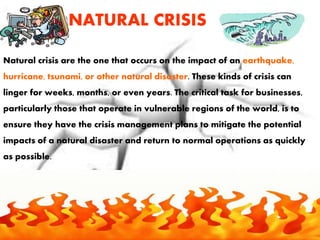
NATURAL CRISIS
Natural crisis are the one that occurs on the impact of an earthquake,
hurricane, tsunami, or other natural disaster. These kinds of crisis can
linger for weeks, months, or even years. The critical task for businesses,
particularly those that operate in vulnerable regions of the world, is to
ensure they have the crisis management plans to mitigate the potential
impacts of a natural disaster and return to normal operations as quickly
as possible.
2011 THAILAND FLOOD CRISIS
HONDA
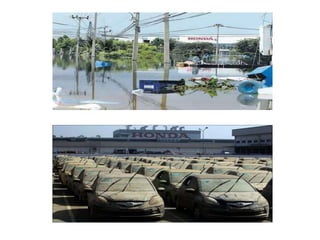
Honda plant which was situated 80kms north of Bangkok was totally inundated leading to a six-month halt in
production. Set in the lowlands The plant stood in almost 2m of water for more than two months before the floods
receded.
Amazingly, the factory took just a further three months to recover. Executive vice president of Honda Automobile
Thailand, Pitak Pruittisarikorn, said: There was complete devastation inside the plant but the building was intact.
To get up and running again it would normally take a year to build a production line and two to construct an entire
plant.
To prevent the flood waters they built sandbag walls around the factory but the amount of water was too great
there was nowhere to pump it as all the land around was flooded.
“Once that happened, we immediately started working on how we were going to repair the damage and decided
that we would replace the production lines entirely rather than trying to do any repairs – this was the quickest and
most cost-effective solution.”
There was human cost as well. Some 80% of the 6,000 employees had their homes ruined. They could also not
work for three months while the factory lines were re-built. Honda, however, continued to pay 100% wages and
guaranteed interest free loans for repair work on homes as most workers were uninsured.
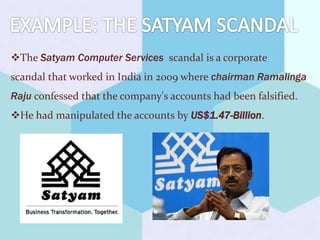
The Satyam Computer Services scandal is a corporate
scandal that worked in India in 2009 where chairman Ramalinga
Raju confessed that the company's accounts had been falsified.
He had manipulated the accounts by US$1.47-Billion.
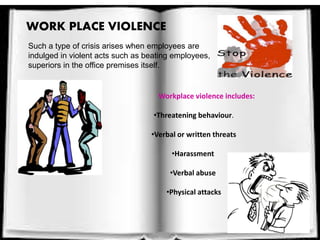
Such a type of crisis arises when employees are
indulged in violent acts such as beating employees,
superiors in the office premises itself.
WORK PLACE VIOLENCE
Workplace violence includes:
•Threatening behaviour.
•Verbal or written threats
•Harassment
•Verbal abuse
•Physical attacks
According to a report by the Bureau of Justice Statistics,
“In 2009, approximately 5,72,000 nonfatal violent crimes (rape/sexual
assault, robbery, and aggravated and simple assault) occurred against
persons while they were at work or on duty, based on findings from the
National Crime Victimization Survey (NCVS)”.
The report goes on to say that in 2009, “521 persons age 16 or older
were victims of homicide in the workplace”.
The report also states that in 2009, “an estimated 4 violent crimes per
1,000 employed persons were committed while the victims were at work
or on duty”.
AN EXAMPLE OF WORKPLACE
VIOLENCE
In a tragic incident, the DGM of graphite india ltd-
Powermax steel division, was killed when some
suspended workers staging “dharna” outside the plant
at orissa stopped his car and allegedly set it on fire.
 Alarm systems or panic button
Mirrors
Bright, effective lighting
 Adequate staffing
 Emergency procedures
Post incident evaluation and response
procedures
 Assistance programs for victims
SOLUTION
Planning and preparation is required to eliminate
workplace violence. A strategic crisis management plan is
required to prevent violence and to respond and
implement when workplace violence occurs. Some
methods that an organisation could follow are:
It is extremely essential for every company to have an
efficient Crisis Management plan and team.
A crisis can hit an organization at any point of time and a
company should be prepared to face any of it.
With the recent collapse of several high profile high street
brands including HMV and Jessops, the importance for
companies to have a crisis management strategy is more
important than ever
Crisis management

Crisis management

  • 2.
    Crisis is amajor, unpredictable event that threatens to harm an operation, staff, customers, reputation or the legal and financial status of an organization. A critical event or point of decision which, if not handled in an appropriate and timely manner (or if not handled at all), may turn into a disaster or catastrophe.
  • 3.
    The art ofproactively dealing with sudden and unexpected events which disturbs the employees, organization as well as external clients refers to Proactive Crisis Management.
  • 4.
    Employees can understandand analyze the causes of crisis and cope with it in the best possible way. Crisis Management helps the managers to devise strategies to come out of uncertain conditions and also decide on the future course of action. Crisis Management helps the managers to feel the early signs of crisis, warn the employees against the aftermaths and take necessary precautions for the same.
  • 6.
     Financial Crisisis any crisis that affects the companys financial position, its market value and its networth. Any losses ,bankruptcy ,unavailability of funds, increase in costs will lead to a financial crisis for the company.
  • 7.
     In 2011,Kingfisher airlines recorded an accumulated loss of over Rs.4283 Crores and a total outstanding debt of Rs.7057 Crore.  in July 2011, the airlines 40 bank accounts were frozen by the Reserve Bank of India In July 2014, Kingfisher Airlines has appeared as the country's top NPA after it failed to repay loans of over Rs 4,000 crore
  • 8.
    BETTER INVESTMENT DECISIONS KFAbought Air Deccan for Rs.550 Crores , an an airline which already bore debt of Rs.550 Crore .  BETTER COST CONTROL •KFA spent on luxury services like televison screens fordomestic flights when it was running on a loss. • Very high advertising expenses were made on the IPL team and on Formula 1 team.
  • 9.
     Technological crisisarises as a result of failure in technology. Problems in the overall systems lead to technological crisis.  Breakdown of machine, corrupted software and so on give rise to technological crisis.
  • 10.
    On the nightof December 2, an industrial negligence in Bhopal led to a release of 30 tonnes of toxic methyl icocyanate(MIC)gas, exposing nearly 5 lakh people in the city to the deadly gas.  A state government report said the accident caused more than 3500 deaths.
  • 11.
    • The BhopalGas Tragedy was an example of poor management. •If proper safety measures in line with International standard would have been maintained, it could be avoided. •Costs were controlled using hazardous chemicals(MIC) instead of the less dangerous ones. • The safety systems shut down due to poor maintenance.
  • 12.
    •Organizations face crisisof malevolence when some notorious employees take the help of criminal activities and extreme steps to fulfill their demands. •Acts like kidnapping company’s officials, false rumours all lead to crisis of malevolence.
  • 13.
    The Chicago Tylenolmurders were a series of poisoning deaths resulting from drug tampering in the Chicago metropolitan area in 1982. The victims had all taken Tylenol- branded acetaminophen capsules that had been laced with potassium cyanide.
  • 14.
    Although Johnson &Johnson knew they were not responsible for the tampering of the product, they assumed responsibility by ensuring public safety first and recalled all of their capsules from the market.  Tylenol products were re-introduced containing a triple-seal tamper resistant packaging. It became the first company to comply with the Food and Drug Administration mandate of tamper-resistant packaging. To recover loss stock from the crisis, Johnson & Johnson made a new pricing program that gave consumers up to 25% off the purchase of the product.
  • 15.
    NATURAL CRISIS Natural crisisare the one that occurs on the impact of an earthquake, hurricane, tsunami, or other natural disaster. These kinds of crisis can linger for weeks, months, or even years. The critical task for businesses, particularly those that operate in vulnerable regions of the world, is to ensure they have the crisis management plans to mitigate the potential impacts of a natural disaster and return to normal operations as quickly as possible.
  • 16.
    2011 THAILAND FLOODCRISIS HONDA Honda plant which was situated 80kms north of Bangkok was totally inundated leading to a six-month halt in production. Set in the lowlands The plant stood in almost 2m of water for more than two months before the floods receded. Amazingly, the factory took just a further three months to recover. Executive vice president of Honda Automobile Thailand, Pitak Pruittisarikorn, said: There was complete devastation inside the plant but the building was intact. To get up and running again it would normally take a year to build a production line and two to construct an entire plant. To prevent the flood waters they built sandbag walls around the factory but the amount of water was too great there was nowhere to pump it as all the land around was flooded. “Once that happened, we immediately started working on how we were going to repair the damage and decided that we would replace the production lines entirely rather than trying to do any repairs – this was the quickest and most cost-effective solution.” There was human cost as well. Some 80% of the 6,000 employees had their homes ruined. They could also not work for three months while the factory lines were re-built. Honda, however, continued to pay 100% wages and guaranteed interest free loans for repair work on homes as most workers were uninsured.
  • 19.
    The Satyam ComputerServices scandal is a corporate scandal that worked in India in 2009 where chairman Ramalinga Raju confessed that the company's accounts had been falsified. He had manipulated the accounts by US$1.47-Billion.
  • 20.
    Such a typeof crisis arises when employees are indulged in violent acts such as beating employees, superiors in the office premises itself. WORK PLACE VIOLENCE Workplace violence includes: •Threatening behaviour. •Verbal or written threats •Harassment •Verbal abuse •Physical attacks
  • 21.
    According to areport by the Bureau of Justice Statistics, “In 2009, approximately 5,72,000 nonfatal violent crimes (rape/sexual assault, robbery, and aggravated and simple assault) occurred against persons while they were at work or on duty, based on findings from the National Crime Victimization Survey (NCVS)”. The report goes on to say that in 2009, “521 persons age 16 or older were victims of homicide in the workplace”. The report also states that in 2009, “an estimated 4 violent crimes per 1,000 employed persons were committed while the victims were at work or on duty”.
  • 22.
    AN EXAMPLE OFWORKPLACE VIOLENCE In a tragic incident, the DGM of graphite india ltd- Powermax steel division, was killed when some suspended workers staging “dharna” outside the plant at orissa stopped his car and allegedly set it on fire.
  • 23.
     Alarm systemsor panic button Mirrors Bright, effective lighting  Adequate staffing  Emergency procedures Post incident evaluation and response procedures  Assistance programs for victims SOLUTION Planning and preparation is required to eliminate workplace violence. A strategic crisis management plan is required to prevent violence and to respond and implement when workplace violence occurs. Some methods that an organisation could follow are:
  • 24.
    It is extremelyessential for every company to have an efficient Crisis Management plan and team. A crisis can hit an organization at any point of time and a company should be prepared to face any of it. With the recent collapse of several high profile high street brands including HMV and Jessops, the importance for companies to have a crisis management strategy is more important than ever