 In your groups/pairs
1. Define what creative is.
2. Define what creative isn‟t.
3. Identify three ways in which the digital
technologies /using conventions of real media
texts you have used - have allowed you to be
creative.
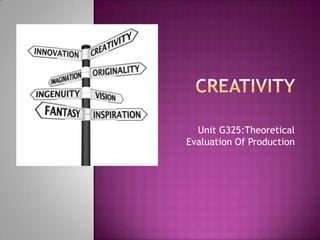
Unit G325:Theoretical
Evaluation Of Production
 What are you learning today?
The aim of this session is to introduce you to theories of
creativity and discuss ways in which you demonstrated
creativity in your project work.
 What must you be able to do by the end of the
lesson?
You must be able to explain how your creativity
developed from your AS Preliminary Task to your AS Main
Task
 Why are you doing this?
This will allow you to answer Question 1a), Section A –
Theoretical Evaluation of Production, which is part of
Unit G325: Critical Perspectives In Media.
 How will I demonstrate what I have learned?
As homework, you will apply what you have learned to
your AS Foundation Portfolio coursework in the form of
a slideshow/mash up/ prezi or other presentational
software and upload to your blog.
“The making of the new and the rearranging
of the old” (Bentley, 1997).
• According to Bentley‟s
definition of creativity does
the work you produced for
your AS project count as
creativity?
• Explain why/why not?
• You have two minutes to
complete this task.
David Gauntlett has written extensively about
creativity and the idea that “making is
connecting”.
His main argument is that “through making
things, and sharing them with others, we feel a
greater connection with the world, and more
engaged with being more active in the
environment rather than sitting back and
watching.” (2003)
 According to Gauntlett‟s definition of creativity
does the work you produced for your AS projects
count as creativity?
 You have two minutes to complete this task.
Creativity involves thinking or behaving
imaginatively . The imaginative activity is
purposeful – set against or defined by a meaningful
objective. The processes must generate something
original.
Paul Roberts (2006)
 According to Robert‟s definition of creativity does
the work you produced for your AS projects count
as creativity?
 Explain why/why not?
 You have two minutes to complete this task.
 Did your set briefs allow you to be creative?
If so how?
 Did the set briefs limit or constrain your
creativity?
 If not, why not? – You could talk about media
language – how did you use generic
conventions/micro elements to be creative?
 Did you expand upon, or consciously reject
generic conventions?
Banaji, Burn & Buckingham have researched
into the extent to which technology makes us
more creative. They conclude that “creativity
is not an inevitable consequence of using
technology.”
(Banaji, Burn and Buckingham, 2006).
Do you agree /disagree – Why?
 Explain how your creativity developed from
the preliminary student magazine to the
main project the music magazine
Or…
 Explain why your creativity didn‟t develop (If
you have time left write an essay plan for
your homework assignment).
 In your own experience, how has your
creativity developed through your
coursework - planning, research, production
and post production?
 Refer to specific and detailed examples from
your products.
 Remember the focus of this question is your
skills development.
 Use as much media theory
(Bentley, Gauntlett and Buckingham) and
terminology as possible.
 Post this work to your blog.
Here are the questions you need to ask yourself when completing your
assignment.
What do you understand by „creativity‟ and to what extent have you been
creative?
How have you tried to facilitate and encourage your own creativity?
Did you experience limits/blocks on your own creativity?
How easy/difficult was it to be creative while still working to the brief?
Did working within conventions stifle your creativity?
To what extent did you need to work with others and „bounce ideas‟ off
other people to be truly creative?
How much of your creativity was about trying to picture things in your
mind‟s eye?
How much of your creativity was about trial and error?
To what extent was a lack of confidence an issue in terms of your creativity?
To what extent was a lack of technical competence/confidence an obstacle
to your creativity?
 Research and Planning.– This will allow you
to answer Question 1a), Section A –
Theoretical Evaluation of Production, which
is part of Unit G325: Critical Perspectives In
Media.

Creativity

  • 1.
     In yourgroups/pairs 1. Define what creative is. 2. Define what creative isn‟t. 3. Identify three ways in which the digital technologies /using conventions of real media texts you have used - have allowed you to be creative.
  • 2.
  • 3.
     What areyou learning today? The aim of this session is to introduce you to theories of creativity and discuss ways in which you demonstrated creativity in your project work.  What must you be able to do by the end of the lesson? You must be able to explain how your creativity developed from your AS Preliminary Task to your AS Main Task  Why are you doing this? This will allow you to answer Question 1a), Section A – Theoretical Evaluation of Production, which is part of Unit G325: Critical Perspectives In Media.  How will I demonstrate what I have learned? As homework, you will apply what you have learned to your AS Foundation Portfolio coursework in the form of a slideshow/mash up/ prezi or other presentational software and upload to your blog.
  • 4.
    “The making ofthe new and the rearranging of the old” (Bentley, 1997). • According to Bentley‟s definition of creativity does the work you produced for your AS project count as creativity? • Explain why/why not? • You have two minutes to complete this task.
  • 5.
    David Gauntlett haswritten extensively about creativity and the idea that “making is connecting”. His main argument is that “through making things, and sharing them with others, we feel a greater connection with the world, and more engaged with being more active in the environment rather than sitting back and watching.” (2003)  According to Gauntlett‟s definition of creativity does the work you produced for your AS projects count as creativity?  You have two minutes to complete this task.
  • 6.
    Creativity involves thinkingor behaving imaginatively . The imaginative activity is purposeful – set against or defined by a meaningful objective. The processes must generate something original. Paul Roberts (2006)  According to Robert‟s definition of creativity does the work you produced for your AS projects count as creativity?  Explain why/why not?  You have two minutes to complete this task.
  • 7.
     Did yourset briefs allow you to be creative? If so how?  Did the set briefs limit or constrain your creativity?  If not, why not? – You could talk about media language – how did you use generic conventions/micro elements to be creative?  Did you expand upon, or consciously reject generic conventions?
  • 8.
    Banaji, Burn &Buckingham have researched into the extent to which technology makes us more creative. They conclude that “creativity is not an inevitable consequence of using technology.” (Banaji, Burn and Buckingham, 2006). Do you agree /disagree – Why?
  • 9.
     Explain howyour creativity developed from the preliminary student magazine to the main project the music magazine Or…  Explain why your creativity didn‟t develop (If you have time left write an essay plan for your homework assignment).
  • 10.
     In yourown experience, how has your creativity developed through your coursework - planning, research, production and post production?  Refer to specific and detailed examples from your products.  Remember the focus of this question is your skills development.  Use as much media theory (Bentley, Gauntlett and Buckingham) and terminology as possible.  Post this work to your blog.
  • 11.
    Here are thequestions you need to ask yourself when completing your assignment. What do you understand by „creativity‟ and to what extent have you been creative? How have you tried to facilitate and encourage your own creativity? Did you experience limits/blocks on your own creativity? How easy/difficult was it to be creative while still working to the brief? Did working within conventions stifle your creativity? To what extent did you need to work with others and „bounce ideas‟ off other people to be truly creative? How much of your creativity was about trying to picture things in your mind‟s eye? How much of your creativity was about trial and error? To what extent was a lack of confidence an issue in terms of your creativity? To what extent was a lack of technical competence/confidence an obstacle to your creativity?
  • 12.
     Research andPlanning.– This will allow you to answer Question 1a), Section A – Theoretical Evaluation of Production, which is part of Unit G325: Critical Perspectives In Media.