Prepared by:
Ms. Cristine Joy M. Vergara
Teacher
CREATIVE
NON-FICTION
Subject Description:
Focusing on formal elements and writing
techniques, including autobiography and
blogging, among others, the subject introduces
the students to the reading and writing of
Creative Nonfiction as a literary form.
The subject develops in students skills in
reading, and thinking critically and creatively,
that will help them to be imaginative readers
and writers.
WHAT IS CREATIVE NON-FICTION?
Creative non-fiction is like jazz—it’s a
rich mix of flavors, ideas, and techniques,
some newly invented and others as old as
writing itself.
Creative non-fiction can be an essay, a
journal article, a research paper, a memoir,
a tweet; it can be personal or not, or it can
be all of these.
WHAT IS CREATIVE NON-FICTION?
“Creative” doesn’t mean inventing what
didn’t happen or reporting and describing
what wasn’t there. It doesn’t mean that the
writer has a license to lie.
The cardinal rule is clear—and cannot
be violated.
Creative non-fiction is true stories, well
told.
WHAT IS CREATIVE NON-FICTION?
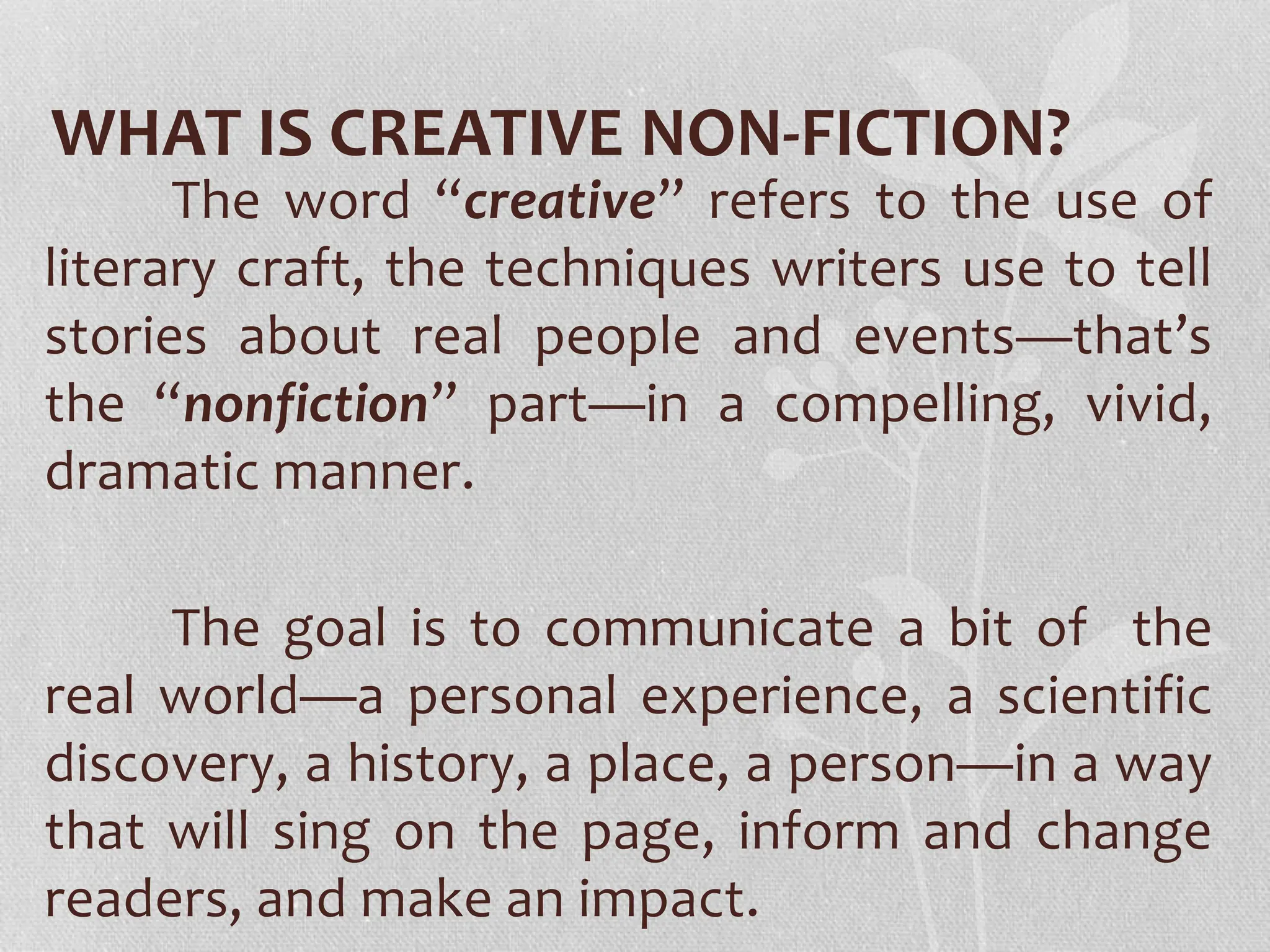
The word “creative” refers to the use of
literary craft, the techniques writers use to tell
stories about real people and events—that’s
the “nonfiction” part—in a compelling, vivid,
dramatic manner.
The goal is to communicate a bit of the
real world—a personal experience, a scientific
discovery, a history, a place, a person—in a way
that will sing on the page, inform and change
readers, and make an impact.
Understanding Conventions
of Traditional Genres
INTRODUCTION
TO LITERARY
GENRES
KEY WORDS:
• Conventions - is just another way of referring
to standard practices and expectations that
we follow in all sorts of areas of our lives. We
have conventions for how to greet people,
make polite requests, and express gratitude.
• Traditional - following or belonging to the
ways of behaving or beliefs that have been
established for a long time or habitually
done, used, or found.
KEY WORDS:
• Literary - concerned with or
connected with the writing, study,
or appreciation of literature.
• Genre - a category of artistic,
musical, or literary composition
characterized by a particular style,
form, or content.
KEY WORDS:
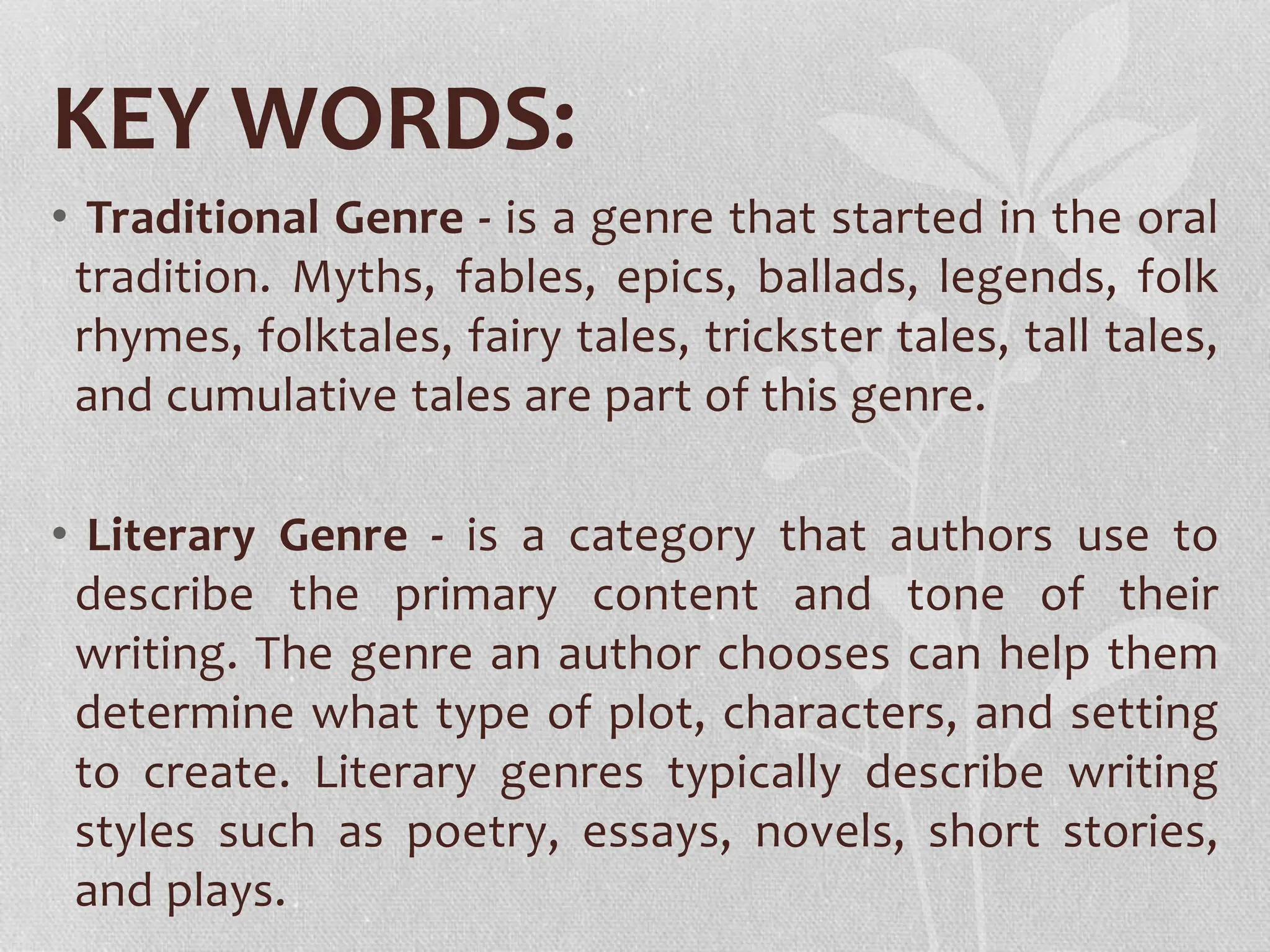
• Traditional Genre - is a genre that started in the oral
tradition. Myths, fables, epics, ballads, legends, folk
rhymes, folktales, fairy tales, trickster tales, tall tales,
and cumulative tales are part of this genre.
• Literary Genre - is a category that authors use to
describe the primary content and tone of their
writing. The genre an author chooses can help them
determine what type of plot, characters, and setting
to create. Literary genres typically describe writing
styles such as poetry, essays, novels, short stories,
and plays.
Understanding Conventions
of Traditional Genres
a. Fiction
b. Poetry
c. Drama
d. Other forms
WHAT IS A STORY
• A narration of now
something that happened
• Tells us who what, when,
where, and now a
particular event took place
• It can be real or imaginary
WHAT IS A LITERARY GENRE?
• It’s a writing style in
making or writing a
piece.
• The genre is a category
used to classify the work
of an author.
• It can either be Fiction
or Non-fiction.
WHAT IS A LITERARY GENRE?
• It’s a writing style in making or
writing a piece.
• The genre is a category used to
classify the work of an author.
• It can either be Fiction or Non-
fiction.
 Fiction are writings or stories created from the mind or
imagination of the author.
 Non-fiction are writings that are factual, realistic, and
existing They are not imaginary.
LITERATURE
•Derived from the Latin
litteratura meaning “writing
formed with letters,”
•Most commonly refers to
works of the creative
imagination, including
poetry, drama, fiction,
nonfiction, journalism, and
some instances, song.
IMPORTANCE OF LITERATURE
• Literature is the foundation of life.
• Places an emphasis on many topics from
human tragedies to tales of the ever-popular
search for love.
• While it’s physically written in words, these
words come alive in the imagination of the
mind, and its ability to comprehend the
complexity or simplicity of the text.
IMPORTANCE OF LITERATURE
• Enables people to see through the lenses of
others, and sometimes even inanimate
objects, therefore, it becomes a looking glass
into the world as others view it.
• A journey that is inscribed in pages, and
powered by the imagination of the reader.
• It has provided a gateway to teach the reader
about life experiences from the saddest
stories to the most joyful ones that will touch
the hearts.
Lesson 1 - Creative Non-fiction Lecture.pptx

Lesson 1 - Creative Non-fiction Lecture.pptx

  • 1.
    Prepared by: Ms. CristineJoy M. Vergara Teacher CREATIVE NON-FICTION
  • 2.
    Subject Description: Focusing onformal elements and writing techniques, including autobiography and blogging, among others, the subject introduces the students to the reading and writing of Creative Nonfiction as a literary form. The subject develops in students skills in reading, and thinking critically and creatively, that will help them to be imaginative readers and writers.
  • 3.
    WHAT IS CREATIVENON-FICTION? Creative non-fiction is like jazz—it’s a rich mix of flavors, ideas, and techniques, some newly invented and others as old as writing itself. Creative non-fiction can be an essay, a journal article, a research paper, a memoir, a tweet; it can be personal or not, or it can be all of these.
  • 4.
    WHAT IS CREATIVENON-FICTION? “Creative” doesn’t mean inventing what didn’t happen or reporting and describing what wasn’t there. It doesn’t mean that the writer has a license to lie. The cardinal rule is clear—and cannot be violated. Creative non-fiction is true stories, well told.
  • 5.
    WHAT IS CREATIVENON-FICTION? The word “creative” refers to the use of literary craft, the techniques writers use to tell stories about real people and events—that’s the “nonfiction” part—in a compelling, vivid, dramatic manner. The goal is to communicate a bit of the real world—a personal experience, a scientific discovery, a history, a place, a person—in a way that will sing on the page, inform and change readers, and make an impact.
  • 6.
    Understanding Conventions of TraditionalGenres INTRODUCTION TO LITERARY GENRES
  • 7.
    KEY WORDS: • Conventions- is just another way of referring to standard practices and expectations that we follow in all sorts of areas of our lives. We have conventions for how to greet people, make polite requests, and express gratitude. • Traditional - following or belonging to the ways of behaving or beliefs that have been established for a long time or habitually done, used, or found.
  • 8.
    KEY WORDS: • Literary- concerned with or connected with the writing, study, or appreciation of literature. • Genre - a category of artistic, musical, or literary composition characterized by a particular style, form, or content.
  • 9.
    KEY WORDS: • TraditionalGenre - is a genre that started in the oral tradition. Myths, fables, epics, ballads, legends, folk rhymes, folktales, fairy tales, trickster tales, tall tales, and cumulative tales are part of this genre. • Literary Genre - is a category that authors use to describe the primary content and tone of their writing. The genre an author chooses can help them determine what type of plot, characters, and setting to create. Literary genres typically describe writing styles such as poetry, essays, novels, short stories, and plays.
  • 10.
    Understanding Conventions of TraditionalGenres a. Fiction b. Poetry c. Drama d. Other forms
  • 11.
    WHAT IS ASTORY • A narration of now something that happened • Tells us who what, when, where, and now a particular event took place • It can be real or imaginary
  • 12.
    WHAT IS ALITERARY GENRE? • It’s a writing style in making or writing a piece. • The genre is a category used to classify the work of an author. • It can either be Fiction or Non-fiction.
  • 13.
    WHAT IS ALITERARY GENRE? • It’s a writing style in making or writing a piece. • The genre is a category used to classify the work of an author. • It can either be Fiction or Non- fiction.  Fiction are writings or stories created from the mind or imagination of the author.  Non-fiction are writings that are factual, realistic, and existing They are not imaginary.
  • 14.
    LITERATURE •Derived from theLatin litteratura meaning “writing formed with letters,” •Most commonly refers to works of the creative imagination, including poetry, drama, fiction, nonfiction, journalism, and some instances, song.
  • 15.
    IMPORTANCE OF LITERATURE •Literature is the foundation of life. • Places an emphasis on many topics from human tragedies to tales of the ever-popular search for love. • While it’s physically written in words, these words come alive in the imagination of the mind, and its ability to comprehend the complexity or simplicity of the text.
  • 16.
    IMPORTANCE OF LITERATURE •Enables people to see through the lenses of others, and sometimes even inanimate objects, therefore, it becomes a looking glass into the world as others view it. • A journey that is inscribed in pages, and powered by the imagination of the reader. • It has provided a gateway to teach the reader about life experiences from the saddest stories to the most joyful ones that will touch the hearts.