Authors Ana Simona NEGOMIREANU
Simona HERCZEG
Project SoundBeatsTime
soundbeatstime@gmail.com
soundbeatstime.com
Partners Yellow Shirts – Romania
Institutul Român de Educație a Adulților – Romania
Giovani senza Frontiere – Italy
Disclaimer This project has been funded with support from the European Commission.
This publication reflects the views only of the author, and the Commission
cannot be held responsible for any use which may be made of the
information contained therein.
This manual has been elaborated during the project “SoundBeatsTime”
(with the ref. no. 2020-1-RO01-KA227-YOU-095777), funded by the
European Union through the Romanian National Agency, in the context of
the Erasmus+ KA2 – Cooperation for innovation and the exchange of good
practices action, Partnership for Creativity sub-action.
CONTENTS
PART I – CULTURAL ENTREPRENEURHIP
Definition of cultural entrepreneurship ......................................................................... 5
Live music production: how to prepare a live/online event ................................ 14
The management during the event .............................................................................. 19
Music marketing: creating your own brand ............................................................... 24
Cooperation in the field of music: how to interact with other musicians from
your country and/or abroad ............................................................................................ 29
Developing professional skills ......................................................................................... 35
Overcoming challenges: young musicians and the role of virtual reality in the
COVID-19 era ......................................................................................................................... 38
Audience development for young musicians in the digital age ........................ 42
How to make money from music as a young musician ......................................... 45
Intellectual property and copyright management ................................................. 51
The needs of young musicians and benefits of music to young people ........ 56
Online solutions for cultural entrepreneurship ........................................................ 59
Conclusion .............................................................................................................................. 65
PART II – ELECTRONIC MUSIC
Career guide for electronic music producers ............................................................ 67
How to become an entrepreneur as an electronic music artist ......................... 79
Best ways to promote yourself as an electronic music artist using digital tools
.......................................................................................................................................................89
Financial tips to earn money as an electronic music artist ................................. 100
Bibliography ......................................................................................................................... 108
5
PART I – CULTURAL ENTREPRENEURHIP
The research conducted for the second part of entrepreneurship, dedicated to cultural
entrepreneurship, has led to a structure focused on topics of great interest to young
musicians or young people who want to start a career in the music field. We have
organized the subjects as follows:
DEFINITION OF CULTURAL ENTREPRENEURSHIP
Cultural entrepreneurship is characterized as a continuously changing field situated at the
intersection of art, culture, and business.
Considering the complexity of this field, those who work in this area are often individuals
with vision, capable of taking risks, as well as mediating, managing, and interpreting a
range of complex and contradictory processes.
From generating ideas, realizing or implementing them, to commercializing these cultural
products or developing specific mechanisms to make them profitable, cultural
entrepreneurs are usually involved in all the processes mentioned above.
The process of generating cultural businesses involves several factors related to
generating creative and relevant ideas and content, as well as a good understanding of
societal contexts that can provide perspectives for the success of cultural proposals.
Without understanding socio-economic realities, cultural entrepreneurs cannot generate
usable ideas.
The context or contexts in which cultural businesses operate usually dictate how this type
of business functions. Although we talk about creative entrepreneurship, this type of
business cannot operate without being closely tied to immediate social realities.
Since there are no special rules for entrepreneurs to follow in creating cultural products,
their value can only be confirmed or negated once they are placed on the market. As
mentioned above, their validation is closely linked to the social contexts in which they
take place or unfold.
In terms of risks associated with this type of activity, it should be noted that cultural
entrepreneurship carries a high degree of risk precisely due to the lack of classic business
recipes. The better entrepreneurs understand the specificities in which they operate, the
greater their chances of success. Cultural entrepreneurship can be conceptualized as the
process of creating, managing, and promoting cultural products, services, or initiatives
6
with an entrepreneurial mindset. It involves applying entrepreneurial principles and
strategies in cultural and creative industries to generate cultural and economic value.
Cultural entrepreneurship encompasses the fusion of creativity, innovation, and business
acumen to leverage artistic and cultural resources for the development of sustainable
businesses. It involves identifying cultural opportunities, conducting research, planning,
and implementing ideas that address cultural gaps or needs within a specific community
or industry.
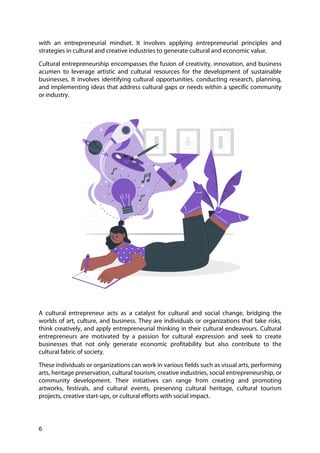
A cultural entrepreneur acts as a catalyst for cultural and social change, bridging the
worlds of art, culture, and business. They are individuals or organizations that take risks,
think creatively, and apply entrepreneurial thinking in their cultural endeavours. Cultural
entrepreneurs are motivated by a passion for cultural expression and seek to create
businesses that not only generate economic profitability but also contribute to the
cultural fabric of society.
These individuals or organizations can work in various fields such as visual arts, performing
arts, heritage preservation, cultural tourism, creative industries, social entrepreneurship, or
community development. Their initiatives can range from creating and promoting
artworks, festivals, and cultural events, preserving cultural heritage, cultural tourism
projects, creative start-ups, or cultural efforts with social impact.
7
Therefore, cultural entrepreneurship involves the exploration, development, and
entrepreneurial management of cultural initiatives, combining artistic vision with business
strategies to create sustainable businesses that generate both cultural and economic
value.
Cultural entrepreneurship is rooted in recognizing and appreciating culture as a valuable
resource that can stimulate economic growth, social cohesion, and individual
empowerment. It goes beyond the traditional view of culture as solely artistic or aesthetic
expression and adopts a broader perspective that encompasses cultural heritage,
diversity, creativity, and innovation.
One key aspect of cultural entrepreneurship is the ability to identify and capitalize on
cultural opportunities. Cultural entrepreneurs have a keen insight for identifying gaps or
underserved areas within the cultural landscape and seek to fill these gaps with innovative
cultural products, services, or experiences. They often engage in market research,
audience analysis, and trend monitoring to understand the needs and preferences of their
target audience.
Cultural entrepreneurship involves applying business principles to cultural initiatives.
Cultural entrepreneurs develop business models, create marketing strategies, manage
budgets and finances, establish partnerships, and navigate legal frameworks and
8
regulations. They leverage entrepreneurial skills such as risk-taking, networking, creativity,
and adaptability to ensure the viability and sustainability of their cultural businesses.
Additionally, cultural entrepreneurship often involves collaboration and community
engagement. Cultural entrepreneurs actively seek partnerships with artists, cultural
organizations, community groups, and other stakeholders to leverage resources,
expertise, and networks. They connect with the community to ensure that their initiatives
align with local values, aspirations, and needs, promoting a sense of ownership,
belonging, and participation. The impact of cultural entrepreneurship extends beyond
economic gains.
Cultural entrepreneurs contribute to the preservation and promotion of cultural heritage,
the revitalization of traditional arts and crafts, the promotion of cultural diversity, and the
empowerment of marginalized communities. They create platforms for cultural exchange,
dialogue, and understanding, promoting social cohesion and improving the quality of life
in communities.
In conclusion, cultural entrepreneurship is a dynamic and multidimensional process that
combines creativity, innovation, and insight to create sustainable cultural businesses. It
involves identifying cultural opportunities, applying entrepreneurial strategies,
collaborating with stakeholders, and making a positive impact on cultural, social, and
economic development.
9
Cultural entrepreneurs play a vital role in shaping and enriching the cultural landscape of
societies. When addressing young musicians, particularly in the context of cultural
entrepreneurship, there are several key considerations and strategies that can be
beneficial:
• Education and skill development: young musicians should focus on honing their
musical skills and knowledge through formal education, music lessons, workshops,
and mentorship programs. It is essential to continuously seek growth
opportunities, explore different genres, and develop a diverse musical repertoire.
• Entrepreneurial mindset: encourage young musicians to adopt an
entrepreneurial mindset from the outset. This involves cultivating a strong work
ethic, embracing innovation, taking calculated risks, and being open to exploring
new avenues for their music beyond traditional performance settings.
• Networking and collaboration: building a network of connections in the music
industry is crucial for young musicians. Encourage them to participate in music
events, conferences, and festivals, where they can meet industry professionals,
fellow musicians, and potential collaborators. Collaborations with artists from
different genres or art forms can lead to unique and innovative projects.
• Branding and promotion: developing a strong personal brand is essential for
young musicians. Encourage them to create a compelling artistic identity,
including a professional website, social media presence, and high-quality
promotional materials. Leveraging digital platforms and social networks can help
young musicians reach a broader audience and build a dedicated fan base.
• Entrepreneurial opportunities: encourage young musicians to explore diverse
entrepreneurial opportunities in the music industry. This could include organizing
their own concerts or music events, forming a band or ensemble, composing and
recording original music, offering music lessons, or collaborating with brands for
sponsorships or donations. Encourage them to think outside the box and find
innovative ways to monetize their talent and passion.
• Business and financial management: young musicians should familiarize
themselves with basic business and financial management concepts. They should
learn about budgeting, contracts, copyright, licensing, taxes, and other legal and
financial aspects of the music industry. This knowledge will help them make
informed decisions and protect their rights as musicians.
• Continued learning and adaptation: the music industry is constantly evolving, so
encourage young musicians to stay updated on industry trends, technological
advancements, and changes in audience preferences. Emphasize the importance
of adaptability and willingness to embrace new opportunities and challenges.
• Mentorship and guidance: access to mentorship and guidance from experienced
professionals can be highly beneficial for young musicians. Encourage them to
seek mentorship from established musicians, music educators, or cultural
entrepreneurs who can provide valuable perspectives, advice, and support
throughout their entrepreneurial journey.
10
By addressing these aspects and adopting a cultural entrepreneurial vision, young
musicians can navigate the music industry with a strategic mindset, create unique
opportunities for themselves, and contribute to the cultural and artistic landscape while
pursuing their passion for music.
Therefore, cultural entrepreneurship refers to the process of creating, managing, and
promoting cultural products, services, or initiatives with an entrepreneurial mindset. It
involves combining creativity, innovation, and business strategies to generate both
cultural and economic value within the cultural and creative industries.
Cultural entrepreneurs aim to leverage artistic and cultural resources to develop
sustainable enterprises and contribute to the cultural and social fabric of a society. Here
are a few steps and approaches commonly associated with cultural entrepreneurship:
• Identifying cultural opportunities: cultural entrepreneurs begin by identifying
gaps, needs, or cultural opportunities within a specific community or industry. They
explore potential areas where cultural products, services, or experiences can be
developed to address these gaps.
• Research and planning: once an opportunity is identified, cultural entrepreneurs
conduct thorough research to understand the target audience, market trends.
• Creating value: cultural entrepreneurs focus on creating value through their
cultural offerings. They develop unique and innovative ideas that resonate with
their target audience, whether it's a new art form, an immersive cultural
experience, a cultural tourism initiative, or a socially impactful project.
11
• Building partnerships and networks: collaboration is essential in cultural
entrepreneurship. Cultural entrepreneurs actively seek partnerships and
collaborations with artists, cultural organizations, community groups, businesses,
and other stakeholders. These partnerships help leverage resources, expertise, and
networks, promoting a supportive ecosystem.
• Securing funding: cultural enterprises often require financial support to start or
sustain their operations. Cultural entrepreneurs explore various funding sources
such as grants, sponsorships, crowdfunding, investments, or earned revenue
streams. They develop compelling proposals and presentations to secure funding
from both public and private sources.
• Implementation and operation: cultural entrepreneurs bring their ideas to life by
implementing plans and managing the day-to-day operations of their enterprises.
This involves hiring talent, managing budgets, marketing and promoting cultural
products or services, and ensuring high-quality execution.
• Evaluation and adaptation: continuous evaluation is crucial for cultural
entrepreneurs to assess the impact and effectiveness of their initiatives. They
collect feedback, measure results, and make necessary adjustments to improve
their offerings, business models, or strategies based on obtained information.
Approaches to cultural entrepreneurship
• Preserving cultural heritage: cultural entrepreneurs can focus on preserving and
revitalizing traditional arts, crafts, rituals, or heritage sites. They create sustainable
business models that generate income for local communities while safeguarding
cultural practices.
• Cultural tourism: cultural entrepreneurs develop tourism initiatives that highlight
the unique cultural attributes of a region or community. This approach promotes
cultural exchange, generates economic benefits, and raises awareness of local
traditions and customs.
• Social entrepreneurship: cultural entrepreneurs combine their cultural initiatives
with a social mission, addressing social or environmental challenges. They aim to
create a positive social impact alongside economic sustainability, using culture as a
tool for community development and empowerment.
• Creative industries and start-ups: cultural entrepreneurs can establish creative
businesses in sectors such as film, music, publishing, fashion, design, or gaming.
They apply entrepreneurial strategies to develop commercially viable cultural
products or services, often incorporating technology and innovation.
• Community engagement and collaboration: cultural entrepreneurs promote
community engagement and participation in cultural initiatives. They involve local
communities in decision-making processes, co-creation, and knowledge-sharing,
ensuring that cultural projects reflect the values and needs of the community.
12
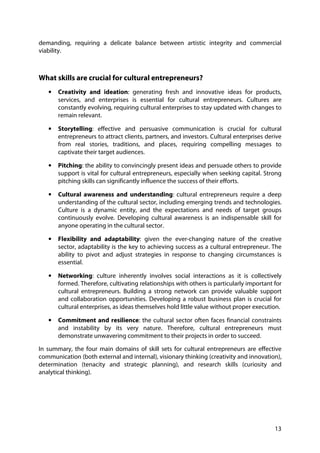
These steps and approaches provide a general framework for cultural entrepreneurship,
but it's important to adapt them to specific contexts and individual enterprises. Cultural
entrepreneurship requires a combination of artistic vision, business acumen, strategic
thinking, and a deep understanding of the cultural landscape.
Who qualifies as a cultural entrepreneur?
A cultural entrepreneur can be an individual or an organization involved in creating and
managing cultural products and services. These encompass various fields, including art,
heritage, media, and entertainment, serving either commercial or social purposes. A vital
attribute for cultural entrepreneurs is the ability to identify opportunities for transforming
cultural resources into profitable products or services.
According to EU regulations, cultural and creative sectors include activities such as the
development, creation, production, dissemination, and preservation of goods and services
that incorporate cultural, artistic, or creative expressions.
Therefore, anything within this domain can serve as an example of cultural
entrepreneurship. Cultural entrepreneurs play a crucial role in promoting creativity,
innovation, and cultural diversity within their communities. However, their work is often
13
demanding, requiring a delicate balance between artistic integrity and commercial
viability.
What skills are crucial for cultural entrepreneurs?
• Creativity and ideation: generating fresh and innovative ideas for products,
services, and enterprises is essential for cultural entrepreneurs. Cultures are
constantly evolving, requiring cultural enterprises to stay updated with changes to
remain relevant.
• Storytelling: effective and persuasive communication is crucial for cultural
entrepreneurs to attract clients, partners, and investors. Cultural enterprises derive
from real stories, traditions, and places, requiring compelling messages to
captivate their target audiences.
• Pitching: the ability to convincingly present ideas and persuade others to provide
support is vital for cultural entrepreneurs, especially when seeking capital. Strong
pitching skills can significantly influence the success of their efforts.
• Cultural awareness and understanding: cultural entrepreneurs require a deep
understanding of the cultural sector, including emerging trends and technologies.
Culture is a dynamic entity, and the expectations and needs of target groups
continuously evolve. Developing cultural awareness is an indispensable skill for
anyone operating in the cultural sector.
• Flexibility and adaptability: given the ever-changing nature of the creative
sector, adaptability is the key to achieving success as a cultural entrepreneur. The
ability to pivot and adjust strategies in response to changing circumstances is
essential.
• Networking: culture inherently involves social interactions as it is collectively
formed. Therefore, cultivating relationships with others is particularly important for
cultural entrepreneurs. Building a strong network can provide valuable support
and collaboration opportunities. Developing a robust business plan is crucial for
cultural enterprises, as ideas themselves hold little value without proper execution.
• Commitment and resilience: the cultural sector often faces financial constraints
and instability by its very nature. Therefore, cultural entrepreneurs must
demonstrate unwavering commitment to their projects in order to succeed.
In summary, the four main domains of skill sets for cultural entrepreneurs are effective
communication (both external and internal), visionary thinking (creativity and innovation),
determination (tenacity and strategic planning), and research skills (curiosity and
analytical thinking).
14
LIVE MUSIC PRODUCTION: How to prepare a live/online event
Whether you're an up-and-coming artist, an event organizer, or simply a music enthusiast,
this topic will provide practical tips and guidelines to help you create memorable music
experiences.
Live or online music events present an extraordinary opportunity to bring artists and
audiences together, create strong connections, and convey unique emotions through
music. However, organizing such an event requires careful planning, coordination, and
adequate preparation.
In the following, we will explore various aspects of live and online music production. We
will begin by guiding you through the process of planning and preparing for the event,
considering aspects such as venue selection, budgeting, artist selection, and effective
promotion.
We will provide valuable tips on securing sponsorships and partnerships, creating a
cohesive and engaging program, and ensuring smooth logistics for the successful
execution of the event.
Additionally, we will delve into the technical aspects of live and online music production,
such as sound, lighting, stage design, and visual elements. We will provide information on
the necessary equipment, audio mixing techniques, lighting design, and online streaming
aspects to create an impressive sonic and visual experience for the audience.
In addition to the technical aspects, we will discuss event management, team
coordination, and ensuring effective communication among all involved parties. We will
also address aspects related to audience safety and compliance with regulations and
standards.
Whether you are considering organizing a live concert in a concert hall, an outdoor venue,
or an online event, this information will provide you with the tools and knowledge to
adequately prepare and succeed in live music production.
So let's embark on this exciting journey into the world of live and online music production!
How to manage the necessary resources for organization
If you are a cultural entrepreneur, event organizer, or event producer, you should know
that organizing a physical concert involves varying levels of coordination and logistics,
depending on the event.
15
Preparing artists for the event
Preparing artists for events is similar for both physical and online events, with respect and
dedication to the audience being essential in both situations. Regardless of the type of
music being performed, the artist, whether performing individually or as part of a band,
needs to prepare for the concert. This involves rehearsals prior to the concert and
preparing choreography where applicable.
For example, in the case of classical music instrumentalists who do not perform their own
repertoire, they need to study the selected works for the concert. The number of
rehearsals varies depending on the type of event, but a final rehearsal before the concert
is essential for all young musicians, often on the stage where the concert will take place.
Additionally, in the process of preparing for the concert, it is important for the musician to
be aware of the needs and expectations of the audience they are performing in front of,
both physically and online, in order to adjust their artistic presentation (whether they are
performing at a festival, a more formal event, a party, etc).
16
The technical setup and sound-check
In addition to rehearsals, a crucial part of preparing for a live concert is the technical setup
and sound check. This is the moment when the audio equipment is tested and adjusted to
ensure the best sound quality for the performance. In a live venue, this would involve
setting up the stage, placing microphones, tuning instruments, and adjusting sound levels
on the mixer.
For an online concert, sound check is equally important. Musicians need to test their audio
equipment, such as microphones and headphones, to ensure the best sound quality for
the online audience. They may also need to check their internet connection to avoid any
streaming issues during the concert.
Marketing and promotion
Another crucial aspect of organizing a concert is marketing and promotion. This involves
creating awareness about the concert and encouraging people to attend. For a physical
concert, this could involve distributing flyers, displaying posters, or advertising in local
media.
For an online event, marketing could involve promoting the concert on social media
platforms, sending out informative newsletters via email, or creating an event page on
platforms like Facebook or Eventbrite. Artists can also use platforms like Instagram Live or
YouTube Live to engage with their audience and promote their event.
Ticket sales and audience management
For a physical concert, ticket sales and audience management are an important part of the
process. This involves setting ticket prices, selling tickets, and managing the audience on
the day of the event.
For an online concert, ticket sales can be managed through platforms like Zoom,
Eventbrite, or even social media platforms that offer live streaming features. Audience
management may also involve moderating comments during the live stream and
engaging with the audience through question and answer sessions or interactive features.
Legal considerations
There are legal considerations involved in organizing a concert. These may include
obtaining the necessary permits for a live event, ensuring compliance with noise
regulations, and obtaining copyright permissions for any songs that will be performed.
Online concerts also have legal considerations, primarily related to copyright. Musicians
need to ensure they have the rights to perform all the music they intend to play during the
concert, as platforms may mute or remove streams that violate copyright laws.
17
Accessibility
Whether the event is live or online, organizers should consider accessibility. For live
events, this could involve providing ramps for wheelchair users or sign language
interpreters for those who are hearing impaired. For online events, ensuring the platform
used is accessible to all and considering options for subtitles or sign language interpreters
can be beneficial.
By considering these additional aspects when organizing a live or online concert,
musicians can ensure a successful and well-managed event.
Last but not least, in addition to the technical preparation of musicians and other technical
and organizational aspects, it is important to consider the mental health aspect of
musicians, their ability to feel comfortable on stage and connect with the audience, both
in a physical and online concert.
As long as the musician feels comfortable and is in a state of emotional balance, they will
achieve better results in terms of artistic performance. The pandemic has highlighted the
fact that musicians face many mental health issues that have been even more significant
due to isolation and professional uncertainty.
For the well-being of musicians, we recommend a few resources:
• www.musichealth.com – The Musicians GO-TO guide for health, wellness and
injury prevention;
• music.depaul.edu/resources/career-services/Documents/The%20Healthy%20
Musician.pdf – THE HEALTHY MUSICIAN: Taking Care of your Mind and Body;
18
• www.rcm.ac.uk/upbeat/articles/healthymusician.aspx – Being a healthy Musician;
• artists.spotify.com/en/blog/a-psychologists-take-on-mental-health-for-musicians –
Spotify for Artist – A Psychologist’s Take on Mental Health for Musicians;
• www.helpmusicians.org.uk/get-advice/health-wellbeing/musicians-
health/musicians-health – Musicians Help – health for musicians/
The institutions/organizations and collaborators that have to be
involved
When a young musician wants to hold a concert and there is no organizer, they need to
handle the interaction and coordination with an entire production and logistics team. The
young musician needs to identify the venue for the concert (either indoors or outdoors)
and establish the terms of collaboration with the venue owners.
They must enter into a contract that stipulates the terms of collaboration between the
musician, as the organizer, and the concert hosts. The musician also needs to ensure that
the space is safe, not only for themselves and the other band members but also for the
audience.
When the concert is organized online, the young musician has fewer elements to consider.
No other institution is involved online; it is a much more free environment, where the
musician only needs to comply with copyright policies (to avoid copyright infringement).
19
THE MANAGEMENT DURING THE EVENT
Choosing the venue for a show or concert
Once the target audience is defined, it is important to find the right setting for the event.
There are many options available: multipurpose halls, concert halls, public spaces, streets..
Therefore, the young musician needs to ensure they choose a location that is suitable for
the nature of the event. In fact, an outdoor space may be more appropriate than a room,
and vice versa, considering different contexts.
Similarly, you should opt for a venue based on the purpose of the presence and the size of
the event. In all cases, it is important to verify if the venue for the show or concert
complies with the applicable regulations, especially regarding accessibility, safety, and
hosting the audience.
Should the artists involved be volunteer or paid artists?
The young musician will choose the artists or bands that will participate in the event,
alongside their own band. The young musician organizing a show or concert thus has two
options: either involve volunteer artists or seek the services of paid artists.
On the one hand, if they involve volunteer artists, it becomes an amateur show. In this
case, they need to comply with the provisions of the laws regulating this type of cultural
event (each musician has the obligation to check the current legislation in the country
where the concert is being prepared).
On the other hand, they can manage with paid artists if there is a budget or the prospect
of ticket sales. In any case, as the organizer, the musician must sign a contract with all the
other musicians involved in the concert. It is a mandatory activity that facilitates the legal
implementation of the concert.
Setting the budget for the association event
Certainly, the young organizer/musician should not forget to establish the budget for their
association event. From acquiring or renting audiovisual equipment to booking the
auditorium, to potentially hiring intermediaries, compensating artists, and paying fees and
taxes, nothing should be overlooked, not even the smallest details. It is also strongly
recommended to allocate a margin for unforeseen expenses.
Regarding funding the preparations for their artistic event, the musician/organizer can rely
on their overall budget. However, there is nothing preventing them from exploring
alternatives to finance their show or concert. Sponsorships or patronage options can be
sought.
20
Mandatory administrative formalities to be completed
Organizing a show or concert is subject to certain legal obligations. The young musician
usually needs to create a company or an association that initiates the project, and this
organization is responsible for several administrative procedures.
Completion of the required declaration formalities:
• The nature, number, duration and date of the event;
• The number of employees hired;
• Logo, name (trade name), address (registered office), and legal form of the venue
operator and the producer (promoter).
Note that for certain shows (e.g., in Romania, for outdoor shows or shows that exceed a
certain capacity), organizers are required to make a declaration to the municipality or
prefecture. This declaration typically needs to include the following information and
details:
• Identity of the organizer;
• Venue and event date, as well as start and end time;
• Attendance;
• Venue capacity;
• Description of planned security measures and public order service.
21
Apply for the necessary permits from the appropriate authority
Depending on the situation, young musicians utilizing the company or association need
to obtain permission from the municipality or prefecture to organize an artistic event, a
concert. This application should include:
• Names, addresses, and contact information of the members of the event
organizing committee
• Purpose of the concert
• Venue, date, and time of the show or concert
• Signature of the association's president or an authorized representative
Other required permits
Additional permits may also be necessary for organizing an artistic event.
Here are a few examples:
• Setting up a bar: Requesting a liquor license at least 15 days before the show or
concert;
• Installing a tent: Declaration specifying the location, date of the event, seating
capacity, and technical characteristics of the tent;
• Broadcasting music and public use of copyrighted works (specific composer's
music): Requesting permission and paying the necessary fees;
• Using a sound system in public space: Prior application to the municipality must
be made by the organizer.
From the assembly to the dismantling of facilities, it is crucial to insure individuals,
property, and spaces against any potential harm that may occur before, during, and after
the show or concert. The insurance policy should include:
• Public liability insurance to cover the organizer in case of damage to a third party
or a member of the association;
• Personal accident coverage to compensate members, leaders, and volunteers of
the organisation who suffer personal injuries;
• All-risk material insurance;
• Cancellation guarantee in case of the artistic event being cancelled due to a strike
or unfavourable weather conditions.
Certainly, for a young musician, such insurance may not be affordable in terms of budget
but they are truly necessary considering that unforeseen events and tragic incidents can
occur when least expected.
22
The role of event staff
In addition to artists and musicians, a successful event requires a team of staff and
volunteers to manage various aspects of the event.
This team could include security personnel, stage managers, sound engineers, lighting
technicians, and front-of-house staff. These individuals are crucial to the smooth running
of the event, ensuring that all technical aspects are in order, the event runs on time, and
any issues are quickly resolved.
23
Provide a security and emergency service
Indeed, the organizing association must take all necessary measures to ensure the security
of the event they are organizing, especially if it gathers more than 500 people. Therefore,
the young musician needs to arrange for a security service, the implementation of which
should be declared to the municipality or prefecture well in advance of the show or
concert date.
The declaration should include the following information:
• Identity and contact details of the organizer;
• Nature of the artistic event;
• Date and time;
• Venue and its capacity;
• Number of people participating (members, volunteers, suppliers, etc.);
• Expected number of spectators.
Detailed security measures and order of service
As for emergency services, it may not be mandatory for small-scale events. However, it is
highly recommended to have a first aid kit on hand and also a list of emergency numbers.
On the other hand, for large-scale shows and concerts, it is imperative to have paramedics,
fire-fighters, or the local Red Cross branch present. This is to ensure the safety of visitors
and staff members.
Health and safety are crucial considerations in managing an event. This includes ensuring
that the venue is secure and that all equipment is properly installed to prevent accidents.
Additionally, there should be procedures in place to handle emergency situations, such as
providing first aid and evacuation plans.
For online events, although physical safety is less of a concern, it is important to ensure
that the event takes place in a respectful and inclusive environment. This may involve
having a code of conduct for participants and moderators to manage any inappropriate
behaviour.
24
MUSIC MARKETING: Creating your own brand
How to select and target your audience
Discussions about audiences and the public are highly relevant today, especially in the
post-Covid period. Culture and artists contribute to the quality of our lives, making each
day better and more significant.
Culture is not a trend or an extravagance; it is a necessity. The context caused by the
COVID-19 pandemic has profoundly affected the activities of the creative sector, both
institutional and independent.
In this context, young musicians, as representatives of the music cultural sector, are
exploring different approaches designed to revitalize it and foster better cooperation
among its stakeholders, as well as establish an authentic reconnection with the audience.
After the pandemic, musicians need to find solutions to reconnect with the audience,
which has lost the habit of attending live concerts. Therefore, a frequently accessed
solution is organizing events in public spaces to guarantee access to a greater diversity of
audiences, including regular ones, new ones, and occasional ones who wouldn't otherwise
attend those concerts.
For young musicians who may not work with a manager and who don't rely on the
experience of an event organizer, it is crucial to understand the audiences in front of them.
Each invitation should be well-studied, and each appearance should be analyzed in
relation to the present audience.
Solutions for audience identification and developing audience relationships:
• Why is audience development a vital part of the marketing mix? – this article
discusses the importance of audience development in the marketing mix and
provides useful information on how to attract and maintain a loyal audience. You
can find more details here:
www.plusmusicpr.com/post/guest-post-why-is-audience-development-a-vital-
part-of-the-marketing-mix
• A guide to developing audiences for classical music – this guide focuses on
audience development for classical music, offering strategies and practical advice
for attracting and engaging new audiences. You can refer to the guide here:
www.culturehive.co.uk/resources/a-guide-to-developing-audiences-for-classical-
music
• What influences audience experience with music? – this resource examines the
factors that influence the audience's experience with music and provides insights
25
on how to improve the connection with your audience. You can find more
information here:
www.newaud.org/working-communities/experiencing-music
• Online with your audience – this article discusses online streaming of concerts
and the use of social media platforms like Facebook and Twitter as excellent ways
to create interaction between the audience and artists. You can find more
information here:
www.newaud.org/working-communities/online-with-your-audience
• 4 steps to find your target audience or niche as a musician to grow a fanbase –
this article provides four steps to help you find your target audience or niche as a
musician and grow a strong fan base. You can access the guide here:
d4musicmarketing.com/find-target-audience-niche
• Musician's guide to finding a target market – this resource offers a step-by-step
guide to finding a target market and identifying the appropriate audience for your
music. You can find more information here:
www.cyberprmusic.com/find-your-niche
• How to find a target audience for your music – this comprehensive guide
provides information and strategies to find your target audience and develop a fan
base. You can access the guide here:
bestfriendsclub.ca/how-to-find-a-target-audience-for-your-music
Useful tools for online promotion
Our world today is a digital world, where a significant part of our lives has shifted online.
Therefore, most professions require online exposure, and this is especially true for the
music industry. The COVID-19 period has highlighted that musicians can still remain
relevant by using online resources to connect with their audience.
Here are some examples of resources that can be useful for effective promotion for young
musicians:
• Digital release and promotion strategies for musicians – this LinkedIn Learning
course provides insights into digital release and promotion strategies specifically
tailored for musicians. You can find more information here:
www.linkedin.com/learning/digital-release-and-promotion-strategies-for-
musicians.
• How to promote music in 2021 – this article offers tips and strategies on
promoting music in 2021. It covers various aspects of online promotion and
marketing. You can read it here:
26
www.mi.edu/in-the-know/promote-music-2021.
• Musicians' union – promoting yourself and your music online – the Musicians'
Union provides a guide on promoting yourself and your music online. It offers
practical advice and tips for effective online promotion. You can access the guide
here:
musiciansunion.org.uk/career-development/career-guides/marketing-and-
promotion/promoting-yourself-and-your-music-online.
• How to promote your music independently in 2022 – this article from Ditto
Music provides insights and strategies for independent musicians on promoting
their music effectively. You can find more information here:
dittomusic.com/en/blog/how-to-promote-your-music-independently.
Marketing tools
● Spotify for artists;
● Soundcharts;
● ReverbNation;
● Hubspot (CRM);
● Show.co;
27
● ToneDen;
● Amplify;
● Buzzstream;
● Facebook Bots.
Types of Music Marketing Platforms:
● Social Media;
● Advertising;
● CRM: Direct-to-Fan Communication;
● Digital Service Providers;
● Media and Publications.
Platforms for the promotion and sale of music products
• YouTube;
• Twitter, Facebook, and Instagram;
• Spotify;
• TikTok;
• Spotify Audio Ads and Pandora AMP;
• Radio.
How to craft your unique brand image and story
A fundamental part of music marketing is creating your own brand, which essentially
represents your personality as a musician or band. It's about creating a narrative and
image that resonates with your target audience, one that is authentic and distinct.
Identify your unique selling proposition: the first step in building your personal brand is
understanding what sets you apart from other musicians. This could be your unique
sound, story, aesthetics, or even your values. It's vital to identify this unique selling
proposition and integrate it into your brand.
Develop your visual identity: your visual identity, including your logo, album covers,
website design, and social media aesthetics, plays a significant role in establishing your
28
brand's image. This visual identity should be consistent across all platforms to ensure
instant recognition.
Craft your story: your story is a powerful tool in connecting with your audience on an
emotional level. It should articulate who you are, where you come from, what inspires you,
and what your music represents. Incorporating this narrative into your marketing
strategies can make your brand more relatable and captivating.
Align your brand with your music: your brand image and your music should be in
harmony with each other. The emotions and messages conveyed through your music
should be reflected in your brand image, and vice versa.
Consistency is the key: whether it's your social media posts, music videos, or live
performances, consistency in presenting your brand is essential. Consistent branding
strengthens your image and makes you more memorable.
Additional reading on creating a unique brand in the music industry:
• blog.landr.com;
• www.synchtank.com/blog/5-essential-branding-tips;
• bandzoogle.com/blog.
29
COOPERATION IN THE FIELD OF MUSIC: How to interact with
other musicians from your country and/or abroad
How can cooperation enhance the prospects of achieving better results
in the music industry?
The pandemic period has shown the vulnerability of the music sector, demonstrating that
cooperative activities are essential in challenging times. Musicians have found it very
challenging to continue their musical activities, even online, and collaborative projects
have proven their functionality in this crisis period.
Musicians from all over Europe have gathered on various platforms through which they
have presented concerts and created various musical events, which had an impact and
garnered views in the early stages of the pandemic, suffering a decline in popularity
shortly after.
Additionally, due to the fact that during the pandemic, most musicians have lost their
previous financial commitments, they have been put in a position to seek alternative
financial solutions. Some musicians have transitioned and taken up jobs in other fields to
survive financially in this difficult period.
Lastly, musicians have organized themselves during this time to obtain support from the
government through grants and financial assistance. Governments in Romania, Italy,
Spain, France, Germany, and other European countries have provided support to
musicians and cultural operators in general through monthly grants and support
programs.
For example, in Romania, the government came to the aid of artists by offering tax
facilities similar to furlough (allowance for copyright contracts), funding lines were opened
to support the independent sector (Ministry of Culture through the Access Online
program or BRD through funding via the Scena 9 Foundation).
Unfortunately, only 20 cultural entities and 20 independent projects were supported by
these initiatives, and the artists' allowances supported some artists during the state of
emergency and state of alert with amounts too small to ensure a decent standard of living.
Too little for a severely affected cultural sector.
The nearly two-year period in which we have fought the pandemic has been a time when
many musicians and music industry workers have had to change the profile of their
professional activities, making it very difficult for some of them to return to the music
industry now. However, concerted efforts and joint projects are a solution for increasing
cooperation and achieving better results in the music field.
For example, the European Music Council, the largest music association in Europe,
launched a support program for musicians' initiatives called MusicAire, which has
supported over 100 initiatives since the beginning of the pandemic. The European
30
Commission has also created the Music Moves Europe program, through which
organizations and musicians are supported in implementing their project ideas.
The power of networking and collaborations
Another aspect of music marketing that cannot be ignored is creating networks and
collaborations. By collaborating with other artists, you can gain exposure to their audience
and vice versa. Building contacts within the industry can also open doors to opportunities
that can boost your career.
Collaborations: collaborating with artists who have a similar audience can be a win-win
situation. It allows both artists to reach a larger audience and create something unique
together.
Networking: interacting with industry professionals, attending events, and joining online
communities can help you build connections that can be beneficial to your career.
Cross-promotion: cross-promoting with other artists or even brands can help you reach a
wider audience. This can be as simple as sharing each other's music on social media or as
complex as touring together or releasing a collaborative album.
31
Additional reading on the power of networking and collaborations in the music industry:
• Networking in the Music Industry:
www.musicindustryhowto.com/category/networking-for-musicians
• Essential Networking Tips for the Music Industry:
dittomusic.com/en/blog/the-music-industry-networking-tips-you-need-to-know
• Cross-Promotion Strategies for Musicians:
bandzoogle.com/blog/category/music-marketing-and-promotion
Podcasts, blogs, and music influencers
Do not underestimate the power of podcasts, blogs, and music influencers in promoting
your music. These platforms can provide valuable exposure and help you connect with the
audience on a deeper level.
Podcasts: appearing on music-related podcasts or even starting your own can help you
reach a dedicated audience. Podcasts provide a more intimate way to share your story,
discuss music, and connect with fans.
Blogs: being featured on influential music blogs can significantly increase your visibility.
Similarly, starting a blog on your own website can help you engage with your audience
and keep them updated on your journey.
Music influencers: collaborating with music influencers on platforms like YouTube,
Instagram, and TikTok can help you reach a larger audience. These influencers have a loyal
following that trusts their music recommendations.
Further reading on utilizing podcasts, blogs, and influencers:
• A guide to getting featured on music blogs:
soundcharts.com/blog
• Want to promote your album? Start a podcast about it:
www.vulture.com/2020/02/musicians-starting-podcasts-spotify.html
• How to work with music influencers:
www.synchtank.com/?s=influencers
32
Email marketing and fan clubs
Email marketing and fan clubs are two powerful tools in the arsenal of an artist, band, or
music industry company. Let's explore how these strategies are implemented and why
they are important in promoting music and building a strong fan base.
Email marketing is a technique that involves sending personalized emails to a database
of subscribers interested in the artist's or company's music and activities. These emails can
contain news, updates, new music releases, concert information, or any other relevant
information. It is important to build and maintain a database of subscribers who have
voluntarily opted to receive these messages and have explicitly given permission to be
contacted via email.
Email marketing is important because it provides a direct and personal way to
communicate with fans. Through these messages, the artist or company can maintain a
constant connection with fans and keep their interest alive. It can also be used to promote
music releases, tours, merchandise products, or invite fans to special events such as artist
meet-ups or autograph sessions. Through email marketing, a community of loyal and
engaged fans can be built and strengthened.
Fan clubs are online communities dedicated to fans of an artist or band. These can be
managed on social platforms, the artist's own website, or through dedicated applications.
Fan clubs provide opportunities for direct interaction between the artist and fans, as well
as between fans themselves. These communities can benefit from exclusive access to
special content, contests, ticket discounts, or other privileges.
33
Fan clubs are important because they offer a dedicated space for loyal fans to connect
with each other and with their favorite artist or band. These communities are a place
where common passions can be shared, memories can be created, and strong emotional
connections can be established. Additionally, fan clubs provide the artist or band with a
platform to listen directly to their fans, receive feedback, answer questions, and actively
engage with their supporter community.
Both email marketing and fan clubs play a role in strengthening the relationship between
the artist and their fans, maintaining a high level of engagement, and building a solid base
of loyal supporters. These strategies offer a range of advantages and benefits in
promoting music and developing a sustainable career:
• Direct communication: both email marketing and fan clubs provide a direct
communication channel between the artist and the audience. This means that
messages or updates reach interested fans directly, without being filtered by
algorithms or distribution restrictions. The artist can convey important information,
news, and exclusive content, thus creating a personal and authentic connection
with their fans.
• Building a loyal fan base: email marketing and fan clubs allow the artist to build a
base of loyal and engaged supporters. By offering exclusive content and special
privileges such as discounted tickets, artist meet-ups, or special events, the artist
can reward fan loyalty and motivate them to remain involved and continue
supporting their music.
• Efficient promotion of releases and tours: email marketing is a powerful tool for
promoting new song releases, albums, music videos, as well as upcoming tours or
concerts. Through personalized messages, the artist can create a sense of
anticipation and excitement among fans, encouraging them to participate and
purchase tickets or associated products.
• Direct feedback and continuous improvement: through fan clubs and email
marketing, the artist can receive direct feedback from the public. This provides an
opportunity to understand fan preferences and needs and continuously improve
their music, performances, or experiences offered. Listening to feedback and
actively engaging with the fan community contributes to the artist's long-term
relevance and success.
• Generating additional revenue: both email marketing and fan clubs can be used
to generate additional revenue through the sale of merchandise, tickets to
exclusive events, or through streaming and music distribution platforms. A solid
base of engaged and loyal fans is an important factor in obtaining financial support
and developing a sustainable music career.
In conclusion, email marketing and fan clubs are essential tools in promoting music and
building a strong relationship between an artist and their fans. These strategies provide
opportunities for direct communication, building a base of loyal supporters, promoting
releases and tours, receiving direct feedback, and generating additional revenue.
34
Through email marketing, artists can maintain a constant connection with fans and
provide them with updated information and exclusive content. Fan clubs create a
dedicated community where fans can interact with each other and the artist, serving as a
source of energy and mutual support.
Furthermore, both email marketing and fan clubs offer a platform for testing and
continuous improvement. Artists can use the feedback received to better understand their
audience and adapt their promotion strategies and messages. This allows them to build a
consistent and authentic image in the eyes of their fans.
In the digital era, email marketing and fan clubs are essential for establishing a strong
presence in the music industry. These strategies enable artists to develop a base of loyal
fans and promote their music in a personal and direct manner. They also provide
opportunities to generate additional revenue and increase success and impact in their
music career.
Therefore, email marketing and fan clubs are powerful and necessary tools in promoting
music and building an authentic relationship with fans. These strategies can contribute to
increasing an artist's visibility, consolidating a base of loyal fans, and achieving success in
the music industry.
35
DEVELOPING PROFESSIONAL SKILLS
The lifelong learning process is also fundamental for the music industry. A young person
who is starting a career in music must be aware that what he knows today is not enough
and that developments in the field of music require him to be always up to date with what
is happening and to try to constantly improve his musical skills. Take the classical music
industry as an example, where musicians have to practice on a daily basis in order to attain
good performances.
Developing professional skills is available through a series of activities:
• Lifelong learning study programmes in universities;
• Physical and online masteclasses;
• One to one sessions with reputed music professors;
• Working in collective project with more experienced musicians;
• Attending conferences and workshops;
• Reading the publications that tackle topics from the music sector;
• Being connected with the most recent evolution in the sector.
Developing personal skills
The mental health of musicians has always been a topic of interest, because of its
importance to the overall progress of the sector. Already in 2017 a study commissioned by
Help Musicians UK found that 71.1% of the participants in the survey admitted having
suffered from panic attacks or anxiety and more than 68% struggled with depression.
The instability of job offers, unpredictable pay and future uncertainty negatively
contributes to the fragile state of mind of the musicians. In 2020 in the study “The impact
of the COVID-19 pandemic on suicide rates” published by Oxford University Press,
emphasizes the factor that lead to the development of exacerbation of stress-related
disorders and suicidal rate in vulnerable populations, especially those with pre-existing
issues (as mentioned above).
The COVID-19 pandemic has not been brutal on musicians, but also on the whole
population of the EU, who suffered from isolation, exacerbating the need for mental
health approaches.
In Romania, the elderly people, isolated in the residential facilities, with minimum care for
their mental well-being, were more marginalized than ever before. So, for young
36
musicians it is essential to get together, communicate with each other and attend mental
health training activities, either online or physical.
So it is important for young musicians to set a long term objective of being aware of the
importance of mental health (as an essential component of the recovery of the musical
ecosystem) as well as of the value of music as a social cohesion catalyst and support of the
well-being of the individuals.
We would like to propose an idea of a project that could be of great support to young
musicians as well as to musicians of all ages. It should develop both a physical experience
and a digital opportunity for musicians. The project outcomes and impact revolve around
the connection between music and mental health and well-being.
Through the project young musicians gain access to a training for mental health as well as
to digital resources – through the a platform that we would like to call MusiCure and the
online therapy sessions and the adults across the EU as well as social workers from
European countries have access to a European platform rich in contents and
methodologies that can be used either in individual activities and group activities
(facilitated by social workers, educators and youth workers).
The therapy activities should focus on musicians and should be developed on four
therapeutic dimensions that will have an important impact on the participants in the
activities and the users of the platform:
• Self-development and group exercises based on positive psychology and its three
levels: subjective, individual and group.
• Encouraging character strengths, optimistic emotions and happiness promotion
based on both emotional and mental factors.
• Awareness and strengthening of positive experiences (happiness, joy, inspiration
and love).
• Gratitude, resilience and compassion as unconditional self-producing skills.
37
The outcomes and impact of such project:
• Musicians have access to intensive training on mental health;
• Musicians have access to free online therapy sessions;
• European platform for therapy for musicians and music therapy is created –
MusiCure;
• The project gives impetus to the development of the music therapy sector as well
as to the health of the musicians.
Digital skills: adapting to technological changes
In today's digital age, it's crucial for musicians to keep pace with the latest technological
advancements in the music industry. Technology not only changes how music is
produced, but also how it's distributed, marketed, and consumed.
Music production software: understanding and mastering music production software
like Ableton Live, Logic Pro, and Pro Tools can significantly enhance your music
production skills.
Digital audio workstations (DAWs): DAWs have revolutionized music production by
making it accessible to anyone with a computer. Learning to navigate a DAW can be a
game-changer for a musician. We have a free full video course and free manual about
music production where you can learn more about this topic.
Social media platforms: social media has become a powerful tool for promoting music
and engaging with fans. Musicians need to understand how to leverage different social
media platforms effectively.
Music Streaming Services: Music streaming services like Spotify, Apple Music, and Tidal
have changed the way people consume music. Musicians should be familiar with these
platforms and understand how they can use them to their advantage.
Developing business and entrepreneurship skills
In addition to their musical abilities, musicians need to cultivate business and
entrepreneurship skills. This includes understanding the business side of the music
industry, such as contracts, royalties, and marketing, as well as developing entrepreneurial
skills like networking, resource management, and strategic planning.
If you want to learn more about the topic of entrepreneurship, check out our free
materials about this topic by following this link: www.soundbeatstime.com/resources.
38
OVERCOMING CHALLENGES: Young musicians and the role of
virtual reality in the COVID-19 era
The COVID-19 pandemic has posed significant challenges to the music industry, affecting
both seasoned and aspiring musicians. In particular, young musicians starting their careers
faced unique obstacles such as limited performance opportunities and lack of support.
However, in response to these challenges, many young musicians have adapted by
adopting online platforms and exploring innovative solutions. This part looks at the
evolving landscape of music during the pandemic and highlights the role of virtual reality
(VR) technology as a possible avenue for immersive music experiences.
• The shift to online platforms: with concert halls closed and live events cancelled,
young musicians quickly recognized the need to adapt and connect with
audiences online.
Initially, online concerts gained ground as people sought solace and entertainment
from home. Musicians, including emerging talent, have begun offering virtual
performances and experiences through live streaming platforms. These digital
efforts have helped alleviate stress and anxiety by providing a sense of connection
between musicians and their audiences.
• Limitations of online performances: despite the initial success of online concerts,
a noticeable decline in audience engagement emerged about six months into the
pandemic. Audiences began to yearn for the unique experience that only physical
concert halls could provide. Recognizing this limitation, young musicians sought
alternative solutions to recreate the immersive and interactive nature of live
performances.
• The Emergence of Virtual Reality (VR) in Music: virtual reality, a technology that
promises unprecedented experiences, has captured the attention of musicians and
concert organizers. VR has provided an opportunity to deliver immersive and
interactive experiences to audiences at home. For classical music concerts, VR has
proven to be particularly promising, as it has enabled orchestras to engage with
new audiences and remain relevant in today's socio-economic context.
• Enhancing Music Experiences with VR: through VR, musicians can create an
immersive environment that brings audiences closer to the performance than ever
before. VR technology enables 3D viewing and binaural sound playback, allowing
users to experience the concert from various perspectives, whether seated next to
the conductor or surrounded by individual members of the orchestra. This level of
intimacy and detail is unparalleled, even for those with the best seats in a physical
concert hall.
• Pioneers in VR for orchestras: the Los Angeles Philharmonic was one of the first
to use VR for orchestral performances. In 2015, they launched the VAN Beethoven
39
project, which featured a specially equipped truck that offered a virtual reality
experience that simulated the atmosphere of the famous Walt Disney Concert Hall.
Other orchestras, such as the Philharmonic Orchestra in the United Kingdom and
the Berlin Philharmonic in Germany (through their Digital Concert Hall), have also
adopted VR technology to enhance audience experiences.
So, as young musicians navigate the challenges brought on by the COVID-19 pandemic,
embracing virtual reality technology offers a compelling avenue for innovation and
audience engagement.
By using VR, young musicians can overcome the limitations of online performances and
deliver immersive and interactive musical experiences to a global audience. The
integration of VR technology into the music industry has the potential to reshape the way
musicians connect with their listeners, ensuring continued artistic growth and
development even in the face of adversity.
Although virtual reality (VR) technology holds huge potential for the music industry,
including classical music, there are still some considerations and challenges to address. As
VR integration continues to evolve, musicians and orchestras must explore ways to
optimize the technology's capabilities and overcome obstacles.
A challenge is also the accessibility of VR equipment. Although the cost of VR devices has
come down over time, it remains an obstacle for many people, including musicians and
audiences. However, as the technology becomes more widely adopted and demand
40
grows, prices are expected to continue to drop, making VR more affordable for musicians
and fans alike.
In addition, there is a need for continuous technical development to ensure the highest
qualities of VR experiences. Musicians must work closely with developers and technology
experts to optimize the visual and auditory aspects of VR performances. This includes
capturing high-resolution immersive images and using binaural audio techniques to
recreate the spatial sound environment of a concert hall.
Moreover, VR experiences should be designed with user comfort in mind. Dizziness and
discomfort can be a problem for some people when using VR headsets for long periods.
Musicians and VR developers should consider these factors and explore ways to mitigate
any potential adverse effects to ensure a smooth and enjoyable experience for audiences.
As VR technology advances, it is important for musicians to find a balance between virtual
and physical performances. While VR can provide an engaging and immersive experience,
it should not replace the irreplaceable atmosphere and social connection that live
performances provide. Therefore, young musicians should continue to aspire to a
combination of virtual and physical performance, using VR to complement and enhance
the traditional concert experience, rather than replace it entirely.
In conclusion, virtual reality holds immense promise for young musicians navigating the
challenges posed by the COVID-19 pandemic. By embracing VR technology, musicians can
create immersive and interactive musical experiences, giving audiences a unique way to
connect with their art.
While there are challenges to be addressed, continued advancements in VR technology,
along with a careful integration of virtual and physical performances, can pave the way for
an exciting future in the music industry. Young musicians should remain open-minded in
exploring these opportunities and adapt to changes in event organization in order to
carve out successful careers in music.
Here are some practical examples of using virtual reality (VR) in the music industry:
• Virtual concert experiences: musicians and bands have started using VR to
provide virtual concert experiences. For example, the band Gorillaz created a VR
app called "Gorillaz – Saturnz Barz" that allowed fans to enter their virtual world
and experience a live performance in a unique and immersive way.
• VR music videos: VR technology has been used to create innovative and
interactive music videos. Artists such as Björk and The Chemical Brothers have
released VR music videos that allow viewers to explore virtual environments and
interact with the music video's visuals.
• VR concert halls: some orchestras and concert halls have adopted VR to recreate
the concert hall experience. The Los Angeles Philharmonic launched the VAN
Beethoven project, which used VR technology to simulate sitting in the famous
Walt Disney Concert Hall, providing an immersive and intimate experience for
virtual attendees.
41
• VR music education and training: VR has been used as a tool for music education
and training. It allows aspiring musicians to have virtual lessons, practice with
virtual bandmates or even simulate performing in front of an audience. Technology
provides a safe and controlled environment for learning and skill development.
• VR music festivals and events: virtual reality has been used to create virtual music
festivals and events, especially during the COVID-19 pandemic. Platforms like
WaveXR and Sansar have hosted virtual music festivals where attendees can
navigate virtual environments, interact with other attendees, and watch live
performances in real time.
• Immersive music experiences: VR has been used to create immersive experiences
that go beyond traditional performances. For example, the VR experience
"TheWaveVR" allows users to create and manipulate music in a virtual
environment, turning them into DJs and performers in their own virtual worlds.
These practical examples demonstrate the versatility and potential of virtual reality in the
music industry. By using VR technology, musicians can deliver unique and immersive
experiences to their audiences, reaching global audiences and pushing the boundaries of
creativity and performance. As technology continues to advance, we can expect even
more innovative applications of VR in the world of music.
42
AUDIENCE DEVELOPMENT FOR YOUNG MUSICIANS IN THE
DIGITAL AGE
Consolidating and keeping current audience
Building and maintaining an existing audience are topics of interest for musicians, and the
online environment offers many answers for this aspect of a musician's business.
Artists cannot exist without an audience, so the relationship with the audience is a
fundamental one, which must be constantly maintained through appropriate
communication strategies. Thus, the already formed audience, which the musician
considers loyal, must be rewarded for its loyalty.
There are several ways to do this, and many bands use these solutions:
• Free provisioning for loyal audience;
• Organizing contests for loyalty;
• Frequent online postings that make the audience feel valued because they know
what their favorite musician is up to. The public is kept up to date with the latest
musical productions, with concerts, but also, very importantly, with certain events
in the musicians' private lives, which inform and show what they do in their daily
lives, showing their human side;
• Giving gifts to loyal fans (free recordings, meeting the musicians);
• Q&A sessions on musicians' social media pages.
Discussing the options of developing new audiences
Given the fact that a young musician relies on a limited audience, considering that he
started his activity recently. Therefore, it must also focus on developing new audiences
while strengthening the ones it already has. Again, to develop new audiences, the online
environment is the right place to do this, because there you can identify different
audiences that can be targeted.
Social networks as well as Google Analytics allow you to choose the desired audience, so if
the young musician has financial resources to invest in promotion, he can indirectly
develop new audiences.
This is a fundamental step in a changing world, because audiences are volatile and
audiences interested today may lose interest in the future, so your audience growth
strategy needs to be versatile and smart. If the young musician has to deal with these
43
issues on his own, it will certainly be a challenge for him to identify the most appropriate
ways in which he can reach new audiences.
In terms of direct interaction with the public, the young musician can explore different
places to present his artistic act, trying to identify where and in what contexts a new
audience can appear, to which he can be addressed.
Collaborations and networking in the music industry
One of the often overlooked strategies for audience development involves collaborations
and networking in the music industry. By collaborating with other musicians, young artists
can expose their music to different fan bases and potentially attract a larger audience. This
could involve appearing on another artist's track, co-producing songs, or even just
promoting each other's music.
Networking also plays a crucial role in audience development. Building relationships with
other musicians, producers and industry professionals can open up opportunities for live
performances, radio airplay and other forms of exposure. Attending industry events and
joining professional organizations can be effective ways to build these relationships.
44
Involvement in community outreach and education
Another effective strategy for developing new audiences involves engaging in community
outreach and education. By giving back to the community and educating the public about
their music, young musicians can appeal to a wider and more diverse audience.
This could involve performing at community events, offering music workshops or
masterclasses, or partnering with local schools or community centres. Such activities not
only help build a positive image for the artist, but also provide an opportunity to connect
with potential fans on a more personal level.
Exploring non-traditional performance venues
While traditional music venues such as concert halls and music festivals are important,
exploring non-traditional performance venues can be a valuable strategy for attracting
new audiences. This could include performances in art galleries, coffee shops, public parks
or even online gaming platforms.
Performing in these less conventional spaces can help musicians reach people who might
not normally attend a traditional concert. Additionally, these venues often offer a more
intimate and relaxed atmosphere that can foster a stronger connection between artist and
audience.
Creating unique and engaging live performances
The quality of a musician's live performance can have a significant impact on their ability
to attract and retain an audience. By creating unique and engaging live performances,
young musicians can stand out from the crowd and leave a lasting impression on their
audience.
This could involve incorporating elements of theatre or dance into their performances,
using innovative staging or lighting techniques, or simply delivering a passionate and
authentic performance. By providing an unforgettable live music experience, musicians
can not only attract new fans, but also ensure existing fans keep coming back for more.
45
HOW TO MAKE MONEY FROM MUSIC AS A YOUNG MUSICIAN
Young musicians find it difficult to make money from music, so we'll discuss cooperation,
agency affiliation, union representation, marketing approaches, etc. A young musician, at
the beginning of the journey, especially in the post-pandemic period, faces multiple
difficulties related to securing the necessary income from music.
What options does a young musician have?
• Register on collaboration platforms with other musicians, but also on platforms
where producers or event organizers can select them for different projects.
• Be inspired by the experience of musicians in the same niche, to observe successful
and less successful stories, to follow one path or another.
• Become your own manager and thus start a creative entrepreneurial foray, where
you have to plan, manage resources, interact with different categories of people,
etc.
• Get involved in various existing projects for which funding is secured, such as
festivals or other recurring events.
• Develop their own projects for which they can access grants or certain
sponsorships, which can really launch a musical career.
How to be your own manager as a young musician?
• You have to know music – any young music lover can become a good musician,
but it doesn't happen overnight, it takes effort. Today, it's easier than ever to learn
music and make music. There are tons of apps that help musicians in all fields get
better or sometimes even start (to give a few examples).
In addition to applications that require self-taught skills, young people who want
to become musicians can participate in online masterclasses, which are becoming
more and more numerous, but also of better quality, which is also an effect of the
pandemic. Thus, nowadays, it is not necessary to be a graduate of a music school,
to come from a family of musicians, or to have played music since childhood.
The learning process is much more accessible, more open, and for example for
music where mixes are important, there are many applications that significantly
simplify the work of musicians. We can also give examples of festivals in Romania,
such as Electric Castle or Vest Fest, where young bands are invited to open the
series of concerts, offering young musicians with less experience good exposure
platforms.
46
In addition to musical knowledge itself, a young musician must also have the
ability to produce music, to create music, with or without the help of technology.
The good news is that there are plenty of courses out there, one of which was
developed as part of the Sound Beats Time project.
• You need to know as much as possible about the market and the audience –
any young person starting out in music has high aspirations and a desire to prove
that they can make music history. Unfortunately, in more than 95% of cases, this
does not happen and the musical journey becomes more of an amateur
experience. However, 5% of those who try and succeed build bands, or are
instrumental musicians or performing soloists. These are primarily graduates of
music schools, those with well-established skills, but also those who really want a
career in music and those who enjoy making music.
Besides these qualities, it is the market that tells whether certain genres of music
are desired at a certain time or less relevant. For example, if today French young
people are big fans of rap, in Romania young people are more attracted to drum &
bass and trap, genres that are not radically different, but which show two different
musical markets. Thus, you must know which market you are entering, know its
characteristics and analyze very well the preferences of the public, from a certain
region, country or even at an international level.
47
• You need to have minimal knowledge of music business and event planning –
it is very difficult for a young musician to have such knowledge, he is just starting
out. However, young musicians can learn from more experienced musicians and
bands, taking examples of good practice from them. Additionally, there are many
sources of information on how to start your own online music business.
Here are some examples:
o How to be your own tour manager:
blog.sonicbids.com/how-to-be-your-own-tour-manager
o 8 Keys to Becoming a Successful Tour Manager:
tourcollective.co/how-to-go-on-tour/8-keys
o How to Manage Your Own Band:
makingmusicmag.com/manage-your-own-band
o How to become a great band manager:
www.thebalancecareers.com/skills-band-managers-need-2460644
o Top tips for self-managing your band:
waterbear.org.uk/top-tips-for-self-managing-your-band
• Know the law – a young musician, who does not have an extended team to
support him, needs to know a lot of information, including the legal provisions that
need to be taken into account: rules related to the organization of concerts, legal
provisions related to property rights intellectual, etc. Therefore, a young person
who becomes a professional musician must be well informed, use whenever he
thinks necessary the advice of a lawyer or a jurist, in order not to take unwanted
risks.
• Marketing knowledge – a young musician starting a solo or band career without a
marketing team needs to have minimal online marketing knowledge. Thus, the
young musician must create professional profiles on social networks, through
which he can promote his professional activity, make recurring posts from the
studio, from rehearsals, during the concert, so that the existing and potential
audience is aware of what do what. Of course, before starting an online marketing
campaign, it would be advisable for the young musician to consult with an expert
in marketing and communication, to have a minimum of guidance in his online
activity. In addition, offline marketing campaigns can be initiated, but now they
work less than online ones, requiring a greater financial and time investment.
• Have financial resources – a young musician starting out is usually in a not very
prosperous financial situation. Even so, owning one is still beyond the reach of the
average person. In training (courses, webinars, masterclasses and the purchase of
applications and software that can facilitate music production, on the one hand.
On the other hand in marketing and promotion which are essential today,
48
especially in the online environment. But what what happens is that a lot of online
content is no longer viewed by a large number of people due to algorithms that do
not encourage original and authentic content, so the young musician must be
aware of this and find ways to counteract these effects.
These are some tips for young musicians who want to make money from music. Of course,
to be successful in this career, it is not enough to know and love music, you also need to
be a good businessman, know the music market, have marketing knowledge, have a team
to support and most importantly persevere in your work because success does not come
overnight.
Monetizing skills and talent beyond performance
Although live performances are a significant source of income for many musicians, young
artists in the digital age have other ways to monetize their skills and talent. One of these
opportunities is music lessons. Young musicians, especially those proficient on an
instrument or in vocal technique, can give lessons to aspiring musicians. This can be done
either in person or online, with the latter option offering the opportunity to reach a global
audience.
Music composition and songwriting are also potential sources of income. Many film,
television and game producers, as well as other musicians, are willing to pay for original
music. Some musicians even manage to make a living just by composing music for these
industries.
Production and mixing services are another possible income stream for musicians with the
necessary skills and equipment. With the rise of home recording, many musicians need
professional mixing and mastering services to make their recordings sound as good as
possible.
Merchandising
Merchandising can be a lucrative source of income for musicians. This can include
anything from t-shirts and posters to more unique items that reflect the artist's brand. The
key is to create products that will appeal to your fans and reflect the personality and
aesthetic of the artist or band. Musicians can sell merchandise at their shows, through
their websites, or on various online platforms dedicated to artist merchandise.
Grants and funding opportunities
Many countries and institutions offer grants and funding opportunities for musicians.
These can be especially helpful for young musicians just starting out who may not have
the financial resources to fully pursue their artistic vision. Grants can be used for a variety
of purposes, including registration, touring and marketing.
49
Music licensing and copyright
Music licensing can be a significant source of income for musicians. Whenever a musician's
song is played on the radio, used in a movie or TV series, or streamed online, they are
entitled to royalties. There are various organizations that collect and distribute these
royalties to musicians. It is important that young musicians understand their rights and
ensure that they are registered with the relevant organizations in order to receive the
royalties they are entitled to.
Crowdfunding and fan support
In recent years, many musicians have turned to crowdfunding platforms to finance their
projects. This can be an effective way to raise money for recording, touring and other
expenses. Some platforms even allow musicians to receive ongoing support from fans in
exchange for exclusive content and experiences.
Similarly, fan support can be used through membership or subscription models, where
fans pay a regular amount to receive exclusive content, early access to new music, or other
perks. This not only provides a regular income stream for the artist, but also helps build a
closer relationship between the artist and their most dedicated fans.
50
Live session performances
Live session shows are a great way for young musicians to gain exposure and money.
These can be either physically staged performances or online performances, often in an
intimate setting. The musician may charge an entry fee for these shows, or use them as an
opportunity to sell merchandise or promote their music. In an online context, live sessions
can be streamed on various platforms where fans can donate or pay a ticket fee.
With the rise of platforms like YouTube, Twitch and even Zoom, musicians can now
organize live concerts and performances online. Some artists have even started holding
online meet-ups, Q&A sessions, and other interactive experiences for their fans. These
platforms also allow for additional income through fan donations and subscriptions.
Using other internet platforms
The digital age has transformed the music industry, offering new avenues of income for
musicians. In this section, we'll discuss how musicians can use internet platforms,
streaming services, and even blockchain technology like NFTs to make money.
Music streaming services: platforms like Spotify, Apple Music and Tidal have become the
main way people listen to music. By distributing music through these platforms, musicians
can earn royalties every time their song is streamed. However, it is important to note that
the pay per stream is generally quite low, so substantial streaming income usually comes
from a large number of streams. Some artists release content exclusively on certain
platforms for a premium, leveraging fan loyalty to increase revenue. Bandcamp is an
online platform that allows artists to sell their music and products directly to their fans.
Artists set their own prices and Bandcamp keeps 10-15% revenue. This platform is
especially popular with independent artists as it gives them considerable control and
transparency.
Patreon and fan subscriptions: Patreon and other subscription-based platforms allow
fans to support their favorite musicians directly. Artists can set different levels of monthly
support, each offering unique perks such as early access to new songs, exclusive
merchandise or personal interactions. This model provides a steady stream of revenue and
helps build a strong community of fans.
Non-Fungible Tokens (NFTs): NFTs are a type of digital asset that represents ownership
of a unique object or content using blockchain technology. Musicians can create NFTs of
their work, whether it's a full album, a single song, or even a unique piece of art related to
their music. This allows artists to sell their work directly to fans, who then own a unique
piece of the musician's output. NFTs have the potential to revolutionize the music industry
by providing more power and income to artists.
51
INTELLECTUAL PROPERTY AND COPYRIGHT MANAGEMENT
The use of music for a certain economic purpose involves the capitalization of copyright /
related rights. Copyright and related rights thus represent the legal system that provides
legal mechanisms for protecting musical works and phonograms (especially
contemporary musical work that is covered by these legal provisions).
This protection subsequently allows control over the capitalization of the author's or rights
holder's rights. Major entertainment companies, record companies, music publishers, as
well as independent artists and authors are involved in the capitalization of copyright /
related rights.
Here are just a few examples of classic capitalization of copyright / related rights specific
to the music industry:
• Performing concerts involves the capitalization of the right to interpret the musical
work by the performer;
• The organization of public parties with music involves the public communication
of musical works and phonograms;
• The production of music albums involves the reproduction of the musical work and
the phonogram, as well as their subsequent distribution to buyers;
• The recording of the phonogram implies obtaining the agreement for the
capitalization of the copyright (musical work and arrangement) and the
performance right by the producer.
The music industry began to form as a distinct economic branch in the 19th century, when
musical works performed in public halls and at private events began to be reproduced on
paper and later performed by others. This led to the emergence of the first music
publishers, a seed for the further development of the international music industry, which
today has annual revenue of tens of billions of dollars.
The capitalization of related rights in the international music industry generates more than
17 billion dollars annually. Thus, in the natural evolution of the structure of capitalization
and related rights, recording companies are the holders of related rights as long as they
deal with the recording of phonograms and their subsequent commercialization, and
music publishers are the ones who deal with the capitalization of copyrights.
There is no final rule on how and when owners own copyright / related rights in the music
industry. It should be noted at the outset that intellectual property is a private form of
property and that rights holders are free to negotiate and make their own decisions about
the use of their rights.
In the music industry, a practice has emerged that has many exceptions. The classic rule is
that major labels tend to:
52
• Obtain all related rights to the printed phonogram and performance;
• Obtain copyright through affiliated music publishers;
• Reward the authors / producers / performers by returning a remuneration
stipulated as a percentage (royalty) of the revenues obtained or by fixed amounts
established in the author's contract;
• Offer a financial advance to rights holders at the time of signing copyright
contracts.
Smaller companies in the field, which typically do not have the same financial resources
and opportunities to provide a cash advance or invest in the production of music material,
tend to grant more rights to rights holders.
According to a study by Music Business World Wide, Universal Music Group has a market
share of approx. 29.06%, Sony Music Entertainment – 22.79% and Warner Music Group –
17.48%, and independents (both independent companies and independent artists) own
approx. 29.88% of the market share.
53
Music licensing and sync deals
An additional aspect of capitalizing on intellectual property rights in music involves music
licensing and sync contracts. These agreements cover the use of music in connection with
visual media such as television shows, movies, commercials, video games and more (more
details here: blog.songtrust.com/guide-to-sync- deals-and-licensing).
In a sync agreement, a music rights holder (which can be the artist, but is often a record
label or publisher) gives permission for their music to be used in a particular project. This
can be a single song, part of a song, or even a specific recording. The rights holder is paid a
fee for this use, which can vary widely depending on the project and the prominence of
the song or recording in it.
Sync deals can be lucrative for rights holders, especially if the song is used in a popular
movie or television series. However, obtaining these agreements can be challenging and
often requires a good understanding of the market and strong networking skills. Some
artists and rights holders work with sync agencies to help them obtain these agreements.
Copyright management organizations
An important element of copyright management is the role of copyright management
organisations, also known as performing rights organizations or PROs. These organizations
exist to ensure that when music is performed publicly – whether it's on radio, television, in
a concert or even in a mall – rights holders receive the copyrights they are owed.
Examples of these organizations include ASCAP and BMI in the United States, PRS for
Music in the UK, and SACEM in France. These organizations collect royalties from
businesses that use the music, and then distribute those royalties to their members, which
include composers, lyricists and music publishers.
Digital rights management
With the advent of digital technology and the Internet, protecting and capitalizing on
intellectual property rights in music has become more complex. Digital Rights
Management (DRM) is a broad term for the strategies and technologies used to control
access to copyrighted digital material, including music.
DRM technologies can prevent unauthorized copying or sharing of digital music files, limit
the devices on which they can be played, and track their usage. While these technologies
can help protect intellectual property rights, they can also be controversial because they
can limit the ways in which consumers can use the music they've purchased.
54
Music in the public domain
After a certain period of time, intellectual property rights in music expire and the music
enters the public domain. This means that it can be used freely without the need for
permission or payment of copyright. In the US, for example, music generally enters the
public domain 70 years after the death of the last surviving author.
Understanding how copyright and intellectual property law applies to music in the public
domain is important for musicians and rights holders. It can allow them to use existing
music in their own work without infringing anyone's rights, and it can also impact their
own rights if their music eventually becomes part of the public domain.
In the European Union, copyright law is governed by the EU Copyright Directive, which
each member state is required to implement in its own legislation. However, although this
directive establishes a common framework, there may still be some differences in how
copyright law is applied in each country.
55
Copyright and intellectual property in the EU
Under EU law, copyright protection generally lasts for the life of the author plus 70 years.
This applies to works of music, literature and art, among others. For musical compositions
with lyrics, the duration of copyright protection is calculated based on the lifetime of the
last surviving author, whether the composer or the lyricist.
In terms of related rights, performers and producers of phonograms are protected for 50
years from the date of performance or publication of the recording. However, the EU
recently extended this term to 70 years for musical and audiovisual performances and
phonograms.
EU law also provides for moral rights, which are separate from economic rights. Moral
rights include the right of attribution (the right to be identified as the author of the work)
and the right to integrity (the right to oppose disparaging treatment of the work). These
rights cannot be transferred or sold and, in some EU countries, they do not expire.
Public Domain in the EU
Once the term of copyright protection has expired, a work enters the public domain and
can be used freely without the need for permission or the payment of royalties. However,
determining when a work has entered the public domain can be complex, particularly for
musical works.
For example, a piece of music may consist of a separate composition and recording, each
with its own copyright term. Even if the composition is in the public domain, the recording
can still be protected.
Furthermore, while the term of copyright protection in the EU is generally life plus 70
years, there may be exceptions. For example, in some countries, there are extended terms
of protection for works that were not published during the lifetime of the author or for
authors who died in active military service.
56
THE NEEDS OF YOUNG MUSICIANS AND THE BENEFITS OF
MUSIC TO YOUNG PEOPLE
Young musicians in the field of classical music (an example)
According to the Research Report on Urban Performing Arts Consumers (D&D Research,
2015, for the Development Bank of Romania), 50.4% of Romanian residents say they are
not interested in classical music performances. The main reason is that classical music is
part of high or elitist culture, characterized by the creation of unique products, with a high
degree of aesthetic content and requires a high level of education and mastery of an
aesthetic language (ESS-Net Culture data – according to the Strategy for Culture and
National Heritage 2016-2022).
In addition, in Romania there is a large fluctuation in cultural consumption, over 70% of
the audience of philharmonics and orchestras in the country is over 45 years old (data
collected by the applicant following discussions with representatives of the Banatul
Philharmonic in Timișoara, the Transilvania Philharmonic in Cluj- Napoca and the Arad
Philharmonic, while the young audience is not constant, but fluctuates, not regularly
returning to the performance hall).
Completing these statistics, we can say that from the previous activity of the project team,
but also from the consultations with the members of the philharmonic orchestras, it
resulted that it is necessary to diversify the philharmonic activity, an opening of these
structures to a new audience, by stimulating professionalism and continuous training .
Moreover, there is an acute need to increase the quality of the program offered by public
institutions, but also by the independent classical music sector, in order to attract a new
audience and maintain the regular one.
In the landscape of Romanian classical music, the Enescu Festival is distinguished by its
importance, grandeur and reputation, where the world's greatest orchestras and greatest
conductors take the stage. Smaller but more prestigious projects such as the Stradivarius
Tour, the SoNoro Festival or the Romanian Chamber Orchestra are projects that give life,
from the independent sector, to the classical music scene every year. It is small for such a
vast genre, which faces the major issue of developing new audiences, as documented by
the 2019 study – "Classical Music Audience Strategies: An Exploration of Existing Practices
Used by Art Music Organizations in Western Europe".
There are some specific needs of young musicians active in the field of classical music that
need to be addressed:
• The need for more professionalization of musicians, but also for connecting with
other professionals in the field – through conferences supported by international
and national guests, through workshops, round tables, through the presentation of
new technologies that can be used in classical music, through the presentation of
implemented multidisciplinary projects in other countries.
57
• The need to create connections, cooperative relations between Romanian
professionals in this field, but also to have contact with professionals from abroad –
through round tables, meetings for the exchange of experience.
• The need to develop new artistic content and become relevant in the age of
digitization – by presenting new methods of presenting classical music, inspired by
successful practices from abroad.
• The need to develop new audiences, without which the path of classical music
does not seem easy, in the medium and long term.
A young musician's journey is filled with both intoxicating melodies and challenging
beats. As they embark on their musical journey, several key needs emerge that are critical
to their growth and success. Each of these elements plays a unique role in shaping the
journey of young musicians and influences their ability to excel in the dynamic and
competitive world of music.
These needs can be categorized into four broad areas.
Mentoring and guidance: young musicians need industry-experienced mentors who can
provide guidance, share their experiences, and help navigate the professional world of
music. This can include career guidance, technical training, performance coaching and
advice on managing the business aspects of a music career.
Financial support: young musicians often face financial constraints. Scholarships, grants,
sponsorships and other forms of financial assistance are essential to enable them to focus
on their art.
58
Exposure and opportunities: young musicians need platforms to showcase their talent.
This could include opportunities to perform at concerts, competitions, festivals or even
digital platforms that can reach a wider audience. The exposure not only helps them gain
recognition but also opens up avenues for collaborations and networking.
Access to equipment and resources: quality musical instruments and recording
equipment can be expensive and out of reach for many young musicians. Providing access
to these resources can help them produce high-quality music and improve their skills.
The benefits of music for young people (beyond the profession)
Music, often thought of as the universal language, can provide a number of benefits to
young people that go beyond entertainment. These benefits can contribute significantly
to the overall development of young people by shaping their personality, improving their
cognitive skills and influencing their social interactions.
The benefits of being involved in music can be understood through six main aspects. Each
benefit intertwines with the others, creating a harmonious impact that helps promote
balanced, well-rounded development in young people.
Cognitive development: research suggests that engaging in music can improve
cognitive skills, such as memory, attention and problem-solving skills. It also stimulates
creativity and innovative thinking.
Social skills: participating in group performances or orchestras helps young people
develop teamwork and communication skills. It also fosters a sense of community and
belonging.
Emotional well-being: music is a powerful means of self-expression. It allows young
people to explore and express their emotions, helping them cope with stress and anxiety.
It can also boost self-esteem and confidence.
Academic performance: studies have found correlations between musical training and
academic performance, particularly in subjects such as math and language arts. Music can
also improve concentration and focus, contributing to better study habits.
Cultural awareness: engaging with different genres of music from around the world can
cultivate cultural sensitivity and tolerance among young people, promoting a more
inclusive society.
Life skills: learning to play an instrument teaches discipline, patience, perseverance and
time management. These skills can be applied in many other areas of life.
To this end, three arguments are discussed in light of recent empirical research: music
influences important aspects of adolescent development; music can represent a
protective and a risk factor; and music can serve as an adjunct component in prevention
and intervention.
59
There is an increasingly robust literature of recent research findings supporting the
importance of music development in adolescence. Dave Miranda's 2011 study, The Role of
Music in Adolescent Development: Much More than the Same Old Song, informs current
knowledge about how music listening may play a role in adolescent psychosocial
development.
In this sense, three arguments are discussed in the light of recent empirical research: music
influences important aspects of adolescent development; music can represent a
protective factor and a risk factor; and music can serve as an adjunctive component in
prevention and intervention.
The use of music in education, be it formal, non-formal and informal, has an essential
developmental role for the everyday psychological, social and cultural needs of
contemporary adolescents. Youth can use musical experiences to form friendships and
differentiate themselves from parents and younger children (Program for Early Parental
Support (PEPS) 2015).
In addition, young people perceive music as the "social binder" and as a bridge to build
acceptance and tolerance for people of different ages and cultural backgrounds
(Presentation to the US Congress, 2007, Washington DC. Invited and arranged by the
National Music Dealers Association/ NAMM, on "The Impact of Music on the Lives of
Children and Adolescents"). In the context of the COVID-19 pandemic, music education
can indeed produce very positive changes and results.
In conclusion, nurturing young musicians and encouraging youth involvement in music
can have far-reaching benefits. It is essential that society invests in music education and
gives young musicians the support they need to flourish.
60
ONLINE SOLUTIONS FOR CULTURAL ENTREPRENEURSHIP
In the rest of this chapter, we will explore other key aspects of online solutions for cultural
entrepreneurship. We'll discuss the importance of creating an effective digital marketing
strategy and the different channels and tactics you can use to promote your cultural
business online.
We therefore propose an example of a program for developing entrepreneurial skills by
creating a platform that can be built on 4 sections, which make it interesting for the
cultural environment of one city or another, as well as for cultural operators from other
cities/countries.
Through this example we therefore want to further emphasize the importance of
adaptability and continuous learning in an ever-changing online environment by
providing tips and resources to keep you up to date with new technologies and trends in
the field of cultural entrepreneurship.
Broad insight into online solutions for cultural entrepreneurship and we will encourage
you to take risks and explore new opportunities in the digital environment. You will find
that by using online solutions effectively, you can expand your business, connect with a
wider audience and make a significant impact in the cultural industry.
These 4 sections of such a cultural program for the development of entrepreneurial skills
in the cultural field could be:
Cultural kit
Current and relevant course modules/materials/information – this section is structured
around several themes. Under each of these general themes, an online course is organized
and relevant materials used in the course are uploaded, as well as other current materials
relevant to different cultural sectors and to cultural management as a whole.
These topics, which will be addressed professionally, with the support of nationally and
internationally renowned specialists, are the following:
Management of cultural projects – how to write a project, how to plan a project, how to
make a procurement plan, how to carry out the financial management of a project, how to
generate and implement an implementation program.
The management of cultural projects will be placed in a national and international
context, by encouraging cross-border cooperation for better results in culture. Examples
of good practices from the country and abroad should be presented on the platform.
Event Production/Implementation – courses for sound, lighting, projection or video and
scenography include a description of working equipment and details of assembly forms.
61
This course would be useful for proper use of technical equipment for bands and concert
organizers.
Features of new equipment in the market as well as the latest trends in equipment would
be presented. All these solutions and working methods should be in accordance with the
latest security measures provided by the legislation in force. The technical management
course will include practical exercises for building large outdoor events.
Funding sources (national and international) – national and international funding sources
would be taken into account, all being centralized on this platform. Daily updates on new
opportunities should be available on the platform, as well as testimonials and reports from
beneficiaries of various funding.
In addition, the same section would include information and recommendations on
creating and implementing fundraising strategies for cultural projects. If in Western
countries, some large-scale cultural projects are supported exclusively through funds
raised in fundraising campaigns, in Romania, for example, this chapter is almost unwritten.
We would propose solutions by sharing experiences – of some experts, but also by
transferring some models in the local context.
Audience development – is an objective already well implemented in the minds of
cultural operators in Romania and Italy. Audience development can be achieved by
creating a cultural capacity for citizens and other entities (IT companies, schools, research
centres) who want to be part of the creative process.
62
Culture must no longer be seen as an elitist activity, but must be democratized, so that
those interested public categories can assume the creative act together with the
professionals. This approach could be integrated on this platform to teach operators to
work with audiences: www.kcl.ac.uk/Cultural/-/Projects/Towards-cultural-democracy.
Financial management of cultural activity – considering the fact that funding from the
independent cultural sector is not constant and depends on private and public funding,
we believe it would be useful to present through this section models of good cultural
management practice.
We would highlight sustainable methods of income generation by cultural actors in the
independent sector (social economy, paid cultural activities, online income generation
activities).
Legal aspects related to cultural activity – the need for opinions, the legal restrictions
imposed by the organization of events with a large number of people, restrictions most
likely imposed after the COVID-19 crisis, which will transform the way cultural events are
organized. Develop a guide for the implementation of cultural events, in accordance with
the laws of the EU countries, but also with the European recommendations formulated in
this regard. We would use a European model project as a starting point:
www.creativespacesandcities.com.
Furthermore, this section will be supplemented with information on the legal framework
for generating European networks of partners in the field of culture to encourage
sustainable, not occasional, cross-border partnerships.
PR & Communication – a section dedicated to cultural operators in the creative sector of
public relations, communication and cultural marketing. The purpose of the module is to
familiarize cultural operators with the marketing and communication tools that can be
used in the proper promotion of the project and how they can be used in the most
effective way, depending on the specifics and concepts of the projects developed by the
course participants.
Detail the theoretical and practical part of the dimensions mentioned above: introduction
to PR and communication in the digital age; defining the PR & communication strategy;
marketing research/planning and analysis; identifying the audience and ways to actively
engage them; techniques for managing social communication platforms; PR & crisis
communication and case studies; creating or identifying good practice projects in the
cultural field.
Content Writing – a section that addresses the different categories of content that can be
generated to communicate with a specific target audience: press releases, feature articles,
opinion pieces, event reviews or blog articles. In the context of the digital age that
facilitates unlimited access to written content and resources, this section aims to provide
curatorial tools for content generators so that written material follows certain standards of
quality and, of course, expression.
This course will cover mind mapping techniques, identifying the structure of an
investigative or review article, arguing your opinion in an objective and documented way,
generating online traffic through engaging and relevant content.
63
Players – cultural actors need more interaction and cooperation
The Players section would be designed as an ambivalent one, where both young
musicians and cultural organisations can create an account to connect, become visible.
And enter this network.
Artist profile – young musicians and other artists from all cultural fields create a profile or
associate their LinkedIn profile with the platform, in order to be identified by cultural
operators who need collaborators for different projects (music, theatre, performances,
visual arts, etc.)
Organisation profile – in this profile/portfolio, organisations present their activities,
expertise, projects in which they work or have worked over time.
The interaction is generated like this: each of those who have an account is notified by
email when someone is looking for / offers a collaboration opportunity in their field, in the
country or in Europe.
64
InFocus-contributors
Contributions, articles, opinions, reviews. In this section, content should be uploaded with
the contributions of the local music scene, but also of some cultural personalities from the
cross-border region, from the country, but also from abroad. Professional and relevant
voices can be promoted through this section, as well as people trained by specialised
cultural trainers in a creative writing course integrated on the platform.
Network & Resources section – resources and opportunities for
collaborations and engagements in various cultural projects
Classifieds section: collaboration opportunities for young musicians, but also design,
project writing, and partnership opportunities in various cultural or educational and social
fields.
This section would also have the function of a virtual resource centre: you need a specific
service related to the implementation of cultural services, you can find it on the platform
posted by another cultural operator, you also need collaborators for a multidisciplinary
project, and you can find the right people on the platform.
65
CONCLUSION
In the post-COVID era, young musicians may find it even more difficult than before to
build a career in the field. The music sector has been deeply affected by the restrictions
imposed during the pandemic, and therefore resuming the activity is not as simple as it
might seem. Young musicians, to be part of the process, need a lot of support and relevant
information, and this guide is one of the tools they can rely on.
In the rapidly evolving landscape of cultural entrepreneurship, young musicians have the
opportunity to forge their own paths and make a mark in the music industry. By
embracing digital platforms, exploring new technologies and leveraging online solutions,
we can overcome the challenges of the COVID-19 pandemic and connect with audiences
around the world.
To be successful in cultural entrepreneurship, young musicians must strive for excellence
in live music production. This involves meticulous event preparation, technical proficiency
and the ability to create immersive experiences for both live and online audiences. By
honing their skills in event management and production, they can deliver memorable
shows that leave a lasting impression.
However, cultural entrepreneurship extends beyond the stage. Creating a strong brand
presence is crucial for young musicians to differentiate themselves in a crowded market.
Through effective music marketing strategies, including social media engagement,
content creation and strategic collaborations, they can cultivate a loyal fan base and
create meaningful connections with their audience.
Collaboration is also essential in the music industry. By actively seeking opportunities to
collaborate with other musicians, both local and international, young artists can expand
their networks, gain exposure to new styles and genres, and unlock creative synergies. The
collaboration not only broadens their artistic horizons, but also opens doors to new
audiences and markets.
As young musicians navigate their careers, they must prioritise ongoing professional
development. This entails a commitment to improving one's technical skills, exploring
new musical avenues, and staying current with industry trends. By embracing a growth
mindset and seeking opportunities to learn and grow, they can adapt to changes in the
music landscape and stay relevant in a dynamic industry.
In the digital age, audience development is of paramount importance. Young musicians
need to use online platforms, streaming services and social media to engage with their
audience and expand their audience. By embracing innovative approaches such as virtual
concerts, live streams and interactive online experiences, they can build a strong and loyal
fan base.
While pursuing their artistic endeavours, young musicians must also explore various
streams of income. They can monetise their music through live performances, sales of
promotional products, crowdfunding, sponsorships and digital streaming platforms. By
66
diversifying their sources of income, they can support their careers and invest in their
artistic growth.
Understanding intellectual property rights and copyright management is crucial to
protecting one's creative works. Young musicians should educate themselves about
licensing, copyright and the legal framework to protect their intellectual property and
ensure they are fairly compensated for their artistic contributions.
Finally, young musicians should recognise the transformative power of music and its
impact on society. They can use their talent and platform to advocate for social causes,
promote inclusion and inspire positive change. By understanding the needs of young
musicians and the benefits of youth music, they can contribute to the well-being of
communities and make a difference through their art.
In conclusion, cultural entrepreneurship offers young musicians a world of opportunities
to create, innovate and succeed. By following the steps and approaches outlined in this
exploration, they can navigate challenges, adapt to the digital landscape, and build
fulfilling and sustainable careers in music. With passion, perseverance and a strong
entrepreneurial spirit, young musicians can shape the future of the music industry and
leave a lasting legacy through their artistic contributions.
67
PART II – ELECTRONIC MUSIC
CAREER GUIDE FOR ELECTRONIC MUSIC PRODUCERS
Introduction
Are you passionate about electronic music and want to make a career out of it? Look no
further! In this comprehensive guide, we will explore the steps to becoming a successful
electronic music producer. From honing your production skills to building your brand and
finding gigs, you can find valuable information and tips here to take your electronic music
career to new heights!
Electronic music has become a global phenomenon, captivating audiences with its
pulsating rhythms, innovative sound design, and limitless creative possibilities. If you have
a deep passion for electronic music and dream of making a career out of it, embark on an
exciting and rewarding journey. In this comprehensive guide, we will delve into the world
of electronic music production and provide you with valuable information and tips to
navigate your path to success.
The realm of electronic music offers a wide range of genres and subgenres, from the
pulsating beats of techno to the ethereal melodies of ambient music. As an electronic
music producer, you have the opportunity to explore and shape your unique sound,
combining elements from different genres and creating music that resonates with your
audience.
However, building a career as an electronic music producer requires more than just a love
for music. It demands dedication, perseverance, and a commitment to continuous
learning and growth. Whether you're starting out or looking to take your existing skills to
new heights, this guide will provide you with the tools and knowledge necessary to thrive
in the competitive landscape of electronic music production.
We will begin by studying the development of your production skills. Understanding the
fundamentals of music theory, experimenting with different genres, and studying the
works of established producers are essential steps to perfecting your craft. We will also
explore the importance of collaboration, as working with other artists can spark new ideas
and expand your musical horizons.
Building your brand is another crucial aspect of a successful career as an electronic music
producer. We will discuss the importance of defining your unique style and creating a
professional online presence to showcase your music and engage with your audience.
Additionally, we will analyze the significance of consistently releasing high-quality music
to gain visibility and attract new listeners.
68
Finding gigs and networking play an essential role in advancing your career as an
electronic music producer. We will explore strategies for participating in industry events,
submitting your music to record labels and playlists, and performing live shows and DJ
sets. Furthermore, we will emphasize the value of collaborating with visual artists and live
performers to enhance your live performances and create unforgettable experiences for
your audience.
Remember, the journey of an electronic music producer is a continuous process of growth,
experimentation, and adaptation. This guide provides a solid but not exhaustive
foundation. It is essential to remain open to new ideas and techniques and to continue
pushing the boundaries of creativity. So, let's dive into the world of electronic music
production and unlock the limitless possibilities that await you on the path to becoming a
successful electronic music producer.
69
What do electronic music producers do?
As an electronic music producer, you will be responsible for creating and composing
original music using electronic equipment and instruments. In addition to composition
and production, you will also be responsible for mixing, engineering, and mastering
tracks.
To succeed in this career, you will need a strong understanding of music theory and
composition, as well as a keen ear for detail. For more on music theory and composition,
check out the dedicated online course on this project's platform: Basic Recording and
Audio Mixing Course.
Electronic music producers wear many hats in the creative process of bringing a track to
life. Let's explore the different roles and responsibilities they take on:
• Composition and arrangement: as an electronic music producer, you will be
responsible for composing and arranging original music. This involves creating
melodies, harmonies, bass lines, and other musical elements using electronic
instruments and synthesizers. You will have the freedom to experiment with
different sounds and textures to create unique sonic landscapes.
• Sound design: electronic music producers are masters of sound design. They
manipulate synthesizers, samplers, and virtual instruments to create captivating
and innovative sounds. From crafting intricate leads and atmospheric pads to
designing rhythmic bass lines and complex drum patterns, sound design is a
fundamental aspect of electronic music production.
• Beat creation: electronic music is heavily driven by rhythm, and as a producer, you
will be responsible for creating compelling beats. This involves programming drum
patterns, layering and processing percussion sounds, and adding effects to create a
distinctive groove that keeps listeners engaged and dancing.
• Mixing and engineering: Achieving a balanced and polished sound is crucial in
electronic music production. Producers spend time mixing individual tracks,
adjusting levels, panning, and applying EQ, compression, and other audio effects
to create a cohesive and professional mix. Attention to detail is essential to ensure
that every element in the track fits well within the overall sonic landscape.
• Mastering: once the mixing stage is complete, electronic music producers often
take on the task of mastering. Mastering involves finalizing the mix, enhancing
overall clarity, tone, and balance. It ensures that the track translates well on
different playback systems and maintains consistency when played alongside
other tracks.
• Collaboration: electronic music production often involves collaborating with
other artists. This can include working with vocalists, instrumentalists, co-
producers, or composers. Collaboration brings fresh perspectives and ideas,
leading to exciting and dynamic musical creations.
70
• Experimentation and innovation: electronic music is known for pushing
boundaries and exploring new sonic territories. As a producer, you will constantly
experiment with different techniques, effects, and production styles to develop
your unique sound. Innovation and a willingness to think outside the box are key
traits in electronic music production.
• Keep up with technology: the field of electronic music production continuously
evolves with technological advancements. As a producer, you need to stay up to
date with the latest software, plug-ins, and production techniques. Embracing new
tools and technologies can enhance your workflow and enable you to create
cutting-edge music.
As you embark on your journey as an electronic music producer, remember that the role
encompasses not only technical skills but also artistic vision and creativity. Strive to
express yourself authentically through your music and let your passion and dedication
drive you towards success in this dynamic and ever-evolving field.
Skills needed to be an electronic music producer
To be a successful electronic music producer, you will need a strong understanding of
music theory and composition. You should be able to use a variety of software programs
and different audio editing techniques. Additionally, it is important to have good
communication skills and work well with other members of a production team.
Becoming a competent electronic music producer requires a combination of technical
expertise, musical knowledge, and interpersonal skills. Let's explore the essential skills you
need to excel in this field:
71
• Music theory and composition: a solid foundation in music theory is crucial for
electronic music producers. Understanding concepts such as scales, chords, and
progressions will allow you to create harmonically rich and captivating
compositions. It also helps you make informed decisions when selecting sounds
and creating melodies.
• Proficiency in production software: electronic music production relies heavily on
software programs and digital audio workstations (DAWs). It is essential to develop
proficiency in using industry-standard production software such as Ableton Live, FL
Studio, Logic Pro, or Bitwig Studio. Familiarize yourself with the tools and features
offered by these programs, including MIDI sequencing, audio editing, and effects
processing.
• Sound design and synthesis: sound design is a fundamental skill for electronic
music producers. You should be able to create and manipulate sounds using
synthesizers, samplers, and virtual instruments. Understanding synthesis
techniques such as subtractive synthesis, FM, and wavetable synthesis will allow
you to create unique and captivating sounds that define your style.
• Audio editing and processing: having a solid understanding of audio editing and
processing techniques is essential to refine your tracks. Learn how to clean up
recordings, edit audio clips, apply effects, and use EQ, compression, and reverb
effectively. These skills will help you achieve a clear and professional sound in your
productions.
• Creativity and experimentation: the ability to think outside the box and
experiment with different sounds, textures, and production techniques is what sets
great electronic music producers apart. Embrace creativity, push boundaries, and
explore new sonic territories. Embracing experimentation allows you to develop a
unique sound and remain innovative in an ever-evolving genre.
• Collaboration and communication: electronic music production often involves
working with others, whether it's collaborating with vocalists, instrumentalists, or
other producers. Strong communication skills are essential to effectively convey
your ideas, provide and receive feedback, and work harmoniously within a team.
Collaborating with others can bring fresh perspectives and enrich your musical
creations.
• Attention to detail: paying attention to detail is crucial in producing high-quality
tracks. Take the time to fine-tune the mix, ensuring that each element sits well
within the overall sonic landscape. Be meticulous when editing and arranging
tracks, making sure that each transition and sound is exactly where it needs to be.
• Continuous learning and adaptability: the field of electronic music production is
constantly evolving, with new technologies, techniques, and trends emerging
regularly. It is essential to have a growth mindset and a thirst for knowledge. Stay
updated with industry developments, attend workshops, and seek opportunities to
learn from experienced producers. Adaptability is key to staying relevant and
continuously improving your skills.
72
Remember, mastering these skills takes time and practice. Be patient with yourself and
embrace the journey of growth and improvement. Build a solid foundation in music
theory, refine your technical skills, and nurture your creativity. With dedication and
perseverance, you can cultivate the skills necessary to become a successful electronic
music producer.
Types of electronic music production
The different types of electronic music production can be divided into three main
categories: live performance, studio production, and DJ-ing.
Live performance is the process of creating electronic music in real-time, often using
computers or other electronic musical instruments. This type of electronic music
production is often seen in clubs or concerts, as the performer interacts with the audience
to create an engaging experience.
Studio-based production is the process of creating electronic music in a controlled
environment, such as a home studio or a commercial recording studio. This type of
production allows for more experimentation and creativity as the producer has more time
to explore different sounds and ideas.
DJ-ing is the process of playing pre-recorded music for a live audience. A DJ often uses a
variety of techniques to mix different songs, create seamless transitions, and keep the
crowd engaged. Some DJs produce their own original tracks, which they can play during
their sets.
73
These different types of electronic music production offer distinct approaches and
experiences. Let's review each of these categories:
• Live performance: Live performance in electronic music production involves
creating music in real-time, often using electronic instruments, synthesizers,
controllers, and computers. The emphasis is on delivering a captivating and
dynamic experience for the audience. Live performers have the freedom to
manipulate and shape the music on the fly, incorporating improvisation and
responding to the energy of the crowd. This type of production is commonly
encountered in concerts, festivals, and clubs, where the artist directly interacts with
the audience and creates a unique atmosphere through their performance.
• Studio production: Studio production involves creating electronic music in a
controlled environment, such as a home studio or a professional recording studio.
This type of production offers producers the freedom to experiment with different
sounds, textures, and production techniques. In the studio, producers have access
to a wide range of software, hardware, and recording equipment to meticulously
shape their tracks. They can spend time perfecting their compositions, layering
sounds, and applying various effects to achieve their desired sonic palette. Studio-
based production allows for a more detailed and refined approach, providing
producers the opportunity to fully explore their creative ideas and produce tracks
with intricate arrangements and nuanced production quality.
• DJ-ing: DJ-ing is a unique form of electronic music production that focuses on
playing pre-recorded music for a live audience. The DJ organizes and mixes tracks
from various artists, genres, and time periods, seamlessly blending them to create a
continuous flow of music. DJs often play music in clubs, parties, and events where
their role is to entertain and energize the crowd. Some DJs produce their own
tracks, incorporating their original music into their DJ sets. DJ-ing requires a deep
understanding of music selection, beat-matching, and interacting with the crowd.
It is a skill that combines technical proficiency, musical knowledge, and the ability
to read the energy of the audience to create an engaging experience.
It is important to note that these categories are not mutually exclusive, and many
electronic music producers may engage in multiple types of production. For example, a
producer may create tracks in the studio, perform them live using electronic instruments,
and DJ at events to showcase their music and interact with the audience.
The choice of which type of electronic music production to pursue depends on personal
preferences, strengths, and goals as an artist. Some may gravitate towards the energy and
spontaneity of live performance, while others may thrive in the creative and controlled
environment of the studio. DJ-ing provides a platform to connect with an audience and
present an organized selection of music.
Ultimately, the different types of electronic music production offer artists diverse avenues
for expression, connecting with the audience, and contributing to the vibrant and ever-
evolving electronic music scene.
74
How to start your career as an electronic music producer
As a producer of electronic music, you have many options when it comes to starting a
career in this industry. You can work as an independent producer, sign with a production
house, or start your own business. There are also various ways to get your music heard,
including submitting it to online platforms and radio stations or performing at live venues.
The most important thing is to start and gain experience. To do this, you'll need to learn
how to use music production software and hardware and how to mix and master your
tracks. You can find plenty of online tutorials or take courses at a local college or
university. Once you have the necessary skills, start working on your own music and try to
get it heard by as many people as possible. With hard work, you will eventually be able to
make a living from your passion.
Starting your career as an electronic music producer is an exciting journey that requires
dedication, perseverance, and a proactive approach. Here are some essential steps to help
you kicks-tart your path to success:
• Learn music production tools and techniques: familiarize yourself with the
commonly used music production software and hardware in the industry. Invest
time in learning how to use digital audio workstations (DAWs) like Ableton Live, FL
Studio, or Logic Pro. Explore various plug-ins, synthesizers, and effects to expand
75
your sonic palette. Online tutorials, courses, and workshops can provide valuable
guidance in understanding production techniques and workflows.
• Develop your skills: practice is the key to improving your skills as an electronic
music producer. Experiment with different genres, sounds, and production
techniques. Dedicate regular time to composing and producing your own tracks,
refining arrangements, and experimenting with sound design. Seek feedback from
experienced producers or mentors to help you develop and refine your craft.
• Build your portfolio: start creating a portfolio showcasing your best tracks. Focus
on quality over quantity, presenting your unique style and attention to detail.
Develop a consistent brand identity by creating album artwork, logos, and artist
profiles that represent your musical personality. Having a strong portfolio will allow
you to showcase your work to potential collaborators, labels, and audiences.
• Seek collaborations and networking opportunities: collaborating with other
artists, vocalists, or instrumentalists can provide fresh perspectives and help you
expand your network. Attend local music events, conferences, and workshops to
connect with other producers, DJs, and industry professionals. Engage in online
communities, forums, and social media platforms to connect with like-minded
individuals and share your work.
• Submit your music: take advantage of online platforms, streaming services, and
radio stations that accept music submissions. Research blogs, playlists, and digital
platforms that focus on electronic music and submit your tracks for potential
features and exposure. Participate in remix contests or independently release your
music on platforms like Bandcamp or SoundCloud to reach a wider audience.
• Perform live: showcase your talent by performing live at venues, parties, or local
events. Look for opportunities to DJ or play your own tracks to directly engage with
the audience. Building a reputation as an captivating live performer can open
doors to more significant opportunities, including bookings at festivals or tours.
• Market yourself: establish a strong online presence through social media
platforms, a dedicated website, or an artist profile on platforms like Spotify or
Beatport. Regularly release new music or mixes, engage with the audience, and
share insights about your creative process. Take advantage of social media
advertising or collaborate with influencers to expand your reach and attract new
listeners.
• Learn and adapt: the electronic music industry is constantly evolving, and it's
crucial to stay informed about new trends, technologies, and techniques.
Continuously seek learning opportunities, whether it's attending workshops,
online courses, or industry events. Embrace new production methods, explore
emerging sub-genres, and remain adaptable to industry changes.
• Build a support network: surround yourself with a supportive network of fellow
musicians, producers, and industry professionals. Get involved in collaborations,
attend music production meet-ups, and join online communities to connect with
like-minded individuals. Building relationships with peers can lead to valuable
76
insights, feedback, and potential collaboration opportunities. Additionally,
consider seeking out a mentor who can provide guidance and advice based on
their experience in the industry.
• Stay persistent and resilient: building a successful career as an electronic music
producer takes time and perseverance. Understand that failures and challenges are
a natural part of the journey. Stay dedicated to your craft, even during periods
when motivation may wane. Be open to constructive criticism, learn from failures,
and use them as stepping stones for growth. Celebrate small victories along the
way and maintain a positive mindset to overcome obstacles.
• Stay up to date with industry trends: the electronic music industry is constantly
evolving, with new sub-genres, production techniques, and trends emerging
regularly. Stay up to date with the latest developments by following music
publications, industry blogs, and online forums. Attend conferences and
workshops where industry professionals share insights and present new
technologies. Staying current with trends and innovations will help you remain
relevant and adaptable in a dynamic industry.
• Seek professional development opportunities: consider pursuing formal
education or specialized courses in music production, sound engineering, or music
business. These programs can provide a structured curriculum and valuable
industry connections. Additionally, be on the lookout for grants, scholarships, or
funding opportunities that can support your growth and development as an
electronic music producer.
• Embrace a diverse set of skills: expand your skill set beyond music production.
Gain knowledge in areas such as marketing, branding, and music business.
Familiarize yourself with copyright laws, publishing, and licensing to protect your
work and ensure you receive proper credit and compensation. Developing a well-
rounded set of skills will enable you to navigate the business side of the industry
effectively.
• Adapt to digital platforms and streaming services: the digital landscape and
technological advancements have provided electronic music producers with
unprecedented opportunities to connect with audiences and distribute their music
on a global scale. Online platforms, streaming services, and social media networks
have become powerful promotional tools and avenues to reach a wide audience.
Utilize these digital platforms, along with staying abreast of industry trends and
marketing strategies, to significantly enhance your chances of success.
• Remain true to your artistic vision: while it's important to stay open to industry
trends and audience feedback, it's equally important to remain true to your artistic
vision. Don't compromise your creative integrity just to cater to popular trends.
Strive to create music that reflects your unique voice and resonates with the
audience on a deeper level. Authenticity and passion will set you apart in a
crowded field.
Remember, building a career in electronic music production is not guaranteed overnight.
It takes persistence, resilience, and a willingness to adapt to the ever-changing industry
77
landscape. Be prepared to face challenges, learn from failures, and continuously evolve as
an artist. Building a sustainable and fulfilling career will take time and effort, but with
determination and commitment to constant improvement, you can achieve your goals.
In conclusion, a career in electronic music production offers an exciting and dynamic path
filled with opportunities for artistic expression and personal growth. By honing your
production skills, developing your unique style, embracing collaboration and networking,
and utilizing digital platforms, you can position yourself in the industry and make a
significant impact with your music.
Remember to continually learn, adapt to industry trends, and remain true to your artistic
vision as mentioned above. Building a rewarding and successful career as an electronic
music producer requires dedication, perseverance, and a passion for your craft. With
determination and commitment to continuous improvement, you can build a fulfilling
and successful career, sharing your creativity and passion with audiences worldwide.
After all, the digital landscape and technological progress have provided electronic music
producers with unprecedented opportunities to connect with audiences and distribute
their music globally. Online platforms, streaming services, and social media have become
powerful tools for promotion and reaching a wide audience. By utilizing these platforms,
along with staying updated on industry trends and marketing strategies, you can greatly
enhance your chances of success.
It's important to remember that success in the field of electronic music production is not
guaranteed overnight. It takes time, effort, and a commitment to continuous learning and
improvement. Stay focused on refining your skills, creating high-quality music, and
actively seeking growth and exposure opportunities. With determination and passion for
78
your craft, you can build a fulfilling and successful career in the vibrant and ever-evolving
world of electronic music.
Ultimately, the most crucial aspect of a career as an electronic music producer is to stay
true to your artistic vision. Maintain your unique style, experiment with new ideas, and let
your passion shine through your own music. Connect with your audience on a deeper
level and create a significant impact with your compositions. Remember that this journey
as an electronic music producer is not just about achieving success, but also about the joy
of creating and sharing your art with the world.
So embrace the opportunities, cultivate your skills, stay committed to your artistic vision,
and enjoy the exciting journey of building a career as an electronic music producer. The
possibilities are endless, and with perseverance and dedication, you can leave your mark
in the vibrant and ever-evolving world of electronic music.
As you can see, a career in electronic music production is both rewarding and challenging.
However, with the right knowledge and resources at your disposal, it is entirely
achievable. We hope that this guide has provided you with all the information you need to
embark on your journey as an electronic music producer. With hard work and dedication,
who knows how far you could go? Good luck!
79
HOW TO BECOME AN ENTREPRENEUR AS AN ELECTRONIC
MUSIC ARTIST
Are you an aspiring electronic music artist yearning to break into the industry's big league,
but unsure of where to begin? Do you possess an unwavering passion both for music and
entrepreneurship, yet struggle to find the perfect blend? Look no further, as this material
serves as your guide to becoming a triumphant music entrepreneur in the realm of
electronic music.
From building your brand and establishing connections with industry professionals to
effectively managing your finances and implementing successful marketing strategies,
we've got you covered. Brace yourself as we embark on this transformative journey,
turning your musical dreams into a vibrant reality.
Understanding the role of a electronic music entrepreneur
A music entrepreneur is an artist who specializes in the business aspects of music. As a
music entrepreneur, your responsibilities encompass promoting and marketing your
music, booking gigs, and ensuring financial management. To venture into this path
successfully, a genuine passion for music and a comprehensive comprehension of the
business side of the industry are imperative. If you find yourself uncertain of where to
begin, fear not, as a wealth of online resources and libraries awaits to assist you in your
quest.
80
Diverse archetypes of electronic music artists
The world of electronic music harbours an array of artist archetypes, each with their
unique approach and specialization. Some electronic music artists prefer to produce their
own music, dedicating countless hours to meticulously crafting their distinct sounds
capes. Others thrive in collaborative endeavours, pooling their talents with a team of
producers to create groundbreaking compositions. Some excel in mesmerizing live
performances, captivating audiences with their energy and stage presence. Additionally,
there are those who channel their creativity through visual arts, engaging in activities such
as VJ or crafting immersive light shows.
Regardless of your chosen focus, embracing the role of an electronic music entrepreneur
demands effective self-promotion and brand marketing. Establishing a formidable online
presence becomes essential, gathering a loyal following of fans who ardently support your
artistic endeavours. Moreover, networking with fellow artists, promoters, and venues is the
key to securing gigs and expanding your fan base.
Advantages and disadvantages of being an electronic music
entrepreneur
Embarking on the journey of a music entrepreneur necessitates careful consideration of
the advantages and disadvantages inherent in this path. On the one hand, the
opportunity to be your own boss and construct something from scratch is undeniably
rewarding. The creative autonomy to shape your musical vision, the direct connection
forged with your fans, and the potential for substantial financial gains in the event of a
thriving business are among the enticing pros. Conversely, the journey is not without its
challenges. Long hours, unpredictable outcomes, the risk of burnout, and the ever-present
financial uncertainties are some of the cons that require resilience and adaptability.
Ultimately, the decision of whether or not to pursue the path of a music entrepreneur
hinges on your personal goals and preferences. If your passion for music burns bright and
you are willing to invest the necessary effort, this avenue may serve as the perfect catalyst
for achieving your dreams.
Guiding principles for aspiring music entrepreneurs
• Create your niche: Identify the type of music you create and define your unique
selling proposition.
• Navigate the business landscape: Delve into the intricacies of the music
industry's business side, familiarizing yourself with copyright laws, licensing
requirements, and other legal aspects that may influence your enterprise.
• Forge a business plan: Craft a comprehensive blueprint for your music venture,
determining the most suitable business structure and setting realistic financial
goals.
81
• Assemble a capable team: Surround yourself with a network of professionals,
including booking agents, publicists, managers, and lawyers, who can propel your
business toward success.
• Cultivate a compelling brand strategy: Develop a strong branding approach that
resonates with your musical style and captivates your target audience.
• Embrace industry trends: Stay updated on the latest developments within the
music industry, keeping a close eye on social media platforms, streaming services,
and emerging technologies that can shape your business strategies.
• Embrace the hustle: Be prepared to put in the hard work and dedication required
to thrive as an entrepreneur in the music industry. Success often comes to those
who relentlessly pursue their goals.
Signs of readiness for the music entrepreneurial journey
Embarking on the path of a music entrepreneur requires a certain level of preparedness.
Not everyone who aspires to become a music entrepreneur possesses the necessary
knowledge, skills, and experience. Here are some signs that indicate you may be ready to
take the leap:
• Clear vision: You have a well-defined vision for your music career, knowing
precisely where you want to go and how you want to get there.
• Fearlessness in hard work: You embrace hard work and are willing to put in the
necessary effort and dedication to turn your vision into reality.
• Willingness to take risks: You are unafraid to take calculated risks, understanding
that risks often lead to great rewards.
• Networking prowess: You possess strong networking skills and excel in building
meaningful relationships with fellow artists, industry professionals, and potential
collaborators.
• Organizational excellence: You exhibit strong organizational skills in managing
your time effectively, ensuring that all aspects of your business run smoothly.
• Passionate belief in yourself: You possess an unwavering passion for your music
and believe in your ability to succeed, even in the face of challenges.
• Resilience and positivism: You maintain a positive attitude and exhibit resilience
when faced with setbacks, using them as stepping stones for growth and
improvement.
Becoming a music entrepreneur in the realm of electronic music is no easy feat, but it is an
achievable endeavour with perseverance and dedication. Success in this career requires a
deep understanding of the industry, access to valuable resources, and the ability to forge
meaningful connections.
82
By applying the strategies and principles outlined in this material, you will set yourself on
the path to realizing your aspirations in this dynamic field. With an unwavering passion for
your craft and an indomitable spirit, there are no limits to what you can achieve as an
electronic music entrepreneur. Embrace the journey, seize opportunities, and watch as
your musical dreams flourish into an extraordinary reality.
Continuing on the topic of becoming a music entrepreneur in the realm of electronic
music, let's explore the significance of perseverance and adaptability in this dynamic
industry.
Perseverance: the key to overcoming challenges
As you navigate the path of a electronic music entrepreneur, it's important to recognize
that challenges and obstacles are inevitable. However, it is your perseverance that will
determine your ability to overcome these hurdles and continue progressing towards your
goals. Building a successful career in electronic music requires a steadfast commitment to
your craft, even in the face of rejection, setbacks, and self-doubt.
For instance, you may encounter difficulties in booking gigs, finding the right
collaborators, or getting your music noticed by the right audience. During these times, it's
crucial to stay focused, maintain a positive mindset, and continue honing your skills.
Remember that every setback is an opportunity for growth and learning. Use these
experiences to refine your approach, seek feedback, and adapt your strategies
accordingly.
83
Adaptability: thriving in a changing landscape
The music industry, especially the electronic music scene, is ever-evolving. Technological
advancements, shifting consumer preferences, and emerging trends can reshape the
landscape overnight. To thrive as a music entrepreneur, you must embrace adaptability
and stay attuned to these changes.
One area where adaptability is crucial is in your approach to marketing and promotion.
With the rise of digital platforms and streaming services, traditional methods of marketing
have undergone significant transformations. It's essential to stay abreast of current trends
in social media, digital advertising, and influencer marketing to effectively promote your
music and engage with your audience.
Additionally, keep an eye on emerging technologies that can enhance your creative
process and production quality. For example, virtual reality (VR) and augmented reality
(AR) present exciting opportunities to create immersive experiences for your audience. By
exploring and integrating new tools and technologies into your music production and
performances, you can set yourself apart from the competition and captivate your
audience in innovative ways.
Remember, as a electronic music entrepreneur, your success relies on your ability to adapt,
embrace change, and stay ahead of the curve. By combining perseverance with
adaptability, you can navigate the ever-changing landscape of electronic music and
position yourself for long-term success.
In conclusion, the journey to becoming a entrepreneur in electronic music is an exciting
and challenging one. It requires a unique blend of passion, business acumen,
perseverance, and adaptability. By following the principles outlined in this this material,
such as building your brand, networking effectively, and staying committed to your vision,
you can forge a fulfilling and prosperous career in this vibrant industry. Embrace the
process, learn from the journey, and let your love for electronic music drive you to achieve
remarkable heights as a music entrepreneur.
Collaboration: expanding your network and creating opportunities
Collaboration is a powerful tool for music entrepreneurs in the electronic music industry.
By actively seeking opportunities to collaborate with other artists, producers, and industry
professionals, you can expand your network, tap into new creative energies, and create
exciting opportunities for growth.
Collaboration can take many forms. It could involve co-producing tracks with other artists,
remixing each other's work, or even organizing joint performances or events. By
collaborating, you not only benefit from the diverse perspectives and talents of others but
also gain access to their networks and fan bases, which can significantly expand your
reach and exposure.
Moreover, collaborations allow you to leverage the strengths and expertise of others,
filling in any gaps in your own skill set. For instance, you might partner with a visual artist
to create stunning visuals for your live performances or work with a seasoned producer to
84
enhance the quality of your recordings. Such collaborations can elevate the overall
experience you offer to your audience and set you apart from the competition.
Furthermore, engaging in collaborations helps foster a sense of community within the
electronic music scene. By actively supporting and promoting fellow artists, you
contribute to a collective growth mindset where everyone benefits. Attend industry
events, participate in workshops, and join online communities to connect with like-
minded individuals and explore collaborative opportunities.
Continual growth: embracing lifelong learning
To succeed as a music entrepreneur in the ever-evolving world of electronic music, it's
crucial to embrace a mindset of lifelong learning. The industry is constantly evolving, and
staying on top of new trends, technologies, and production techniques is essential.
Invest time in expanding your musical knowledge and technical skills. Explore new genres,
experiment with different production tools and software, and attend workshops and
masterclasses to learn from industry experts. By continually pushing the boundaries of
your creative capabilities, you can unlock new avenues for artistic expression and keep
your music fresh and innovative.
Additionally, staying informed about changes in the business side of the industry is vital.
Keep track of copyright laws, licensing requirements, and emerging revenue streams such
as sync licensing and brand partnerships. Continuously educate yourself on marketing
strategies, digital distribution platforms, and effective ways to monetize your music.
Embracing lifelong learning also means seeking feedback and being open to constructive
criticism. Connect with trusted mentors, seek out industry professionals for guidance, and
actively engage with your audience for their input. This feedback can provide valuable
insights and help you refine your craft and career trajectory.
In conclusion, as you embark on your journey to become a music entrepreneur in the
realm of electronic music, remember the importance of collaboration, continual growth,
and embracing change. By expanding your network, staying adaptable, and constantly
learning, you can position yourself for success in this vibrant and ever-evolving industry.
Embrace the challenges, seize opportunities, and let your passion for electronic music
drive you towards a fulfilling and prosperous career as a music entrepreneur.
Adaptation to digital landscape: maximizing online presence
In today's digital age, having a strong online presence is crucial for music entrepreneurs in
the electronic music industry. The internet provides a powerful platform to reach a global
audience, connect with fans, and promote your music effectively. Embracing the digital
landscape and maximizing your online presence can significantly impact your success as a
music entrepreneur.
85
Start by establishing a professional website or artist profile that showcases your music,
provides information about upcoming releases and performances, and allows fans to
connect with you. Utilize social media platforms strategically to engage with your
audience, share behind-the-scenes content, and build a loyal following. Regularly update
your profiles, respond to comments and messages, and use analytics tools to gain insights
into your audience demographics and engagement.
In addition to social media, leverage digital streaming platforms to distribute your music
worldwide. Platforms like Spotify, Apple Music, and SoundCloud offer immense exposure
and the opportunity to reach listeners beyond geographical boundaries. Explore playlist
placements, collaborate with influential curators, and actively promote your music on
these platforms to expand your fan base.
Another essential aspect of maximizing your online presence is creating compelling visual
content. Invest in visually captivating album artwork, music videos, and promotional
graphics that reflect your artistic identity. Visuals play a vital role in grabbing attention and
leaving a lasting impression on your audience.
Furthermore, explore digital marketing strategies to amplify your reach and engage with
potential fans. Utilize targeted advertising campaigns, email newsletters, and
collaborations with influencers or blogs to increase visibility and drive traffic to your music
and online platforms.
Remember, the digital landscape is ever-evolving, so stay informed about emerging
technologies and trends. Be adaptive and willing to experiment with new platforms,
features, and promotional strategies. By embracing the digital realm and maximizing your
online presence, you can connect with a global audience and establish a solid foundation
for your music entrepreneurship.
86
Building resilience: navigating challenges in the music industry
The music industry, including the electronic music sector, is known for its competitive
nature and inherent challenges. As a music entrepreneur, it's crucial to develop resilience
and a strong mindset to navigate these obstacles and setbacks effectively.
Understand that rejection and setbacks are part of the journey. Not every opportunity will
pan out, and not every release will achieve instant success. Embrace failures as learning
experiences and use them to fuel your motivation and growth. Take constructive criticism
in stride and use it as an opportunity to improve your craft.
Networking and building relationships are key components of resilience in the music
industry. Surround yourself with a supportive community of fellow artists, industry
professionals, and mentors who can offer guidance, inspiration, and collaboration
opportunities. Attend conferences, workshops, and music industry events to expand your
network and stay connected with the pulse of the industry.
Financial management is another crucial aspect of building resilience. As a music
entrepreneur, it's essential to understand the financial side of your business and develop
solid money management skills. Create a budget, track your income and expenses, and
explore diverse revenue streams beyond music sales, such as merchandise, royalties, and
live performances. Diversifying your income sources can help mitigate financial instability
and provide a more sustainable career path.
Lastly, prioritize self-care and well-being. The music industry can be demanding, and
burnout is a common challenge. Take breaks, practice self-reflection, and maintain a
healthy work-life balance. Cultivate hobbies and interests outside of music to recharge
and foster creativity.
In conclusion, building resilience and navigating challenges are essential aspects of being
a music entrepreneur in the electronic music industry. By maximizing your online
presence, staying adaptable, and fostering resilience, you can overcome obstacles, seize
opportunities, and carve out a successful and fulfilling career.
Remember, success in the music industry takes time, dedication and perseverance!
Embracing innovation: harnessing technology and sound design
As an electronic music entrepreneur, embracing innovation and harnessing the power of
technology is crucial for staying relevant and pushing creative boundaries. The electronic
music landscape is constantly evolving, with new technologies and production techniques
emerging regularly. To thrive in this industry, you must stay updated with the latest
advancements and explore new possibilities in sound design and music production.
Technology has revolutionized the way music is created, produced, and performed.
Experiment with different software, plug-ins, and hardware to discover unique sounds and
textures that define your artistic style. Stay informed about advancements in digital audio
workstations (DAWs), synthesizers, samplers, and other production tools that can enhance
your creative process.
87
Additionally, explore emerging trends in electronic music genres and subgenres. From
ambient and down tempo to techno and house, each genre has its own distinct
characteristics and trends. Stay connected with the scene, attend live performances, and
engage with fellow artists to stay at the forefront of evolving genres.
Collaboration and networking within the electronic music community can open doors to
innovative opportunities. Collaborate with other artists, vocalists, instrumentalists, or even
visual artists to create multidimensional experiences that captivate audiences. Embrace
the fusion of different genres, experiment with cross-genre collaborations, and push the
boundaries of what electronic music can achieve.
Moreover, delve into the realm of live performances and immersive experiences. Explore
interactive technologies, visual mapping, projection mapping, and virtual reality to create
engaging and memorable live shows. Incorporating visuals, lighting, and stage design can
elevate your performances and create a unique atmosphere for your audience.
Remember, innovation goes beyond just technology. It also involves challenging
conventions, exploring unconventional sounds, and pushing the limits of creativity. Be
open to experimentation, take risks, and don't be afraid to break the rules. Innovation is
the key to standing out in a saturated market and capturing the attention of listeners.
In conclusion, embracing innovation and harnessing technology is essential for electronic
music entrepreneurs. By staying informed about advancements, exploring new
production techniques, collaborating with other artists, and pushing creative boundaries,
you can create a distinctive sound and captivate audiences with immersive experiences.
Embracing innovation is not only about staying relevant but also about shaping the future
of electronic music.
Final thoughts: paving your unique path in the electronic music industry
Becoming an entrepreneur in the electronic music industry is a journey filled with
challenges, creativity, and self-discovery. It requires a combination of passion, business
acumen, resilience, and a constant drive to innovate. Each artist's path is unique, and there
is no one-size-fits-all formula for success.
As you embark on this journey, remember to stay true to your artistic vision and identity.
Be authentic in your music, branding, and interactions with your audience. Your
uniqueness is what will set you apart in a sea of electronic music artists.
Continually seek opportunities for growth, whether through education, collaborations, or
industry events. Stay connected with the pulse of the industry, adapt to changes, and
always be open to learning and evolving as an artist and entrepreneur.
Above all, never lose sight of the joy and passion that brought you to music in the first
place. Cherish the creative process, celebrate your milestones, and find fulfilment in
sharing your music with the world. The electronic music industry is an ever-evolving and
exciting realm where you can carve out a rewarding and impactful career.
88
So, embrace the challenges, grow your creativity, and embark on this extraordinary
journey as an electronic music entrepreneur. With dedication, perseverance, and a
willingness to explore uncharted territories, the possibilities are limitless. The stage is set
for you to make your mark in the vibrant and ever-evolving world of electronic music.
89
BEST WAYS TO PROMOTE YOURSELF AS AN ELECTRONIC MUSIC
ARTIST USING DIGITAL TOOLS
In today's digital age, electronic music artists have numerous opportunities to promote
themselves and their music using a variety of digital tools. If you are an electronic music
artist seeking to enhance your online presence and expand your reach to a wider
audience, this guide is designed to assist you in navigating the most effective methods of
self-promotion using digital tools.
Platforms like SoundCloud, Spotify, and Bandcamp offer excellent opportunities for
electronic music artists to share their music, connect with fans, and even sell their tracks
directly. SoundCloud allows you to create a profile, share your tracks, and engage with
other users. Consider utilizing paid ads on SoundCloud to enhance the visibility of your
tracks. Spotify, another popular streaming platform, enables you to create a profile, share
your tracks, and promote them through paid ads. Bandcamp is an excellent platform for
selling your music directly to fans. Create a profile, showcase your tracks, and leverage
paid ads to increase your visibility.
90
Social media platforms such as Twitter, Facebook, and Instagram are essential tools for
promoting your music to a broader audience. Create engaging profiles on these platforms,
regularly share your tracks, and interact with your fans. Respond to comments, show
appreciation for their support, and keep them updated on your latest releases and
upcoming shows. Building a strong brand image on social media is crucial. Ensure that
your profiles reflect the image you want to project as an electronic music artist. Utilize
high-quality visuals, such as photos and videos, and consistently post interesting and
engaging content. Consider utilizing social media ads to expand your reach and reinforce
your branding message.
Streaming services offer an incredible opportunity to share your music with a vast
audience and connect with your fans. Ensure that your tracks are of high quality and that
you have appealing cover art. Provide descriptions for your tracks to give listeners an
understanding of what they can expect. Utilize hashtags and share links to your tracks on
platforms like SoundCloud and Bandcamp. You can also submit your tracks to music blogs
and websites that feature new music. Promoting yourself online helps you reach a wider
audience and cultivate a loyal fanbase.
In addition to social media and streaming services, there are other digital tools to consider.
Platforms like Twitter and Instagram can help you share your work with a broader
audience and build a following. SoundCloud offers a space to upload tracks and receive
feedback from other users, while Bandcamp enables you to sell your music directly to
fans.
Setting up a website or blog can provide a central hub for your music, where you can
share news, updates, and even sell merchandise or tickets to shows. Don't underestimate
the power of word-of-mouth; ask your friends and family to spread the word about your
music.
In conclusion, the electronic music industry is highly competitive, and effectively using
digital tools is essential for success. By leveraging streaming services, social media
platforms, and other digital tools, you can promote your music, build a strong brand, and
stand out in a saturated market. Embrace the opportunities provided by these tools, create
engaging content, and watch your fanbase grow as you connect with a wider audience.
With dedication and perseverance, your hard work will pay off, and you'll see the rewards
of a thriving music career.
91
In addition to the previously mentioned digital tools, there are several other strategies you
can employ to further promote yourself as an electronic music artist using digital tools.
Let's explore some additional avenues to enhance your online presence and reach.
• Video marketing: videos are a powerful medium for engaging with your audience
and showcasing your music visually. Consider creating music videos for your tracks
or even behind-the-scenes footage of your creative process. Platforms like
YouTube and Vimeo are excellent for hosting and sharing your videos. You can also
leverage social media platforms by uploading short video clips or teasers to pique
interest and drive traffic to your full videos.
• Email campaigns: building an email list of dedicated fans and supporters allows
you to communicate directly with them. Encourage your followers to sign up for
your newsletter through your social media profiles or website. Use email
campaigns to share exclusive content, announce upcoming releases or shows, and
offer special promotions or discounts. Personalized and targeted emails can help
foster a deeper connection with your audience.
• Collaborations: collaborating with other artists and producers in the electronic
music scene can expand your reach and expose your music to new audiences. Look
for opportunities to collaborate on tracks, remixes, or even joint performances.
Collaborative projects often result in cross-promotion, where both artists can
introduce their respective fan bases to each other's work, thereby expanding their
reach collectively.
• Online music communities and forums: engaging with online music
communities and forums specific to electronic music can help you connect with
like-minded individuals, receive feedback on your work, and discover new
opportunities. Participate in discussions, share your knowledge, and contribute
valuable insights. This active involvement can lead to networking opportunities
and potential collaborations.
• Music blogs and podcasts: research and reach out to influential music blogs and
podcasts that focus on electronic music. Submit your tracks, EPs, or albums for
review or feature consideration. Getting featured on respected platforms can
significantly increase your visibility and credibility within the electronic music
community.
• Live streaming and virtual events: take advantage of the growing trend of live
streaming performances and virtual events. Platforms like Twitch, YouTube Live, or
dedicated streaming platforms for music, such as Mixcloud Live, offer opportunities
to showcase your DJ sets, live performances, or even interactive Q&A sessions.
Engage with your audience in real-time, and leverage these platforms to promote
upcoming releases or shows.
Remember, consistency is the key in the digital realm. Stay active on social media,
regularly update your profiles with new content, and engage with your audience.
Monitor your analytics and insights to understand which strategies are working
best for you and adjust your approach accordingly.
92
By harnessing the power of these additional digital tools and strategies, you can
amplify your online presence, broaden your fan base, and increase your chances of
success as an electronic music artist. Embrace the ever-evolving digital landscape,
stay innovative, and continue to refine your promotional efforts to stay ahead in
the competitive music industry.
• Influencer collaborations: consider partnering with social media influencers or
music influencers who have a dedicated following within the electronic music
community. Collaborating with influencers can help expose your music to their
audience and introduce you to potential new fans. Reach out to relevant
influencers whose values align with your brand and explore ways to collaborate,
such as featuring your music in their content or creating joint promotional
campaigns.
• Online radio and podcast shows: look for online radio stations or podcast shows
that specialize in electronic music. Submit your tracks or mixes for airplay or
request to be a guest on their shows. This exposure can help you connect with
listeners who have a specific interest in electronic music and expand your reach to
new audiences.
• Remix contests and competitions: participating in remix contests or music
competitions is a great way to showcase your skills and gain recognition within the
electronic music community. Many platforms and labels organize such contests
where artists are invited to remix a specific track or submit their original
compositions. Winning or even receiving honourable mentions in these
competitions can provide valuable exposure and validation for your work.
• Online advertising: if you have the budget, consider investing in targeted online
advertising campaigns. Platforms like Facebook Ads and Google Ads allow you to
93
reach specific demographics and tailor your promotions to reach potential fans
that are likely to be interested in electronic music. Be strategic with your ad
placements and ensure your content is compelling and visually appealing to
capture attention.
• Music licensing and sync opportunities: explore opportunities to license your
music for use in films, TV shows, commercials, or video games. Platforms like
Musicbed and Syncr offer platforms where artists can showcase their music to
industry professionals looking for soundtracks. Getting your music featured in
media can expose your work to a wider audience and open doors to new
opportunities.
• Build a professional website: a well-designed and user-friendly website serves as
a hub for all your online activities. Showcase your music, provide a bio, create a
press kit, and include links to your social media profiles and streaming platforms.
You can also sell merchandise, tickets to shows, or offer exclusive content through
your website. Ensure your website is mobile-responsive and optimized for search
engines to improve its discoverability.
• Engage with online communities: participate actively in online communities
related to electronic music, such as forums, Facebook groups, and subreddits.
Contribute valuable insights, provide feedback on other artists' work, and share
your own music when appropriate. Building a presence in these communities can
help you establish connections, gain valuable feedback, and generate organic
interest in your music.
• Utilize data analytics: take advantage of the data analytics provided by streaming
platforms, social media, and other digital tools. Analyze metrics such as play
counts, listener demographics, engagement rates, and audience retention to gain
insights into your target audience and make data-driven decisions. This
information can guide your promotional strategies, content creation, and audience
targeting.
• Collaborate with visual artists: visuals play a significant role in enhancing the
impact of your music. Consider collaborating with visual artists, graphic designers,
or VJs (visual jockeys) to create compelling visuals for your live performances,
music videos, or social media content. The combination of captivating music and
visually stunning elements can create a memorable experience for your audience.
• Create compelling content: in addition to sharing your music, develop engaging
and shareable content that resonates with your audience. This can include behind-
the-scenes footage, studio sessions, tutorials, or even vlogs documenting your
journey as an artist. By providing unique and valuable content, you can build a
stronger connection with your fans and keep them invested in your music.
• Utilize SEO optimization: optimize your online presence by implementing search
engine optimization (SEO) techniques. Ensure your artist name, track titles, and
descriptions are optimized for search engines, making it easier for fans to discover
your music. Utilize relevant keywords, metadata, and alt tags for images to improve
your visibility in search results.
94
• Offer free downloads or exclusive content: consider offering free downloads or
exclusive content to motivate fans to engage with your music and sign up for your
mailing list. This can help you grow your fanbase and create a sense of exclusivity
and appreciation for your supporters.
• Attend virtual music conferences and workshops: in the digital era, many music
conferences, workshops, and networking events have transitioned to virtual
platforms. Take advantage of these opportunities to connect with industry
professionals, learn from experts, and expand your network. Participate in panel
discussions, virtual showcases, and one-on-one networking sessions to gain
exposure and build relationships within the electronic music industry.
• Stay active and adaptable: the digital landscape is ever-evolving, so it's crucial to
stay informed about emerging trends, new platforms, and changes in algorithms or
marketing strategies. Be adaptable and open to trying new tools and techniques as
they arise. Continuously refine your approach, experiment with different strategies,
and adapt to the shifting dynamics of the digital music industry.
By implementing these additional strategies and utilizing digital tools effectively,
you can maximize your promotional efforts and increase your visibility as an
electronic music artist. Stay proactive, stay connected with your audience, and
remain dedicated to producing high-quality music. With persistence, innovation,
and strategic marketing, you can elevate your career and achieve success in the
competitive electronic music industry.
• Utilize influencer marketing: collaborate with influencers or tastemakers in the
electronic music scene to amplify your reach and tap into their established
audience. Influencers can feature your music, provide reviews, or promote your
95
upcoming releases. Partnering with influencers who align with your genre and
style can significantly enhance your visibility and credibility among their followers.
• Create engaging live streams: take advantage of the popularity of live streaming
platforms like Twitch, Instagram Live, or Facebook Live to connect with your
audience in real-time. Host live DJ sets, Q&A sessions, or behind-the-scenes
glimpses into your creative process. Interact with viewers, respond to their
comments, and encourage sharing and engagement during the live stream.
• Leverage user-generated content: encourage your fans to create and share
content related to your music. Run contests or challenges where fans can remix
your tracks, create dance routines, or produce visual artwork inspired by your
music. User-generated content not only strengthens the bond with your fans but
also generates organic promotion as they share their creations on social media
platforms.
• Engage with music discovery platforms: submit your music to popular music
discovery platforms and playlists tailored to electronic music. Platforms like Hype
Machine, SubmitHub, and playlists created by influencers or streaming services can
expose your music to a wider audience and increase its discoverability.
• Build relationships with music bloggers and journalists: reach out to music
bloggers and journalists who cover electronic music. Share your press releases,
upcoming releases, and offer exclusive interviews or guest articles. Building
relationships with key influencers in the music media can result in features,
reviews, or interviews that provide valuable exposure and validation.
• Utilize data-driven targeted advertising: utilize advanced targeting options
provided by social media platforms and advertising networks to reach specific
demographics and fans of similar artists. Utilize demographic filters, interest-based
targeting, and look-alike audiences to ensure your ads are reaching the right
audience most likely to appreciate your music.
• Engage in cross-promotion with fellow artists: collaborate with other electronic
music artists for cross-promotion opportunities. Feature each other's tracks on
playlists, co-host live streams or events, or promote each other's releases on social
media. By supporting and promoting one another, you can leverage each other's
fanbases and expand your reach collectively.
• Monitor online mentions and engage with fans: set up Google Alerts or use
social media monitoring tools to keep track of online mentions of your artist name
or tracks. Respond to comments, engage with fans, and show appreciation for their
support. Actively participating in conversations and acknowledging your fans can
help foster a loyal and dedicated community around your music.
• Stay authentic and true to your sound: while it's important to utilize digital tools
and strategies for promotion, never lose sight of your unique artistic vision and
sound. Stay true to your style and create music that resonates with you.
Authenticity will attract dedicated fans that connect with your music on a deeper
level.
96
• Continuously evolve and experiment: the digital landscape and music industry
are constantly evolving. Stay informed about new platforms, trends, and emerging
technologies. Don't be afraid to experiment with different approaches, explore
new genres, or collaborate with artists from different backgrounds. Embrace
innovation, adaptability, and a willingness to step out of your comfort zone to keep
your music fresh and relevant.
• Engage with music streaming playlists: created playlists on platforms like
Spotify, Apple Music, and Deezer can have a significant impact on your exposure
and reach. Research playlists that align with your genre, and submit your tracks for
consideration. Additionally, connect with playlist curators and build relationships
with them. Regularly share your latest releases with curators to increase the
chances of being featured on their playlists.
• Offer limited-time promotions and exclusive content: create a sense of urgency
and exclusivity by offering limited-time promotions or exclusive content to your
fans. This could include discounted merchandise, early access to new releases, or
exclusive remixes. Encourage fans to sign up for your newsletter or follow you on
social media to access these special offers.
• Utilize visual branding: develop a cohesive visual brand that represents your
music and persona. Use consistent visual elements such as logos, color schemes,
and typography across your social media profiles, website, album art, and
promotional materials. A strong visual identity can help you stand out and make a
memorable impression on your audience.
97
• Engage with niche communities: beyond general electronic music communities,
explore niche communities that focus on sub-genres or specific interests within the
electronic music scene. Engage with these communities by sharing your music,
participating in discussions, and connecting with like-minded individuals. Niche
communities can provide a dedicated fan base and opportunities for collaboration
and growth.
• Explore emerging platforms and technologies: stay abreast of emerging
platforms and technologies in the music industry. For example, virtual reality (VR)
and augmented reality (AR) experiences are gaining traction in the music world.
Consider experimenting with these technologies to create unique and immersive
experiences for your fans.
• Create compelling visual content: in addition to music videos, consider creating
other visual content such as lyric videos, behind-the-scenes documentaries, or live
performance footage. Engaging visual content can captivate your audience and
increase the shareability of your music across social media platforms.
• Collaborate with brands: seek partnerships with brands that align with your
music and values. Collaborating with brands can provide exposure and financial
support for your projects. Look for opportunities to create sponsored content,
participate in brand campaigns, or have your music featured in brand
advertisements.
• Engage with online radio stations: explore online radio stations dedicated to
electronic music and submit your tracks for airplay. Online radio stations often
have niche audiences that are passionate about specific sub-genres. Being featured
on these stations can introduce your music to dedicated fans who actively seek out
new electronic music.
• Attend virtual music festivals and events: in the era of virtual events, take
advantage of virtual music festivals, conferences, and workshops. These events
provide networking opportunities, industry insights, and chances to showcase your
music to a global audience. Participate in panels, perform live sets, or host virtual
workshops to connect with industry professionals and fans alike.
• Foster collaborative relationships with producers and DJs: collaborate with
other producers and DJs within the electronic music scene. Remix each other's
tracks, co-produce new music, or DJ together at events. Collaborations not only
broaden your exposure but also allow for mutual support and creative growth.
• Utilize fan feedback and insights: pay attention to feedback from your fans and
use it to improve your music and promotional strategies. Engage with your
audience through surveys, polls, or direct communication to understand their
preferences and expectations. Incorporate their feedback into your creative
process and adjust your promotional efforts accordingly.
• Create a memorable brand identity: develop a strong and consistent brand
identity that aligns with your music and resonates with your target audience. This
includes your artist name, logo, visual aesthetics, and overall messaging. A
98
memorable brand identity helps you stand out and creates a lasting impression on
fans and industry professionals.
• Collaborate with visual artists for album artwork and visual assets: work with
talented visual artists to create captivating album artwork, promotional graphics,
and visual assets for your music releases. Visuals play a crucial role in attracting
attention and conveying the mood and concept of your music. Collaborating with
visual artists can elevate the overall presentation of your music.
• Utilize crowdfunding platforms: if you have upcoming projects or albums,
consider utilizing crowdfunding platforms such as Kickstarter or Patreon to involve
your fans in the creation process and gather financial support. Offer exclusive
rewards or experiences to your backers to incentivize their participation and create
a sense of community around your music.
• Engage with music licensing and sync opportunities: explore opportunities to
license your music for use in films, TV shows, commercials, or video games.
Collaborate with music licensing agencies or connect directly with content creators
seeking music for their projects. Getting your music placed in media can
significantly expand your reach and introduce your music to new audiences.
• Network and collaborate with music industry professionals: attend music
industry conferences, workshops, and networking events to connect with industry
professionals such as managers, agents, and record label representatives. Building
relationships with these professionals can open doors for collaborations,
distribution opportunities, and industry guidance.
• Develop a comprehensive press kit: create a well-crafted press kit that includes
your biography, high-quality press photos, music samples, and relevant press
coverage. A comprehensive press kit makes it easier for media outlets, promoters,
and industry professionals to learn about you and promote your music.
• Participate in online music competitions and showcases: enter online music
competitions and showcases specific to electronic music. These platforms provide
exposure and opportunities to showcase your talent to industry experts, fellow
musicians, and fans. Winning or placing in these competitions can boost your
credibility and attract attention to your music.
• Stay active on social media and engage with your audience: consistently post
engaging content on your social media platforms and actively engage with your
audience. Respond to comments, messages, and mentions, and create a sense of
community by encouraging conversations and fostering a personal connection
with your fans.
• Keep learning and stay updated: the music industry and digital landscape are
constantly evolving. Stay updated on the latest trends, technologies, and
marketing strategies relevant to the electronic music scene. Continuously educate
yourself through online courses, workshops, and industry publications to refine
your skills and adapt to the changing landscape.
99
Remember, building a successful career as an electronic music artist requires a
combination of talent, hard work, and effective promotion. Embrace these strategies,
experiment with different approaches, and remain dedicated to your craft. With
persistence and perseverance, you can elevate your music career and reach new heights.
Digital promotion is an ongoing effort, and what works for one artist may not work for
another. Continuously assess and adapt your strategies based on your unique goals, target
audience, and the evolving digital landscape.
Stay connected with your fans, be responsive to feedback, and always prioritize creating
exceptional music that resonates with your audience.
With dedication, persistence, and a strategic approach, artists can maximize their
promotional efforts, increase their visibility, and achieve success in their music careers.
100
FINANCIAL TIPS TO EARN MONEY AS AN ELECTRONIC MUSIC
ARTIST
Are you an electronic music artist struggling to make a living from your passion? You're
not alone. Many talented musicians find it hard to monetize their art, but with the right
financial tips and strategies, you can start earning money and build a sustainable career in
the music industry. In this updated essay, we'll share some practical advice on how to
boost your income as an electronic music artist, incorporating new information from
current bibliographic sources. So grab a pen and paper (or open up a new note on your
phone) because these tips are going to help you achieve financial success while doing
what you love!
The music industry is ever-changing
The electronic music industry is in a constant state of flux, with new technologies and
platforms emerging all the time. This can be both challenging and exciting for artists
trying to make a living from their music. On the one hand, it's easier than ever to reach a
global audience and build a following; on the other hand, there's more competition than
ever, and it can be hard to stand out from the crowd.
So how can you make sure you're staying ahead of the curve and making the most of
opportunities in the ever-changing music industry? Here are a few updated tips:
• Stay up to date with new platforms and technologies. In addition to using social
media to promote your music, explore emerging platforms like TikTok, Twitch, and
Clubhouse, which have gained significant popularity among music enthusiasts.
These platforms provide unique opportunities to connect with fans and gain
exposure.
• Be flexible and adaptable. The rapid evolution of the music industry requires
artists to be open to new ideas and styles. Embrace collaborations with other artists
and explore different genres or sub-genres to broaden your appeal and attract a
diverse fanbase.
• Be proactive, not reactive. The importance of taking control of your career cannot
be overstated. Utilize the internet and digital tools to your advantage by self-
releasing music, managing your own online presence, and exploring alternative
revenue streams such as crowdfunding and direct-to-fan platforms.
• Constantly evolve your sound. While it's crucial to maintain your artistic integrity,
incorporating fresh elements and experimenting with new production techniques
can help you stay relevant and engage your audience. Stay connected with the
latest trends and innovations in electronic music production to expand your
creative horizons.
101
How to make money as an electronic music artist
As an electronic music artist, there are several updated ways that you can make money.
First, selling your music online remains a primary source of income. In addition to
established platforms like iTunes and Spotify, explore emerging platforms such as
Bandcamp, which allows artists to sell digital downloads and physical merchandise
directly to fans while offering more favourable revenue splits.
Live performances and concerts continue to be a significant income generator. However,
in the wake of the COVID-19 pandemic, virtual concerts and live streaming have gained
popularity. Utilize platforms like YouTube, Twitch, and Facebook Live to connect with your
audience and monetize your performances through ticket sales, virtual tip jars, or
sponsorships.
Teaching classes or workshops on electronic music production has also become a viable
revenue stream. Capitalize on your expertise and offer online courses or one-on-one
sessions to aspiring producers who want to learn from your experience.
Lastly, creating and selling merchandise remains a tried-and-true method of generating
income. From t-shirts and hoodies to limited edition vinyl records, your fans will
appreciate the opportunity to support you while proudly displaying their love for your
music.
102
Tips for marketing your music
Effective marketing is crucial to reaching a wider audience and building a dedicated
fanbase. Here are some updated tips to help you market your music successfully:
First, focus on creating high-quality content that resonates with your target audience. This
includes not only your music but also visual content such as music videos, lyric videos, and
behind-the-scenes footage. Engage with your fans through social media platforms by
posting regularly, sharing updates about your music, and interacting with comments and
messages. Building a strong online presence and maintaining a consistent brand image
will help you attract and retain loyal followers.
Second, consider utilizing influencer marketing strategies. Collaborating with influencers
in the electronic music scene or related industries can expose your music to a wider
audience. Seek partnerships with popular DJs, music bloggers, or YouTube channels that
align with your style and target demographic. These influencers can share your music with
their followers, giving you increased visibility and potential new fans.
Third, leverage the power of streaming platforms. While being on popular platforms like
Spotify and Apple Music is essential, take advantage of curated playlists and algorithmic
recommendations to increase your discoverability. Submit your music to playlist curators
who specialize in electronic music and engage with your listeners by encouraging them to
save, share, and add your tracks to their own playlists.
Fourth, consider the value of live streaming. Platforms like Twitch, YouTube Live, and
Instagram Live provide opportunities for interactive performances, Q&A sessions, and
behind-the-scenes glimpses into your creative process. Live streaming allows you to
connect directly with your fans, build a sense of community, and generate additional
income through virtual tips, donations, or sponsorships.
Building a fanbase
Building a strong and dedicated fanbase is crucial for long-term success as an electronic
music artist. In addition to the previous suggestions, here are some updated strategies to
help you grow your fanbase:
First, engage with your fans on a personal level. Respond to comments and messages,
show appreciation for their support, and make an effort to connect with them during live
performances or virtual events. Building genuine relationships with your fans will foster
loyalty and encourage them to spread the word about your music.
Second, explore collaborations and remix opportunities with other artists. Partnering with
established or up-and-coming musicians can introduce your music to their fanbase and
vice versa. Remixing popular tracks or participating in compilation albums can also help
expand your reach and attract new listeners.
Third, consider utilizing fan-generated content. Encourage your fans to create and share
their own remixes, covers, or dance videos inspired by your music. This not only
103
showcases their talent but also increases the visibility of your music as it spreads across
different social media platforms.
Playing live shows
Playing live shows remains a vital aspect of an electronic music artist's career. However,
the landscape has evolved due to the impact of the pandemic and changing audience
preferences. Here are some updated financial tips for earning money as an electronic
music artist during live performances:
• Embrace hybrid performances. As live events resume, consider incorporating
both physical and virtual elements into your shows. Live stream your performances
to reach a global audience and offer virtual tickets for those who cannot attend in
person. This hybrid approach allows you to maximize your earning potential while
catering to different audience preferences.
• Diversify your performance venues. In addition to traditional music venues,
explore alternative spaces such as art galleries, unconventional event spaces, or
outdoor festivals. Collaborating with visual artists or other performers can create
unique and immersive experiences that attract a broader audience.
• Seek sponsorship and brand partnerships. Brands are increasingly interested in
associating themselves with the music industry, and electronic music offers
opportunities for collaborations. Approach relevant brands for potential
sponsorships, endorsements or partnerships that align with your image and values.
This can provide additional financial support and exposure for your music.
104
• Consider organizing your own events. Instead of solely relying on booking
agents or promoters, take the initiative to curate your own shows or mini-festivals.
This gives you greater control over the financial aspects and allows you to
showcase not only your music but also other artists you admire or have a strong
connection with. By curating your own events, you have the potential to generate
higher revenue through ticket sales and merchandise while creating a unique
experience for your fans.
• Take advantage of performance royalties. Ensure that your music is properly
registered with performance rights organizations (PROs) such as ASCAP, BMI, or
SESAC. These organizations collect royalties on behalf of artists for the public
performance of their music. When your music is played at venues, festivals, or even
on the radio, you have the opportunity to earn additional income through these
performance royalties.
In today's rapidly evolving music industry, electronic music artists have more
opportunities than ever to earn money and build successful careers. By staying informed
about new platforms, being adaptable to industry changes, and proactively seeking
opportunities, you can maximize your financial potential. Selling your music online,
engaging with your fanbase, marketing effectively, and strategically approaching live
performances are key components to your success.
Remember, building a sustainable career as an electronic music artist requires dedication,
hard work, and continuous adaptation to stay ahead of the curve. With the right financial
tips and strategies, you can turn your passion for electronic music into a fulfilling and
financially rewarding profession.
In addition to the previously mentioned strategies, there are a few more financial tips that
can help you earn money as an electronic music artist:
• Explore sync licensing opportunities: sync licensing involves placing your music
in commercials, films, TV shows, video games, and other media. This can be a
lucrative revenue stream and provide exposure to a wider audience. Consider
working with a sync licensing agency or actively pitching your music to music
supervisors and production companies.
• Collaborate with brands and create sponsored content: many brands are
looking to partner with musicians to create branded content or endorse their
products. This can range from sponsored social media posts to creating exclusive
tracks for brand campaigns. Be selective in choosing brand partnerships that align
with your values and resonate with your fanbase.
• Leverage crowdfunding platforms: crowdfunding platforms like Kickstarter and
Patreon allow you to engage directly with your fans and receive financial support
for your music. You can offer exclusive content, early access to releases,
merchandise, or personalized experiences as rewards for your supporters. This not
only provides a source of income but also strengthens the connection between
you and your fans.
105
• Seek out music grants and funding opportunities: many organizations,
foundations, and government agencies offer grants and funding programs
specifically for musicians and artists. These grants can help cover recording costs,
equipment upgrades, promotional expenses, or even touring expenses. Research
and apply for grants that are relevant to your genre and career stage.
• Diversify your income streams: relying solely on music sales and performances
can be challenging, especially during uncertain times. Consider diversifying your
income by offering music production services, DJ-ing at events or parties,
providing mixing and mastering services, or even creating sample packs or sound
libraries for other producers. These additional income streams can provide stability
and support your music career.
Remember, financial success as an electronic music artist takes time, persistence, and a
strategic approach. Continuously honing your craft, building your fanbase, and staying
informed about industry trends and opportunities are essential.
Embrace the ever-changing landscape of the music industry, adapt to new technologies
and platforms, and seize opportunities to showcase your unique sound and style. By
combining your passion for music with smart financial strategies, you can create a
sustainable career as an electronic music artist and achieve the financial success you
desire.
106
As the electronic music industry continues to evolve, it's important to stay updated on the
latest trends and strategies. Here are some additional financial tips to keep in mind as you
navigate your career as an electronic music artist:
• Embrace the power of data: in today's digital age, data plays a crucial role in
understanding your audience and making informed decisions. Utilize analytics
tools provided by streaming platforms and social media to gain insights into your
listeners' demographics, locations, and listening habits. This information can help
you target your marketing efforts, plan tours in areas with high fan engagement,
and negotiate better deals with sponsors or promoters.
• Establish a strong online presence: in addition to social media platforms,
consider creating your own website or artist platform. This serves as a central hub
for your music, merchandise, and updates, and allows you to maintain direct
contact with your fans. Utilize email marketing to build a subscriber list and keep
your fans informed about new releases, shows, and exclusive content. By owning
your online presence, you have more control over your brand and revenue
streams.
• Explore licensing opportunities for your music: apart from sync licensing,
consider exploring other licensing avenues for your music. This could include
licensing your tracks for use in podcasts, YouTube videos, online advertisements, or
even background music for businesses. Platforms like Artlist and Epidemic Sound
offer opportunities to license your music for various purposes, providing a steady
stream of income.
• Develop strategic partnerships: collaborating with other artists, DJs, or
producers can not only enhance your creative process but also expand your
network and open up new opportunities. Partnering with established artists for
remixes or featuring on their tracks can introduce your music to a wider audience
and potentially lead to higher revenue streams. Additionally, collaborating with
brands or companies on exclusive releases or sponsored content can provide
financial support and exposure.
• Invest in your professional development: as an electronic music artist, it's crucial
to stay on top of your game and continually develop your skills. Consider investing
in music production courses, attending industry conferences, or joining music
organizations to expand your knowledge and network. This investment in yourself
can lead to better productions, collaborations, and ultimately, increased financial
opportunities.
In conclusion, being a successful electronic music artist goes beyond just creating great
music.
The path to financial success as an electronic music artist requires a multifaceted
approach. By implementing the financial tips discussed in this essay and staying up-to-
date with the latest industry trends, you can maximize your earning potential and build a
sustainable career. Remember to adapt to the ever-changing music landscape, explore
new platforms and technologies, and be proactive in seeking opportunities.
107
Diversifying your income streams, whether through music sales, live performances,
teaching, merchandise, sponsorships, or collaborations, can provide stability and multiple
revenue streams. Embrace marketing strategies that resonate with your target audience,
leverage social media platforms, and consider collaborations and partnerships to expand
your reach.
Building a dedicated fanbase is essential for long-term success. Engage with your fans,
both online and offline, and foster meaningful connections. Explore new avenues for
growth, such as sync licensing, crowdfunding, and grants, to support your artistic
endeavours and fund future projects.
Ultimately, financial success as an electronic music artist requires a combination of talent,
hard work, adaptability, and business acumen. Stay passionate about your craft,
continuously refine your skills, and strive for excellence. With perseverance and the right
financial strategies, you can turn your love for electronic music into a fulfilling and
lucrative career.
108
BIBLIOGRAPHY
• Essig, L., & Gensler, E. E. (2019). Cultural Entrepreneurship: A Practical Guide for
Creatives and Arts Professionals. Routledge;
• Kay, S., & Tovey, D. (2017). The Cultural Entrepreneur's Handbook: How to Create a
Successful Arts-Based Business. Bloomsbury Publishing;
• Martin, P. (2011). Cultural Entrepreneurship: Making a Living Making Art. Rowman
& Littlefield Publishers;
• Dworkin, A. (2010). The Art of Cultural Entrepreneurship: A Practical Guide to
Creating and Sustaining a Successful Arts Organization. University of Michigan
Press;
Live music production. How to prepare a live/online event
• Atkins, M. (2017). Tour:Smart: And Break the Band. Soluble LLC
• Thomas, J. D. (2017). Concert and Live Music Photography: Pro Tips from the Pit.
CRC Press;
• Marcone, S., & Philp, D. (2014). Managing Your Band: Artist Management: The
Ultimate Responsibility. Hal Leonard Corporation;
• Vasey, J. (2012). Concert Tour Production Management. Focal Press;
Music marketing – Creation of your own brand
• Borg, B. (2014). Music Marketing for the DIY Musician. Hal Leonard Corporation;
• Jones, S. (2011). Brand Like a Rock Star: Lessons from Rock 'n' Roll to Make Your
Business Rich and Famous. John Wiley & Sons;
• Berger, J. (2013). Contagious: How to Build Word of Mouth in the Digital Age.
Simon & Schuster;
• Heath, C., & Heath, D. (2007). Made to Stick: Why Some Ideas Survive and Others
Die. Random House;
109
Cooperation in the field of music – How to interact with other musicians
in your country and abroad
• Passman, D. S. (2019). All You Need to Know About the Music Business. Simon &
Schuster;
• Baskerville, D., & Baskerville, T. (2018). Music Business Handbook and Career Guide.
SAGE Publications;
• Kimpel, D. (2018). Networking Strategies for the New Music Business. Routledge;
• Chertkow, R., & Feehan, J. (2012). The Indie Band Survival Guide: The Complete
Manual for the Do-It-Yourself Musician. St. Martin's Griffin;
Developing professional skills
• Coyle, D. (2009). The Talent Code: Greatness Isn't Born. It's Grown. Here's How.
Bantam Books;
• Godin, S. (2020). The Practice: Shipping Creative Work. Portfolio;
• Ericsson, A., & Pool, R. (2016). Peak: Secrets from the New Science of Expertise.
Eamon Dolan/Houghton Mifflin Harcourt;
• Gladwell, M. (2008). Outliers: The Story of Success. Little, Brown and Company;
• Research Report on Urban Performing Arts Consumers (D&D Research, 2015, for
the Romanian Development Bank);
• 2015 Program for Early Parent Support (PEPS);
• Presentation to the U.S. Congress, 2007, Washington D.C – The National
Association of Music Merchants/NAMM, on “The Impact of Music on the Lives of
Children and Adolescents”;
• ESS-Net Culture – Strategy for Culture and National Heritage 2016-202;
• “The impact of the Covd-19 pandemic on suicide rates”, 2020, published by Oxford
University Press;
• op.europa.eu/en/publication-detail/-/publication/dcac4767-0daf-4fd5-8d8a-
4bb502823723;
• ec.europa.eu/eurostat/documents/3217494/5748437/KS-31-12-758-EN.PDF;
• www.europarl.europa.eu/doceo/document/A-7-2013-0248_EN.html;
• cultural-entrepreneurship.org;
• www.culturepartnership.eu/en/article/cultural-entrepreneurship-in-the-21st-
century;
110
• culture.ec.europa.eu;
• culture.ec.europa.eu/cultural-and-creative-sectors/cultural-and-creative-sectors;
• ec.europa.eu/commission/presscorner/detail/en/IP_22_3920;
• national-policies.eacea.ec.europa.eu/youthwiki/chapters/romania/86-developing-
entrepreneurial-skills-through-culture;
• www.kcl.ac.uk/Cultural/-/Projects/Towards-cultural-democracy;
• www.musicbusinessworldwide.com/every-2-hours-the-major-music-companies-
now-jointly-generate-more-than-5-million;
• www.musichealth.com – The Musicians GO-TO guide for health, wellness and
injury prevention;
• music.depaul.edu/resources/career-
services/Documents/The%20Healthy%20Musician.pdf THE HEALTHY MUSICIAN:
Taking Care of your Mind and Body;
• www.rcm.ac.uk/upbeat/articles/healthymusician.aspx – Being a healthy Musician;
• artists.spotify.com/en/blog/a-psychologists-take-on-mental-health-for-musicians –
Spotify for Artist – A Psychologist’s Take on Mental Health for Musicians;
• www.helpmusicians.org.uk/get-advice/health-wellbeing/musicians-
health/musicians-health – Musicians Help – health for musicians;
Solutions for identifying audiences and developing relationships with
audiences
• www.plusmusicpr.com/post/guest-post-why-is-audience-development-a-vital-
part-of-the-marketing-mix – Why Is Audience Development a Vital Part of the
Marketing Mix?;
• www.culturehive.co.uk/resources/a-guide-to-developing-audiences-for-classical-
music – A guide to developing audiences for classical music;
• www.newaud.org/working-communities/experiencing-music – What influences
the audience's experience with music?;
• www.newaud.org/working-communities/online-with-your-audience – Online
streaming of concerts, using social media, Facebook and Twitter are great ways to
create contact between audience and artists;
• d4musicmarketing.com/find-target-audience-niche – 4 Steps To Find Your Target
Audience Or Niche As A Musician To Grow A Fanbase;
111
• www.cyberprmusic.com/find-your-niche – The Musician’s Guide to Finding A
Target Market;
• bestfriendsclub.ca/how-to-find-a-target-audience-for-your-music – How To Find A
Target Audience For Your Music (Full Guide!).
Photo source
• www.freepic.com
Creative entrepreneurship: steps and approaches

Creative entrepreneurship: steps and approaches

  • 4.
    Authors Ana SimonaNEGOMIREANU Simona HERCZEG Project SoundBeatsTime soundbeatstime@gmail.com soundbeatstime.com Partners Yellow Shirts – Romania Institutul Român de Educație a Adulților – Romania Giovani senza Frontiere – Italy Disclaimer This project has been funded with support from the European Commission. This publication reflects the views only of the author, and the Commission cannot be held responsible for any use which may be made of the information contained therein. This manual has been elaborated during the project “SoundBeatsTime” (with the ref. no. 2020-1-RO01-KA227-YOU-095777), funded by the European Union through the Romanian National Agency, in the context of the Erasmus+ KA2 – Cooperation for innovation and the exchange of good practices action, Partnership for Creativity sub-action.
  • 5.
    CONTENTS PART I –CULTURAL ENTREPRENEURHIP Definition of cultural entrepreneurship ......................................................................... 5 Live music production: how to prepare a live/online event ................................ 14 The management during the event .............................................................................. 19 Music marketing: creating your own brand ............................................................... 24 Cooperation in the field of music: how to interact with other musicians from your country and/or abroad ............................................................................................ 29 Developing professional skills ......................................................................................... 35 Overcoming challenges: young musicians and the role of virtual reality in the COVID-19 era ......................................................................................................................... 38 Audience development for young musicians in the digital age ........................ 42 How to make money from music as a young musician ......................................... 45
  • 6.
    Intellectual property andcopyright management ................................................. 51 The needs of young musicians and benefits of music to young people ........ 56 Online solutions for cultural entrepreneurship ........................................................ 59 Conclusion .............................................................................................................................. 65 PART II – ELECTRONIC MUSIC Career guide for electronic music producers ............................................................ 67 How to become an entrepreneur as an electronic music artist ......................... 79 Best ways to promote yourself as an electronic music artist using digital tools .......................................................................................................................................................89 Financial tips to earn money as an electronic music artist ................................. 100 Bibliography ......................................................................................................................... 108
  • 7.
    5 PART I –CULTURAL ENTREPRENEURHIP The research conducted for the second part of entrepreneurship, dedicated to cultural entrepreneurship, has led to a structure focused on topics of great interest to young musicians or young people who want to start a career in the music field. We have organized the subjects as follows: DEFINITION OF CULTURAL ENTREPRENEURSHIP Cultural entrepreneurship is characterized as a continuously changing field situated at the intersection of art, culture, and business. Considering the complexity of this field, those who work in this area are often individuals with vision, capable of taking risks, as well as mediating, managing, and interpreting a range of complex and contradictory processes. From generating ideas, realizing or implementing them, to commercializing these cultural products or developing specific mechanisms to make them profitable, cultural entrepreneurs are usually involved in all the processes mentioned above. The process of generating cultural businesses involves several factors related to generating creative and relevant ideas and content, as well as a good understanding of societal contexts that can provide perspectives for the success of cultural proposals. Without understanding socio-economic realities, cultural entrepreneurs cannot generate usable ideas. The context or contexts in which cultural businesses operate usually dictate how this type of business functions. Although we talk about creative entrepreneurship, this type of business cannot operate without being closely tied to immediate social realities. Since there are no special rules for entrepreneurs to follow in creating cultural products, their value can only be confirmed or negated once they are placed on the market. As mentioned above, their validation is closely linked to the social contexts in which they take place or unfold. In terms of risks associated with this type of activity, it should be noted that cultural entrepreneurship carries a high degree of risk precisely due to the lack of classic business recipes. The better entrepreneurs understand the specificities in which they operate, the greater their chances of success. Cultural entrepreneurship can be conceptualized as the process of creating, managing, and promoting cultural products, services, or initiatives
  • 8.
    6 with an entrepreneurialmindset. It involves applying entrepreneurial principles and strategies in cultural and creative industries to generate cultural and economic value. Cultural entrepreneurship encompasses the fusion of creativity, innovation, and business acumen to leverage artistic and cultural resources for the development of sustainable businesses. It involves identifying cultural opportunities, conducting research, planning, and implementing ideas that address cultural gaps or needs within a specific community or industry. A cultural entrepreneur acts as a catalyst for cultural and social change, bridging the worlds of art, culture, and business. They are individuals or organizations that take risks, think creatively, and apply entrepreneurial thinking in their cultural endeavours. Cultural entrepreneurs are motivated by a passion for cultural expression and seek to create businesses that not only generate economic profitability but also contribute to the cultural fabric of society. These individuals or organizations can work in various fields such as visual arts, performing arts, heritage preservation, cultural tourism, creative industries, social entrepreneurship, or community development. Their initiatives can range from creating and promoting artworks, festivals, and cultural events, preserving cultural heritage, cultural tourism projects, creative start-ups, or cultural efforts with social impact.
  • 9.
    7 Therefore, cultural entrepreneurshipinvolves the exploration, development, and entrepreneurial management of cultural initiatives, combining artistic vision with business strategies to create sustainable businesses that generate both cultural and economic value. Cultural entrepreneurship is rooted in recognizing and appreciating culture as a valuable resource that can stimulate economic growth, social cohesion, and individual empowerment. It goes beyond the traditional view of culture as solely artistic or aesthetic expression and adopts a broader perspective that encompasses cultural heritage, diversity, creativity, and innovation. One key aspect of cultural entrepreneurship is the ability to identify and capitalize on cultural opportunities. Cultural entrepreneurs have a keen insight for identifying gaps or underserved areas within the cultural landscape and seek to fill these gaps with innovative cultural products, services, or experiences. They often engage in market research, audience analysis, and trend monitoring to understand the needs and preferences of their target audience. Cultural entrepreneurship involves applying business principles to cultural initiatives. Cultural entrepreneurs develop business models, create marketing strategies, manage budgets and finances, establish partnerships, and navigate legal frameworks and
  • 10.
    8 regulations. They leverageentrepreneurial skills such as risk-taking, networking, creativity, and adaptability to ensure the viability and sustainability of their cultural businesses. Additionally, cultural entrepreneurship often involves collaboration and community engagement. Cultural entrepreneurs actively seek partnerships with artists, cultural organizations, community groups, and other stakeholders to leverage resources, expertise, and networks. They connect with the community to ensure that their initiatives align with local values, aspirations, and needs, promoting a sense of ownership, belonging, and participation. The impact of cultural entrepreneurship extends beyond economic gains. Cultural entrepreneurs contribute to the preservation and promotion of cultural heritage, the revitalization of traditional arts and crafts, the promotion of cultural diversity, and the empowerment of marginalized communities. They create platforms for cultural exchange, dialogue, and understanding, promoting social cohesion and improving the quality of life in communities. In conclusion, cultural entrepreneurship is a dynamic and multidimensional process that combines creativity, innovation, and insight to create sustainable cultural businesses. It involves identifying cultural opportunities, applying entrepreneurial strategies, collaborating with stakeholders, and making a positive impact on cultural, social, and economic development.
  • 11.
    9 Cultural entrepreneurs playa vital role in shaping and enriching the cultural landscape of societies. When addressing young musicians, particularly in the context of cultural entrepreneurship, there are several key considerations and strategies that can be beneficial: • Education and skill development: young musicians should focus on honing their musical skills and knowledge through formal education, music lessons, workshops, and mentorship programs. It is essential to continuously seek growth opportunities, explore different genres, and develop a diverse musical repertoire. • Entrepreneurial mindset: encourage young musicians to adopt an entrepreneurial mindset from the outset. This involves cultivating a strong work ethic, embracing innovation, taking calculated risks, and being open to exploring new avenues for their music beyond traditional performance settings. • Networking and collaboration: building a network of connections in the music industry is crucial for young musicians. Encourage them to participate in music events, conferences, and festivals, where they can meet industry professionals, fellow musicians, and potential collaborators. Collaborations with artists from different genres or art forms can lead to unique and innovative projects. • Branding and promotion: developing a strong personal brand is essential for young musicians. Encourage them to create a compelling artistic identity, including a professional website, social media presence, and high-quality promotional materials. Leveraging digital platforms and social networks can help young musicians reach a broader audience and build a dedicated fan base. • Entrepreneurial opportunities: encourage young musicians to explore diverse entrepreneurial opportunities in the music industry. This could include organizing their own concerts or music events, forming a band or ensemble, composing and recording original music, offering music lessons, or collaborating with brands for sponsorships or donations. Encourage them to think outside the box and find innovative ways to monetize their talent and passion. • Business and financial management: young musicians should familiarize themselves with basic business and financial management concepts. They should learn about budgeting, contracts, copyright, licensing, taxes, and other legal and financial aspects of the music industry. This knowledge will help them make informed decisions and protect their rights as musicians. • Continued learning and adaptation: the music industry is constantly evolving, so encourage young musicians to stay updated on industry trends, technological advancements, and changes in audience preferences. Emphasize the importance of adaptability and willingness to embrace new opportunities and challenges. • Mentorship and guidance: access to mentorship and guidance from experienced professionals can be highly beneficial for young musicians. Encourage them to seek mentorship from established musicians, music educators, or cultural entrepreneurs who can provide valuable perspectives, advice, and support throughout their entrepreneurial journey.
  • 12.
    10 By addressing theseaspects and adopting a cultural entrepreneurial vision, young musicians can navigate the music industry with a strategic mindset, create unique opportunities for themselves, and contribute to the cultural and artistic landscape while pursuing their passion for music. Therefore, cultural entrepreneurship refers to the process of creating, managing, and promoting cultural products, services, or initiatives with an entrepreneurial mindset. It involves combining creativity, innovation, and business strategies to generate both cultural and economic value within the cultural and creative industries. Cultural entrepreneurs aim to leverage artistic and cultural resources to develop sustainable enterprises and contribute to the cultural and social fabric of a society. Here are a few steps and approaches commonly associated with cultural entrepreneurship: • Identifying cultural opportunities: cultural entrepreneurs begin by identifying gaps, needs, or cultural opportunities within a specific community or industry. They explore potential areas where cultural products, services, or experiences can be developed to address these gaps. • Research and planning: once an opportunity is identified, cultural entrepreneurs conduct thorough research to understand the target audience, market trends. • Creating value: cultural entrepreneurs focus on creating value through their cultural offerings. They develop unique and innovative ideas that resonate with their target audience, whether it's a new art form, an immersive cultural experience, a cultural tourism initiative, or a socially impactful project.
  • 13.
    11 • Building partnershipsand networks: collaboration is essential in cultural entrepreneurship. Cultural entrepreneurs actively seek partnerships and collaborations with artists, cultural organizations, community groups, businesses, and other stakeholders. These partnerships help leverage resources, expertise, and networks, promoting a supportive ecosystem. • Securing funding: cultural enterprises often require financial support to start or sustain their operations. Cultural entrepreneurs explore various funding sources such as grants, sponsorships, crowdfunding, investments, or earned revenue streams. They develop compelling proposals and presentations to secure funding from both public and private sources. • Implementation and operation: cultural entrepreneurs bring their ideas to life by implementing plans and managing the day-to-day operations of their enterprises. This involves hiring talent, managing budgets, marketing and promoting cultural products or services, and ensuring high-quality execution. • Evaluation and adaptation: continuous evaluation is crucial for cultural entrepreneurs to assess the impact and effectiveness of their initiatives. They collect feedback, measure results, and make necessary adjustments to improve their offerings, business models, or strategies based on obtained information. Approaches to cultural entrepreneurship • Preserving cultural heritage: cultural entrepreneurs can focus on preserving and revitalizing traditional arts, crafts, rituals, or heritage sites. They create sustainable business models that generate income for local communities while safeguarding cultural practices. • Cultural tourism: cultural entrepreneurs develop tourism initiatives that highlight the unique cultural attributes of a region or community. This approach promotes cultural exchange, generates economic benefits, and raises awareness of local traditions and customs. • Social entrepreneurship: cultural entrepreneurs combine their cultural initiatives with a social mission, addressing social or environmental challenges. They aim to create a positive social impact alongside economic sustainability, using culture as a tool for community development and empowerment. • Creative industries and start-ups: cultural entrepreneurs can establish creative businesses in sectors such as film, music, publishing, fashion, design, or gaming. They apply entrepreneurial strategies to develop commercially viable cultural products or services, often incorporating technology and innovation. • Community engagement and collaboration: cultural entrepreneurs promote community engagement and participation in cultural initiatives. They involve local communities in decision-making processes, co-creation, and knowledge-sharing, ensuring that cultural projects reflect the values and needs of the community.
  • 14.
    12 These steps andapproaches provide a general framework for cultural entrepreneurship, but it's important to adapt them to specific contexts and individual enterprises. Cultural entrepreneurship requires a combination of artistic vision, business acumen, strategic thinking, and a deep understanding of the cultural landscape. Who qualifies as a cultural entrepreneur? A cultural entrepreneur can be an individual or an organization involved in creating and managing cultural products and services. These encompass various fields, including art, heritage, media, and entertainment, serving either commercial or social purposes. A vital attribute for cultural entrepreneurs is the ability to identify opportunities for transforming cultural resources into profitable products or services. According to EU regulations, cultural and creative sectors include activities such as the development, creation, production, dissemination, and preservation of goods and services that incorporate cultural, artistic, or creative expressions. Therefore, anything within this domain can serve as an example of cultural entrepreneurship. Cultural entrepreneurs play a crucial role in promoting creativity, innovation, and cultural diversity within their communities. However, their work is often
  • 15.
    13 demanding, requiring adelicate balance between artistic integrity and commercial viability. What skills are crucial for cultural entrepreneurs? • Creativity and ideation: generating fresh and innovative ideas for products, services, and enterprises is essential for cultural entrepreneurs. Cultures are constantly evolving, requiring cultural enterprises to stay updated with changes to remain relevant. • Storytelling: effective and persuasive communication is crucial for cultural entrepreneurs to attract clients, partners, and investors. Cultural enterprises derive from real stories, traditions, and places, requiring compelling messages to captivate their target audiences. • Pitching: the ability to convincingly present ideas and persuade others to provide support is vital for cultural entrepreneurs, especially when seeking capital. Strong pitching skills can significantly influence the success of their efforts. • Cultural awareness and understanding: cultural entrepreneurs require a deep understanding of the cultural sector, including emerging trends and technologies. Culture is a dynamic entity, and the expectations and needs of target groups continuously evolve. Developing cultural awareness is an indispensable skill for anyone operating in the cultural sector. • Flexibility and adaptability: given the ever-changing nature of the creative sector, adaptability is the key to achieving success as a cultural entrepreneur. The ability to pivot and adjust strategies in response to changing circumstances is essential. • Networking: culture inherently involves social interactions as it is collectively formed. Therefore, cultivating relationships with others is particularly important for cultural entrepreneurs. Building a strong network can provide valuable support and collaboration opportunities. Developing a robust business plan is crucial for cultural enterprises, as ideas themselves hold little value without proper execution. • Commitment and resilience: the cultural sector often faces financial constraints and instability by its very nature. Therefore, cultural entrepreneurs must demonstrate unwavering commitment to their projects in order to succeed. In summary, the four main domains of skill sets for cultural entrepreneurs are effective communication (both external and internal), visionary thinking (creativity and innovation), determination (tenacity and strategic planning), and research skills (curiosity and analytical thinking).
  • 16.
    14 LIVE MUSIC PRODUCTION:How to prepare a live/online event Whether you're an up-and-coming artist, an event organizer, or simply a music enthusiast, this topic will provide practical tips and guidelines to help you create memorable music experiences. Live or online music events present an extraordinary opportunity to bring artists and audiences together, create strong connections, and convey unique emotions through music. However, organizing such an event requires careful planning, coordination, and adequate preparation. In the following, we will explore various aspects of live and online music production. We will begin by guiding you through the process of planning and preparing for the event, considering aspects such as venue selection, budgeting, artist selection, and effective promotion. We will provide valuable tips on securing sponsorships and partnerships, creating a cohesive and engaging program, and ensuring smooth logistics for the successful execution of the event. Additionally, we will delve into the technical aspects of live and online music production, such as sound, lighting, stage design, and visual elements. We will provide information on the necessary equipment, audio mixing techniques, lighting design, and online streaming aspects to create an impressive sonic and visual experience for the audience. In addition to the technical aspects, we will discuss event management, team coordination, and ensuring effective communication among all involved parties. We will also address aspects related to audience safety and compliance with regulations and standards. Whether you are considering organizing a live concert in a concert hall, an outdoor venue, or an online event, this information will provide you with the tools and knowledge to adequately prepare and succeed in live music production. So let's embark on this exciting journey into the world of live and online music production! How to manage the necessary resources for organization If you are a cultural entrepreneur, event organizer, or event producer, you should know that organizing a physical concert involves varying levels of coordination and logistics, depending on the event.
  • 17.
    15 Preparing artists forthe event Preparing artists for events is similar for both physical and online events, with respect and dedication to the audience being essential in both situations. Regardless of the type of music being performed, the artist, whether performing individually or as part of a band, needs to prepare for the concert. This involves rehearsals prior to the concert and preparing choreography where applicable. For example, in the case of classical music instrumentalists who do not perform their own repertoire, they need to study the selected works for the concert. The number of rehearsals varies depending on the type of event, but a final rehearsal before the concert is essential for all young musicians, often on the stage where the concert will take place. Additionally, in the process of preparing for the concert, it is important for the musician to be aware of the needs and expectations of the audience they are performing in front of, both physically and online, in order to adjust their artistic presentation (whether they are performing at a festival, a more formal event, a party, etc).
  • 18.
    16 The technical setupand sound-check In addition to rehearsals, a crucial part of preparing for a live concert is the technical setup and sound check. This is the moment when the audio equipment is tested and adjusted to ensure the best sound quality for the performance. In a live venue, this would involve setting up the stage, placing microphones, tuning instruments, and adjusting sound levels on the mixer. For an online concert, sound check is equally important. Musicians need to test their audio equipment, such as microphones and headphones, to ensure the best sound quality for the online audience. They may also need to check their internet connection to avoid any streaming issues during the concert. Marketing and promotion Another crucial aspect of organizing a concert is marketing and promotion. This involves creating awareness about the concert and encouraging people to attend. For a physical concert, this could involve distributing flyers, displaying posters, or advertising in local media. For an online event, marketing could involve promoting the concert on social media platforms, sending out informative newsletters via email, or creating an event page on platforms like Facebook or Eventbrite. Artists can also use platforms like Instagram Live or YouTube Live to engage with their audience and promote their event. Ticket sales and audience management For a physical concert, ticket sales and audience management are an important part of the process. This involves setting ticket prices, selling tickets, and managing the audience on the day of the event. For an online concert, ticket sales can be managed through platforms like Zoom, Eventbrite, or even social media platforms that offer live streaming features. Audience management may also involve moderating comments during the live stream and engaging with the audience through question and answer sessions or interactive features. Legal considerations There are legal considerations involved in organizing a concert. These may include obtaining the necessary permits for a live event, ensuring compliance with noise regulations, and obtaining copyright permissions for any songs that will be performed. Online concerts also have legal considerations, primarily related to copyright. Musicians need to ensure they have the rights to perform all the music they intend to play during the concert, as platforms may mute or remove streams that violate copyright laws.
  • 19.
    17 Accessibility Whether the eventis live or online, organizers should consider accessibility. For live events, this could involve providing ramps for wheelchair users or sign language interpreters for those who are hearing impaired. For online events, ensuring the platform used is accessible to all and considering options for subtitles or sign language interpreters can be beneficial. By considering these additional aspects when organizing a live or online concert, musicians can ensure a successful and well-managed event. Last but not least, in addition to the technical preparation of musicians and other technical and organizational aspects, it is important to consider the mental health aspect of musicians, their ability to feel comfortable on stage and connect with the audience, both in a physical and online concert. As long as the musician feels comfortable and is in a state of emotional balance, they will achieve better results in terms of artistic performance. The pandemic has highlighted the fact that musicians face many mental health issues that have been even more significant due to isolation and professional uncertainty. For the well-being of musicians, we recommend a few resources: • www.musichealth.com – The Musicians GO-TO guide for health, wellness and injury prevention; • music.depaul.edu/resources/career-services/Documents/The%20Healthy%20 Musician.pdf – THE HEALTHY MUSICIAN: Taking Care of your Mind and Body;
  • 20.
    18 • www.rcm.ac.uk/upbeat/articles/healthymusician.aspx –Being a healthy Musician; • artists.spotify.com/en/blog/a-psychologists-take-on-mental-health-for-musicians – Spotify for Artist – A Psychologist’s Take on Mental Health for Musicians; • www.helpmusicians.org.uk/get-advice/health-wellbeing/musicians- health/musicians-health – Musicians Help – health for musicians/ The institutions/organizations and collaborators that have to be involved When a young musician wants to hold a concert and there is no organizer, they need to handle the interaction and coordination with an entire production and logistics team. The young musician needs to identify the venue for the concert (either indoors or outdoors) and establish the terms of collaboration with the venue owners. They must enter into a contract that stipulates the terms of collaboration between the musician, as the organizer, and the concert hosts. The musician also needs to ensure that the space is safe, not only for themselves and the other band members but also for the audience. When the concert is organized online, the young musician has fewer elements to consider. No other institution is involved online; it is a much more free environment, where the musician only needs to comply with copyright policies (to avoid copyright infringement).
  • 21.
    19 THE MANAGEMENT DURINGTHE EVENT Choosing the venue for a show or concert Once the target audience is defined, it is important to find the right setting for the event. There are many options available: multipurpose halls, concert halls, public spaces, streets.. Therefore, the young musician needs to ensure they choose a location that is suitable for the nature of the event. In fact, an outdoor space may be more appropriate than a room, and vice versa, considering different contexts. Similarly, you should opt for a venue based on the purpose of the presence and the size of the event. In all cases, it is important to verify if the venue for the show or concert complies with the applicable regulations, especially regarding accessibility, safety, and hosting the audience. Should the artists involved be volunteer or paid artists? The young musician will choose the artists or bands that will participate in the event, alongside their own band. The young musician organizing a show or concert thus has two options: either involve volunteer artists or seek the services of paid artists. On the one hand, if they involve volunteer artists, it becomes an amateur show. In this case, they need to comply with the provisions of the laws regulating this type of cultural event (each musician has the obligation to check the current legislation in the country where the concert is being prepared). On the other hand, they can manage with paid artists if there is a budget or the prospect of ticket sales. In any case, as the organizer, the musician must sign a contract with all the other musicians involved in the concert. It is a mandatory activity that facilitates the legal implementation of the concert. Setting the budget for the association event Certainly, the young organizer/musician should not forget to establish the budget for their association event. From acquiring or renting audiovisual equipment to booking the auditorium, to potentially hiring intermediaries, compensating artists, and paying fees and taxes, nothing should be overlooked, not even the smallest details. It is also strongly recommended to allocate a margin for unforeseen expenses. Regarding funding the preparations for their artistic event, the musician/organizer can rely on their overall budget. However, there is nothing preventing them from exploring alternatives to finance their show or concert. Sponsorships or patronage options can be sought.
  • 22.
    20 Mandatory administrative formalitiesto be completed Organizing a show or concert is subject to certain legal obligations. The young musician usually needs to create a company or an association that initiates the project, and this organization is responsible for several administrative procedures. Completion of the required declaration formalities: • The nature, number, duration and date of the event; • The number of employees hired; • Logo, name (trade name), address (registered office), and legal form of the venue operator and the producer (promoter). Note that for certain shows (e.g., in Romania, for outdoor shows or shows that exceed a certain capacity), organizers are required to make a declaration to the municipality or prefecture. This declaration typically needs to include the following information and details: • Identity of the organizer; • Venue and event date, as well as start and end time; • Attendance; • Venue capacity; • Description of planned security measures and public order service.
  • 23.
    21 Apply for thenecessary permits from the appropriate authority Depending on the situation, young musicians utilizing the company or association need to obtain permission from the municipality or prefecture to organize an artistic event, a concert. This application should include: • Names, addresses, and contact information of the members of the event organizing committee • Purpose of the concert • Venue, date, and time of the show or concert • Signature of the association's president or an authorized representative Other required permits Additional permits may also be necessary for organizing an artistic event. Here are a few examples: • Setting up a bar: Requesting a liquor license at least 15 days before the show or concert; • Installing a tent: Declaration specifying the location, date of the event, seating capacity, and technical characteristics of the tent; • Broadcasting music and public use of copyrighted works (specific composer's music): Requesting permission and paying the necessary fees; • Using a sound system in public space: Prior application to the municipality must be made by the organizer. From the assembly to the dismantling of facilities, it is crucial to insure individuals, property, and spaces against any potential harm that may occur before, during, and after the show or concert. The insurance policy should include: • Public liability insurance to cover the organizer in case of damage to a third party or a member of the association; • Personal accident coverage to compensate members, leaders, and volunteers of the organisation who suffer personal injuries; • All-risk material insurance; • Cancellation guarantee in case of the artistic event being cancelled due to a strike or unfavourable weather conditions. Certainly, for a young musician, such insurance may not be affordable in terms of budget but they are truly necessary considering that unforeseen events and tragic incidents can occur when least expected.
  • 24.
    22 The role ofevent staff In addition to artists and musicians, a successful event requires a team of staff and volunteers to manage various aspects of the event. This team could include security personnel, stage managers, sound engineers, lighting technicians, and front-of-house staff. These individuals are crucial to the smooth running of the event, ensuring that all technical aspects are in order, the event runs on time, and any issues are quickly resolved.
  • 25.
    23 Provide a securityand emergency service Indeed, the organizing association must take all necessary measures to ensure the security of the event they are organizing, especially if it gathers more than 500 people. Therefore, the young musician needs to arrange for a security service, the implementation of which should be declared to the municipality or prefecture well in advance of the show or concert date. The declaration should include the following information: • Identity and contact details of the organizer; • Nature of the artistic event; • Date and time; • Venue and its capacity; • Number of people participating (members, volunteers, suppliers, etc.); • Expected number of spectators. Detailed security measures and order of service As for emergency services, it may not be mandatory for small-scale events. However, it is highly recommended to have a first aid kit on hand and also a list of emergency numbers. On the other hand, for large-scale shows and concerts, it is imperative to have paramedics, fire-fighters, or the local Red Cross branch present. This is to ensure the safety of visitors and staff members. Health and safety are crucial considerations in managing an event. This includes ensuring that the venue is secure and that all equipment is properly installed to prevent accidents. Additionally, there should be procedures in place to handle emergency situations, such as providing first aid and evacuation plans. For online events, although physical safety is less of a concern, it is important to ensure that the event takes place in a respectful and inclusive environment. This may involve having a code of conduct for participants and moderators to manage any inappropriate behaviour.
  • 26.
    24 MUSIC MARKETING: Creatingyour own brand How to select and target your audience Discussions about audiences and the public are highly relevant today, especially in the post-Covid period. Culture and artists contribute to the quality of our lives, making each day better and more significant. Culture is not a trend or an extravagance; it is a necessity. The context caused by the COVID-19 pandemic has profoundly affected the activities of the creative sector, both institutional and independent. In this context, young musicians, as representatives of the music cultural sector, are exploring different approaches designed to revitalize it and foster better cooperation among its stakeholders, as well as establish an authentic reconnection with the audience. After the pandemic, musicians need to find solutions to reconnect with the audience, which has lost the habit of attending live concerts. Therefore, a frequently accessed solution is organizing events in public spaces to guarantee access to a greater diversity of audiences, including regular ones, new ones, and occasional ones who wouldn't otherwise attend those concerts. For young musicians who may not work with a manager and who don't rely on the experience of an event organizer, it is crucial to understand the audiences in front of them. Each invitation should be well-studied, and each appearance should be analyzed in relation to the present audience. Solutions for audience identification and developing audience relationships: • Why is audience development a vital part of the marketing mix? – this article discusses the importance of audience development in the marketing mix and provides useful information on how to attract and maintain a loyal audience. You can find more details here: www.plusmusicpr.com/post/guest-post-why-is-audience-development-a-vital- part-of-the-marketing-mix • A guide to developing audiences for classical music – this guide focuses on audience development for classical music, offering strategies and practical advice for attracting and engaging new audiences. You can refer to the guide here: www.culturehive.co.uk/resources/a-guide-to-developing-audiences-for-classical- music • What influences audience experience with music? – this resource examines the factors that influence the audience's experience with music and provides insights
  • 27.
    25 on how toimprove the connection with your audience. You can find more information here: www.newaud.org/working-communities/experiencing-music • Online with your audience – this article discusses online streaming of concerts and the use of social media platforms like Facebook and Twitter as excellent ways to create interaction between the audience and artists. You can find more information here: www.newaud.org/working-communities/online-with-your-audience • 4 steps to find your target audience or niche as a musician to grow a fanbase – this article provides four steps to help you find your target audience or niche as a musician and grow a strong fan base. You can access the guide here: d4musicmarketing.com/find-target-audience-niche • Musician's guide to finding a target market – this resource offers a step-by-step guide to finding a target market and identifying the appropriate audience for your music. You can find more information here: www.cyberprmusic.com/find-your-niche • How to find a target audience for your music – this comprehensive guide provides information and strategies to find your target audience and develop a fan base. You can access the guide here: bestfriendsclub.ca/how-to-find-a-target-audience-for-your-music Useful tools for online promotion Our world today is a digital world, where a significant part of our lives has shifted online. Therefore, most professions require online exposure, and this is especially true for the music industry. The COVID-19 period has highlighted that musicians can still remain relevant by using online resources to connect with their audience. Here are some examples of resources that can be useful for effective promotion for young musicians: • Digital release and promotion strategies for musicians – this LinkedIn Learning course provides insights into digital release and promotion strategies specifically tailored for musicians. You can find more information here: www.linkedin.com/learning/digital-release-and-promotion-strategies-for- musicians. • How to promote music in 2021 – this article offers tips and strategies on promoting music in 2021. It covers various aspects of online promotion and marketing. You can read it here:
  • 28.
    26 www.mi.edu/in-the-know/promote-music-2021. • Musicians' union– promoting yourself and your music online – the Musicians' Union provides a guide on promoting yourself and your music online. It offers practical advice and tips for effective online promotion. You can access the guide here: musiciansunion.org.uk/career-development/career-guides/marketing-and- promotion/promoting-yourself-and-your-music-online. • How to promote your music independently in 2022 – this article from Ditto Music provides insights and strategies for independent musicians on promoting their music effectively. You can find more information here: dittomusic.com/en/blog/how-to-promote-your-music-independently. Marketing tools ● Spotify for artists; ● Soundcharts; ● ReverbNation; ● Hubspot (CRM); ● Show.co;
  • 29.
    27 ● ToneDen; ● Amplify; ●Buzzstream; ● Facebook Bots. Types of Music Marketing Platforms: ● Social Media; ● Advertising; ● CRM: Direct-to-Fan Communication; ● Digital Service Providers; ● Media and Publications. Platforms for the promotion and sale of music products • YouTube; • Twitter, Facebook, and Instagram; • Spotify; • TikTok; • Spotify Audio Ads and Pandora AMP; • Radio. How to craft your unique brand image and story A fundamental part of music marketing is creating your own brand, which essentially represents your personality as a musician or band. It's about creating a narrative and image that resonates with your target audience, one that is authentic and distinct. Identify your unique selling proposition: the first step in building your personal brand is understanding what sets you apart from other musicians. This could be your unique sound, story, aesthetics, or even your values. It's vital to identify this unique selling proposition and integrate it into your brand. Develop your visual identity: your visual identity, including your logo, album covers, website design, and social media aesthetics, plays a significant role in establishing your
  • 30.
    28 brand's image. Thisvisual identity should be consistent across all platforms to ensure instant recognition. Craft your story: your story is a powerful tool in connecting with your audience on an emotional level. It should articulate who you are, where you come from, what inspires you, and what your music represents. Incorporating this narrative into your marketing strategies can make your brand more relatable and captivating. Align your brand with your music: your brand image and your music should be in harmony with each other. The emotions and messages conveyed through your music should be reflected in your brand image, and vice versa. Consistency is the key: whether it's your social media posts, music videos, or live performances, consistency in presenting your brand is essential. Consistent branding strengthens your image and makes you more memorable. Additional reading on creating a unique brand in the music industry: • blog.landr.com; • www.synchtank.com/blog/5-essential-branding-tips; • bandzoogle.com/blog.
  • 31.
    29 COOPERATION IN THEFIELD OF MUSIC: How to interact with other musicians from your country and/or abroad How can cooperation enhance the prospects of achieving better results in the music industry? The pandemic period has shown the vulnerability of the music sector, demonstrating that cooperative activities are essential in challenging times. Musicians have found it very challenging to continue their musical activities, even online, and collaborative projects have proven their functionality in this crisis period. Musicians from all over Europe have gathered on various platforms through which they have presented concerts and created various musical events, which had an impact and garnered views in the early stages of the pandemic, suffering a decline in popularity shortly after. Additionally, due to the fact that during the pandemic, most musicians have lost their previous financial commitments, they have been put in a position to seek alternative financial solutions. Some musicians have transitioned and taken up jobs in other fields to survive financially in this difficult period. Lastly, musicians have organized themselves during this time to obtain support from the government through grants and financial assistance. Governments in Romania, Italy, Spain, France, Germany, and other European countries have provided support to musicians and cultural operators in general through monthly grants and support programs. For example, in Romania, the government came to the aid of artists by offering tax facilities similar to furlough (allowance for copyright contracts), funding lines were opened to support the independent sector (Ministry of Culture through the Access Online program or BRD through funding via the Scena 9 Foundation). Unfortunately, only 20 cultural entities and 20 independent projects were supported by these initiatives, and the artists' allowances supported some artists during the state of emergency and state of alert with amounts too small to ensure a decent standard of living. Too little for a severely affected cultural sector. The nearly two-year period in which we have fought the pandemic has been a time when many musicians and music industry workers have had to change the profile of their professional activities, making it very difficult for some of them to return to the music industry now. However, concerted efforts and joint projects are a solution for increasing cooperation and achieving better results in the music field. For example, the European Music Council, the largest music association in Europe, launched a support program for musicians' initiatives called MusicAire, which has supported over 100 initiatives since the beginning of the pandemic. The European
  • 32.
    30 Commission has alsocreated the Music Moves Europe program, through which organizations and musicians are supported in implementing their project ideas. The power of networking and collaborations Another aspect of music marketing that cannot be ignored is creating networks and collaborations. By collaborating with other artists, you can gain exposure to their audience and vice versa. Building contacts within the industry can also open doors to opportunities that can boost your career. Collaborations: collaborating with artists who have a similar audience can be a win-win situation. It allows both artists to reach a larger audience and create something unique together. Networking: interacting with industry professionals, attending events, and joining online communities can help you build connections that can be beneficial to your career. Cross-promotion: cross-promoting with other artists or even brands can help you reach a wider audience. This can be as simple as sharing each other's music on social media or as complex as touring together or releasing a collaborative album.
  • 33.
    31 Additional reading onthe power of networking and collaborations in the music industry: • Networking in the Music Industry: www.musicindustryhowto.com/category/networking-for-musicians • Essential Networking Tips for the Music Industry: dittomusic.com/en/blog/the-music-industry-networking-tips-you-need-to-know • Cross-Promotion Strategies for Musicians: bandzoogle.com/blog/category/music-marketing-and-promotion Podcasts, blogs, and music influencers Do not underestimate the power of podcasts, blogs, and music influencers in promoting your music. These platforms can provide valuable exposure and help you connect with the audience on a deeper level. Podcasts: appearing on music-related podcasts or even starting your own can help you reach a dedicated audience. Podcasts provide a more intimate way to share your story, discuss music, and connect with fans. Blogs: being featured on influential music blogs can significantly increase your visibility. Similarly, starting a blog on your own website can help you engage with your audience and keep them updated on your journey. Music influencers: collaborating with music influencers on platforms like YouTube, Instagram, and TikTok can help you reach a larger audience. These influencers have a loyal following that trusts their music recommendations. Further reading on utilizing podcasts, blogs, and influencers: • A guide to getting featured on music blogs: soundcharts.com/blog • Want to promote your album? Start a podcast about it: www.vulture.com/2020/02/musicians-starting-podcasts-spotify.html • How to work with music influencers: www.synchtank.com/?s=influencers
  • 34.
    32 Email marketing andfan clubs Email marketing and fan clubs are two powerful tools in the arsenal of an artist, band, or music industry company. Let's explore how these strategies are implemented and why they are important in promoting music and building a strong fan base. Email marketing is a technique that involves sending personalized emails to a database of subscribers interested in the artist's or company's music and activities. These emails can contain news, updates, new music releases, concert information, or any other relevant information. It is important to build and maintain a database of subscribers who have voluntarily opted to receive these messages and have explicitly given permission to be contacted via email. Email marketing is important because it provides a direct and personal way to communicate with fans. Through these messages, the artist or company can maintain a constant connection with fans and keep their interest alive. It can also be used to promote music releases, tours, merchandise products, or invite fans to special events such as artist meet-ups or autograph sessions. Through email marketing, a community of loyal and engaged fans can be built and strengthened. Fan clubs are online communities dedicated to fans of an artist or band. These can be managed on social platforms, the artist's own website, or through dedicated applications. Fan clubs provide opportunities for direct interaction between the artist and fans, as well as between fans themselves. These communities can benefit from exclusive access to special content, contests, ticket discounts, or other privileges.
  • 35.
    33 Fan clubs areimportant because they offer a dedicated space for loyal fans to connect with each other and with their favorite artist or band. These communities are a place where common passions can be shared, memories can be created, and strong emotional connections can be established. Additionally, fan clubs provide the artist or band with a platform to listen directly to their fans, receive feedback, answer questions, and actively engage with their supporter community. Both email marketing and fan clubs play a role in strengthening the relationship between the artist and their fans, maintaining a high level of engagement, and building a solid base of loyal supporters. These strategies offer a range of advantages and benefits in promoting music and developing a sustainable career: • Direct communication: both email marketing and fan clubs provide a direct communication channel between the artist and the audience. This means that messages or updates reach interested fans directly, without being filtered by algorithms or distribution restrictions. The artist can convey important information, news, and exclusive content, thus creating a personal and authentic connection with their fans. • Building a loyal fan base: email marketing and fan clubs allow the artist to build a base of loyal and engaged supporters. By offering exclusive content and special privileges such as discounted tickets, artist meet-ups, or special events, the artist can reward fan loyalty and motivate them to remain involved and continue supporting their music. • Efficient promotion of releases and tours: email marketing is a powerful tool for promoting new song releases, albums, music videos, as well as upcoming tours or concerts. Through personalized messages, the artist can create a sense of anticipation and excitement among fans, encouraging them to participate and purchase tickets or associated products. • Direct feedback and continuous improvement: through fan clubs and email marketing, the artist can receive direct feedback from the public. This provides an opportunity to understand fan preferences and needs and continuously improve their music, performances, or experiences offered. Listening to feedback and actively engaging with the fan community contributes to the artist's long-term relevance and success. • Generating additional revenue: both email marketing and fan clubs can be used to generate additional revenue through the sale of merchandise, tickets to exclusive events, or through streaming and music distribution platforms. A solid base of engaged and loyal fans is an important factor in obtaining financial support and developing a sustainable music career. In conclusion, email marketing and fan clubs are essential tools in promoting music and building a strong relationship between an artist and their fans. These strategies provide opportunities for direct communication, building a base of loyal supporters, promoting releases and tours, receiving direct feedback, and generating additional revenue.
  • 36.
    34 Through email marketing,artists can maintain a constant connection with fans and provide them with updated information and exclusive content. Fan clubs create a dedicated community where fans can interact with each other and the artist, serving as a source of energy and mutual support. Furthermore, both email marketing and fan clubs offer a platform for testing and continuous improvement. Artists can use the feedback received to better understand their audience and adapt their promotion strategies and messages. This allows them to build a consistent and authentic image in the eyes of their fans. In the digital era, email marketing and fan clubs are essential for establishing a strong presence in the music industry. These strategies enable artists to develop a base of loyal fans and promote their music in a personal and direct manner. They also provide opportunities to generate additional revenue and increase success and impact in their music career. Therefore, email marketing and fan clubs are powerful and necessary tools in promoting music and building an authentic relationship with fans. These strategies can contribute to increasing an artist's visibility, consolidating a base of loyal fans, and achieving success in the music industry.
  • 37.
    35 DEVELOPING PROFESSIONAL SKILLS Thelifelong learning process is also fundamental for the music industry. A young person who is starting a career in music must be aware that what he knows today is not enough and that developments in the field of music require him to be always up to date with what is happening and to try to constantly improve his musical skills. Take the classical music industry as an example, where musicians have to practice on a daily basis in order to attain good performances. Developing professional skills is available through a series of activities: • Lifelong learning study programmes in universities; • Physical and online masteclasses; • One to one sessions with reputed music professors; • Working in collective project with more experienced musicians; • Attending conferences and workshops; • Reading the publications that tackle topics from the music sector; • Being connected with the most recent evolution in the sector. Developing personal skills The mental health of musicians has always been a topic of interest, because of its importance to the overall progress of the sector. Already in 2017 a study commissioned by Help Musicians UK found that 71.1% of the participants in the survey admitted having suffered from panic attacks or anxiety and more than 68% struggled with depression. The instability of job offers, unpredictable pay and future uncertainty negatively contributes to the fragile state of mind of the musicians. In 2020 in the study “The impact of the COVID-19 pandemic on suicide rates” published by Oxford University Press, emphasizes the factor that lead to the development of exacerbation of stress-related disorders and suicidal rate in vulnerable populations, especially those with pre-existing issues (as mentioned above). The COVID-19 pandemic has not been brutal on musicians, but also on the whole population of the EU, who suffered from isolation, exacerbating the need for mental health approaches. In Romania, the elderly people, isolated in the residential facilities, with minimum care for their mental well-being, were more marginalized than ever before. So, for young
  • 38.
    36 musicians it isessential to get together, communicate with each other and attend mental health training activities, either online or physical. So it is important for young musicians to set a long term objective of being aware of the importance of mental health (as an essential component of the recovery of the musical ecosystem) as well as of the value of music as a social cohesion catalyst and support of the well-being of the individuals. We would like to propose an idea of a project that could be of great support to young musicians as well as to musicians of all ages. It should develop both a physical experience and a digital opportunity for musicians. The project outcomes and impact revolve around the connection between music and mental health and well-being. Through the project young musicians gain access to a training for mental health as well as to digital resources – through the a platform that we would like to call MusiCure and the online therapy sessions and the adults across the EU as well as social workers from European countries have access to a European platform rich in contents and methodologies that can be used either in individual activities and group activities (facilitated by social workers, educators and youth workers). The therapy activities should focus on musicians and should be developed on four therapeutic dimensions that will have an important impact on the participants in the activities and the users of the platform: • Self-development and group exercises based on positive psychology and its three levels: subjective, individual and group. • Encouraging character strengths, optimistic emotions and happiness promotion based on both emotional and mental factors. • Awareness and strengthening of positive experiences (happiness, joy, inspiration and love). • Gratitude, resilience and compassion as unconditional self-producing skills.
  • 39.
    37 The outcomes andimpact of such project: • Musicians have access to intensive training on mental health; • Musicians have access to free online therapy sessions; • European platform for therapy for musicians and music therapy is created – MusiCure; • The project gives impetus to the development of the music therapy sector as well as to the health of the musicians. Digital skills: adapting to technological changes In today's digital age, it's crucial for musicians to keep pace with the latest technological advancements in the music industry. Technology not only changes how music is produced, but also how it's distributed, marketed, and consumed. Music production software: understanding and mastering music production software like Ableton Live, Logic Pro, and Pro Tools can significantly enhance your music production skills. Digital audio workstations (DAWs): DAWs have revolutionized music production by making it accessible to anyone with a computer. Learning to navigate a DAW can be a game-changer for a musician. We have a free full video course and free manual about music production where you can learn more about this topic. Social media platforms: social media has become a powerful tool for promoting music and engaging with fans. Musicians need to understand how to leverage different social media platforms effectively. Music Streaming Services: Music streaming services like Spotify, Apple Music, and Tidal have changed the way people consume music. Musicians should be familiar with these platforms and understand how they can use them to their advantage. Developing business and entrepreneurship skills In addition to their musical abilities, musicians need to cultivate business and entrepreneurship skills. This includes understanding the business side of the music industry, such as contracts, royalties, and marketing, as well as developing entrepreneurial skills like networking, resource management, and strategic planning. If you want to learn more about the topic of entrepreneurship, check out our free materials about this topic by following this link: www.soundbeatstime.com/resources.
  • 40.
    38 OVERCOMING CHALLENGES: Youngmusicians and the role of virtual reality in the COVID-19 era The COVID-19 pandemic has posed significant challenges to the music industry, affecting both seasoned and aspiring musicians. In particular, young musicians starting their careers faced unique obstacles such as limited performance opportunities and lack of support. However, in response to these challenges, many young musicians have adapted by adopting online platforms and exploring innovative solutions. This part looks at the evolving landscape of music during the pandemic and highlights the role of virtual reality (VR) technology as a possible avenue for immersive music experiences. • The shift to online platforms: with concert halls closed and live events cancelled, young musicians quickly recognized the need to adapt and connect with audiences online. Initially, online concerts gained ground as people sought solace and entertainment from home. Musicians, including emerging talent, have begun offering virtual performances and experiences through live streaming platforms. These digital efforts have helped alleviate stress and anxiety by providing a sense of connection between musicians and their audiences. • Limitations of online performances: despite the initial success of online concerts, a noticeable decline in audience engagement emerged about six months into the pandemic. Audiences began to yearn for the unique experience that only physical concert halls could provide. Recognizing this limitation, young musicians sought alternative solutions to recreate the immersive and interactive nature of live performances. • The Emergence of Virtual Reality (VR) in Music: virtual reality, a technology that promises unprecedented experiences, has captured the attention of musicians and concert organizers. VR has provided an opportunity to deliver immersive and interactive experiences to audiences at home. For classical music concerts, VR has proven to be particularly promising, as it has enabled orchestras to engage with new audiences and remain relevant in today's socio-economic context. • Enhancing Music Experiences with VR: through VR, musicians can create an immersive environment that brings audiences closer to the performance than ever before. VR technology enables 3D viewing and binaural sound playback, allowing users to experience the concert from various perspectives, whether seated next to the conductor or surrounded by individual members of the orchestra. This level of intimacy and detail is unparalleled, even for those with the best seats in a physical concert hall. • Pioneers in VR for orchestras: the Los Angeles Philharmonic was one of the first to use VR for orchestral performances. In 2015, they launched the VAN Beethoven
  • 41.
    39 project, which featureda specially equipped truck that offered a virtual reality experience that simulated the atmosphere of the famous Walt Disney Concert Hall. Other orchestras, such as the Philharmonic Orchestra in the United Kingdom and the Berlin Philharmonic in Germany (through their Digital Concert Hall), have also adopted VR technology to enhance audience experiences. So, as young musicians navigate the challenges brought on by the COVID-19 pandemic, embracing virtual reality technology offers a compelling avenue for innovation and audience engagement. By using VR, young musicians can overcome the limitations of online performances and deliver immersive and interactive musical experiences to a global audience. The integration of VR technology into the music industry has the potential to reshape the way musicians connect with their listeners, ensuring continued artistic growth and development even in the face of adversity. Although virtual reality (VR) technology holds huge potential for the music industry, including classical music, there are still some considerations and challenges to address. As VR integration continues to evolve, musicians and orchestras must explore ways to optimize the technology's capabilities and overcome obstacles. A challenge is also the accessibility of VR equipment. Although the cost of VR devices has come down over time, it remains an obstacle for many people, including musicians and audiences. However, as the technology becomes more widely adopted and demand
  • 42.
    40 grows, prices areexpected to continue to drop, making VR more affordable for musicians and fans alike. In addition, there is a need for continuous technical development to ensure the highest qualities of VR experiences. Musicians must work closely with developers and technology experts to optimize the visual and auditory aspects of VR performances. This includes capturing high-resolution immersive images and using binaural audio techniques to recreate the spatial sound environment of a concert hall. Moreover, VR experiences should be designed with user comfort in mind. Dizziness and discomfort can be a problem for some people when using VR headsets for long periods. Musicians and VR developers should consider these factors and explore ways to mitigate any potential adverse effects to ensure a smooth and enjoyable experience for audiences. As VR technology advances, it is important for musicians to find a balance between virtual and physical performances. While VR can provide an engaging and immersive experience, it should not replace the irreplaceable atmosphere and social connection that live performances provide. Therefore, young musicians should continue to aspire to a combination of virtual and physical performance, using VR to complement and enhance the traditional concert experience, rather than replace it entirely. In conclusion, virtual reality holds immense promise for young musicians navigating the challenges posed by the COVID-19 pandemic. By embracing VR technology, musicians can create immersive and interactive musical experiences, giving audiences a unique way to connect with their art. While there are challenges to be addressed, continued advancements in VR technology, along with a careful integration of virtual and physical performances, can pave the way for an exciting future in the music industry. Young musicians should remain open-minded in exploring these opportunities and adapt to changes in event organization in order to carve out successful careers in music. Here are some practical examples of using virtual reality (VR) in the music industry: • Virtual concert experiences: musicians and bands have started using VR to provide virtual concert experiences. For example, the band Gorillaz created a VR app called "Gorillaz – Saturnz Barz" that allowed fans to enter their virtual world and experience a live performance in a unique and immersive way. • VR music videos: VR technology has been used to create innovative and interactive music videos. Artists such as Björk and The Chemical Brothers have released VR music videos that allow viewers to explore virtual environments and interact with the music video's visuals. • VR concert halls: some orchestras and concert halls have adopted VR to recreate the concert hall experience. The Los Angeles Philharmonic launched the VAN Beethoven project, which used VR technology to simulate sitting in the famous Walt Disney Concert Hall, providing an immersive and intimate experience for virtual attendees.
  • 43.
    41 • VR musiceducation and training: VR has been used as a tool for music education and training. It allows aspiring musicians to have virtual lessons, practice with virtual bandmates or even simulate performing in front of an audience. Technology provides a safe and controlled environment for learning and skill development. • VR music festivals and events: virtual reality has been used to create virtual music festivals and events, especially during the COVID-19 pandemic. Platforms like WaveXR and Sansar have hosted virtual music festivals where attendees can navigate virtual environments, interact with other attendees, and watch live performances in real time. • Immersive music experiences: VR has been used to create immersive experiences that go beyond traditional performances. For example, the VR experience "TheWaveVR" allows users to create and manipulate music in a virtual environment, turning them into DJs and performers in their own virtual worlds. These practical examples demonstrate the versatility and potential of virtual reality in the music industry. By using VR technology, musicians can deliver unique and immersive experiences to their audiences, reaching global audiences and pushing the boundaries of creativity and performance. As technology continues to advance, we can expect even more innovative applications of VR in the world of music.
  • 44.
    42 AUDIENCE DEVELOPMENT FORYOUNG MUSICIANS IN THE DIGITAL AGE Consolidating and keeping current audience Building and maintaining an existing audience are topics of interest for musicians, and the online environment offers many answers for this aspect of a musician's business. Artists cannot exist without an audience, so the relationship with the audience is a fundamental one, which must be constantly maintained through appropriate communication strategies. Thus, the already formed audience, which the musician considers loyal, must be rewarded for its loyalty. There are several ways to do this, and many bands use these solutions: • Free provisioning for loyal audience; • Organizing contests for loyalty; • Frequent online postings that make the audience feel valued because they know what their favorite musician is up to. The public is kept up to date with the latest musical productions, with concerts, but also, very importantly, with certain events in the musicians' private lives, which inform and show what they do in their daily lives, showing their human side; • Giving gifts to loyal fans (free recordings, meeting the musicians); • Q&A sessions on musicians' social media pages. Discussing the options of developing new audiences Given the fact that a young musician relies on a limited audience, considering that he started his activity recently. Therefore, it must also focus on developing new audiences while strengthening the ones it already has. Again, to develop new audiences, the online environment is the right place to do this, because there you can identify different audiences that can be targeted. Social networks as well as Google Analytics allow you to choose the desired audience, so if the young musician has financial resources to invest in promotion, he can indirectly develop new audiences. This is a fundamental step in a changing world, because audiences are volatile and audiences interested today may lose interest in the future, so your audience growth strategy needs to be versatile and smart. If the young musician has to deal with these
  • 45.
    43 issues on hisown, it will certainly be a challenge for him to identify the most appropriate ways in which he can reach new audiences. In terms of direct interaction with the public, the young musician can explore different places to present his artistic act, trying to identify where and in what contexts a new audience can appear, to which he can be addressed. Collaborations and networking in the music industry One of the often overlooked strategies for audience development involves collaborations and networking in the music industry. By collaborating with other musicians, young artists can expose their music to different fan bases and potentially attract a larger audience. This could involve appearing on another artist's track, co-producing songs, or even just promoting each other's music. Networking also plays a crucial role in audience development. Building relationships with other musicians, producers and industry professionals can open up opportunities for live performances, radio airplay and other forms of exposure. Attending industry events and joining professional organizations can be effective ways to build these relationships.
  • 46.
    44 Involvement in communityoutreach and education Another effective strategy for developing new audiences involves engaging in community outreach and education. By giving back to the community and educating the public about their music, young musicians can appeal to a wider and more diverse audience. This could involve performing at community events, offering music workshops or masterclasses, or partnering with local schools or community centres. Such activities not only help build a positive image for the artist, but also provide an opportunity to connect with potential fans on a more personal level. Exploring non-traditional performance venues While traditional music venues such as concert halls and music festivals are important, exploring non-traditional performance venues can be a valuable strategy for attracting new audiences. This could include performances in art galleries, coffee shops, public parks or even online gaming platforms. Performing in these less conventional spaces can help musicians reach people who might not normally attend a traditional concert. Additionally, these venues often offer a more intimate and relaxed atmosphere that can foster a stronger connection between artist and audience. Creating unique and engaging live performances The quality of a musician's live performance can have a significant impact on their ability to attract and retain an audience. By creating unique and engaging live performances, young musicians can stand out from the crowd and leave a lasting impression on their audience. This could involve incorporating elements of theatre or dance into their performances, using innovative staging or lighting techniques, or simply delivering a passionate and authentic performance. By providing an unforgettable live music experience, musicians can not only attract new fans, but also ensure existing fans keep coming back for more.
  • 47.
    45 HOW TO MAKEMONEY FROM MUSIC AS A YOUNG MUSICIAN Young musicians find it difficult to make money from music, so we'll discuss cooperation, agency affiliation, union representation, marketing approaches, etc. A young musician, at the beginning of the journey, especially in the post-pandemic period, faces multiple difficulties related to securing the necessary income from music. What options does a young musician have? • Register on collaboration platforms with other musicians, but also on platforms where producers or event organizers can select them for different projects. • Be inspired by the experience of musicians in the same niche, to observe successful and less successful stories, to follow one path or another. • Become your own manager and thus start a creative entrepreneurial foray, where you have to plan, manage resources, interact with different categories of people, etc. • Get involved in various existing projects for which funding is secured, such as festivals or other recurring events. • Develop their own projects for which they can access grants or certain sponsorships, which can really launch a musical career. How to be your own manager as a young musician? • You have to know music – any young music lover can become a good musician, but it doesn't happen overnight, it takes effort. Today, it's easier than ever to learn music and make music. There are tons of apps that help musicians in all fields get better or sometimes even start (to give a few examples). In addition to applications that require self-taught skills, young people who want to become musicians can participate in online masterclasses, which are becoming more and more numerous, but also of better quality, which is also an effect of the pandemic. Thus, nowadays, it is not necessary to be a graduate of a music school, to come from a family of musicians, or to have played music since childhood. The learning process is much more accessible, more open, and for example for music where mixes are important, there are many applications that significantly simplify the work of musicians. We can also give examples of festivals in Romania, such as Electric Castle or Vest Fest, where young bands are invited to open the series of concerts, offering young musicians with less experience good exposure platforms.
  • 48.
    46 In addition tomusical knowledge itself, a young musician must also have the ability to produce music, to create music, with or without the help of technology. The good news is that there are plenty of courses out there, one of which was developed as part of the Sound Beats Time project. • You need to know as much as possible about the market and the audience – any young person starting out in music has high aspirations and a desire to prove that they can make music history. Unfortunately, in more than 95% of cases, this does not happen and the musical journey becomes more of an amateur experience. However, 5% of those who try and succeed build bands, or are instrumental musicians or performing soloists. These are primarily graduates of music schools, those with well-established skills, but also those who really want a career in music and those who enjoy making music. Besides these qualities, it is the market that tells whether certain genres of music are desired at a certain time or less relevant. For example, if today French young people are big fans of rap, in Romania young people are more attracted to drum & bass and trap, genres that are not radically different, but which show two different musical markets. Thus, you must know which market you are entering, know its characteristics and analyze very well the preferences of the public, from a certain region, country or even at an international level.
  • 49.
    47 • You needto have minimal knowledge of music business and event planning – it is very difficult for a young musician to have such knowledge, he is just starting out. However, young musicians can learn from more experienced musicians and bands, taking examples of good practice from them. Additionally, there are many sources of information on how to start your own online music business. Here are some examples: o How to be your own tour manager: blog.sonicbids.com/how-to-be-your-own-tour-manager o 8 Keys to Becoming a Successful Tour Manager: tourcollective.co/how-to-go-on-tour/8-keys o How to Manage Your Own Band: makingmusicmag.com/manage-your-own-band o How to become a great band manager: www.thebalancecareers.com/skills-band-managers-need-2460644 o Top tips for self-managing your band: waterbear.org.uk/top-tips-for-self-managing-your-band • Know the law – a young musician, who does not have an extended team to support him, needs to know a lot of information, including the legal provisions that need to be taken into account: rules related to the organization of concerts, legal provisions related to property rights intellectual, etc. Therefore, a young person who becomes a professional musician must be well informed, use whenever he thinks necessary the advice of a lawyer or a jurist, in order not to take unwanted risks. • Marketing knowledge – a young musician starting a solo or band career without a marketing team needs to have minimal online marketing knowledge. Thus, the young musician must create professional profiles on social networks, through which he can promote his professional activity, make recurring posts from the studio, from rehearsals, during the concert, so that the existing and potential audience is aware of what do what. Of course, before starting an online marketing campaign, it would be advisable for the young musician to consult with an expert in marketing and communication, to have a minimum of guidance in his online activity. In addition, offline marketing campaigns can be initiated, but now they work less than online ones, requiring a greater financial and time investment. • Have financial resources – a young musician starting out is usually in a not very prosperous financial situation. Even so, owning one is still beyond the reach of the average person. In training (courses, webinars, masterclasses and the purchase of applications and software that can facilitate music production, on the one hand. On the other hand in marketing and promotion which are essential today,
  • 50.
    48 especially in theonline environment. But what what happens is that a lot of online content is no longer viewed by a large number of people due to algorithms that do not encourage original and authentic content, so the young musician must be aware of this and find ways to counteract these effects. These are some tips for young musicians who want to make money from music. Of course, to be successful in this career, it is not enough to know and love music, you also need to be a good businessman, know the music market, have marketing knowledge, have a team to support and most importantly persevere in your work because success does not come overnight. Monetizing skills and talent beyond performance Although live performances are a significant source of income for many musicians, young artists in the digital age have other ways to monetize their skills and talent. One of these opportunities is music lessons. Young musicians, especially those proficient on an instrument or in vocal technique, can give lessons to aspiring musicians. This can be done either in person or online, with the latter option offering the opportunity to reach a global audience. Music composition and songwriting are also potential sources of income. Many film, television and game producers, as well as other musicians, are willing to pay for original music. Some musicians even manage to make a living just by composing music for these industries. Production and mixing services are another possible income stream for musicians with the necessary skills and equipment. With the rise of home recording, many musicians need professional mixing and mastering services to make their recordings sound as good as possible. Merchandising Merchandising can be a lucrative source of income for musicians. This can include anything from t-shirts and posters to more unique items that reflect the artist's brand. The key is to create products that will appeal to your fans and reflect the personality and aesthetic of the artist or band. Musicians can sell merchandise at their shows, through their websites, or on various online platforms dedicated to artist merchandise. Grants and funding opportunities Many countries and institutions offer grants and funding opportunities for musicians. These can be especially helpful for young musicians just starting out who may not have the financial resources to fully pursue their artistic vision. Grants can be used for a variety of purposes, including registration, touring and marketing.
  • 51.
    49 Music licensing andcopyright Music licensing can be a significant source of income for musicians. Whenever a musician's song is played on the radio, used in a movie or TV series, or streamed online, they are entitled to royalties. There are various organizations that collect and distribute these royalties to musicians. It is important that young musicians understand their rights and ensure that they are registered with the relevant organizations in order to receive the royalties they are entitled to. Crowdfunding and fan support In recent years, many musicians have turned to crowdfunding platforms to finance their projects. This can be an effective way to raise money for recording, touring and other expenses. Some platforms even allow musicians to receive ongoing support from fans in exchange for exclusive content and experiences. Similarly, fan support can be used through membership or subscription models, where fans pay a regular amount to receive exclusive content, early access to new music, or other perks. This not only provides a regular income stream for the artist, but also helps build a closer relationship between the artist and their most dedicated fans.
  • 52.
    50 Live session performances Livesession shows are a great way for young musicians to gain exposure and money. These can be either physically staged performances or online performances, often in an intimate setting. The musician may charge an entry fee for these shows, or use them as an opportunity to sell merchandise or promote their music. In an online context, live sessions can be streamed on various platforms where fans can donate or pay a ticket fee. With the rise of platforms like YouTube, Twitch and even Zoom, musicians can now organize live concerts and performances online. Some artists have even started holding online meet-ups, Q&A sessions, and other interactive experiences for their fans. These platforms also allow for additional income through fan donations and subscriptions. Using other internet platforms The digital age has transformed the music industry, offering new avenues of income for musicians. In this section, we'll discuss how musicians can use internet platforms, streaming services, and even blockchain technology like NFTs to make money. Music streaming services: platforms like Spotify, Apple Music and Tidal have become the main way people listen to music. By distributing music through these platforms, musicians can earn royalties every time their song is streamed. However, it is important to note that the pay per stream is generally quite low, so substantial streaming income usually comes from a large number of streams. Some artists release content exclusively on certain platforms for a premium, leveraging fan loyalty to increase revenue. Bandcamp is an online platform that allows artists to sell their music and products directly to their fans. Artists set their own prices and Bandcamp keeps 10-15% revenue. This platform is especially popular with independent artists as it gives them considerable control and transparency. Patreon and fan subscriptions: Patreon and other subscription-based platforms allow fans to support their favorite musicians directly. Artists can set different levels of monthly support, each offering unique perks such as early access to new songs, exclusive merchandise or personal interactions. This model provides a steady stream of revenue and helps build a strong community of fans. Non-Fungible Tokens (NFTs): NFTs are a type of digital asset that represents ownership of a unique object or content using blockchain technology. Musicians can create NFTs of their work, whether it's a full album, a single song, or even a unique piece of art related to their music. This allows artists to sell their work directly to fans, who then own a unique piece of the musician's output. NFTs have the potential to revolutionize the music industry by providing more power and income to artists.
  • 53.
    51 INTELLECTUAL PROPERTY ANDCOPYRIGHT MANAGEMENT The use of music for a certain economic purpose involves the capitalization of copyright / related rights. Copyright and related rights thus represent the legal system that provides legal mechanisms for protecting musical works and phonograms (especially contemporary musical work that is covered by these legal provisions). This protection subsequently allows control over the capitalization of the author's or rights holder's rights. Major entertainment companies, record companies, music publishers, as well as independent artists and authors are involved in the capitalization of copyright / related rights. Here are just a few examples of classic capitalization of copyright / related rights specific to the music industry: • Performing concerts involves the capitalization of the right to interpret the musical work by the performer; • The organization of public parties with music involves the public communication of musical works and phonograms; • The production of music albums involves the reproduction of the musical work and the phonogram, as well as their subsequent distribution to buyers; • The recording of the phonogram implies obtaining the agreement for the capitalization of the copyright (musical work and arrangement) and the performance right by the producer. The music industry began to form as a distinct economic branch in the 19th century, when musical works performed in public halls and at private events began to be reproduced on paper and later performed by others. This led to the emergence of the first music publishers, a seed for the further development of the international music industry, which today has annual revenue of tens of billions of dollars. The capitalization of related rights in the international music industry generates more than 17 billion dollars annually. Thus, in the natural evolution of the structure of capitalization and related rights, recording companies are the holders of related rights as long as they deal with the recording of phonograms and their subsequent commercialization, and music publishers are the ones who deal with the capitalization of copyrights. There is no final rule on how and when owners own copyright / related rights in the music industry. It should be noted at the outset that intellectual property is a private form of property and that rights holders are free to negotiate and make their own decisions about the use of their rights. In the music industry, a practice has emerged that has many exceptions. The classic rule is that major labels tend to:
  • 54.
    52 • Obtain allrelated rights to the printed phonogram and performance; • Obtain copyright through affiliated music publishers; • Reward the authors / producers / performers by returning a remuneration stipulated as a percentage (royalty) of the revenues obtained or by fixed amounts established in the author's contract; • Offer a financial advance to rights holders at the time of signing copyright contracts. Smaller companies in the field, which typically do not have the same financial resources and opportunities to provide a cash advance or invest in the production of music material, tend to grant more rights to rights holders. According to a study by Music Business World Wide, Universal Music Group has a market share of approx. 29.06%, Sony Music Entertainment – 22.79% and Warner Music Group – 17.48%, and independents (both independent companies and independent artists) own approx. 29.88% of the market share.
  • 55.
    53 Music licensing andsync deals An additional aspect of capitalizing on intellectual property rights in music involves music licensing and sync contracts. These agreements cover the use of music in connection with visual media such as television shows, movies, commercials, video games and more (more details here: blog.songtrust.com/guide-to-sync- deals-and-licensing). In a sync agreement, a music rights holder (which can be the artist, but is often a record label or publisher) gives permission for their music to be used in a particular project. This can be a single song, part of a song, or even a specific recording. The rights holder is paid a fee for this use, which can vary widely depending on the project and the prominence of the song or recording in it. Sync deals can be lucrative for rights holders, especially if the song is used in a popular movie or television series. However, obtaining these agreements can be challenging and often requires a good understanding of the market and strong networking skills. Some artists and rights holders work with sync agencies to help them obtain these agreements. Copyright management organizations An important element of copyright management is the role of copyright management organisations, also known as performing rights organizations or PROs. These organizations exist to ensure that when music is performed publicly – whether it's on radio, television, in a concert or even in a mall – rights holders receive the copyrights they are owed. Examples of these organizations include ASCAP and BMI in the United States, PRS for Music in the UK, and SACEM in France. These organizations collect royalties from businesses that use the music, and then distribute those royalties to their members, which include composers, lyricists and music publishers. Digital rights management With the advent of digital technology and the Internet, protecting and capitalizing on intellectual property rights in music has become more complex. Digital Rights Management (DRM) is a broad term for the strategies and technologies used to control access to copyrighted digital material, including music. DRM technologies can prevent unauthorized copying or sharing of digital music files, limit the devices on which they can be played, and track their usage. While these technologies can help protect intellectual property rights, they can also be controversial because they can limit the ways in which consumers can use the music they've purchased.
  • 56.
    54 Music in thepublic domain After a certain period of time, intellectual property rights in music expire and the music enters the public domain. This means that it can be used freely without the need for permission or payment of copyright. In the US, for example, music generally enters the public domain 70 years after the death of the last surviving author. Understanding how copyright and intellectual property law applies to music in the public domain is important for musicians and rights holders. It can allow them to use existing music in their own work without infringing anyone's rights, and it can also impact their own rights if their music eventually becomes part of the public domain. In the European Union, copyright law is governed by the EU Copyright Directive, which each member state is required to implement in its own legislation. However, although this directive establishes a common framework, there may still be some differences in how copyright law is applied in each country.
  • 57.
    55 Copyright and intellectualproperty in the EU Under EU law, copyright protection generally lasts for the life of the author plus 70 years. This applies to works of music, literature and art, among others. For musical compositions with lyrics, the duration of copyright protection is calculated based on the lifetime of the last surviving author, whether the composer or the lyricist. In terms of related rights, performers and producers of phonograms are protected for 50 years from the date of performance or publication of the recording. However, the EU recently extended this term to 70 years for musical and audiovisual performances and phonograms. EU law also provides for moral rights, which are separate from economic rights. Moral rights include the right of attribution (the right to be identified as the author of the work) and the right to integrity (the right to oppose disparaging treatment of the work). These rights cannot be transferred or sold and, in some EU countries, they do not expire. Public Domain in the EU Once the term of copyright protection has expired, a work enters the public domain and can be used freely without the need for permission or the payment of royalties. However, determining when a work has entered the public domain can be complex, particularly for musical works. For example, a piece of music may consist of a separate composition and recording, each with its own copyright term. Even if the composition is in the public domain, the recording can still be protected. Furthermore, while the term of copyright protection in the EU is generally life plus 70 years, there may be exceptions. For example, in some countries, there are extended terms of protection for works that were not published during the lifetime of the author or for authors who died in active military service.
  • 58.
    56 THE NEEDS OFYOUNG MUSICIANS AND THE BENEFITS OF MUSIC TO YOUNG PEOPLE Young musicians in the field of classical music (an example) According to the Research Report on Urban Performing Arts Consumers (D&D Research, 2015, for the Development Bank of Romania), 50.4% of Romanian residents say they are not interested in classical music performances. The main reason is that classical music is part of high or elitist culture, characterized by the creation of unique products, with a high degree of aesthetic content and requires a high level of education and mastery of an aesthetic language (ESS-Net Culture data – according to the Strategy for Culture and National Heritage 2016-2022). In addition, in Romania there is a large fluctuation in cultural consumption, over 70% of the audience of philharmonics and orchestras in the country is over 45 years old (data collected by the applicant following discussions with representatives of the Banatul Philharmonic in Timișoara, the Transilvania Philharmonic in Cluj- Napoca and the Arad Philharmonic, while the young audience is not constant, but fluctuates, not regularly returning to the performance hall). Completing these statistics, we can say that from the previous activity of the project team, but also from the consultations with the members of the philharmonic orchestras, it resulted that it is necessary to diversify the philharmonic activity, an opening of these structures to a new audience, by stimulating professionalism and continuous training . Moreover, there is an acute need to increase the quality of the program offered by public institutions, but also by the independent classical music sector, in order to attract a new audience and maintain the regular one. In the landscape of Romanian classical music, the Enescu Festival is distinguished by its importance, grandeur and reputation, where the world's greatest orchestras and greatest conductors take the stage. Smaller but more prestigious projects such as the Stradivarius Tour, the SoNoro Festival or the Romanian Chamber Orchestra are projects that give life, from the independent sector, to the classical music scene every year. It is small for such a vast genre, which faces the major issue of developing new audiences, as documented by the 2019 study – "Classical Music Audience Strategies: An Exploration of Existing Practices Used by Art Music Organizations in Western Europe". There are some specific needs of young musicians active in the field of classical music that need to be addressed: • The need for more professionalization of musicians, but also for connecting with other professionals in the field – through conferences supported by international and national guests, through workshops, round tables, through the presentation of new technologies that can be used in classical music, through the presentation of implemented multidisciplinary projects in other countries.
  • 59.
    57 • The needto create connections, cooperative relations between Romanian professionals in this field, but also to have contact with professionals from abroad – through round tables, meetings for the exchange of experience. • The need to develop new artistic content and become relevant in the age of digitization – by presenting new methods of presenting classical music, inspired by successful practices from abroad. • The need to develop new audiences, without which the path of classical music does not seem easy, in the medium and long term. A young musician's journey is filled with both intoxicating melodies and challenging beats. As they embark on their musical journey, several key needs emerge that are critical to their growth and success. Each of these elements plays a unique role in shaping the journey of young musicians and influences their ability to excel in the dynamic and competitive world of music. These needs can be categorized into four broad areas. Mentoring and guidance: young musicians need industry-experienced mentors who can provide guidance, share their experiences, and help navigate the professional world of music. This can include career guidance, technical training, performance coaching and advice on managing the business aspects of a music career. Financial support: young musicians often face financial constraints. Scholarships, grants, sponsorships and other forms of financial assistance are essential to enable them to focus on their art.
  • 60.
    58 Exposure and opportunities:young musicians need platforms to showcase their talent. This could include opportunities to perform at concerts, competitions, festivals or even digital platforms that can reach a wider audience. The exposure not only helps them gain recognition but also opens up avenues for collaborations and networking. Access to equipment and resources: quality musical instruments and recording equipment can be expensive and out of reach for many young musicians. Providing access to these resources can help them produce high-quality music and improve their skills. The benefits of music for young people (beyond the profession) Music, often thought of as the universal language, can provide a number of benefits to young people that go beyond entertainment. These benefits can contribute significantly to the overall development of young people by shaping their personality, improving their cognitive skills and influencing their social interactions. The benefits of being involved in music can be understood through six main aspects. Each benefit intertwines with the others, creating a harmonious impact that helps promote balanced, well-rounded development in young people. Cognitive development: research suggests that engaging in music can improve cognitive skills, such as memory, attention and problem-solving skills. It also stimulates creativity and innovative thinking. Social skills: participating in group performances or orchestras helps young people develop teamwork and communication skills. It also fosters a sense of community and belonging. Emotional well-being: music is a powerful means of self-expression. It allows young people to explore and express their emotions, helping them cope with stress and anxiety. It can also boost self-esteem and confidence. Academic performance: studies have found correlations between musical training and academic performance, particularly in subjects such as math and language arts. Music can also improve concentration and focus, contributing to better study habits. Cultural awareness: engaging with different genres of music from around the world can cultivate cultural sensitivity and tolerance among young people, promoting a more inclusive society. Life skills: learning to play an instrument teaches discipline, patience, perseverance and time management. These skills can be applied in many other areas of life. To this end, three arguments are discussed in light of recent empirical research: music influences important aspects of adolescent development; music can represent a protective and a risk factor; and music can serve as an adjunct component in prevention and intervention.
  • 61.
    59 There is anincreasingly robust literature of recent research findings supporting the importance of music development in adolescence. Dave Miranda's 2011 study, The Role of Music in Adolescent Development: Much More than the Same Old Song, informs current knowledge about how music listening may play a role in adolescent psychosocial development. In this sense, three arguments are discussed in the light of recent empirical research: music influences important aspects of adolescent development; music can represent a protective factor and a risk factor; and music can serve as an adjunctive component in prevention and intervention. The use of music in education, be it formal, non-formal and informal, has an essential developmental role for the everyday psychological, social and cultural needs of contemporary adolescents. Youth can use musical experiences to form friendships and differentiate themselves from parents and younger children (Program for Early Parental Support (PEPS) 2015). In addition, young people perceive music as the "social binder" and as a bridge to build acceptance and tolerance for people of different ages and cultural backgrounds (Presentation to the US Congress, 2007, Washington DC. Invited and arranged by the National Music Dealers Association/ NAMM, on "The Impact of Music on the Lives of Children and Adolescents"). In the context of the COVID-19 pandemic, music education can indeed produce very positive changes and results. In conclusion, nurturing young musicians and encouraging youth involvement in music can have far-reaching benefits. It is essential that society invests in music education and gives young musicians the support they need to flourish.
  • 62.
    60 ONLINE SOLUTIONS FORCULTURAL ENTREPRENEURSHIP In the rest of this chapter, we will explore other key aspects of online solutions for cultural entrepreneurship. We'll discuss the importance of creating an effective digital marketing strategy and the different channels and tactics you can use to promote your cultural business online. We therefore propose an example of a program for developing entrepreneurial skills by creating a platform that can be built on 4 sections, which make it interesting for the cultural environment of one city or another, as well as for cultural operators from other cities/countries. Through this example we therefore want to further emphasize the importance of adaptability and continuous learning in an ever-changing online environment by providing tips and resources to keep you up to date with new technologies and trends in the field of cultural entrepreneurship. Broad insight into online solutions for cultural entrepreneurship and we will encourage you to take risks and explore new opportunities in the digital environment. You will find that by using online solutions effectively, you can expand your business, connect with a wider audience and make a significant impact in the cultural industry. These 4 sections of such a cultural program for the development of entrepreneurial skills in the cultural field could be: Cultural kit Current and relevant course modules/materials/information – this section is structured around several themes. Under each of these general themes, an online course is organized and relevant materials used in the course are uploaded, as well as other current materials relevant to different cultural sectors and to cultural management as a whole. These topics, which will be addressed professionally, with the support of nationally and internationally renowned specialists, are the following: Management of cultural projects – how to write a project, how to plan a project, how to make a procurement plan, how to carry out the financial management of a project, how to generate and implement an implementation program. The management of cultural projects will be placed in a national and international context, by encouraging cross-border cooperation for better results in culture. Examples of good practices from the country and abroad should be presented on the platform. Event Production/Implementation – courses for sound, lighting, projection or video and scenography include a description of working equipment and details of assembly forms.
  • 63.
    61 This course wouldbe useful for proper use of technical equipment for bands and concert organizers. Features of new equipment in the market as well as the latest trends in equipment would be presented. All these solutions and working methods should be in accordance with the latest security measures provided by the legislation in force. The technical management course will include practical exercises for building large outdoor events. Funding sources (national and international) – national and international funding sources would be taken into account, all being centralized on this platform. Daily updates on new opportunities should be available on the platform, as well as testimonials and reports from beneficiaries of various funding. In addition, the same section would include information and recommendations on creating and implementing fundraising strategies for cultural projects. If in Western countries, some large-scale cultural projects are supported exclusively through funds raised in fundraising campaigns, in Romania, for example, this chapter is almost unwritten. We would propose solutions by sharing experiences – of some experts, but also by transferring some models in the local context. Audience development – is an objective already well implemented in the minds of cultural operators in Romania and Italy. Audience development can be achieved by creating a cultural capacity for citizens and other entities (IT companies, schools, research centres) who want to be part of the creative process.
  • 64.
    62 Culture must nolonger be seen as an elitist activity, but must be democratized, so that those interested public categories can assume the creative act together with the professionals. This approach could be integrated on this platform to teach operators to work with audiences: www.kcl.ac.uk/Cultural/-/Projects/Towards-cultural-democracy. Financial management of cultural activity – considering the fact that funding from the independent cultural sector is not constant and depends on private and public funding, we believe it would be useful to present through this section models of good cultural management practice. We would highlight sustainable methods of income generation by cultural actors in the independent sector (social economy, paid cultural activities, online income generation activities). Legal aspects related to cultural activity – the need for opinions, the legal restrictions imposed by the organization of events with a large number of people, restrictions most likely imposed after the COVID-19 crisis, which will transform the way cultural events are organized. Develop a guide for the implementation of cultural events, in accordance with the laws of the EU countries, but also with the European recommendations formulated in this regard. We would use a European model project as a starting point: www.creativespacesandcities.com. Furthermore, this section will be supplemented with information on the legal framework for generating European networks of partners in the field of culture to encourage sustainable, not occasional, cross-border partnerships. PR & Communication – a section dedicated to cultural operators in the creative sector of public relations, communication and cultural marketing. The purpose of the module is to familiarize cultural operators with the marketing and communication tools that can be used in the proper promotion of the project and how they can be used in the most effective way, depending on the specifics and concepts of the projects developed by the course participants. Detail the theoretical and practical part of the dimensions mentioned above: introduction to PR and communication in the digital age; defining the PR & communication strategy; marketing research/planning and analysis; identifying the audience and ways to actively engage them; techniques for managing social communication platforms; PR & crisis communication and case studies; creating or identifying good practice projects in the cultural field. Content Writing – a section that addresses the different categories of content that can be generated to communicate with a specific target audience: press releases, feature articles, opinion pieces, event reviews or blog articles. In the context of the digital age that facilitates unlimited access to written content and resources, this section aims to provide curatorial tools for content generators so that written material follows certain standards of quality and, of course, expression. This course will cover mind mapping techniques, identifying the structure of an investigative or review article, arguing your opinion in an objective and documented way, generating online traffic through engaging and relevant content.
  • 65.
    63 Players – culturalactors need more interaction and cooperation The Players section would be designed as an ambivalent one, where both young musicians and cultural organisations can create an account to connect, become visible. And enter this network. Artist profile – young musicians and other artists from all cultural fields create a profile or associate their LinkedIn profile with the platform, in order to be identified by cultural operators who need collaborators for different projects (music, theatre, performances, visual arts, etc.) Organisation profile – in this profile/portfolio, organisations present their activities, expertise, projects in which they work or have worked over time. The interaction is generated like this: each of those who have an account is notified by email when someone is looking for / offers a collaboration opportunity in their field, in the country or in Europe.
  • 66.
    64 InFocus-contributors Contributions, articles, opinions,reviews. In this section, content should be uploaded with the contributions of the local music scene, but also of some cultural personalities from the cross-border region, from the country, but also from abroad. Professional and relevant voices can be promoted through this section, as well as people trained by specialised cultural trainers in a creative writing course integrated on the platform. Network & Resources section – resources and opportunities for collaborations and engagements in various cultural projects Classifieds section: collaboration opportunities for young musicians, but also design, project writing, and partnership opportunities in various cultural or educational and social fields. This section would also have the function of a virtual resource centre: you need a specific service related to the implementation of cultural services, you can find it on the platform posted by another cultural operator, you also need collaborators for a multidisciplinary project, and you can find the right people on the platform.
  • 67.
    65 CONCLUSION In the post-COVIDera, young musicians may find it even more difficult than before to build a career in the field. The music sector has been deeply affected by the restrictions imposed during the pandemic, and therefore resuming the activity is not as simple as it might seem. Young musicians, to be part of the process, need a lot of support and relevant information, and this guide is one of the tools they can rely on. In the rapidly evolving landscape of cultural entrepreneurship, young musicians have the opportunity to forge their own paths and make a mark in the music industry. By embracing digital platforms, exploring new technologies and leveraging online solutions, we can overcome the challenges of the COVID-19 pandemic and connect with audiences around the world. To be successful in cultural entrepreneurship, young musicians must strive for excellence in live music production. This involves meticulous event preparation, technical proficiency and the ability to create immersive experiences for both live and online audiences. By honing their skills in event management and production, they can deliver memorable shows that leave a lasting impression. However, cultural entrepreneurship extends beyond the stage. Creating a strong brand presence is crucial for young musicians to differentiate themselves in a crowded market. Through effective music marketing strategies, including social media engagement, content creation and strategic collaborations, they can cultivate a loyal fan base and create meaningful connections with their audience. Collaboration is also essential in the music industry. By actively seeking opportunities to collaborate with other musicians, both local and international, young artists can expand their networks, gain exposure to new styles and genres, and unlock creative synergies. The collaboration not only broadens their artistic horizons, but also opens doors to new audiences and markets. As young musicians navigate their careers, they must prioritise ongoing professional development. This entails a commitment to improving one's technical skills, exploring new musical avenues, and staying current with industry trends. By embracing a growth mindset and seeking opportunities to learn and grow, they can adapt to changes in the music landscape and stay relevant in a dynamic industry. In the digital age, audience development is of paramount importance. Young musicians need to use online platforms, streaming services and social media to engage with their audience and expand their audience. By embracing innovative approaches such as virtual concerts, live streams and interactive online experiences, they can build a strong and loyal fan base. While pursuing their artistic endeavours, young musicians must also explore various streams of income. They can monetise their music through live performances, sales of promotional products, crowdfunding, sponsorships and digital streaming platforms. By
  • 68.
    66 diversifying their sourcesof income, they can support their careers and invest in their artistic growth. Understanding intellectual property rights and copyright management is crucial to protecting one's creative works. Young musicians should educate themselves about licensing, copyright and the legal framework to protect their intellectual property and ensure they are fairly compensated for their artistic contributions. Finally, young musicians should recognise the transformative power of music and its impact on society. They can use their talent and platform to advocate for social causes, promote inclusion and inspire positive change. By understanding the needs of young musicians and the benefits of youth music, they can contribute to the well-being of communities and make a difference through their art. In conclusion, cultural entrepreneurship offers young musicians a world of opportunities to create, innovate and succeed. By following the steps and approaches outlined in this exploration, they can navigate challenges, adapt to the digital landscape, and build fulfilling and sustainable careers in music. With passion, perseverance and a strong entrepreneurial spirit, young musicians can shape the future of the music industry and leave a lasting legacy through their artistic contributions.
  • 69.
    67 PART II –ELECTRONIC MUSIC CAREER GUIDE FOR ELECTRONIC MUSIC PRODUCERS Introduction Are you passionate about electronic music and want to make a career out of it? Look no further! In this comprehensive guide, we will explore the steps to becoming a successful electronic music producer. From honing your production skills to building your brand and finding gigs, you can find valuable information and tips here to take your electronic music career to new heights! Electronic music has become a global phenomenon, captivating audiences with its pulsating rhythms, innovative sound design, and limitless creative possibilities. If you have a deep passion for electronic music and dream of making a career out of it, embark on an exciting and rewarding journey. In this comprehensive guide, we will delve into the world of electronic music production and provide you with valuable information and tips to navigate your path to success. The realm of electronic music offers a wide range of genres and subgenres, from the pulsating beats of techno to the ethereal melodies of ambient music. As an electronic music producer, you have the opportunity to explore and shape your unique sound, combining elements from different genres and creating music that resonates with your audience. However, building a career as an electronic music producer requires more than just a love for music. It demands dedication, perseverance, and a commitment to continuous learning and growth. Whether you're starting out or looking to take your existing skills to new heights, this guide will provide you with the tools and knowledge necessary to thrive in the competitive landscape of electronic music production. We will begin by studying the development of your production skills. Understanding the fundamentals of music theory, experimenting with different genres, and studying the works of established producers are essential steps to perfecting your craft. We will also explore the importance of collaboration, as working with other artists can spark new ideas and expand your musical horizons. Building your brand is another crucial aspect of a successful career as an electronic music producer. We will discuss the importance of defining your unique style and creating a professional online presence to showcase your music and engage with your audience. Additionally, we will analyze the significance of consistently releasing high-quality music to gain visibility and attract new listeners.
  • 70.
    68 Finding gigs andnetworking play an essential role in advancing your career as an electronic music producer. We will explore strategies for participating in industry events, submitting your music to record labels and playlists, and performing live shows and DJ sets. Furthermore, we will emphasize the value of collaborating with visual artists and live performers to enhance your live performances and create unforgettable experiences for your audience. Remember, the journey of an electronic music producer is a continuous process of growth, experimentation, and adaptation. This guide provides a solid but not exhaustive foundation. It is essential to remain open to new ideas and techniques and to continue pushing the boundaries of creativity. So, let's dive into the world of electronic music production and unlock the limitless possibilities that await you on the path to becoming a successful electronic music producer.
  • 71.
    69 What do electronicmusic producers do? As an electronic music producer, you will be responsible for creating and composing original music using electronic equipment and instruments. In addition to composition and production, you will also be responsible for mixing, engineering, and mastering tracks. To succeed in this career, you will need a strong understanding of music theory and composition, as well as a keen ear for detail. For more on music theory and composition, check out the dedicated online course on this project's platform: Basic Recording and Audio Mixing Course. Electronic music producers wear many hats in the creative process of bringing a track to life. Let's explore the different roles and responsibilities they take on: • Composition and arrangement: as an electronic music producer, you will be responsible for composing and arranging original music. This involves creating melodies, harmonies, bass lines, and other musical elements using electronic instruments and synthesizers. You will have the freedom to experiment with different sounds and textures to create unique sonic landscapes. • Sound design: electronic music producers are masters of sound design. They manipulate synthesizers, samplers, and virtual instruments to create captivating and innovative sounds. From crafting intricate leads and atmospheric pads to designing rhythmic bass lines and complex drum patterns, sound design is a fundamental aspect of electronic music production. • Beat creation: electronic music is heavily driven by rhythm, and as a producer, you will be responsible for creating compelling beats. This involves programming drum patterns, layering and processing percussion sounds, and adding effects to create a distinctive groove that keeps listeners engaged and dancing. • Mixing and engineering: Achieving a balanced and polished sound is crucial in electronic music production. Producers spend time mixing individual tracks, adjusting levels, panning, and applying EQ, compression, and other audio effects to create a cohesive and professional mix. Attention to detail is essential to ensure that every element in the track fits well within the overall sonic landscape. • Mastering: once the mixing stage is complete, electronic music producers often take on the task of mastering. Mastering involves finalizing the mix, enhancing overall clarity, tone, and balance. It ensures that the track translates well on different playback systems and maintains consistency when played alongside other tracks. • Collaboration: electronic music production often involves collaborating with other artists. This can include working with vocalists, instrumentalists, co- producers, or composers. Collaboration brings fresh perspectives and ideas, leading to exciting and dynamic musical creations.
  • 72.
    70 • Experimentation andinnovation: electronic music is known for pushing boundaries and exploring new sonic territories. As a producer, you will constantly experiment with different techniques, effects, and production styles to develop your unique sound. Innovation and a willingness to think outside the box are key traits in electronic music production. • Keep up with technology: the field of electronic music production continuously evolves with technological advancements. As a producer, you need to stay up to date with the latest software, plug-ins, and production techniques. Embracing new tools and technologies can enhance your workflow and enable you to create cutting-edge music. As you embark on your journey as an electronic music producer, remember that the role encompasses not only technical skills but also artistic vision and creativity. Strive to express yourself authentically through your music and let your passion and dedication drive you towards success in this dynamic and ever-evolving field. Skills needed to be an electronic music producer To be a successful electronic music producer, you will need a strong understanding of music theory and composition. You should be able to use a variety of software programs and different audio editing techniques. Additionally, it is important to have good communication skills and work well with other members of a production team. Becoming a competent electronic music producer requires a combination of technical expertise, musical knowledge, and interpersonal skills. Let's explore the essential skills you need to excel in this field:
  • 73.
    71 • Music theoryand composition: a solid foundation in music theory is crucial for electronic music producers. Understanding concepts such as scales, chords, and progressions will allow you to create harmonically rich and captivating compositions. It also helps you make informed decisions when selecting sounds and creating melodies. • Proficiency in production software: electronic music production relies heavily on software programs and digital audio workstations (DAWs). It is essential to develop proficiency in using industry-standard production software such as Ableton Live, FL Studio, Logic Pro, or Bitwig Studio. Familiarize yourself with the tools and features offered by these programs, including MIDI sequencing, audio editing, and effects processing. • Sound design and synthesis: sound design is a fundamental skill for electronic music producers. You should be able to create and manipulate sounds using synthesizers, samplers, and virtual instruments. Understanding synthesis techniques such as subtractive synthesis, FM, and wavetable synthesis will allow you to create unique and captivating sounds that define your style. • Audio editing and processing: having a solid understanding of audio editing and processing techniques is essential to refine your tracks. Learn how to clean up recordings, edit audio clips, apply effects, and use EQ, compression, and reverb effectively. These skills will help you achieve a clear and professional sound in your productions. • Creativity and experimentation: the ability to think outside the box and experiment with different sounds, textures, and production techniques is what sets great electronic music producers apart. Embrace creativity, push boundaries, and explore new sonic territories. Embracing experimentation allows you to develop a unique sound and remain innovative in an ever-evolving genre. • Collaboration and communication: electronic music production often involves working with others, whether it's collaborating with vocalists, instrumentalists, or other producers. Strong communication skills are essential to effectively convey your ideas, provide and receive feedback, and work harmoniously within a team. Collaborating with others can bring fresh perspectives and enrich your musical creations. • Attention to detail: paying attention to detail is crucial in producing high-quality tracks. Take the time to fine-tune the mix, ensuring that each element sits well within the overall sonic landscape. Be meticulous when editing and arranging tracks, making sure that each transition and sound is exactly where it needs to be. • Continuous learning and adaptability: the field of electronic music production is constantly evolving, with new technologies, techniques, and trends emerging regularly. It is essential to have a growth mindset and a thirst for knowledge. Stay updated with industry developments, attend workshops, and seek opportunities to learn from experienced producers. Adaptability is key to staying relevant and continuously improving your skills.
  • 74.
    72 Remember, mastering theseskills takes time and practice. Be patient with yourself and embrace the journey of growth and improvement. Build a solid foundation in music theory, refine your technical skills, and nurture your creativity. With dedication and perseverance, you can cultivate the skills necessary to become a successful electronic music producer. Types of electronic music production The different types of electronic music production can be divided into three main categories: live performance, studio production, and DJ-ing. Live performance is the process of creating electronic music in real-time, often using computers or other electronic musical instruments. This type of electronic music production is often seen in clubs or concerts, as the performer interacts with the audience to create an engaging experience. Studio-based production is the process of creating electronic music in a controlled environment, such as a home studio or a commercial recording studio. This type of production allows for more experimentation and creativity as the producer has more time to explore different sounds and ideas. DJ-ing is the process of playing pre-recorded music for a live audience. A DJ often uses a variety of techniques to mix different songs, create seamless transitions, and keep the crowd engaged. Some DJs produce their own original tracks, which they can play during their sets.
  • 75.
    73 These different typesof electronic music production offer distinct approaches and experiences. Let's review each of these categories: • Live performance: Live performance in electronic music production involves creating music in real-time, often using electronic instruments, synthesizers, controllers, and computers. The emphasis is on delivering a captivating and dynamic experience for the audience. Live performers have the freedom to manipulate and shape the music on the fly, incorporating improvisation and responding to the energy of the crowd. This type of production is commonly encountered in concerts, festivals, and clubs, where the artist directly interacts with the audience and creates a unique atmosphere through their performance. • Studio production: Studio production involves creating electronic music in a controlled environment, such as a home studio or a professional recording studio. This type of production offers producers the freedom to experiment with different sounds, textures, and production techniques. In the studio, producers have access to a wide range of software, hardware, and recording equipment to meticulously shape their tracks. They can spend time perfecting their compositions, layering sounds, and applying various effects to achieve their desired sonic palette. Studio- based production allows for a more detailed and refined approach, providing producers the opportunity to fully explore their creative ideas and produce tracks with intricate arrangements and nuanced production quality. • DJ-ing: DJ-ing is a unique form of electronic music production that focuses on playing pre-recorded music for a live audience. The DJ organizes and mixes tracks from various artists, genres, and time periods, seamlessly blending them to create a continuous flow of music. DJs often play music in clubs, parties, and events where their role is to entertain and energize the crowd. Some DJs produce their own tracks, incorporating their original music into their DJ sets. DJ-ing requires a deep understanding of music selection, beat-matching, and interacting with the crowd. It is a skill that combines technical proficiency, musical knowledge, and the ability to read the energy of the audience to create an engaging experience. It is important to note that these categories are not mutually exclusive, and many electronic music producers may engage in multiple types of production. For example, a producer may create tracks in the studio, perform them live using electronic instruments, and DJ at events to showcase their music and interact with the audience. The choice of which type of electronic music production to pursue depends on personal preferences, strengths, and goals as an artist. Some may gravitate towards the energy and spontaneity of live performance, while others may thrive in the creative and controlled environment of the studio. DJ-ing provides a platform to connect with an audience and present an organized selection of music. Ultimately, the different types of electronic music production offer artists diverse avenues for expression, connecting with the audience, and contributing to the vibrant and ever- evolving electronic music scene.
  • 76.
    74 How to startyour career as an electronic music producer As a producer of electronic music, you have many options when it comes to starting a career in this industry. You can work as an independent producer, sign with a production house, or start your own business. There are also various ways to get your music heard, including submitting it to online platforms and radio stations or performing at live venues. The most important thing is to start and gain experience. To do this, you'll need to learn how to use music production software and hardware and how to mix and master your tracks. You can find plenty of online tutorials or take courses at a local college or university. Once you have the necessary skills, start working on your own music and try to get it heard by as many people as possible. With hard work, you will eventually be able to make a living from your passion. Starting your career as an electronic music producer is an exciting journey that requires dedication, perseverance, and a proactive approach. Here are some essential steps to help you kicks-tart your path to success: • Learn music production tools and techniques: familiarize yourself with the commonly used music production software and hardware in the industry. Invest time in learning how to use digital audio workstations (DAWs) like Ableton Live, FL Studio, or Logic Pro. Explore various plug-ins, synthesizers, and effects to expand
  • 77.
    75 your sonic palette.Online tutorials, courses, and workshops can provide valuable guidance in understanding production techniques and workflows. • Develop your skills: practice is the key to improving your skills as an electronic music producer. Experiment with different genres, sounds, and production techniques. Dedicate regular time to composing and producing your own tracks, refining arrangements, and experimenting with sound design. Seek feedback from experienced producers or mentors to help you develop and refine your craft. • Build your portfolio: start creating a portfolio showcasing your best tracks. Focus on quality over quantity, presenting your unique style and attention to detail. Develop a consistent brand identity by creating album artwork, logos, and artist profiles that represent your musical personality. Having a strong portfolio will allow you to showcase your work to potential collaborators, labels, and audiences. • Seek collaborations and networking opportunities: collaborating with other artists, vocalists, or instrumentalists can provide fresh perspectives and help you expand your network. Attend local music events, conferences, and workshops to connect with other producers, DJs, and industry professionals. Engage in online communities, forums, and social media platforms to connect with like-minded individuals and share your work. • Submit your music: take advantage of online platforms, streaming services, and radio stations that accept music submissions. Research blogs, playlists, and digital platforms that focus on electronic music and submit your tracks for potential features and exposure. Participate in remix contests or independently release your music on platforms like Bandcamp or SoundCloud to reach a wider audience. • Perform live: showcase your talent by performing live at venues, parties, or local events. Look for opportunities to DJ or play your own tracks to directly engage with the audience. Building a reputation as an captivating live performer can open doors to more significant opportunities, including bookings at festivals or tours. • Market yourself: establish a strong online presence through social media platforms, a dedicated website, or an artist profile on platforms like Spotify or Beatport. Regularly release new music or mixes, engage with the audience, and share insights about your creative process. Take advantage of social media advertising or collaborate with influencers to expand your reach and attract new listeners. • Learn and adapt: the electronic music industry is constantly evolving, and it's crucial to stay informed about new trends, technologies, and techniques. Continuously seek learning opportunities, whether it's attending workshops, online courses, or industry events. Embrace new production methods, explore emerging sub-genres, and remain adaptable to industry changes. • Build a support network: surround yourself with a supportive network of fellow musicians, producers, and industry professionals. Get involved in collaborations, attend music production meet-ups, and join online communities to connect with like-minded individuals. Building relationships with peers can lead to valuable
  • 78.
    76 insights, feedback, andpotential collaboration opportunities. Additionally, consider seeking out a mentor who can provide guidance and advice based on their experience in the industry. • Stay persistent and resilient: building a successful career as an electronic music producer takes time and perseverance. Understand that failures and challenges are a natural part of the journey. Stay dedicated to your craft, even during periods when motivation may wane. Be open to constructive criticism, learn from failures, and use them as stepping stones for growth. Celebrate small victories along the way and maintain a positive mindset to overcome obstacles. • Stay up to date with industry trends: the electronic music industry is constantly evolving, with new sub-genres, production techniques, and trends emerging regularly. Stay up to date with the latest developments by following music publications, industry blogs, and online forums. Attend conferences and workshops where industry professionals share insights and present new technologies. Staying current with trends and innovations will help you remain relevant and adaptable in a dynamic industry. • Seek professional development opportunities: consider pursuing formal education or specialized courses in music production, sound engineering, or music business. These programs can provide a structured curriculum and valuable industry connections. Additionally, be on the lookout for grants, scholarships, or funding opportunities that can support your growth and development as an electronic music producer. • Embrace a diverse set of skills: expand your skill set beyond music production. Gain knowledge in areas such as marketing, branding, and music business. Familiarize yourself with copyright laws, publishing, and licensing to protect your work and ensure you receive proper credit and compensation. Developing a well- rounded set of skills will enable you to navigate the business side of the industry effectively. • Adapt to digital platforms and streaming services: the digital landscape and technological advancements have provided electronic music producers with unprecedented opportunities to connect with audiences and distribute their music on a global scale. Online platforms, streaming services, and social media networks have become powerful promotional tools and avenues to reach a wide audience. Utilize these digital platforms, along with staying abreast of industry trends and marketing strategies, to significantly enhance your chances of success. • Remain true to your artistic vision: while it's important to stay open to industry trends and audience feedback, it's equally important to remain true to your artistic vision. Don't compromise your creative integrity just to cater to popular trends. Strive to create music that reflects your unique voice and resonates with the audience on a deeper level. Authenticity and passion will set you apart in a crowded field. Remember, building a career in electronic music production is not guaranteed overnight. It takes persistence, resilience, and a willingness to adapt to the ever-changing industry
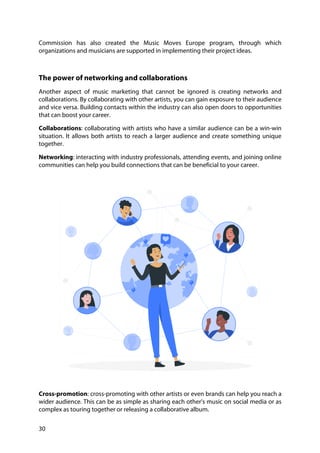
  • 79.
    77 landscape. Be preparedto face challenges, learn from failures, and continuously evolve as an artist. Building a sustainable and fulfilling career will take time and effort, but with determination and commitment to constant improvement, you can achieve your goals. In conclusion, a career in electronic music production offers an exciting and dynamic path filled with opportunities for artistic expression and personal growth. By honing your production skills, developing your unique style, embracing collaboration and networking, and utilizing digital platforms, you can position yourself in the industry and make a significant impact with your music. Remember to continually learn, adapt to industry trends, and remain true to your artistic vision as mentioned above. Building a rewarding and successful career as an electronic music producer requires dedication, perseverance, and a passion for your craft. With determination and commitment to continuous improvement, you can build a fulfilling and successful career, sharing your creativity and passion with audiences worldwide. After all, the digital landscape and technological progress have provided electronic music producers with unprecedented opportunities to connect with audiences and distribute their music globally. Online platforms, streaming services, and social media have become powerful tools for promotion and reaching a wide audience. By utilizing these platforms, along with staying updated on industry trends and marketing strategies, you can greatly enhance your chances of success. It's important to remember that success in the field of electronic music production is not guaranteed overnight. It takes time, effort, and a commitment to continuous learning and improvement. Stay focused on refining your skills, creating high-quality music, and actively seeking growth and exposure opportunities. With determination and passion for
  • 80.
    78 your craft, youcan build a fulfilling and successful career in the vibrant and ever-evolving world of electronic music. Ultimately, the most crucial aspect of a career as an electronic music producer is to stay true to your artistic vision. Maintain your unique style, experiment with new ideas, and let your passion shine through your own music. Connect with your audience on a deeper level and create a significant impact with your compositions. Remember that this journey as an electronic music producer is not just about achieving success, but also about the joy of creating and sharing your art with the world. So embrace the opportunities, cultivate your skills, stay committed to your artistic vision, and enjoy the exciting journey of building a career as an electronic music producer. The possibilities are endless, and with perseverance and dedication, you can leave your mark in the vibrant and ever-evolving world of electronic music. As you can see, a career in electronic music production is both rewarding and challenging. However, with the right knowledge and resources at your disposal, it is entirely achievable. We hope that this guide has provided you with all the information you need to embark on your journey as an electronic music producer. With hard work and dedication, who knows how far you could go? Good luck!
  • 81.
    79 HOW TO BECOMEAN ENTREPRENEUR AS AN ELECTRONIC MUSIC ARTIST Are you an aspiring electronic music artist yearning to break into the industry's big league, but unsure of where to begin? Do you possess an unwavering passion both for music and entrepreneurship, yet struggle to find the perfect blend? Look no further, as this material serves as your guide to becoming a triumphant music entrepreneur in the realm of electronic music. From building your brand and establishing connections with industry professionals to effectively managing your finances and implementing successful marketing strategies, we've got you covered. Brace yourself as we embark on this transformative journey, turning your musical dreams into a vibrant reality. Understanding the role of a electronic music entrepreneur A music entrepreneur is an artist who specializes in the business aspects of music. As a music entrepreneur, your responsibilities encompass promoting and marketing your music, booking gigs, and ensuring financial management. To venture into this path successfully, a genuine passion for music and a comprehensive comprehension of the business side of the industry are imperative. If you find yourself uncertain of where to begin, fear not, as a wealth of online resources and libraries awaits to assist you in your quest.
  • 82.
    80 Diverse archetypes ofelectronic music artists The world of electronic music harbours an array of artist archetypes, each with their unique approach and specialization. Some electronic music artists prefer to produce their own music, dedicating countless hours to meticulously crafting their distinct sounds capes. Others thrive in collaborative endeavours, pooling their talents with a team of producers to create groundbreaking compositions. Some excel in mesmerizing live performances, captivating audiences with their energy and stage presence. Additionally, there are those who channel their creativity through visual arts, engaging in activities such as VJ or crafting immersive light shows. Regardless of your chosen focus, embracing the role of an electronic music entrepreneur demands effective self-promotion and brand marketing. Establishing a formidable online presence becomes essential, gathering a loyal following of fans who ardently support your artistic endeavours. Moreover, networking with fellow artists, promoters, and venues is the key to securing gigs and expanding your fan base. Advantages and disadvantages of being an electronic music entrepreneur Embarking on the journey of a music entrepreneur necessitates careful consideration of the advantages and disadvantages inherent in this path. On the one hand, the opportunity to be your own boss and construct something from scratch is undeniably rewarding. The creative autonomy to shape your musical vision, the direct connection forged with your fans, and the potential for substantial financial gains in the event of a thriving business are among the enticing pros. Conversely, the journey is not without its challenges. Long hours, unpredictable outcomes, the risk of burnout, and the ever-present financial uncertainties are some of the cons that require resilience and adaptability. Ultimately, the decision of whether or not to pursue the path of a music entrepreneur hinges on your personal goals and preferences. If your passion for music burns bright and you are willing to invest the necessary effort, this avenue may serve as the perfect catalyst for achieving your dreams. Guiding principles for aspiring music entrepreneurs • Create your niche: Identify the type of music you create and define your unique selling proposition. • Navigate the business landscape: Delve into the intricacies of the music industry's business side, familiarizing yourself with copyright laws, licensing requirements, and other legal aspects that may influence your enterprise. • Forge a business plan: Craft a comprehensive blueprint for your music venture, determining the most suitable business structure and setting realistic financial goals.
  • 83.
    81 • Assemble acapable team: Surround yourself with a network of professionals, including booking agents, publicists, managers, and lawyers, who can propel your business toward success. • Cultivate a compelling brand strategy: Develop a strong branding approach that resonates with your musical style and captivates your target audience. • Embrace industry trends: Stay updated on the latest developments within the music industry, keeping a close eye on social media platforms, streaming services, and emerging technologies that can shape your business strategies. • Embrace the hustle: Be prepared to put in the hard work and dedication required to thrive as an entrepreneur in the music industry. Success often comes to those who relentlessly pursue their goals. Signs of readiness for the music entrepreneurial journey Embarking on the path of a music entrepreneur requires a certain level of preparedness. Not everyone who aspires to become a music entrepreneur possesses the necessary knowledge, skills, and experience. Here are some signs that indicate you may be ready to take the leap: • Clear vision: You have a well-defined vision for your music career, knowing precisely where you want to go and how you want to get there. • Fearlessness in hard work: You embrace hard work and are willing to put in the necessary effort and dedication to turn your vision into reality. • Willingness to take risks: You are unafraid to take calculated risks, understanding that risks often lead to great rewards. • Networking prowess: You possess strong networking skills and excel in building meaningful relationships with fellow artists, industry professionals, and potential collaborators. • Organizational excellence: You exhibit strong organizational skills in managing your time effectively, ensuring that all aspects of your business run smoothly. • Passionate belief in yourself: You possess an unwavering passion for your music and believe in your ability to succeed, even in the face of challenges. • Resilience and positivism: You maintain a positive attitude and exhibit resilience when faced with setbacks, using them as stepping stones for growth and improvement. Becoming a music entrepreneur in the realm of electronic music is no easy feat, but it is an achievable endeavour with perseverance and dedication. Success in this career requires a deep understanding of the industry, access to valuable resources, and the ability to forge meaningful connections.
  • 84.
    82 By applying thestrategies and principles outlined in this material, you will set yourself on the path to realizing your aspirations in this dynamic field. With an unwavering passion for your craft and an indomitable spirit, there are no limits to what you can achieve as an electronic music entrepreneur. Embrace the journey, seize opportunities, and watch as your musical dreams flourish into an extraordinary reality. Continuing on the topic of becoming a music entrepreneur in the realm of electronic music, let's explore the significance of perseverance and adaptability in this dynamic industry. Perseverance: the key to overcoming challenges As you navigate the path of a electronic music entrepreneur, it's important to recognize that challenges and obstacles are inevitable. However, it is your perseverance that will determine your ability to overcome these hurdles and continue progressing towards your goals. Building a successful career in electronic music requires a steadfast commitment to your craft, even in the face of rejection, setbacks, and self-doubt. For instance, you may encounter difficulties in booking gigs, finding the right collaborators, or getting your music noticed by the right audience. During these times, it's crucial to stay focused, maintain a positive mindset, and continue honing your skills. Remember that every setback is an opportunity for growth and learning. Use these experiences to refine your approach, seek feedback, and adapt your strategies accordingly.
  • 85.
    83 Adaptability: thriving ina changing landscape The music industry, especially the electronic music scene, is ever-evolving. Technological advancements, shifting consumer preferences, and emerging trends can reshape the landscape overnight. To thrive as a music entrepreneur, you must embrace adaptability and stay attuned to these changes. One area where adaptability is crucial is in your approach to marketing and promotion. With the rise of digital platforms and streaming services, traditional methods of marketing have undergone significant transformations. It's essential to stay abreast of current trends in social media, digital advertising, and influencer marketing to effectively promote your music and engage with your audience. Additionally, keep an eye on emerging technologies that can enhance your creative process and production quality. For example, virtual reality (VR) and augmented reality (AR) present exciting opportunities to create immersive experiences for your audience. By exploring and integrating new tools and technologies into your music production and performances, you can set yourself apart from the competition and captivate your audience in innovative ways. Remember, as a electronic music entrepreneur, your success relies on your ability to adapt, embrace change, and stay ahead of the curve. By combining perseverance with adaptability, you can navigate the ever-changing landscape of electronic music and position yourself for long-term success. In conclusion, the journey to becoming a entrepreneur in electronic music is an exciting and challenging one. It requires a unique blend of passion, business acumen, perseverance, and adaptability. By following the principles outlined in this this material, such as building your brand, networking effectively, and staying committed to your vision, you can forge a fulfilling and prosperous career in this vibrant industry. Embrace the process, learn from the journey, and let your love for electronic music drive you to achieve remarkable heights as a music entrepreneur. Collaboration: expanding your network and creating opportunities Collaboration is a powerful tool for music entrepreneurs in the electronic music industry. By actively seeking opportunities to collaborate with other artists, producers, and industry professionals, you can expand your network, tap into new creative energies, and create exciting opportunities for growth. Collaboration can take many forms. It could involve co-producing tracks with other artists, remixing each other's work, or even organizing joint performances or events. By collaborating, you not only benefit from the diverse perspectives and talents of others but also gain access to their networks and fan bases, which can significantly expand your reach and exposure. Moreover, collaborations allow you to leverage the strengths and expertise of others, filling in any gaps in your own skill set. For instance, you might partner with a visual artist to create stunning visuals for your live performances or work with a seasoned producer to
  • 86.
    84 enhance the qualityof your recordings. Such collaborations can elevate the overall experience you offer to your audience and set you apart from the competition. Furthermore, engaging in collaborations helps foster a sense of community within the electronic music scene. By actively supporting and promoting fellow artists, you contribute to a collective growth mindset where everyone benefits. Attend industry events, participate in workshops, and join online communities to connect with like- minded individuals and explore collaborative opportunities. Continual growth: embracing lifelong learning To succeed as a music entrepreneur in the ever-evolving world of electronic music, it's crucial to embrace a mindset of lifelong learning. The industry is constantly evolving, and staying on top of new trends, technologies, and production techniques is essential. Invest time in expanding your musical knowledge and technical skills. Explore new genres, experiment with different production tools and software, and attend workshops and masterclasses to learn from industry experts. By continually pushing the boundaries of your creative capabilities, you can unlock new avenues for artistic expression and keep your music fresh and innovative. Additionally, staying informed about changes in the business side of the industry is vital. Keep track of copyright laws, licensing requirements, and emerging revenue streams such as sync licensing and brand partnerships. Continuously educate yourself on marketing strategies, digital distribution platforms, and effective ways to monetize your music. Embracing lifelong learning also means seeking feedback and being open to constructive criticism. Connect with trusted mentors, seek out industry professionals for guidance, and actively engage with your audience for their input. This feedback can provide valuable insights and help you refine your craft and career trajectory. In conclusion, as you embark on your journey to become a music entrepreneur in the realm of electronic music, remember the importance of collaboration, continual growth, and embracing change. By expanding your network, staying adaptable, and constantly learning, you can position yourself for success in this vibrant and ever-evolving industry. Embrace the challenges, seize opportunities, and let your passion for electronic music drive you towards a fulfilling and prosperous career as a music entrepreneur. Adaptation to digital landscape: maximizing online presence In today's digital age, having a strong online presence is crucial for music entrepreneurs in the electronic music industry. The internet provides a powerful platform to reach a global audience, connect with fans, and promote your music effectively. Embracing the digital landscape and maximizing your online presence can significantly impact your success as a music entrepreneur.
  • 87.
    85 Start by establishinga professional website or artist profile that showcases your music, provides information about upcoming releases and performances, and allows fans to connect with you. Utilize social media platforms strategically to engage with your audience, share behind-the-scenes content, and build a loyal following. Regularly update your profiles, respond to comments and messages, and use analytics tools to gain insights into your audience demographics and engagement. In addition to social media, leverage digital streaming platforms to distribute your music worldwide. Platforms like Spotify, Apple Music, and SoundCloud offer immense exposure and the opportunity to reach listeners beyond geographical boundaries. Explore playlist placements, collaborate with influential curators, and actively promote your music on these platforms to expand your fan base. Another essential aspect of maximizing your online presence is creating compelling visual content. Invest in visually captivating album artwork, music videos, and promotional graphics that reflect your artistic identity. Visuals play a vital role in grabbing attention and leaving a lasting impression on your audience. Furthermore, explore digital marketing strategies to amplify your reach and engage with potential fans. Utilize targeted advertising campaigns, email newsletters, and collaborations with influencers or blogs to increase visibility and drive traffic to your music and online platforms. Remember, the digital landscape is ever-evolving, so stay informed about emerging technologies and trends. Be adaptive and willing to experiment with new platforms, features, and promotional strategies. By embracing the digital realm and maximizing your online presence, you can connect with a global audience and establish a solid foundation for your music entrepreneurship.
  • 88.
    86 Building resilience: navigatingchallenges in the music industry The music industry, including the electronic music sector, is known for its competitive nature and inherent challenges. As a music entrepreneur, it's crucial to develop resilience and a strong mindset to navigate these obstacles and setbacks effectively. Understand that rejection and setbacks are part of the journey. Not every opportunity will pan out, and not every release will achieve instant success. Embrace failures as learning experiences and use them to fuel your motivation and growth. Take constructive criticism in stride and use it as an opportunity to improve your craft. Networking and building relationships are key components of resilience in the music industry. Surround yourself with a supportive community of fellow artists, industry professionals, and mentors who can offer guidance, inspiration, and collaboration opportunities. Attend conferences, workshops, and music industry events to expand your network and stay connected with the pulse of the industry. Financial management is another crucial aspect of building resilience. As a music entrepreneur, it's essential to understand the financial side of your business and develop solid money management skills. Create a budget, track your income and expenses, and explore diverse revenue streams beyond music sales, such as merchandise, royalties, and live performances. Diversifying your income sources can help mitigate financial instability and provide a more sustainable career path. Lastly, prioritize self-care and well-being. The music industry can be demanding, and burnout is a common challenge. Take breaks, practice self-reflection, and maintain a healthy work-life balance. Cultivate hobbies and interests outside of music to recharge and foster creativity. In conclusion, building resilience and navigating challenges are essential aspects of being a music entrepreneur in the electronic music industry. By maximizing your online presence, staying adaptable, and fostering resilience, you can overcome obstacles, seize opportunities, and carve out a successful and fulfilling career. Remember, success in the music industry takes time, dedication and perseverance! Embracing innovation: harnessing technology and sound design As an electronic music entrepreneur, embracing innovation and harnessing the power of technology is crucial for staying relevant and pushing creative boundaries. The electronic music landscape is constantly evolving, with new technologies and production techniques emerging regularly. To thrive in this industry, you must stay updated with the latest advancements and explore new possibilities in sound design and music production. Technology has revolutionized the way music is created, produced, and performed. Experiment with different software, plug-ins, and hardware to discover unique sounds and textures that define your artistic style. Stay informed about advancements in digital audio workstations (DAWs), synthesizers, samplers, and other production tools that can enhance your creative process.
  • 89.
    87 Additionally, explore emergingtrends in electronic music genres and subgenres. From ambient and down tempo to techno and house, each genre has its own distinct characteristics and trends. Stay connected with the scene, attend live performances, and engage with fellow artists to stay at the forefront of evolving genres. Collaboration and networking within the electronic music community can open doors to innovative opportunities. Collaborate with other artists, vocalists, instrumentalists, or even visual artists to create multidimensional experiences that captivate audiences. Embrace the fusion of different genres, experiment with cross-genre collaborations, and push the boundaries of what electronic music can achieve. Moreover, delve into the realm of live performances and immersive experiences. Explore interactive technologies, visual mapping, projection mapping, and virtual reality to create engaging and memorable live shows. Incorporating visuals, lighting, and stage design can elevate your performances and create a unique atmosphere for your audience. Remember, innovation goes beyond just technology. It also involves challenging conventions, exploring unconventional sounds, and pushing the limits of creativity. Be open to experimentation, take risks, and don't be afraid to break the rules. Innovation is the key to standing out in a saturated market and capturing the attention of listeners. In conclusion, embracing innovation and harnessing technology is essential for electronic music entrepreneurs. By staying informed about advancements, exploring new production techniques, collaborating with other artists, and pushing creative boundaries, you can create a distinctive sound and captivate audiences with immersive experiences. Embracing innovation is not only about staying relevant but also about shaping the future of electronic music. Final thoughts: paving your unique path in the electronic music industry Becoming an entrepreneur in the electronic music industry is a journey filled with challenges, creativity, and self-discovery. It requires a combination of passion, business acumen, resilience, and a constant drive to innovate. Each artist's path is unique, and there is no one-size-fits-all formula for success. As you embark on this journey, remember to stay true to your artistic vision and identity. Be authentic in your music, branding, and interactions with your audience. Your uniqueness is what will set you apart in a sea of electronic music artists. Continually seek opportunities for growth, whether through education, collaborations, or industry events. Stay connected with the pulse of the industry, adapt to changes, and always be open to learning and evolving as an artist and entrepreneur. Above all, never lose sight of the joy and passion that brought you to music in the first place. Cherish the creative process, celebrate your milestones, and find fulfilment in sharing your music with the world. The electronic music industry is an ever-evolving and exciting realm where you can carve out a rewarding and impactful career.
  • 90.
    88 So, embrace thechallenges, grow your creativity, and embark on this extraordinary journey as an electronic music entrepreneur. With dedication, perseverance, and a willingness to explore uncharted territories, the possibilities are limitless. The stage is set for you to make your mark in the vibrant and ever-evolving world of electronic music.
  • 91.
    89 BEST WAYS TOPROMOTE YOURSELF AS AN ELECTRONIC MUSIC ARTIST USING DIGITAL TOOLS In today's digital age, electronic music artists have numerous opportunities to promote themselves and their music using a variety of digital tools. If you are an electronic music artist seeking to enhance your online presence and expand your reach to a wider audience, this guide is designed to assist you in navigating the most effective methods of self-promotion using digital tools. Platforms like SoundCloud, Spotify, and Bandcamp offer excellent opportunities for electronic music artists to share their music, connect with fans, and even sell their tracks directly. SoundCloud allows you to create a profile, share your tracks, and engage with other users. Consider utilizing paid ads on SoundCloud to enhance the visibility of your tracks. Spotify, another popular streaming platform, enables you to create a profile, share your tracks, and promote them through paid ads. Bandcamp is an excellent platform for selling your music directly to fans. Create a profile, showcase your tracks, and leverage paid ads to increase your visibility.
  • 92.
    90 Social media platformssuch as Twitter, Facebook, and Instagram are essential tools for promoting your music to a broader audience. Create engaging profiles on these platforms, regularly share your tracks, and interact with your fans. Respond to comments, show appreciation for their support, and keep them updated on your latest releases and upcoming shows. Building a strong brand image on social media is crucial. Ensure that your profiles reflect the image you want to project as an electronic music artist. Utilize high-quality visuals, such as photos and videos, and consistently post interesting and engaging content. Consider utilizing social media ads to expand your reach and reinforce your branding message. Streaming services offer an incredible opportunity to share your music with a vast audience and connect with your fans. Ensure that your tracks are of high quality and that you have appealing cover art. Provide descriptions for your tracks to give listeners an understanding of what they can expect. Utilize hashtags and share links to your tracks on platforms like SoundCloud and Bandcamp. You can also submit your tracks to music blogs and websites that feature new music. Promoting yourself online helps you reach a wider audience and cultivate a loyal fanbase. In addition to social media and streaming services, there are other digital tools to consider. Platforms like Twitter and Instagram can help you share your work with a broader audience and build a following. SoundCloud offers a space to upload tracks and receive feedback from other users, while Bandcamp enables you to sell your music directly to fans. Setting up a website or blog can provide a central hub for your music, where you can share news, updates, and even sell merchandise or tickets to shows. Don't underestimate the power of word-of-mouth; ask your friends and family to spread the word about your music. In conclusion, the electronic music industry is highly competitive, and effectively using digital tools is essential for success. By leveraging streaming services, social media platforms, and other digital tools, you can promote your music, build a strong brand, and stand out in a saturated market. Embrace the opportunities provided by these tools, create engaging content, and watch your fanbase grow as you connect with a wider audience. With dedication and perseverance, your hard work will pay off, and you'll see the rewards of a thriving music career.
  • 93.
    91 In addition tothe previously mentioned digital tools, there are several other strategies you can employ to further promote yourself as an electronic music artist using digital tools. Let's explore some additional avenues to enhance your online presence and reach. • Video marketing: videos are a powerful medium for engaging with your audience and showcasing your music visually. Consider creating music videos for your tracks or even behind-the-scenes footage of your creative process. Platforms like YouTube and Vimeo are excellent for hosting and sharing your videos. You can also leverage social media platforms by uploading short video clips or teasers to pique interest and drive traffic to your full videos. • Email campaigns: building an email list of dedicated fans and supporters allows you to communicate directly with them. Encourage your followers to sign up for your newsletter through your social media profiles or website. Use email campaigns to share exclusive content, announce upcoming releases or shows, and offer special promotions or discounts. Personalized and targeted emails can help foster a deeper connection with your audience. • Collaborations: collaborating with other artists and producers in the electronic music scene can expand your reach and expose your music to new audiences. Look for opportunities to collaborate on tracks, remixes, or even joint performances. Collaborative projects often result in cross-promotion, where both artists can introduce their respective fan bases to each other's work, thereby expanding their reach collectively. • Online music communities and forums: engaging with online music communities and forums specific to electronic music can help you connect with like-minded individuals, receive feedback on your work, and discover new opportunities. Participate in discussions, share your knowledge, and contribute valuable insights. This active involvement can lead to networking opportunities and potential collaborations. • Music blogs and podcasts: research and reach out to influential music blogs and podcasts that focus on electronic music. Submit your tracks, EPs, or albums for review or feature consideration. Getting featured on respected platforms can significantly increase your visibility and credibility within the electronic music community. • Live streaming and virtual events: take advantage of the growing trend of live streaming performances and virtual events. Platforms like Twitch, YouTube Live, or dedicated streaming platforms for music, such as Mixcloud Live, offer opportunities to showcase your DJ sets, live performances, or even interactive Q&A sessions. Engage with your audience in real-time, and leverage these platforms to promote upcoming releases or shows. Remember, consistency is the key in the digital realm. Stay active on social media, regularly update your profiles with new content, and engage with your audience. Monitor your analytics and insights to understand which strategies are working best for you and adjust your approach accordingly.
  • 94.
    92 By harnessing thepower of these additional digital tools and strategies, you can amplify your online presence, broaden your fan base, and increase your chances of success as an electronic music artist. Embrace the ever-evolving digital landscape, stay innovative, and continue to refine your promotional efforts to stay ahead in the competitive music industry. • Influencer collaborations: consider partnering with social media influencers or music influencers who have a dedicated following within the electronic music community. Collaborating with influencers can help expose your music to their audience and introduce you to potential new fans. Reach out to relevant influencers whose values align with your brand and explore ways to collaborate, such as featuring your music in their content or creating joint promotional campaigns. • Online radio and podcast shows: look for online radio stations or podcast shows that specialize in electronic music. Submit your tracks or mixes for airplay or request to be a guest on their shows. This exposure can help you connect with listeners who have a specific interest in electronic music and expand your reach to new audiences. • Remix contests and competitions: participating in remix contests or music competitions is a great way to showcase your skills and gain recognition within the electronic music community. Many platforms and labels organize such contests where artists are invited to remix a specific track or submit their original compositions. Winning or even receiving honourable mentions in these competitions can provide valuable exposure and validation for your work. • Online advertising: if you have the budget, consider investing in targeted online advertising campaigns. Platforms like Facebook Ads and Google Ads allow you to
  • 95.
    93 reach specific demographicsand tailor your promotions to reach potential fans that are likely to be interested in electronic music. Be strategic with your ad placements and ensure your content is compelling and visually appealing to capture attention. • Music licensing and sync opportunities: explore opportunities to license your music for use in films, TV shows, commercials, or video games. Platforms like Musicbed and Syncr offer platforms where artists can showcase their music to industry professionals looking for soundtracks. Getting your music featured in media can expose your work to a wider audience and open doors to new opportunities. • Build a professional website: a well-designed and user-friendly website serves as a hub for all your online activities. Showcase your music, provide a bio, create a press kit, and include links to your social media profiles and streaming platforms. You can also sell merchandise, tickets to shows, or offer exclusive content through your website. Ensure your website is mobile-responsive and optimized for search engines to improve its discoverability. • Engage with online communities: participate actively in online communities related to electronic music, such as forums, Facebook groups, and subreddits. Contribute valuable insights, provide feedback on other artists' work, and share your own music when appropriate. Building a presence in these communities can help you establish connections, gain valuable feedback, and generate organic interest in your music. • Utilize data analytics: take advantage of the data analytics provided by streaming platforms, social media, and other digital tools. Analyze metrics such as play counts, listener demographics, engagement rates, and audience retention to gain insights into your target audience and make data-driven decisions. This information can guide your promotional strategies, content creation, and audience targeting. • Collaborate with visual artists: visuals play a significant role in enhancing the impact of your music. Consider collaborating with visual artists, graphic designers, or VJs (visual jockeys) to create compelling visuals for your live performances, music videos, or social media content. The combination of captivating music and visually stunning elements can create a memorable experience for your audience. • Create compelling content: in addition to sharing your music, develop engaging and shareable content that resonates with your audience. This can include behind- the-scenes footage, studio sessions, tutorials, or even vlogs documenting your journey as an artist. By providing unique and valuable content, you can build a stronger connection with your fans and keep them invested in your music. • Utilize SEO optimization: optimize your online presence by implementing search engine optimization (SEO) techniques. Ensure your artist name, track titles, and descriptions are optimized for search engines, making it easier for fans to discover your music. Utilize relevant keywords, metadata, and alt tags for images to improve your visibility in search results.
  • 96.
    94 • Offer freedownloads or exclusive content: consider offering free downloads or exclusive content to motivate fans to engage with your music and sign up for your mailing list. This can help you grow your fanbase and create a sense of exclusivity and appreciation for your supporters. • Attend virtual music conferences and workshops: in the digital era, many music conferences, workshops, and networking events have transitioned to virtual platforms. Take advantage of these opportunities to connect with industry professionals, learn from experts, and expand your network. Participate in panel discussions, virtual showcases, and one-on-one networking sessions to gain exposure and build relationships within the electronic music industry. • Stay active and adaptable: the digital landscape is ever-evolving, so it's crucial to stay informed about emerging trends, new platforms, and changes in algorithms or marketing strategies. Be adaptable and open to trying new tools and techniques as they arise. Continuously refine your approach, experiment with different strategies, and adapt to the shifting dynamics of the digital music industry. By implementing these additional strategies and utilizing digital tools effectively, you can maximize your promotional efforts and increase your visibility as an electronic music artist. Stay proactive, stay connected with your audience, and remain dedicated to producing high-quality music. With persistence, innovation, and strategic marketing, you can elevate your career and achieve success in the competitive electronic music industry. • Utilize influencer marketing: collaborate with influencers or tastemakers in the electronic music scene to amplify your reach and tap into their established audience. Influencers can feature your music, provide reviews, or promote your
  • 97.
    95 upcoming releases. Partneringwith influencers who align with your genre and style can significantly enhance your visibility and credibility among their followers. • Create engaging live streams: take advantage of the popularity of live streaming platforms like Twitch, Instagram Live, or Facebook Live to connect with your audience in real-time. Host live DJ sets, Q&A sessions, or behind-the-scenes glimpses into your creative process. Interact with viewers, respond to their comments, and encourage sharing and engagement during the live stream. • Leverage user-generated content: encourage your fans to create and share content related to your music. Run contests or challenges where fans can remix your tracks, create dance routines, or produce visual artwork inspired by your music. User-generated content not only strengthens the bond with your fans but also generates organic promotion as they share their creations on social media platforms. • Engage with music discovery platforms: submit your music to popular music discovery platforms and playlists tailored to electronic music. Platforms like Hype Machine, SubmitHub, and playlists created by influencers or streaming services can expose your music to a wider audience and increase its discoverability. • Build relationships with music bloggers and journalists: reach out to music bloggers and journalists who cover electronic music. Share your press releases, upcoming releases, and offer exclusive interviews or guest articles. Building relationships with key influencers in the music media can result in features, reviews, or interviews that provide valuable exposure and validation. • Utilize data-driven targeted advertising: utilize advanced targeting options provided by social media platforms and advertising networks to reach specific demographics and fans of similar artists. Utilize demographic filters, interest-based targeting, and look-alike audiences to ensure your ads are reaching the right audience most likely to appreciate your music. • Engage in cross-promotion with fellow artists: collaborate with other electronic music artists for cross-promotion opportunities. Feature each other's tracks on playlists, co-host live streams or events, or promote each other's releases on social media. By supporting and promoting one another, you can leverage each other's fanbases and expand your reach collectively. • Monitor online mentions and engage with fans: set up Google Alerts or use social media monitoring tools to keep track of online mentions of your artist name or tracks. Respond to comments, engage with fans, and show appreciation for their support. Actively participating in conversations and acknowledging your fans can help foster a loyal and dedicated community around your music. • Stay authentic and true to your sound: while it's important to utilize digital tools and strategies for promotion, never lose sight of your unique artistic vision and sound. Stay true to your style and create music that resonates with you. Authenticity will attract dedicated fans that connect with your music on a deeper level.
  • 98.
    96 • Continuously evolveand experiment: the digital landscape and music industry are constantly evolving. Stay informed about new platforms, trends, and emerging technologies. Don't be afraid to experiment with different approaches, explore new genres, or collaborate with artists from different backgrounds. Embrace innovation, adaptability, and a willingness to step out of your comfort zone to keep your music fresh and relevant. • Engage with music streaming playlists: created playlists on platforms like Spotify, Apple Music, and Deezer can have a significant impact on your exposure and reach. Research playlists that align with your genre, and submit your tracks for consideration. Additionally, connect with playlist curators and build relationships with them. Regularly share your latest releases with curators to increase the chances of being featured on their playlists. • Offer limited-time promotions and exclusive content: create a sense of urgency and exclusivity by offering limited-time promotions or exclusive content to your fans. This could include discounted merchandise, early access to new releases, or exclusive remixes. Encourage fans to sign up for your newsletter or follow you on social media to access these special offers. • Utilize visual branding: develop a cohesive visual brand that represents your music and persona. Use consistent visual elements such as logos, color schemes, and typography across your social media profiles, website, album art, and promotional materials. A strong visual identity can help you stand out and make a memorable impression on your audience.
  • 99.
    97 • Engage withniche communities: beyond general electronic music communities, explore niche communities that focus on sub-genres or specific interests within the electronic music scene. Engage with these communities by sharing your music, participating in discussions, and connecting with like-minded individuals. Niche communities can provide a dedicated fan base and opportunities for collaboration and growth. • Explore emerging platforms and technologies: stay abreast of emerging platforms and technologies in the music industry. For example, virtual reality (VR) and augmented reality (AR) experiences are gaining traction in the music world. Consider experimenting with these technologies to create unique and immersive experiences for your fans. • Create compelling visual content: in addition to music videos, consider creating other visual content such as lyric videos, behind-the-scenes documentaries, or live performance footage. Engaging visual content can captivate your audience and increase the shareability of your music across social media platforms. • Collaborate with brands: seek partnerships with brands that align with your music and values. Collaborating with brands can provide exposure and financial support for your projects. Look for opportunities to create sponsored content, participate in brand campaigns, or have your music featured in brand advertisements. • Engage with online radio stations: explore online radio stations dedicated to electronic music and submit your tracks for airplay. Online radio stations often have niche audiences that are passionate about specific sub-genres. Being featured on these stations can introduce your music to dedicated fans who actively seek out new electronic music. • Attend virtual music festivals and events: in the era of virtual events, take advantage of virtual music festivals, conferences, and workshops. These events provide networking opportunities, industry insights, and chances to showcase your music to a global audience. Participate in panels, perform live sets, or host virtual workshops to connect with industry professionals and fans alike. • Foster collaborative relationships with producers and DJs: collaborate with other producers and DJs within the electronic music scene. Remix each other's tracks, co-produce new music, or DJ together at events. Collaborations not only broaden your exposure but also allow for mutual support and creative growth. • Utilize fan feedback and insights: pay attention to feedback from your fans and use it to improve your music and promotional strategies. Engage with your audience through surveys, polls, or direct communication to understand their preferences and expectations. Incorporate their feedback into your creative process and adjust your promotional efforts accordingly. • Create a memorable brand identity: develop a strong and consistent brand identity that aligns with your music and resonates with your target audience. This includes your artist name, logo, visual aesthetics, and overall messaging. A
  • 100.
    98 memorable brand identityhelps you stand out and creates a lasting impression on fans and industry professionals. • Collaborate with visual artists for album artwork and visual assets: work with talented visual artists to create captivating album artwork, promotional graphics, and visual assets for your music releases. Visuals play a crucial role in attracting attention and conveying the mood and concept of your music. Collaborating with visual artists can elevate the overall presentation of your music. • Utilize crowdfunding platforms: if you have upcoming projects or albums, consider utilizing crowdfunding platforms such as Kickstarter or Patreon to involve your fans in the creation process and gather financial support. Offer exclusive rewards or experiences to your backers to incentivize their participation and create a sense of community around your music. • Engage with music licensing and sync opportunities: explore opportunities to license your music for use in films, TV shows, commercials, or video games. Collaborate with music licensing agencies or connect directly with content creators seeking music for their projects. Getting your music placed in media can significantly expand your reach and introduce your music to new audiences. • Network and collaborate with music industry professionals: attend music industry conferences, workshops, and networking events to connect with industry professionals such as managers, agents, and record label representatives. Building relationships with these professionals can open doors for collaborations, distribution opportunities, and industry guidance. • Develop a comprehensive press kit: create a well-crafted press kit that includes your biography, high-quality press photos, music samples, and relevant press coverage. A comprehensive press kit makes it easier for media outlets, promoters, and industry professionals to learn about you and promote your music. • Participate in online music competitions and showcases: enter online music competitions and showcases specific to electronic music. These platforms provide exposure and opportunities to showcase your talent to industry experts, fellow musicians, and fans. Winning or placing in these competitions can boost your credibility and attract attention to your music. • Stay active on social media and engage with your audience: consistently post engaging content on your social media platforms and actively engage with your audience. Respond to comments, messages, and mentions, and create a sense of community by encouraging conversations and fostering a personal connection with your fans. • Keep learning and stay updated: the music industry and digital landscape are constantly evolving. Stay updated on the latest trends, technologies, and marketing strategies relevant to the electronic music scene. Continuously educate yourself through online courses, workshops, and industry publications to refine your skills and adapt to the changing landscape.
  • 101.
    99 Remember, building asuccessful career as an electronic music artist requires a combination of talent, hard work, and effective promotion. Embrace these strategies, experiment with different approaches, and remain dedicated to your craft. With persistence and perseverance, you can elevate your music career and reach new heights. Digital promotion is an ongoing effort, and what works for one artist may not work for another. Continuously assess and adapt your strategies based on your unique goals, target audience, and the evolving digital landscape. Stay connected with your fans, be responsive to feedback, and always prioritize creating exceptional music that resonates with your audience. With dedication, persistence, and a strategic approach, artists can maximize their promotional efforts, increase their visibility, and achieve success in their music careers.
  • 102.
    100 FINANCIAL TIPS TOEARN MONEY AS AN ELECTRONIC MUSIC ARTIST Are you an electronic music artist struggling to make a living from your passion? You're not alone. Many talented musicians find it hard to monetize their art, but with the right financial tips and strategies, you can start earning money and build a sustainable career in the music industry. In this updated essay, we'll share some practical advice on how to boost your income as an electronic music artist, incorporating new information from current bibliographic sources. So grab a pen and paper (or open up a new note on your phone) because these tips are going to help you achieve financial success while doing what you love! The music industry is ever-changing The electronic music industry is in a constant state of flux, with new technologies and platforms emerging all the time. This can be both challenging and exciting for artists trying to make a living from their music. On the one hand, it's easier than ever to reach a global audience and build a following; on the other hand, there's more competition than ever, and it can be hard to stand out from the crowd. So how can you make sure you're staying ahead of the curve and making the most of opportunities in the ever-changing music industry? Here are a few updated tips: • Stay up to date with new platforms and technologies. In addition to using social media to promote your music, explore emerging platforms like TikTok, Twitch, and Clubhouse, which have gained significant popularity among music enthusiasts. These platforms provide unique opportunities to connect with fans and gain exposure. • Be flexible and adaptable. The rapid evolution of the music industry requires artists to be open to new ideas and styles. Embrace collaborations with other artists and explore different genres or sub-genres to broaden your appeal and attract a diverse fanbase. • Be proactive, not reactive. The importance of taking control of your career cannot be overstated. Utilize the internet and digital tools to your advantage by self- releasing music, managing your own online presence, and exploring alternative revenue streams such as crowdfunding and direct-to-fan platforms. • Constantly evolve your sound. While it's crucial to maintain your artistic integrity, incorporating fresh elements and experimenting with new production techniques can help you stay relevant and engage your audience. Stay connected with the latest trends and innovations in electronic music production to expand your creative horizons.
  • 103.
    101 How to makemoney as an electronic music artist As an electronic music artist, there are several updated ways that you can make money. First, selling your music online remains a primary source of income. In addition to established platforms like iTunes and Spotify, explore emerging platforms such as Bandcamp, which allows artists to sell digital downloads and physical merchandise directly to fans while offering more favourable revenue splits. Live performances and concerts continue to be a significant income generator. However, in the wake of the COVID-19 pandemic, virtual concerts and live streaming have gained popularity. Utilize platforms like YouTube, Twitch, and Facebook Live to connect with your audience and monetize your performances through ticket sales, virtual tip jars, or sponsorships. Teaching classes or workshops on electronic music production has also become a viable revenue stream. Capitalize on your expertise and offer online courses or one-on-one sessions to aspiring producers who want to learn from your experience. Lastly, creating and selling merchandise remains a tried-and-true method of generating income. From t-shirts and hoodies to limited edition vinyl records, your fans will appreciate the opportunity to support you while proudly displaying their love for your music.
  • 104.
    102 Tips for marketingyour music Effective marketing is crucial to reaching a wider audience and building a dedicated fanbase. Here are some updated tips to help you market your music successfully: First, focus on creating high-quality content that resonates with your target audience. This includes not only your music but also visual content such as music videos, lyric videos, and behind-the-scenes footage. Engage with your fans through social media platforms by posting regularly, sharing updates about your music, and interacting with comments and messages. Building a strong online presence and maintaining a consistent brand image will help you attract and retain loyal followers. Second, consider utilizing influencer marketing strategies. Collaborating with influencers in the electronic music scene or related industries can expose your music to a wider audience. Seek partnerships with popular DJs, music bloggers, or YouTube channels that align with your style and target demographic. These influencers can share your music with their followers, giving you increased visibility and potential new fans. Third, leverage the power of streaming platforms. While being on popular platforms like Spotify and Apple Music is essential, take advantage of curated playlists and algorithmic recommendations to increase your discoverability. Submit your music to playlist curators who specialize in electronic music and engage with your listeners by encouraging them to save, share, and add your tracks to their own playlists. Fourth, consider the value of live streaming. Platforms like Twitch, YouTube Live, and Instagram Live provide opportunities for interactive performances, Q&A sessions, and behind-the-scenes glimpses into your creative process. Live streaming allows you to connect directly with your fans, build a sense of community, and generate additional income through virtual tips, donations, or sponsorships. Building a fanbase Building a strong and dedicated fanbase is crucial for long-term success as an electronic music artist. In addition to the previous suggestions, here are some updated strategies to help you grow your fanbase: First, engage with your fans on a personal level. Respond to comments and messages, show appreciation for their support, and make an effort to connect with them during live performances or virtual events. Building genuine relationships with your fans will foster loyalty and encourage them to spread the word about your music. Second, explore collaborations and remix opportunities with other artists. Partnering with established or up-and-coming musicians can introduce your music to their fanbase and vice versa. Remixing popular tracks or participating in compilation albums can also help expand your reach and attract new listeners. Third, consider utilizing fan-generated content. Encourage your fans to create and share their own remixes, covers, or dance videos inspired by your music. This not only
  • 105.
    103 showcases their talentbut also increases the visibility of your music as it spreads across different social media platforms. Playing live shows Playing live shows remains a vital aspect of an electronic music artist's career. However, the landscape has evolved due to the impact of the pandemic and changing audience preferences. Here are some updated financial tips for earning money as an electronic music artist during live performances: • Embrace hybrid performances. As live events resume, consider incorporating both physical and virtual elements into your shows. Live stream your performances to reach a global audience and offer virtual tickets for those who cannot attend in person. This hybrid approach allows you to maximize your earning potential while catering to different audience preferences. • Diversify your performance venues. In addition to traditional music venues, explore alternative spaces such as art galleries, unconventional event spaces, or outdoor festivals. Collaborating with visual artists or other performers can create unique and immersive experiences that attract a broader audience. • Seek sponsorship and brand partnerships. Brands are increasingly interested in associating themselves with the music industry, and electronic music offers opportunities for collaborations. Approach relevant brands for potential sponsorships, endorsements or partnerships that align with your image and values. This can provide additional financial support and exposure for your music.
  • 106.
    104 • Consider organizingyour own events. Instead of solely relying on booking agents or promoters, take the initiative to curate your own shows or mini-festivals. This gives you greater control over the financial aspects and allows you to showcase not only your music but also other artists you admire or have a strong connection with. By curating your own events, you have the potential to generate higher revenue through ticket sales and merchandise while creating a unique experience for your fans. • Take advantage of performance royalties. Ensure that your music is properly registered with performance rights organizations (PROs) such as ASCAP, BMI, or SESAC. These organizations collect royalties on behalf of artists for the public performance of their music. When your music is played at venues, festivals, or even on the radio, you have the opportunity to earn additional income through these performance royalties. In today's rapidly evolving music industry, electronic music artists have more opportunities than ever to earn money and build successful careers. By staying informed about new platforms, being adaptable to industry changes, and proactively seeking opportunities, you can maximize your financial potential. Selling your music online, engaging with your fanbase, marketing effectively, and strategically approaching live performances are key components to your success. Remember, building a sustainable career as an electronic music artist requires dedication, hard work, and continuous adaptation to stay ahead of the curve. With the right financial tips and strategies, you can turn your passion for electronic music into a fulfilling and financially rewarding profession. In addition to the previously mentioned strategies, there are a few more financial tips that can help you earn money as an electronic music artist: • Explore sync licensing opportunities: sync licensing involves placing your music in commercials, films, TV shows, video games, and other media. This can be a lucrative revenue stream and provide exposure to a wider audience. Consider working with a sync licensing agency or actively pitching your music to music supervisors and production companies. • Collaborate with brands and create sponsored content: many brands are looking to partner with musicians to create branded content or endorse their products. This can range from sponsored social media posts to creating exclusive tracks for brand campaigns. Be selective in choosing brand partnerships that align with your values and resonate with your fanbase. • Leverage crowdfunding platforms: crowdfunding platforms like Kickstarter and Patreon allow you to engage directly with your fans and receive financial support for your music. You can offer exclusive content, early access to releases, merchandise, or personalized experiences as rewards for your supporters. This not only provides a source of income but also strengthens the connection between you and your fans.
  • 107.
    105 • Seek outmusic grants and funding opportunities: many organizations, foundations, and government agencies offer grants and funding programs specifically for musicians and artists. These grants can help cover recording costs, equipment upgrades, promotional expenses, or even touring expenses. Research and apply for grants that are relevant to your genre and career stage. • Diversify your income streams: relying solely on music sales and performances can be challenging, especially during uncertain times. Consider diversifying your income by offering music production services, DJ-ing at events or parties, providing mixing and mastering services, or even creating sample packs or sound libraries for other producers. These additional income streams can provide stability and support your music career. Remember, financial success as an electronic music artist takes time, persistence, and a strategic approach. Continuously honing your craft, building your fanbase, and staying informed about industry trends and opportunities are essential. Embrace the ever-changing landscape of the music industry, adapt to new technologies and platforms, and seize opportunities to showcase your unique sound and style. By combining your passion for music with smart financial strategies, you can create a sustainable career as an electronic music artist and achieve the financial success you desire.
  • 108.
    106 As the electronicmusic industry continues to evolve, it's important to stay updated on the latest trends and strategies. Here are some additional financial tips to keep in mind as you navigate your career as an electronic music artist: • Embrace the power of data: in today's digital age, data plays a crucial role in understanding your audience and making informed decisions. Utilize analytics tools provided by streaming platforms and social media to gain insights into your listeners' demographics, locations, and listening habits. This information can help you target your marketing efforts, plan tours in areas with high fan engagement, and negotiate better deals with sponsors or promoters. • Establish a strong online presence: in addition to social media platforms, consider creating your own website or artist platform. This serves as a central hub for your music, merchandise, and updates, and allows you to maintain direct contact with your fans. Utilize email marketing to build a subscriber list and keep your fans informed about new releases, shows, and exclusive content. By owning your online presence, you have more control over your brand and revenue streams. • Explore licensing opportunities for your music: apart from sync licensing, consider exploring other licensing avenues for your music. This could include licensing your tracks for use in podcasts, YouTube videos, online advertisements, or even background music for businesses. Platforms like Artlist and Epidemic Sound offer opportunities to license your music for various purposes, providing a steady stream of income. • Develop strategic partnerships: collaborating with other artists, DJs, or producers can not only enhance your creative process but also expand your network and open up new opportunities. Partnering with established artists for remixes or featuring on their tracks can introduce your music to a wider audience and potentially lead to higher revenue streams. Additionally, collaborating with brands or companies on exclusive releases or sponsored content can provide financial support and exposure. • Invest in your professional development: as an electronic music artist, it's crucial to stay on top of your game and continually develop your skills. Consider investing in music production courses, attending industry conferences, or joining music organizations to expand your knowledge and network. This investment in yourself can lead to better productions, collaborations, and ultimately, increased financial opportunities. In conclusion, being a successful electronic music artist goes beyond just creating great music. The path to financial success as an electronic music artist requires a multifaceted approach. By implementing the financial tips discussed in this essay and staying up-to- date with the latest industry trends, you can maximize your earning potential and build a sustainable career. Remember to adapt to the ever-changing music landscape, explore new platforms and technologies, and be proactive in seeking opportunities.
  • 109.
    107 Diversifying your incomestreams, whether through music sales, live performances, teaching, merchandise, sponsorships, or collaborations, can provide stability and multiple revenue streams. Embrace marketing strategies that resonate with your target audience, leverage social media platforms, and consider collaborations and partnerships to expand your reach. Building a dedicated fanbase is essential for long-term success. Engage with your fans, both online and offline, and foster meaningful connections. Explore new avenues for growth, such as sync licensing, crowdfunding, and grants, to support your artistic endeavours and fund future projects. Ultimately, financial success as an electronic music artist requires a combination of talent, hard work, adaptability, and business acumen. Stay passionate about your craft, continuously refine your skills, and strive for excellence. With perseverance and the right financial strategies, you can turn your love for electronic music into a fulfilling and lucrative career.
  • 110.
    108 BIBLIOGRAPHY • Essig, L.,& Gensler, E. E. (2019). Cultural Entrepreneurship: A Practical Guide for Creatives and Arts Professionals. Routledge; • Kay, S., & Tovey, D. (2017). The Cultural Entrepreneur's Handbook: How to Create a Successful Arts-Based Business. Bloomsbury Publishing; • Martin, P. (2011). Cultural Entrepreneurship: Making a Living Making Art. Rowman & Littlefield Publishers; • Dworkin, A. (2010). The Art of Cultural Entrepreneurship: A Practical Guide to Creating and Sustaining a Successful Arts Organization. University of Michigan Press; Live music production. How to prepare a live/online event • Atkins, M. (2017). Tour:Smart: And Break the Band. Soluble LLC • Thomas, J. D. (2017). Concert and Live Music Photography: Pro Tips from the Pit. CRC Press; • Marcone, S., & Philp, D. (2014). Managing Your Band: Artist Management: The Ultimate Responsibility. Hal Leonard Corporation; • Vasey, J. (2012). Concert Tour Production Management. Focal Press; Music marketing – Creation of your own brand • Borg, B. (2014). Music Marketing for the DIY Musician. Hal Leonard Corporation; • Jones, S. (2011). Brand Like a Rock Star: Lessons from Rock 'n' Roll to Make Your Business Rich and Famous. John Wiley & Sons; • Berger, J. (2013). Contagious: How to Build Word of Mouth in the Digital Age. Simon & Schuster; • Heath, C., & Heath, D. (2007). Made to Stick: Why Some Ideas Survive and Others Die. Random House;
  • 111.
    109 Cooperation in thefield of music – How to interact with other musicians in your country and abroad • Passman, D. S. (2019). All You Need to Know About the Music Business. Simon & Schuster; • Baskerville, D., & Baskerville, T. (2018). Music Business Handbook and Career Guide. SAGE Publications; • Kimpel, D. (2018). Networking Strategies for the New Music Business. Routledge; • Chertkow, R., & Feehan, J. (2012). The Indie Band Survival Guide: The Complete Manual for the Do-It-Yourself Musician. St. Martin's Griffin; Developing professional skills • Coyle, D. (2009). The Talent Code: Greatness Isn't Born. It's Grown. Here's How. Bantam Books; • Godin, S. (2020). The Practice: Shipping Creative Work. Portfolio; • Ericsson, A., & Pool, R. (2016). Peak: Secrets from the New Science of Expertise. Eamon Dolan/Houghton Mifflin Harcourt; • Gladwell, M. (2008). Outliers: The Story of Success. Little, Brown and Company; • Research Report on Urban Performing Arts Consumers (D&D Research, 2015, for the Romanian Development Bank); • 2015 Program for Early Parent Support (PEPS); • Presentation to the U.S. Congress, 2007, Washington D.C – The National Association of Music Merchants/NAMM, on “The Impact of Music on the Lives of Children and Adolescents”; • ESS-Net Culture – Strategy for Culture and National Heritage 2016-202; • “The impact of the Covd-19 pandemic on suicide rates”, 2020, published by Oxford University Press; • op.europa.eu/en/publication-detail/-/publication/dcac4767-0daf-4fd5-8d8a- 4bb502823723; • ec.europa.eu/eurostat/documents/3217494/5748437/KS-31-12-758-EN.PDF; • www.europarl.europa.eu/doceo/document/A-7-2013-0248_EN.html; • cultural-entrepreneurship.org; • www.culturepartnership.eu/en/article/cultural-entrepreneurship-in-the-21st- century;
  • 112.
    110 • culture.ec.europa.eu; • culture.ec.europa.eu/cultural-and-creative-sectors/cultural-and-creative-sectors; •ec.europa.eu/commission/presscorner/detail/en/IP_22_3920; • national-policies.eacea.ec.europa.eu/youthwiki/chapters/romania/86-developing- entrepreneurial-skills-through-culture; • www.kcl.ac.uk/Cultural/-/Projects/Towards-cultural-democracy; • www.musicbusinessworldwide.com/every-2-hours-the-major-music-companies- now-jointly-generate-more-than-5-million; • www.musichealth.com – The Musicians GO-TO guide for health, wellness and injury prevention; • music.depaul.edu/resources/career- services/Documents/The%20Healthy%20Musician.pdf THE HEALTHY MUSICIAN: Taking Care of your Mind and Body; • www.rcm.ac.uk/upbeat/articles/healthymusician.aspx – Being a healthy Musician; • artists.spotify.com/en/blog/a-psychologists-take-on-mental-health-for-musicians – Spotify for Artist – A Psychologist’s Take on Mental Health for Musicians; • www.helpmusicians.org.uk/get-advice/health-wellbeing/musicians- health/musicians-health – Musicians Help – health for musicians; Solutions for identifying audiences and developing relationships with audiences • www.plusmusicpr.com/post/guest-post-why-is-audience-development-a-vital- part-of-the-marketing-mix – Why Is Audience Development a Vital Part of the Marketing Mix?; • www.culturehive.co.uk/resources/a-guide-to-developing-audiences-for-classical- music – A guide to developing audiences for classical music; • www.newaud.org/working-communities/experiencing-music – What influences the audience's experience with music?; • www.newaud.org/working-communities/online-with-your-audience – Online streaming of concerts, using social media, Facebook and Twitter are great ways to create contact between audience and artists; • d4musicmarketing.com/find-target-audience-niche – 4 Steps To Find Your Target Audience Or Niche As A Musician To Grow A Fanbase;
  • 113.
    111 • www.cyberprmusic.com/find-your-niche –The Musician’s Guide to Finding A Target Market; • bestfriendsclub.ca/how-to-find-a-target-audience-for-your-music – How To Find A Target Audience For Your Music (Full Guide!). Photo source • www.freepic.com