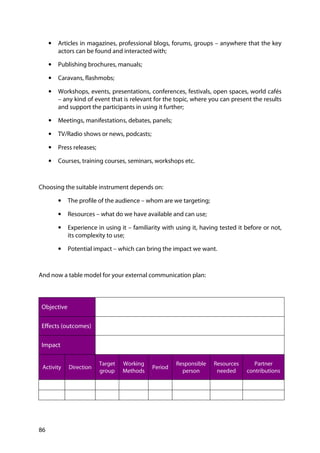
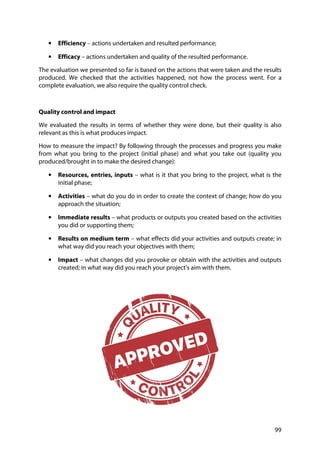
Author Andreea CĂPLESCU
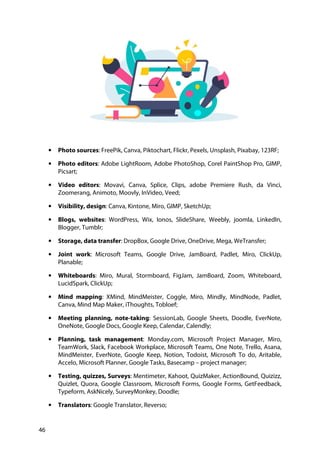
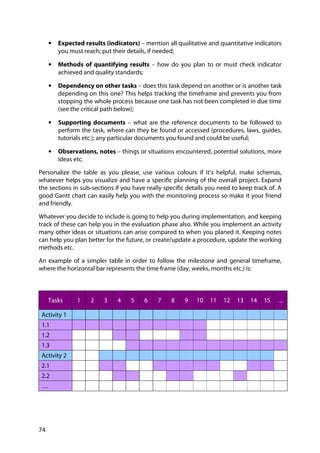
Project SoundBeatsTime
soundbeatstime@gmail.com
soundbeatstime.com
Partners Yellow Shirts – Romania
Institutul Român de Educație a Adulților – Romania
Giovani senza Frontiere – Italy
Disclaimer This project has been funded with support from the European Commission.
This publication reflects the views only of the author, and the Commission
cannot be held responsible for any use which may be made of the
information contained therein.
This manual has been elaborated during the project “SoundBeatsTime”
(with the ref. no. 2020–1–RO01–KA227–YOU–095777), funded by the
European Union through the Romanian National Agency, in the context of
the Erasmus+ KA2 – Cooperation for innovation and the exchange of good
practices action, Partnership for Creativity sub–action.
CONTENTS
I. WELCOME .................................................................................................... 5
II. THE PROJECT CYCLE .................................................................................. 7
Defining the project ................................................................................................................................. 7
The starting point ...................................................................................................................................... 8
The need .................................................................................................................................................... 10
The context ............................................................................................................................................... 15
III. PROJECT WRITING .................................................................................. 16
The six pillars ............................................................................................................................................ 16
Additional aspects .................................................................................................................................. 24
Basic project application structure ................................................................................................... 27
IV. THE LEARNING PROCESS ....................................................................... 32
Education and learning ........................................................................................................................ 32
The learning process ............................................................................................................................. 36
Facilitating the learning process ....................................................................................................... 39
Planning the activities .......................................................................................................................... 42
Digital tools and instruments ............................................................................................................. 45
Getting access to resources ................................................................................................................ 47
V. EUROPEAN UNION FUNDS ..................................................................... 48
Finding EU grant opportunities ......................................................................................................... 48
How to decide on the proper funds? ............................................................................................... 51
Cultural and youth sector funds ........................................................................................................ 52
VI. PROJECT MANAGEMENT ....................................................................... 65
The organisation ..................................................................................................................................... 65
Team building and joint work ............................................................................................................ 68
Project management ............................................................................................................................ 71
Logistics inside-out .............................................................................................................................. 105
VII. WHAT ELSE SHOULD YOU KNOW ..................................................... 135
Frequently Asked Questions ............................................................................................................. 135
Frequent vocabulary used in Erasmus+ and European Solidarity Corps .......................... 150
VIII. RESOURCES ....................................................................................... 160
IX. BIBLIOGRAPHY .................................................................................... 166
5
I. WELCOME
This guide resulted from the desire to support and encourage groups or organisations
wanting to get involved in their community. We wrote it having in mind particularly the
beginners, who have little to no know-how about this kind of activity, yet a lot of
motivation and desire to do something in and for their community.
We have all been there, “alone in the dark”, at a certain point and we most likely faced
similar questions and situations. Our main and available option at the time was trial and
error. We made many silly mistakes that could have been avoided if we had a deeper
understanding and knowledge of project management or the project world as a whole.
Mistakes are wonderful teachers! But if we can avoid wasting time, energy, perhaps
resources, financial investments or even people from our team, why not learn from
others’ experiences?
Inside this manual you will find lots of tips and templates that resulted from years of
trying to find our way around, which eventually gave us an incredible amount of practical
experience in writing and coordinating projects.
You may wonder what backs this endeavour. Here’s a short sum-up of where our project
experience, mainly in the youth sector, comes from:
• Participated in and organized projects for about 15 years, during which we were in
“the thick of the action”;
• Coordinated 24 projects (5 local and 19 EU funded) and organized hundreds of
local workshops and short events;
• Hosted 310 participants in 11 international mobilities;
• Hosted 114 volunteers (23 long-term, 91 short-term) in 14 international
volunteering projects, either as a hosting (receiving foreign volunteers and
implement activities in our community) or coordinating organisation (our projects);
• Collaborated in over 100 projects in partnership, mainly mobilities, at the local
and international level, and sent more than 1200 people in these projects.
Is this a lot of experience or hardly any at all? Hard to say. What we can say though is that
we faced beginners’ struggles and now want to share what we learned. We do not hold
the “absolute truth” in writing and managing projects, nor do we pretend to do so.
It is now up to you to take our knowledge and convert it into what you need and is
applicable to your context. Take this guide for what it is: practical experience sharing.
You may also find helpful tips supporting general project management in our other
materials resulted from the SoundBeatsTime project:
6
• Online methods to be used in training of young musicians – examples of
methods and instruments for the digital approach (textbook);
• Entrepreneurship for beginners – the way a business can be planned and
handled, easily replicated for an organisation as a leading model (textbook and
online video course);
• Online promotion – tips to build your online presence for your organisation,
applicable as well at the project level (textbook and online video course);
• www.soundbeatstime.com – the Blog and Resources sections contain lots of
information helpful for you.
We strongly feel about emphasizing the Entrepreneurship for beginners materials as a
guiding tool towards efficient organisational management (replicable from the business
environment), as well as lots of information on management, human resources and
finances.
Before we move on to the contents of this guide, we’d also like to point out two more
manuals and courses developed during this project, helpful for those of you interested in
the music sector:
• Basic audio recording and mixing – get your basic knowledge on musical theory
and producing audio recordings;
• Creative entrepreneurship: steps and approaches – entrepreneurship actions
specific for the music industry.
Best of luck!
7
II. THE PROJECT CYCLE
Key concepts
• What is a project? What does the term “project” refer to?
• What is a project cycle? What are its steps?
• What is a need? How can we work it out?
Defining the project
We see the project as a living organism. It starts with an idea based on a need, evolving
with time if taken care of at conceptual level. Close to maturity, it may not resemble to the
initial idea or model the original expectations too closely, and that is the beauty of it. A
project will challenge you along the way and is up to you as a manager or coordinator to
supervise and guide it towards where you want it to go.
The term „project”, as referred to throughout this guide, is defined by the following
dictionaries as:
• Cambridge: a piece of planned work or an activity that is finished over a period of
time and intended to achieve a particular purpose; a study of a particular subject
done over a period of time, especially by students;
• Dictionary.com: something that is contemplated, devised, or planned; plan,
scheme; a large or major undertaking, especially one involving considerable
money, personnel, and equipment;
• Oxford Learners: a piece of work involving careful study of a subject over a period
of time, done by school or college students; a planned piece of work that is
designed to find information about something, to produce something new, or to
improve something; a set of aims, ideas or activities that somebody is interested in
or wants to bring to people’s attention;
• Collins: a project is a task that requires a lot of time and effort; a project is a
detailed study of a subject by a pupil or student
• Merriam Webster: a specific plan or design, an idea; a planned undertaking: such
as definitely formulated piece of research, a large usually government-supported
undertaking, a task or problem engaged in usually by a group of students to
supplement and apply classroom studies;
8
• MacMillan: a planned piece of work that has a particular aim, especially one that is
organized by a government, company, or other organization an energy
conservation project; a piece of work that involves collecting detailed information
about something;
• Longman: a carefully planned piece of work to get information about something,
to build something, to improve something etc; a part of a school or college course
that involves careful study of a particular subject over a period of time.
All the definitions above have in common the element of planning, an action widely
needed. With a careful allocation of time and efforts our actions will have a purpose, an
implementation and generate the desired results.
We like to define the project as a set of well-structured actions, done during a specific
timeframe, following a precise order under set conditions, destined to change the
status of a target group or area of intervention, in order to generate results that
ultimately alter and impact positively our lives.
The starting point
Projects are circular. We start and end with the desired results, as they give us the
starting point, the need, the problem to focus on, the unfavourable situation that we want
to transform and improve for us or the people around us.
A project must be based on a need, and not just an idea (no matter how brilliant) you have
and which sounds fun to do. Nor should it be based on the fact that you found a funding
programme and sounds like you could be doing something on that.
It is quite the opposite: you have the need that you want to solve, based on which you
create the structure of the project with more details, and then you search for financing
and adapt it to their requests, while of course, you try to make the work as “fun” as
possible for you and your team.
It’s equally important to mention that you should enjoy working with the topics, as well
as the activities of the projects you do, and have knowledge and resources on the topics
for an easier and qualitative implementation.
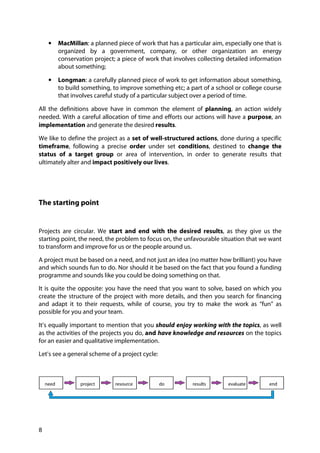
Let’s see a general scheme of a project cycle:
need project resource do results evaluate end
9
• Need – identifying the need;
• Project – constructing the project structure based on the identified need;
• Resources – looking for (financing) resources to be able to do the project;
• Doing or implementation – implement the set of actions to achieve what we
wanted;
• Results – obtaining the results based on the activities from the implementation
phase;
• Evaluating and measuring the impact – analysing the results created and
comparing with the initial planning;
• Ending and reporting – summing-up all your efforts in an objective and critical
way so you can check how good you managed to solve the identified need, in the
terms you decided on through the project.
Once the project ends, it’s done and gone: a project has a specific timeframe in which it
is implemented. If you want to continue developing your idea, based on the already
gained knowledge, you must modify the initial structure of the project, adapt it to the
newly learned information (your experience from the project) and initiate again the
project cycle.
Even if the need is the same, there are other aspects that may differ. Supposing you want
to repeat absolutely everything you previously did (pretty hard in practice, actually), you
still need to adjust at least the timeframe.
10
The need
We can define the need as a problem, a barrier, a challenge that stops/prevents you from
reaching an objective under the same conditions as others, a lack or low level of a context,
a gap that needs to be filled in. It’s like a thorn you have in your finger that keeps
bothering and hurting you, and will continue to do so if you don’t deal with it.
Let’s see how we analyse the need and what exactly should we look for. The needs
analysis begins with observing and understanding what people or areas around us are
facing and what their difficulties, challenges, barriers are. Collect information on the
background of the situation and try to learn what others did on this matter before you,
their process and the results obtained.
Sources of information:
• Local, regional, national development plans and programmes (their priorities,
objectives, intervention directions, target groups);
• Direct observation of the context;
• Online and library research (books, articles, interactions with experts);
• Online and onsite community approach (questionnaires, surveys, discussions,
focus groups with the persons from that context).
Even if the situation you identified is completely new, you still need to collect a lot of data
about the background so you can understand it better and use it as foundation for your
structure. It takes a lot of analysis, documentation and research on the topic before you
actually start developing the idea.
11
Information to be collected:
• Quantitative information (numbers) such as number of affected persons/
surfaces, percentages of inequalities or lacking/low aspects, ratios of access to
services etc.
• Qualitative information (status) such as description of properties, feelings,
perceptions, satisfaction level, feasibility, utility, changes etc.
The aspects to take into account during research and analysis are:
• Data – information describing a situation, a group, a region etc.; example: access to
electronic devices in schools/x rural area (quantitative), satisfaction level of the
school’s offer (qualitative);
• Indicators – the predefined measures of the data we collect; example: number of
pupils learning in the school (quantitative), percentage of highly satisfied pupils of
the school’s offer (qualitative);
• Targets – the effective values we want to reach at the end of the activities;
example: 5 tablets and 20 children taught to use them (quantitative), maximum
satisfaction of their new IT&C activities of 55-75% of the pupils involved in the
activity (qualitative).
It is time now to see how we can reach the roots of a need and work on its specificities.
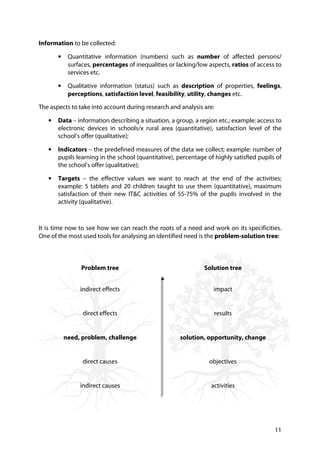
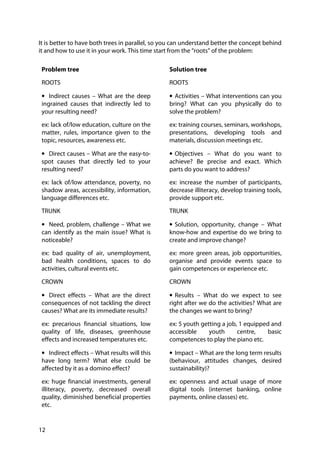
One of the most used tools for analysing an identified need is the problem-solution tree:
Problem tree Solution tree
indirect effects impact
direct effects results
need, problem, challenge solution, opportunity, change
direct causes objectives
indirect causes activities
12
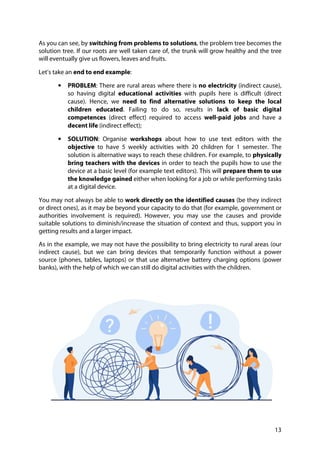
It is better to have both trees in parallel, so you can understand better the concept behind
it and how to use it in your work. This time start from the “roots” of the problem:
Problem tree
ROOTS
• Indirect causes – What are the deep
ingrained causes that indirectly led to
your resulting need?
ex: lack of/low education, culture on the
matter, rules, importance given to the
topic, resources, awareness etc.
• Direct causes – What are the easy-to-
spot causes that directly led to your
resulting need?
ex: lack of/low attendance, poverty, no
shadow areas, accessibility, information,
language differences etc.
TRUNK
• Need, problem, challenge – What we
can identify as the main issue? What is
noticeable?
ex: bad quality of air, unemployment,
bad health conditions, spaces to do
activities, cultural events etc.
CROWN
• Direct effects – What are the direct
consequences of not tackling the direct
causes? What are its immediate results?
ex: precarious financial situations, low
quality of life, diseases, greenhouse
effects and increased temperatures etc.
• Indirect effects – What results will this
have long term? What else could be
affected by it as a domino effect?
ex: huge financial investments, general
illiteracy, poverty, decreased overall
quality, diminished beneficial properties
etc.
Solution tree
ROOTS
• Activities – What interventions can you
bring? What can you physically do to
solve the problem?
ex: training courses, seminars, workshops,
presentations, developing tools and
materials, discussion meetings etc.
• Objectives – What do you want to
achieve? Be precise and exact. Which
parts do you want to address?
ex: increase the number of participants,
decrease illiteracy, develop training tools,
provide support etc.
TRUNK
• Solution, opportunity, change – What
know-how and expertise do we bring to
create and improve change?
ex: more green areas, job opportunities,
organise and provide events space to
gain competences or experience etc.
CROWN
• Results – What do we expect to see
right after we do the activities? What are
the changes we want to bring?
ex: 5 youth getting a job, 1 equipped and
accessible youth centre, basic
competences to play the piano etc.
• Impact – What are the long term results
(behaviour, attitudes changes, desired
sustainability)?
ex: openness and actual usage of more
digital tools (internet banking, online
payments, online classes) etc.
13
As you can see, by switching from problems to solutions, the problem tree becomes the
solution tree. If our roots are well taken care of, the trunk will grow healthy and the tree
will eventually give us flowers, leaves and fruits.
Let’s take an end to end example:
• PROBLEM: There are rural areas where there is no electricity (indirect cause),
so having digital educational activities with pupils here is difficult (direct
cause). Hence, we need to find alternative solutions to keep the local
children educated. Failing to do so, results in lack of basic digital
competences (direct effect) required to access well-paid jobs and have a
decent life (indirect effect);
• SOLUTION: Organise workshops about how to use text editors with the
objective to have 5 weekly activities with 20 children for 1 semester. The
solution is alternative ways to reach these children. For example, to physically
bring teachers with the devices in order to teach the pupils how to use the
device at a basic level (for example text editors). This will prepare them to use
the knowledge gained either when looking for a job or while performing tasks
at a digital device.
You may not always be able to work directly on the identified causes (be they indirect
or direct ones), as it may be beyond your capacity to do that (for example, government or
authorities involvement is required). However, you may use the causes and provide
suitable solutions to diminish/increase the situation of context and thus, support you in
getting results and a larger impact.
As in the example, we may not have the possibility to bring electricity to rural areas (our
indirect cause), but we can bring devices that temporarily function without a power
source (phones, tables, laptops) or that use alternative battery charging options (power
banks), with the help of which we can still do digital activities with the children.
14
Once decided on a community need you want to tackle, you may want to check your
potential and suitability to approach this challenge:
• Context:
o Where did this need result from? How was it identified?
o What was the context, the trigger, that led to you discovering/observing
it?
o What results can you foresee for it? What can you change?
o What opportunity do you and the community have here?
o How does this align with your organisation and your directions?
• Capacity:
o What competences and resources do you have?
o Would you need to learn more about the topic before approaching it?
How much time would it take and what would you need to invest in this
process?
o What kind of support would you need?
o Is there anyone who could support you in the process? How?
o Is it realistic and achievable for you to do it at this particular point with
the resources (including partners) that you have? Can you really obtain
results out of it?
o Would you expose yourself to risks you cannot deal with?
o What would be the obstacles for you in tackling the need?
• Solution:
o What approaches could you have towards the need?
o Is it based on abilities, skills/knowledge, information/attitudes and
values, or a combination of these? How?
o What methods and tools would you need?
o How much could you initially cover and improve/solve through a first
intervention?
It is important here to mention that the needs must be as local and specific as possible. We
all want the world to be better, yet it is not very realistic and achievable by us through a
single project. So go to the very grassroots level need you face as an organisation, as a
consortium of partners, or of the target group.
15
The context
Our last step is seeing how we can work on our context. For this, we will use two tools,
more extensively presented in the “Entrepreneurship for beginners” manual and course:
• The S.W.O.T. analysis: this is an analysis of your strengths (what are you good
at), weaknesses (what are you not so good at), opportunities (what could
support you in solving the challenge) and threats (what could stop you or slow
you down from achieving your objectives). This analysis is good for the context,
your organisation, your partners, your project team etc., anything you depend
on in order to be able to reach your objectives and get the expected results;
• The P.E.S.T.E.L. analysis: this analysis is more suitable for the context and
external factors, as it gives you insights on Political, Economical, Social,
Technological, Environmental and Legal frames of your project. It may seem
like it is a bit too specialized for businesses, but it’s also suitable in NGO
(nongovernmental organisation) projects as we have all these contexts that can
influence us, even if not targeting specifically one of these 6 frames.
16
III. PROJECT WRITING
Key concepts
• What are the practical aspects we should include in a project?
• What else should we take into consideration when writing a project?
• What is the general structure of a project application?
Now that we identified and analysed the need, the next step is transforming it intro a
project. During project writing we expand the identified need to create a logical and
coherent structure that takes into account the consistency and interdependency of the
objectives with activities, results and impact. This particular step will be developed more
in the following chapter.
We have our basic structure of the project and we know exactly what we want to do in
order to solve the identified need. A potential obstacle at this point could be having the
resources (material, human, financial, space etc.) to actually put it into practice. We’ve
selected a handful of funding opportunities for you, with some particular ones specific for
the cultural – youth fields (chapter V).
Once we have the resources needed and we can get the project started, we need
knowledge of and tools for management and implementation. So we make sure we
create a plan and follow it through to achieve the desired results. Also, while
implementing the project we monitor and evaluate our evolution, in tandem with
measuring the results and impact created.
At the end of the project, we need to fully verify our work, evaluate the actions and create
the report to let our funder and community know what we did, as well as to internally
keep track of our actions. All these aspects will be talked about in details in Chapter VI.
The six pillars
The six pillars are the most important aspects of a project structure. Based on them, you
can adapt the idea to any application or request from various funders. These pillars are:
the context, target group – beneficiaries, objectives, activities, results, impact.
17
Context
In the previous chapter we have seen how to identify and analyse a need in order to be
able to generate the base for a project. We used the problem-solution tree for this and its
results will help us progress to the actual writing of a project as it provides the context and
helps maintain a fil rouge of our project.
To go a bit deeper in how exactly we write the need, we should take into consideration
that it should be SURE:
• Specific for the target group(actually needed);
• Unique (in approach);
• Realistic (doable in real time);
• Educational (to solve the problem or lead to its solving).
Target group – beneficiaries
The target group represents the people with particular and well defined characteristics
that created the need we identified. They are the ones that have a direct effect in leading
to the need, problem or challenge faced. The target groups are the ones that should be
approached to support you in solving the encountered problem.
The beneficiaries are the people that suffer the consequences of the problem, and are in
fact the people for whom you do the project. They are of two types: direct (we get them
directly involved in the project, they participate to the activities) and indirect (they hear
about our project and activities from the direct beneficiaries).
Often used as synonyms, target group and beneficiaries are not the same things:
• Target group: our cause of the problem; answers to What? Who?
• Beneficiaries: who gets affected by the problem; answers to Why? For whom?
Tightly connected to the context, the target groups and beneficiaries are well defined and
identified (as characteristics) from the very beginning.
Objectives
The goals or objectives are the purposes, the aims, the targets we want to reach, the
directions we want to follow, in order to bring a change and contribute to solving the
need.
The term “goal” is mostly used for the general purpose of the project and should show
what you achieve as a sum-up when the project is over, while “objectives” are used for the
intermediary specific steps we want to take in order to achieve the goal. The objectives are
18
mainly used to support the evaluation of the project and see at the end of it if we achieved
the goal and the level of doing so.
A project should have 1 goal and about 2-3 objectives; it could get up to 3-5 objectives if
it’s a large project. We highly recommend to keep it simpler and rather go with general
objectives (2-5) if it is to create a strategy (a plan on a wider term) that can include several
smaller projects, each contributing dependently or independently on each other to reach
the main goal.
Don’t go overboard with writing long paragraphs as just one objective. Make it clear, brief
and easy to understand for whoever reads it. Also, 30-50 words should be more than
enough.
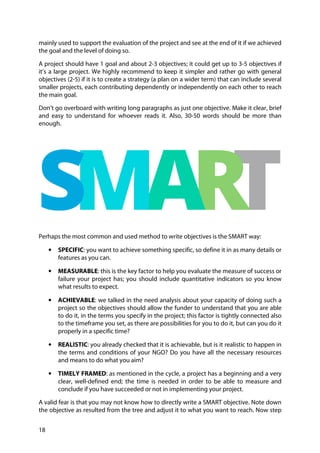
Perhaps the most common and used method to write objectives is the SMART way:
• SPECIFIC: you want to achieve something specific, so define it in as many details or
features as you can.
• MEASURABLE: this is the key factor to help you evaluate the measure of success or
failure your project has; you should include quantitative indicators so you know
what results to expect.
• ACHIEVABLE: we talked in the need analysis about your capacity of doing such a
project so the objectives should allow the funder to understand that you are able
to do it, in the terms you specify in the project; this factor is tightly connected also
to the timeframe you set, as there are possibilities for you to do it, but can you do it
properly in a specific time?
• REALISTIC: you already checked that it is achievable, but is it realistic to happen in
the terms and conditions of your NGO? Do you have all the necessary resources
and means to do what you aim?
• TIMELY FRAMED: as mentioned in the cycle, a project has a beginning and a very
clear, well-defined end; the time is needed in order to be able to measure and
conclude if you have succeeded or not in implementing your project.
A valid fear is that you may not know how to directly write a SMART objective. Note down
the objective as resulted from the tree and adjust it to what you want to reach. Now step
19
by step verify that it touches every letter of SMART. If it’s not, adjust the objective by
adding the details needed.
Let’s take an example: I want to learn to play an instrument. This could easily be
transformed into our main goal, and in order to reach it, written into the SMART way, we
could have: I want to learn to play (improve my skills) Beethoven’s Moonlight Sonata’s 1st
Movement on piano in 3 months.
• S – I want to learn to play piano so I can play Beethoven’s Moonlight Sonata’s 1st
Movement; this part is what I want to learn (not the entire sonata, nor the full
capacity of a piano that I may not require for this sonata);
• M – 1 part (1st
Movement), 3 months;
• A – even if I am a total beginner, this part is achievable in 2 months, therefore 3
months can give me enough time and extra to practice;
• R – others have learned it with the help of tutorials (should take more time than
with a teacher), and if I commit to practicing daily, even 10 minutes, I can achieve it
as the part is not so difficult nor long;
• T – I have 3 months to learn it and after this time I will evaluate my progress.
Referring back to the specific objective writing task, we can also follow this structure:
• Direction of the change (increase, decrease, developing, awareness);
• The field of change (knowledge-information, abilities-skills, attitudes-values);
• Target group (a profile that identifies and specifies whom we address, location etc);
• Time (days, weeks, months, specific date);
• Measure (included in the mentioned aspects).
Another way to approach the setting of objectives is the HEART method:
• HOLISTIC: takes into account everybody involved (the entire community, targeted
group, beneficiaries, organisation etc.); the purpose of a project is to address and
educate the target group to eliminate the problem;
• EFFECTS: or side effects, assume that the proposed solution also deals with all the
initial problems’ side effects; the need to change is obvious, yet there might be
good things happening currently that you can keep and continue;
• AFFIRMATIVE: we formulate the objective such that it is positively expressed and
using the present tense rather than past; it is all about what we want to achieve,
not what we don’t have.
20
• RESPONSIBLE: taking the responsibility for the project as it totally depends on us
to make it happen; the success or failure of it is directly connected to our
commitment and involvement in making it happen;
• TESTABLE: the final result can be perceived one way or another through the 5
senses (sensorial reception): seen, heard, felt, tasted, spoken; the emotions and
feelings are a very important part of a project’s results concerning our target group
and beneficiaries.
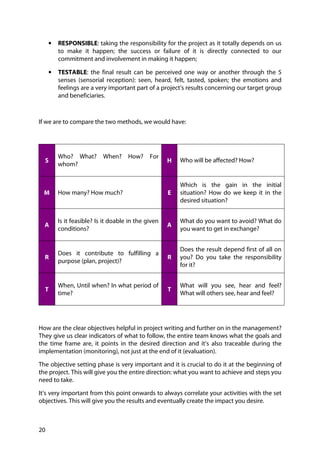
If we are to compare the two methods, we would have:
S
Who? What? When? How? For
whom?
H Who will be affected? How?
M How many? How much? E
Which is the gain in the initial
situation? How do we keep it in the
desired situation?
A
Is it feasible? Is it doable in the given
conditions?
A
What do you want to avoid? What do
you want to get in exchange?
R
Does it contribute to fulfilling a
purpose (plan, project)?
R
Does the result depend first of all on
you? Do you take the responsibility
for it?
T
When, Until when? In what period of
time?
T
What will you see, hear and feel?
What will others see, hear and feel?
How are the clear objectives helpful in project writing and further on in the management?
They give us clear indicators of what to follow, the entire team knows what the goals and
the time frame are, it points in the desired direction and it’s also traceable during the
implementation (monitoring), not just at the end of it (evaluation).
The objective setting phase is very important and it is crucial to do it at the beginning of
the project. This will give you the entire direction: what you want to achieve and steps you
need to take.
It’s very important from this point onwards to always correlate your activities with the set
objectives. This will give you the results and eventually create the impact you desire.
21
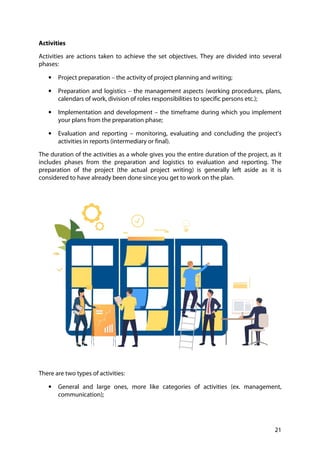
Activities
Activities are actions taken to achieve the set objectives. They are divided into several
phases:
• Project preparation – the activity of project planning and writing;
• Preparation and logistics – the management aspects (working procedures, plans,
calendars of work, division of roles responsibilities to specific persons etc.);
• Implementation and development – the timeframe during which you implement
your plans from the preparation phase;
• Evaluation and reporting – monitoring, evaluating and concluding the project’s
activities in reports (intermediary or final).
The duration of the activities as a whole gives you the entire duration of the project, as it
includes phases from the preparation and logistics to evaluation and reporting. The
preparation of the project (the actual project writing) is generally left aside as it is
considered to have already been done since you get to work on the plan.
There are two types of activities:
• General and large ones, more like categories of activities (ex. management,
communication);
22
• Specific and small ones, more like the specific actions you take (ex. in the
management category we have the time management, risk analysis, monitoring
etc.).
As mentioned for objectives, activities also need to be connected and interconnected with
the other pillars. That means that once we established the context and the target group,
as well as we defined the objectives, we can clearly identify the categories and specific
activities we want to have, in order to achieve the set goal.
The activities chosen must be suitable, achievable, realistic and relevant for the objectives.
Transposing activities into practice is done through methods, about which mode detailed
will be given in chapter IV.
Tightly connected to activities are budget and resource allocation. The latter is a
comprehensive category including financial, equipment, space, human or time resources.
Careful planning of activities allows for efficient resource allocation and purposeful use of
available means (details in chapter VI).
Results
A part of the outcome will result naturally from the activities and objectives once we are
clear about our aimed achievements. Similarly, this applies to results stemming from the
solution tree tool, except that here we need to be specific about what we want to focus on
and correlate them with objectives and corresponding activities.
This section will focus on short-term results, as they are easily measurable by the end of
the project. There are two kinds of results:
• Tangible – consisting of outputs or products (products, services, materials, guides,
manuals, brochures, movies, podcasts etc.) from implemented activities;
• Intangible – consisting of outcomes or effect results (knowledge, attitudes, skills)
derived as immediate effects of fulfilling the objectives.
Both tangible and intangible results are measured with the help of the indicators
(quantitative or qualitative), which provide information about:
• What is to be measured (what is going to change, what we expect to change);
• Unit of measurement used to describe the change;
• Pre-program status/state, also known as the baseline (where possible);
• Size, magnitude, or dimension of the intended change;
• Quality or standard of the change to be achieved;
• Target population(s);
• Timeframe.
23
Indicators are aspects that you set through the objectives and overall view on the project.
You need to be aware of the starting point (context analysis) and end point (where you
want to get to) as you must be able to follow it through monitoring during the project and
evaluate it at the end to see the evolution (achieved or not, or exceeded expectations).
The following questions will enable us to perform a quality assessment of an indicator:
• Is it targeted? Does it tell us what is changing, who is involved, where and when is
the change happening?
• Is it measurable? Does it have specific measuring units? Is it clear what and how will
be measured? Do you have with what to compare it (initial benchmark)? Does it tell
you concretely what to expect in terms of quality (for ex., what does it mean for
you “good” in terms of standards of quality, how can you evaluate that)?
• Is it reliable? Does it offer consistency and measurement options? Are the quality of
information and source credible? Are the assumptions minimal and more verifiable
one way or another? Does it have a connection between what you want to achieve
and what you measure? Would it give the same results to everyone who would like
to collect this data?
• Is it feasible? Is it easy to collect it? Is it easy to verify it? Can the collection be done?
Can the information be obtained?
• Is it useful? Does it offer critical information related to the objectives? Is the
indicator connected to the project or need? Does it affect one way or another a
decision process inside the project or afterwards?
Methods on how to collect and verify the results-indicators will be explained further in
chapter 6.
Impact
Similar to results, the impact has the same features and characteristics. The difference is
that these are the results visible on medium and long term, most likely after the project
finishes. It represents changes, benefits, effects of learning.
Impact tends to be intangible (changes in behaviours, attitudes), achieved with the
support of tangible results (the courses reached a specific number of people, there was an
increase in the number of volunteers involved and so the activities increased, there was a
decrease in non-selected waste because we reached more people etc.).
In order to create a strong and durable impact, the long-term results should be effective,
efficient and align with the set objectives.
How the impact is being created:
24
Impact is of three types:
• Intermediary – small changes, yet important steps towards the main, big impact;
• Soft – a bit harder to observe or measures, as it involves changes afterwards such
as that of attitudes or opinions;
• Hard – the obvious impact that involves a drastic external change in the people’s
behaviour or of certain circumstances; it is measurable in numbers, percents; it can
take a lot of time and requires persistence.
Additional aspects
Partners or collaborators
These are important key persons/entities that can support and help you in developing
your project. They may be officially involved in the project with rights, responsibilities and
shared budget, or just supportive for your activities, yet not fully engaged in your
undertaking.
While thinking whether to take a partner (deeply involved in the project) or a collaborator
(occasional or one time involvement) on board you should have in mind aspects such as:
• Rightfulness (suitable as values and shared principles);
• Helpfulness (trustworthy and eager to jump in);
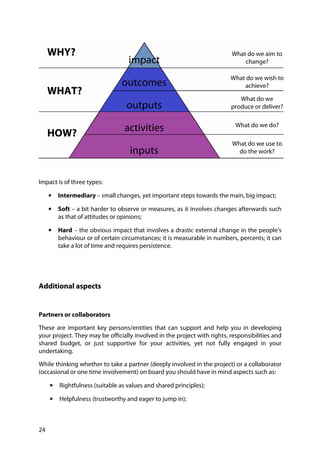
HOW?
WHAT?
WHY?
impact
outcomes
outputs
activities
inputs
What do we aim to
change?
What do we wish to
achieve?
What do we
produce or deliver?
What do we do?
What do we use to
do the work?
25
• Usefulness (skills, assets, if they are actually needed);
• Responsibility (capable and willing to finish up the job in due time);
• Results created together (quality coming from expertise and know-how).
Some examples of the qualities you should be looking at in a partner/partnership are:
• Suitable for you (you know them and what they do);
• Open to distribute and share tasks (clear tasks and roles for each);
• Common interests and values (targeting the same results and methods of getting
them);
• Efficient communication (open to cooperate, communicate, express concerns and
gratitude);
• Serious and trustful (you can count on them to deliver their tasks);
• Experience in the field or working with the targeted group (something that
recommends them to be involved in the project);
• Potential for a long term collaboration (opportunity to work and grow together);
• Potential for common follow-ups (continuation of the collaboration, particularly on
this topic and developing together the next steps);
• Clear vision of the objectives (aiming towards the same thing);
Let’s see some examples of partners could you think of:
• Educational institutions: nurseries, kindergartens, schools, high schools,
universities, private course providers;
• Cultural institutions : museums, libraries, community cultural centres, cinemas,
theatres etc.;
• NGOs: local, regional, national, European, international/depending on the topic
they approach;
• Media representatives: TV, radio, newspaper representatives, photographers,
videographers, bloggers, vloggers, influencers etc.;
• Governmental institutions and authorities: city halls, local councils, county
prefectures, sanitary, youth, sport, social welfare etc. offices, ministers etc.;
• Private companies and persons: experts with know-how/support with resources.
And now of places where you could find them:
• Online – various groups, forums, data bases;
• Recommendations – previous collaborations of trustful partners you have;
26
• Research, publications – you find out about them while searching for your context,
for example;
• Meetings, conferences, seminars, presentations – the best places to get more
acquaintances in your field and start talking to see if you match as partners;
• Networks of organisations, entities – already established networks (most of the
times on a specific topic), with entities working in that specific field.
Examples of the type of help they could provide you with:
• “Brain” resource: access to or the knowledge, information, know-how, expertise
itself;
• Material resources: objects, equipment, devices, technology, space, tools, raw
materials and supplies etc.;
• Human resources: employees/volunteers as experts;
• Financial resources: direct money, coverage of certain costs, providers of certain
services or products;
• Time and energy, services resources.
The tests
Checking out your project structure is really important before you move on with
developing it further. For this, we have two “tests”:
• The grandma test – give your plan to someone (can be literally your grandma, or
children, playing the role of an evaluator) who has no idea about what you worked
on so far and ask them to tell you after reading it what they think the main idea is; if
they can tell you exactly what you meant, then your plan is good to go further; if
they can’t, pay attention to their feedback and improve those areas to make it
more understandable for someone totally new to your plan; this test is for checking
if it has a simple vocabulary, not very technical aspects, easy to comprehend and
follow in terms of writing style;
• The beer test – similar to the grandma test, if you present your idea to your friends
(as potential target group or beneficiaries) as you enjoy your time out together,
and they can understand your plan, then you’re good to go; if not, same as before,
take the feedback and adjust the plan accordingly; this test follows more the
structure and connection of activities-objectives-results, rather than the vocabulary
as you tell it orally.
27
Whoever will read your text should understand fully what you mean without needing
additional explanations. It is often clear to us what we have in our minds as we are the
ones who initiated and developed the idea, yet put yourself in the shoes of the evaluators,
who may be reading even 10 projects per day, from 10 different domains of which they
have no clue (real expertise) about.
Explain your plan as if the person has no idea about that field, because they actually might
not, so help them fully understand and be able to follow the structure behind it. Be
consistent, relevant and easy to follow for whoever reads!
Basic project application structure
At this point you have the structure of your project, it is clear for everyone and so you
want to take it one step further and write a project proposal.
The application forms or the project candidatures are different depending on the funder,
yet they all have certain elements in common, such as:
• Title – should give a first insight to what the project is about, intrigue and attract,
yet be short and concise; we’d recommend 10, maximum 20 words for it; we, for
example, are not big fans of the descriptive titles (detailed explanation of what you
want to do), but rather we try to find a name that is easy to remember, short, funny,
and connected to the topic; for example, SoundBeatsTime gives you a first
connection with the music; you can even think of an acronym for the title (in our
case, SBT);
• The project’s dates – these dates refer to the entire period when your project is
implemented; we mentioned before that a project should include the phases from
28
preparation to evaluation and reporting so think about all the time required for the
project, for example 6, 9 months, 1-2 years (you can give specific dates for starting
and ending); the activity dates are included in the project ones and are visible from
the calendar of activities, these being of few days, weeks, or months;
• A short summary – this is always helpful to have in the beginning so the reader
can get a general idea of what they are about to read; even though it must be
placed in the first pages, you should elaborate it at the end of the writing process,
after you have everything clear about the connections of activities-objectives-
results-impact;
• Context and needs – take the important parts of your analysis (those that are
relevant to your project) and put them here; describe them in enough details so
the reader understands where the project will take place, how you identified the
need and whom you are targeting, among which general problems you selected
these particular ones; weaknesses and threats of the S.W.O.T. analysis or P.E.S.T.E.L.
aspects can be presented as well; feel free to include statistics, survey results,
official reports etc., in order to argue and strengthen your position and the context;
in case of partnerships, the need of the project should be felt or dealt with by all
the partners involved; some organisational needs or approaches (quite indicated
here for diversity and different expertise) may differ, yet the core problem should
be important for all the partners;
• Motivation – why do you want to make this project and why are you suitable for
making it, and not someone else; present yourself with your greatest strengths,
minding the opportunities (S.W.O.T.), while describing the P.E.S.T.E.L. aspects that
are in your favour; it is worth mentioning here that the motivation should include
your partners as well, if you have them, as the project is a joint work and effort to
solve a common need identified for all of you; this will give the evaluators a first
idea about the reason why this project should be financed so argument it well;
• Objectives – in addition to what we said about them before, keep in mind that the
objectives should present a future situation (where you want to get) of your
organisation or the target group (solving completely or partially the need/
problem). Simultaneously, reaching objectives, once the project ended, must
translate into an improved situation for the organisation or the target group; we
stress again and again the importance of a strong connection between needs and
objectives-activities-results; the objectives should point out the goals clearly, the
results towards you are aiming with the project and the changes it can produce
once you finalise it;
• Target groups – describe their profile in as many details as possible (age, location,
gender, education, social, economic status etc., yet only provide details relevant for
your need) correlated with the need tackled; the profile and correlation with the
need will help you set the base or benchmark indicators to begin from;
• Beneficiaries – similar to the target group, except with focus on the people we will
involve in our activities, directly or indirectly;
29
• Partners, if the case (officially involved in the project) – who they are, what they
generally do, how they can support and get involved in the project, what their
needs related to the project are, what their general target group is, their strengths
and opportunities, benefits for joining the project, their experience and expertise
or what they can gain regarding it, the added value their involvement can bring; it
is crucial to make sure the need for involving this partner is obvious (their
contribution, their importance for reaching the objectives together in terms of
experience, knowledge, community profile, expertise of staff members etc.); it’s
worth also mentioning how they were identified and how the cooperation will
function;
• Collaborators, if the case (supporting the project from a limited point of
action) – the above questions are valid here as well, with the mention once more
that their role is essential to the implementation of the project, yet not vital (that
would make them partners); it’s worth mentioning how they were identified and
how the cooperation will function;
• Management and team work – it is good to have in mind the initial planning from
the management point of view (preparation, implementation following,
monitoring and evaluation), as well as the roles and responsibilities you will fulfil
with the human resources during the project (not necessarily by providing names,
but in terms of what they are expected to do); the roles and responsibilities should
be clearly identified, including those of the partners and of partners’ staff involved
in the project; this section should involve all the tools and methods of
collaborating, working together and making the project happen by joint efforts;
30
• Communication and promotion – although it’s part of the management, we’d
like to point this one out specifically; the communication happens internally (your
team, your organisation, your consortium, collaborators) and externally (target
groups, beneficiaries, third parties); the external one is equally important to the
internal one as through this you get to be seen (visibility), recognised and
acknowledged by the target group and beneficiaries you want to address; keeping
everyone informed inside and outside the project is important and helpful for you
to reach out more people, and so to get support for touching your objectives;
• Activities – we’ve mentioned before the general list with categories of activities
and activities; it should include management and communication elements, even if
they are implied. They can be detailed by specific activities and have assigned a
responsible (partner/person), resources, timeframes and deadlines, and any other
detail you consider important for you; the activities can briefly mention the
methods and tools through which they will be implemented, stressing once more
that they must be correlated with the project objectives and clearly lead to
achieving them, in close relation with the desired results, touch upon the target
group, and taking into account the needed budget to do so (cost-result effort
efficiency)
• Results – the specific results you are expecting to get by the end of the project,
tightly connected to the objectives and resulted from the activities you make;
present the selected indicators (you can mention both initial and final ones you
want to reach), having in mind equally the qualitative and quantitative ones (most
of the times we tend to emphasize the quantity more as it is easier to measure); the
learning outcomes are crucial for the projects which aim to educate the target
groups and beneficiaries, so think about these as well when mentioning the results;
• Impact – what effect did your actions create on organisations, participants, target
group, community per whole, third parties and stakeholders, what are the changes
that you expect, how will you make sure they have the space and context to
happen, how will you track it, how do you plan to do and evaluate it after to see if,
how, what resulted from it;
• Monitoring and evaluating – in order for you to assess and be able to prove it to
the funder afterwards, you need to clearly establish the indicators (results) that you
want to track and how you will verify their fulfilment (methods, instruments, tools);
it should be clear from the project what benchmarks you have and which targets
you want to reach (values, qualities etc.); the monitoring should happen frequently
and should have occasional milestones to be able afterwards to analyse the
progress; the evaluation is based on the collected data from the monitoring actions
so it is vital to have a clear planning of minimum who, when, how often, what, until
when it happens, and the status achieved;
• Dissemination and exploitation of results – the measures, methods and tools
through which you make sure that other parties than the ones included in your
project, find out about your results and make use of them; think about who you
will address, through what types of activities and methods, who is responsible for it
(you or your partners), what resources would it demand, what results would it
31
disseminate; the actions are taken with the purpose the results to be
acknowledged and adopted to be used by others to simplify, improve or create a
context in their entities, with the support of your results;
• Sustainability – or the ability to sustain, is all about how the project idea or its
results, can continue to be used or implemented in the work, once the financing
ends; it’s not only about disseminating it to others and trying to persuade them to
use your results in their work, but also about how you and your partners continue
to use it in your work and daily operations; in the end you did this project as a
result of your identified need so it should be further used mostly and firstly by you,
if not by the others;
• Follow-up – how do you intend to further use and exploit the results, especially
outputs, of this project in your work (including partners and others), is there any
intention to upgrade and continue this project, what are the lessons you gained
from this project that are useful in the future, how can you expand this project to
solve a connected need, what improvements can you bring to this project to
develop a new one.
The aspects mentioned here are the ones we consider important to have in mind when
writing a project, even if the application does not require certain sections. These parts can
help you in the management section to plan better and detail your moves, thus helping
you to ease your work during the implementation phase.
32
IV. THE LEARNING PROCESS
Key concepts
• Education styles and learning process;
• Acknowledging the learning process;
• Designing the activities;
• Examples of activities and methods;
• Digital supportive tools;
• Resources.
We mentioned that while defining the need, it is important this to have an educational
aspect in mind. Why is that? Because only by educating people (target group,
beneficiaries) can we reduce or prevent the identified problem. And so, the learning
aspect is a very important part of creating our plan of activities and choosing the suitable
methods for reaching our objectives.
Further we give various information about aspects you should take into consideration
while planning, however we will not extend it too much. Feel free to research additional
information on the parts that interest you the most.
Education and learning
For a long time, education and the learning connected to it were thought to happen
almost exclusively in a classroom. Today, however, it is more recognised and
acknowledged to happen everywhere, in different types of contexts.
Given this evolution, we can divide the education or the learning process, in three main
parts:
• Formal – what you learn in schools, within an education system, while following a
path, clear structure and curriculum; ex.: going to high school or university, taking
private courses to become an accountant;
33
• Informal – the process of learning by experimenting, discovering by accident
(because it happens to you), not planned; ex.: learning how to walk or talk, make
friends, leave the hot food to cool down a bit before eating it;
• Non-formal – similar to the formal one in terms of having a structure and
curriculum, yet emphasizing more the practical experience and experiential try-
out; it is aimed to supplement formal education by equipping people with deeper
competences; ex.: being a leader and lead a team, public speech, constructing a
Lego tower.
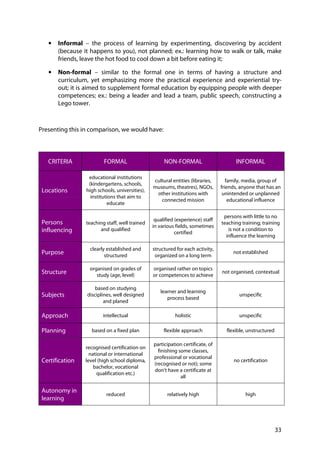
Presenting this in comparison, we would have:
CRITERIA FORMAL NON-FORMAL INFORMAL
Locations
educational institutions
(kindergartens, schools,
high schools, universities),
institutions that aim to
educate
cultural entities (libraries,
museums, theatres), NGOs,
other institutions with
connected mission
family, media, group of
friends, anyone that has an
unintended or unplanned
educational influence
Persons
influencing
teaching staff, well trained
and qualified
qualified (experience) staff
in various fields, sometimes
certified
persons with little to no
teaching training; training
is not a condition to
influence the learning
Purpose
clearly established and
structured
structured for each activity,
organized on a long term
not established
Structure
organised on grades of
study (age, level)
organised rather on topics
or competences to achieve
not organised, contextual
Subjects
based on studying
disciplines, well designed
and planed
learner and learning
process based
unspecific
Approach intellectual holistic unspecific
Planning based on a fixed plan flexible approach flexible, unstructured
Certification
recognised certification on
national or international
level (high school diploma,
bachelor, vocational
qualification etc.)
participation certificate, of
finishing some classes,
professional or vocational
(recognised or not); some
don’t have a certificate at
all
no certification
Autonomy in
learning
reduced relatively high high
34
Non-formal education and recognition at the EU level
Let’s see a bit closer some characteristics of the non-formal learning context, as we believe
that this should be an important component in planning the activities of any project:
• Experiential, interactive;
• Personal, engaging, involving;
• Participative, active;
• Attractive, fun, creative, innovative;
• Facilitated, directed, structured.
Non-formal education can easily provide learning points, and, in the case of European
Union projects, can even give you a certification of what you learned, as a result of an
introspection and reflective process.
Youthpass
Youthpass is one of the documents that the European Union offers through organisations
(as beneficiaries of Erasmus+, European Solidarity Corps programmes) to participants of
youth projects.
The Youthpass is a certificate that confirms the participation to such a project,
simultaneously offering a description of the activities and learning results (described as
competences). It does not offer any legal rights to its holder, nor is it a formal recognition
of some competences or qualification, as a formal education issued diploma would.
The certificate is used to have a better administration of the individual’s learning evolution
progress and to eventually reflect the non-formal learning results, through self-reflection
of the participants, with the support of specialised youth workers (coordinators, mentors,
group leaders, facilitators, trainers etc.).
35
We’ve already seen that learning can happen everywhere, anytime and through different
means and tools. The common aspect of these kinds of learning remains acquiring
competences.
A competence results from development of:
• Attitudes, values (TO BE – heart) – being something, being aware of, becoming;
• Skills, abilities (TO DO – hand) – being able to do something, being capable;
• Knowledge, information (TO KNOW – head) – knowing, finding out, being informed
about.
The most difficult to understand perhaps is the attitude. It is basically formed by the
cognitive learning, emotional learning and behaviour change. It is what provides you with
willingness, motivation and readiness, courage to do something.
Please bear in mind that competences also recognise the learning process of formal and
informal education, not just the non-formal one. We have chosen to talk about it here so
we can present the Youthpass certificate in connection to the competences you can fill in.
There are 8 key competences recognised through the Youthpass:
• Multilingual;
• Personal, social and learning to learn;
• Citizenship;
• Entrepreneurship;
• Cultural awareness and expression;
• Digital;
• Mathematical, science, technology and engineering
• Literacy.
More information about the certificate and details on each competence can be found on
www.youthpass.eu.
36
The learning process
We consider the learning process to be consisted of four phases:
DATA (visualisation)
~ discrete elements ~
INFORMATION (design)
~ linked elements ~
KONWLEDGE (mapping)
~ organised information ~
WISDOM (proper usage)
~ applied knowledge ~
The relation between the phases is visualised in this graphic:
joining
of wholes
WISDOM
formation
of a whole
KNOWLEDGE
connection
of parts
INFORMATION
future
gathering
of parts
connection,
context
DATA
past
Experience
understanding
researching absorbing doing interacting reflecting
Experiential learning is a key factor in non-formal education. The more you learn by
yourself from interacting with others, testing, listening, touching, feeling, doing etc., the
easier you will remember later that experience and its lessons.
understanding relations
understanding patterns
understanding principles
37
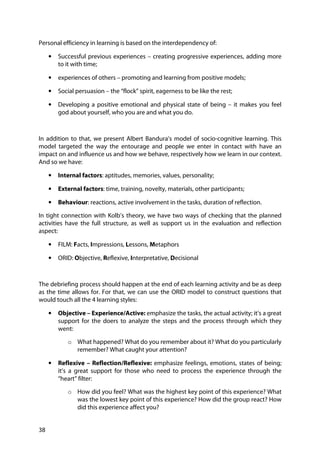
David Kolb elaborated the cycle of learning through experience:
Taking Kolb’s cycle, we will elaborate learning styles on:
• Experience – Active: needs to do, hands-on, try-out;
• Reflection – Reflexive: needs to think about it, go deeply on the emotional level
and how can they connect with it;
• Generalization – Theoretician: needs to see the theory behind it, instructions, logic,
structure
• Application, transfer – Pragmatic: needs to see the applicability in real life.
The means of learning, if we can call them as such, are divided into many categories.
Learning can happen individually or in groups, through logic or testing, and combinations.
We’ll present the VARK model:
• Visual – SEEING: charts, graphs, outlining, photos, flashcards;
• Auditory – LISTENING: read-aloud, audio books, verbal instructions, discussions,
repeating information;
• Read/Write – VISUAL TEXT: books, texts, dictionaries, taking notes;
• Kinaesthetic – DOING: body movements, tactile touch, feel, hands-on, taste;
SPECIFIC
EXPERIENCE
feelings, emotions
REFLEXIVE
OBSERVATION
observing
CONCEPTUALIZATION,
GENERALIZATION
thinking
APPLYING, ACTIVE
EXPERIMENTATION
acting
38
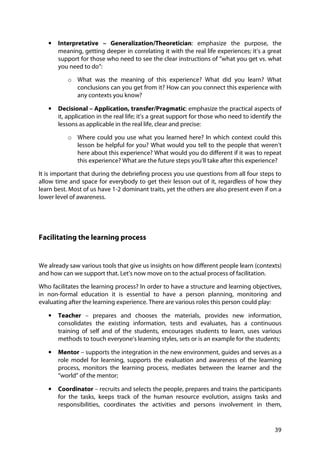
Personal efficiency in learning is based on the interdependency of:
• Successful previous experiences – creating progressive experiences, adding more
to it with time;
• experiences of others – promoting and learning from positive models;
• Social persuasion – the “flock” spirit, eagerness to be like the rest;
• Developing a positive emotional and physical state of being – it makes you feel
god about yourself, who you are and what you do.
In addition to that, we present Albert Bandura’s model of socio-cognitive learning. This
model targeted the way the entourage and people we enter in contact with have an
impact on and influence us and how we behave, respectively how we learn in our context.
And so we have:
• Internal factors: aptitudes, memories, values, personality;
• External factors: time, training, novelty, materials, other participants;
• Behaviour: reactions, active involvement in the tasks, duration of reflection.
In tight connection with Kolb’s theory, we have two ways of checking that the planned
activities have the full structure, as well as support us in the evaluation and reflection
aspect:
• FILM: Facts, Impressions, Lessons, Metaphors
• ORID: Objective, Reflexive, Interpretative, Decisional
The debriefing process should happen at the end of each learning activity and be as deep
as the time allows for. For that, we can use the ORID model to construct questions that
would touch all the 4 learning styles:
• Objective – Experience/Active: emphasize the tasks, the actual activity; it’s a great
support for the doers to analyze the steps and the process through which they
went:
o What happened? What do you remember about it? What do you particularly
remember? What caught your attention?
• Reflexive – Reflection/Reflexive: emphasize feelings, emotions, states of being;
it’s a great support for those who need to process the experience through the
“heart” filter:
o How did you feel? What was the highest key point of this experience? What
was the lowest key point of this experience? How did the group react? How
did this experience affect you?
39
• Interpretative – Generalization/Theoretician: emphasize the purpose, the
meaning, getting deeper in correlating it with the real life experiences; it’s a great
support for those who need to see the clear instructions of “what you get vs. what
you need to do”:
o What was the meaning of this experience? What did you learn? What
conclusions can you get from it? How can you connect this experience with
any contexts you know?
• Decisional – Application, transfer/Pragmatic: emphasize the practical aspects of
it, application in the real life; it’s a great support for those who need to identify the
lessons as applicable in the real life, clear and precise:
o Where could you use what you learned here? In which context could this
lesson be helpful for you? What would you tell to the people that weren’t
here about this experience? What would you do different if it was to repeat
this experience? What are the future steps you’ll take after this experience?
It is important that during the debriefing process you use questions from all four steps to
allow time and space for everybody to get their lesson out of it, regardless of how they
learn best. Most of us have 1-2 dominant traits, yet the others are also present even if on a
lower level of awareness.
Facilitating the learning process
We already saw various tools that give us insights on how different people learn (contexts)
and how can we support that. Let’s now move on to the actual process of facilitation.
Who facilitates the learning process? In order to have a structure and learning objectives,
in non-formal education it is essential to have a person planning, monitoring and
evaluating after the learning experience. There are various roles this person could play:
• Teacher – prepares and chooses the materials, provides new information,
consolidates the existing information, tests and evaluates, has a continuous
training of self and of the students, encourages students to learn, uses various
methods to touch everyone’s learning styles, sets or is an example for the students;
• Mentor – supports the integration in the new environment, guides and serves as a
role model for learning, supports the evaluation and awareness of the learning
process, monitors the learning process, mediates between the learner and the
“world” of the mentor;
• Coordinator – recruits and selects the people, prepares and trains the participants
for the tasks, keeps track of the human resource evolution, assigns tasks and
responsibilities, coordinates the activities and persons involvement in them,
40
verifies and corrects, if needed, creates and manages the work team, offers
feedback regarding the implementation of activities and learning progress, and
evaluates;
• Group leader, representative – contact between organisations/groups, knows
the group the best and so proposes various suitable activities or methods,
potentially facilitates the evaluation process, transmits all the information between
involved parties, offers support in tracking the learning progress;
• Trainer – similar to the teacher, offers information and accumulated expertise,
knows the people and offers appropriate methods of learning, structures and plans
the activities accordingly, evaluates the learning process;
• Facilitator – eases the learning and communication processes, moderates
meetings or discussions, supports the reflection and evaluation of the learning
progress.
We’ll generically name the roles mentioned before as a “worker” inside your NGO. They all
have the core purpose of supporting the learning process and so this person is essential in
our project, especially in order to obtain intangible results.
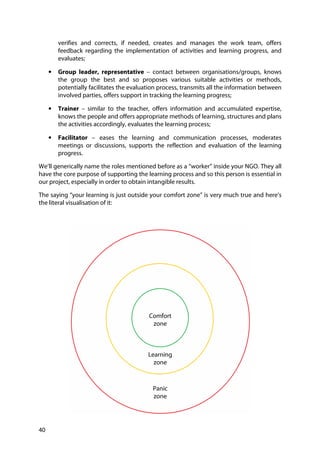
The saying “your learning is just outside your comfort zone” is very much true and here’s
the literal visualisation of it:
Comfort
zone
Learning
zone
Panic
zone
41
The learning process should be supported by:
• Stimulating the responsibility and initiating the learning process;
• Creating challenging learning activities;
• Creating an authentic and relevant learning context, which can be correlated with
real life;
• Facilitating the cooperation between learners;
• Ensuring a complex evaluation.
We can therefore say that the role of the worker is to create the context that encourages
you, attracts you, mesmerizes you even to let yourself absorbed by the experiential
learning, and eventually grow with its help.
The worker needs to pay close attention to creating a safe, yet challenging environment,
without pushing the learner’s boundary more than necessary. If one is brought in the
panic zone, the learning process will either not happen or be different from the initial
intentions.
What are some of the purposes this worker can have?
• Bring social education and change;
• Encourage and support personal development;
• Develop key competences;
• Build characters;
• Empower the people they work with;
• Increase cultural awareness;
• Educate (non-formal);
• Raise awareness about global issues;
• Expand horizons;
• Motivate and inspire people;
• Teach and preach tolerance;
• Support overcoming stereotypes.
And so, with the support of the workers that have practical experience and a direct
relationship with the participants, we get to develop the activities plan.
42
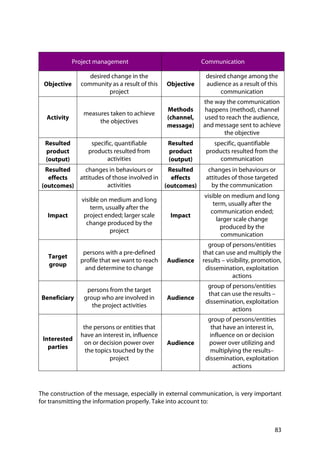
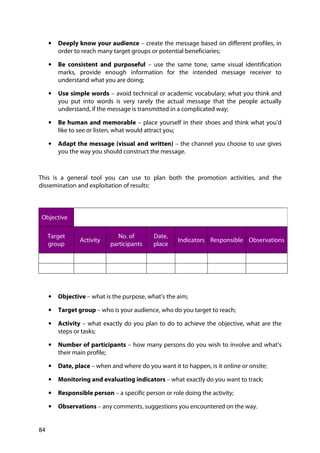
Planning the activities
The activities are the actions you take in order to achieve the set objectives and obtain the
wanted results.
So far, we gathered various information to support us specifically in designing activities
that emphasize learning. Here’s an idea of how to structure it:
• Types of beneficiaries – what are their characteristics, profile;
• Learning/training needs – what do they need to learn connected to your project;
• Type of learning activity – we will give some examples just after this;
• Number of hours, days required – how much time would it require to go through
all the activities planned;
• Topics and associated methods – what themes are they connected to and how do
we plan to implement the activities (more about methods further on);
• Expected results, even impact – at institutional level, organisation, general
community;
• Changed behaviours – at individual level (target group, beneficiaries, participants);
• Learning process – what do they learn to change their behaviour and produce the
expected impact;
• Reaction – how can you get a positive reaction towards learning and the learning
environment, in order to support the behavioural change, connected to the
methods you use.
43
Here are some examples of activities you can include:
• Developing, testing and adopting practices, working methods;
• Initiatives that develop engagement and involvement in the community’s
development;
• Cooperation and/or dialogue between organisations, authorities, communities to
solve the problems;
• Training materials – course curriculum, online courses, steps to follow and check
lists, guides;
• Elaborating methods and working instruments to improve management,
implementation, leadership, communication, coordination, recruiting etc.;
• Learning: training courses, seminars, presentations, workshops, events, exchanges,
conferences, feasibility visits, study visits, job shadowing etc.;
• Promotion/dissemination: training courses, seminars, presentations, workshops,
events, conferences etc.
• Management and team meetings for coordination purposes;
• Visibility and promotion: creation of logo, promotional materials, blogs and
websites, social media accounts;
• Mobility preparations: participants preparation (recruiting, selecting, training),
follow-up and disseminations etc.
The list is not exhaustive so don’t limit yourself to it. Whatever action you plan to take to
support you in achieving the set objectives counts as an activity.
Working methods
Methods are ways through which you implement the activities in order to obtain the
desired results.
Here are aspects you should take into consideration when deciding for one method or
another:
• Learning objectives,
• Suitability,
• Persons involved,
• Space available, in/outdoor,
• Potential risks,
• Motivation,
44
• Time it takes,
• Time of the day,
• Number of people,
• Disabilities – inclusive approaches,
• Resources.
In order to keep track of the methods, you can try to make an “inventory file” for each. You
can start elaborating your own “catalogue” of methods by following this pattern, as later
on you will be able to decide easier and faster on which method works where. Let’s see
about its contents:
• Name – it might have a name or just choose something that rings a bell to you
when thinking of it (connected to what it is about);
• Description – explain its steps, phases in implementing it, how it is actually done;
• Learning objective – what can you learn with this method, what does it
emphasize or touch upon from a learning point of view;
• Number of participants – minimum-maximum, recommended number for this
method;
• Profile of the participants – what are the participants’ characteristics, what is a
must have, what could prevent them for being fully engaged;
• Duration – how long does it take (minimum-maximum, average) for the activity to
be done (bear in mind you can have various durations depending on the size of the
group);
• Location – indoor, outdoor, specific location requirements;
• Needed resources – specific number of materials, objects, equipment etc. you
need, their technicalities or properties if there is something specific required;
• Debrief and processing supportive questions – following the ORID model, write
down questions for each of the four steps;
• Observations, advices, tips – personal experience after having tested it in various
contexts or groups.
Let’s see some examples of methods. Feel free to research about them and create the
method file for those you find suitable for your work:
• Games: ice breaking, name, getting to know each other, relaxing, team building,
roles, trust, simulations, bingo;
45
• Group management and dynamics: talking stick, speaking ticket, ordering and
defining;
• Hands-on: practical application, workshops, self-instructions, demonstrations, field
trips; practicing, repeating; active participation;
• Presentations: lectures, lessons, committees, press conferences simulation, public
speech, stories, educational fair;
• Learning: introspection, reflection, E-learning, journal or diary keeping;
• Working together and individually: brainstorming, analysis; small/big group work,
research and documentation, summaries, diagrams, study case;
• Talk: Debates, dialogue, discussions, round tables, aquarium, depositions, trial
simulation, Q&A, interviewing, open questions living library, words’ spinning
wheel;
• Theatre: improvisation, labyrinth, forum, socio drama, socio-educational animation,
green drama, psycho drama, writing, situation simulation, stimulus with open
ending;
• Large groups interactions: carousel, world café, silent floor, open space;
• Creative expression: street animation, origami, dance, movies and photos, songs
and poems, photo voice, exhibition, posters and visual materials, media simulation
(newspaper, radio, TV);
Digital tools and instruments
The methods presented before are the most used in face to face encounters. Let’s see
some digital tools to help you create materials, as well as interact and lead activities
online.
Digital creation of materials and online activities:
• Text: Word, Google Doc, NotePad;
• Tables: Excel, Google Sheets;
• Presentations: PowerPoint, Prezi, Animaker, Google Slides, KeyNote, PowToon,
SlideDog, ShowPad;
• Animations: Animaker, Canva, Scratch, PowToon, Skillshare, LottieFiles, Blender,
FlipaClip, OpenToonz, Animation Desk, Draw Cartoons, Stop Motion Studio, Stick
Nodes;
46
• Photo sources: FreePik, Canva, Piktochart, Flickr, Pexels, Unsplash, Pixabay, 123RF;
• Photo editors: Adobe LightRoom, Adobe PhotoShop, Corel PaintShop Pro, GIMP,
Picsart;
• Video editors: Movavi, Canva, Splice, Clips, adobe Premiere Rush, da Vinci,
Zoomerang, Animoto, Moovly, InVideo, Veed;
• Visibility, design: Canva, Kintone, Miro, GIMP, SketchUp;
• Blogs, websites: WordPress, Wix, Ionos, SlideShare, Weebly, joomla, LinkedIn,
Blogger, Tumblr;
• Storage, data transfer: DropBox, Google Drive, OneDrive, Mega, WeTransfer;
• Joint work: Microsoft Teams, Google Drive, JamBoard, Padlet, Miro, ClickUp,
Planable;
• Whiteboards: Miro, Mural, Stormboard, FigJam, JamBoard, Zoom, Whiteboard,
LucidSpark, ClickUp;
• Mind mapping: XMind, MindMeister, Coggle, Miro, Mindly, MindNode, Padlet,
Canva, Mind Map Maker, iThoughts, Tobloef;
• Meeting planning, note-taking: SessionLab, Google Sheets, Doodle, EverNote,
OneNote, Google Docs, Google Keep, Calendar, Calendly;
• Planning, task management: Monday.com, Microsoft Project Manager, Miro,
TeamWork, Slack, Facebook Workplace, Microsoft Teams, One Note, Trello, Asana,
MindMeister, EverNote, Google Keep, Notion, Todoist, Microsoft To do, Aritable,
Accelo, Microsoft Planner, Google Tasks, Basecamp – project manager;
• Testing, quizzes, Surveys: Mentimeter, Kahoot, QuizMaker, ActionBound, Quizizz,
Quizlet, Quora, Google Classroom, Microsoft Forms, Google Forms, GetFeedback,
Typeform, AskNicely, SurveyMonkey, Doodle;
• Translators: Google Translator, Reverso;
47
• Subtitles: YouTube, Animaker, Veed, MixCaptions, Kaptioned, Autocap;
• Information: forums, Wikipedia, Quora, Ask.fm, Reddit;
• Trainings: Udemy, Teachale, Coursera, edX, FutureLearn, MasterClass, Skillshare,
CourseLab, Khan Academy, Kajabi;
• Podcasts and audio: SoundCloud, Spotify, YouTube. Zencastr, Google Podcasts,
Apple Podcasts, Pocket Casts, PodBean, Player FM;
• Social media: Facebook, Instagram, Twitter, LinkedIn, Snapchat, Tumblr, Pinterst,
TikTok, Reddit, MySpace, Twitch, Patreon, WhatsApp, Telegram, Viber, Signal;
• Video communication: Skype, Zoom, GoogleMeet, Microsoft Teams, Slack,
WebinarJam, Cisco Webex, ClickMeeting, GoToMeeting, FreeConferenceCall,
Spotify Greenroom, Discord, FaceTime;
• Live communication (streaming): WebinarJam, TikTok, Facebook, Instagram,
TikTok, Twitch, YouTube, Discord, OBS, BroadcastMe, Livestream;
• Written, regular communication: WhatsApp, Telegram, Facebook Messenger,
Instagram, emails, Google chat, Hangouts, Viber, Signal, Snapchat
For more tools, especially connected to the youth & music sector, we recommend another
textbook in this series, “Online methods to be used in training of young musicians”.
Getting access to resources
Here are some resources that you can use to find out more about methods, information
and knowledge, experiences and good practices:
• Youth: www.salto-youth.net (methods, trainings), www.otlas.eu (partners),
European Youth Portal (opportunities);
• School: School Education Gateway, eTwinning (partners, ideas, opportunities,
information);
• Adults, Vocational Education and Training: EPALE (partners, ideas, opportunities,
information);
• Social networks: Facebook (groups, pages), Instagram, LinkedIn, TikTok etc.;
• EuroDesk and territorial representatives, National Agencies and Executive Agency;
• Europe Direct centres;
• www.youthpass.eu.
48
V. EUROPEAN UNION FUNDS
Key concepts
• Where can we find the EU funding opportunities?
• How to decide on the proper funds?
• Which are some of the funds that can be accessed for the cultural – youth sector(s)?
Finding EU grant opportunities
Access to technology and information nowadays makes it increasingly easier to obtain
information about funding opportunities. With the help of a simple search of “grants for
<topic>” or “EU grants for <topic>” we get countless results we can research and see if
they fit our idea.
Even so, the European Commission has been making great efforts to bring all its
programmes into a single platform and so to be more accessible to interested parties.
Currently called Funding & tender opportunities, the platform can be accessed on:
ec.europa.eu/info/funding-tenders/opportunities/portal/screen/home.
By accessing www.euro-access.eu you can see the current deadlines, as well as a short
description of the calls.
Besides the information related to the programmes and calls, you can easily create an
account here, usable also for applying to projects, and support you in partner search.
49
Here’s the list of programmes the European Union offers for the 2021-2027 cycle:
• Asylum, migration and integration fund (AMIF);
• Border management and visa policy instrument (BMVI);
• Citizens, equality, rights and values (CERV);
• Connecting Europe facility (CEF);
• Consumer Programme (CP);
• Creative Europe (CREA);
• Customs control equipment instruments (CCEI);
• Customs (CUST);
• Digital Europe (DIGITAL);
• Erasmus+ (ERASMUS+);
• EU bodies and agencies (EUBA);
• EU external action (RELEX);
• EU4HEALTH (EU4H);
• Euratom research and training (EURATOM);
• Europe Direct (ED);
• European defence fund (EDF);
• European maritime, fisheries and aquaculture fund (EMFAF);
• European Parliament (EP);
• European social fund+ (ESF+);
• European Solidarity Corps (ESC);
• Fiscalis (FISC);
• Horizon Europe (HORIZON);
• Hercule III (HERC)
• 3rd
health programme (3HP);
• Information measures for the EU cohesion policy (IMREG);
• Innovation fund (INNOVFUND);
• Interreg Europe (INTERREG);
50
• Internal security fund (ISF);
• Interregional innovation investments instrument (I3);
• Just Transition mechanism (JTM);
• Justice (JUST);
• Neighbourhood, development and international cooperation instrument – global
Europe (NDICI);
• Pilot projects and preparation actions (PPPA);
• Programme for the environment and climate action (LIFE);
• Programme for the competitiveness of enterprises and small and medium-sized
enterprises (COSME);
• Programme for the protection of the Euro against counterfeiting (PERICLES IV);
• Promotion of agricultural products (AGRIP);
• Research fund for coal & steel (RFCS);
• Rights, equality and citizenship (REC);
• Single market programme (SMP);
• Social prerogative and specific competencies lines (SOCPL);
• Support for information measures relating to the common agricultural policy
(IMCAP);
• Technical support instrument (TSI);
• Union anti-fraud (EUAF);
• Union civil protection mechanism (UCPM;
• Union renewable energy financing mechanism (RENEWFM).
As you can see, the list is quite large and covers many fields. Within the purpose of our
guide and the SBT project, we will focus on those related to the youth and/or cultural
sectors, and they’ll be described below in more details.
Feel free to check any programme you think is suitable for your ideas. Bear in mind
though, that some programmes are exclusively addressed to governments or state
institutions.
It is worth mentioning here that there are various other funds not necessarily in direct
connection with the EU, from which you could still benefit and take advantage of.
Therefore also check the national, regional or local programmes and calls (ministers, local
51
authorities and institutions, private funds) and feel free to research online for funds at the
EU or even international level.
How to decide on the proper funds?
We start from the very beginning in order to answer this question – identify correctly the
need and check its suitability for your organisation. Get the skeleton of the project done
and only afterwards start searching for a fund.
Once you identified several funds, see their granting rules, conditions and terms. Could
your idea fit in their requirements? Then look for the calls and application forms and get
the work started. Would you have to change lots of things and alter significantly your
idea? Then it might not be the right funding for you so keep looking.
It is really important, and we can’t stress this enough, that you have a project for which
you look for funding, and not the vice-versa. This means you didn’t just find a granting
programme and now you come up with an idea that fits it. A project is to solve a real
problem encountered at the local level in your and your partners’ communities, and not
creating an artificial one because the grant sounds cool to apply to.
Read the guides and requirements and if you still have doubts about it, don’t fear to go
ahead and contact the grants’ responsible (wherever you apply directly). Tell them about
your idea and check with them if it’s suitable for what they are looking for to fund. Make
sure that besides the suitability of your idea (their priorities, objectives, topics match your
project proposal), you are also eligible to apply (type of entity, capacity, deadline not
passed etc.).
Revising the check points to see if to do the project and if to apply to a specific funder:
• The project idea fits well in the organisation’s strategic plan;
• You have the expertise to do it;
• You have the capacity to do it (resources, people, time);
• The grant may cover the funding you need or you are well aware of the additional
funds you need to bring in (and have sources for that);
• You have partners and collaborators, if needed (if the grant requires it, if the
project requires it);
• Your context research and need analysis is well done;
• You have real chances of being selected to be funded; sometimes we are well
aware that some grants are already “promised” for specific people or entities, and
52
although it’s not fair or ethic, you don’t have to waste your time with it, if this is the
case;
• You have enough time to prepare the proposal, collect the documents needed and
submit the application within the given deadline;
• (Optional) You have past successful experiences with this funder and know how
things are going, you know what they want.
There is no point in wasting neither their (checking and evaluating a proposal) nor your
time if your project doesn’t match the criteria. Look for something else in case of
mismatches.
Cultural and youth sector funds
We will briefly describe the main aspects and directions of some funding programmes. If
anything catches your attention and sounds like it could match your idea, feel free to
explore deeper what the programme offers and requires.
The following selected funds have NGOs as eligible coordinators and/or partners:
• Citizens, Equality, Rights and Values programme (CERV)
This programme aims to protect and promote rights and values as stipulated in the EU
Treaties and the Charter of Fundamental Rights in particular by supporting civil society
organisations active at local, regional, national and transnational level.
The programme has four strands:
• Equality, Rights and Gender Equality – promoting rights, non-discrimination,
equality (including gender equality), and advancing gender and non-
discrimination mainstreaming;
• Citizens' engagement and participation – promoting citizens engagement and
participation in the democratic life of the Union, exchanges between citizens of
different Member States, and raising awareness of the common European history;
• DAPHNE – fight violence, including gender-based violence;
• Union values – protect and promote Union values.
53
Web: commission.europa.eu/about-european-commission/departments-and-executive-
agencies/justice-and-consumers/justice-and-consumers-funding-tenders/funding-
programmes/citizens-equality-rights-and-values-programme_en
• Creative Europe (CREA)
Europe invests in actions that reinforce cultural diversity and respond to the needs and
challenges of the cultural and creative sectors.
The main objectives of the programme are to:
• Safeguard, develop and promote European cultural and linguistic diversity and
heritage;
• Increase the competitiveness and economic potential of the cultural and creative
sectors, in particular the audio-visual sector.
The novelties of the programme will contribute to the recovery of these sectors,
reinforcing their efforts to become more inclusive, more digital and environmentally more
sustainable. CREA is divided in 3 strands:
54
The CULTURE strand supports a wide range of cultural and creative sectors including:
architecture, cultural heritage, design, literature and publishing, music, performing arts.
The Culture strand encourages cooperation and exchanges among cultural organisations
and artists within Europe and beyond. CREA aims to:
• Foster artistic creation and innovation;
• Support the promotion and the distribution of European content across Europe
and beyond;
• Help artists find creation and performance opportunities across borders;
• Stimulate the digital and environmental transition of the European Culture and
Creative Sectors.
For the musical fields, check the actions of: Music moves Europe, I-portunus, MusicAIRE.
The MEDIA strand supports the European film and audio-visual industries to develop,
distribute and promote European works, taking into account today’s digital environment.
In addition it:
• Encourages cooperation across the value chain of the audio-visual industry and at
EU level in order to scale up enterprises and European content globally;
• Nurtures talents – wherever they come from – and facilitates knowledge-sharing;
• Supports innovative solutions to meet the market demands and trends;
• Engages with audiences of all ages, especially the younger generations.
The purpose of the CROSS-SECTORIAL strand is to reinforce collaboration between
different cultural and creative sectors (CCS) in order to help them address the common
challenges they face and find innovative solutions. These are its main priorities:
• To support cross sectorial transnational policy cooperation, promoting the visibility
of the programme and support the transferability of results;
• To encourage innovative approaches to content creation, access, distribution, and
promotion across CCS and with other sectors;
• To support adjustments to the structural and technological changes faced by the
news media;
• To support the establishment and activities of the CREA Desks.
web: culture.ec.europa.eu/creative-europe
55
• Digital Europe (DIGITAL)
DIGITAL is a new EU funding programme focused on bringing digital technology to
businesses, citizens and public administrations. How to make Europe greener and more
digital are the twin challenges for our generation, and our success in meeting them will
define our future.
DIGITAL will provide strategic funding in five key capacity areas: in supercomputing,
artificial intelligence, cyber security, advanced digital skills, and ensuring a wide use of
digital technologies across the economy and society, including through Digital Innovation
Hubs.
It aims to accelerate the economic recovery and shape the digital transformation of
Europe’s society and economy, bringing benefits to everyone, but in particular to small
and medium-sized enterprises.
Web: digital-strategy.ec.europa.eu/en/activities/digital-programme
• Erasmus+ (ERASMUS)
Erasmus+ is the EU's programme to support education, training, youth and sport in
Europe. The programme places a strong focus on social inclusion, the green and digital
transitions, and promoting young people’s participation in democratic life.
It supports priorities and activities set out in the European Education Area, Digital
Education Action Plan and the European Skills Agenda. The programme also:
• Supports the European Pillar of Social Rights;
• Implements the EU Youth Strategy 2019-2027;
• Develops the European dimension in sport.
56
Erasmus+ offers mobility and cooperation opportunities in:
• Higher education;
• Vocational education and training;
• School education (including early childhood education and care);
• Adult education;
• Youth;
• Sport.
Organisations wanting to participate in Erasmus+ may engage in a number of
development and networking activities, including strategic improvement of the
professional skills of their staff, organisational capacity building, and creating
transnational cooperative partnerships with organisations from other countries in order to
produce innovative outputs or exchange best practices.
The benefits for involved organisations include an increased capacity to operate at
international level, improved management methods, access to more funding
opportunities and projects, increased ability to prepare, manage, and follow-up projects,
as well as a more attractive portfolio of opportunities for learners and staff at participating
organisations.
Key Actions
• KA1: Learning mobility of individuals – learning mobility opportunities aim to
encourage the mobility of students, staff, trainees, apprentices, youth workers
and young people.
• KA2: Cooperation among organisations and institutions – the cooperation
among organisations and institutions is expected to result in the development,
transfer and/or implementation of innovative practices at organisational, local,
regional, national or European levels.
• KA3: Support for policy reform – opportunities under this Key Action contribute
to supporting the overall EU policy agenda, the Education and Training 2020
cooperation framework, and the Youth Strategy.
• Jean Monnet – opportunities for teaching, research, and policy debate on the EU
and its policies.
57
• Sport – designed to develop and implement joint activities to promote sport and
physical activity, identify and implement innovative activities in the field of sport,
and manages not-for-profit events to increase participation in sport.
Web: erasmus-plus.ec.europa.eu
• Erasmus Young Entrepreneurs (EYE)
EYE helps provide aspiring European entrepreneurs with the skills necessary to start
and/or successfully run a small business in Europe. New entrepreneurs gather and
exchange knowledge and business ideas with an experienced entrepreneur, with whom
they stay and collaborate for a period of 1 to 6 months.
As a new entrepreneur, you will benefit from on-the-job training in a small or medium-
sized enterprise in another Participating Country. This will ease the successful start of your
business or strengthen your new enterprise.
As a host entrepreneur, you can benefit from fresh ideas from a motivated new
entrepreneur on your business. S/He may have specialised skills or knowledge in an area
you do not master, which could also complement yours.
It is really a win-win collaboration whereby both of you can also discover new European
markets or business partners, different ways of doing business.
Web: www.erasmus-entrepreneurs.eu
• Europe for Citizens (EFC)
EFC support initiatives to strengthen remembrance of the recent European history and to
enhance civic participation at EU level.
EFC is the EU’s programme for funding projects that:
• Help the public understand the EU's history, values and diversity;
• Encourage citizens to participate and engage in democracy at the EU level.
58
Funding streams:
European remembrance — the EU as a peace project
The programme supports initiatives that:
• Discuss why and how the totalitarian regimes that blighted Europe’s modern
history came into power;
• Look at the EU's other defining moments and reference points;
• Consider different historical perspectives.
Democratic engagement & civic participation — getting citizens involved
• Town twinning – Projects bring together citizens from twinned towns to debate
issues on the European political agenda. They develop opportunities for people to
engage with each other and to volunteer at EU level;
• Networks of towns – Towns are encouraged to cooperate with each other in the
long term to explore particular topics or themes, share resources and/or interests,
increase their influence and/or face common challenges;
• Civil society projects – These projects give citizens an opportunity to participate
concretely in the EU policy-making process. They stimulate debates to propose
practical solutions to issues through cooperation at European level.
Web: www.eacea.ec.europa.eu/grants/2021-2027/citizens-equality-rights-and-values-
cerv_en
• European Social Funds Plus (ESF+)
ESF+ is the EU’s main instrument for investing in people. The ESF+ continues to provide an
important contribution to the EU’s employment, social, education and skills policies,
including structural reforms in these areas.
The fund will also be one of the cornerstones of EU socio-economic recovery from the
Corona virus pandemic. The pandemic has reversed gains in labour participation,
challenged educational and health systems and increased inequalities. The ESF+ will be
one of the key EU instrument helping Member States to address these challenges.
59
Web: ec.europa.eu/european-social-fund-plus/en
• European Solidarity Corps (ESC)
ESC funding is provided in the form of grants to organisations through call for proposals.
These projects offer an inspiring and empowering experience, as well as the chance to
bring change while developing your skills and competences.
Broadly, you can get involved in:
• Volunteering;
• Local Solidarity Projects;
• Humanitarian aid volunteering (European Voluntary Humanitarian Aid Corps).
These can be in a wide range of fields – education and training, citizenship and democratic
participation, environment and natural protection, migration, culture, humanitarian aid,
and many others.
Web: youth.europa.eu/solidarity_en
• Interreg Volunteering Youth (IVY)
IVY initiative represents a unique opportunity for young people who want to have an
impact on the world we live in, by supporting solidarity actions through cooperation.
Along with local actors, IVY volunteers tackle the challenges that Europe and its
neighbouring regions are facing, helping to find and implement common solutions.
IVY initiative aims to promote cooperation by achieving the following three goals:
60
• Support cooperation: Support cooperation projects, thanks to the involvement of
motivated young people;
• Make cooperation visible: Make the benefits of cooperation more visible among
local communities and beyond;
• Empower youth: Empower young people to engage in cooperation.
Web: www.interregyouth.com
• Pilot Projects and Preparatory Actions (PPPAs)
PPPAs are new initiatives that might turn into EU funding programmes. Pilot projects
are designed to test the feasibility of an action, and last not more than 2 years.
Preparatory actions last for up to 3 years, and are often the successor of a successful pilot
project. They are designed to prepare new EU policies, legislation, programmes etc.
Web: www.eacea.ec.europa.eu/grants/2021-2027/pilot-projects-and-preparatory-actions-
pppas_en
• Programme for the Environment and Climate Action (LIFE)
LIFE is divided into two strands:
The environment strand has two sub-programmes:
• Nature and biodiversity;
• Circular economy and quality of life.
The climate action strand also has two sub-programmes:
• Climate change mitigation and adaptation;
• Clean energy transition (continuation of H2020 Energy Efficiency market uptake).
Web: cinea.ec.europa.eu/programmes/life_en
61
Non-EU grant opportunities
• Collaboration grants
The programme of grants supports UK and overseas organisations to collaborate
internationally. The programme is designed to support artists to make and develop
creative artwork with their international peers, and to encourage new international
partnerships and innovative ways of collaborating. Small and large grants are now
available to UK and international organisations.
Applications must demonstrate genuine international collaboration and an explicit
benefit to individual artists and international partners, and projects should address
significant contemporary themes, from climate change to global challenges.
Web: www.britishcouncil.org/arts/international-collaboration-grants
• European Cultural Foundation (ECF)
ECF founding figures believed passionately in culture as a vital ingredient for Europe’s
post-war rebuilding and healing. They created the ECF “for the stimulation of the
European sentiment, to promote the development and preservation of a feeling of mutual
comprehension and democratic solidarity between the peoples of Europe by encouraging
cultural and educational activities of common interest”.
The foundation has always focused on programs and grants enabling mobility and the
exchange of ideas, education through culture, and capacity-building. In its existence the
foundation has initiated and developed dozens of programmes, supported thousands of
Europeans with grants and exchanges and helped put culture and cultural policies on the
European agenda.
Web: culturalfoundation.eu
62
o Supporting Travel for Engaged Partnerships (STEP)
STEP travel grants support creative and critical artists and cultural change-makers
travelling across Europe and its neighbours, to help foster a society with greater solidarity,
participation, equality and a stronger sense of social justice.
Web: ecflabs.org/step-travel-grants
• European Music Council (EMC)
EMC is a non-profit organisation dedicated to the development and promotion of all
genres and types of music in Europe. It is a network that promotes and supports music-
related activities for representatives of both national music councils and European
networks involved in the fields of music education, creation, performance, participation,
production and heritage.
The EMC contributes to a better understanding among people and their different cultures,
and promotes the right for their musical cultures to coexist. Therefore, it provides
exceptional value to its members through the analysis of policy developments and
formulation of policy statements; capacity building and knowledge exchange, as well as
creating networking opportunities within and beyond the music sector on an
international platform.
Web: www.emc-imc.org
• Gaude Polonia
The scholarship for culture and arts specialists (artists, writers, Polish literature translators,
musicians, filmmakers, art critics, museum employees), offers a six-month creative training
course in cultural institutions of the Republic of Poland.
Web: www.nck.pl/en/dotacje-i-stypendia/stypendia/programy/gaude-poloni
• Independent Society of Musicians (ISM)
ISM is the UK’s largest representative non-union body for musicians and a nationally
recognised subject association for music. It has been dedicated to promoting the
importance of music and supporting those working in the music profession.
Members receive unrivalled legal expertise from their in-house legal team, comprehensive
insurance and specialist services, to meet the professions and needs of those who work in
music. The members come from all areas of the music industry, and from a wide variety of
genres and musical backgrounds. This includes those who are studying and starting out,
as well as those with established, multi-faceted careers in the industry.
Web: www.ism.org/advice/funding-for-composers
63
• European Youth Foundation (EYF)
EYF is a fund established by the Council of Europe to provide financial and educational
support for European youth activities.
The EYF is part of the Youth Department of the Council of Europe’s Directorate of
Democratic Participation, Directorate General of Democracy and Human Dignity.
The European Youth Foundation is an instrument:
• To make the voice of youth heard at a top decision making level;
• Managed by both youth non-governmental organisations (NGOs) and government
representatives, who decide and monitor the Council of Europe's Youth
programme;
• To support European non-governmental youth organisations and networks;
• To promote peace, understanding and respect.
Web: www.coe.int/en/web/european-youth-foundation
• International fund for cultural diversity (IFCD)
IFCD invests in the cultural and creative industries to empower countries in the Global
South and enrich the entire world.
The IFCD is one of the few United Nations funds that supports arts and cultural bodies,
government institutions and non-governmental organizations in the Global South to
develop stronger cultural and creative industries (CCIs) in their countries.
It funds innovative projects across the globe within the fields of cinema, performing arts,
visual arts, and media arts, as well as design, music, and publishing. By working together,
they aim to build lasting change so that everyone can express and enjoy diverse cultural
expressions.
64
IFCD invests in people who might otherwise not have the chance to upgrade their skills
and networks. Also, they invest in developing and implementing policies that are based
on evidence and are inclusive. The goal is to support communities to build thriving
cultural and creative industries.
This has helped:
• Develop and implement cultural policies that have reshaped entire sectors,
creating widespread social and economic benefits;
• Build the skills of cultural entrepreneurs and create new cultural industry business
models;
• Create new income opportunities for women, youth, indigenous people and other
marginalized groups.;
• Identify new markets for creatives to share diverse cultural expressions and for
more people to access these;
• Allowed more people to shape their societies’ narrative, promoting social inclusion
and fostering peace.
Web: www.unesco.org/creativity/en/international-fund-cultural-diversity
• MusicFund
Music Fund is a Belgian non-profit association that supports music schools and socio-
artistic projects in conflict zones and developing countries, as well as in Europe.
The association collects musical instruments, repairs them and give them a second life by
donating them to musical projects. Music Fund does more than simply donating musical
instruments. Training instrument repairers and establishing repair workshops are at the
heart of its projects, ensuring an element of sustainability. The training gives the repairers
the opportunity to make a living from their skill and to share their know-how in the region.
Web: musicfund.eu/en
65
VI. PROJECT MANAGEMENT
Key concepts
• Basics of an organisation;
• Forming a team;
• Project management;
• Logistics specific for Erasmus+ projects.
A lot of aspects treated in this guide have been explained more thoroughly in the “Getting
a business running” chapter of our parallel manual and course, Entrepreneurship for
beginners. We do not want to repeat the information here, so whenever you see
something connected to management, human resources or finances, we encourage you
to check it for additional information and tips (especially while reaching chapter 6 of that
guide). Have it handy and use both sources for your planning.
The organisation
Your organisation is the main hub from where all directions and activities are set. The way
you manage and lead your organisation will be most likely visible in the way you manage
projects.
In order to function properly as an NGO, and later on, in a project, you must create a
certain order and structure within it. It all starts with the big, external frame and gets
reduced to the smallest details at internal level:
• Legislation – what are you allowed and not allowed to do as an NGO, what are the
laws you must obey (to be established, to function, financial, reporting etc.);
• Statute – what you want to do, within legal restrictions; your main direction, the
types of needs, categories you want to approach;
• Strategic management – based on your statute, elaborate your mission, vision,
values, purpose and objectives; think long term, for at least 5 years or longer;
where are you now and where do you want to reach, how do you plan to do that,
what do you need for it;
66
• Internal policies and rules – internal regulations, code of conduct, rules or
however you want to call them, should be clearly established and decided upon;
this is helpful to select the people that suit your values, while at the same time
ensure that everyone respects each other, knows what to expect both as rewards
and consequences;
• Working procedures – automating everything that can be done in repeated ways;
write the steps of who does it (the role, function), what must be done (objective,
expected result) and how must it be done (steps one by one); do procedures for
everything that can be repeated to ease your work and obtain a common quality;
• Daily functioning – this is the operational management and it’s based on daily,
weekly, monthly etc. planning; make sure you allow for sufficient time when
planning an activity so not to under or overload your or your team’s work schedule.
Three particular documents that we recommend to have are:
• Document registry – a simple table with the date, number of document and a
short description of what the document is; like this you’ll easily keep track of what
you issued or received in terms of partnerships, offers, declarations, press releases,
contracts etc., anything that has a registration number. You can have a yearly
register (resetting it every year back to 1) or a continuous one. We like having a
separate registry for each project so not to mix project and regular documents we
issue/receive;
• Template documents – create in advance all sorts of templates with design and
your visual identity aspects, such as invoices, header-footer for contracts, issued
documents, contracts, offers etc. You will be able to use them afterwards without
spending too much time on formatting or designing something new every time. A
bonus here is, that if you are good with Sheets and you can automate certain
processes, that will save you even more time (for example automatic counting
invoices, calculations of budgets etc.);
67
• Check lists – together with the working procedures, these will make it easier to
verify your own work or someone else’s. Include the check lists in the procedures
and have them at hand whenever you need to evaluate something.
The more orderly you are, the easier it is for you to follow and monitor, evaluate or have a
clear status at any given point of where you are or how things are going. You can think of
regulations concerning the following aspects, yet expand the list with whatever suits your
contexts and organisational needs:
• Human – staff, volunteers, collaborators, partners, target groups, beneficiaries;
including recruiting and selection, implementation and coordination, monitoring
and evaluation procedures;
• Financial – financial and non-financial documents; it is important to have a
minimum knowledge and awareness of how the money is spent in the NGO,
respectively in a project;
• Time – standard times to do a specific action, general timeframes to implement
certain actions; optimize the actions to flow naturally, to depend as little as
possible on each other, to be implemented as fast as possible, yet in a qualitative
way, by involving a minimum of resources;
• Resources – every type of resource you have (informational, material, equipment,
space, consumables etc.); how you maintain them, when to order new ones, do you
rent or buy, how is their maintenance or repairing process etc;
• Risks – what can go wrong, how can you prevent it, how can it affect you if it
happens, how do you deal with it if it happens;
• Monitoring and evaluation – what things do you need to have under control on
constantly or during a specific phase; what are the indicators you follow, what
templates can you use, how to extract final conclusions from monitoring;
• Quality and control – connected to monitoring, what do you want to control,
what measures and specificities do you expect from each result in particular, what
are the standards (what is acceptable or not, what is an excellent result etc.), and
how to control that, who is in charge, when does it happen;
• Communication (internal and external) – what do you expect internal and
external communication to be like, are there any standard messages, is there a
person responsible for it, who replies to emails and how, who keeps in contact with
the press etc.;
• Decision taking – until what point the team members can decide without asking
for permission, who can make decisions and how, when, who needs to get
approval from whom and for what, how often are decision making team meetings
happening;
68
• Maintaining the office/working space – what are the incomes that support these
financial costs, who does the actual maintenance, what products should/should
not be used, how often should it happen etc.;
• Event organising, offering services – what kind of events do you organise, what
kind of services do you offer, what do you need for that, who is in charge, when do
they happen, specific resources you need to involve etc.
Team building and joint work
You have established the frame you will work in and that is a tiny part with big impact in
management. It is time to select the team you will work with, be it staff, volunteers or
partners. We’re not going to discuss the actual recruitment and selection process as you
can find more details in the entrepreneurship manual (steps are the same), however we
will highlight the forming of the team in order to obtain performance.
Bruce Tuckman created a model in 5 steps that describe the evolution of a team:
• Forming – this is where people are selected and allotted on a joint task; waters are
tested, people are checked and evaluated at personal level, questions about one or
another appear, there is eagerness and excitement, people are nice with each
other, curious, maybe even try to influence others and establish themselves as
group (in)formal leaders; performance cannot be taken into account at this point.
What you should do: take the lead, coordinate people, facilitate their meeting, be
visible among your team, offer information about the “big picture” of the NGO, of
the project in particular, state your expectations from the team and the individuals,
provide answers and information, whenever asked.
• Storming – as people get to better know each other and their capabilities, certain
resistance and conflict situations appear, there are differences of opinions,
69
competition starts to arise too, “the emotional temperature” rises, as people show
their “real person”, some people may decide to drop out because they don’t see
themselves fitting in; performance at this point is even lower than before.
What you should do: offer and request feedback, monitor the situation and the
interactions in order to identify aspects that need to be addressed and fixed, build
trust, support and encourage the free speech, collect ideas from everyone.
• Norming – the context is explained, objectives and activities are understood,
people get more confident about their role and tasks, they start to commit and
engage, a set of common rules is established and agreed upon, which improves
working conditions, and generally cohesion emerges.
What you should do: observe and praise team and individual efforts, create
learning and performance contexts, set firm rules and norms of working together,
monitor the team’s performance in terms of cohesion and collaboration, direct
people towards their dedicated path (how and what to do), initiate the working
process with them, support with the tasks when needed.
• Performing – everything is going according to the planning, everyone knows what
they have to do and how, and they do it, people are motivated, there is mutual
trust and a healthy co-dependency level established, there is some micro-
management happening as the coordinator rather evaluates than verifies the
quality, results start to appear and so the team’s performance is increasing and
even reaching its highest peak.
What you should do: gradually reduce assistance and take on monitoring and
guidance from the side, with as little interventions as possible, celebrate successes
and work together with them for failures or delays, encourage the people, support
them in their work, promote micro decision-making whenever possible, optimize
and streamline the processes at individual levels.
• Adjourning, transitioning, mourning – the tasks have been performed, results
have been delivered, there is recognition of people’s worth as individuals and
team, and slowly the team starts to disappear as it is no longer needed since the
project is completed and finished.
What you should do: prepare the team for the transition to not working together
anymore and/or working in another project, recognize the change, evaluate team
and individual performance, find the lessons learned, especially the hard ones (risk
prevention updating), acknowledge each individual’s evolution, and finally
celebrate the ending together.
Just like we mentioned before about how a project is unique, so is a team from a
performance perspective: you gather a number of people with particular skills to do
specific tasks.
The people you had once teamed up may work together in other projects at some point,
and even if you keep the same people, the process is the same. You might get through the
forming stage easier as you already know each other, but the team needs to have the
cycle because the new project has different requirements, different timelines.
70
The time allocated to each step depends a lot on the people, their number, their previous
joint work and on the coordinator. It is important though to allow a sufficient time for the
first 3 steps in order to reach the performing phase and be indeed performing.
You might face times when the team returns to norming, storming or even forming if new
members appear, conflicts arise, unpredictable situations that turn things upside down
come up etc. Remain flexible and monitor the progress so you prevent or solve the
situations as fast as possible, if not as soon as they happen.
Human resources management
We’ll not get very deep into this subject, however it’s important to mention the following
steps that you should include in the general strategic planning and in the specific
procedures for human resources:
• Preparing the organisation – plan the organisational chart with the roles and
positions you need to fill in, procedures, job descriptions, recruiting and selecting
procedures, and any particular document that you may need so that you and your
NGO are ready for this;
• Recruiting – launch the recruitment campaign, collect data and prepare for the
selection process; make sure that your expectations and needs are aligned in terms
of action, individual evolution and future;
• Selecting – conduct interviews, tests, focus groups etc. depending on the selecting
method you’ve chosen; evaluate the candidates, select the suitable ones and
welcome them in your NGO;
71
• Orienteering, instructing – present your expectations from them, from the
positions they filled in, regarding the activities they must perform, the context in
which work will happen, working procedures, requirements and everything
relevant so they can perform their tasks;
• Supervising – the initial, testing period requires closer supervision to make sure
they are performing tasks in accordance to your expectations; verify, teach, allow
the learning process to happen;
• Monitoring – demand and expect status and progress reports, meet with them to
discuss the process, observe and analyse how things are moving forward;
• Motivating – the motivation and energy level are high in the beginning, yet make
sure you keep it as elevated as possible along the way as well; motivated people
bring you good results;
• Recognising of merits – celebrate the evolution within the NGO, team and project
tasks, give recognition to their efforts and maintain a positive, fruitful atmosphere
inside the team; encourage the creation and nurture of work relations;
• Evaluating – evaluate progress and performance made and intervene where the
case.
The way you construct and care about the team will be highly visible in the results they
have and the quality they offer.
Project management
Everything is ready now and so you prepare for the management of the project. The
following documents are all relevant and important in managing a project as qualitatively
as possible, so we recommend you get them done. Start with a sketch and update it
whenever something new comes up, you have other ideas, you saw examples of good
practices, you had an experience etc.
Likewise, in the beginning keep all documents “open for editing”, as some information
may be revealed later on. For example, the Gantt chart requires mentioning the
responsible persons, which you will only know when you get to task division. On the same
page, once you know how you want to divide the tasks among the partners, you’ll be able
to finish the partnership agreement and the budgetary division. They are all
interconnected so feel free to use the information from one in another.
In fact, many of the tools or sections we will mention here are applicable in the writing
phase, as you can already create all these managerial tools before the or during the
project writing stage. This will ease your preparation phase after the project is approved
72
(just needs updating and revising), while providing you with structured and correlated
information to include in the project application.
Many of the following examples are have a tabular structure because this way we find it
easy to create, observe and keep in mind the connection between various managerial
steps you need to take.
The implementation plan
This plan is basically your big “procedure” of how to make the project happen. It includes
the calendar of activities, responsible persons, resources, timeline, deadlines and many
other details that seem important and relevant for you.
As it can get quite wide, we recommend you to have it in a sheet type of file rather than
text, or even using a specific app for it. Keep it as a draft version until you finish with this
entire chapter. There will be additional tools that can help you decide on one or another,
so update it, if the case.
An example for having all the information together, is the Gantt chart:
Tasks Status Responsible Timeline Deadline Progress Resources …
Activity 1
1.1
1.2
1.3
Activity 2
2.1
2.2
…
• Tasks – all the activities, in a logical or co-dependent order; here we have the
activity or the category (for example, management) and its subdivisions or tasks to
fulfil (for example, overall management, financial, human, resources, monitoring,
evaluation etc.); for each of activity and task/step, you have the following
categories;
• Status – not started, in progress, done, cancelled etc;
• Responsible person/partner – who is the organisation in charge or the specific
person; if in the beginning you don’t have the names, just put P1, P2 etc. (partner 1,
73
partner 2) or the role of the person (accountant, manager, communication officer
etc.);
• Role of responsible – what position needs to cover this activity; check the above
details;
• Timeline or start and end date – you can put the whole duration as dates or even
separate it by start-end date; for projects with long implementation times, it is also
customary to mark the timeline for each month in particular (month 1, month 2,
month 3 etc.); this creates a particularly wide chart but can help you see the co-
dependency status (you can for example colour the months so you have an
overview of which activity is to happen when);
• Duration – how many hours, days, weeks, months it takes;
• Back-up time – how much time can you delay the start or the implementation,
without affecting the co-dependent activity or the entire project;
• Deadline – what is the deadline to finish this project; you can have intermediary
deadlines (used for monitoring) or just the final one;
• Progress and its date – how much has been achieved (you can use percentage,
numbers like 20/45, number of chapters, pages etc – a numeric tracking indicator)
and until what particular date (for monitoring);
• Resources needed – this can be also subdivided into the types of resources you
need, especially if there are more requirements or specific aspects you should take
into account, or keep it as a general list (materials, space, transportation, people,
products, raw materials etc.);
• Budget allocated vs. consumed – you can also mention the budget you had and
consumed so far (also helpful for monitoring); this is mainly helpful if you have a lot
of tiny materials that you need to purchase or if you have a budget in common
with a colleague so you all know on what was the money spent and how much;
74
• Expected results (indicators) – mention all qualitative and quantitative indicators
you must reach; put their details, if needed;
• Methods of quantifying results – how do you plan to or must check indicator
achieved and quality standards;
• Dependency on other tasks – does this task depend on another or is another task
depending on this one? This helps tracking the timeframe and prevents you from
stopping the whole process because one task has not been completed in due time
(see the critical path below);
• Supporting documents – what are the reference documents to be followed to
perform the task, where can they be found or accessed (procedures, laws, guides,
tutorials etc.); any particular documents you found and could be useful;
• Observations, notes – things or situations encountered, potential solutions, more
ideas etc.
Personalize the table as you please, use various colours if it’s helpful, make schemas,
whatever helps you visualize and have a specific planning of the overall project. Expand
the sections in sub-sections if you have really specific details you need to keep track of. A
good Gantt chart can easily help you with the monitoring process so make it your friend
and friendly.
Whatever you decide to include is going to help you during implementation, and keeping
track of these can help you in the evaluation phase also. While you implement an activity
many other ideas or situations can arise compared to when you planed it. Keeping notes
can help you plan better for the future, or create/update a procedure, update the working
methods etc.
An example of a simpler table in order to follow the milestone and general timeframe,
where the horizontal bar represents the time frame (day, weeks, months etc.) is:
Tasks 1 2 3 4 5 6 7 8 9 10 11 12 13 14 15 …
Activity 1
1.1
1.2
1.3
Activity 2
2.1
2.2
…
75
The activity’s timeline represents the total duration in which the sub-activities or tasks are
to be performed.
The critical path
This is another tool used for visualizing the activities and their co-dependency. It’s like
playing with Lego to construct something: some parts might be self-standing (nothing
depends on them nor do they depend on anything), while some rely on other cubes and
together form the construction.
Besides the vision board it offers, it also gives you a great view over the timeframes of your
activities. The non-critical paths allow you more flexibility, while the critical ones are where
you need to pay close attention to everybody fulfilling their tasks in due time. All in all, it
gives you the minimum necessary time to complete the entire project.
B
2
A
5
D
10
C
4
START
E
6
END
F
7
G
2
The letters represent the tasks, while the number represents the amount of time needed
to perform the task, in our case let’s say months.
76
• Simple tasks – they don’t depend on anything else; the total duration needed is
the duration of the task:
Task A = 5 months
Task D = 10 months
Task E = 6 months
Task F = 7 months
• Simple compound tasks – 2 components or more, in a straight line; the total
duration needed is the sum of the consecutive tasks:
Task B = task A + task B = 5 + 2 = 7 months
Task G = task F + task G = 7 + 2 = 9 months
• Co-depending tasks – a task depending on 2 previous tasks or more; the total
duration needed is given by the task with the longest time (or the sum resulted
from consecutive tasks):
Task C = task A vs. task D + task C = 5 vs. 10 + 4 = 10 + 4 = 14 months
• Minimum duration of the project – the longest (in terms of timing), direct line
that takes you from START to END:
From the total time of each task, we can see that the longest to fulfil is task C,
therefore: START –> task D –> task C –> END = 14 months
Let’s see the flexibility some tasks have:
• If our project takes 14 months and by looking at our board, we can see that we can
delay or prolong task E for example for 14 (maximum length) – 6 (task E) = 8
months. This means we have an additional of 8 months to use the time to fulfil this
task. You can postpone its start (if it’s not fixed) or extend the time needed to solve
it, with up to 8 months, without endangering your project.
• In the case of task G, we have as well a total time of 14 months to perform these
tasks, and their total duration is 9 months, that means we can have a delay of
maximum 5 months.
• In the case of task B, things are similar (7 months-tasks out of 14 total): we have 7
more months at our disposal to fulfil task B.
• However, in the case of task C, even if task A is performed in the first 5 months, it
will not be able to start until task D is finished (10 months), which gives us once
more an additional time of 5 months to do task A without endangering the flow.
When planning the timing for each activity, especially for the critical ones, make sure you
can have some back-up time, just in case, to add perhaps even 25% extra time. In case you
77
will not need it, you can go on with your work and finish it earlier, which can give you time
to check it, test it, extra promotion or usage etc.
The more activities or tasks you put in, the easier it will be for you to follow and see the co-
dependencies between activities. We recommend, however, that if you have many
activities and tasks, to make a critical path with tasks per main activity, and a joint one with
the activities only, to be easier to follow at micro and macro level.
Similarly to the Gantt, make it as colourful or appealing as you want, because it will be
indeed a great supportive tool that you should be using as much as possible, even in
micro-management aspects.
Time management
We’ve seen how to count the total duration of our activities and project as a whole, how to
see their independency and co-dependency and we reached quite an important step
already.
Now it’s time to go to tips on how to use the time you have in an efficient way:
• Time is a precious, limited and irreplaceable resource; don’t waste it on irrelevant
matters;
• Use the urgency matrix of Eisenhower to establish what is urgent or not, a priority
or not; deal with the matters following this rank;
• Multi-tasking is to be avoided as it consumes a lot of time and may not give the
best results in terms of quality and performance; deal with one thing at a time;
• Make a daily plan of the things you want to achieve; try to estimate a reality
depending on your capacities; ticking things you finish off will give you a sense of
pride and accomplishment by the end of the day;
• Plan in accordance to the daily, routine tasks you have, give time for the current
tasks (about 60%), as well as leave aside a “surprise” time for unpredictable events
(about 40%); in case you won’t have any interruptions, you can use that time for
the current tasks;
• Planning may require a bit of time in the beginning, but it can later save you time
when implementing; if you have everything set and correlated, you only have the
actual action to perform and not worry about the rest;
• Breaks should also be part of your working plan; take regular breaks and your
productivity may increase; performing tasks while being tired may reduce your
attention span, also the performance and quality you offer; reward yourself with
breaks and little motivational things that make you want to continue once the
break is finished;
• An overview calendar for a week or month is also helpful to plan the tasks you are
to perform later or to see what you can delay while dealing with urgent matters;
78
• Don’t spend too much time over-thinking; once a (calculated) decision has been
made, stop thinking about it and start putting it into practice; if, along the way, you
notice things don’t go right, stop and analyse what you have to do;
• Use tools such as calendars, graphics, vision boards to be clear about what you
need to do and by when;
• Set realistic deadlines for your work; you know exactly the capacity you have and
the rhythm in which you do one thing or another; add additional back-up time for
the unpredicted cases or changes that occur during implementation;
• Get yourself a working system with procedures and automations that can later save
you lots of times;
• Restrain yourself for getting distracted while you work; set a specific time during
the day when you answer emails or take phone calls, avoid having “uninvited
guest” talks or if needed, plan the meetings at the end of the working schedule;
• Once a task is delegated to someone else, it is no longer your responsibility; you
are to check the progress and the result, but not how it is being done; state your
expectations clearly from the beginning and let them do the job;
79
• Communicate important decisions or tasks in writing to avoid misunderstandings,
omissions, unclear tasks;
• Know your body’s functional times and plan the most demanding activities in the
daily periods when you are most active; keep the routine, non-demanding tasks for
the times when your energy is lower;
• Priorities can change so make sure you do your work regularly to prevent the
appearance of more urgent things to handle, while leaving aside others for that
“later” time when it becomes too late or you get overcrowded.
Managing the time inside a project is an important assessment you want to learn. Look for
courses that get deeper in this topic and adopt the means and methods you find suitable
for yourself. “Force” yourself to become more organised and you’ll eventually see how you
can obtain more time by planning in advance.
Risk matrix
The risk matrix is a tool that helps you think in advance and prevent certain actions to
happen, or if they do happen, to be already prepared with an immediate response. This
will minimize the negative impact on the activities or project as a whole.
There is no predetermined template that suits all projects. There are some general
common risks all projects may face, yet the type of your activities may bring into your
attention additional ones.
This is the perfect time and place to think as negatively as you can. Imagine the darkest or
absurd things (keep it within the limits of reality though) that can happen during the
project, evaluate their potential damage, and plan for solutions to prevent or solve the
situation.
Let’s see some types of risks that you can encounter:
• General – protection and security of teams/participants, technological, limited
resources, experience, delays and time management, general expertise, cost-
efficiency, communication
• Partnership – conflicts, disagreements related to task-budget division, lack/low
engagement and interest, involvement of poor quality, inconsistency,
communication, not following the contract (tasks, deadlines, budgets etc), bad
time management, lack/low resources or people, incapacity to perform tasks,
different objectives (hidden agendas), different values, interests, cultural
differences;
• Staff – referring to the people working for the project, regardless if they are
employed, volunteers or collaborators; unprepared, ill/holidays (time out),
80
incompetent, insufficient, abandoning the project, lack/low interest in performing
tasks, motivation, communication, bad time management;
• Participants – unsuitability (poor or no quality of recruiting and selecting process),
abandoning the project, inconsistency in involvement, conflicts, restrictions and
barriers (from family members, jobs, language, possibility to be present –
transportation etc), poor quality of involvement, motivation;
• Force majeure – unforeseen sudden events happening at the local, regional,
national or international level that affect or stop your activity; natural disasters
(erupting volcanoes, floods, earthquakes, landslide etc.), health issues (epidemics),
infrastructure (interruption of electricity, gas explosions) etc.;
• Specific to activities – depending on the methods, equipment, tools used to
perform the activity.
How to count the score:
• Decide on a scale, for example 1-5, 1-6, 1-10 etc., don’t go too high though; you will
have 2 axes, one for probability to happen and one for impact it can create;
• By multiplying the probability with the impact number, you will obtain the risk
score;
• The risk score is low, medium, high, extreme/critical; intermediary steps can be low
medium and medium high; based on the scale you chose, allocate the risk level for
each point interval; for example, a 1-3 scale has minimum points = 1x1 = 1 and
maximum points = 3x3 = 9; the scale scores would then be: 1-3 low, 4-6 medium, 7-
8 high, 9 critical);
81
An example: the probability is 2/5 and the impact is 5/5, so we have a risk score of 2x5=10;
10 (risk score) out of 25 (scale score) is less than half so it could be considered as a medium
risk.
Once all these identified, use the table below to help you deal with the identified risks and
track measures to prevent or solve them:
Risk name Level of risk Control measures Reaction measures
• Risk name – what is the identified risk, a short description, what could happen;
• Level of risk – number and colour; the colours help you indicate the gravity of the
risk, so choose from light colours to intense, such as: low (green), medium
(yellow/orange), high (orange/red), extreme/critical (black/red);
• Control measures – how can you control it, what can you do to prevent it from
happening;
• Reaction measures – how can you react to it, what can you do to solve it, in case it
happens.
The communication plan
The communication is defined as the process of notifying, transmitting some information
or acknowledgment of the mass, regarding of what is wanted to be transmitted through
different channels and methods.
When we want to communicate, we should take into consideration the sender, the
receiver, the communication channel and the message. Moreover, we need to take care of
the barriers we could face and the way they can affect the message.
The communication plan should contain information related to:
• Internal communication: with the partners, team members;
• External communication: with the funder, target group, beneficiaries,
participants, stakeholder, mass-media, third parties (other NGOs, companies,
institutions, authorities etc.)
Internal communication is used for brainstorming, progress updates, planning,
management meetings or strengthening the team and can be done face to face, in phone
conversations, minutes, agendas, reports, calendars, plans, tools, emails, common tasks
board etc.
82
External communication is defined as the communication between the partners and other
interested parties not directly involved in the project. The type of information you should
share externally is about:
• The project and funder (disclaimer, logo);
• The activity – when, where, how, for who, what for etc.;
• The profile of expected participants (general or specific);
• The expected results (number of participants, materials, products etc.);
• Documents meant for public use.
The type of information you shouldn’t share externally:
• Internal communication;
• Details about partners, other than what is commonly agreed to be shared;
• Documents meant for internal management;
• Personal information of the participants (names, contact details etc).
Part of external communication are also:
• Visibility – the elements by which the public identifies you and is aware of the
connection between you and the project, or project and the topic (you are
remembered and identified); examples: visual identity (logo, colours, styles),
website, social media accounts, presentations at events, press releases;
• Promotion – the way you make the project known to the public, throughout its
entire duration (you are seen); examples: ads, distribution of content, press
releases, presentations at events, newsletters;
• Dissemination – the way you distribute the results of your project and make them
known by the people that can use them (you reach further); examples:
presentation at events, caravans, workshops, press releases, meetings,
online/physical distribution of products;
• Exploitation of results – the way the results are used to increase the area of their
usage and thus extending the project’s impact (you create changes); examples:
testing products, pilot events/activities/materials, online/physical distribution of
products, presentation of products.
Visibility and promotion are used throughout the entire project in order to make the
public aware of your existence and initiative, activities, results obtained, while
dissemination and exploitation of results appear with the first obtained results.
Below are some concepts regularly used in project management in parallel to the
communication vocabulary:
83
Project management Communication
Objective
desired change in the
community as a result of this
project
Objective
desired change among the
audience as a result of this
communication
Activity
measures taken to achieve
the objectives
Methods
(channel,
message)
the way the communication
happens (method), channel
used to reach the audience,
and message sent to achieve
the objective
Resulted
product
(output)
specific, quantifiable
products resulted from
activities
Resulted
product
(output)
specific, quantifiable
products resulted from the
communication
Resulted
effects
(outcomes)
changes in behaviours or
attitudes of those involved in
activities
Resulted
effects
(outcomes)
changes in behaviours or
attitudes of those targeted
by the communication
Impact
visible on medium and long
term, usually after the
project ended; larger scale
change produced by the
project
Impact
visible on medium and long
term, usually after the
communication ended;
larger scale change
produced by the
communication
Target
group
persons with a pre-defined
profile that we want to reach
and determine to change
Audience
group of persons/entities
that can use and multiply the
results – visibility, promotion,
dissemination, exploitation
actions
Beneficiary
persons from the target
group who are involved in
the project activities
Audience
group of persons/entities
that can use the results –
dissemination, exploitation
actions
Interested
parties
the persons or entities that
have an interest in, influence
on or decision power over
the topics touched by the
project
Audience
group of persons/entities
that have an interest in,
influence on or decision
power over utilizing and
multiplying the results–
dissemination, exploitation
actions
The construction of the message, especially in external communication, is very important
for transmitting the information properly. Take into account to:
84
• Deeply know your audience – create the message based on different profiles, in
order to reach many target groups or potential beneficiaries;
• Be consistent and purposeful – use the same tone, same visual identification
marks, provide enough information for the intended message receiver to
understand what you are doing;
• Use simple words – avoid technical or academic vocabulary; what you think and
you put into words is very rarely the actual message that the people actually
understand, if the message is transmitted in a complicated way;
• Be human and memorable – place yourself in their shoes and think what you’d
like to see or listen, what would attract you;
• Adapt the message (visual and written) – the channel you choose to use gives
you the way you should construct the message.
This is a general tool you can use to plan both the promotion activities, and the
dissemination and exploitation of results:
Objective
Target
group
Activity
No. of
participants
Date,
place
Indicators Responsible Observations
• Objective – what is the purpose, what’s the aim;
• Target group – who is your audience, who do you target to reach;
• Activity – what exactly do you plan to do to achieve the objective, what are the
steps or tasks;
• Number of participants – how many persons do you wish to involve and what’s
their main profile;
• Date, place – when and where do you want it to happen, is it online or onsite;
• Monitoring and evaluating indicators – what exactly do you want to track;
• Responsible person – a specific person or role doing the activity;
• Observations – any comments, suggestions you encountered on the way.
85
While the visibility and promotion actions are important to become known and
remembered in the community, the dissemination and exploitation of results actions have
a particularity in this matter. It’s not only that you want to be known, you want the results
of your project to be known as well, and, more than that, to be used by others as well.
The steps for preparing a successful dissemination plan are:
• Name it – give a name to the product or event you want to disseminate so people
can identify it properly;
• Set objectives – what do you want to reach, what is it worth to show and share with
others;
• Decide on the communication directions and audience/public – channels,
message, targeted audience;
• Decide on the type of activity and working method – how do you want to reach
that audience and through what means;
• Identify who, what, when and where can this activity be implemented.
Examples of dissemination and exploitation of results instruments and methods that can
be used:
• Online platforms, social media pages and groups;
86
• Articles in magazines, professional blogs, forums, groups – anywhere that the key
actors can be found and interacted with;
• Publishing brochures, manuals;
• Caravans, flashmobs;
• Workshops, events, presentations, conferences, festivals, open spaces, world cafés
– any kind of event that is relevant for the topic, where you can present the results
and support the participants in using it further;
• Meetings, manifestations, debates, panels;
• TV/Radio shows or news, podcasts;
• Press releases;
• Courses, training courses, seminars, workshops etc.
Choosing the suitable instrument depends on:
• The profile of the audience – whom are we targeting;
• Resources – what do we have available and can use;
• Experience in using it – familiarity with using it, having tested it before or not,
its complexity to use;
• Potential impact – which can bring the impact we want.
And now a table model for your external communication plan:
Objective
Effects (outcomes)
Impact
Activity Direction
Target
group
Working
Methods
Period
Responsible
person
Resources
needed
Partner
contributions
87
• Objective – what do you wish to achieve through the communication actions;
• Effects (outcomes) – the results you aim to get through the communication
actions;
• Impact – the impact you aim to get through the communication actions;
• Activity – name of the activity (promoting the guide, organise event etc.);
• Direction – what kind of action it is: visibility, promotion, dissemination,
exploitation; there can be more than one action touching 1 specific activity;
• Target group – whom do you want to reach while performing the activity, to
whom is it addressed;
• Working methods – what are the methods, tools and instruments, and channels
used to implement the activity;
• Period (days, weeks, months etc.) – when exactly is it expected to happen;
• Responsible person – who is in charge of this activity (specific person or role);
• Needed resources – what do you need in order to be able to perform the activity;
• Partners’ contributions – what do the partners do regarding this activity, what is
their involvement in it.
Similar to the general project Gantt, you can do one specifically with communication
matters.
Partnership agreements
Partnership agreements are contracts that we strongly recommend you have and sign
with the partners for a more straightforward general management, monitoring and task
division. It is recommended to sign individual agreements with each partner rather than a
general one signed by all in the consortium. This way you can individualise the tasks,
conditions and budgetary division.
When should you sign the agreement? Opinions are divided on whether to do so before or
after. Especially in the case of new partners, we recommend to have a pre-contract where
the general terms of the collaboration are decided. If you can’t agree on this (you see if
you have similar working values) then you might want to reconsider this collaboration.
You can see it as a collaboration offer, where all the conditions are stated, and in case the
project is approved, you have a base of negotiation or re-division of tasks, if needed. You
can estimate certain budget divisions based on the foreseen activities and tasks, yet make
sure they know things can change. Your project budget can be changed by the funder –
they may give you less, cut some activities.
Once the project is approved, have a first common meeting with all the partners and see
their status concerning the first proposed tasks. If something changes (maybe they lost
88
some team members or gained new ones, they might have gotten some experience or
ideas meanwhile etc.), adapt the contract and sign a new one.
The new contract can be more specific and very detailed about who does what and the
financial benefit. We keep bringing up the money talk because it is important that the
partners and yourself are aware of the financial implications. It’s not only about how much
money you can get, but also about what are you allowed to spend it on, how, what
documents you need to provide, the percentage of costs covered and co-financing,
possibility to count as co-financing the resources you already have (contributions in-kind
such as spaces, equipment or the volunteering work) etc.
The contract doesn’t have a fixed format, yet you may want to consider having the
following:
• Identification data – of the project, of the coordinator, of the partner;
• General data about the project – project identifier with the funder (for further
references), total budget, expected co-financing, if the case, particular rules and
financial guidelines (documents as referring point);
• Duration – how long does it take in weeks, months, years, the dates of starting and
ending; since when is the contract entering into force, eligibility of costs (if the
case);
• Obligations and rights – of coordinator, of partners, general ones as a working
frame inside the project; this is like the code of conduct or rules of work;
• Roles and tasks – what specific activities are allocated to the partner and what are
the tasks for it, including expected results as indicators and as quality;
89
• Financing aspects – more detailed information about budget sharing in terms of
categories of costs or allocated budget for each partner; include the co-financing
rules, if the case; payment details (when, how, how much, supporting documents
required etc.);
• Monitoring, evaluation and reporting – when, how, supporting documents
needed, templates, conditions etc.;
• Liability, terms of termination of the contract, jurisdiction clause – legal terms
concerning the contract, ways of having amendments when the case;
• List of annexes – if the case can be about budget division, particular types of
activities, list of responsibilities, template documents etc.
This document is essential and crucially important in the partnership as it sets the rules
and work frame of how things will go. Spend as much time as needed time on creating the
template as it can be very helpful onwards when implementing, especially in cases of
conflicts with partners.
Top five tips from our side connected to the partnership agreement:
• Keep it short and simple: don’t go very long with the contract; it’s rather the frame
under which you want to work in; make additional elements such as annexes or
internal procedures (accepted and adopted by the partners) which can be easily
modified, if the case;
• Better safe than sorry: state clearly the consequences (positive and negative), how
are these evaluated, by whom; you have the risk analysis done so get inspiration
from it to have the consequences cleared out in written;
• Me before them: the conditions and consequences are to protect yourself first of
all; as a coordinator, you are the one fully responsible to the funder; have your back
because no one else will;
• Money loves order: take from the activity plan and correlate it with the resources
needed and estimated budget, allocate the tasks to each partner with as specific
budget as possible; make sure that everything is clear in terms of what, who has to
do and the corresponding financial benefits;
• Money is the root of all evil: one of the biggest issue that can arise in a project is the
budget division and being paid for the tasks; not always all the partners actually
want to do the work (or of high quality), yet expect to be paid even if there are
delays, poor quality or no performance at all; state clearly the conditions under
which they get paid, when, specify clearly the conditions of quality check and
everything that is connected to it; it will save you a lot of trouble later on.
90
Task division and roles
If you’ve done all the previous steps, then this one will be a piece of cake. You have the list
of tasks already mentioned in the Gantt, now it’s all about assigning them to a specific
partner or person/role.
How do you actually do the division then? In the very beginning when analysing the
context and the needs, including those of the partners, you identified the problems you
face and the potential solution or expertise the consortium has to contribute with. It
comes naturally to allocate activities to partners based on their expertise or need to test
what will be created.
For example, if partner A has experience in using various methods to combat illiteracy in
rural areas, they should be the ones covering (managing or contributing) a guide with
methods as a pilot curriculum. If partner B has started to work with such a community, but
doesn’t know how to tackle this situation, then with the guide written by partner A, they
will be able to test it. Altogether, partner A and B are connected in dealing with these 2
activities: partner A will create a curriculum more personalised on partner’s B community
(as a starting point, but also applicable in more similar contexts), while partner B has the
chance to apply it and offer feedback to partner A on its utility or suitability.
Adjust the tasks to the capacity and willingness of the partners to take on that
responsibility. Of course, it is very important to ask them from the beginning what they’d
like to sign up for (at the project writing phase) and even ask them more particularities or
inside aspects of what they’ll do. For example, if partner A does this guide then ask them
to give you a list of topics they’d like to approach, and some details concerning the final
91
product (number of estimated pages, format etc.). This can also be the base of the quality
check process of this material.
In case of internal division (within the partner organisation), take the allocated tasks to
you, and see what human resource you’d need from the competence and experience
point of view. Check if your team already has these qualities, and if so, assign them to the
roles. If you lack the human resource or what you have is not suitable for the roles you
have, ask external support by employing, recruiting volunteers or establishing
collaborations.
At internal level there is an additional tool that can support the division: the job
description. Starting from activities you have to do, it will also give you information about
the expertise and competences needed, and so, you can create the job description for
each particular role.
A person can play several roles in a project, yet if they overlap in time, make sure they are
able to fulfil the tasks in a qualitative way, without overburdening them. For example, if a
person needs 2 hours/day to manage the social media accounts and 4 hours/day to write
articles for the blog, than these 2 roles can be easily fulfilled by the same person within a
working day. However, if you want a person to do these 2 tasks and write a guide that
takes 6 hours/day, it might be just too much. Extend the duration of the activity,
reduce/share the tasks or consider bringing in another person.
The budget and the financial control
Seen often as one of the most unpleasant tasks, the financial control is essential in
managing a project.
How do you calculate what you need? In the Gantt chart where you have described the
activities you want to do, you also have the resource section. It might be that you need
materials, a space, human resources or anything else connected to what you want to do;
some you may already have, while some you’ll need to acquire. Research the market and
see how much their cost is.
If your project gets approved in several months or a specific activity is to happen maybe
one year from now, estimate and anticipate the potential cost increase (inflation,
economic evolution). Add 10% (or whatever percentage you observe the market is
changing with) in case you know that the prices change, so you don’t end up having less
money than they actually cost by the time you implement it.
Gather all the resources and their costs in one table, and arrange them by their type. See if
there are repetitive resources that you need and combine the similar ones from different
activities. For example, you need 3 boxes of papers for task A and 5 for task B; therefore,
for the whole project you need 3 + 5 = 8 boxes. Based on the final numbers you got and
costs you researched, count how much the total budget is.
Here’s a table for it:
92
Activity Resource Status Quantity Price Total Allocation
• Activity – for which activity you need it;
• Resource – what is it that you need;
• Status – do you already have it, does it need to be purchased, can it be borrowed
etc.;
• Quantity – how much do you need; write detailed information about the quantity
rather than just the final result (ex: no. of participants x no. of days);
• Price – what cost you identified (including the potential price change); if you are
not required to give a budget to the cent, round up the numbers for an easier
calculation;
• Total – quantity x price = total needed for that resource;
• Allocation – where/by who is needed; it can be a specific department or even
partner.
Based on this table, you can then separate and calculate which resource is needed for
where, and in the case of the partners you can sum up and count the global budget per
project or per activity.
At the same time, this table can help you monitor the status of spent budget. For this, add
to the table columns such as periods (when is the checking done, or when the purchase
was done) and status (how much was consumed), and you can have even an observation
column where to specify which exact resources have been acquired and what is left. This
can be effective to see if you have savings from one category or on the contrary, where the
budget is tight and needs adjustments.
Based on the resource-budget table, you can create another financial control tool in terms
of documentation needed:
Activity Resource
Financial
documents
Non-
financial
documents
Documents
status
Financial
status
Observations
93
• Activity – for which activity do you need it;
• Resource – what is it that you need;
• Financial documents – which types of documents are accepted and required
(invoice, receipt, bank extract etc.);
• Non-financial documents – which types of documents are accepted and required
(contract, technical description, request for materials, consumption note etc.);
• Documents status – what documents you received/have, what is missing; you can
even write their numbers for an easier identification (invoice’s, contract’s etc.);
• Financial status – has the full payment been done, is it in instalments, if so, how
much was paid and when, what document is it assigned to it;
• Observation – can mention differences in quantities required and bought, if there
are suggestions or comments on the documents, prices etc.
The list of documentation needed, both financial and non-financial, is given by the
funder’s requirements, national laws and internal procedures.
Keeping track of what you actually spend the budget on is also important. The following
table has columns that you can expand or eliminate, in accordance to what you need to
keep track of, how easy and often you have access to your accounting, and what is
required for you to know at any given time.
Date Activity
Cost
description
Provider
Doc.
no.
Payment
method
Cost Currency
Total
cost
• Date – when did you buy it;
• Activity – to which category of activity it belongs to; you can have different sheets
or tables for each activity separate for an easier tracking;
• Cost description – what did you buy;
• Provider – where did you buy it from, whom did you pay;
• Document number – what is the identification number of the document (invoice,
contract etc.);
• Payment method – was it cash or via bank;
• Cost – how much did it cost;
94
• Currency – if using a currency at the national level but need to report in another
one (euro for example), have the exchange rate for an easier calculation; the rates
can be imposed by the funder or you can use the officially published ones;
• Total cost – in case you have a different currency, this will be the conversion of the
price in the reporting currency.
A centralizer in a separate sheet can be useful too. Like this you can see how much you
initially had, how much you spent and how much you have left to spend. This can give you
a quick glance over the potential category transfers, if the case and if possible.
Activity Initial budget Spent budget Difference to be spent Observations
• Activity – of which category of costs does it belong to;
• Initial budget – how much did you get approved for this category;
• Spent budget – the sum-up of the same activity’s types of costs;
• Difference to be spent – initial budget-spent budget = difference to be spent;
how much you still have available to spend;
• Observations – if there is any particular deadline by which you need to spent the
money, available budget as potential transfers etc.
A quick note to end the financial aspects: every single resource has a financial equivalent,
even if you don’t directly pay for it. Make sure you appreciate the in-kind support you get
(volunteers, equipment you already own, space etc,); it’s not free, it’s priceless. In its
absence you might need to pay a good amount of money to have it. Be aware of their
value and treat them properly!
Monitoring
Monitoring is the process to collect information and data, in order to support the
evaluation of the actions taken so far for reaching the set objectives. It’s used internally in
the NGO or consortium and is a routine process that examines the activities and the
project’s progress. More than that, it supports identification of off-tracks during the
implementation.
We’ve already tackled financial monitoring in the previous section. We will refer therefore
to the activities. Everything can be monitored if it’s tracked so if there are other aspects
95
that you consider important to be monitored (for example human resources), adapt the
tables to your needs.
Here’s a general management monitoring table example:
Activity Data Source Methods Responsible Period Reporting
• Activity – what to observe;
• Data – what data and information to collect;
• Source – the source of the data, where to get it from;
• Methods – the methods of collecting data which to apply in which contexts;
• Responsible – who does the monitoring;
• Period – when to collect the data, for how long, how often;
• Reporting – when, to whom, how to report the monitoring.
96
In the case of result dissemination and exploitation, we monitor the results through
various methods and instruments, correlated with the planning we made for this.
Here’s an example of such a monitoring table:
Result Indicator Target Methods Instrument Sample Period Responsible
• Result – what is the result that you are tracking;
• Indicator – what is the quantity or quality expected (set indicators);
• Target – where do you start vs. where do you want to reach;
• Methods of data collection – what methods you can use to obtain the
information you need;
• Instruments – what tools you can use to obtain the information you need;
• Sample population – with whom will you measure the result, who is the
respondent to your method of collection;
• Period of collecting data – what is the timeframe, period, specific dates when
you’ll collect the data;
• Responsible person – who is the responsible person for the collection (specific
person or role).
The method is the general way to approach an aspect, such as observation (analysing
documents, analysing contents or case studies), social inquest, survey, individual
interviews or focus groups.
The instruments are the specific modalities to collect the information, such as observation
guide, questionnaire or an interview guide. Feel free to have two tables or separate
sections for tracking the outputs and outcomes separately if it’s more convenient to you.
The project journal, as we like to call it, is a tool similar to an agenda, where you can write
down the information you want to keep track of:
Date Type Activity Results Observations
97
• Date – when the activity took place; recommended to be exactly the date and not
a timeframe, even if the activity is on a longer term; in the latter case, you write the
activities you do in a different row, daily;
• Type – which big category of activities does it belong to (example: management,
visibility, media, activity, partner’s activity etc.);
• Activity – what exactly happened, what did you do;
• Results – if any specific ones, what documents, links, ideas, suggestions,
conclusions etc. resulted from it;
• Observations – if anything particular happened that you can mark as a future
suggestion, thoughts, ideas worth to be taken into consideration or potentially
helpful in the future.
This tool is used to keep track of the relevant points like meetings or press appearances,
but also you can extend it to the “log in-log out” in terms of specific work to prepare a
material, or how long an activity took etc. For example, if today you worked 4 hours on
writing a booklet, note that down in observations. At the end of an activity, you can see
exactly how much time you spent on writing it so in the future you’ll easily approximate
the time needed for such materials (a 20 page brochure, for example).
A last tool for monitoring is the progress check-up table:
Indicator
Initial
status
Period 1 Status 1 Period 2 Status 2 …
Final
status
Observations
• Indicator – what you want to monitor;
• Initial status – what is the benchmark, the starting point as identified in the
context and need analysis;
• Period 1, 2 etc. – how often, deadlines, timeframes that you are checking the
progress;
• Status 1, 2 etc. – numbers, percentage, obtained results by that specific period;
• Final status – the results you want to achieve, the target you are aiming for;
• Observations – any suggestions, comments encountered on the way or at the
end.
98
Evaluation
The evaluation is a systematic process within which, based on various information and
data collected, we evaluate based on a value. It is done by following predefined criteria
and standards, and uses the data collected through monitoring. Its purpose is to improve
the process (continuous evaluation) or measure the achieved results (intermediary, final
evaluation).
Jack Philips introduces the evaluation level, which is very useful in processing the
information you gathered:
Level Chain of effects What we measure
Information’s
value
Beneficiary’s
position
1
reaction,
satisfaction,
action
participants’ reactions and
their satisfaction regarding
the project and implemented
activities
low consumer
2 learning
produced changes at the
knowledge, abilities and
attitudes’ level
3 implementation
changes at the application
place and progress of the
planned activities
4 impact
changes at the general
operating level of the
evaluated NGO
5
benefit resulting
from the
investigation
compares the evaluated
benefit regarding financial
terms with the project’s costs
high client
It is important to mention that just informing the population does not raise awareness,
same as just instructing does not change the behaviour. It requires more profound
movements in order to generate a change, and so, an impact.
General overall success indicators for your project can be:
• Numbers – how many participants, beneficiaries, stakeholders, institutions etc.
were involved;
• Time – activities, deliverables were concluded in time;
• Functionality – delays caused in delivering results inside the project team;
99
• Efficiency – actions undertaken and resulted performance;
• Efficacy – actions undertaken and quality of the resulted performance.
The evaluation we presented so far is based on the actions that were taken and the results
produced. We checked that the activities happened, not how the process went. For a
complete evaluation, we also require the quality control check.
Quality control and impact
We evaluated the results in terms of whether they were done, but their quality is also
relevant as this is what produces impact.
How to measure the impact? By following through the processes and progress you make
from what you bring to the project (initial phase) and what you take out (quality you
produced/brought in to make the desired change):
• Resources, entries, inputs – what is it that you bring to the project, what is the
initial phase;
• Activities – what do you do in order to create the context of change; how do you
approach the situation;
• Immediate results – what products or outputs you created based on the activities
you did or supporting them;
• Results on medium term – what effects did your activities and outputs create; in
what way did you reach your objectives with them;
• Impact – what changes did you provoke or obtain with the activities and outputs
created; in what way did you reach your project’s aim with them.
100
Measuring these is done by quantifying the resulted items, such as having numbers,
grades, percentages etc. It is important to quantify also the quality indicators in forms of
scales or grades of satisfaction, impact, changes produced etc.
For example, if we have as indicator reaching 5 youngsters that are more aware of the
development opportunities they have, the measuring of the impact can be done through
questions such as:
• Quantity (observing): how many youngsters did I reach, how many did I get
involved in my activities; were there any youngsters I had previously worked with
and I managed to bring them along;
• Quality (interaction with the participant): on a scale from 1 to 5, how aware were
you of the opportunities you have, before our activities; how about now, after our
presentation; on a scale of 1 to 10 how satisfied are you with the information
received, how much would you recommend these activities to your friends, how
convinced are you to participate in such an opportunity.
As we can see, by asking them to scale or grade the knowledge before and after the
interaction with us, we can quantify the quality of the educational results our activities
aimed at. Through these numbers, together with the quantitative indicators is how we
actually can measure the impact we created.
Evaluating if we reached our objectives or not means that initially we have specified the
conditions which give us a satisfactory level or numbers we want to achieve.
A quality control check table can look like:
Result Responsible Requirements
Resulted
product
Differences Measure Observations
• Result – what we are checking;
• Responsible – who made the product, who coordinated it;
• Requirements – initial requirements you set, the benchmarks to surpass;
• Resulted product – characteristics of the resulted product; what you created, what
is it like;
• Differences – any differences between what was requested and what resulted, if
the case;
101
• Measure – the quantifiable measure of its success; both initial and obtained
quantities should be mentioned;
• Observations – any comments, suggestions arose from the process.
The sections set to control and evaluate the quality are, for example, about:
• Format – how should the products look like in the end;
• Content – how useful, satisfactory is the product;
• Ease of usability – how easy, fast, intuitive and accessible is the product;
• Guideline – any specific technical requirements that the product needs to have;
• Timeline and performance – time initially foreseen vs. time actually spent on
creating the product;
• Cost efficiency – cost initially foreseen vs. cost actually spent on creating the
product;
• Change and intervention – how many changes does the product require to reach
the final form (number of meetings, revising versions, budget reallocations, change
or responsible person etc.).
The expected levels for these aspects should be anticipated and decided upon initially and
then evaluated internally by the project team (initially what is expected and at the end
what it actually resulted). For the end results evaluation you benefit as well of the help of
the users/participants (questionnaire, feedbacks etc.).
The Most Significant Change (MSC)
This is a technique to monitor and evaluate an activity from its participatory point of view.
It analyses personal changes that can lead to internal decision making, change tracking,
and providing you with the reason why it happens.
The steps of MSC are:
• Raising interest – presenting the tools to the people you directly work with; you
need them onboard and with full understanding of the process as they are part of
it; this step includes also forming and preparing the team (interviewers and
logistics) for it;
• Deciding on domains of change – what is the purpose, dimensions (measuring),
area, respondents (staff, board, volunteers etc.) you want to approach;
• Deciding on logistics – how often do you want to monitor the changes; what kind
of data you collect; what questions (open-ended), methods of recording you want
to use;
102
• Collecting stories – the actual interactions with the participants or staff involved
in the activities, and collection of their stories;
• Selecting the most significant stories – filter the information for what you need
to monitor and evaluate; prepare a document with the resulted material;
• Feed-back results – have a joint meeting with the partners and/or key people and
decide which stories are the ones of your interest;
• Verifying the stories – check the veracity of the stories; some people tend to
exaggerate or flourish while telling it; also it is helpful to see in practice the actual
story as it may be more than what it was initially told;
• Quantifying the stories – collect and analyse the quantitative information you
need (number of people involved, number of activities they joined, number of
times a change is recorded etc.);
• Evaluating and revising the process – analysing the results and drawing
conclusions; bring changes to the methods or approaches in implementing
activities, if the case.
This tool is helpful in assessing the impact and quality of your work in connection to the
people you come in contact with (target group, beneficiaries, third parties, stakeholders,
working team, partners etc.).
It is not wide spread or frequently used because it is time-consuming (you track long
term), yet you can think to use it for the most important people you are involving in the
project and of whose stories you are mostly interested in.
Reporting
The report is the document or set of documents that comprise information about how you
managed the project or an activity in reaching your objectives. There are two types of
reports: intermediary (during the project/activities, when the timeline is of a longer
period) and final (at the end of the project/activity). The main parts of it are the technical-
narrative one, where you describe what you have done, and the financial one, where you
show how the budget was spent (not always demanded in case of activities).
There is no specific format a report should have. Each funder has their own template and
it’s extremely rare that you do not get guiding questions on what they want to know
about the project. Some of the aspects it covers are:
• Overall management – how did you manage the project as a whole;
• Partnerships cooperation and collaborations – how did you manage the project
with the partners, their involvement;
• Reaching the objectives – how and to what degree you reached them;
103
• Tasks fulfilment – activities you did and the degree in which you did everything
you proposed;
• Communication process – how did you do the promotion and dissemination
actions;
• Monitoring and evaluation – how did you do it, conclusions of it;
• Results and impact – what you specific results did you obtain; learning progress of
persons involved;
• Budget overview – description of types of costs you engaged, co-financing sources.
Some report templates are more demanding or the funders can require many specific
details. Check the guidelines from the call if there are specific extra documents you should
prepare or present. Based on all the previous information collected you’d be able to
provide such details in no time.
If everything is documented neatly and kept regularly, the report phase will be less
demanding in terms of time or effort.
Sustainability
We saw that the profound changes produced by the project’s intervention, also known as
impact, become visible a longer time after the activity or the project ended. Sustainability
is the way we manage ensure that our intervention continues to produce effects, even
after the project ended.
104
Sustainability is identifiable at result level, tightly connected to the direct effects we
identified in the problem-tree. To support our tree to grow and pass its withering phase
(problem-tree) we need to continue to use what we created in the project and so to “water
the roots” and improve them in time (reducing or eliminating the causes).
An important aspect of the sustainability is that results should be financially sustainable
even after the ending of the funding, so here is where another planning comes handy:
• Professional experience of persons and organisations – this is something you can
continue to use in future projects as well;
• Gained competences – they increase the quality of the service offered, lead to the
loyalty of those that participated in the activities towards the NGOs, lead to the
development of the NGO and increasing its organisational capacity;
• Partnership – whatever connection or network you managed to start, improve or
develop during the project can continue afterwards;
• Strong bond and expertise towards the entities’ needs solving – you have now
made another step towards fulfilling your mission;
• Strategic development plan – you have created and brought valuable information
that supports your organisational development plan;
• Products – create them from the beginning in ways that they are durable,
replicable, usable in different types of contexts;
• Potential new services offer – the results such as manuals, guides, course
curriculum etc. can be transformed into profit; while bearing in mind that the
created products must still have free licence even after the project ended, the
selling here refers to, for example, the printed version of the materials (free online
to download, but not free in the printed version), or based on the curriculum or
manual you created, to develop courses and facilitate them for money.
To plan your sustainability actions, here’s a supportive table:
Reusable result Internal usage External usage
Financial
benefits
Costs Conclusion
• Reusable result – which of the results can you continue to use;
• Internal usage – how you can use it in your advantage (internal development);
105
• External usage – how you can use it in others’ advantage (training, support of
others);
• Financial benefits – if you could obtain financial benefits, how would that be, how
much would that be;
• Costs – how much it would cost you to keep using it, maintain it, produce it;
• Conclusion – if the result will be reused or not and under what conditions.
You can easily use the results of the table as foundations for future projects or
continuation of the current topic.
Logistics inside-out
In the previous section we saw various tools and methods to manage our project. We will
now take a look at the more specific logistic preparations for local events or international
mobilities (meetings between partners or partners’ participants).
We’ll refer to the logistics of a mobility (several days), yet you can easily apply the
information to a smaller event also.
Transport
Decide with the partners or participants for the best routes in accordance to where you
are located and from where they depart. You can prepare beforehand a document with
the main companies or destinations arriving in your area, as well as local transportation
options to reach the venue.
Try to support them with information to help them help you. The shorter, more
convenient and more economic the way is, the better for all parties involved. Bear in mind
the mean (plane, train, bus, ferry), prices, schedule, location of stations and need for
connection, if the case, nearby arrival options (mainly for international arrivals).
Working together with the participant on the arrival/departure plan can give you first-
hand information to plan it locally, as well as you have more information on how they can
reach the venue safely and economically. Perhaps there is a certain bus that doesn’t work
after 10 PM and you need to re-route or find a solution for it.
In case there are specific documents you need to collect for financial documentation or
reimbursement, announce the participants about the conditions beforehand so they
know what to give you and ease the reimbursement/expenses claim process.
Make sure you write down the date, time and arrival point, as well as transfers, if the case,
for both arrivals and departures. Mind the potential time zone differences between their
country and yours. It may affect the information you provide for local transfers.
106
Insurance
Regardless of the types of activities, but even more in case of those more danger-prone
(rock climbing, sportive, hiking etc.), it is recommended that every participant joining your
mobility has an insurance.
It should cover travel (flights cancellation, missed connections, lost documents, lost
luggage etc.) and health related issues (accidents, diseases, medication, hospitalization
etc.). The more complex it can be the better, yet mind the costs.
In case of EU members, the European Health Insurance Card can be obtained for free
(check the regulations at national level), which covers lots of emergency situations.
Visa
For the participants coming from countries that require visas, you should prepare for these
procedures. There are two types: border-issued and embassy-issued. The first one is quite
easy as you require perhaps paying a tax or just getting a stamp of entrance, directly at the
border.
For the embassy one, there are previous steps you need to take to support the participant.
The period of obtaining it depends a lot on the relation between the countries. It can be
few days up to a month, or even longer if setting up the interview also takes a while. The
participant should fill in a request, to which they annex various personal documents, but
also documents from you, as hosting organisation.
An invitation or a contract is most likely helpful for the visa procedure. You should include
important details about your organisation and the project, such as: identification data of
your NGO, identification data of the invited person, details about the project and mobility
107
(dates, location, activities), costs covered by whom and for what, who is the funder,
contact data of the project manager or person in charge with travelling aspects.
In addition to the invitation, the participants may need to show proof of accommodation
(you can send a copy of the contract from the place you will host them), possibility to
sustain themselves while abroad (if requested additional papers, you can also send a bank
extract or copy of the contract with the funder), of transportation (they can make a
reservation for flights).
Note that for most cases in which you need a visa, you will need a valid passport for at
least 6 months from the entrance to the country. Equally important is that for obtaining a
visa, the participant must have travel insurance.
Accommodation
The accommodation place depends a lot on the topic of the project and its venue. For
example, if you have a project about outdoor education, you can think about having them
accommodated in a tent camp.
In order to save money, think for alternative places that can be cheaper, yet of minimum
quality standards. You can opt for hotels, guesthouses, cottages, dormitories, or even
guests in local community’s houses. On the same note, you can opt for rooms of bigger or
smaller capacities, with or without bathroom access from the room.
Among the reasons why you should choose one place or another should be:
• The easiness for your participants to get there, but especially yours (especially in
case of emergencies); in case you need to go to other places for activities and is
not within walking distances, you should have nearby access to public
transportation or solutions for private transfers;
• Cosiness and “quietness” as you don’t disturb anyone else and no one can disturb
you either (other guests, nosy neighbours etc.);
• The facilities it offers cover almost all if not all of what you need so you have
everything in one place (sleeping, eating, activities);
• Facilities surrounding the place such as restaurants, bars, shops etc; if you want
participants to form a closer bond and get to know each other better, we
recommend you opt for a rather remote location so that the participants are
“forced” to spend time together.
The room allocation has always been divided: should you mix them or not. This is up to
you and what you want to achieve for the informal time. We like mixing them up for a
chance to know other people, yet there are also cases when keeping them grouped helps
(language barrier is the most frequent one). Regardless of your preference, make sure you
do the room allocation before they arrive. This will make it easier for you with the check-in.
Tell the participants if they should bring certain items such as personal ones (hygiene,
towels, slippers etc.) or specific for activities (tents, sleeping bag, hiking boots etc.)
108
Meals
The most exciting part, yet most demanding one. There are various restrictions or
preferences that you can encounter nowadays: regular menus, vegetarian, ovo-lacto
vegetarian, vegan, halal, pescatarian, lactose intolerance, gluten intolerance, allergies and
many others.
In order to avoid a very big mess with the food, we recommend to give the few basic
options you can provide and put a comment section where they can write extra
requirement, if really the case (like allergies). The fewer options you give, the easier it is for
you to manage it, of course without neglecting the actual dietary restrictions.
In terms of menu, think about general internationally appreciated foods as well as some
local ones. You may think that foreigners are always attracted to try the local foods, which
in most cases is true, but that doesn’t mean they also like it. Try some and if they are
successful, hang on to them, if not, don’t repeat them. Make a list with the
kitchen/catering staff and make sure it includes all the dietary restrictions.
What worked quite nicely for us was the “Swedish buffet” meals, meaning you offer
various options and people can choose (not pre-determined portions on one plate).
Everyone can eat what they like and so you reduce waste.
This doesn’t mean you have to offer 10 options all the time, you can easily go with regular
and vegan options, and so everyone can find what to eat. Of course, in this case, you need
to take into consideration that certain foods might be more liked than others so you need
to find a balance in quantities.
109
In the beginning it might be harder for you to figure out which foods are generally
preferred or liked (also depending on the country they come from), so ask for feedbacks
and “keep track” of the most and less eaten foods. Keep the list and use it in future
mobilities.
You may agree with the kitchen on a specific menu, yet try to have flexibility with them
about it. If you see during the activity that a certain food is required or not quite eaten, try
to change the menu accordingly.
Another point to mention here is also the variety of food. Potatoes, rice and pasta are the
easiest, fastest and satiable types of food one can have. Try to balance it out though with
more vegetables as salads or even garnish.
Coffee break
Offer your participants the possibility to have access to water (constantly). Additionally
you can give tea, coffee or even some snacks, cakes or fruits for the breaks. You don’t have
to feed them with these so don’t go big with the quantities.
You can consider coffee breaks required after every working session (1.5 maximum 2
hours), for 15-30 minutes. A working day should not have more than 8 hours, yet we
recommend a maximum of 4 sessions (6 hours), with 2 in the morning and 2 in the
afternoon, while the rest of the time to be for coffee breaks, lunch and free time.
Activities
The activity room or space is recommended to be on the premises of the accommodation
or in nearby area, to avoid wasting time with getting to and from it, but also to be easier
from the management point of view (same billing, no extra discussions or research for a
place, constant access etc.).
Look at what the space offers in terms of equipment (computer, internet, video projector,
sound system, microphones etc.) and furniture (chairs, tables, sofas etc.) and think what
you need for your activities (Gantt – resource section).
In case the place doesn’t have them, make sure you can cover them (bring your own, get
sponsorship, borrow, rent). If it creates too much fuss or you cannot do it, better look for
another location.
Needless to say, it should have enough space for you and the participants to all fit, and to
do your activities in a comfortable way.
The activity room is not just your space to have the activities in, but it’s also the space of
the participants and where they come to learn and enjoy their time together. Think about
objects, decorations, information you can put around to make it more appealing,
entertaining and creating a good atmosphere. Stick papers you get from the working
groups, question box, gossips, free time activity proposals, words in different languages,
inspirational quotes, lost & found, project’s “wall” (imitating social networks) etc.
110
The Gantt and the resource budget tools provide you with the information regarding what
you need and their quantities. Try to purchase (or get in your possession) everything you
need in advance and avoid last minute shopping. Avoid stressing about not having the
time or the persons to do it when you are very busy with leading the activities.
Have back-up plans (and materials for it) in case things don’t go as you initially planned. It
might be the weather (indoor-outdoor activities), the participants’ needs, guest speakers
cancelling etc. Regardless of the reason, have a plan and be ready for it.
Besides the topic of the project and activities connected to it, you should think about
activities to get the group to know each other (in the first day) and interact throughout the
entire duration of the mobility (team building).
Providing the space and time for socializing is also important so you can think of activities
that can unite them (welcome and good bye party, cultural evening, movie nights, pyjama
parties, karaoke, storytelling, camp fire, games, dancing, birthday or name day parties,
national holidays etc.).
Preparation of participants
Culture – if you have participants from various countries that are not that well
accustomed to yours, or even the local traditions and customs, you may think to prepare
beforehand a general infopack about it; you can include important laws (alcohol, drugs,
cigarettes consumption, public order etc.), small presentation about your country, region
or city, some touristic aspects, maps.
Currency – if you use other currencies than your participants’ countries, mention what
you are using and an approximate exchange rate for the most popular currencies.
Linguistic – make sure that you have the possibility to interact equally to all the
participants while in the mobility, this meaning that if they do not speak the language,
someone (preferably from their group) knows it and can support you with facilitating
translations; talk to them to be well assured they know what they sign up for as
translations are not that easy and it’s quite demanding as efforts and time; re-think your
activities also as this may unbalance the group dynamics or take more time; you can even
think of short “language course” for them to follow before arrival (the most common
phrases) or while in the mobility, from everyone’s language.
Learning support – depending on the type of mobility, you may have trainers or
facilitators, which should include in the learning programme also debriefing and reflection
upon the learned things and activities; additionally, you can have the support of group
leaders or facilitators leading reflection meetings.
Risks – talk to the partner or the participants and ask them to make a list of questions
regarding their safety and risks they could be exposed to; provide them with the answers
in the same meeting or afterwards in writing; this can give you additional ideas to fill in
your risk matrix, particularly for activities.
111
Dissemination – although not a must, what we do is to include as a task for participants
concerning dissemination (we have a contract with them as well, not just with the
partner); this means that at the end of the mobility, be it during the activities if you include
it or after they arrive home, they prepare a material of dissemination of whatever format
they want (article, photo collage, video, testimonial, presentation with public etc.) and
distribute it within their network, as well as providing us with that material so we can
distribute it also; this helps them acknowledge their experience (they reflect upon what
happened) and helps you reach more people with your project.
Safety and protection
On-site safety – put in a visible place the emergency numbers and have accessible a first-
aid kit (and a person trained to use it is helpful too); make sure you have a session
regarding safety with the participants in the beginning, where to talk about meeting
places in case of emergencies, numbers to call, whom to contact in case they get lost etc.;
think about the situations you could encounter.
Insurance – besides all the measures that you can take, it is important that the
participants have insurance for the mobility and travelling period.
Social security – think about all the written and unwritten rules your community has and
mention them in your communication with the partners and participants (written is even
better); for example, the street lights turn off at 10 PM to save energy, you cannot go alone
after 12 AM, you need to have an ID constantly with you, you need to show your ID for
entering pubs, food stores close at 5 PM, the restaurants’ kitchen closes at 11 PM, you
need to wear long sleeve, pants or skirts to enter a religious place, you need to cover your
head while entering a religious space etc. These rules can be either national or specific to
112
the local context and should be respected also by the guests. Ease their integration in the
local community by providing them with this information – you know it best.
Culture – bringing together many different cultures and religions is an amazing
experience, yet it can also be the main cause for conflicts; different languages, values,
mentalities, opinions have always leaked out and that smoke that can easily turn into fire;
create a safe space for openness and tolerance, encourage everyone to ask questions and
rephrase in case they don’t understand something, be open to experiences and set the bar
lower for getting offended, as what is normal in one country may not be in another.
Religious practices are important to be taken into consideration as also these can create
anger, disrespect, dissociations, stereotypes or prejudice.
Weather forecast – useful not only for you to know how to plan your activities, but also
for them to prepare their luggage. Take into consideration that the climate is different
even inside the same country and when people travel, especially for the first times, they
tend to guide themselves and relate to what they know; a person coming from South Italy
to Romania in winter might have a shock to see that here there are -15°C and not 15°C so
they need proper clothes to feel comfortable.
Risks assessment – check the risk matrix and see what could occur and how can you react
to it in terms of activities. Prepare yourself beforehand and you can reduce the troubles
and increase the trust in your capacity to manage a project and organise activities.
Visibility and promotion
You might want to prepare well in advance the designs or even materials for this one. The
items you can create and use are:
• Project logo – a visual identification of your project, giving a clear connection to
the topic addressed;
• Posters, covers – providing information about who you are, what you want to do,
location, dates, access to more details;
• Presentation brochures, infopacks – information that the participants should be
aware of, such as touristic information and logistics, or about activities, as
mentioned before;
• Promotional materials – stickers, t-shirts (or other clothing), cups, pens,
notebooks, backpacks, water bottles etc; whatever you have the budget for and
have a utility even after the mobility finishes (so they can continue to use it and
increase the project’s awareness);
• Website, blog, newsletters, social media accounts – information about the NGO,
partners, activities of the project, updates from the implementation period,
materials resulted from the activities, results etc.; no need to create new ones every
time you have a project, you can just choose what you already have, but then
maybe make a sub-page, use tags and hashtags, categories etc., to differentiate
this project from others;
113
• Certificates – to thank for the participation or involvement in your activities; they
can include even description of activities and learning objectives-results, not to be
just of attendance.
Key roles
The Media person should be someone in charge with taking photos, videos, posting on
social media, being in contact with the community (external participants) or with mass-
media. The visibility and promotion actions should be at least daily. Additional to your
person, you can also identify “specialists” among the participants that can help you with it.
Be careful though that their main concern is to attend the activities, not to do the media
job.
The Logistic person is often the one who managed all the logistical aspects (found the
accommodation, food, transport etc. and is in contact with them). Their main task is to
make sure that everything is functional, available and usable. This person can also be
responsible for gathering all the financial documents that may result from the activities
such as after buying something, paying the accommodation, tickets, travelling documents
of participants etc.
The Activity person is the one who is in charge with the activities as a facilitator or trainer,
either themselves or coordinating the speakers, guests, facilitators, trainers. Besides the
114
actual implementation of the activities, this person is the one that prepares (or makes sure
they get) beforehand the materials to be used (presentations, flipcharts, handouts etc.)
and keeps track of them through a daily report.
It is important to have assigned to these 3 roles at least 3 different persons, if not more.
Doing everything at the same time can be very consuming and sometimes you just cannot
be solving to issues concomitantly.
The Complainer person is most often found among the participants. It’s not quite a role
you give, but they take it freely. You will probably never manage to please everyone with
everything so don’t worry about that. What you need to worry about and prepare carefully
for is having good accommodation, great food and well planned activities. The rest are
adjustable and come with time as you accumulate experience. In case complainers start to
act out, try to solve the issue on the spot. Be open to communication and solve the
situation as fast and convenient as possible for everyone. Don’t go the extra mile for
exaggerated demands though.
Template of an infopack
You do not have to limit yourself to this particular information. Feel free to add
information you find relevant or take out what you don’t find relevant for you.
General information
• Name of the project, identification number;
• Host organisation;
• Dates;
• Venue (city, country);
International transport & transfer
• Nearby airports, distance from your city (if different), potential routes or flying
companies;
• Information about transfers to the city/venue of the activities.
Local transportation
• Information about the local public transportation, taxis (general fares, working
schedule, a map of the connections etc.).
115
Local community
• Time zone;
• Expected temperatures;
• Currency and exchanges, card/cash payments;
• Local touristic guide.
Accommodation
• Accommodation’s name and address;
• Check in/out times;
• What’s included and what’s not (meals, access to kitchen, additional options etc.).
Meals & coffee breaks
• Where is the breakfast and how is it served (if at accommodation, on their own etc);
• How is the lunch provided and where;
• Options for dinner;
• Coffee break facilities.
Working space & materials
• The location of the working space;
• Any particular requests for equipment/materials from the partners’ side;
• Can be in the same place of the accommodation or in a different one.
Activities
• Give the agenda; it should include the discussion topics, dates and times;
• Point out if there are any particular aspects to prepare by the partners
(presentations, documents, materials etc);
• Set deadlines for receiving particular materials or information for what you need.
116
Template of a check-list
Action to take Responsible Deadline Done Observations
BEFORE THE MOBILITY
Mobility’s agenda and dates
List of attending persons
Prepare participation list
Prepare certificates of attending
Support partners with the travel
Find a suitable accommodation
Prepare the mobility’s infopack
Inform the partners about the
agenda, local logistics, materials
to prepare
Prepare the materials you need to
present
Have clear information about the
arrival of each participant
Have clear information about the
food arrangements
Print the participation lists (>2
copies)
Print the attending certificates
and have them signed by the
legal representative
Print other documents you need
Prepare the funder and project
visibility materials
Prepare the meeting room
(furniture, equipment, working
materials)
Prepare the coffee break
Place the funder and project’s
visibility materials in suitable
places for photos
Post on social media about the
up-coming mobility
117
Action to take Responsible Deadline Done Observations
DURING THE MOBILITY
Have the participants sign the
lists
Have your legal representative
sign the participation list
Take photos with funder and
project’s visibility elements, if
possible
Post on social media about the
mobility
Action to take Responsible Deadline Done Observations
AT THE END OF THE MOBILITY
Have clear information about the
departure of each participant
Prepare the minute or a report of
the mobility
Post on social media about the
mobility
Prepare and do dissemination
actions and events
118
Template of a procedure for organising a mobility
For a successfully organised transnational mobility, the following steps should be taken
into consideration:
PRACTICAL ASPECTS
Before the meeting
• Check the project application in order to see the topics of the mobility; discuss with
the coordinator if you have questions;
• Prepare the mobility’s agenda in accordance to the project application and to the
on-going situations; check with the partners if there is anything else they would
like to address during it;
• Set the dates in agreement with all the partners; allocate additional time for the
travel, besides the mobility days;
• Ask for the names of the attending participants from each partner; support them
with the local logistics for travel and lodging;
• Prepare the participants list and certificates of attendance;
• You are the mobility leader so prepare your materials/presentations in advance;
make sure the partners/participants know as well in due time what they have to
prepare (if the case);
• Create a material that would contain all the needed information for the
travel/transfer to the accommodation, mobility location, food arrangements etc.
(infopack); You may include materials/information regarding the local community
to support the incoming participants with getting to know more about your
community;
• Send the agenda of the mobility, the list of the materials they need to prepare (if
the case) and any other information you may need for organising the mobility;
• Organise the arrivals/local transfers and check-ins;
• Make sure you have everything you need for the activity room (furniture,
equipment, working materials); try your equipment before in order to avoid
technical problems;
• Print in advance the participation list and other documents you may need;
• Prepare a roll-up/banner/visible material with the logo of the project and/or of the
funding programme; place it in a visible place in the activity room, suitable for
photos during the mobility;
119
• Post on your social media accounts that the mobility will take place and few details
about it, using at least the hashtags of the funder and of your project.
During the mobility
• Print in advance the participation lists and the attendance certificates, and have
everyone sign in BLUE ink; make sure the legal representative of your organisation
signs them;
• Keep track of your activities; at the end of the mobility you are responsible to
prepare a minute or report, and send it together with all the presented materials to
all the partners;
• Take photos during the activities; make sure you have at least one group photo
and the project and/or funding programme’s logo is visible in it;
• Post on your social media accounts that the mobility takes place, and few details
about it (feel free to include photos or any kind of visual material), using at least the
hashtags of the funder and of your project.
At the end of the mobility
• Organise the departures (local transfers) and check-outs;
• Post on your social media accounts that the mobility took place and few details
about it (feel free to include photos or any kind of visual material), using at least the
hashtags of the funder and of your project;
• Prepare and implement dissemination activities by yourself, by your partners,
with/by the participants.
LOGISTICS
Travel
• Check with the partner the potential routes to the closest or more convenient
airport nearby you;
• Check the potential transfers (timing, means of transportation available) to your
city before buying the plane tickets or offer various alternatives with their schedule
and prices (bus, train, private transfer, taxi etc.);
• Once the tickets are bought, note down the arrival date and time for each
participant/partner.
Accommodation
• Search locally for suitable accommodation in terms of price, breakfast offer (if the
case), room conditions and distance to the activity room (if they don’t provide
space);
120
• Decide which best fits your needs.
Food arrangements
• For the meals you organise, make sure you ask the participants about their food
diet and plan accordingly;
• Make sure the lunch break is sufficiently long, in accordance to the food
arrangements you do;
• Feel free to propose options from your local gastronomy and recommend places
where to eat, in case of free time where you don’t organise their meal.
Working space and materials
• Make sure you have sufficient space and furniture (tables, chairs, sofas etc.) for all
the participants, including your members attending the mobility;
• Have a projector and a laptop at hand for digital presentations/online meetings
with members who could not attend physically; make sure you have a webcam and
microphone, and a good stable internet connection;
• Prepare in advance a handful of stationary products for the activities; make sure
the participants have a notebook/papers and pens, or provide them with power
strips for their laptops to note down information, if they need to do so;
• Reduce as much as possible the consumption of paper and plastic and provide
greener alternatives whenever possible;
• Bear in mind that the potential costs of the activity room, working materials or
coffee breaks are to be covered by each hosting organisation.
Coffee breaks
• Make sure you have available coffee/tea and water for the participants;
• Extra cookies or fruits are also welcomed;
• Reduce as much as possible the consumption of paper and plastic and whenever
possible provide washable items.
ANNEXES
I. List of participants
II. Certificates of attendance
III. Model of infopack
IV. Check list
121
SoundBeatsTime examples
In the following pages we’d like to present some guidance concerning Collaborative
Partnership projects types of activities (Erasmus+), that we also used in our project.
Transnational project meetings (TPMs)
Calculation of the grant amount
• The grant amount is calculated by multiplying the total number of participations
by the unit contribution applicable.
• By default, the place of origin is understood as the place where the sending
organisation is located and the place of venue as the place where the receiving
organisation is located.
• If a different place of origin or venue is reported, the beneficiary must provide the
reason for this difference.
Triggering event
• The participants’ actual participation in the transnational project meeting.
Supporting documents
• Proof of attendance of the activity in the form of an attendance list specifying the
name of the participant, sending organisation, organisation’s address, signature of
participant, the purpose of the activity as well as its starting and end date – signed
by the receiving organisation and the participant.
• The attendance list must be given in original to the coordinator representatives (1
copy); if the host organisation requires one as well in original, 2 identical lists can
be done.
• Proof of attendance of the activity in the form of a participation certificate
specifying the name of the participant, sending organisation, organisation’s
address, the purpose of the activity as well as its starting and end date – signed by
the receiving organisation.
• The participation certificates must be given in copies/scanned version to the
coordinator representatives.
• In case of travel from a place different than that where the sending organisation is
located and/or travel to a place different than that where the receiving
organisation is located, which leads to a change of distance band, the actual travel
itinerary must be supported with travel tickets or other invoices specifying the
place of departure and the place of arrival.
122
• There is no need to provide financial documents for any aspect connected to how
the budget was spent (travel, accommodation, food, local transportation etc.).
• Proof of travelling in the form of copies of tickets/boarding passes, from which the
route taken can be seen (prices are not relevant) sent by email to the coordinator.
• The documents provided by the organiser must respect the models given by the
coordinator.
Reporting
• The meeting coordinator must report on the venue of the meeting, the date and
the number of participants.
• The sending organisations must be able to demonstrate a formal link with the
persons participating in transnational project meetings, whether they are involved
in the project as staff (whether on a professional or voluntary basis).
• The formal link document must be given in original to the coordinator
representatives for each meeting, in case there are changes from the initial list.
• Final detailed agenda and the minute of the meeting must be given to the
coordinator and to the partners.
• Any documents used or distributed at the transnational project meeting must be
given to the coordinator and to the partners.
• Photos and videos from the meeting must be given to the coordinator and to the
partners.
• The resulted materials of the meeting shall be uploaded in the project’s drive.
123
Learning, teaching and training activities (LTTs or mobilities)
Calculation of the grant amount
• The grant amount takes the form of a unit contribution towards the travel,
individual support and linguistic support. It is calculated as follows:
o TRAVEL: the grant amount is calculated by multiplying the number of
participants by the unit contribution applicable to the distance band for the
travel as specified
o INDIVIDUAL SUPPORT: the grant amount is calculated by multiplying the
number of days/months (including 2 travel days) per participant, including
accompanying persons, by the unit contribution applicable per day/month for
the type of participant and for the receiving country concerned.
o LINGUISTIC SUPPORT: the grant amount is calculated by multiplying the total
number of participants receiving linguistic support by the unit contribution
applicable (only long-term mobilities).
• The partners must be able to demonstrate the formal link with the persons
participating in Transnational training, teaching or learning activities, whether they
are involved in the project as staff (either on a professional or a voluntary basis) or
as learners.
• However, such formal link is not required for young people participating in
blended mobility and youth workers participating in short-term staff training
events.
Triggering event
• TRAVEL COSTS: the event that conditions the entitlement to the grant is that the
participant has actually undertaken the activity.
• INDIVIDUAL SUPPORT: the event that conditions the entitlement to the grant is
that the participant has actually undertaken the activity.
• LINGUISTIC SUPPORT: the triggering event for the entitlement to the grant is that
the participant has undertaken an activity exceeding 2 months and that the person
has actually undertaken language preparation in the language of instruction/work.
Supporting documents
• TRAVEL: Proof of attendance of the activity in the form of an attendance list signed
by the receiving organisation and specifying the names of the participants, the
purpose of the activity, as well as its starting and end date.
o There is no need to provide financial documents for any aspect connected to
how the budget was spent (travel, accommodation, food, local transportation
etc.).
124
o Proof of travelling in the form of copies of tickets/boarding passes, from which
the route taken can be seen (prices are not relevant) sent by email to the
coordinator.
• INDIVIDUAL SUPPORT: Proof of attendance of the activity in the form of an
attendance list (blended mobilities of young people)/participation certificate (staff
mobilities) signed by the receiving organisation specifying the name of the
participant, the purpose of the activity, as well as its start and end date;
o Digital format of the emitted Youthpass/participation certificate.
• LINGUISTIC SUPPORT
o Proof of attendance of courses in the form of a declaration signed by the course
provider, specifying the name of the participant, the language taught, the
format and duration of the linguistic support provided, or
o Invoice for the purchase of learning materials, specifying the language
concerned, the name and address of the body issuing the invoice, the amount
and currency, and the date of the invoice, or
o In case the linguistic support is provided directly by the beneficiary: a
declaration signed and dated by the participant, specifying the name of the
participant, the language taught, the format and duration of the linguistic
support received.
• The attendance list must be given in original to the coordinator representatives (1
copy); if the host organisation requires one as well in original, 2 identical lists can
be done.
• The documents provided by the organiser must respect the models given by the
coordinator.
Reporting
• The organiser must report on the venue of the learning, teaching and training
activity, the date and the number of participants.
• The organiser must report a report of the activity (daily/monthly schedule,
activities, methods, results etc.)
• Any documents used or distributed at the mobility must be given to the
coordinator and to the partners.
• Photos and videos from the meeting must be given to the coordinator and to the
partners.
• The resulted materials of the meeting shall be uploaded in the project’s drive.
125
Intellectual outputs (IOs)
Calculation of the grant amount
• The grant amount is calculated by multiplying the number of days of work
performed by the staff of the beneficiaries by the unit contribution applicable per
day for the category of staff for the country in which the beneficiary concerned is
established.
• The category applicable does not relate to the professional profile of the person,
but to the function performed by the person in relation to the development of the
intellectual output.
• Staff costs for managers and administrative staff are expected to be covered
already under the "Project management and implementation" budget item.
• These costs can be used under the "Intellectual Outputs" budget item only if
applied for and approved by the NA.
Triggering event
• The event that conditions the entitlement to the grant is that the intellectual
output has been produced and that it is of an acceptable quality level, as
determined by the evaluation of the NA.
• The material must pass the plagiarism check. In case it fails, it must be re-done by
the partner.
Supporting documents
• Proof of the intellectual output produced – the resulted product itself.
• Proof of the staff time invested in the production of the intellectual output in the
form of a time sheet per person, identifying the name of the person, the category
of staff in terms of the 4 categories, the dates and the total number of days of work
of the person for the production of the intellectual output (Annex V).
• Annex V – Intellectual Output Timesheet must be signed both by the legal
representative and the person performing the tasks from that partner.
• There can be several persons covering the same position, as long as the number of
days and budget are respected.
For example, if you have attributed 60 days for research, there can be 3 persons for
20 days working or 1 person for the full 60 days. The division of the number of days
is up to you as long as you fulfil the task.
• Proof of the nature of the relationship between the person and the beneficiary
concerned (such as type of employment contract, voluntary work, SME ownership
etc.), as registered in the official records of the beneficiary.
126
• In all cases, the beneficiaries must be able to demonstrate the formal link with the
person concerned, whether he/she is involved in the Project on a professional or
voluntary basis.
• Persons working for a beneficiary on the basis of service contract (e.g. translators,
web designer etc.) are not considered as staff of the organisation concerned.
• Their working time can therefore not be claimed under "intellectual outputs" but
may be eligible under "exceptional costs" under the conditions specified in the
related section below.
• The coordinator can demand anytime the work in progress based on the Annex V’s
descriptions and quarter reports.
• The partners must take into consideration the time to produce the final outcome
and the involvement of other partners in finalising the product – translations,
design.
• The documents provided by the partner must respect the models given by the
coordinator.
Reporting
• The activity coordinator must report on the activities undertaken and results
produced.
• The activity coordinator must include information on the start and end date and
on the number of days of work per category of staff for each of the beneficiaries
cooperating directly on the development of intellectual outputs.
Multiplying events (MEs)
Calculation of the grant amount
• The grant amount is calculated by multiplying the number of participants from
organisations other than the beneficiary, the associated partners hosting a
multiplier event and other project partner organisations as specified in the
Agreement by the unit contribution applicable per participant.
Triggering event
• The event that conditions the entitlement to the grant is that the multiplier event
has taken place and that it is of an acceptable quality level, as determined by the
evaluation of the NA.
Supporting documents
• Proof of attendance of the multiplier event in the form of a participants list signed
by the participants and the receiving organisation, specifying the name, date and
127
place of the multiplier event, and for each participant: name and signature of the
person, name and address of the sending organisation of the person (if applicable).
• The participants list must be given in copies/scanned version to the coordinator
representatives; if the organiser can provide the original instead of a copy, this is
preferred.
• Detailed agenda and any documents used or distributed at the multiplier event.
• Photos and videos from the meeting must be given to the coordinator and to the
partners.
• The resulted materials of the event shall be uploaded in the project’s drive.
• There is no need to provide financial documents for any aspect connected to how
the budget was spent (travel, accommodation, food, local transportation, renting
the working space, speakers etc.).
• The documents provided by the organiser must respect the models given by the
coordinator.
Reporting
• The organiser must report on the description of the multiplier event, the
intellectual outputs covered, the leading and participating organisations, the
venue of the meeting and the numbers of local and international participants.
• In case the beneficiaries do not develop the intellectual outputs applied for and
approved by the NA, the related Multiplier events will not be considered eligible
for grant support either.
• If the NA awarded support for the development of several intellectual outputs but
only some of them are ultimately realised, the NA must determine to which extent
each of the related Multiplier events is eligible for grant support.
128
Communication report sample
Reporting partner
Reported period
Responsible person
A. Promotion and Visibility
I. General activities
1. How did you promote the project and made sure it is visible inside and outside your
organization?
2. Please provide links/print screens (in a separate document) of the actions taken. If you
can include the insights (reactions, reach, engagement, views etc.) is even better.
3. How is the visibility of Erasmus+ programme ensured?
II. Specific activities
Please insert links and attach in a separate document print screens with visibility
materials. If insights are visible (reactions, engagements, reach, views etc.) it is even
better.
1. Transnational meetings – how did you ensure their promotion and visibility?
2. Intellectual outputs – how did you ensure their promotion and visibility?
3. Learning, teaching, training activities – how did you ensure their promotion and
visibility?
4. Multiplying events – how did you ensure their promotion and visibility?
129
B. Dissemination and exploitation of results
I. General activities
1. Describe the dissemination activities you did so far.
2. How do you plan to further disseminate the results of the project inside and outside
your organisation? Give details about your plan to do so (estimated calendar).
3. Describe the exploitation activities you did so far.
4. How do you plan to further exploit the results of the project inside and outside your
organisation? Give details about your plan to do so (estimated calendar).
II. Specific activities
Please insert links and attach in a separate document print screens with visibility
materials. If insights are visible (reactions, engagements, reach, views etc.) it is even
better.
1. Transnational meetings – how did you ensure their dissemination and exploitation?
2. Intellectual outputs – how did you ensure their dissemination and exploitation?
3. Learning, teaching, training activities – how did you ensure their dissemination and
exploitation?
4. Multiplying events – how did you ensure their dissemination and exploitation?
Intermediary and final report sample
Reporting partner
Reported period
Responsible person
130
MANAGEMENT
I. Formal aspects. The partnership
1. Were there any changes regarding the legal representative/contact person?
2. Other changes (dates, activities etc.) – all to be mentioned
3. How is going with the communication inside the consortium?
4. What are the positive aspects about working in this consortium and in this project?
5. Were there any difficulties in this collaboration? If yes, how did this affect the
implementation of the project and how was it solved.
6. Are there any aspects that could be improved about the way the partnership works?
II. Project implementation. Organizational internal involvement
1. Did you make a detailed implementation plan of your activities (objectives, activities,
resources, responsible persons, expected results, implementation period)? Please
describe it/how it goes (progress).
2. How is this project integrated in the working plan/organization’s strategic plan?
3. How is the participation in the project known at the level of your organization?
4. Project team (responsible with the implementation) – who is working, what are their
tasks, responsibilities?
5. Have the tasks at team level been clearly decided? Are they identifiable? How are you
tracking this aspect?
6. Were there any problems regarding communication inside the project team (leading,
staff, volunteers etc.)?
131
III. Implementation – activities
1. Describe the management measures you have taken.
2. What kind of costs did you incur for management purposes?
3. What are the achievements of the project at this stage? Are the initial project activities
and objectives being carried out and reached so far? How?
4. How is the monitoring of the project being carried out so far and by whom? What is the
progress you’ve done so far?
5. If the project involves other organizations (local partners/collaborations), not formally
participating in the project, please briefly describe their involvement.
6. If relevant, please describe any difficulties you have encountered until now in
managing the implementation of the project and how you handle them.
7. Any other comments, suggestions or requests.
IV. Monitoring and evaluation
1. What methods and instruments are you using to monitor the progress?
2. What are the conclusions of the monitoring process so far? What are the positive
aspects? What are the parts that demand more attention? What are the actions you need
to take in this matter?
3. What methods and instruments are you using to evaluate your actions and
contribution to the partnership?
4. What are the conclusions of the evaluation process so far? What are the positive
aspects? What are the parts that demand more attention? What are the actions you need
to take in this matter?
5. Do you have any evaluations/feedback/testimonial/questionnaires etc. from target
group/participants? Mention them here.
132
V. Impact
1. What is the impact on your organization so far?
2. What is the impact on your targeted group so far?
3. What is the impact on your local partner/collaborators so far?
4. What is the impact on other interested third parties so far?
TRANSNATIONAL PROJECT MEETINGS
1. Which transnational project meetings you attended? Where did they take place and on
which dates?
2. Describe how each meeting was for you in terms of presented information.
3. Was there any other aspect you would have liked to know but it was not touched upon
in the meeting(s)?
INTELLECTUAL OUTPUTS
1. Is your work for this product in time with its planning?
2. What phase are you in with this product? Please describe the implemented activities
for this product.
3. Did you provide the coordinator with the IO Timesheet Table?
4. What is the percentage of the work done so far in comparison with your part?
MULTIPLYING EVENTS
1. Which multiplying event you attended? Where did they take place and on which
dates?
2. How did you promote the event?
133
3. How did you select the participants? What was their profile?
4. Describe how it was (its type, activities implemented, venue and date, IO disseminated,
feedbacks/opinions from participants)
5. How did you disseminate after the event?
LEARNING/TEACHING/TRAINING
1. Which learning/teaching/training event you attended? Where did it take place and on
which dates?
2. How did you promote the event for selecting the participants?
3. What was the selection process? What was their profile? How many did you select and
out of how many candidates?
4. How did you prepare your participants for this mobility?
5. Describe how it was (activities implemented, venue and date, IO disseminated,
feedbacks/opinions from participants)
6. Are there any visibility materials from the activities? Please describe.
7. How did you disseminate after the event?
8. How did your participants integrate the learning aspect in their work?
9. How do the participants evaluate their participation?
10. Is there any notable impact on your organization/staff/participants resulted from this
activity so far?
11. How did you support the participant in filling in the Youthpass certificate?
12. (Organizing): What activities were implemented? Are there are any additional
materials given to the participants for individual preparation/practicing after the event?
What methods did you use?
134
13. (Organizing): How did you monitor and evaluate the evolution of the participants?
14. (Organising): What measures did you take to ensure the protection and safety of the
participants?
15. If there are any notable changes connected to this mobility in comparison with the
application form, please describe and argument why.
EXCEPTIONAL COSTS (75%)
1. What did you spend this budget on?
2. What percentage of the exceptional costs budget did you spend?
3. Did you send the financial documents for this to the coordinator?
4. Where did you cover the 25% as your co-financing part from?
ADDITIONAL COMMENTS
Is there anything else you would like to mention?
135
VII. WHAT ELSE YOU SHOULD KNOW
Key concepts
• Frequently asked questions;
• Frequently used vocabulary in Erasmus+ and European Solidarity Corps.
This chapter is entirely dedicated to various questions you may ask yourself and still have
missing information after having read this guide. The answers are 100% based on our
experience and approaches we have. Feel free to adapt them or do whatever you feel is
most suitable for you and your context (internal procedures, national laws, funders’
requests).
Frequently Asked Questions
EU funding – NGOs
1. Where do I find the EU funded programmes?
The main portal for the EU funded programmes is ec.europa.eu/info/funding-
tenders/opportunities/portal. With a simple search of “EU funding and tenders” you can
easily find the website too.
2. How can I find out which sub-programme is appropriate for my project?
Once you have identified the funding programme you would like to apply to, read the
guide, forms or any document put available to support the respective call.
Additionally, if you are still not sure about it, you can ask for counselling to the funders’
managing offices by explaining them what you would like to do. They’d guide you
towards the most suitable sub-programme. Asking experts among your friends or network
or even your partners, can be also helpful.
3. How can I practice in the world of EU-funded projects and their management?
The only way to get it is by doing it. If you don’t yet have the courage to start coordinating
a project, try to become a partner in one, or as an individual, to get engaged and involved
in as staff/volunteer.
136
Volunteering, internships or regular participations can give you lots of insights, experience
and get you used to this magical world.
When you feel slightly ready or at least courageous enough to try, do your first project and
permanently ask for support from the experts around you (funder’s officers, partners,
consultants etc.).
4. What is the National Agency? Does it work for all European programmes?
The National Agency is the grant manager and the one responsible, at national/regional,
decentralised level, for instance for Erasmus+ and European Solidarity Corps programmes.
They are the territorial representatives (at national or even regional level) of the European
Commission, and make sure that the grants given respect the rules of the programme.
Every European programme has a managing authority, yet not all are under the same
institution. You should research who is in charge of the programme you are interested in,
at the level of your country, and in some cases, even region. In some instances, some
programmes or sub-actions are only dealt by a single centralised body.
Every guide and/or call for proposals has mentioned inside it information about who is in
charge of the grant awarding, and how to contact them, especially in the case of multiple
agencies, such as the national decentralised ones.
5. When should the National Agency be consulted?
We recommend you to do whenever you need it:
• Preparation phase of writing the application form: should you have any questions,
doubts, they are the first hand experts to clarify them for you;
• Contracting phase: as a beginner, there might be terms and conditions in the
contract you don’t understand; get in contact with the responsible person for your
project and clarify them; do not sign a contract without fully understanding it;
• Preparation phase of the activities: you started your project and now find yourself
in various situations where you are not sure how to proceed; get in contact with
the agency and ask for advice or guidance;
• Implementation phase: for whatever doubts you have, better go with the “might
be a stupid question, but…” approach; same goes in case of difficulties, conflicts,
complaints etc.; better safe, than sorry;
• Evaluation and reporting phase: make sure you have and provide all the
information they request; if you’re not sure what documents to fill in or how you
should express certain things (especially in case of problems encountered during
the implementation), once more we say, get in contact with them and see what’s
the best solution for your case.
137
So contact them literally whenever you need it, but make sure you don’t over crowd them
with questions for which you can find the answer in the documents you have available
(guide, calls, rules etc.).
6. How do I find partners?
Be clear about what you want to do so you can select partners fitting your idea (need,
problem) and values, principles. Think about the places where you can find them and start
engaging with them – online (groups, forums, platforms), recommendations, networks,
meetings, events etc. You can find more details about it in Chapter III (Additional aspects,
Partners or collaborators).
7. What kind of writing is best for the presentation of a project?
The one that you feel comfortable with, that is easy to understand and follow, that uses
simple terms and the least technical terms as possible (or explained if you do need to use
them), that is concise and relevant for the topic. Check the Chapter III for the Grandma and
Beer tests explanations (Additional aspects, The tests).
8. Is it better to be long in describing the project or to be direct and concise?
Both, in certain ways:
• Don’t divagate from the subject just to make it look longer because “a bigger
application sounds like you know stuff”. Concision and relevancy are important;
• Go into details in sections where you are to describe the really important parts,
such as processes that need to be described deeper to give the full picture (for
example activities and methods, results). The first statement still applies though.
The easier it is for an “outsider” to read and understand the project, the better. If that
means to be very concise, be so. If it requires more details, give them. Mind the limitations
of applications (if the case), as that means you need to compress all the information in a
limited space, yet be relevant and give enough details to be understood.
9. Who writes the project? Is the whole partnership or the project leader writing the
project?
The project should be written in collaboration with the partners. Normally, the coordinator
is the one that collects the inputs (the skeleton based on common needs, objectives,
activities, tasks and roles etc.) and writes or puts together the application form’s sections.
138
10. How long does it take to write a project?
There is no specific amount of time. It depends on the experience of the writer, on the
complexity of the project, on information already at hand (research, from the partners), on
the complexity of the application form.
We recommend planning the writing work (with your partners) for at least 2 weeks,
depending on the factors mentioned before.
11. Where can I find the specific application form?
Once the relevant call for applications is found, it will also indicate the documents or links
to the application forms. Some programmes have specific portals and online forms, while
for some you need to download them, pre-fill the documents and upload them back
online. All the details concerning the application are mentioned in the call – documents
needed, steps to make, ways to apply, deadlines etc.
You can contact the National Agency or the authority managing the fund to support you
in having access to the application procedure and documents.
Some application forms are accessible only a specific time before the deadline (the online
forms), and so, you can only find drafts or examples of forms, but you cannot apply until
the call is open. Still, you can get the main idea of what the requirements are, and even
start working on your project through notes, text documents, or even the classical pen
and paper.
We highly recommend that even in the case of fully online applications to start writing
your project in a text document (from where afterwards to copy and paste it in the form)
than working directly online. It may happen that the platform has bugs or malfunctions
(especially if overloaded, as it gets closer to the deadline), your internet or electricity gets
interrupted etc. For sure you don’t want to lose all that work due to technical problems.
12. If the project is rejected, can I resubmit it?
In most cases, yes. If the call is repeated, you are most likely able to resubmit your
proposal. An extra help is that the EU programmes send the evaluators’ comments for all
proposals, regardless if they were accepted or not. This can help you improve your
application and so get higher chances for resubmitting it.
13. What is the target group?
The target group represents people with particular and well defined characteristics that
created the need you identified. More details about this subject can be found in Chapter III
(The six pillars – Target group – beneficiaries).
139
14. How do I define the target group?
The target group is defined based on the needs you identified and selected to tackle
during the project. More details about this subject can be found in Chapter III (The six
pillars, Target group – beneficiaries).
15. What is non-formal education and for which types of projects is it suitable?
Non-formal education is a type of education similar to the formal one in terms of structure
and curriculum, yet placing more emphasis on practical experience and experiential try-
out. More details about this subject can be found in Chapter IV (Education and learning).
The non-formal educational approaches are suitable for projects that have as objectives to
educate people and bring changes in their behaviour one way or another. Being based on
experiential learning, the non-formal education provides challenging contexts where
participants need to discover by themselves or with support (facilitator, trainer, coach,
mentor, leader, coordinator etc.) the lessons we aimed at through the learning objectives.
16. How do I plan a project schedule with respect to time and objectives?
List all the activities you want to implement. Are they relevant to the objectives you set?
Will they help you achieve the results you desire? If not, take them out. If yes, try to
realistically estimate how much time it would take you to do it. Put extra 25% as back-up,
as in many cases there are emergencies or something comes up, or the participants
require extra time to fulfil the task.
140
As a general rule, the time you need to implement the activity is equally needed for its
preparation beforehand, and in some cases, if research is needed, it can be double.
Preparation should be taken into consideration too when planning the schedule.
Arrange the activities you decided to keep in the order you’d like them to happen. Count
the total amount of time needed. Draft the critical path to make sure you have sufficient
time allocated to its preparation, implementation and evaluation. More details about this
subject can be found in Chapter VI (Critical path).
17. What happens if the initial project objectives are not met?
If the initial objectives are not met your project failed partially or completely, depending
on how many objectives were not fulfilled or their degree of failure. Depending on when
you realise this is happening, you may still have chances to fix things (if you have good
monitoring) and so you may face delays, but not serious consequences. If you realise this
aspect close to the end of the project or even when it’s done, there’s not much you can do
about it than prepare yourself to give totally or partially the fund you received back.
18. What happens if not all the activities planned in the project are carried out?
In this case, you most likely fail to reach your objectives and set indicators, and thus, not
reach all the foreseen results. Your project is not a successful one, and similar to the
previous question, you may be required to give back a certain part of the money or the
entire amount.
In certain cases, some micro level activities can be skipped or replaced without affecting
the project’s implementation. However, you must make sure that you implement every
activity you mention in the application form. You may be sanctioned for not doing them,
even if they were not critical for the project. So, when planning and writing the project
initially, think thoroughly about the correlation between objectives-activities-results, and
if they are relevant and truly needed.
19. What should be written in a report?
The report is the document that provides the funder with information and supportive
documents, if the case, regarding how you spent the grant. In general, a report contains a
descriptive part, where you provide information about how you spent the money, and a
quantitative part. Both need to be correlated with what you asked and wrote you would
do. Therefore, the report should contain information related to the actions you took in
order to achieve your objectives.
The report is not copy-paste from the application form, even if you change the verbs into
the past tense. It’s very unlikely to have a project 100% implemented as you foresaw in the
form. You should describe exactly the steps you took, actions and activities you did,
problems or challenges you encountered, or, on the contrary, unexpected results you got.
Make sure that whatever you report is supported by evidence (documents, actions, lists of
141
participants etc.). Don’t invent things if they didn’t happen, even if initially they were
mentioned in the grant request.
The main aspects to be mentioned in a report are: identification data of the project,
coordinator, partners; duration – period of implementation; objectives, topics; summary of
the project; potential changes compared to the initial application; information related to
management actions, activities, participants, dissemination actions, monitoring and
evaluation, results, impact.
Check the report form of the funder and create your monitoring and evaluating tools
based on that. This way it will be easier for you to collect the requested information in the
desired format. More details about this can be found in Chapter VI (Reporting).
20. Where do I find documentation for reporting, reimbursements etc.?
The funder should put at your disposal or make available on their website all the
documentation needed for reporting, reimbursement, conditions to manage and gather
financial and non-financial documents. In most cases, the funders make all the
documentation for the report phase available during the call/application process, or after
having granted you the fund.
You are very likely to find these documents in the same place where you found the call
(guide, forms etc.).
The way of reporting, its frequency and expectations are also most likely mentioned in the
contract so read it carefully.
Partnership and cooperation
21. How is the coordinator chosen?
The coordinator may be the initiator of the project and so takes the responsibility for its
implementation. At the same time, the coordinator can be chosen by the consortium
based on the expertise, requirements from the funder, organisational capacity, financial
capacity of one or another. It is up to the consortium of partners to decide which would be
the most suitable for the chosen project.
22. What are the coordinator’s tasks?
The coordination involves tasks such as: communication with the funder, partners and
collaborators; planning, monitoring and evaluating activities, ensuring that the tasks are
fulfilled in due time and of good quality; creates the working team and makes sure
everyone is well informed about the project; assigns roles and tasks; supervises or does
minimal financial and budgeting controls; controls the resources usage and efficiency of
them, including time management; analyses risks and mitigates proper solutions for them.
142
23. How are tasks divided in the partnership?
The tasks are divided based on experience, resources, know-how and expertise, as well as
based on the needs of the organisation vs. project, in order to obtain the best results with
the minimum of efforts for all the parties involved.
24. How often do the partners need to meet to discuss progress?
There is no regular timeframe for it. Depending on the type of activities you want to
implement and duration of the project, it can be weekly, monthly, quarterly or even yearly.
If the partners or the coordinator have less experience, more meetings may be necessary.
Also, if there is a specific product or activity needing more attention, the metings number
can increase until this period passes.
It is recommended to have at least 2 meetings (beginning and ending), and at least an
intermediary one for projects lasting more than 6 months.
25. How are the activities outlined?
The activities are outlined according to objectives (should reach specific, previously well-
established results), joint resources of the consortium, availability and capability of it.
143
26. What to do if partners do not comply with previously assigned tasks?
A form of communication is required (a meeting would be easier for direct
communication) during which to check the reasons why the tasks have not/could not be
performed. If the partner cannot continue the task, regardless of the reason, it can be
reassigned to another partner or, if not essential, subcontracted.
To avoid the critical situations of not performing the tasks by the end of its period, we
recommend having intermediary check-ups (monitoring) in order to find such problems as
early as possible.
27. What is the best way to handle a conflict during the project?
Open communication is essential. Most of the times, conflicts arise due to lack or partial
common grounds – miscommunication, misinterpretation, misconceptions, personal filter
etc. Each part involved should present what they understood from the message and then
the understanding must be harmonized through discussions. In case of refusal to
communicate or cooperate, the coordinator can exclude that partner, or even end the
project prematurely.
28. What happens in case of a complaint between partners?
Just as the previous question, communication here is essential. Try to understand the core
of the problem and take responsibility for the aspects you did wrong. Try to keep the
conflict internally and sort it out, and if it gets to an official complaint further on to the
funder, respond to the funder’s requests and see how it evolves.
Make sure you have everything documented, whenever possible – minutes of meetings or
recordings (especially for audio-video ones), emails, documents etc. Thus you have both
evidences and track of the situation from your side.
A tip here is to “defend” yourself rather than attack the complaining partner. Keep it
professional and don’t escalate more the conflict.
29. What happens if one of the core members of the partnership withdraws?
First, you go by the funder’s rules and act accordingly. Of course, you need to inform them
and plan your further steps after having consulted with them and having read your
contract.
Those remaining in the consortium can decide if to replace the partner that withdrew with
an organisation with similar needs, target groups, approaches etc. or to keep the
consortium as it is and redistribute the tasks.
144
30. Is it possible that one of the partners withdraws from the project while it is
running? What happens in that case?
Yes, sometimes partners can withdraw (and announce you about it) or simply disappear
and stop responding to you. In this case, regardless of the reason, you handle the situation
as mentioned in the previous point.
31. Is it compulsory to ask for feedback from partners at the end of the project?
No, it is not compulsory, however, it is very useful to know the opinion of the people you
worked with. They have a different perspective and experience than you regarding the
project and their inputs can be highly valuable for the report as well.
Budgeting and finances
32. How is the budget calculated?
The budget is calculated based on the activities and needed resources. In some cases, it is
enough to estimate the sum, while some funders need exact amounts.
In the case of Erasmus+ and European Solidarity Corps, the vast majority of the budget
you can request is based on lump sums (fixed amounts) or unit costs (fixed sums
depending on number of persons and/or days). The real costs (exact amounts) are
generally for exceptional costs (visas, expensive travels, vaccinations, resident permits
etc.).
145
33. How is the budget divided in a project? Do partners get shares?
There is no specific rule of how the budget is to be divided. The budget is mainly divided
based on the tasks and responsibilities the partners have. Their involvement in the project
should be equivalent to the percentage or sum of the budget division they get.
In some cases, you need to decide from the very beginning the amount you will give.
Make an estimated budget as detailed as you can (together with the partner) and divide
the tasks to see who gets what task-cost.
In other cases, you may have a global budget to divide, and likewise, you can estimate the
costs for each category of activity, and based on the division of the tasks, split it out.
In all cases, it is advisable to allocate a reserve fund that can cover unpredicted costs
(something you didn’t anticipate, emergencies, costs increases after the project started).
34. How do you determine the fees for the human resources involved?
The fees are generally accepted as the rates you usually use in your organisation or those
that are generally used at national level (high or low, depending on the economic power
of the country). In some cases, the funder gives a minimum-maximum amount from where
you can choose, or even a specific fixed rate.
The rates can be calculated per working day (generally accepted 1 day = 8 hours) for a
rather shorter amount of time, or per working month, in case of long term jobs.
The rates can also differ depending on the tasks performed or experience/expertise
required. For example, a manager with +10 years of experience can request a higher sum
than a secretary.
In case of free option for the rate, we advise to have an internal procedure where to have a
pay scale table that takes into account the economy (update it according to the evolution
of minimum wage), expertise and experience required, tasks and responsibilities to be
fulfilled.
35. How do reimbursements for travel expenses for the partnership work?
Generally the payment of work-related travel for the partners is included in the periodical
instalment. For example, if a project is set to happen for 1 year, the coordinator may
advance 40% of the total sum corresponding to a partner so it can have financial means to
support their part of activities. This sum can already include the money for the required
travel.
In other cases, the reimbursement can be done after the travel has occurred, based on
specific documents requested by the coordinator (make sure you announce what you will
need before the actual travel) or the funder.
146
The actual reimbursement procedure depends on you and your internal accounting rules,
unless particularly specified by the funder.
36. How do reimbursements for participants’ travel expenses work?
Similar to the partners, the participants can receive their reimbursement after presenting a
previously, well established set of documents, imposed by the coordinator or the funder.
The actual reimbursement procedure depends on you and your internal accounting rules,
unless particularly specified by the funder.
The reimbursement can be made based on real costs (what they spent – with documents –
is what they get) or unit costs (a fixed amount of money, regardless of what they spend).
37. What should be done if reimbursement documents are missing?
You can request the missing documents and wait for them in order to do the
reimbursement; do it in separate instalments until you get the requested documents; or
refuse the payment of that sum if it is not covered by a document, as you requested.
In case that some travel documents get lost (for example, boarding passes), but there are
other supportive documents to prove the travel (for example, invoices, electronic ticket),
you can request the participant to sign a statement mentioning the context, require a
duplicate, or refuse totally that reimbursement.
The way you do the reimbursement depends on the internal procedures and
requirements of the funder. Make sure you write them all in a document/contract and
provide the participants with this information before they start arranging their travel
plans.
38. In what case must obtained funds be returned?
The funds must be returned in case of not fulfilling completely or partially the project’s
objectives. This means you faced problems that stopped or slowed you down or even you
decided to close the project before its natural end.
The funder may decide whether to request the entire sum or part of it, depending on the
rules and on the amount of work you have performed.
Read the contract carefully and know the conditions of receiving and spending the money
very well.
147
Mobilities – local activities
39. What is a mobility?
A mobility or learning mobility is an activity physically taking place in a country other than
your own (cross-border) or in-country (in your own country), with the purpose to study,
get trained or learn through non-formal and/or informal contexts.
40. What is facilitation?
Facilitation is the process through which one person takes the role to lead, guide, mediate
an activity, where the participants learn from each other or through self-reflection.
The facilitator eases the learning and communication processes, moderates meetings or
discussions, supports the reflection and evaluation of the learning progress.
41. Is it possible to film or photograph all participants to post the event on social
media?
Yes, but you should previously ask (in writing) for everyone’s permission to make sure they
feel comfortable with it and agree. In case there are participants that do not wish to do so,
mind when you select the photos to blur them out or not post that material at all.
In case of underage participants, you should act according to your country’s laws. We
recommend to have the legal tutor’s approval, in writing, and if the situation is such that
you cannot obtain it or they refuse, to just blur or not use those specific photos.
148
42. What measures are necessary in case of underage participants?
First of all, make sure you are well aware of the laws of your country or of the place where
your activities take place.
Most likely you would need the legal tutor’s approval for the minor to join. In order to
assure the smoothness of the events, you should have additional set of rules, code of
conduct, and protection and safety measures for such cases. On top of that, make sure you
have enough people to accompany or supervise the minors, as the responsibility for them
is much higher than for an adult (+18).
43. What to do if participants do not fit into the pre-set target group?
The selection of participants is an important part of the preparation phase. Based on the
needs and target group you already established in your project, you should create a
profile for the desired participant. And so, with its help, create the best way to select the
proper candidates in accordance to your needs, objectives and proposed activities.
Supposed you’ve done this and yet it still happened that the selected participants do not
fit. What you can do is take them aside to have a talk and understand what their objective
in having joined your activity is and then plan accordingly additional measures to
integrate them in accordance to their needs. If the participants refuse to cooperate with
you on this matter and there is no way you can deal with it, you have the right to stop the
contract/agreement and cease the joint activities, with further repercussions.
Of course, in order to stop a contract you must have it to begin with. Prepare a template
that consists of terms of ending contracts and consequences if this happens. Having
someone sign a document can make them much more responsible towards you. If the
situation is or can affect the project, let the funder know about the situation and act as
instructed, if the case.
44. What should be done if the group or parts of the group are not involved in the
process?
Similar to the previous question, if the group or parts of the group do not wish to get
involved and be active in your activity, have a talk with them and try to find out the main
issue. If the cooperation is denied, you have the right to cease their contract.
45. What is a multiplier event?
A multiplier event is an action taken by one or more partners to bring together a part of
the target group in order to present one or more results achieved during the project. It
plays a huge role in dissemination and is addressed to people outside of the consortium,
totally unrelated to what has been done in the project.
46. Is it compulsory to ask for feedback from participants at the end of the project?
149
No, it is not compulsory however it is very useful to know the opinion of the people you
worked with. They have a different perspective and experience on the project than you
did, and their input can be highly valuable for the report as well.
EU funding – participants
47. Where do I find the opportunities to participate in European projects?
You might want to check out:
• The European Youth Portal;
• Local NGOs;
• Social media (groups, pages), blogs, websites; mass-media;
• EuroDesk, National Agency, Europe Direct centres;
• Your school’s Extracurricular/International department, if any;
• Recommendations from friends and acquaintances.
48. What is the difference between an Erasmus+ youth exchange and a short-term
European Solidarity Corps (ESC) volunteering?
A youth exchange is destined to young people aged 13-30 years, from at least two
countries, to meet and learn from each other for a short period of time (5-21 days of
activity) through a non-formal learning programme on a topic of their interest.
A short-term volunteering mobility is destined to young people aged 18-30 years, from at
least two countries, for a period of 14-59 days, where they take part in solidarity activities
contributing to the daily work of the participating organisations, to the ultimate benefit of
the communities within which the activities are carried out.
49. What is the difference between a short-term ESC volunteering and a long-term ESC
volunteering? How do I decide which one is more suitable for my objectives?
The main difference is the length. The short one is for 14-59 days, while the long one is for
2 up to 12 months. Another difference may be the number of the participants, as usually
the short ones are for teams of minimum 10 volunteers, while the long ones are individual
and do not require a specific number of volunteers at the same time.
The decision whether to go for a short or long term is totally up to you, yet take into
consideration your availability and courage to start this kind of journey. You might want to
try a short experience first if you are not fully ready to commit on the long term.
50. What happens in case of a complaint by participants?
150
Similar to the complaints of the partners, communication here is essential. Try to
understand the core of the problem and take responsibility for the aspects you did wrong.
Try to keep the conflict internally and sort it out, and if it gets to an official complaint
further on to the funder, respond to the funder’s requests and see how it evolves.
Make sure you have everything documented, whenever possible – minutes of meetings or
recordings (especially for audio-video, face to face ones), emails, documents etc. Thus you
have evidence and are able to track the situation.
A tip here is to “defend” yourself rather than attack the complaining participant. Keep it
professional and don’t escalate the conflict.
Frequent vocabulary used in Erasmus+ and European Solidarity Corps
Organisations
• Accreditation = Process to ensure that the organisations wishing to receive
funding under an Action of the Erasmus+ Programme comply with a set of
qualitative standards or pre-requisites laid down by the European Commission for
that Action.
• Activity = Set of tasks carried out as part of a project. An activity is defined by the
same location, the same time frame and the same scope.
• Adult education = All forms of non-vocational adult education, whether of a
formal, non-formal or informal nature (for continuous vocational training see
"VET").
• Applicant = Any participating organisation or informal group of young people that
submits a grant application. Applicants may apply either individually or on behalf
of other organisations involved in the project. In the latter case, the applicant is
also defined as coordinator
• Application deadline = Final date for submission of the application to the
National or Executive Agency to be considered admissible.
• Associated partners = These are partners from the public or private sector that
contribute to the implementation of specific project tasks/activities or support the
promotion and sustainability of the project, but that for contractual management
aspects are not considered to be beneficiaries, and do not receive any funding
from the Programme as part of the project (they do not have the right to charge
costs or claim contributions).
• Beneficiary (E+) = When a project is approved, the applicant organisation
becomes a beneficiary by signing a contract with the National or Executive Agency
151
that has selected the project. If the application was made on behalf of other
participating organisations, the partners may become co-beneficiaries of the grant.
• Beneficiary (ESC) = The signatories of the grant agreement (either directly or
through an accession form/mandate).
• Co-financing = The principle under which part of the costs of a project supported
by the EU must be born by the beneficiary, or covered through external
contributions other than the EU grant.
• Consortium = Two or more participating organisations teaming up to prepare,
implement and follow up a project or an activity within a project. A consortium
may be national (i.e. involving organisations established in the same country) or
international (involving participating organisations from different countries). The
contract is signed by all participating organisations, or by one of them which has
been duly authorised by the others.
• Coordinator/Coordinating organisation = A participating organisation applying
for a grant on behalf of a consortium of partner organisations. The coordinator has
special obligations foreseen in the grant agreement.
• National Agency = A body in charge of managing the implementation of the
Programme at national level in a Member State or in a third country associated to
the Programme. One or more National Agencies may exist in each country.
• NGO = Nongovernmental organisation.
• OID = The Organisation ID (OID) uniquely identifies your organisation among all
organisations participating in the Erasmus+ and European Solidarity Corps actions
managed by National Agencies. You can use your organisation’s OID when
applying for an accreditation or grant under the Erasmus+ and European Solidarity
Corps actions managed by National Agencies.
• Participating organisation = An organisation or informal group of young people
involved in a project, as either coordinator, partner or associated.
• Partner organisation = a partner organisations is an organisation formally
involved in the project (co-beneficiaries) but not taking the role of coordinator.
• Partnership = An agreement between a group of institutions or organisations to
carry out joint activities and projects.
• PIC = Personal Identification Code; similar to OID, yet used for projects applied at
the Executive Agency.
• PIF = Partner Identification Form; a document that described who the partner is
(identification, legal, contact data), description of the background of the
organisation, experience in the field connected to the project proposal, experience
and expertise of the staff allocated to the project.
152
• Project = A coherent set of activities which are designed and organised in order to
achieve defined objectives and results.
• Quality Label (ESC) = Procedure that ensures that the organisations wishing to
receive funding under an Action of the European Solidarity Corps respect a set of
qualitative standards or pre-requisites defined by the European Commission for
that given Action. Depending on the type of organisation and/or the country
where the requesting organisation is located, the Quality Label is carried out by the
Executive Agency, a National Agency or a SALTO Resource Centre.
• Staff = A person who, on either a professional or a voluntary basis, is involved in
education, training or non-formal learning at all levels. Includes professors,
teachers (including pre-school teachers), trainers, school leaders, youth workers,
sport staff, early childhood education and care staff, non-educational staff and
other practitioners involved on a regular basis in promoting learning.
• Virtual cooperation = Any form of cooperation using information and
communication technology tools to facilitate and support any relevant Programme
actions.
• Vocational education and training (VET) = Vocational education and training is
to be understood as the education and training which aims to equip young people
and adults with knowledge, skills and competences required in particular
occupations or more broadly on the labour market. It may be provided in formal
and in non-formal settings, at all levels of the European Qualifications Framework
(EQF), including tertiary level, if applicable. For the purpose of Erasmus+, projects
focusing on initial or continuing vocational education and training are eligible
under VET actions.
153
Participants – mobilities
• Accompanying person (E+) = A person who accompanies participants (learners,
staff, young people or youth workers) in a mobility activity in order to ensure their
safety, provide support and assistance, as well as assist with the participant’s
effective learning during the mobility experience. In individual activities, an
accompanying person may accompany participants with fewer opportunities or
minors and youngsters with little experience outside their own country. In case of
group activities in the field of education and training, qualified education staff
must accompany the group to facilitate the learning process.
• Accompanying person (ESC) = A person who accompanies participants with
fewer opportunities (particularly participants with disabilities) in an activity, in
order to ensure their safety, provide support and extra assistance, as well as assist
with the participant’s effective learning during the experience.
• Adult learner = Any adult who, having completed or being no longer involved in
initial education or training, returns to some forms of non-vocational continuing
learning (formal, non-formal or informal). For the purpose of the Erasmus+
projects, educational staff (teachers, trainers, educators, academic and youth staff
etc.) in any of the Erasmus+ sector cannot be considered as adult learners in Adult
Education. Staff members formally linked to their working educational
organization (school, vocational education and training, school education, higher
education and adult education organization etc.) may participate in activities for
staff in a relevant sector of the Erasmus+ programme.
• Blended mobility = Combination of physical mobility and a virtual component,
facilitating collaborative online learning exchange/teamwork.
• Certificate of participation = A document issued to any person who has
completed a learning activity in the field of education, training, youth, European
Solidarity corps where applicable. It certifies the attendance and, where applicable,
the learning outcomes of the participant in the activity.
• Coach (youth, solidarity projects) = A resource person – not member of the
group – who supports young people in the preparation, implementation and
evaluation of their project.
• Cross-border activity = Activity taking place in another country than the country
where the participant is legally resident.
• Europass = The Europass online platform, an action of the European Skills Agenda,
provides individuals and organisations with web-based tools and information on
learning opportunities, qualifications frameworks and qualifications, guidance,
skills intelligence, self-assessment tools and documentation of skills and
qualifications, and connectivity with learning and employment opportunities. The
Europass platform also offers tools and software to support digitally-signed
credentials, as announced in the Digital Education Action Plan, through the
European Digital Credentials for Learning. The platform interconnects with
154
national data sources for learning opportunities and national qualifications
databases or registers.
• General Online Training (ESC) = A set of training modules for the registered
candidates and participants selected for an activity provided via the European
Solidarity Corps portal
• Green travel = Travel that use low-emissions means of transport for the main part
of the travel, such as bus, train or car-pooling.
• Group Leader (youth) = A group leader is an adult of at least 18 years old who
joins the young people participating in a Youth Exchange or DiscoverEU Inclusion
Action in order to ensure their effective learning (Youthpass), protection and
safety.
• Group of young people (ESC) = Group of at least five young people who do not
have their own legal personality under the applicable national law; however one of
their representatives has the legal capacity to undertake legal obligations on their
behalf.
• Humanitarian aid activity (ESC) = Activity that supports post-crisis and long-term
humanitarian aid operations in third countries, that is intended to provide needs-
based assistance aimed at preserving life, preventing and alleviating human
suffering, and maintaining human dignity in the face of man-made crises or natural
disasters, and that includes assistance, relief and protection operations in ongoing
humanitarian crises or their aftermath, supporting measures to ensure access to
people in need and to facilitate the free flow of assistance, and actions that aim to
reinforce disaster preparedness and disaster risk reduction, link relief, rehabilitation
and development and contribute towards strengthening the resilience and
capacity of vulnerable or disaster-affected communities to cope with and recover
from crises.
• In-country activity = Activity taking place in the same country than the one where
the participant is legally resident.
• Informal group of young people (youth) = Group of at least four young people
which does not have legal personality under the applicable national law, provided
that their representatives have the legal capacity to undertake legal obligations on
their behalf. These groups of young people can be applicants and partners in some
Actions of Erasmus+. For the purpose of simplification, they are assimilated to legal
persons (organisations, institutions etc.) in this Guide and fit within the notion of
Erasmus+ participating organisations for the Key Action 1 actions in which they can
take part. The group must be composed of at least four young persons and their
age should be according with the overall age of the young people in the
programme (13-30). In exceptional cases and if all young people are minors, the
group could be represented by an adult. This would allow a group of young people
(where all are minors) with a help of a youth worker/coach to submit an
application.
155
• Itinerant activity (youth) = An activity taking place in more than one country.
Itinerant activities imply the movement of all participants at the same time.
• Job shadowing = A stay at a partner organisation in another country with the aim
of receiving training by following practitioners in their daily work in the receiving
organisation, exchanging good practices, acquiring skills and knowledge and/or
building long-term partnerships through participative observation.
• Learning mobility = Moving physically to a country other than the country of
residence, in order to undertake study, training or non-formal, or informal learning.
• Location (ESC) = A place in which volunteering activities are organised for a
specific number of volunteers. A location must not have distinct legal personality
from the host organisation. By default, the main address of the host organisation is
considered as a first location but organisations could declare and host volunteers
in more than one location.
• Member of the informal group implementing a project = Under Solidarity
Projects, young people implementing the project are called members of the group.
• Mobility/Learning agreement = An agreement between the sending and
receiving organisation and the participating individuals, defining the aims and
content of the mobility period in order to ensure its relevance and quality. It can
also be used as a basis for recognition of the period abroad by the receiving
organisation.
• Month = A month is equal to 30 days
• Participant (E+) = Individual who is fully involved in a project and who may
receive European Union funding intended to cover the costs of participation
(notably travel and subsistence).
• Participants (ESC) = Young person registered in the European Solidarity Corps
Portal, who is fully involved in a project and who may receive European Union
funding intended to cover their costs of participation (notably travel and
subsistence).
• Participant with fewer opportunities = People with fewer opportunities means
people who, for economic, social, cultural, geographical or health reasons, a
migrant background, or for reasons such as disability and educational difficulties or
for any other reasons, including those that can give rise to discrimination under
article 21 of the Charter of Fundamental rights of the European Union, face
obstacles that prevent them from having effective access to opportunities under
the programme.
• Preparatory Visit = Visits to the country of the receiving organisation prior to the
start of mobility activities to prepare and ensure high quality of those activities.
Examples include tasks to facilitate administrative arrangements and build trust
and understanding between organisations involved.
156
• Receiving organisation = A participating organisation receiving participants and
organising activities of a project.
• Registered Candidate = An individual aged between 17 and 35 years who has
registered in the European Solidarity Corps Portal for the purposes of expressing
interest in engaging in a solidarity activity but who is not yet participating in a
solidarity activity.
• Sending organisation = A participating organisation sending one or more
participants to an activity of an project.
• Solidarity activity (ESC) = A high-quality, inclusive activity that addresses
important societal that takes the form of volunteering, a solidarity project or a
networking activity in various fields, including in the field of humanitarian aid
carried out in the frame of the European Solidarity Corps.
• Study visit = A trip where the participant gets to know and study another
organisation or institution, its practices and systems. It enables the participant to
have a learning experience based on direct contact and on observation of the host
organisation’s methods and practices.
• Vocational education and training (VET) learner = A person enrolled in an initial
or continuous vocational education and training programme or a person who has
recently graduated or obtained a qualification from such a programme.
• Young people = Individuals aged between 13 and 30.
• Youth activity = An out-of-school activity (such as youth exchange, volunteering
or youth training) carried out by a young person, either individually or in a group,
in particular through youth organisations, and characterised by a non-formal
learning approach.
• Youth worker = A professional or a volunteer involved in non-formal learning who
supports young people in their personal socio-educational, and professional
development.
• Youthpass = The European tool to improve the recognition of the learning
outcomes of young people and youth workers from their participation in projects
supported by the Erasmus+ and European Solidarity Corps Programmes.
Youthpass consists of: a) certificates that can be obtained by participants in several
Actions of the Programme; and b) a defined process which supports young people,
youth workers and youth organisations to reflect about the learning outcomes
from a project in the field of youth and non-formal learning. Youthpass is also part
of a broader European Commission strategy which aims to enhance the
recognition of non-formal and informal learning and of youth work in Europe and
beyond.
157
Education and learning
• Basic skills = Literacy, mathematics, science and technology; these skills are
included in the key competences.
• Digital competence = Involves the confident, critical and responsible use of, and
engagement with, digital technologies for learning, at work, and for participation
in society. It includes information and data literacy, communication and
collaboration, media literacy, digital content creation (including programming),
safety (including digital well-being and competences related to cybersecurity),
intellectual property related questions, problem solving and critical thinking.
• Digital Youth Work = Proactively using or addressing digital media and
technology in youth work. Digital media and technology can be either a tool, an
activity or a content in youth work. Digital youth work is not a youth work method,
it can be included in any youth work setting and it has the same goals as youth
work in general.
• Green skills = Fundamental skills to the transition to a low-carbon economy,
which can be general such as sustainable agriculture, soil protection, energy use
and waste reduction, or more technical such as knowledge on renewable energy.
• Informal learning = Learning resulting from daily activities and experiences which
is not organised or structured in terms of objectives, time or learning support; it
may be unintentional from the learner’s perspective.
158
• Key competences = The basic set of knowledge, skills and attitudes which all
individuals need for personal fulfilment and development, employability, social
inclusion, sustainable lifestyle, successful life in peaceful societies, health-conscious
life management and active citizenship, as described in the Council
Recommendation 2018/C 189/01 of 22 May 2018 on key competences for lifelong
learning.
• Learning outcomes = Statements of what a participant knows, understands and is
able to do on completion of a learning process, which are defined in terms of
knowledge, skills and competence.
• Life-long learning = Learning in all its forms, whether formal, non-formal or
informal, taking place at all stages in life and resulting in an improvement or
update in knowledge, skills, competences and attitudes or participation in society
from a personal, civic, cultural, social or employment-related perspective, including
the provision of counselling and guidance services; it includes early childhood
education and care, general education, vocational education and training, higher
education, adult education, youth work and other learning settings outside formal
education and training and it typically promotes cross-sectoral cooperation and
flexible learning pathways.
• MOOC = Stands for "Massive Open Online Course," a type of course that is
completely delivered online, is open to be accessed by anyone without cost, entry
qualifications or other restrictions; participant numbers are often high. These
courses can have in-person components, e.g. encouraging local participant
meetings, and formal assessment, but tend to use peer review, self-assessment and
automated grading. There are many variations of MOOCs, focused on specific
sectors, target groups (e.g. vocational focus, teachers etc.) or teaching methods.
MOOCs funded under Erasmus+ have to be open to all and both the participation
and a certificate or badge of completion are free of charge for participants. The
open access requirement for educational resources applies also to MOOCs and
other complete courses.
• Non-formal learning = Learning which takes place through planned learning
activities where some form of learning support is present, but which is not part of
the formal education and training system.
• Open Access = A general concept of publishing materials of a specific kind openly,
i.e. designed to be accessible and usable by the broadest possible user group and
the greatest number of use cases. Erasmus+ has an Open Access Requirement for
educational resources and encourages Open Access of research results and data.
• Open Educational Resources (OER) = Educational materials of any kind (e.g.
textbooks, worksheets, lesson plans, instructional videos, entire online courses,
educational games) which can be freely used, adapted and shared. OERs have
either been released under an open licence or are in the public domain (i.e.
copyright protection has expired). Cost-free materials that cannot be adapted and
shared by the public are not OERs.
159
• Open licence = A way for copyright holders (creators or other rightsholders) to
grant the general public the legal permission to freely use their work. Under the
Erasmus+ Open Access Requirement, any such open license must permit at least
use, adaptation and distribution. The open license should be indicated on the work
itself or wherever the work is distributed. Educational materials with an open
license are called Open Educational Resources (OERs).
• Peer Learning = A reciprocal learning activity, which is mutually beneficial and
involves the sharing of knowledge, ideas and experience between the participants.
Peer learning practices enable to interact with other participants, their peers, and
participate in activities where they can learn from each other and meet
educational, professional and/or personal development goals.
• Professional development = Process of enhancing the professional capabilities of
participants (learners and staff) by developing competences and expertise and
acquiring new skills, which are normally identified in a development needs
analysis. Professional development encompasses all types of learning
opportunities, ranging from structured trainings and seminars to informal learning
opportunities.
• Transversal (soft; life) skills = Include the ability to think critically, be curious and
creative, to take initiative, to solve problems and work collaboratively, to be able to
communicate efficiently in a multicultural and interdisciplinary environment, to be
able to adapt to context and to cope with stress and uncertainty. These skills are
part of the key competences.
• Validation of non-formal and informal learning = A process of confirmation by
an authorised body that an individual has acquired learning outcomes measured
against a relevant standard and consists of the following four distinct phases: 1.
Identification through dialogue of particular experiences of an individual; 2.
Documentation to make visible the individual's experiences; 3. A formal
assessment of these experiences; and 4. Certification of the results of the
assessment which may lead to a partial or full qualification.
• Virtual learning = Acquisition of knowledge, skills and competences through the
use of information and communication technology tools that allow participants to
have a meaningful transnational or international learning experience.
• Work-based learning (VET) = Acquisition of knowledge and skills through
carrying out – and reflecting on – tasks in a vocational context, either at the
workplace (such as alternance training) or in a vocational education and training
institution.
160
VIII. RESOURCES
For those interested in reading and learning more on the topics, here are some
recommendations to support you in the process:
Books & Publications
• Adedeji B. Badiru – Project management: systems, principles and applications
• Chip R. Bell – Managers and mentors
• Michael B. Bender – A manager’s guide to project management: learn how to apply
best practices
• Ken Blanchard – The one minute manager
• Ken Blanchard – Leadership and the one minute manager: increasing effectiveness
through situational leadership II
• Jack K. Boyson – Resources for mobilizing funding for development projects
• Edward de Bono – The six thinking hats
• Dale Carnegie – Art of public speaking
• Marrison Chris – The fundamentals of risk measurement
• H. Edmund Conrow – Effective risk management: some keys to success
• Edward Deci, Richard Ryan – Self-determination theory: basic psychological needs
in motivation, development, and wellness
• Edward Deci, Richard Flaste – Why we do what we do: understanding self-
motivation
• Gary Dessler – Human resource management
• Carol Dweck – Mindset: The new psychology of success
• Maurice J. Elias, Steven E. Tobias, Brian S. Friedlander – Emotional intelligent
parenting: how to raise a self-disciplined, responsible, socially skilled child
• Mike Field, Laurie Keller – Project management
• Adam Fletcher, Kari Kunst – So, you wanna be a playa? A guide to cooperative
games for social change
161
• Andy Fryar, Rob Jackson, Fraser Dyer – Turn your organization into a volunteer
magnet
• Hector Garcia, Francesc Miralles – Ikigai: the Japanese secret to a long and happy
life
• Kerzner Harold – Project management
• Napoleon Hill – Think and grow rich
• Richard Holloway – Trainer manual; towards financial self-reliance: a handbook on
resource mobilization for civil society organizations in the South
• Spencer Johnson – Who moved my cheese?: An a-mazing way to deal with change
in your work and in your life
• Max Landsberg – Coaching
• Dennis Lock – Project management
• Richard Koch – The 80/20 manager: ten ways to become a great leader
• Richard Koch – The 80/20 principle: the secret of achieving more with less
• David Marquet – Turn the ship around! A true story of turning followers into
leaders
• Jack R. Meredith, Samuel J. Mantel – Project management. A managerial approach
• Stanley Milgram – Obedience to authority: an experimental view
• Project Management Institute – A guide to the project management body of
knowledge (PMBOK®)
• Geoff Reiss – Project management demystified
• Paul Roberts – Effective project management: identify and manage risks plan and
budget; keep projects under control
• Gareis Roland – Happy projects
• Simon Sinek – Leaders eat last: why some teams pull together and others don't
• Simon Sinek – Start with why
• Andrew Sorkin – Too big to fail. The Inside story of how Wall Street and
Washington fought to save the financial system from crisis – and themselves
• George Stock – The book of questions
• Robert Townsend – Up the organisation
162
• Andreea Loredana Tudorache – Differences challenge assumptions: manual for
facilitators in diversity and sensitivity learning
• Rodney Turner – Gower handbook of project management
• Michael A. West – Effective teamwork
Materials created by other NGOs
• Artoolkit: Art for intercultural dialogue (CEIPES)
• How to build a good small NGO
• Career compass: a toolkit for career professionals (Euroguidance)
• Dragon dreaming: project design
• EVSification: EVS volunteer management (Centrul de Voluntariat Cluj-Napoca)
• Games & activities (Life Foundation)
• Games, activities, fun for everyone! (Team for Youth Association)
• Be the hero, be an EVS mentor! (Latvian National Agency)
• Sustainability in NGOs (Youth and Environment Europe)
163
• Handbook for people working with youth groups: non-formal education practice in
Lithuania
• The learning curve: a guide to evaluation for youth organizations
• 100 ways to energise groups: games to use in workshops, meetings and the
community
• The manual: formal meets non-formal (Jaunimo epicentras)
• Humor me! The smallest distance
• Non-formal education toolkit: promoting social entrepreneurship in youth wok
(Fundacja Dobry Rozwoj)
• Competencies for managers of volunteers (Volunteering New Zeeland)
• All for one and one for all games (Yellow Shirts)
T-kits and publications from EU Commission and European Council
• T-kit 1: Organisational management
• T-kit 2: Methodology in language learning
• T-kit 3: Project management
• T-kit 4: Intercultural learning
• T-kit 5: International voluntary service
• T-kit 6: Training essentials
• T-kit 7: European citizenship in youth work
• T-kit 8: Social inclusion
• T-kit 9: Funding and financial management
• T-kit 10: Educational evaluation in youth work
• T-kit 11: Mosaic. The training kit for Euro-Mediterranean youth work
• T-kit 12: Youth transforming conflict
• T-kit 13: Sustainability and youth work
• T-kit 14: Value-based learning in mobility projects
• Cartoon books against intolerance. Starting points for working with young people
on responses to intolerance
164
• Compass: A manual on human rights education with young people
• DOmino: A manual to use peer group education as a means to fight racism,
xenophobia, anti-Semitism and intolerance
• Education pack: Ideas, resources, methods and activities for informal intercultural
education with young people and adults
• Youthpass for all! Recognition of learning, focusing on inclusion groups
• Study on the links between formal and non-formal education
• Manual for facilitators in non-formal education
• A practical guide for school leaders
• Cookbook
• European Commission – Project cycle management manual
• Companion – a campaign guide about education and learning for change in
diversity, human rights and participation
• Coyote magazines
• EVS learning notebook
• Tools studies and research: tools for learning in non-formal education
• How to write clearly
• Training on human rights for youth members of European organizations
• Jabbertalk: a methodology for international youth work
• Making waves: creating more impact with your youth projects
• SALTO think thank on youth participation: closer to the edge of participation and
activism
Tests and games
• Belbin’s test – role in the team
• Peter Honey and Alan Mumford’s test – earning styles
• Learning out of the box (Salto)
• Council of Europe youth work portfolio – your self-assessment of youth work
competence
• survey.worldskills.org/survey – what professions, domains suit you
165
Websites
• www.salto-youth.net
• www.coe.int/en/web/youth-portfolio
• youth.europa.eu/home_en
• www.coe.int/en/web/youth/european-platform-for-youth-centres1
• epale.ec.europa.eu/en
• www.fundsforngos.org/resources-ngos
• www.schooleducationgateway.eu/en/pub/index.htm
• www.udemy.com
• www.teachable.com
• www.coursera.org
• www.futurelearn.com
Remember that management and leading an NGO is a constant process and it evolves in
time. You need to keep yourself updated as much as possible with the last trends and
tools in order to make your work easier. You decide though what is suitable and helpful for
you and your context.
166
IX. BIBLIOGRAPHY
Courses, handouts and notes
• Leadership Education – November 2010; Bucharest, Romania;
• Accessing the European funds – November 2010; Bucharest, Romania;
• Fundraising in the Youth in Action context – November 2010; Bucharest, Romania;
• Project management in the Youth in Action context – January 2011; Bucharest,
Romania;
• Project writing in the Youth in Action context – March 2011; Slatina, Romania;
• Project management in the Youth in Action context – August 2011; Bucharest,
Romania;
• Project management in the Youth in Action context – January 2012; Bucharest,
Romania;
• Get started II – March 2012; Glücksburg, Germany;
• TICTAC Turkey – March 2012; Adrasan, Turkey;
• Methods and instruments of non-formal education – July 2012; Baia Mare,
Romania;
• Final report writing in the Youth in Action context – November 2012; Bucharest,
Romania;
• Project management in the Youth in Action context – November 2012; Bucharest,
Romania;
• Holiday centre animator – October 2014; Poiana Brașov, Romania;
• Writing and project management in Erasmus+ – November 2014; Baia Mare,
Romania;
• Learning activities’ design under Erasmus+ – January 2015; Cluj Napoca, Romania;
• Erasmus+ funding opportunities for youth – May-June 2015; online;
• Cultural projects’ management – February 2016; Baia Mare, Romania;
• EUSDR 2nd youth platform: learning pathways to social cohesion, synergies
between formal and non-formal learning – May 2016; Vienna, Austria;
• Alternative teaching methods – June 2016; Baia Mare, Romania;
167
• ONG update – July 2016; Baia Mare, Romania;
• Erasmus+ funding opportunities for youth – October-December 2016; online;
• Erasmus+ funding opportunities for youth – October-November 2017; online;
• Did you notice the Youthpass? – March 2019; Gaziantep, Turkey;
• Ready, set, make the change! ESC MOOC – September-October 2019; online;
• La casa de project management – May 2020; online;
• MOOC Erasmus+ funding opportunities for youth – December 2020; online;
• RezultatE+ – June 2021, online;
• MOOC on Youthpass – June 2022; online;
• The 1st
phase of MOOC on the ESC – June 2022; online;
• The 2nd
phase of MOOC on the ESC – November 2022; online;
• Humanitarian Aid presentation – January 2023; online;
• Time management – February 2023; online.
Online resources
• Erasmus+ guide, 2023, version 1
• European Solidarity Corps guide, 2023, version 1
• ec.europa.eu/info/funding-tenders/opportunities/portal/screen/home
• www.andyszekely.ro
• www.asana.com
• www.euro-access.eu
• www.gethownow.com
• www.linkedin.com
• www.portal365.org
• www.toladata.com
Illustrations, photos
• www.freepik.com
•
NGO project start-up pack

NGO project start-up pack

  • 4.
    Author Andreea CĂPLESCU ProjectSoundBeatsTime soundbeatstime@gmail.com soundbeatstime.com Partners Yellow Shirts – Romania Institutul Român de Educație a Adulților – Romania Giovani senza Frontiere – Italy Disclaimer This project has been funded with support from the European Commission. This publication reflects the views only of the author, and the Commission cannot be held responsible for any use which may be made of the information contained therein. This manual has been elaborated during the project “SoundBeatsTime” (with the ref. no. 2020–1–RO01–KA227–YOU–095777), funded by the European Union through the Romanian National Agency, in the context of the Erasmus+ KA2 – Cooperation for innovation and the exchange of good practices action, Partnership for Creativity sub–action.
  • 5.
    CONTENTS I. WELCOME ....................................................................................................5 II. THE PROJECT CYCLE .................................................................................. 7 Defining the project ................................................................................................................................. 7 The starting point ...................................................................................................................................... 8 The need .................................................................................................................................................... 10 The context ............................................................................................................................................... 15 III. PROJECT WRITING .................................................................................. 16 The six pillars ............................................................................................................................................ 16 Additional aspects .................................................................................................................................. 24 Basic project application structure ................................................................................................... 27 IV. THE LEARNING PROCESS ....................................................................... 32 Education and learning ........................................................................................................................ 32 The learning process ............................................................................................................................. 36 Facilitating the learning process ....................................................................................................... 39 Planning the activities .......................................................................................................................... 42 Digital tools and instruments ............................................................................................................. 45 Getting access to resources ................................................................................................................ 47 V. EUROPEAN UNION FUNDS ..................................................................... 48 Finding EU grant opportunities ......................................................................................................... 48 How to decide on the proper funds? ............................................................................................... 51 Cultural and youth sector funds ........................................................................................................ 52
  • 6.
    VI. PROJECT MANAGEMENT....................................................................... 65 The organisation ..................................................................................................................................... 65 Team building and joint work ............................................................................................................ 68 Project management ............................................................................................................................ 71 Logistics inside-out .............................................................................................................................. 105 VII. WHAT ELSE SHOULD YOU KNOW ..................................................... 135 Frequently Asked Questions ............................................................................................................. 135 Frequent vocabulary used in Erasmus+ and European Solidarity Corps .......................... 150 VIII. RESOURCES ....................................................................................... 160 IX. BIBLIOGRAPHY .................................................................................... 166
  • 7.
    5 I. WELCOME This guideresulted from the desire to support and encourage groups or organisations wanting to get involved in their community. We wrote it having in mind particularly the beginners, who have little to no know-how about this kind of activity, yet a lot of motivation and desire to do something in and for their community. We have all been there, “alone in the dark”, at a certain point and we most likely faced similar questions and situations. Our main and available option at the time was trial and error. We made many silly mistakes that could have been avoided if we had a deeper understanding and knowledge of project management or the project world as a whole. Mistakes are wonderful teachers! But if we can avoid wasting time, energy, perhaps resources, financial investments or even people from our team, why not learn from others’ experiences? Inside this manual you will find lots of tips and templates that resulted from years of trying to find our way around, which eventually gave us an incredible amount of practical experience in writing and coordinating projects. You may wonder what backs this endeavour. Here’s a short sum-up of where our project experience, mainly in the youth sector, comes from: • Participated in and organized projects for about 15 years, during which we were in “the thick of the action”; • Coordinated 24 projects (5 local and 19 EU funded) and organized hundreds of local workshops and short events; • Hosted 310 participants in 11 international mobilities; • Hosted 114 volunteers (23 long-term, 91 short-term) in 14 international volunteering projects, either as a hosting (receiving foreign volunteers and implement activities in our community) or coordinating organisation (our projects); • Collaborated in over 100 projects in partnership, mainly mobilities, at the local and international level, and sent more than 1200 people in these projects. Is this a lot of experience or hardly any at all? Hard to say. What we can say though is that we faced beginners’ struggles and now want to share what we learned. We do not hold the “absolute truth” in writing and managing projects, nor do we pretend to do so. It is now up to you to take our knowledge and convert it into what you need and is applicable to your context. Take this guide for what it is: practical experience sharing. You may also find helpful tips supporting general project management in our other materials resulted from the SoundBeatsTime project:
  • 8.
    6 • Online methodsto be used in training of young musicians – examples of methods and instruments for the digital approach (textbook); • Entrepreneurship for beginners – the way a business can be planned and handled, easily replicated for an organisation as a leading model (textbook and online video course); • Online promotion – tips to build your online presence for your organisation, applicable as well at the project level (textbook and online video course); • www.soundbeatstime.com – the Blog and Resources sections contain lots of information helpful for you. We strongly feel about emphasizing the Entrepreneurship for beginners materials as a guiding tool towards efficient organisational management (replicable from the business environment), as well as lots of information on management, human resources and finances. Before we move on to the contents of this guide, we’d also like to point out two more manuals and courses developed during this project, helpful for those of you interested in the music sector: • Basic audio recording and mixing – get your basic knowledge on musical theory and producing audio recordings; • Creative entrepreneurship: steps and approaches – entrepreneurship actions specific for the music industry. Best of luck!
  • 9.
    7 II. THE PROJECTCYCLE Key concepts • What is a project? What does the term “project” refer to? • What is a project cycle? What are its steps? • What is a need? How can we work it out? Defining the project We see the project as a living organism. It starts with an idea based on a need, evolving with time if taken care of at conceptual level. Close to maturity, it may not resemble to the initial idea or model the original expectations too closely, and that is the beauty of it. A project will challenge you along the way and is up to you as a manager or coordinator to supervise and guide it towards where you want it to go. The term „project”, as referred to throughout this guide, is defined by the following dictionaries as: • Cambridge: a piece of planned work or an activity that is finished over a period of time and intended to achieve a particular purpose; a study of a particular subject done over a period of time, especially by students; • Dictionary.com: something that is contemplated, devised, or planned; plan, scheme; a large or major undertaking, especially one involving considerable money, personnel, and equipment; • Oxford Learners: a piece of work involving careful study of a subject over a period of time, done by school or college students; a planned piece of work that is designed to find information about something, to produce something new, or to improve something; a set of aims, ideas or activities that somebody is interested in or wants to bring to people’s attention; • Collins: a project is a task that requires a lot of time and effort; a project is a detailed study of a subject by a pupil or student • Merriam Webster: a specific plan or design, an idea; a planned undertaking: such as definitely formulated piece of research, a large usually government-supported undertaking, a task or problem engaged in usually by a group of students to supplement and apply classroom studies;
  • 10.
    8 • MacMillan: aplanned piece of work that has a particular aim, especially one that is organized by a government, company, or other organization an energy conservation project; a piece of work that involves collecting detailed information about something; • Longman: a carefully planned piece of work to get information about something, to build something, to improve something etc; a part of a school or college course that involves careful study of a particular subject over a period of time. All the definitions above have in common the element of planning, an action widely needed. With a careful allocation of time and efforts our actions will have a purpose, an implementation and generate the desired results. We like to define the project as a set of well-structured actions, done during a specific timeframe, following a precise order under set conditions, destined to change the status of a target group or area of intervention, in order to generate results that ultimately alter and impact positively our lives. The starting point Projects are circular. We start and end with the desired results, as they give us the starting point, the need, the problem to focus on, the unfavourable situation that we want to transform and improve for us or the people around us. A project must be based on a need, and not just an idea (no matter how brilliant) you have and which sounds fun to do. Nor should it be based on the fact that you found a funding programme and sounds like you could be doing something on that. It is quite the opposite: you have the need that you want to solve, based on which you create the structure of the project with more details, and then you search for financing and adapt it to their requests, while of course, you try to make the work as “fun” as possible for you and your team. It’s equally important to mention that you should enjoy working with the topics, as well as the activities of the projects you do, and have knowledge and resources on the topics for an easier and qualitative implementation. Let’s see a general scheme of a project cycle: need project resource do results evaluate end
  • 11.
    9 • Need –identifying the need; • Project – constructing the project structure based on the identified need; • Resources – looking for (financing) resources to be able to do the project; • Doing or implementation – implement the set of actions to achieve what we wanted; • Results – obtaining the results based on the activities from the implementation phase; • Evaluating and measuring the impact – analysing the results created and comparing with the initial planning; • Ending and reporting – summing-up all your efforts in an objective and critical way so you can check how good you managed to solve the identified need, in the terms you decided on through the project. Once the project ends, it’s done and gone: a project has a specific timeframe in which it is implemented. If you want to continue developing your idea, based on the already gained knowledge, you must modify the initial structure of the project, adapt it to the newly learned information (your experience from the project) and initiate again the project cycle. Even if the need is the same, there are other aspects that may differ. Supposing you want to repeat absolutely everything you previously did (pretty hard in practice, actually), you still need to adjust at least the timeframe.
  • 12.
    10 The need We candefine the need as a problem, a barrier, a challenge that stops/prevents you from reaching an objective under the same conditions as others, a lack or low level of a context, a gap that needs to be filled in. It’s like a thorn you have in your finger that keeps bothering and hurting you, and will continue to do so if you don’t deal with it. Let’s see how we analyse the need and what exactly should we look for. The needs analysis begins with observing and understanding what people or areas around us are facing and what their difficulties, challenges, barriers are. Collect information on the background of the situation and try to learn what others did on this matter before you, their process and the results obtained. Sources of information: • Local, regional, national development plans and programmes (their priorities, objectives, intervention directions, target groups); • Direct observation of the context; • Online and library research (books, articles, interactions with experts); • Online and onsite community approach (questionnaires, surveys, discussions, focus groups with the persons from that context). Even if the situation you identified is completely new, you still need to collect a lot of data about the background so you can understand it better and use it as foundation for your structure. It takes a lot of analysis, documentation and research on the topic before you actually start developing the idea.
  • 13.
    11 Information to becollected: • Quantitative information (numbers) such as number of affected persons/ surfaces, percentages of inequalities or lacking/low aspects, ratios of access to services etc. • Qualitative information (status) such as description of properties, feelings, perceptions, satisfaction level, feasibility, utility, changes etc. The aspects to take into account during research and analysis are: • Data – information describing a situation, a group, a region etc.; example: access to electronic devices in schools/x rural area (quantitative), satisfaction level of the school’s offer (qualitative); • Indicators – the predefined measures of the data we collect; example: number of pupils learning in the school (quantitative), percentage of highly satisfied pupils of the school’s offer (qualitative); • Targets – the effective values we want to reach at the end of the activities; example: 5 tablets and 20 children taught to use them (quantitative), maximum satisfaction of their new IT&C activities of 55-75% of the pupils involved in the activity (qualitative). It is time now to see how we can reach the roots of a need and work on its specificities. One of the most used tools for analysing an identified need is the problem-solution tree: Problem tree Solution tree indirect effects impact direct effects results need, problem, challenge solution, opportunity, change direct causes objectives indirect causes activities
  • 14.
    12 It is betterto have both trees in parallel, so you can understand better the concept behind it and how to use it in your work. This time start from the “roots” of the problem: Problem tree ROOTS • Indirect causes – What are the deep ingrained causes that indirectly led to your resulting need? ex: lack of/low education, culture on the matter, rules, importance given to the topic, resources, awareness etc. • Direct causes – What are the easy-to- spot causes that directly led to your resulting need? ex: lack of/low attendance, poverty, no shadow areas, accessibility, information, language differences etc. TRUNK • Need, problem, challenge – What we can identify as the main issue? What is noticeable? ex: bad quality of air, unemployment, bad health conditions, spaces to do activities, cultural events etc. CROWN • Direct effects – What are the direct consequences of not tackling the direct causes? What are its immediate results? ex: precarious financial situations, low quality of life, diseases, greenhouse effects and increased temperatures etc. • Indirect effects – What results will this have long term? What else could be affected by it as a domino effect? ex: huge financial investments, general illiteracy, poverty, decreased overall quality, diminished beneficial properties etc. Solution tree ROOTS • Activities – What interventions can you bring? What can you physically do to solve the problem? ex: training courses, seminars, workshops, presentations, developing tools and materials, discussion meetings etc. • Objectives – What do you want to achieve? Be precise and exact. Which parts do you want to address? ex: increase the number of participants, decrease illiteracy, develop training tools, provide support etc. TRUNK • Solution, opportunity, change – What know-how and expertise do we bring to create and improve change? ex: more green areas, job opportunities, organise and provide events space to gain competences or experience etc. CROWN • Results – What do we expect to see right after we do the activities? What are the changes we want to bring? ex: 5 youth getting a job, 1 equipped and accessible youth centre, basic competences to play the piano etc. • Impact – What are the long term results (behaviour, attitudes changes, desired sustainability)? ex: openness and actual usage of more digital tools (internet banking, online payments, online classes) etc.
  • 15.
    13 As you cansee, by switching from problems to solutions, the problem tree becomes the solution tree. If our roots are well taken care of, the trunk will grow healthy and the tree will eventually give us flowers, leaves and fruits. Let’s take an end to end example: • PROBLEM: There are rural areas where there is no electricity (indirect cause), so having digital educational activities with pupils here is difficult (direct cause). Hence, we need to find alternative solutions to keep the local children educated. Failing to do so, results in lack of basic digital competences (direct effect) required to access well-paid jobs and have a decent life (indirect effect); • SOLUTION: Organise workshops about how to use text editors with the objective to have 5 weekly activities with 20 children for 1 semester. The solution is alternative ways to reach these children. For example, to physically bring teachers with the devices in order to teach the pupils how to use the device at a basic level (for example text editors). This will prepare them to use the knowledge gained either when looking for a job or while performing tasks at a digital device. You may not always be able to work directly on the identified causes (be they indirect or direct ones), as it may be beyond your capacity to do that (for example, government or authorities involvement is required). However, you may use the causes and provide suitable solutions to diminish/increase the situation of context and thus, support you in getting results and a larger impact. As in the example, we may not have the possibility to bring electricity to rural areas (our indirect cause), but we can bring devices that temporarily function without a power source (phones, tables, laptops) or that use alternative battery charging options (power banks), with the help of which we can still do digital activities with the children.
  • 16.
    14 Once decided ona community need you want to tackle, you may want to check your potential and suitability to approach this challenge: • Context: o Where did this need result from? How was it identified? o What was the context, the trigger, that led to you discovering/observing it? o What results can you foresee for it? What can you change? o What opportunity do you and the community have here? o How does this align with your organisation and your directions? • Capacity: o What competences and resources do you have? o Would you need to learn more about the topic before approaching it? How much time would it take and what would you need to invest in this process? o What kind of support would you need? o Is there anyone who could support you in the process? How? o Is it realistic and achievable for you to do it at this particular point with the resources (including partners) that you have? Can you really obtain results out of it? o Would you expose yourself to risks you cannot deal with? o What would be the obstacles for you in tackling the need? • Solution: o What approaches could you have towards the need? o Is it based on abilities, skills/knowledge, information/attitudes and values, or a combination of these? How? o What methods and tools would you need? o How much could you initially cover and improve/solve through a first intervention? It is important here to mention that the needs must be as local and specific as possible. We all want the world to be better, yet it is not very realistic and achievable by us through a single project. So go to the very grassroots level need you face as an organisation, as a consortium of partners, or of the target group.
  • 17.
    15 The context Our laststep is seeing how we can work on our context. For this, we will use two tools, more extensively presented in the “Entrepreneurship for beginners” manual and course: • The S.W.O.T. analysis: this is an analysis of your strengths (what are you good at), weaknesses (what are you not so good at), opportunities (what could support you in solving the challenge) and threats (what could stop you or slow you down from achieving your objectives). This analysis is good for the context, your organisation, your partners, your project team etc., anything you depend on in order to be able to reach your objectives and get the expected results; • The P.E.S.T.E.L. analysis: this analysis is more suitable for the context and external factors, as it gives you insights on Political, Economical, Social, Technological, Environmental and Legal frames of your project. It may seem like it is a bit too specialized for businesses, but it’s also suitable in NGO (nongovernmental organisation) projects as we have all these contexts that can influence us, even if not targeting specifically one of these 6 frames.
  • 18.
    16 III. PROJECT WRITING Keyconcepts • What are the practical aspects we should include in a project? • What else should we take into consideration when writing a project? • What is the general structure of a project application? Now that we identified and analysed the need, the next step is transforming it intro a project. During project writing we expand the identified need to create a logical and coherent structure that takes into account the consistency and interdependency of the objectives with activities, results and impact. This particular step will be developed more in the following chapter. We have our basic structure of the project and we know exactly what we want to do in order to solve the identified need. A potential obstacle at this point could be having the resources (material, human, financial, space etc.) to actually put it into practice. We’ve selected a handful of funding opportunities for you, with some particular ones specific for the cultural – youth fields (chapter V). Once we have the resources needed and we can get the project started, we need knowledge of and tools for management and implementation. So we make sure we create a plan and follow it through to achieve the desired results. Also, while implementing the project we monitor and evaluate our evolution, in tandem with measuring the results and impact created. At the end of the project, we need to fully verify our work, evaluate the actions and create the report to let our funder and community know what we did, as well as to internally keep track of our actions. All these aspects will be talked about in details in Chapter VI. The six pillars The six pillars are the most important aspects of a project structure. Based on them, you can adapt the idea to any application or request from various funders. These pillars are: the context, target group – beneficiaries, objectives, activities, results, impact.
  • 19.
    17 Context In the previouschapter we have seen how to identify and analyse a need in order to be able to generate the base for a project. We used the problem-solution tree for this and its results will help us progress to the actual writing of a project as it provides the context and helps maintain a fil rouge of our project. To go a bit deeper in how exactly we write the need, we should take into consideration that it should be SURE: • Specific for the target group(actually needed); • Unique (in approach); • Realistic (doable in real time); • Educational (to solve the problem or lead to its solving). Target group – beneficiaries The target group represents the people with particular and well defined characteristics that created the need we identified. They are the ones that have a direct effect in leading to the need, problem or challenge faced. The target groups are the ones that should be approached to support you in solving the encountered problem. The beneficiaries are the people that suffer the consequences of the problem, and are in fact the people for whom you do the project. They are of two types: direct (we get them directly involved in the project, they participate to the activities) and indirect (they hear about our project and activities from the direct beneficiaries). Often used as synonyms, target group and beneficiaries are not the same things: • Target group: our cause of the problem; answers to What? Who? • Beneficiaries: who gets affected by the problem; answers to Why? For whom? Tightly connected to the context, the target groups and beneficiaries are well defined and identified (as characteristics) from the very beginning. Objectives The goals or objectives are the purposes, the aims, the targets we want to reach, the directions we want to follow, in order to bring a change and contribute to solving the need. The term “goal” is mostly used for the general purpose of the project and should show what you achieve as a sum-up when the project is over, while “objectives” are used for the intermediary specific steps we want to take in order to achieve the goal. The objectives are
  • 20.
    18 mainly used tosupport the evaluation of the project and see at the end of it if we achieved the goal and the level of doing so. A project should have 1 goal and about 2-3 objectives; it could get up to 3-5 objectives if it’s a large project. We highly recommend to keep it simpler and rather go with general objectives (2-5) if it is to create a strategy (a plan on a wider term) that can include several smaller projects, each contributing dependently or independently on each other to reach the main goal. Don’t go overboard with writing long paragraphs as just one objective. Make it clear, brief and easy to understand for whoever reads it. Also, 30-50 words should be more than enough. Perhaps the most common and used method to write objectives is the SMART way: • SPECIFIC: you want to achieve something specific, so define it in as many details or features as you can. • MEASURABLE: this is the key factor to help you evaluate the measure of success or failure your project has; you should include quantitative indicators so you know what results to expect. • ACHIEVABLE: we talked in the need analysis about your capacity of doing such a project so the objectives should allow the funder to understand that you are able to do it, in the terms you specify in the project; this factor is tightly connected also to the timeframe you set, as there are possibilities for you to do it, but can you do it properly in a specific time? • REALISTIC: you already checked that it is achievable, but is it realistic to happen in the terms and conditions of your NGO? Do you have all the necessary resources and means to do what you aim? • TIMELY FRAMED: as mentioned in the cycle, a project has a beginning and a very clear, well-defined end; the time is needed in order to be able to measure and conclude if you have succeeded or not in implementing your project. A valid fear is that you may not know how to directly write a SMART objective. Note down the objective as resulted from the tree and adjust it to what you want to reach. Now step
  • 21.
    19 by step verifythat it touches every letter of SMART. If it’s not, adjust the objective by adding the details needed. Let’s take an example: I want to learn to play an instrument. This could easily be transformed into our main goal, and in order to reach it, written into the SMART way, we could have: I want to learn to play (improve my skills) Beethoven’s Moonlight Sonata’s 1st Movement on piano in 3 months. • S – I want to learn to play piano so I can play Beethoven’s Moonlight Sonata’s 1st Movement; this part is what I want to learn (not the entire sonata, nor the full capacity of a piano that I may not require for this sonata); • M – 1 part (1st Movement), 3 months; • A – even if I am a total beginner, this part is achievable in 2 months, therefore 3 months can give me enough time and extra to practice; • R – others have learned it with the help of tutorials (should take more time than with a teacher), and if I commit to practicing daily, even 10 minutes, I can achieve it as the part is not so difficult nor long; • T – I have 3 months to learn it and after this time I will evaluate my progress. Referring back to the specific objective writing task, we can also follow this structure: • Direction of the change (increase, decrease, developing, awareness); • The field of change (knowledge-information, abilities-skills, attitudes-values); • Target group (a profile that identifies and specifies whom we address, location etc); • Time (days, weeks, months, specific date); • Measure (included in the mentioned aspects). Another way to approach the setting of objectives is the HEART method: • HOLISTIC: takes into account everybody involved (the entire community, targeted group, beneficiaries, organisation etc.); the purpose of a project is to address and educate the target group to eliminate the problem; • EFFECTS: or side effects, assume that the proposed solution also deals with all the initial problems’ side effects; the need to change is obvious, yet there might be good things happening currently that you can keep and continue; • AFFIRMATIVE: we formulate the objective such that it is positively expressed and using the present tense rather than past; it is all about what we want to achieve, not what we don’t have.
  • 22.
    20 • RESPONSIBLE: takingthe responsibility for the project as it totally depends on us to make it happen; the success or failure of it is directly connected to our commitment and involvement in making it happen; • TESTABLE: the final result can be perceived one way or another through the 5 senses (sensorial reception): seen, heard, felt, tasted, spoken; the emotions and feelings are a very important part of a project’s results concerning our target group and beneficiaries. If we are to compare the two methods, we would have: S Who? What? When? How? For whom? H Who will be affected? How? M How many? How much? E Which is the gain in the initial situation? How do we keep it in the desired situation? A Is it feasible? Is it doable in the given conditions? A What do you want to avoid? What do you want to get in exchange? R Does it contribute to fulfilling a purpose (plan, project)? R Does the result depend first of all on you? Do you take the responsibility for it? T When, Until when? In what period of time? T What will you see, hear and feel? What will others see, hear and feel? How are the clear objectives helpful in project writing and further on in the management? They give us clear indicators of what to follow, the entire team knows what the goals and the time frame are, it points in the desired direction and it’s also traceable during the implementation (monitoring), not just at the end of it (evaluation). The objective setting phase is very important and it is crucial to do it at the beginning of the project. This will give you the entire direction: what you want to achieve and steps you need to take. It’s very important from this point onwards to always correlate your activities with the set objectives. This will give you the results and eventually create the impact you desire.
  • 23.
    21 Activities Activities are actionstaken to achieve the set objectives. They are divided into several phases: • Project preparation – the activity of project planning and writing; • Preparation and logistics – the management aspects (working procedures, plans, calendars of work, division of roles responsibilities to specific persons etc.); • Implementation and development – the timeframe during which you implement your plans from the preparation phase; • Evaluation and reporting – monitoring, evaluating and concluding the project’s activities in reports (intermediary or final). The duration of the activities as a whole gives you the entire duration of the project, as it includes phases from the preparation and logistics to evaluation and reporting. The preparation of the project (the actual project writing) is generally left aside as it is considered to have already been done since you get to work on the plan. There are two types of activities: • General and large ones, more like categories of activities (ex. management, communication);
  • 24.
    22 • Specific andsmall ones, more like the specific actions you take (ex. in the management category we have the time management, risk analysis, monitoring etc.). As mentioned for objectives, activities also need to be connected and interconnected with the other pillars. That means that once we established the context and the target group, as well as we defined the objectives, we can clearly identify the categories and specific activities we want to have, in order to achieve the set goal. The activities chosen must be suitable, achievable, realistic and relevant for the objectives. Transposing activities into practice is done through methods, about which mode detailed will be given in chapter IV. Tightly connected to activities are budget and resource allocation. The latter is a comprehensive category including financial, equipment, space, human or time resources. Careful planning of activities allows for efficient resource allocation and purposeful use of available means (details in chapter VI). Results A part of the outcome will result naturally from the activities and objectives once we are clear about our aimed achievements. Similarly, this applies to results stemming from the solution tree tool, except that here we need to be specific about what we want to focus on and correlate them with objectives and corresponding activities. This section will focus on short-term results, as they are easily measurable by the end of the project. There are two kinds of results: • Tangible – consisting of outputs or products (products, services, materials, guides, manuals, brochures, movies, podcasts etc.) from implemented activities; • Intangible – consisting of outcomes or effect results (knowledge, attitudes, skills) derived as immediate effects of fulfilling the objectives. Both tangible and intangible results are measured with the help of the indicators (quantitative or qualitative), which provide information about: • What is to be measured (what is going to change, what we expect to change); • Unit of measurement used to describe the change; • Pre-program status/state, also known as the baseline (where possible); • Size, magnitude, or dimension of the intended change; • Quality or standard of the change to be achieved; • Target population(s); • Timeframe.
  • 25.
    23 Indicators are aspectsthat you set through the objectives and overall view on the project. You need to be aware of the starting point (context analysis) and end point (where you want to get to) as you must be able to follow it through monitoring during the project and evaluate it at the end to see the evolution (achieved or not, or exceeded expectations). The following questions will enable us to perform a quality assessment of an indicator: • Is it targeted? Does it tell us what is changing, who is involved, where and when is the change happening? • Is it measurable? Does it have specific measuring units? Is it clear what and how will be measured? Do you have with what to compare it (initial benchmark)? Does it tell you concretely what to expect in terms of quality (for ex., what does it mean for you “good” in terms of standards of quality, how can you evaluate that)? • Is it reliable? Does it offer consistency and measurement options? Are the quality of information and source credible? Are the assumptions minimal and more verifiable one way or another? Does it have a connection between what you want to achieve and what you measure? Would it give the same results to everyone who would like to collect this data? • Is it feasible? Is it easy to collect it? Is it easy to verify it? Can the collection be done? Can the information be obtained? • Is it useful? Does it offer critical information related to the objectives? Is the indicator connected to the project or need? Does it affect one way or another a decision process inside the project or afterwards? Methods on how to collect and verify the results-indicators will be explained further in chapter 6. Impact Similar to results, the impact has the same features and characteristics. The difference is that these are the results visible on medium and long term, most likely after the project finishes. It represents changes, benefits, effects of learning. Impact tends to be intangible (changes in behaviours, attitudes), achieved with the support of tangible results (the courses reached a specific number of people, there was an increase in the number of volunteers involved and so the activities increased, there was a decrease in non-selected waste because we reached more people etc.). In order to create a strong and durable impact, the long-term results should be effective, efficient and align with the set objectives. How the impact is being created:
  • 26.
    24 Impact is ofthree types: • Intermediary – small changes, yet important steps towards the main, big impact; • Soft – a bit harder to observe or measures, as it involves changes afterwards such as that of attitudes or opinions; • Hard – the obvious impact that involves a drastic external change in the people’s behaviour or of certain circumstances; it is measurable in numbers, percents; it can take a lot of time and requires persistence. Additional aspects Partners or collaborators These are important key persons/entities that can support and help you in developing your project. They may be officially involved in the project with rights, responsibilities and shared budget, or just supportive for your activities, yet not fully engaged in your undertaking. While thinking whether to take a partner (deeply involved in the project) or a collaborator (occasional or one time involvement) on board you should have in mind aspects such as: • Rightfulness (suitable as values and shared principles); • Helpfulness (trustworthy and eager to jump in); HOW? WHAT? WHY? impact outcomes outputs activities inputs What do we aim to change? What do we wish to achieve? What do we produce or deliver? What do we do? What do we use to do the work?
  • 27.
    25 • Usefulness (skills,assets, if they are actually needed); • Responsibility (capable and willing to finish up the job in due time); • Results created together (quality coming from expertise and know-how). Some examples of the qualities you should be looking at in a partner/partnership are: • Suitable for you (you know them and what they do); • Open to distribute and share tasks (clear tasks and roles for each); • Common interests and values (targeting the same results and methods of getting them); • Efficient communication (open to cooperate, communicate, express concerns and gratitude); • Serious and trustful (you can count on them to deliver their tasks); • Experience in the field or working with the targeted group (something that recommends them to be involved in the project); • Potential for a long term collaboration (opportunity to work and grow together); • Potential for common follow-ups (continuation of the collaboration, particularly on this topic and developing together the next steps); • Clear vision of the objectives (aiming towards the same thing); Let’s see some examples of partners could you think of: • Educational institutions: nurseries, kindergartens, schools, high schools, universities, private course providers; • Cultural institutions : museums, libraries, community cultural centres, cinemas, theatres etc.; • NGOs: local, regional, national, European, international/depending on the topic they approach; • Media representatives: TV, radio, newspaper representatives, photographers, videographers, bloggers, vloggers, influencers etc.; • Governmental institutions and authorities: city halls, local councils, county prefectures, sanitary, youth, sport, social welfare etc. offices, ministers etc.; • Private companies and persons: experts with know-how/support with resources. And now of places where you could find them: • Online – various groups, forums, data bases; • Recommendations – previous collaborations of trustful partners you have;
  • 28.
    26 • Research, publications– you find out about them while searching for your context, for example; • Meetings, conferences, seminars, presentations – the best places to get more acquaintances in your field and start talking to see if you match as partners; • Networks of organisations, entities – already established networks (most of the times on a specific topic), with entities working in that specific field. Examples of the type of help they could provide you with: • “Brain” resource: access to or the knowledge, information, know-how, expertise itself; • Material resources: objects, equipment, devices, technology, space, tools, raw materials and supplies etc.; • Human resources: employees/volunteers as experts; • Financial resources: direct money, coverage of certain costs, providers of certain services or products; • Time and energy, services resources. The tests Checking out your project structure is really important before you move on with developing it further. For this, we have two “tests”: • The grandma test – give your plan to someone (can be literally your grandma, or children, playing the role of an evaluator) who has no idea about what you worked on so far and ask them to tell you after reading it what they think the main idea is; if they can tell you exactly what you meant, then your plan is good to go further; if they can’t, pay attention to their feedback and improve those areas to make it more understandable for someone totally new to your plan; this test is for checking if it has a simple vocabulary, not very technical aspects, easy to comprehend and follow in terms of writing style; • The beer test – similar to the grandma test, if you present your idea to your friends (as potential target group or beneficiaries) as you enjoy your time out together, and they can understand your plan, then you’re good to go; if not, same as before, take the feedback and adjust the plan accordingly; this test follows more the structure and connection of activities-objectives-results, rather than the vocabulary as you tell it orally.
  • 29.
    27 Whoever will readyour text should understand fully what you mean without needing additional explanations. It is often clear to us what we have in our minds as we are the ones who initiated and developed the idea, yet put yourself in the shoes of the evaluators, who may be reading even 10 projects per day, from 10 different domains of which they have no clue (real expertise) about. Explain your plan as if the person has no idea about that field, because they actually might not, so help them fully understand and be able to follow the structure behind it. Be consistent, relevant and easy to follow for whoever reads! Basic project application structure At this point you have the structure of your project, it is clear for everyone and so you want to take it one step further and write a project proposal. The application forms or the project candidatures are different depending on the funder, yet they all have certain elements in common, such as: • Title – should give a first insight to what the project is about, intrigue and attract, yet be short and concise; we’d recommend 10, maximum 20 words for it; we, for example, are not big fans of the descriptive titles (detailed explanation of what you want to do), but rather we try to find a name that is easy to remember, short, funny, and connected to the topic; for example, SoundBeatsTime gives you a first connection with the music; you can even think of an acronym for the title (in our case, SBT); • The project’s dates – these dates refer to the entire period when your project is implemented; we mentioned before that a project should include the phases from
  • 30.
    28 preparation to evaluationand reporting so think about all the time required for the project, for example 6, 9 months, 1-2 years (you can give specific dates for starting and ending); the activity dates are included in the project ones and are visible from the calendar of activities, these being of few days, weeks, or months; • A short summary – this is always helpful to have in the beginning so the reader can get a general idea of what they are about to read; even though it must be placed in the first pages, you should elaborate it at the end of the writing process, after you have everything clear about the connections of activities-objectives- results-impact; • Context and needs – take the important parts of your analysis (those that are relevant to your project) and put them here; describe them in enough details so the reader understands where the project will take place, how you identified the need and whom you are targeting, among which general problems you selected these particular ones; weaknesses and threats of the S.W.O.T. analysis or P.E.S.T.E.L. aspects can be presented as well; feel free to include statistics, survey results, official reports etc., in order to argue and strengthen your position and the context; in case of partnerships, the need of the project should be felt or dealt with by all the partners involved; some organisational needs or approaches (quite indicated here for diversity and different expertise) may differ, yet the core problem should be important for all the partners; • Motivation – why do you want to make this project and why are you suitable for making it, and not someone else; present yourself with your greatest strengths, minding the opportunities (S.W.O.T.), while describing the P.E.S.T.E.L. aspects that are in your favour; it is worth mentioning here that the motivation should include your partners as well, if you have them, as the project is a joint work and effort to solve a common need identified for all of you; this will give the evaluators a first idea about the reason why this project should be financed so argument it well; • Objectives – in addition to what we said about them before, keep in mind that the objectives should present a future situation (where you want to get) of your organisation or the target group (solving completely or partially the need/ problem). Simultaneously, reaching objectives, once the project ended, must translate into an improved situation for the organisation or the target group; we stress again and again the importance of a strong connection between needs and objectives-activities-results; the objectives should point out the goals clearly, the results towards you are aiming with the project and the changes it can produce once you finalise it; • Target groups – describe their profile in as many details as possible (age, location, gender, education, social, economic status etc., yet only provide details relevant for your need) correlated with the need tackled; the profile and correlation with the need will help you set the base or benchmark indicators to begin from; • Beneficiaries – similar to the target group, except with focus on the people we will involve in our activities, directly or indirectly;
  • 31.
    29 • Partners, ifthe case (officially involved in the project) – who they are, what they generally do, how they can support and get involved in the project, what their needs related to the project are, what their general target group is, their strengths and opportunities, benefits for joining the project, their experience and expertise or what they can gain regarding it, the added value their involvement can bring; it is crucial to make sure the need for involving this partner is obvious (their contribution, their importance for reaching the objectives together in terms of experience, knowledge, community profile, expertise of staff members etc.); it’s worth also mentioning how they were identified and how the cooperation will function; • Collaborators, if the case (supporting the project from a limited point of action) – the above questions are valid here as well, with the mention once more that their role is essential to the implementation of the project, yet not vital (that would make them partners); it’s worth mentioning how they were identified and how the cooperation will function; • Management and team work – it is good to have in mind the initial planning from the management point of view (preparation, implementation following, monitoring and evaluation), as well as the roles and responsibilities you will fulfil with the human resources during the project (not necessarily by providing names, but in terms of what they are expected to do); the roles and responsibilities should be clearly identified, including those of the partners and of partners’ staff involved in the project; this section should involve all the tools and methods of collaborating, working together and making the project happen by joint efforts;
  • 32.
    30 • Communication andpromotion – although it’s part of the management, we’d like to point this one out specifically; the communication happens internally (your team, your organisation, your consortium, collaborators) and externally (target groups, beneficiaries, third parties); the external one is equally important to the internal one as through this you get to be seen (visibility), recognised and acknowledged by the target group and beneficiaries you want to address; keeping everyone informed inside and outside the project is important and helpful for you to reach out more people, and so to get support for touching your objectives; • Activities – we’ve mentioned before the general list with categories of activities and activities; it should include management and communication elements, even if they are implied. They can be detailed by specific activities and have assigned a responsible (partner/person), resources, timeframes and deadlines, and any other detail you consider important for you; the activities can briefly mention the methods and tools through which they will be implemented, stressing once more that they must be correlated with the project objectives and clearly lead to achieving them, in close relation with the desired results, touch upon the target group, and taking into account the needed budget to do so (cost-result effort efficiency) • Results – the specific results you are expecting to get by the end of the project, tightly connected to the objectives and resulted from the activities you make; present the selected indicators (you can mention both initial and final ones you want to reach), having in mind equally the qualitative and quantitative ones (most of the times we tend to emphasize the quantity more as it is easier to measure); the learning outcomes are crucial for the projects which aim to educate the target groups and beneficiaries, so think about these as well when mentioning the results; • Impact – what effect did your actions create on organisations, participants, target group, community per whole, third parties and stakeholders, what are the changes that you expect, how will you make sure they have the space and context to happen, how will you track it, how do you plan to do and evaluate it after to see if, how, what resulted from it; • Monitoring and evaluating – in order for you to assess and be able to prove it to the funder afterwards, you need to clearly establish the indicators (results) that you want to track and how you will verify their fulfilment (methods, instruments, tools); it should be clear from the project what benchmarks you have and which targets you want to reach (values, qualities etc.); the monitoring should happen frequently and should have occasional milestones to be able afterwards to analyse the progress; the evaluation is based on the collected data from the monitoring actions so it is vital to have a clear planning of minimum who, when, how often, what, until when it happens, and the status achieved; • Dissemination and exploitation of results – the measures, methods and tools through which you make sure that other parties than the ones included in your project, find out about your results and make use of them; think about who you will address, through what types of activities and methods, who is responsible for it (you or your partners), what resources would it demand, what results would it
  • 33.
    31 disseminate; the actionsare taken with the purpose the results to be acknowledged and adopted to be used by others to simplify, improve or create a context in their entities, with the support of your results; • Sustainability – or the ability to sustain, is all about how the project idea or its results, can continue to be used or implemented in the work, once the financing ends; it’s not only about disseminating it to others and trying to persuade them to use your results in their work, but also about how you and your partners continue to use it in your work and daily operations; in the end you did this project as a result of your identified need so it should be further used mostly and firstly by you, if not by the others; • Follow-up – how do you intend to further use and exploit the results, especially outputs, of this project in your work (including partners and others), is there any intention to upgrade and continue this project, what are the lessons you gained from this project that are useful in the future, how can you expand this project to solve a connected need, what improvements can you bring to this project to develop a new one. The aspects mentioned here are the ones we consider important to have in mind when writing a project, even if the application does not require certain sections. These parts can help you in the management section to plan better and detail your moves, thus helping you to ease your work during the implementation phase.
  • 34.
    32 IV. THE LEARNINGPROCESS Key concepts • Education styles and learning process; • Acknowledging the learning process; • Designing the activities; • Examples of activities and methods; • Digital supportive tools; • Resources. We mentioned that while defining the need, it is important this to have an educational aspect in mind. Why is that? Because only by educating people (target group, beneficiaries) can we reduce or prevent the identified problem. And so, the learning aspect is a very important part of creating our plan of activities and choosing the suitable methods for reaching our objectives. Further we give various information about aspects you should take into consideration while planning, however we will not extend it too much. Feel free to research additional information on the parts that interest you the most. Education and learning For a long time, education and the learning connected to it were thought to happen almost exclusively in a classroom. Today, however, it is more recognised and acknowledged to happen everywhere, in different types of contexts. Given this evolution, we can divide the education or the learning process, in three main parts: • Formal – what you learn in schools, within an education system, while following a path, clear structure and curriculum; ex.: going to high school or university, taking private courses to become an accountant;
  • 35.
    33 • Informal –the process of learning by experimenting, discovering by accident (because it happens to you), not planned; ex.: learning how to walk or talk, make friends, leave the hot food to cool down a bit before eating it; • Non-formal – similar to the formal one in terms of having a structure and curriculum, yet emphasizing more the practical experience and experiential try- out; it is aimed to supplement formal education by equipping people with deeper competences; ex.: being a leader and lead a team, public speech, constructing a Lego tower. Presenting this in comparison, we would have: CRITERIA FORMAL NON-FORMAL INFORMAL Locations educational institutions (kindergartens, schools, high schools, universities), institutions that aim to educate cultural entities (libraries, museums, theatres), NGOs, other institutions with connected mission family, media, group of friends, anyone that has an unintended or unplanned educational influence Persons influencing teaching staff, well trained and qualified qualified (experience) staff in various fields, sometimes certified persons with little to no teaching training; training is not a condition to influence the learning Purpose clearly established and structured structured for each activity, organized on a long term not established Structure organised on grades of study (age, level) organised rather on topics or competences to achieve not organised, contextual Subjects based on studying disciplines, well designed and planed learner and learning process based unspecific Approach intellectual holistic unspecific Planning based on a fixed plan flexible approach flexible, unstructured Certification recognised certification on national or international level (high school diploma, bachelor, vocational qualification etc.) participation certificate, of finishing some classes, professional or vocational (recognised or not); some don’t have a certificate at all no certification Autonomy in learning reduced relatively high high
  • 36.
    34 Non-formal education andrecognition at the EU level Let’s see a bit closer some characteristics of the non-formal learning context, as we believe that this should be an important component in planning the activities of any project: • Experiential, interactive; • Personal, engaging, involving; • Participative, active; • Attractive, fun, creative, innovative; • Facilitated, directed, structured. Non-formal education can easily provide learning points, and, in the case of European Union projects, can even give you a certification of what you learned, as a result of an introspection and reflective process. Youthpass Youthpass is one of the documents that the European Union offers through organisations (as beneficiaries of Erasmus+, European Solidarity Corps programmes) to participants of youth projects. The Youthpass is a certificate that confirms the participation to such a project, simultaneously offering a description of the activities and learning results (described as competences). It does not offer any legal rights to its holder, nor is it a formal recognition of some competences or qualification, as a formal education issued diploma would. The certificate is used to have a better administration of the individual’s learning evolution progress and to eventually reflect the non-formal learning results, through self-reflection of the participants, with the support of specialised youth workers (coordinators, mentors, group leaders, facilitators, trainers etc.).
  • 37.
    35 We’ve already seenthat learning can happen everywhere, anytime and through different means and tools. The common aspect of these kinds of learning remains acquiring competences. A competence results from development of: • Attitudes, values (TO BE – heart) – being something, being aware of, becoming; • Skills, abilities (TO DO – hand) – being able to do something, being capable; • Knowledge, information (TO KNOW – head) – knowing, finding out, being informed about. The most difficult to understand perhaps is the attitude. It is basically formed by the cognitive learning, emotional learning and behaviour change. It is what provides you with willingness, motivation and readiness, courage to do something. Please bear in mind that competences also recognise the learning process of formal and informal education, not just the non-formal one. We have chosen to talk about it here so we can present the Youthpass certificate in connection to the competences you can fill in. There are 8 key competences recognised through the Youthpass: • Multilingual; • Personal, social and learning to learn; • Citizenship; • Entrepreneurship; • Cultural awareness and expression; • Digital; • Mathematical, science, technology and engineering • Literacy. More information about the certificate and details on each competence can be found on www.youthpass.eu.
  • 38.
    36 The learning process Weconsider the learning process to be consisted of four phases: DATA (visualisation) ~ discrete elements ~ INFORMATION (design) ~ linked elements ~ KONWLEDGE (mapping) ~ organised information ~ WISDOM (proper usage) ~ applied knowledge ~ The relation between the phases is visualised in this graphic: joining of wholes WISDOM formation of a whole KNOWLEDGE connection of parts INFORMATION future gathering of parts connection, context DATA past Experience understanding researching absorbing doing interacting reflecting Experiential learning is a key factor in non-formal education. The more you learn by yourself from interacting with others, testing, listening, touching, feeling, doing etc., the easier you will remember later that experience and its lessons. understanding relations understanding patterns understanding principles
  • 39.
    37 David Kolb elaboratedthe cycle of learning through experience: Taking Kolb’s cycle, we will elaborate learning styles on: • Experience – Active: needs to do, hands-on, try-out; • Reflection – Reflexive: needs to think about it, go deeply on the emotional level and how can they connect with it; • Generalization – Theoretician: needs to see the theory behind it, instructions, logic, structure • Application, transfer – Pragmatic: needs to see the applicability in real life. The means of learning, if we can call them as such, are divided into many categories. Learning can happen individually or in groups, through logic or testing, and combinations. We’ll present the VARK model: • Visual – SEEING: charts, graphs, outlining, photos, flashcards; • Auditory – LISTENING: read-aloud, audio books, verbal instructions, discussions, repeating information; • Read/Write – VISUAL TEXT: books, texts, dictionaries, taking notes; • Kinaesthetic – DOING: body movements, tactile touch, feel, hands-on, taste; SPECIFIC EXPERIENCE feelings, emotions REFLEXIVE OBSERVATION observing CONCEPTUALIZATION, GENERALIZATION thinking APPLYING, ACTIVE EXPERIMENTATION acting
  • 40.
    38 Personal efficiency inlearning is based on the interdependency of: • Successful previous experiences – creating progressive experiences, adding more to it with time; • experiences of others – promoting and learning from positive models; • Social persuasion – the “flock” spirit, eagerness to be like the rest; • Developing a positive emotional and physical state of being – it makes you feel god about yourself, who you are and what you do. In addition to that, we present Albert Bandura’s model of socio-cognitive learning. This model targeted the way the entourage and people we enter in contact with have an impact on and influence us and how we behave, respectively how we learn in our context. And so we have: • Internal factors: aptitudes, memories, values, personality; • External factors: time, training, novelty, materials, other participants; • Behaviour: reactions, active involvement in the tasks, duration of reflection. In tight connection with Kolb’s theory, we have two ways of checking that the planned activities have the full structure, as well as support us in the evaluation and reflection aspect: • FILM: Facts, Impressions, Lessons, Metaphors • ORID: Objective, Reflexive, Interpretative, Decisional The debriefing process should happen at the end of each learning activity and be as deep as the time allows for. For that, we can use the ORID model to construct questions that would touch all the 4 learning styles: • Objective – Experience/Active: emphasize the tasks, the actual activity; it’s a great support for the doers to analyze the steps and the process through which they went: o What happened? What do you remember about it? What do you particularly remember? What caught your attention? • Reflexive – Reflection/Reflexive: emphasize feelings, emotions, states of being; it’s a great support for those who need to process the experience through the “heart” filter: o How did you feel? What was the highest key point of this experience? What was the lowest key point of this experience? How did the group react? How did this experience affect you?
  • 41.
    39 • Interpretative –Generalization/Theoretician: emphasize the purpose, the meaning, getting deeper in correlating it with the real life experiences; it’s a great support for those who need to see the clear instructions of “what you get vs. what you need to do”: o What was the meaning of this experience? What did you learn? What conclusions can you get from it? How can you connect this experience with any contexts you know? • Decisional – Application, transfer/Pragmatic: emphasize the practical aspects of it, application in the real life; it’s a great support for those who need to identify the lessons as applicable in the real life, clear and precise: o Where could you use what you learned here? In which context could this lesson be helpful for you? What would you tell to the people that weren’t here about this experience? What would you do different if it was to repeat this experience? What are the future steps you’ll take after this experience? It is important that during the debriefing process you use questions from all four steps to allow time and space for everybody to get their lesson out of it, regardless of how they learn best. Most of us have 1-2 dominant traits, yet the others are also present even if on a lower level of awareness. Facilitating the learning process We already saw various tools that give us insights on how different people learn (contexts) and how can we support that. Let’s now move on to the actual process of facilitation. Who facilitates the learning process? In order to have a structure and learning objectives, in non-formal education it is essential to have a person planning, monitoring and evaluating after the learning experience. There are various roles this person could play: • Teacher – prepares and chooses the materials, provides new information, consolidates the existing information, tests and evaluates, has a continuous training of self and of the students, encourages students to learn, uses various methods to touch everyone’s learning styles, sets or is an example for the students; • Mentor – supports the integration in the new environment, guides and serves as a role model for learning, supports the evaluation and awareness of the learning process, monitors the learning process, mediates between the learner and the “world” of the mentor; • Coordinator – recruits and selects the people, prepares and trains the participants for the tasks, keeps track of the human resource evolution, assigns tasks and responsibilities, coordinates the activities and persons involvement in them,
  • 42.
    40 verifies and corrects,if needed, creates and manages the work team, offers feedback regarding the implementation of activities and learning progress, and evaluates; • Group leader, representative – contact between organisations/groups, knows the group the best and so proposes various suitable activities or methods, potentially facilitates the evaluation process, transmits all the information between involved parties, offers support in tracking the learning progress; • Trainer – similar to the teacher, offers information and accumulated expertise, knows the people and offers appropriate methods of learning, structures and plans the activities accordingly, evaluates the learning process; • Facilitator – eases the learning and communication processes, moderates meetings or discussions, supports the reflection and evaluation of the learning progress. We’ll generically name the roles mentioned before as a “worker” inside your NGO. They all have the core purpose of supporting the learning process and so this person is essential in our project, especially in order to obtain intangible results. The saying “your learning is just outside your comfort zone” is very much true and here’s the literal visualisation of it: Comfort zone Learning zone Panic zone
  • 43.
    41 The learning processshould be supported by: • Stimulating the responsibility and initiating the learning process; • Creating challenging learning activities; • Creating an authentic and relevant learning context, which can be correlated with real life; • Facilitating the cooperation between learners; • Ensuring a complex evaluation. We can therefore say that the role of the worker is to create the context that encourages you, attracts you, mesmerizes you even to let yourself absorbed by the experiential learning, and eventually grow with its help. The worker needs to pay close attention to creating a safe, yet challenging environment, without pushing the learner’s boundary more than necessary. If one is brought in the panic zone, the learning process will either not happen or be different from the initial intentions. What are some of the purposes this worker can have? • Bring social education and change; • Encourage and support personal development; • Develop key competences; • Build characters; • Empower the people they work with; • Increase cultural awareness; • Educate (non-formal); • Raise awareness about global issues; • Expand horizons; • Motivate and inspire people; • Teach and preach tolerance; • Support overcoming stereotypes. And so, with the support of the workers that have practical experience and a direct relationship with the participants, we get to develop the activities plan.
  • 44.
    42 Planning the activities Theactivities are the actions you take in order to achieve the set objectives and obtain the wanted results. So far, we gathered various information to support us specifically in designing activities that emphasize learning. Here’s an idea of how to structure it: • Types of beneficiaries – what are their characteristics, profile; • Learning/training needs – what do they need to learn connected to your project; • Type of learning activity – we will give some examples just after this; • Number of hours, days required – how much time would it require to go through all the activities planned; • Topics and associated methods – what themes are they connected to and how do we plan to implement the activities (more about methods further on); • Expected results, even impact – at institutional level, organisation, general community; • Changed behaviours – at individual level (target group, beneficiaries, participants); • Learning process – what do they learn to change their behaviour and produce the expected impact; • Reaction – how can you get a positive reaction towards learning and the learning environment, in order to support the behavioural change, connected to the methods you use.
  • 45.
    43 Here are someexamples of activities you can include: • Developing, testing and adopting practices, working methods; • Initiatives that develop engagement and involvement in the community’s development; • Cooperation and/or dialogue between organisations, authorities, communities to solve the problems; • Training materials – course curriculum, online courses, steps to follow and check lists, guides; • Elaborating methods and working instruments to improve management, implementation, leadership, communication, coordination, recruiting etc.; • Learning: training courses, seminars, presentations, workshops, events, exchanges, conferences, feasibility visits, study visits, job shadowing etc.; • Promotion/dissemination: training courses, seminars, presentations, workshops, events, conferences etc. • Management and team meetings for coordination purposes; • Visibility and promotion: creation of logo, promotional materials, blogs and websites, social media accounts; • Mobility preparations: participants preparation (recruiting, selecting, training), follow-up and disseminations etc. The list is not exhaustive so don’t limit yourself to it. Whatever action you plan to take to support you in achieving the set objectives counts as an activity. Working methods Methods are ways through which you implement the activities in order to obtain the desired results. Here are aspects you should take into consideration when deciding for one method or another: • Learning objectives, • Suitability, • Persons involved, • Space available, in/outdoor, • Potential risks, • Motivation,
  • 46.
    44 • Time ittakes, • Time of the day, • Number of people, • Disabilities – inclusive approaches, • Resources. In order to keep track of the methods, you can try to make an “inventory file” for each. You can start elaborating your own “catalogue” of methods by following this pattern, as later on you will be able to decide easier and faster on which method works where. Let’s see about its contents: • Name – it might have a name or just choose something that rings a bell to you when thinking of it (connected to what it is about); • Description – explain its steps, phases in implementing it, how it is actually done; • Learning objective – what can you learn with this method, what does it emphasize or touch upon from a learning point of view; • Number of participants – minimum-maximum, recommended number for this method; • Profile of the participants – what are the participants’ characteristics, what is a must have, what could prevent them for being fully engaged; • Duration – how long does it take (minimum-maximum, average) for the activity to be done (bear in mind you can have various durations depending on the size of the group); • Location – indoor, outdoor, specific location requirements; • Needed resources – specific number of materials, objects, equipment etc. you need, their technicalities or properties if there is something specific required; • Debrief and processing supportive questions – following the ORID model, write down questions for each of the four steps; • Observations, advices, tips – personal experience after having tested it in various contexts or groups. Let’s see some examples of methods. Feel free to research about them and create the method file for those you find suitable for your work: • Games: ice breaking, name, getting to know each other, relaxing, team building, roles, trust, simulations, bingo;
  • 47.
    45 • Group managementand dynamics: talking stick, speaking ticket, ordering and defining; • Hands-on: practical application, workshops, self-instructions, demonstrations, field trips; practicing, repeating; active participation; • Presentations: lectures, lessons, committees, press conferences simulation, public speech, stories, educational fair; • Learning: introspection, reflection, E-learning, journal or diary keeping; • Working together and individually: brainstorming, analysis; small/big group work, research and documentation, summaries, diagrams, study case; • Talk: Debates, dialogue, discussions, round tables, aquarium, depositions, trial simulation, Q&A, interviewing, open questions living library, words’ spinning wheel; • Theatre: improvisation, labyrinth, forum, socio drama, socio-educational animation, green drama, psycho drama, writing, situation simulation, stimulus with open ending; • Large groups interactions: carousel, world café, silent floor, open space; • Creative expression: street animation, origami, dance, movies and photos, songs and poems, photo voice, exhibition, posters and visual materials, media simulation (newspaper, radio, TV); Digital tools and instruments The methods presented before are the most used in face to face encounters. Let’s see some digital tools to help you create materials, as well as interact and lead activities online. Digital creation of materials and online activities: • Text: Word, Google Doc, NotePad; • Tables: Excel, Google Sheets; • Presentations: PowerPoint, Prezi, Animaker, Google Slides, KeyNote, PowToon, SlideDog, ShowPad; • Animations: Animaker, Canva, Scratch, PowToon, Skillshare, LottieFiles, Blender, FlipaClip, OpenToonz, Animation Desk, Draw Cartoons, Stop Motion Studio, Stick Nodes;
  • 48.
    46 • Photo sources:FreePik, Canva, Piktochart, Flickr, Pexels, Unsplash, Pixabay, 123RF; • Photo editors: Adobe LightRoom, Adobe PhotoShop, Corel PaintShop Pro, GIMP, Picsart; • Video editors: Movavi, Canva, Splice, Clips, adobe Premiere Rush, da Vinci, Zoomerang, Animoto, Moovly, InVideo, Veed; • Visibility, design: Canva, Kintone, Miro, GIMP, SketchUp; • Blogs, websites: WordPress, Wix, Ionos, SlideShare, Weebly, joomla, LinkedIn, Blogger, Tumblr; • Storage, data transfer: DropBox, Google Drive, OneDrive, Mega, WeTransfer; • Joint work: Microsoft Teams, Google Drive, JamBoard, Padlet, Miro, ClickUp, Planable; • Whiteboards: Miro, Mural, Stormboard, FigJam, JamBoard, Zoom, Whiteboard, LucidSpark, ClickUp; • Mind mapping: XMind, MindMeister, Coggle, Miro, Mindly, MindNode, Padlet, Canva, Mind Map Maker, iThoughts, Tobloef; • Meeting planning, note-taking: SessionLab, Google Sheets, Doodle, EverNote, OneNote, Google Docs, Google Keep, Calendar, Calendly; • Planning, task management: Monday.com, Microsoft Project Manager, Miro, TeamWork, Slack, Facebook Workplace, Microsoft Teams, One Note, Trello, Asana, MindMeister, EverNote, Google Keep, Notion, Todoist, Microsoft To do, Aritable, Accelo, Microsoft Planner, Google Tasks, Basecamp – project manager; • Testing, quizzes, Surveys: Mentimeter, Kahoot, QuizMaker, ActionBound, Quizizz, Quizlet, Quora, Google Classroom, Microsoft Forms, Google Forms, GetFeedback, Typeform, AskNicely, SurveyMonkey, Doodle; • Translators: Google Translator, Reverso;
  • 49.
    47 • Subtitles: YouTube,Animaker, Veed, MixCaptions, Kaptioned, Autocap; • Information: forums, Wikipedia, Quora, Ask.fm, Reddit; • Trainings: Udemy, Teachale, Coursera, edX, FutureLearn, MasterClass, Skillshare, CourseLab, Khan Academy, Kajabi; • Podcasts and audio: SoundCloud, Spotify, YouTube. Zencastr, Google Podcasts, Apple Podcasts, Pocket Casts, PodBean, Player FM; • Social media: Facebook, Instagram, Twitter, LinkedIn, Snapchat, Tumblr, Pinterst, TikTok, Reddit, MySpace, Twitch, Patreon, WhatsApp, Telegram, Viber, Signal; • Video communication: Skype, Zoom, GoogleMeet, Microsoft Teams, Slack, WebinarJam, Cisco Webex, ClickMeeting, GoToMeeting, FreeConferenceCall, Spotify Greenroom, Discord, FaceTime; • Live communication (streaming): WebinarJam, TikTok, Facebook, Instagram, TikTok, Twitch, YouTube, Discord, OBS, BroadcastMe, Livestream; • Written, regular communication: WhatsApp, Telegram, Facebook Messenger, Instagram, emails, Google chat, Hangouts, Viber, Signal, Snapchat For more tools, especially connected to the youth & music sector, we recommend another textbook in this series, “Online methods to be used in training of young musicians”. Getting access to resources Here are some resources that you can use to find out more about methods, information and knowledge, experiences and good practices: • Youth: www.salto-youth.net (methods, trainings), www.otlas.eu (partners), European Youth Portal (opportunities); • School: School Education Gateway, eTwinning (partners, ideas, opportunities, information); • Adults, Vocational Education and Training: EPALE (partners, ideas, opportunities, information); • Social networks: Facebook (groups, pages), Instagram, LinkedIn, TikTok etc.; • EuroDesk and territorial representatives, National Agencies and Executive Agency; • Europe Direct centres; • www.youthpass.eu.
  • 50.
    48 V. EUROPEAN UNIONFUNDS Key concepts • Where can we find the EU funding opportunities? • How to decide on the proper funds? • Which are some of the funds that can be accessed for the cultural – youth sector(s)? Finding EU grant opportunities Access to technology and information nowadays makes it increasingly easier to obtain information about funding opportunities. With the help of a simple search of “grants for <topic>” or “EU grants for <topic>” we get countless results we can research and see if they fit our idea. Even so, the European Commission has been making great efforts to bring all its programmes into a single platform and so to be more accessible to interested parties. Currently called Funding & tender opportunities, the platform can be accessed on: ec.europa.eu/info/funding-tenders/opportunities/portal/screen/home. By accessing www.euro-access.eu you can see the current deadlines, as well as a short description of the calls. Besides the information related to the programmes and calls, you can easily create an account here, usable also for applying to projects, and support you in partner search.
  • 51.
    49 Here’s the listof programmes the European Union offers for the 2021-2027 cycle: • Asylum, migration and integration fund (AMIF); • Border management and visa policy instrument (BMVI); • Citizens, equality, rights and values (CERV); • Connecting Europe facility (CEF); • Consumer Programme (CP); • Creative Europe (CREA); • Customs control equipment instruments (CCEI); • Customs (CUST); • Digital Europe (DIGITAL); • Erasmus+ (ERASMUS+); • EU bodies and agencies (EUBA); • EU external action (RELEX); • EU4HEALTH (EU4H); • Euratom research and training (EURATOM); • Europe Direct (ED); • European defence fund (EDF); • European maritime, fisheries and aquaculture fund (EMFAF); • European Parliament (EP); • European social fund+ (ESF+); • European Solidarity Corps (ESC); • Fiscalis (FISC); • Horizon Europe (HORIZON); • Hercule III (HERC) • 3rd health programme (3HP); • Information measures for the EU cohesion policy (IMREG); • Innovation fund (INNOVFUND); • Interreg Europe (INTERREG);
  • 52.
    50 • Internal securityfund (ISF); • Interregional innovation investments instrument (I3); • Just Transition mechanism (JTM); • Justice (JUST); • Neighbourhood, development and international cooperation instrument – global Europe (NDICI); • Pilot projects and preparation actions (PPPA); • Programme for the environment and climate action (LIFE); • Programme for the competitiveness of enterprises and small and medium-sized enterprises (COSME); • Programme for the protection of the Euro against counterfeiting (PERICLES IV); • Promotion of agricultural products (AGRIP); • Research fund for coal & steel (RFCS); • Rights, equality and citizenship (REC); • Single market programme (SMP); • Social prerogative and specific competencies lines (SOCPL); • Support for information measures relating to the common agricultural policy (IMCAP); • Technical support instrument (TSI); • Union anti-fraud (EUAF); • Union civil protection mechanism (UCPM; • Union renewable energy financing mechanism (RENEWFM). As you can see, the list is quite large and covers many fields. Within the purpose of our guide and the SBT project, we will focus on those related to the youth and/or cultural sectors, and they’ll be described below in more details. Feel free to check any programme you think is suitable for your ideas. Bear in mind though, that some programmes are exclusively addressed to governments or state institutions. It is worth mentioning here that there are various other funds not necessarily in direct connection with the EU, from which you could still benefit and take advantage of. Therefore also check the national, regional or local programmes and calls (ministers, local
  • 53.
    51 authorities and institutions,private funds) and feel free to research online for funds at the EU or even international level. How to decide on the proper funds? We start from the very beginning in order to answer this question – identify correctly the need and check its suitability for your organisation. Get the skeleton of the project done and only afterwards start searching for a fund. Once you identified several funds, see their granting rules, conditions and terms. Could your idea fit in their requirements? Then look for the calls and application forms and get the work started. Would you have to change lots of things and alter significantly your idea? Then it might not be the right funding for you so keep looking. It is really important, and we can’t stress this enough, that you have a project for which you look for funding, and not the vice-versa. This means you didn’t just find a granting programme and now you come up with an idea that fits it. A project is to solve a real problem encountered at the local level in your and your partners’ communities, and not creating an artificial one because the grant sounds cool to apply to. Read the guides and requirements and if you still have doubts about it, don’t fear to go ahead and contact the grants’ responsible (wherever you apply directly). Tell them about your idea and check with them if it’s suitable for what they are looking for to fund. Make sure that besides the suitability of your idea (their priorities, objectives, topics match your project proposal), you are also eligible to apply (type of entity, capacity, deadline not passed etc.). Revising the check points to see if to do the project and if to apply to a specific funder: • The project idea fits well in the organisation’s strategic plan; • You have the expertise to do it; • You have the capacity to do it (resources, people, time); • The grant may cover the funding you need or you are well aware of the additional funds you need to bring in (and have sources for that); • You have partners and collaborators, if needed (if the grant requires it, if the project requires it); • Your context research and need analysis is well done; • You have real chances of being selected to be funded; sometimes we are well aware that some grants are already “promised” for specific people or entities, and
  • 54.
    52 although it’s notfair or ethic, you don’t have to waste your time with it, if this is the case; • You have enough time to prepare the proposal, collect the documents needed and submit the application within the given deadline; • (Optional) You have past successful experiences with this funder and know how things are going, you know what they want. There is no point in wasting neither their (checking and evaluating a proposal) nor your time if your project doesn’t match the criteria. Look for something else in case of mismatches. Cultural and youth sector funds We will briefly describe the main aspects and directions of some funding programmes. If anything catches your attention and sounds like it could match your idea, feel free to explore deeper what the programme offers and requires. The following selected funds have NGOs as eligible coordinators and/or partners: • Citizens, Equality, Rights and Values programme (CERV) This programme aims to protect and promote rights and values as stipulated in the EU Treaties and the Charter of Fundamental Rights in particular by supporting civil society organisations active at local, regional, national and transnational level. The programme has four strands: • Equality, Rights and Gender Equality – promoting rights, non-discrimination, equality (including gender equality), and advancing gender and non- discrimination mainstreaming; • Citizens' engagement and participation – promoting citizens engagement and participation in the democratic life of the Union, exchanges between citizens of different Member States, and raising awareness of the common European history; • DAPHNE – fight violence, including gender-based violence; • Union values – protect and promote Union values.
  • 55.
    53 Web: commission.europa.eu/about-european-commission/departments-and-executive- agencies/justice-and-consumers/justice-and-consumers-funding-tenders/funding- programmes/citizens-equality-rights-and-values-programme_en • CreativeEurope (CREA) Europe invests in actions that reinforce cultural diversity and respond to the needs and challenges of the cultural and creative sectors. The main objectives of the programme are to: • Safeguard, develop and promote European cultural and linguistic diversity and heritage; • Increase the competitiveness and economic potential of the cultural and creative sectors, in particular the audio-visual sector. The novelties of the programme will contribute to the recovery of these sectors, reinforcing their efforts to become more inclusive, more digital and environmentally more sustainable. CREA is divided in 3 strands:
  • 56.
    54 The CULTURE strandsupports a wide range of cultural and creative sectors including: architecture, cultural heritage, design, literature and publishing, music, performing arts. The Culture strand encourages cooperation and exchanges among cultural organisations and artists within Europe and beyond. CREA aims to: • Foster artistic creation and innovation; • Support the promotion and the distribution of European content across Europe and beyond; • Help artists find creation and performance opportunities across borders; • Stimulate the digital and environmental transition of the European Culture and Creative Sectors. For the musical fields, check the actions of: Music moves Europe, I-portunus, MusicAIRE. The MEDIA strand supports the European film and audio-visual industries to develop, distribute and promote European works, taking into account today’s digital environment. In addition it: • Encourages cooperation across the value chain of the audio-visual industry and at EU level in order to scale up enterprises and European content globally; • Nurtures talents – wherever they come from – and facilitates knowledge-sharing; • Supports innovative solutions to meet the market demands and trends; • Engages with audiences of all ages, especially the younger generations. The purpose of the CROSS-SECTORIAL strand is to reinforce collaboration between different cultural and creative sectors (CCS) in order to help them address the common challenges they face and find innovative solutions. These are its main priorities: • To support cross sectorial transnational policy cooperation, promoting the visibility of the programme and support the transferability of results; • To encourage innovative approaches to content creation, access, distribution, and promotion across CCS and with other sectors; • To support adjustments to the structural and technological changes faced by the news media; • To support the establishment and activities of the CREA Desks. web: culture.ec.europa.eu/creative-europe
  • 57.
    55 • Digital Europe(DIGITAL) DIGITAL is a new EU funding programme focused on bringing digital technology to businesses, citizens and public administrations. How to make Europe greener and more digital are the twin challenges for our generation, and our success in meeting them will define our future. DIGITAL will provide strategic funding in five key capacity areas: in supercomputing, artificial intelligence, cyber security, advanced digital skills, and ensuring a wide use of digital technologies across the economy and society, including through Digital Innovation Hubs. It aims to accelerate the economic recovery and shape the digital transformation of Europe’s society and economy, bringing benefits to everyone, but in particular to small and medium-sized enterprises. Web: digital-strategy.ec.europa.eu/en/activities/digital-programme • Erasmus+ (ERASMUS) Erasmus+ is the EU's programme to support education, training, youth and sport in Europe. The programme places a strong focus on social inclusion, the green and digital transitions, and promoting young people’s participation in democratic life. It supports priorities and activities set out in the European Education Area, Digital Education Action Plan and the European Skills Agenda. The programme also: • Supports the European Pillar of Social Rights; • Implements the EU Youth Strategy 2019-2027; • Develops the European dimension in sport.
  • 58.
    56 Erasmus+ offers mobilityand cooperation opportunities in: • Higher education; • Vocational education and training; • School education (including early childhood education and care); • Adult education; • Youth; • Sport. Organisations wanting to participate in Erasmus+ may engage in a number of development and networking activities, including strategic improvement of the professional skills of their staff, organisational capacity building, and creating transnational cooperative partnerships with organisations from other countries in order to produce innovative outputs or exchange best practices. The benefits for involved organisations include an increased capacity to operate at international level, improved management methods, access to more funding opportunities and projects, increased ability to prepare, manage, and follow-up projects, as well as a more attractive portfolio of opportunities for learners and staff at participating organisations. Key Actions • KA1: Learning mobility of individuals – learning mobility opportunities aim to encourage the mobility of students, staff, trainees, apprentices, youth workers and young people. • KA2: Cooperation among organisations and institutions – the cooperation among organisations and institutions is expected to result in the development, transfer and/or implementation of innovative practices at organisational, local, regional, national or European levels. • KA3: Support for policy reform – opportunities under this Key Action contribute to supporting the overall EU policy agenda, the Education and Training 2020 cooperation framework, and the Youth Strategy. • Jean Monnet – opportunities for teaching, research, and policy debate on the EU and its policies.
  • 59.
    57 • Sport –designed to develop and implement joint activities to promote sport and physical activity, identify and implement innovative activities in the field of sport, and manages not-for-profit events to increase participation in sport. Web: erasmus-plus.ec.europa.eu • Erasmus Young Entrepreneurs (EYE) EYE helps provide aspiring European entrepreneurs with the skills necessary to start and/or successfully run a small business in Europe. New entrepreneurs gather and exchange knowledge and business ideas with an experienced entrepreneur, with whom they stay and collaborate for a period of 1 to 6 months. As a new entrepreneur, you will benefit from on-the-job training in a small or medium- sized enterprise in another Participating Country. This will ease the successful start of your business or strengthen your new enterprise. As a host entrepreneur, you can benefit from fresh ideas from a motivated new entrepreneur on your business. S/He may have specialised skills or knowledge in an area you do not master, which could also complement yours. It is really a win-win collaboration whereby both of you can also discover new European markets or business partners, different ways of doing business. Web: www.erasmus-entrepreneurs.eu • Europe for Citizens (EFC) EFC support initiatives to strengthen remembrance of the recent European history and to enhance civic participation at EU level. EFC is the EU’s programme for funding projects that: • Help the public understand the EU's history, values and diversity; • Encourage citizens to participate and engage in democracy at the EU level.
  • 60.
    58 Funding streams: European remembrance— the EU as a peace project The programme supports initiatives that: • Discuss why and how the totalitarian regimes that blighted Europe’s modern history came into power; • Look at the EU's other defining moments and reference points; • Consider different historical perspectives. Democratic engagement & civic participation — getting citizens involved • Town twinning – Projects bring together citizens from twinned towns to debate issues on the European political agenda. They develop opportunities for people to engage with each other and to volunteer at EU level; • Networks of towns – Towns are encouraged to cooperate with each other in the long term to explore particular topics or themes, share resources and/or interests, increase their influence and/or face common challenges; • Civil society projects – These projects give citizens an opportunity to participate concretely in the EU policy-making process. They stimulate debates to propose practical solutions to issues through cooperation at European level. Web: www.eacea.ec.europa.eu/grants/2021-2027/citizens-equality-rights-and-values- cerv_en • European Social Funds Plus (ESF+) ESF+ is the EU’s main instrument for investing in people. The ESF+ continues to provide an important contribution to the EU’s employment, social, education and skills policies, including structural reforms in these areas. The fund will also be one of the cornerstones of EU socio-economic recovery from the Corona virus pandemic. The pandemic has reversed gains in labour participation, challenged educational and health systems and increased inequalities. The ESF+ will be one of the key EU instrument helping Member States to address these challenges.
  • 61.
    59 Web: ec.europa.eu/european-social-fund-plus/en • EuropeanSolidarity Corps (ESC) ESC funding is provided in the form of grants to organisations through call for proposals. These projects offer an inspiring and empowering experience, as well as the chance to bring change while developing your skills and competences. Broadly, you can get involved in: • Volunteering; • Local Solidarity Projects; • Humanitarian aid volunteering (European Voluntary Humanitarian Aid Corps). These can be in a wide range of fields – education and training, citizenship and democratic participation, environment and natural protection, migration, culture, humanitarian aid, and many others. Web: youth.europa.eu/solidarity_en • Interreg Volunteering Youth (IVY) IVY initiative represents a unique opportunity for young people who want to have an impact on the world we live in, by supporting solidarity actions through cooperation. Along with local actors, IVY volunteers tackle the challenges that Europe and its neighbouring regions are facing, helping to find and implement common solutions. IVY initiative aims to promote cooperation by achieving the following three goals:
  • 62.
    60 • Support cooperation:Support cooperation projects, thanks to the involvement of motivated young people; • Make cooperation visible: Make the benefits of cooperation more visible among local communities and beyond; • Empower youth: Empower young people to engage in cooperation. Web: www.interregyouth.com • Pilot Projects and Preparatory Actions (PPPAs) PPPAs are new initiatives that might turn into EU funding programmes. Pilot projects are designed to test the feasibility of an action, and last not more than 2 years. Preparatory actions last for up to 3 years, and are often the successor of a successful pilot project. They are designed to prepare new EU policies, legislation, programmes etc. Web: www.eacea.ec.europa.eu/grants/2021-2027/pilot-projects-and-preparatory-actions- pppas_en • Programme for the Environment and Climate Action (LIFE) LIFE is divided into two strands: The environment strand has two sub-programmes: • Nature and biodiversity; • Circular economy and quality of life. The climate action strand also has two sub-programmes: • Climate change mitigation and adaptation; • Clean energy transition (continuation of H2020 Energy Efficiency market uptake). Web: cinea.ec.europa.eu/programmes/life_en
  • 63.
    61 Non-EU grant opportunities •Collaboration grants The programme of grants supports UK and overseas organisations to collaborate internationally. The programme is designed to support artists to make and develop creative artwork with their international peers, and to encourage new international partnerships and innovative ways of collaborating. Small and large grants are now available to UK and international organisations. Applications must demonstrate genuine international collaboration and an explicit benefit to individual artists and international partners, and projects should address significant contemporary themes, from climate change to global challenges. Web: www.britishcouncil.org/arts/international-collaboration-grants • European Cultural Foundation (ECF) ECF founding figures believed passionately in culture as a vital ingredient for Europe’s post-war rebuilding and healing. They created the ECF “for the stimulation of the European sentiment, to promote the development and preservation of a feeling of mutual comprehension and democratic solidarity between the peoples of Europe by encouraging cultural and educational activities of common interest”. The foundation has always focused on programs and grants enabling mobility and the exchange of ideas, education through culture, and capacity-building. In its existence the foundation has initiated and developed dozens of programmes, supported thousands of Europeans with grants and exchanges and helped put culture and cultural policies on the European agenda. Web: culturalfoundation.eu
  • 64.
    62 o Supporting Travelfor Engaged Partnerships (STEP) STEP travel grants support creative and critical artists and cultural change-makers travelling across Europe and its neighbours, to help foster a society with greater solidarity, participation, equality and a stronger sense of social justice. Web: ecflabs.org/step-travel-grants • European Music Council (EMC) EMC is a non-profit organisation dedicated to the development and promotion of all genres and types of music in Europe. It is a network that promotes and supports music- related activities for representatives of both national music councils and European networks involved in the fields of music education, creation, performance, participation, production and heritage. The EMC contributes to a better understanding among people and their different cultures, and promotes the right for their musical cultures to coexist. Therefore, it provides exceptional value to its members through the analysis of policy developments and formulation of policy statements; capacity building and knowledge exchange, as well as creating networking opportunities within and beyond the music sector on an international platform. Web: www.emc-imc.org • Gaude Polonia The scholarship for culture and arts specialists (artists, writers, Polish literature translators, musicians, filmmakers, art critics, museum employees), offers a six-month creative training course in cultural institutions of the Republic of Poland. Web: www.nck.pl/en/dotacje-i-stypendia/stypendia/programy/gaude-poloni • Independent Society of Musicians (ISM) ISM is the UK’s largest representative non-union body for musicians and a nationally recognised subject association for music. It has been dedicated to promoting the importance of music and supporting those working in the music profession. Members receive unrivalled legal expertise from their in-house legal team, comprehensive insurance and specialist services, to meet the professions and needs of those who work in music. The members come from all areas of the music industry, and from a wide variety of genres and musical backgrounds. This includes those who are studying and starting out, as well as those with established, multi-faceted careers in the industry. Web: www.ism.org/advice/funding-for-composers
  • 65.
    63 • European YouthFoundation (EYF) EYF is a fund established by the Council of Europe to provide financial and educational support for European youth activities. The EYF is part of the Youth Department of the Council of Europe’s Directorate of Democratic Participation, Directorate General of Democracy and Human Dignity. The European Youth Foundation is an instrument: • To make the voice of youth heard at a top decision making level; • Managed by both youth non-governmental organisations (NGOs) and government representatives, who decide and monitor the Council of Europe's Youth programme; • To support European non-governmental youth organisations and networks; • To promote peace, understanding and respect. Web: www.coe.int/en/web/european-youth-foundation • International fund for cultural diversity (IFCD) IFCD invests in the cultural and creative industries to empower countries in the Global South and enrich the entire world. The IFCD is one of the few United Nations funds that supports arts and cultural bodies, government institutions and non-governmental organizations in the Global South to develop stronger cultural and creative industries (CCIs) in their countries. It funds innovative projects across the globe within the fields of cinema, performing arts, visual arts, and media arts, as well as design, music, and publishing. By working together, they aim to build lasting change so that everyone can express and enjoy diverse cultural expressions.
  • 66.
    64 IFCD invests inpeople who might otherwise not have the chance to upgrade their skills and networks. Also, they invest in developing and implementing policies that are based on evidence and are inclusive. The goal is to support communities to build thriving cultural and creative industries. This has helped: • Develop and implement cultural policies that have reshaped entire sectors, creating widespread social and economic benefits; • Build the skills of cultural entrepreneurs and create new cultural industry business models; • Create new income opportunities for women, youth, indigenous people and other marginalized groups.; • Identify new markets for creatives to share diverse cultural expressions and for more people to access these; • Allowed more people to shape their societies’ narrative, promoting social inclusion and fostering peace. Web: www.unesco.org/creativity/en/international-fund-cultural-diversity • MusicFund Music Fund is a Belgian non-profit association that supports music schools and socio- artistic projects in conflict zones and developing countries, as well as in Europe. The association collects musical instruments, repairs them and give them a second life by donating them to musical projects. Music Fund does more than simply donating musical instruments. Training instrument repairers and establishing repair workshops are at the heart of its projects, ensuring an element of sustainability. The training gives the repairers the opportunity to make a living from their skill and to share their know-how in the region. Web: musicfund.eu/en
  • 67.
    65 VI. PROJECT MANAGEMENT Keyconcepts • Basics of an organisation; • Forming a team; • Project management; • Logistics specific for Erasmus+ projects. A lot of aspects treated in this guide have been explained more thoroughly in the “Getting a business running” chapter of our parallel manual and course, Entrepreneurship for beginners. We do not want to repeat the information here, so whenever you see something connected to management, human resources or finances, we encourage you to check it for additional information and tips (especially while reaching chapter 6 of that guide). Have it handy and use both sources for your planning. The organisation Your organisation is the main hub from where all directions and activities are set. The way you manage and lead your organisation will be most likely visible in the way you manage projects. In order to function properly as an NGO, and later on, in a project, you must create a certain order and structure within it. It all starts with the big, external frame and gets reduced to the smallest details at internal level: • Legislation – what are you allowed and not allowed to do as an NGO, what are the laws you must obey (to be established, to function, financial, reporting etc.); • Statute – what you want to do, within legal restrictions; your main direction, the types of needs, categories you want to approach; • Strategic management – based on your statute, elaborate your mission, vision, values, purpose and objectives; think long term, for at least 5 years or longer; where are you now and where do you want to reach, how do you plan to do that, what do you need for it;
  • 68.
    66 • Internal policiesand rules – internal regulations, code of conduct, rules or however you want to call them, should be clearly established and decided upon; this is helpful to select the people that suit your values, while at the same time ensure that everyone respects each other, knows what to expect both as rewards and consequences; • Working procedures – automating everything that can be done in repeated ways; write the steps of who does it (the role, function), what must be done (objective, expected result) and how must it be done (steps one by one); do procedures for everything that can be repeated to ease your work and obtain a common quality; • Daily functioning – this is the operational management and it’s based on daily, weekly, monthly etc. planning; make sure you allow for sufficient time when planning an activity so not to under or overload your or your team’s work schedule. Three particular documents that we recommend to have are: • Document registry – a simple table with the date, number of document and a short description of what the document is; like this you’ll easily keep track of what you issued or received in terms of partnerships, offers, declarations, press releases, contracts etc., anything that has a registration number. You can have a yearly register (resetting it every year back to 1) or a continuous one. We like having a separate registry for each project so not to mix project and regular documents we issue/receive; • Template documents – create in advance all sorts of templates with design and your visual identity aspects, such as invoices, header-footer for contracts, issued documents, contracts, offers etc. You will be able to use them afterwards without spending too much time on formatting or designing something new every time. A bonus here is, that if you are good with Sheets and you can automate certain processes, that will save you even more time (for example automatic counting invoices, calculations of budgets etc.);
  • 69.
    67 • Check lists– together with the working procedures, these will make it easier to verify your own work or someone else’s. Include the check lists in the procedures and have them at hand whenever you need to evaluate something. The more orderly you are, the easier it is for you to follow and monitor, evaluate or have a clear status at any given point of where you are or how things are going. You can think of regulations concerning the following aspects, yet expand the list with whatever suits your contexts and organisational needs: • Human – staff, volunteers, collaborators, partners, target groups, beneficiaries; including recruiting and selection, implementation and coordination, monitoring and evaluation procedures; • Financial – financial and non-financial documents; it is important to have a minimum knowledge and awareness of how the money is spent in the NGO, respectively in a project; • Time – standard times to do a specific action, general timeframes to implement certain actions; optimize the actions to flow naturally, to depend as little as possible on each other, to be implemented as fast as possible, yet in a qualitative way, by involving a minimum of resources; • Resources – every type of resource you have (informational, material, equipment, space, consumables etc.); how you maintain them, when to order new ones, do you rent or buy, how is their maintenance or repairing process etc; • Risks – what can go wrong, how can you prevent it, how can it affect you if it happens, how do you deal with it if it happens; • Monitoring and evaluation – what things do you need to have under control on constantly or during a specific phase; what are the indicators you follow, what templates can you use, how to extract final conclusions from monitoring; • Quality and control – connected to monitoring, what do you want to control, what measures and specificities do you expect from each result in particular, what are the standards (what is acceptable or not, what is an excellent result etc.), and how to control that, who is in charge, when does it happen; • Communication (internal and external) – what do you expect internal and external communication to be like, are there any standard messages, is there a person responsible for it, who replies to emails and how, who keeps in contact with the press etc.; • Decision taking – until what point the team members can decide without asking for permission, who can make decisions and how, when, who needs to get approval from whom and for what, how often are decision making team meetings happening;
  • 70.
    68 • Maintaining theoffice/working space – what are the incomes that support these financial costs, who does the actual maintenance, what products should/should not be used, how often should it happen etc.; • Event organising, offering services – what kind of events do you organise, what kind of services do you offer, what do you need for that, who is in charge, when do they happen, specific resources you need to involve etc. Team building and joint work You have established the frame you will work in and that is a tiny part with big impact in management. It is time to select the team you will work with, be it staff, volunteers or partners. We’re not going to discuss the actual recruitment and selection process as you can find more details in the entrepreneurship manual (steps are the same), however we will highlight the forming of the team in order to obtain performance. Bruce Tuckman created a model in 5 steps that describe the evolution of a team: • Forming – this is where people are selected and allotted on a joint task; waters are tested, people are checked and evaluated at personal level, questions about one or another appear, there is eagerness and excitement, people are nice with each other, curious, maybe even try to influence others and establish themselves as group (in)formal leaders; performance cannot be taken into account at this point. What you should do: take the lead, coordinate people, facilitate their meeting, be visible among your team, offer information about the “big picture” of the NGO, of the project in particular, state your expectations from the team and the individuals, provide answers and information, whenever asked. • Storming – as people get to better know each other and their capabilities, certain resistance and conflict situations appear, there are differences of opinions,
  • 71.
    69 competition starts toarise too, “the emotional temperature” rises, as people show their “real person”, some people may decide to drop out because they don’t see themselves fitting in; performance at this point is even lower than before. What you should do: offer and request feedback, monitor the situation and the interactions in order to identify aspects that need to be addressed and fixed, build trust, support and encourage the free speech, collect ideas from everyone. • Norming – the context is explained, objectives and activities are understood, people get more confident about their role and tasks, they start to commit and engage, a set of common rules is established and agreed upon, which improves working conditions, and generally cohesion emerges. What you should do: observe and praise team and individual efforts, create learning and performance contexts, set firm rules and norms of working together, monitor the team’s performance in terms of cohesion and collaboration, direct people towards their dedicated path (how and what to do), initiate the working process with them, support with the tasks when needed. • Performing – everything is going according to the planning, everyone knows what they have to do and how, and they do it, people are motivated, there is mutual trust and a healthy co-dependency level established, there is some micro- management happening as the coordinator rather evaluates than verifies the quality, results start to appear and so the team’s performance is increasing and even reaching its highest peak. What you should do: gradually reduce assistance and take on monitoring and guidance from the side, with as little interventions as possible, celebrate successes and work together with them for failures or delays, encourage the people, support them in their work, promote micro decision-making whenever possible, optimize and streamline the processes at individual levels. • Adjourning, transitioning, mourning – the tasks have been performed, results have been delivered, there is recognition of people’s worth as individuals and team, and slowly the team starts to disappear as it is no longer needed since the project is completed and finished. What you should do: prepare the team for the transition to not working together anymore and/or working in another project, recognize the change, evaluate team and individual performance, find the lessons learned, especially the hard ones (risk prevention updating), acknowledge each individual’s evolution, and finally celebrate the ending together. Just like we mentioned before about how a project is unique, so is a team from a performance perspective: you gather a number of people with particular skills to do specific tasks. The people you had once teamed up may work together in other projects at some point, and even if you keep the same people, the process is the same. You might get through the forming stage easier as you already know each other, but the team needs to have the cycle because the new project has different requirements, different timelines.
  • 72.
    70 The time allocatedto each step depends a lot on the people, their number, their previous joint work and on the coordinator. It is important though to allow a sufficient time for the first 3 steps in order to reach the performing phase and be indeed performing. You might face times when the team returns to norming, storming or even forming if new members appear, conflicts arise, unpredictable situations that turn things upside down come up etc. Remain flexible and monitor the progress so you prevent or solve the situations as fast as possible, if not as soon as they happen. Human resources management We’ll not get very deep into this subject, however it’s important to mention the following steps that you should include in the general strategic planning and in the specific procedures for human resources: • Preparing the organisation – plan the organisational chart with the roles and positions you need to fill in, procedures, job descriptions, recruiting and selecting procedures, and any particular document that you may need so that you and your NGO are ready for this; • Recruiting – launch the recruitment campaign, collect data and prepare for the selection process; make sure that your expectations and needs are aligned in terms of action, individual evolution and future; • Selecting – conduct interviews, tests, focus groups etc. depending on the selecting method you’ve chosen; evaluate the candidates, select the suitable ones and welcome them in your NGO;
  • 73.
    71 • Orienteering, instructing– present your expectations from them, from the positions they filled in, regarding the activities they must perform, the context in which work will happen, working procedures, requirements and everything relevant so they can perform their tasks; • Supervising – the initial, testing period requires closer supervision to make sure they are performing tasks in accordance to your expectations; verify, teach, allow the learning process to happen; • Monitoring – demand and expect status and progress reports, meet with them to discuss the process, observe and analyse how things are moving forward; • Motivating – the motivation and energy level are high in the beginning, yet make sure you keep it as elevated as possible along the way as well; motivated people bring you good results; • Recognising of merits – celebrate the evolution within the NGO, team and project tasks, give recognition to their efforts and maintain a positive, fruitful atmosphere inside the team; encourage the creation and nurture of work relations; • Evaluating – evaluate progress and performance made and intervene where the case. The way you construct and care about the team will be highly visible in the results they have and the quality they offer. Project management Everything is ready now and so you prepare for the management of the project. The following documents are all relevant and important in managing a project as qualitatively as possible, so we recommend you get them done. Start with a sketch and update it whenever something new comes up, you have other ideas, you saw examples of good practices, you had an experience etc. Likewise, in the beginning keep all documents “open for editing”, as some information may be revealed later on. For example, the Gantt chart requires mentioning the responsible persons, which you will only know when you get to task division. On the same page, once you know how you want to divide the tasks among the partners, you’ll be able to finish the partnership agreement and the budgetary division. They are all interconnected so feel free to use the information from one in another. In fact, many of the tools or sections we will mention here are applicable in the writing phase, as you can already create all these managerial tools before the or during the project writing stage. This will ease your preparation phase after the project is approved
  • 74.
    72 (just needs updatingand revising), while providing you with structured and correlated information to include in the project application. Many of the following examples are have a tabular structure because this way we find it easy to create, observe and keep in mind the connection between various managerial steps you need to take. The implementation plan This plan is basically your big “procedure” of how to make the project happen. It includes the calendar of activities, responsible persons, resources, timeline, deadlines and many other details that seem important and relevant for you. As it can get quite wide, we recommend you to have it in a sheet type of file rather than text, or even using a specific app for it. Keep it as a draft version until you finish with this entire chapter. There will be additional tools that can help you decide on one or another, so update it, if the case. An example for having all the information together, is the Gantt chart: Tasks Status Responsible Timeline Deadline Progress Resources … Activity 1 1.1 1.2 1.3 Activity 2 2.1 2.2 … • Tasks – all the activities, in a logical or co-dependent order; here we have the activity or the category (for example, management) and its subdivisions or tasks to fulfil (for example, overall management, financial, human, resources, monitoring, evaluation etc.); for each of activity and task/step, you have the following categories; • Status – not started, in progress, done, cancelled etc; • Responsible person/partner – who is the organisation in charge or the specific person; if in the beginning you don’t have the names, just put P1, P2 etc. (partner 1,
  • 75.
    73 partner 2) orthe role of the person (accountant, manager, communication officer etc.); • Role of responsible – what position needs to cover this activity; check the above details; • Timeline or start and end date – you can put the whole duration as dates or even separate it by start-end date; for projects with long implementation times, it is also customary to mark the timeline for each month in particular (month 1, month 2, month 3 etc.); this creates a particularly wide chart but can help you see the co- dependency status (you can for example colour the months so you have an overview of which activity is to happen when); • Duration – how many hours, days, weeks, months it takes; • Back-up time – how much time can you delay the start or the implementation, without affecting the co-dependent activity or the entire project; • Deadline – what is the deadline to finish this project; you can have intermediary deadlines (used for monitoring) or just the final one; • Progress and its date – how much has been achieved (you can use percentage, numbers like 20/45, number of chapters, pages etc – a numeric tracking indicator) and until what particular date (for monitoring); • Resources needed – this can be also subdivided into the types of resources you need, especially if there are more requirements or specific aspects you should take into account, or keep it as a general list (materials, space, transportation, people, products, raw materials etc.); • Budget allocated vs. consumed – you can also mention the budget you had and consumed so far (also helpful for monitoring); this is mainly helpful if you have a lot of tiny materials that you need to purchase or if you have a budget in common with a colleague so you all know on what was the money spent and how much;
  • 76.
    74 • Expected results(indicators) – mention all qualitative and quantitative indicators you must reach; put their details, if needed; • Methods of quantifying results – how do you plan to or must check indicator achieved and quality standards; • Dependency on other tasks – does this task depend on another or is another task depending on this one? This helps tracking the timeframe and prevents you from stopping the whole process because one task has not been completed in due time (see the critical path below); • Supporting documents – what are the reference documents to be followed to perform the task, where can they be found or accessed (procedures, laws, guides, tutorials etc.); any particular documents you found and could be useful; • Observations, notes – things or situations encountered, potential solutions, more ideas etc. Personalize the table as you please, use various colours if it’s helpful, make schemas, whatever helps you visualize and have a specific planning of the overall project. Expand the sections in sub-sections if you have really specific details you need to keep track of. A good Gantt chart can easily help you with the monitoring process so make it your friend and friendly. Whatever you decide to include is going to help you during implementation, and keeping track of these can help you in the evaluation phase also. While you implement an activity many other ideas or situations can arise compared to when you planed it. Keeping notes can help you plan better for the future, or create/update a procedure, update the working methods etc. An example of a simpler table in order to follow the milestone and general timeframe, where the horizontal bar represents the time frame (day, weeks, months etc.) is: Tasks 1 2 3 4 5 6 7 8 9 10 11 12 13 14 15 … Activity 1 1.1 1.2 1.3 Activity 2 2.1 2.2 …
  • 77.
    75 The activity’s timelinerepresents the total duration in which the sub-activities or tasks are to be performed. The critical path This is another tool used for visualizing the activities and their co-dependency. It’s like playing with Lego to construct something: some parts might be self-standing (nothing depends on them nor do they depend on anything), while some rely on other cubes and together form the construction. Besides the vision board it offers, it also gives you a great view over the timeframes of your activities. The non-critical paths allow you more flexibility, while the critical ones are where you need to pay close attention to everybody fulfilling their tasks in due time. All in all, it gives you the minimum necessary time to complete the entire project. B 2 A 5 D 10 C 4 START E 6 END F 7 G 2 The letters represent the tasks, while the number represents the amount of time needed to perform the task, in our case let’s say months.
  • 78.
    76 • Simple tasks– they don’t depend on anything else; the total duration needed is the duration of the task: Task A = 5 months Task D = 10 months Task E = 6 months Task F = 7 months • Simple compound tasks – 2 components or more, in a straight line; the total duration needed is the sum of the consecutive tasks: Task B = task A + task B = 5 + 2 = 7 months Task G = task F + task G = 7 + 2 = 9 months • Co-depending tasks – a task depending on 2 previous tasks or more; the total duration needed is given by the task with the longest time (or the sum resulted from consecutive tasks): Task C = task A vs. task D + task C = 5 vs. 10 + 4 = 10 + 4 = 14 months • Minimum duration of the project – the longest (in terms of timing), direct line that takes you from START to END: From the total time of each task, we can see that the longest to fulfil is task C, therefore: START –> task D –> task C –> END = 14 months Let’s see the flexibility some tasks have: • If our project takes 14 months and by looking at our board, we can see that we can delay or prolong task E for example for 14 (maximum length) – 6 (task E) = 8 months. This means we have an additional of 8 months to use the time to fulfil this task. You can postpone its start (if it’s not fixed) or extend the time needed to solve it, with up to 8 months, without endangering your project. • In the case of task G, we have as well a total time of 14 months to perform these tasks, and their total duration is 9 months, that means we can have a delay of maximum 5 months. • In the case of task B, things are similar (7 months-tasks out of 14 total): we have 7 more months at our disposal to fulfil task B. • However, in the case of task C, even if task A is performed in the first 5 months, it will not be able to start until task D is finished (10 months), which gives us once more an additional time of 5 months to do task A without endangering the flow. When planning the timing for each activity, especially for the critical ones, make sure you can have some back-up time, just in case, to add perhaps even 25% extra time. In case you
  • 79.
    77 will not needit, you can go on with your work and finish it earlier, which can give you time to check it, test it, extra promotion or usage etc. The more activities or tasks you put in, the easier it will be for you to follow and see the co- dependencies between activities. We recommend, however, that if you have many activities and tasks, to make a critical path with tasks per main activity, and a joint one with the activities only, to be easier to follow at micro and macro level. Similarly to the Gantt, make it as colourful or appealing as you want, because it will be indeed a great supportive tool that you should be using as much as possible, even in micro-management aspects. Time management We’ve seen how to count the total duration of our activities and project as a whole, how to see their independency and co-dependency and we reached quite an important step already. Now it’s time to go to tips on how to use the time you have in an efficient way: • Time is a precious, limited and irreplaceable resource; don’t waste it on irrelevant matters; • Use the urgency matrix of Eisenhower to establish what is urgent or not, a priority or not; deal with the matters following this rank; • Multi-tasking is to be avoided as it consumes a lot of time and may not give the best results in terms of quality and performance; deal with one thing at a time; • Make a daily plan of the things you want to achieve; try to estimate a reality depending on your capacities; ticking things you finish off will give you a sense of pride and accomplishment by the end of the day; • Plan in accordance to the daily, routine tasks you have, give time for the current tasks (about 60%), as well as leave aside a “surprise” time for unpredictable events (about 40%); in case you won’t have any interruptions, you can use that time for the current tasks; • Planning may require a bit of time in the beginning, but it can later save you time when implementing; if you have everything set and correlated, you only have the actual action to perform and not worry about the rest; • Breaks should also be part of your working plan; take regular breaks and your productivity may increase; performing tasks while being tired may reduce your attention span, also the performance and quality you offer; reward yourself with breaks and little motivational things that make you want to continue once the break is finished; • An overview calendar for a week or month is also helpful to plan the tasks you are to perform later or to see what you can delay while dealing with urgent matters;
  • 80.
    78 • Don’t spendtoo much time over-thinking; once a (calculated) decision has been made, stop thinking about it and start putting it into practice; if, along the way, you notice things don’t go right, stop and analyse what you have to do; • Use tools such as calendars, graphics, vision boards to be clear about what you need to do and by when; • Set realistic deadlines for your work; you know exactly the capacity you have and the rhythm in which you do one thing or another; add additional back-up time for the unpredicted cases or changes that occur during implementation; • Get yourself a working system with procedures and automations that can later save you lots of times; • Restrain yourself for getting distracted while you work; set a specific time during the day when you answer emails or take phone calls, avoid having “uninvited guest” talks or if needed, plan the meetings at the end of the working schedule; • Once a task is delegated to someone else, it is no longer your responsibility; you are to check the progress and the result, but not how it is being done; state your expectations clearly from the beginning and let them do the job;
  • 81.
    79 • Communicate importantdecisions or tasks in writing to avoid misunderstandings, omissions, unclear tasks; • Know your body’s functional times and plan the most demanding activities in the daily periods when you are most active; keep the routine, non-demanding tasks for the times when your energy is lower; • Priorities can change so make sure you do your work regularly to prevent the appearance of more urgent things to handle, while leaving aside others for that “later” time when it becomes too late or you get overcrowded. Managing the time inside a project is an important assessment you want to learn. Look for courses that get deeper in this topic and adopt the means and methods you find suitable for yourself. “Force” yourself to become more organised and you’ll eventually see how you can obtain more time by planning in advance. Risk matrix The risk matrix is a tool that helps you think in advance and prevent certain actions to happen, or if they do happen, to be already prepared with an immediate response. This will minimize the negative impact on the activities or project as a whole. There is no predetermined template that suits all projects. There are some general common risks all projects may face, yet the type of your activities may bring into your attention additional ones. This is the perfect time and place to think as negatively as you can. Imagine the darkest or absurd things (keep it within the limits of reality though) that can happen during the project, evaluate their potential damage, and plan for solutions to prevent or solve the situation. Let’s see some types of risks that you can encounter: • General – protection and security of teams/participants, technological, limited resources, experience, delays and time management, general expertise, cost- efficiency, communication • Partnership – conflicts, disagreements related to task-budget division, lack/low engagement and interest, involvement of poor quality, inconsistency, communication, not following the contract (tasks, deadlines, budgets etc), bad time management, lack/low resources or people, incapacity to perform tasks, different objectives (hidden agendas), different values, interests, cultural differences; • Staff – referring to the people working for the project, regardless if they are employed, volunteers or collaborators; unprepared, ill/holidays (time out),
  • 82.
    80 incompetent, insufficient, abandoningthe project, lack/low interest in performing tasks, motivation, communication, bad time management; • Participants – unsuitability (poor or no quality of recruiting and selecting process), abandoning the project, inconsistency in involvement, conflicts, restrictions and barriers (from family members, jobs, language, possibility to be present – transportation etc), poor quality of involvement, motivation; • Force majeure – unforeseen sudden events happening at the local, regional, national or international level that affect or stop your activity; natural disasters (erupting volcanoes, floods, earthquakes, landslide etc.), health issues (epidemics), infrastructure (interruption of electricity, gas explosions) etc.; • Specific to activities – depending on the methods, equipment, tools used to perform the activity. How to count the score: • Decide on a scale, for example 1-5, 1-6, 1-10 etc., don’t go too high though; you will have 2 axes, one for probability to happen and one for impact it can create; • By multiplying the probability with the impact number, you will obtain the risk score; • The risk score is low, medium, high, extreme/critical; intermediary steps can be low medium and medium high; based on the scale you chose, allocate the risk level for each point interval; for example, a 1-3 scale has minimum points = 1x1 = 1 and maximum points = 3x3 = 9; the scale scores would then be: 1-3 low, 4-6 medium, 7- 8 high, 9 critical);
  • 83.
    81 An example: theprobability is 2/5 and the impact is 5/5, so we have a risk score of 2x5=10; 10 (risk score) out of 25 (scale score) is less than half so it could be considered as a medium risk. Once all these identified, use the table below to help you deal with the identified risks and track measures to prevent or solve them: Risk name Level of risk Control measures Reaction measures • Risk name – what is the identified risk, a short description, what could happen; • Level of risk – number and colour; the colours help you indicate the gravity of the risk, so choose from light colours to intense, such as: low (green), medium (yellow/orange), high (orange/red), extreme/critical (black/red); • Control measures – how can you control it, what can you do to prevent it from happening; • Reaction measures – how can you react to it, what can you do to solve it, in case it happens. The communication plan The communication is defined as the process of notifying, transmitting some information or acknowledgment of the mass, regarding of what is wanted to be transmitted through different channels and methods. When we want to communicate, we should take into consideration the sender, the receiver, the communication channel and the message. Moreover, we need to take care of the barriers we could face and the way they can affect the message. The communication plan should contain information related to: • Internal communication: with the partners, team members; • External communication: with the funder, target group, beneficiaries, participants, stakeholder, mass-media, third parties (other NGOs, companies, institutions, authorities etc.) Internal communication is used for brainstorming, progress updates, planning, management meetings or strengthening the team and can be done face to face, in phone conversations, minutes, agendas, reports, calendars, plans, tools, emails, common tasks board etc.
  • 84.
    82 External communication isdefined as the communication between the partners and other interested parties not directly involved in the project. The type of information you should share externally is about: • The project and funder (disclaimer, logo); • The activity – when, where, how, for who, what for etc.; • The profile of expected participants (general or specific); • The expected results (number of participants, materials, products etc.); • Documents meant for public use. The type of information you shouldn’t share externally: • Internal communication; • Details about partners, other than what is commonly agreed to be shared; • Documents meant for internal management; • Personal information of the participants (names, contact details etc). Part of external communication are also: • Visibility – the elements by which the public identifies you and is aware of the connection between you and the project, or project and the topic (you are remembered and identified); examples: visual identity (logo, colours, styles), website, social media accounts, presentations at events, press releases; • Promotion – the way you make the project known to the public, throughout its entire duration (you are seen); examples: ads, distribution of content, press releases, presentations at events, newsletters; • Dissemination – the way you distribute the results of your project and make them known by the people that can use them (you reach further); examples: presentation at events, caravans, workshops, press releases, meetings, online/physical distribution of products; • Exploitation of results – the way the results are used to increase the area of their usage and thus extending the project’s impact (you create changes); examples: testing products, pilot events/activities/materials, online/physical distribution of products, presentation of products. Visibility and promotion are used throughout the entire project in order to make the public aware of your existence and initiative, activities, results obtained, while dissemination and exploitation of results appear with the first obtained results. Below are some concepts regularly used in project management in parallel to the communication vocabulary:
  • 85.
    83 Project management Communication Objective desiredchange in the community as a result of this project Objective desired change among the audience as a result of this communication Activity measures taken to achieve the objectives Methods (channel, message) the way the communication happens (method), channel used to reach the audience, and message sent to achieve the objective Resulted product (output) specific, quantifiable products resulted from activities Resulted product (output) specific, quantifiable products resulted from the communication Resulted effects (outcomes) changes in behaviours or attitudes of those involved in activities Resulted effects (outcomes) changes in behaviours or attitudes of those targeted by the communication Impact visible on medium and long term, usually after the project ended; larger scale change produced by the project Impact visible on medium and long term, usually after the communication ended; larger scale change produced by the communication Target group persons with a pre-defined profile that we want to reach and determine to change Audience group of persons/entities that can use and multiply the results – visibility, promotion, dissemination, exploitation actions Beneficiary persons from the target group who are involved in the project activities Audience group of persons/entities that can use the results – dissemination, exploitation actions Interested parties the persons or entities that have an interest in, influence on or decision power over the topics touched by the project Audience group of persons/entities that have an interest in, influence on or decision power over utilizing and multiplying the results– dissemination, exploitation actions The construction of the message, especially in external communication, is very important for transmitting the information properly. Take into account to:
  • 86.
    84 • Deeply knowyour audience – create the message based on different profiles, in order to reach many target groups or potential beneficiaries; • Be consistent and purposeful – use the same tone, same visual identification marks, provide enough information for the intended message receiver to understand what you are doing; • Use simple words – avoid technical or academic vocabulary; what you think and you put into words is very rarely the actual message that the people actually understand, if the message is transmitted in a complicated way; • Be human and memorable – place yourself in their shoes and think what you’d like to see or listen, what would attract you; • Adapt the message (visual and written) – the channel you choose to use gives you the way you should construct the message. This is a general tool you can use to plan both the promotion activities, and the dissemination and exploitation of results: Objective Target group Activity No. of participants Date, place Indicators Responsible Observations • Objective – what is the purpose, what’s the aim; • Target group – who is your audience, who do you target to reach; • Activity – what exactly do you plan to do to achieve the objective, what are the steps or tasks; • Number of participants – how many persons do you wish to involve and what’s their main profile; • Date, place – when and where do you want it to happen, is it online or onsite; • Monitoring and evaluating indicators – what exactly do you want to track; • Responsible person – a specific person or role doing the activity; • Observations – any comments, suggestions you encountered on the way.
  • 87.
    85 While the visibilityand promotion actions are important to become known and remembered in the community, the dissemination and exploitation of results actions have a particularity in this matter. It’s not only that you want to be known, you want the results of your project to be known as well, and, more than that, to be used by others as well. The steps for preparing a successful dissemination plan are: • Name it – give a name to the product or event you want to disseminate so people can identify it properly; • Set objectives – what do you want to reach, what is it worth to show and share with others; • Decide on the communication directions and audience/public – channels, message, targeted audience; • Decide on the type of activity and working method – how do you want to reach that audience and through what means; • Identify who, what, when and where can this activity be implemented. Examples of dissemination and exploitation of results instruments and methods that can be used: • Online platforms, social media pages and groups;
  • 88.
    86 • Articles inmagazines, professional blogs, forums, groups – anywhere that the key actors can be found and interacted with; • Publishing brochures, manuals; • Caravans, flashmobs; • Workshops, events, presentations, conferences, festivals, open spaces, world cafés – any kind of event that is relevant for the topic, where you can present the results and support the participants in using it further; • Meetings, manifestations, debates, panels; • TV/Radio shows or news, podcasts; • Press releases; • Courses, training courses, seminars, workshops etc. Choosing the suitable instrument depends on: • The profile of the audience – whom are we targeting; • Resources – what do we have available and can use; • Experience in using it – familiarity with using it, having tested it before or not, its complexity to use; • Potential impact – which can bring the impact we want. And now a table model for your external communication plan: Objective Effects (outcomes) Impact Activity Direction Target group Working Methods Period Responsible person Resources needed Partner contributions
  • 89.
    87 • Objective –what do you wish to achieve through the communication actions; • Effects (outcomes) – the results you aim to get through the communication actions; • Impact – the impact you aim to get through the communication actions; • Activity – name of the activity (promoting the guide, organise event etc.); • Direction – what kind of action it is: visibility, promotion, dissemination, exploitation; there can be more than one action touching 1 specific activity; • Target group – whom do you want to reach while performing the activity, to whom is it addressed; • Working methods – what are the methods, tools and instruments, and channels used to implement the activity; • Period (days, weeks, months etc.) – when exactly is it expected to happen; • Responsible person – who is in charge of this activity (specific person or role); • Needed resources – what do you need in order to be able to perform the activity; • Partners’ contributions – what do the partners do regarding this activity, what is their involvement in it. Similar to the general project Gantt, you can do one specifically with communication matters. Partnership agreements Partnership agreements are contracts that we strongly recommend you have and sign with the partners for a more straightforward general management, monitoring and task division. It is recommended to sign individual agreements with each partner rather than a general one signed by all in the consortium. This way you can individualise the tasks, conditions and budgetary division. When should you sign the agreement? Opinions are divided on whether to do so before or after. Especially in the case of new partners, we recommend to have a pre-contract where the general terms of the collaboration are decided. If you can’t agree on this (you see if you have similar working values) then you might want to reconsider this collaboration. You can see it as a collaboration offer, where all the conditions are stated, and in case the project is approved, you have a base of negotiation or re-division of tasks, if needed. You can estimate certain budget divisions based on the foreseen activities and tasks, yet make sure they know things can change. Your project budget can be changed by the funder – they may give you less, cut some activities. Once the project is approved, have a first common meeting with all the partners and see their status concerning the first proposed tasks. If something changes (maybe they lost
  • 90.
    88 some team membersor gained new ones, they might have gotten some experience or ideas meanwhile etc.), adapt the contract and sign a new one. The new contract can be more specific and very detailed about who does what and the financial benefit. We keep bringing up the money talk because it is important that the partners and yourself are aware of the financial implications. It’s not only about how much money you can get, but also about what are you allowed to spend it on, how, what documents you need to provide, the percentage of costs covered and co-financing, possibility to count as co-financing the resources you already have (contributions in-kind such as spaces, equipment or the volunteering work) etc. The contract doesn’t have a fixed format, yet you may want to consider having the following: • Identification data – of the project, of the coordinator, of the partner; • General data about the project – project identifier with the funder (for further references), total budget, expected co-financing, if the case, particular rules and financial guidelines (documents as referring point); • Duration – how long does it take in weeks, months, years, the dates of starting and ending; since when is the contract entering into force, eligibility of costs (if the case); • Obligations and rights – of coordinator, of partners, general ones as a working frame inside the project; this is like the code of conduct or rules of work; • Roles and tasks – what specific activities are allocated to the partner and what are the tasks for it, including expected results as indicators and as quality;
  • 91.
    89 • Financing aspects– more detailed information about budget sharing in terms of categories of costs or allocated budget for each partner; include the co-financing rules, if the case; payment details (when, how, how much, supporting documents required etc.); • Monitoring, evaluation and reporting – when, how, supporting documents needed, templates, conditions etc.; • Liability, terms of termination of the contract, jurisdiction clause – legal terms concerning the contract, ways of having amendments when the case; • List of annexes – if the case can be about budget division, particular types of activities, list of responsibilities, template documents etc. This document is essential and crucially important in the partnership as it sets the rules and work frame of how things will go. Spend as much time as needed time on creating the template as it can be very helpful onwards when implementing, especially in cases of conflicts with partners. Top five tips from our side connected to the partnership agreement: • Keep it short and simple: don’t go very long with the contract; it’s rather the frame under which you want to work in; make additional elements such as annexes or internal procedures (accepted and adopted by the partners) which can be easily modified, if the case; • Better safe than sorry: state clearly the consequences (positive and negative), how are these evaluated, by whom; you have the risk analysis done so get inspiration from it to have the consequences cleared out in written; • Me before them: the conditions and consequences are to protect yourself first of all; as a coordinator, you are the one fully responsible to the funder; have your back because no one else will; • Money loves order: take from the activity plan and correlate it with the resources needed and estimated budget, allocate the tasks to each partner with as specific budget as possible; make sure that everything is clear in terms of what, who has to do and the corresponding financial benefits; • Money is the root of all evil: one of the biggest issue that can arise in a project is the budget division and being paid for the tasks; not always all the partners actually want to do the work (or of high quality), yet expect to be paid even if there are delays, poor quality or no performance at all; state clearly the conditions under which they get paid, when, specify clearly the conditions of quality check and everything that is connected to it; it will save you a lot of trouble later on.
  • 92.
    90 Task division androles If you’ve done all the previous steps, then this one will be a piece of cake. You have the list of tasks already mentioned in the Gantt, now it’s all about assigning them to a specific partner or person/role. How do you actually do the division then? In the very beginning when analysing the context and the needs, including those of the partners, you identified the problems you face and the potential solution or expertise the consortium has to contribute with. It comes naturally to allocate activities to partners based on their expertise or need to test what will be created. For example, if partner A has experience in using various methods to combat illiteracy in rural areas, they should be the ones covering (managing or contributing) a guide with methods as a pilot curriculum. If partner B has started to work with such a community, but doesn’t know how to tackle this situation, then with the guide written by partner A, they will be able to test it. Altogether, partner A and B are connected in dealing with these 2 activities: partner A will create a curriculum more personalised on partner’s B community (as a starting point, but also applicable in more similar contexts), while partner B has the chance to apply it and offer feedback to partner A on its utility or suitability. Adjust the tasks to the capacity and willingness of the partners to take on that responsibility. Of course, it is very important to ask them from the beginning what they’d like to sign up for (at the project writing phase) and even ask them more particularities or inside aspects of what they’ll do. For example, if partner A does this guide then ask them to give you a list of topics they’d like to approach, and some details concerning the final
  • 93.
    91 product (number ofestimated pages, format etc.). This can also be the base of the quality check process of this material. In case of internal division (within the partner organisation), take the allocated tasks to you, and see what human resource you’d need from the competence and experience point of view. Check if your team already has these qualities, and if so, assign them to the roles. If you lack the human resource or what you have is not suitable for the roles you have, ask external support by employing, recruiting volunteers or establishing collaborations. At internal level there is an additional tool that can support the division: the job description. Starting from activities you have to do, it will also give you information about the expertise and competences needed, and so, you can create the job description for each particular role. A person can play several roles in a project, yet if they overlap in time, make sure they are able to fulfil the tasks in a qualitative way, without overburdening them. For example, if a person needs 2 hours/day to manage the social media accounts and 4 hours/day to write articles for the blog, than these 2 roles can be easily fulfilled by the same person within a working day. However, if you want a person to do these 2 tasks and write a guide that takes 6 hours/day, it might be just too much. Extend the duration of the activity, reduce/share the tasks or consider bringing in another person. The budget and the financial control Seen often as one of the most unpleasant tasks, the financial control is essential in managing a project. How do you calculate what you need? In the Gantt chart where you have described the activities you want to do, you also have the resource section. It might be that you need materials, a space, human resources or anything else connected to what you want to do; some you may already have, while some you’ll need to acquire. Research the market and see how much their cost is. If your project gets approved in several months or a specific activity is to happen maybe one year from now, estimate and anticipate the potential cost increase (inflation, economic evolution). Add 10% (or whatever percentage you observe the market is changing with) in case you know that the prices change, so you don’t end up having less money than they actually cost by the time you implement it. Gather all the resources and their costs in one table, and arrange them by their type. See if there are repetitive resources that you need and combine the similar ones from different activities. For example, you need 3 boxes of papers for task A and 5 for task B; therefore, for the whole project you need 3 + 5 = 8 boxes. Based on the final numbers you got and costs you researched, count how much the total budget is. Here’s a table for it:
  • 94.
    92 Activity Resource StatusQuantity Price Total Allocation • Activity – for which activity you need it; • Resource – what is it that you need; • Status – do you already have it, does it need to be purchased, can it be borrowed etc.; • Quantity – how much do you need; write detailed information about the quantity rather than just the final result (ex: no. of participants x no. of days); • Price – what cost you identified (including the potential price change); if you are not required to give a budget to the cent, round up the numbers for an easier calculation; • Total – quantity x price = total needed for that resource; • Allocation – where/by who is needed; it can be a specific department or even partner. Based on this table, you can then separate and calculate which resource is needed for where, and in the case of the partners you can sum up and count the global budget per project or per activity. At the same time, this table can help you monitor the status of spent budget. For this, add to the table columns such as periods (when is the checking done, or when the purchase was done) and status (how much was consumed), and you can have even an observation column where to specify which exact resources have been acquired and what is left. This can be effective to see if you have savings from one category or on the contrary, where the budget is tight and needs adjustments. Based on the resource-budget table, you can create another financial control tool in terms of documentation needed: Activity Resource Financial documents Non- financial documents Documents status Financial status Observations
  • 95.
    93 • Activity –for which activity do you need it; • Resource – what is it that you need; • Financial documents – which types of documents are accepted and required (invoice, receipt, bank extract etc.); • Non-financial documents – which types of documents are accepted and required (contract, technical description, request for materials, consumption note etc.); • Documents status – what documents you received/have, what is missing; you can even write their numbers for an easier identification (invoice’s, contract’s etc.); • Financial status – has the full payment been done, is it in instalments, if so, how much was paid and when, what document is it assigned to it; • Observation – can mention differences in quantities required and bought, if there are suggestions or comments on the documents, prices etc. The list of documentation needed, both financial and non-financial, is given by the funder’s requirements, national laws and internal procedures. Keeping track of what you actually spend the budget on is also important. The following table has columns that you can expand or eliminate, in accordance to what you need to keep track of, how easy and often you have access to your accounting, and what is required for you to know at any given time. Date Activity Cost description Provider Doc. no. Payment method Cost Currency Total cost • Date – when did you buy it; • Activity – to which category of activity it belongs to; you can have different sheets or tables for each activity separate for an easier tracking; • Cost description – what did you buy; • Provider – where did you buy it from, whom did you pay; • Document number – what is the identification number of the document (invoice, contract etc.); • Payment method – was it cash or via bank; • Cost – how much did it cost;
  • 96.
    94 • Currency –if using a currency at the national level but need to report in another one (euro for example), have the exchange rate for an easier calculation; the rates can be imposed by the funder or you can use the officially published ones; • Total cost – in case you have a different currency, this will be the conversion of the price in the reporting currency. A centralizer in a separate sheet can be useful too. Like this you can see how much you initially had, how much you spent and how much you have left to spend. This can give you a quick glance over the potential category transfers, if the case and if possible. Activity Initial budget Spent budget Difference to be spent Observations • Activity – of which category of costs does it belong to; • Initial budget – how much did you get approved for this category; • Spent budget – the sum-up of the same activity’s types of costs; • Difference to be spent – initial budget-spent budget = difference to be spent; how much you still have available to spend; • Observations – if there is any particular deadline by which you need to spent the money, available budget as potential transfers etc. A quick note to end the financial aspects: every single resource has a financial equivalent, even if you don’t directly pay for it. Make sure you appreciate the in-kind support you get (volunteers, equipment you already own, space etc,); it’s not free, it’s priceless. In its absence you might need to pay a good amount of money to have it. Be aware of their value and treat them properly! Monitoring Monitoring is the process to collect information and data, in order to support the evaluation of the actions taken so far for reaching the set objectives. It’s used internally in the NGO or consortium and is a routine process that examines the activities and the project’s progress. More than that, it supports identification of off-tracks during the implementation. We’ve already tackled financial monitoring in the previous section. We will refer therefore to the activities. Everything can be monitored if it’s tracked so if there are other aspects
  • 97.
    95 that you considerimportant to be monitored (for example human resources), adapt the tables to your needs. Here’s a general management monitoring table example: Activity Data Source Methods Responsible Period Reporting • Activity – what to observe; • Data – what data and information to collect; • Source – the source of the data, where to get it from; • Methods – the methods of collecting data which to apply in which contexts; • Responsible – who does the monitoring; • Period – when to collect the data, for how long, how often; • Reporting – when, to whom, how to report the monitoring.
  • 98.
    96 In the caseof result dissemination and exploitation, we monitor the results through various methods and instruments, correlated with the planning we made for this. Here’s an example of such a monitoring table: Result Indicator Target Methods Instrument Sample Period Responsible • Result – what is the result that you are tracking; • Indicator – what is the quantity or quality expected (set indicators); • Target – where do you start vs. where do you want to reach; • Methods of data collection – what methods you can use to obtain the information you need; • Instruments – what tools you can use to obtain the information you need; • Sample population – with whom will you measure the result, who is the respondent to your method of collection; • Period of collecting data – what is the timeframe, period, specific dates when you’ll collect the data; • Responsible person – who is the responsible person for the collection (specific person or role). The method is the general way to approach an aspect, such as observation (analysing documents, analysing contents or case studies), social inquest, survey, individual interviews or focus groups. The instruments are the specific modalities to collect the information, such as observation guide, questionnaire or an interview guide. Feel free to have two tables or separate sections for tracking the outputs and outcomes separately if it’s more convenient to you. The project journal, as we like to call it, is a tool similar to an agenda, where you can write down the information you want to keep track of: Date Type Activity Results Observations
  • 99.
    97 • Date –when the activity took place; recommended to be exactly the date and not a timeframe, even if the activity is on a longer term; in the latter case, you write the activities you do in a different row, daily; • Type – which big category of activities does it belong to (example: management, visibility, media, activity, partner’s activity etc.); • Activity – what exactly happened, what did you do; • Results – if any specific ones, what documents, links, ideas, suggestions, conclusions etc. resulted from it; • Observations – if anything particular happened that you can mark as a future suggestion, thoughts, ideas worth to be taken into consideration or potentially helpful in the future. This tool is used to keep track of the relevant points like meetings or press appearances, but also you can extend it to the “log in-log out” in terms of specific work to prepare a material, or how long an activity took etc. For example, if today you worked 4 hours on writing a booklet, note that down in observations. At the end of an activity, you can see exactly how much time you spent on writing it so in the future you’ll easily approximate the time needed for such materials (a 20 page brochure, for example). A last tool for monitoring is the progress check-up table: Indicator Initial status Period 1 Status 1 Period 2 Status 2 … Final status Observations • Indicator – what you want to monitor; • Initial status – what is the benchmark, the starting point as identified in the context and need analysis; • Period 1, 2 etc. – how often, deadlines, timeframes that you are checking the progress; • Status 1, 2 etc. – numbers, percentage, obtained results by that specific period; • Final status – the results you want to achieve, the target you are aiming for; • Observations – any suggestions, comments encountered on the way or at the end.
  • 100.
    98 Evaluation The evaluation isa systematic process within which, based on various information and data collected, we evaluate based on a value. It is done by following predefined criteria and standards, and uses the data collected through monitoring. Its purpose is to improve the process (continuous evaluation) or measure the achieved results (intermediary, final evaluation). Jack Philips introduces the evaluation level, which is very useful in processing the information you gathered: Level Chain of effects What we measure Information’s value Beneficiary’s position 1 reaction, satisfaction, action participants’ reactions and their satisfaction regarding the project and implemented activities low consumer 2 learning produced changes at the knowledge, abilities and attitudes’ level 3 implementation changes at the application place and progress of the planned activities 4 impact changes at the general operating level of the evaluated NGO 5 benefit resulting from the investigation compares the evaluated benefit regarding financial terms with the project’s costs high client It is important to mention that just informing the population does not raise awareness, same as just instructing does not change the behaviour. It requires more profound movements in order to generate a change, and so, an impact. General overall success indicators for your project can be: • Numbers – how many participants, beneficiaries, stakeholders, institutions etc. were involved; • Time – activities, deliverables were concluded in time; • Functionality – delays caused in delivering results inside the project team;
  • 101.
    99 • Efficiency –actions undertaken and resulted performance; • Efficacy – actions undertaken and quality of the resulted performance. The evaluation we presented so far is based on the actions that were taken and the results produced. We checked that the activities happened, not how the process went. For a complete evaluation, we also require the quality control check. Quality control and impact We evaluated the results in terms of whether they were done, but their quality is also relevant as this is what produces impact. How to measure the impact? By following through the processes and progress you make from what you bring to the project (initial phase) and what you take out (quality you produced/brought in to make the desired change): • Resources, entries, inputs – what is it that you bring to the project, what is the initial phase; • Activities – what do you do in order to create the context of change; how do you approach the situation; • Immediate results – what products or outputs you created based on the activities you did or supporting them; • Results on medium term – what effects did your activities and outputs create; in what way did you reach your objectives with them; • Impact – what changes did you provoke or obtain with the activities and outputs created; in what way did you reach your project’s aim with them.
  • 102.
    100 Measuring these isdone by quantifying the resulted items, such as having numbers, grades, percentages etc. It is important to quantify also the quality indicators in forms of scales or grades of satisfaction, impact, changes produced etc. For example, if we have as indicator reaching 5 youngsters that are more aware of the development opportunities they have, the measuring of the impact can be done through questions such as: • Quantity (observing): how many youngsters did I reach, how many did I get involved in my activities; were there any youngsters I had previously worked with and I managed to bring them along; • Quality (interaction with the participant): on a scale from 1 to 5, how aware were you of the opportunities you have, before our activities; how about now, after our presentation; on a scale of 1 to 10 how satisfied are you with the information received, how much would you recommend these activities to your friends, how convinced are you to participate in such an opportunity. As we can see, by asking them to scale or grade the knowledge before and after the interaction with us, we can quantify the quality of the educational results our activities aimed at. Through these numbers, together with the quantitative indicators is how we actually can measure the impact we created. Evaluating if we reached our objectives or not means that initially we have specified the conditions which give us a satisfactory level or numbers we want to achieve. A quality control check table can look like: Result Responsible Requirements Resulted product Differences Measure Observations • Result – what we are checking; • Responsible – who made the product, who coordinated it; • Requirements – initial requirements you set, the benchmarks to surpass; • Resulted product – characteristics of the resulted product; what you created, what is it like; • Differences – any differences between what was requested and what resulted, if the case;
  • 103.
    101 • Measure –the quantifiable measure of its success; both initial and obtained quantities should be mentioned; • Observations – any comments, suggestions arose from the process. The sections set to control and evaluate the quality are, for example, about: • Format – how should the products look like in the end; • Content – how useful, satisfactory is the product; • Ease of usability – how easy, fast, intuitive and accessible is the product; • Guideline – any specific technical requirements that the product needs to have; • Timeline and performance – time initially foreseen vs. time actually spent on creating the product; • Cost efficiency – cost initially foreseen vs. cost actually spent on creating the product; • Change and intervention – how many changes does the product require to reach the final form (number of meetings, revising versions, budget reallocations, change or responsible person etc.). The expected levels for these aspects should be anticipated and decided upon initially and then evaluated internally by the project team (initially what is expected and at the end what it actually resulted). For the end results evaluation you benefit as well of the help of the users/participants (questionnaire, feedbacks etc.). The Most Significant Change (MSC) This is a technique to monitor and evaluate an activity from its participatory point of view. It analyses personal changes that can lead to internal decision making, change tracking, and providing you with the reason why it happens. The steps of MSC are: • Raising interest – presenting the tools to the people you directly work with; you need them onboard and with full understanding of the process as they are part of it; this step includes also forming and preparing the team (interviewers and logistics) for it; • Deciding on domains of change – what is the purpose, dimensions (measuring), area, respondents (staff, board, volunteers etc.) you want to approach; • Deciding on logistics – how often do you want to monitor the changes; what kind of data you collect; what questions (open-ended), methods of recording you want to use;
  • 104.
    102 • Collecting stories– the actual interactions with the participants or staff involved in the activities, and collection of their stories; • Selecting the most significant stories – filter the information for what you need to monitor and evaluate; prepare a document with the resulted material; • Feed-back results – have a joint meeting with the partners and/or key people and decide which stories are the ones of your interest; • Verifying the stories – check the veracity of the stories; some people tend to exaggerate or flourish while telling it; also it is helpful to see in practice the actual story as it may be more than what it was initially told; • Quantifying the stories – collect and analyse the quantitative information you need (number of people involved, number of activities they joined, number of times a change is recorded etc.); • Evaluating and revising the process – analysing the results and drawing conclusions; bring changes to the methods or approaches in implementing activities, if the case. This tool is helpful in assessing the impact and quality of your work in connection to the people you come in contact with (target group, beneficiaries, third parties, stakeholders, working team, partners etc.). It is not wide spread or frequently used because it is time-consuming (you track long term), yet you can think to use it for the most important people you are involving in the project and of whose stories you are mostly interested in. Reporting The report is the document or set of documents that comprise information about how you managed the project or an activity in reaching your objectives. There are two types of reports: intermediary (during the project/activities, when the timeline is of a longer period) and final (at the end of the project/activity). The main parts of it are the technical- narrative one, where you describe what you have done, and the financial one, where you show how the budget was spent (not always demanded in case of activities). There is no specific format a report should have. Each funder has their own template and it’s extremely rare that you do not get guiding questions on what they want to know about the project. Some of the aspects it covers are: • Overall management – how did you manage the project as a whole; • Partnerships cooperation and collaborations – how did you manage the project with the partners, their involvement; • Reaching the objectives – how and to what degree you reached them;
  • 105.
    103 • Tasks fulfilment– activities you did and the degree in which you did everything you proposed; • Communication process – how did you do the promotion and dissemination actions; • Monitoring and evaluation – how did you do it, conclusions of it; • Results and impact – what you specific results did you obtain; learning progress of persons involved; • Budget overview – description of types of costs you engaged, co-financing sources. Some report templates are more demanding or the funders can require many specific details. Check the guidelines from the call if there are specific extra documents you should prepare or present. Based on all the previous information collected you’d be able to provide such details in no time. If everything is documented neatly and kept regularly, the report phase will be less demanding in terms of time or effort. Sustainability We saw that the profound changes produced by the project’s intervention, also known as impact, become visible a longer time after the activity or the project ended. Sustainability is the way we manage ensure that our intervention continues to produce effects, even after the project ended.
  • 106.
    104 Sustainability is identifiableat result level, tightly connected to the direct effects we identified in the problem-tree. To support our tree to grow and pass its withering phase (problem-tree) we need to continue to use what we created in the project and so to “water the roots” and improve them in time (reducing or eliminating the causes). An important aspect of the sustainability is that results should be financially sustainable even after the ending of the funding, so here is where another planning comes handy: • Professional experience of persons and organisations – this is something you can continue to use in future projects as well; • Gained competences – they increase the quality of the service offered, lead to the loyalty of those that participated in the activities towards the NGOs, lead to the development of the NGO and increasing its organisational capacity; • Partnership – whatever connection or network you managed to start, improve or develop during the project can continue afterwards; • Strong bond and expertise towards the entities’ needs solving – you have now made another step towards fulfilling your mission; • Strategic development plan – you have created and brought valuable information that supports your organisational development plan; • Products – create them from the beginning in ways that they are durable, replicable, usable in different types of contexts; • Potential new services offer – the results such as manuals, guides, course curriculum etc. can be transformed into profit; while bearing in mind that the created products must still have free licence even after the project ended, the selling here refers to, for example, the printed version of the materials (free online to download, but not free in the printed version), or based on the curriculum or manual you created, to develop courses and facilitate them for money. To plan your sustainability actions, here’s a supportive table: Reusable result Internal usage External usage Financial benefits Costs Conclusion • Reusable result – which of the results can you continue to use; • Internal usage – how you can use it in your advantage (internal development);
  • 107.
    105 • External usage– how you can use it in others’ advantage (training, support of others); • Financial benefits – if you could obtain financial benefits, how would that be, how much would that be; • Costs – how much it would cost you to keep using it, maintain it, produce it; • Conclusion – if the result will be reused or not and under what conditions. You can easily use the results of the table as foundations for future projects or continuation of the current topic. Logistics inside-out In the previous section we saw various tools and methods to manage our project. We will now take a look at the more specific logistic preparations for local events or international mobilities (meetings between partners or partners’ participants). We’ll refer to the logistics of a mobility (several days), yet you can easily apply the information to a smaller event also. Transport Decide with the partners or participants for the best routes in accordance to where you are located and from where they depart. You can prepare beforehand a document with the main companies or destinations arriving in your area, as well as local transportation options to reach the venue. Try to support them with information to help them help you. The shorter, more convenient and more economic the way is, the better for all parties involved. Bear in mind the mean (plane, train, bus, ferry), prices, schedule, location of stations and need for connection, if the case, nearby arrival options (mainly for international arrivals). Working together with the participant on the arrival/departure plan can give you first- hand information to plan it locally, as well as you have more information on how they can reach the venue safely and economically. Perhaps there is a certain bus that doesn’t work after 10 PM and you need to re-route or find a solution for it. In case there are specific documents you need to collect for financial documentation or reimbursement, announce the participants about the conditions beforehand so they know what to give you and ease the reimbursement/expenses claim process. Make sure you write down the date, time and arrival point, as well as transfers, if the case, for both arrivals and departures. Mind the potential time zone differences between their country and yours. It may affect the information you provide for local transfers.
  • 108.
    106 Insurance Regardless of thetypes of activities, but even more in case of those more danger-prone (rock climbing, sportive, hiking etc.), it is recommended that every participant joining your mobility has an insurance. It should cover travel (flights cancellation, missed connections, lost documents, lost luggage etc.) and health related issues (accidents, diseases, medication, hospitalization etc.). The more complex it can be the better, yet mind the costs. In case of EU members, the European Health Insurance Card can be obtained for free (check the regulations at national level), which covers lots of emergency situations. Visa For the participants coming from countries that require visas, you should prepare for these procedures. There are two types: border-issued and embassy-issued. The first one is quite easy as you require perhaps paying a tax or just getting a stamp of entrance, directly at the border. For the embassy one, there are previous steps you need to take to support the participant. The period of obtaining it depends a lot on the relation between the countries. It can be few days up to a month, or even longer if setting up the interview also takes a while. The participant should fill in a request, to which they annex various personal documents, but also documents from you, as hosting organisation. An invitation or a contract is most likely helpful for the visa procedure. You should include important details about your organisation and the project, such as: identification data of your NGO, identification data of the invited person, details about the project and mobility
  • 109.
    107 (dates, location, activities),costs covered by whom and for what, who is the funder, contact data of the project manager or person in charge with travelling aspects. In addition to the invitation, the participants may need to show proof of accommodation (you can send a copy of the contract from the place you will host them), possibility to sustain themselves while abroad (if requested additional papers, you can also send a bank extract or copy of the contract with the funder), of transportation (they can make a reservation for flights). Note that for most cases in which you need a visa, you will need a valid passport for at least 6 months from the entrance to the country. Equally important is that for obtaining a visa, the participant must have travel insurance. Accommodation The accommodation place depends a lot on the topic of the project and its venue. For example, if you have a project about outdoor education, you can think about having them accommodated in a tent camp. In order to save money, think for alternative places that can be cheaper, yet of minimum quality standards. You can opt for hotels, guesthouses, cottages, dormitories, or even guests in local community’s houses. On the same note, you can opt for rooms of bigger or smaller capacities, with or without bathroom access from the room. Among the reasons why you should choose one place or another should be: • The easiness for your participants to get there, but especially yours (especially in case of emergencies); in case you need to go to other places for activities and is not within walking distances, you should have nearby access to public transportation or solutions for private transfers; • Cosiness and “quietness” as you don’t disturb anyone else and no one can disturb you either (other guests, nosy neighbours etc.); • The facilities it offers cover almost all if not all of what you need so you have everything in one place (sleeping, eating, activities); • Facilities surrounding the place such as restaurants, bars, shops etc; if you want participants to form a closer bond and get to know each other better, we recommend you opt for a rather remote location so that the participants are “forced” to spend time together. The room allocation has always been divided: should you mix them or not. This is up to you and what you want to achieve for the informal time. We like mixing them up for a chance to know other people, yet there are also cases when keeping them grouped helps (language barrier is the most frequent one). Regardless of your preference, make sure you do the room allocation before they arrive. This will make it easier for you with the check-in. Tell the participants if they should bring certain items such as personal ones (hygiene, towels, slippers etc.) or specific for activities (tents, sleeping bag, hiking boots etc.)
  • 110.
    108 Meals The most excitingpart, yet most demanding one. There are various restrictions or preferences that you can encounter nowadays: regular menus, vegetarian, ovo-lacto vegetarian, vegan, halal, pescatarian, lactose intolerance, gluten intolerance, allergies and many others. In order to avoid a very big mess with the food, we recommend to give the few basic options you can provide and put a comment section where they can write extra requirement, if really the case (like allergies). The fewer options you give, the easier it is for you to manage it, of course without neglecting the actual dietary restrictions. In terms of menu, think about general internationally appreciated foods as well as some local ones. You may think that foreigners are always attracted to try the local foods, which in most cases is true, but that doesn’t mean they also like it. Try some and if they are successful, hang on to them, if not, don’t repeat them. Make a list with the kitchen/catering staff and make sure it includes all the dietary restrictions. What worked quite nicely for us was the “Swedish buffet” meals, meaning you offer various options and people can choose (not pre-determined portions on one plate). Everyone can eat what they like and so you reduce waste. This doesn’t mean you have to offer 10 options all the time, you can easily go with regular and vegan options, and so everyone can find what to eat. Of course, in this case, you need to take into consideration that certain foods might be more liked than others so you need to find a balance in quantities.
  • 111.
    109 In the beginningit might be harder for you to figure out which foods are generally preferred or liked (also depending on the country they come from), so ask for feedbacks and “keep track” of the most and less eaten foods. Keep the list and use it in future mobilities. You may agree with the kitchen on a specific menu, yet try to have flexibility with them about it. If you see during the activity that a certain food is required or not quite eaten, try to change the menu accordingly. Another point to mention here is also the variety of food. Potatoes, rice and pasta are the easiest, fastest and satiable types of food one can have. Try to balance it out though with more vegetables as salads or even garnish. Coffee break Offer your participants the possibility to have access to water (constantly). Additionally you can give tea, coffee or even some snacks, cakes or fruits for the breaks. You don’t have to feed them with these so don’t go big with the quantities. You can consider coffee breaks required after every working session (1.5 maximum 2 hours), for 15-30 minutes. A working day should not have more than 8 hours, yet we recommend a maximum of 4 sessions (6 hours), with 2 in the morning and 2 in the afternoon, while the rest of the time to be for coffee breaks, lunch and free time. Activities The activity room or space is recommended to be on the premises of the accommodation or in nearby area, to avoid wasting time with getting to and from it, but also to be easier from the management point of view (same billing, no extra discussions or research for a place, constant access etc.). Look at what the space offers in terms of equipment (computer, internet, video projector, sound system, microphones etc.) and furniture (chairs, tables, sofas etc.) and think what you need for your activities (Gantt – resource section). In case the place doesn’t have them, make sure you can cover them (bring your own, get sponsorship, borrow, rent). If it creates too much fuss or you cannot do it, better look for another location. Needless to say, it should have enough space for you and the participants to all fit, and to do your activities in a comfortable way. The activity room is not just your space to have the activities in, but it’s also the space of the participants and where they come to learn and enjoy their time together. Think about objects, decorations, information you can put around to make it more appealing, entertaining and creating a good atmosphere. Stick papers you get from the working groups, question box, gossips, free time activity proposals, words in different languages, inspirational quotes, lost & found, project’s “wall” (imitating social networks) etc.
  • 112.
    110 The Gantt andthe resource budget tools provide you with the information regarding what you need and their quantities. Try to purchase (or get in your possession) everything you need in advance and avoid last minute shopping. Avoid stressing about not having the time or the persons to do it when you are very busy with leading the activities. Have back-up plans (and materials for it) in case things don’t go as you initially planned. It might be the weather (indoor-outdoor activities), the participants’ needs, guest speakers cancelling etc. Regardless of the reason, have a plan and be ready for it. Besides the topic of the project and activities connected to it, you should think about activities to get the group to know each other (in the first day) and interact throughout the entire duration of the mobility (team building). Providing the space and time for socializing is also important so you can think of activities that can unite them (welcome and good bye party, cultural evening, movie nights, pyjama parties, karaoke, storytelling, camp fire, games, dancing, birthday or name day parties, national holidays etc.). Preparation of participants Culture – if you have participants from various countries that are not that well accustomed to yours, or even the local traditions and customs, you may think to prepare beforehand a general infopack about it; you can include important laws (alcohol, drugs, cigarettes consumption, public order etc.), small presentation about your country, region or city, some touristic aspects, maps. Currency – if you use other currencies than your participants’ countries, mention what you are using and an approximate exchange rate for the most popular currencies. Linguistic – make sure that you have the possibility to interact equally to all the participants while in the mobility, this meaning that if they do not speak the language, someone (preferably from their group) knows it and can support you with facilitating translations; talk to them to be well assured they know what they sign up for as translations are not that easy and it’s quite demanding as efforts and time; re-think your activities also as this may unbalance the group dynamics or take more time; you can even think of short “language course” for them to follow before arrival (the most common phrases) or while in the mobility, from everyone’s language. Learning support – depending on the type of mobility, you may have trainers or facilitators, which should include in the learning programme also debriefing and reflection upon the learned things and activities; additionally, you can have the support of group leaders or facilitators leading reflection meetings. Risks – talk to the partner or the participants and ask them to make a list of questions regarding their safety and risks they could be exposed to; provide them with the answers in the same meeting or afterwards in writing; this can give you additional ideas to fill in your risk matrix, particularly for activities.
  • 113.
    111 Dissemination – althoughnot a must, what we do is to include as a task for participants concerning dissemination (we have a contract with them as well, not just with the partner); this means that at the end of the mobility, be it during the activities if you include it or after they arrive home, they prepare a material of dissemination of whatever format they want (article, photo collage, video, testimonial, presentation with public etc.) and distribute it within their network, as well as providing us with that material so we can distribute it also; this helps them acknowledge their experience (they reflect upon what happened) and helps you reach more people with your project. Safety and protection On-site safety – put in a visible place the emergency numbers and have accessible a first- aid kit (and a person trained to use it is helpful too); make sure you have a session regarding safety with the participants in the beginning, where to talk about meeting places in case of emergencies, numbers to call, whom to contact in case they get lost etc.; think about the situations you could encounter. Insurance – besides all the measures that you can take, it is important that the participants have insurance for the mobility and travelling period. Social security – think about all the written and unwritten rules your community has and mention them in your communication with the partners and participants (written is even better); for example, the street lights turn off at 10 PM to save energy, you cannot go alone after 12 AM, you need to have an ID constantly with you, you need to show your ID for entering pubs, food stores close at 5 PM, the restaurants’ kitchen closes at 11 PM, you need to wear long sleeve, pants or skirts to enter a religious place, you need to cover your head while entering a religious space etc. These rules can be either national or specific to
  • 114.
    112 the local contextand should be respected also by the guests. Ease their integration in the local community by providing them with this information – you know it best. Culture – bringing together many different cultures and religions is an amazing experience, yet it can also be the main cause for conflicts; different languages, values, mentalities, opinions have always leaked out and that smoke that can easily turn into fire; create a safe space for openness and tolerance, encourage everyone to ask questions and rephrase in case they don’t understand something, be open to experiences and set the bar lower for getting offended, as what is normal in one country may not be in another. Religious practices are important to be taken into consideration as also these can create anger, disrespect, dissociations, stereotypes or prejudice. Weather forecast – useful not only for you to know how to plan your activities, but also for them to prepare their luggage. Take into consideration that the climate is different even inside the same country and when people travel, especially for the first times, they tend to guide themselves and relate to what they know; a person coming from South Italy to Romania in winter might have a shock to see that here there are -15°C and not 15°C so they need proper clothes to feel comfortable. Risks assessment – check the risk matrix and see what could occur and how can you react to it in terms of activities. Prepare yourself beforehand and you can reduce the troubles and increase the trust in your capacity to manage a project and organise activities. Visibility and promotion You might want to prepare well in advance the designs or even materials for this one. The items you can create and use are: • Project logo – a visual identification of your project, giving a clear connection to the topic addressed; • Posters, covers – providing information about who you are, what you want to do, location, dates, access to more details; • Presentation brochures, infopacks – information that the participants should be aware of, such as touristic information and logistics, or about activities, as mentioned before; • Promotional materials – stickers, t-shirts (or other clothing), cups, pens, notebooks, backpacks, water bottles etc; whatever you have the budget for and have a utility even after the mobility finishes (so they can continue to use it and increase the project’s awareness); • Website, blog, newsletters, social media accounts – information about the NGO, partners, activities of the project, updates from the implementation period, materials resulted from the activities, results etc.; no need to create new ones every time you have a project, you can just choose what you already have, but then maybe make a sub-page, use tags and hashtags, categories etc., to differentiate this project from others;
  • 115.
    113 • Certificates –to thank for the participation or involvement in your activities; they can include even description of activities and learning objectives-results, not to be just of attendance. Key roles The Media person should be someone in charge with taking photos, videos, posting on social media, being in contact with the community (external participants) or with mass- media. The visibility and promotion actions should be at least daily. Additional to your person, you can also identify “specialists” among the participants that can help you with it. Be careful though that their main concern is to attend the activities, not to do the media job. The Logistic person is often the one who managed all the logistical aspects (found the accommodation, food, transport etc. and is in contact with them). Their main task is to make sure that everything is functional, available and usable. This person can also be responsible for gathering all the financial documents that may result from the activities such as after buying something, paying the accommodation, tickets, travelling documents of participants etc. The Activity person is the one who is in charge with the activities as a facilitator or trainer, either themselves or coordinating the speakers, guests, facilitators, trainers. Besides the
  • 116.
    114 actual implementation ofthe activities, this person is the one that prepares (or makes sure they get) beforehand the materials to be used (presentations, flipcharts, handouts etc.) and keeps track of them through a daily report. It is important to have assigned to these 3 roles at least 3 different persons, if not more. Doing everything at the same time can be very consuming and sometimes you just cannot be solving to issues concomitantly. The Complainer person is most often found among the participants. It’s not quite a role you give, but they take it freely. You will probably never manage to please everyone with everything so don’t worry about that. What you need to worry about and prepare carefully for is having good accommodation, great food and well planned activities. The rest are adjustable and come with time as you accumulate experience. In case complainers start to act out, try to solve the issue on the spot. Be open to communication and solve the situation as fast and convenient as possible for everyone. Don’t go the extra mile for exaggerated demands though. Template of an infopack You do not have to limit yourself to this particular information. Feel free to add information you find relevant or take out what you don’t find relevant for you. General information • Name of the project, identification number; • Host organisation; • Dates; • Venue (city, country); International transport & transfer • Nearby airports, distance from your city (if different), potential routes or flying companies; • Information about transfers to the city/venue of the activities. Local transportation • Information about the local public transportation, taxis (general fares, working schedule, a map of the connections etc.).
  • 117.
    115 Local community • Timezone; • Expected temperatures; • Currency and exchanges, card/cash payments; • Local touristic guide. Accommodation • Accommodation’s name and address; • Check in/out times; • What’s included and what’s not (meals, access to kitchen, additional options etc.). Meals & coffee breaks • Where is the breakfast and how is it served (if at accommodation, on their own etc); • How is the lunch provided and where; • Options for dinner; • Coffee break facilities. Working space & materials • The location of the working space; • Any particular requests for equipment/materials from the partners’ side; • Can be in the same place of the accommodation or in a different one. Activities • Give the agenda; it should include the discussion topics, dates and times; • Point out if there are any particular aspects to prepare by the partners (presentations, documents, materials etc); • Set deadlines for receiving particular materials or information for what you need.
  • 118.
    116 Template of acheck-list Action to take Responsible Deadline Done Observations BEFORE THE MOBILITY Mobility’s agenda and dates List of attending persons Prepare participation list Prepare certificates of attending Support partners with the travel Find a suitable accommodation Prepare the mobility’s infopack Inform the partners about the agenda, local logistics, materials to prepare Prepare the materials you need to present Have clear information about the arrival of each participant Have clear information about the food arrangements Print the participation lists (>2 copies) Print the attending certificates and have them signed by the legal representative Print other documents you need Prepare the funder and project visibility materials Prepare the meeting room (furniture, equipment, working materials) Prepare the coffee break Place the funder and project’s visibility materials in suitable places for photos Post on social media about the up-coming mobility
  • 119.
    117 Action to takeResponsible Deadline Done Observations DURING THE MOBILITY Have the participants sign the lists Have your legal representative sign the participation list Take photos with funder and project’s visibility elements, if possible Post on social media about the mobility Action to take Responsible Deadline Done Observations AT THE END OF THE MOBILITY Have clear information about the departure of each participant Prepare the minute or a report of the mobility Post on social media about the mobility Prepare and do dissemination actions and events
  • 120.
    118 Template of aprocedure for organising a mobility For a successfully organised transnational mobility, the following steps should be taken into consideration: PRACTICAL ASPECTS Before the meeting • Check the project application in order to see the topics of the mobility; discuss with the coordinator if you have questions; • Prepare the mobility’s agenda in accordance to the project application and to the on-going situations; check with the partners if there is anything else they would like to address during it; • Set the dates in agreement with all the partners; allocate additional time for the travel, besides the mobility days; • Ask for the names of the attending participants from each partner; support them with the local logistics for travel and lodging; • Prepare the participants list and certificates of attendance; • You are the mobility leader so prepare your materials/presentations in advance; make sure the partners/participants know as well in due time what they have to prepare (if the case); • Create a material that would contain all the needed information for the travel/transfer to the accommodation, mobility location, food arrangements etc. (infopack); You may include materials/information regarding the local community to support the incoming participants with getting to know more about your community; • Send the agenda of the mobility, the list of the materials they need to prepare (if the case) and any other information you may need for organising the mobility; • Organise the arrivals/local transfers and check-ins; • Make sure you have everything you need for the activity room (furniture, equipment, working materials); try your equipment before in order to avoid technical problems; • Print in advance the participation list and other documents you may need; • Prepare a roll-up/banner/visible material with the logo of the project and/or of the funding programme; place it in a visible place in the activity room, suitable for photos during the mobility;
  • 121.
    119 • Post onyour social media accounts that the mobility will take place and few details about it, using at least the hashtags of the funder and of your project. During the mobility • Print in advance the participation lists and the attendance certificates, and have everyone sign in BLUE ink; make sure the legal representative of your organisation signs them; • Keep track of your activities; at the end of the mobility you are responsible to prepare a minute or report, and send it together with all the presented materials to all the partners; • Take photos during the activities; make sure you have at least one group photo and the project and/or funding programme’s logo is visible in it; • Post on your social media accounts that the mobility takes place, and few details about it (feel free to include photos or any kind of visual material), using at least the hashtags of the funder and of your project. At the end of the mobility • Organise the departures (local transfers) and check-outs; • Post on your social media accounts that the mobility took place and few details about it (feel free to include photos or any kind of visual material), using at least the hashtags of the funder and of your project; • Prepare and implement dissemination activities by yourself, by your partners, with/by the participants. LOGISTICS Travel • Check with the partner the potential routes to the closest or more convenient airport nearby you; • Check the potential transfers (timing, means of transportation available) to your city before buying the plane tickets or offer various alternatives with their schedule and prices (bus, train, private transfer, taxi etc.); • Once the tickets are bought, note down the arrival date and time for each participant/partner. Accommodation • Search locally for suitable accommodation in terms of price, breakfast offer (if the case), room conditions and distance to the activity room (if they don’t provide space);
  • 122.
    120 • Decide whichbest fits your needs. Food arrangements • For the meals you organise, make sure you ask the participants about their food diet and plan accordingly; • Make sure the lunch break is sufficiently long, in accordance to the food arrangements you do; • Feel free to propose options from your local gastronomy and recommend places where to eat, in case of free time where you don’t organise their meal. Working space and materials • Make sure you have sufficient space and furniture (tables, chairs, sofas etc.) for all the participants, including your members attending the mobility; • Have a projector and a laptop at hand for digital presentations/online meetings with members who could not attend physically; make sure you have a webcam and microphone, and a good stable internet connection; • Prepare in advance a handful of stationary products for the activities; make sure the participants have a notebook/papers and pens, or provide them with power strips for their laptops to note down information, if they need to do so; • Reduce as much as possible the consumption of paper and plastic and provide greener alternatives whenever possible; • Bear in mind that the potential costs of the activity room, working materials or coffee breaks are to be covered by each hosting organisation. Coffee breaks • Make sure you have available coffee/tea and water for the participants; • Extra cookies or fruits are also welcomed; • Reduce as much as possible the consumption of paper and plastic and whenever possible provide washable items. ANNEXES I. List of participants II. Certificates of attendance III. Model of infopack IV. Check list
  • 123.
    121 SoundBeatsTime examples In thefollowing pages we’d like to present some guidance concerning Collaborative Partnership projects types of activities (Erasmus+), that we also used in our project. Transnational project meetings (TPMs) Calculation of the grant amount • The grant amount is calculated by multiplying the total number of participations by the unit contribution applicable. • By default, the place of origin is understood as the place where the sending organisation is located and the place of venue as the place where the receiving organisation is located. • If a different place of origin or venue is reported, the beneficiary must provide the reason for this difference. Triggering event • The participants’ actual participation in the transnational project meeting. Supporting documents • Proof of attendance of the activity in the form of an attendance list specifying the name of the participant, sending organisation, organisation’s address, signature of participant, the purpose of the activity as well as its starting and end date – signed by the receiving organisation and the participant. • The attendance list must be given in original to the coordinator representatives (1 copy); if the host organisation requires one as well in original, 2 identical lists can be done. • Proof of attendance of the activity in the form of a participation certificate specifying the name of the participant, sending organisation, organisation’s address, the purpose of the activity as well as its starting and end date – signed by the receiving organisation. • The participation certificates must be given in copies/scanned version to the coordinator representatives. • In case of travel from a place different than that where the sending organisation is located and/or travel to a place different than that where the receiving organisation is located, which leads to a change of distance band, the actual travel itinerary must be supported with travel tickets or other invoices specifying the place of departure and the place of arrival.
  • 124.
    122 • There isno need to provide financial documents for any aspect connected to how the budget was spent (travel, accommodation, food, local transportation etc.). • Proof of travelling in the form of copies of tickets/boarding passes, from which the route taken can be seen (prices are not relevant) sent by email to the coordinator. • The documents provided by the organiser must respect the models given by the coordinator. Reporting • The meeting coordinator must report on the venue of the meeting, the date and the number of participants. • The sending organisations must be able to demonstrate a formal link with the persons participating in transnational project meetings, whether they are involved in the project as staff (whether on a professional or voluntary basis). • The formal link document must be given in original to the coordinator representatives for each meeting, in case there are changes from the initial list. • Final detailed agenda and the minute of the meeting must be given to the coordinator and to the partners. • Any documents used or distributed at the transnational project meeting must be given to the coordinator and to the partners. • Photos and videos from the meeting must be given to the coordinator and to the partners. • The resulted materials of the meeting shall be uploaded in the project’s drive.
  • 125.
    123 Learning, teaching andtraining activities (LTTs or mobilities) Calculation of the grant amount • The grant amount takes the form of a unit contribution towards the travel, individual support and linguistic support. It is calculated as follows: o TRAVEL: the grant amount is calculated by multiplying the number of participants by the unit contribution applicable to the distance band for the travel as specified o INDIVIDUAL SUPPORT: the grant amount is calculated by multiplying the number of days/months (including 2 travel days) per participant, including accompanying persons, by the unit contribution applicable per day/month for the type of participant and for the receiving country concerned. o LINGUISTIC SUPPORT: the grant amount is calculated by multiplying the total number of participants receiving linguistic support by the unit contribution applicable (only long-term mobilities). • The partners must be able to demonstrate the formal link with the persons participating in Transnational training, teaching or learning activities, whether they are involved in the project as staff (either on a professional or a voluntary basis) or as learners. • However, such formal link is not required for young people participating in blended mobility and youth workers participating in short-term staff training events. Triggering event • TRAVEL COSTS: the event that conditions the entitlement to the grant is that the participant has actually undertaken the activity. • INDIVIDUAL SUPPORT: the event that conditions the entitlement to the grant is that the participant has actually undertaken the activity. • LINGUISTIC SUPPORT: the triggering event for the entitlement to the grant is that the participant has undertaken an activity exceeding 2 months and that the person has actually undertaken language preparation in the language of instruction/work. Supporting documents • TRAVEL: Proof of attendance of the activity in the form of an attendance list signed by the receiving organisation and specifying the names of the participants, the purpose of the activity, as well as its starting and end date. o There is no need to provide financial documents for any aspect connected to how the budget was spent (travel, accommodation, food, local transportation etc.).
  • 126.
    124 o Proof oftravelling in the form of copies of tickets/boarding passes, from which the route taken can be seen (prices are not relevant) sent by email to the coordinator. • INDIVIDUAL SUPPORT: Proof of attendance of the activity in the form of an attendance list (blended mobilities of young people)/participation certificate (staff mobilities) signed by the receiving organisation specifying the name of the participant, the purpose of the activity, as well as its start and end date; o Digital format of the emitted Youthpass/participation certificate. • LINGUISTIC SUPPORT o Proof of attendance of courses in the form of a declaration signed by the course provider, specifying the name of the participant, the language taught, the format and duration of the linguistic support provided, or o Invoice for the purchase of learning materials, specifying the language concerned, the name and address of the body issuing the invoice, the amount and currency, and the date of the invoice, or o In case the linguistic support is provided directly by the beneficiary: a declaration signed and dated by the participant, specifying the name of the participant, the language taught, the format and duration of the linguistic support received. • The attendance list must be given in original to the coordinator representatives (1 copy); if the host organisation requires one as well in original, 2 identical lists can be done. • The documents provided by the organiser must respect the models given by the coordinator. Reporting • The organiser must report on the venue of the learning, teaching and training activity, the date and the number of participants. • The organiser must report a report of the activity (daily/monthly schedule, activities, methods, results etc.) • Any documents used or distributed at the mobility must be given to the coordinator and to the partners. • Photos and videos from the meeting must be given to the coordinator and to the partners. • The resulted materials of the meeting shall be uploaded in the project’s drive.
  • 127.
    125 Intellectual outputs (IOs) Calculationof the grant amount • The grant amount is calculated by multiplying the number of days of work performed by the staff of the beneficiaries by the unit contribution applicable per day for the category of staff for the country in which the beneficiary concerned is established. • The category applicable does not relate to the professional profile of the person, but to the function performed by the person in relation to the development of the intellectual output. • Staff costs for managers and administrative staff are expected to be covered already under the "Project management and implementation" budget item. • These costs can be used under the "Intellectual Outputs" budget item only if applied for and approved by the NA. Triggering event • The event that conditions the entitlement to the grant is that the intellectual output has been produced and that it is of an acceptable quality level, as determined by the evaluation of the NA. • The material must pass the plagiarism check. In case it fails, it must be re-done by the partner. Supporting documents • Proof of the intellectual output produced – the resulted product itself. • Proof of the staff time invested in the production of the intellectual output in the form of a time sheet per person, identifying the name of the person, the category of staff in terms of the 4 categories, the dates and the total number of days of work of the person for the production of the intellectual output (Annex V). • Annex V – Intellectual Output Timesheet must be signed both by the legal representative and the person performing the tasks from that partner. • There can be several persons covering the same position, as long as the number of days and budget are respected. For example, if you have attributed 60 days for research, there can be 3 persons for 20 days working or 1 person for the full 60 days. The division of the number of days is up to you as long as you fulfil the task. • Proof of the nature of the relationship between the person and the beneficiary concerned (such as type of employment contract, voluntary work, SME ownership etc.), as registered in the official records of the beneficiary.
  • 128.
    126 • In allcases, the beneficiaries must be able to demonstrate the formal link with the person concerned, whether he/she is involved in the Project on a professional or voluntary basis. • Persons working for a beneficiary on the basis of service contract (e.g. translators, web designer etc.) are not considered as staff of the organisation concerned. • Their working time can therefore not be claimed under "intellectual outputs" but may be eligible under "exceptional costs" under the conditions specified in the related section below. • The coordinator can demand anytime the work in progress based on the Annex V’s descriptions and quarter reports. • The partners must take into consideration the time to produce the final outcome and the involvement of other partners in finalising the product – translations, design. • The documents provided by the partner must respect the models given by the coordinator. Reporting • The activity coordinator must report on the activities undertaken and results produced. • The activity coordinator must include information on the start and end date and on the number of days of work per category of staff for each of the beneficiaries cooperating directly on the development of intellectual outputs. Multiplying events (MEs) Calculation of the grant amount • The grant amount is calculated by multiplying the number of participants from organisations other than the beneficiary, the associated partners hosting a multiplier event and other project partner organisations as specified in the Agreement by the unit contribution applicable per participant. Triggering event • The event that conditions the entitlement to the grant is that the multiplier event has taken place and that it is of an acceptable quality level, as determined by the evaluation of the NA. Supporting documents • Proof of attendance of the multiplier event in the form of a participants list signed by the participants and the receiving organisation, specifying the name, date and
  • 129.
    127 place of themultiplier event, and for each participant: name and signature of the person, name and address of the sending organisation of the person (if applicable). • The participants list must be given in copies/scanned version to the coordinator representatives; if the organiser can provide the original instead of a copy, this is preferred. • Detailed agenda and any documents used or distributed at the multiplier event. • Photos and videos from the meeting must be given to the coordinator and to the partners. • The resulted materials of the event shall be uploaded in the project’s drive. • There is no need to provide financial documents for any aspect connected to how the budget was spent (travel, accommodation, food, local transportation, renting the working space, speakers etc.). • The documents provided by the organiser must respect the models given by the coordinator. Reporting • The organiser must report on the description of the multiplier event, the intellectual outputs covered, the leading and participating organisations, the venue of the meeting and the numbers of local and international participants. • In case the beneficiaries do not develop the intellectual outputs applied for and approved by the NA, the related Multiplier events will not be considered eligible for grant support either. • If the NA awarded support for the development of several intellectual outputs but only some of them are ultimately realised, the NA must determine to which extent each of the related Multiplier events is eligible for grant support.
  • 130.
    128 Communication report sample Reportingpartner Reported period Responsible person A. Promotion and Visibility I. General activities 1. How did you promote the project and made sure it is visible inside and outside your organization? 2. Please provide links/print screens (in a separate document) of the actions taken. If you can include the insights (reactions, reach, engagement, views etc.) is even better. 3. How is the visibility of Erasmus+ programme ensured? II. Specific activities Please insert links and attach in a separate document print screens with visibility materials. If insights are visible (reactions, engagements, reach, views etc.) it is even better. 1. Transnational meetings – how did you ensure their promotion and visibility? 2. Intellectual outputs – how did you ensure their promotion and visibility? 3. Learning, teaching, training activities – how did you ensure their promotion and visibility? 4. Multiplying events – how did you ensure their promotion and visibility?
  • 131.
    129 B. Dissemination andexploitation of results I. General activities 1. Describe the dissemination activities you did so far. 2. How do you plan to further disseminate the results of the project inside and outside your organisation? Give details about your plan to do so (estimated calendar). 3. Describe the exploitation activities you did so far. 4. How do you plan to further exploit the results of the project inside and outside your organisation? Give details about your plan to do so (estimated calendar). II. Specific activities Please insert links and attach in a separate document print screens with visibility materials. If insights are visible (reactions, engagements, reach, views etc.) it is even better. 1. Transnational meetings – how did you ensure their dissemination and exploitation? 2. Intellectual outputs – how did you ensure their dissemination and exploitation? 3. Learning, teaching, training activities – how did you ensure their dissemination and exploitation? 4. Multiplying events – how did you ensure their dissemination and exploitation? Intermediary and final report sample Reporting partner Reported period Responsible person
  • 132.
    130 MANAGEMENT I. Formal aspects.The partnership 1. Were there any changes regarding the legal representative/contact person? 2. Other changes (dates, activities etc.) – all to be mentioned 3. How is going with the communication inside the consortium? 4. What are the positive aspects about working in this consortium and in this project? 5. Were there any difficulties in this collaboration? If yes, how did this affect the implementation of the project and how was it solved. 6. Are there any aspects that could be improved about the way the partnership works? II. Project implementation. Organizational internal involvement 1. Did you make a detailed implementation plan of your activities (objectives, activities, resources, responsible persons, expected results, implementation period)? Please describe it/how it goes (progress). 2. How is this project integrated in the working plan/organization’s strategic plan? 3. How is the participation in the project known at the level of your organization? 4. Project team (responsible with the implementation) – who is working, what are their tasks, responsibilities? 5. Have the tasks at team level been clearly decided? Are they identifiable? How are you tracking this aspect? 6. Were there any problems regarding communication inside the project team (leading, staff, volunteers etc.)?
  • 133.
    131 III. Implementation –activities 1. Describe the management measures you have taken. 2. What kind of costs did you incur for management purposes? 3. What are the achievements of the project at this stage? Are the initial project activities and objectives being carried out and reached so far? How? 4. How is the monitoring of the project being carried out so far and by whom? What is the progress you’ve done so far? 5. If the project involves other organizations (local partners/collaborations), not formally participating in the project, please briefly describe their involvement. 6. If relevant, please describe any difficulties you have encountered until now in managing the implementation of the project and how you handle them. 7. Any other comments, suggestions or requests. IV. Monitoring and evaluation 1. What methods and instruments are you using to monitor the progress? 2. What are the conclusions of the monitoring process so far? What are the positive aspects? What are the parts that demand more attention? What are the actions you need to take in this matter? 3. What methods and instruments are you using to evaluate your actions and contribution to the partnership? 4. What are the conclusions of the evaluation process so far? What are the positive aspects? What are the parts that demand more attention? What are the actions you need to take in this matter? 5. Do you have any evaluations/feedback/testimonial/questionnaires etc. from target group/participants? Mention them here.
  • 134.
    132 V. Impact 1. Whatis the impact on your organization so far? 2. What is the impact on your targeted group so far? 3. What is the impact on your local partner/collaborators so far? 4. What is the impact on other interested third parties so far? TRANSNATIONAL PROJECT MEETINGS 1. Which transnational project meetings you attended? Where did they take place and on which dates? 2. Describe how each meeting was for you in terms of presented information. 3. Was there any other aspect you would have liked to know but it was not touched upon in the meeting(s)? INTELLECTUAL OUTPUTS 1. Is your work for this product in time with its planning? 2. What phase are you in with this product? Please describe the implemented activities for this product. 3. Did you provide the coordinator with the IO Timesheet Table? 4. What is the percentage of the work done so far in comparison with your part? MULTIPLYING EVENTS 1. Which multiplying event you attended? Where did they take place and on which dates? 2. How did you promote the event?
  • 135.
    133 3. How didyou select the participants? What was their profile? 4. Describe how it was (its type, activities implemented, venue and date, IO disseminated, feedbacks/opinions from participants) 5. How did you disseminate after the event? LEARNING/TEACHING/TRAINING 1. Which learning/teaching/training event you attended? Where did it take place and on which dates? 2. How did you promote the event for selecting the participants? 3. What was the selection process? What was their profile? How many did you select and out of how many candidates? 4. How did you prepare your participants for this mobility? 5. Describe how it was (activities implemented, venue and date, IO disseminated, feedbacks/opinions from participants) 6. Are there any visibility materials from the activities? Please describe. 7. How did you disseminate after the event? 8. How did your participants integrate the learning aspect in their work? 9. How do the participants evaluate their participation? 10. Is there any notable impact on your organization/staff/participants resulted from this activity so far? 11. How did you support the participant in filling in the Youthpass certificate? 12. (Organizing): What activities were implemented? Are there are any additional materials given to the participants for individual preparation/practicing after the event? What methods did you use?
  • 136.
    134 13. (Organizing): Howdid you monitor and evaluate the evolution of the participants? 14. (Organising): What measures did you take to ensure the protection and safety of the participants? 15. If there are any notable changes connected to this mobility in comparison with the application form, please describe and argument why. EXCEPTIONAL COSTS (75%) 1. What did you spend this budget on? 2. What percentage of the exceptional costs budget did you spend? 3. Did you send the financial documents for this to the coordinator? 4. Where did you cover the 25% as your co-financing part from? ADDITIONAL COMMENTS Is there anything else you would like to mention?
  • 137.
    135 VII. WHAT ELSEYOU SHOULD KNOW Key concepts • Frequently asked questions; • Frequently used vocabulary in Erasmus+ and European Solidarity Corps. This chapter is entirely dedicated to various questions you may ask yourself and still have missing information after having read this guide. The answers are 100% based on our experience and approaches we have. Feel free to adapt them or do whatever you feel is most suitable for you and your context (internal procedures, national laws, funders’ requests). Frequently Asked Questions EU funding – NGOs 1. Where do I find the EU funded programmes? The main portal for the EU funded programmes is ec.europa.eu/info/funding- tenders/opportunities/portal. With a simple search of “EU funding and tenders” you can easily find the website too. 2. How can I find out which sub-programme is appropriate for my project? Once you have identified the funding programme you would like to apply to, read the guide, forms or any document put available to support the respective call. Additionally, if you are still not sure about it, you can ask for counselling to the funders’ managing offices by explaining them what you would like to do. They’d guide you towards the most suitable sub-programme. Asking experts among your friends or network or even your partners, can be also helpful. 3. How can I practice in the world of EU-funded projects and their management? The only way to get it is by doing it. If you don’t yet have the courage to start coordinating a project, try to become a partner in one, or as an individual, to get engaged and involved in as staff/volunteer.
  • 138.
    136 Volunteering, internships orregular participations can give you lots of insights, experience and get you used to this magical world. When you feel slightly ready or at least courageous enough to try, do your first project and permanently ask for support from the experts around you (funder’s officers, partners, consultants etc.). 4. What is the National Agency? Does it work for all European programmes? The National Agency is the grant manager and the one responsible, at national/regional, decentralised level, for instance for Erasmus+ and European Solidarity Corps programmes. They are the territorial representatives (at national or even regional level) of the European Commission, and make sure that the grants given respect the rules of the programme. Every European programme has a managing authority, yet not all are under the same institution. You should research who is in charge of the programme you are interested in, at the level of your country, and in some cases, even region. In some instances, some programmes or sub-actions are only dealt by a single centralised body. Every guide and/or call for proposals has mentioned inside it information about who is in charge of the grant awarding, and how to contact them, especially in the case of multiple agencies, such as the national decentralised ones. 5. When should the National Agency be consulted? We recommend you to do whenever you need it: • Preparation phase of writing the application form: should you have any questions, doubts, they are the first hand experts to clarify them for you; • Contracting phase: as a beginner, there might be terms and conditions in the contract you don’t understand; get in contact with the responsible person for your project and clarify them; do not sign a contract without fully understanding it; • Preparation phase of the activities: you started your project and now find yourself in various situations where you are not sure how to proceed; get in contact with the agency and ask for advice or guidance; • Implementation phase: for whatever doubts you have, better go with the “might be a stupid question, but…” approach; same goes in case of difficulties, conflicts, complaints etc.; better safe, than sorry; • Evaluation and reporting phase: make sure you have and provide all the information they request; if you’re not sure what documents to fill in or how you should express certain things (especially in case of problems encountered during the implementation), once more we say, get in contact with them and see what’s the best solution for your case.
  • 139.
    137 So contact themliterally whenever you need it, but make sure you don’t over crowd them with questions for which you can find the answer in the documents you have available (guide, calls, rules etc.). 6. How do I find partners? Be clear about what you want to do so you can select partners fitting your idea (need, problem) and values, principles. Think about the places where you can find them and start engaging with them – online (groups, forums, platforms), recommendations, networks, meetings, events etc. You can find more details about it in Chapter III (Additional aspects, Partners or collaborators). 7. What kind of writing is best for the presentation of a project? The one that you feel comfortable with, that is easy to understand and follow, that uses simple terms and the least technical terms as possible (or explained if you do need to use them), that is concise and relevant for the topic. Check the Chapter III for the Grandma and Beer tests explanations (Additional aspects, The tests). 8. Is it better to be long in describing the project or to be direct and concise? Both, in certain ways: • Don’t divagate from the subject just to make it look longer because “a bigger application sounds like you know stuff”. Concision and relevancy are important; • Go into details in sections where you are to describe the really important parts, such as processes that need to be described deeper to give the full picture (for example activities and methods, results). The first statement still applies though. The easier it is for an “outsider” to read and understand the project, the better. If that means to be very concise, be so. If it requires more details, give them. Mind the limitations of applications (if the case), as that means you need to compress all the information in a limited space, yet be relevant and give enough details to be understood. 9. Who writes the project? Is the whole partnership or the project leader writing the project? The project should be written in collaboration with the partners. Normally, the coordinator is the one that collects the inputs (the skeleton based on common needs, objectives, activities, tasks and roles etc.) and writes or puts together the application form’s sections.
  • 140.
    138 10. How longdoes it take to write a project? There is no specific amount of time. It depends on the experience of the writer, on the complexity of the project, on information already at hand (research, from the partners), on the complexity of the application form. We recommend planning the writing work (with your partners) for at least 2 weeks, depending on the factors mentioned before. 11. Where can I find the specific application form? Once the relevant call for applications is found, it will also indicate the documents or links to the application forms. Some programmes have specific portals and online forms, while for some you need to download them, pre-fill the documents and upload them back online. All the details concerning the application are mentioned in the call – documents needed, steps to make, ways to apply, deadlines etc. You can contact the National Agency or the authority managing the fund to support you in having access to the application procedure and documents. Some application forms are accessible only a specific time before the deadline (the online forms), and so, you can only find drafts or examples of forms, but you cannot apply until the call is open. Still, you can get the main idea of what the requirements are, and even start working on your project through notes, text documents, or even the classical pen and paper. We highly recommend that even in the case of fully online applications to start writing your project in a text document (from where afterwards to copy and paste it in the form) than working directly online. It may happen that the platform has bugs or malfunctions (especially if overloaded, as it gets closer to the deadline), your internet or electricity gets interrupted etc. For sure you don’t want to lose all that work due to technical problems. 12. If the project is rejected, can I resubmit it? In most cases, yes. If the call is repeated, you are most likely able to resubmit your proposal. An extra help is that the EU programmes send the evaluators’ comments for all proposals, regardless if they were accepted or not. This can help you improve your application and so get higher chances for resubmitting it. 13. What is the target group? The target group represents people with particular and well defined characteristics that created the need you identified. More details about this subject can be found in Chapter III (The six pillars – Target group – beneficiaries).
  • 141.
    139 14. How doI define the target group? The target group is defined based on the needs you identified and selected to tackle during the project. More details about this subject can be found in Chapter III (The six pillars, Target group – beneficiaries). 15. What is non-formal education and for which types of projects is it suitable? Non-formal education is a type of education similar to the formal one in terms of structure and curriculum, yet placing more emphasis on practical experience and experiential try- out. More details about this subject can be found in Chapter IV (Education and learning). The non-formal educational approaches are suitable for projects that have as objectives to educate people and bring changes in their behaviour one way or another. Being based on experiential learning, the non-formal education provides challenging contexts where participants need to discover by themselves or with support (facilitator, trainer, coach, mentor, leader, coordinator etc.) the lessons we aimed at through the learning objectives. 16. How do I plan a project schedule with respect to time and objectives? List all the activities you want to implement. Are they relevant to the objectives you set? Will they help you achieve the results you desire? If not, take them out. If yes, try to realistically estimate how much time it would take you to do it. Put extra 25% as back-up, as in many cases there are emergencies or something comes up, or the participants require extra time to fulfil the task.
  • 142.
    140 As a generalrule, the time you need to implement the activity is equally needed for its preparation beforehand, and in some cases, if research is needed, it can be double. Preparation should be taken into consideration too when planning the schedule. Arrange the activities you decided to keep in the order you’d like them to happen. Count the total amount of time needed. Draft the critical path to make sure you have sufficient time allocated to its preparation, implementation and evaluation. More details about this subject can be found in Chapter VI (Critical path). 17. What happens if the initial project objectives are not met? If the initial objectives are not met your project failed partially or completely, depending on how many objectives were not fulfilled or their degree of failure. Depending on when you realise this is happening, you may still have chances to fix things (if you have good monitoring) and so you may face delays, but not serious consequences. If you realise this aspect close to the end of the project or even when it’s done, there’s not much you can do about it than prepare yourself to give totally or partially the fund you received back. 18. What happens if not all the activities planned in the project are carried out? In this case, you most likely fail to reach your objectives and set indicators, and thus, not reach all the foreseen results. Your project is not a successful one, and similar to the previous question, you may be required to give back a certain part of the money or the entire amount. In certain cases, some micro level activities can be skipped or replaced without affecting the project’s implementation. However, you must make sure that you implement every activity you mention in the application form. You may be sanctioned for not doing them, even if they were not critical for the project. So, when planning and writing the project initially, think thoroughly about the correlation between objectives-activities-results, and if they are relevant and truly needed. 19. What should be written in a report? The report is the document that provides the funder with information and supportive documents, if the case, regarding how you spent the grant. In general, a report contains a descriptive part, where you provide information about how you spent the money, and a quantitative part. Both need to be correlated with what you asked and wrote you would do. Therefore, the report should contain information related to the actions you took in order to achieve your objectives. The report is not copy-paste from the application form, even if you change the verbs into the past tense. It’s very unlikely to have a project 100% implemented as you foresaw in the form. You should describe exactly the steps you took, actions and activities you did, problems or challenges you encountered, or, on the contrary, unexpected results you got. Make sure that whatever you report is supported by evidence (documents, actions, lists of
  • 143.
    141 participants etc.). Don’tinvent things if they didn’t happen, even if initially they were mentioned in the grant request. The main aspects to be mentioned in a report are: identification data of the project, coordinator, partners; duration – period of implementation; objectives, topics; summary of the project; potential changes compared to the initial application; information related to management actions, activities, participants, dissemination actions, monitoring and evaluation, results, impact. Check the report form of the funder and create your monitoring and evaluating tools based on that. This way it will be easier for you to collect the requested information in the desired format. More details about this can be found in Chapter VI (Reporting). 20. Where do I find documentation for reporting, reimbursements etc.? The funder should put at your disposal or make available on their website all the documentation needed for reporting, reimbursement, conditions to manage and gather financial and non-financial documents. In most cases, the funders make all the documentation for the report phase available during the call/application process, or after having granted you the fund. You are very likely to find these documents in the same place where you found the call (guide, forms etc.). The way of reporting, its frequency and expectations are also most likely mentioned in the contract so read it carefully. Partnership and cooperation 21. How is the coordinator chosen? The coordinator may be the initiator of the project and so takes the responsibility for its implementation. At the same time, the coordinator can be chosen by the consortium based on the expertise, requirements from the funder, organisational capacity, financial capacity of one or another. It is up to the consortium of partners to decide which would be the most suitable for the chosen project. 22. What are the coordinator’s tasks? The coordination involves tasks such as: communication with the funder, partners and collaborators; planning, monitoring and evaluating activities, ensuring that the tasks are fulfilled in due time and of good quality; creates the working team and makes sure everyone is well informed about the project; assigns roles and tasks; supervises or does minimal financial and budgeting controls; controls the resources usage and efficiency of them, including time management; analyses risks and mitigates proper solutions for them.
  • 144.
    142 23. How aretasks divided in the partnership? The tasks are divided based on experience, resources, know-how and expertise, as well as based on the needs of the organisation vs. project, in order to obtain the best results with the minimum of efforts for all the parties involved. 24. How often do the partners need to meet to discuss progress? There is no regular timeframe for it. Depending on the type of activities you want to implement and duration of the project, it can be weekly, monthly, quarterly or even yearly. If the partners or the coordinator have less experience, more meetings may be necessary. Also, if there is a specific product or activity needing more attention, the metings number can increase until this period passes. It is recommended to have at least 2 meetings (beginning and ending), and at least an intermediary one for projects lasting more than 6 months. 25. How are the activities outlined? The activities are outlined according to objectives (should reach specific, previously well- established results), joint resources of the consortium, availability and capability of it.
  • 145.
    143 26. What todo if partners do not comply with previously assigned tasks? A form of communication is required (a meeting would be easier for direct communication) during which to check the reasons why the tasks have not/could not be performed. If the partner cannot continue the task, regardless of the reason, it can be reassigned to another partner or, if not essential, subcontracted. To avoid the critical situations of not performing the tasks by the end of its period, we recommend having intermediary check-ups (monitoring) in order to find such problems as early as possible. 27. What is the best way to handle a conflict during the project? Open communication is essential. Most of the times, conflicts arise due to lack or partial common grounds – miscommunication, misinterpretation, misconceptions, personal filter etc. Each part involved should present what they understood from the message and then the understanding must be harmonized through discussions. In case of refusal to communicate or cooperate, the coordinator can exclude that partner, or even end the project prematurely. 28. What happens in case of a complaint between partners? Just as the previous question, communication here is essential. Try to understand the core of the problem and take responsibility for the aspects you did wrong. Try to keep the conflict internally and sort it out, and if it gets to an official complaint further on to the funder, respond to the funder’s requests and see how it evolves. Make sure you have everything documented, whenever possible – minutes of meetings or recordings (especially for audio-video ones), emails, documents etc. Thus you have both evidences and track of the situation from your side. A tip here is to “defend” yourself rather than attack the complaining partner. Keep it professional and don’t escalate more the conflict. 29. What happens if one of the core members of the partnership withdraws? First, you go by the funder’s rules and act accordingly. Of course, you need to inform them and plan your further steps after having consulted with them and having read your contract. Those remaining in the consortium can decide if to replace the partner that withdrew with an organisation with similar needs, target groups, approaches etc. or to keep the consortium as it is and redistribute the tasks.
  • 146.
    144 30. Is itpossible that one of the partners withdraws from the project while it is running? What happens in that case? Yes, sometimes partners can withdraw (and announce you about it) or simply disappear and stop responding to you. In this case, regardless of the reason, you handle the situation as mentioned in the previous point. 31. Is it compulsory to ask for feedback from partners at the end of the project? No, it is not compulsory, however, it is very useful to know the opinion of the people you worked with. They have a different perspective and experience than you regarding the project and their inputs can be highly valuable for the report as well. Budgeting and finances 32. How is the budget calculated? The budget is calculated based on the activities and needed resources. In some cases, it is enough to estimate the sum, while some funders need exact amounts. In the case of Erasmus+ and European Solidarity Corps, the vast majority of the budget you can request is based on lump sums (fixed amounts) or unit costs (fixed sums depending on number of persons and/or days). The real costs (exact amounts) are generally for exceptional costs (visas, expensive travels, vaccinations, resident permits etc.).
  • 147.
    145 33. How isthe budget divided in a project? Do partners get shares? There is no specific rule of how the budget is to be divided. The budget is mainly divided based on the tasks and responsibilities the partners have. Their involvement in the project should be equivalent to the percentage or sum of the budget division they get. In some cases, you need to decide from the very beginning the amount you will give. Make an estimated budget as detailed as you can (together with the partner) and divide the tasks to see who gets what task-cost. In other cases, you may have a global budget to divide, and likewise, you can estimate the costs for each category of activity, and based on the division of the tasks, split it out. In all cases, it is advisable to allocate a reserve fund that can cover unpredicted costs (something you didn’t anticipate, emergencies, costs increases after the project started). 34. How do you determine the fees for the human resources involved? The fees are generally accepted as the rates you usually use in your organisation or those that are generally used at national level (high or low, depending on the economic power of the country). In some cases, the funder gives a minimum-maximum amount from where you can choose, or even a specific fixed rate. The rates can be calculated per working day (generally accepted 1 day = 8 hours) for a rather shorter amount of time, or per working month, in case of long term jobs. The rates can also differ depending on the tasks performed or experience/expertise required. For example, a manager with +10 years of experience can request a higher sum than a secretary. In case of free option for the rate, we advise to have an internal procedure where to have a pay scale table that takes into account the economy (update it according to the evolution of minimum wage), expertise and experience required, tasks and responsibilities to be fulfilled. 35. How do reimbursements for travel expenses for the partnership work? Generally the payment of work-related travel for the partners is included in the periodical instalment. For example, if a project is set to happen for 1 year, the coordinator may advance 40% of the total sum corresponding to a partner so it can have financial means to support their part of activities. This sum can already include the money for the required travel. In other cases, the reimbursement can be done after the travel has occurred, based on specific documents requested by the coordinator (make sure you announce what you will need before the actual travel) or the funder.
  • 148.
    146 The actual reimbursementprocedure depends on you and your internal accounting rules, unless particularly specified by the funder. 36. How do reimbursements for participants’ travel expenses work? Similar to the partners, the participants can receive their reimbursement after presenting a previously, well established set of documents, imposed by the coordinator or the funder. The actual reimbursement procedure depends on you and your internal accounting rules, unless particularly specified by the funder. The reimbursement can be made based on real costs (what they spent – with documents – is what they get) or unit costs (a fixed amount of money, regardless of what they spend). 37. What should be done if reimbursement documents are missing? You can request the missing documents and wait for them in order to do the reimbursement; do it in separate instalments until you get the requested documents; or refuse the payment of that sum if it is not covered by a document, as you requested. In case that some travel documents get lost (for example, boarding passes), but there are other supportive documents to prove the travel (for example, invoices, electronic ticket), you can request the participant to sign a statement mentioning the context, require a duplicate, or refuse totally that reimbursement. The way you do the reimbursement depends on the internal procedures and requirements of the funder. Make sure you write them all in a document/contract and provide the participants with this information before they start arranging their travel plans. 38. In what case must obtained funds be returned? The funds must be returned in case of not fulfilling completely or partially the project’s objectives. This means you faced problems that stopped or slowed you down or even you decided to close the project before its natural end. The funder may decide whether to request the entire sum or part of it, depending on the rules and on the amount of work you have performed. Read the contract carefully and know the conditions of receiving and spending the money very well.
  • 149.
    147 Mobilities – localactivities 39. What is a mobility? A mobility or learning mobility is an activity physically taking place in a country other than your own (cross-border) or in-country (in your own country), with the purpose to study, get trained or learn through non-formal and/or informal contexts. 40. What is facilitation? Facilitation is the process through which one person takes the role to lead, guide, mediate an activity, where the participants learn from each other or through self-reflection. The facilitator eases the learning and communication processes, moderates meetings or discussions, supports the reflection and evaluation of the learning progress. 41. Is it possible to film or photograph all participants to post the event on social media? Yes, but you should previously ask (in writing) for everyone’s permission to make sure they feel comfortable with it and agree. In case there are participants that do not wish to do so, mind when you select the photos to blur them out or not post that material at all. In case of underage participants, you should act according to your country’s laws. We recommend to have the legal tutor’s approval, in writing, and if the situation is such that you cannot obtain it or they refuse, to just blur or not use those specific photos.
  • 150.
    148 42. What measuresare necessary in case of underage participants? First of all, make sure you are well aware of the laws of your country or of the place where your activities take place. Most likely you would need the legal tutor’s approval for the minor to join. In order to assure the smoothness of the events, you should have additional set of rules, code of conduct, and protection and safety measures for such cases. On top of that, make sure you have enough people to accompany or supervise the minors, as the responsibility for them is much higher than for an adult (+18). 43. What to do if participants do not fit into the pre-set target group? The selection of participants is an important part of the preparation phase. Based on the needs and target group you already established in your project, you should create a profile for the desired participant. And so, with its help, create the best way to select the proper candidates in accordance to your needs, objectives and proposed activities. Supposed you’ve done this and yet it still happened that the selected participants do not fit. What you can do is take them aside to have a talk and understand what their objective in having joined your activity is and then plan accordingly additional measures to integrate them in accordance to their needs. If the participants refuse to cooperate with you on this matter and there is no way you can deal with it, you have the right to stop the contract/agreement and cease the joint activities, with further repercussions. Of course, in order to stop a contract you must have it to begin with. Prepare a template that consists of terms of ending contracts and consequences if this happens. Having someone sign a document can make them much more responsible towards you. If the situation is or can affect the project, let the funder know about the situation and act as instructed, if the case. 44. What should be done if the group or parts of the group are not involved in the process? Similar to the previous question, if the group or parts of the group do not wish to get involved and be active in your activity, have a talk with them and try to find out the main issue. If the cooperation is denied, you have the right to cease their contract. 45. What is a multiplier event? A multiplier event is an action taken by one or more partners to bring together a part of the target group in order to present one or more results achieved during the project. It plays a huge role in dissemination and is addressed to people outside of the consortium, totally unrelated to what has been done in the project. 46. Is it compulsory to ask for feedback from participants at the end of the project?
  • 151.
    149 No, it isnot compulsory however it is very useful to know the opinion of the people you worked with. They have a different perspective and experience on the project than you did, and their input can be highly valuable for the report as well. EU funding – participants 47. Where do I find the opportunities to participate in European projects? You might want to check out: • The European Youth Portal; • Local NGOs; • Social media (groups, pages), blogs, websites; mass-media; • EuroDesk, National Agency, Europe Direct centres; • Your school’s Extracurricular/International department, if any; • Recommendations from friends and acquaintances. 48. What is the difference between an Erasmus+ youth exchange and a short-term European Solidarity Corps (ESC) volunteering? A youth exchange is destined to young people aged 13-30 years, from at least two countries, to meet and learn from each other for a short period of time (5-21 days of activity) through a non-formal learning programme on a topic of their interest. A short-term volunteering mobility is destined to young people aged 18-30 years, from at least two countries, for a period of 14-59 days, where they take part in solidarity activities contributing to the daily work of the participating organisations, to the ultimate benefit of the communities within which the activities are carried out. 49. What is the difference between a short-term ESC volunteering and a long-term ESC volunteering? How do I decide which one is more suitable for my objectives? The main difference is the length. The short one is for 14-59 days, while the long one is for 2 up to 12 months. Another difference may be the number of the participants, as usually the short ones are for teams of minimum 10 volunteers, while the long ones are individual and do not require a specific number of volunteers at the same time. The decision whether to go for a short or long term is totally up to you, yet take into consideration your availability and courage to start this kind of journey. You might want to try a short experience first if you are not fully ready to commit on the long term. 50. What happens in case of a complaint by participants?
  • 152.
    150 Similar to thecomplaints of the partners, communication here is essential. Try to understand the core of the problem and take responsibility for the aspects you did wrong. Try to keep the conflict internally and sort it out, and if it gets to an official complaint further on to the funder, respond to the funder’s requests and see how it evolves. Make sure you have everything documented, whenever possible – minutes of meetings or recordings (especially for audio-video, face to face ones), emails, documents etc. Thus you have evidence and are able to track the situation. A tip here is to “defend” yourself rather than attack the complaining participant. Keep it professional and don’t escalate the conflict. Frequent vocabulary used in Erasmus+ and European Solidarity Corps Organisations • Accreditation = Process to ensure that the organisations wishing to receive funding under an Action of the Erasmus+ Programme comply with a set of qualitative standards or pre-requisites laid down by the European Commission for that Action. • Activity = Set of tasks carried out as part of a project. An activity is defined by the same location, the same time frame and the same scope. • Adult education = All forms of non-vocational adult education, whether of a formal, non-formal or informal nature (for continuous vocational training see "VET"). • Applicant = Any participating organisation or informal group of young people that submits a grant application. Applicants may apply either individually or on behalf of other organisations involved in the project. In the latter case, the applicant is also defined as coordinator • Application deadline = Final date for submission of the application to the National or Executive Agency to be considered admissible. • Associated partners = These are partners from the public or private sector that contribute to the implementation of specific project tasks/activities or support the promotion and sustainability of the project, but that for contractual management aspects are not considered to be beneficiaries, and do not receive any funding from the Programme as part of the project (they do not have the right to charge costs or claim contributions). • Beneficiary (E+) = When a project is approved, the applicant organisation becomes a beneficiary by signing a contract with the National or Executive Agency
  • 153.
    151 that has selectedthe project. If the application was made on behalf of other participating organisations, the partners may become co-beneficiaries of the grant. • Beneficiary (ESC) = The signatories of the grant agreement (either directly or through an accession form/mandate). • Co-financing = The principle under which part of the costs of a project supported by the EU must be born by the beneficiary, or covered through external contributions other than the EU grant. • Consortium = Two or more participating organisations teaming up to prepare, implement and follow up a project or an activity within a project. A consortium may be national (i.e. involving organisations established in the same country) or international (involving participating organisations from different countries). The contract is signed by all participating organisations, or by one of them which has been duly authorised by the others. • Coordinator/Coordinating organisation = A participating organisation applying for a grant on behalf of a consortium of partner organisations. The coordinator has special obligations foreseen in the grant agreement. • National Agency = A body in charge of managing the implementation of the Programme at national level in a Member State or in a third country associated to the Programme. One or more National Agencies may exist in each country. • NGO = Nongovernmental organisation. • OID = The Organisation ID (OID) uniquely identifies your organisation among all organisations participating in the Erasmus+ and European Solidarity Corps actions managed by National Agencies. You can use your organisation’s OID when applying for an accreditation or grant under the Erasmus+ and European Solidarity Corps actions managed by National Agencies. • Participating organisation = An organisation or informal group of young people involved in a project, as either coordinator, partner or associated. • Partner organisation = a partner organisations is an organisation formally involved in the project (co-beneficiaries) but not taking the role of coordinator. • Partnership = An agreement between a group of institutions or organisations to carry out joint activities and projects. • PIC = Personal Identification Code; similar to OID, yet used for projects applied at the Executive Agency. • PIF = Partner Identification Form; a document that described who the partner is (identification, legal, contact data), description of the background of the organisation, experience in the field connected to the project proposal, experience and expertise of the staff allocated to the project.
  • 154.
    152 • Project =A coherent set of activities which are designed and organised in order to achieve defined objectives and results. • Quality Label (ESC) = Procedure that ensures that the organisations wishing to receive funding under an Action of the European Solidarity Corps respect a set of qualitative standards or pre-requisites defined by the European Commission for that given Action. Depending on the type of organisation and/or the country where the requesting organisation is located, the Quality Label is carried out by the Executive Agency, a National Agency or a SALTO Resource Centre. • Staff = A person who, on either a professional or a voluntary basis, is involved in education, training or non-formal learning at all levels. Includes professors, teachers (including pre-school teachers), trainers, school leaders, youth workers, sport staff, early childhood education and care staff, non-educational staff and other practitioners involved on a regular basis in promoting learning. • Virtual cooperation = Any form of cooperation using information and communication technology tools to facilitate and support any relevant Programme actions. • Vocational education and training (VET) = Vocational education and training is to be understood as the education and training which aims to equip young people and adults with knowledge, skills and competences required in particular occupations or more broadly on the labour market. It may be provided in formal and in non-formal settings, at all levels of the European Qualifications Framework (EQF), including tertiary level, if applicable. For the purpose of Erasmus+, projects focusing on initial or continuing vocational education and training are eligible under VET actions.
  • 155.
    153 Participants – mobilities •Accompanying person (E+) = A person who accompanies participants (learners, staff, young people or youth workers) in a mobility activity in order to ensure their safety, provide support and assistance, as well as assist with the participant’s effective learning during the mobility experience. In individual activities, an accompanying person may accompany participants with fewer opportunities or minors and youngsters with little experience outside their own country. In case of group activities in the field of education and training, qualified education staff must accompany the group to facilitate the learning process. • Accompanying person (ESC) = A person who accompanies participants with fewer opportunities (particularly participants with disabilities) in an activity, in order to ensure their safety, provide support and extra assistance, as well as assist with the participant’s effective learning during the experience. • Adult learner = Any adult who, having completed or being no longer involved in initial education or training, returns to some forms of non-vocational continuing learning (formal, non-formal or informal). For the purpose of the Erasmus+ projects, educational staff (teachers, trainers, educators, academic and youth staff etc.) in any of the Erasmus+ sector cannot be considered as adult learners in Adult Education. Staff members formally linked to their working educational organization (school, vocational education and training, school education, higher education and adult education organization etc.) may participate in activities for staff in a relevant sector of the Erasmus+ programme. • Blended mobility = Combination of physical mobility and a virtual component, facilitating collaborative online learning exchange/teamwork. • Certificate of participation = A document issued to any person who has completed a learning activity in the field of education, training, youth, European Solidarity corps where applicable. It certifies the attendance and, where applicable, the learning outcomes of the participant in the activity. • Coach (youth, solidarity projects) = A resource person – not member of the group – who supports young people in the preparation, implementation and evaluation of their project. • Cross-border activity = Activity taking place in another country than the country where the participant is legally resident. • Europass = The Europass online platform, an action of the European Skills Agenda, provides individuals and organisations with web-based tools and information on learning opportunities, qualifications frameworks and qualifications, guidance, skills intelligence, self-assessment tools and documentation of skills and qualifications, and connectivity with learning and employment opportunities. The Europass platform also offers tools and software to support digitally-signed credentials, as announced in the Digital Education Action Plan, through the European Digital Credentials for Learning. The platform interconnects with
  • 156.
    154 national data sourcesfor learning opportunities and national qualifications databases or registers. • General Online Training (ESC) = A set of training modules for the registered candidates and participants selected for an activity provided via the European Solidarity Corps portal • Green travel = Travel that use low-emissions means of transport for the main part of the travel, such as bus, train or car-pooling. • Group Leader (youth) = A group leader is an adult of at least 18 years old who joins the young people participating in a Youth Exchange or DiscoverEU Inclusion Action in order to ensure their effective learning (Youthpass), protection and safety. • Group of young people (ESC) = Group of at least five young people who do not have their own legal personality under the applicable national law; however one of their representatives has the legal capacity to undertake legal obligations on their behalf. • Humanitarian aid activity (ESC) = Activity that supports post-crisis and long-term humanitarian aid operations in third countries, that is intended to provide needs- based assistance aimed at preserving life, preventing and alleviating human suffering, and maintaining human dignity in the face of man-made crises or natural disasters, and that includes assistance, relief and protection operations in ongoing humanitarian crises or their aftermath, supporting measures to ensure access to people in need and to facilitate the free flow of assistance, and actions that aim to reinforce disaster preparedness and disaster risk reduction, link relief, rehabilitation and development and contribute towards strengthening the resilience and capacity of vulnerable or disaster-affected communities to cope with and recover from crises. • In-country activity = Activity taking place in the same country than the one where the participant is legally resident. • Informal group of young people (youth) = Group of at least four young people which does not have legal personality under the applicable national law, provided that their representatives have the legal capacity to undertake legal obligations on their behalf. These groups of young people can be applicants and partners in some Actions of Erasmus+. For the purpose of simplification, they are assimilated to legal persons (organisations, institutions etc.) in this Guide and fit within the notion of Erasmus+ participating organisations for the Key Action 1 actions in which they can take part. The group must be composed of at least four young persons and their age should be according with the overall age of the young people in the programme (13-30). In exceptional cases and if all young people are minors, the group could be represented by an adult. This would allow a group of young people (where all are minors) with a help of a youth worker/coach to submit an application.
  • 157.
    155 • Itinerant activity(youth) = An activity taking place in more than one country. Itinerant activities imply the movement of all participants at the same time. • Job shadowing = A stay at a partner organisation in another country with the aim of receiving training by following practitioners in their daily work in the receiving organisation, exchanging good practices, acquiring skills and knowledge and/or building long-term partnerships through participative observation. • Learning mobility = Moving physically to a country other than the country of residence, in order to undertake study, training or non-formal, or informal learning. • Location (ESC) = A place in which volunteering activities are organised for a specific number of volunteers. A location must not have distinct legal personality from the host organisation. By default, the main address of the host organisation is considered as a first location but organisations could declare and host volunteers in more than one location. • Member of the informal group implementing a project = Under Solidarity Projects, young people implementing the project are called members of the group. • Mobility/Learning agreement = An agreement between the sending and receiving organisation and the participating individuals, defining the aims and content of the mobility period in order to ensure its relevance and quality. It can also be used as a basis for recognition of the period abroad by the receiving organisation. • Month = A month is equal to 30 days • Participant (E+) = Individual who is fully involved in a project and who may receive European Union funding intended to cover the costs of participation (notably travel and subsistence). • Participants (ESC) = Young person registered in the European Solidarity Corps Portal, who is fully involved in a project and who may receive European Union funding intended to cover their costs of participation (notably travel and subsistence). • Participant with fewer opportunities = People with fewer opportunities means people who, for economic, social, cultural, geographical or health reasons, a migrant background, or for reasons such as disability and educational difficulties or for any other reasons, including those that can give rise to discrimination under article 21 of the Charter of Fundamental rights of the European Union, face obstacles that prevent them from having effective access to opportunities under the programme. • Preparatory Visit = Visits to the country of the receiving organisation prior to the start of mobility activities to prepare and ensure high quality of those activities. Examples include tasks to facilitate administrative arrangements and build trust and understanding between organisations involved.
  • 158.
    156 • Receiving organisation= A participating organisation receiving participants and organising activities of a project. • Registered Candidate = An individual aged between 17 and 35 years who has registered in the European Solidarity Corps Portal for the purposes of expressing interest in engaging in a solidarity activity but who is not yet participating in a solidarity activity. • Sending organisation = A participating organisation sending one or more participants to an activity of an project. • Solidarity activity (ESC) = A high-quality, inclusive activity that addresses important societal that takes the form of volunteering, a solidarity project or a networking activity in various fields, including in the field of humanitarian aid carried out in the frame of the European Solidarity Corps. • Study visit = A trip where the participant gets to know and study another organisation or institution, its practices and systems. It enables the participant to have a learning experience based on direct contact and on observation of the host organisation’s methods and practices. • Vocational education and training (VET) learner = A person enrolled in an initial or continuous vocational education and training programme or a person who has recently graduated or obtained a qualification from such a programme. • Young people = Individuals aged between 13 and 30. • Youth activity = An out-of-school activity (such as youth exchange, volunteering or youth training) carried out by a young person, either individually or in a group, in particular through youth organisations, and characterised by a non-formal learning approach. • Youth worker = A professional or a volunteer involved in non-formal learning who supports young people in their personal socio-educational, and professional development. • Youthpass = The European tool to improve the recognition of the learning outcomes of young people and youth workers from their participation in projects supported by the Erasmus+ and European Solidarity Corps Programmes. Youthpass consists of: a) certificates that can be obtained by participants in several Actions of the Programme; and b) a defined process which supports young people, youth workers and youth organisations to reflect about the learning outcomes from a project in the field of youth and non-formal learning. Youthpass is also part of a broader European Commission strategy which aims to enhance the recognition of non-formal and informal learning and of youth work in Europe and beyond.
  • 159.
    157 Education and learning •Basic skills = Literacy, mathematics, science and technology; these skills are included in the key competences. • Digital competence = Involves the confident, critical and responsible use of, and engagement with, digital technologies for learning, at work, and for participation in society. It includes information and data literacy, communication and collaboration, media literacy, digital content creation (including programming), safety (including digital well-being and competences related to cybersecurity), intellectual property related questions, problem solving and critical thinking. • Digital Youth Work = Proactively using or addressing digital media and technology in youth work. Digital media and technology can be either a tool, an activity or a content in youth work. Digital youth work is not a youth work method, it can be included in any youth work setting and it has the same goals as youth work in general. • Green skills = Fundamental skills to the transition to a low-carbon economy, which can be general such as sustainable agriculture, soil protection, energy use and waste reduction, or more technical such as knowledge on renewable energy. • Informal learning = Learning resulting from daily activities and experiences which is not organised or structured in terms of objectives, time or learning support; it may be unintentional from the learner’s perspective.
  • 160.
    158 • Key competences= The basic set of knowledge, skills and attitudes which all individuals need for personal fulfilment and development, employability, social inclusion, sustainable lifestyle, successful life in peaceful societies, health-conscious life management and active citizenship, as described in the Council Recommendation 2018/C 189/01 of 22 May 2018 on key competences for lifelong learning. • Learning outcomes = Statements of what a participant knows, understands and is able to do on completion of a learning process, which are defined in terms of knowledge, skills and competence. • Life-long learning = Learning in all its forms, whether formal, non-formal or informal, taking place at all stages in life and resulting in an improvement or update in knowledge, skills, competences and attitudes or participation in society from a personal, civic, cultural, social or employment-related perspective, including the provision of counselling and guidance services; it includes early childhood education and care, general education, vocational education and training, higher education, adult education, youth work and other learning settings outside formal education and training and it typically promotes cross-sectoral cooperation and flexible learning pathways. • MOOC = Stands for "Massive Open Online Course," a type of course that is completely delivered online, is open to be accessed by anyone without cost, entry qualifications or other restrictions; participant numbers are often high. These courses can have in-person components, e.g. encouraging local participant meetings, and formal assessment, but tend to use peer review, self-assessment and automated grading. There are many variations of MOOCs, focused on specific sectors, target groups (e.g. vocational focus, teachers etc.) or teaching methods. MOOCs funded under Erasmus+ have to be open to all and both the participation and a certificate or badge of completion are free of charge for participants. The open access requirement for educational resources applies also to MOOCs and other complete courses. • Non-formal learning = Learning which takes place through planned learning activities where some form of learning support is present, but which is not part of the formal education and training system. • Open Access = A general concept of publishing materials of a specific kind openly, i.e. designed to be accessible and usable by the broadest possible user group and the greatest number of use cases. Erasmus+ has an Open Access Requirement for educational resources and encourages Open Access of research results and data. • Open Educational Resources (OER) = Educational materials of any kind (e.g. textbooks, worksheets, lesson plans, instructional videos, entire online courses, educational games) which can be freely used, adapted and shared. OERs have either been released under an open licence or are in the public domain (i.e. copyright protection has expired). Cost-free materials that cannot be adapted and shared by the public are not OERs.
  • 161.
    159 • Open licence= A way for copyright holders (creators or other rightsholders) to grant the general public the legal permission to freely use their work. Under the Erasmus+ Open Access Requirement, any such open license must permit at least use, adaptation and distribution. The open license should be indicated on the work itself or wherever the work is distributed. Educational materials with an open license are called Open Educational Resources (OERs). • Peer Learning = A reciprocal learning activity, which is mutually beneficial and involves the sharing of knowledge, ideas and experience between the participants. Peer learning practices enable to interact with other participants, their peers, and participate in activities where they can learn from each other and meet educational, professional and/or personal development goals. • Professional development = Process of enhancing the professional capabilities of participants (learners and staff) by developing competences and expertise and acquiring new skills, which are normally identified in a development needs analysis. Professional development encompasses all types of learning opportunities, ranging from structured trainings and seminars to informal learning opportunities. • Transversal (soft; life) skills = Include the ability to think critically, be curious and creative, to take initiative, to solve problems and work collaboratively, to be able to communicate efficiently in a multicultural and interdisciplinary environment, to be able to adapt to context and to cope with stress and uncertainty. These skills are part of the key competences. • Validation of non-formal and informal learning = A process of confirmation by an authorised body that an individual has acquired learning outcomes measured against a relevant standard and consists of the following four distinct phases: 1. Identification through dialogue of particular experiences of an individual; 2. Documentation to make visible the individual's experiences; 3. A formal assessment of these experiences; and 4. Certification of the results of the assessment which may lead to a partial or full qualification. • Virtual learning = Acquisition of knowledge, skills and competences through the use of information and communication technology tools that allow participants to have a meaningful transnational or international learning experience. • Work-based learning (VET) = Acquisition of knowledge and skills through carrying out – and reflecting on – tasks in a vocational context, either at the workplace (such as alternance training) or in a vocational education and training institution.
  • 162.
    160 VIII. RESOURCES For thoseinterested in reading and learning more on the topics, here are some recommendations to support you in the process: Books & Publications • Adedeji B. Badiru – Project management: systems, principles and applications • Chip R. Bell – Managers and mentors • Michael B. Bender – A manager’s guide to project management: learn how to apply best practices • Ken Blanchard – The one minute manager • Ken Blanchard – Leadership and the one minute manager: increasing effectiveness through situational leadership II • Jack K. Boyson – Resources for mobilizing funding for development projects • Edward de Bono – The six thinking hats • Dale Carnegie – Art of public speaking • Marrison Chris – The fundamentals of risk measurement • H. Edmund Conrow – Effective risk management: some keys to success • Edward Deci, Richard Ryan – Self-determination theory: basic psychological needs in motivation, development, and wellness • Edward Deci, Richard Flaste – Why we do what we do: understanding self- motivation • Gary Dessler – Human resource management • Carol Dweck – Mindset: The new psychology of success • Maurice J. Elias, Steven E. Tobias, Brian S. Friedlander – Emotional intelligent parenting: how to raise a self-disciplined, responsible, socially skilled child • Mike Field, Laurie Keller – Project management • Adam Fletcher, Kari Kunst – So, you wanna be a playa? A guide to cooperative games for social change
  • 163.
    161 • Andy Fryar,Rob Jackson, Fraser Dyer – Turn your organization into a volunteer magnet • Hector Garcia, Francesc Miralles – Ikigai: the Japanese secret to a long and happy life • Kerzner Harold – Project management • Napoleon Hill – Think and grow rich • Richard Holloway – Trainer manual; towards financial self-reliance: a handbook on resource mobilization for civil society organizations in the South • Spencer Johnson – Who moved my cheese?: An a-mazing way to deal with change in your work and in your life • Max Landsberg – Coaching • Dennis Lock – Project management • Richard Koch – The 80/20 manager: ten ways to become a great leader • Richard Koch – The 80/20 principle: the secret of achieving more with less • David Marquet – Turn the ship around! A true story of turning followers into leaders • Jack R. Meredith, Samuel J. Mantel – Project management. A managerial approach • Stanley Milgram – Obedience to authority: an experimental view • Project Management Institute – A guide to the project management body of knowledge (PMBOK®) • Geoff Reiss – Project management demystified • Paul Roberts – Effective project management: identify and manage risks plan and budget; keep projects under control • Gareis Roland – Happy projects • Simon Sinek – Leaders eat last: why some teams pull together and others don't • Simon Sinek – Start with why • Andrew Sorkin – Too big to fail. The Inside story of how Wall Street and Washington fought to save the financial system from crisis – and themselves • George Stock – The book of questions • Robert Townsend – Up the organisation
  • 164.
    162 • Andreea LoredanaTudorache – Differences challenge assumptions: manual for facilitators in diversity and sensitivity learning • Rodney Turner – Gower handbook of project management • Michael A. West – Effective teamwork Materials created by other NGOs • Artoolkit: Art for intercultural dialogue (CEIPES) • How to build a good small NGO • Career compass: a toolkit for career professionals (Euroguidance) • Dragon dreaming: project design • EVSification: EVS volunteer management (Centrul de Voluntariat Cluj-Napoca) • Games & activities (Life Foundation) • Games, activities, fun for everyone! (Team for Youth Association) • Be the hero, be an EVS mentor! (Latvian National Agency) • Sustainability in NGOs (Youth and Environment Europe)
  • 165.
    163 • Handbook forpeople working with youth groups: non-formal education practice in Lithuania • The learning curve: a guide to evaluation for youth organizations • 100 ways to energise groups: games to use in workshops, meetings and the community • The manual: formal meets non-formal (Jaunimo epicentras) • Humor me! The smallest distance • Non-formal education toolkit: promoting social entrepreneurship in youth wok (Fundacja Dobry Rozwoj) • Competencies for managers of volunteers (Volunteering New Zeeland) • All for one and one for all games (Yellow Shirts) T-kits and publications from EU Commission and European Council • T-kit 1: Organisational management • T-kit 2: Methodology in language learning • T-kit 3: Project management • T-kit 4: Intercultural learning • T-kit 5: International voluntary service • T-kit 6: Training essentials • T-kit 7: European citizenship in youth work • T-kit 8: Social inclusion • T-kit 9: Funding and financial management • T-kit 10: Educational evaluation in youth work • T-kit 11: Mosaic. The training kit for Euro-Mediterranean youth work • T-kit 12: Youth transforming conflict • T-kit 13: Sustainability and youth work • T-kit 14: Value-based learning in mobility projects • Cartoon books against intolerance. Starting points for working with young people on responses to intolerance
  • 166.
    164 • Compass: Amanual on human rights education with young people • DOmino: A manual to use peer group education as a means to fight racism, xenophobia, anti-Semitism and intolerance • Education pack: Ideas, resources, methods and activities for informal intercultural education with young people and adults • Youthpass for all! Recognition of learning, focusing on inclusion groups • Study on the links between formal and non-formal education • Manual for facilitators in non-formal education • A practical guide for school leaders • Cookbook • European Commission – Project cycle management manual • Companion – a campaign guide about education and learning for change in diversity, human rights and participation • Coyote magazines • EVS learning notebook • Tools studies and research: tools for learning in non-formal education • How to write clearly • Training on human rights for youth members of European organizations • Jabbertalk: a methodology for international youth work • Making waves: creating more impact with your youth projects • SALTO think thank on youth participation: closer to the edge of participation and activism Tests and games • Belbin’s test – role in the team • Peter Honey and Alan Mumford’s test – earning styles • Learning out of the box (Salto) • Council of Europe youth work portfolio – your self-assessment of youth work competence • survey.worldskills.org/survey – what professions, domains suit you
  • 167.
    165 Websites • www.salto-youth.net • www.coe.int/en/web/youth-portfolio •youth.europa.eu/home_en • www.coe.int/en/web/youth/european-platform-for-youth-centres1 • epale.ec.europa.eu/en • www.fundsforngos.org/resources-ngos • www.schooleducationgateway.eu/en/pub/index.htm • www.udemy.com • www.teachable.com • www.coursera.org • www.futurelearn.com Remember that management and leading an NGO is a constant process and it evolves in time. You need to keep yourself updated as much as possible with the last trends and tools in order to make your work easier. You decide though what is suitable and helpful for you and your context.
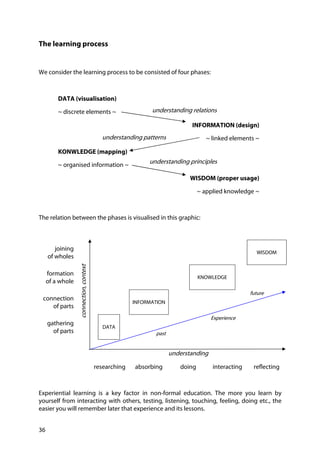
  • 168.
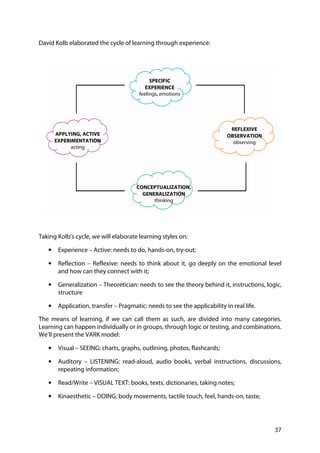
    166 IX. BIBLIOGRAPHY Courses, handoutsand notes • Leadership Education – November 2010; Bucharest, Romania; • Accessing the European funds – November 2010; Bucharest, Romania; • Fundraising in the Youth in Action context – November 2010; Bucharest, Romania; • Project management in the Youth in Action context – January 2011; Bucharest, Romania; • Project writing in the Youth in Action context – March 2011; Slatina, Romania; • Project management in the Youth in Action context – August 2011; Bucharest, Romania; • Project management in the Youth in Action context – January 2012; Bucharest, Romania; • Get started II – March 2012; Glücksburg, Germany; • TICTAC Turkey – March 2012; Adrasan, Turkey; • Methods and instruments of non-formal education – July 2012; Baia Mare, Romania; • Final report writing in the Youth in Action context – November 2012; Bucharest, Romania; • Project management in the Youth in Action context – November 2012; Bucharest, Romania; • Holiday centre animator – October 2014; Poiana Brașov, Romania; • Writing and project management in Erasmus+ – November 2014; Baia Mare, Romania; • Learning activities’ design under Erasmus+ – January 2015; Cluj Napoca, Romania; • Erasmus+ funding opportunities for youth – May-June 2015; online; • Cultural projects’ management – February 2016; Baia Mare, Romania; • EUSDR 2nd youth platform: learning pathways to social cohesion, synergies between formal and non-formal learning – May 2016; Vienna, Austria; • Alternative teaching methods – June 2016; Baia Mare, Romania;
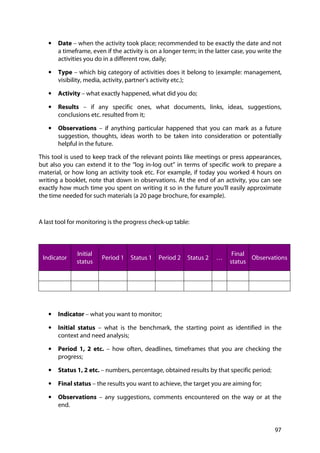
  • 169.
    167 • ONG update– July 2016; Baia Mare, Romania; • Erasmus+ funding opportunities for youth – October-December 2016; online; • Erasmus+ funding opportunities for youth – October-November 2017; online; • Did you notice the Youthpass? – March 2019; Gaziantep, Turkey; • Ready, set, make the change! ESC MOOC – September-October 2019; online; • La casa de project management – May 2020; online; • MOOC Erasmus+ funding opportunities for youth – December 2020; online; • RezultatE+ – June 2021, online; • MOOC on Youthpass – June 2022; online; • The 1st phase of MOOC on the ESC – June 2022; online; • The 2nd phase of MOOC on the ESC – November 2022; online; • Humanitarian Aid presentation – January 2023; online; • Time management – February 2023; online. Online resources • Erasmus+ guide, 2023, version 1 • European Solidarity Corps guide, 2023, version 1 • ec.europa.eu/info/funding-tenders/opportunities/portal/screen/home • www.andyszekely.ro • www.asana.com • www.euro-access.eu • www.gethownow.com • www.linkedin.com • www.portal365.org • www.toladata.com Illustrations, photos • www.freepik.com
  • 171.