Licenses Creative Commons Creative Commons  is a nonprofit organization founded by Lawrence Lessig (Stanford University) and James Boyle (Duke Law School), inspired by the work of Richard Stallman (GNU General Public License) and the work of the Free Software Foundation (FSF). Creative Commons can not be considered as organization a management rights or an intermediary between authors, rights holders and users. Creative Commons licenses adapted to the laws of individual countries ( http://creativecommons.org/international/ ).
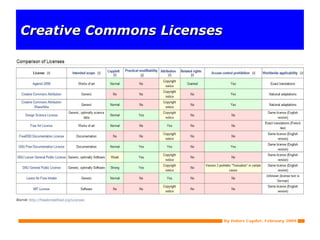
Creative Commons Licenses License Conditions: Attribution:  The creator allows you to copy, distribute and perform the work while recognizing and properly cite the original author.
Noncommercial:  Permission is granted to copy, distribute and perform the work until it is used for commercial purposes.
No Derivative Works:  The creator allows you to copy, distribute and publicly communicate unaltered copies of the work, but not make derivative works of them.
Share Alike:  It allows to distribute derivative works only under a license identical to that which governs the original work.
Creative Commons Licenses The licenses: Attribution:  Lets others distribute, remix, tweak, and build upon your work, even commercially, as long as they credit you for the original creation. This is the most accommodating of licenses offered, in terms of what others can do with your works licensed under Attribution.
Attribution Share Alike:  Lets others remix, tweak, and build upon your work even for commercial reasons, as long as they credit you and license their new creations under the identical terms. This license is often compared to open source software licenses. All new works based on yours will carry the same license, so any derivatives will also allow commercial use.
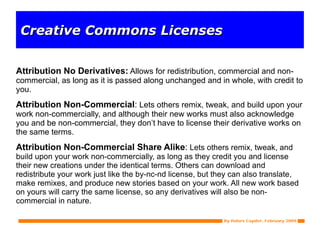
Creative Commons Licenses Attribution No Derivatives:  Allows for redistribution, commercial and non-commercial, as long as it is passed along unchanged and in whole, with credit to you.
Attribution Non-Commercial :  Lets others remix, tweak, and build upon your work non-commercially, and although their new works must also acknowledge you and be non-commercial, they don’t have to license their derivative works on the same terms.

IPT692R: Creative Commons Licenses

  • 1.
    Licenses Creative CommonsCreative Commons is a nonprofit organization founded by Lawrence Lessig (Stanford University) and James Boyle (Duke Law School), inspired by the work of Richard Stallman (GNU General Public License) and the work of the Free Software Foundation (FSF). Creative Commons can not be considered as organization a management rights or an intermediary between authors, rights holders and users. Creative Commons licenses adapted to the laws of individual countries ( http://creativecommons.org/international/ ).
  • 2.
    Creative Commons LicensesLicense Conditions: Attribution: The creator allows you to copy, distribute and perform the work while recognizing and properly cite the original author.
  • 3.
    Noncommercial: Permissionis granted to copy, distribute and perform the work until it is used for commercial purposes.
  • 4.
    No Derivative Works: The creator allows you to copy, distribute and publicly communicate unaltered copies of the work, but not make derivative works of them.
  • 5.
    Share Alike: It allows to distribute derivative works only under a license identical to that which governs the original work.
  • 6.
    Creative Commons LicensesThe licenses: Attribution: Lets others distribute, remix, tweak, and build upon your work, even commercially, as long as they credit you for the original creation. This is the most accommodating of licenses offered, in terms of what others can do with your works licensed under Attribution.
  • 7.
    Attribution Share Alike: Lets others remix, tweak, and build upon your work even for commercial reasons, as long as they credit you and license their new creations under the identical terms. This license is often compared to open source software licenses. All new works based on yours will carry the same license, so any derivatives will also allow commercial use.
  • 8.
    Creative Commons LicensesAttribution No Derivatives: Allows for redistribution, commercial and non-commercial, as long as it is passed along unchanged and in whole, with credit to you.
  • 9.
    Attribution Non-Commercial : Lets others remix, tweak, and build upon your work non-commercially, and although their new works must also acknowledge you and be non-commercial, they don’t have to license their derivative works on the same terms.