Big Questions
in
Science and Religion
Relationships between
Science and Religion
Image source:
http://publishingarchaeology.blog
spot.com/2012/01/rejected-by-
science_27.html (fair use)
What is Science?
•The word scientia
originally meant general
knowledge and was
inferior to sapientia
which meant wisdom
•Science as an
occupation did not
appear until the 19th
century
•Before the 19th century,
many scientists sought
to provide evidence for
religion (natural
philosophy)
Image source:
http://www.amazon.com/Scientific-
Endeavor-Primer-Principles-
Practice/dp/0805345965/ref=sr_1_1?s=boo
ks&ie=UTF8&qid=1358951332&sr=1-
1&keywords=scientific+endeavor (fair use)
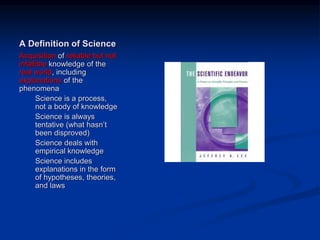
A Definition of Science
Acquisition of reliable but not
infallible knowledge of the
real world, including
explanations of the
phenomena
Science is a process,
not a body of knowledge
Science is always
tentative (what hasn’t
been disproved)
Science deals with
empirical knowledge
Science includes
explanations in the form
of hypotheses, theories,
and laws
Image source:
http://www.eurasiareview.com/25022011-
religion-and-terrorism-a-socio-historical-
reconsideration/ (fair use)
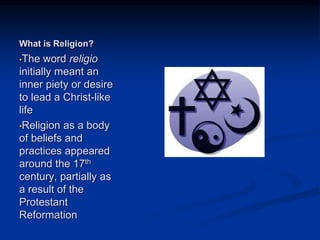
What is Religion?
•The word religio
initially meant an
inner piety or desire
to lead a Christ-like
life
•Religion as a body
of beliefs and
practices appeared
around the 17th
century, partially as
a result of the
Protestant
Reformation
A Definition of Religion
 A strong belief in a supernatural power or
powers that control human destiny
 An institution to express belief in a divine
power
 A belief concerning the supernatural,
sacred, or divine, and the practices and
institutions associated with such belief
 The sum total of answers given to explain
humankind’s relationship with the universe
Image source:
http://www.tutorvista.com/content/physics/physic
s-iv/optics/interference-light.php (fair use)
How Do We
Know Things in
Science?
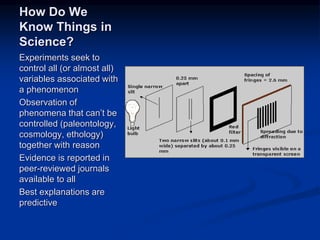
Experiments seek to
control all (or almost all)
variables associated with
a phenomenon
Observation of
phenomena that can’t be
controlled (paleontology,
cosmology, ethology)
together with reason
Evidence is reported in
peer-reviewed journals
available to all
Best explanations are
predictive
Image source: http://news.gts.edu/2012/05/deirdre-
good-joins-interfaith-presentation-on-sacred-
texts/sacred-texts/ (fair use)
How Do We Know
Things in
Religion?
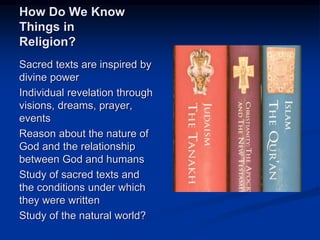
Sacred texts are inspired by
divine power
Individual revelation through
visions, dreams, prayer,
events
Reason about the nature of
God and the relationship
between God and humans
Study of sacred texts and
the conditions under which
they were written
Study of the natural world?
Image source:
http://www.eurasiareview.com/25
022011-religion-and-terrorism-a-
socio-historical-reconsideration/
(fair use)
Worldviews
We all have belief systems
that influence how we
answer the important
questions of life
Range of views within
Christianity, Judaism,
agnosticism, relativism,
Buddhism, atheism,
Islam
Scientists also have
worldviews (paradigms)
that determine the
questions they
investigate
Are there differences in
worldviews between
science and religion?
Christian Beliefs
 Humans are made in the
image of God
 God rules the world in a
faithful, consistent
manner
 God has established
natural laws
 Humans are not able to
understand God’s world
completely
 Nature can be studied
by humans
 Nature works by
natural cause and
effect
 Natural phenomena
are
repeatable/observable
 Experiments and
observations are
needed for explanation
Source: Haarsma and Haarsma, Origin: A
Reformed Look at Creation, Design, and
Evolution (Grand Rapids, MI: Faith Alive, 2007)
Beliefs Needed for Science
Scientific and Christian
Beliefs
Image source:
http://www.amazon.com/Religi
on-Science-Gifford-Lectures-
Barbour/dp/0060609389/ref=sr
_1_1?s=books&ie=UTF8&qid
=1358952534&sr=1-
1&keywords=religion+and+sci
ence+ian+barbour (fair use)
How Do Science and
Religion Relate to Each
Other?
Ian Barbour
identified four ways
Conflict
Independence
Dialogue
Integration
From Barbour, Religion and
Science: Historical and
Contemporary Issues (New
York: HarperCollins, 1997)
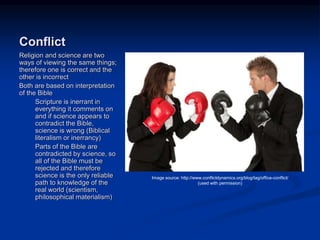
Conflict
Religion and science are two
ways of viewing the same things;
therefore one is correct and the
other is incorrect
Both are based on interpretation
of the Bible
Scripture is inerrant in
everything it comments on
and if science appears to
contradict the Bible,
science is wrong (Biblical
literalism or inerrancy)
Parts of the Bible are
contradicted by science, so
all of the Bible must be
rejected and therefore
science is the only reliable
path to knowledge of the
real world (scientism,
philosophical materialism)
Image source: http://www.conflictdynamics.org/blog/tag/office-conflict/
(used with permission)
Image source:
http://www.boston.com/jobs/galle
ries/workplaceconflict/ (fair use)
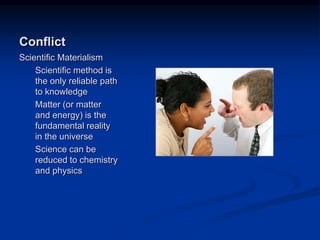
Conflict
Scientific Materialism
Scientific method is
the only reliable path
to knowledge
Matter (or matter
and energy) is the
fundamental reality
in the universe
Science can be
reduced to chemistry
and physics
 In order to accept this model, scientific
materialists must believe that:
 they are completely neutral with respect to
their biases and worldviews
 all of life, including the arts, social sciences,
and others, is reducible to physical processes
 that there is a single way of interpretation of
the Bible, and that it is mistaken
 Are these true?
Conflict
Image source: http://www.maximumadvantage.com/conflict-resolution-in-the-
workplace.html (fair use)
Conflict
Biblical Literalism
Scripture is
inerrant in
everything it
comments on
If science
appears to
contradict the
Bible, science is
wrong
Image source:
http://heatherdhawkins.blogspot.com/2
009/05/clergy-letter.html (fair use)
Conflict
In order to accept this model,
Christians must believe that:
there are no conflicts,
inaccuracies, or
contradictions in the
Bible
scientists are mistaken
or purposely fraudulent
in their investigations
into origins (and origins
alone; i.e., not with
respect to medicine,
technology et al.)
scientists are hostile to
Christianity (or religion)
Are these true?
Image source: http://www.bethinking.org/science-
christianity/ways-of-understanding-science-and-
religion.htm (fair use)
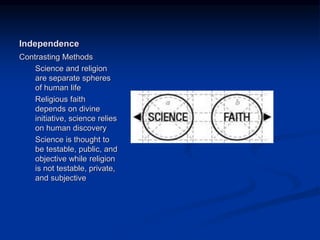
Independence
Contrasting Methods
Science and religion
are separate spheres
of human life
Religious faith
depends on divine
initiative, science relies
on human discovery
Science is thought to
be testable, public, and
objective while religion
is not testable, private,
and subjective
 Differing Languages
 Scientific language is used primarily for
prediction and control (theories, delimited
questions)
 Religious language elicits a set of attitudes and
encourages allegiance to moral principles
 Religious language often deals with liberation
from suffering and experiences of peace and
unity (not scientific)
 What it means: science will discover/explain
everything it can, and religion will explain
the rest
Independence
Image source:
http://www.loc.gov/exhibits/treasures/trt024.html
(fair use)
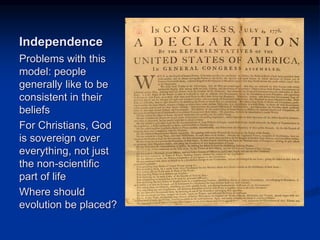
Independence
Problems with this
model: people
generally like to be
consistent in their
beliefs
For Christians, God
is sovereign over
everything, not just
the non-scientific
part of life
Where should
evolution be placed?
Image source:
http://defendchristianfaith.blogspot.com/201
2/04/science-and-religion-do-mix.html (fair
use)
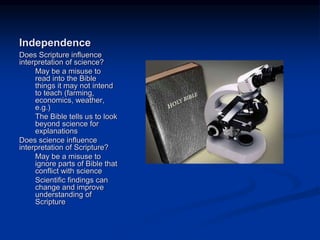
Independence
Does Scripture influence
interpretation of science?
May be a misuse to
read into the Bible
things it may not intend
to teach (farming,
economics, weather,
e.g.)
The Bible tells us to look
beyond science for
explanations
Does science influence
interpretation of Scripture?
May be a misuse to
ignore parts of Bible that
conflict with science
Scientific findings can
change and improve
understanding of
Scripture
Image source: http://en.wikipedia.org/wiki/Dialogue (fair use)
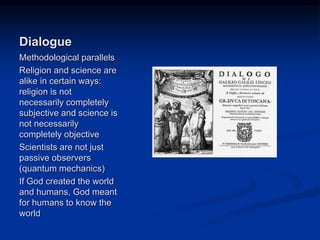
Dialogue
Methodological parallels
Religion and science are
alike in certain ways:
religion is not
necessarily completely
subjective and science is
not necessarily
completely objective
Scientists are not just
passive observers
(quantum mechanics)
If God created the world
and humans, God meant
for humans to know the
world
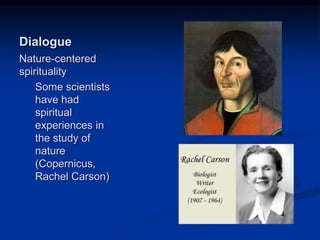
Image source: http://www.rachelcarson.org/ (fair use)
Image source:
http://ircamera.as.arizona.edu/NatSci102/N
atSci102/lectures/copernicus.htm (fair use)
Dialogue
Nature-centered
spirituality
Some scientists
have had
spiritual
experiences in
the study of
nature
(Copernicus,
Rachel Carson)
 Intelligibility and contingency can be areas
of dialogue: neither is completely
answerable by scientific methods
 God is the primary cause and works
through secondary causes, which science
can describe
 Avoids God of the gaps, since science is
complete on its own
 In order to accept this model, Christians
and scientific materialists must be open to
the other’s viewpoint
Dialogue
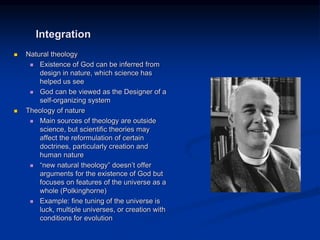
Image source:
http://incharacter.org/features/john-
polkinghornes-unseen-realities/ (fair
use)
 Natural theology
 Existence of God can be inferred from
design in nature, which science has
helped us see
 God can be viewed as the Designer of a
self-organizing system
 Theology of nature
 Main sources of theology are outside
science, but scientific theories may
affect the reformulation of certain
doctrines, particularly creation and
human nature
 “new natural theology” doesn’t offer
arguments for the existence of God but
focuses on features of the universe as a
whole (Polkinghorne)
 Example: fine tuning of the universe is
luck, multiple universes, or creation with
conditions for evolution
Integration
Image source:
http://evolve4peace.com/2012/10/02/science-and-religion/
(fair use)
Integration
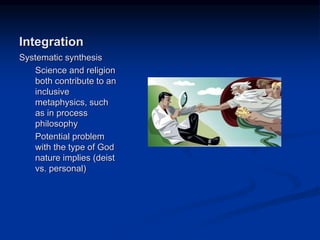
Systematic synthesis
Science and religion
both contribute to an
inclusive
metaphysics, such
as in process
philosophy
Potential problem
with the type of God
nature implies (deist
vs. personal)
Image source:
http://whatafy.com/science-and-
religion-sworn-enemies.html (fair
use)
Integration
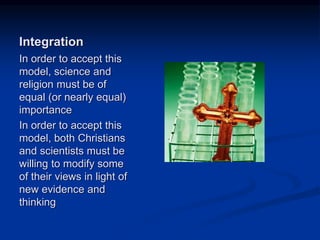
In order to accept this
model, science and
religion must be of
equal (or nearly equal)
importance
In order to accept this
model, both Christians
and scientists must be
willing to modify some
of their views in light of
new evidence and
thinking
Image source:
http://www.iscast.org/even
t_2011_08_19_Annual_Le
cture_Vic
Image source:
http://www.crs.uu.se/Resea
rch/impactofreligion/Theme
_6/Customized+Science+I
%3A+Value-
Free+versus+Value-
Directed+Science/?languag
eId=1
Photo credit Max Marcus,
Uppsala University
Used with permission
Other views of the
relationship between
science and religion
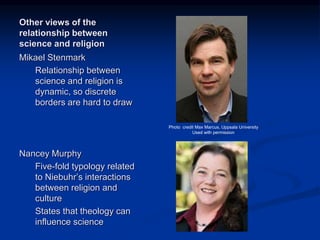
Mikael Stenmark
Relationship between
science and religion is
dynamic, so discrete
borders are hard to draw
Nancey Murphy
Five-fold typology related
to Niebuhr’s interactions
between religion and
culture
States that theology can
influence science
Photo credit Max Marcus, Uppsala University
Used with permission
Image source:
http://spacetheology.blogsp
ot.com/2012/04/professor-
ted-peters.html (fair use)
Image source:
http://polyskeptic.com/
tag/john-haught/ (fair
use)
Other views of the
relationship between
science and religion
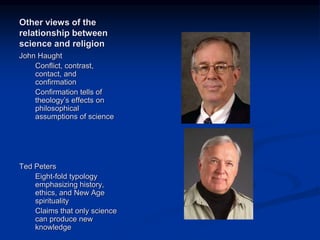
John Haught
Conflict, contrast,
contact, and
confirmation
Confirmation tells of
theology’s effects on
philosophical
assumptions of science
Ted Peters
Eight-fold typology
emphasizing history,
ethics, and New Age
spirituality
Claims that only science
can produce new
knowledge
 Critical thinking helps us determine the
which claims are more likely to be true
 Being aware of our own thinking (and our
own biases, cultural values, etc.) can help
us evaluate claims also
 Looking for the strengths and weaknesses
of others’ arguments and our own can help
us determine the truth of conflicting claims
 Examples of weaknesses in claims?
How Do We Evaluate Claims
Made by Religion and Science?
Image source:
http://www.amazon.com/How
-Think-About-Weird-
Things/dp/007353577X/ref=s
r_1_1?s=books&ie=UTF8&qi
d=1358953931&sr=1-
1&keywords=schick+and+va
ughn (fair use)
Fallacies Associated
with Religion and
Science
Begging the question:
the conclusion is used
as one of the premises
(circular reasoning)
False dilemma:
presumes only two
alternatives exist when
there may be more than
two
From Schick and Vaughn,
How to Think About Weird
Things: Critical Thinking for a
New Age, (New York:
McGraw-Hill, 2011)
 Appeal to authority: the use of experts’
opinions in a field in which they are not
experts
 Appeal to the masses: argument must be
true if a large number of people believe it
to be true
Fallacies Associated with
Religion and Science
 Appeal to tradition: argument that something
must be true because it’s part of an
established tradition
 Appeal to ignorance: opponents’ inability to
disprove a conclusion is proof of its
incorrectness
 Appeal to fear: use of harm to advance one’s
position
 Straw man: misrepresenting someone’s claim
to make it easier to dismiss or reject
Fallacies Associated with
Religion and Science
 Faulty analogy: using analogy without
looking at dissimilarities
 Slippery slope: performing one action
necessarily leads to additional bad actions
Fallacies Associated with
Religion and Science
Image source:
http://gavinortlund.wordp
ress.com/2012/04/18/au
gustines-intellectual-
development/ (fair use)
From St. Augustine. . .
“If [people outside the faith] find a Christian mistaken in a field which they themselves know
well and hear him maintaining his foolish opinions about our books, how are they going to
believe those goods and matters concerning the resurrection of the dead, the hope of
eternal life, and the kingdom of heaven, when they think their pages are full of falsehoods
on facts which they themselves have learned from experience in the light of reason?”
 In thinking critically about Christianity and
evolution we need to:
 realize that there are more than two positions
 carefully consider claims, whether they agree
with our position or not
 consider whether biases are affecting a claim,
either our own biases or those of another
Conclusion
 In thinking critically about Christianity and
evolution we need to:
 use reason as well as emotion in evaluating
claims
 trust (at least provisionally) the opinions of
experts, but only in their areas of expertise
 have the humility to admit that we may be
wrong (after all, there are a variety of views
already)
Conclusion

DawsonMemorial14_Powerpoint.pptx

  • 1.
  • 2.
  • 3.
    Image source: http://publishingarchaeology.blog spot.com/2012/01/rejected-by- science_27.html (fairuse) What is Science? •The word scientia originally meant general knowledge and was inferior to sapientia which meant wisdom •Science as an occupation did not appear until the 19th century •Before the 19th century, many scientists sought to provide evidence for religion (natural philosophy)
  • 4.
    Image source: http://www.amazon.com/Scientific- Endeavor-Primer-Principles- Practice/dp/0805345965/ref=sr_1_1?s=boo ks&ie=UTF8&qid=1358951332&sr=1- 1&keywords=scientific+endeavor (fairuse) A Definition of Science Acquisition of reliable but not infallible knowledge of the real world, including explanations of the phenomena Science is a process, not a body of knowledge Science is always tentative (what hasn’t been disproved) Science deals with empirical knowledge Science includes explanations in the form of hypotheses, theories, and laws
  • 5.
    Image source: http://www.eurasiareview.com/25022011- religion-and-terrorism-a-socio-historical- reconsideration/ (fairuse) What is Religion? •The word religio initially meant an inner piety or desire to lead a Christ-like life •Religion as a body of beliefs and practices appeared around the 17th century, partially as a result of the Protestant Reformation
  • 6.
    A Definition ofReligion  A strong belief in a supernatural power or powers that control human destiny  An institution to express belief in a divine power  A belief concerning the supernatural, sacred, or divine, and the practices and institutions associated with such belief  The sum total of answers given to explain humankind’s relationship with the universe
  • 7.
    Image source: http://www.tutorvista.com/content/physics/physic s-iv/optics/interference-light.php (fairuse) How Do We Know Things in Science? Experiments seek to control all (or almost all) variables associated with a phenomenon Observation of phenomena that can’t be controlled (paleontology, cosmology, ethology) together with reason Evidence is reported in peer-reviewed journals available to all Best explanations are predictive
  • 8.
    Image source: http://news.gts.edu/2012/05/deirdre- good-joins-interfaith-presentation-on-sacred- texts/sacred-texts/(fair use) How Do We Know Things in Religion? Sacred texts are inspired by divine power Individual revelation through visions, dreams, prayer, events Reason about the nature of God and the relationship between God and humans Study of sacred texts and the conditions under which they were written Study of the natural world?
  • 9.
    Image source: http://www.eurasiareview.com/25 022011-religion-and-terrorism-a- socio-historical-reconsideration/ (fair use) Worldviews Weall have belief systems that influence how we answer the important questions of life Range of views within Christianity, Judaism, agnosticism, relativism, Buddhism, atheism, Islam Scientists also have worldviews (paradigms) that determine the questions they investigate Are there differences in worldviews between science and religion?
  • 10.
    Christian Beliefs  Humansare made in the image of God  God rules the world in a faithful, consistent manner  God has established natural laws  Humans are not able to understand God’s world completely  Nature can be studied by humans  Nature works by natural cause and effect  Natural phenomena are repeatable/observable  Experiments and observations are needed for explanation Source: Haarsma and Haarsma, Origin: A Reformed Look at Creation, Design, and Evolution (Grand Rapids, MI: Faith Alive, 2007) Beliefs Needed for Science Scientific and Christian Beliefs
  • 11.
    Image source: http://www.amazon.com/Religi on-Science-Gifford-Lectures- Barbour/dp/0060609389/ref=sr _1_1?s=books&ie=UTF8&qid =1358952534&sr=1- 1&keywords=religion+and+sci ence+ian+barbour (fairuse) How Do Science and Religion Relate to Each Other? Ian Barbour identified four ways Conflict Independence Dialogue Integration From Barbour, Religion and Science: Historical and Contemporary Issues (New York: HarperCollins, 1997)
  • 12.
    Conflict Religion and scienceare two ways of viewing the same things; therefore one is correct and the other is incorrect Both are based on interpretation of the Bible Scripture is inerrant in everything it comments on and if science appears to contradict the Bible, science is wrong (Biblical literalism or inerrancy) Parts of the Bible are contradicted by science, so all of the Bible must be rejected and therefore science is the only reliable path to knowledge of the real world (scientism, philosophical materialism) Image source: http://www.conflictdynamics.org/blog/tag/office-conflict/ (used with permission)
  • 13.
    Image source: http://www.boston.com/jobs/galle ries/workplaceconflict/ (fairuse) Conflict Scientific Materialism Scientific method is the only reliable path to knowledge Matter (or matter and energy) is the fundamental reality in the universe Science can be reduced to chemistry and physics
  • 14.
     In orderto accept this model, scientific materialists must believe that:  they are completely neutral with respect to their biases and worldviews  all of life, including the arts, social sciences, and others, is reducible to physical processes  that there is a single way of interpretation of the Bible, and that it is mistaken  Are these true? Conflict
  • 15.
    Image source: http://www.maximumadvantage.com/conflict-resolution-in-the- workplace.html(fair use) Conflict Biblical Literalism Scripture is inerrant in everything it comments on If science appears to contradict the Bible, science is wrong
  • 16.
    Image source: http://heatherdhawkins.blogspot.com/2 009/05/clergy-letter.html (fairuse) Conflict In order to accept this model, Christians must believe that: there are no conflicts, inaccuracies, or contradictions in the Bible scientists are mistaken or purposely fraudulent in their investigations into origins (and origins alone; i.e., not with respect to medicine, technology et al.) scientists are hostile to Christianity (or religion) Are these true?
  • 17.
    Image source: http://www.bethinking.org/science- christianity/ways-of-understanding-science-and- religion.htm(fair use) Independence Contrasting Methods Science and religion are separate spheres of human life Religious faith depends on divine initiative, science relies on human discovery Science is thought to be testable, public, and objective while religion is not testable, private, and subjective
  • 18.
     Differing Languages Scientific language is used primarily for prediction and control (theories, delimited questions)  Religious language elicits a set of attitudes and encourages allegiance to moral principles  Religious language often deals with liberation from suffering and experiences of peace and unity (not scientific)  What it means: science will discover/explain everything it can, and religion will explain the rest Independence
  • 19.
    Image source: http://www.loc.gov/exhibits/treasures/trt024.html (fair use) Independence Problemswith this model: people generally like to be consistent in their beliefs For Christians, God is sovereign over everything, not just the non-scientific part of life Where should evolution be placed?
  • 20.
    Image source: http://defendchristianfaith.blogspot.com/201 2/04/science-and-religion-do-mix.html (fair use) Independence DoesScripture influence interpretation of science? May be a misuse to read into the Bible things it may not intend to teach (farming, economics, weather, e.g.) The Bible tells us to look beyond science for explanations Does science influence interpretation of Scripture? May be a misuse to ignore parts of Bible that conflict with science Scientific findings can change and improve understanding of Scripture
  • 21.
    Image source: http://en.wikipedia.org/wiki/Dialogue(fair use) Dialogue Methodological parallels Religion and science are alike in certain ways: religion is not necessarily completely subjective and science is not necessarily completely objective Scientists are not just passive observers (quantum mechanics) If God created the world and humans, God meant for humans to know the world
  • 22.
    Image source: http://www.rachelcarson.org/(fair use) Image source: http://ircamera.as.arizona.edu/NatSci102/N atSci102/lectures/copernicus.htm (fair use) Dialogue Nature-centered spirituality Some scientists have had spiritual experiences in the study of nature (Copernicus, Rachel Carson)
  • 23.
     Intelligibility andcontingency can be areas of dialogue: neither is completely answerable by scientific methods  God is the primary cause and works through secondary causes, which science can describe  Avoids God of the gaps, since science is complete on its own  In order to accept this model, Christians and scientific materialists must be open to the other’s viewpoint Dialogue
  • 24.
    Image source: http://incharacter.org/features/john- polkinghornes-unseen-realities/ (fair use) Natural theology  Existence of God can be inferred from design in nature, which science has helped us see  God can be viewed as the Designer of a self-organizing system  Theology of nature  Main sources of theology are outside science, but scientific theories may affect the reformulation of certain doctrines, particularly creation and human nature  “new natural theology” doesn’t offer arguments for the existence of God but focuses on features of the universe as a whole (Polkinghorne)  Example: fine tuning of the universe is luck, multiple universes, or creation with conditions for evolution Integration
  • 25.
    Image source: http://evolve4peace.com/2012/10/02/science-and-religion/ (fair use) Integration Systematicsynthesis Science and religion both contribute to an inclusive metaphysics, such as in process philosophy Potential problem with the type of God nature implies (deist vs. personal)
  • 26.
    Image source: http://whatafy.com/science-and- religion-sworn-enemies.html (fair use) Integration Inorder to accept this model, science and religion must be of equal (or nearly equal) importance In order to accept this model, both Christians and scientists must be willing to modify some of their views in light of new evidence and thinking
  • 27.
    Image source: http://www.iscast.org/even t_2011_08_19_Annual_Le cture_Vic Image source: http://www.crs.uu.se/Resea rch/impactofreligion/Theme _6/Customized+Science+I %3A+Value- Free+versus+Value- Directed+Science/?languag eId=1 Photocredit Max Marcus, Uppsala University Used with permission Other views of the relationship between science and religion Mikael Stenmark Relationship between science and religion is dynamic, so discrete borders are hard to draw Nancey Murphy Five-fold typology related to Niebuhr’s interactions between religion and culture States that theology can influence science Photo credit Max Marcus, Uppsala University Used with permission
  • 28.
    Image source: http://spacetheology.blogsp ot.com/2012/04/professor- ted-peters.html (fairuse) Image source: http://polyskeptic.com/ tag/john-haught/ (fair use) Other views of the relationship between science and religion John Haught Conflict, contrast, contact, and confirmation Confirmation tells of theology’s effects on philosophical assumptions of science Ted Peters Eight-fold typology emphasizing history, ethics, and New Age spirituality Claims that only science can produce new knowledge
  • 29.
     Critical thinkinghelps us determine the which claims are more likely to be true  Being aware of our own thinking (and our own biases, cultural values, etc.) can help us evaluate claims also  Looking for the strengths and weaknesses of others’ arguments and our own can help us determine the truth of conflicting claims  Examples of weaknesses in claims? How Do We Evaluate Claims Made by Religion and Science?
  • 30.
    Image source: http://www.amazon.com/How -Think-About-Weird- Things/dp/007353577X/ref=s r_1_1?s=books&ie=UTF8&qi d=1358953931&sr=1- 1&keywords=schick+and+va ughn (fairuse) Fallacies Associated with Religion and Science Begging the question: the conclusion is used as one of the premises (circular reasoning) False dilemma: presumes only two alternatives exist when there may be more than two From Schick and Vaughn, How to Think About Weird Things: Critical Thinking for a New Age, (New York: McGraw-Hill, 2011)
  • 31.
     Appeal toauthority: the use of experts’ opinions in a field in which they are not experts  Appeal to the masses: argument must be true if a large number of people believe it to be true Fallacies Associated with Religion and Science
  • 32.
     Appeal totradition: argument that something must be true because it’s part of an established tradition  Appeal to ignorance: opponents’ inability to disprove a conclusion is proof of its incorrectness  Appeal to fear: use of harm to advance one’s position  Straw man: misrepresenting someone’s claim to make it easier to dismiss or reject Fallacies Associated with Religion and Science
  • 33.
     Faulty analogy:using analogy without looking at dissimilarities  Slippery slope: performing one action necessarily leads to additional bad actions Fallacies Associated with Religion and Science
  • 34.
    Image source: http://gavinortlund.wordp ress.com/2012/04/18/au gustines-intellectual- development/ (fairuse) From St. Augustine. . . “If [people outside the faith] find a Christian mistaken in a field which they themselves know well and hear him maintaining his foolish opinions about our books, how are they going to believe those goods and matters concerning the resurrection of the dead, the hope of eternal life, and the kingdom of heaven, when they think their pages are full of falsehoods on facts which they themselves have learned from experience in the light of reason?”
  • 35.
     In thinkingcritically about Christianity and evolution we need to:  realize that there are more than two positions  carefully consider claims, whether they agree with our position or not  consider whether biases are affecting a claim, either our own biases or those of another Conclusion
  • 36.
     In thinkingcritically about Christianity and evolution we need to:  use reason as well as emotion in evaluating claims  trust (at least provisionally) the opinions of experts, but only in their areas of expertise  have the humility to admit that we may be wrong (after all, there are a variety of views already) Conclusion

Editor's Notes

  • #28 Nancey Murphy, "A Niebuhrian Typology for the Relation of Theology to Science," Pacific Theological Review XVIII, Three (Spring 1985): 16-23. Stenmark, Mikael, “Ways of relating science and religion”, Cambridge Companion to Science and Religion, 2010: 278-295.
  • #29 John F. Haught, Science & Religion: From Conflict to Conversion (New York: Paulist Press, 1995), Ch. 1. Ted Peters, Ed., Science & Theology: The New Consonance (Boulder, Colorado: Westview Press, 1998), p. 13-22.
  • #31 Example of begging the question: Is the Bible true? It says it is, therefore it must be true. The conclusion (the Bible is true) is used as one of the premises (the Bible says it’s true). Example of false dilemma: either biblical creation is true or evolution is true. This argument ignores other versions of creation as well as nuanced views of creation and evolution such as theological evolution.
  • #32 Example of appeal to authority: Richard Dawkins makes philosophical claims about Christianity though he is neither a theologian or a philosopher. Many persons of faith make claims about aspects of science they themselves have never studied. Note that neither example means the persons are wrong, simply that they are speaking about subjects as laypeople rather than as experts. Example of appeal to the masses: surveys show that a majority of Americans believe in a biblical view of creation, therefore that must be correct. Surveys of Europeans in the Middle Ages would have shown an almost 100% agreement that the sun revolves around the earth.
  • #33 Example of appeal to tradition: “we’ve always felt that way”. Example of appeal to ignorance: if they can’t show how something happened, then it didn’t happen that way. The usual counter to this argument is that absence of evidence is not evidence of absence. Example of appeal to fear: often Hitler/Nazism is used to scare people into believing a position, such as “Hitler used Darwinism to promote eugenics” or “Hitler was a Christian.” Example of a straw man argument: since no one has seen a cat give birth to a rabbit, evolution cannot be true. Evolution has never made such a claim, so the argument is a straw man.