Creating Learning OutcomesZSR | July 5, 2011
Step 1: Needs AssessmentWhat would you like your students to know?What would you like your students to understand? What would you like your students to be able to do?What are our goals?
LIB100 GoalsLearn how to determine the nature and extent of information needed for identifying a research topic.Become familiar with the strengths and limitations of different types of information resources in order to access resources effectively.Learn strategies for the critical evaluation of information in order to evaluate the reliability of a resource and determine the biases that are inherent in a resource.Learn how to structure and implement research strategies in order to plan and execute an effective search.Acquire in-depth knowledge of library services and resources in order to be lifelong learners.Develop awareness of the legal, economic, political and social aspects of information resources in order to use information ethically.
Step 2: Rough DraftGoal 1: Learn how to determine the nature and extent of information needed for identifying a research topic.
Step 2: Rough DraftGoal 2: Become familiar with the strengths and limitations of different types of information resources in order to access resources effectively.
Step 2: Rough DraftGoal 3: Learn strategies for the critical evaluation of information in order to evaluate the reliability of a resource and determine the biases that are inherent in a resource.
Step 2: Rough DraftGoal 4: Learn how to structure and implement research strategies in order to plan and execute an effective search.
Step 2: Rough DraftGoal 5: Acquire in-depth knowledge of library services and resources in order to be lifelong learners.
Step 2: Rough DraftGoal 6: Develop awareness of the legal, economic, political and social aspects of information resources in order to use information ethically.
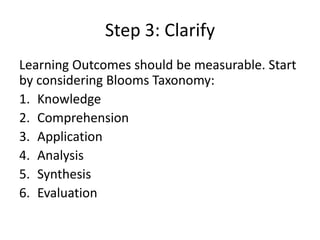
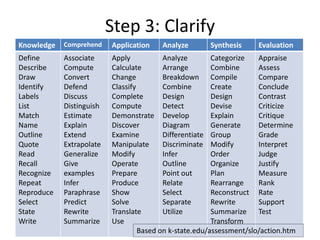
Step 3: ClarifyLearning Outcomes should be measurable. Start by considering Blooms Taxonomy:KnowledgeComprehensionApplicationAnalysisSynthesisEvaluation
Step 3: ClarifyBased on k-state.edu/assessment/slo/action.htm
Step 4: SpecifyBy the end of X, the student will be able to Y.OR Upon completion of LIB100, the student will:
Learn how to determine the nature and extent of information needed for identifying a research topic.By the end of LIB100, the student will be able to:recognize the sources required by WFU assigned papers.prepare a bibliography using Zotero.assess the depth of research necessary for an assigned paper of 2, 5, and 10 pages.
Become familiar with the strengths and limitations of different types of information resources in order to access resources effectively.By the end of LIB100, the student will be able to:analyze an article to determine if it is scholarly.determine when a book vs. a scholarly journal is an appropriate source.
Learn strategies for the critical evaluation of information in order to evaluate the reliability of a resource and determine the biases that are inherent in a resource.By the end of LIB100, the student will be able to:List qualities reputable websites share in common.Classify works as written by scholars, reputable organizations, or for the mainstream press.
Learn how to structure and implement research strategies in order to plan and execute an effective search.By the end of LIB100, the student will be able to:Write the steps of the research process.Explain why scholarly works take longer to become available.Plan specific steps for an assigned research project.
Acquire in-depth knowledge of library services and resources in order to be lifelong learners.By the end of LIB100, the student will be able to:Describe services offered at the circulation desk, the Bridge, reference, and archives/special collections.Explain the role of the library in the research process.
Develop awareness of the legal, economic, political and social aspects of information resources in order to use information ethically.By the end of LIB100, the student will be able to:Differentiate between plagiarism and fair use.Explain the impact of free information on the web on the scholarly publishing landscape.Justify their use of resources in their research project.
Step 5: AssessThat’s an entirely separate talk! 

Creating Learning Outcomes

  • 1.
  • 2.
    Step 1: NeedsAssessmentWhat would you like your students to know?What would you like your students to understand? What would you like your students to be able to do?What are our goals?
  • 3.
    LIB100 GoalsLearn howto determine the nature and extent of information needed for identifying a research topic.Become familiar with the strengths and limitations of different types of information resources in order to access resources effectively.Learn strategies for the critical evaluation of information in order to evaluate the reliability of a resource and determine the biases that are inherent in a resource.Learn how to structure and implement research strategies in order to plan and execute an effective search.Acquire in-depth knowledge of library services and resources in order to be lifelong learners.Develop awareness of the legal, economic, political and social aspects of information resources in order to use information ethically.
  • 4.
    Step 2: RoughDraftGoal 1: Learn how to determine the nature and extent of information needed for identifying a research topic.
  • 5.
    Step 2: RoughDraftGoal 2: Become familiar with the strengths and limitations of different types of information resources in order to access resources effectively.
  • 6.
    Step 2: RoughDraftGoal 3: Learn strategies for the critical evaluation of information in order to evaluate the reliability of a resource and determine the biases that are inherent in a resource.
  • 7.
    Step 2: RoughDraftGoal 4: Learn how to structure and implement research strategies in order to plan and execute an effective search.
  • 8.
    Step 2: RoughDraftGoal 5: Acquire in-depth knowledge of library services and resources in order to be lifelong learners.
  • 9.
    Step 2: RoughDraftGoal 6: Develop awareness of the legal, economic, political and social aspects of information resources in order to use information ethically.
  • 10.
    Step 3: ClarifyLearningOutcomes should be measurable. Start by considering Blooms Taxonomy:KnowledgeComprehensionApplicationAnalysisSynthesisEvaluation
  • 11.
    Step 3: ClarifyBasedon k-state.edu/assessment/slo/action.htm
  • 12.
    Step 4: SpecifyBythe end of X, the student will be able to Y.OR Upon completion of LIB100, the student will:
  • 13.
    Learn how todetermine the nature and extent of information needed for identifying a research topic.By the end of LIB100, the student will be able to:recognize the sources required by WFU assigned papers.prepare a bibliography using Zotero.assess the depth of research necessary for an assigned paper of 2, 5, and 10 pages.
  • 14.
    Become familiar withthe strengths and limitations of different types of information resources in order to access resources effectively.By the end of LIB100, the student will be able to:analyze an article to determine if it is scholarly.determine when a book vs. a scholarly journal is an appropriate source.
  • 15.
    Learn strategies forthe critical evaluation of information in order to evaluate the reliability of a resource and determine the biases that are inherent in a resource.By the end of LIB100, the student will be able to:List qualities reputable websites share in common.Classify works as written by scholars, reputable organizations, or for the mainstream press.
  • 16.
    Learn how tostructure and implement research strategies in order to plan and execute an effective search.By the end of LIB100, the student will be able to:Write the steps of the research process.Explain why scholarly works take longer to become available.Plan specific steps for an assigned research project.
  • 17.
    Acquire in-depth knowledgeof library services and resources in order to be lifelong learners.By the end of LIB100, the student will be able to:Describe services offered at the circulation desk, the Bridge, reference, and archives/special collections.Explain the role of the library in the research process.
  • 18.
    Develop awareness ofthe legal, economic, political and social aspects of information resources in order to use information ethically.By the end of LIB100, the student will be able to:Differentiate between plagiarism and fair use.Explain the impact of free information on the web on the scholarly publishing landscape.Justify their use of resources in their research project.
  • 19.
    Step 5: AssessThat’san entirely separate talk! 