ACCESSING INFORMATION IN THE 21ST CENTURY (LIB100)
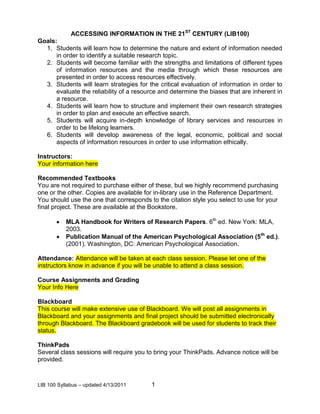
Goals:
  1. Students will learn how to determine the nature and extent of information needed
      in order to identify a suitable research topic.
  2. Students will become familiar with the strengths and limitations of different types
      of information resources and the media through which these resources are
      presented in order to access resources effectively.
  3. Students will learn strategies for the critical evaluation of information in order to
      evaluate the reliability of a resource and determine the biases that are inherent in
      a resource.
  4. Students will learn how to structure and implement their own research strategies
      in order to plan and execute an effective search.
  5. Students will acquire in-depth knowledge of library services and resources in
      order to be lifelong learners.
  6. Students will develop awareness of the legal, economic, political and social
      aspects of information resources in order to use information ethically.

Instructors:
Your information here

Recommended Textbooks
You are not required to purchase either of these, but we highly recommend purchasing
one or the other. Copies are available for in-library use in the Reference Department.
You should use the one that corresponds to the citation style you select to use for your
final project. These are available at the Bookstore.

          MLA Handbook for Writers of Research Papers. 6th ed. New York: MLA,
           2003.
          Publication Manual of the American Psychological Association (5th ed.).
           (2001). Washington, DC: American Psychological Association.

Attendance: Attendance will be taken at each class session. Please let one of the
instructors know in advance if you will be unable to attend a class session.

Course Assignments and Grading
Your Info Here

Blackboard
This course will make extensive use of Blackboard. We will post all assignments in
Blackboard and your assignments and final project should be submitted electronically
through Blackboard. The Blackboard gradebook will be used for students to track their
status.

ThinkPads
Several class sessions will require you to bring your ThinkPads. Advance notice will be
provided.


LIB 100 Syllabus – updated 4/13/2011     1
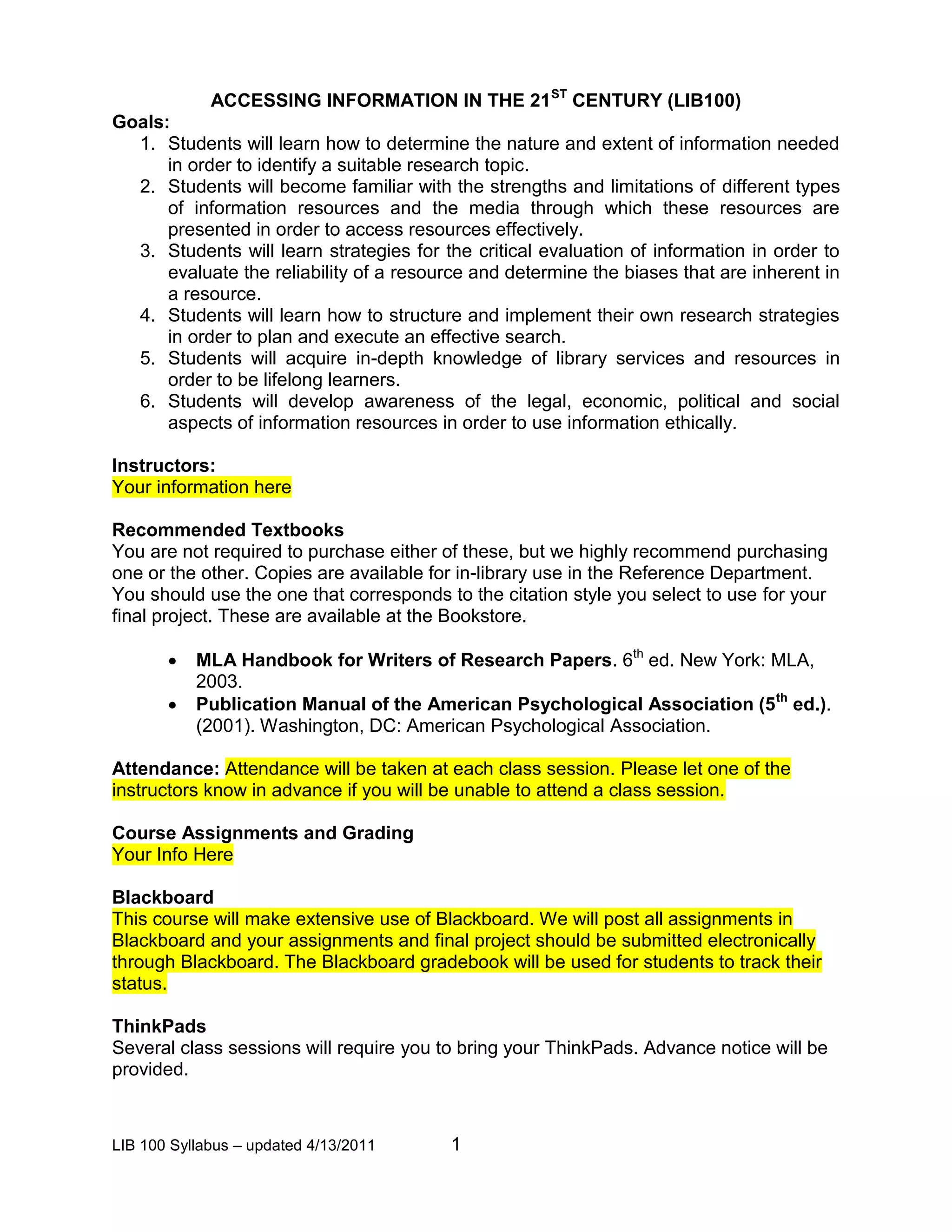
LIB 100 – Accessing Information -- Course Outline
Class 1         Introduction
                     Introductions
                     Syllabus
                     Final Project Information
                     Library tour

                Assignment: Annotated Bibliography Topic

Class 2         Getting to a Research Topic
                 Steps in the Research Process
                 Broadening and Narrowing Your Topic
                 Search Terms
                 In-class exercise: Broadening and Narrowing Paper topics
Class 3         Search Terms
                 Research Questions
                 Concepts
                 Controlled Vocabularies
                 Search Terms
                 In-Class Exercise: Concept Blocking for your topic

                DUE: Annotated Bibliography Topic
Class 4         Searching the Online Catalog
                 Search Terms vs. Subject Headings; Keywords, etc.
Bring Your       Truncation, Boolean Operators.
THINKPAD         Using the online catalog to search: types of searches, limits, how to
                   interpret your results.
                 LC Subject Headings
                 In-Class Exercise: Searching the Online Catalog – getting to subject
                   headings
Class 5         Evaluating and Citing Your Sources
                 Tips on evaluating resources
Bring your       Style Guides (MLA and APA)
ThinkPad         Why citations are important (Plagiarism)
                 In-Class exercise: Citation practice


Class 6          Reference Resources
                 Types of resources found in Reference and
Bring your       Finding Reference Books in the catalog.
ThinkPad         Evaluation of reference resources.
                 In-Class Exercise: Searching for and finding reference sources


LIB 100 Syllabus – updated 4/13/2011      2
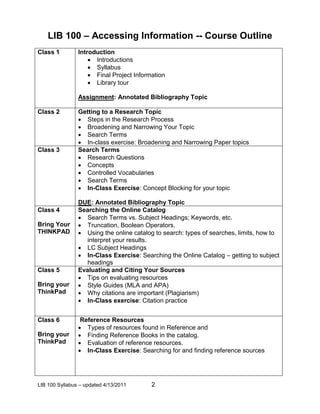
Class 7         Books and Annotations
                 How books are classified (LC Call number and LC Subject Headings)
Bring your       How to find books in the Online Catalog
ThinkPad         How to find book in the ZSR Library
                 Evaluation of books for research
                 Writing Annotations
                 In-class Exercise: Getting started on Assignment #1

                Assignment: Books assignment. (Assignment #1)
Class 8         Databases #1 – Journals and Online Databases
                 Scholarly vs. non-scholarly articles
Bring your       Academic publishing
ThinkPad         ZSR’s Find a Journal page
                 Selecting appropriate databases for potential topics.
                 In Class Exercise: Picking databases for your topic
                Due: Books Assignment. (Assignment #1)
Class 9         Databases #2 – Searching Databases and Getting to Results
                 Complex searching in databases
Bring your       Evaluating Articles
ThinkPad         Scholarly vs. non-scholarly articles
                 Citing articles from a database
                 In-Class Exercise: Getting started on Assignment #2
                Assignment: Journal Assignment (Assignment #2)
Class 10        Issues in Information
                    Current issues in information
                Due: Journal Assignment (Assignment #2)
Class 11        Web Resources #1 -- Searching the Internet
                 Search engines v. search directories v. meta search engines.
Bring your       Invisible Web
ThinkPad         Search strategies

Class 12        Web Resources #2 -- Evaluating and Citing Web Sites
                 Evaluation of free Web resources
Bring your       Citing Web Sites
ThinkPad         In-Class Exercise: Getting started on Assignment #3
to class
                Assignment: Web Site Assignment (Assignment #3)


LIB 100 Syllabus – updated 4/13/2011      3
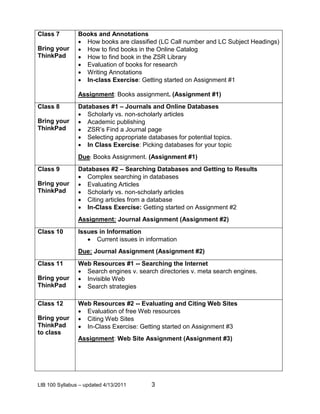
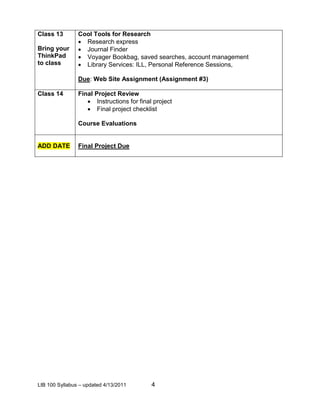
Class 13        Cool Tools for Research
                 Research express
Bring your       Journal Finder
ThinkPad         Voyager Bookbag, saved searches, account management
to class         Library Services: ILL, Personal Reference Sessions,

                Due: Web Site Assignment (Assignment #3)

Class 14        Final Project Review
                    Instructions for final project
                    Final project checklist

                Course Evaluations


ADD DATE        Final Project Due


LIB 100 Syllabus – updated 4/13/2011       4

LIB100 Syllabus Template

  • 1.
    ACCESSING INFORMATION INTHE 21ST CENTURY (LIB100) Goals: 1. Students will learn how to determine the nature and extent of information needed in order to identify a suitable research topic. 2. Students will become familiar with the strengths and limitations of different types of information resources and the media through which these resources are presented in order to access resources effectively. 3. Students will learn strategies for the critical evaluation of information in order to evaluate the reliability of a resource and determine the biases that are inherent in a resource. 4. Students will learn how to structure and implement their own research strategies in order to plan and execute an effective search. 5. Students will acquire in-depth knowledge of library services and resources in order to be lifelong learners. 6. Students will develop awareness of the legal, economic, political and social aspects of information resources in order to use information ethically. Instructors: Your information here Recommended Textbooks You are not required to purchase either of these, but we highly recommend purchasing one or the other. Copies are available for in-library use in the Reference Department. You should use the one that corresponds to the citation style you select to use for your final project. These are available at the Bookstore.  MLA Handbook for Writers of Research Papers. 6th ed. New York: MLA, 2003.  Publication Manual of the American Psychological Association (5th ed.). (2001). Washington, DC: American Psychological Association. Attendance: Attendance will be taken at each class session. Please let one of the instructors know in advance if you will be unable to attend a class session. Course Assignments and Grading Your Info Here Blackboard This course will make extensive use of Blackboard. We will post all assignments in Blackboard and your assignments and final project should be submitted electronically through Blackboard. The Blackboard gradebook will be used for students to track their status. ThinkPads Several class sessions will require you to bring your ThinkPads. Advance notice will be provided. LIB 100 Syllabus – updated 4/13/2011 1
  • 2.
    LIB 100 –Accessing Information -- Course Outline Class 1 Introduction  Introductions  Syllabus  Final Project Information  Library tour Assignment: Annotated Bibliography Topic Class 2 Getting to a Research Topic  Steps in the Research Process  Broadening and Narrowing Your Topic  Search Terms  In-class exercise: Broadening and Narrowing Paper topics Class 3 Search Terms  Research Questions  Concepts  Controlled Vocabularies  Search Terms  In-Class Exercise: Concept Blocking for your topic DUE: Annotated Bibliography Topic Class 4 Searching the Online Catalog  Search Terms vs. Subject Headings; Keywords, etc. Bring Your  Truncation, Boolean Operators. THINKPAD  Using the online catalog to search: types of searches, limits, how to interpret your results.  LC Subject Headings  In-Class Exercise: Searching the Online Catalog – getting to subject headings Class 5 Evaluating and Citing Your Sources  Tips on evaluating resources Bring your  Style Guides (MLA and APA) ThinkPad  Why citations are important (Plagiarism)  In-Class exercise: Citation practice Class 6 Reference Resources  Types of resources found in Reference and Bring your  Finding Reference Books in the catalog. ThinkPad  Evaluation of reference resources.  In-Class Exercise: Searching for and finding reference sources LIB 100 Syllabus – updated 4/13/2011 2
  • 3.
    Class 7 Books and Annotations  How books are classified (LC Call number and LC Subject Headings) Bring your  How to find books in the Online Catalog ThinkPad  How to find book in the ZSR Library  Evaluation of books for research  Writing Annotations  In-class Exercise: Getting started on Assignment #1 Assignment: Books assignment. (Assignment #1) Class 8 Databases #1 – Journals and Online Databases  Scholarly vs. non-scholarly articles Bring your  Academic publishing ThinkPad  ZSR’s Find a Journal page  Selecting appropriate databases for potential topics.  In Class Exercise: Picking databases for your topic Due: Books Assignment. (Assignment #1) Class 9 Databases #2 – Searching Databases and Getting to Results  Complex searching in databases Bring your  Evaluating Articles ThinkPad  Scholarly vs. non-scholarly articles  Citing articles from a database  In-Class Exercise: Getting started on Assignment #2 Assignment: Journal Assignment (Assignment #2) Class 10 Issues in Information  Current issues in information Due: Journal Assignment (Assignment #2) Class 11 Web Resources #1 -- Searching the Internet  Search engines v. search directories v. meta search engines. Bring your  Invisible Web ThinkPad  Search strategies Class 12 Web Resources #2 -- Evaluating and Citing Web Sites  Evaluation of free Web resources Bring your  Citing Web Sites ThinkPad  In-Class Exercise: Getting started on Assignment #3 to class Assignment: Web Site Assignment (Assignment #3) LIB 100 Syllabus – updated 4/13/2011 3
  • 4.
    Class 13 Cool Tools for Research  Research express Bring your  Journal Finder ThinkPad  Voyager Bookbag, saved searches, account management to class  Library Services: ILL, Personal Reference Sessions, Due: Web Site Assignment (Assignment #3) Class 14 Final Project Review  Instructions for final project  Final project checklist Course Evaluations ADD DATE Final Project Due LIB 100 Syllabus – updated 4/13/2011 4