Incorporating the Mercer University
Libraries into a Course Design
Florence Tang
Liaison to the College of Continuing and
Professional Studies for the Atlanta Campus
678-547-6261
tang_fy@mercer.edu
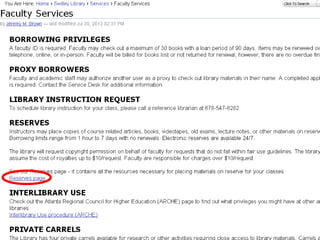
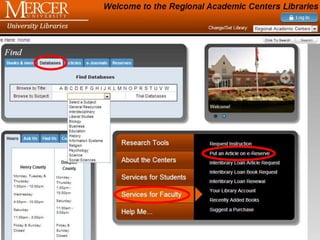
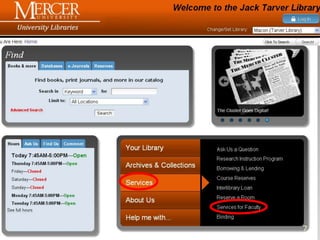
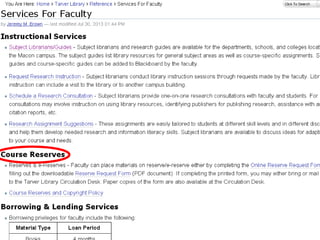
 Faculty services basics
 What you do currently, what you would like to see
changed
 Common issues with student papers?
 Why use library-related assignments?
 ACRL Information Literacy Competency
Standards for Higher Education
 Critical thinking
 Resources
 Answer any questions you may have
Outline / Agenda
3
4
5
6
7
8
Discussion
 What do you do currently do to incorporate the
Mercer University Libraries into course design?
 What do you hope to achieve?
 How would you like the library to be involved?
9
Common issues with student
papers?
 Non-academic sources
 The evidence does not support the claims / The
sources are not relevant
 Not using anything resembling APA Style 6th ed.
 Include broken links to articles
10
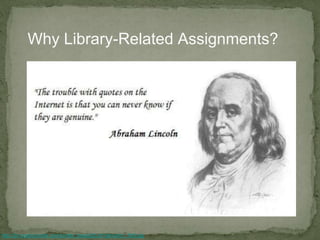
Why Library-Related Assignments?
http://24.media.tumblr.com/tumblr_lneqa3j2LW1qilmuho1_500.jpg
Enhance students’ critical thinking skills
Teach students to evaluate information
Encourage active participation in learning
Utilize technology to enhance
understanding of topic
Why Library-Related Assignments?
Information Literacy Competency
Standards for Higher Education
13
http://unitproj.library.ucla.edu/special/rbms/images/ACRL_white.gif http://http://theturekclinic.com/assets/PlasticHolyGrail.jpg
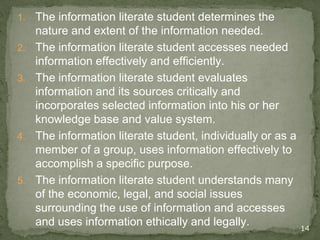
1. The information literate student determines the
nature and extent of the information needed.
2. The information literate student accesses needed
information effectively and efficiently.
3. The information literate student evaluates
information and its sources critically and
incorporates selected information into his or her
knowledge base and value system.
4. The information literate student, individually or as a
member of a group, uses information effectively to
accomplish a specific purpose.
5. The information literate student understands many
of the economic, legal, and social issues
surrounding the use of information and accesses
and uses information ethically and legally. 14
 Illustrate relevance – not just to course objectives but
to life
 Show how information literacy can be a “marketable”
skill in the workplace
 Provide clear, simple, written instructions to students
(and to librarian if consulting with one)
 Allow students to explore their own interests
 Meet librarians (we don’t bite) and explain differences
between public/academic libraries
Creating Effective Library Assignments
Do
 Ask students open-ended questions
 Schedule library instruction sessions as close to the
point of students’ research need (well in advance as
occasionally multiple classes need library instruction
sessions at the same time).
16
Can
 Tell them their work should demonstrate critical
thinking.
 Limit date range of acceptable sources
 Limit sources to original research vs. reviews
17
Please don’t
 Assign scavenger hunt assignments
 Limit to print or digital format
 Expect students to reference primary research in a
field that they cannot comprehend.
 Require the use of resources that Mercer Libraries do
not have access to.
Critical Thinking
 Encourage active reading. – What’s the point?
What’s most/least helpful? Do you agree?
 Can they synthesize and use what they’ve read to
form and support their own voice?
 Is the voice entirely that of the student’s or entirely
that of the reading?
 Student peer review - students can be more
discerning of missing information in their colleagues’
papers than in their own.
18
Resources
http://flickr.com/photos/stephenliveshere/524595756/
 Books including eBooks (eBrary and eBooks on EBSCOhost)
 Databases (Magazines, Scholarly
Journals, Newspapers, Multimedia, etc.)
 Websites
 Books or articles not at Mercer
 InterLibrary Loan (ILL)
**You need your Mercer ID Number (MUID) to access
many of these resources**
Types of Resources
21
22
23
24
25
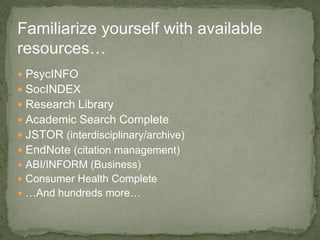
 PsycINFO
 SocINDEX
 Research Library
 Academic Search Complete
 JSTOR (interdisciplinary/archive)
 EndNote (citation management)
 ABI/INFORM (Business)
 Consumer Health Complete
 …And hundreds more…
Familiarize yourself with available
resources…
 There are thousands of reputable websites with LOTS
of great, often-updated information. Teach students to
think critically and evaluate…
Helpful websites…
http://www.flickr.com/photos/striatic/2144933705/
Questions? Comments?
http://flickr.com/photos/travelinlibrarian/223839049/
References
 Greenfield Community College. (nd). Creating Effective Library Assignments.
Retrieved August 5, 2009, from
http://www.gcc.mass.edu/library/faculty/assignments.html
 Norem, M. (nd). Library Assignments. Retrieved August 7, 2009, from
http://oldnh.lonestar.edu/27606/
 Wochna, L. (2009). Tips for Creating Library/Research Assignments. Retrieved
August 5, 2009, from http://www.library.ohiou.edu/inst/creative.html
References
Atwood, T. A., & Crosetto, A. (2009). How to address “I've already written my paper,
now I just need to find some sources”: Teaching personal voice through
library instruction. College & Undergraduate Libraries, 16(4), 322-328. doi:
10.1080/10691310903355952
Hayes-Bohanan, P., & Spievak, E. (2008). You Can Lead Students to Sources, but
Can You Make Them Think? College & Undergraduate Libraries, 15(1/2),
173-210. doi: 10.1080/10691310802177200
Mahaffy, M. (2006). Encouraging critical thinking in student library research: An
application of national standards. College Teaching, 54(4), 324-327.
http://proxy-s.mercer.edu/login?url=http://search.ebscohost.com/login.aspx?
direct=true&db=fth&AN=23337669&site=ehost-live
Miller, I. R. (2010). Turning the tables: A faculty-centered approach to integrating
information literacy. Reference Services Review, 38(4), 647-662. doi:
http://dx.doi.org/10.1108/00907321011090782
END

Adjunct Faculty Retreat - Library

  • 1.
    Incorporating the MercerUniversity Libraries into a Course Design Florence Tang Liaison to the College of Continuing and Professional Studies for the Atlanta Campus 678-547-6261 tang_fy@mercer.edu
  • 2.
     Faculty servicesbasics  What you do currently, what you would like to see changed  Common issues with student papers?  Why use library-related assignments?  ACRL Information Literacy Competency Standards for Higher Education  Critical thinking  Resources  Answer any questions you may have Outline / Agenda
  • 3.
  • 4.
  • 5.
  • 6.
  • 7.
  • 8.
  • 9.
    Discussion  What doyou do currently do to incorporate the Mercer University Libraries into course design?  What do you hope to achieve?  How would you like the library to be involved? 9
  • 10.
    Common issues withstudent papers?  Non-academic sources  The evidence does not support the claims / The sources are not relevant  Not using anything resembling APA Style 6th ed.  Include broken links to articles 10
  • 11.
  • 12.
    Enhance students’ criticalthinking skills Teach students to evaluate information Encourage active participation in learning Utilize technology to enhance understanding of topic Why Library-Related Assignments?
  • 13.
    Information Literacy Competency Standardsfor Higher Education 13 http://unitproj.library.ucla.edu/special/rbms/images/ACRL_white.gif http://http://theturekclinic.com/assets/PlasticHolyGrail.jpg
  • 14.
    1. The informationliterate student determines the nature and extent of the information needed. 2. The information literate student accesses needed information effectively and efficiently. 3. The information literate student evaluates information and its sources critically and incorporates selected information into his or her knowledge base and value system. 4. The information literate student, individually or as a member of a group, uses information effectively to accomplish a specific purpose. 5. The information literate student understands many of the economic, legal, and social issues surrounding the use of information and accesses and uses information ethically and legally. 14
  • 15.
     Illustrate relevance– not just to course objectives but to life  Show how information literacy can be a “marketable” skill in the workplace  Provide clear, simple, written instructions to students (and to librarian if consulting with one)  Allow students to explore their own interests  Meet librarians (we don’t bite) and explain differences between public/academic libraries Creating Effective Library Assignments
  • 16.
    Do  Ask studentsopen-ended questions  Schedule library instruction sessions as close to the point of students’ research need (well in advance as occasionally multiple classes need library instruction sessions at the same time). 16 Can  Tell them their work should demonstrate critical thinking.  Limit date range of acceptable sources  Limit sources to original research vs. reviews
  • 17.
    17 Please don’t  Assignscavenger hunt assignments  Limit to print or digital format  Expect students to reference primary research in a field that they cannot comprehend.  Require the use of resources that Mercer Libraries do not have access to.
  • 18.
    Critical Thinking  Encourageactive reading. – What’s the point? What’s most/least helpful? Do you agree?  Can they synthesize and use what they’ve read to form and support their own voice?  Is the voice entirely that of the student’s or entirely that of the reading?  Student peer review - students can be more discerning of missing information in their colleagues’ papers than in their own. 18
  • 19.
  • 20.
     Books includingeBooks (eBrary and eBooks on EBSCOhost)  Databases (Magazines, Scholarly Journals, Newspapers, Multimedia, etc.)  Websites  Books or articles not at Mercer  InterLibrary Loan (ILL) **You need your Mercer ID Number (MUID) to access many of these resources** Types of Resources
  • 21.
  • 22.
  • 23.
  • 24.
  • 25.
  • 26.
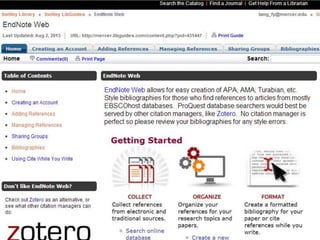
     PsycINFO  SocINDEX Research Library  Academic Search Complete  JSTOR (interdisciplinary/archive)  EndNote (citation management)  ABI/INFORM (Business)  Consumer Health Complete  …And hundreds more… Familiarize yourself with available resources…
  • 27.
     There arethousands of reputable websites with LOTS of great, often-updated information. Teach students to think critically and evaluate… Helpful websites… http://www.flickr.com/photos/striatic/2144933705/
  • 28.
  • 29.
    References  Greenfield CommunityCollege. (nd). Creating Effective Library Assignments. Retrieved August 5, 2009, from http://www.gcc.mass.edu/library/faculty/assignments.html  Norem, M. (nd). Library Assignments. Retrieved August 7, 2009, from http://oldnh.lonestar.edu/27606/  Wochna, L. (2009). Tips for Creating Library/Research Assignments. Retrieved August 5, 2009, from http://www.library.ohiou.edu/inst/creative.html
  • 30.
    References Atwood, T. A.,& Crosetto, A. (2009). How to address “I've already written my paper, now I just need to find some sources”: Teaching personal voice through library instruction. College & Undergraduate Libraries, 16(4), 322-328. doi: 10.1080/10691310903355952 Hayes-Bohanan, P., & Spievak, E. (2008). You Can Lead Students to Sources, but Can You Make Them Think? College & Undergraduate Libraries, 15(1/2), 173-210. doi: 10.1080/10691310802177200 Mahaffy, M. (2006). Encouraging critical thinking in student library research: An application of national standards. College Teaching, 54(4), 324-327. http://proxy-s.mercer.edu/login?url=http://search.ebscohost.com/login.aspx? direct=true&db=fth&AN=23337669&site=ehost-live Miller, I. R. (2010). Turning the tables: A faculty-centered approach to integrating information literacy. Reference Services Review, 38(4), 647-662. doi: http://dx.doi.org/10.1108/00907321011090782
  • 31.

Editor's Notes

  • #11 Do you students site Marie Claire and Vanity Fair? Or worse yet a Facebook infographic?“I've Already Written My Paper, Now I Just Need to Find Some Sources”The references are too specific or too broad in relation to their topic.“I need two articles. Any two under ten pages from this list of 1,862 will do.”Do your students not have consistency in their reference formats?As a librarian, I don’t often get to read student papers but earlier this year I served on the Cecil B. Day Campus Research Prize committee. Reading the submissions was very telling.
  • #13 I’ve read in more than one article that faculty valued librarians’ technical skill.
  • #14 It’s the Association of College and Research Libraries’ holy grail, but it does not have to be yours or CCPS’s.
  • #17 It’s possible to teach critical thinking without telling your students that that’s what you’re teaching, but it’s not required to be a secret either.
  • #18 Scavanger hunts are mechanical tasks and do not engage in higher level thinking. Students can too easily copy their answers from their classmates.One student removes the book and no one else can find the answer.Many students want to write papers about medical conditions that they or someone they know suffers from, but can they understand primary research on cell mutation?Do not give assignments requiring the Wharton Research Data Service which is a database Mercer does not have access to. Databases cannot be interlibrary loaned. Getting a trial for the same database each time a course is offered is unethical.
  • #19 Is it a monologue, regurgitation, summary or something better?
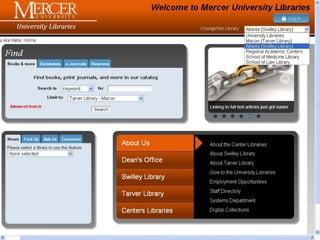
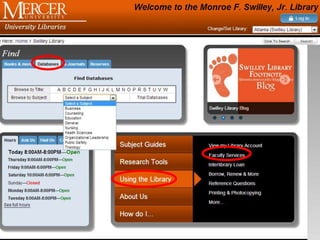
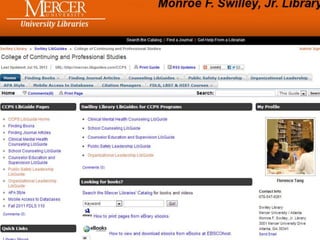
  • #22 The Swilley Librarians are very proud of their LibGuides. Each librarian creates their own webpages to guide students and faculty in library research for a particular subject area.You can get to them by clicking on Subjects Guides from the Swilley Library’s homepage.
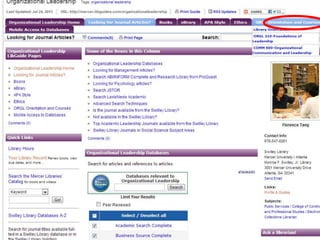
  • #23 Most of my LibGuides have a tab for “Looking for Journal Articles?”For each class that I give an instruction session for and have a syllabus for, I create a LibGuide.
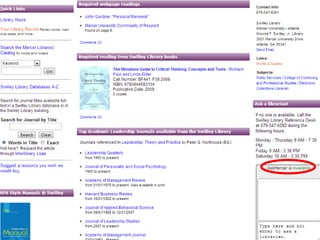
  • #24 I’ve heard that the best kept secret about libraries is instant messaging reference. If you use MSN, Yahoo! AOL or Google Hangouts for instant messaging you can add AskMercer as your friend or you can enter your question whenever you see one of these chat widgets, to chat with a librarian.
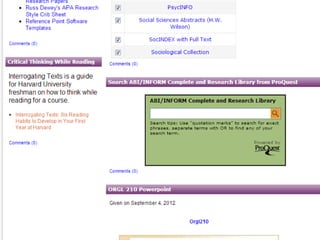
  • #26 We have LibGuides for EndNote and Zotero.Raise your hand if you’ve used EndNote or Zotero before?Use citation managers to import references from databases or the library catalog and use them to create footnotes and bibliographies in approximate APA Style 6th ed., (or almost any other style).It’s not foolproof so students will still have to know APA Style to correct the software’s mistakes.