Healthcare Supply Chainnovators, 2015:
Collaborative Models in Medical Devices
Rise to the Top
09 September 2015
G00290483
Analyst(s): Eric O'Daffer | Stephen Meyer | Dana Stiffler | Mark Atwood | Ken Chadwick |
Michael Burkett
Free preview of Gartner research
Summary
These awards recognize supply chain innovation initiatives that have increased efficiency,
improved patient care and reduced costs in healthcare. Supply chain leaders can make similar
improvements using the best practices of our Healthcare Supply Chainnovators: BJC
HealthCare and Medtronic.
Overview
Key Findings
 Collaboration was a key element for this year's winners. BJC HealthCare won for its
innovative partnership with Cardinal Health and Cook Medical while Medtronic was awarded
for its hospital solutions outsourcing model that helped its customers realize greater cath lab
efficiency.
 Innovation in the healthcare supply chain goes beyond product design or product choice.
Leaders focus on patient outcomes and bring efficiencies and alignment between trading
partners that have historically been elusive.
 Healthcare Supply Chainnovators submission themes included internal supply chain
excellence in demand planning, three-way collaborations among
manufacturer/distributor/provider and integrated delivery network (IDN) supply chain's
integration with clinical decision making at the point of care.
Recommendations
 Seek out and embrace scalable collaboration opportunities with select trading partners to
form value-added partnerships.
 Broaden your collaboration horizon beyond operational solutions to solve patient care
problem statements.
 Build an innovation team with a mission to deliver value beyond price and volume. Make
outside-in supply chain responsiveness a core competency.
 Segment your trading partners ruthlessly. Identify those who are both large enough and
have an advanced supply chain vision to invest time and resources in, which will impact
quality and cost of care.
Table of Contents
 Analysis
o BJC HealthCare
 How Chainnovation Was Achieved
 Chainnovation Value
o Medtronic
 How Chainnovation Was Achieved
 Chainnovation Value
o Looking Forward
 Gartner Recommended Reading
Figures
 Figure 1. Significant Waste in the Supply Chain
 Figure 2. End-to-End Supply Chain
 Figure 3. IHS Offerings Are Built on Four Pillars
 Figure 4. Delivering Economic Value to Client Partners
Analysis
Gartner's Healthcare Supply Chainnovators is a research and recognition program that
highlights the efforts of healthcare companies to drive better supply chain performance and
elevate the role of the supply chain. Our healthcare supply chain top 25 research recognizes
companies that achieve broad excellence, while Chainnovators recognizes great innovative
projects and high-impact approaches (see "The Healthcare Supply Chain Top 25 for 2014" ).
This research highlights Chainnovators in two healthcare categories:
 Providers
 Manufacturers, distributors or retailers
Gartner has three primary criteria for selection:
1. Demonstrate an innovative and collaborative approach to supply chain that is impactful,
measurable and sustainable.
2. Show how this initiative led to improved collaboration, financial performance or a large ROI
on a project, or an improved link to quality of care.
3. Share the details of how this impact was achieved (see Note 1 for the mission and
methodology of Gartner Supply Chainnovators).
We had a record number of submissions this year in both categories. Eleven healthcare
providers and six manufacturers submitted Chainnovations. The entries were diverse. They
ranged from internal improvements using demand sensing strategies to improve performance,
to new outsourced solutions on the manufacturing side. For healthcare providers, many
initiatives focused internally on reducing costs while reducing clinical variability.
In the manufacturer/distributor/retailer category, our 2015 Chainnovator is Medtronic. In the
provider category, we selected BJC HealthCare. In both categories, the winners used
groundbreaking, high-impact approaches to drive transformation in the healthcare industry
supply chain. This research shares the challenges they faced and the techniques they used to
achieve those results. The goal is to generate applied insights for the healthcare supply chain
community, which has historically struggled to balance day-to-day operations with efforts to
drive innovation and improvement. Although there could only be two winners, we were
impressed by all submissions received. The process of choosing winners was difficult because
of the high quality of the projects that were offered for our consideration
Gartner congratulates BJC HealthCare and Medtronic for their Chainnovations and recognizes
the work of all submitters. We look forward to recognizing further advancements in supply chain
efforts that help lower costs and improve patient care in 2016.
BJC HealthCare
How Chainnovation Was Achieved
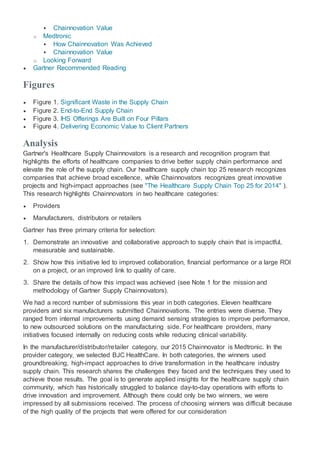
Historically, there has been little a healthcare provider could do in a medical device supply chain
to reduce the losses that directly impacted their bottom line in areas such as inventory holding
costs, order processing and expiration/obsolescence. Several studies, including Modern
Healthcare and GHX's study, estimate the losses total 10% to 30%, depending on which
implantable medical device supply chain was reviewed (see Figure 1).
Figure 1. Significant Waste in the Supply Chain
Source: BJC HealthCare
BJC HealthCare tackled these issues head on by piloting an innovative program for devices
used in the cath lab. This program involves signficant collaboration across the value chain from
clinical through provider supply chain, to a logistics partner in Cardinal Health and a
manufacturer partner in Cook Medical. The new process gives clinicians and hospital leadership
information around case cost, inventory and utilization. It also gives suppliers a real-time view of
inventory from point-of-use cabinets all the way to what is stocked in the central warehouse.
By consolidating inventory into one central location for the system, BJC is able to improve local
service, rely less on supply chain activity by sales representatives holding product in their
vehicles and reduce system cost of holding excess inventory. Figure 2 illustrates how the
manufacturer (Cook Medical) ships into the central warehouse (run by Cardinal Health), which
then serves each individual point of care. RFID technology provided by Cardinal Health's
WaveMark solution is tagged on each product and read at each stop in the supply chain so the
organization can better collectively manage the process.
The demand signal begins with a point-of-use scan tied to the electronic medical record (EMR)
and then cascades through the ERP and EMR systems allowing for improvements that enable
transitions and outcomes (see Table 1).
Figure 2. End-to-End Supply Chain
Source: BJC HealthCare
Table 1. Transitions and Outcomes
Transition Outcome
Manual to Automated Orders and Implant logs are both keyed off an RFID scan of the
product
Decentralized to
Centralized
Bulk inventory is kept centrally and only sent to the sites when
needed via the leveraged logistics infrastructure provided by
Cardinal
Transactional to
Collaborative Supplier
Relationships
Allows for a more strategic supplier discussion and improved
trading partner relationship enabled by centralized service model
and better access to a demand signal
Siloed Views Toward More
Transparency
Visibility is improved to all stakeholders from clinicians to supply
chain to suppliers
Source: Gartner (September 2015)
Chainnovation Value
This three way collaboration allowed BJC HealthCare to demonstrate a return to justify a $10
million investment to expand the program to other areas of implantable medical devices. That
return was based on the following results:
 23% average periodic automatic replenishment (PAR) reduction of inventory at the hospitals
 17% SKU reduction across the system
 $30,000 reduction in expired product write-offs
 $400,000 consignment savings for Cook
 $0 in expedited freight costs (BJC, Cook & Cardinal Health) for the pilot program
 $0 in expired product in the last 9 months (distributed, BJC owned & consigned)
 Increased clinician time to work on patient care and less on supply chain issues
 Eliminated supply chain activity for the manufacturing sales representative
 Allowed a focus on clinical activity to achieve mutual utilization goals
Medtronic
How Chainnovation Was Achieved
Medtronic's Chainnovation demonstrated substantial progress in understanding and addressing
the challenges IDNs experience in consistently managing patient care cost-effectively in the
cardiac services/cath lab. The medical device maker developed its Integrated Health Solutions
(IHS) group to manage hospital cath labs to create cost savings and improve patient outcomes.
The model scales depending on the level of service outsourced to Medtronic. The company may
design and install a new lab, finance equipment, manage the lab and help grow the business.
The IHS entity is manufacturer-agnostic, and procures equipment and material of clinical choice
and preference.
Analytics tools manage physician behavior and show information such as lengths of stay and
infection rates.
The partnership includes help with buying the right equipment and product, using it effectively,
managing inventory and reducing cost of supplies. It also includes services to optimize
operational efficiencies and clinical outcomes by incorporating best-practices developed across
IHS network of centers under managed services. The partnership also incorporates services to
drive business growth and improve patient access to care.
This more collaborative relationship with providers was a groundbreaking move. Manufacturers
traditionally focused on selling the product, which is a major part of the procedure cost, rather
than end-to-end service that helps the healthcare provider with issues beyond
procurement/sourcing. The broader focus adapts to the changing revenue models at healthcare
providers and brings the scale and breadth of Medtronic solutions closer to the patient.
This Supply Chainnovation is in line with Gartner's research that indicates customers are
looking for a solution to problems versus just a product that comes in a box. These solutions
can be supply chain led but should not stop at solving operational challenges. The IHS Group
development demonstrates a leading collaboration capability at a medical device manufacturer.
It qualifies in the strategic partner realm of Gartner's collaboration in healthcare research (see
"Best Practices: Segmenting Collaborative Relationships in the Healthcare Value Chain" ).
IHS also embodies the patient-driven value network (PDVN) maturity model through the
implications of its solution on ways that directly impact the outcomes, cost and quality aligned to
the demand signal — revenue (see "Introducing the Patient-Driven Value Network Model for
IDN Supply Chain" ). Few healthcare provider supply chain leaders think about the upstream
revenue and patient care implications of their decisions, and even fewer manufacturers break
through this transparency barrier in healthcare.
Chainnovation Value
By acknowledging the key areas to be addressed by the partnership, Medtronic takes a leap
forward here in addressing core issues in these four areas:
 Growth:
o Increasing revenue, driven by improved patient recruitment
o Optimizing referral network
o Securing superior patient experience and satisfaction
 Operational efficiency:
o Increasing patient throughput
o Reducing cost of nonphysician staff
o Reducing cost of consumables and supplies
 Patient outcomes:
o Reducing re-admissions by assuming risk, reducing hospital infection rates and better
interpretation of data
o Reducing medical errors
o Interpreting data to improve patient outcomes
 Capital efficiency: Financing of capital equipment
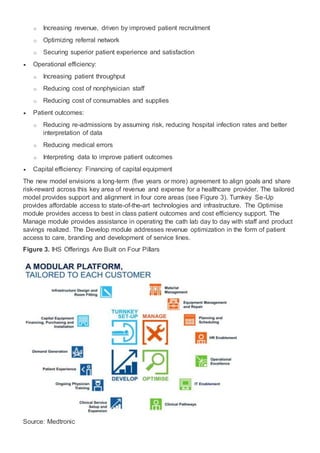
The new model envisions a long-term (five years or more) agreement to align goals and share
risk-reward across this key area of revenue and expense for a healthcare provider. The tailored
model provides support and alignment in four core areas (see Figure 3). Turnkey Se-Up
provides affordable access to state-of-the-art technologies and infrastructure. The Optimise
module provides access to best in class patient outcomes and cost efficiency support. The
Manage module provides assistance in operating the cath lab day to day with staff and product
savings realized. The Develop module addresses revenue optimization in the form of patient
access to care, branding and development of service lines.
Figure 3. IHS Offerings Are Built on Four Pillars
Source: Medtronic
Medtronic's IHS group creates the potential for the elusive win-win partnership. Medtronic gets a
long-term and predictable revenue flow and the ability to differentiate the company from its
competitors. The company gets a direct relationship with the customer in channels where there
are dealers and has the ability to create a reward structure (and a risk structure) for delivering
benefits to its IDN customer. Provider partners get access to capital and a risk-sharing
manufacturing partner aligned with their goal of lowering the per cost case while growing the
business.
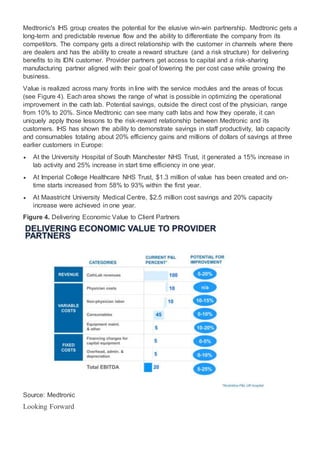
Value is realized across many fronts in line with the service modules and the areas of focus
(see Figure 4). Each area shows the range of what is possible in optimizing the operational
improvement in the cath lab. Potential savings, outside the direct cost of the physician, range
from 10% to 20%. Since Medtronic can see many cath labs and how they operate, it can
uniquely apply those lessons to the risk-reward relationship between Medtronic and its
customers. IHS has shown the ability to demonstrate savings in staff productivity, lab capacity
and consumables totaling about 20% efficiency gains and millions of dollars of savings at three
earlier customers in Europe:
 At the University Hospital of South Manchester NHS Trust, it generated a 15% increase in
lab activity and 25% increase in start time efficiency in one year.
 At Imperial College Healthcare NHS Trust, $1.3 million of value has been created and on-
time starts increased from 58% to 93% within the first year.
 At Maastricht University Medical Centre, $2.5 million cost savings and 20% capacity
increase were achieved in one year.
Figure 4. Delivering Economic Value to Client Partners
Source: Medtronic
Looking Forward
Based on work happening in the field today, we expect an acceleration of innovation and
collaboration in the next few years. We look forward to recognizing these innovations that
improve patient care and lower costs through supply chain again in 2016.
Gartner Recommended Reading
Some documents may not be available as part of your current Gartner subscription.
"The Healthcare Supply Chain Top 25 for 2014"
"Healthcare Supply Chainnovators, 2014: Fresh Approaches to Major Challenges"
"2015 Gartner Supply Chain Top 25: Life Sciences"
"Now Is the Time for IDNs to Build Patient-Outcome-Driven Supply Chains"
"Catalysts for Supply Chain Transformation"
"Assess Your Supply Chain Maturity Using the Seven Dimensions of DDVN Excellence"
Note 1
Mission and Methodology of Gartner Supply Chainnovators
Gartner Healthcare Supply Chainnovators launched in 2014 as a research and recognition
platform for supply chain organizations in healthcare across manufacturers, distributors,
providers and retailers. Supply chain leaders in these companies often wear three hats —
operations, strategy and transformation — and resources are stretched very thin, making step-
level change challenging. Companies recognized as Healthcare Supply Chainnovators have
been successful with unconventional, innovative and/or high-impact approaches that peer
leaders can learn from and emulate. The program provides chief supply chain officers with
valuable insight for annual strategic planning, resource allocation and investment cycles. For the
Chainnovator, formal recognition helps demonstrate major impacts internally and externally, and
serves as a beacon for attracting supply chain talent and hopefully inspires further innovation.
Healthcare Chainnovator nominees are uncovered through submissions made to the Healthcare
Supply Chainnovator team of analysts. Analysts vet the Chainnovations on a 10-point rubric in
five key categories of innovation, impact, sustainability, patient outcomes focus and
collaboration. Two other main characteristics are that they:
 Demonstrate above-average financial performance, large ROI on a project or a major
turnaround
 Are willing to share details on how this was achieved
Companies recognized as Healthcare Supply Chainnovators are invited to participate in the
Chainnovators panel at Gartner's annual Supply Chain Executive Conference in May.

Gartner supply chainnovators 2015

  • 1.
    Healthcare Supply Chainnovators,2015: Collaborative Models in Medical Devices Rise to the Top 09 September 2015 G00290483 Analyst(s): Eric O'Daffer | Stephen Meyer | Dana Stiffler | Mark Atwood | Ken Chadwick | Michael Burkett Free preview of Gartner research Summary These awards recognize supply chain innovation initiatives that have increased efficiency, improved patient care and reduced costs in healthcare. Supply chain leaders can make similar improvements using the best practices of our Healthcare Supply Chainnovators: BJC HealthCare and Medtronic. Overview Key Findings  Collaboration was a key element for this year's winners. BJC HealthCare won for its innovative partnership with Cardinal Health and Cook Medical while Medtronic was awarded for its hospital solutions outsourcing model that helped its customers realize greater cath lab efficiency.  Innovation in the healthcare supply chain goes beyond product design or product choice. Leaders focus on patient outcomes and bring efficiencies and alignment between trading partners that have historically been elusive.  Healthcare Supply Chainnovators submission themes included internal supply chain excellence in demand planning, three-way collaborations among manufacturer/distributor/provider and integrated delivery network (IDN) supply chain's integration with clinical decision making at the point of care. Recommendations  Seek out and embrace scalable collaboration opportunities with select trading partners to form value-added partnerships.  Broaden your collaboration horizon beyond operational solutions to solve patient care problem statements.  Build an innovation team with a mission to deliver value beyond price and volume. Make outside-in supply chain responsiveness a core competency.  Segment your trading partners ruthlessly. Identify those who are both large enough and have an advanced supply chain vision to invest time and resources in, which will impact quality and cost of care. Table of Contents  Analysis o BJC HealthCare  How Chainnovation Was Achieved
  • 2.
     Chainnovation Value oMedtronic  How Chainnovation Was Achieved  Chainnovation Value o Looking Forward  Gartner Recommended Reading Figures  Figure 1. Significant Waste in the Supply Chain  Figure 2. End-to-End Supply Chain  Figure 3. IHS Offerings Are Built on Four Pillars  Figure 4. Delivering Economic Value to Client Partners Analysis Gartner's Healthcare Supply Chainnovators is a research and recognition program that highlights the efforts of healthcare companies to drive better supply chain performance and elevate the role of the supply chain. Our healthcare supply chain top 25 research recognizes companies that achieve broad excellence, while Chainnovators recognizes great innovative projects and high-impact approaches (see "The Healthcare Supply Chain Top 25 for 2014" ). This research highlights Chainnovators in two healthcare categories:  Providers  Manufacturers, distributors or retailers Gartner has three primary criteria for selection: 1. Demonstrate an innovative and collaborative approach to supply chain that is impactful, measurable and sustainable. 2. Show how this initiative led to improved collaboration, financial performance or a large ROI on a project, or an improved link to quality of care. 3. Share the details of how this impact was achieved (see Note 1 for the mission and methodology of Gartner Supply Chainnovators). We had a record number of submissions this year in both categories. Eleven healthcare providers and six manufacturers submitted Chainnovations. The entries were diverse. They ranged from internal improvements using demand sensing strategies to improve performance, to new outsourced solutions on the manufacturing side. For healthcare providers, many initiatives focused internally on reducing costs while reducing clinical variability. In the manufacturer/distributor/retailer category, our 2015 Chainnovator is Medtronic. In the provider category, we selected BJC HealthCare. In both categories, the winners used groundbreaking, high-impact approaches to drive transformation in the healthcare industry supply chain. This research shares the challenges they faced and the techniques they used to achieve those results. The goal is to generate applied insights for the healthcare supply chain community, which has historically struggled to balance day-to-day operations with efforts to drive innovation and improvement. Although there could only be two winners, we were impressed by all submissions received. The process of choosing winners was difficult because of the high quality of the projects that were offered for our consideration
  • 3.
    Gartner congratulates BJCHealthCare and Medtronic for their Chainnovations and recognizes the work of all submitters. We look forward to recognizing further advancements in supply chain efforts that help lower costs and improve patient care in 2016. BJC HealthCare How Chainnovation Was Achieved Historically, there has been little a healthcare provider could do in a medical device supply chain to reduce the losses that directly impacted their bottom line in areas such as inventory holding costs, order processing and expiration/obsolescence. Several studies, including Modern Healthcare and GHX's study, estimate the losses total 10% to 30%, depending on which implantable medical device supply chain was reviewed (see Figure 1). Figure 1. Significant Waste in the Supply Chain Source: BJC HealthCare BJC HealthCare tackled these issues head on by piloting an innovative program for devices used in the cath lab. This program involves signficant collaboration across the value chain from clinical through provider supply chain, to a logistics partner in Cardinal Health and a manufacturer partner in Cook Medical. The new process gives clinicians and hospital leadership information around case cost, inventory and utilization. It also gives suppliers a real-time view of inventory from point-of-use cabinets all the way to what is stocked in the central warehouse. By consolidating inventory into one central location for the system, BJC is able to improve local service, rely less on supply chain activity by sales representatives holding product in their vehicles and reduce system cost of holding excess inventory. Figure 2 illustrates how the manufacturer (Cook Medical) ships into the central warehouse (run by Cardinal Health), which then serves each individual point of care. RFID technology provided by Cardinal Health's WaveMark solution is tagged on each product and read at each stop in the supply chain so the organization can better collectively manage the process. The demand signal begins with a point-of-use scan tied to the electronic medical record (EMR) and then cascades through the ERP and EMR systems allowing for improvements that enable transitions and outcomes (see Table 1).
  • 4.
    Figure 2. End-to-EndSupply Chain Source: BJC HealthCare Table 1. Transitions and Outcomes Transition Outcome Manual to Automated Orders and Implant logs are both keyed off an RFID scan of the product Decentralized to Centralized Bulk inventory is kept centrally and only sent to the sites when needed via the leveraged logistics infrastructure provided by Cardinal Transactional to Collaborative Supplier Relationships Allows for a more strategic supplier discussion and improved trading partner relationship enabled by centralized service model and better access to a demand signal Siloed Views Toward More Transparency Visibility is improved to all stakeholders from clinicians to supply chain to suppliers Source: Gartner (September 2015) Chainnovation Value This three way collaboration allowed BJC HealthCare to demonstrate a return to justify a $10 million investment to expand the program to other areas of implantable medical devices. That return was based on the following results:  23% average periodic automatic replenishment (PAR) reduction of inventory at the hospitals  17% SKU reduction across the system  $30,000 reduction in expired product write-offs  $400,000 consignment savings for Cook
  • 5.
     $0 inexpedited freight costs (BJC, Cook & Cardinal Health) for the pilot program  $0 in expired product in the last 9 months (distributed, BJC owned & consigned)  Increased clinician time to work on patient care and less on supply chain issues  Eliminated supply chain activity for the manufacturing sales representative  Allowed a focus on clinical activity to achieve mutual utilization goals Medtronic How Chainnovation Was Achieved Medtronic's Chainnovation demonstrated substantial progress in understanding and addressing the challenges IDNs experience in consistently managing patient care cost-effectively in the cardiac services/cath lab. The medical device maker developed its Integrated Health Solutions (IHS) group to manage hospital cath labs to create cost savings and improve patient outcomes. The model scales depending on the level of service outsourced to Medtronic. The company may design and install a new lab, finance equipment, manage the lab and help grow the business. The IHS entity is manufacturer-agnostic, and procures equipment and material of clinical choice and preference. Analytics tools manage physician behavior and show information such as lengths of stay and infection rates. The partnership includes help with buying the right equipment and product, using it effectively, managing inventory and reducing cost of supplies. It also includes services to optimize operational efficiencies and clinical outcomes by incorporating best-practices developed across IHS network of centers under managed services. The partnership also incorporates services to drive business growth and improve patient access to care. This more collaborative relationship with providers was a groundbreaking move. Manufacturers traditionally focused on selling the product, which is a major part of the procedure cost, rather than end-to-end service that helps the healthcare provider with issues beyond procurement/sourcing. The broader focus adapts to the changing revenue models at healthcare providers and brings the scale and breadth of Medtronic solutions closer to the patient. This Supply Chainnovation is in line with Gartner's research that indicates customers are looking for a solution to problems versus just a product that comes in a box. These solutions can be supply chain led but should not stop at solving operational challenges. The IHS Group development demonstrates a leading collaboration capability at a medical device manufacturer. It qualifies in the strategic partner realm of Gartner's collaboration in healthcare research (see "Best Practices: Segmenting Collaborative Relationships in the Healthcare Value Chain" ). IHS also embodies the patient-driven value network (PDVN) maturity model through the implications of its solution on ways that directly impact the outcomes, cost and quality aligned to the demand signal — revenue (see "Introducing the Patient-Driven Value Network Model for IDN Supply Chain" ). Few healthcare provider supply chain leaders think about the upstream revenue and patient care implications of their decisions, and even fewer manufacturers break through this transparency barrier in healthcare. Chainnovation Value By acknowledging the key areas to be addressed by the partnership, Medtronic takes a leap forward here in addressing core issues in these four areas:  Growth:
  • 6.
    o Increasing revenue,driven by improved patient recruitment o Optimizing referral network o Securing superior patient experience and satisfaction  Operational efficiency: o Increasing patient throughput o Reducing cost of nonphysician staff o Reducing cost of consumables and supplies  Patient outcomes: o Reducing re-admissions by assuming risk, reducing hospital infection rates and better interpretation of data o Reducing medical errors o Interpreting data to improve patient outcomes  Capital efficiency: Financing of capital equipment The new model envisions a long-term (five years or more) agreement to align goals and share risk-reward across this key area of revenue and expense for a healthcare provider. The tailored model provides support and alignment in four core areas (see Figure 3). Turnkey Se-Up provides affordable access to state-of-the-art technologies and infrastructure. The Optimise module provides access to best in class patient outcomes and cost efficiency support. The Manage module provides assistance in operating the cath lab day to day with staff and product savings realized. The Develop module addresses revenue optimization in the form of patient access to care, branding and development of service lines. Figure 3. IHS Offerings Are Built on Four Pillars Source: Medtronic
  • 7.
    Medtronic's IHS groupcreates the potential for the elusive win-win partnership. Medtronic gets a long-term and predictable revenue flow and the ability to differentiate the company from its competitors. The company gets a direct relationship with the customer in channels where there are dealers and has the ability to create a reward structure (and a risk structure) for delivering benefits to its IDN customer. Provider partners get access to capital and a risk-sharing manufacturing partner aligned with their goal of lowering the per cost case while growing the business. Value is realized across many fronts in line with the service modules and the areas of focus (see Figure 4). Each area shows the range of what is possible in optimizing the operational improvement in the cath lab. Potential savings, outside the direct cost of the physician, range from 10% to 20%. Since Medtronic can see many cath labs and how they operate, it can uniquely apply those lessons to the risk-reward relationship between Medtronic and its customers. IHS has shown the ability to demonstrate savings in staff productivity, lab capacity and consumables totaling about 20% efficiency gains and millions of dollars of savings at three earlier customers in Europe:  At the University Hospital of South Manchester NHS Trust, it generated a 15% increase in lab activity and 25% increase in start time efficiency in one year.  At Imperial College Healthcare NHS Trust, $1.3 million of value has been created and on- time starts increased from 58% to 93% within the first year.  At Maastricht University Medical Centre, $2.5 million cost savings and 20% capacity increase were achieved in one year. Figure 4. Delivering Economic Value to Client Partners Source: Medtronic Looking Forward
  • 8.
    Based on workhappening in the field today, we expect an acceleration of innovation and collaboration in the next few years. We look forward to recognizing these innovations that improve patient care and lower costs through supply chain again in 2016. Gartner Recommended Reading Some documents may not be available as part of your current Gartner subscription. "The Healthcare Supply Chain Top 25 for 2014" "Healthcare Supply Chainnovators, 2014: Fresh Approaches to Major Challenges" "2015 Gartner Supply Chain Top 25: Life Sciences" "Now Is the Time for IDNs to Build Patient-Outcome-Driven Supply Chains" "Catalysts for Supply Chain Transformation" "Assess Your Supply Chain Maturity Using the Seven Dimensions of DDVN Excellence" Note 1 Mission and Methodology of Gartner Supply Chainnovators Gartner Healthcare Supply Chainnovators launched in 2014 as a research and recognition platform for supply chain organizations in healthcare across manufacturers, distributors, providers and retailers. Supply chain leaders in these companies often wear three hats — operations, strategy and transformation — and resources are stretched very thin, making step- level change challenging. Companies recognized as Healthcare Supply Chainnovators have been successful with unconventional, innovative and/or high-impact approaches that peer leaders can learn from and emulate. The program provides chief supply chain officers with valuable insight for annual strategic planning, resource allocation and investment cycles. For the Chainnovator, formal recognition helps demonstrate major impacts internally and externally, and serves as a beacon for attracting supply chain talent and hopefully inspires further innovation. Healthcare Chainnovator nominees are uncovered through submissions made to the Healthcare Supply Chainnovator team of analysts. Analysts vet the Chainnovations on a 10-point rubric in five key categories of innovation, impact, sustainability, patient outcomes focus and collaboration. Two other main characteristics are that they:  Demonstrate above-average financial performance, large ROI on a project or a major turnaround  Are willing to share details on how this was achieved Companies recognized as Healthcare Supply Chainnovators are invited to participate in the Chainnovators panel at Gartner's annual Supply Chain Executive Conference in May.