Soozie Bea
Networker, Explorer & Trainer
Ex Post-Grad Education
[ME.Prim & GDE.Sec] curriculum writer,
facilitator, & ed tech lecturer
KISS!
Keep It Simple (for) Students
“Tools should never get
in the way of the Learning;
make the technology assist.”
Why Run a Lab
How to Run a Lab
Activity
What
So What
Now What
Learning Skills
Assessing a Lab
Goals for today
Why Run a Lab?
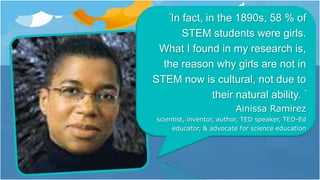
“In fact, in the 1890s, 58 % of
STEM students were girls.
What I found in my research is,
the reason why girls are not in
STEM now is cultural, not due to
their natural ability. ”
Ainissa Ramirez
scientist, inventor, author, TED speaker, TED-Ed
educator, & advocate for science education
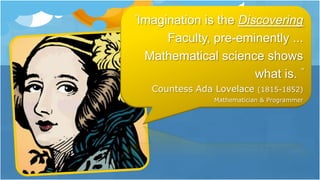
“Imagination is the Discovering
Faculty, pre-eminently ...
Mathematical science shows
what is. ”
Countess Ada Lovelace (1815-1852)
Mathematician & Programmer
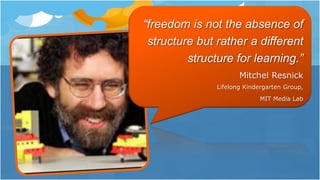
“freedom is not the absence of
structure but rather a different
structure for learning.”
Mitchel Resnick
Lifelong Kindergarten Group,
MIT Media Lab
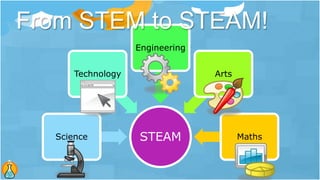
STEAMScience
Technology
Engineering
Arts
Maths
From STEM to STEAM!
How to Run a Lab
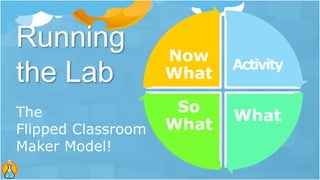
Activity
What
So
What
Now
What
Running
the Lab
The
Flipped Classroom
Maker Model!
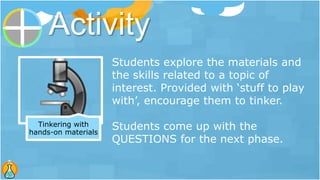
Activity
Tinkering with
hands-on materials
Students explore the materials and
the skills related to a topic of
interest. Provided with ‘stuff to play
with’, encourage them to tinker.
Students come up with the
QUESTIONS for the next phase.
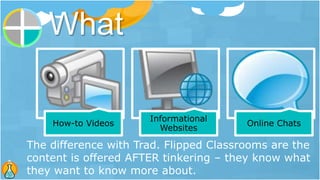
What
How-to Videos
Informational
Websites
Online Chats
The difference with Trad. Flipped Classrooms are the
content is offered AFTER tinkering – they know what
they want to know more about.
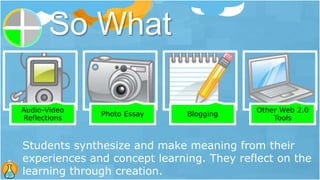
Audio-Video
Reflections
Photo Essay Blogging
Other Web 2.0
Tools
Students synthesize and make meaning from their
experiences and concept learning. They reflect on the
learning through creation.
So What
Demonstration &
Application
Students present their work
through instructional videos to
teach others, a performance or live
demonstration to an audience.
Now What
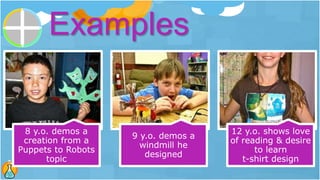
8 y.o. demos a
creation from a
Puppets to Robots
topic
9 y.o. demos a
windmill he
designed
12 y.o. shows love
of reading & desire
to learn
t-shirt design
Examples
Think of as many uses
as you can for each of
the following: a paper
clip, a blanket, a brick.
In what other plausible
ways could
Shakespeare have
ended Romeo and
Juliet?
If you saw an alien,
how could you
communicate that you
mean it no harm?
What criteria would
you use to determine if
an artistic painting is
of high quality?
Think of as many
principles of physics
you could investigate
using each of the
following: a paper clip,
a blanket, a brick.
What common
household objects
could you use to make
pond water drinkable?
What criteria would
you use to select the
most aesthetic of
several different (and
safe) bridge designs?
STEAM Ideas

Creating & evaluating a learning lab draft one

  • 2.
    Soozie Bea Networker, Explorer& Trainer Ex Post-Grad Education [ME.Prim & GDE.Sec] curriculum writer, facilitator, & ed tech lecturer KISS! Keep It Simple (for) Students “Tools should never get in the way of the Learning; make the technology assist.”
  • 3.
    Why Run aLab How to Run a Lab Activity What So What Now What Learning Skills Assessing a Lab Goals for today
  • 4.
  • 5.
    “In fact, inthe 1890s, 58 % of STEM students were girls. What I found in my research is, the reason why girls are not in STEM now is cultural, not due to their natural ability. ” Ainissa Ramirez scientist, inventor, author, TED speaker, TED-Ed educator, & advocate for science education
  • 6.
    “Imagination is theDiscovering Faculty, pre-eminently ... Mathematical science shows what is. ” Countess Ada Lovelace (1815-1852) Mathematician & Programmer
  • 7.
    “freedom is notthe absence of structure but rather a different structure for learning.” Mitchel Resnick Lifelong Kindergarten Group, MIT Media Lab
  • 8.
  • 9.
  • 10.
  • 11.
    Activity Tinkering with hands-on materials Studentsexplore the materials and the skills related to a topic of interest. Provided with ‘stuff to play with’, encourage them to tinker. Students come up with the QUESTIONS for the next phase.
  • 12.
    What How-to Videos Informational Websites Online Chats Thedifference with Trad. Flipped Classrooms are the content is offered AFTER tinkering – they know what they want to know more about.
  • 13.
    Audio-Video Reflections Photo Essay Blogging OtherWeb 2.0 Tools Students synthesize and make meaning from their experiences and concept learning. They reflect on the learning through creation. So What
  • 14.
    Demonstration & Application Students presenttheir work through instructional videos to teach others, a performance or live demonstration to an audience. Now What
  • 15.
    8 y.o. demosa creation from a Puppets to Robots topic 9 y.o. demos a windmill he designed 12 y.o. shows love of reading & desire to learn t-shirt design Examples
  • 16.
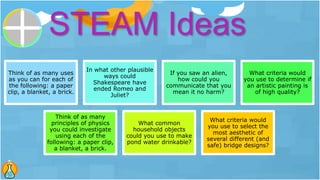
    Think of asmany uses as you can for each of the following: a paper clip, a blanket, a brick. In what other plausible ways could Shakespeare have ended Romeo and Juliet? If you saw an alien, how could you communicate that you mean it no harm? What criteria would you use to determine if an artistic painting is of high quality? Think of as many principles of physics you could investigate using each of the following: a paper clip, a blanket, a brick. What common household objects could you use to make pond water drinkable? What criteria would you use to select the most aesthetic of several different (and safe) bridge designs? STEAM Ideas

Editor's Notes

  • #2 Today we'll look at how to include student-centred, flipped learning to teach not only the content, but the learning, organisational & study skills necessary for life-long learning – BY GETTING INTO ‘MAKER’ ED
  • #3 Kid-Learning for AdultsEx-Tertiary School of EdEx-L&D MgrSTILL consultant & trainer – networking mutantADHD (Squirrel-brained)Possible mild AspergersMORE PEOPLE LIKE ME COMING!
  • #6 Girls NEED STEM
  • #7 The emphasis is on collaboration, multi-disciplinary learning, creating things and student empowerment, encouraging risk-taking and trial & error, and intrinsic motivation.
  • #8 The emphasis is on collaboration, multi-disciplinary learning, creating things and student empowerment, encouraging risk-taking and trial & error, and intrinsic motivation.
  • #11 So what’s all the buzz about “Making”? Making is creative, innovative, inventive, collaborative, resourceful and empowering. as the popularity of Making increases, so does the interest in introducing youth to the magic of Making. People are taking note and the benefits of Maker programs for youth are being acknowledged by community organizations, educators, parents, and most importantly, the youth who are already actively involved. Heavy on the STEMHands-on is key. offer children the opportunity to build, make and create. Children make something (design process) versus doing experiments (scientific process). Programs can follow a set of planned activities, but should encourage trial and error and allow for individual creativity and experimentation. Children own their creations. When a project is completed, kids should be able to take their project home. Programs should be long enough in duration that children can immerse themselves and result in a meaningful experience. Make sharing of ideas, projects, skills and knowledge an integral part of the program. an in-school program, offered in 40-minute blocks once a week.