Sales training
What Is Selling?
What is selling?
• Selling Process
• Selling Types
• Selling Skills
Selling Process
• Selling is a process rather than action
• Consists of number of steps
• Every step needs planning
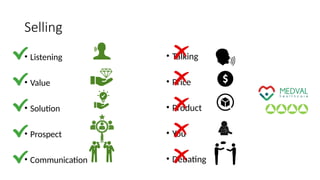
Selling
• Listening
• Value
• Solution
• Prospect
• Communication
• Talking
• Price
• Product
• You
• Debating
Selling Process
• Prospecting
• Qualifying
• Presentation
• Closing
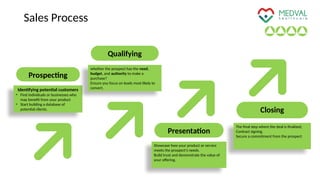
Identifying potential customers
• Find individuals or businesses who
may benefit from your product
• Start building a database of
potential clients.
Prospecting
whether the prospect has the need,
budget, and authority to make a
purchase?
Ensure you focus on leads most likely to
convert.
Qualifying
Showcase how your product or service
meets the prospect’s needs.
Build trust and demonstrate the value of
your offering.
Presentation
The final step where the deal is finalized,
Contract signing.
Secure a commitment from the prospect
Closing
Sales Process
Prospecting
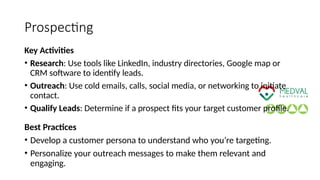
Key Activities
• Research: Use tools like LinkedIn, industry directories, Google map or
CRM software to identify leads.
• Outreach: Use cold emails, calls, social media, or networking to initiate
contact.
• Qualify Leads: Determine if a prospect fits your target customer profile.
Best Practices
• Develop a customer persona to understand who you’re targeting.
• Personalize your outreach messages to make them relevant and
engaging.
Qualifying
Key Activities
• Discovery Questions: Ask open-ended questions to understand the prospect's needs,
challenges, and decision-making process.
• Examples:
• "What challenges are you currently facing in [specific area]?"
• "Who is involved in the decision-making process for purchases like this?"
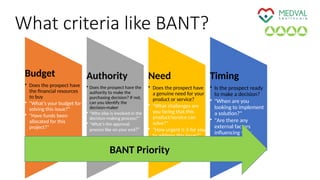
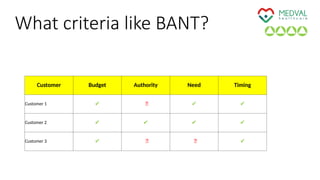
• Assess Fit: Use criteria like BANT (Budget, Authority, Need, Timing) to qualify prospects.
Best Practices
• Listen more than you talk.
• Be honest about whether your solution is a good fit.
Budget
• Does the prospect have
the financial resources
to buy
• "What’s your budget for
solving this issue?"
• "Have funds been
allocated for this
project?"
Authority
• Does the prospect have the
authority to make the
purchasing decision? If not,
can you identify the
decision-maker
• "Who else is involved in the
decision-making process?"
• "What’s the approval
process like on your end?"
Need
• Does the prospect have
a genuine need for your
product or service?
• "What challenges are
you facing that this
product/service can
solve?"
• "How urgent is it for you
to address this issue?"
Timing
• Is the prospect ready
to make a decision?
• "When are you
looking to implement
a solution?"
• "Are there any
external factors
influencing your
timeline?"
What criteria like BANT?
BANT Priority
What criteria like BANT?
Customer Budget Authority Need Timing
Customer 1 ✔ ❌ ✔ ✔
Customer 2 ✔ ✔ ✔ ✔
Customer 3 ✔ ❌ ❌ ✔
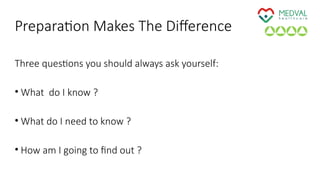
Preparation Makes The Difference
Three questions you should always ask yourself:
• What do I know ?
• What do I need to know ?
• How am I going to find out ?
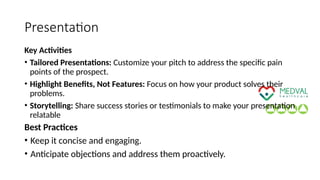
Presentation
Key Activities
• Tailored Presentations: Customize your pitch to address the specific pain
points of the prospect.
• Highlight Benefits, Not Features: Focus on how your product solves their
problems.
• Storytelling: Share success stories or testimonials to make your presentation
relatable
Best Practices
• Keep it concise and engaging.
• Anticipate objections and address them proactively.
Closing
Key Activities
• Summarize Value: Reiterate how your solution meets their needs.
• Use Closing Techniques:
• Assumptive Close: "When should we schedule delivery?"
• Urgency Close: "This offer is valid until [date]."
• Handle Objections: Address any last-minute concerns with empathy and
confidence.
Best Practices
• Look for buying signals, such as positive responses or detailed
questions.
• Always follow up if the decision isn’t made immediately.
SELLING TYPES
B2B Vs B2C
• B2B (Business-to-Business)
• B2C (Business-to-Consumer)
sales is essential, as each approach requires distinct strategies.
• B2B: Relationship-driven, logical, complex, and long-term.
• B2C: Emotion-driven, fast-paced, and focused on personal benefits
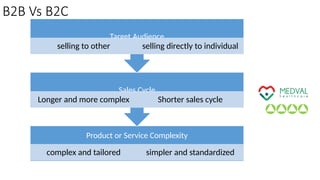
B2B Vs B2C
Product or Service Complexity
complex and tailored simpler and standardized
Sales Cycle
Longer and more complex Shorter sales cycle
Target Audience
selling to other selling directly to individual
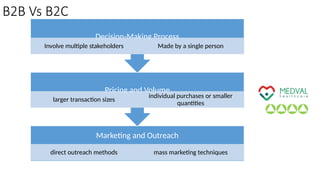
Marketing and Outreach
direct outreach methods mass marketing techniques
Pricing and Volume
larger transaction sizes
individual purchases or smaller
quantities
Decision-Making Process
Involve multiple stakeholders Made by a single person
B2B Vs B2C
Reach Marketing Strategy
• ATL
• BTL
• TTL
Selling Channels
• Direct sales
• Re-seller
• Store
• Online
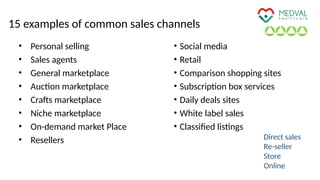
15 examples of common sales channels
• Personal selling
• Sales agents
• General marketplace
• Auction marketplace
• Crafts marketplace
• Niche marketplace
• On-demand market Place
• Resellers
• Social media
• Retail
• Comparison shopping sites
• Subscription box services
• Daily deals sites
• White label sales
• Classified listings
Direct sales
Re-seller
Store
Online
SELLING SKILLS
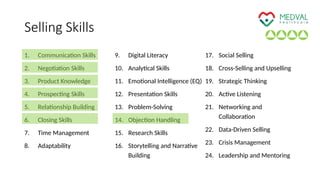
Selling Skills
1. Communication Skills
2. Negotiation Skills
3. Product Knowledge
4. Prospecting Skills
5. Relationship Building
6. Closing Skills
7. Time Management
8. Adaptability
9. Digital Literacy
10. Analytical Skills
11. Emotional Intelligence (EQ)
12. Presentation Skills
13. Problem-Solving
14. Objection Handling
15. Research Skills
16. Storytelling and Narrative
Building
17. Social Selling
18. Cross-Selling and Upselling
19. Strategic Thinking
20. Active Listening
21. Networking and
Collaboration
22. Data-Driven Selling
23. Crisis Management
24. Leadership and Mentoring
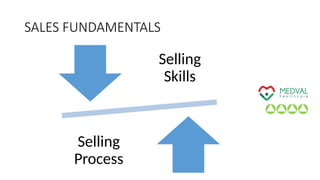
SALES FUNDAMENTALS
Selling
Skills
Selling
Process
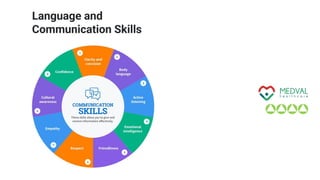
Communication Skills
• What to Say and Not to Say
1. Mindray…
oWe are Medval agent of Mindray in the IVD products
oHighlight our Own Identity
Communication Skills
• What to Say and Not to Say
2. Highest Quality and Best Customer Service
• There are many things sales recruiters and reps promise when trying to
close a deal.
• Saying they have the highest quality product is common.
• But can you prove it? Don’t communicate you have the highest quality if you don’t
have the research to back it up.
• Avoid saying you have the best customer service unless you are willing to
back it up. Have proof ready
o such as customer testimonials
o case studies.
Communication Skills
• What to Say and Not to Say
3. I’m Not Here to Make Money…
• Yes, you are. We all are.
• Everyone is doing their job for the money, so don’t pretend you are
only doing sales to help people.
• No one believes this statement, and you will only risk the trust you
built with a prospect if you use statements like this.
Communication Skills
• What to Say and Not to Say
4. Competitors’ name…
oWe only say it is competitor
oWe only mention Our name and brand
Communication Skills
• What to Say and Not to Say
5. Are You the Main Decision Maker?
• Asking the question directly can lead to a number of undesirable responses:
• Ask the question in a better way to get the answer you want –
o who the actual decision makers are?
o Who is part of the decision-making process?
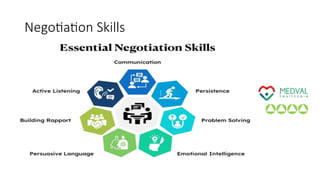
Negotiation Skills
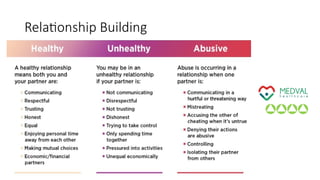
Relationship Building
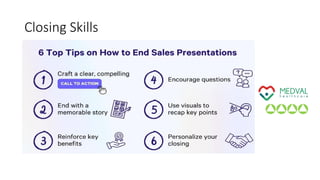
Closing Skills
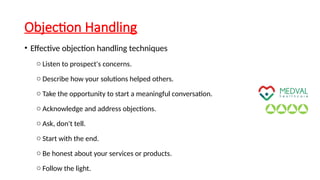
Objection Handling
• Effective objection handling techniques
o Listen to prospect's concerns.
o Describe how your solutions helped others.
o Take the opportunity to start a meaningful conversation.
o Acknowledge and address objections.
o Ask, don't tell.
o Start with the end.
o Be honest about your services or products.
o Follow the light.
THANK YOU

01-Selling Skills Training presentaition.pptx

  • 1.
  • 2.
  • 3.
    What is selling? •Selling Process • Selling Types • Selling Skills
  • 4.
    Selling Process • Sellingis a process rather than action • Consists of number of steps • Every step needs planning
  • 5.
    Selling • Listening • Value •Solution • Prospect • Communication • Talking • Price • Product • You • Debating
  • 6.
    Selling Process • Prospecting •Qualifying • Presentation • Closing
  • 7.
    Identifying potential customers •Find individuals or businesses who may benefit from your product • Start building a database of potential clients. Prospecting whether the prospect has the need, budget, and authority to make a purchase? Ensure you focus on leads most likely to convert. Qualifying Showcase how your product or service meets the prospect’s needs. Build trust and demonstrate the value of your offering. Presentation The final step where the deal is finalized, Contract signing. Secure a commitment from the prospect Closing Sales Process
  • 8.
    Prospecting Key Activities • Research:Use tools like LinkedIn, industry directories, Google map or CRM software to identify leads. • Outreach: Use cold emails, calls, social media, or networking to initiate contact. • Qualify Leads: Determine if a prospect fits your target customer profile. Best Practices • Develop a customer persona to understand who you’re targeting. • Personalize your outreach messages to make them relevant and engaging.
  • 9.
    Qualifying Key Activities • DiscoveryQuestions: Ask open-ended questions to understand the prospect's needs, challenges, and decision-making process. • Examples: • "What challenges are you currently facing in [specific area]?" • "Who is involved in the decision-making process for purchases like this?" • Assess Fit: Use criteria like BANT (Budget, Authority, Need, Timing) to qualify prospects. Best Practices • Listen more than you talk. • Be honest about whether your solution is a good fit.
  • 10.
    Budget • Does theprospect have the financial resources to buy • "What’s your budget for solving this issue?" • "Have funds been allocated for this project?" Authority • Does the prospect have the authority to make the purchasing decision? If not, can you identify the decision-maker • "Who else is involved in the decision-making process?" • "What’s the approval process like on your end?" Need • Does the prospect have a genuine need for your product or service? • "What challenges are you facing that this product/service can solve?" • "How urgent is it for you to address this issue?" Timing • Is the prospect ready to make a decision? • "When are you looking to implement a solution?" • "Are there any external factors influencing your timeline?" What criteria like BANT? BANT Priority
  • 11.
    What criteria likeBANT? Customer Budget Authority Need Timing Customer 1 ✔ ❌ ✔ ✔ Customer 2 ✔ ✔ ✔ ✔ Customer 3 ✔ ❌ ❌ ✔
  • 12.
    Preparation Makes TheDifference Three questions you should always ask yourself: • What do I know ? • What do I need to know ? • How am I going to find out ?
  • 13.
    Presentation Key Activities • TailoredPresentations: Customize your pitch to address the specific pain points of the prospect. • Highlight Benefits, Not Features: Focus on how your product solves their problems. • Storytelling: Share success stories or testimonials to make your presentation relatable Best Practices • Keep it concise and engaging. • Anticipate objections and address them proactively.
  • 14.
    Closing Key Activities • SummarizeValue: Reiterate how your solution meets their needs. • Use Closing Techniques: • Assumptive Close: "When should we schedule delivery?" • Urgency Close: "This offer is valid until [date]." • Handle Objections: Address any last-minute concerns with empathy and confidence. Best Practices • Look for buying signals, such as positive responses or detailed questions. • Always follow up if the decision isn’t made immediately.
  • 15.
  • 16.
    B2B Vs B2C •B2B (Business-to-Business) • B2C (Business-to-Consumer) sales is essential, as each approach requires distinct strategies. • B2B: Relationship-driven, logical, complex, and long-term. • B2C: Emotion-driven, fast-paced, and focused on personal benefits
  • 17.
    B2B Vs B2C Productor Service Complexity complex and tailored simpler and standardized Sales Cycle Longer and more complex Shorter sales cycle Target Audience selling to other selling directly to individual
  • 18.
    Marketing and Outreach directoutreach methods mass marketing techniques Pricing and Volume larger transaction sizes individual purchases or smaller quantities Decision-Making Process Involve multiple stakeholders Made by a single person B2B Vs B2C
  • 19.
    Reach Marketing Strategy •ATL • BTL • TTL
  • 20.
    Selling Channels • Directsales • Re-seller • Store • Online
  • 21.
    15 examples ofcommon sales channels • Personal selling • Sales agents • General marketplace • Auction marketplace • Crafts marketplace • Niche marketplace • On-demand market Place • Resellers • Social media • Retail • Comparison shopping sites • Subscription box services • Daily deals sites • White label sales • Classified listings Direct sales Re-seller Store Online
  • 22.
  • 23.
    Selling Skills 1. CommunicationSkills 2. Negotiation Skills 3. Product Knowledge 4. Prospecting Skills 5. Relationship Building 6. Closing Skills 7. Time Management 8. Adaptability 9. Digital Literacy 10. Analytical Skills 11. Emotional Intelligence (EQ) 12. Presentation Skills 13. Problem-Solving 14. Objection Handling 15. Research Skills 16. Storytelling and Narrative Building 17. Social Selling 18. Cross-Selling and Upselling 19. Strategic Thinking 20. Active Listening 21. Networking and Collaboration 22. Data-Driven Selling 23. Crisis Management 24. Leadership and Mentoring
  • 24.
  • 25.
  • 26.
    Communication Skills • Whatto Say and Not to Say 1. Mindray… oWe are Medval agent of Mindray in the IVD products oHighlight our Own Identity
  • 27.
    Communication Skills • Whatto Say and Not to Say 2. Highest Quality and Best Customer Service • There are many things sales recruiters and reps promise when trying to close a deal. • Saying they have the highest quality product is common. • But can you prove it? Don’t communicate you have the highest quality if you don’t have the research to back it up. • Avoid saying you have the best customer service unless you are willing to back it up. Have proof ready o such as customer testimonials o case studies.
  • 28.
    Communication Skills • Whatto Say and Not to Say 3. I’m Not Here to Make Money… • Yes, you are. We all are. • Everyone is doing their job for the money, so don’t pretend you are only doing sales to help people. • No one believes this statement, and you will only risk the trust you built with a prospect if you use statements like this.
  • 29.
    Communication Skills • Whatto Say and Not to Say 4. Competitors’ name… oWe only say it is competitor oWe only mention Our name and brand
  • 30.
    Communication Skills • Whatto Say and Not to Say 5. Are You the Main Decision Maker? • Asking the question directly can lead to a number of undesirable responses: • Ask the question in a better way to get the answer you want – o who the actual decision makers are? o Who is part of the decision-making process?
  • 31.
  • 32.
  • 33.
  • 34.
    Objection Handling • Effectiveobjection handling techniques o Listen to prospect's concerns. o Describe how your solutions helped others. o Take the opportunity to start a meaningful conversation. o Acknowledge and address objections. o Ask, don't tell. o Start with the end. o Be honest about your services or products. o Follow the light.
  • 35.