Creating an SDMP for
your NHS Trust
Sponsored by
Today’s speakers:
Claire Igoe, Head of Environmental Sustainability, Central
Manchester University Hospitals
Alex Hammond, Sustainability Director, ETL
Adam Newman, Senior Sustainability Consultant, WRM
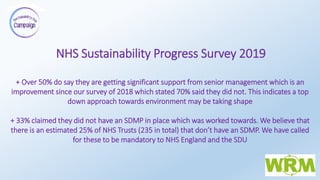
NHS Sustainability Progress Survey 2019
+ Over 50% do say they are getting significant support from senior management which is an
improvement since our survey of 2018 which stated 70% said they did not. This indicates a top
down approach towards environment may be taking shape
+ 33% claimed they did not have an SDMP in place which was worked towards. We believe that
there is an estimated 25% of NHS Trusts (235 in total) that don’t have an SDMP. We have called
for these to be mandatory to NHS England and the SDU
Please feel free to submit questions during
the webinar using the chat box
Developing and Implementing an
SDMP:
Experiences from Manchester University
Hospitals NHS Foundation Trust
Claire Igoe
Head of Environmental Sustainability,
Manchester University NHS Foundation Trust
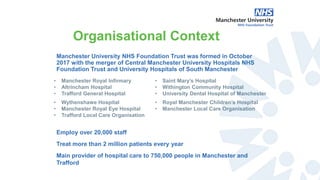
Organisational Context
Manchester University NHS Foundation Trust was formed in October
2017 with the merger of Central Manchester University Hospitals NHS
Foundation Trust and University Hospitals of South Manchester
Employ over 20,000 staff
Treat more than 2 million patients every year
Main provider of hospital care to 750,000 people in Manchester and
Trafford
• Manchester Royal Infirmary
• Altrincham Hospital
• Trafford General Hospital
• Saint Mary’s Hospital
• Withington Community Hospital
• University Dental Hospital of Manchester
• Wythenshawe Hospital
• Manchester Royal Eye Hospital
• Trafford Local Care Organisation
• Royal Manchester Children’s Hospital
• Manchester Local Care Organisation
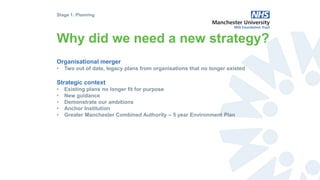
Why did we need a new strategy?
Organisational merger
• Two out of date, legacy plans from organisations that no longer existed
Strategic context
• Existing plans no longer fit for purpose
• New guidance
• Demonstrate our ambitions
• Anchor Institution
• Greater Manchester Combined Authority – 5 year Environment Plan
Stage 1: Planning
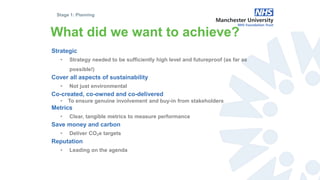
What did we want to achieve?
Strategic
• Strategy needed to be sufficiently high level and futureproof (as far as
possible!)
Cover all aspects of sustainability
• Not just environmental
Co-created, co-owned and co-delivered
• To ensure genuine involvement and buy-in from stakeholders
Metrics
• Clear, tangible metrics to measure performance
Save money and carbon
• Deliver CO₂e targets
Reputation
• Leading on the agenda
Stage 1: Planning
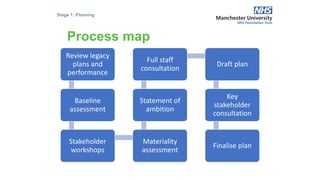
Process map
Review legacy
plans and
performance
Baseline
assessment
Stakeholder
workshops
Materiality
assessment
Statement of
ambition
Full staff
consultation
Draft plan
Key
stakeholder
consultation
Finalise plan
Stage 1: Planning
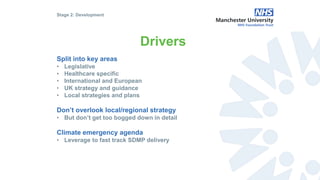
Drivers
Split into key areas
• Legislative
• Healthcare specific
• International and European
• UK strategy and guidance
• Local strategies and plans
Don’t overlook local/regional strategy
• But don’t get too bogged down in detail
Climate emergency agenda
• Leverage to fast track SDMP delivery
Stage 2: Development
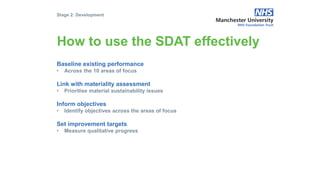
How to use the SDAT effectively
Baseline existing performance
• Across the 10 areas of focus
Link with materiality assessment
• Prioritise material sustainability issues
Inform objectives
• Identify objectives across the areas of focus
Set improvement targets
• Measure qualitative progress
Stage 2: Development
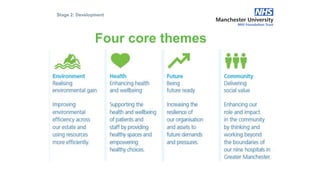
Four core themes
Stage 2: Development
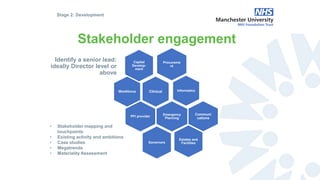
Stakeholder engagement
Procureme
nt
Capital
Develop-
ment
Clinical Informatics
Emergency
Planning
PFI provider
Governors
Estates and
Facilities
Communi
cations
Workforce
• Stakeholder mapping and
touchpoints
• Existing activity and ambitions
• Case studies
• Megatrends
• Materiality Assessment
Stage 2: Development
Identify a senior lead:
ideally Director level or
above
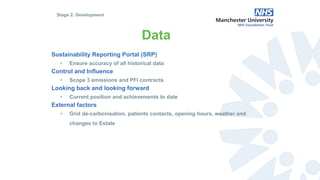
Data
Sustainability Reporting Portal (SRP)
• Ensure accuracy of all historical data
Control and Influence
• Scope 3 emissions and PFI contracts
Looking back and looking forward
• Current position and achievements to date
External factors
• Grid de-carbonisation, patients contacts, opening hours, weather and
changes to Estate
Stage 2: Development
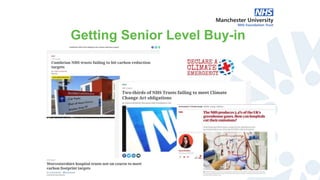
Getting Senior Level Buy-in
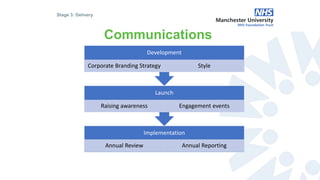
Communications
Implementation
Annual Review Annual Reporting
Launch
Raising awareness Engagement events
Development
Corporate Branding Strategy Style
Stage 3: Delivery
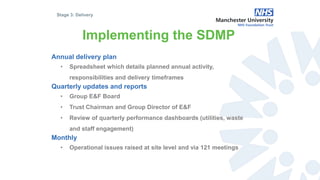
Implementing the SDMP
Annual delivery plan
• Spreadsheet which details planned annual activity,
responsibilities and delivery timeframes
Quarterly updates and reports
• Group E&F Board
• Trust Chairman and Group Director of E&F
• Review of quarterly performance dashboards (utilities, waste
and staff engagement)
Monthly
• Operational issues raised at site level and via 121 meetings
Stage 3: Delivery
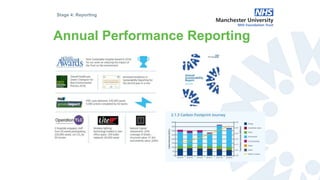
Annual Performance Reporting
Stage 4: Reporting
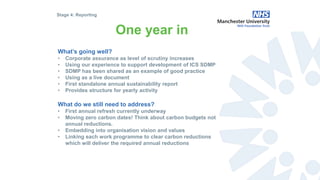
What’s going well?
• Corporate assurance as level of scrutiny increases
• Using our experience to support development of ICS SDMP
• SDMP has been shared as an example of good practice
• Using as a live document
• First standalone annual sustainability report
• Provides structure for yearly activity
What do we still need to address?
• First annual refresh currently underway
• Moving zero carbon dates! Think about carbon budgets not
annual reductions.
• Embedding into organisation vision and values
• Linking each work programme to clear carbon reductions
which will deliver the required annual reductions
One year in
Stage 4: Reporting
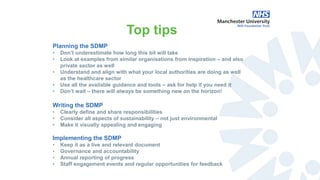
Planning the SDMP
• Don’t underestimate how long this bit will take
• Look at examples from similar organisations from inspiration – and also
private sector as well
• Understand and align with what your local authorities are doing as well
as the healthcare sector
• Use all the available guidance and tools – ask for help if you need it
• Don’t wait – there will always be something new on the horizon!
Writing the SDMP
• Clearly define and share responsibilities
• Consider all aspects of sustainability – not just environmental
• Make it visually appealing and engaging
Implementing the SDMP
• Keep it as a live and relevant document
• Governance and accountability
• Annual reporting of progress
• Staff engagement events and regular opportunities for feedback
Top tips
Questions?
Contact:
Claire.igoe@mft.nhs.uk
ECOteam@mft.nhs.uk
Follow us on Twitter:
@MFTGreen
A healthier perspective
Implementing an SDMP
Alexandra Hammond, Director of Sustainability
6th December 2019
23
Agenda
1. The fundamentals of an SDMP
2. Shaping the document to your Trust
3. Making the document engaging
4. Examples
5. Further improvements to be made
24
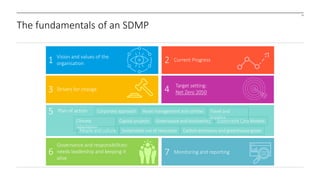
Current Progress
Vision and values of the
organisation
The fundamentals of an SDMP
Monitoring and reporting
Governance and responsibilities:
needs leadership and keeping it
alive
Target setting:
Net Zero 2050
Drivers for change
Plan of action Corporate approach Asset management and utilities Travel and
logistics
Climate
adaptation
Capital projects Greenspace and biodiversity Sustainable Care Models
People and culture Sustainable use of resources Carbon emissions and greenhouse gases
1
3
5
2
4
6 7
25
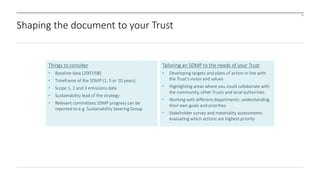
Shaping the document to your Trust
Things to consider
• Baseline data (2007/08)
• Timeframe of the SDMP (1, 5 or 10 years)
• Scope 1, 2 and 3 emissions data
• Sustainability lead of the strategy
• Relevant committees SDMP progress can be
reported to e.g. Sustainability Steering Group
Tailoring an SDMP to the needs of your Trust
• Developing targets and plans of action in line with
the Trust’s vision and values
• Highlighting areas where you could collaborate with
the community, other Trusts and local authorities
• Working with different departments: understanding
their own goals and priorities
• Stakeholder survey and materiality assessments:
evaluating which actions are highest priority
26
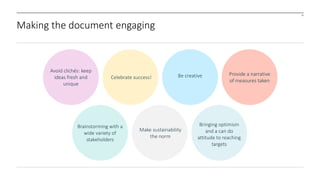
Making the document engaging
Be creative
Avoid clichés: keep
ideas fresh and
unique
Celebrate success!
Bringing optimism
and a can do
attitude to reaching
targets
Provide a narrative
of measures taken
Brainstorming with a
wide variety of
stakeholders
Make sustainability
the norm
27
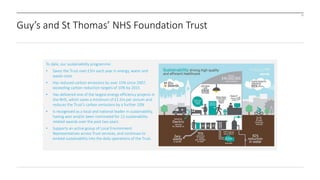
To date, our sustainability programme:
• Saves the Trust over £3m each year in energy, water and
waste costs
• Has reduced carbon emissions by over 15% since 2007,
exceeding carbon reduction targets of 10% by 2015
• Has delivered one of the largest energy efficiency projects in
the NHS, which saves a minimum of £1.5m per annum and
reduces the Trust’s carbon emissions by a further 10%
• Is recognised as a local and national leader in sustainability,
having won and/or been nominated for 12 sustainability
related awards over the past two years
• Supports an active group of Local Environment
Representatives across Trust services, and continues to
embed sustainability into the daily operations of the Trust.
Guy’s and St Thomas’ NHS Foundation Trust
28
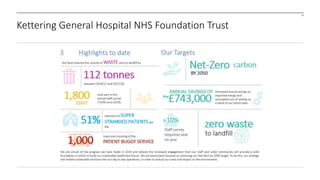
Kettering General Hospital NHS Foundation Trust
29
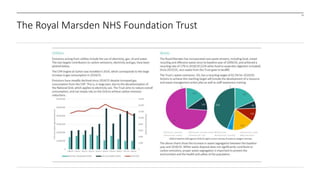
The Royal Marsden NHS Foundation Trust
30
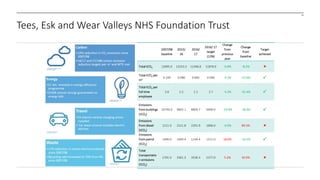
Tees, Esk and Wear Valleys NHS Foundation Trust
2007/08
baseline
2015/
16
2016/
17
2016/ 17
target
(12%)
Change
from
previous
year
Change
from
baseline
Target
achieved
Total tCO2 13495.0 13253.3 12346.0 11876.0 -6.8% -8.5% 
Total tCO2 per
m2
0.109 0.086 0.083 0.096 -4.3% -23.9% 
Total tCO2 per
full time
employee
3.0 2.2 2.1 2.7 -5.3% -31.4% 
Emissions
from buildings
(tCO2)
10794.0 9892.1 8809.7 9499.0 -10.9% -18.4% 
Emissions
from diesel
(tCO2)
1211.0 2311.8 2291.9 1066.0 -0.9% 89.3% 
Emissions
from petrol
(tCO2)
1490.0 1049.4 1244.4 1311.0 18.6% -16.5% 
Total
transportatio
n emissions
(tCO2)
2701.0 3361.3 3536.3 2377.0 5.2% 30.9% 
31
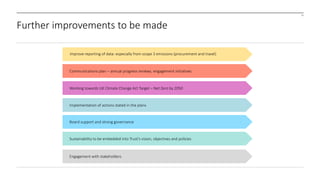
Improve reporting of data: especially from scope 3 emissions (procurement and travel)
Further improvements to be made
Communications plan – annual progress reviews, engagement initiatives
Working towards UK Climate Change Act Target – Net Zero by 2050
Implementation of actions stated in the plans
Engagement with stakeholders
Board support and strong governance
Sustainability to be embedded into Trust’s vision, objectives and policies
A healthier perspective
Thank you
ETL
India House
Second Floor
45 Curlew Street
London
SE1 2ND
+44 (0)20 3976 3000
www.etl.co.uk
Alexandra Hammond
Director | Sustainability
Alexandra.Hammond@etl.co.uk
The value of an SDMP to an NHS
Organisation
Adam Newman
• What is an SDMP?
• What was Leeds’ sustainability agenda before
our SDMP?
• Where are we now?
• How did we develop our SDMP?
• Why should you develop an SDMP?
Introduction
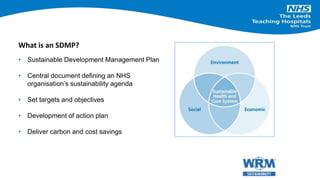
• Sustainable Development Management Plan
• Central document defining an NHS
organisation’s sustainability agenda
• Set targets and objectives
• Development of action plan
• Deliver carbon and cost savings
What is an SDMP?
• Largely unorganised
• Lack of clarity over objectives and
targets
• Lack of senior level buy-in
• Difficult to report and track progress
What was Leeds’ sustainability agenda before our SDMP?
• Strong existing sustainability agenda:
Sustainable Development Management Plan
(SDMP)
Strategic Sustainability Management Group
(SSMG)
Environmental Management System (EMS)
• Sustainability interventions well underway
• Identified reductions of 16,000tCO2e/annum
by 2025
• Genuine senior level buy in
Where are we now?
Electricity Gas Water
Clinical
Waste
Non-Clinical
Waste
Fleet
Vehicles
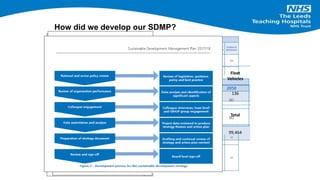
36,965 26,478 710 2,402 1,463 136
Business
Travel
Patient
Transport
Visitor Travel Commuting
Anaesthetic
Gas
Total
4,412 1,843 1,545 19,347 4,165 99,464
How did we develop our SDMP?
• NHS Standard Contract 2019/20 Service Conditions-
18.2
• Centralise sustainability strategy
• Set objectives and targets
• Track progress against objectives and targets
Why should you develop an SDMP?
Adam Newman- Sustainability Manager
adam.newman@nhs.net
adam.newman@wrm-ltd.co.uk
www.wrm-sustainability.co.uk
Thanks for your attention
Questions and Answers
Thanks for listening, a
recording will be made
available from next
Tuesday
Sponsored by

Creating an SDMP for your NHS Trust

  • 1.
    Creating an SDMPfor your NHS Trust Sponsored by
  • 2.
    Today’s speakers: Claire Igoe,Head of Environmental Sustainability, Central Manchester University Hospitals Alex Hammond, Sustainability Director, ETL Adam Newman, Senior Sustainability Consultant, WRM
  • 3.
    NHS Sustainability ProgressSurvey 2019 + Over 50% do say they are getting significant support from senior management which is an improvement since our survey of 2018 which stated 70% said they did not. This indicates a top down approach towards environment may be taking shape + 33% claimed they did not have an SDMP in place which was worked towards. We believe that there is an estimated 25% of NHS Trusts (235 in total) that don’t have an SDMP. We have called for these to be mandatory to NHS England and the SDU
  • 4.
    Please feel freeto submit questions during the webinar using the chat box
  • 5.
    Developing and Implementingan SDMP: Experiences from Manchester University Hospitals NHS Foundation Trust Claire Igoe Head of Environmental Sustainability, Manchester University NHS Foundation Trust
  • 6.
    Organisational Context Manchester UniversityNHS Foundation Trust was formed in October 2017 with the merger of Central Manchester University Hospitals NHS Foundation Trust and University Hospitals of South Manchester Employ over 20,000 staff Treat more than 2 million patients every year Main provider of hospital care to 750,000 people in Manchester and Trafford • Manchester Royal Infirmary • Altrincham Hospital • Trafford General Hospital • Saint Mary’s Hospital • Withington Community Hospital • University Dental Hospital of Manchester • Wythenshawe Hospital • Manchester Royal Eye Hospital • Trafford Local Care Organisation • Royal Manchester Children’s Hospital • Manchester Local Care Organisation
  • 7.
    Why did weneed a new strategy? Organisational merger • Two out of date, legacy plans from organisations that no longer existed Strategic context • Existing plans no longer fit for purpose • New guidance • Demonstrate our ambitions • Anchor Institution • Greater Manchester Combined Authority – 5 year Environment Plan Stage 1: Planning
  • 8.
    What did wewant to achieve? Strategic • Strategy needed to be sufficiently high level and futureproof (as far as possible!) Cover all aspects of sustainability • Not just environmental Co-created, co-owned and co-delivered • To ensure genuine involvement and buy-in from stakeholders Metrics • Clear, tangible metrics to measure performance Save money and carbon • Deliver CO₂e targets Reputation • Leading on the agenda Stage 1: Planning
  • 9.
    Process map Review legacy plansand performance Baseline assessment Stakeholder workshops Materiality assessment Statement of ambition Full staff consultation Draft plan Key stakeholder consultation Finalise plan Stage 1: Planning
  • 10.
    Drivers Split into keyareas • Legislative • Healthcare specific • International and European • UK strategy and guidance • Local strategies and plans Don’t overlook local/regional strategy • But don’t get too bogged down in detail Climate emergency agenda • Leverage to fast track SDMP delivery Stage 2: Development
  • 11.
    How to usethe SDAT effectively Baseline existing performance • Across the 10 areas of focus Link with materiality assessment • Prioritise material sustainability issues Inform objectives • Identify objectives across the areas of focus Set improvement targets • Measure qualitative progress Stage 2: Development
  • 12.
    Four core themes Stage2: Development
  • 13.
    Stakeholder engagement Procureme nt Capital Develop- ment Clinical Informatics Emergency Planning PFIprovider Governors Estates and Facilities Communi cations Workforce • Stakeholder mapping and touchpoints • Existing activity and ambitions • Case studies • Megatrends • Materiality Assessment Stage 2: Development Identify a senior lead: ideally Director level or above
  • 14.
    Data Sustainability Reporting Portal(SRP) • Ensure accuracy of all historical data Control and Influence • Scope 3 emissions and PFI contracts Looking back and looking forward • Current position and achievements to date External factors • Grid de-carbonisation, patients contacts, opening hours, weather and changes to Estate Stage 2: Development
  • 15.
  • 16.
    Communications Implementation Annual Review AnnualReporting Launch Raising awareness Engagement events Development Corporate Branding Strategy Style Stage 3: Delivery
  • 17.
    Implementing the SDMP Annualdelivery plan • Spreadsheet which details planned annual activity, responsibilities and delivery timeframes Quarterly updates and reports • Group E&F Board • Trust Chairman and Group Director of E&F • Review of quarterly performance dashboards (utilities, waste and staff engagement) Monthly • Operational issues raised at site level and via 121 meetings Stage 3: Delivery
  • 18.
  • 19.
    What’s going well? •Corporate assurance as level of scrutiny increases • Using our experience to support development of ICS SDMP • SDMP has been shared as an example of good practice • Using as a live document • First standalone annual sustainability report • Provides structure for yearly activity What do we still need to address? • First annual refresh currently underway • Moving zero carbon dates! Think about carbon budgets not annual reductions. • Embedding into organisation vision and values • Linking each work programme to clear carbon reductions which will deliver the required annual reductions One year in Stage 4: Reporting
  • 20.
    Planning the SDMP •Don’t underestimate how long this bit will take • Look at examples from similar organisations from inspiration – and also private sector as well • Understand and align with what your local authorities are doing as well as the healthcare sector • Use all the available guidance and tools – ask for help if you need it • Don’t wait – there will always be something new on the horizon! Writing the SDMP • Clearly define and share responsibilities • Consider all aspects of sustainability – not just environmental • Make it visually appealing and engaging Implementing the SDMP • Keep it as a live and relevant document • Governance and accountability • Annual reporting of progress • Staff engagement events and regular opportunities for feedback Top tips
  • 21.
  • 22.
    A healthier perspective Implementingan SDMP Alexandra Hammond, Director of Sustainability 6th December 2019
  • 23.
    23 Agenda 1. The fundamentalsof an SDMP 2. Shaping the document to your Trust 3. Making the document engaging 4. Examples 5. Further improvements to be made
  • 24.
    24 Current Progress Vision andvalues of the organisation The fundamentals of an SDMP Monitoring and reporting Governance and responsibilities: needs leadership and keeping it alive Target setting: Net Zero 2050 Drivers for change Plan of action Corporate approach Asset management and utilities Travel and logistics Climate adaptation Capital projects Greenspace and biodiversity Sustainable Care Models People and culture Sustainable use of resources Carbon emissions and greenhouse gases 1 3 5 2 4 6 7
  • 25.
    25 Shaping the documentto your Trust Things to consider • Baseline data (2007/08) • Timeframe of the SDMP (1, 5 or 10 years) • Scope 1, 2 and 3 emissions data • Sustainability lead of the strategy • Relevant committees SDMP progress can be reported to e.g. Sustainability Steering Group Tailoring an SDMP to the needs of your Trust • Developing targets and plans of action in line with the Trust’s vision and values • Highlighting areas where you could collaborate with the community, other Trusts and local authorities • Working with different departments: understanding their own goals and priorities • Stakeholder survey and materiality assessments: evaluating which actions are highest priority
  • 26.
    26 Making the documentengaging Be creative Avoid clichés: keep ideas fresh and unique Celebrate success! Bringing optimism and a can do attitude to reaching targets Provide a narrative of measures taken Brainstorming with a wide variety of stakeholders Make sustainability the norm
  • 27.
    27 To date, oursustainability programme: • Saves the Trust over £3m each year in energy, water and waste costs • Has reduced carbon emissions by over 15% since 2007, exceeding carbon reduction targets of 10% by 2015 • Has delivered one of the largest energy efficiency projects in the NHS, which saves a minimum of £1.5m per annum and reduces the Trust’s carbon emissions by a further 10% • Is recognised as a local and national leader in sustainability, having won and/or been nominated for 12 sustainability related awards over the past two years • Supports an active group of Local Environment Representatives across Trust services, and continues to embed sustainability into the daily operations of the Trust. Guy’s and St Thomas’ NHS Foundation Trust
  • 28.
    28 Kettering General HospitalNHS Foundation Trust
  • 29.
    29 The Royal MarsdenNHS Foundation Trust
  • 30.
    30 Tees, Esk andWear Valleys NHS Foundation Trust 2007/08 baseline 2015/ 16 2016/ 17 2016/ 17 target (12%) Change from previous year Change from baseline Target achieved Total tCO2 13495.0 13253.3 12346.0 11876.0 -6.8% -8.5%  Total tCO2 per m2 0.109 0.086 0.083 0.096 -4.3% -23.9%  Total tCO2 per full time employee 3.0 2.2 2.1 2.7 -5.3% -31.4%  Emissions from buildings (tCO2) 10794.0 9892.1 8809.7 9499.0 -10.9% -18.4%  Emissions from diesel (tCO2) 1211.0 2311.8 2291.9 1066.0 -0.9% 89.3%  Emissions from petrol (tCO2) 1490.0 1049.4 1244.4 1311.0 18.6% -16.5%  Total transportatio n emissions (tCO2) 2701.0 3361.3 3536.3 2377.0 5.2% 30.9% 
  • 31.
    31 Improve reporting ofdata: especially from scope 3 emissions (procurement and travel) Further improvements to be made Communications plan – annual progress reviews, engagement initiatives Working towards UK Climate Change Act Target – Net Zero by 2050 Implementation of actions stated in the plans Engagement with stakeholders Board support and strong governance Sustainability to be embedded into Trust’s vision, objectives and policies
  • 32.
    A healthier perspective Thankyou ETL India House Second Floor 45 Curlew Street London SE1 2ND +44 (0)20 3976 3000 www.etl.co.uk Alexandra Hammond Director | Sustainability Alexandra.Hammond@etl.co.uk
  • 33.
    The value ofan SDMP to an NHS Organisation Adam Newman
  • 34.
    • What isan SDMP? • What was Leeds’ sustainability agenda before our SDMP? • Where are we now? • How did we develop our SDMP? • Why should you develop an SDMP? Introduction
  • 35.
    • Sustainable DevelopmentManagement Plan • Central document defining an NHS organisation’s sustainability agenda • Set targets and objectives • Development of action plan • Deliver carbon and cost savings What is an SDMP?
  • 36.
    • Largely unorganised •Lack of clarity over objectives and targets • Lack of senior level buy-in • Difficult to report and track progress What was Leeds’ sustainability agenda before our SDMP?
  • 37.
    • Strong existingsustainability agenda: Sustainable Development Management Plan (SDMP) Strategic Sustainability Management Group (SSMG) Environmental Management System (EMS) • Sustainability interventions well underway • Identified reductions of 16,000tCO2e/annum by 2025 • Genuine senior level buy in Where are we now?
  • 38.
    Electricity Gas Water Clinical Waste Non-Clinical Waste Fleet Vehicles 36,96526,478 710 2,402 1,463 136 Business Travel Patient Transport Visitor Travel Commuting Anaesthetic Gas Total 4,412 1,843 1,545 19,347 4,165 99,464 How did we develop our SDMP?
  • 39.
    • NHS StandardContract 2019/20 Service Conditions- 18.2 • Centralise sustainability strategy • Set objectives and targets • Track progress against objectives and targets Why should you develop an SDMP?
  • 40.
    Adam Newman- SustainabilityManager adam.newman@nhs.net adam.newman@wrm-ltd.co.uk www.wrm-sustainability.co.uk Thanks for your attention
  • 41.
  • 42.
    Thanks for listening,a recording will be made available from next Tuesday Sponsored by

Editor's Notes