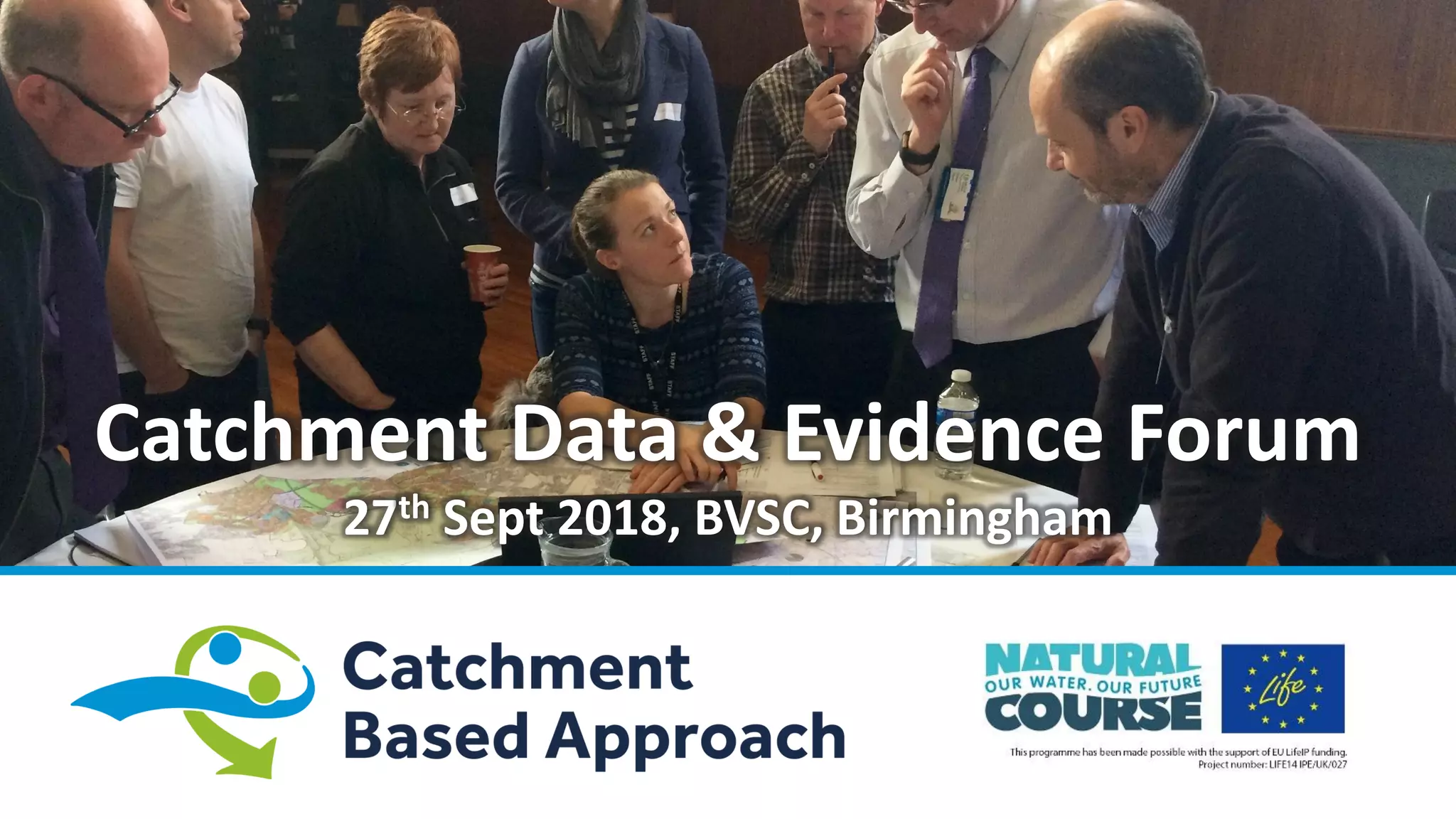
Catchment Data & Evidence Forum
27th Sept 2018, BVSC, Birmingham
Why a Catchment Data & Evidence Forum?
✓ Share knowledge
✓ Identify opportunities to work together
✓ Discuss how to support delivery of the 25 year plan
How could CaBA Data & Evidence Support
Programme and the Catchment Data User Group
input to Defra’s 25 year environment plan?
Michelle Walker, The Rivers Trust
Co-chair Catchment Data User Group
How did we get here?
What has CaBA achieved?
Where next?
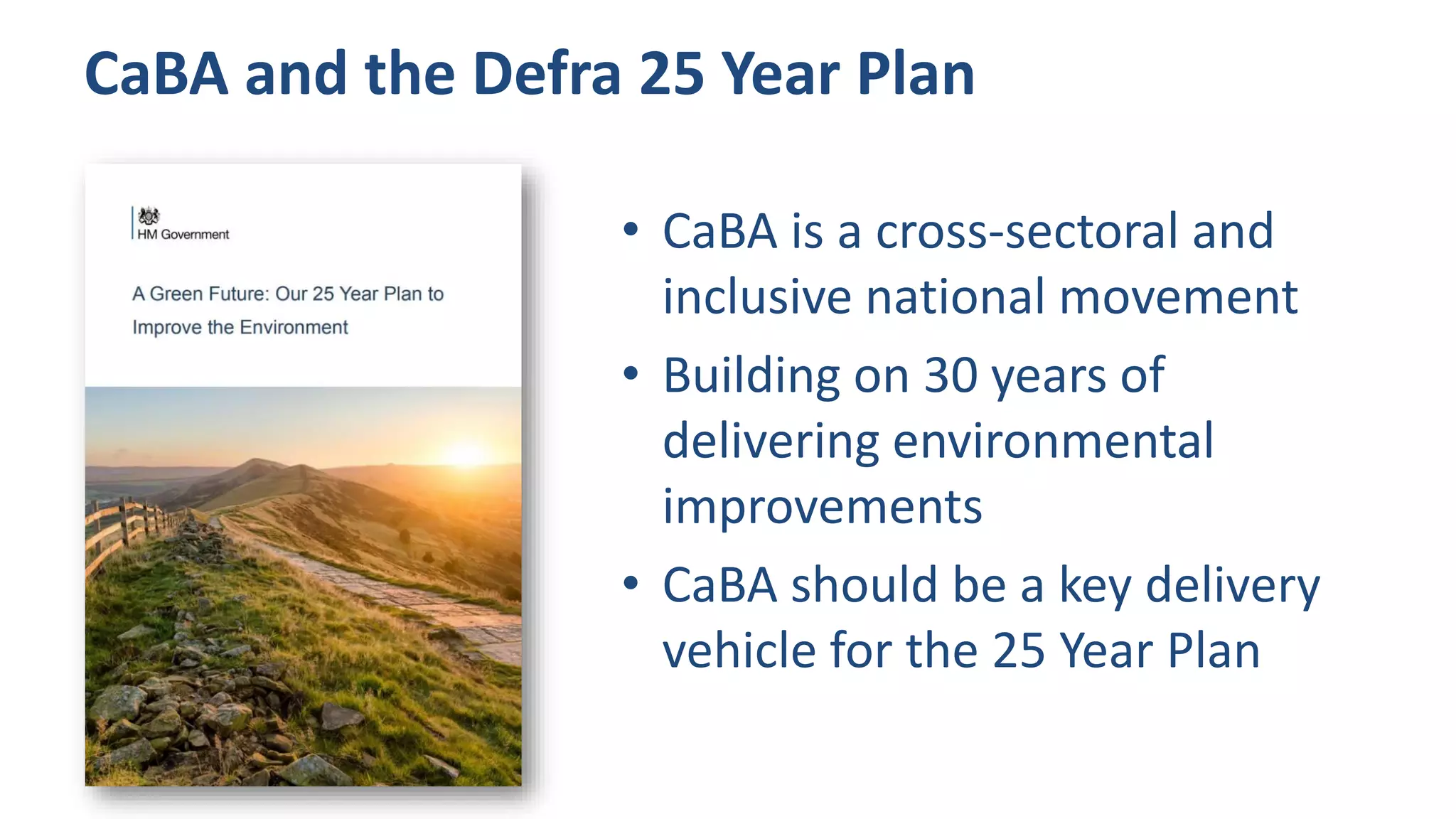
CaBA and the Defra 25 Year Plan
• CaBA is a cross-sectoral and
inclusive national movement
• Building on 30 years of
delivering environmental
improvements
• CaBA should be a key delivery
vehicle for the 25 Year Plan
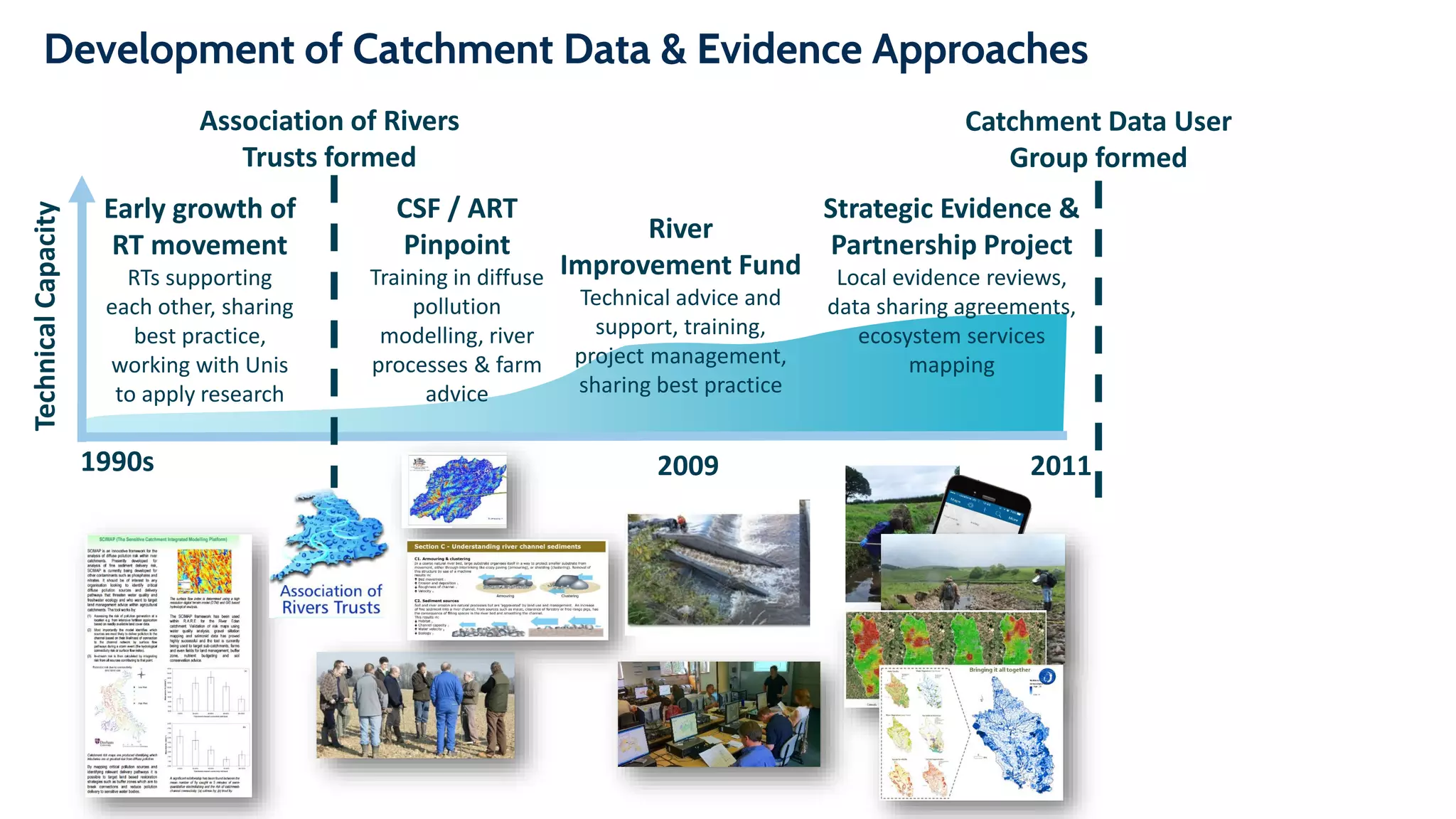
Development of Catchment Data & Evidence Approaches
1990s 2009 2011
CSF / ART
Pinpoint
Training in diffuse
pollution
modelling, river
processes & farm
advice
TechnicalCapacity
River
Improvement Fund
Technical advice and
support, training,
project management,
sharing best practice
Strategic Evidence &
Partnership Project
Local evidence reviews,
data sharing agreements,
ecosystem services
mapping
21
4.6Macro-invertebratesurvey:
4.6.1Methodology:
Macro-invertebratesamplingwascompletedatallofthemonitoringsites,excludingsite4.The
samplingprocedurewascompliantwiththeEnvironmentAgency'soperationalinstructionmanual
producedin2008(Technicalreferencematerial:freshwatermacro-invertebratesamplinginrivers).
Aoneminutemanualsearchwasinitiallycarriedoutateachsite,followedbykicksamplingusing
thethreeminute,pond,netsamplingmethod.Thenetusedwasastandard1mmmeshsampling
net.Thekicksamplingtechniqueinvolvesdisturbingthesubstratebyfootandcapturingany
displacedinvertebratesastheydriftdownstreamwiththeflowintothesamplingnet.Allavailable
habitattypesateachsiteweresampledproportionatelyandforatotaltimeofthreeminutes.
CollectedsampleswereplacedintoacontainerandthenpreservedusingIMS(industrialmethylated
spirits).Allsampleswerefirstexaminedonthebanksidefordeadinvertebrates.
Thephysicalcharacteristicsofeachsite,includingdepth,substrateandflowtype,asubjective
assessmentofturbidityandanyotherrelevantobservationswererecorded.Estimatesofalgaeand
macrophytecoverwerealsorecorded.
Atalaterdate,thesamplesweresievedusinga500-micronsieveandplacedintoasortingtray.
Wherepossible,macro-invertebrateswereidentifiedtospecieslevelwiththeexceptionof
Oligochaetawhichwereidentifiedtoclass,andSimuliidae,SphaeridaeandChironomidaewhich
wereidentifiedtofamilylevel.Factorsmakingitimpossibletoidentifyothermacro-invertebratesto
specieslevelincludesizeorcrucialidentificationfeaturesmissing.
Thefamiliespresentinasamplecontributetothe
derivationofabiological(BMWP)scoreforeachsite.
Thisscoringsystemwasdevelopedasawayof
assessingthebiologicalqualityofriversandstreams.
Themethodassignsascoretoeachtaxonrangingfrom
1to10dependingontheircapacitytotolerate
pollution.Thosemosttoleranttopollutionhavealow
score,whilstthoseleasttoleranthaveahighscore.
Thesumofthetaxascoresfromasampleisthe
BiologicalMonitoringWorkingParty(BMWP)score.
TheBMWPscore,andASPT(averagescorepertaxon)
werecalculatedforeachsample.
Figure23:Macro-invertebratesampling
atBidneyFarm(Site3).
Early growth of
RT movement
RTs supporting
each other, sharing
best practice,
working with Unis
to apply research
Association of Rivers
Trusts formed
Catchment Data User
Group formed
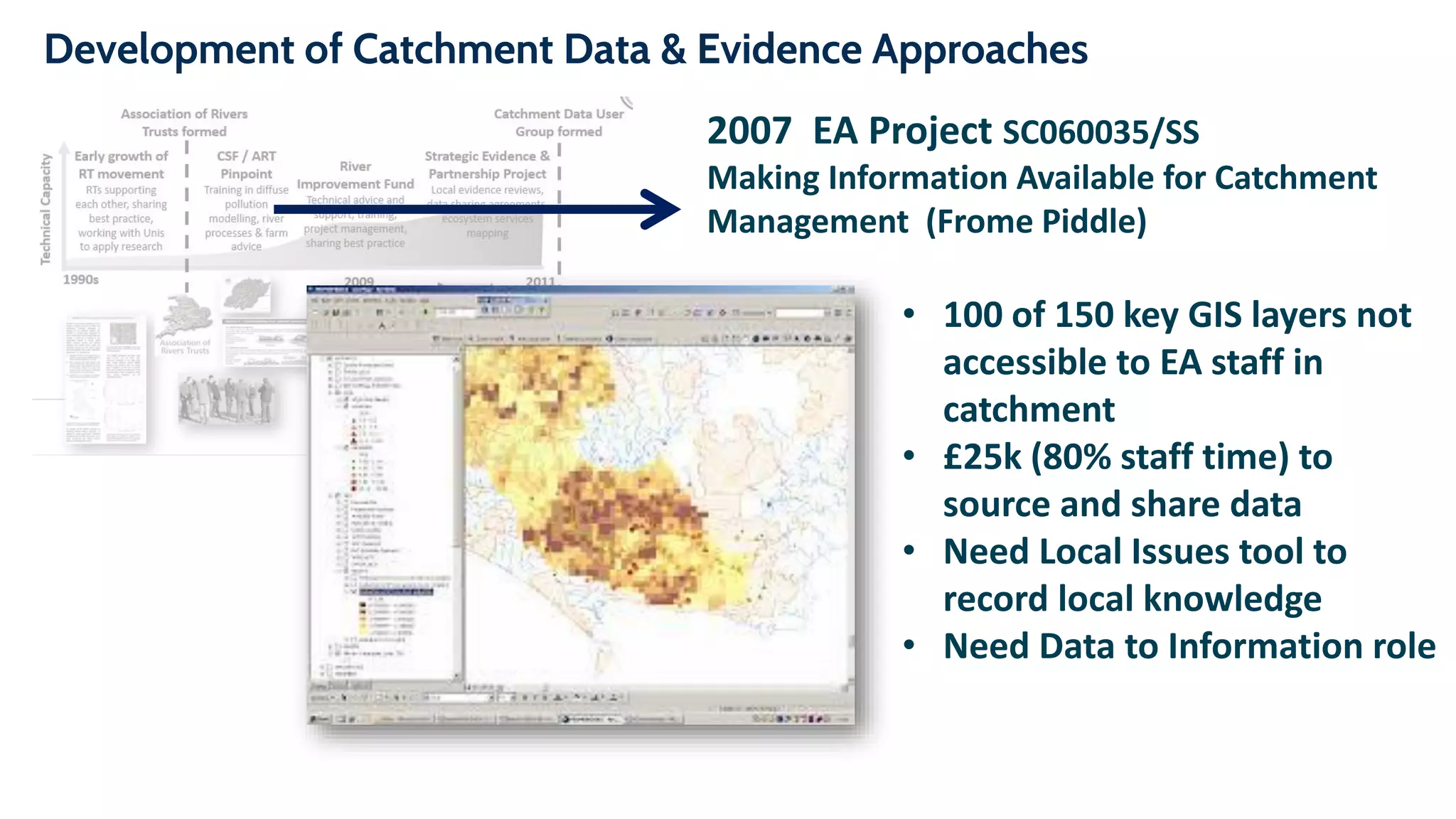
Development of Catchment Data & Evidence Approaches
2007 EA Project SC060035/SS
Making Information Available for Catchment
Management (Frome Piddle)
• 100 of 150 key GIS layers not
accessible to EA staff in
catchment
• £25k (80% staff time) to
source and share data
• Need Local Issues tool to
record local knowledge
• Need Data to Information role
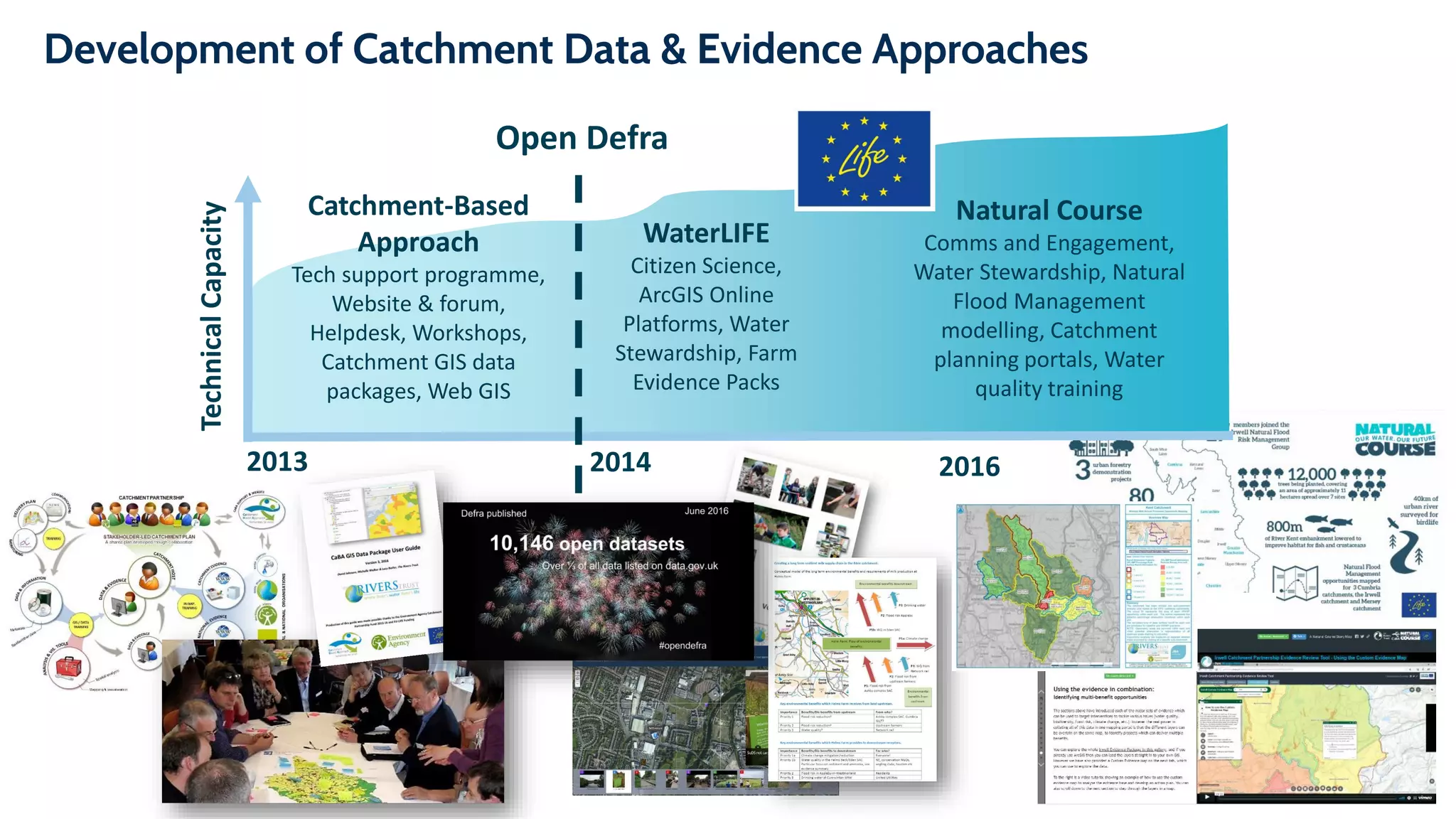
2013 2014 2016
TechnicalCapacity Catchment-Based
Approach
Tech support programme,
Website & forum,
Helpdesk, Workshops,
Catchment GIS data
packages, Web GIS
WaterLIFE
Citizen Science,
ArcGIS Online
Platforms, Water
Stewardship, Farm
Evidence Packs
Natural Course
Comms and Engagement,
Water Stewardship, Natural
Flood Management
modelling, Catchment
planning portals, Water
quality training
Open Defra
Development of Catchment Data & Evidence Approaches
Catchment Data User Group
• Multi-sectoral interest group
formed 2011
• End user community for
RBMP outputs
• Open up data access
• Strategy for tech support
• Review CaBA outputs
• Join up tools and platforms
• Collaborative projects
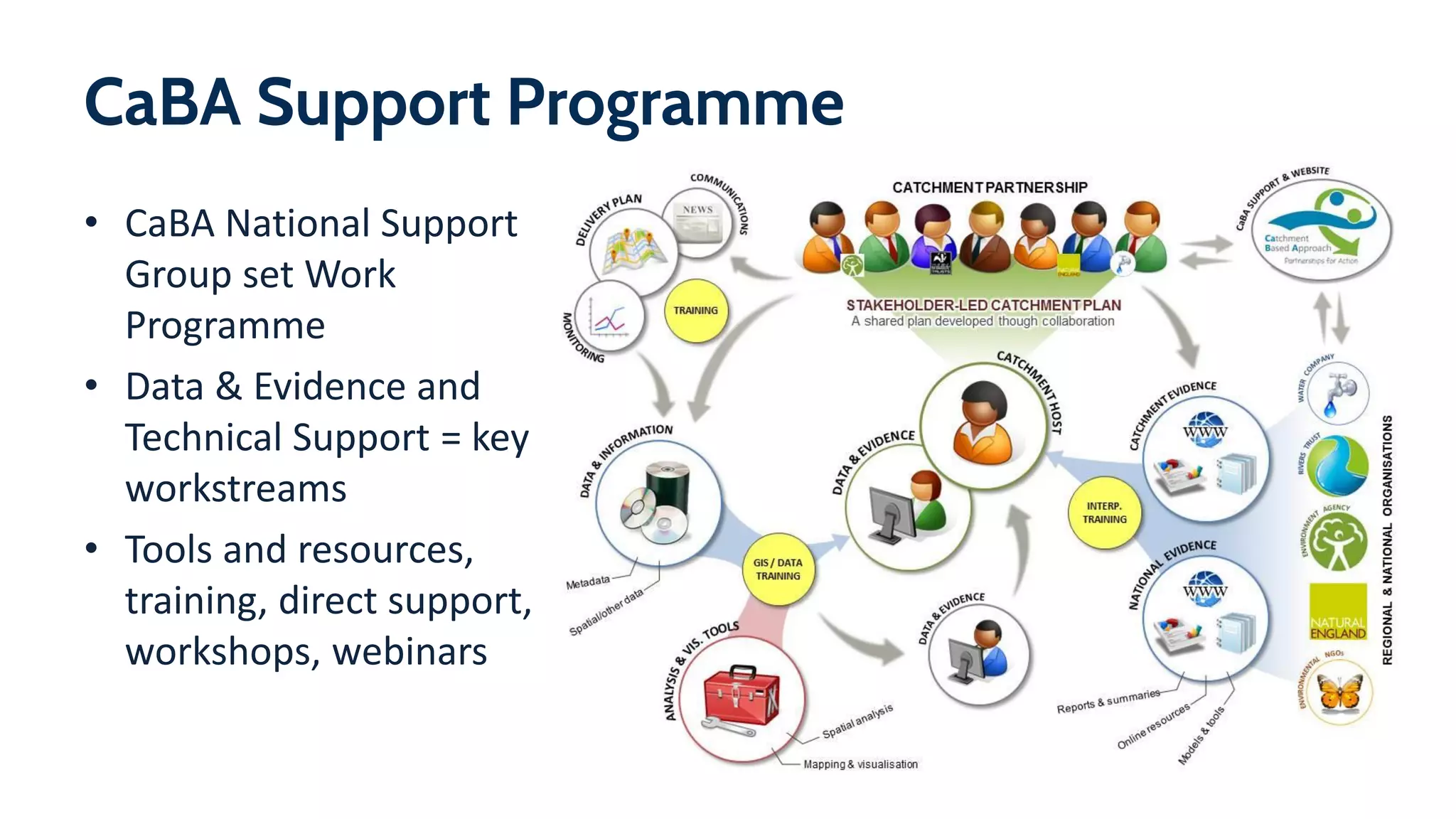
CaBA Support Programme
• CaBA National Support
Group set Work
Programme
• Data & Evidence and
Technical Support = key
workstreams
• Tools and resources,
training, direct support,
workshops, webinars
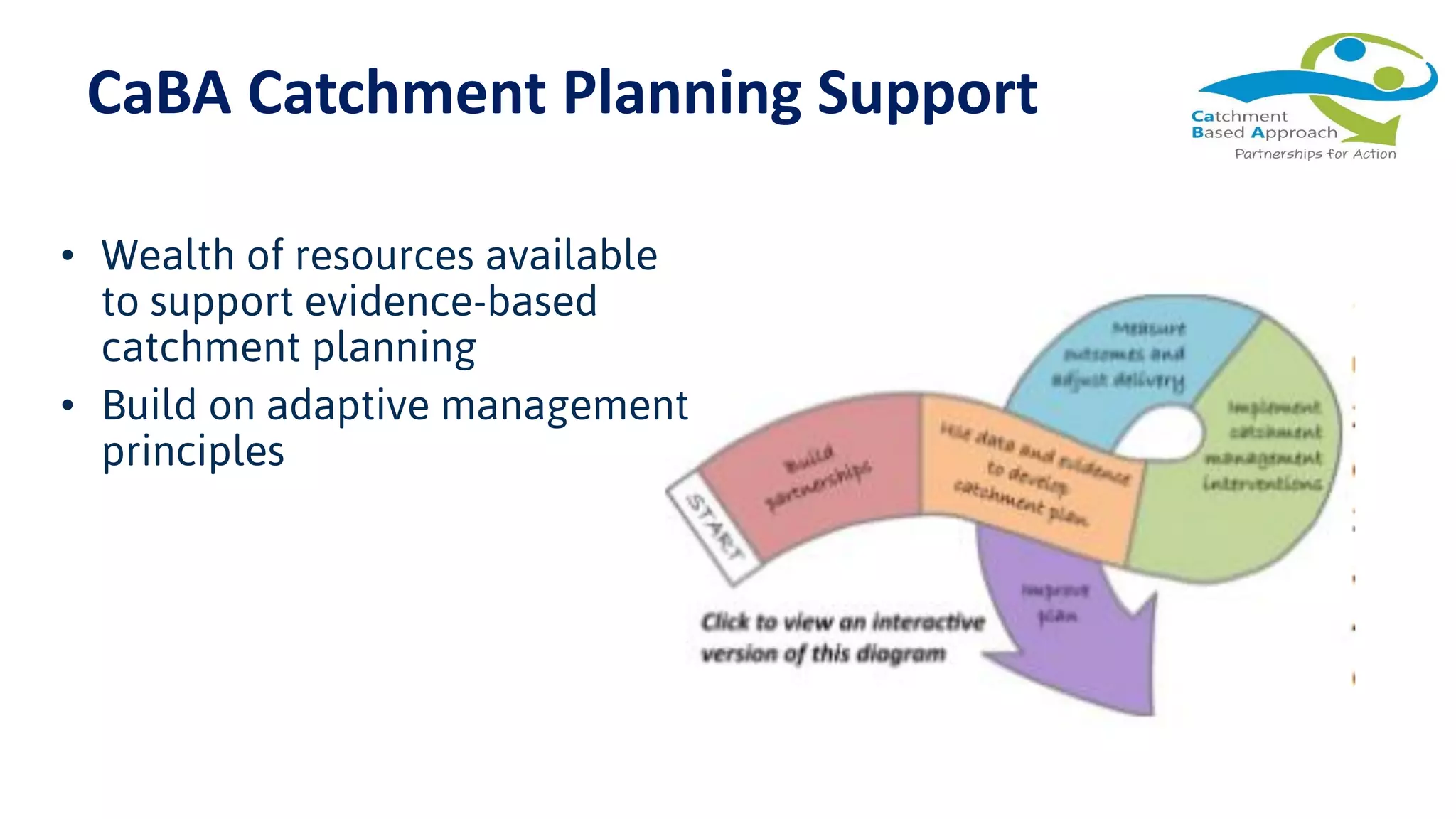
• Wealth of resources available
to support evidence-based
catchment planning
• Build on adaptive management
principles
CaBA Catchment Planning Support
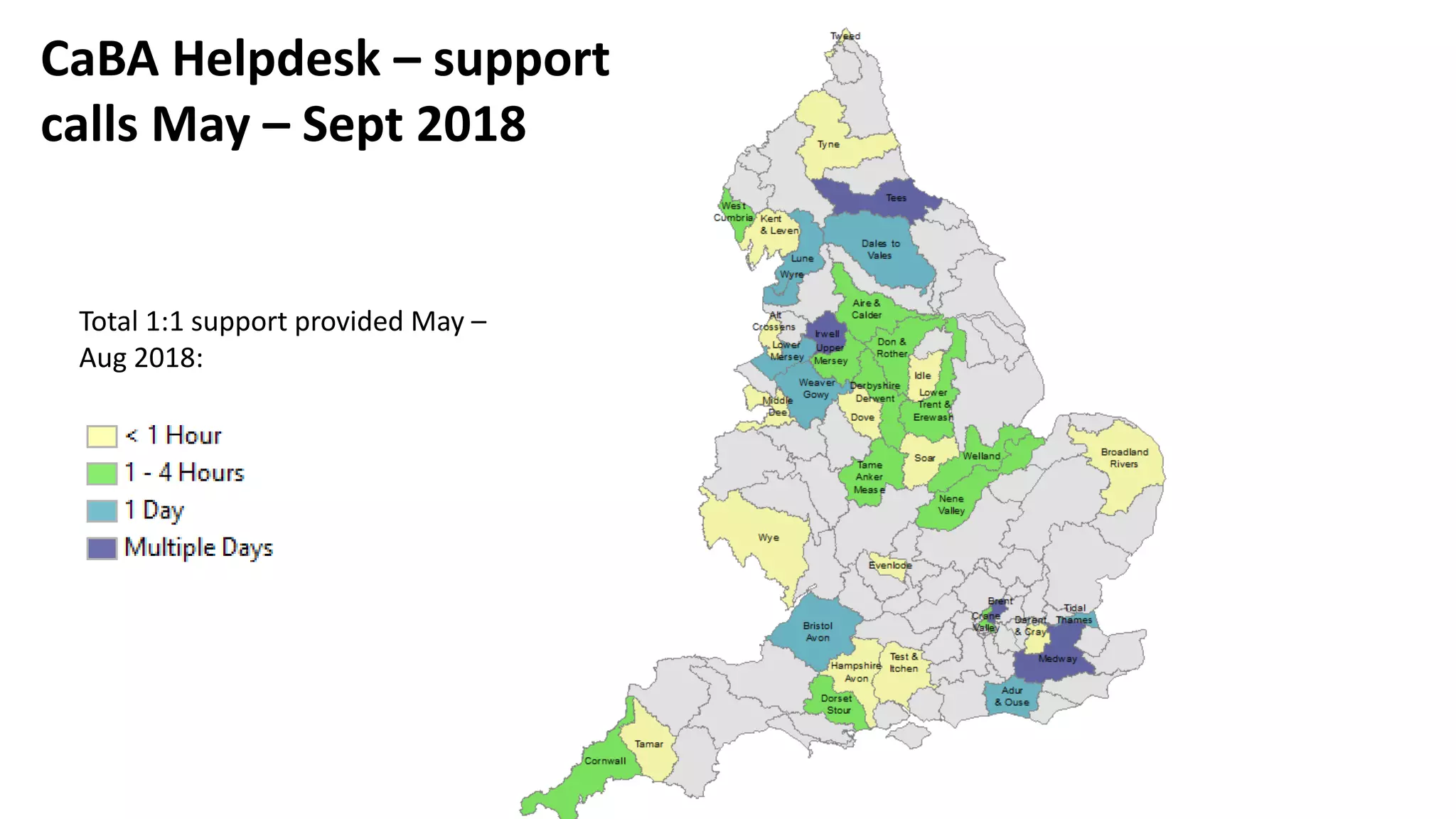
CaBA Helpdesk – support
calls May – Sept 2018
Total 1:1 support provided May –
Aug 2018:
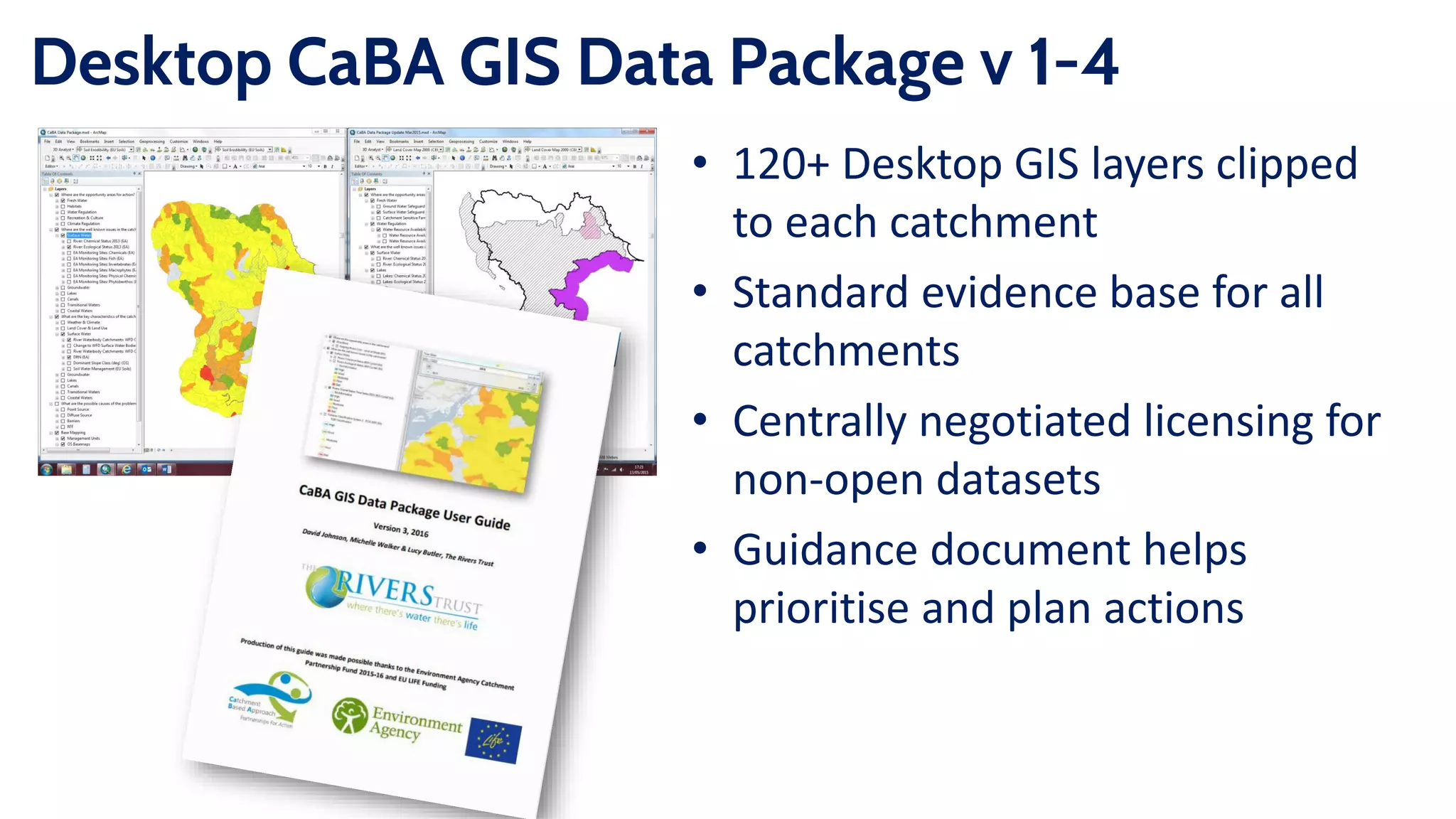
Desktop CaBA GIS Data Package v 1-4
• 120+ Desktop GIS layers clipped
to each catchment
• Standard evidence base for all
catchments
• Centrally negotiated licensing for
non-open datasets
• Guidance document helps
prioritise and plan actions
14
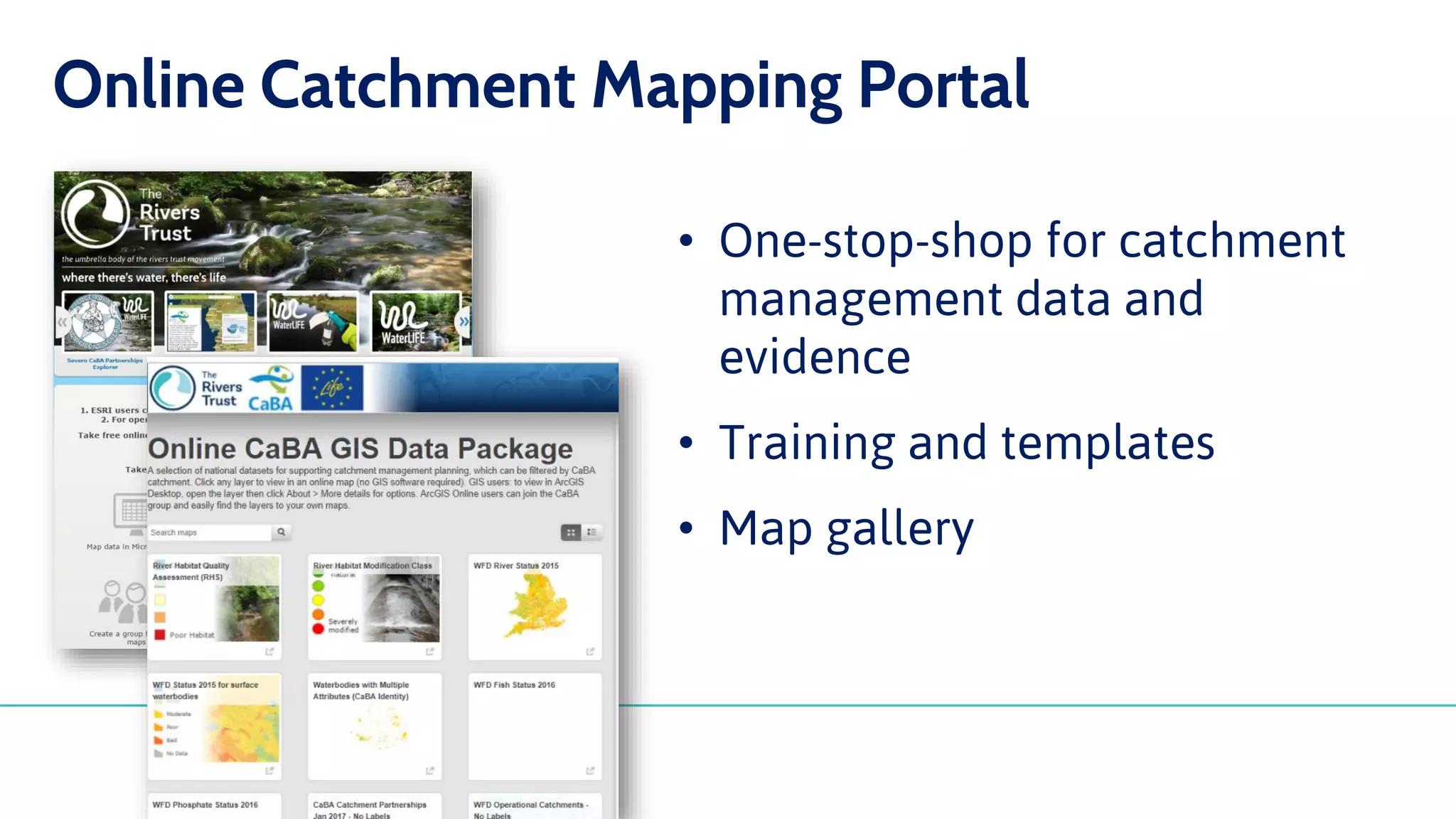
Online Catchment Mapping Portal
• One-stop-shop for catchment
management data and
evidence
• Training and templates
• Map gallery
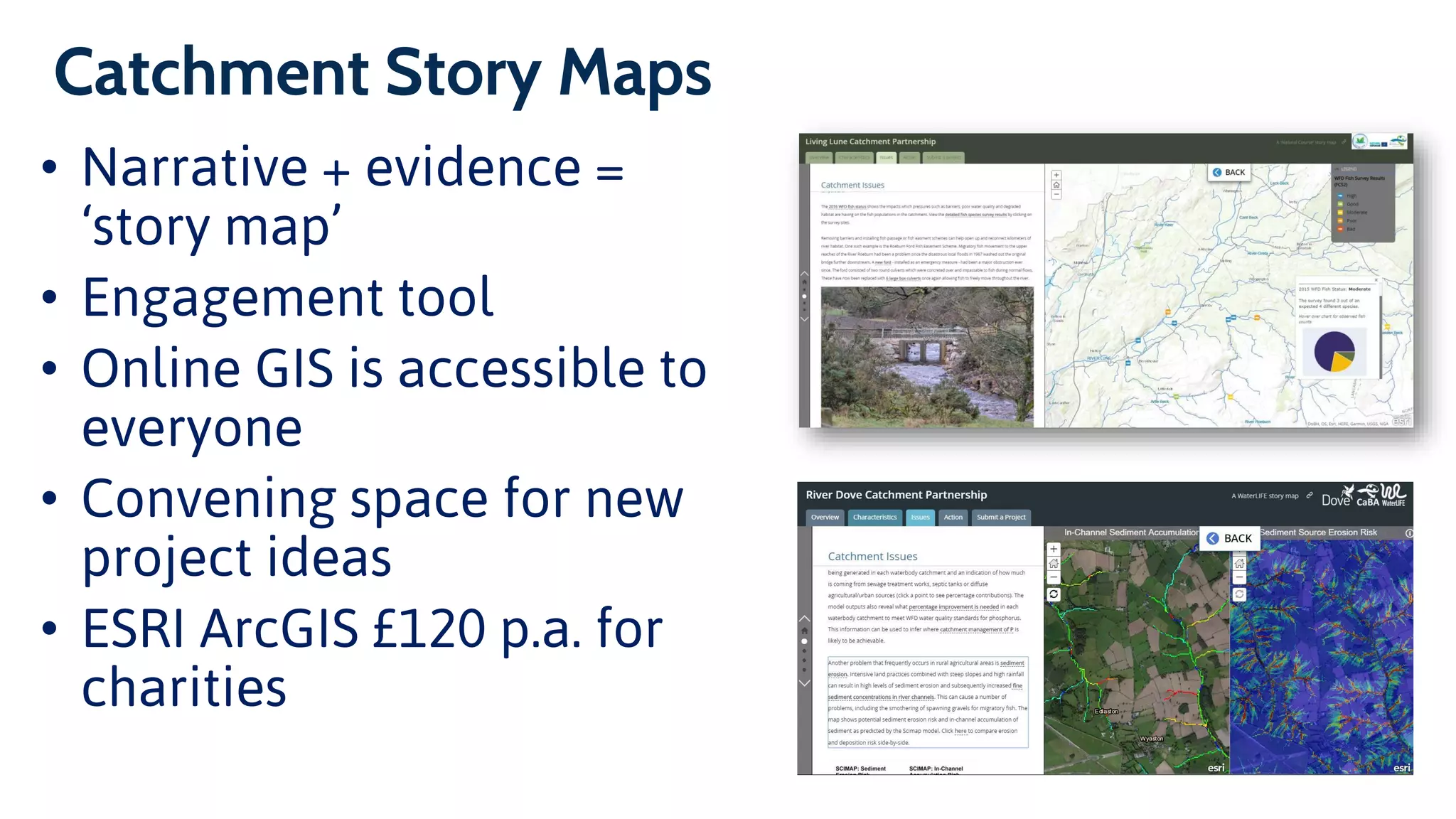
Catchment Story Maps
• Narrative + evidence =
‘story map’
• Engagement tool
• Online GIS is accessible to
everyone
• Convening space for new
project ideas
• ESRI ArcGIS £120 p.a. for
charities
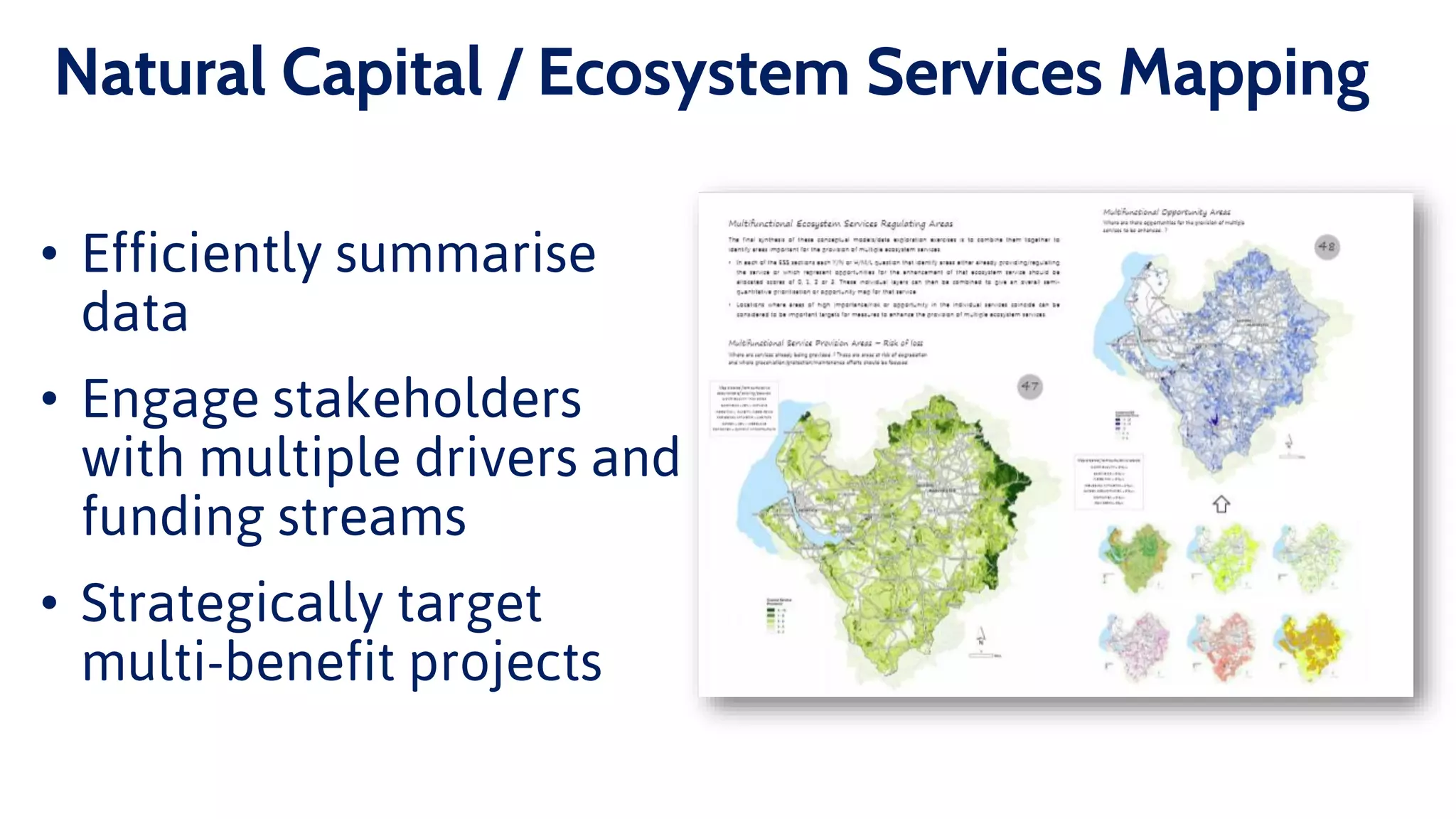
Natural Capital / Ecosystem Services Mapping
• Efficiently summarise
data
• Engage stakeholders
with multiple drivers and
funding streams
• Strategically target
multi-benefit projects
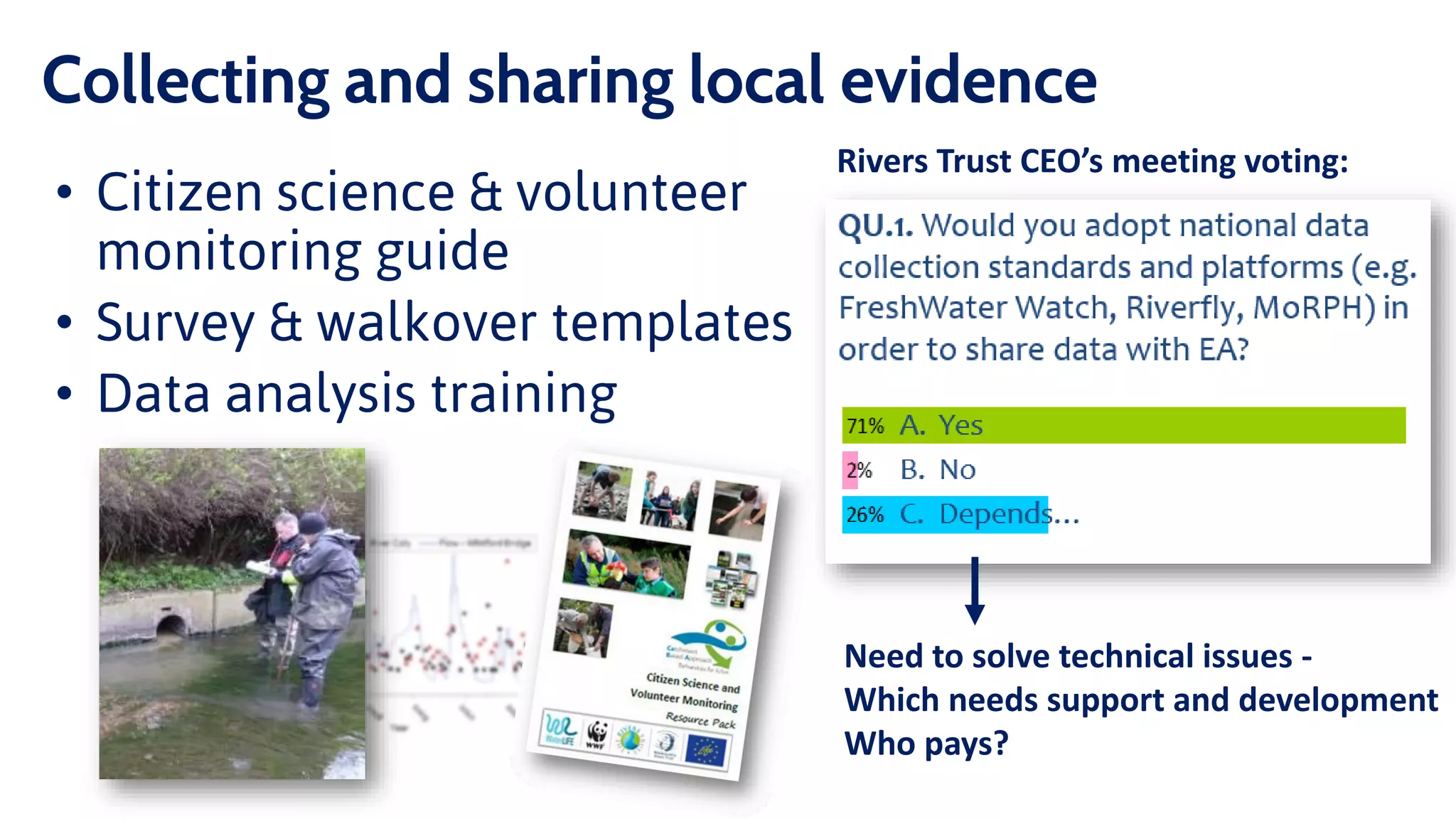
Collecting and sharing local evidence
• Citizen science & volunteer
monitoring guide
• Survey & walkover templates
• Data analysis training
Rivers Trust CEO’s meeting voting:
Need to solve technical issues -
Which needs support and development
Who pays?
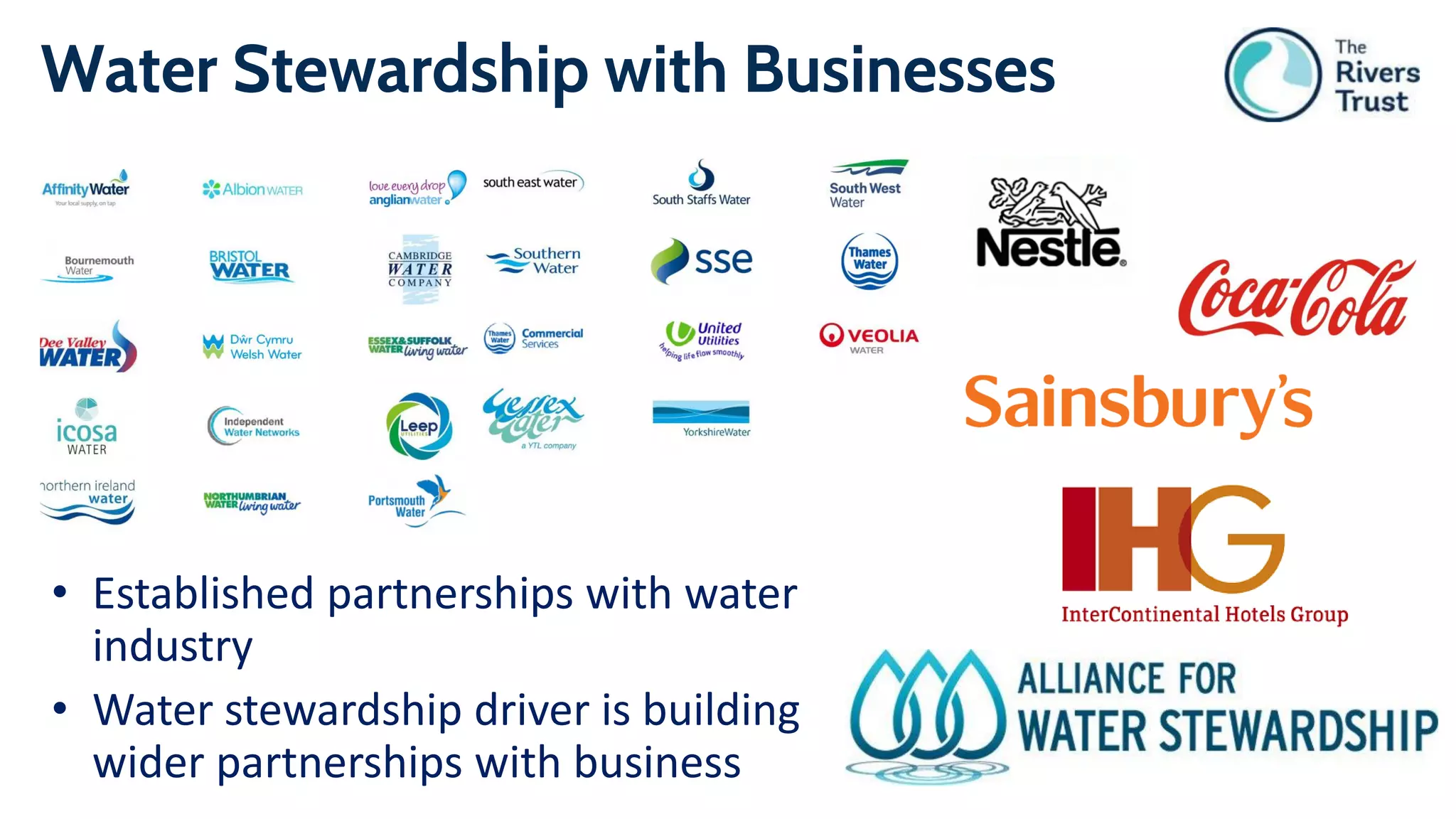
Water Stewardship with Businesses
• Established partnerships with water
industry
• Water stewardship driver is building
wider partnerships with business
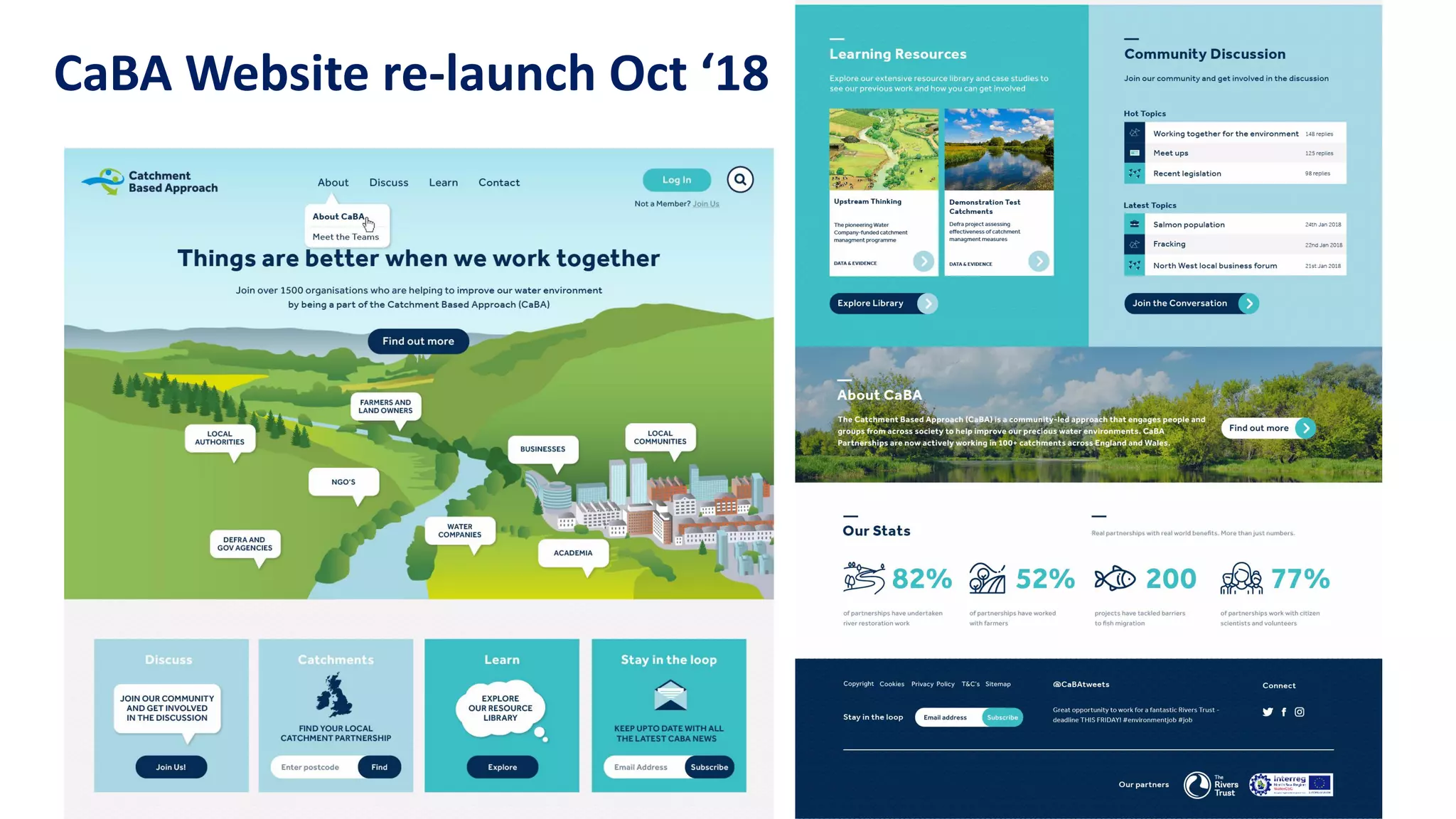
CaBA Website re-launch Oct ‘18
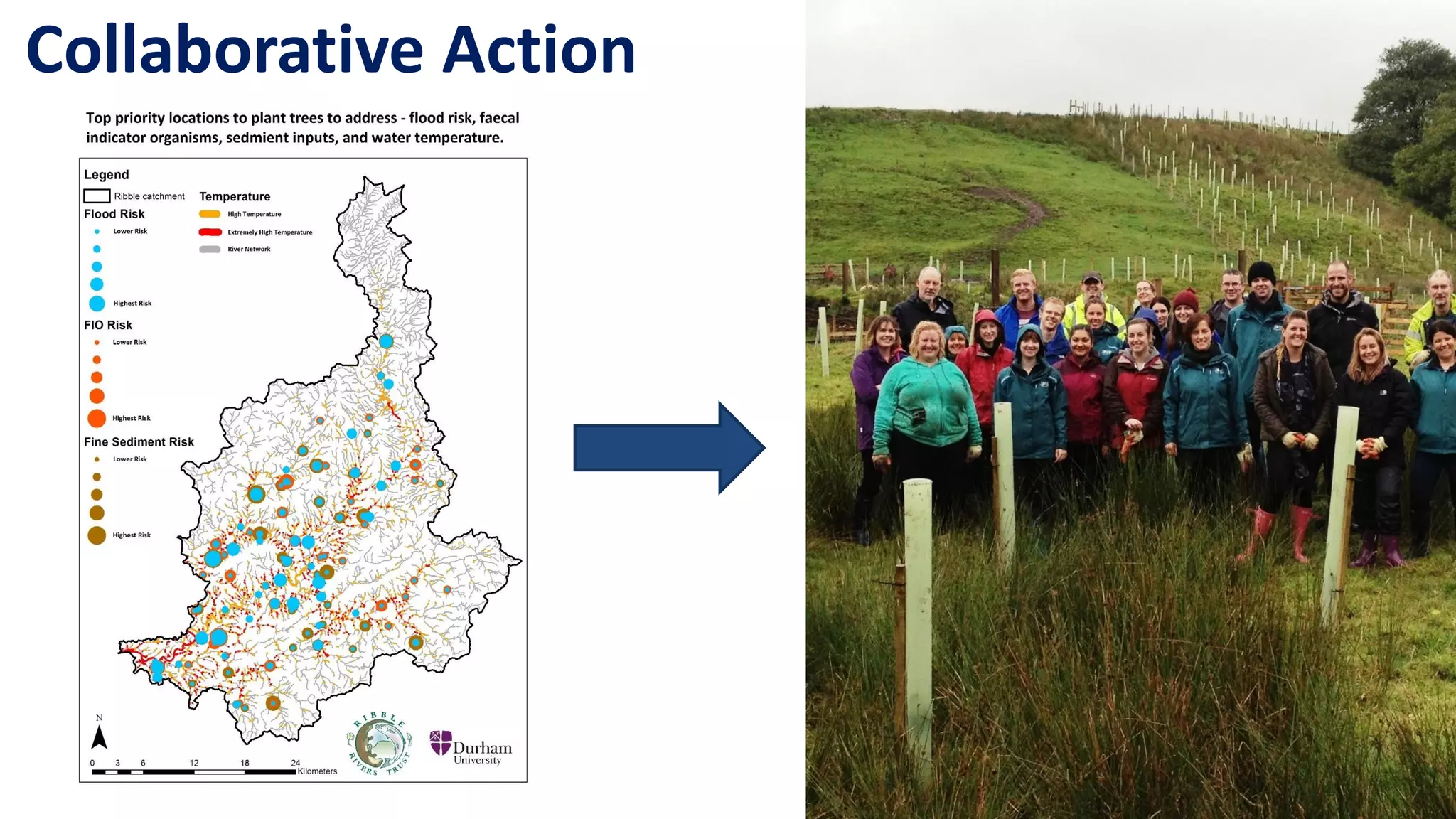
Collaborative Action
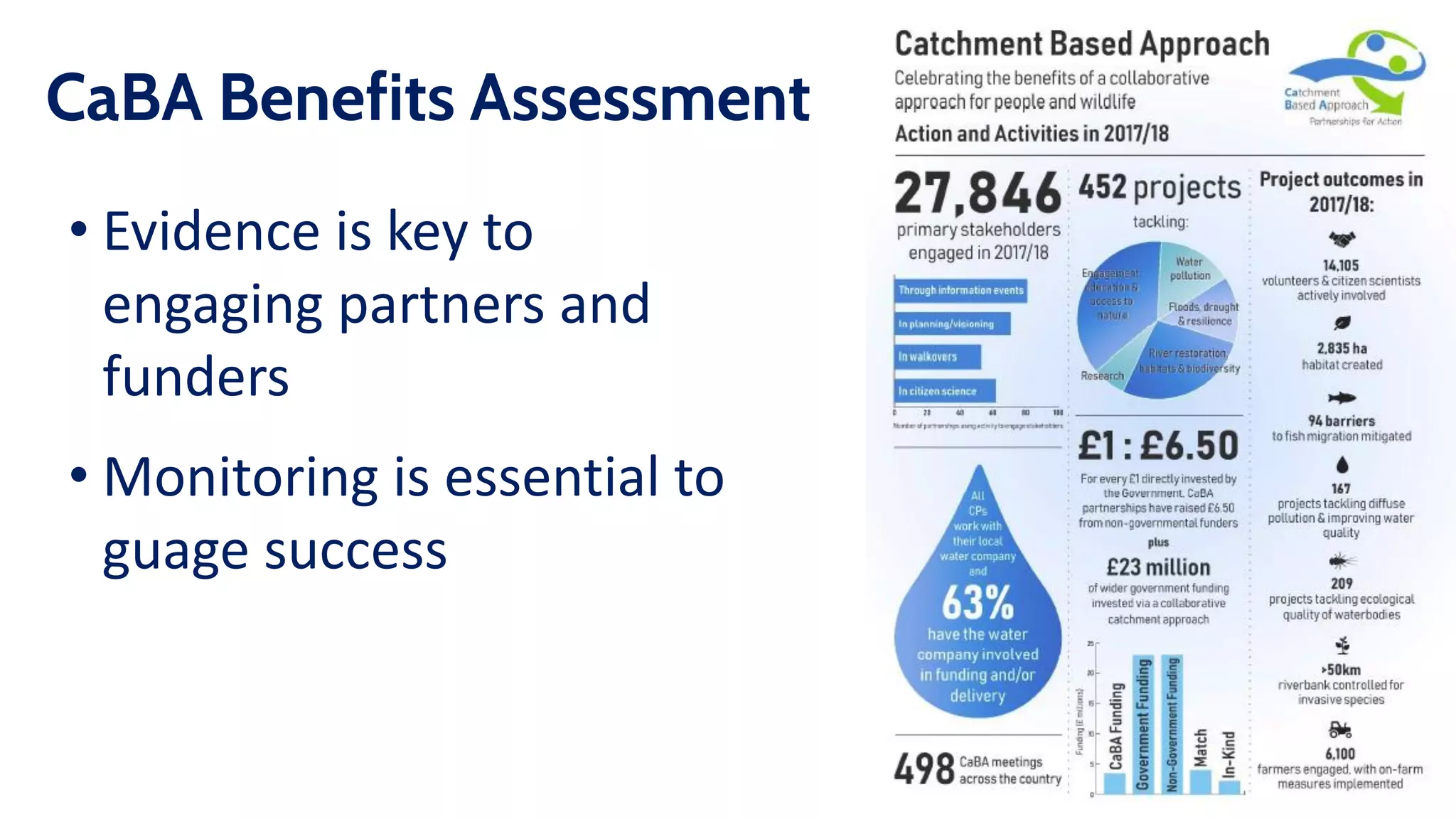
• Evidence is key to
engaging partners and
funders
• Monitoring is essential to
guage success
CaBA Benefits Assessment
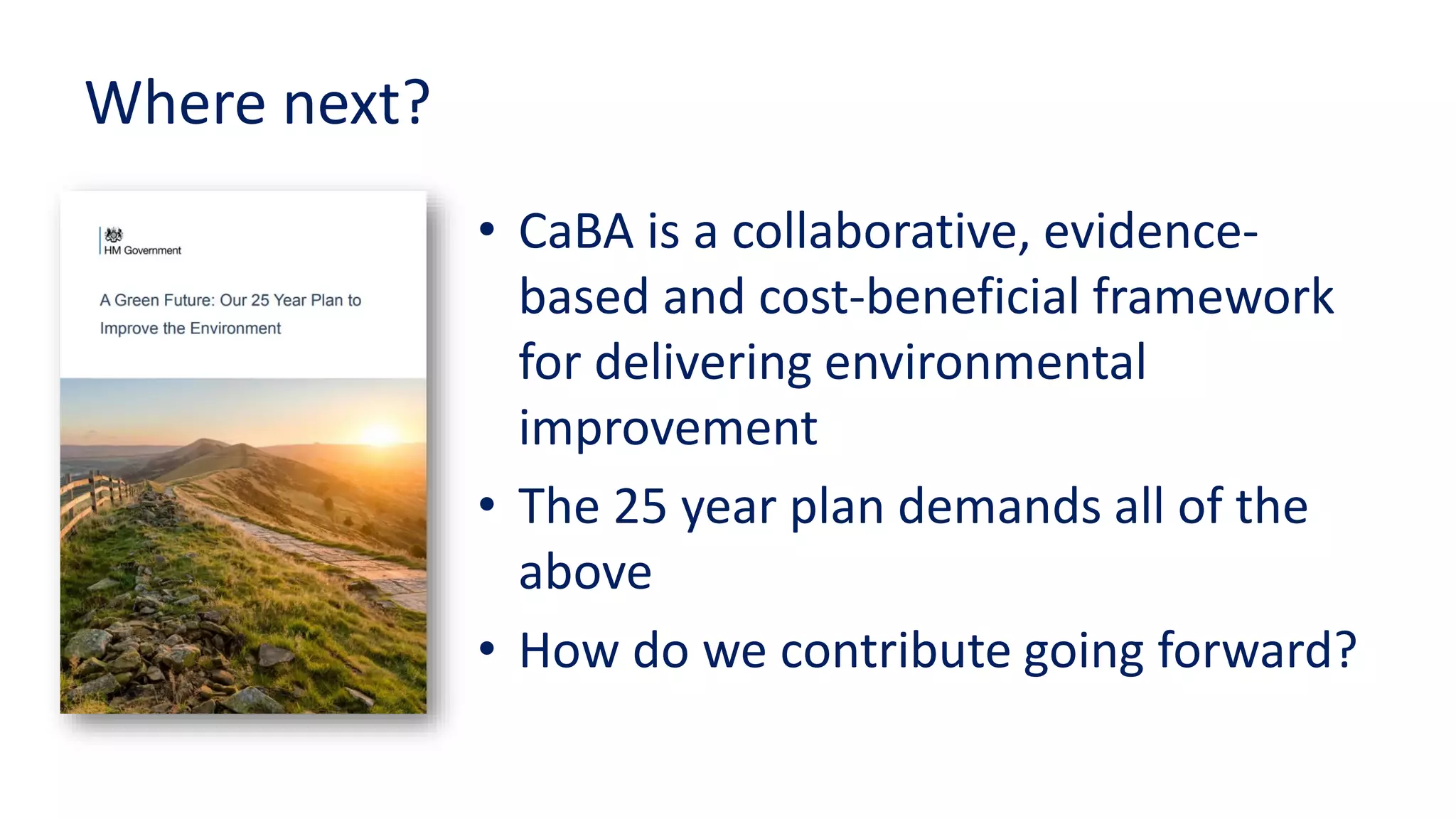
Where next?
• CaBA is a collaborative, evidence-
based and cost-beneficial framework
for delivering environmental
improvement
• The 25 year plan demands all of the
above
• How do we contribute going forward?
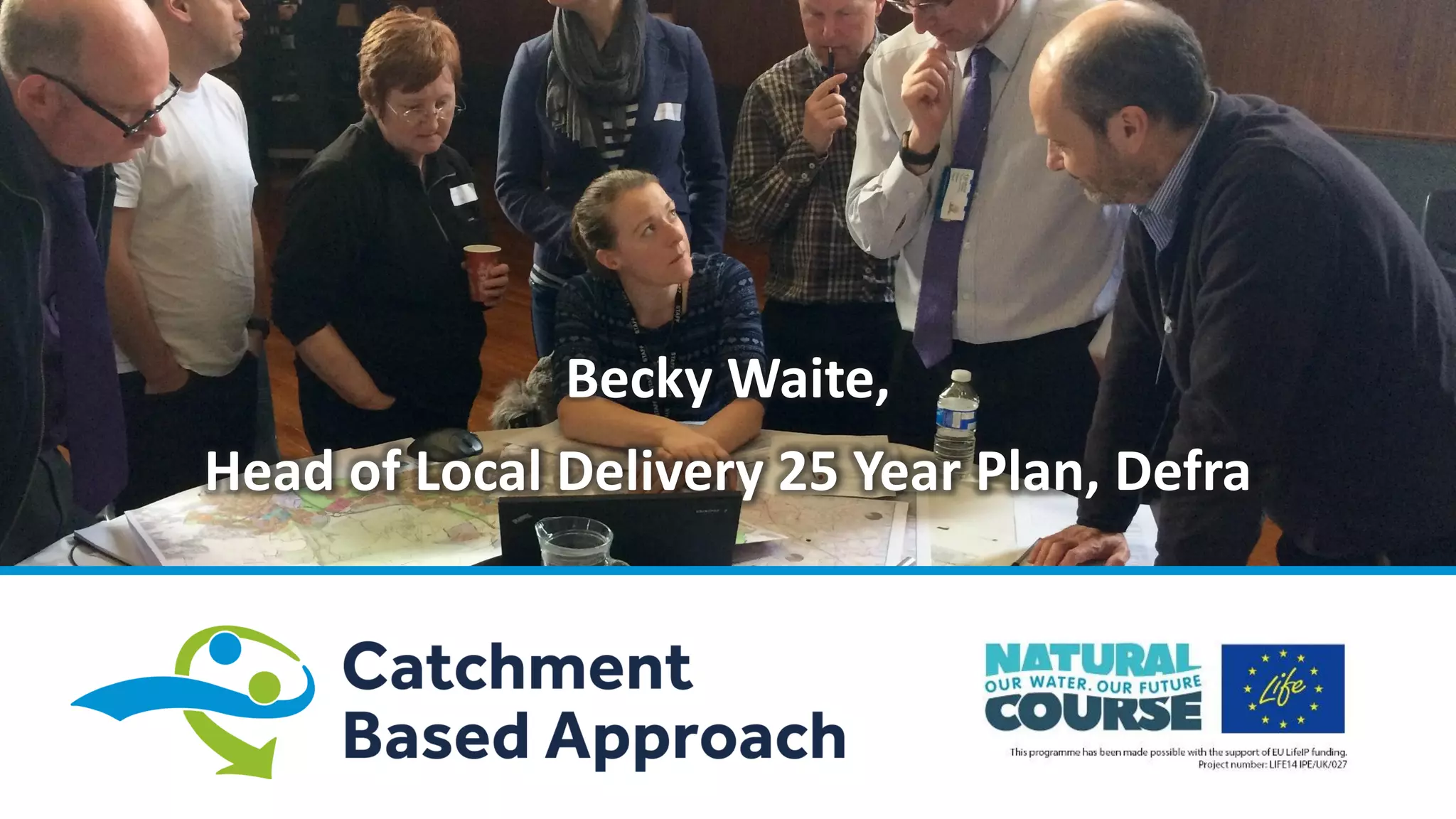
Becky Waite,
Head of Local Delivery 25 Year Plan, Defra
The 25 Year Environment Plan
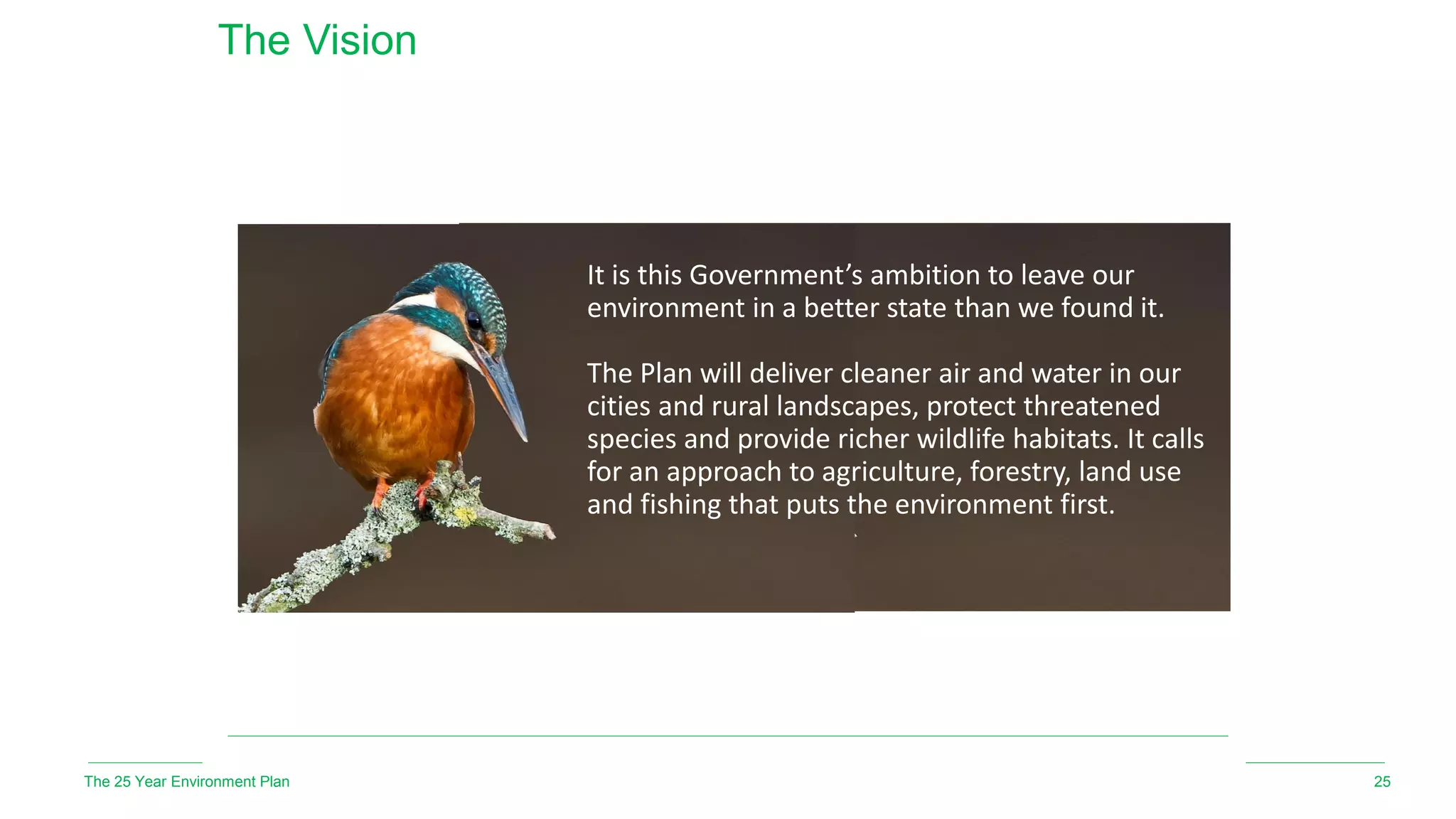
The Vision
The 25 Year Environment Plan 25
It is this Government’s ambition to leave our
environment in a better state than we found it.
The Plan will deliver cleaner air and water in our
cities and rural landscapes, protect threatened
species and provide richer wildlife habitats. It calls
for an approach to agriculture, forestry, land use
and fishing that puts the environment first.
26
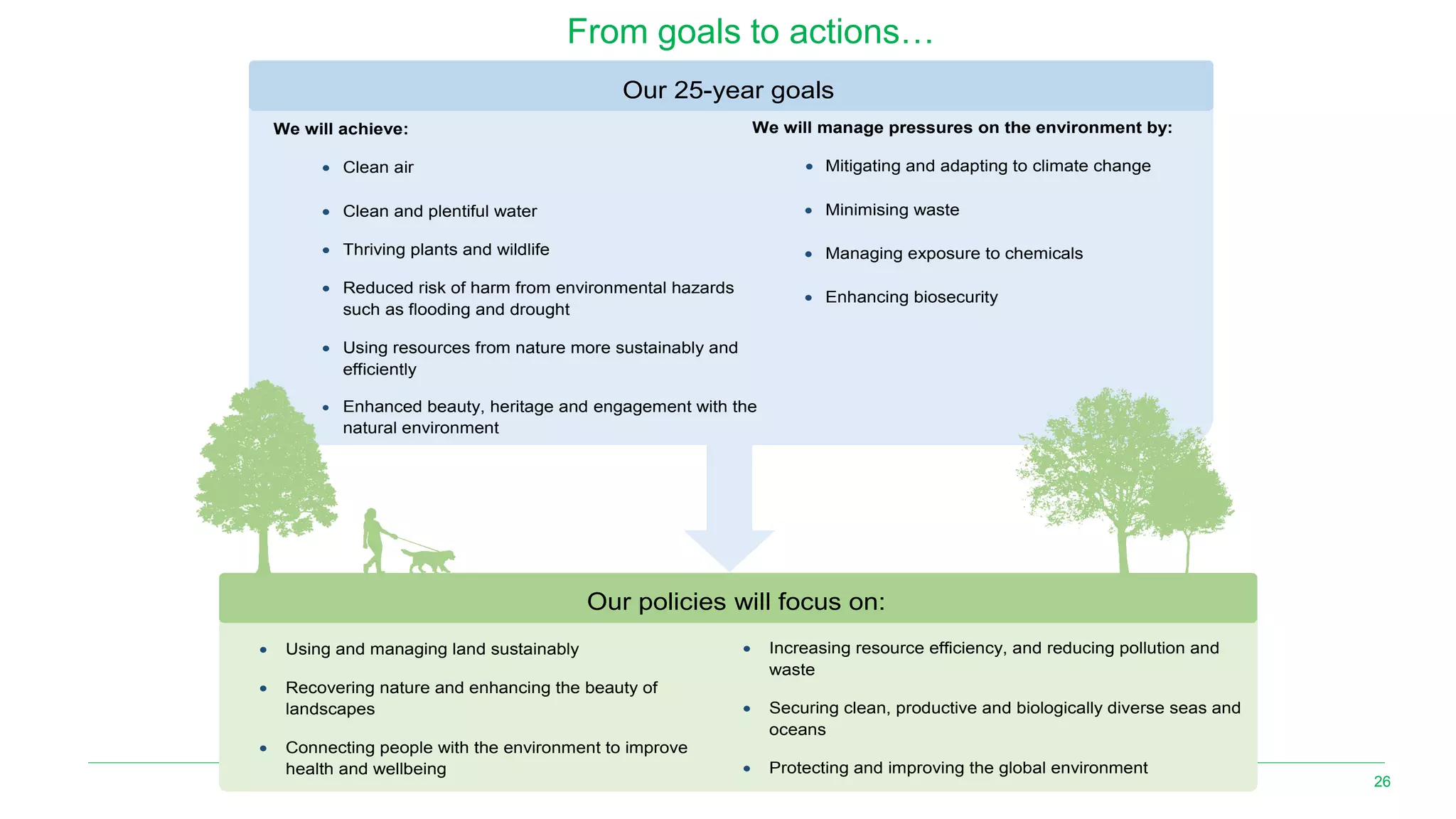
Our 25-year goals
Our policies will focus on:
• Using and managing land sustainably
• Recovering nature and enhancing the beauty of
landscapes
• Connecting people with the environment to improve
health and wellbeing
We will achieve:
• Clean air
• Clean and plentiful water
• Thriving plants and wildlife
• Reduced risk of harm from environmental hazards
such as flooding and drought
• Using resources from nature more sustainably and
efficiently
• Enhanced beauty, heritage and engagement with the
natural environment
We will manage pressures on the environment by:
• Mitigating and adapting to climate change
• Minimising waste
• Managing exposure to chemicals
• Enhancing biosecurity
• Increasing resource efficiency, and reducing pollution and
waste
• Securing clean, productive and biologically diverse seas and
oceans
• Protecting and improving the global environment
From goals to actions…
27
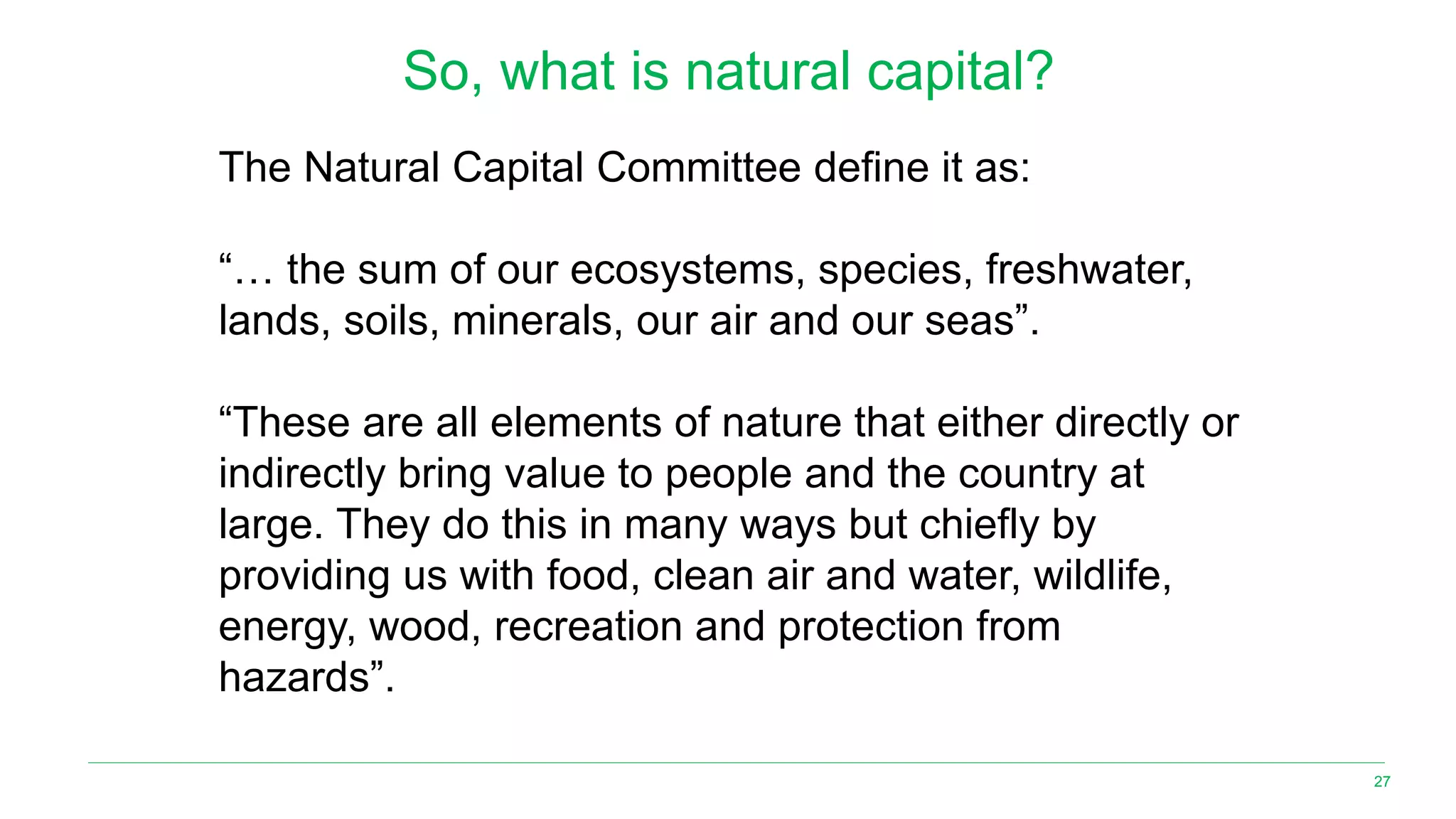
So, what is natural capital?
The Natural Capital Committee define it as:
“… the sum of our ecosystems, species, freshwater,
lands, soils, minerals, our air and our seas”.
“These are all elements of nature that either directly or
indirectly bring value to people and the country at
large. They do this in many ways but chiefly by
providing us with food, clean air and water, wildlife,
energy, wood, recreation and protection from
hazards”.
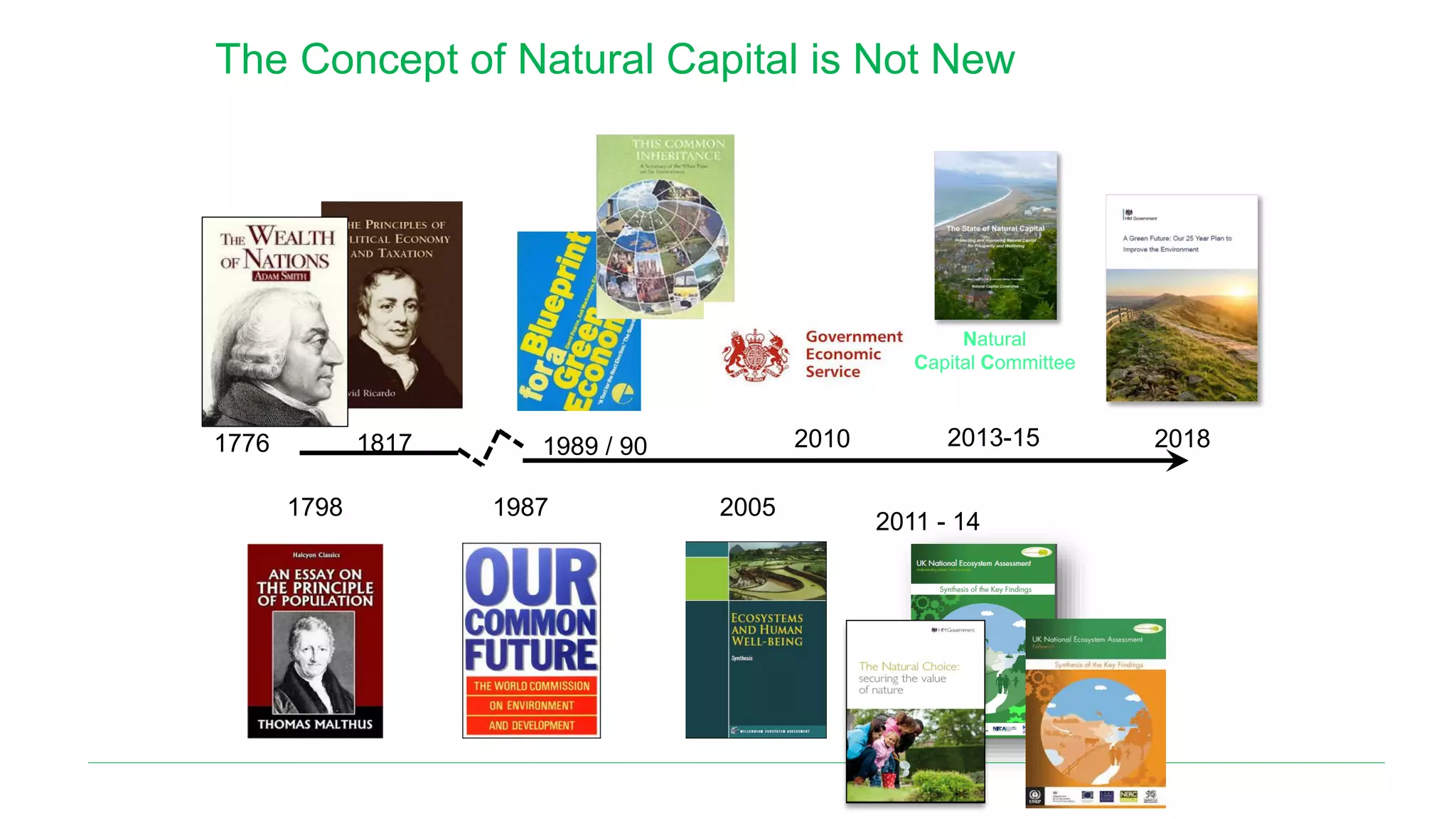
The Concept of Natural Capital is Not New
1776
1798
1817
1987
1989 / 90
2005
2011 - 14
2010 2013-15
Natural
Capital Committee
2018
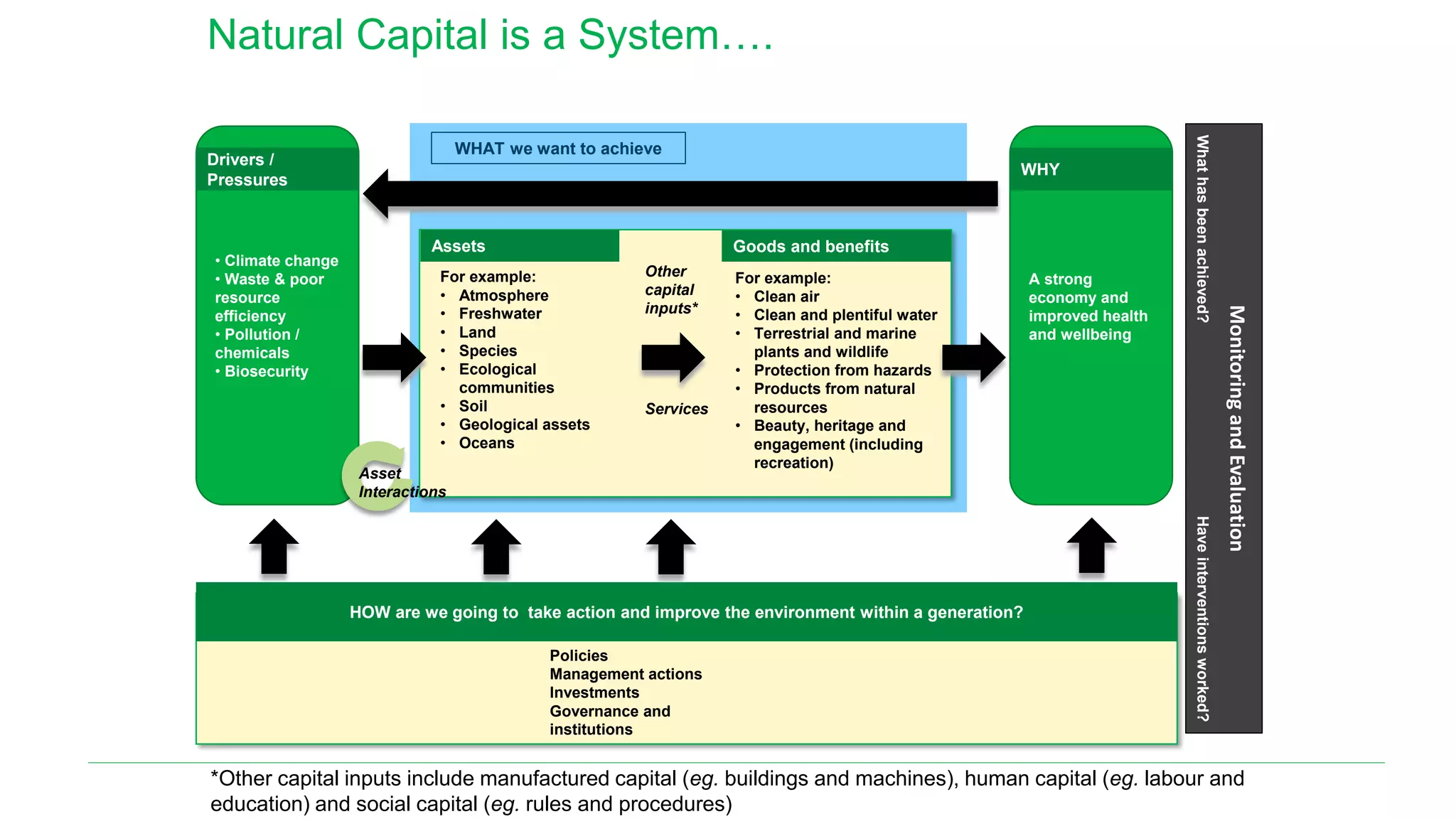
• Climate change
• Waste & poor
resource
efficiency
• Pollution /
chemicals
• Biosecurity
For example:
• Atmosphere
• Freshwater
• Land
• Species
• Ecological
communities
• Soil
• Geological assets
• Oceans
MonitoringandEvaluation
Assets
For example:
• Clean air
• Clean and plentiful water
• Terrestrial and marine
plants and wildlife
• Protection from hazards
• Products from natural
resources
• Beauty, heritage and
engagement (including
recreation)
Goods and benefits
Policies
Management actions
Investments
Governance and
institutions
HOW are we going to take action and improve the environment within a generation?
Whathasbeenachieved?Haveinterventionsworked?
Other
capital
inputs*
WHAT we want to achieve
*Other capital inputs include manufactured capital (eg. buildings and machines), human capital (eg. labour and
education) and social capital (eg. rules and procedures)
Services
Asset
Interactions
Natural Capital is a System….
Drivers /
Pressures
A strong
economy and
improved health
and wellbeing
WHY
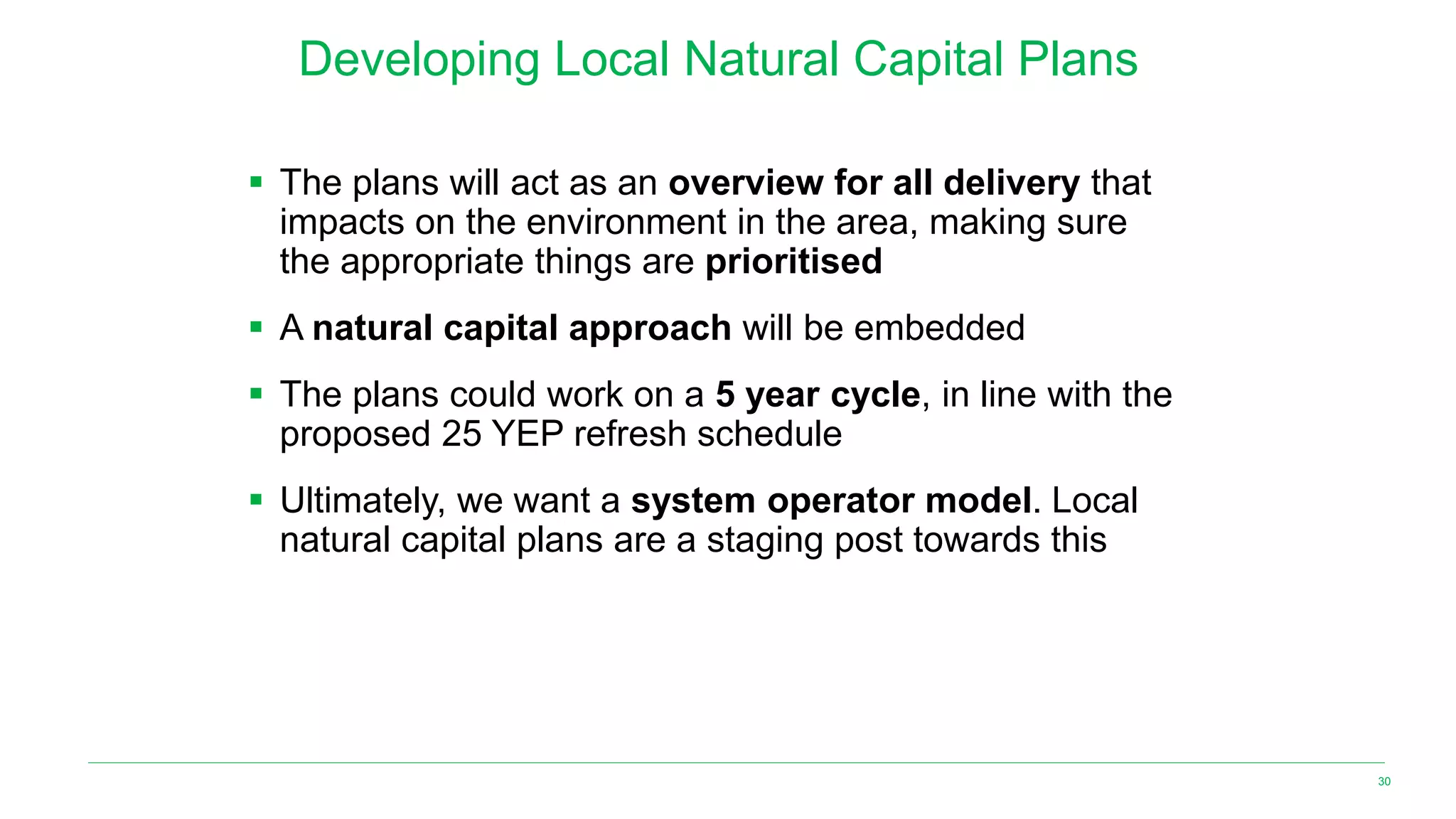
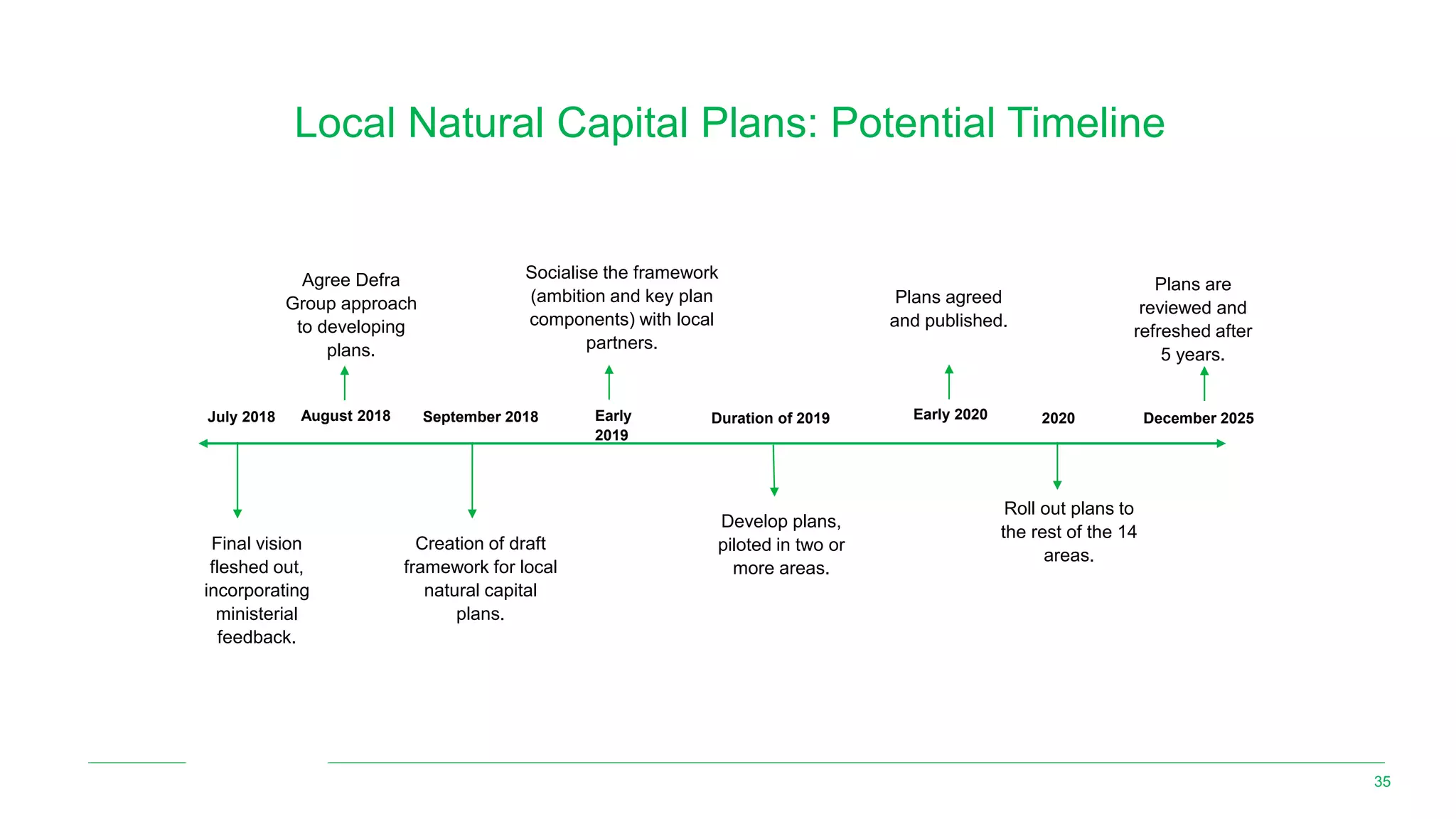
Developing Local Natural Capital Plans
▪ The plans will act as an overview for all delivery that
impacts on the environment in the area, making sure
the appropriate things are prioritised
▪ A natural capital approach will be embedded
▪ The plans could work on a 5 year cycle, in line with the
proposed 25 YEP refresh schedule
▪ Ultimately, we want a system operator model. Local
natural capital plans are a staging post towards this
30
31
14 Area integrated plans (AIPs) ‘owned’ by Defra Group
▪ AIPs: drawn up as a result of a boundary
alignment exercise
▪ Internal to the Defra Group delivery bodies
(EA, NE and FC)
▪ Joint statement of work carried out in the area
by the delivery bodies, identifying priorities for
the area
▪ Accompanied by a thumbprint summarising
key data held by the Defra Group on the area
What does the current landscape look like?
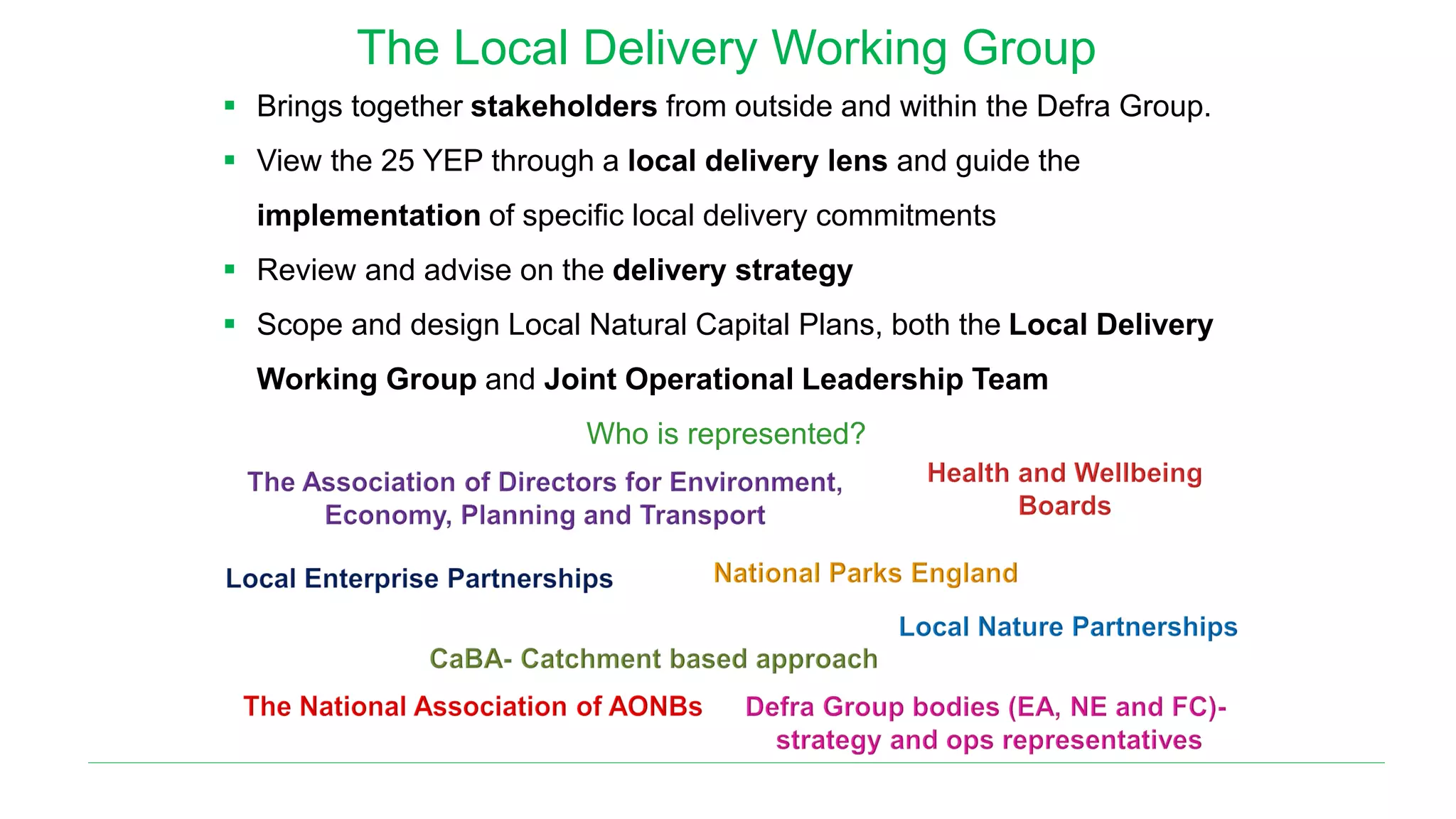
The Local Delivery Working Group
▪ Brings together stakeholders from outside and within the Defra Group.
▪ View the 25 YEP through a local delivery lens and guide the
implementation of specific local delivery commitments
▪ Review and advise on the delivery strategy
▪ Scope and design Local Natural Capital Plans, both the Local Delivery
Working Group and Joint Operational Leadership Team
Who is represented?
33
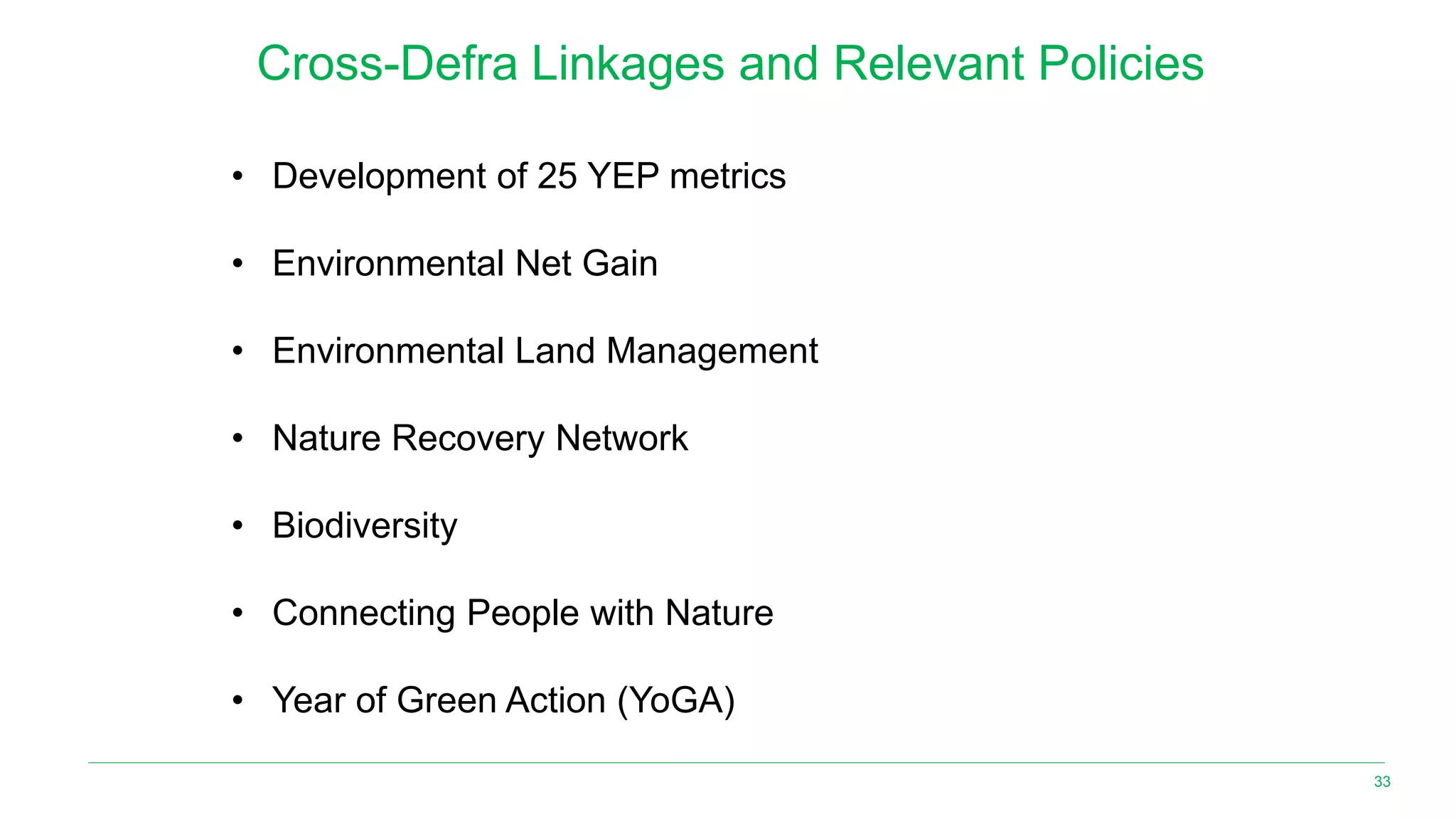
Cross-Defra Linkages and Relevant Policies
• Development of 25 YEP metrics
• Environmental Net Gain
• Environmental Land Management
• Nature Recovery Network
• Biodiversity
• Connecting People with Nature
• Year of Green Action (YoGA)
Pilot Phase
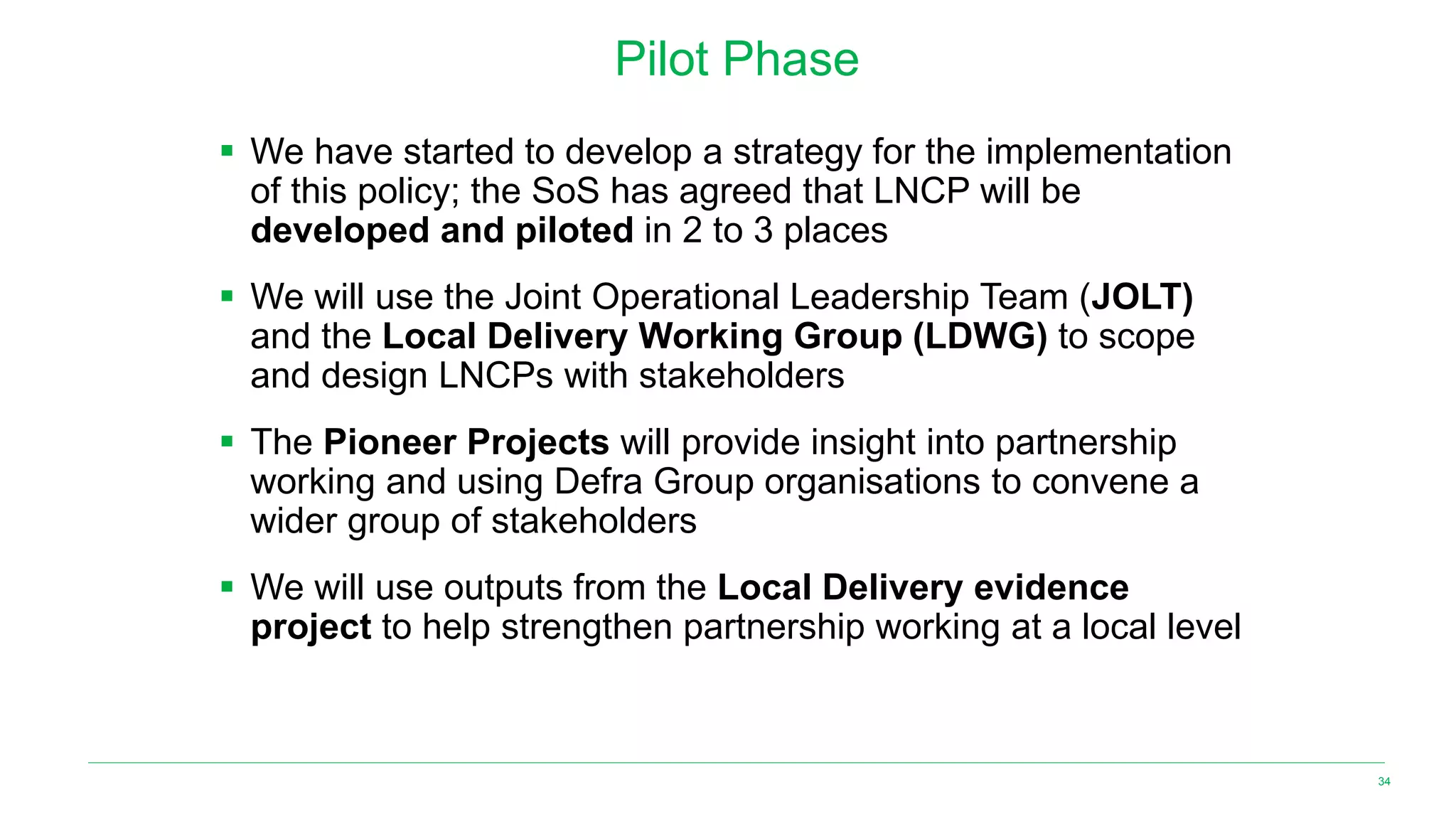
▪ We have started to develop a strategy for the implementation
of this policy; the SoS has agreed that LNCP will be
developed and piloted in 2 to 3 places
▪ We will use the Joint Operational Leadership Team (JOLT)
and the Local Delivery Working Group (LDWG) to scope
and design LNCPs with stakeholders
▪ The Pioneer Projects will provide insight into partnership
working and using Defra Group organisations to convene a
wider group of stakeholders
▪ We will use outputs from the Local Delivery evidence
project to help strengthen partnership working at a local level
34
35
Socialise the framework
(ambition and key plan
components) with local
partners.
Duration of 2019
Final vision
fleshed out,
incorporating
ministerial
feedback.
Agree Defra
Group approach
to developing
plans.
Develop plans,
piloted in two or
more areas.
Plans agreed
and published.
Local Natural Capital Plans: Potential Timeline
Plans are
reviewed and
refreshed after
5 years.
Roll out plans to
the rest of the 14
areas.
2020Early 2020 December 2025September 2018 Early
2019
July 2018 August 2018
Creation of draft
framework for local
natural capital
plans.
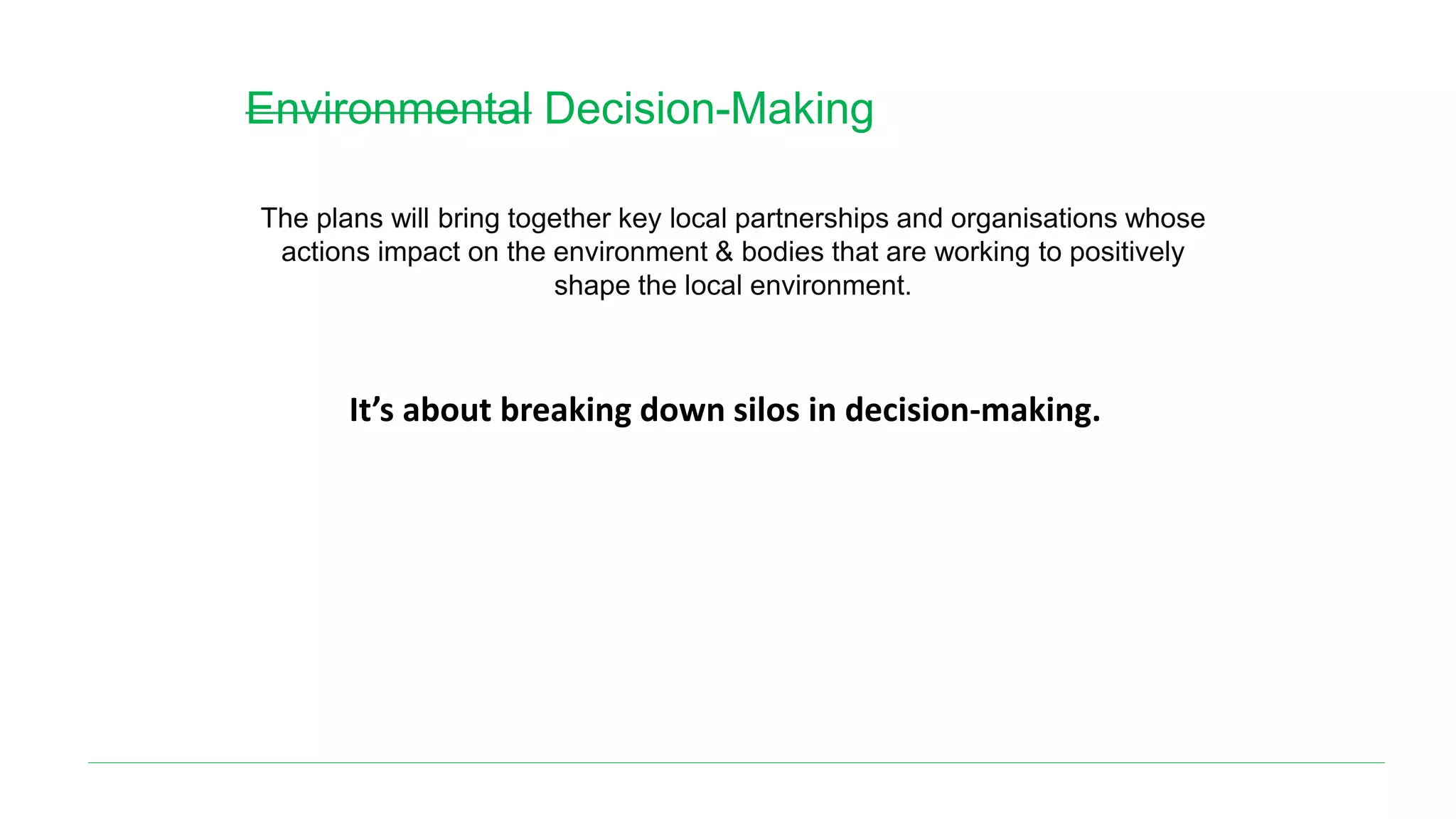
Environmental Decision-Making
The plans will bring together key local partnerships and organisations whose
actions impact on the environment & bodies that are working to positively
shape the local environment.
It’s about breaking down silos in decision-making.

Catchment Data & Evidence Forum 27/09/18 - Intro & Keynote

  • 1.
    Catchment Data &Evidence Forum 27th Sept 2018, BVSC, Birmingham
  • 2.
    Why a CatchmentData & Evidence Forum? ✓ Share knowledge ✓ Identify opportunities to work together ✓ Discuss how to support delivery of the 25 year plan
  • 3.
    How could CaBAData & Evidence Support Programme and the Catchment Data User Group input to Defra’s 25 year environment plan? Michelle Walker, The Rivers Trust Co-chair Catchment Data User Group
  • 4.
    How did weget here? What has CaBA achieved? Where next?
  • 5.
    CaBA and theDefra 25 Year Plan • CaBA is a cross-sectoral and inclusive national movement • Building on 30 years of delivering environmental improvements • CaBA should be a key delivery vehicle for the 25 Year Plan
  • 6.
    Development of CatchmentData & Evidence Approaches 1990s 2009 2011 CSF / ART Pinpoint Training in diffuse pollution modelling, river processes & farm advice TechnicalCapacity River Improvement Fund Technical advice and support, training, project management, sharing best practice Strategic Evidence & Partnership Project Local evidence reviews, data sharing agreements, ecosystem services mapping 21 4.6Macro-invertebratesurvey: 4.6.1Methodology: Macro-invertebratesamplingwascompletedatallofthemonitoringsites,excludingsite4.The samplingprocedurewascompliantwiththeEnvironmentAgency'soperationalinstructionmanual producedin2008(Technicalreferencematerial:freshwatermacro-invertebratesamplinginrivers). Aoneminutemanualsearchwasinitiallycarriedoutateachsite,followedbykicksamplingusing thethreeminute,pond,netsamplingmethod.Thenetusedwasastandard1mmmeshsampling net.Thekicksamplingtechniqueinvolvesdisturbingthesubstratebyfootandcapturingany displacedinvertebratesastheydriftdownstreamwiththeflowintothesamplingnet.Allavailable habitattypesateachsiteweresampledproportionatelyandforatotaltimeofthreeminutes. CollectedsampleswereplacedintoacontainerandthenpreservedusingIMS(industrialmethylated spirits).Allsampleswerefirstexaminedonthebanksidefordeadinvertebrates. Thephysicalcharacteristicsofeachsite,includingdepth,substrateandflowtype,asubjective assessmentofturbidityandanyotherrelevantobservationswererecorded.Estimatesofalgaeand macrophytecoverwerealsorecorded. Atalaterdate,thesamplesweresievedusinga500-micronsieveandplacedintoasortingtray. Wherepossible,macro-invertebrateswereidentifiedtospecieslevelwiththeexceptionof Oligochaetawhichwereidentifiedtoclass,andSimuliidae,SphaeridaeandChironomidaewhich wereidentifiedtofamilylevel.Factorsmakingitimpossibletoidentifyothermacro-invertebratesto specieslevelincludesizeorcrucialidentificationfeaturesmissing. Thefamiliespresentinasamplecontributetothe derivationofabiological(BMWP)scoreforeachsite. Thisscoringsystemwasdevelopedasawayof assessingthebiologicalqualityofriversandstreams. Themethodassignsascoretoeachtaxonrangingfrom 1to10dependingontheircapacitytotolerate pollution.Thosemosttoleranttopollutionhavealow score,whilstthoseleasttoleranthaveahighscore. Thesumofthetaxascoresfromasampleisthe BiologicalMonitoringWorkingParty(BMWP)score. TheBMWPscore,andASPT(averagescorepertaxon) werecalculatedforeachsample. Figure23:Macro-invertebratesampling atBidneyFarm(Site3). Early growth of RT movement RTs supporting each other, sharing best practice, working with Unis to apply research Association of Rivers Trusts formed Catchment Data User Group formed
  • 7.
    Development of CatchmentData & Evidence Approaches 2007 EA Project SC060035/SS Making Information Available for Catchment Management (Frome Piddle) • 100 of 150 key GIS layers not accessible to EA staff in catchment • £25k (80% staff time) to source and share data • Need Local Issues tool to record local knowledge • Need Data to Information role
  • 8.
    2013 2014 2016 TechnicalCapacityCatchment-Based Approach Tech support programme, Website & forum, Helpdesk, Workshops, Catchment GIS data packages, Web GIS WaterLIFE Citizen Science, ArcGIS Online Platforms, Water Stewardship, Farm Evidence Packs Natural Course Comms and Engagement, Water Stewardship, Natural Flood Management modelling, Catchment planning portals, Water quality training Open Defra Development of Catchment Data & Evidence Approaches
  • 9.
    Catchment Data UserGroup • Multi-sectoral interest group formed 2011 • End user community for RBMP outputs • Open up data access • Strategy for tech support • Review CaBA outputs • Join up tools and platforms • Collaborative projects
  • 10.
    CaBA Support Programme •CaBA National Support Group set Work Programme • Data & Evidence and Technical Support = key workstreams • Tools and resources, training, direct support, workshops, webinars
  • 11.
    • Wealth ofresources available to support evidence-based catchment planning • Build on adaptive management principles CaBA Catchment Planning Support
  • 12.
    CaBA Helpdesk –support calls May – Sept 2018 Total 1:1 support provided May – Aug 2018:
  • 13.
    Desktop CaBA GISData Package v 1-4 • 120+ Desktop GIS layers clipped to each catchment • Standard evidence base for all catchments • Centrally negotiated licensing for non-open datasets • Guidance document helps prioritise and plan actions
  • 14.
    14 Online Catchment MappingPortal • One-stop-shop for catchment management data and evidence • Training and templates • Map gallery
  • 15.
    Catchment Story Maps •Narrative + evidence = ‘story map’ • Engagement tool • Online GIS is accessible to everyone • Convening space for new project ideas • ESRI ArcGIS £120 p.a. for charities
  • 16.
    Natural Capital /Ecosystem Services Mapping • Efficiently summarise data • Engage stakeholders with multiple drivers and funding streams • Strategically target multi-benefit projects
  • 17.
    Collecting and sharinglocal evidence • Citizen science & volunteer monitoring guide • Survey & walkover templates • Data analysis training Rivers Trust CEO’s meeting voting: Need to solve technical issues - Which needs support and development Who pays?
  • 18.
    Water Stewardship withBusinesses • Established partnerships with water industry • Water stewardship driver is building wider partnerships with business
  • 19.
  • 20.
  • 21.
    • Evidence iskey to engaging partners and funders • Monitoring is essential to guage success CaBA Benefits Assessment
  • 22.
    Where next? • CaBAis a collaborative, evidence- based and cost-beneficial framework for delivering environmental improvement • The 25 year plan demands all of the above • How do we contribute going forward?
  • 23.
    Becky Waite, Head ofLocal Delivery 25 Year Plan, Defra
  • 24.
    The 25 YearEnvironment Plan
  • 25.
    The Vision The 25Year Environment Plan 25 It is this Government’s ambition to leave our environment in a better state than we found it. The Plan will deliver cleaner air and water in our cities and rural landscapes, protect threatened species and provide richer wildlife habitats. It calls for an approach to agriculture, forestry, land use and fishing that puts the environment first.
  • 26.
    26 Our 25-year goals Ourpolicies will focus on: • Using and managing land sustainably • Recovering nature and enhancing the beauty of landscapes • Connecting people with the environment to improve health and wellbeing We will achieve: • Clean air • Clean and plentiful water • Thriving plants and wildlife • Reduced risk of harm from environmental hazards such as flooding and drought • Using resources from nature more sustainably and efficiently • Enhanced beauty, heritage and engagement with the natural environment We will manage pressures on the environment by: • Mitigating and adapting to climate change • Minimising waste • Managing exposure to chemicals • Enhancing biosecurity • Increasing resource efficiency, and reducing pollution and waste • Securing clean, productive and biologically diverse seas and oceans • Protecting and improving the global environment From goals to actions…
  • 27.
    27 So, what isnatural capital? The Natural Capital Committee define it as: “… the sum of our ecosystems, species, freshwater, lands, soils, minerals, our air and our seas”. “These are all elements of nature that either directly or indirectly bring value to people and the country at large. They do this in many ways but chiefly by providing us with food, clean air and water, wildlife, energy, wood, recreation and protection from hazards”.
  • 28.
    The Concept ofNatural Capital is Not New 1776 1798 1817 1987 1989 / 90 2005 2011 - 14 2010 2013-15 Natural Capital Committee 2018
  • 29.
    • Climate change •Waste & poor resource efficiency • Pollution / chemicals • Biosecurity For example: • Atmosphere • Freshwater • Land • Species • Ecological communities • Soil • Geological assets • Oceans MonitoringandEvaluation Assets For example: • Clean air • Clean and plentiful water • Terrestrial and marine plants and wildlife • Protection from hazards • Products from natural resources • Beauty, heritage and engagement (including recreation) Goods and benefits Policies Management actions Investments Governance and institutions HOW are we going to take action and improve the environment within a generation? Whathasbeenachieved?Haveinterventionsworked? Other capital inputs* WHAT we want to achieve *Other capital inputs include manufactured capital (eg. buildings and machines), human capital (eg. labour and education) and social capital (eg. rules and procedures) Services Asset Interactions Natural Capital is a System…. Drivers / Pressures A strong economy and improved health and wellbeing WHY
  • 30.
    Developing Local NaturalCapital Plans ▪ The plans will act as an overview for all delivery that impacts on the environment in the area, making sure the appropriate things are prioritised ▪ A natural capital approach will be embedded ▪ The plans could work on a 5 year cycle, in line with the proposed 25 YEP refresh schedule ▪ Ultimately, we want a system operator model. Local natural capital plans are a staging post towards this 30
  • 31.
    31 14 Area integratedplans (AIPs) ‘owned’ by Defra Group ▪ AIPs: drawn up as a result of a boundary alignment exercise ▪ Internal to the Defra Group delivery bodies (EA, NE and FC) ▪ Joint statement of work carried out in the area by the delivery bodies, identifying priorities for the area ▪ Accompanied by a thumbprint summarising key data held by the Defra Group on the area What does the current landscape look like?
  • 32.
    The Local DeliveryWorking Group ▪ Brings together stakeholders from outside and within the Defra Group. ▪ View the 25 YEP through a local delivery lens and guide the implementation of specific local delivery commitments ▪ Review and advise on the delivery strategy ▪ Scope and design Local Natural Capital Plans, both the Local Delivery Working Group and Joint Operational Leadership Team Who is represented?
  • 33.
    33 Cross-Defra Linkages andRelevant Policies • Development of 25 YEP metrics • Environmental Net Gain • Environmental Land Management • Nature Recovery Network • Biodiversity • Connecting People with Nature • Year of Green Action (YoGA)
  • 34.
    Pilot Phase ▪ Wehave started to develop a strategy for the implementation of this policy; the SoS has agreed that LNCP will be developed and piloted in 2 to 3 places ▪ We will use the Joint Operational Leadership Team (JOLT) and the Local Delivery Working Group (LDWG) to scope and design LNCPs with stakeholders ▪ The Pioneer Projects will provide insight into partnership working and using Defra Group organisations to convene a wider group of stakeholders ▪ We will use outputs from the Local Delivery evidence project to help strengthen partnership working at a local level 34
  • 35.
    35 Socialise the framework (ambitionand key plan components) with local partners. Duration of 2019 Final vision fleshed out, incorporating ministerial feedback. Agree Defra Group approach to developing plans. Develop plans, piloted in two or more areas. Plans agreed and published. Local Natural Capital Plans: Potential Timeline Plans are reviewed and refreshed after 5 years. Roll out plans to the rest of the 14 areas. 2020Early 2020 December 2025September 2018 Early 2019 July 2018 August 2018 Creation of draft framework for local natural capital plans.
  • 36.
    Environmental Decision-Making The planswill bring together key local partnerships and organisations whose actions impact on the environment & bodies that are working to positively shape the local environment. It’s about breaking down silos in decision-making.